

- Market Size (2026)
- USD 486.0 Mn
- Forecast (2036)
- USD 1272.1 Mn
- CAGR (2026 to 2036)
- 10.1%
How big is Hydrogen Compressors Condition Monitoring Systems Market in 2026?
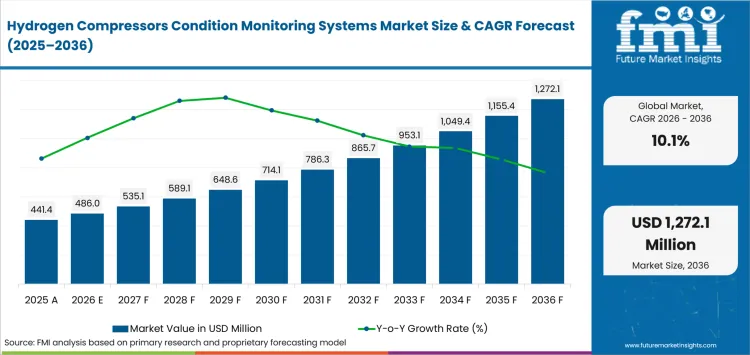
USD 486.0 million in 2026 and USD 1272.1 million by 2036 at a 10.1% CAGR.
Demand for hydrogen compressor monitoring is expected to rise at a 10.1% CAGR as heavy-duty hydrogen compressors run longer between planned outages. The market is projected to increase from USD 486.0 million in 2026 to USD 1272.1 million by 2036. Growth in hydrogen production and handling infrastructure is increasing reliance on high-duty compression equipment across industrial facilities. IEA data published in June 2026 show global hydrogen demand grew almost 3% in 2025 and surpassed 100 Mt. Longer operating hours increase diagnostic value because one compressor trip can curtail plant throughput and contracted output.
Project maturity sets the purchase pace for condition monitoring systems used on hydrogen compression assets. Germany illustrates the conversion workload: the Bundesnetzagentur published a June 2026 network proposal covering 9,241 km of hydrogen pipelines by 2037. A larger commissioned network raises retrofit and service requirements, while markets with earlier-stage projects defer monitoring orders until compression duty and maintenance ownership are defined.
Key Takeaways
- Hydrogen production and transfer projects increase compressor operating hours, which raises the commercial value of early fault detection and planned maintenance intervention.
- By monitoring solution, online condition monitoring system is estimated to hold 41.0% in 2026 owing to continuous data that gives reliability teams earlier warning between manual inspections.
- In 2026, vibration monitoring is expected to lead monitoring application with 43.0% share because bearing and alignment faults produce measurable signatures without stopping the compressor.
- Hydrogen production plants are projected to hold 44.0% of end-use industry demand in 2026 owing to compressor availability affecting several production and transfer stages.
- Mixed equipment fleets and uncertain project schedules can delay deployment by increasing integration work before operators trust alarms enough to change maintenance plans.
- Some of the key players in this market include Baker Hughes Company, Siemens AG, Emerson Electric Co., Honeywell International Inc., Schneider Electric SE, Rockwell Automation, Inc., Yokogawa Electric Corporation, and SKF AB.
Analyst Perspective
"A hydrogen compressor monitor earns its place when the alarm separates developing machinery faults from normal pressure-cycle changes. Stronger offers pair compressor-specific diagnostics with plant controls and field response so a warning becomes planned maintenance before throughput is lost."
- Nikhil Kaitwade, Principal Consultant, Future Market Insights
How is the Hydrogen Compressors Condition Monitoring Systems Market segmented?
The hydrogen compressors condition monitoring systems market is segmented by monitoring solution, monitoring application, end-use industry, customer category, sensing technology and region.
Monitoring solution covers online monitoring, remote diagnostics, predictive maintenance and asset-integrity platforms. Monitoring application includes vibration, temperature, pressure, seal leakage and lubrication analysis. End-use industry spans hydrogen production, refueling, chemicals, refining and power. Customer category identifies operators, gas producers, OEMs, integrators and engineering firms. Sensing technology covers wireless networks, edge devices, AI analytics, pressure transmitters and acoustic sensing.
Why do Hydrogen Production Plants lead the End-Use industry category?
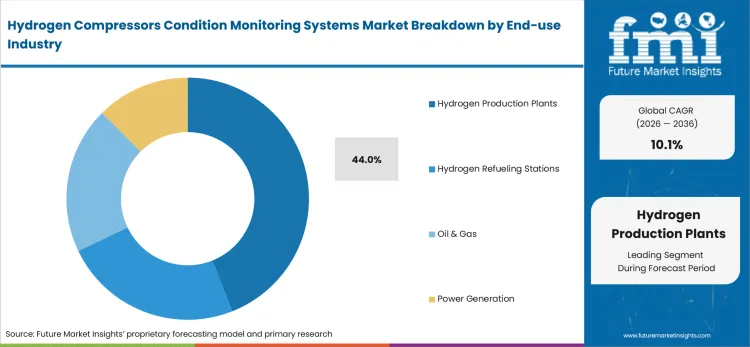
Production plants concentrate compression between generation and storage transfer, so one trip can restrict several process steps. The USA Department of Energy closed a USD 1.66 billion loan guarantee in January 2025 to finance up to six Plug Power hydrogen facilities. Predictive maintenance becomes commercially relevant as those projects move into equipment selection and operating plans.
- By end-use industry, hydrogen production plants are forecast to represent 44.0% in 2026 because compressor uptime affects multiple production and transfer operations.
- Plant teams justify dedicated monitoring where compressor outages restrict contracted hydrogen output after maintenance ownership and field-response procedures are fixed before commissioning.
What makes Online Condition Monitoring System central to the Monitoring Solution category?
Hydrogen compressor condition can change between inspection rounds during startup and pressure cycling at production or transfer sites. Emerson released AMS Machine Works version 1.8 in April 2025 to unite current AMS condition-monitoring hardware data under one reliability workspace, giving reliability engineers one machine condition monitoring history.
- By monitoring solution, online condition monitoring system is estimated to hold 41.0% in 2026 owing to continuous data that supports earlier diagnosis and remote expert review.
- Remote teams compare new alarms with earlier vibration and process history before assigning a field inspection. The workflow reduces diagnostic handoffs at sites without a machinery specialist on every operating shift.
How does Vibration Monitoring Influence selection within the Monitoring Application category?
Bearing wear and shaft alignment problems often alter vibration before a hydrogen compressor loses usable function. Condition monitoring sensors give maintenance engineers a non-intrusive first screen that can be checked against pressure or temperature data before opening the compressor casing.
- In 2026, vibration monitoring is expected to lead monitoring application with 43.0% share due to broad mechanical fault coverage without interrupting compressor operation.
- Vibration specialists increasingly extend condition data from basic measurement into field diagnosis and service support. SKF signed an agreement in March 2026 to acquire G-Tech Instruments, whose portfolio includes vibration analyzers and diagnostic tools for mechanical fault investigation.
What drives Wireless Sensor Network adoption within the Sensing Technology category?
Remote sites and older compressor packages can make new cable runs expensive during a monitoring retrofit. AI-driven predictive maintenance uses wireless and edge data to extend coverage without converting every measurement point into a major installation project.
- Wireless sensor network is set to lead sensing technology with 38.0% share in 2026 primarily because phased retrofits reduce field-wiring requirements.
- Emerson upgraded its Wireless 1410S gateways and 781S smart antennas for industrial monitoring in April 2025. The update doubled network capacity versus previous models and extended WirelessHART range, allowing larger industrial sites to monitor more field devices with fewer gateways.
What are the drivers, restraints and opportunities in the Hydrogen Compressors Condition Monitoring Systems Market?
Hydrogen project investment expands compressor duty, uncertain offtake delays monitoring commitments and staged wireless deployment provides a practical retrofit route.
- Driver: Commercial hydrogen projects increase the number of high-value compressor duty points that plant teams must keep within safe operating limits.
- Restraint: Uncertain offtake and mixed installed fleets can defer monitoring purchases until project schedules, alarm ownership and integration work are settled.
- Opportunity: Wireless sensing and remote diagnostics let operators prove alarm quality on critical compressor points before extending coverage to the wider fleet.
Capital Spending Extends the Monitored Asset Base
Hydrogen projects become monitoring customers after construction turns compressors into operating assets with uptime obligations. The IEA recorded nearly USD 7 billion of low-emissions hydrogen capital spending in 2025, almost double the 2024 level. More commissioned production and transfer equipment expands the compressor population needing alarm review and planned service, while condition monitoring services extend paid diagnostic support beyond hardware installation.
Offtake Uncertainty Delays Reliability Spending
A monitoring contract is difficult to justify while a hydrogen project lacks firm utilization and an operating schedule. The IEA recorded 1.7 Mtpa of new low-emissions hydrogen offtake agreements in 2025, with one-fifth backed by firm commitments. Weak project certainty can postpone compressor packages and monitoring subscriptions, so AI predictive maintenance SaaS converts more slowly until maintenance ownership and operating hours are defined.
Eligible Monitoring Equipment Improves Retrofit Economics
Canada gives project engineers a direct reason to specify monitoring during clean-hydrogen plant design instead of treating it as a later service purchase. CRA guidance dated May 2026 includes hydrogen compression and dedicated control or monitoring systems within eligible production property. Earlier specification can place safety-critical parameter monitoring inside the financed project scope, while off-site transport compression remains outside the same eligibility boundary.
Which country CAGRs are profiled in the Hydrogen Compressors Condition Monitoring Systems Market?
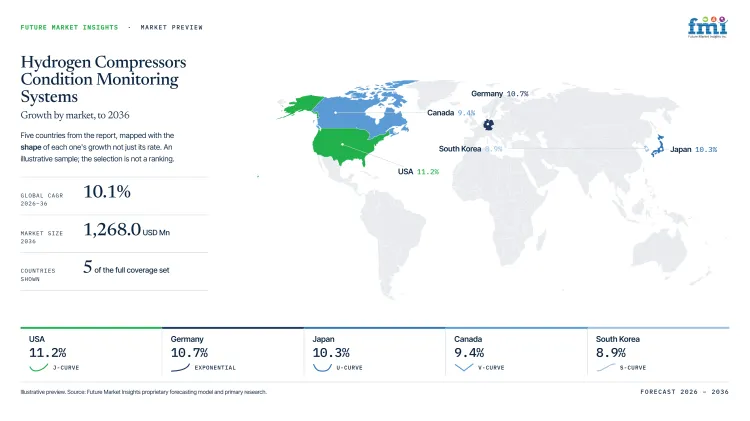
| Country | CAGR |
|---|---|
| USA | 11.2% |
| Germany | 10.7% |
| Japan | 10.3% |
| Canada | 9.4% |
| South Korea | 8.9% |
How do country-level CAGRs compare in the Hydrogen Compressors Condition Monitoring Systems Market?
The 2.3-point range separates the USA from a lower pair formed by Canada and South Korea. Germany and Japan remain close behind the USA, while Canada occupies a transition position before the Korean rate. The spacing points to different commissioning calendars and service economics rather than differences in installed-base size.
- USA hub geography makes common alarm taxonomies useful for multi-state compressor fleets.
- Germany’s brownfield station conversions place control-system interoperability ahead of wholesale sensor replacement.
- Japan’s mobility corridors favor compact service models for refueling assets with limited staffing.
- Canada’s long service distances raise the value of remote fault review.
- South Korea’s power contracts place availability reporting beside fuel qualification during evaluation.
Similar CAGRs produce different order timing because maintenance ownership and commissioning risk vary materially by country.
The full report provides country-level CAGR analysis across North America, Latin America, Europe, East Asia, South Asia, Oceania and the Middle East and Africa.
Country-wise Analysis
- USA hydrogen developers often plan production and dispensing assets as multi-site programs, so monitoring specifications must preserve common alarm rules and service records from the first compressor package through later fleet additions and handoffs. The USA market is forecast to rise at 11.2% CAGR through 2036 because hub-scale projects place repeated compressor duty under one maintenance organization once facilities move beyond design and enter commissioning. In January 2025 the USA Department of Energy awarded the Heartland Hydrogen Hub USD 20 million for Phase 1 planning and design, while permitting milestones can postpone monitoring orders and fleet-scale data models can follow commissioned sites.
- German reliability teams must integrate repurposed gas infrastructure with purpose-built hydrogen equipment, so retrofit monitoring has to preserve existing station controls and maintenance records while separating new compressor alarms from legacy signals. Hydrogen compressor monitoring demand in Germany is forecast to expand at 10.7% CAGR over the assessment period tied to network conversion and industrial clusters that need staged station upgrades. On April 30 2025 the Bundesnetzagentur approved the scenario framework for the Gas and Hydrogen Network Development Plan 2025-2037/2045, giving operators a common planning basis while uncertain station timing makes detailed retrofit documentation necessary before service capacity is committed.
- Japanese hydrogen activity is concentrating in mobility corridors where repeated station layouts let service organizations reuse diagnostic tooling and maintenance routines for a narrower set of compressor operating patterns during early deployment. Japan is estimated to post 10.3% CAGR over the forecast period given coordinated deployment programs, and METI selected five priority regions with six core local governments in May 2025 to stimulate fuel-cell commercial vehicle demand. Concentrated sites reduce diagnostic travel while hydrogen procurement costs and uneven station utilization pressure operating budgets, so monitoring firms gain more from regional service packages that share expertise than isolated station-by-station support.
- Canadian clean-hydrogen projects can sit far from major rotating-equipment service centers during sustained operation, which raises the operating value of wireless sensing and remote expert review after compressor packages leave the commissioning team. CRA guidance dated May 2026 excludes compression used to prepare hydrogen for off-site transport at project sites, so project teams must separate eligible production-site monitoring from downstream logistics equipment during capital planning. Adoption of hydrogen compressor monitoring in Canada is anticipated to advance at 9.4% CAGR through 2036 attributable to production-site qualification routes, while winter access and specialist travel still determine whether remote diagnostics improve lifecycle service economics.
- South Korean hydrogen power projects operate under long contract horizons, so compressor availability must be planned beside clean-hydrogen certification and fuel-delivery terms before each plant enters sustained commercial service. South Korea is projected to record 8.9% CAGR during the assessment period supported by hydrogen power procurement, and MOTIR opened the May 2025 clean-hydrogen bidding market at 3,000 GWh per year with 15-year contracts. Long commitments make predictive maintenance economically clearer while bidders still face fuel-grade and supply-stability tests, so monitoring companies gain an advantage when diagnostics fit existing control and reporting systems without adding a separate operator workflow.
Who are the notable companies in the Hydrogen Compressors Condition Monitoring Systems Market?
Baker Hughes Company, Siemens AG, Emerson Electric Co., Honeywell International Inc., Schneider Electric SE, Rockwell Automation, Inc., Yokogawa Electric Corporation, SKF AB
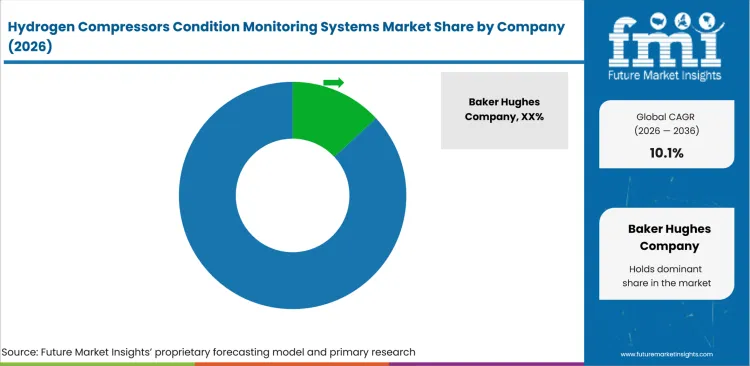
Competition spans compressor diagnostics, plant automation platforms and reliability software used to interpret rotating-equipment health data. Baker Hughes and Emerson emphasize rotating-equipment monitoring, while Siemens and Honeywell integrate asset health with plant systems. Entry barriers rise with hydrogen-relevant fault interpretation and hazardous-area integration at remote asset management sites.
- Compressor and predictive diagnostics: Baker Hughes Company, Siemens AG and Emerson Electric Co. provide compressor monitoring, predictive maintenance or remote machinery analysis.
- Integrated plant monitoring: Honeywell International Inc., Schneider Electric SE, Rockwell Automation, Inc. and Yokogawa Electric Corporation link asset health with wider automation or maintenance workflows.
- Vibration and reliability instrumentation: SKF AB specializes in machine-condition diagnostics and portable or online vibration analysis.
Competitive Benchmarking: Hydrogen Compressors Condition Monitoring Systems Market
| Company | Compressor-Specific Diagnostics | Wireless and Edge Monitoring | Predictive Asset Intelligence | Geographic Reach |
|---|---|---|---|---|
| Baker Hughes Company | High | High | High | Global energy and industrial markets |
| Siemens AG | Medium | Medium | High | Global industrial automation markets |
| Emerson Electric Co. | High | High | High | Global process industries |
| Honeywell International Inc. | High | Medium | High | Global process and energy markets |
| Schneider Electric SE | Low | Medium | High | Global industrial and infrastructure markets |
| Rockwell Automation, Inc. | Medium | High | High | Americas, Europe and Asia-Pacific industrial markets |
| Yokogawa Electric Corporation | Medium | Medium | High | Global process industries with strong Asia presence |
| SKF AB | Medium | High | High | Global rotating-equipment and reliability markets |
Scoring basis: High compressor-specific diagnostics requires compressor or turbomachinery monitoring with several documented mechanical fault classes. Medium covers broader rotating machinery including compressors, while Low identifies wider asset-health coverage without comparable compressor depth. High wireless and edge monitoring requires connected sensing plus remote analysis, while Medium documents one route and Low indicates narrower coverage. High predictive asset intelligence links anomaly detection with maintenance action, while Medium covers one predictive layer and Low identifies descriptive monitoring. Geographic reach reflects documented operating regions and service presence instead of corporate revenue or headquarters location.
Key Developments in the Hydrogen Compressors Condition Monitoring Systems Market
- In July 2026, Rockwell Automation, Inc. formed a technology and go-to-market partnership with Augury to link machine-health intelligence with Fiix maintenance execution and FactoryTalk Optix industrial workflows.
- In April 2025, Honeywell International Inc. announced that Honeywell Forge Asset Performance Management (APM) would be deployed across five Aker BP assets in the North Sea, supporting asset reliability, condition monitoring, and predictive-maintenance capabilities.
- In March 2025, Siemens AG expanded Industrial Copilot with a new generative-AI-powered maintenance offering that incorporates Senseye Predictive Maintenance, extending AI-supported maintenance from reactive and preventive activities toward predictive and optimization workflows.
Key Players in the Hydrogen Compressors Condition Monitoring Systems Market
Compressor and Predictive Diagnostics
- Baker Hughes Company
- Siemens AG
- Emerson Electric Co.
Integrated Plant Monitoring and Maintenance Workflows
- Honeywell International Inc.
- Schneider Electric SE
- Rockwell Automation, Inc.
- Yokogawa Electric Corporation
Vibration and Reliability Instrumentation
- SKF AB
Hydrogen Compressors Condition Monitoring Systems Market - Report Scope
| Coverage field | Report scope |
|---|---|
| Market breakdown | By monitoring solution, monitoring application, end-use industry, customer category, sensing technology and region. |
| Quantitative Units | USD Million. |
| Market Definition | Revenue includes sensors, transmitters, gateways, online compressor monitoring systems, condition-monitoring software, cloud or edge analytics, remote diagnostics and integration services sold specifically for hydrogen compressor monitoring. It excludes compressor equipment revenue, hydrogen production or fuel revenue, general plant control systems not sold for compressor condition monitoring and adjacent asset monitoring. |
| Regions Covered | North America, Latin America, Western Europe, Eastern Europe, East Asia, South Asia and Pacific, and Middle East and Africa. |
| Countries Covered | USA, Germany, Japan, Canada, South Korea, and 20+ countries included in the full report. |
| Key Companies Profiled | Baker Hughes Company, Siemens AG, Emerson Electric Co., Honeywell International Inc., Schneider Electric SE, Rockwell Automation, Inc., Yokogawa Electric Corporation, SKF AB |
| Forecast Period | 2026 to 2036. |
| Approach | Primary and secondary research with market triangulation. |
Hydrogen Compressors Condition Monitoring Systems Market - Research Methodology
| Method | Approach |
|---|---|
| Primary Research | FMI analysts gathered input from manufacturers, service providers, technology developers, distributors, end users, procurement teams, and subject-matter experts. Interviews examined purchasing decisions, product or service evaluation, adoption barriers, approval requirements, pricing considerations, and expectations for technical or commercial support. Respondents were also asked what evidence is required before a trial, pilot, or initial order develops into regular purchasing. |
| Desk Research | Desk research covered government statistics, regulatory publications, trade data, industry associations, technical literature, standards, company filings, product information, and official corporate announcements. Sources were reviewed for relevance, publication date, geographic coverage, and consistency with the defined market scope. Claims relating to performance, applications, approvals, capacity, investment, and commercial activity were retained only when supported by credible public evidence. |
| Market Sizing and Forecasting | The market model combined the baseline value with historical performance, segment structure, pricing and volume indicators, adoption levels, company participation, and country-level demand conditions. Forecast assumptions considered economic activity, investment trends, regulatory developments, technology adoption, purchasing cycles, supply availability, and barriers to wider market use. Segment and regional estimates were reconciled before the final market total was calculated. |
| Data Validation | Estimates were checked against multiple independent indicators, including public data, company activity, trade patterns, industry developments, and findings from primary interviews. Validation also tested whether products, services, applications, and company revenues fell within the defined market boundaries. Adjacent categories, unsupported claims, overlapping revenues, and activities without direct market relevance were excluded to reduce double counting and maintain consistency across segments and countries. |
Hydrogen Compressors Condition Monitoring Systems Market by Segments
Hydrogen Compressors Condition Monitoring Systems Market segmented by Monitoring Solution:
- Online Condition Monitoring System
- Continuous Asset Monitoring
- Remote Diagnostics Platform
- Predictive Maintenance Platform
- AI-based Asset Health Platform
- Machine Learning Diagnostics
- Performance Optimization Suite
- Compressor Performance Analytics
- Energy Efficiency Analytics
- Asset Integrity Management
- Remaining Useful Life Analysis
- Failure Prediction Engine
Hydrogen Compressors Condition Monitoring Systems Market segmented by Monitoring Application:
- Vibration Monitoring
- Bearing Condition Analysis
- Shaft Alignment Monitoring
- Temperature Monitoring
- Discharge Temperature Analysis
- Cooling System Monitoring
- Pressure Monitoring
- Suction Pressure Monitoring
- Seal Leakage Detection
- Lubrication Monitoring
- Oil Quality Monitoring
- Filter Condition Monitoring
Hydrogen Compressors Condition Monitoring Systems Market segmented by End-use Industry:
- Hydrogen Production Plants
- Green Hydrogen Facilities
- Blue Hydrogen Plants
- Hydrogen Refueling Stations
- Transportation Infrastructure
- Chemical Processing
- Oil & Gas
- Refineries
- Petrochemical Plants
- Power Generation
- Hydrogen Power Plants
- Renewable Energy Projects
Hydrogen Compressors Condition Monitoring Systems Market segmented by Customer Category:
- Hydrogen Plant Operators
- Industrial Gas Producers
- Compressor OEMs
- Energy Companies
- Fleet Operators
- Utility Companies
- Project Developers
- Maintenance Service Providers
- System Integrators
- Engineering Procurement & Construction Firms
- Industrial Automation Providers
Hydrogen Compressors Condition Monitoring Systems Market segmented by Sensing Technology:
- Wireless Sensor Network
- IIoT-enabled Sensors
- Edge Monitoring Devices
- AI-powered Analytics Platform
- Cloud-based Monitoring Platform
- Digital Twin Technology
- Vibration Analysis Sensors
- Pressure Transmitters
- Acoustic Emission Sensors
- Cloud-based Asset Management
- Predictive AI Algorithms
- Digital Condition Dashboard
Hydrogen Compressors Condition Monitoring Systems Market by Region:
- North America
- United States
- Canada
- Latin America
- Brazil
- Mexico
- Chile
- Rest of Latin America
- Western Europe
- Germany
- United Kingdom
- Italy
- Spain
- France
- Nordics
- Benelux
- Rest of Western Europe
- Eastern Europe
- Russia
- Poland
- Hungary
- Balkan and Baltic States
- Rest of Eastern Europe
- East Asia
- China
- Japan
- South Korea
- South Asia and Pacific
- India
- ASEAN
- Australia and New Zealand
- Rest of South Asia and Pacific
- Middle East and Africa
- Kingdom of Saudi Arabia
- Other GCC Countries
- Türkiye
- South Africa
- Other African Union Countries
- Rest of Middle East and Africa
Research Sources and Bibliography
- International Energy Agency. (2026, June 18). Global Hydrogen Review 2026.
- Bundesnetzagentur. (2026, June 15). Bundesnetzagentur launches consultation for Gas and Hydrogen Network Development Plan 2025-2037/2045.
- Emerson Electric Co. (2025, April 2). Emerson’s Asset Management Software Unifies Equipment Reliability Data in a Secure, Easy-to-Use, Integrated Platform.
- AB SKF. (2026, April). Q1 2026 Report.
- USA Department of Energy. (2025, January 16). DOE Announces $1.66 Billion Loan Guarantee to Plug Power to Produce and Liquify Clean Hydrogen Fuel.
- Emerson Electric Co. (2025, April 28). Emerson Enhances Scalability, Flexibility, Range and Efficiency of Wireless Networking Infrastructure.
- Canada Revenue Agency. (2026, May 21). What projects qualify - Clean Hydrogen Investment Tax Credit (ITC).
- USA Department of Energy, Office of Clean Energy Demonstrations. (2025, January 17). OCED Awards Final Two Regional Clean Hydrogen Hubs to Establish Critical Energy Infrastructure in America’s Heartland and Mid-Atlantic.
- Bundesnetzagentur. (2025, April 30). Bundesnetzagentur approves electricity and gas/hydrogen scenario frameworks.
- Ministry of Economy, Trade and Industry, Japan. (2025, May 19). First Selection of Priority Regions for Promoting the Deployment of Fuel-Cell Commercial Vehicles.
- Ministry of Trade, Industry and Resources, Republic of Korea. (2025, May 9). Korea Opens 2025 Hydrogen Power Bidding Market.
- Rockwell Automation, Inc. (2026, July 23). Rockwell Automation and Augury Partner to Improve Industrial Performance with Agentic AI.
- Honeywell International Inc. (2025, April 29). Honeywell Technology To Drive Process Automation For Aker BP Operations In The North Sea.
- Siemens AG. (2025, March 24). Siemens expands Industrial Copilot with New generative AI-powered Maintenance Offering.
- ABB. (2025, March 4). ABB and UptimeAI join forces to advance Asset Health and Performance Management.
- Schneider Electric SE. (2025, October 9). Schneider Electric Launches EcoCare Advanced+ for Electrical Distribution to Deliver New Levels of Support, Improve Operational Efficiency and Safety.
- Emerson Electric Co. (2026, May 20). Emerson Launches New IIoT Platform for Expanded Wireless Visibility Without Costly Infrastructure Changes.
- Yokogawa Electric Corporation. (2025, June 18). Yokogawa Collaborates with Shell on Robotics and AI Technology for Plant Maintenance.
- AVEVA. (2025, July 1). AVEVA and Protium join forces to accelerate innovation in the green hydrogen industry.
- Baker Hughes Company. (2026, February 5). Fiscal Year 2025 Form 10-K.
- Baker Hughes Company. (2026, July 16). Baker Hughes Completes Acquisition of Chart Industries.
- Honeywell International Inc. (2025, June 9). Honeywell Completes Acquisition of Sundyne to Expand Process Industry Capabilities.
- Rockwell Automation, Inc. (2026, June 22). Rockwell Automation Launches FactoryTalk Orchestration Software at Automate.
- DNV Business Assurance USA Inc. (2025, May 16). MSC Certificate.
- Intertek Testing Services NA, Inc. (2025, November 10). Certificate of Registration.
This bibliography is provided for reader reference and is not exhaustive. The full report contains the complete reference list and detailed citations
This Report Answers
- What is the hydrogen compressors condition monitoring systems market size in 2026 and 2036?
- Which operating conditions are increasing demand for continuous hydrogen compressor monitoring?
- Why does online condition monitoring system hold the leading monitoring solution share in 2026?
- Why does vibration monitoring remain central to hydrogen compressor fault screening?
- Why do hydrogen production plants account for the largest end-use industry share in 2026?
- How do growth conditions differ among the USA, Germany, Japan, Canada and South Korea?
- Which companies provide compressor diagnostics, automation integration, wireless sensing and predictive asset intelligence?
- What project and integration constraints can delay condition-monitoring purchases?
Frequently Asked Questions
How big is the Hydrogen Compressors Condition Monitoring Systems Market in 2026?
The hydrogen compressors condition monitoring systems market is valued at USD 486.0 million in 2026 and is projected to reach USD 1,268.0 million by 2036. Higher compressor utilization increases demand for planned fault detection and remote diagnostics.
What is the CAGR of the Hydrogen Compressors Condition Monitoring Systems Market from 2026 to 2036?
The hydrogen compressors condition monitoring systems market is projected to grow at a CAGR of 10.1% between 2026 and 2036. Hydrogen production and infrastructure projects place more compressors under continuous operating and maintenance requirements.
Which monitoring solution leads the Hydrogen Compressors Condition Monitoring Systems Market?
The online condition monitoring system segment is expected to hold 41.0% of the hydrogen compressors condition monitoring systems market in 2026, driven by continuous data for earlier diagnosis. Remote review also reduces reliance on periodic manual inspection routes at dispersed compressor sites.
Which monitoring application leads the Hydrogen Compressors Condition Monitoring Systems Market?
The vibration monitoring segment is estimated to hold 43.0% of the hydrogen compressors condition monitoring systems market in 2026, attributable to broad mechanical fault coverage. Bearing wear and alignment problems can be screened without opening the compressor.
How much value will the Hydrogen Compressors Condition Monitoring Systems Market add between 2026 and 2036?
The hydrogen compressors condition monitoring systems market is expected to add USD 782.0 million in value between 2026 and 2036. The increase follows wider use of monitoring hardware and remote diagnostics as compressor fleets enter sustained operation.
Which countries are projected to record the highest growth in the Hydrogen Compressors Condition Monitoring Systems Market?
The USA is projected to grow at 11.2% CAGR, followed by Germany at 10.7% and Japan at 10.3% through 2036. Growth follows different mixes of hydrogen infrastructure and service requirements in each country.
Which companies are active in the Hydrogen Compressors Condition Monitoring Systems Market?
Key companies operating in the hydrogen compressors condition monitoring systems market include Baker Hughes Company, Siemens AG, Emerson Electric Co., Honeywell International Inc., Schneider Electric SE, Rockwell Automation, Inc., Yokogawa Electric Corporation, and SKF AB. Their positions differ by diagnostic depth and automation integration within hydrogen compressor reliability programs.
Preview the report firsthand - request a free sample
Get SampleGet the brochure for pricing and purchase details.
Get PDFTable of Content
- Key Takeaways
- Market Size and CAGR
- Top Growth Driver
- Fastest Growing Segment
- Leading Region
- Key Companies
- Emerging Opportunities
- Executive Summary
- Global Market Outlook
- Demand-side Trends
- Supply-side Trends
- Technology Roadmap Analysis
- Analysis and Recommendations
- Analyst Perspective (What is happening? Why now? What should investors know?)
- Key Questions Answered
- How large is the market?
- What is the CAGR?
- What are key trends?
- Which region dominates?
- Who are the leaders?
- Market Overview
- Market Coverage / Taxonomy
- Market Definition / Scope / Limitations
- Research Methodology
- Chapter Orientation
- Analytical Lens and Working Hypotheses
- Market Structure, Signals, and Trend Drivers
- Benchmarking and Cross-market Comparability
- Market Sizing, Forecasting, and Opportunity Mapping
- Research Design and Evidence Framework
- Desk Research Programme (Secondary Evidence)
- Expert Input and Fieldwork (Primary Evidence)
- Tooling, Models, and Reference Databases
- Data Engineering and Model Build
- Quality Assurance and Audit Trail
- Market Background
- Market Dynamics (Drivers, Restraints, Opportunity, Trends)
- Scenario Forecast (Optimistic, Likely, Conservative)
- Impact Analysis
- AI Impact
- Sustainability Impact
- Regulatory Impact
- Technology Impact
- Consumer / Buyer Analysis
- Purchase Drivers
- Adoption Barriers
- Buyer Journey
- Opportunity Map Analysis
- Product Life Cycle Analysis
- Supply Chain Analysis
- Investment Feasibility Matrix
- Value Chain Analysis
- PESTLE and Porter's Analysis
- Regulatory Landscape
- Regional Parent Market Outlook
- Production and Consumption Statistics
- Import and Export Statistics
- Global Market Analysis and Forecast, 2021 to 2036
- Historical Market Size Value (USD Million) Analysis, 2021 to 2025
- Current and Future Market Size Value (USD Million) Projections, 2026 to 2036
- Y-o-Y Growth Trend Analysis
- Absolute $ Opportunity Analysis
- Global Market Pricing Analysis, 2021 to 2036
- Global Market Analysis and Forecast, By Monitoring Solution, 2021 to 2036
- Introduction / Key Findings
- Historical Market Size Value (USD Million) Analysis By Monitoring Solution, 2021 to 2025
- Current and Future Market Size Value (USD Million) Analysis and Forecast By Monitoring Solution, 2026 to 2036
- Online Condition Monitoring System
- Continuous Asset Monitoring
- Remote Diagnostics Platform
- Predictive Maintenance Platform
- AI-based Asset Health Platform
- Machine Learning Diagnostics
- Performance Optimization Suite
- Compressor Performance Analytics
- Energy Efficiency Analytics
- Asset Integrity Management
- Remaining Useful Life Analysis
- Failure Prediction Engine
- Online Condition Monitoring System
- Y-o-Y Growth Trend Analysis By Monitoring Solution, 2021 to 2025
- Absolute $ Opportunity Analysis By Monitoring Solution, 2026 to 2036
- Global Market Analysis and Forecast, By Monitoring Application, 2021 to 2036
- Introduction / Key Findings
- Historical Market Size Value (USD Million) Analysis By Monitoring Application, 2021 to 2025
- Current and Future Market Size Value (USD Million) Analysis and Forecast By Monitoring Application, 2026 to 2036
- Vibration Monitoring
- Bearing Condition Analysis
- Shaft Alignment Monitoring
- Temperature Monitoring
- Discharge Temperature Analysis
- Cooling System Monitoring
- Pressure Monitoring
- Suction Pressure Monitoring
- Seal Leakage Detection
- Lubrication Monitoring
- Oil Quality Monitoring
- Filter Condition Monitoring
- Vibration Monitoring
- Y-o-Y Growth Trend Analysis By Monitoring Application, 2021 to 2025
- Absolute $ Opportunity Analysis By Monitoring Application, 2026 to 2036
- Global Market Analysis and Forecast, By End-use Industry, 2021 to 2036
- Introduction / Key Findings
- Historical Market Size Value (USD Million) Analysis By End-use Industry, 2021 to 2025
- Current and Future Market Size Value (USD Million) Analysis and Forecast By End-use Industry, 2026 to 2036
- Hydrogen Production Plants
- Green Hydrogen Facilities
- Blue Hydrogen Plants
- Hydrogen Refueling Stations
- Transportation Infrastructure
- Chemical Processing
- Oil & Gas
- Refineries
- Petrochemical Plants
- Power Generation
- Hydrogen Power Plants
- Renewable Energy Projects
- Hydrogen Production Plants
- Y-o-Y Growth Trend Analysis By End-use Industry, 2021 to 2025
- Absolute $ Opportunity Analysis By End-use Industry, 2026 to 2036
- Global Market Analysis and Forecast, By Customer Category, 2021 to 2036
- Introduction / Key Findings
- Historical Market Size Value (USD Million) Analysis By Customer Category, 2021 to 2025
- Current and Future Market Size Value (USD Million) Analysis and Forecast By Customer Category, 2026 to 2036
- Hydrogen Plant Operators
- Industrial Gas Producers
- Compressor OEMs
- Energy Companies
- Fleet Operators
- Maintenance Service Providers
- System Integrators
- Engineering Procurement & Construction Firms
- Industrial Automation Providers
- Utility Companies
- Public Utilities
- Project Developers
- Hydrogen Plant Operators
- Y-o-Y Growth Trend Analysis By Customer Category, 2021 to 2025
- Absolute $ Opportunity Analysis By Customer Category, 2026 to 2036
- Global Market Analysis and Forecast, By Sensing Technology, 2021 to 2036
- Introduction / Key Findings
- Historical Market Size Value (USD Million) Analysis By Sensing Technology, 2021 to 2025
- Current and Future Market Size Value (USD Million) Analysis and Forecast By Sensing Technology, 2026 to 2036
- Wireless Sensor Network
- IIoT-enabled Sensors
- Edge Monitoring Devices
- AI-powered Analytics Platform
- Cloud-based Monitoring Platform
- Digital Twin Technology
- Vibration Analysis Sensors
- Pressure Transmitters
- Acoustic Emission Sensors
- Cloud-based Asset Management
- Predictive AI Algorithms
- Digital Condition Dashboard
- Wireless Sensor Network
- Y-o-Y Growth Trend Analysis By Sensing Technology, 2021 to 2025
- Absolute $ Opportunity Analysis By Sensing Technology, 2026 to 2036
- Global Market Analysis and Forecast, By Region, 2021 to 2036
- Introduction
- Historical Market Size Value (USD Million) Analysis By Region, 2021 to 2025
- Current Market Size Value (USD Million) Analysis and Forecast By Region, 2026 to 2036
- North America
- Latin America
- Western Europe
- Eastern Europe
- East Asia
- South Asia and Pacific
- Middle East & Africa
- Market Attractiveness Analysis By Region
- North America Market Analysis and Forecast, By Country, 2021 to 2036
- Historical Market Size Value (USD Million) Trend Analysis By Market Taxonomy, 2021 to 2025
- Market Size Value (USD Million) Forecast By Market Taxonomy, 2026 to 2036
- By Country
- USA
- Canada
- By Monitoring Solution
- By Monitoring Application
- By End-use Industry
- By Customer Category
- By Sensing Technology
- By Country
- Market Attractiveness Analysis
- By Country
- By Monitoring Solution
- By Monitoring Application
- By End-use Industry
- By Customer Category
- By Sensing Technology
- Key Takeaways
- Latin America Market Analysis and Forecast, By Country
- Historical Market Size Value (USD Million) Trend Analysis By Market Taxonomy, 2021 to 2025
- Market Size Value (USD Million) Forecast By Market Taxonomy, 2026 to 2036
- By Country
- Brazil
- Mexico
- Chile
- Rest of Latin America
- By Monitoring Solution
- By Monitoring Application
- By End-use Industry
- By Customer Category
- By Sensing Technology
- By Country
- Market Attractiveness Analysis
- By Country
- By Monitoring Solution
- By Monitoring Application
- By End-use Industry
- By Customer Category
- By Sensing Technology
- Key Takeaways
- Western Europe Market Analysis and Forecast, By Country
- Historical Market Size Value (USD Million) Trend Analysis By Market Taxonomy, 2021 to 2025
- Market Size Value (USD Million) Forecast By Market Taxonomy, 2026 to 2036
- By Country
- Germany
- UK
- Italy
- Spain
- France
- Nordic
- BENELUX
- Rest of Western Europe
- By Monitoring Solution
- By Monitoring Application
- By End-use Industry
- By Customer Category
- By Sensing Technology
- By Country
- Market Attractiveness Analysis
- By Country
- By Monitoring Solution
- By Monitoring Application
- By End-use Industry
- By Customer Category
- By Sensing Technology
- Key Takeaways
- Eastern Europe Market Analysis and Forecast, By Country
- Historical Market Size Value (USD Million) Trend Analysis By Market Taxonomy, 2021 to 2025
- Market Size Value (USD Million) Forecast By Market Taxonomy, 2026 to 2036
- By Country
- Russia
- Poland
- Hungary
- Balkan & Baltic
- Rest of Eastern Europe
- By Monitoring Solution
- By Monitoring Application
- By End-use Industry
- By Customer Category
- By Sensing Technology
- By Country
- Market Attractiveness Analysis
- By Country
- By Monitoring Solution
- By Monitoring Application
- By End-use Industry
- By Customer Category
- By Sensing Technology
- Key Takeaways
- East Asia Market Analysis and Forecast, By Country
- Historical Market Size Value (USD Million) Trend Analysis By Market Taxonomy, 2021 to 2025
- Market Size Value (USD Million) Forecast By Market Taxonomy, 2026 to 2036
- By Country
- China
- Japan
- South Korea
- By Monitoring Solution
- By Monitoring Application
- By End-use Industry
- By Customer Category
- By Sensing Technology
- By Country
- Market Attractiveness Analysis
- By Country
- By Monitoring Solution
- By Monitoring Application
- By End-use Industry
- By Customer Category
- By Sensing Technology
- Key Takeaways
- South Asia and Pacific Market Analysis and Forecast, By Country
- Historical Market Size Value (USD Million) Trend Analysis By Market Taxonomy, 2021 to 2025
- Market Size Value (USD Million) Forecast By Market Taxonomy, 2026 to 2036
- By Country
- India
- ASEAN
- Australia & New Zealand
- Rest of South Asia and Pacific
- By Monitoring Solution
- By Monitoring Application
- By End-use Industry
- By Customer Category
- By Sensing Technology
- By Country
- Market Attractiveness Analysis
- By Country
- By Monitoring Solution
- By Monitoring Application
- By End-use Industry
- By Customer Category
- By Sensing Technology
- Key Takeaways
- Middle East & Africa Market Analysis and Forecast, By Country
- Historical Market Size Value (USD Million) Trend Analysis By Market Taxonomy, 2021 to 2025
- Market Size Value (USD Million) Forecast By Market Taxonomy, 2026 to 2036
- By Country
- Kingdom of Saudi Arabia
- Other GCC Countries
- Türkiye
- South Africa
- Other African Union
- Rest of Middle East & Africa
- By Monitoring Solution
- By Monitoring Application
- By End-use Industry
- By Customer Category
- By Sensing Technology
- By Country
- Market Attractiveness Analysis
- By Country
- By Monitoring Solution
- By Monitoring Application
- By End-use Industry
- By Customer Category
- By Sensing Technology
- Key Takeaways
- Key Countries Market Analysis
- USA
- Pricing Analysis
- Market Share Analysis, 2025
- By Monitoring Solution
- By Monitoring Application
- By End-use Industry
- By Customer Category
- By Sensing Technology
- Canada
- Pricing Analysis
- Market Share Analysis, 2025
- By Monitoring Solution
- By Monitoring Application
- By End-use Industry
- By Customer Category
- By Sensing Technology
- Mexico
- Pricing Analysis
- Market Share Analysis, 2025
- By Monitoring Solution
- By Monitoring Application
- By End-use Industry
- By Customer Category
- By Sensing Technology
- Brazil
- Pricing Analysis
- Market Share Analysis, 2025
- By Monitoring Solution
- By Monitoring Application
- By End-use Industry
- By Customer Category
- By Sensing Technology
- Chile
- Pricing Analysis
- Market Share Analysis, 2025
- By Monitoring Solution
- By Monitoring Application
- By End-use Industry
- By Customer Category
- By Sensing Technology
- Germany
- Pricing Analysis
- Market Share Analysis, 2025
- By Monitoring Solution
- By Monitoring Application
- By End-use Industry
- By Customer Category
- By Sensing Technology
- UK
- Pricing Analysis
- Market Share Analysis, 2025
- By Monitoring Solution
- By Monitoring Application
- By End-use Industry
- By Customer Category
- By Sensing Technology
- Italy
- Pricing Analysis
- Market Share Analysis, 2025
- By Monitoring Solution
- By Monitoring Application
- By End-use Industry
- By Customer Category
- By Sensing Technology
- Spain
- Pricing Analysis
- Market Share Analysis, 2025
- By Monitoring Solution
- By Monitoring Application
- By End-use Industry
- By Customer Category
- By Sensing Technology
- France
- Pricing Analysis
- Market Share Analysis, 2025
- By Monitoring Solution
- By Monitoring Application
- By End-use Industry
- By Customer Category
- By Sensing Technology
- India
- Pricing Analysis
- Market Share Analysis, 2025
- By Monitoring Solution
- By Monitoring Application
- By End-use Industry
- By Customer Category
- By Sensing Technology
- ASEAN
- Pricing Analysis
- Market Share Analysis, 2025
- By Monitoring Solution
- By Monitoring Application
- By End-use Industry
- By Customer Category
- By Sensing Technology
- Australia & New Zealand
- Pricing Analysis
- Market Share Analysis, 2025
- By Monitoring Solution
- By Monitoring Application
- By End-use Industry
- By Customer Category
- By Sensing Technology
- China
- Pricing Analysis
- Market Share Analysis, 2025
- By Monitoring Solution
- By Monitoring Application
- By End-use Industry
- By Customer Category
- By Sensing Technology
- Japan
- Pricing Analysis
- Market Share Analysis, 2025
- By Monitoring Solution
- By Monitoring Application
- By End-use Industry
- By Customer Category
- By Sensing Technology
- South Korea
- Pricing Analysis
- Market Share Analysis, 2025
- By Monitoring Solution
- By Monitoring Application
- By End-use Industry
- By Customer Category
- By Sensing Technology
- Russia
- Pricing Analysis
- Market Share Analysis, 2025
- By Monitoring Solution
- By Monitoring Application
- By End-use Industry
- By Customer Category
- By Sensing Technology
- Poland
- Pricing Analysis
- Market Share Analysis, 2025
- By Monitoring Solution
- By Monitoring Application
- By End-use Industry
- By Customer Category
- By Sensing Technology
- Hungary
- Pricing Analysis
- Market Share Analysis, 2025
- By Monitoring Solution
- By Monitoring Application
- By End-use Industry
- By Customer Category
- By Sensing Technology
- Kingdom of Saudi Arabia
- Pricing Analysis
- Market Share Analysis, 2025
- By Monitoring Solution
- By Monitoring Application
- By End-use Industry
- By Customer Category
- By Sensing Technology
- Türkiye
- Pricing Analysis
- Market Share Analysis, 2025
- By Monitoring Solution
- By Monitoring Application
- By End-use Industry
- By Customer Category
- By Sensing Technology
- South Africa
- Pricing Analysis
- Market Share Analysis, 2025
- By Monitoring Solution
- By Monitoring Application
- By End-use Industry
- By Customer Category
- By Sensing Technology
- USA
- Market Structure Analysis
- Competition Dashboard
- Competition Benchmarking
- Market Share Analysis of Top Players
- By Regional
- By Monitoring Solution
- By Monitoring Application
- By End-use Industry
- By Customer Category
- By Sensing Technology
- Emerging Startups
- Innovation Benchmarking
- Competition Analysis
- Competition Deep Dive
- Baker Hughes Company
- Overview
- Product Portfolio
- Profitability by Market Segments
- Sales Footprint
- Strategy Overview
- Marketing Strategy
- Product Strategy
- Channel Strategy
- Siemens AG
- Emerson Electric Co.
- ABB Ltd.
- Honeywell International Inc.
- Schneider Electric SE
- General Electric Company
- Rockwell Automation, Inc.
- Yokogawa Electric Corporation
- SKF AB
- Baker Hughes Company
- Case Studies
- Success Stories
- Recent Developments
- Competition Deep Dive
- Assumptions & Acronyms Used


