

- Market Size (2026)
- USD 516.8 Mn
- Forecast (2036)
- USD 925.5 Mn
- CAGR (2026 to 2036)
- 6.0%
Hydrophobic Pore-Blocking Agents for Waterproof Concrete Market Size, Market Forecast and Outlook By FMI
Summary of the Hydrophobic Pore-Blocking Agents for Waterproof Concrete Market
- Demand and Growth Drivers
- Hydrophobic Pore-Blocking Agents for Waterproof Concrete Market is projected to follow waterproof concrete specifications in basements and tunnels.
- Ready-mix plants are expected to use pore-blocking agents when buyers ask for lower water permeability at batching.
- Bridge decks and water tanks are forecast to support higher additive loading as leakage risk affects lifecycle costs.
- Product and Segment View
- Crystalline admixtures are projected to hold 41.0% share in 2026 as self-sealing chemistry suits water-retaining concrete.
- Liquid admixture is expected to secure 48.5% share in 2026 with batching systems requiring steady dosing flow.
- Direct supply is anticipated to account for 51.5% share in 2026 since project accounts need formulation checks before use.
- Geography and Competitive Outlook
- India is projected to record 7.5% CAGR by 2036 due to metro and highway waterproofing needs.
- China is expected to expand at 6.6% CAGR by 2036 as durable concrete specifications gain share in municipal projects.
- Sika and Saint-Gobain Fosroc compete based on concrete admixture systems as Kryton and Penetron compete through crystalline waterproofing depth.
- Analyst Opinion
- Nikhil Kaitwade, Principal Analyst for Chemicals and Materials at FMI, observes, “Pore-blocking agents are becoming a risk-control input for concrete buyers. Contractors compare permeability reduction and dosage tolerance before approving a product. Suppliers with ready-mix support and proof across blended cements should gain better access to basements and tunnels. Water tank projects add another approval route.”
- Hydrophobic Pore-Blocking Agents for Waterproof Concrete Market Value Analysis
- Hydrophobic pore-blocking agents for waterproof concrete are moving from large admixture use into a clearer durability-focused concrete input.
- Specification activity is rising as contractors seek lower water ingress in basements and roof slabs during new builds.
- Broader use is supported by infrastructure owners selecting admixtures reducing seepage and later maintenance risk.
- Formulation demand is strengthened by concrete producers needing workable mixes protecting structures without complex membrane installation.
Key Takeaways, Market Size, and Forecast
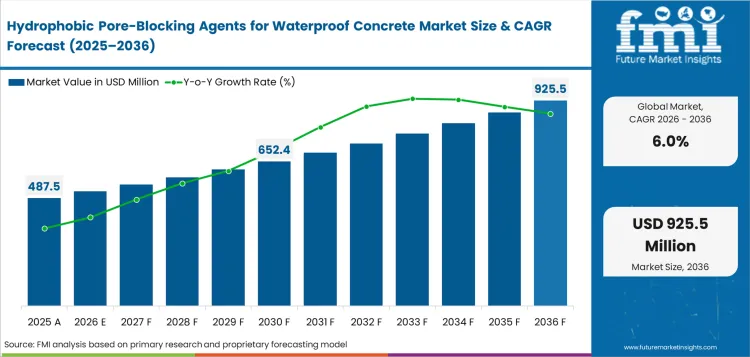
- The hydrophobic pore-blocking agents for waterproof concrete market value stood at USD 487.5 million in 2025.
- Industry revenue is projected to reach USD 925.5 million by 2036 as waterproof concrete buyers specify internal permeability control.
- Market value is expected to expand at 6.0% CAGR from 2026 to 2036 across infrastructure and building concrete channels.
- Industry opportunity is projected to add USD 408.7 million between 2026 and 2036 through specification-based concrete work.
- Direct supply is projected to account for 51.5% share in 2026 due to larger accounts requiring mix trials and dosage checks.
- Liquid admixture is expected to hold 48.5% share in 2026 as ready-mix plants favor pumpable dosing systems.
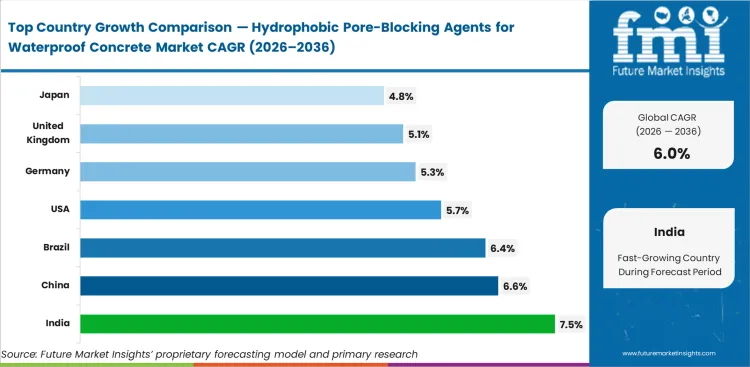
- India at 7.5% CAGR and China at 6.6% CAGR are expected to record the fastest pace by 2036.
Water ingress through capillary pores remains the main failure mode for waterproof concrete. Sika stated in March 2025 that SikaControl®-730 WT HPI is a hydrophobic pore-blocking ingredient for concrete. Its 1.0 to 2.0 litres per 100 kg cement dosage gives ready-mix producers a defined batching route. Hycrete documentation states that Endure WP reduces water absorption to 1% or lower and can heal cracks up to 0.4 mm. That positions premium admixtures around durability and corrosion protection instead of basic damp resistance. The Institute of Concrete Technology stated in 2025 that hybrid admixtures combine pore-blocking, hydrophobic and self-healing mechanisms. Reported 70% to 95% reductions in water absorption rate and permeability are likely to raise buyer interest in multi-mechanism systems.
Hydrophobic Pore-Blocking Agents for Waterproof Concrete Market Definition
Sector scope covers hydrophobic and pore-blocking agents added to concrete during mixing to reduce water movement through capillary pores. Included products cover crystalline admixtures and stearate-based hydrophobes. Silane blends and polymer pore blockers complete the product scope. Materials are sold to ready-mix producers and contractors making waterproof concrete for basements and tunnels. Water tanks and bridge decks form major project uses. External membranes and post-applied coatings remain outside the revenue boundary.
Hydrophobic Pore-Blocking Agents for Waterproof Concrete Market Inclusions
Market scope covers all commercially traded hydrophobic pore-blocking agents for waterproof concrete categorized by chemistry type, including silane-siloxane blends and stearate-based agents; form, including powder and liquid additives; applications, including basements, tunnels, bridges, roof slabs, and water-retaining structures; and end users, including ready-mix concrete producers, precast manufacturers, infrastructure contractors, and building repair firms. Revenue scope covers 2026 to 2036. The key stakeholders include waterproofing admixture manufacturers, construction chemical suppliers, cement and concrete producers, raw material suppliers, contractors, infrastructure owners, building developers, testing laboratories, distributors, standards bodies, and regulatory agencies.
Hydrophobic Pore-Blocking Agents for Waterproof Concrete Market Exclusions
Study scope excludes external waterproofing membranes and roof coatings. Sealants and injection resins are excluded from the value boundary. Surface-applied water proof coatings are treated as adjacent systems because revenue is not generated at concrete batching. Crack injection products and repair mortars are outside the boundary unless the same chemistry is sold as an integral concrete admixture.
Hydrophobic Pore-Blocking Agents for Waterproof Concrete Market Research Methodology
- Primary Research: FMI analysts reviewed admixture suppliers and ready-mix producers using crystalline and hydrophobic systems. Interviews focused on dosage control and permeability testing. Project approval paths were checked during buyer calls.
- Desk Research: Desk review used infrastructure condition data and official construction output indicators. Standards references and official company actions after January 2024 were checked.
- Market Sizing and Forecasting: Forecast work combined waterproofing admixture value with pore-blocking agent shares and application-based dosage assumptions.
- Data Validation: Segment shares were checked against ready-mix handling needs and direct technical selling patterns. Waterproof concrete specifications were reviewed before country checks.
Why is the Hydrophobic Pore-Blocking Agents for Waterproof Concrete Market Growing?
- USA bridge repair need supports durable concrete admixture use as 6.8% of bridges were in poor condition in 2024.
- European building refurbishment policy supports concrete repair material demand as the revised directive targets the 16% worst-performing non-residential buildings by 2030.
- India’s National Highway network reached 146,560 km in December 2025. Wider concrete maintenance needs follow from that asset stock.
- Japan’s road maintenance need is visible across 730,000 bridges. About 48% are expected to be 50 years old within ten years.
Waterproof concrete buyers are shifting more decisions into the mix design stage. Bridge decks and basements expose concrete to water pressure before surface systems can protect every joint. Federal Highway Administration bridge data in June 2024 showed a poor-condition bridge inventory keeping repair durability in focus. Pore-blocking agents suit this application as internal capillary sealing lowers water movement through hardened concrete. Product suppliers with proof across chloride exposure and wet curing should gain stronger positions in public works specifications.
Building owners are treating leakage as a lifecycle cost issue. Concrete waterproofing failure can lead to tenant disruption and corrosion repair. Costly access work creates a separate risk in buried structures. India’s highway length and Japan’s aging bridge stock reflect on why concrete durability is becoming a planning item across large countries. Hydrophobic agents address this pressure by making concrete less water-friendly. Ready-mix producers are likely to witness more trial work as designers seek durability without another surface layer.
Market Segmentation Analysis
- Crystalline admixtures are projected to hold 41.0% share in 2026 as internal crystal formation suits water tanks.
- With a projected 48.5% share in 2026, liquid admixture is expected to lead due to plant dosing control.
- Below-grade concrete is estimated to reach 32.5% share in 2026 since basement slabs face groundwater pressure.
- Ready-mix producers are expected to hold 39.5% share in 2026, led by batching plants controlling admixture dosage decisions.
- Direct supply is projected to secure 51.5% share in 2026, reflected by trial batching and technical sign-off requirements.
The market is segmented by chemistry type, including silane-siloxane blends and stearate-based agents with silane-siloxane blends projected to lead due to deeper water-repellent action inside concrete pores. Form segmentation covers powder additives and liquid admixtures with liquid admixtures expected to hold wider use as ready-mix plants need easier dosing control. By application and end user, the industry comprises basements, tunnels, bridges, roof slabs and water-retaining structures supported by contractors and infrastructure owners managing leakage risk. Sales channel segmentation covers direct supply, distributors and retail channels with direct supply projected to lead as concrete producers need mix-design support before project approval.
Insights into the Crystalline Admixtures Agent Type Segment
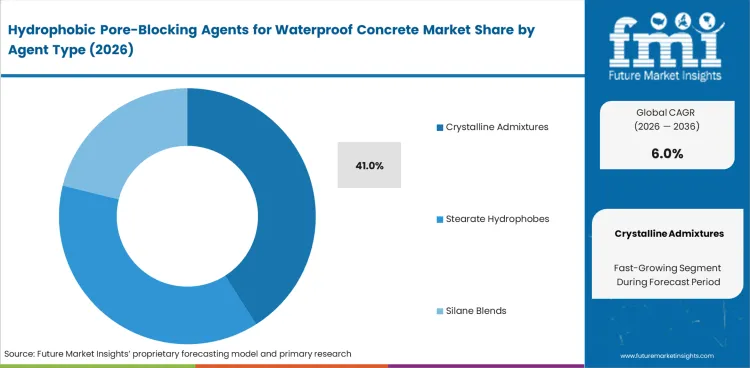
- Crystalline admixtures are expected to account for 41.0% share in 2026 as water tanks and basements need internal pore sealing after curing.
- Stearate hydrophobes hold use in cost-sensitive concrete where buyers need water repellency without complex performance documentation.
Insights into the Liquid Admixture Form Segment
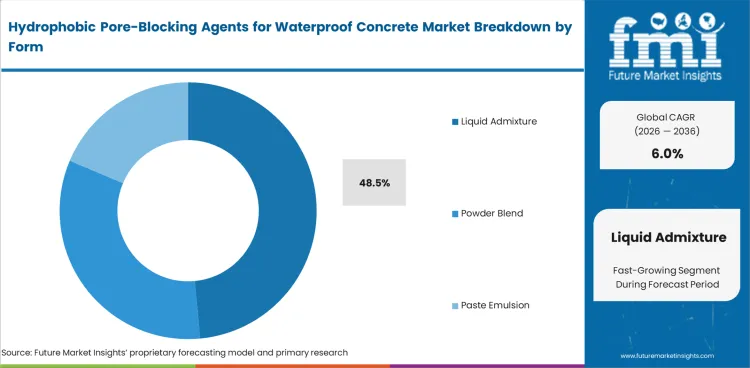
- Liquid admixture is projected to represent 48.5% share in 2026 with ready-mix plants favoring pump dosing and simple quality checks.
- Powder blends keep a role in dry batching locations where silo handling and bagged dosage fit local project practice.
Insights into the Below-Grade Concrete Application Segment
- Below-grade concrete is anticipated to account for 32.5% share in 2026, led by basements and podium slabs facing constant groundwater exposure.
- Water-retaining structures use pore-blocking agents when tank walls require internal protection without depending on exposed surfaces.
Insights into the Ready-Mix Producers End User Segment
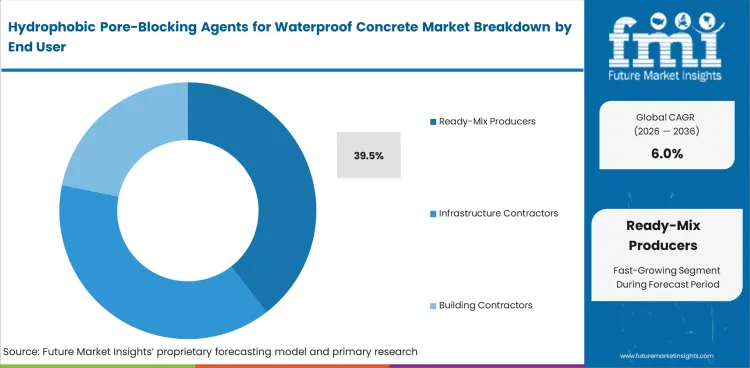
- Ready-mix producers are expected to hold 39.5% share in 2026, influenced by batching teams controlling dosage accuracy and mix compatibility.
- Infrastructure contractors value hydrophobic agents as tunnel walls and bridge decks require performance proof before public project approval.
Insights into the Direct Supply Sales Channel Segment
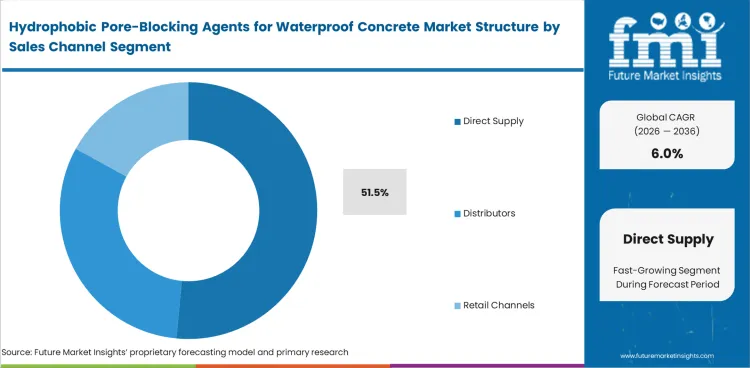
- Direct supply is projected to represent 51.5% share in 2026 with large projects requiring trial pours and permeability checks.
- Distributor sales serve smaller builders purchasing additives for basements and small water-retaining structures near active sites.
Hydrophobic Pore-Blocking Agents for Waterproof Concrete Market Drivers, Restraints, and Opportunities
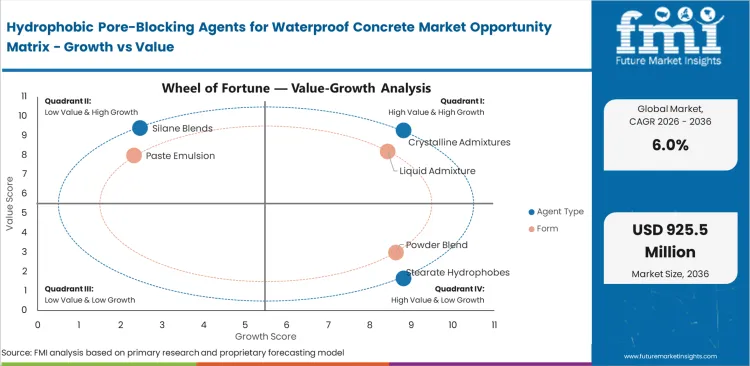
- Groundwater-facing concrete is expected to lift additive adoption as pore sealing lowers leakage risk after curing.
- Cement compatibility testing is anticipated to slow supplier switching since hydrophobic performance changes with binder chemistry and jobsite water.
- Low-carbon concrete is likely to create prospects as blended cement mixes need waterproofing support without surface-layer complexity.
Repair programs are expected to favor pore-blocking agents reducing water movement inside aging concrete structures. USA bridge data shows a clear repair need, with 6.8% of bridges rated in poor condition in 2024. Bridge decks and buried structures expose concrete to moisture under pressure. Hydrophobic agents are better suited to these areas since internal pore treatment reduces capillary water movement. Suppliers with permeability data and clear dosage guidance are expected to gain stronger approval in public infrastructure work.
Specification control is likely to remain a restraint during the forecast period. Hydrophobic agents raise material cost and often need trial batches before use in waterproof concrete. Poor cement compatibility can reduce slump or weaken curing performance at the jobsite. Buyers will therefore prefer suppliers able to provide simple mixing rules and documented water-resistance tests. Opportunity will favor additive makers capable of proving performance across blended cement mixes and groundwater-facing concrete areas.
Blended Cement Compatibility
Binder change is expected to remain a practical restraint for hydrophobic pore-blocking agents during the forecast period. Cement producers are using blended cements as carbon targets reshape concrete mix design. China produced 179.53 million tons of cement in May 2024 with output down 8.2% year over year. Lower production does not remove durability needs in higher-specification concrete. Hydrophobic agents are required to work with new binder chemistry without reducing slump or curing performance. Suppliers with clear dosage ranges across CEM II and local blends are likely to reduce trial failure risk.
Direct Technical Selling
Sales opportunity is expected to focus toward suppliers supporting batching plants before large waterproof pours begin. Waterproofing chemistry is bought considering leakage can delay handover or trigger repair claims. Sika opened a Kazakhstan facility in April 2025 with mortar and concrete admixture lines in addition to a laboratory. Local testing capacity improves trial speed before contractors approve full project use. Direct technical selling should gain share in major basement and tunnel projects. Distributors will serve smaller repair jobs while larger infrastructure work favors supplier-backed mix design support.
Regional Analysis
.webp "Top Country Growth Comparison Hydrophobic Pore Blocking Agents For Waterproof Concrete Market Cagr (2026 2036)")
| Country | CAGR 2026 to 2036 |
|---|---|
| India | 7.5% |
| China | 6.6% |
| Brazil | 6.4% |
| United States | 5.7% |
| Germany | 5.3% |
| United Kingdom | 5.1% |
| Japan | 4.8% |
Source: Future Market Insights analysis based on waterproof concrete admixture adoption review in 2026.
Analysis of Hydrophobic Pore-Blocking Agents for Waterproof Concrete Market by Key Countries
- India is projected to record 7.5% CAGR by 2036 reflecting infrastructure concrete and basement waterproofing pull.
- China is expected to expand at 6.6% CAGR by 2036 as municipal projects favor stronger durability specifications.
- Brazil is forecast to grow at 6.4% CAGR by 2036 due to urban infrastructure funding influencing waterproof concrete needs.
- United States is expected to advance at 5.7% CAGR by 2036, led by bridge and tunnel maintenance work.
- Germany at 5.3% CAGR and United Kingdom at 5.1% CAGR expand through mature building standards. Japan at 4.8% CAGR follows through preventive maintenance needs.
Country performance changes with infrastructure intensity and concrete specification maturity. India and China are forecast above the global pace through larger new project volumes. Brazil tracks above average as public works raise concrete durability needs. United States moves near the global pace through maintenance. Germany and United Kingdom grow more slowly as established specifications limit rapid conversion. Japan follows the same pattern through preventive maintenance practice.
Demand Outlook for Hydrophobic Pore-Blocking Agents for Waterproof Concrete Market in India
Waterproof concrete use in India is tied to new infrastructure scale and dense urban building work. India’s road transport ministry reported the National Highway network at 146,560 km in December 2025. Wider road assets create more decks and underpasses. Drainage structures add another waterproof concrete use. India is projected to record 7.5% CAGR by 2036, led by metro and highway projects expand waterproofing needs. Suppliers with local batching support and distributor depth should convert specifications faster in construction chemicals.
- Delhi Metro repair crews need concrete mixes controlling water movement in underground stations and tunnel interfaces.
- Mumbai basement contractors favor liquid admixtures when groundwater exposure makes membrane-only designs risky.
- Gujarat precast yards value pore-blocking additives for water tanks supplied to industrial estates near Ahmedabad.
Sales Analysis for Hydrophobic Pore-Blocking Agents for Waterproof Concrete Market in China
Industry sales in China are expected to expand at 6.6% CAGR by 2036, led by municipal basements and metros using tighter durability controls. China remains a large concrete buyer even as cement output slows. National Bureau of Statistics data placed May 2024 cement output at 179.53 million tons with an 8.2% yearly decline. Lower cement volume pushes suppliers toward value-added concrete chemistry instead of pure tonnage.
- Shanghai metro extensions need low-permeability concrete for station boxes and cut-and-cover sections exposed to groundwater.
- Guangdong ready-mix producers prefer liquid systems maintaining dosing control during humid batching conditions.
- Chengdu municipal works create use cases for crystalline admixtures in water channels and utility tunnels.
Demand Analysis of Hydrophobic Pore-Blocking Agents for Waterproof Concrete Market in Brazil
Brazilian demand is shaped by urban infrastructure renewal and water-exposed construction. Novo PAC allocates about R$1.7 trillion to social and urban infrastructure. Funding across sanitation and mobility creates concrete work where waterproofing performance affects service life. The sector in Brazil is forecast to grow at 6.4% CAGR by 2036 due to public projects and private basements adopting more integral admixtures. Suppliers should balance price sensitivity with field guidance for contractors in Sao Paulo and coastal cities.
- Sao Paulo commercial basements require internal water resistance where dense sites limit membrane access after concrete placement.
- Piracicaba bioenergy projects create durability needs for crystalline waterproofing in tanks exposed to aggressive process water.
- Rio de Janeiro coastal works favor pore-blocking agents with chloride exposure raising reinforcement corrosion risk.
Opportunity Analysis of Hydrophobic Pore-Blocking Agents for Waterproof Concrete Market in United States
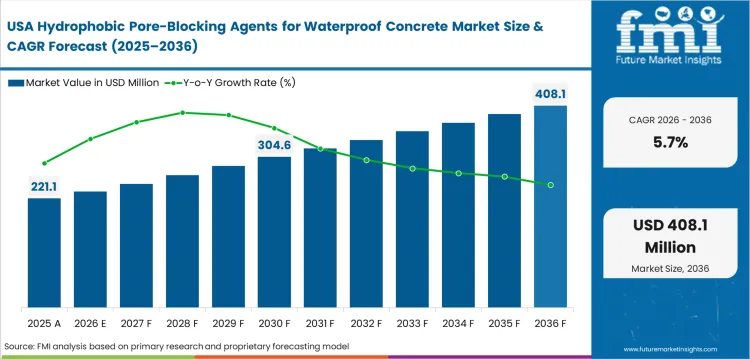
United States sector is expected to advance at 5.7% CAGR by 2036, influenced by infrastructure owners specify admixtures for bridge decks and below-grade utility structures. American bridge data in 2024 placed 6.8% of bridges in poor condition. Maintenance work gives concrete durability a direct role in repair life and closure planning.
- New York transit and tunnel projects depend on permeability control in concrete placed near groundwater and old infrastructure.
- Florida coastal building teams favor hydrophobic concrete where salt exposure can move into porous slabs.
- Nebraska processing plants use crystalline admixtures in below-grade concrete as groundwater threatens utility spaces.
Future Outlook for Hydrophobic Pore-Blocking Agents for Waterproof Concrete Market in Germany
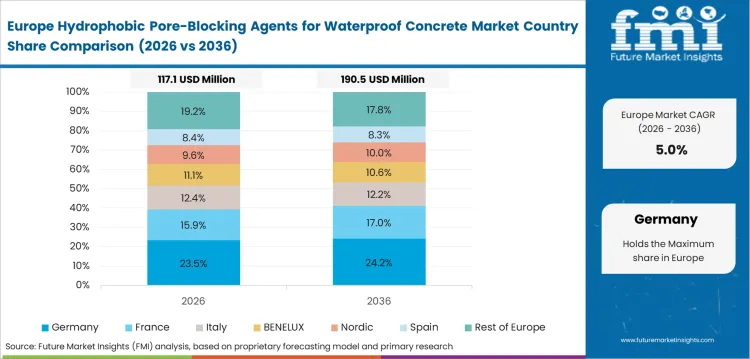
European Union building rules entered a new phase in 2024 with energy performance goals tied to renovation planning. Germany’s permits table reflected 149,748 buildings or construction works approved in 2025. Building repair and civil works therefore stay selective instead of volume-driven. Growth for the sector in Germany is projected to rise at 5.3% CAGR by 2036, driven by specification quality influencing construction chemicals demand. Suppliers are required to prove compatibility with local cement standards and concrete testing practice.
- Berlin basement renovation projects require waterproof concrete leading property owners to avoid repeated leakage repairs.
- Hamburg port infrastructure favors low-permeability concrete since chloride and moisture exposure shorten repair cycles.
- North Rhine-Westphalia industrial flooring work uses pore-blocking systems as water and chemical exposure affect slabs.
Demand Outlook for Hydrophobic Pore-Blocking Agents for Waterproof Concrete Market in the United Kingdom
The market expansion in United Kingdom is forecast at 5.1% CAGR by 2036 as public project discipline favors proven admixture systems. United Kingdom uptake reflects a combination of infrastructure planning and cautious construction activity. A March 2026 national infrastructure pipeline listed 734 projects worth £718 billion. Planned hospitals and schools create uses for waterproof concrete in foundations. Railways and reservoirs extend the same need into water structures.
- London basement construction needs dosing control due to groundwater and tight access raising post-handover leakage costs.
- Manchester commercial refurbishment projects value integral waterproofing helping older masonry interfaces create water paths.
- Welsh reservoir projects favor concrete admixtures influencing water retention and long service checks.
In-depth Analysis of Hydrophobic Pore-Blocking Agents for Waterproof Concrete Market in Japan
Ministry road materials describe roughly 730,000 road bridges across Japan. Nearly 48% are expected to be 50 years old within ten years. Industry demand in Japan is expected to post 4.8% CAGR by 2036 since preventive maintenance keeps waterproof concrete relevant. Mature contractor practice limits rapid share shifts while rewarding suppliers with test data and local approvals for concrete admixture in Japan.
- Tokyo underground stations need concrete mixes limiting water movement during short repair windows.
- Osaka urban redevelopment favors liquid admixtures where ready-mix suppliers are required to control dosage in dense delivery routes.
- Hokkaido bridge decks require permeability control due to freeze-thaw exposure widening small cracks in concrete.
Competitive Positioning and Strategic Supplier Strength
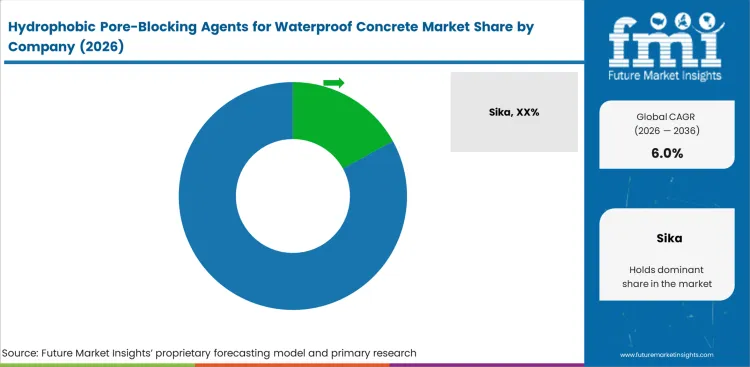
- Sika can gain waterproof concrete accounts by combining admixture production with local laboratory support and batching guidance.
- Saint-Gobain Fosroc is expected to defend Asia and Middle East work through construction chemicals depth and waterproofing system reach.
- Kryton and Penetron stand out through crystalline waterproofing systems used in basements and water-exposed concrete.
- Wacker supports adjacent cementitious binder work as low-carbon cement shifts increase the need for compatibility-tested formulations.
Competition is becoming a proof contest at the batching plant. Waterproof concrete buyers compare labels or dosage costs along with gathering evidence for the admixture to work with local cement and pour conditions. Sika’s Kazakhstan plant focuses on this shift as mortar and concrete admixture lines are backed by laboratory capacity. Local testing gives ready-mix producers faster answers before large infrastructure pours begin. Suppliers with lab proof and field support are likely to gain stronger access to waterproof concrete specifications.
Saint-Gobain Fosroc changes the competitive map in Asia and the Middle East. The acquisition gives Saint-Gobain a wider construction chemicals platform in regions where basements and industrial projects need stronger water control. For buyers, the practical gain is a larger product basket with regional service teams. For competitors, the pressure is sharper since system selling becomes harder to match with a narrow product line. Larger suppliers should use admixtures along with waterproofing membranes and repair products as connected packages.
Crystalline specialists hold a different position. Kryton and Penetron compete closer to the structure itself as their systems make concrete part of the waterproofing barrier. Kryton’s India push around KIM and Hard-Cem shows how durability claims are being tied to longer service life and fewer repairs. Penetron’s product range fits tanks and treatment plants where water pressure is a daily risk. Regional suppliers can gain smaller jobs through price and delivery speed. Complex projects will favor companies that prove performance before the pour.
Key Companies in the Hydrophobic Pore-Blocking Agents for Waterproof Concrete Market
Competition spans construction chemical system suppliers and crystalline waterproofing specialists serving ready-mix producers and contractors.
- System suppliers: Sika and Saint-Gobain Fosroc compete with concrete admixture and waterproofing portfolios across infrastructure accounts. Master Builders Solutions and Mapei hold positions where contractors need specification support and batching advice. Local project coverage supports waterproof concrete work.
- Crystalline specialists: Kryton and Penetron build differentiation around internal pore sealing. Xypex and Alchemco support self-sealing claims in the same field. Project evidence in water tanks and basements supports their position with engineers. Wastewater structures add another proof route before product approval.
- Specialty chemistry suppliers: Wacker Chemie and Dow support nearby cementitious systems through polymer depth. Evonik and BASF add silane and construction chemical reach. Product aligning with concrete bonding agents and cementitious waterproofing let these suppliers influence specification choices beyond one admixture type.
Competitive Benchmarking: Hydrophobic Pore-Blocking Agents for Waterproof Concrete Market
| Company | Pore-Blocking Chemistry Depth | Batching Support Reach | Waterproof Concrete Proof | Footprint |
|---|---|---|---|---|
| Sika | High | High | High | Global |
| Saint-Gobain Fosroc | High | High | High | Global |
| Master Builders Solutions | High | Large | High | Global |
| Mapei | Large | High | Large | Global |
| Kryton | High | Moderate | High | Global |
| Penetron | High | Large | High | Global |
| Xypex Chemical | High | Moderate | High | Global |
| Alchemco | Moderate | Moderate | Large | Regional |
Source: Future Market Insights competitive analysis based on public product portfolios and company activity in 2026.
Key Developments in the Hydrophobic Pore-Blocking Agents for Waterproof Concrete Market
- In April 2025, Sika opened a Kazakhstan facility with mortar and concrete admixture lines plus laboratory support.
- In August 2025, Kryton expanded its India coverage with Smart Concrete resources around KIM crystalline admixture and Hard-Cem durability systems.
- In September 2025, MBT Construction Chemicals inaugurated a Navi Mumbai plant with 25,000 metric tons annual single-shift capacity for construction chemicals.
Key Players in the Hydrophobic Pore-Blocking Agents for Waterproof Concrete Market
Construction chemical system suppliers
- Sika
- Saint-Gobain Fosroc
- Master Builders Solutions
- Mapei
- RPM International
Crystalline waterproofing specialists
- Kryton
- Penetron
- Xypex Chemical
- Alchemco
- Koster Bauchemie
Adjacent chemistry suppliers
- Wacker Chemie
- Dow
- Evonik
- BASF
- Pidilite Industries
Report Scope and Coverage
| Item | Value |
|---|---|
| Market value in 2025 | USD 487.5 million |
| Market value in 2026 | USD 516.8 million |
| Market value in 2036 | USD 925.5 million |
| CAGR from 2026 to 2036 | 6.0% |
| Quantitative units | USD million |
| Market definition | Hydrophobic and pore-blocking agents added to concrete to reduce capillary water movement |
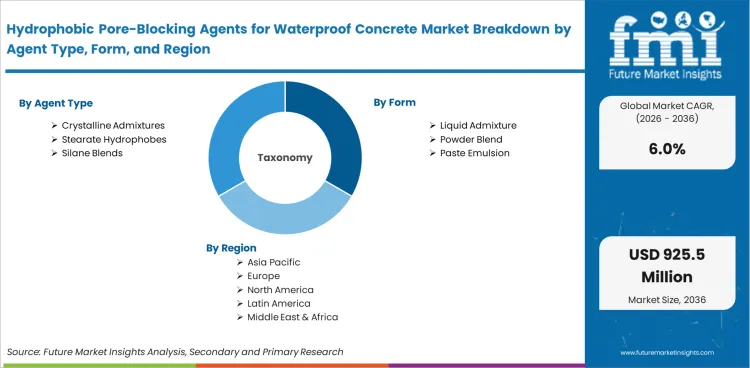
| By agent type | Crystalline admixtures, stearate hydrophobes, silane blends, polymer pore blockers, other agents |
| By form | Liquid admixture, powder blend, paste emulsion |
| By application | Below-grade concrete, tunnels, water-retaining structures, bridge decks, precast elements |
| By end user | Ready-mix producers; infrastructure contractors; building contractors; precast producers |
| By sales channel | Direct supply, distributors, retail channels |
| Regions covered | North America, Latin America, Western Europe, Eastern Europe, East Asia, South Asia and Pacific, Middle East and Africa |
| Forecast period | 2026 to 2036 |
| Approach | Bottom-up additive loading review with parent waterproofing admixture cross-checks |
Source: Future Market Insights analysis, 2026.
Hydrophobic Pore-Blocking Agents for Waterproof Concrete Market Breakdown by Agent Type Form Application End User Sales Channel and Region
Hydrophobic Pore-Blocking Agents for Waterproof Concrete Market Segmented by Agent Type
- Crystalline Admixtures
- Stearate Hydrophobes
- Silane Blends
- Polymer Blockers
- Other Agents
Hydrophobic Pore-Blocking Agents for Waterproof Concrete Market Segmented by Form
- Liquid Admixture
- Powder Blend
- Paste Emulsion
Hydrophobic Pore-Blocking Agents for Waterproof Concrete Market Segmented by Application
- Below-Grade Concrete
- Tunnels
- Water Structures
- Bridge Decks
- Precast Elements
Hydrophobic Pore-Blocking Agents for Waterproof Concrete Market Segmented by End User
- Ready-Mix Producers
- Infrastructure Contractors
- Building Contractors
- Precast Producers
Hydrophobic Pore-Blocking Agents for Waterproof Concrete Market Segmented by Sales Channel
- Direct Supply
- Distributors
- Retail Channels
Hydrophobic Pore-Blocking Agents for Waterproof Concrete Market by Region
- North America
- United States
- Canada
- Mexico
- Latin America
- Brazil
- Chile
- Rest of Latin America
- Western Europe
- Germany
- United Kingdom
- Italy
- Spain
- France
- Eastern Europe
- Poland
- Rest of Eastern Europe
- East Asia
- China
- Japan
- South Korea
- South Asia and Pacific
- India
- ASEAN
- Australia and New Zealand
- Middle East and Africa
- Kingdom of Saudi Arabia
- Other GCC Countries
- South Africa
Research Sources and Bibliography
- American Road & Transportation Builders Association. (2024, August 20). 2024 ARTBA bridge report.
- European Parliament & Council of the European Union. (2024, April 24). Directive (EU) 2024/1275 of the European Parliament and of the Council of 24 April 2024 on the energy performance of buildings (recast). EUR-Lex.
- Federal Highway Administration. (2024, June 15). 2024: Bridge condition by highway system. USA Department of Transportation.
- Kryton International Inc. (2025, August 27). Kryton expands in India with Smart Concrete website launch.
- Master Builders Solutions. (2025, September 2). MBT Construction Chemicals inaugurates new manufacturing plant.
- Ministry of Land, Infrastructure, Transport and Tourism. (2024). Roads in Japan 2024.
- Ministry of Road Transport and Highways. (2025, December 30). Year-end review 2025: Ministry of Road Transport and Highways. Press Information Bureau.
- National Bureau of Statistics of China. (2024, June 25). Industrial production operation in May 2024.
- Office for National Statistics. (2026, April 16). Construction output in Great Britain: February 2026.
- Penetron. (2025, April). Bioenergy plant in São Paulo, Brazil, specifies PENETRON ADMIX to ensure concrete durability.
- Saint-Gobain. (2025, October 2). Saint-Gobain completes the acquisition of FOSROC, a leading player in construction chemicals in Asia and emerging markets, further strengthening its worldwide presence in the sector.
- Sika AG. (2025, April 8). Sika opens a new plant for concrete admixtures and mortars in Kazakhstan.
- Wacker Chemie AG. (2025, March 18). WACKER’s high-performance binders help construction industry reduce carbon footprint.
Bibliography uses public infrastructure sources and official company publications. FMI pages are embedded only as body interlinks.
This Report Answers
- What is the current and future value of the hydrophobic pore-blocking agents for waterproof concrete market from 2026 to 2036?
- What CAGR is expected for the hydrophobic pore-blocking agents for waterproof concrete market during the forecast period?
- Which agent type segment is projected to lead hydrophobic pore-blocking additive demand in 2026?
- Which form segment is expected to hold the highest share in waterproof concrete additives?
- What factors are driving pore-blocking agent use in below-grade concrete?
- How do cement compatibility tests affect supplier selection for waterproof concrete additives?
- Which countries are expected to grow fastest in hydrophobic pore-blocking agents?
- Which companies are positioned across crystalline and hydrophobic waterproof concrete additives?
- How does FMI define the hydrophobic pore-blocking agent revenue scope?
- What forecasting approach was used to estimate additive demand from 2026 to 2036?
Frequently Asked Questions
What is the global market demand for hydrophobic pore-blocking agents for waterproof concrete market in 2026?
The hydrophobic pore-blocking agents for waterproof concrete market is expected to be reach USD 516.8 million in 2026 across concrete batching and infrastructure channels.
What will the hydrophobic pore-blocking agents for waterproof concrete market be worth by 2036?
Industry value is projected to reach USD 925.5 million by 2036 as waterproof concrete use expands in critical structures.
What is the expected CAGR for the hydrophobic pore-blocking agents for waterproof concrete market?
The sector is expected to expand at 6.0% CAGR from 2026 to 2036 across global waterproof concrete channels.
Which agent type leads the hydrophobic pore-blocking agents for waterproof concrete market?
Crystalline admixtures are projected to account for 41.0% share in 2026 due to internal pore sealing performance.
Which form leads the hydrophobic pore-blocking agents for waterproof concrete market?
Liquid admixture is expected to hold 48.5% share in 2026 as ready-mix plants need dosing control.
Which country grows fastest in the hydrophobic pore-blocking agents for waterproof concrete market?
India is projected to record 7.5% CAGR by 2036 as highway and metro waterproofing needs expand.
What does the hydrophobic pore-blocking agents for waterproof concrete market include?
Scope includes crystalline and stearate agents used inside concrete. Silane and polymer agents complete the product group. External membranes are outside additive revenue.
How were the hydrophobic pore-blocking agents for waterproof concrete market forecast prepared?
Forecast work used waterproofing admixture value and additive loading rates. Country specification checks shaped the 2026 to 2036 estimate.
How do hydrophobic pore-blocking agents work in waterproof concrete?
Hydrophobic agents reduce water affinity inside concrete pores. Crystalline systems fill capillary paths when moisture and cement chemistry react.
How long can pore-blocking waterproof concrete performance last?
Performance depends on mix design and curing. Crack movement creates the next approval check. Properly specified crystalline systems can keep internal protection active during service life.
Are pore-blocking agents better than external membranes?
Pore-blocking agents protect concrete internally during batching. Membranes protect surfaces after placement and are often used together in high-risk projects.
What raises the cost of hydrophobic pore-blocking agents?
Cost rises when projects need permeability tests and trial batches. Low-chloride chemistry can add another cost layer before concrete placement.
Which buyers use hydrophobic pore-blocking agents most often?
Ready-mix producers and infrastructure contractors use these agents when water ingress risk can create expensive repair work.
Preview the report firsthand - request a free sample
Get SampleGet the brochure for pricing and purchase details.
Get PDFTable of Content
- Executive Summary
- Global Market Outlook
- Demand-side Trends
- Supply-side Trends
- Technology Roadmap Analysis
- Analysis and Recommendations
- Market Overview
- Market Coverage / Taxonomy
- Market Definition / Scope / Limitations
- Research Methodology
- Chapter Orientation
- Analytical Lens and Working Hypotheses
- Market Structure, Signals, and Trend Drivers
- Benchmarking and Cross-market Comparability
- Market Sizing, Forecasting, and Opportunity Mapping
- Research Design and Evidence Framework
- Desk Research Programme (Secondary Evidence)
- Company Annual and Sustainability Reports
- Peer-reviewed Journals and Academic Literature
- Corporate Websites, Product Literature, and Technical Notes
- Earnings Decks and Investor Briefings
- Statutory Filings and Regulatory Disclosures
- Technical White Papers and Standards Notes
- Trade Journals, Industry Magazines, and Analyst Briefs
- Conference Proceedings, Webinars, and Seminar Materials
- Government Statistics Portals and Public Data Releases
- Press Releases and Reputable Media Coverage
- Specialist Newsletters and Curated Briefings
- Sector Databases and Reference Repositories
- FMI Internal Proprietary Databases and Historical Market Datasets
- Subscription Datasets and Paid Sources
- Social Channels, Communities, and Digital Listening Inputs
- Additional Desk Sources
- Expert Input and Fieldwork (Primary Evidence)
- Primary Modes
- Qualitative Interviews and Expert Elicitation
- Quantitative Surveys and Structured Data Capture
- Blended Approach
- Why Primary Evidence is Used
- Field Techniques
- Interviews
- Surveys
- Focus Groups
- Observational and In-context Research
- Social and Community Interactions
- Stakeholder Universe Engaged
- C-suite Leaders
- Board Members
- Presidents and Vice Presidents
- R&D and Innovation Heads
- Technical Specialists
- Domain Subject-matter Experts
- Scientists
- Physicians and Other Healthcare Professionals
- Governance, Ethics, and Data Stewardship
- Research Ethics
- Data Integrity and Handling
- Primary Modes
- Opportunity
- Trends
- Desk Research Programme (Secondary Evidence)
- Scenario Forecast
- Demand in Optimistic Scenario
- Demand in Likely Scenario
- Demand in Conservative Scenario
- Opportunity Map Analysis
- Product Life Cycle Analysis
- Supply Chain Analysis
- Investment Feasibility Matrix
- Value Chain Analysis
- PESTLE and Porter’s Analysis
- Regulatory Landscape
- Regional Parent Market Outlook
- Production and Consumption Statistics
- Import and Export Statistics
- Global Market Analysis 2021 to 2025 and Forecast, 2026 to 2036
- Historical Market Size Value (USD Million) Analysis, 2021 to 2025
- Current and Future Market Size Value (USD Million) Projections, 2026 to 2036
- Y-o-Y Growth Trend Analysis
- Absolute $ Opportunity Analysis
- Global Market Pricing Analysis 2021 to 2025 and Forecast 2026 to 2036
- Global Market Analysis 2021 to 2025 and Forecast 2026 to 2036, By Agent Type
- Introduction / Key Findings
- Historical Market Size Value (USD Million) Analysis By Agent Type , 2021 to 2025
- Current and Future Market Size Value (USD Million) Analysis and Forecast By Agent Type , 2026 to 2036
- Crystalline Admixtures
- Stearate Hydrophobes
- Silane Blends
- Crystalline Admixtures
- Y-o-Y Growth Trend Analysis By Agent Type , 2021 to 2025
- Absolute $ Opportunity Analysis By Agent Type , 2026 to 2036
- Global Market Analysis 2021 to 2025 and Forecast 2026 to 2036, By Form
- Introduction / Key Findings
- Historical Market Size Value (USD Million) Analysis By Form, 2021 to 2025
- Current and Future Market Size Value (USD Million) Analysis and Forecast By Form, 2026 to 2036
- Liquid Admixture
- Powder Blend
- Paste Emulsion
- Liquid Admixture
- Y-o-Y Growth Trend Analysis By Form, 2021 to 2025
- Absolute $ Opportunity Analysis By Form, 2026 to 2036
- Global Market Analysis 2021 to 2025 and Forecast 2026 to 2036, By Application
- Introduction / Key Findings
- Historical Market Size Value (USD Million) Analysis By Application, 2021 to 2025
- Current and Future Market Size Value (USD Million) Analysis and Forecast By Application, 2026 to 2036
- Below-Grade Concrete
- Tunnels
- Water Structures
- Below-Grade Concrete
- Y-o-Y Growth Trend Analysis By Application, 2021 to 2025
- Absolute $ Opportunity Analysis By Application, 2026 to 2036
- Global Market Analysis 2021 to 2025 and Forecast 2026 to 2036, By End User
- Introduction / Key Findings
- Historical Market Size Value (USD Million) Analysis By End User, 2021 to 2025
- Current and Future Market Size Value (USD Million) Analysis and Forecast By End User, 2026 to 2036
- Ready-Mix Producers
- Infrastructure Contractors
- Building Contractors
- Ready-Mix Producers
- Y-o-Y Growth Trend Analysis By End User, 2021 to 2025
- Absolute $ Opportunity Analysis By End User, 2026 to 2036
- Global Market Analysis 2021 to 2025 and Forecast 2026 to 2036, By Sales Channel
- Introduction / Key Findings
- Historical Market Size Value (USD Million) Analysis By Sales Channel, 2021 to 2025
- Current and Future Market Size Value (USD Million) Analysis and Forecast By Sales Channel, 2026 to 2036
- Direct Supply
- Distributors
- Retail Channels
- Direct Supply
- Y-o-Y Growth Trend Analysis By Sales Channel, 2021 to 2025
- Absolute $ Opportunity Analysis By Sales Channel, 2026 to 2036
- Global Market Analysis 2021 to 2025 and Forecast 2026 to 2036, By Region
- Introduction
- Historical Market Size Value (USD Million) Analysis By Region, 2021 to 2025
- Current Market Size Value (USD Million) Analysis and Forecast By Region, 2026 to 2036
- North America
- Latin America
- Western Europe
- Eastern Europe
- East Asia
- South Asia and Pacific
- Middle East & Africa
- Market Attractiveness Analysis By Region
- North America Market Analysis 2021 to 2025 and Forecast 2026 to 2036, By Country
- Historical Market Size Value (USD Million) Trend Analysis By Market Taxonomy, 2021 to 2025
- Market Size Value (USD Million) Forecast By Market Taxonomy, 2026 to 2036
- By Country
- USA
- Canada
- Mexico
- By Agent Type
- By Form
- By Application
- By End User
- By Sales Channel
- By Country
- Market Attractiveness Analysis
- By Country
- By Agent Type
- By Form
- By Application
- By End User
- By Sales Channel
- Key Takeaways
- Latin America Market Analysis 2021 to 2025 and Forecast 2026 to 2036, By Country
- Historical Market Size Value (USD Million) Trend Analysis By Market Taxonomy, 2021 to 2025
- Market Size Value (USD Million) Forecast By Market Taxonomy, 2026 to 2036
- By Country
- Brazil
- Chile
- Rest of Latin America
- By Agent Type
- By Form
- By Application
- By End User
- By Sales Channel
- By Country
- Market Attractiveness Analysis
- By Country
- By Agent Type
- By Form
- By Application
- By End User
- By Sales Channel
- Key Takeaways
- Western Europe Market Analysis 2021 to 2025 and Forecast 2026 to 2036, By Country
- Historical Market Size Value (USD Million) Trend Analysis By Market Taxonomy, 2021 to 2025
- Market Size Value (USD Million) Forecast By Market Taxonomy, 2026 to 2036
- By Country
- Germany
- UK
- Italy
- Spain
- France
- Nordic
- BENELUX
- Rest of Western Europe
- By Agent Type
- By Form
- By Application
- By End User
- By Sales Channel
- By Country
- Market Attractiveness Analysis
- By Country
- By Agent Type
- By Form
- By Application
- By End User
- By Sales Channel
- Key Takeaways
- Eastern Europe Market Analysis 2021 to 2025 and Forecast 2026 to 2036, By Country
- Historical Market Size Value (USD Million) Trend Analysis By Market Taxonomy, 2021 to 2025
- Market Size Value (USD Million) Forecast By Market Taxonomy, 2026 to 2036
- By Country
- Russia
- Poland
- Hungary
- Balkan & Baltic
- Rest of Eastern Europe
- By Agent Type
- By Form
- By Application
- By End User
- By Sales Channel
- By Country
- Market Attractiveness Analysis
- By Country
- By Agent Type
- By Form
- By Application
- By End User
- By Sales Channel
- Key Takeaways
- East Asia Market Analysis 2021 to 2025 and Forecast 2026 to 2036, By Country
- Historical Market Size Value (USD Million) Trend Analysis By Market Taxonomy, 2021 to 2025
- Market Size Value (USD Million) Forecast By Market Taxonomy, 2026 to 2036
- By Country
- China
- Japan
- South Korea
- By Agent Type
- By Form
- By Application
- By End User
- By Sales Channel
- By Country
- Market Attractiveness Analysis
- By Country
- By Agent Type
- By Form
- By Application
- By End User
- By Sales Channel
- Key Takeaways
- South Asia and Pacific Market Analysis 2021 to 2025 and Forecast 2026 to 2036, By Country
- Historical Market Size Value (USD Million) Trend Analysis By Market Taxonomy, 2021 to 2025
- Market Size Value (USD Million) Forecast By Market Taxonomy, 2026 to 2036
- By Country
- India
- ASEAN
- Australia & New Zealand
- Rest of South Asia and Pacific
- By Agent Type
- By Form
- By Application
- By End User
- By Sales Channel
- By Country
- Market Attractiveness Analysis
- By Country
- By Agent Type
- By Form
- By Application
- By End User
- By Sales Channel
- Key Takeaways
- Middle East & Africa Market Analysis 2021 to 2025 and Forecast 2026 to 2036, By Country
- Historical Market Size Value (USD Million) Trend Analysis By Market Taxonomy, 2021 to 2025
- Market Size Value (USD Million) Forecast By Market Taxonomy, 2026 to 2036
- By Country
- Kingdom of Saudi Arabia
- Other GCC Countries
- Turkiye
- South Africa
- Other African Union
- Rest of Middle East & Africa
- By Agent Type
- By Form
- By Application
- By End User
- By Sales Channel
- By Country
- Market Attractiveness Analysis
- By Country
- By Agent Type
- By Form
- By Application
- By End User
- By Sales Channel
- Key Takeaways
- Key Countries Market Analysis
- USA
- Pricing Analysis
- Market Share Analysis, 2025
- By Agent Type
- By Form
- By Application
- By End User
- By Sales Channel
- Canada
- Pricing Analysis
- Market Share Analysis, 2025
- By Agent Type
- By Form
- By Application
- By End User
- By Sales Channel
- Mexico
- Pricing Analysis
- Market Share Analysis, 2025
- By Agent Type
- By Form
- By Application
- By End User
- By Sales Channel
- Brazil
- Pricing Analysis
- Market Share Analysis, 2025
- By Agent Type
- By Form
- By Application
- By End User
- By Sales Channel
- Chile
- Pricing Analysis
- Market Share Analysis, 2025
- By Agent Type
- By Form
- By Application
- By End User
- By Sales Channel
- Germany
- Pricing Analysis
- Market Share Analysis, 2025
- By Agent Type
- By Form
- By Application
- By End User
- By Sales Channel
- UK
- Pricing Analysis
- Market Share Analysis, 2025
- By Agent Type
- By Form
- By Application
- By End User
- By Sales Channel
- Italy
- Pricing Analysis
- Market Share Analysis, 2025
- By Agent Type
- By Form
- By Application
- By End User
- By Sales Channel
- Spain
- Pricing Analysis
- Market Share Analysis, 2025
- By Agent Type
- By Form
- By Application
- By End User
- By Sales Channel
- France
- Pricing Analysis
- Market Share Analysis, 2025
- By Agent Type
- By Form
- By Application
- By End User
- By Sales Channel
- India
- Pricing Analysis
- Market Share Analysis, 2025
- By Agent Type
- By Form
- By Application
- By End User
- By Sales Channel
- ASEAN
- Pricing Analysis
- Market Share Analysis, 2025
- By Agent Type
- By Form
- By Application
- By End User
- By Sales Channel
- Australia & New Zealand
- Pricing Analysis
- Market Share Analysis, 2025
- By Agent Type
- By Form
- By Application
- By End User
- By Sales Channel
- China
- Pricing Analysis
- Market Share Analysis, 2025
- By Agent Type
- By Form
- By Application
- By End User
- By Sales Channel
- Japan
- Pricing Analysis
- Market Share Analysis, 2025
- By Agent Type
- By Form
- By Application
- By End User
- By Sales Channel
- South Korea
- Pricing Analysis
- Market Share Analysis, 2025
- By Agent Type
- By Form
- By Application
- By End User
- By Sales Channel
- Russia
- Pricing Analysis
- Market Share Analysis, 2025
- By Agent Type
- By Form
- By Application
- By End User
- By Sales Channel
- Poland
- Pricing Analysis
- Market Share Analysis, 2025
- By Agent Type
- By Form
- By Application
- By End User
- By Sales Channel
- Hungary
- Pricing Analysis
- Market Share Analysis, 2025
- By Agent Type
- By Form
- By Application
- By End User
- By Sales Channel
- Kingdom of Saudi Arabia
- Pricing Analysis
- Market Share Analysis, 2025
- By Agent Type
- By Form
- By Application
- By End User
- By Sales Channel
- Turkiye
- Pricing Analysis
- Market Share Analysis, 2025
- By Agent Type
- By Form
- By Application
- By End User
- By Sales Channel
- South Africa
- Pricing Analysis
- Market Share Analysis, 2025
- By Agent Type
- By Form
- By Application
- By End User
- By Sales Channel
- USA
- Market Structure Analysis
- Competition Dashboard
- Competition Benchmarking
- Market Share Analysis of Top Players
- By Regional
- By Agent Type
- By Form
- By Application
- By End User
- By Sales Channel
- Competition Analysis
- Competition Deep Dive
- Sika
- Overview
- Product Portfolio
- Profitability by Market Segments (Product/Age /Sales Channel/Region)
- Sales Footprint
- Strategy Overview
- Marketing Strategy
- Product Strategy
- Channel Strategy
- Saint-Gobain Fosroc
- Master Builders Solutions
- Mapei
- RPM International
- Sika
- Competition Deep Dive
- Assumptions & Acronyms Used


