

- Market Size (2026)
- USD 313.6 Mn
- Forecast (2036)
- USD 677.1 Mn
- CAGR (2026 to 2036)
- 8.0%
How big is Hypertension-Specific Nutrition Market in 2026?
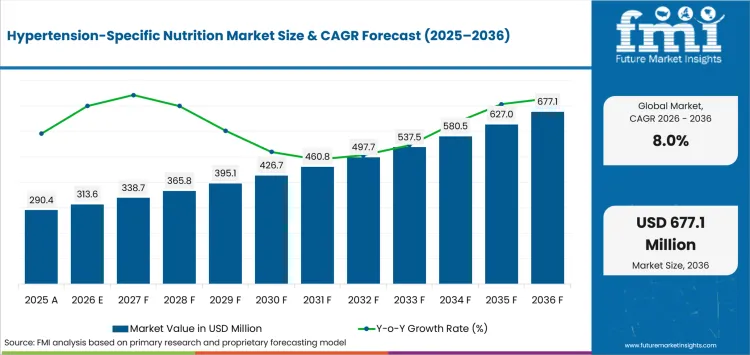
USD 313.6 million in 2026 and USD 677.1 million by 2036 at an 8.0% CAGR.
Demand for hypertension-specific nutrition is projected to expand at an 8.0% CAGR between 2026 and 2036, raising valuation from USD 313.6 million to USD 677.1 million. Commercial demand forms once sodium-reduction advice becomes a meal or supplement that patients can use repeatedly. WHO estimated in September 2025 that 1.4 billion adults aged 30 to 79 had hypertension during 2024. The figure defines a large potential need without implying that every affected adult will buy a specialized product.
National food patterns alter retention because sodium is embedded in meals that consumers already know. Japan's Ministry of Health, Labour and Welfare reported in December 2025 that average salt intake was 9.6 grams per day during 2024. Average intake remained above the national Health Japan 21 target of 7 grams per day. Products sold in Japan must lower sodium without making familiar meals feel clinically separate.
Key Takeaways of Hypertension-Specific Nutrition Market
- Persistent hypertension and sodium exposure support demand for nutrition products that turn dietary advice into a repeatable daily routine.
- By product type, DASH-pattern medical meals are estimated to hold 39.1% in 2026 owing to controlled meal composition that reduces daily planning work.
- In 2026, products below 140 mg sodium per serving are expected to lead the sodium level category with 50.4% share due to a clear threshold that simplifies comparison.
- Physician - payer-referred programs are projected to hold 47.5% of care context revenue in 2026, attributable to clinical selection and benefit eligibility.
- Taste problems and repeat-order cost can interrupt adherence after a clinician recommends dietary change. Uneven benefit coverage can also make continued use unaffordable once the initial clinical guidance has ended.
- Some of the key players in this market include Mom's Meals (PurFoods), BistroMD, ModifyHealth, Abbott, HumanN, NOW Health Group, Pharmavite (Nature Made), and Step One Foods.
Analyst Perspective
"Hypertension-specific nutrition gains commercial traction by removing a daily decision from sodium control without breaking familiar eating habits. Benefit coverage determines part of the recurring cost for payer-linked meals, producing different refill economics from consumer supplements."
- Nandini Roy Choudhury, Principal Consultant, Future Market Insights
How is the Hypertension-Specific Nutrition Market segmented?
The hypertension-specific nutrition market is segmented by product type, sodium level, care context, form, sales channel, and region.
The market covers five product types: DASH-pattern medical meals, low-sodium snacks & staples, potassium & magnesium support, beetroot - nitrate products and others. Sodium level includes <140 mg per serving, 140-400 mg per serving and others. Care context covers physician - payer-referred programs, self-directed use and post-event secondary prevention. Form includes prepared meals, supplements, snacks & beverages and others. Sales channels cover online - DTC, retail pharmacy, supermarkets & hypermarkets, specialty & health stores and others.
What makes DASH-pattern medical meals central to the product type category?
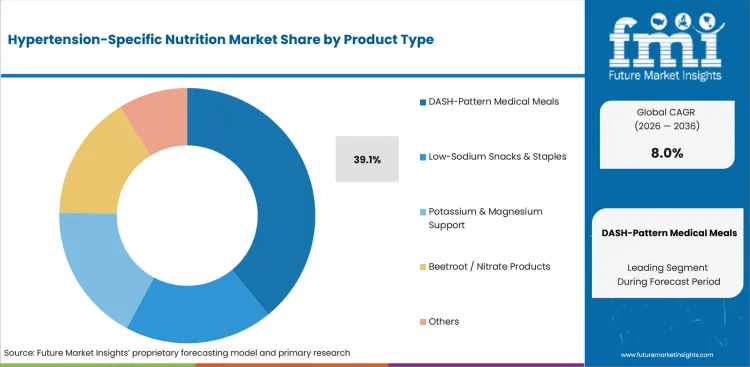
DASH-pattern medical meals fix sodium and portion composition before the meal reaches the patient. NHLBI noted in January 2025 that lower-sodium DASH patterns produced larger blood-pressure reductions than higher-sodium versions, giving medical nutrition programs a reason to standardize meal composition.
- By product type, DASH-pattern medical meals are estimated to hold 39.1% in 2026 owing to complete meal control that reduces daily planning work.
- Clinicians can recommend a defined meal pattern without asking patients to calculate each ingredient at home. Repeat orders depend on taste and delivery reliability because controlled composition provides little benefit if patients stop eating the meals.
Why does the below-140-mg-per-serving tier lead the sodium level category?
A per-serving sodium ceiling reduces comparison work for consumers dividing sodium intake between several foods each day. Functional foods sold beside condition-oriented products need nutrient information that can be understood before checkout.
- In 2026, the below-140-mg-per-serving tier is expected to lead the sodium level category with 50.4% share due to a visible ceiling that simplifies product comparison.
- FDA proposed in January 2025 that front-of-package nutrition boxes classify sodium using three levels named Low, Med and High. A visible sodium band lets shoppers compare per-serving thresholds without recalculating the daily limit.
How do physician - payer-referred programs shape the care context category?
Referral programs establish eligibility before the first delivery and show how nutrition fits ongoing care. NHS England North West reported in May 2025 that community pharmacies had delivered more than 957 thousand blood-pressure checks since October 2021, giving clinical nutrition services a sizable detection point for further assessment.
- Physician - payer-referred programs are projected to hold 47.5% of care context revenue in 2026, attributable to clinical selection and reduced out-of-pocket exposure for eligible members.
- Health plans can direct eligible members into a defined nutrition service without asking households to choose among unrelated products. Retention depends on benefit eligibility and meal acceptance once the initial referral is complete.
What supports prepared meals in the form category?
Prepared meals control ingredients during production and remove much of the cooking work from a repeated sodium-reduction routine. Meal replacement products face a similar practical test because portion control and delivery convenience must remain useful beyond the first week.
- Based on form, prepared meals are projected to account for 49.3% in 2026, underpinned by direct control over ingredients and portion size at the point of consumption.
- NIH reported in August 2025 that DASH4D researchers prepared and measured every study meal in a clinical research kitchen. The controlled feeding design demonstrates why prepared formats can standardize composition even though commercial retention still depends on taste and delivery reliability.
What supports online - DTC demand within the sales channel category?
Online ordering lets consumers compare nutrition details and schedule replenishment without depending on one local store's assortment. HHS guidance updated in January 2026 says registered dietitians can use telehealth for customized nutrition plans that include low-sodium needs, linking personalized nutrition services with remote follow-up.
- Online - DTC is likely to capture 42.9% share in 2026, driven by detailed product information and repeat ordering that households can manage from home.
- Remote follow-up lets registered dietitians adjust low-sodium plans without requiring every review in person. The channel remains useful provided product information and refill timing stay visible between consultations.
What are the drivers, restraints and opportunities in the Hypertension-Specific Nutrition Market?
Screening and sodium-control needs support demand, while taste and repeat-order cost limit adherence and care-linked meal programs broaden payment routes.
- Driver: A large hypertension population sustains demand for products that make sodium reduction easier to execute after diagnosis or screening.
- Restraint: Taste problems and repeat-order cost can end adherence before a nutrition routine becomes durable, especially if supplements introduce extra sodium or dosing friction.
- Opportunity: Care-linked meal programs can place condition-specific food inside existing benefit arrangements that reduce the household cost of continued use.
Hypertension prevalence keeps the potential user pool large even though diagnosis alone does not produce an executable food routine. CDC reported in June 2026 that 48.1% of USA adults had high blood pressure. Conversion into purchases requires nutrient information and daily use that consumers can repeat without rebuilding their diet.
Formulation choices can work against the sodium-control objective that brought a consumer to the product. Germany's BZfE reported in June 2025 that effervescent supplements in its market check contributed 0.17 to 1.46 grams of salt per daily dose. Cardiovascular supplements therefore need clear sodium disclosure and dosing discipline before convenience can translate into repeat use.
Care-linked meal models can reach users through an existing payment arrangement instead of depending entirely on a separate wellness purchase. CMS updated its Medicare Shared Savings Program Application Toolkit in May 2025 with 2026 Prepaid Shared Savings materials that include nutrition counseling and home-delivered meal support. The program establishes an institutional route for qualifying nutrition services without implying universal coverage for people with hypertension.
Which country CAGRs are covered in the Hypertension-Specific Nutrition Market?
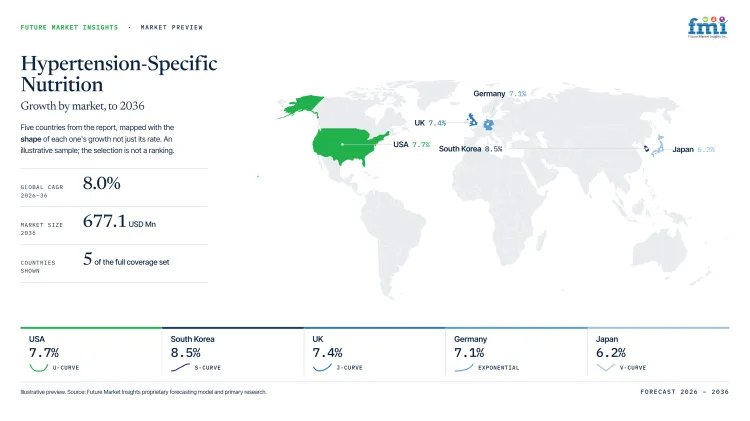
| Country | CAGR |
|---|---|
| South Korea | 8.5% |
| USA | 7.7% |
| UK | 7.4% |
| Germany | 7.1% |
| Japan | 6.2% |
How do country-level CAGRs compare in the Hypertension-Specific Nutrition Market?
South Korea forms the upper position at 8.5% and Japan anchors the lower end at 6.2%. USA at 7.7% and UK at 7.4% form a central group beside Germany at 7.1%. The 2.3-point spread is narrow enough that access routes and food habits can influence commercial performance more than the ranking itself.
- South Korea's dense digital retail makes online discovery a practical route into lower-sodium trial purchases for households.
- USA supports direct delivery beside mass retail and gives condition-focused products several routes into household purchasing.
- UK community pharmacies identify elevated blood pressure at scale and often hand continued nutrition spending back to households.
- Germany applies close nutrition-claim scrutiny that raises documentation requirements for supplement and functional-food cardiovascular positioning.
- Japan rewards familiar portions and flavors, making localized food design central to repeat use for specialized products.
Comparable CAGRs therefore conceal different commercial tasks because countries vary in discovery routes and continued-payment conditions. The full report provides country-level CAGR analysis across North America, Latin America, Western Europe, Eastern Europe, East Asia, South Asia and Pacific, and the Middle East and Africa.
Country-wise Analysis
- Consumers in the USA can buy hypertension-focused meals and supplements through direct delivery or retail channels without waiting for a formal benefit decision. Hypertension-specific nutrition demand in USA is forecast to rise at a 7.7% CAGR over the forecast period, supported by multiple access routes and a large treated population. CDC documented in August 2026 that eight food categories supplied about one-third of total USA dietary sodium during 2021-2023 and concentrated intervention points inside everyday eating. Specialized nutrition programs can target those intake points through foods already used at home, although uneven health-plan coverage leaves repeat-order cost with many households and makes retention sensitive to monthly expense.
- UK blood-pressure detection reaches consumers through community pharmacies and NHS digital channels prior to any nutrition purchase. NHS England reported in February 2026 that its high-blood-pressure webpage received just over two million visits during 2025 and rose 36% from the previous year. The UK hypertension-specific nutrition outlook is anticipated to advance at a 7.4% CAGR over the assessment period, driven by early identification and established heart-health retail channels. Heart health supplements can absorb part of that interest through familiar retail formats, though inconsistent funded nutrition access keeps affordability central following diagnosis. Retailers therefore need refill prices that remain credible once the initial health signal loses urgency.
- German consumers encounter sodium mainly through processed foods and can access cardiovascular supplements through familiar pharmacy retail. Sales of hypertension-specific nutrition in Germany are projected to record a 7.1% CAGR during the assessment period, supported by pharmacy access and continuing cardiovascular nutrition awareness. The German Nutrition Society updated its sodium guidance in September 2025 and identified processed foods as the main dietary sodium source. Mineral supplements fit that retail habit through clear dosing and ingredient disclosure, but strict claim expectations raise the evidence burden for cardiovascular positioning. Pharmacy access therefore eases discovery without solving the reimbursement gap that limits repeated preventive nutrition purchases.
- Japanese consumers already recognize foods with defined function claims, but the notification route now asks brands for more structured safety and manufacturing documentation. From April 2025 the Consumer Affairs Agency requires new function-claim notifications to separate safety information from manufacturing-quality and functionality records. Adoption of hypertension-specific nutrition in Japan is estimated to expand at a 6.2% CAGR through 2036, supported by functional-food familiarity and national salt-reduction goals. Beetroot powder and related cardiovascular formats can use those familiar channels if claims remain within the documented evidence package. Local flavor expectations still make aggressive sodium reduction harder to sustain, so entry depends on balancing claim compliance with foods that households will reorder.
- South Korean sodium exposure is concentrated in frequently eaten meal categories such as noodles and soups, so reformulation must protect familiar flavor instead of relying on occasional specialty products. In South Korea hypertension-specific nutrition demand is predicted to advance at an 8.5% CAGR through 2036, driven by visible sodium-reduction needs and strong digital product discovery. Dietary supplement formats can reach consumers quickly online and through pharmacy retail, but food products face a harder repeat-use test. South Korea's Ministry of Food and Drug Safety reported in July 2025 that average sodium intake was 3,136 mg per day in 2023, based on KDCA survey data, and five food groups supplied more than half of total intake. Familiar flavor still limits how aggressively manufacturers can cut sodium in foods bought repeatedly.
Who are the notable companies in the Hypertension-Specific Nutrition Market?
Mom's Meals (PurFoods), BistroMD, ModifyHealth, Abbott, HumanN, NOW Health Group, Pharmavite (Nature Made), and Step One Foods are the notable companies in this market.
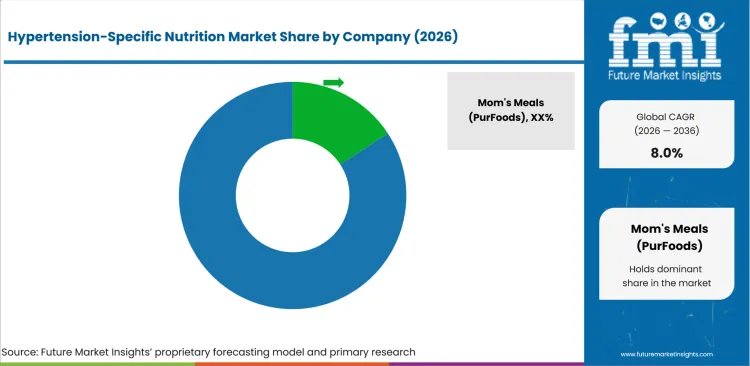
Mom's Meals and ModifyHealth serve care-linked meal delivery and BistroMD plus Step One Foods sell prepared foods directly to households. Abbott and HumanN operate through broader clinical or cardiovascular nutrition channels that reach pharmacy and retail settings. NOW Health Group and Pharmavite (Nature Made) provide supplement manufacturing and retail reach, but hypertension positioning still requires condition-relevant evidence.
- Mom's Meals (PurFoods) and ModifyHealth document care-linked nutrition programs that can operate with payer or provider referral routes.
- BistroMD and Step One Foods sell direct food programs that place structured cardiovascular eating inside recurring home delivery.
- Abbott and HumanN serve broader clinical or cardiovascular nutrition routes and NOW Health Group plus Pharmavite (Nature Made) provide supplement manufacturing and retail access.
Competitive Benchmarking: Hypertension-Specific Nutrition Market
| Company | Condition-Relevant Nutrition Scope | Care-Model Breadth | Format or Channel Breadth | Geographic Reach |
|---|---|---|---|---|
| Mom's Meals (PurFoods) | High | High | High | United States, nationwide delivery |
| BistroMD | Medium | Low | Low | United States, direct delivery |
| ModifyHealth | High | High | High | United States, nationwide delivery |
| Abbott | Medium | Medium | High | Global clinical and retail presence |
| HumanN | High | Low | Medium | United States retail, professional and online channels |
| NOW Health Group | Medium | Low | High | International retail and online channels |
| Pharmavite (Nature Made) | Medium | Low | High | United States mass retail and pharmacy channels |
| Step One Foods | High | Low | Low | United States direct online channels |
Key Developments in the Hypertension-Specific Nutrition Market
- In June 2026, Mom's Meals and Agilix Health launched a collaboration that places medically tailored meals inside high-risk Medicare Advantage care models.
- In February 2026, HumanN and Texas Athletics activated Heart Health Month experiences at Moody Center that carried cardiovascular-health messaging into a consumer sports setting.
- In September 2025, ModifyHealth expanded in-network virtual dietitian access through major USA insurers and linked that coverage to condition-specific medically tailored meals.
Key Players in the Hypertension-Specific Nutrition Market
Care-Linked Meal Platforms
- Mom's Meals (PurFoods)
- ModifyHealth
Direct Prepared-Food Programs
- BistroMD
- Step One Foods
Clinical and Cardiovascular Nutrition Brands
- Abbott
- HumanN
- NOW Health Group
- Pharmavite (Nature Made)
Hypertension-Specific Nutrition Market - Report Scope
| Coverage field | Report scope |
|---|---|
| Market breakdown | By product type, sodium level, care context, form, sales channel and region. |
| Quantitative Units | Revenue in USD million and CAGR in %. |
| Market Definition | Revenue includes prepared meals, foods, supplements, snacks and beverages explicitly designed, marketed or structured for hypertension-related nutrition management. |
| Regions Covered | North America, Latin America, Western Europe, Eastern Europe, East Asia, South Asia and Pacific, and Middle East and Africa. |
| Countries Covered | USA, UK, Germany, Japan, South Korea, and 20+ countries included in the full report. |
| Key Companies | Mom's Meals (PurFoods), BistroMD, ModifyHealth, Abbott, HumanN, NOW Health Group, Pharmavite (Nature Made), and Step One Foods. |
| Forecast Period | 2026 to 2036. |
| Approach | Primary and secondary research with market triangulation. |
Hypertension-Specific Nutrition Market - Research Methodology
| Method | Approach |
|---|---|
| Primary Research | FMI analysts gathered input from manufacturers, service providers, technology developers, distributors, end users, procurement teams, and subject-matter experts. Interviews examined purchasing decisions, product or service evaluation, adoption barriers, approval requirements, pricing considerations, and expectations for technical or commercial support. Respondents were also asked what evidence is required before a trial, pilot, or initial order develops into regular purchasing. |
| Desk Research | Desk research covered government statistics, regulatory publications, trade data, industry associations, technical literature, standards, company filings, product information, and official corporate announcements. Sources were reviewed for relevance, publication date, geographic coverage, and consistency with the defined market scope. Claims relating to performance, applications, approvals, capacity, investment, and commercial activity were retained only when supported by credible public evidence. |
| Market Sizing and Forecasting | The market model combined the baseline value with historical performance, segment structure, pricing and volume indicators, adoption levels, company participation, and country-level demand conditions. Forecast assumptions considered economic activity, investment trends, regulatory developments, technology adoption, purchasing cycles, supply availability, and barriers to wider market use. Segment and regional estimates were reconciled before the final market total was calculated. |
| Data Validation | Estimates were checked against multiple independent indicators, including public data, company activity, trade patterns, industry developments, and findings from primary interviews. Validation also tested whether products, services, applications, and company revenues fell within the defined market boundaries. Adjacent categories, unsupported claims, overlapping revenues, and activities without direct market relevance were excluded to reduce double counting and maintain consistency across segments and countries. |
Hypertension-Specific Nutrition Market by Segments
Hypertension-Specific Nutrition Market segmented by Product Type:
- DASH-Pattern Medical Meals
- Low-Sodium Snacks & Staples
- Potassium & Magnesium Support
- Beetroot - Nitrate Products
- Others
Hypertension-Specific Nutrition Market segmented by Sodium Level:
- <140 mg per Serving
- 140-400 mg per Serving
- Others
Hypertension-Specific Nutrition Market segmented by Care Context:
- Physician - Payer-Referred Programs
- Self-Directed
- Post-Event Secondary Prevention
Hypertension-Specific Nutrition Market segmented by Form:
- Prepared Meals
- Supplements
- Snacks & Beverages
- Others
Hypertension-Specific Nutrition Market segmented by Sales Channel:
- Online - DTC
- Retail Pharmacy
- Supermarkets & Hypermarkets
- Specialty & Health Stores
- Others
Hypertension-Specific Nutrition Market by Region:
- North America
- United States
- Canada
- Latin America
- Brazil
- Mexico
- Argentina
- Chile
- Western Europe
- Germany
- France
- United Kingdom
- Italy
- Spain
- Benelux
- Nordics
- Eastern Europe
- Poland
- Czech Republic
- Romania
- Hungary
- East Asia
- China
- Japan
- South Korea
- South Asia and Pacific
- India
- ASEAN
- Australia and New Zealand
- Middle East and Africa
- GCC Countries
- South Africa
- Türkiye
- Israel
Research Sources and Bibliography
- World Health Organization. (2025, September 25). Hypertension.
- Ministry of Health, Labour and Welfare, Japan. (2025, December 2).
- National Heart, Lung, and Blood Institute. (2025, January 3). NIH-supported DASH diet named "Best Heart-Healthy Diet" and "Best Diet for High Blood Pressure" in 2025.
- USA Food and Drug Administration. (2025, January 14). FDA Proposes Requiring At-a-Glance Nutrition Information on the Front of Packaged Foods.
- NHS England North West. (2025, May 6). This May Measure Month get your blood pressure checked to help avoid the number one cause of preventable death worldwide.
- National Institutes of Health. (2025, August 19). DASH-style diet helps control blood glucose.
- USA Department of Health and Human Services. (2026, January 20). Setting up telehealth to provide nutrition care.
- Centers for Disease Control and Prevention. (2026, June 2). High Blood Pressure Facts.
- Bundeszentrum für Ernährung. (2025, June 11). Überraschend viel Salz in Brausetabletten.
- Centers for Medicare & Medicaid Services. (2025, May 20). Medicare Shared Savings Program Application Toolkit.
- Koyama, A. K., Woodruff, R. C., Jackson, S. L., Gunn, J. P., & Self, J. L. (2026, August 13). Top Food Contributors of Sodium Intake in US Children and Adults Aged 1 Year or Older, National Health and Nutrition Examination Survey, August 2021-August 2023.
- NHS England. (2026, February 21). People searching NHS advice on high blood pressure skyrocketed last year.
- Deutsche Gesellschaft für Ernährung. (2025, September 10). Natrium.
- Consumer Affairs Agency, Japan. (2025, April 1).
- Ministry of Food and Drug Safety, Republic of Korea. (2025, July 1). Dietary Sodium and Sugar Intake Report 2019–2023.
- Mom's Meals. (2026, June 18). Mom’s Meals and Agilix Health Collaborate to Advance Food as Medicine.
- Humann. (2026, February 12). Humann and Texas Athletics Bring Heart Health Month to Life at Moody Center.
- ModifyHealth. (2025, September 4). ModifyHealth Expands Its In-Network Coverage, Strengthening Its Position as One of the Nation’s Largest Providers of Insurance-Covered Virtual Dietitian Support.
- Humann. (2026). Humann Products Named 2026 NEXTY Awards Finalists.
- Abbott. (2026, May 13). Abbott launches Ensure® Strength Pro in India to support healthy ageing.
- ModifyHealth. (2026, September 3). 1,000+ New Yorkers Access Food Assistance, School Supplies, and Health Resources Through Public Health Solutions and ModifyHealth Partnership.
- Mom's Meals. (2025, August 28). Mom’s Meals expands impact in fight against nutrition insecurity.
- Professional Pickleball Association. (2025, January 30). Abbott’s Ensure® Max Protein Joins the Professional Pickleball Association Tour as the Exclusive Protein Shake Partner.
- A2LA. (2026). NOW Health Group, Inc. - Accreditation scope for ISO/IEC 17025 testing laboratory.
- Mom's Meals. (2026, March 5). Mom’s Meals advances food as medicine in 2025, donating nearly 60,000 meals to individuals in need.
- Marley Spoon Group SE. (2026, April 30). Annual Report 2025.
- ModifyHealth. (2025, July 1). ModifyHealth and Monash University Expand Partnership to Advance Low-FODMAP Diet Awareness in the USA
- Abbott. (2025, November 13). Abbott Launches New and Advanced Ensure Diabetes Care, A Clinically Proven Formula to Help Manage Blood Sugar.
- Humann. (2026, September 2). From Lab to Legacy: How Humann Was Born From Research at The University of Texas.
- NOW Health Group. (2025, June 23). NOW ISO 17025 Accreditation Expanded in Both Chemical and Biological Scopes.
- Pharmavite. (2025, May 8). Pharmavite, Maker of Nature Made® Vitamins, Opens $250 Million Production Facility in New Albany, Ohio.
- Step One Foods. (2026, April 18). Bringing Something Savory to Step One Foods - The Right Way.
This bibliography is provided for reader reference and is not exhaustive. The full report contains the complete reference list and detailed citations
This Report Answers
- How large is the hypertension-specific nutrition market in 2026 and what value is forecast for 2036?
- Which operating conditions convert hypertension diagnosis and sodium guidance into repeat nutrition purchases during the forecast period?
- Why do DASH-pattern medical meals account for 39.1% of product type revenue during 2026?
- How do sodium thresholds and prepared meal formats change product comparison and adherence for hypertension-focused users?
- Why do physician - payer-referred programs represent 47.5% of care context revenue during 2026?
- How do the country CAGRs differ under local screening, food culture, claim rules, and access conditions?
- Which companies serve care-linked meals, direct prepared foods, clinical nutrition, and cardiovascular supplement routes in this market?
- Which taste, cost, coverage, and safety conditions can interrupt continued use after an initial nutrition recommendation?
- What competitive capabilities should health plans, providers, retailers, and nutrition teams compare before selecting a program or product?
Frequently Asked Questions
How big is the Hypertension-Specific Nutrition Market in 2026?
The hypertension-specific nutrition market is valued at USD 313.6 million in 2026 and is projected to reach USD 677.1 million by 2036. Persistent blood-pressure management needs support nutrition formats that make sodium control easier to repeat in daily eating.
What is the CAGR of the Hypertension-Specific Nutrition Market from 2026 to 2036?
The hypertension-specific nutrition market is projected to grow at a CAGR of 8.0% between 2026 and 2036. Expansion depends on diagnosed need and condition-focused formats that turn sodium reduction into a routine consumers can maintain.
Which product type leads the Hypertension-Specific Nutrition Market?
The DASH-pattern medical meals segment is expected to hold 39.1% of product type revenue in 2026, driven by complete meal control that reduces daily planning work. Controlled composition also gives clinicians a clearer dietary routine to recommend during ongoing hypertension management.
Which form holds an additional dominant share in the Hypertension-Specific Nutrition Market?
The prepared meals segment is projected to hold 49.3% of form revenue in 2026, attributable to direct control over ingredients and portion size. Ready-to-eat formats also reduce cooking work for consumers following a defined lower-sodium routine at home.
Which countries are included in the country growth comparison for the Hypertension-Specific Nutrition Market?
South Korea is projected to grow at 8.5% CAGR through 2036, followed by USA at 7.7% and UK at 7.4%. Germany and Japan complete the comparison because local access rules and food habits alter continued use.
Which companies are active in the Hypertension-Specific Nutrition Market?
Key companies operating in the market include Mom's Meals (PurFoods), BistroMD, ModifyHealth, Abbott, HumanN, NOW Health Group, Pharmavite (Nature Made), and Step One Foods. Their roles span care-linked meals and prepared foods as well as clinical nutrition and cardiovascular supplements.
Preview the report firsthand - request a free sample
Get SampleGet the brochure for pricing and purchase details.
Get PDFTable of Content
- Key Takeaways
- Market Size and CAGR
- Top Growth Driver
- Fastest Growing Segment
- Leading Region
- Key Companies
- Emerging Opportunities
- Executive Summary
- Global Market Outlook
- Demand-side Trends
- Supply-side Trends
- Technology Roadmap Analysis
- Analysis and Recommendations
- Analyst Perspective (What is happening? Why now? What should investors know?)
- Key Questions Answered
- How large is the market?
- What is the CAGR?
- What are key trends?
- Which region dominates?
- Who are the leaders?
- Market Overview
- Market Coverage / Taxonomy
- Market Definition / Scope / Limitations
- Research Methodology
- Chapter Orientation
- Analytical Lens and Working Hypotheses
- Market Structure, Signals, and Trend Drivers
- Benchmarking and Cross-market Comparability
- Market Sizing, Forecasting, and Opportunity Mapping
- Research Design and Evidence Framework
- Desk Research Programme (Secondary Evidence)
- Expert Input and Fieldwork (Primary Evidence)
- Tooling, Models, and Reference Databases
- Data Engineering and Model Build
- Quality Assurance and Audit Trail
- Market Background
- Market Dynamics (Drivers, Restraints, Opportunity, Trends)
- Scenario Forecast (Optimistic, Likely, Conservative)
- Impact Analysis
- AI Impact
- Sustainability Impact
- Regulatory Impact
- Technology Impact
- Consumer / Buyer Analysis
- Purchase Drivers
- Adoption Barriers
- Buyer Journey
- Opportunity Map Analysis
- Product Life Cycle Analysis
- Supply Chain Analysis
- Investment Feasibility Matrix
- Value Chain Analysis
- PESTLE and Porter's Analysis
- Regulatory Landscape
- Regional Parent Market Outlook
- Production and Consumption Statistics
- Import and Export Statistics
- Global Market Analysis and Forecast, 2021 to 2036
- Historical Market Size Value (USD Million) Analysis, 2021 to 2025
- Current and Future Market Size Value (USD Million) Projections, 2026 to 2036
- Y-o-Y Growth Trend Analysis
- Absolute $ Opportunity Analysis
- Global Market Pricing Analysis, 2021 to 2036
- Global Market Analysis and Forecast, By Product Type, 2021 to 2036
- Introduction / Key Findings
- Historical Market Size Value (USD Million) Analysis By Product Type, 2021 to 2025
- Current and Future Market Size Value (USD Million) Analysis and Forecast By Product Type, 2026 to 2036
- DASH-Pattern Medical Meals
- Low-Sodium Snacks & Staples
- Potassium & Magnesium Support
- Beetroot / Nitrate Products
- Others
- DASH-Pattern Medical Meals
- Y-o-Y Growth Trend Analysis By Product Type, 2021 to 2025
- Absolute $ Opportunity Analysis By Product Type, 2026 to 2036
- Global Market Analysis and Forecast, By Sodium Level, 2021 to 2036
- Introduction / Key Findings
- Historical Market Size Value (USD Million) Analysis By Sodium Level, 2021 to 2025
- Current and Future Market Size Value (USD Million) Analysis and Forecast By Sodium Level, 2026 to 2036
- <140 mg per Serving
- 140-400 mg per Serving
- Others
- <140 mg per Serving
- Y-o-Y Growth Trend Analysis By Sodium Level, 2021 to 2025
- Absolute $ Opportunity Analysis By Sodium Level, 2026 to 2036
- Global Market Analysis and Forecast, By Care Context, 2021 to 2036
- Introduction / Key Findings
- Historical Market Size Value (USD Million) Analysis By Care Context, 2021 to 2025
- Current and Future Market Size Value (USD Million) Analysis and Forecast By Care Context, 2026 to 2036
- Physician / Payer-Referred Programs
- Self-Directed
- Post-Event Secondary Prevention
- Physician / Payer-Referred Programs
- Y-o-Y Growth Trend Analysis By Care Context, 2021 to 2025
- Absolute $ Opportunity Analysis By Care Context, 2026 to 2036
- Global Market Analysis and Forecast, By Form, 2021 to 2036
- Introduction / Key Findings
- Historical Market Size Value (USD Million) Analysis By Form, 2021 to 2025
- Current and Future Market Size Value (USD Million) Analysis and Forecast By Form, 2026 to 2036
- Prepared Meals
- Supplements
- Snacks & Beverages
- Others
- Prepared Meals
- Y-o-Y Growth Trend Analysis By Form, 2021 to 2025
- Absolute $ Opportunity Analysis By Form, 2026 to 2036
- Global Market Analysis and Forecast, By Sales Channel, 2021 to 2036
- Introduction / Key Findings
- Historical Market Size Value (USD Million) Analysis By Sales Channel, 2021 to 2025
- Current and Future Market Size Value (USD Million) Analysis and Forecast By Sales Channel, 2026 to 2036
- Online / DTC
- Retail Pharmacy
- Supermarkets & Hypermarkets
- Specialty & Health Stores
- Others
- Online / DTC
- Y-o-Y Growth Trend Analysis By Sales Channel, 2021 to 2025
- Absolute $ Opportunity Analysis By Sales Channel, 2026 to 2036
- Global Market Analysis and Forecast, By Region, 2021 to 2036
- Introduction
- Historical Market Size Value (USD Million) Analysis By Region, 2021 to 2025
- Current Market Size Value (USD Million) Analysis and Forecast By Region, 2026 to 2036
- North America
- Latin America
- Western Europe
- Eastern Europe
- East Asia
- South Asia and Pacific
- Middle East & Africa
- Market Attractiveness Analysis By Region
- North America Market Analysis and Forecast, By Country, 2021 to 2036
- Historical Market Size Value (USD Million) Trend Analysis By Market Taxonomy, 2021 to 2025
- Market Size Value (USD Million) Forecast By Market Taxonomy, 2026 to 2036
- By Country
- USA
- Canada
- By Product Type
- By Sodium Level
- By Care Context
- By Form
- By Sales Channel
- By Country
- Market Attractiveness Analysis
- By Country
- By Product Type
- By Sodium Level
- By Care Context
- By Form
- By Sales Channel
- Key Takeaways
- Latin America Market Analysis and Forecast, By Country
- Historical Market Size Value (USD Million) Trend Analysis By Market Taxonomy, 2021 to 2025
- Market Size Value (USD Million) Forecast By Market Taxonomy, 2026 to 2036
- By Country
- Brazil
- Mexico
- Chile
- Rest of Latin America
- By Product Type
- By Sodium Level
- By Care Context
- By Form
- By Sales Channel
- By Country
- Market Attractiveness Analysis
- By Country
- By Product Type
- By Sodium Level
- By Care Context
- By Form
- By Sales Channel
- Key Takeaways
- Western Europe Market Analysis and Forecast, By Country
- Historical Market Size Value (USD Million) Trend Analysis By Market Taxonomy, 2021 to 2025
- Market Size Value (USD Million) Forecast By Market Taxonomy, 2026 to 2036
- By Country
- Germany
- UK
- Italy
- Spain
- France
- Nordic
- BENELUX
- Rest of Western Europe
- By Product Type
- By Sodium Level
- By Care Context
- By Form
- By Sales Channel
- By Country
- Market Attractiveness Analysis
- By Country
- By Product Type
- By Sodium Level
- By Care Context
- By Form
- By Sales Channel
- Key Takeaways
- Eastern Europe Market Analysis and Forecast, By Country
- Historical Market Size Value (USD Million) Trend Analysis By Market Taxonomy, 2021 to 2025
- Market Size Value (USD Million) Forecast By Market Taxonomy, 2026 to 2036
- By Country
- Russia
- Poland
- Hungary
- Balkan & Baltic
- Rest of Eastern Europe
- By Product Type
- By Sodium Level
- By Care Context
- By Form
- By Sales Channel
- By Country
- Market Attractiveness Analysis
- By Country
- By Product Type
- By Sodium Level
- By Care Context
- By Form
- By Sales Channel
- Key Takeaways
- East Asia Market Analysis and Forecast, By Country
- Historical Market Size Value (USD Million) Trend Analysis By Market Taxonomy, 2021 to 2025
- Market Size Value (USD Million) Forecast By Market Taxonomy, 2026 to 2036
- By Country
- China
- Japan
- South Korea
- By Product Type
- By Sodium Level
- By Care Context
- By Form
- By Sales Channel
- By Country
- Market Attractiveness Analysis
- By Country
- By Product Type
- By Sodium Level
- By Care Context
- By Form
- By Sales Channel
- Key Takeaways
- South Asia and Pacific Market Analysis and Forecast, By Country
- Historical Market Size Value (USD Million) Trend Analysis By Market Taxonomy, 2021 to 2025
- Market Size Value (USD Million) Forecast By Market Taxonomy, 2026 to 2036
- By Country
- India
- ASEAN
- Australia & New Zealand
- Rest of South Asia and Pacific
- By Product Type
- By Sodium Level
- By Care Context
- By Form
- By Sales Channel
- By Country
- Market Attractiveness Analysis
- By Country
- By Product Type
- By Sodium Level
- By Care Context
- By Form
- By Sales Channel
- Key Takeaways
- Middle East & Africa Market Analysis and Forecast, By Country
- Historical Market Size Value (USD Million) Trend Analysis By Market Taxonomy, 2021 to 2025
- Market Size Value (USD Million) Forecast By Market Taxonomy, 2026 to 2036
- By Country
- Kingdom of Saudi Arabia
- Other GCC Countries
- Türkiye
- South Africa
- Other African Union
- Rest of Middle East & Africa
- By Product Type
- By Sodium Level
- By Care Context
- By Form
- By Sales Channel
- By Country
- Market Attractiveness Analysis
- By Country
- By Product Type
- By Sodium Level
- By Care Context
- By Form
- By Sales Channel
- Key Takeaways
- Key Countries Market Analysis
- USA
- Pricing Analysis
- Market Share Analysis, 2025
- By Product Type
- By Sodium Level
- By Care Context
- By Form
- By Sales Channel
- Canada
- Pricing Analysis
- Market Share Analysis, 2025
- By Product Type
- By Sodium Level
- By Care Context
- By Form
- By Sales Channel
- Mexico
- Pricing Analysis
- Market Share Analysis, 2025
- By Product Type
- By Sodium Level
- By Care Context
- By Form
- By Sales Channel
- Brazil
- Pricing Analysis
- Market Share Analysis, 2025
- By Product Type
- By Sodium Level
- By Care Context
- By Form
- By Sales Channel
- Chile
- Pricing Analysis
- Market Share Analysis, 2025
- By Product Type
- By Sodium Level
- By Care Context
- By Form
- By Sales Channel
- Germany
- Pricing Analysis
- Market Share Analysis, 2025
- By Product Type
- By Sodium Level
- By Care Context
- By Form
- By Sales Channel
- UK
- Pricing Analysis
- Market Share Analysis, 2025
- By Product Type
- By Sodium Level
- By Care Context
- By Form
- By Sales Channel
- Italy
- Pricing Analysis
- Market Share Analysis, 2025
- By Product Type
- By Sodium Level
- By Care Context
- By Form
- By Sales Channel
- Spain
- Pricing Analysis
- Market Share Analysis, 2025
- By Product Type
- By Sodium Level
- By Care Context
- By Form
- By Sales Channel
- France
- Pricing Analysis
- Market Share Analysis, 2025
- By Product Type
- By Sodium Level
- By Care Context
- By Form
- By Sales Channel
- India
- Pricing Analysis
- Market Share Analysis, 2025
- By Product Type
- By Sodium Level
- By Care Context
- By Form
- By Sales Channel
- ASEAN
- Pricing Analysis
- Market Share Analysis, 2025
- By Product Type
- By Sodium Level
- By Care Context
- By Form
- By Sales Channel
- Australia & New Zealand
- Pricing Analysis
- Market Share Analysis, 2025
- By Product Type
- By Sodium Level
- By Care Context
- By Form
- By Sales Channel
- China
- Pricing Analysis
- Market Share Analysis, 2025
- By Product Type
- By Sodium Level
- By Care Context
- By Form
- By Sales Channel
- Japan
- Pricing Analysis
- Market Share Analysis, 2025
- By Product Type
- By Sodium Level
- By Care Context
- By Form
- By Sales Channel
- South Korea
- Pricing Analysis
- Market Share Analysis, 2025
- By Product Type
- By Sodium Level
- By Care Context
- By Form
- By Sales Channel
- Russia
- Pricing Analysis
- Market Share Analysis, 2025
- By Product Type
- By Sodium Level
- By Care Context
- By Form
- By Sales Channel
- Poland
- Pricing Analysis
- Market Share Analysis, 2025
- By Product Type
- By Sodium Level
- By Care Context
- By Form
- By Sales Channel
- Hungary
- Pricing Analysis
- Market Share Analysis, 2025
- By Product Type
- By Sodium Level
- By Care Context
- By Form
- By Sales Channel
- Kingdom of Saudi Arabia
- Pricing Analysis
- Market Share Analysis, 2025
- By Product Type
- By Sodium Level
- By Care Context
- By Form
- By Sales Channel
- Türkiye
- Pricing Analysis
- Market Share Analysis, 2025
- By Product Type
- By Sodium Level
- By Care Context
- By Form
- By Sales Channel
- South Africa
- Pricing Analysis
- Market Share Analysis, 2025
- By Product Type
- By Sodium Level
- By Care Context
- By Form
- By Sales Channel
- USA
- Market Structure Analysis
- Competition Dashboard
- Competition Benchmarking
- Market Share Analysis of Top Players
- By Regional
- By Product Type
- By Sodium Level
- By Care Context
- By Form
- By Sales Channel
- Emerging Startups
- Innovation Benchmarking
- Competition Analysis
- Competition Deep Dive
- Mom's Meals (PurFoods)
- Overview
- Product Portfolio
- Profitability by Market Segments
- Sales Footprint
- Strategy Overview
- Marketing Strategy
- Product Strategy
- Channel Strategy
- BistroMD
- ModifyHealth
- Abbott
- HumanN
- NOW Health Group
- Pharmavite (Nature Made)
- Step One Foods
- Mom's Meals (PurFoods)
- Case Studies
- Success Stories
- Recent Developments
- Competition Deep Dive
- Assumptions & Acronyms Used


