

- Market Size (2026)
- USD 2.1 Bn
- Forecast (2036)
- USD 3.2 Bn
- CAGR (2026 to 2036)
- 4.2%
How big is Ice Melt Pellets Market in 2026?
USD 2.1 billion in 2026 and USD 3.2 billion by 2036 at a 4.2% CAGR.
Demand for ice melt pellets is projected to expand at 4.2% CAGR between 2026 and 2036, increasing valuation from USD 2.1 billion in 2026 to USD 3.2 billion by 2036. The purchase cycle is seasonal, but many commercial buyers cannot defer treatment once ice affects entrances or other pedestrian routes.
Public winter-service programs show why material readiness matters across the wider deicing supply chain. National Highways reported in November 2024 that it had 535 gritters and more than 240,000 tonnes of rock salt in its own barns. That scale of pre-season stocking illustrates the operating requirement: deicing material must be available before weather conditions interrupt normal access.
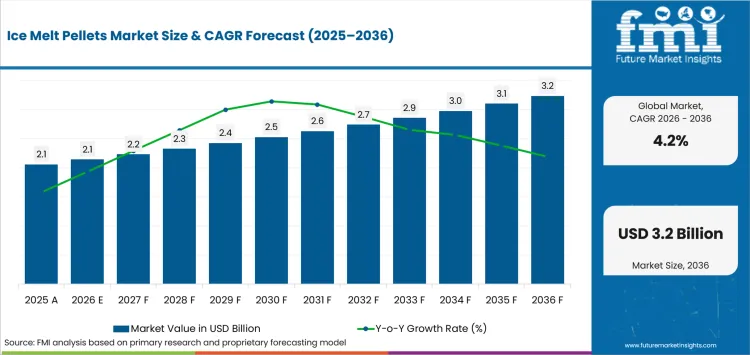
Key Takeaways of Ice Melt Pellets Market
- Recurring winter safety work supports seasonal replenishment across contractor routes and managed properties.
- Calcium chloride pellets are projected at 28.0% of Product Type in 2026, while 25-50 lb bags account for 38.0% of Packaging.
- Commercial properties and snow contractors are each estimated at 29.0% within their respective 2026 categories.
- Retail / home improvement is forecast to account for 34.0% of Sales Channel demand in 2026 because local inventory matters during short weather windows.
- Chloride runoff and corrosion concerns encourage more precise spreading, which can restrain indiscriminate solid-material use.
- Compass Minerals, Cargill, Kissner Milling, OxyChem, Morton Salt, K+S, Prestone, Green Earth Deicer, Safe Paw and National Salt serve different parts of the deicing supply chain.
Analyst Perspective
"Ice melt buyers rarely choose on chemistry alone. A contractor needs the product to work at the expected pavement temperature, arrive before the weather window closes and fit the handling method used on site. Suppliers that make those trade-offs easy to understand can defend value without encouraging excess application ."
- Nikhil Kaitwade, Principal Consultant, Future Market Insights
How is the Ice Melt Pellets Market segmented?
The ice melt pellets market is segmented by Product Type, Packaging, Application, Buyer Type, Sales Channel and Region.
Product Type separates calcium chloride pellets from magnesium chloride, rock salt pellets, blended products and pet-safe formulations. Packaging ranges from crew-portable bags to bulk bags, pails and super sacks. Application covers commercial properties, driveways and sidewalks, municipal walkways, industrial yards and institutional facilities. Buyer Type includes snow contractors, facility managers, retail consumers, municipalities and distributors. Sales Channel spans retail / home improvement, distributor depots, direct bulk supply and e-commerce.
Why do Calcium Chloride Pellets lead the Product Type category?
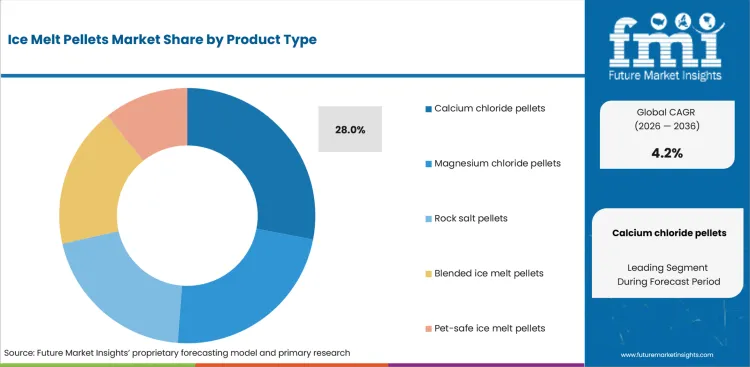
Calcium chloride pellets are selected when buyers need rapid ice penetration at lower pavement temperatures. OxyChem lists calcium chloride in pellet forms for snow and ice control, while Compass Minerals offers a professional pellet product for winter maintenance. The value of calcium chloride comes from targeted performance where commodity rock salt may be less suitable for the event.
- Calcium chloride pellets are projected to account for 28.0% of Product Type in 2026 because low-temperature performance supports priority surfaces and time-sensitive treatment.
- Magnesium chloride pellets, rock salt pellets and blended ice melt products give buyers lower-cost or application-specific alternatives, while pet-safe pellets address sites where animal exposure influences product choice.
Why do 25-50 lb bags lead the Packaging category?
The 25-50 lb range fits the physical workflow of crews that stage deicer near entrances and other bounded surfaces. It can be moved without bulk handling equipment and still provides useful on-site stock for repeated treatment. Small retail packs improve household convenience, while bulk bags and super sacks suit buyers with storage space and suitable handling equipment.
- In 2026, 25-50 lb bags are expected to lead Packaging with 38.0% share because they balance crew portability with seasonal inventory needs.
- Compass Minerals lists Safe Step Calcium Chloride 7300 in a 50 lb bag, and Cargill specifies a 50 lb bag for GreenMelt Ice Melter, showing how commercial deicers are packaged for portable job-site use.
Why do commercial properties lead the Application category?
Commercial properties create repeated spot-treatment requirements around entrances and pedestrian routes during operating hours. Facility teams often work across several surface types within one site, so a portable dry product can be staged close to use. The USA Environmental Protection Agency identifies sidewalks and parking areas among the places where deicing salts are applied, which aligns with the application pattern addressed by bagged pellets.
- Commercial properties are forecast to account for 29.0% of Application demand in 2026 because pedestrian access points can require treatment several times during a freeze event.
- Driveways / sidewalks remain relevant for household and small-business use, while municipal walkways, industrial yards and institutional facilities create larger managed-area requirements with more formal application practices.
Why do Snow contractors lead the Buyer Type category?
Snow contractors purchase against route obligations that can span several weather events. They need material before a storm, then require replenishment if refreeze or a second event extends the service window. That operating model favors suppliers that can provide consistent bagged product through distributors and depots without forcing contractors to hold all seasonal inventory at one site.
- Snow contractors are expected to account for 29.0% of Buyer Type demand in 2026 because route-based service work creates recurring seasonal procurement.
- Facility managers and municipalities buy against defined service areas, while retail consumers purchase in smaller quantities. Distributors connect these buyer groups with local inventory and help absorb short-term weather-driven changes in demand.
Why does Retail / Home improvement lead the Sales Channel category?
Retail and home-improvement stores serve purchases that often happen just before or during freezing weather. Buyers can compare temperature claims and package sizes in one trip, then carry the product away without arranging freight. Distributor depots and direct bulk supply suit professional accounts with planned volumes, while e-commerce widens assortment but must absorb shipping cost for dense materials.
- Retail / home improvement is projected to account for 34.0% of Sales Channel demand in 2026 because immediate local availability matters when weather changes quickly.
- Prestone sells a consumer calcium chloride pellet product, while Morton Salt maintains several packaged ice-melt formats. Green Earth Deicer also offers granular products in wholesale quantities, supporting a mix of local resale and direct purchasing routes.
What are the drivers, restraints and opportunities in the Ice Melt Pellets Market?
Recurring winter safety needs support replenishment, while chloride-management practices restrain overapplication and specialty formulations create room for higher-value use.
- Driver: Pre-season readiness and event-driven surface safety requirements sustain recurring purchases by snow contractors and facility teams.
- Restraint: Chloride runoff, corrosion exposure and more precise salt-management practices can reduce reliance on indiscriminate granular application.
- Opportunity: Low-temperature pellets and pet-sensitive formulations can capture buyers willing to pay for a better fit with specific operating conditions.
Winter-service buyers purchase deicer because traction loss can interrupt normal access. National Highways entered the 2024 winter period with more than 240,000 tonnes of rock salt in its barns, while Poland’s GDDKiA reported 259,384 tonnes of salt used on national roads during the 2024/2025 season. The scale of these programs illustrates why winter-material suppliers pre-position stock before demand becomes weather-driven. The broader sodium chloride market follows the same seasonal procurement logic in colder regions.
Salt-management rules increasingly favor measured application. Environment and Climate Change Canada maintains a code of practice for road-salt management, and Germany’s Autobahn operator describes precise salt use with greater reliance on brine. The USA Environmental Protection Agency also links excess salt with water-quality and infrastructure concerns. These practices raise the value of application guidance and can shift some demand away from indiscriminate dry-solid use. They also create room for low-chloride deicing products on infrastructure-sensitive sites.
The opportunity is more specific than simply selling more salt. Low-temperature chemistry can justify a premium on priority surfaces, while chloride-free or pet-sensitive products address sites with different risk criteria. Green Earth Deicer sells granular calcium magnesium acetate products in 50 lb formats, and Safe Paw markets a salt-free granular deicer. Demand for bio-based deicers also reflects buyer interest in alternatives where environmental exposure carries more weight.
Which country CAGRs are profiled in the Ice Melt Pellets Market?
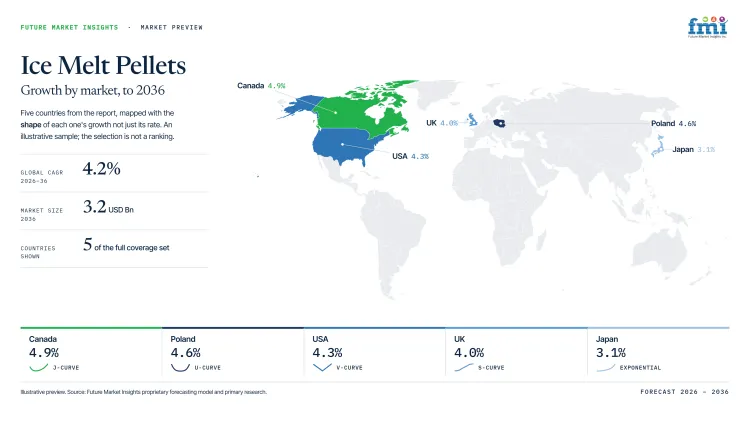
| Country | CAGR |
|---|---|
| Canada | 4.9% |
| USA | 4.3% |
| Japan | 3.1% |
| Poland | 4.6% |
| UK | 4.0% |
| Germany | 3.7% |
| Norway | 3.4% |
How do country-level CAGRs compare in the Ice Melt Pellets Market?
The seven country CAGRs span 1.8 percentage points, from 4.9% in Canada to 3.1% in Japan. Poland follows Canada at 4.6%, while the USA is forecast at 4.3%. The UK and Germany sit at 4.0% and 3.7%, with Norway at 3.4%. These rates describe expected expansion rather than present market size.
- Canada at 4.9% and Poland at 4.6% require early seasonal inventory planning because winter-service material can move through concentrated procurement windows.
- The USA is projected at 4.3%, supported by several purchase routes that include contractor supply, facility procurement and consumer retail.
- The UK is forecast at 4.0%, where established strategic-road salt programs leave packaged pellets focused more heavily on local commercial and household surfaces.
- Germany is projected at 3.7% as precise spreading and brine use on major roads increase the need to position dry pellets where portability still matters.
- Norway at 3.4% and Japan at 3.1% present targeted opportunities where winter maintenance must operate alongside pressure to limit unnecessary deicer application.
Comparable growth rates can still produce different market-entry conditions. The full report assesses country demand within North America, Latin America, Western Europe, Eastern Europe, East Asia, South Asia and Pacific, and the Middle East and Africa.
Country-wise Analysis
- Canada combines frequent winter maintenance with formal salt-management expectations. Ice melt pellet demand in Canada is projected to expand at 4.9% CAGR from 2026 to 2036. Environment and Climate Change Canada reports that road-salt management plans are intended to reduce environmental harm while maintaining road safety. For pellet suppliers, the commercial test is dependable seasonal stock with clear guidance for commercial and institutional surfaces.
- USA buyers include snow contractors and facility operators as well as retail consumers. Demand for ice melt pellets in the USA is forecast to rise at 4.3% CAGR through 2036. The USA Environmental Protection Agency identifies parking areas and sidewalks among surfaces where deicing salts are applied, while its current guidance also stresses practices that reduce salt entering waterways. Broad channel access therefore needs to be paired with controlled application.
- Japan is projected to record 3.1% CAGR from 2026 to 2036. In March 2025, the Ministry of Land, Infrastructure, Transport and Tourism announced about JPY 55.7 billion of additional support for local road snow-removal costs after heavy snowfall. Public winter spending shows the operating intensity in snow-prone regions, while suppliers still need products that fit local efforts to apply deicer only where necessary.
- Poland is forecast to expand at 4.6% CAGR through 2036. GDDKiA reported that 259,384 tonnes of road salt were used on national roads in the 2024/2025 winter season and that more than 333,000 tonnes remained in storage at season end. This scale of winter stock management reinforces the importance of pre-positioned supply for local pellet channels before prolonged cold periods.
- UK demand for ice melt pellets is projected to rise at 4.0% CAGR from 2026 to 2036. National Highways reported 535 gritters and more than 240,000 tonnes of rock salt in its own barns in November 2024. Major-road programs therefore remain centered on bulk salt, leaving packaged pellets more relevant for entrances, footpaths and other localized surfaces served through contractor or retail channels.
- Germany is forecast at 3.7% CAGR through 2036. Autobahn GmbH says salt use is precisely regulated and that brine helps reduce consumption without reducing winter-service safety. This creates substitution pressure on dry products for major roads. Pellet suppliers can concentrate on commercial properties and other locations where portable dry treatment remains easier to deploy.
- Norway is projected to expand at 3.4% CAGR from 2026 to 2036. Statens vegvesen has reported road-salt effects in monitored lakes and has described measures intended to reduce salting. Environmental pressure therefore rewards careful dosage and targeted use. Suppliers need to show why a pellet formulation fits the surface and temperature instead of competing only on material volume.
Who are the notable companies in the Ice Melt Pellets Market?
Compass Minerals, Cargill, Kissner Milling, OxyChem, Morton Salt, K+S, Prestone, Green Earth Deicer, Safe Paw and National Salt are notable companies serving the ice melt pellets market.
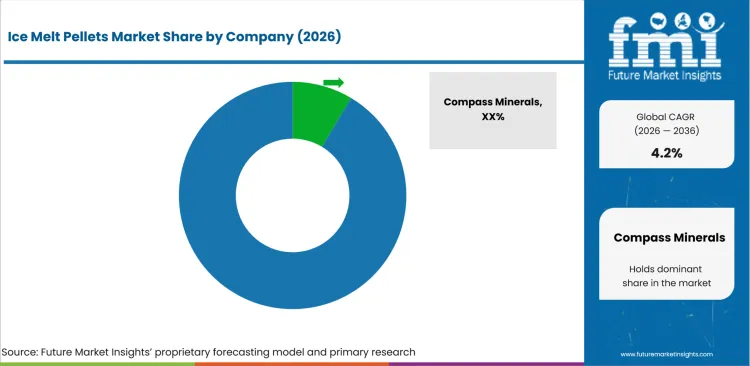
Competition reflects different positions in the deicing value chain. Compass Minerals and Cargill combine salt supply with packaged winter products. Kissner Milling and OxyChem bring formulation or calcium chloride capability, while Morton Salt and Prestone reach packaged end users. K+S serves deicing demand from its European mineral-products base. Green Earth Deicer and Safe Paw emphasize specialty formulations, and National Salt supports regional distribution.
- Broad deicing platforms: Compass Minerals, Cargill, Morton Salt and K+S combine core salt or mineral capability with packaged or enhanced winter products.
- Formulation and calcium chloride specialists: Kissner Milling, OxyChem and Prestone compete where low-temperature performance or formulated ice-melt chemistry matters.
- Specialty and channel-focused suppliers: Green Earth Deicer, Safe Paw and National Salt address differentiated formulations or local distribution requirements.
Competitive Benchmarking: Ice Melt Pellets Market
| Company | Granular Deicer Breadth | Contractor Packaging & Supply | Specialty Formulations | Geographic Reach |
|---|---|---|---|---|
| Compass Minerals | High | High | High | North America with UK operations |
| Cargill | Medium | High | High | USA and Canada deicing supply |
| Kissner Milling | High | High | High | North American manufacturing and distribution |
| OxyChem | Medium | High | Medium | USA, Canada and Latin America |
| Morton Salt | High | Medium | High | USA packaged consumer and commercial channels |
| K+S | Medium | High | Medium | Germany and broader European markets |
| Prestone | Low | Low | Medium | USA retail channel |
| Green Earth Deicer | High | Medium | High | USA wholesale and dealer channel |
| Safe Paw | Low | Medium | High | USA retail and e-commerce |
| National Salt | Medium | High | Medium | Regional USA distribution centered on Ohio |
Scoring basis: Granular Deicer Breadth is High when a company offers several solid deicing chemistries or granular formats, Medium for a narrower range and Low for a limited range. Contractor Packaging & Supply reflects 50 lb, pallet, bulk or distributor-scale supply. Specialty Formulations reflects low-temperature, pet-sensitive or lower-chloride products. Geographic Reach indicates the principal deicing markets served.
Key Developments in the Ice Melt Pellets Market
- In August 2026, Compass Minerals reported that the 2026-27 highway deicing bid season was constructive in its core USA markets, with improved pricing and growth in demand tenders. The company said it was aligning production and planning with supply conditions across its system.
- In January 2026, Occidental completed the sale of OxyChem to Berkshire Hathaway. OxyChem remains an established calcium chloride supplier for snow and ice control, placing a relevant deicing chemistry business under new ownership.
- In March 2026, K+S said de-icing salt sales volumes for 2026 were expected to be higher than in 2025, assuming average winter conditions in the fourth quarter after favorable early-year weather. The outlook reinforces the sensitivity of winter-material demand to seasonal conditions.
Key Players in the Ice Melt Pellets Market
Broad Salt and Deicing Platforms
- Compass Minerals
- Cargill
- Morton Salt
- K+S
Formulation and Calcium Chloride Specialists
- Kissner Milling
- OxyChem
- Prestone
Specialty and Distribution-Focused Suppliers
- Green Earth Deicer
- Safe Paw
- National Salt
Ice Melt Pellets Market - Report Scope
| Coverage field | Report scope |
|---|---|
| Market breakdown | By Product Type, Packaging, Application, Buyer Type, Sales Channel and Region. |
| Quantitative Units | USD billion. |
| Market Definition | The market covers revenue from ice melt pellets across the defined product, packaging, application, buyer and sales-channel categories. Liquid deicers and other winter-maintenance products are excluded. |
| Regions Covered | North America, Latin America, Western Europe, Eastern Europe, East Asia, South Asia and Pacific, and Middle East and Africa. |
| Countries Covered | Canada, USA, Japan, Poland, UK, Germany, Norway, and additional countries included in the full report. |
| Key Companies Profiled | Compass Minerals, Cargill, Kissner Milling, OxyChem, Morton Salt, K+S, Prestone, Green Earth Deicer, Safe Paw, National Salt. |
| Forecast Period | 2026 to 2036. |
| Approach | Primary and secondary research with market triangulation. |
Ice Melt Pellets Market - Research Methodology
| Method | Approach |
|---|---|
| Primary Research | FMI analysts engage manufacturers, distributors, snow contractors, facility managers and procurement teams to understand purchase triggers, formulation choice, packaging preferences, seasonal stocking and the operating conditions that affect repeat demand. |
| Desk Research | Desk research draws on government winter-maintenance statistics, environmental guidance, company filings, product information and corporate announcements to assess deicing chemistry, buyer operations and supplier activity. |
| Market Sizing and Forecasting | Market sizing considers baseline value, segment structure, company participation and country winter-service conditions. Forecasts account for replenishment cycles, formulation mix, channel development, environmental constraints and substitution from liquid or pre-wet deicing practices. |
| Data Validation | Validation uses multiple market indicators and category boundaries to maintain consistency across product, channel, country and company views. |
Ice Melt Pellets Market by Segments
Ice Melt Pellets Market segmented by Product Type:
- Calcium chloride pellets
- Magnesium chloride pellets
- Rock salt pellets
- Blended ice melt pellets
- Pet-safe ice melt pellets
Ice Melt Pellets Market segmented by Packaging:
- 25-50 lb bags
- Bulk bags
- Small retail packs
- Pails / tubs
- Super sacks
Ice Melt Pellets Market segmented by Application:
- Commercial properties
- Driveways / sidewalks
- Municipal walkways
- Industrial yards
- Institutional facilities
Ice Melt Pellets Market segmented by Buyer Type:
- Snow contractors
- Facility managers
- Retail consumers
- Municipalities
- Distributors
Ice Melt Pellets Market segmented by Sales Channel:
- Retail / home improvement
- Distributor depots
- Direct bulk supply
- E-commerce
Ice Melt Pellets Market by Region:
- North America
- United States
- Canada
- Latin America
- Brazil
- Mexico
- Argentina
- Chile
- Western Europe
- Germany
- France
- United Kingdom
- Italy
- Spain
- Benelux
- Nordics
- Eastern Europe
- Poland
- Czech Republic
- Romania
- Hungary
- East Asia
- China
- Japan
- South Korea
- South Asia and Pacific
- India
- ASEAN
- Australia and New Zealand
- Middle East and Africa
- GCC Countries
- South Africa
- Türkiye
- Israel
Research Sources and Bibliography
- Environment and Climate Change Canada. (2025, October 15). Code of Practice for the Environmental Management of Road Salts.
- USA Environmental Protection Agency. (2025, September 30). Best Management Practices for Deicing and Winter Maintenance.
- Ministry of Land, Infrastructure, Transport and Tourism, Japan. (2025, March 18). Additional support for local road snow-removal costs.
- General Directorate for National Roads and Motorways, Poland. (2025, June). Summary of Winter 2024/2025.
- National Highways. (2024, November 19). Road users urged to prepare for extreme weather conditions as winter breakdowns increase.
- Die Autobahn GmbH des Bundes. (2024, November 6). Winter service on Germany’s motorways: safety and efficiency first.
- Statens vegvesen. (2025, May 7). Monitoring of lakes affected by road salt and measures to reduce salting.
- Compass Minerals. (2026, August 5). Compass Minerals Reports Fiscal 2026 Third-Quarter Results.
- Compass Minerals. (n.d.). Safe Step Calcium Chloride 7300.
- Cargill. (2022, April). Diamond Crystal GreenMelt Ice Melter.
- Occidental. (2026, January 2). Occidental Completes Sale of OxyChem.
- K+S Aktiengesellschaft. (2026, March 12). Financial figures in line with expectations.
- K+S Aktiengesellschaft. (n.d.). De-icing salt products and winter-service solutions.
- OxyChem. (n.d.). Calcium Chloride for snow and ice control.
- Morton Salt. (n.d.). Action Melt Elite and packaged snow and ice products.
- Kissner Milling. (n.d.). Stealth Blue and packaged ice melt products.
- Prestone. (n.d.). Driveway Heat concentrated ice melter.
- The Green Earth Deicer Company, Inc. (n.d.). Solid granular deicers and wholesale ice melt products.
- Safe Paw. (n.d.). Salt-free granular ice melter for retail and bulk applications.
- National Salt Distributors. (n.d.). Deicing salt and packaged ice melt products.
This bibliography is provided for reader reference and is not exhaustive. The full report contains the complete reference list and detailed citations.
This Report Answers
- How large is the Ice Melt Pellets Market in 2026 and 2036?
- Which winter-safety conditions support recurring demand for ice melt pellets?
- Why do calcium chloride pellets account for the leading Product Type share?
- How do 25-50 lb bags shape commercial handling and replenishment?
- Why do commercial properties and snow contractors account for the leading shares within their categories?
- How do country-level growth rates differ across Canada, USA, Japan, Poland, UK, Germany and Norway?
- Which companies serve broad deicing, formulation or specialty channel requirements?
- How do chloride-management practices and brine substitution affect solid pellet demand?
Frequently Asked Questions
How big is the ice melt pellets market in 2026?
USD 2.1 billion represents the ice melt pellets market value in 2026. Demand is projected to reach USD 3.2 billion by 2036 as recurring winter-safety purchases continue across contractor, facility and consumer applications.
What is the CAGR of the ice melt pellets market from 2026 to 2036?
A 4.2% CAGR is projected for the ice melt pellets market between 2026 and 2036. Growth depends on seasonal replenishment and the value of formulations that match colder conditions or more sensitive use sites.
Which Product Type segment accounts for 28.0% of the ice melt pellets market?
Calcium chloride pellets are projected to account for 28.0% of Product Type demand in 2026. Their commercial role is tied to rapid melting and lower-temperature performance on surfaces where response time matters.
How much will the ice melt pellets market add between 2026 and 2036?
About USD 1.1 billion is expected to be added to the ice melt pellets market between 2026 and 2036. Seasonal replenishment and demand for formulations suited to colder or more sensitive sites support the decade-long increase.
Which companies are active in the ice melt pellets market?
Compass Minerals, Cargill, Kissner Milling, OxyChem, Morton Salt, K+S, Prestone, Green Earth Deicer, Safe Paw and National Salt are active across packaged deicing products, calcium chloride, specialty formulations or distribution channels relevant to ice melt pellets.
Preview the report firsthand - request a free sample
Get SampleGet the brochure for pricing and purchase details.
Get PDFTable of Content
- Key Takeaways
- Market Size and CAGR
- Top Growth Driver
- Fastest Growing Segment
- Leading Region
- Key Companies
- Emerging Opportunities
- Executive Summary
- Global Market Outlook
- Demand-side Trends
- Supply-side Trends
- Technology Roadmap Analysis
- Analysis and Recommendations
- Analyst Perspective (What is happening? Why now? What should investors know?)
- Key Questions Answered
- How large is the market?
- What is the CAGR?
- What are key trends?
- Which region dominates?
- Who are the leaders?
- Market Overview
- Market Coverage / Taxonomy
- Market Definition / Scope / Limitations
- Research Methodology
- Chapter Orientation
- Analytical Lens and Working Hypotheses
- Market Structure, Signals, and Trend Drivers
- Benchmarking and Cross-market Comparability
- Market Sizing, Forecasting, and Opportunity Mapping
- Research Design and Evidence Framework
- Desk Research Programme (Secondary Evidence)
- Expert Input and Fieldwork (Primary Evidence)
- Tooling, Models, and Reference Databases
- Data Engineering and Model Build
- Quality Assurance and Audit Trail
- Market Background
- Market Dynamics (Drivers, Restraints, Opportunity, Trends)
- Scenario Forecast (Optimistic, Likely, Conservative)
- Impact Analysis
- AI Impact
- Sustainability Impact
- Regulatory Impact
- Technology Impact
- Consumer / Buyer Analysis
- Purchase Drivers
- Adoption Barriers
- Buyer Journey
- Opportunity Map Analysis
- Product Life Cycle Analysis
- Supply Chain Analysis
- Investment Feasibility Matrix
- Value Chain Analysis
- PESTLE and Porter's Analysis
- Regulatory Landscape
- Regional Parent Market Outlook
- Production and Consumption Statistics
- Import and Export Statistics
- Global Market Analysis and Forecast, 2021 to 2036
- Historical Market Size Value (USD Billion) Analysis, 2021 to 2025
- Current and Future Market Size Value (USD Billion) Projections, 2026 to 2036
- Y-o-Y Growth Trend Analysis
- Absolute $ Opportunity Analysis
- Global Market Pricing Analysis, 2021 to 2036
- Global Market Analysis and Forecast, By Product Type, 2021 to 2036
- Introduction / Key Findings
- Historical Market Size Value (USD Billion) Analysis By Product Type, 2021 to 2025
- Current and Future Market Size Value (USD Billion) Analysis and Forecast By Product Type, 2026 to 2036
- Calcium chloride pellets
- Magnesium chloride pellets
- Rock salt pellets
- Blended ice melt pellets
- Pet-safe ice melt pellets
- Calcium chloride pellets
- Y-o-Y Growth Trend Analysis By Product Type, 2021 to 2025
- Absolute $ Opportunity Analysis By Product Type, 2026 to 2036
- Global Market Analysis and Forecast, By Packaging, 2021 to 2036
- Introduction / Key Findings
- Historical Market Size Value (USD Billion) Analysis By Packaging, 2021 to 2025
- Current and Future Market Size Value (USD Billion) Analysis and Forecast By Packaging, 2026 to 2036
- 25-50 lb bags
- Bulk bags
- Small retail packs
- Pails / tubs
- Super sacks
- 25-50 lb bags
- Y-o-Y Growth Trend Analysis By Packaging, 2021 to 2025
- Absolute $ Opportunity Analysis By Packaging, 2026 to 2036
- Global Market Analysis and Forecast, By Application, 2021 to 2036
- Introduction / Key Findings
- Historical Market Size Value (USD Billion) Analysis By Application, 2021 to 2025
- Current and Future Market Size Value (USD Billion) Analysis and Forecast By Application, 2026 to 2036
- Commercial properties
- Driveways / sidewalks
- Municipal walkways
- Industrial yards
- Institutional facilities
- Commercial properties
- Y-o-Y Growth Trend Analysis By Application, 2021 to 2025
- Absolute $ Opportunity Analysis By Application, 2026 to 2036
- Global Market Analysis and Forecast, By Buyer Type, 2021 to 2036
- Introduction / Key Findings
- Historical Market Size Value (USD Billion) Analysis By Buyer Type, 2021 to 2025
- Current and Future Market Size Value (USD Billion) Analysis and Forecast By Buyer Type, 2026 to 2036
- Snow contractors
- Facility managers
- Retail consumers
- Municipalities
- Distributors
- Snow contractors
- Y-o-Y Growth Trend Analysis By Buyer Type, 2021 to 2025
- Absolute $ Opportunity Analysis By Buyer Type, 2026 to 2036
- Global Market Analysis and Forecast, By Sales Channel, 2021 to 2036
- Introduction / Key Findings
- Historical Market Size Value (USD Billion) Analysis By Sales Channel, 2021 to 2025
- Current and Future Market Size Value (USD Billion) Analysis and Forecast By Sales Channel, 2026 to 2036
- Retail / home improvement
- Distributor depots
- Direct bulk supply
- E-commerce
- Retail / home improvement
- Y-o-Y Growth Trend Analysis By Sales Channel, 2021 to 2025
- Absolute $ Opportunity Analysis By Sales Channel, 2026 to 2036
- Global Market Analysis and Forecast, By Region, 2021 to 2036
- Introduction
- Historical Market Size Value (USD Billion) Analysis By Region, 2021 to 2025
- Current Market Size Value (USD Billion) Analysis and Forecast By Region, 2026 to 2036
- North America
- Latin America
- Western Europe
- Eastern Europe
- East Asia
- South Asia and Pacific
- Middle East & Africa
- Market Attractiveness Analysis By Region
- North America Market Analysis and Forecast, By Country, 2021 to 2036
- Historical Market Size Value (USD Billion) Trend Analysis By Market Taxonomy, 2021 to 2025
- Market Size Value (USD Billion) Forecast By Market Taxonomy, 2026 to 2036
- By Country
- USA
- Canada
- By Product Type
- By Packaging
- By Application
- By Buyer Type
- By Sales Channel
- By Country
- Market Attractiveness Analysis
- By Country
- By Product Type
- By Packaging
- By Application
- By Buyer Type
- By Sales Channel
- Key Takeaways
- Latin America Market Analysis and Forecast, By Country
- Historical Market Size Value (USD Billion) Trend Analysis By Market Taxonomy, 2021 to 2025
- Market Size Value (USD Billion) Forecast By Market Taxonomy, 2026 to 2036
- By Country
- Brazil
- Mexico
- Chile
- Rest of Latin America
- By Product Type
- By Packaging
- By Application
- By Buyer Type
- By Sales Channel
- By Country
- Market Attractiveness Analysis
- By Country
- By Product Type
- By Packaging
- By Application
- By Buyer Type
- By Sales Channel
- Key Takeaways
- Western Europe Market Analysis and Forecast, By Country
- Historical Market Size Value (USD Billion) Trend Analysis By Market Taxonomy, 2021 to 2025
- Market Size Value (USD Billion) Forecast By Market Taxonomy, 2026 to 2036
- By Country
- Germany
- UK
- Italy
- Spain
- France
- Nordic
- BENELUX
- Rest of Western Europe
- By Product Type
- By Packaging
- By Application
- By Buyer Type
- By Sales Channel
- By Country
- Market Attractiveness Analysis
- By Country
- By Product Type
- By Packaging
- By Application
- By Buyer Type
- By Sales Channel
- Key Takeaways
- Eastern Europe Market Analysis and Forecast, By Country
- Historical Market Size Value (USD Billion) Trend Analysis By Market Taxonomy, 2021 to 2025
- Market Size Value (USD Billion) Forecast By Market Taxonomy, 2026 to 2036
- By Country
- Russia
- Poland
- Hungary
- Balkan & Baltic
- Rest of Eastern Europe
- By Product Type
- By Packaging
- By Application
- By Buyer Type
- By Sales Channel
- By Country
- Market Attractiveness Analysis
- By Country
- By Product Type
- By Packaging
- By Application
- By Buyer Type
- By Sales Channel
- Key Takeaways
- East Asia Market Analysis and Forecast, By Country
- Historical Market Size Value (USD Billion) Trend Analysis By Market Taxonomy, 2021 to 2025
- Market Size Value (USD Billion) Forecast By Market Taxonomy, 2026 to 2036
- By Country
- China
- Japan
- South Korea
- By Product Type
- By Packaging
- By Application
- By Buyer Type
- By Sales Channel
- By Country
- Market Attractiveness Analysis
- By Country
- By Product Type
- By Packaging
- By Application
- By Buyer Type
- By Sales Channel
- Key Takeaways
- South Asia and Pacific Market Analysis and Forecast, By Country
- Historical Market Size Value (USD Billion) Trend Analysis By Market Taxonomy, 2021 to 2025
- Market Size Value (USD Billion) Forecast By Market Taxonomy, 2026 to 2036
- By Country
- India
- ASEAN
- Australia & New Zealand
- Rest of South Asia and Pacific
- By Product Type
- By Packaging
- By Application
- By Buyer Type
- By Sales Channel
- By Country
- Market Attractiveness Analysis
- By Country
- By Product Type
- By Packaging
- By Application
- By Buyer Type
- By Sales Channel
- Key Takeaways
- Middle East & Africa Market Analysis and Forecast, By Country
- Historical Market Size Value (USD Billion) Trend Analysis By Market Taxonomy, 2021 to 2025
- Market Size Value (USD Billion) Forecast By Market Taxonomy, 2026 to 2036
- By Country
- Kingdom of Saudi Arabia
- Other GCC Countries
- Türkiye
- South Africa
- Other African Union
- Rest of Middle East & Africa
- By Product Type
- By Packaging
- By Application
- By Buyer Type
- By Sales Channel
- By Country
- Market Attractiveness Analysis
- By Country
- By Product Type
- By Packaging
- By Application
- By Buyer Type
- By Sales Channel
- Key Takeaways
- Key Countries Market Analysis
- USA
- Pricing Analysis
- Market Share Analysis, 2025
- By Product Type
- By Packaging
- By Application
- By Buyer Type
- By Sales Channel
- Canada
- Pricing Analysis
- Market Share Analysis, 2025
- By Product Type
- By Packaging
- By Application
- By Buyer Type
- By Sales Channel
- Mexico
- Pricing Analysis
- Market Share Analysis, 2025
- By Product Type
- By Packaging
- By Application
- By Buyer Type
- By Sales Channel
- Brazil
- Pricing Analysis
- Market Share Analysis, 2025
- By Product Type
- By Packaging
- By Application
- By Buyer Type
- By Sales Channel
- Chile
- Pricing Analysis
- Market Share Analysis, 2025
- By Product Type
- By Packaging
- By Application
- By Buyer Type
- By Sales Channel
- Germany
- Pricing Analysis
- Market Share Analysis, 2025
- By Product Type
- By Packaging
- By Application
- By Buyer Type
- By Sales Channel
- UK
- Pricing Analysis
- Market Share Analysis, 2025
- By Product Type
- By Packaging
- By Application
- By Buyer Type
- By Sales Channel
- Italy
- Pricing Analysis
- Market Share Analysis, 2025
- By Product Type
- By Packaging
- By Application
- By Buyer Type
- By Sales Channel
- Spain
- Pricing Analysis
- Market Share Analysis, 2025
- By Product Type
- By Packaging
- By Application
- By Buyer Type
- By Sales Channel
- France
- Pricing Analysis
- Market Share Analysis, 2025
- By Product Type
- By Packaging
- By Application
- By Buyer Type
- By Sales Channel
- India
- Pricing Analysis
- Market Share Analysis, 2025
- By Product Type
- By Packaging
- By Application
- By Buyer Type
- By Sales Channel
- ASEAN
- Pricing Analysis
- Market Share Analysis, 2025
- By Product Type
- By Packaging
- By Application
- By Buyer Type
- By Sales Channel
- Australia & New Zealand
- Pricing Analysis
- Market Share Analysis, 2025
- By Product Type
- By Packaging
- By Application
- By Buyer Type
- By Sales Channel
- China
- Pricing Analysis
- Market Share Analysis, 2025
- By Product Type
- By Packaging
- By Application
- By Buyer Type
- By Sales Channel
- Japan
- Pricing Analysis
- Market Share Analysis, 2025
- By Product Type
- By Packaging
- By Application
- By Buyer Type
- By Sales Channel
- South Korea
- Pricing Analysis
- Market Share Analysis, 2025
- By Product Type
- By Packaging
- By Application
- By Buyer Type
- By Sales Channel
- Russia
- Pricing Analysis
- Market Share Analysis, 2025
- By Product Type
- By Packaging
- By Application
- By Buyer Type
- By Sales Channel
- Poland
- Pricing Analysis
- Market Share Analysis, 2025
- By Product Type
- By Packaging
- By Application
- By Buyer Type
- By Sales Channel
- Hungary
- Pricing Analysis
- Market Share Analysis, 2025
- By Product Type
- By Packaging
- By Application
- By Buyer Type
- By Sales Channel
- Kingdom of Saudi Arabia
- Pricing Analysis
- Market Share Analysis, 2025
- By Product Type
- By Packaging
- By Application
- By Buyer Type
- By Sales Channel
- Türkiye
- Pricing Analysis
- Market Share Analysis, 2025
- By Product Type
- By Packaging
- By Application
- By Buyer Type
- By Sales Channel
- South Africa
- Pricing Analysis
- Market Share Analysis, 2025
- By Product Type
- By Packaging
- By Application
- By Buyer Type
- By Sales Channel
- USA
- Market Structure Analysis
- Competition Dashboard
- Competition Benchmarking
- Market Share Analysis of Top Players
- By Regional
- By Product Type
- By Packaging
- By Application
- By Buyer Type
- By Sales Channel
- Emerging Startups
- Innovation Benchmarking
- Competition Analysis
- Competition Deep Dive
- Compass Minerals
- Overview
- Product Portfolio
- Profitability by Market Segments
- Sales Footprint
- Strategy Overview
- Marketing Strategy
- Product Strategy
- Channel Strategy
- Cargill
- Kissner Milling
- OxyChem
- Morton Salt
- K+S
- Prestone
- Green Earth Deicer
- Safe Paw
- National Salt
- Compass Minerals
- Case Studies
- Success Stories
- Recent Developments
- Competition Deep Dive
- Assumptions & Acronyms Used


