

- Market Size (2026)
- USD 1240.7 Mn
- Forecast (2036)
- USD 2201.0 Mn
- CAGR (2026 to 2036)
- 5.9%
Immersion Survival Suits Market Size, Market Forecast and Outlook By FMI
USD 1,240.7 million in 2026 and USD 2,201.0 million by 2036 at a 5.9% CAGR.
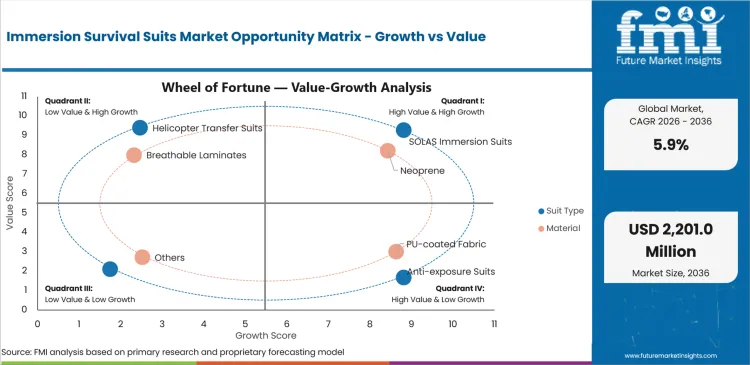
The immersion survival suits market is expected to grow from USD 1,171.6 million in 2025 to USD 2,201.0 million by 2036. SOLAS immersion suits are expected to hold a 47.0% market share in 2026, driven by cargo and passenger vessel requirements for approved abandon-ship protection, while neoprene-based suits are projected to account for 52.0% share due to their superior thermal insulation and ease of handling by crew members. Fleet owners buy approved suits to meet inspection rules and protect crews during cold-water emergencies.
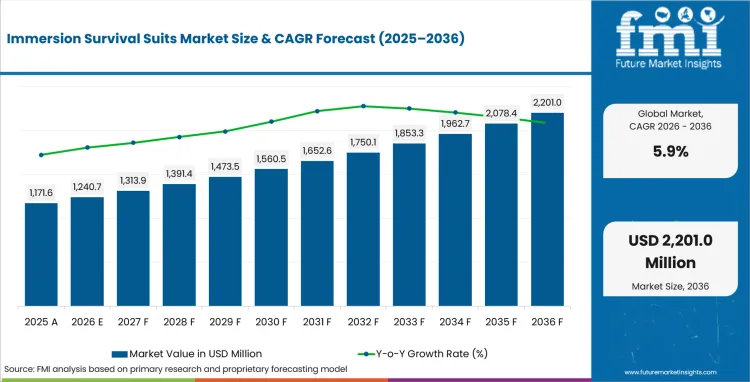
| Metric | Value |
|---|---|
| 2026 Market Size | USD 1,240.7 million |
| 2036 Market Size | USD 2,201.0 million |
| Forecast CAGR | 5.9% from 2026 to 2036 |
| Leading Suit Type | SOLAS Immersion Suits |
| SOLAS Immersion Suits Share in 2026 | 47.0% |
| Leading Material | Neoprene |
| Neoprene Share in 2026 | 52.0% |
| Fastest-growing Country | China |
| China CAGR | 6.8% by 2036 |
Summary of the Immersion Survival Suits Market
| Market Signal | Commercial Impact |
|---|---|
| Demand and Growth Drivers | Demand for immersion survival suits is expected to remain supported by recurring vessel inspections and mandatory safety compliance requirements.
|
| Product and Segment View | SOLAS Immersion Suits, Neoprene materials, Commercial Shipping applications, Universal Adult suits, and Direct Fleet Sales are expected to lead their respective segments.
|
| Geography and Growth Outlook | China, South Korea, and the United States are expected to remain influential markets due to shipbuilding activity and stringent maritime safety requirements.
|
| Competitive Landscape | Competition remains focused on approved product portfolios, service capabilities, and rapid replacement support for fleet operators.
|
| Analyst Perspective | Immersion survival suits remain a practical compliance-driven market where reliability, service support, and replacement accessibility determine purchasing decisions.
- Rahul Pandita, Principal Analyst at FMI |
Demand is not limited to new vessel delivery. Port inspections explain why replacement purchases continue after vessels enter service. USA Coast Guard reported in May 2026 that foreign-flag vessels made 76351 USA port calls in 2025. In May 2026, the Tokyo MOU annual report recorded 35546 port state control inspections in 2025. These inspection routes keep suit replacement close to compliance planning. VIKING's April 2025 female-fit CTV suit launch adds the design angle. Marine operators also review approved suits during wider vessel replacement and maintenance planning. This keeps survival clothing tied to annual safety budgets and audit preparation.
Which factors support expansion in the immersion survival suits market?
Certified suit replacement and service-backed procurement give the market a clear value base across regulated marine operations.
- Revenue begins with approved suit replacement before rental and service channels add incremental value.
- Supplier pricing reflects material choice and approval documentation before buyers compare color or storage format.
- Fleet trust improves from quick label and service-record checks supported by sizing instructions that reduce purchase friction.
- Service providers gain relevance during short port stays due to inspection findings that can create immediate replacement needs.
Why is the immersion survival suits market growing?
Mandatory carriage rules and port inspections keep approved suit replacement active across regulated fleets and offshore operators.
The growth outlook is shaped by inspection risk. For instance, Paris MoU reported in July 2025 that its 2024 detention rate reached 4.03%. A detained vessel loses operating time. Life-saving appliance readiness therefore becomes a commercial issue and not only a safety checklist. Suppliers are likely to witness opportunity when approved stock fits inspection calendars and cold-water route exposure.
How is the immersion survival suits market segmented?
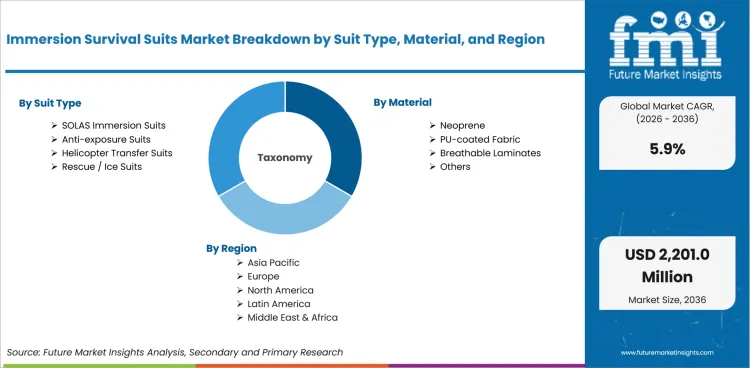
The immersion survival suits industry is segmented by suit type, material, end use, size / fit, sales channel
- SOLAS Immersion Suits are projected to secure 47.0% share in 2026 owing to broad carriage rules that keep demand concentrated among regulated vessels.
- Neoprene is anticipated to hold 52.0% share in 2026 due to insulation and buoyancy that make the material practical for abandon-ship suits.
- Commercial Shipping is forecast to represent 41.0% share in 2026 supported by inspection-led purchase timing that keeps replacement orders recurring.
- Universal Adult suits are expected to account for 58.0% share in 2026 attributable to simplified storage that helps crews manage mixed rotations.
- Direct Fleet Sales are projected to hold 44.0% share in 2026 driven by standard approved specifications that keep large-fleet procurement consistent.
Which suit type category holds a notable share in the immersion survival suits market?
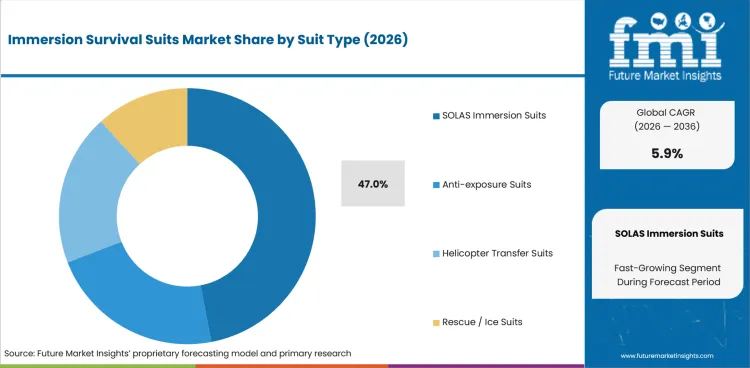
- SOLAS Immersion Suits are projected to account for 47.0% share in 2026 supported by regulated abandon-ship requirements that keep this category central.
- Anti-exposure and helicopter transfer suits gain relevance in work settings that need mobility before a full abandon-ship event.
How does material selection perform in the immersion survival suits market?
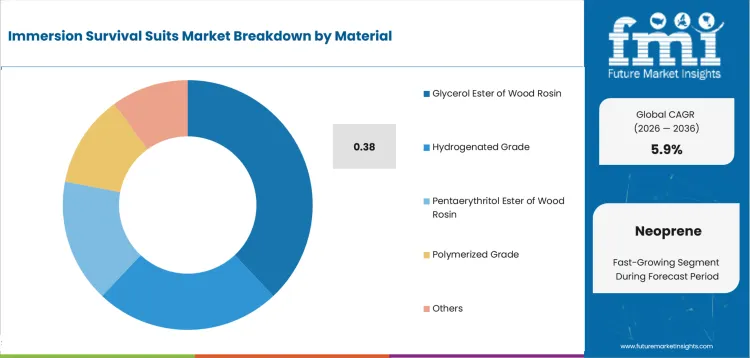
- Neoprene is expected to represent 52.0% share in 2026 owing to familiar construction that gives buyers insulation and buoyancy in one material choice.
- PU-coated fabric competes in programs that prioritize lower storage bulk and vacuum-packed replacement stock.
What drives demand across end-use categories in the immersion survival suits market?
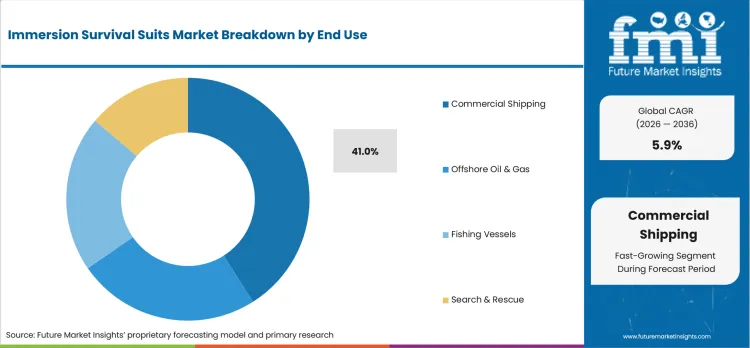
- Commercial Shipping is forecast to hold 41.0% share in 2026 attributable to port-state checks and scheduled vessel audits that shape order timing.
- Offshore Oil & Gas demand gains support from transfer risk and cold-water work near platforms or service vessels.
How are buyers selecting across size and fit options in the immersion survival suits market?
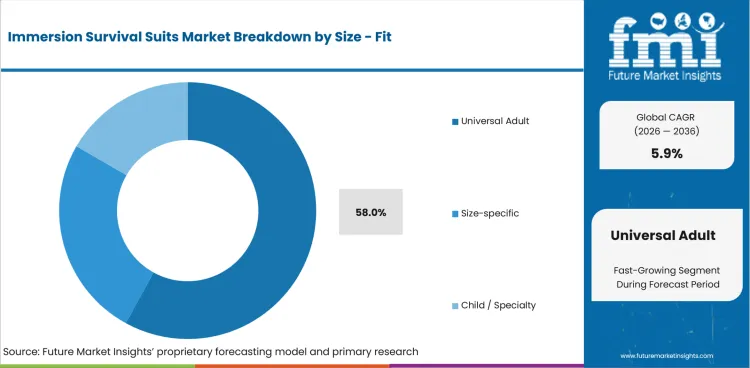
- Universal Adult suits are projected to represent 58.0% share in 2026 due to simple stowage that supports use across mixed crew rotations.
- Size-specific suits gain buyer attention in offshore wind crews that need safer climbing and harness compatibility.
Which sales channel shows a prominent position in the immersion survival suits market?
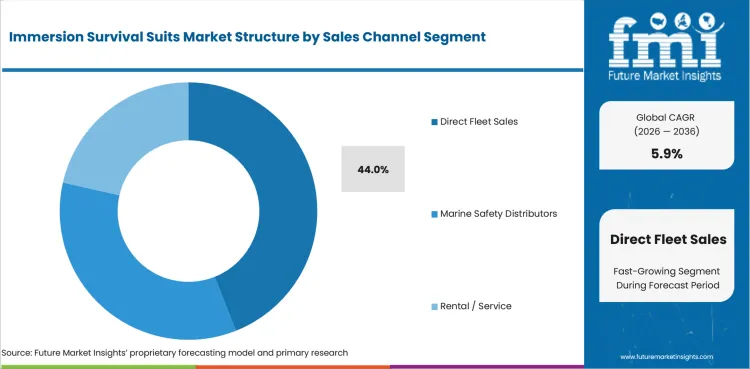
- Direct Fleet Sales are anticipated to account for 44.0% share in 2026 supported by centralized sourcing that helps large owners control approved safety stock.
- Marine safety distributors remain important owing to inspections that can reveal damaged seals or missing storage bags.
What are the drivers, restraints, and opportunities in the immersion survival suits market?
SOLAS compliance supports recurring demand. Service access and price pressure still limit replacement speed in remote and cost-sensitive fleets.
- Driver: Mandatory suit carriage is expected to sustain recurring purchases across regulated vessel fleets that need inspection-ready equipment.
- Restraint: Remote service access can slow replacement for vessels operating outside major port networks.
- Opportunity: Offshore transfer work is projected to raise demand for lower-bulk suits supported by better body-fit coverage.
SOLAS Replacement Cycle Keeps Suit Demand Practical
Regulated vessel operation turns suit purchasing into audit readiness work. The eCFR life-saving systems rules require approved immersion suits of appropriate size for cargo vessel personnel outside defined exemptions. That requirement explains why life-saving appliances stay close to annual budget reviews. Suppliers serving commercial vessel replacement cycles gain preference when approval records reduce port delay risk.
Offshore Fit Needs Are Changing Product Selection
Offshore transfer suits are moving toward better ergonomics and body-fit coverage. In April 2025, VIKING launched a female-fit crew transfer vessel immersion suit after work with offshore wind safety leaders. The launch gives a practical reason for offshore wind transfer activity to affect suit design because technicians need ladder movement and harness compatibility.
Service Bottlenecks Create Channel Opportunity
Service access remains a practical restraint in remote port networks. In September 2024, VIKING expanded PPE service coverage in Tromsø after acquiring a local safety department. The move shows how service points can turn regulatory pressure into replacement access for remote routes. The constraint becomes sharper when ship repair and maintenance service channels cannot supply approved stock on time.
Which countries are growing fastest in the immersion survival suits market?
China 6.8% CAGR, South Korea 6.4% CAGR, India 6.3% CAGR, United States 5.8% CAGR, United Kingdom 5.6% CAGR, Japan 5.5% CAGR, Germany 5.3% CAGR, and France 5.1% CAGR through 2036.
.webp "Top Country Growth Comparison Immersion Survival Suits Market Cagr (2026 2036)")
| Country | CAGR |
|---|---|
| China | 6.8% |
| South Korea | 6.4% |
| India | 6.3% |
| United States | 5.8% |
| United Kingdom | 5.6% |
| Japan | 5.5% |
| Germany | 5.3% |
| France | 5.1% |
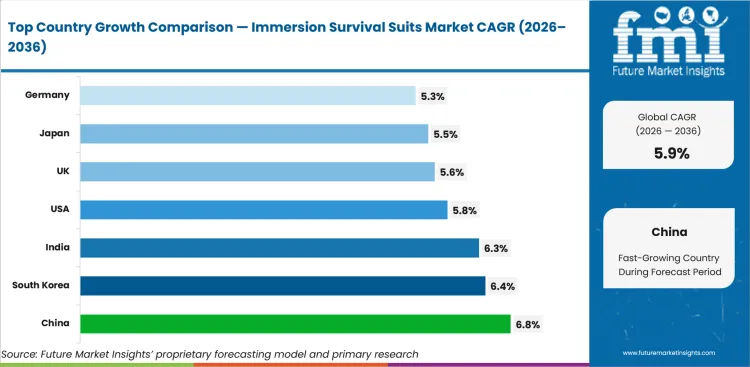
Source: Future Market Insights, 2026.
How do country-level CAGRs compare in the immersion survival suits market?
- China is forecast to record 6.8% CAGR by 2036 due to shipyard outfitting that gives suppliers early access to approved suit orders.
- South Korea is expected to grow at 6.4% CAGR through 2036 supported by high-spec shipbuilding programs that tie safety packages to vessel delivery.
- India is projected to expand at 6.3% CAGR over the forecast period owing to coastal shipping that keeps replacement needs visible beyond offshore operations.
- The United States is estimated to reach 5.8% CAGR by 2036 attributable to approval rules that keep product choice tied to Coast Guard requirements.
- The United Kingdom is forecast to post 5.6% CAGR through 2036 driven by offshore transfer work and merchant replacement cycles that support orders.
- Japan is expected to advance at 5.5% CAGR through 2036 due to shipowner scale and service discipline that strengthen replacement planning.
- Germany is projected to grow at 5.3% CAGR by 2036 supported by North Sea operations and merchant fleet ownership that guide purchasing.
- France is forecast to record 5.1% CAGR through 2036 owing to merchant and fishing vessel needs that support a steady replacement outlook.
How fast is the immersion survival suits market growing in China?
A 6.8% CAGR through 2036 reflects newbuild outfitting and deep marine equipment supply chains.
Country Market Snapshot Table
| Parameter | Value |
|---|---|
| Market Size in 2025 (Value) | USD 289.7 million |
| Market Size in 2026 (Value) | USD 309.4 million |
| Market Forecast in 2036 (Value) | USD 597.2 million |
| CAGR (2026 to 2036) | 6.8% |
| Years Considered | 2021 to 2036 |
| Base Year | 2025 |
| Forecast Period | 2026 to 2036 |
| Units Considered | Value (USD million) |
| Leading Sub-Region | Yangtze River Delta and Pearl River Delta shipbuilding corridors |
China Immersion Survival Suits Market Outlook
China demand is shaped by shipyard outfitting work and fleet safety procurement. Approved suits move into new vessel delivery packages first. Replacement cycles then sustain demand after vessels enter service.
Domestic suppliers compete on certificate access and bulk order responsiveness. Global brands remain relevant for export vessels that need documentation accepted by owners and flag authorities.
Key Growth Drivers
- Newbuild outfitting creates early suit purchase points for shipyards. UNCTAD's September 2025 maritime review reported that Chinese yards delivered 54.6% of global new fleet tonnage in 2024. That scale places approved suits inside vessel handover packages before fleet service begins.
- Fleet ownership gives Chinese buyers enough scale to standardize safety equipment. UNCTAD stated in September 2025 that China and Japan controlled more than 40.0% of world fleet capacity in 2025. This ownership base supports repeat orders for certified suit stock.
- Export vessel programs support demand for SOLAS-approved stock that can pass buyer and flag-state review before handover.
- Fishing and offshore service operations add replacement demand after the newbuild outfitting cycle is complete.
Key Restraints
- Approval matching can slow low-cost local supply. ClassNK guidance states that SOLAS rules require appropriate-size immersion suits for cargo ship personnel outside warm-climate exemptions. This keeps certificate review ahead of price in export vessel supply.
- Price pressure affects domestic tenders due to bulk safety packages being reviewed beside other life-saving appliances.
- International suppliers need local distributor coverage before they can support urgent replacement at inland and coastal yards.
What makes China unique
China is unique for large newbuild outfitting volume and a dense domestic marine safety supply base.
Key Companies
- Grand Ocean Marine
- Kunshan EMF Industrial
- Chongqing Gathering Marine Equipment
- Jiangsu Zeg Marine Equipment
Sales & Marketing Channels
- Shipyard procurement
- Marine safety distributors
- Port chandlers
- Direct fleet sales
- Service replacement programs
Country Segment Breakdown Table
| Segment | Sub-Segments |
|---|---|
| By Suit Type | SOLAS Immersion Suits · Anti-exposure Suits · Helicopter Transfer Suits · Rescue / Ice Suits |
| By Material | Neoprene · PU-coated Fabric · Breathable Laminates · Other |
| By End Use | Commercial Shipping · Offshore Oil & Gas · Fishing Vessels · Search & Rescue |
| By Size / Fit | Universal Adult · Size-specific · Child / Specialty |
| By Sales Channel | Direct Fleet Sales · Marine Safety Distributors · Rental / Service |
| Key Sub-Regions Covered, Marine Corridors | Yangtze River Delta and Pearl River Delta shipbuilding corridors |
Frequently Asked Questions
How fast is China immersion survival suits market growing?
China is forecast to expand at 6.8% CAGR from 2026 to 2036.
Who competes in China immersion survival suits market?
Grand Ocean Marine and Kunshan EMF Industrial compete beside approved global suppliers.
What supports China immersion survival suits market demand?
Newbuild outfitting and export vessel documentation support recurring suit demand.
What supports immersion survival suits demand in South Korea?
A 6.4% CAGR through 2036 reflects high-spec shipbuilding and offshore service demand.
Country Market Snapshot Table
| Parameter | Value |
|---|---|
| Market Size in 2025 (Value) | USD 87.3 million |
| Market Size in 2026 (Value) | USD 92.9 million |
| Market Forecast in 2036 (Value) | USD 172.8 million |
| CAGR (2026 to 2036) | 6.4% |
| Years Considered | 2021 to 2036 |
| Base Year | 2025 |
| Forecast Period | 2026 to 2036 |
| Units Considered | Value (USD million) |
| Leading Sub-Region | Busan, Ulsan, Geoje, and shipyard service corridors |
South Korea Immersion Survival Suits Market Outlook
South Korea demand is closely tied to shipyard delivery programs and high-spec vessel outfitting. Buyers need suits that match export documentation and owner approval lists before handover.
Marine safety suppliers also serve fishing and offshore operators near Busan and Ulsan. Service access becomes important because vessel inspection timing can compress replacement windows.
Key Growth Drivers
- Shipbuilding scale keeps safety equipment demand visible before vessel handover. OECD reported in May 2026 that Korea accounted for about 27.0% of global ship completions by CGT in 2024. That share makes approved suit procurement part of delivery planning.
- Higher-spec vessel programs make documentation part of supplier selection. OECD noted in May 2026 that Korea allocated KRW 260 billion to the 2025 K-Shipbuilding Strategy. The investment context shows why yards are tightening procurement systems for complex vessels.
- Offshore service fleets support anti-exposure and transfer suit demand in work settings that need mobility and thermal protection.
- Port service clusters help distributors maintain emergency replacement stock near Busan and Ulsan.
Key Restraints
- Order timing can still be uneven because shipbuilding demand moves by cycle. OECD observed in May 2026 that Korea's global completions and orders stayed within a 20.0% to 30.0% range in recent years. Suppliers therefore need flexible stock planning instead of fixed-volume assumptions.
- Shipyards often pressure safety-package pricing during large delivery programs.
- Imported suit variants need certificate checks before they can be accepted by export vessel owners.
What makes South Korea unique
South Korea is unique for export-oriented shipbuilding and concentrated marine service hubs.
Key Companies
- VIKING Life-Saving Equipment
- Survitec
- Marinesaver
- Korea Marine Equipment
Sales & Marketing Channels
- Shipyard procurement
- Marine safety distributors
- Service stations
- Port chandlers
- Direct fleet sales
Country Segment Breakdown Table
| Segment | Sub-Segments |
|---|---|
| By Suit Type | SOLAS Immersion Suits · Anti-exposure Suits · Helicopter Transfer Suits · Rescue / Ice Suits |
| By Material | Neoprene · PU-coated Fabric · Breathable Laminates · Other |
| By End Use | Commercial Shipping · Offshore Oil & Gas · Fishing Vessels · Search & Rescue |
| By Size / Fit | Universal Adult · Size-specific · Child / Specialty |
| By Sales Channel | Direct Fleet Sales · Marine Safety Distributors · Rental / Service |
| Key Sub-Regions Covered, Marine Corridors | Busan, Ulsan, Geoje, and shipyard service corridors |
Frequently Asked Questions
How is South Korea immersion survival suits market forecast developing?
South Korea is expected to post 6.4% CAGR through 2036.
Which companies serve South Korea immersion survival suits market?
VIKING Life-Saving Equipment and Survitec serve buyers beside domestic marine suppliers.
What supports South Korea immersion survival suits demand?
Shipyard delivery programs and offshore service needs support suit procurement.
How is the immersion survival suits forecast developing in India?
A 6.3% CAGR through 2036 reflects coastal shipping growth and offshore replacement needs.
Country Market Snapshot Table
| Parameter | Value |
|---|---|
| Market Size in 2025 (Value) | USD 52.6 million |
| Market Size in 2026 (Value) | USD 55.9 million |
| Market Forecast in 2036 (Value) | USD 103.0 million |
| CAGR (2026 to 2036) | 6.3% |
| Years Considered | 2021 to 2036 |
| Base Year | 2025 |
| Forecast Period | 2026 to 2036 |
| Units Considered | Value (USD million) |
| Leading Sub-Region | Mumbai, Gujarat, Chennai, Kochi, and eastern coast corridors |
India Immersion Survival Suits Market Outlook
India sector is propelled by coastal shipping and offshore operations that need approved life-saving appliances. Replacement orders often move through marine distributors near major ports because operators need fast access before inspection.
Buyer decisions remain practical because operators compare certificate availability with delivery time. Domestic suppliers help reduce waiting periods for routine replacement stock.
Key Growth Drivers
- The active vessel base supports periodic suit replacement. India's Ministry of Ports, Shipping and Waterways reported 1545 vessels in 2024. That fleet count gives distributors a recurring base beyond new offshore projects.
- Coastal trade broadens domestic safety equipment needs. India's Ministry of Ports, Shipping and Waterways placed 68.0% of vessels in coastal trade in 2024. This makes certified suit access relevant to ports serving domestic routes.
- Offshore oil and gas activity supports higher-grade suits for crew movement and emergency readiness.
- Port-based distributors help operators obtain replacement stock during inspection and renewal windows.
Key Restraints
- Overseas trade tonnage is concentrated in fewer large vessels. India's Ministry of Ports, Shipping and Waterways reported that overseas vessels represented 88.0% of Indian gross tonnage in 2024. This concentration can narrow bulk replacement orders for some domestic channels.
- Small fishing and coastal operators often delay premium suit purchases until audit or insurance pressure rises.
- Imported approved suits can face lead-time risk during urgent replacement cycles.
What makes India unique
India is unique for its large coastal vessel count and mixed domestic and imported approved safety equipment.
Key Companies
- SHM Shipcare
- LALIZAS
- VIKING Life-Saving Equipment
- Survitec
Sales & Marketing Channels
- Marine safety distributors
- Port chandlers
- Direct fleet sales
- Offshore service suppliers
- Ship repair yards
Country Segment Breakdown Table
| Segment | Sub-Segments |
|---|---|
| By Suit Type | SOLAS Immersion Suits · Anti-exposure Suits · Helicopter Transfer Suits · Rescue / Ice Suits |
| By Material | Neoprene · PU-coated Fabric · Breathable Laminates · Other |
| By End Use | Commercial Shipping · Offshore Oil & Gas · Fishing Vessels · Search & Rescue |
| By Size / Fit | Universal Adult · Size-specific · Child / Specialty |
| By Sales Channel | Direct Fleet Sales · Marine Safety Distributors · Rental / Service |
| Key Sub-Regions Covered, Marine Corridors | Mumbai, Gujarat, Chennai, Kochi, and eastern coast corridors |
Frequently Asked Questions
How fast is India immersion survival suits market growing?
India is projected to grow at 6.3% CAGR from 2026 to 2036.
Who serves India immersion survival suits market?
SHM Shipcare and LALIZAS compete beside VIKING and Survitec in marine safety supply.
What shapes India immersion survival suits demand?
Coastal trade and offshore safety procurement shape recurring suit purchases.
How is the United States performing in the immersion survival suits market?
A 5.8% CAGR through 2036 reflects Coast Guard approval needs and offshore replacement cycles.
Country Market Snapshot Table
| Parameter | Value |
|---|---|
| Market Size in 2025 (Value) | USD 172.1 million |
| Market Size in 2026 (Value) | USD 182.1 million |
| Market Forecast in 2036 (Value) | USD 320.1 million |
| CAGR (2026 to 2036) | 5.8% |
| Years Considered | 2021 to 2036 |
| Base Year | 2025 |
| Forecast Period | 2026 to 2036 |
| Units Considered | Value (USD million) |
| Leading Sub-Region | Gulf Coast, Pacific Northwest, Alaska, and Northeast port corridors |
United States Immersion Survival Suits Market Outlook
United States industry is shaped by Coast Guard approval checks and cold-water route exposure. Fleet managers prioritize suits that can be documented before inspection and replaced quickly after defects appear.
Offshore energy and fishing routes create replacement needs in Alaska and the Pacific Northwest. Gulf Coast operations sustain demand as well. Distributors compete on stock depth and service turnaround.
Key Growth Drivers
- The USA-flag fleet creates recurring regulated purchases. MARAD listed 190 USA-flagged privately owned vessels in December 2025. The count gives suppliers a defined base for approval-led replacement programs.
- Training rules reinforce product readiness during recurring drills. The eCFR requires crews to wear immersion or anti-exposure suits in at least one abandon-ship drill during any three-month period. This keeps storage condition and sizing visible before emergencies.
- Gulf of Mexico offshore routes keep demand active for approved abandonment and transfer suits.
- Standard fleet specifications help operators simplify training and replacement across multiple ports.
Key Restraints
- Approval rules restrict low-cost substitutions. The eCFR requires approved immersion suits of appropriate size for each person on cargo vessels. Buyers therefore need certificate fit before they review lower-priced alternatives.
- Warm-route exemptions reduce required volume on some cargo routes. The eCFR permits exemptions for vessels operating only between 32 degrees north and 32 degrees south. This narrows demand in trades with limited cold-water exposure.
- Regional stocking gaps can extend lead times for size-specific and mission-specific suits.
What makes United States unique
The United States is unique for Coast Guard approval requirements and cold-water regional demand.
Key Companies
- Mustang Survival
- Kent Safety Products
- Survitec
- VIKING Life-Saving Equipment
Sales & Marketing Channels
- Direct fleet sales
- Marine safety distributors
- Service stations
- Port chandlers
- Offshore supply houses
Country Segment Breakdown Table
| Segment | Sub-Segments |
|---|---|
| By Suit Type | SOLAS Immersion Suits · Anti-exposure Suits · Helicopter Transfer Suits · Rescue / Ice Suits |
| By Material | Neoprene · PU-coated Fabric · Breathable Laminates · Other |
| By End Use | Commercial Shipping · Offshore Oil & Gas · Fishing Vessels · Search & Rescue |
| By Size / Fit | Universal Adult · Size-specific · Child / Specialty |
| By Sales Channel | Direct Fleet Sales · Marine Safety Distributors · Rental / Service |
| Key Sub-Regions Covered, Marine Corridors | Gulf Coast, Pacific Northwest, Alaska, and Northeast port corridors |
Frequently Asked Questions
How is the United States immersion survival suits market growing?
The United States is projected to expand at 5.8% CAGR through 2036.
Who competes in United States immersion survival suits market?
Mustang Survival and Kent Safety Products compete beside Survitec and VIKING.
What drives United States immersion survival suits purchases?
Coast Guard approval needs and offshore replacement cycles support recurring purchases.
What is shaping immersion survival suits demand in the United Kingdom?
A 5.6% CAGR through 2036 reflects offshore work and merchant fleet safety replacement demand.
Country Market Snapshot Table
| Parameter | Value |
|---|---|
| Market Size in 2025 (Value) | USD 81.6 million |
| Market Size in 2026 (Value) | USD 86.2 million |
| Market Forecast in 2036 (Value) | USD 148.6 million |
| CAGR (2026 to 2036) | 5.6% |
| Years Considered | 2021 to 2036 |
| Base Year | 2025 |
| Forecast Period | 2026 to 2036 |
| Units Considered | Value (USD million) |
| Leading Sub-Region | Southampton, Aberdeen, Liverpool, London, and offshore wind corridors |
United Kingdom Immersion Survival Suits Market Outlook
Sector in United Kingdom is influenced by merchant fleet requirements and offshore crew transfer work. Buyers value suit designs that support movement during workboat access and wind-farm transfers.
Distributor and service coverage matter because vessel operators need fast replacement during audits. Domestic brands also support specialist marine and rescue channels.
Key Growth Drivers
- UK registered tonnage supports inspection-led replacement cycles. The Department for Transport reported 8.7 million gross tonnes on the UK Ship Register at the end of December 2025. That scale gives suppliers a visible base for approved suit servicing.
- The domestic vessel count keeps service demand visible. The Department for Transport listed 1034 UK-registered vessels at the end of December 2025. The number supports distributor planning for routine replacement and service stock.
- Offshore wind transfer activity supports lighter suits that improve movement and donning speed.
- Domestic safety brands help buyers source specialist suits for rescue and professional marine users.
Key Restraints
- Fleet scale moved lower in the latest official release. The Department for Transport reported a 12.0% decline in UK Ship Register gross tonnage from 2024 to 2025. This drop can make some operators more cautious about bulk safety orders.
- Global fleet share limits domestic flag demand. The Department for Transport placed the UK at 0.4% of the world fleet by deadweight in 2025. The smaller share keeps domestic-flag demand more measured than global service demand.
- Premium work-transfer suits face budget review if fleet managers can renew standard abandon-ship suits instead.
What makes United Kingdom unique
The United Kingdom is unique for offshore wind transfer needs and a specialist domestic marine safety base.
Key Companies
- Survitec
- Crewsaver
- Mullion Survival Technology
- Northern Diver
Sales & Marketing Channels
- Marine safety distributors
- Offshore wind suppliers
- Direct fleet sales
- Service stations
- Specialty rescue suppliers
Country Segment Breakdown Table
| Segment | Sub-Segments |
|---|---|
| By Suit Type | SOLAS Immersion Suits · Anti-exposure Suits · Helicopter Transfer Suits · Rescue / Ice Suits |
| By Material | Neoprene · PU-coated Fabric · Breathable Laminates · Other |
| By End Use | Commercial Shipping · Offshore Oil & Gas · Fishing Vessels · Search & Rescue |
| By Size / Fit | Universal Adult · Size-specific · Child / Specialty |
| By Sales Channel | Direct Fleet Sales · Marine Safety Distributors · Rental / Service |
| Key Sub-Regions Covered, Marine Corridors | Southampton, Aberdeen, Liverpool, London, and offshore wind corridors |
Frequently Asked Questions
What is shaping United Kingdom immersion survival suits demand?
Offshore wind transfer work and merchant fleet replacement shape demand in the United Kingdom.
How fast is United Kingdom immersion survival suits market growing?
The United Kingdom is expected to grow at 5.6% CAGR through 2036.
Which companies serve United Kingdom immersion survival suits buyers?
Survitec and Crewsaver serve major buyer groups while Mullion Survival Technology and Northern Diver support specialist channels.
How does Japan compare in the immersion survival suits market?
A 5.5% CAGR through 2036 reflects fleet ownership scale and inspection-led replacement demand.
Country Market Snapshot Table
| Parameter | Value |
|---|---|
| Market Size in 2025 (Value) | USD 99.9 million |
| Market Size in 2026 (Value) | USD 105.4 million |
| Market Forecast in 2036 (Value) | USD 180.2 million |
| CAGR (2026 to 2036) | 5.5% |
| Years Considered | 2021 to 2036 |
| Base Year | 2025 |
| Forecast Period | 2026 to 2036 |
| Units Considered | Value (USD million) |
| Leading Sub-Region | Tokyo Bay, Osaka, Kobe, Nagasaki, and northern fishing corridors |
Japan Immersion Survival Suits Market Outlook
Japan demand reflects shipowning scale and fisheries. Cold-water routes strengthen replacement needs because crews require dependable thermal protection.
Class society guidance influences service timing and documentation. Suppliers gain relevance by supporting periodic testing and replacement before inspection risk appears.
Key Growth Drivers
- Fleet ownership scale supports replacement planning. UNCTAD stated in September 2025 that China and Japan controlled more than 40.0% of world fleet capacity in 2025. This ownership base keeps approved suit decisions close to ship management systems.
- Shipbuilding activity still creates domestic outfitting demand. OECD reported in May 2026 that Japan held about 11.0% of global completions and new orders in 2024. The share supports a smaller but steady newbuild safety-equipment channel.
- Northern fishing and coastal routes support thermal-protection demand beyond deep-sea merchant ships.
- Class society documentation helps operators define service intervals for older suits.
Key Restraints
- Testing obligations add service cost for older stock. ClassNK states that immersion suits over 10 years of age require annual servicing at an approved service station. This makes service access part of the replacement decision.
- Conservative procurement can slow adoption of new fit-specific designs before clear service proof is available.
- Imported specialist suits may face stocking constraints outside large port cities.
What makes Japan unique
Japan is unique for shipowning influence and class-society attention to service intervals.
Key Companies
- VIKING Life-Saving Equipment
- Survitec
- Hansen Protection
- LALIZAS
Sales & Marketing Channels
- Marine safety distributors
- Ship managers
- Service stations
- Port chandlers
- Shipyard procurement
Country Segment Breakdown Table
| Segment | Sub-Segments |
|---|---|
| By Suit Type | SOLAS Immersion Suits · Anti-exposure Suits · Helicopter Transfer Suits · Rescue / Ice Suits |
| By Material | Neoprene · PU-coated Fabric · Breathable Laminates · Other |
| By End Use | Commercial Shipping · Offshore Oil & Gas · Fishing Vessels · Search & Rescue |
| By Size / Fit | Universal Adult · Size-specific · Child / Specialty |
| By Sales Channel | Direct Fleet Sales · Marine Safety Distributors · Rental / Service |
| Key Sub-Regions Covered, Marine Corridors | Tokyo Bay, Osaka, Kobe, Nagasaki, and northern fishing corridors |
Frequently Asked Questions
How does Japan compare in the immersion survival suits market?
Japan is forecast to record 5.5% CAGR through 2036.
Who serves Japan immersion survival suits market?
VIKING and Survitec serve approved-suit buyers while Hansen Protection and LALIZAS support additional supply.
What supports Japan immersion survival suits purchases?
Shipowning scale and service interval requirements support replacement purchases in Japan.
What is the immersion survival suits outlook in Germany?
A 5.3% CAGR through 2036 reflects merchant fleet ownership and offshore service needs.
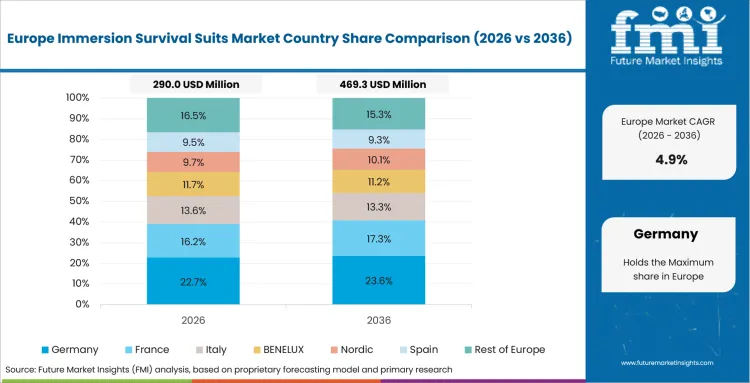
Country Market Snapshot Table
| Parameter | Value |
|---|---|
| Market Size in 2025 (Value) | USD 85.3 million |
| Market Size in 2026 (Value) | USD 89.8 million |
| Market Forecast in 2036 (Value) | USD 150.6 million |
| CAGR (2026 to 2036) | 5.3% |
| Years Considered | 2021 to 2036 |
| Base Year | 2025 |
| Forecast Period | 2026 to 2036 |
| Units Considered | Value (USD million) |
| Leading Sub-Region | Hamburg, Bremen, Kiel, Rostock, and offshore North Sea corridors |
Germany Immersion Survival Suits Market Outlook
Germany demand is tied to ship managers and offshore service contractors. North Sea operating routes create replacement needs for cold-water work. Buyers prefer approved suits that can be serviced near major ports.
German suppliers and European brands compete on fit and PPE integration. Service access remains part of selection because fleet owners need documentation consistency across multi-vessel programs.
Key Growth Drivers
- German merchant shipping creates a steady safety-equipment base. The German Shipowners' Association reported a fleet of 1764 ships in March 2025. This ownership base supports regular replacement planning across managed fleets.
- Large fleet tonnage reinforces replacement programs. The German Shipowners' Association reported 47.4 million gross tonnes in March 2025. This tonnage base keeps safety equipment procurement tied to fleet management routines.
- Offshore North Sea work sustains demand for suits that support movement in transfer and deck tasks.
- Local PPE engineering supports buyer interest in suits paired with compatible lifejackets and workwear.
Key Restraints
- Data changes complicate market comparisons. Deutsche Flagge stated in January 2026 that the December 2025 monthly table expanded the ship types included. This limits direct year-to-year interpretation of fleet movement.
- Foreign-flag use can move purchase decisions away from German domestic channels.
- Cost reviews can delay replacement of premium anti-exposure suits if standard SOLAS suits meet the audit need.
What makes Germany unique
Germany is unique for maritime ownership scale and local PPE engineering capacity.
Key Companies
- VIKING Life-Saving Equipment
- Survitec
- SECUMAR
- LALIZAS
Sales & Marketing Channels
- Marine safety distributors
- Direct fleet sales
- Service stations
- Ship managers
- Offshore service suppliers
Country Segment Breakdown Table
| Segment | Sub-Segments |
|---|---|
| By Suit Type | SOLAS Immersion Suits · Anti-exposure Suits · Helicopter Transfer Suits · Rescue / Ice Suits |
| By Material | Neoprene · PU-coated Fabric · Breathable Laminates · Other |
| By End Use | Commercial Shipping · Offshore Oil & Gas · Fishing Vessels · Search & Rescue |
| By Size / Fit | Universal Adult · Size-specific · Child / Specialty |
| By Sales Channel | Direct Fleet Sales · Marine Safety Distributors · Rental / Service |
| Key Sub-Regions Covered, Marine Corridors | Hamburg, Bremen, Kiel, Rostock, and offshore North Sea corridors |
Frequently Asked Questions
What is the immersion survival suits outlook in Germany?
Germany is projected to record 5.3% CAGR through 2036.
Which companies serve Germany immersion survival suits market?
VIKING and Survitec serve German buyers while SECUMAR and LALIZAS support additional supply.
What supports Germany immersion survival suits demand?
Merchant fleet ownership and North Sea service work support demand in Germany.
How is France positioned in the immersion survival suits market?
A 5.1% CAGR through 2036 reflects merchant fleet replacement and fishing vessel safety demand.
Country Market Snapshot Table
| Parameter | Value |
|---|---|
| Market Size in 2025 (Value) | USD 74.4 million |
| Market Size in 2026 (Value) | USD 78.2 million |
| Market Forecast in 2036 (Value) | USD 128.5 million |
| CAGR (2026 to 2036) | 5.1% |
| Years Considered | 2021 to 2036 |
| Base Year | 2025 |
| Forecast Period | 2026 to 2036 |
| Units Considered | Value (USD million) |
| Leading Sub-Region | Brittany, Normandy, Marseille, Dunkirk, and overseas fleet corridors |
France Immersion Survival Suits Market Outlook
France demand is shaped by merchant shipping and maritime service vessels. Fishing fleets create another buyer base. Operators need reliable replacement access across mainland ports and overseas routes.
Local marine suppliers support professional safety categories and specialist workwear. Global suppliers remain important for SOLAS-certified suit programs that need accepted documentation.
Key Growth Drivers
- The commercial fleet supports approved suit replacement. France's Ministry of the Sea reported 464 French-flagged commercial vessels over 100 UMS in January 2026. That vessel base keeps SOLAS documentation central to procurement.
- Fishing vessel safety needs add regional demand. France's fisheries ministry listed 5986 active fishing vessels in its fleet file on 1 September 2025. This fleet broadens demand beyond merchant routes and ferry operations.
- Passenger and ferry routes create recurring demand for documented life-saving appliance stock.
- Overseas territories widen distributor needs supported by certified emergency stock requirements for distant operating zones.
Key Restraints
- Transport vessel scale limits bulk demand. France's Ministry of the Sea reported 231 transport vessels over 100 UMS in January 2026. That narrower fleet base can reduce large standardized orders.
- Small fishing vessels can be cost sensitive. France's fisheries ministry reported that 86.0% of mainland fishing vessels were under 12 meters in 2025. The size profile can limit premium suit replacement outside mandatory requirements.
- Replacement logistics are harder for overseas and island operations that need certified stock quickly.
What makes France unique
France is unique for merchant and fishing demand. Service vessels and overseas routes create additional replacement needs.
Key Companies
- Survitec
- VIKING Life-Saving Equipment
- Plastimo
- Guy Cotten
Sales & Marketing Channels
- Marine safety distributors
- Fishing cooperatives
- Port chandlers
- Direct fleet sales
- Service stations
Country Segment Breakdown Table
| Segment | Sub-Segments |
|---|---|
| By Suit Type | SOLAS Immersion Suits · Anti-exposure Suits · Helicopter Transfer Suits · Rescue / Ice Suits |
| By Material | Neoprene · PU-coated Fabric · Breathable Laminates · Other |
| By End Use | Commercial Shipping · Offshore Oil & Gas · Fishing Vessels · Search & Rescue |
| By Size / Fit | Universal Adult · Size-specific · Child / Specialty |
| By Sales Channel | Direct Fleet Sales · Marine Safety Distributors · Rental / Service |
| Key Sub-Regions Covered, Marine Corridors | Brittany, Normandy, Marseille, Dunkirk, and overseas fleet corridors |
Frequently Asked Questions
How is France positioned in the immersion survival suits market?
France is forecast to expand at 5.1% CAGR through 2036.
Who serves France immersion survival suits buyers?
Survitec and VIKING serve professional marine channels while Plastimo and Guy Cotten support local supply.
What supports France immersion survival suits demand?
Merchant fleet replacement and fishing vessel safety needs support demand in France.
Who are the leading companies in the immersion survival suits market?
Survitec, VIKING Life-Saving Equipment, Mustang Survival, Hansen Protection, Crewsaver, LALIZAS
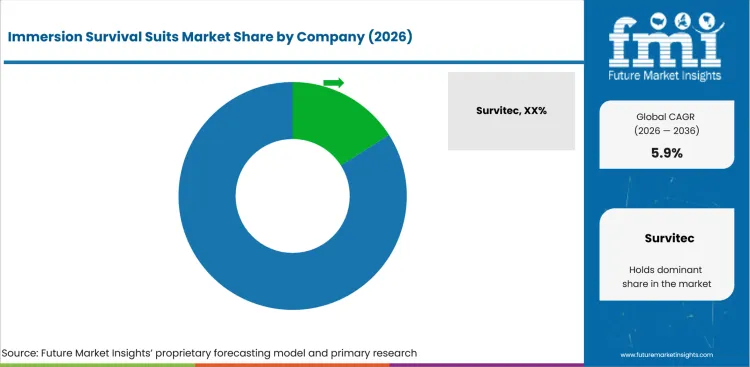
- Competition is shaped by approval records and material choice supported by fast size-range supply during urgent vessel replacement.
- Service-station access influences fleet accounts owing to inspection failures that can delay vessel readiness.
- Mission-specific suppliers compete on mobility and thermal protection for offshore and rescue applications.
- Distributors protect local accounts by holding replacement stock near ports and ship repair yards.
The competitive outlook in the sector includes global survival-technology suppliers and marine PPE brands. Regional manufacturers and port distributors serve local replacement needs after inspections expose damaged or missing suits.
Supplier positioning is shaped by service delivery and fleet account access. Survitec and VIKING Life-Saving Equipment use broad product ranges and service networks to support global fleets. Mustang Survival and Crewsaver add strength in professional cold-water applications. Hansen Protection supports mission-specific programs that need suit mobility and thermal protection.
Companies are expected to be better positioned once they combine approved product lines with replacement access in major port corridors. Suppliers that support rental swaps and inspection documentation can protect recurring accounts. Regional distributors remain relevant because urgent-stock settings still depend on local availability.
How do top immersion survival suits market companies compare?
Companies compare by approval breadth and product focus. Fleet access and service reach then define account strength.
| Company | Portfolio / Focus | Account Access | Footprint / Service Reach |
|---|---|---|---|
| Survitec | SOLAS suits, dry suits, rental swaps, service programs | Commercial fleets, offshore operators, distributors | Global service network and acquired survival brands |
| VIKING Life-Saving Equipment | SOLAS immersion suits, crew-transfer suits, PPE service | Fleet owners, offshore wind operators, ship managers | Global service-station network and marine channels |
| Mustang Survival | Professional dry suits and cold-water survival wear | Defense, rescue, offshore, and marine users | North American strength with export channels |
| Hansen Protection | Immersion suits, constant-wear suits, aviation survival suits | Offshore, aviation, rescue, and marine buyers | Survitec brand reach and service support |
| Crewsaver | SOLAS immersion suits and professional marine survival equipment | Commercial marine, rescue, and distributor accounts | United Kingdom and export distributor channels |
Source: Company websites and Future Market Insights, 2026.
Who are the key players in the immersion survival suits market?
Global companies leading the immersion survival suits market include approved suit suppliers and survival technology specialists.
Key global companies leading the immersion survival suits market include:
- Survitec
- VIKING Life-Saving Equipment
- Mustang Survival
- Hansen Protection
- Crewsaver
- LALIZAS
- Kent Safety Products
- SECUMAR
Key Developments in Immersion Survival Suits Market
- In April 2025, VIKING Life-Saving Equipment released a female-fit crew transfer vessel immersion suit after development input from offshore wind operators.
- In September 2024, VIKING Life-Saving Equipment expanded northern Norway service coverage after acquiring a Tromsø safety department.
- In March 2026, Survitec promoted SuitXChange as an immersion suit rental service that swaps compliant suits during servicing windows.
Key Players in the Immersion Survival Suits Market
Global survival technology suppliers
- Survitec
- VIKING Life-Saving Equipment
- Mustang Survival
- Hansen Protection
Regional and specialist marine safety suppliers
- Crewsaver
- LALIZAS
- Kent Safety Products
- SECUMAR
- Mullion Survival Technology
- Plastimo
- Guy Cotten
Asia marine safety suppliers and distributors
- Grand Ocean Marine
- Kunshan EMF Industrial
- SHM Shipcare
- Marinesaver
What is the scope of the immersion survival suits market report?
| Attribute | Details |
|---|---|
| Forecast period | 2026 to 2036 |
| Historical period | 2021 to 2025 |
| Quantitative unit | Value in USD million |
| Suit Type | SOLAS Immersion Suits; Anti-exposure Suits; Helicopter Transfer Suits; Rescue / Ice Suits |
| Material | Neoprene; PU-coated Fabric; Breathable Laminates; Other |
| End Use | Commercial Shipping; Offshore Oil & Gas; Fishing Vessels; Search & Rescue |
| Size / Fit | Universal Adult; Size-specific; Child / Specialty |
| Sales Channel | Direct Fleet Sales; Marine Safety Distributors; Rental / Service |
| Regions covered | North America; Latin America; Western Europe; Eastern Europe; East Asia; South Asia and Pacific; Middle East and Africa |
| Countries covered | United States; United Kingdom; Germany; France; Japan; China; South Korea; India |
| Key companies profiled | Survitec; VIKING Life-Saving Equipment; Mustang Survival; Hansen Protection; Crewsaver; LALIZAS |
| Approach | Primary interviews, desk research, fleet statistics, supplier validation, and triangulated market sizing |
Source: Future Market Insights, 2026.
What is included in the scope and definition of the immersion survival suits market?
| Scope Item | Definition |
|---|---|
| Market Definition | Waterproof protective suits used to reduce cold shock and heat loss after accidental water entry or abandon-ship events. |
| Functions Covered | Thermal protection, buoyancy support, water ingress reduction, visibility support, and emergency donning. |
| Applications Covered | Abandon-ship survival, offshore transfer safety, rescue operations, fishing vessel safety, and inspection replacement. |
| End-Use Industries | Commercial shipping, offshore oil and gas, fishing vessels, search and rescue, and offshore wind service support. |
| Grades Covered | SOLAS approved immersion suits, anti-exposure suits, helicopter transfer suits, and rescue or ice suits. |
| Inclusions | Approved immersion suits, service-backed replacement, rental programs, and professional marine distributor supply. |
| Exclusions | Recreational wetsuits, diving dry suits, general rainwear, liferafts, lifeboats, and standalone flotation devices. |
What research methodology is used for the immersion survival suits market?
| Methodology Step | Description |
|---|---|
| Primary Research | FMI analysts reviewed inputs from ship managers, offshore safety officers, marine distributors, fleet procurement teams, and service station operators. |
| Desk Research | Desk research reviewed SOLAS rules, LSA Code references, fleet statistics, official company pages, and supplier announcements. |
| Market Sizing & Forecasting | The model combined fleet replacement volumes, material mix, end-use safety budgets, channel margins, and country-level marine activity. |
| Data Validation | Forecasts were checked against vessel fleet data, supplier portfolios, service footprints, approval patterns, and expert interviews. |
Immersion Survival Suits Market Breakdown by Suit Type, Material, End Use, Size-Fit, Sales Channel, and Region
Immersion Survival Suits Market Segmented by Suit Type
- SOLAS Immersion Suits
- Anti-exposure Suits
- Helicopter Transfer Suits
- Rescue / Ice Suits
Immersion Survival Suits Market Segmented by Material
- Neoprene
- PU-coated Fabric
- Breathable Laminates
- Other
Immersion Survival Suits Market Segmented by End Use
- Commercial Shipping
- Offshore Oil & Gas
- Fishing Vessels
- Search & Rescue
Immersion Survival Suits Market Segmented by Size / Fit
- Universal Adult
- Size-specific
- Child / Specialty
Immersion Survival Suits Market Segmented by Sales Channel
- Direct Fleet Sales
- Marine Safety Distributors
- Rental / Service
Immersion Survival Suits Market by Region
- North America
- United States
- Canada
- Mexico
- Latin America
- Brazil
- Chile
- Rest of Latin America
- Western Europe
- Germany
- United Kingdom
- Italy
- Spain
- France
- Nordics
- BENELUX
- Rest of Western Europe
- Eastern Europe
- Russia
- Poland
- Hungary
- Balkan and Baltic Countries
- Rest of Eastern Europe
- East Asia
- China
- Japan
- South Korea
- South Asia and Pacific
- India
- ASEAN
- Australia and New Zealand
- Rest of South Asia and Pacific
- Middle East and Africa
- Kingdom of Saudi Arabia
- Other GCC Countries
- Türkiye
- South Africa
- Other African Union
- Rest of Middle East and Africa
Bibliography
- International Maritime Organization. (2024). International life-saving appliance code and SOLAS carriage requirements. International Maritime Organization.
- USA Electronic Code of Federal Regulations. (2026). Title 46, Part 199, Lifesaving systems for vessels and cargo vessel immersion suit rules. USA Government Publishing Office.
- USA Coast Guard. (May 2026). 2025 port state control annual report. USA Department of Homeland Security.
- Tokyo MOU. (May 2026). Annual report on port state control in the Asia-Pacific region 2025. Tokyo MOU Secretariat.
- Paris MoU. (July 2025). 2024 Paris MoU annual report: Progress and performance highlights of the Paris MoU 2024. Paris MoU.
- USA Maritime Administration. (December 2025). USA-flagged privately owned fleet dashboard. USA Department of Transportation.
- Department for Transport. (February 2026). Shipping fleet statistics 2025. Government of the United Kingdom.
- Federal Maritime and Hydrographic Agency. (January 2026). German merchant fleet statistics. Deutsche Flagge.
- German Shipowners' Association. (March 2025). German merchant shipping remains strong in turbulent times. Verband Deutscher Reeder.
- Ministry of Ports, Shipping and Waterways. (December 2025). Indian shipping statistics 2024. Government of India.
- United Nations Conference on Trade and Development. (September 2025). Review of maritime transport 2025: Staying the course in turbulent waters. United Nations.
- Organisation for Economic Co-operation and Development. (May 2026). Peer review of the Korean shipbuilding industry. OECD.
- Organisation for Economic Co-operation and Development. (May 2026). Peer review of the Japanese shipbuilding industry. OECD.
- Ministry of the Sea. (January 2026). French commercial fleet under French flag. Government of France.
- Ministry of Agriculture and Food Sovereignty. (September 2025). French fisheries and aquaculture fleet data. Government of France.
- ClassNK. (2025). Immersion suits and anti-exposure suits flag information. Nippon Kaiji Kyokai.
- VIKING Life-Saving Equipment. (April 2025). VIKING launches female-fit crew transfer vessel immersion suit. VIKING Life-Saving Equipment.
- VIKING Life-Saving Equipment. (September 2024). VIKING expands PPE service coverage in Tromsø. VIKING Life-Saving Equipment.
- VIKING Life-Saving Equipment. (March 2026). SOLAS immersion suits for vessels operating worldwide. VIKING Life-Saving Equipment.
- Survitec. (2026). Immersion suits and SuitXChange immersion suit rental solutions. Survitec Group.
- Mustang Survival. (2026). Professional marine dry suits and cold-water survival equipment. Mustang Survival.
- Hansen Protection. (2026). Immersion suits for marine, aviation, and rescue use. Hansen Protection.
- Crewsaver. (2026). SOLAS immersion suits and professional survival equipment. Crewsaver.
- LALIZAS. (2026). Neptune SOLAS and MED approved immersion suit. LALIZAS.
- Kent Safety Products. (2026). Immersion suit approval and marine safety products. Kent Safety Products.
- SECUMAR. (2025). CONTRA professional immersion suit portfolio. Bernhardt Apparatebau.
What does this report answer about the immersion survival suits market?
- The report explains how approved suit replacement supports market value from 2026 to 2036.
- The report identifies which suit type and material categories lead demand due to end-use, size / fit and sales channel selection.
- The report compares country-level CAGRs and explains why China and South Korea show prominent outlooks.
- The report evaluates supplier competition across approvals and service reach supported by product fit and distributor access that shape positioning.
- The report outlines which companies remain relevant in global and regional immersion suit supply.
Frequently Asked Questions
How large is the Immersion Survival Suits Market expected to be in the near term?
The market is expanding steadily as regulated vessel fleets maintain certified immersion suits for abandon ship and cold water emergency protection.
What is the long term outlook for the Immersion Survival Suits Market?
The outlook remains stable as inspection cycles and mandatory carriage rules keep suit replacement tied to fleet safety planning.
What drives recurring demand for immersion survival suits?
Growth is driven by recurring compliance checks rather than new vessel deliveries, keeping demand consistent across active fleets.
Which material is most widely preferred?
Neoprene is preferred because it offers reliable thermal insulation and familiar handling for crews.
Which end use segment generates the highest demand?
Commercial shipping leads demand as routine port inspections trigger recurring replacement purchases.
Which size and fit category is most common?
Universal adult suits dominate because they simplify stowage and crew issue across mixed rotations.
Which sales channel is most important in this market?
Direct fleet sales lead as large shipowners prefer centralized sourcing with consistent approvals and documentation.
Which countries are key markets for immersion survival suits?
China, South Korea, India, the United States, the United Kingdom, Japan, Germany, and France are key markets.
What supports China’s leading growth momentum?
Shipyard outfitting volume and large fleet ownership create early and recurring demand for approved suits.
Why is South Korea an important market?
High spec shipbuilding programs and offshore service fleets sustain demand for certified survival equipment.
What drives demand in the United States?
Coast Guard approval requirements and cold water operational zones support regular suit replacement.
What restrains faster growth in the immersion survival suits market?
Remote service access and price sensitivity can delay replacement in smaller or distant fleets.
Who are the leading companies in the Immersion Survival Suits Market?
Leading companies include Survitec, VIKING Life Saving Equipment, Mustang Survival, Hansen Protection, Crewsaver, and LALIZAS.
How do suppliers differentiate immersion survival suits?
Suppliers differentiate through approval coverage, service station reach, fit options, and rapid replacement availability.
Preview the report firsthand - request a free sample
Get SampleGet the brochure for pricing and purchase details.
Get PDFTable of Content
- Key Takeaways
- Market Size and CAGR
- Top Growth Driver
- Fastest Growing Segment
- Leading Region
- Key Companies
- Emerging Opportunities
- Executive Summary
- Global Market Outlook
- Demand-side Trends
- Supply-side Trends
- Technology Roadmap Analysis
- Analysis and Recommendations
- Analyst Perspective (What is happening? Why now? What should investors know?)
- Key Questions Answered
- How large is the market?
- What is the CAGR?
- What are key trends?
- Which region dominates?
- Who are the leaders?
- Market Overview
- Market Coverage / Taxonomy
- Market Definition / Scope / Limitations
- Research Methodology
- Chapter Orientation
- Analytical Lens and Working Hypotheses
- Market Structure, Signals, and Trend Drivers
- Benchmarking and Cross-market Comparability
- Market Sizing, Forecasting, and Opportunity Mapping
- Research Design and Evidence Framework
- Desk Research Programme (Secondary Evidence)
- Expert Input and Fieldwork (Primary Evidence)
- Tooling, Models, and Reference Databases
- Data Engineering and Model Build
- Quality Assurance and Audit Trail
- Market Background
- Market Dynamics (Drivers, Restraints, Opportunity, Trends)
- Scenario Forecast (Optimistic, Likely, Conservative)
- Impact Analysis
- AI Impact
- Sustainability Impact
- Regulatory Impact
- Technology Impact
- Consumer / Buyer Analysis
- Purchase Drivers
- Adoption Barriers
- Buyer Journey
- Opportunity Map Analysis
- Product Life Cycle Analysis
- Supply Chain Analysis
- Investment Feasibility Matrix
- Value Chain Analysis
- PESTLE and Porter's Analysis
- Regulatory Landscape
- Regional Parent Market Outlook
- Production and Consumption Statistics
- Import and Export Statistics
- Global Market Analysis and Forecast, 2021 to 2036
- Historical Market Size Value (USD Million) & Volume (Unit) Analysis, 2021 to 2025
- Current and Future Market Size Value (USD Million) & Volume (Unit) Projections, 2026 to 2036
- Y-o-Y Growth Trend Analysis
- Absolute $ Opportunity Analysis
- Global Market Pricing Analysis, 2021 to 2036
- Global Market Analysis and Forecast, By Suit Type, 2021 to 2036
- Introduction / Key Findings
- Historical Market Size Value (USD Million) & Volume (Unit) Analysis By Suit Type, 2021 to 2025
- Current and Future Market Size Value (USD Million) & Volume (Unit) Analysis and Forecast By Suit Type, 2026 to 2036
- SOLAS Immersion Suits
- Anti-exposure Suits
- Helicopter Transfer Suits
- Rescue / Ice Suits
- SOLAS Immersion Suits
- Y-o-Y Growth Trend Analysis By Suit Type, 2021 to 2025
- Absolute $ Opportunity Analysis By Suit Type, 2026 to 2036
- Global Market Analysis and Forecast, By Material, 2021 to 2036
- Introduction / Key Findings
- Historical Market Size Value (USD Million) & Volume (Unit) Analysis By Material, 2021 to 2025
- Current and Future Market Size Value (USD Million) & Volume (Unit) Analysis and Forecast By Material, 2026 to 2036
- Neoprene
- PU-coated Fabric
- Breathable Laminates
- Others
- Neoprene
- Y-o-Y Growth Trend Analysis By Material, 2021 to 2025
- Absolute $ Opportunity Analysis By Material, 2026 to 2036
- Global Market Analysis and Forecast, By End Use, 2021 to 2036
- Introduction / Key Findings
- Historical Market Size Value (USD Million) & Volume (Unit) Analysis By End Use, 2021 to 2025
- Current and Future Market Size Value (USD Million) & Volume (Unit) Analysis and Forecast By End Use, 2026 to 2036
- Commercial Shipping
- Offshore Oil & Gas
- Fishing Vessels
- Search & Rescue
- Commercial Shipping
- Y-o-Y Growth Trend Analysis By End Use, 2021 to 2025
- Absolute $ Opportunity Analysis By End Use, 2026 to 2036
- Global Market Analysis and Forecast, By Size / Fit, 2021 to 2036
- Introduction / Key Findings
- Historical Market Size Value (USD Million) & Volume (Unit) Analysis By Size / Fit, 2021 to 2025
- Current and Future Market Size Value (USD Million) & Volume (Unit) Analysis and Forecast By Size / Fit, 2026 to 2036
- Universal Adult
- Size-specific
- Child / Specialty
- Universal Adult
- Y-o-Y Growth Trend Analysis By Size / Fit, 2021 to 2025
- Absolute $ Opportunity Analysis By Size / Fit, 2026 to 2036
- Global Market Analysis and Forecast, By Sales Channel, 2021 to 2036
- Introduction / Key Findings
- Historical Market Size Value (USD Million) & Volume (Unit) Analysis By Sales Channel, 2021 to 2025
- Current and Future Market Size Value (USD Million) & Volume (Unit) Analysis and Forecast By Sales Channel, 2026 to 2036
- Direct Fleet Sales
- Marine Safety Distributors
- Rental / Service
- Direct Fleet Sales
- Y-o-Y Growth Trend Analysis By Sales Channel, 2021 to 2025
- Absolute $ Opportunity Analysis By Sales Channel, 2026 to 2036
- Global Market Analysis and Forecast, By Region, 2021 to 2036
- Introduction
- Historical Market Size Value (USD Million) & Volume (Unit) Analysis By Region, 2021 to 2025
- Current Market Size Value (USD Million) & Volume (Unit) Analysis and Forecast By Region, 2026 to 2036
- North America
- Latin America
- Western Europe
- Eastern Europe
- East Asia
- South Asia and Pacific
- Middle East & Africa
- Market Attractiveness Analysis By Region
- North America Market Analysis and Forecast, By Country, 2021 to 2036
- Historical Market Size Value (USD Million) & Volume (Unit) Trend Analysis By Market Taxonomy, 2021 to 2025
- Market Size Value (USD Million) & Volume (Unit) Forecast By Market Taxonomy, 2026 to 2036
- By Country
- USA
- Canada
- Mexico
- By Suit Type
- By Material
- By End Use
- By Size / Fit
- By Sales Channel
- By Country
- Market Attractiveness Analysis
- By Country
- By Suit Type
- By Material
- By End Use
- By Size / Fit
- By Sales Channel
- Key Takeaways
- Latin America Market Analysis and Forecast, By Country
- Historical Market Size Value (USD Million) & Volume (Unit) Trend Analysis By Market Taxonomy, 2021 to 2025
- Market Size Value (USD Million) & Volume (Unit) Forecast By Market Taxonomy, 2026 to 2036
- By Country
- Brazil
- Chile
- Rest of Latin America
- By Suit Type
- By Material
- By End Use
- By Size / Fit
- By Sales Channel
- By Country
- Market Attractiveness Analysis
- By Country
- By Suit Type
- By Material
- By End Use
- By Size / Fit
- By Sales Channel
- Key Takeaways
- Western Europe Market Analysis and Forecast, By Country
- Historical Market Size Value (USD Million) & Volume (Unit) Trend Analysis By Market Taxonomy, 2021 to 2025
- Market Size Value (USD Million) & Volume (Unit) Forecast By Market Taxonomy, 2026 to 2036
- By Country
- Germany
- UK
- Italy
- Spain
- France
- Nordic
- BENELUX
- Rest of Western Europe
- By Suit Type
- By Material
- By End Use
- By Size / Fit
- By Sales Channel
- By Country
- Market Attractiveness Analysis
- By Country
- By Suit Type
- By Material
- By End Use
- By Size / Fit
- By Sales Channel
- Key Takeaways
- Eastern Europe Market Analysis and Forecast, By Country
- Historical Market Size Value (USD Million) & Volume (Unit) Trend Analysis By Market Taxonomy, 2021 to 2025
- Market Size Value (USD Million) & Volume (Unit) Forecast By Market Taxonomy, 2026 to 2036
- By Country
- Russia
- Poland
- Hungary
- Balkan & Baltic
- Rest of Eastern Europe
- By Suit Type
- By Material
- By End Use
- By Size / Fit
- By Sales Channel
- By Country
- Market Attractiveness Analysis
- By Country
- By Suit Type
- By Material
- By End Use
- By Size / Fit
- By Sales Channel
- Key Takeaways
- East Asia Market Analysis and Forecast, By Country
- Historical Market Size Value (USD Million) & Volume (Unit) Trend Analysis By Market Taxonomy, 2021 to 2025
- Market Size Value (USD Million) & Volume (Unit) Forecast By Market Taxonomy, 2026 to 2036
- By Country
- China
- Japan
- South Korea
- By Suit Type
- By Material
- By End Use
- By Size / Fit
- By Sales Channel
- By Country
- Market Attractiveness Analysis
- By Country
- By Suit Type
- By Material
- By End Use
- By Size / Fit
- By Sales Channel
- Key Takeaways
- South Asia and Pacific Market Analysis and Forecast, By Country
- Historical Market Size Value (USD Million) & Volume (Unit) Trend Analysis By Market Taxonomy, 2021 to 2025
- Market Size Value (USD Million) & Volume (Unit) Forecast By Market Taxonomy, 2026 to 2036
- By Country
- India
- ASEAN
- Australia & New Zealand
- Rest of South Asia and Pacific
- By Suit Type
- By Material
- By End Use
- By Size / Fit
- By Sales Channel
- By Country
- Market Attractiveness Analysis
- By Country
- By Suit Type
- By Material
- By End Use
- By Size / Fit
- By Sales Channel
- Key Takeaways
- Middle East & Africa Market Analysis and Forecast, By Country
- Historical Market Size Value (USD Million) & Volume (Unit) Trend Analysis By Market Taxonomy, 2021 to 2025
- Market Size Value (USD Million) & Volume (Unit) Forecast By Market Taxonomy, 2026 to 2036
- By Country
- Kingdom of Saudi Arabia
- Other GCC Countries
- Türkiye
- South Africa
- Other African Union
- Rest of Middle East & Africa
- By Suit Type
- By Material
- By End Use
- By Size / Fit
- By Sales Channel
- By Country
- Market Attractiveness Analysis
- By Country
- By Suit Type
- By Material
- By End Use
- By Size / Fit
- By Sales Channel
- Key Takeaways
- Key Countries Market Analysis
- USA
- Pricing Analysis
- Market Share Analysis, 2025
- By Suit Type
- By Material
- By End Use
- By Size / Fit
- By Sales Channel
- Canada
- Pricing Analysis
- Market Share Analysis, 2025
- By Suit Type
- By Material
- By End Use
- By Size / Fit
- By Sales Channel
- Mexico
- Pricing Analysis
- Market Share Analysis, 2025
- By Suit Type
- By Material
- By End Use
- By Size / Fit
- By Sales Channel
- Brazil
- Pricing Analysis
- Market Share Analysis, 2025
- By Suit Type
- By Material
- By End Use
- By Size / Fit
- By Sales Channel
- Chile
- Pricing Analysis
- Market Share Analysis, 2025
- By Suit Type
- By Material
- By End Use
- By Size / Fit
- By Sales Channel
- Germany
- Pricing Analysis
- Market Share Analysis, 2025
- By Suit Type
- By Material
- By End Use
- By Size / Fit
- By Sales Channel
- UK
- Pricing Analysis
- Market Share Analysis, 2025
- By Suit Type
- By Material
- By End Use
- By Size / Fit
- By Sales Channel
- Italy
- Pricing Analysis
- Market Share Analysis, 2025
- By Suit Type
- By Material
- By End Use
- By Size / Fit
- By Sales Channel
- Spain
- Pricing Analysis
- Market Share Analysis, 2025
- By Suit Type
- By Material
- By End Use
- By Size / Fit
- By Sales Channel
- France
- Pricing Analysis
- Market Share Analysis, 2025
- By Suit Type
- By Material
- By End Use
- By Size / Fit
- By Sales Channel
- India
- Pricing Analysis
- Market Share Analysis, 2025
- By Suit Type
- By Material
- By End Use
- By Size / Fit
- By Sales Channel
- ASEAN
- Pricing Analysis
- Market Share Analysis, 2025
- By Suit Type
- By Material
- By End Use
- By Size / Fit
- By Sales Channel
- Australia & New Zealand
- Pricing Analysis
- Market Share Analysis, 2025
- By Suit Type
- By Material
- By End Use
- By Size / Fit
- By Sales Channel
- China
- Pricing Analysis
- Market Share Analysis, 2025
- By Suit Type
- By Material
- By End Use
- By Size / Fit
- By Sales Channel
- Japan
- Pricing Analysis
- Market Share Analysis, 2025
- By Suit Type
- By Material
- By End Use
- By Size / Fit
- By Sales Channel
- South Korea
- Pricing Analysis
- Market Share Analysis, 2025
- By Suit Type
- By Material
- By End Use
- By Size / Fit
- By Sales Channel
- Russia
- Pricing Analysis
- Market Share Analysis, 2025
- By Suit Type
- By Material
- By End Use
- By Size / Fit
- By Sales Channel
- Poland
- Pricing Analysis
- Market Share Analysis, 2025
- By Suit Type
- By Material
- By End Use
- By Size / Fit
- By Sales Channel
- Hungary
- Pricing Analysis
- Market Share Analysis, 2025
- By Suit Type
- By Material
- By End Use
- By Size / Fit
- By Sales Channel
- Kingdom of Saudi Arabia
- Pricing Analysis
- Market Share Analysis, 2025
- By Suit Type
- By Material
- By End Use
- By Size / Fit
- By Sales Channel
- Türkiye
- Pricing Analysis
- Market Share Analysis, 2025
- By Suit Type
- By Material
- By End Use
- By Size / Fit
- By Sales Channel
- South Africa
- Pricing Analysis
- Market Share Analysis, 2025
- By Suit Type
- By Material
- By End Use
- By Size / Fit
- By Sales Channel
- USA
- Market Structure Analysis
- Competition Dashboard
- Competition Benchmarking
- Market Share Analysis of Top Players
- By Regional
- By Suit Type
- By Material
- By End Use
- By Size / Fit
- By Sales Channel
- Emerging Startups
- Innovation Benchmarking
- Competition Analysis
- Competition Deep Dive
- Survitec
- Overview
- Product Portfolio
- Profitability by Market Segments (Product/Region/Sales Channel)
- Sales Footprint
- Strategy Overview
- Marketing Strategy
- Product Strategy
- Channel Strategy
- VIKING Life-Saving Equipment
- Mustang Survival
- Hansen Protection
- Crewsaver
- Survitec
- Case Studies
- Success Stories
- Recent Developments
- Competition Deep Dive
- Assumptions & Acronyms Used


