

- Market Size (2026)
- USD 108.0 Mn
- Forecast (2036)
- USD 341.5 Mn
- CAGR (2026 to 2036)
- 12.2%
How big is the industrial certificate lifecycle management market in 2026?
USD 108.0 million in 2026 and USD 341.5 million by 2036 at a 12.2% CAGR.
The industrial certificate lifecycle management market is expected to rise from USD 96.3 million in 2025 to USD 341.5 million by 2036. Growth is supported by OT identity governance and certificate renewal automation across connected plants. Software is forecast to represent 48.0% share in 2026 because buyers need discovery and renewal workflows that reduce manual spreadsheet control. Asset Discovery is expected to secure 31.0% share in 2026 due to certificate blind spots across controllers, gateways, and plant service portals.
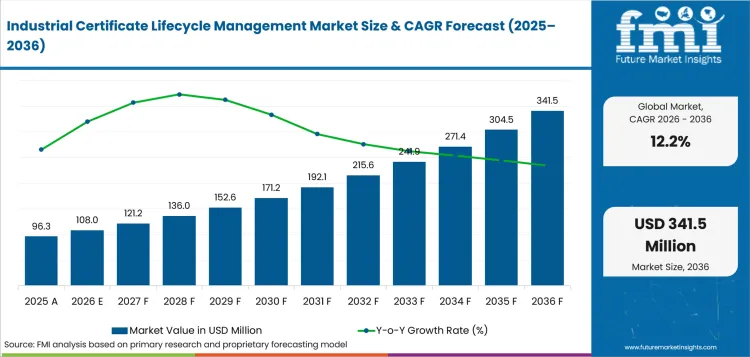
Industrial Certificate Lifecycle Management Market Overview: Size and Forecast
- 2025 Market Size: USD 96.3 million
- 2026 Market Size: USD 108.0 million
- 2036 Market Size: USD 341.5 million
- Forecast CAGR: 12.2% from 2026 to 2036
- Leading Offering: Software
- Software Share in 2026: 48.0%
- Leading Security Function: Asset Discovery
- Asset Discovery Share in 2026: 31.0%
- Fastest-growing Country: India
- India Forecast CAGR: 14.2% from 2026 to 2036
Summary of the Industrial Certificate Lifecycle Management Market
- Demand and Growth Drivers
- OPC UA certificate handling is creating demand for central trust-list tools across controllers and plant servers.
- Shorter TLS certificate validity is raising renewal workload for industrial portals and support systems.
- Post-quantum migration planning is pushing buyers to inventory certificates before algorithm changes begin.
- Hybrid deployment is projected at 44.0% share in 2026 due to local control needs.
- Manufacturing is estimated to hold 36.0% of end-use revenue in 2026 due to broad automation density.
- Product and Segment View
- Software is projected to lead the Offering segment with 48.0% share as automation reduces missed renewals.
- Asset Discovery is expected to lead Security Function with 31.0% share because unmanaged certificates often hide in OT networks.
- Hybrid deployment is projected to lead Deployment with 44.0% share as plants need local continuity and central reporting.
- Manufacturing is estimated to lead End-use Industry with 36.0% share due to dense machine connectivity.
- North America is projected to account for 38.0% regional share in 2026 due to mature OT security buying.
- Geography and Competitive Outlook
- India is projected to grow fastest at 14.2% CAGR from 2026 to 2036 due to smart manufacturing and infrastructure security demand.
- China is expected to expand at 13.7% CAGR from 2026 to 2036 as industrial data-security programs widen the buyer pool.
- South Korea is forecast to grow at 12.8% CAGR from 2026 to 2036 with semiconductor and electronics automation needs.
- DigiCert, Keyfactor, Palo Alto Networks (CyberArk/Venafi), Sectigo, AppViewX, and GMO GlobalSign are relevant certificate lifecycle vendors.
- Siemens and Unified Automation shape industrial fit through OPC UA certificate management support.
- Analyst Opinion
- Nikhil Kaitwade, Principal Consultant at Future Market Insights for industrial domain, says, “Industrial certificate lifecycle management is moving from a narrow IT task into a plant reliability control point. Buyers now need safe discovery, approved renewal workflows, and cryptographic visibility without disturbing production systems.”
Certificate renewal failures are now treated as production risk rather than routine administration. Shorter public TLS lifetimes push industrial portals and vendor access systems toward automated renewal. Suppliers also connect machine certificates with certificate authority software and private PKI workflows. NIST released its first three finalized post-quantum encryption standards in August 2024. That decision gives plant security teams a reason to map certificate types and algorithms before migration planning starts.
Which factors support expansion in the industrial certificate lifecycle management market?
Certificate-bearing industrial assets and compliance-led OT security programs support market value across software, appliances, and managed services.
- Software licenses form the first revenue layer because buyers need certificate discovery, renewal workflows, and policy control before they add managed services.
- Supplier pricing reflects plant size and certificate count before custom integration changes the contract value.
- Factory revenue expands when plants replace manual certificate logs with discovery and renewal workflows that reduce expired-certificate downtime risk.
- Approval logs strengthen buyer trust because they show IT security and plant operations teams who approved a renewal, exception, or policy change.
Why is the industrial certificate lifecycle management market growing?
Industrial buyers are replacing manual certificate tracking because renewal errors can interrupt remote access and machine communication. OPC UA certificate handling makes central certificate management more relevant for automation networks. Public TLS validity changes are raising renewal frequency for plant-facing web services. These needs sit next to wider operational technology security programs that already focus on asset identity and remote access.
Industrial certificate buying is moving toward prevention because a missed renewal can stop access to production systems during a maintenance event. The CA/Browser Forum approved a staged reduction of public certificate validity in April 2025. That change does not cover every private industrial certificate, but it increases renewal workload for public portals and vendor access systems. Buyers now treat renewal automation as a continuity feature rather than a back-office control.
Cryptographic change adds a second driver. NIST finalized three post-quantum encryption standards in August 2024. Industrial operators need to know which certificates use which algorithms before they test new trust chains. This turns certificate discovery into the first step of crypto-agility planning for long-life assets.
How is the industrial certificate lifecycle management market segmented?
The industrial certificate lifecycle management industry is segmented by offering, security function, deployment, end-use industry, and region.
- Software is estimated to account for 48.0% of offering revenue in 2026 as buyers prioritize discovery and renewal workflows.
- Asset Discovery is expected to lead by security function with 31.0% share as hidden certificates carry outage risk.
- Hybrid deployment is projected to account for 44.0% share in 2026 with plant teams keeping local control for critical assets.
- Manufacturing buyers are expected to represent 36.0% of end-use revenue in 2026 due to high certificate density.
- North America is projected to hold 38.0% regional share in 2026 as mature OT security budgets support early buying.
Segmentation is shaped by the practical question of who owns certificates inside the plant. Enterprise security teams usually own identity and access management tools. Control engineers often own systems that depend on certificates. Suppliers gain ground when discovery, renewal, and audit evidence connect without forcing unsafe changes during production.
Why does software lead the industrial certificate lifecycle management market?
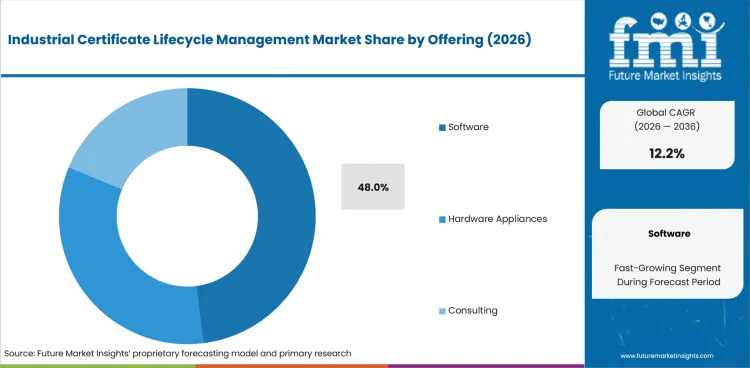
- Software is projected to account for 48.0% share in 2026 due to automated discovery and renewal control across mixed OT systems.
- Manual inventory fails at plant boundaries where certificates appear inside gateways and OPC UA servers outside normal IT scans.
Which security function leads the industrial certificate lifecycle management market?
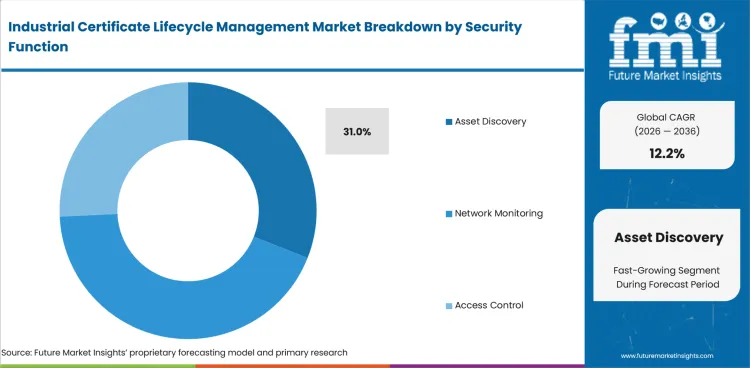
- Asset Discovery is estimated to hold 31.0% share in 2026 as certificates must be found before renewal can be planned.
- Discovery tools are judged on low-touch scanning because aggressive probes can disturb controllers or trigger alarms.
Which deployment model leads the industrial certificate lifecycle management market?
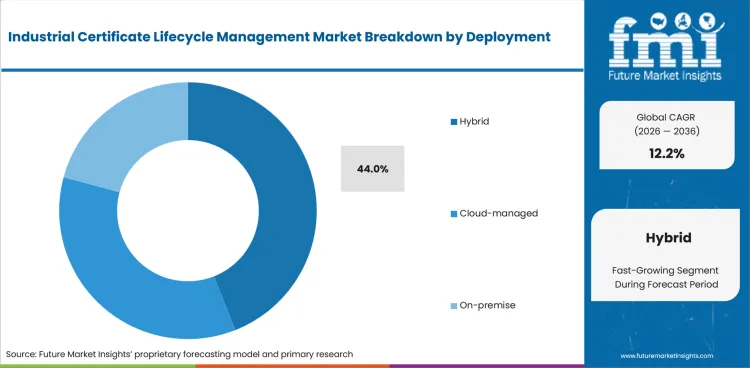
- Hybrid deployment is anticipated to represent 44.0% share in 2026 as plants need local control and central audit visibility.
- Buyers often keep certificate authority functions close to production and use cloud views for reporting.
Which end-use industry leads the industrial certificate lifecycle management market?
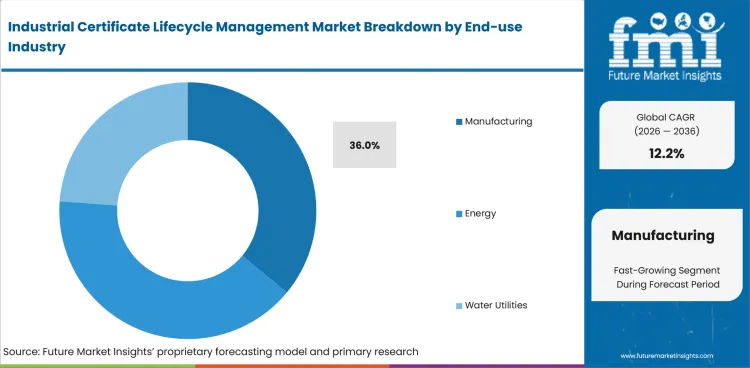
- Manufacturing is expected to account for 36.0% share in 2026 due to connected machines and remote maintenance links.
- Semiconductor and automotive plants need tighter certificate change windows because downtime costs can exceed software budgets.
Which region leads the industrial certificate lifecycle management market?
- North America is projected to hold 38.0% regional share in 2026 as OT security programs already include identity budgets.
- U.S. critical infrastructure guidance keeps asset identity and access assurance in focus for regulated plants.
What are the drivers, restraints, and opportunities in the industrial certificate lifecycle management market?
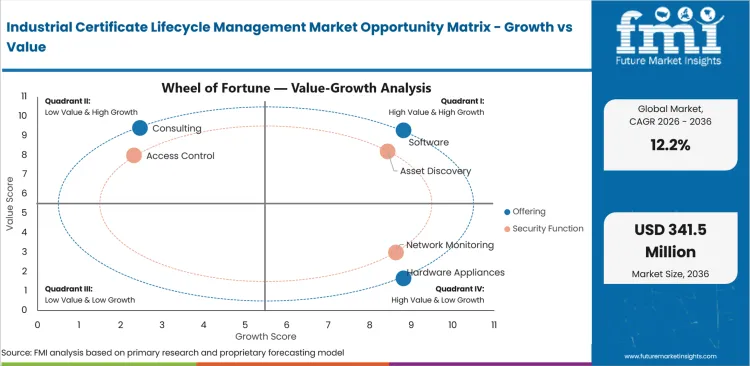
Certificate expiry risk and OPC UA trust management support adoption. Legacy plant constraints and staffing gaps slow full automation.
- Shorter certificate validity creates renewal workload that manual teams cannot absorb safely across plant portals, remote-access systems, and automation-facing assets.
- OPC UA security adoption increases demand for central trust-list and certificate handling because automation networks need controlled identity across machines and servers.
- Post-quantum planning pushes buyers to build certificate inventories now, so algorithm changes can be managed before industrial assets become migration bottlenecks.
- Legacy controllers slow CLM adoption when they cannot run modern certificate protocols, renewal agents, or automated trust-list updates without production risk.
- Service providers can package CLM with OT asset discovery and managed renewal playbooks, giving plants a practical route when internal PKI skills are limited.
Industrial Certificate Lifecycle Management Market Demand Outlook
Demand outlook is moving toward certificate controls that can prove asset identity and renewal discipline before channel expansion. OPC Foundation documentation states that a Global Discovery Server can include certificate management functions for a plant or entire system. This makes the link between automation architecture and public key infrastructure platforms more practical for buyers.
Certificate expiry risk is becoming a plant reliability issue as digital access routes now support operations and maintenance. Buyers need workflow tools that route approvals through IT security and plant operations. Stronger governance also links CLM with identity governance tools where access evidence is reviewed across business and OT owners.
Voice of Customer and Decision-driver Analysis
Purchase decisions are shaped by safe discovery, maintenance-window control, and proof that renewal workflows do not disrupt production. Buyers compare CLM tools against existing hardware security modules and secure-key infrastructure. This matters for plants that require tighter control over private keys and certificate authority operations.
Smaller plants often lack internal PKI and OT security staff. Managed CLM therefore gains attention when buyers already use security operations services for monitoring and incident support. Vendors must show clear escalation rules and local approval checkpoints before renewal automation is accepted.
Which countries are growing fastest in the industrial certificate lifecycle management market?
India 14.2% CAGR, China 13.7% CAGR, South Korea 12.8% CAGR, United States 11.8% CAGR, Germany 11.7% CAGR, Japan 11.5% CAGR, United Kingdom 11.3% CAGR, and France 11.2% CAGR from 2026 to 2036.
.webp "Top Country Growth Comparison Industrial Certificate Lifecycle Management Market Cagr (2026 2036)")
| Country | CAGR |
|---|---|
| India | 14.2% |
| China | 13.7% |
| South Korea | 12.8% |
| United States | 11.8% |
| Germany | 11.7% |
| Japan | 11.5% |
| United Kingdom | 11.3% |
| France | 11.2% |
Source: Future Market Insights, 2026.
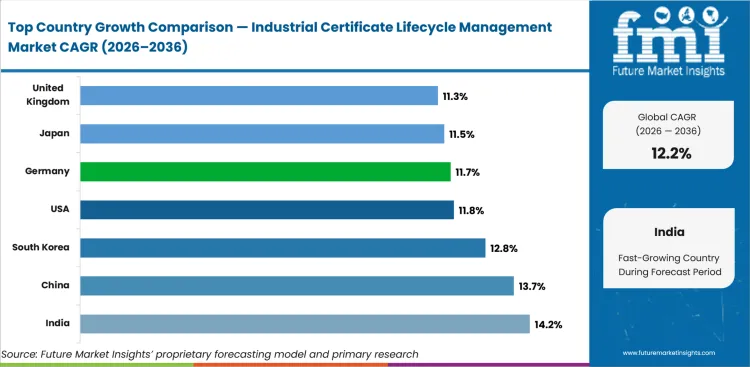
How do country-level CAGRs compare in the industrial certificate lifecycle management market?
- India leads country growth with 14.2% CAGR from 2026 to 2036 because industrial cyber programs are moving into factories and infrastructure.
- China is expected to expand at 13.7% CAGR from 2026 to 2036 due to industrial data-security policy and domestic platform demand.
- South Korea is projected to grow at 12.8% CAGR from 2026 to 2036 as semiconductor and electronics plants require disciplined certificate governance.
- The United States is estimated to rise at 11.8% CAGR from 2026 to 2036 with critical infrastructure oversight and mature PKI buying.
- Germany is forecast to post 11.7% CAGR from 2026 to 2036 as engineering-led OT security controls enter plant planning.
- Japan is expected to advance at 11.5% CAGR over the forecast period with semiconductor OT guidance and local CA channel reach.
- The United Kingdom is forecast to grow at 11.3% CAGR from 2026 to 2036 as cyber resilience guidance shapes plant access controls.
- France is projected to post 11.2% CAGR from 2026 to 2036 as industrial system classification improves supplier access discipline.
How fast is the industrial certificate lifecycle management market growing in United States?
An 11.8% CAGR from 2026 to 2036 reflects critical infrastructure oversight and mature PKI buying across industrial sites.
Country Market Snapshot Table
| Parameter | Value |
|---|---|
| Market Size in 2025 (Value) | USD 28.6 million |
| Market Size in 2026 (Value) | USD 32.0 million |
| Market Forecast in 2036 (Value) | USD 97.6 million |
| CAGR (2026 to 2036) | 11.8% |
| Years Considered | 2021 to 2036 |
| Base Year | 2025 |
| Forecast Period | 2026 to 2036 |
| Units Considered | Value (USD million) |
| Leading Sub-Region | Midwest industrial belt |
United States Industrial Certificate Lifecycle Management Market Outlook
United States certificate lifecycle demand is influenced by critical infrastructure oversight and enterprise PKI maturity. Buyers need CLM tools that can connect public certificates, private trust stores and plant approval workflows.
Industrial sites are expected to prioritize low-impact discovery and renewal evidence. Vendors with CA depth, machine identity visibility and OT-safe deployment references should gain stronger procurement access.
Key Growth Drivers
- United States industrial buyers are mapping certificate estates because NIST finalized 3 post-quantum encryption standards in August 2024.
- United States semiconductor plants are expanding certificate-bearing assets as Census reported semiconductor establishments rising to 2,545 in the first quarter of 2024.
- United States utilities and transport operators use CLM to connect asset identity with remote access governance.
- United States manufacturers adopt hybrid CLM when maintenance windows require local approval before renewal.
Key Restraints
- United States plant budgets face restraint because BEA reported private goods-producing real value added fell 1.8% in the fourth quarter of 2025.
- United States legacy PLCs can slow certificate automation when agents or modern protocols are not supported.
- United States operators require proof that discovery scans will not trigger alarms or disrupt production assets.
What makes United States unique
The United States combines large CA platforms, critical infrastructure scrutiny and mature enterprise PKI budgets.
Key Companies
- DigiCert
- Keyfactor
- Palo Alto Networks (CyberArk/Venafi)
- Sectigo
- AppViewX
- Industrial cybersecurity integrators
Sales & Marketing Channels
- Direct enterprise CA sales
- OT security integrators
- Managed PKI service providers
- Industrial automation partners
- Critical infrastructure consulting firms
Country Segment Breakdown Table
| Segment | Sub-Segments |
|---|---|
| By Offering | Software · Hardware Appliances · Managed Services · Consulting · Training |
| By Security Function | Asset Discovery · Network Monitoring · Access Control · Backup & Recovery · Vulnerability Management |
| By Deployment | On-premise · Cloud-managed · Hybrid |
| By End-use Industry | Manufacturing · Energy · Water Utilities · Chemicals · Pharmaceuticals · Transportation |
| Key Sub-Regions Covered, Manufacturing and automation corridors | Midwest industrial belt · Gulf Coast energy corridor · Northeast utilities · West Coast technology clusters · Texas industrial corridor |
Frequently Asked Questions
How fast is United States industrial certificate lifecycle management market growing?
Sales in United States are forecast to grow at 11.8% CAGR from 2026 to 2036.
Who leads United States industrial certificate lifecycle management market?
Local integrators and global CLM vendors lead where they provide OT-safe discovery and maintenance-window workflows.
What is the main restraint in United States industrial certificate lifecycle management market?
The main restraint is safe deployment inside production networks with older controllers and limited PKI staff.
How fast is the industrial certificate lifecycle management market growing in United Kingdom?
An 11.3% CAGR from 2026 to 2036 reflects cyber resilience pressure and managed security delivery across UK industry.
Country Market Snapshot Table
| Parameter | Value |
|---|---|
| Market Size in 2025 (Value) | USD 6.5 million |
| Market Size in 2026 (Value) | USD 7.2 million |
| Market Forecast in 2036 (Value) | USD 21.0 million |
| CAGR (2026 to 2036) | 11.3% |
| Years Considered | 2021 to 2036 |
| Base Year | 2025 |
| Forecast Period | 2026 to 2036 |
| Units Considered | Value (USD million) |
| Leading Sub-Region | Midlands manufacturing |
United Kingdom Industrial Certificate Lifecycle Management Market Outlook
United Kingdom certificate lifecycle demand is shaped by cyber resilience language and board-level risk governance. Industrial operators need clearer control over remote access certificates and supplier trust evidence.
Market adoption is expected to favor managed services because mid-sized operators lack deep PKI staff. Vendors that connect CLM with Cyber Essentials-style controls and OT approval workflows should gain traction.
Key Growth Drivers
- United Kingdom industrial buyers are raising OT access discipline after the NCSC handled 204 nationally significant cyber attacks in the year to August 2025.
- United Kingdom manufacturing recovery supports certificate governance because ONS reported production output increased 1.2% in the three months to February 2026.
- United Kingdom infrastructure operators use CLM to document access control across remote engineering and maintenance portals.
- United Kingdom managed security providers can package renewal workflows for plants without internal PKI teams.
Key Restraints
- United Kingdom adoption is restrained by workforce gaps because DSIT reported 49% of businesses had a basic cyber security skills gap in 2025.
- United Kingdom buyers may delay automation when OT approval ownership is split across contractors and plant teams.
- United Kingdom plants require supplier assurance before allowing certificate discovery inside production networks.
What makes United Kingdom unique
The United Kingdom links CLM demand to cyber resilience and managed service delivery rather than plant automation alone.
Key Companies
- Palo Alto Networks (CyberArk/Venafi)
- DigiCert
- Keyfactor
- Sectigo
- OT security consultancies
- Managed security service providers
Sales & Marketing Channels
- Managed security providers
- Industrial cyber consultancies
- Direct enterprise sales
- Utilities procurement panels
- Systems integrators
Country Segment Breakdown Table
| Segment | Sub-Segments |
|---|---|
| By Offering | Software · Hardware Appliances · Managed Services · Consulting · Training |
| By Security Function | Asset Discovery · Network Monitoring · Access Control · Backup & Recovery · Vulnerability Management |
| By Deployment | On-premise · Cloud-managed · Hybrid |
| By End-use Industry | Manufacturing · Energy · Water Utilities · Chemicals · Pharmaceuticals · Transportation |
| Key Sub-Regions Covered, Manufacturing and automation corridors | Midlands manufacturing · London and Southeast utilities · Scotland energy corridor · Northern transport clusters · Wales process industry |
Frequently Asked Questions
How fast is United Kingdom industrial certificate lifecycle management market growing?
Sales in United Kingdom are forecast to grow at 11.3% CAGR from 2026 to 2036.
Who leads United Kingdom industrial certificate lifecycle management market?
Local integrators and global CLM vendors lead where they provide OT-safe discovery and maintenance-window workflows.
What is the main restraint in United Kingdom industrial certificate lifecycle management market?
The main restraint is safe deployment inside production networks with older controllers and limited PKI staff.
How fast is the industrial certificate lifecycle management market growing in Germany?
An 11.7% CAGR from 2026 to 2036 reflects engineering-led OT security and manufacturing renewal requirements.
Country Market Snapshot Table
| Parameter | Value |
|---|---|
| Market Size in 2025 (Value) | USD 7.9 million |
| Market Size in 2026 (Value) | USD 8.8 million |
| Market Forecast in 2036 (Value) | USD 26.6 million |
| CAGR (2026 to 2036) | 11.7% |
| Years Considered | 2021 to 2036 |
| Base Year | 2025 |
| Forecast Period | 2026 to 2036 |
| Units Considered | Value (USD million) |
| Leading Sub-Region | North Rhine-Westphalia |
Germany Industrial Certificate Lifecycle Management Market Outlook
Germany certificate lifecycle demand is shaped by production engineering discipline and strong evaluation requirements. Buyers expect tools to fit plant change control and automation standards.
The market is expected to reward vendors that integrate with industrial systems and avoid disruptive scans. Local references and German-language service coverage remain important for procurement access.
Key Growth Drivers
- Germany manufacturers need renewal control as Destatis reported manufacturing new orders rose 7.8% month on month in December 2025.
- Germany cyber governance supports CLM demand because the Federal Ministry of the Interior reported 131,391 cybercrime cases in June 2025.
- Germany industrial operators use CLM to align certificate renewal with maintenance windows and supplier access rules.
- Germany automation ecosystems support demand where OPC UA trust-list handling enters plant security design.
Key Restraints
- Germany adoption is restrained by plant budget pressure because Destatis reported real manufacturing turnover fell 1.4% month on month in December 2025.
- Germany buyers often require long proof cycles before adding certificate tools to production networks.
- Germany plants can reject renewal automation that does not align with engineering documentation and validation routines.
What makes Germany unique
Germany stands out for engineering-led evaluation where certificate lifecycle tools must fit automation standards.
Key Companies
- Siemens
- Utimaco
- Unified Automation
- DigiCert
- Keyfactor
- Industrial automation integrators
Sales & Marketing Channels
- Automation system integrators
- Industrial cybersecurity consultancies
- Direct enterprise sales
- Managed PKI providers
- Engineering procurement channels
Country Segment Breakdown Table
| Segment | Sub-Segments |
|---|---|
| By Offering | Software · Hardware Appliances · Managed Services · Consulting · Training |
| By Security Function | Asset Discovery · Network Monitoring · Access Control · Backup & Recovery · Vulnerability Management |
| By Deployment | On-premise · Cloud-managed · Hybrid |
| By End-use Industry | Manufacturing · Energy · Water Utilities · Chemicals · Pharmaceuticals · Transportation |
| Key Sub-Regions Covered, Manufacturing and automation corridors | North Rhine-Westphalia · Bavaria · Baden-Wurttemberg · Lower Saxony · Hamburg logistics corridor |
Frequently Asked Questions
How fast is Germany industrial certificate lifecycle management market growing?
Sales in Germany are forecast to grow at 11.7% CAGR from 2026 to 2036.
Who leads Germany industrial certificate lifecycle management market?
Local integrators and global CLM vendors lead where they provide OT-safe discovery and maintenance-window workflows.
What is the main restraint in Germany industrial certificate lifecycle management market?
The main restraint is safe deployment inside production networks with older controllers and limited PKI staff.
How fast is the industrial certificate lifecycle management market growing in France?
An 11.2% CAGR from 2026 to 2036 reflects structured industrial security classification and cautious supplier access.
Country Market Snapshot Table
| Parameter | Value |
|---|---|
| Market Size in 2025 (Value) | USD 5.8 million |
| Market Size in 2026 (Value) | USD 6.4 million |
| Market Forecast in 2036 (Value) | USD 18.5 million |
| CAGR (2026 to 2036) | 11.2% |
| Years Considered | 2021 to 2036 |
| Base Year | 2025 |
| Forecast Period | 2026 to 2036 |
| Units Considered | Value (USD million) |
| Leading Sub-Region | Ile-de-France |
France Industrial Certificate Lifecycle Management Market Outlook
France certificate lifecycle demand is shaped by industrial system classification and formal risk review. Buyers need CLM tools that fit security zoning and supplier access documentation.
Market adoption is expected to move through integrator-led projects in energy, aerospace and process industries. Vendors that document safe discovery and approval evidence should be better positioned.
Key Growth Drivers
- France manufacturers need CLM evidence for security zoning because ANSSI issued its industrial control systems classification method version 2.0 in December 2025.
- France manufacturing buyers can justify access controls after INSEE reported the manufacturing business climate reached 102 in December 2025.
- France production recovery adds renewal use cases because INSEE reported first-quarter 2026 manufacturing output was 1.5% higher year over year.
- France regulated operators use CLM to support classification evidence and renewal traceability across plant zones.
Key Restraints
- France rollout can slow because INSEE reported manufacturing output fell 0.8% month on month in December 2025.
- France buyers often require local assurance documentation before granting discovery access to production systems.
- France plant teams may limit cloud-managed certificate visibility when sensitive infrastructure rules apply.
What makes France unique
France is distinct because classification discipline and security assurance shape vendor access before price discussions.
Key Companies
- Thales
- Airbus Cybersecurity
- Eviden
- DigiCert
- Palo Alto Networks (CyberArk/Venafi)
- Industrial security integrators
Sales & Marketing Channels
- Industrial cybersecurity integrators
- Energy and transport procurement panels
- Direct enterprise sales
- Managed PKI providers
- Compliance consultancies
Country Segment Breakdown Table
| Segment | Sub-Segments |
|---|---|
| By Offering | Software · Hardware Appliances · Managed Services · Consulting · Training |
| By Security Function | Asset Discovery · Network Monitoring · Access Control · Backup & Recovery · Vulnerability Management |
| By Deployment | On-premise · Cloud-managed · Hybrid |
| By End-use Industry | Manufacturing · Energy · Water Utilities · Chemicals · Pharmaceuticals · Transportation |
| Key Sub-Regions Covered, Manufacturing and automation corridors | Ile-de-France · Auvergne-Rhone-Alpes · Occitanie aerospace · Normandy energy · Nouvelle-Aquitaine industrial corridor |
Frequently Asked Questions
How fast is France industrial certificate lifecycle management market growing?
Sales in France are forecast to grow at 11.2% CAGR from 2026 to 2036.
Who leads France industrial certificate lifecycle management market?
Local integrators and global CLM vendors lead where they provide OT-safe discovery and maintenance-window workflows.
What is the main restraint in France industrial certificate lifecycle management market?
The main restraint is safe deployment inside production networks with older controllers and limited PKI staff.
How fast is the industrial certificate lifecycle management market growing in Japan?
An 11.5% CAGR from 2026 to 2036 reflects semiconductor OT guidance and high downtime sensitivity in process automation.
Country Market Snapshot Table
| Parameter | Value |
|---|---|
| Market Size in 2025 (Value) | USD 7.2 million |
| Market Size in 2026 (Value) | USD 8.0 million |
| Market Forecast in 2036 (Value) | USD 23.8 million |
| CAGR (2026 to 2036) | 11.5% |
| Years Considered | 2021 to 2036 |
| Base Year | 2025 |
| Forecast Period | 2026 to 2036 |
| Units Considered | Value (USD million) |
| Leading Sub-Region | Tokyo-Kanto |
Japan Industrial Certificate Lifecycle Management Market Outlook
Japan certificate lifecycle demand is shaped by semiconductor process automation and careful validation routines. Buyers require proof that lifecycle automation will not disturb tuned production environments.
Local CA presence and automation partners support buyer education. Vendors that connect CLM with factory guidelines and maintenance-window workflows should gain more acceptance.
Key Growth Drivers
- Japan factory operators need renewal controls because METI reported December 2025 industrial production at 101.8 on the 2020 average index.
- Japan production planning supports CLM windows because METI’s December 2025 forecast survey expected output to rise 8.0% in January 2026.
- Japan semiconductor buyers gained a direct OT security trigger when METI released factory security guidance in October 2025.
- Japan local CA channels can explain renewal automation to manufacturers already using certificate-based trust.
Key Restraints
- Japan validation cycles are slower because METI reported production capacity fell 1.8% year over year in December 2025.
- Japan process plants require staged testing before certificate renewal can reach production systems.
- Japan buyers may prefer local implementation partners when global vendors lack Japanese-language support.
What makes Japan unique
Japan is unique because semiconductor process automation creates a precise OT certificate use case with high downtime sensitivity.
Key Companies
- GMO GlobalSign
- DigiCert
- Siemens
- NEC security integrators
- Mitsubishi Electric integrators
- Factory automation partners
Sales & Marketing Channels
- Local CA channels
- Semiconductor system integrators
- Factory automation partners
- Managed certificate services
- Compliance consulting firms
Country Segment Breakdown Table
| Segment | Sub-Segments |
|---|---|
| By Offering | Software · Hardware Appliances · Managed Services · Consulting · Training |
| By Security Function | Asset Discovery · Network Monitoring · Access Control · Backup & Recovery · Vulnerability Management |
| By Deployment | On-premise · Cloud-managed · Hybrid |
| By End-use Industry | Manufacturing · Energy · Water Utilities · Chemicals · Pharmaceuticals · Transportation |
| Key Sub-Regions Covered, Manufacturing and automation corridors | Tokyo-Kanto · Kansai · Chubu · Kyushu semiconductor corridor · Tohoku electronics clusters |
Frequently Asked Questions
How fast is Japan industrial certificate lifecycle management market growing?
Sales in Japan are forecast to grow at 11.5% CAGR from 2026 to 2036.
Who leads Japan industrial certificate lifecycle management market?
Local integrators and global CLM vendors lead where they provide OT-safe discovery and maintenance-window workflows.
What is the main restraint in Japan industrial certificate lifecycle management market?
The main restraint is safe deployment inside production networks with older controllers and limited PKI staff.
How fast is the industrial certificate lifecycle management market growing in China?
A 13.7% CAGR from 2026 to 2036 reflects industrial data-security policy and connected manufacturing scale.
Country Market Snapshot Table
| Parameter | Value |
|---|---|
| Market Size in 2025 (Value) | USD 11.0 million |
| Market Size in 2026 (Value) | USD 12.5 million |
| Market Forecast in 2036 (Value) | USD 45.1 million |
| CAGR (2026 to 2036) | 13.7% |
| Years Considered | 2021 to 2036 |
| Base Year | 2025 |
| Forecast Period | 2026 to 2036 |
| Units Considered | Value (USD million) |
| Leading Sub-Region | Yangtze River Delta |
China Industrial Certificate Lifecycle Management Market Outlook
China certificate lifecycle demand is shaped by industrial data protection policy and domestic platform ecosystems. Buyers need stronger control over access, encryption and trusted machine identity.
Procurement is expected to favor vendors that align with local compliance requirements and industrial internet programs. Domestic channels matter more where sensitive sectors limit external supplier access.
Key Growth Drivers
- China industrial buyers gained a policy trigger when the State Council listed 11 tasks for industrial data protection in February 2024.
- China connected manufacturing supports CLM demand because NBS reported industrial value added rose 5.9% in 2025.
- China high-technology manufacturing creates certificate density because NBS reported 9.4% growth for 2025.
- China platform ecosystems can place CLM inside broader industrial internet and data-security programs.
Key Restraints
- China buyer budgets face margin pressure because NBS reported industrial profit rate at 5.29% for January to November 2025.
- China sensitive sectors may restrict foreign CLM and PKI suppliers from plant networks.
- China local standards and approval cycles can slow external vendor entry despite strong demand.
What makes China unique
China combines industrial digitization with local compliance requirements that change vendor selection and channel access.
Key Companies
- Domestic certificate authority channels
- Industrial internet platform providers
- Local cybersecurity integrators
- Automation engineering firms
- Approved cloud providers
- State-linked service partners
Sales & Marketing Channels
- Local cybersecurity integrators
- Industrial internet platform partners
- State-linked procurement channels
- Domestic CA channels
- Automation engineering firms
Country Segment Breakdown Table
| Segment | Sub-Segments |
|---|---|
| By Offering | Software · Hardware Appliances · Managed Services · Consulting · Training |
| By Security Function | Asset Discovery · Network Monitoring · Access Control · Backup & Recovery · Vulnerability Management |
| By Deployment | On-premise · Cloud-managed · Hybrid |
| By End-use Industry | Manufacturing · Energy · Water Utilities · Chemicals · Pharmaceuticals · Transportation |
| Key Sub-Regions Covered, Manufacturing and automation corridors | Yangtze River Delta · Pearl River Delta · Beijing-Tianjin-Hebei · Chengdu-Chongqing · Shandong industrial belt |
Frequently Asked Questions
How fast is China industrial certificate lifecycle management market growing?
Sales in China are forecast to grow at 13.7% CAGR from 2026 to 2036.
Who leads China industrial certificate lifecycle management market?
Local integrators and global CLM vendors lead where they provide OT-safe discovery and maintenance-window workflows.
What is the main restraint in China industrial certificate lifecycle management market?
The main restraint is safe deployment inside production networks with older controllers and limited PKI staff.
How fast is the industrial certificate lifecycle management market growing in South Korea?
A 12.8% CAGR from 2026 to 2036 reflects semiconductor concentration and group-level technology governance.
Country Market Snapshot Table
| Parameter | Value |
|---|---|
| Market Size in 2025 (Value) | USD 6.0 million |
| Market Size in 2026 (Value) | USD 6.8 million |
| Market Forecast in 2036 (Value) | USD 22.7 million |
| CAGR (2026 to 2036) | 12.8% |
| Years Considered | 2021 to 2036 |
| Base Year | 2025 |
| Forecast Period | 2026 to 2036 |
| Units Considered | Value (USD million) |
| Leading Sub-Region | Seoul Capital Area |
South Korea Industrial Certificate Lifecycle Management Market Outlook
South Korea certificate lifecycle demand is tied to semiconductor and electronics plants with centralized technology governance. Large groups need certificate policy control across production tools and supplier access routes.
Market adoption is expected to depend on local system integrators and Korean-language service depth. Vendors that provide OT references and group-level reporting should gain procurement access.
Key Growth Drivers
- South Korea semiconductor groups support CLM standardization as MSIT’s 2025 work plan expands 12 national strategic technologies to 35% of government R&D funding by 2027.
- South Korea machinery procurement supports OT service work because KOSTAT reported domestic machinery orders increased 6.9% year over year in December 2025.
- South Korea manufacturing activity creates renewal demand because KOSTAT reported production increased 1.9% month on month in December 2025.
- South Korea group-level cyber teams can standardize CLM across semiconductor and electronics sites.
Key Restraints
- South Korea equipment spending can restrain projects because KOSTAT reported the equipment investment index fell 10.3% year on year in December 2025.
- South Korea buyers often need Korean-language workflows and local support before adopting global CLM platforms.
- South Korea plant teams may resist discovery tools without semiconductor references and safe-scan evidence.
What makes South Korea unique
South Korea’s certificate lifecycle demand is tied closely to semiconductor and electronics groups with centralized technology governance.
Key Companies
- Samsung SDS
- LG CNS
- SK shieldus
- DigiCert partners
- Keyfactor partners
- Local OT integrators
Sales & Marketing Channels
- Local system integrators
- Managed security service providers
- Enterprise technology affiliates
- Semiconductor engineering partners
- Direct global vendor sales
Country Segment Breakdown Table
| Segment | Sub-Segments |
|---|---|
| By Offering | Software · Hardware Appliances · Managed Services · Consulting · Training |
| By Security Function | Asset Discovery · Network Monitoring · Access Control · Backup & Recovery · Vulnerability Management |
| By Deployment | On-premise · Cloud-managed · Hybrid |
| By End-use Industry | Manufacturing · Energy · Water Utilities · Chemicals · Pharmaceuticals · Transportation |
| Key Sub-Regions Covered, Manufacturing and automation corridors | Seoul Capital Area · Gyeonggi semiconductor cluster · Ulsan industrial belt · Busan shipbuilding · Daejeon technology corridor |
Frequently Asked Questions
How fast is South Korea industrial certificate lifecycle management market growing?
Sales in South Korea are forecast to grow at 12.8% CAGR from 2026 to 2036.
Who leads South Korea industrial certificate lifecycle management market?
Local integrators and global CLM vendors lead where they provide OT-safe discovery and maintenance-window workflows.
What is the main restraint in South Korea industrial certificate lifecycle management market?
The main restraint is safe deployment inside production networks with older controllers and limited PKI staff.
How fast is the industrial certificate lifecycle management market growing in India?
A 14.2% CAGR from 2026 to 2036 reflects smart infrastructure, electronics manufacturing and service-led implementation.
Country Market Snapshot Table
| Parameter | Value |
|---|---|
| Market Size in 2025 (Value) | USD 4.6 million |
| Market Size in 2026 (Value) | USD 5.2 million |
| Market Forecast in 2036 (Value) | USD 19.6 million |
| CAGR (2026 to 2036) | 14.2% |
| Years Considered | 2021 to 2036 |
| Base Year | 2025 |
| Forecast Period | 2026 to 2036 |
| Units Considered | Value (USD million) |
| Leading Sub-Region | Maharashtra-Pune |
India Industrial Certificate Lifecycle Management Market Outlook
India certificate lifecycle demand is shaped by public infrastructure cyber programs and industrial digitization. Buyers often need consulting and managed services before full CLM automation.
The market is expected to favor vendors with local implementation partners and training capacity. Public-sector industrial buyers also need tender-ready documentation and service coverage across varied plant types.
Key Growth Drivers
- India infrastructure buyers need certificate governance as PIB reported all 100 Smart Cities have Integrated Command and Control Centres in June 2025.
- India manufacturers can justify CLM as MoSPI reported manufacturing output rose 8.1% in December 2025.
- India electronics plants create certificate density because MoSPI reported computer, electronic and optical products output rose 34.9% in December 2025.
- India service-led implementation can scale managed CLM across plants with limited internal PKI capacity.
Key Restraints
- India budget timing can restrain rollouts because PIB reported 512 Smart Cities projects worth Rs. 13,043 crore were still under implementation in May 2025.
- India plants often require integrator-led deployment because PKI and OT security skills remain uneven across regions.
- India public-sector buyers may slow procurement when tender documents do not clearly define CLM ownership.
What makes India unique
India is the fastest-growing country because service-led implementation can scale certificate controls across varied industrial sites.
Key Companies
- AppViewX
- DigiCert partners
- GMO GlobalSign partners
- Indian cybersecurity integrators
- Managed security providers
- Public-sector system integrators
Sales & Marketing Channels
- Public-sector tenders
- Industrial cybersecurity integrators
- Managed security service providers
- Direct enterprise sales
- Automation engineering partners
Country Segment Breakdown Table
| Segment | Sub-Segments |
|---|---|
| By Offering | Software · Hardware Appliances · Managed Services · Consulting · Training |
| By Security Function | Asset Discovery · Network Monitoring · Access Control · Backup & Recovery · Vulnerability Management |
| By Deployment | On-premise · Cloud-managed · Hybrid |
| By End-use Industry | Manufacturing · Energy · Water Utilities · Chemicals · Pharmaceuticals · Transportation |
| Key Sub-Regions Covered, Manufacturing and automation corridors | Maharashtra-Pune · Gujarat industrial corridor · Karnataka electronics · Tamil Nadu automotive · Telangana-Hyderabad · Chhattisgarh steel corridor |
Frequently Asked Questions
How fast is India industrial certificate lifecycle management market growing?
Sales in India are forecast to grow at 14.2% CAGR from 2026 to 2036.
Who leads India industrial certificate lifecycle management market?
Local integrators and global CLM vendors lead where they provide OT-safe discovery and maintenance-window workflows.
What is the main restraint in India industrial certificate lifecycle management market?
The main restraint is safe deployment inside production networks with older controllers and limited PKI staff.
Who are the leading players in the industrial certificate lifecycle management market?
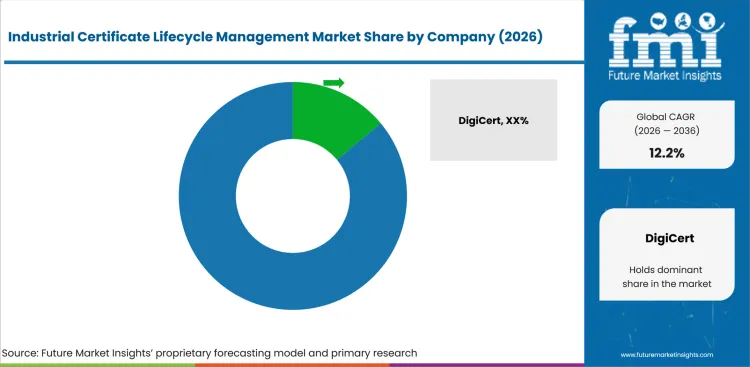
The market is moderately concentrated because large certificate vendors hold trust infrastructure and global CA relationships. Specialist vendors compete through OT-safe discovery and workflow automation for mixed certificate estates.
Competitive positioning is shaped by the ability to connect enterprise certificate governance with plant-level operating rules. DigiCert, Keyfactor, Palo Alto Networks (CyberArk/Venafi), Sectigo, AppViewX, and GMO GlobalSign compete through discovery, renewal, revocation, and policy workflows. Siemens and Unified Automation influence industrial fit because OPC UA certificate management grounds CLM in automation practice.
Industrial fit remains the harder barrier for new entrants. OPC UA certificate management requires trust-list handling and safe behavior around production systems. Suppliers with low-impact discovery and maintenance-window support are better placed than generic tools used in broad industrial cybersecurity programs.
Secure-key infrastructure providers remain relevant where buyers need stronger private-key control. Utimaco and Fortanix support HSM and key orchestration layers around CA operations. This connects CLM spending with digital credential management software and audit workflows across high-control environments.
The opportunity is strongest where CLM vendors partner with automation integrators. This route is useful in plants where operational technology deployments require certificate changes to follow production rules and local approvals.
Key Companies in the Industrial Certificate Lifecycle Management Market
- Certificate Lifecycle Platforms: DigiCert, Keyfactor, Palo Alto Networks (CyberArk/Venafi), Sectigo, AppViewX, GMO GlobalSign, and Entrust compete through certificate discovery and renewal workflows.
- Industrial Ecosystem Vendors: Siemens and Unified Automation influence certificate handling through OPC UA security support and Global Discovery Server functions.
- Secure-Key Infrastructure Providers: Utimaco and Fortanix support HSMs, secure key handling, and integrations with CLM platforms.
Competitive Benchmarking: Industrial Certificate Lifecycle Management Market
| Company | OT Certificate Discovery Fit | CA and PKI Automation Depth | Industrial Workflow Support | Geographic Footprint |
|---|---|---|---|---|
| DigiCert | Medium | High | Strong | Global |
| Keyfactor | Strong | High | Strong | Global |
| Palo Alto Networks (CyberArk/Venafi) | Medium | High | Strong | Global |
| Sectigo | Medium | High | Moderate | Global |
| AppViewX | Medium | High | Moderate | Global |
| GMO GlobalSign | Medium | Strong | Moderate | Global |
| Entrust | Medium | Strong | Moderate | Global |
| Siemens | High | Medium | High | Global |
| Unified Automation | High | Medium | High | Europe and global partners |
| Utimaco | Low | Medium | Strong | Global |
| Fortanix | Low | Medium | Moderate | Global |
Source: Future Market Insights competitive analysis, 2026. Ratings reflect relative positioning based on OT certificate discovery fit, CA and PKI automation depth, and industrial workflow support.
Key Developments in Industrial Certificate Lifecycle Management Market
- In September 2024, DigiCert completed the acquisition of Vercara. The deal expanded DigiCert’s PKI and certificate management infrastructure for people, software, websites, and devices.
- In October 2024, CyberArk completed the acquisition of Venafi, adding machine identity management to its identity security platform. In February 2026, Palo Alto Networks completed its acquisition of CyberArk, making CyberArk/Venafi part of Palo Alto Networks' identity security portfolio.
- In March 2026, Sectigo introduced its multi-tenant Partner Platform for managed CLM delivery. The platform supports MSP and distributor-led certificate operations.
Industrial Certificate Lifecycle Management Market - Report Scope
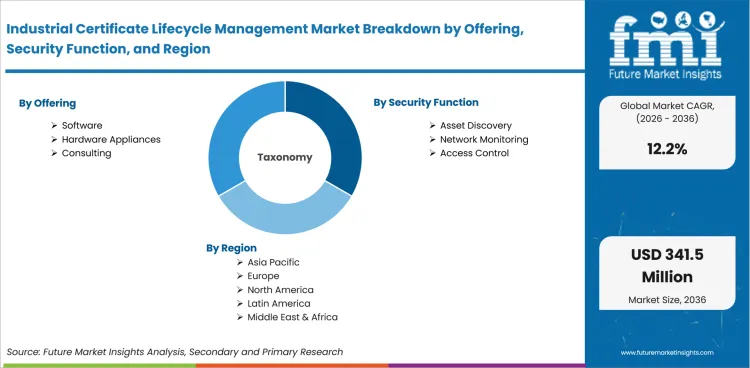
| Parameter | Details |
|---|---|
| Forecast period | 2026 to 2036 |
| Historical period | 2021 to 2025 |
| Quantitative unit | Revenue in USD million |
| By offering | Software, hardware appliances, managed services, consulting, training |
| By security function | Asset discovery, network monitoring, access control, backup & recovery, vulnerability management |
| By deployment | On-premise, cloud-managed, hybrid |
| By end-use industry | Manufacturing, energy, water utilities, chemicals, pharmaceuticals, transportation |
| Regions covered | North America, Latin America, Europe, East Asia, South Asia and Pacific, Middle East and Africa |
| Countries covered | United States, United Kingdom, Germany, France, Japan, China, South Korea, India |
| Key companies profiled | DigiCert, Keyfactor, Palo Alto Networks (CyberArk/Venafi), Sectigo, AppViewX, GMO GlobalSign, Entrust, Siemens, Unified Automation, Utimaco, Fortanix |
| Approach | Hybrid bottom-up and top-down approach using certificate-bearing asset pools, vendor portfolio checks, CLM pricing, OT security maturity, and country-level deployment patterns |
| Source | Future Market Insights, 2026. |
Industrial Certificate Lifecycle Management Market - Scope & Definition
| Attribute | Detail |
|---|---|
| Market Definition | Software, appliances, and services used to discover, issue, renew, revoke, monitor, and audit digital certificates across industrial environments |
| Functions Covered | Certificate discovery, issuance, renewal, revocation, monitoring, trust-list control, audit evidence, and policy workflow management |
| Applications Covered | OT networks, OPC UA applications, industrial gateways, remote access systems, plant-facing portals, and supplier access workflows |
| End-Use Industries | Manufacturing, energy, water utilities, chemicals, pharmaceuticals, transportation, and other industrial operators using certificate-based trust |
| Deployment Models Covered | On-premise, cloud-managed, and hybrid certificate lifecycle management deployments |
| Inclusions | Industrial CLM software, hardware appliances, managed services, consulting, and training used for certificate control across plant and infrastructure environments |
| Exclusions | Standalone SSL resale, consumer identity tools, password managers, broad endpoint suites, and generic IT service tools without industrial certificate discovery or lifecycle control |
Industrial Certificate Lifecycle Management Market - Research Methodology
| Method | Description |
|---|---|
| Primary Research | FMI analyst interviews with plant cybersecurity teams, automation integrators, managed security service providers, enterprise PKI teams, and industrial buyers supporting OT assets |
| Desk Research | Review of OT security guidance, OPC UA specifications, CA lifecycle changes, government statistics, regulator publications, and official company product information |
| Market Sizing & Forecasting | Hybrid sizing model using certificate-bearing industrial asset pools, CLM licensing patterns, managed service adoption, plant size, certificate count, and country-level OT security maturity |
| Data Validation | Cross-verification using adjacent PKI spending, industrial cybersecurity budgets, OT automation deployment patterns, company portfolios, and post-2024 official statistics |
Industrial Certificate Lifecycle Management Market Breakdown by Offering, Security Function, Deployment, End-use Industry, and Region
Industrial Certificate Lifecycle Management Market Segmented by Offering:
- Software
- Hardware Appliances
- Managed Services
- Consulting
- Training
Industrial Certificate Lifecycle Management Market Segmented by Security Function:
- Asset Discovery
- Network Monitoring
- Access Control
- Backup & Recovery
- Vulnerability Management
Industrial Certificate Lifecycle Management Market Segmented by Deployment:
- On-premise
- Cloud-managed
- Hybrid
Industrial Certificate Lifecycle Management Market Segmented by End-use Industry:
- Manufacturing
- Energy
- Water Utilities
- Chemicals
- Pharmaceuticals
- Transportation
Industrial Certificate Lifecycle Management Market by Region:
- North America
- Latin America
- Europe
- East Asia
- South Asia and Pacific
- Middle East and Africa
Research Sources and Bibliography
- 1. Agence nationale de la sécurité des systèmes d’information. (2025, December). Cybersecurity of industrial control systems: Classification method. ANSSI.
- 2. Bureau of Economic Analysis. (2026, April). GDP by industry. U.S. Department of Commerce.
- 3. CA/Browser Forum. (2025, April 11). Ballot SC081v3: Introduce schedule of reducing validity and data reuse periods. CA/Browser Forum.
- 4. CyberArk. (2024, October). CyberArk completes acquisition of Venafi. CyberArk.
- 5. Cybersecurity and Infrastructure Security Agency. (2025, September 29). CISA and UK NCSC release joint guidance for securing OT systems. U.S. Department of Homeland Security.
- 6. Destatis. (2026, February 5). New orders in manufacturing in December 2025: +7.8% on the previous month. German Federal Statistical Office.
- 7. DigiCert. (2024, September 23). DigiCert completes acquisition of Vercara. DigiCert.
- 8. Federal Ministry of the Interior. (2025, June 3). 2024 National Situation Report on Cyber Crime. Federal Republic of Germany.
- 9. Fortanix. (2024, March 27). AppViewX and Fortanix partner to deliver code signing and machine identity management. Fortanix.
- 10. INSEE. (2025, December 18). In December 2025, the business climate in manufacturing industry has rebounded. National Institute of Statistics and Economic Studies.
- 11. INSEE. (2026, February 5). In December 2025, manufacturing output fell back sharply. National Institute of Statistics and Economic Studies.
- 12. INSEE. (2026, May 6). In March 2026, manufacturing output increased by 1.2%. National Institute of Statistics and Economic Studies.
- 13. Keyfactor. (2025, May). Keyfactor acquires InfoSec Global and CipherInsights. Keyfactor.
- 14. Ministry of Economy, Trade and Industry. (2025, October 24). OT security guidelines for semiconductor device factories compiled in Japanese and English versions. Government of Japan.
- 15. Ministry of Economy, Trade and Industry. (2026, February 16). Indices of industrial production: December 2025 revised report. Government of Japan.
- 16. Ministry of Science and ICT. (2025). 2025 work plan. Government of the Republic of Korea.
- 17. Ministry of Statistics and Programme Implementation. (2026, January 28). Quick estimate of Index of Industrial Production for December 2025. Government of India.
- 18. National Bureau of Statistics of China. (2025, December 29). Profit of industrial enterprises above the designated size from January to November in 2025. National Bureau of Statistics of China.
- 19. National Bureau of Statistics of China. (2026, January 20). Industrial production operation in December 2025. National Bureau of Statistics of China.
- 20. National Cyber Security Centre. (2025, October 14). UK experiencing four nationally significant cyber attacks every week. UK National Cyber Security Centre.
- 21. National Institute of Standards and Technology. (2024, August 13). NIST releases first 3 finalized post-quantum encryption standards. U.S. Department of Commerce.
- 22. Office for National Statistics. (2026, April 16). GDP monthly estimate, UK: February 2026. Office for National Statistics.
- 23. OPC Foundation. (2026). OPC Unified Architecture Part 2: Security Model. OPC Foundation.
- 24. Press Information Bureau. (2025, June 10). Integrated Command and Control Centres set up in all 100 Smart Cities. Government of India.
- 25. Press Information Bureau. (2025, June 24). 10 years of Smart Cities Mission. Government of India.
- 26. Sectigo. (2026, March 24). Sectigo launches multi-tenant partner platform for managed certificate lifecycle management. Sectigo.
- 27. Statistics Korea. (2026, January 30). Monthly industrial statistics, December 2025. Ministry of Data and Statistics.
- 28. The State Council of the People’s Republic of China. (2024, February 26). China unveils plan to better protect data of industrial firms. The State Council.
- 29. U.S. Census Bureau. (2024, October 3). Manufacturing Week 2024: Spotlight on the semiconductor industry. U.S. Census Bureau.
- 30. UK Department for Science, Innovation and Technology. (2026, February 2). Cyber security skills in the UK labour market 2025. GOV.UK.
This Report Answers
- Market size estimates for 2026 and forecasts through 2036 for the industrial certificate lifecycle management market.
- Insights across more than 30 regional and country-level industrial security markets.
- Analysis of demand drivers, certificate renewal risks, OPC UA trust management, and post-quantum readiness.
- Evaluation of offering, security function, deployment, and end-use industry segmentation.
- Assessment of country-level growth across the United States, United Kingdom, Germany, France, Japan, China, South Korea, and India.
- Review of competitive positioning across certificate lifecycle platforms, industrial ecosystem vendors, and secure-key infrastructure providers.
- Identification of supplier opportunities across OT-safe discovery, managed CLM, hybrid deployment, and maintenance-window renewal workflows.
- Delivery of market data, forecasts, and supporting analysis in Word-ready report format.
Frequently Asked Questions
What is the global market demand for Industrial Certificate Lifecycle Management Market in 2026?
Global demand is estimated at USD 108.0 million in 2026.
What will be the value of the Industrial Certificate Lifecycle Management Market by 2036?
The market is forecast to reach USD 341.5 million by 2036.
What CAGR is expected for the Industrial Certificate Lifecycle Management Market from 2026 to 2036?
The market is expected to grow at a 12.2% CAGR from 2026 to 2036.
Which offering segment is expected to lead the market in 2026?
Software is expected to lead with 48.0% share in 2026.
Which security function is expected to lead market revenue in 2026?
Asset Discovery is expected to lead with 31.0% share in 2026.
Which country is expected to grow fastest in this market?
India is expected to grow fastest with a 14.2% CAGR through 2036.
What does industrial certificate lifecycle management include?
It includes discovery, issuance, renewal, revocation, monitoring, and audit control for industrial digital certificates.
How was the market forecast prepared?
The forecast was prepared through asset-pool modeling, vendor portfolio review, and validation against adjacent OT security spending.
Preview the report firsthand - request a free sample
Get SampleGet the brochure for pricing and purchase details.
Get PDFTable of Content
- Key Takeaways
- Market Size and CAGR
- Top Growth Driver
- Fastest Growing Segment
- Leading Region
- Key Companies
- Emerging Opportunities
- Executive Summary
- Global Market Outlook
- Demand-side Trends
- Supply-side Trends
- Technology Roadmap Analysis
- Analysis and Recommendations
- Analyst Perspective (What is happening? Why now? What should investors know?)
- Key Questions Answered
- How large is the market?
- What is the CAGR?
- What are key trends?
- Which region dominates?
- Who are the leaders?
- Market Overview
- Market Coverage / Taxonomy
- Market Definition / Scope / Limitations
- Research Methodology
- Chapter Orientation
- Analytical Lens and Working Hypotheses
- Market Structure, Signals, and Trend Drivers
- Benchmarking and Cross-market Comparability
- Market Sizing, Forecasting, and Opportunity Mapping
- Research Design and Evidence Framework
- Desk Research Programme (Secondary Evidence)
- Expert Input and Fieldwork (Primary Evidence)
- Tooling, Models, and Reference Databases
- Data Engineering and Model Build
- Quality Assurance and Audit Trail
- Market Background
- Market Dynamics (Drivers, Restraints, Opportunity, Trends)
- Scenario Forecast (Optimistic, Likely, Conservative)
- Impact Analysis
- AI Impact
- Sustainability Impact
- Regulatory Impact
- Technology Impact
- Consumer / Buyer Analysis
- Purchase Drivers
- Adoption Barriers
- Buyer Journey
- Opportunity Map Analysis
- Product Life Cycle Analysis
- Supply Chain Analysis
- Investment Feasibility Matrix
- Value Chain Analysis
- PESTLE and Porter's Analysis
- Regulatory Landscape
- Regional Parent Market Outlook
- Production and Consumption Statistics
- Import and Export Statistics
- Global Market Analysis and Forecast, 2021 to 2036
- Historical Market Size Value (USD Million) & Volume (Unit) Analysis, 2021 to 2025
- Current and Future Market Size Value (USD Million) & Volume (Unit) Projections, 2026 to 2036
- Y-o-Y Growth Trend Analysis
- Absolute $ Opportunity Analysis
- Global Market Pricing Analysis, 2021 to 2036
- Global Market Analysis and Forecast, By Offering, 2021 to 2036
- Introduction / Key Findings
- Historical Market Size Value (USD Million) & Volume (Unit) Analysis By Offering, 2021 to 2025
- Current and Future Market Size Value (USD Million) & Volume (Unit) Analysis and Forecast By Offering, 2026 to 2036
- Software
- Hardware Appliances
- Managed Services
- Consulting
- Training
- Software
- Y-o-Y Growth Trend Analysis By Offering, 2021 to 2025
- Absolute $ Opportunity Analysis By Offering, 2026 to 2036
- Global Market Analysis and Forecast, By Security Function, 2021 to 2036
- Introduction / Key Findings
- Historical Market Size Value (USD Million) & Volume (Unit) Analysis By Security Function, 2021 to 2025
- Current and Future Market Size Value (USD Million) & Volume (Unit) Analysis and Forecast By Security Function, 2026 to 2036
- Asset Discovery
- Network Monitoring
- Access Control
- Backup & Recovery
- Vulnerability Management
- Asset Discovery
- Y-o-Y Growth Trend Analysis By Security Function, 2021 to 2025
- Absolute $ Opportunity Analysis By Security Function, 2026 to 2036
- Global Market Analysis and Forecast, By Deployment, 2021 to 2036
- Introduction / Key Findings
- Historical Market Size Value (USD Million) & Volume (Unit) Analysis By Deployment, 2021 to 2025
- Current and Future Market Size Value (USD Million) & Volume (Unit) Analysis and Forecast By Deployment, 2026 to 2036
- Hybrid
- On-premise
- Cloud-managed
- Hybrid
- Y-o-Y Growth Trend Analysis By Deployment, 2021 to 2025
- Absolute $ Opportunity Analysis By Deployment, 2026 to 2036
- Global Market Analysis and Forecast, By End-use Industry, 2021 to 2036
- Introduction / Key Findings
- Historical Market Size Value (USD Million) & Volume (Unit) Analysis By End-use Industry, 2021 to 2025
- Current and Future Market Size Value (USD Million) & Volume (Unit) Analysis and Forecast By End-use Industry, 2026 to 2036
- Manufacturing
- Energy
- Water Utilities
- Chemicals
- Pharmaceuticals
- Transportation
- Manufacturing
- Y-o-Y Growth Trend Analysis By End-use Industry, 2021 to 2025
- Absolute $ Opportunity Analysis By End-use Industry, 2026 to 2036
- Global Market Analysis and Forecast, By Region, 2021 to 2036
- Introduction
- Historical Market Size Value (USD Million) & Volume (Unit) Analysis By Region, 2021 to 2025
- Current Market Size Value (USD Million) & Volume (Unit) Analysis and Forecast By Region, 2026 to 2036
- North America
- Latin America
- Western Europe
- Eastern Europe
- East Asia
- South Asia and Pacific
- Middle East & Africa
- Market Attractiveness Analysis By Region
- North America Market Analysis and Forecast, By Country, 2021 to 2036
- Historical Market Size Value (USD Million) & Volume (Unit) Trend Analysis By Market Taxonomy, 2021 to 2025
- Market Size Value (USD Million) & Volume (Unit) Forecast By Market Taxonomy, 2026 to 2036
- By Country
- USA
- Canada
- Mexico
- By Offering
- By Security Function
- By Deployment
- By End-use Industry
- By Country
- Market Attractiveness Analysis
- By Country
- By Offering
- By Security Function
- By Deployment
- By End-use Industry
- Key Takeaways
- Latin America Market Analysis and Forecast, By Country
- Historical Market Size Value (USD Million) & Volume (Unit) Trend Analysis By Market Taxonomy, 2021 to 2025
- Market Size Value (USD Million) & Volume (Unit) Forecast By Market Taxonomy, 2026 to 2036
- By Country
- Brazil
- Chile
- Rest of Latin America
- By Offering
- By Security Function
- By Deployment
- By End-use Industry
- By Country
- Market Attractiveness Analysis
- By Country
- By Offering
- By Security Function
- By Deployment
- By End-use Industry
- Key Takeaways
- Western Europe Market Analysis and Forecast, By Country
- Historical Market Size Value (USD Million) & Volume (Unit) Trend Analysis By Market Taxonomy, 2021 to 2025
- Market Size Value (USD Million) & Volume (Unit) Forecast By Market Taxonomy, 2026 to 2036
- By Country
- Germany
- UK
- Italy
- Spain
- France
- Nordic
- BENELUX
- Rest of Western Europe
- By Offering
- By Security Function
- By Deployment
- By End-use Industry
- By Country
- Market Attractiveness Analysis
- By Country
- By Offering
- By Security Function
- By Deployment
- By End-use Industry
- Key Takeaways
- Eastern Europe Market Analysis and Forecast, By Country
- Historical Market Size Value (USD Million) & Volume (Unit) Trend Analysis By Market Taxonomy, 2021 to 2025
- Market Size Value (USD Million) & Volume (Unit) Forecast By Market Taxonomy, 2026 to 2036
- By Country
- Russia
- Poland
- Hungary
- Balkan & Baltic
- Rest of Eastern Europe
- By Offering
- By Security Function
- By Deployment
- By End-use Industry
- By Country
- Market Attractiveness Analysis
- By Country
- By Offering
- By Security Function
- By Deployment
- By End-use Industry
- Key Takeaways
- East Asia Market Analysis and Forecast, By Country
- Historical Market Size Value (USD Million) & Volume (Unit) Trend Analysis By Market Taxonomy, 2021 to 2025
- Market Size Value (USD Million) & Volume (Unit) Forecast By Market Taxonomy, 2026 to 2036
- By Country
- China
- Japan
- South Korea
- By Offering
- By Security Function
- By Deployment
- By End-use Industry
- By Country
- Market Attractiveness Analysis
- By Country
- By Offering
- By Security Function
- By Deployment
- By End-use Industry
- Key Takeaways
- South Asia and Pacific Market Analysis and Forecast, By Country
- Historical Market Size Value (USD Million) & Volume (Unit) Trend Analysis By Market Taxonomy, 2021 to 2025
- Market Size Value (USD Million) & Volume (Unit) Forecast By Market Taxonomy, 2026 to 2036
- By Country
- India
- ASEAN
- Australia & New Zealand
- Rest of South Asia and Pacific
- By Offering
- By Security Function
- By Deployment
- By End-use Industry
- By Country
- Market Attractiveness Analysis
- By Country
- By Offering
- By Security Function
- By Deployment
- By End-use Industry
- Key Takeaways
- Middle East & Africa Market Analysis and Forecast, By Country
- Historical Market Size Value (USD Million) & Volume (Unit) Trend Analysis By Market Taxonomy, 2021 to 2025
- Market Size Value (USD Million) & Volume (Unit) Forecast By Market Taxonomy, 2026 to 2036
- By Country
- Kingdom of Saudi Arabia
- Other GCC Countries
- Türkiye
- South Africa
- Other African Union
- Rest of Middle East & Africa
- By Offering
- By Security Function
- By Deployment
- By End-use Industry
- By Country
- Market Attractiveness Analysis
- By Country
- By Offering
- By Security Function
- By Deployment
- By End-use Industry
- Key Takeaways
- Key Countries Market Analysis
- USA
- Pricing Analysis
- Market Share Analysis, 2025
- By Offering
- By Security Function
- By Deployment
- By End-use Industry
- Canada
- Pricing Analysis
- Market Share Analysis, 2025
- By Offering
- By Security Function
- By Deployment
- By End-use Industry
- Mexico
- Pricing Analysis
- Market Share Analysis, 2025
- By Offering
- By Security Function
- By Deployment
- By End-use Industry
- Brazil
- Pricing Analysis
- Market Share Analysis, 2025
- By Offering
- By Security Function
- By Deployment
- By End-use Industry
- Chile
- Pricing Analysis
- Market Share Analysis, 2025
- By Offering
- By Security Function
- By Deployment
- By End-use Industry
- Germany
- Pricing Analysis
- Market Share Analysis, 2025
- By Offering
- By Security Function
- By Deployment
- By End-use Industry
- UK
- Pricing Analysis
- Market Share Analysis, 2025
- By Offering
- By Security Function
- By Deployment
- By End-use Industry
- Italy
- Pricing Analysis
- Market Share Analysis, 2025
- By Offering
- By Security Function
- By Deployment
- By End-use Industry
- Spain
- Pricing Analysis
- Market Share Analysis, 2025
- By Offering
- By Security Function
- By Deployment
- By End-use Industry
- France
- Pricing Analysis
- Market Share Analysis, 2025
- By Offering
- By Security Function
- By Deployment
- By End-use Industry
- India
- Pricing Analysis
- Market Share Analysis, 2025
- By Offering
- By Security Function
- By Deployment
- By End-use Industry
- ASEAN
- Pricing Analysis
- Market Share Analysis, 2025
- By Offering
- By Security Function
- By Deployment
- By End-use Industry
- Australia & New Zealand
- Pricing Analysis
- Market Share Analysis, 2025
- By Offering
- By Security Function
- By Deployment
- By End-use Industry
- China
- Pricing Analysis
- Market Share Analysis, 2025
- By Offering
- By Security Function
- By Deployment
- By End-use Industry
- Japan
- Pricing Analysis
- Market Share Analysis, 2025
- By Offering
- By Security Function
- By Deployment
- By End-use Industry
- South Korea
- Pricing Analysis
- Market Share Analysis, 2025
- By Offering
- By Security Function
- By Deployment
- By End-use Industry
- Russia
- Pricing Analysis
- Market Share Analysis, 2025
- By Offering
- By Security Function
- By Deployment
- By End-use Industry
- Poland
- Pricing Analysis
- Market Share Analysis, 2025
- By Offering
- By Security Function
- By Deployment
- By End-use Industry
- Hungary
- Pricing Analysis
- Market Share Analysis, 2025
- By Offering
- By Security Function
- By Deployment
- By End-use Industry
- Kingdom of Saudi Arabia
- Pricing Analysis
- Market Share Analysis, 2025
- By Offering
- By Security Function
- By Deployment
- By End-use Industry
- Türkiye
- Pricing Analysis
- Market Share Analysis, 2025
- By Offering
- By Security Function
- By Deployment
- By End-use Industry
- South Africa
- Pricing Analysis
- Market Share Analysis, 2025
- By Offering
- By Security Function
- By Deployment
- By End-use Industry
- USA
- Market Structure Analysis
- Competition Dashboard
- Competition Benchmarking
- Market Share Analysis of Top Players
- By Regional
- By Offering
- By Security Function
- By Deployment
- By End-use Industry
- Emerging Startups
- Innovation Benchmarking
- Competition Analysis
- Competition Deep Dive
- DigiCert
- Overview
- Product Portfolio
- Profitability by Market Segments (Product/Region/Sales Channel)
- Sales Footprint
- Strategy Overview
- Marketing Strategy
- Product Strategy
- Channel Strategy
- Keyfactor
- Palo Alto Networks (CyberArk/Venafi)
- Sectigo
- AppViewX
- GMO GlobalSign
- Entrust
- Siemens
- Unified Automation
- Utimaco
- Fortanix
- DigiCert
- Case Studies
- Success Stories
- Recent Developments
- Competition Deep Dive
- Assumptions & Acronyms Used


