

- Market Size (2026)
- USD 8.3 Bn
- Forecast (2036)
- USD 39.2 Bn
- CAGR (2026 to 2036)
- 16.8%
Industrial Robot Market Size, Market Forecast and Outlook By FMI
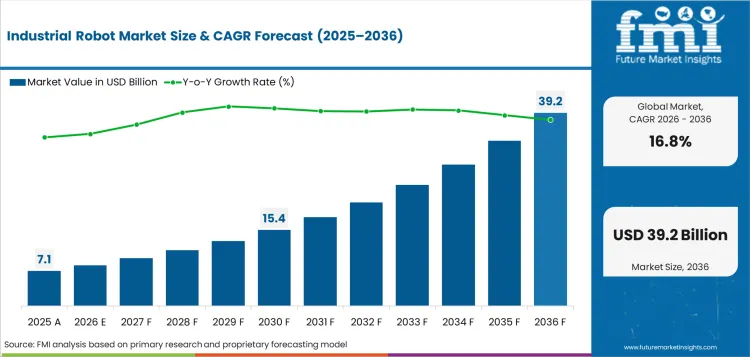
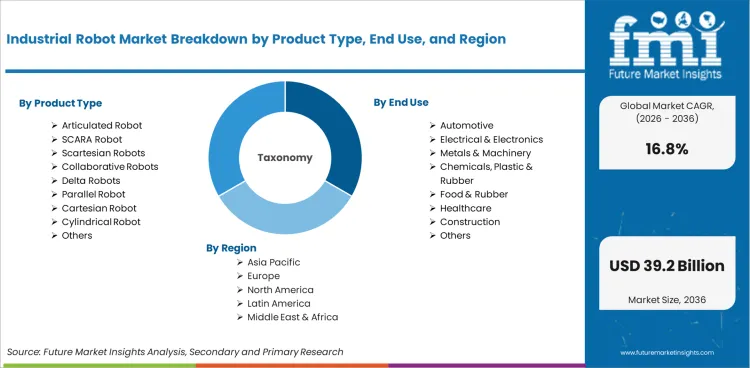
The industrial robot market was valued at USD 7.1 billion in 2025. The market is set to reach USD 8.3 billion by 2026-end and grow at a CAGR of 16.8% between 2026-2036 to reach USD 39.2 billion by 2036. Articulated Robot will dominate with a 49.0% share, while Automotive will lead with a 34.0% share.
Summary of the Industrial Robot Market
- Demand and Growth Drivers
- Manufacturing labor shortages across the USA, Germany, Japan, and South Korea are creating structural demand for robotic automation, with unfilled manufacturing positions exceeding 500,000 in the USA alone.
- EV battery and electronics manufacturing scaling is creating new high-volume robot installation segments beyond traditional automotive body welding, with gigafactory and semiconductor fab buildout requiring thousands of robots per facility.
- Collaborative robot adoption is expanding the addressable market to small and medium manufacturers by reducing integration complexity, cost, and safety fencing requirements compared to traditional industrial robots.
- Product and Segment View
- The product type segment accounted for 49.0% of articulated robots in 2026 as 4 to 7 axis configurations provide the flexibility required for automotive, general manufacturing and heavy payload applications.
- End use: Automotive is 34.0%, with body welding, painting and final assembly still the largest robot application, now augmented by EV battery module assembly.
- The material handling application segment is leading the market, where pick-and-place, palletizing, machine tending, and bin picking are the most consumed robot installation volumes across manufacturing sectors.
- Geography and Competitive Outlook
- The USA is in the lead on 17.1% CAGR, driven by reshoring investment, CHIPS Act semiconductor fab construction and EV gigafactory buildout creating concentrated robot demand.
- Japan at 16.9% reflects the world's largest robot manufacturing base (FANUC, Yaskawa, Kawasaki) and domestic automotive/electronics manufacturing robot density growth.
- FANUC Corporation holds the leading position with 18.0% market share through the broadest industrial robot portfolio, global manufacturing capacity, and reliability-driven brand strength.
- Analyst Opinion
- The industrial robot market is entering an accelerated growth phase as labor scarcity, reshoring, and new manufacturing segments (EV batteries, semiconductors) create compounding installation demand beyond traditional automotive applications.
- Growth at 16.8% CAGR reflects the convergence of demographic-driven automation necessity, manufacturing investment cycles, and technology advancement that together lower adoption barriers across industries.
- FANUC maintains the leading position through the broadest robot product line from 0.5 kg to 2,300 kg payload, global service network density, and manufacturing reliability that earns OEM specification preference.
- Companies offering simplified programming, AI-powered vision integration and cobot platforms that can be accessed by non-specialist integrators are capturing the growing SME manufacturing segment.
- Capital allocation toward AI-powered robot intelligence, mobile manipulation platforms, and emerging market distribution is expected to shape competitive positioning through 2036.
Key Takeaways, Market Size, and Forecast
- The industrial robot market was valued at USD 7.1 billion in 2025.
- By 2036, the Industrial Robot Market is expected to be worth USD 39.19 billion.
- From 2026 to 2036, the market is projected to expand at a CAGR of 16.8%.
- The market is projected to create an incremental opportunity of USD 30.89 billion between 2026 and 2036.
- In 2026, articulated robots are expected to account for 49.0% of the product type segment, driven by automotive welding, painting, and material handling applications requiring multi-axis flexibility.
- The USA (17.1%) and Japan (16.9%) are two of the fastest growing markets in the world.
Industrial Robot Market Definition
The industrial robot market includes programmable, multi-function manipulators designed for manufacturing automation. Products include articulated, SCARA, Cartesian, collaborative, delta, and parallel robot configurations serving automotive, electronics, metals, chemicals, food, and healthcare manufacturing applications.
Industrial Robot Market Inclusions
Market scope includes articulated, SCARA, Cartesian, collaborative, delta, and parallel robots. Revenue is tracked by product type, end use, technology (automatic, semi-automatic, manual), and application from 2026 to 2036.
Industrial Robot Market Exclusions
The scope does not include service robots for non-manufacturing applications, autonomous mobile robots (AMRs) without manipulation capability, or CNC machine tools.
Industrial Robot Market Research Methodology
- Primary Research: FMI analysts conducted interviews with robot manufacturers, system integrators, automotive OEM automation engineers, and manufacturing facility managers across key markets.
- Desk research combined data from installation statistics of the International Federation of Robotics (IFR), manufacturing output data, facility construction announcements, and manufacturer financial disclosures.
- Market Sizing & Forecasting - Bottom-up aggregation of manufacturing facility counts by industry and geography, robot density targets and average robot system pricing, triangulated against IFR installation data.
- Data Validation: Quarterly checks against IFR World Robotics data, manufacturer shipment data and system integrator project pipeline data.
Why is the Industrial Robot Market Growing?
- Global manufacturing labor shortages beyond 2 million unfilled positions across developed economies create the structural ROI justification for robot investment, with payback periods declining below 2 years in high-wage markets.
- The USA leads with 17.1% CAGR, driven by fab construction from the CHIPS Act, IRA-incentivized EV gigafactories, and reshoring manufacturing facilities leading to concentrated multi-thousand-robot installation projects.
- AI-powered vision systems are reducing integration costs by allowing robots to perform unstructured tasks (bin picking, random part orientation) that used to require expensive custom fixturing.
The industrial robot market is about to enter a period of rapid growth driven by labor scarcity, reshoring of manufacturing and new high volume installation segments. Traditional automotive body welding remains the largest application but EV battery module assembly, semiconductor fab automation and food/beverage packaging are generating new demand categories that compound total installations. More than 500,000 robots are installed globally each year and the growth is accelerating as the robot density in non-automotive manufacturing rises, the IFR said.
Collaborative robots are expanding the addressable market by lowering the barriers to adoption for small and medium manufacturers. Universal Robots, FANUC and ABB cobots are safe to operate without fencing, easier to program via teach pendants and hand guidance, and reduce integration costs from USD 150,000 to 250,000 for traditional cells to USD 50,000 to 100,000 for cobot installations. The market is projected to expand at a CAGR of 16.8% between 2026 and 2036.
Market Segmentation Analysis
- Articulated robots represented 49.0% of the segment by product type. 6-axis configurations provide maximum flexibility in workspace for welding, painting, assembly and material handling.
- 34.0% end use is the automotive sector, with the highest robot density per facility in body-in-white welding, painting and assembly operations.
- The technology sector is defined by automatic operation. Fully programmed autonomous robot cells are in use 24/7 in high-volume manufacturing settings.
The industrial robot market is segmented on the basis of product type, end use, technology and application. Each dimension reflects different payload, reach, speed and accuracy requirements across different manufacturing sectors.
Insights into the Articulated Robot Product Segment
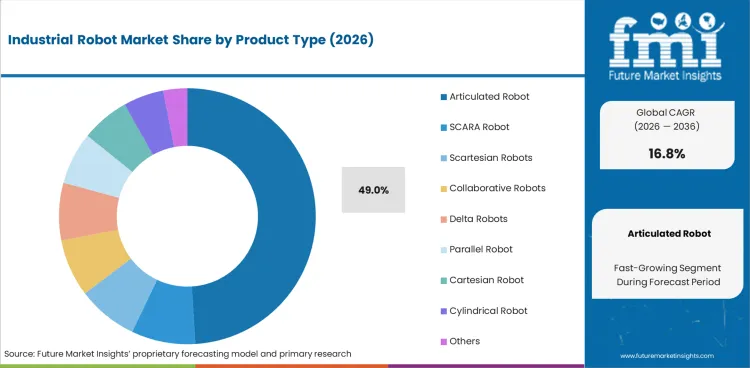
In 2026, articulated robots are expected to hold 49.0% of the product type segment. Six-axis articulated arms with payloads from 3 kg to 2,300 kg serve the broadest application range. Small articulated robots (3 to 20 kg) serve electronics assembly. Medium payload (20 to 100 kg) serves welding and machine tending. Large payload (100 to 2,300 kg) serves automotive body handling and heavy material manipulation.
SCARA, Cartesian, collaborative, delta, and parallel robots serve the remaining share. SCARA robots provide high-speed pick-and-place for electronics assembly. Collaborative robots serve human-adjacent applications. Delta robots provide high-speed packaging and sorting.
Insights into the Automotive End-Use Segment
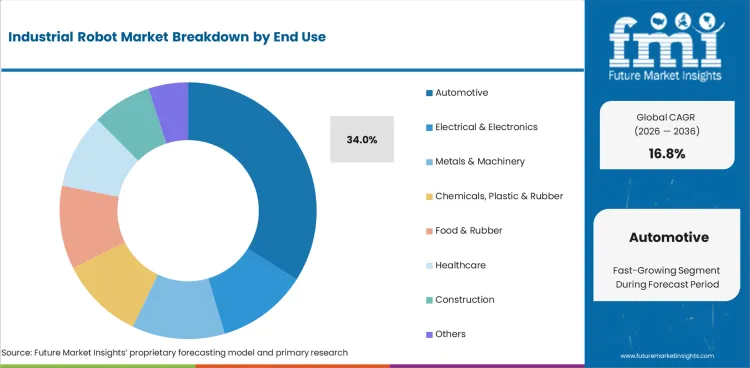
Automotive is 34.0% of end use in 2026. Body-in-white welding has the largest robot population when measured in robots per facility-with 400 to 1,000 robots per automotive body shop. Paint application robots offer uniform coating quality. Final assembly robots install glass, seats and trim. EV battery module assembly creates a new automotive robot application of high installation density.
The remaining share is from manufacturing of electrical & electronics, metals & machinery, chemicals, food & healthcare. Electronics manufacturing robots are becoming more common, and cleanroom-rated robot installations are required for semiconductor and display fabrication.
Industrial Robot Market Drivers, Restraints, and Opportunities
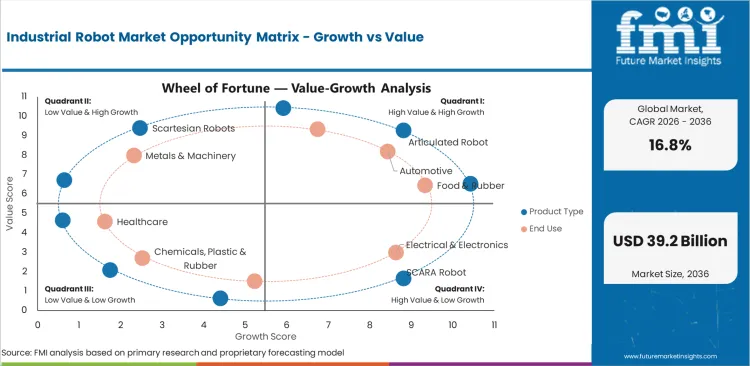
- Labour shortage in manufacturing and wage inflation provide structural economic justification for robot investment with declining payback periods across manufacturing sectors.
- The complexity of integration and availability of system integrators limit the speed of installation. Qualified robot integrators have a project backlog of 6 to 12 months in key markets.
- Collaborative robots are making automation more accessible for SME manufacturers by reducing cost, complexity and safety infrastructure requirements.
Industrial robot market is driven by labor economics, investment in manufacturing and accessibility to technology. 16.8% CAGR from 2026 to 2036 indicates an increased acceleration in automation adoption.
Labor Scarcity Economics
Demand reflects manufacturing labor shortages of more than 2 million positions globally in developed economies. Attractive ROI with payback periods for robot investments of less than 2 years in USA, Germany and Japan The average age of the manufacturing workforce in Japan is 48, and it is 48 in South Korea. Aging workforces speed up the urgency for automation.
System Integrator Bottleneck
The adoption speed is limited by qualified system integrator capacity. Robots are installed with mechanical integration, programming, installation of vision systems and validation of production. Integrator backlogs of 6 to 12 months lengthen project timelines and create a competitive advantage for manufacturers with in-house integration capability.
Collaborative Robot Expansion
Universal Robots, FANUC and ABB cobots enable SME adoption by removing the need for safety fencing, simplifying programming and reducing system cost. Cobot installations are growing faster than traditional robots, expanding the addressable market beyond large manufacturers.
EV and Semiconductor Mega-Projects
It’s not just the construction of Gigafactories, or semiconductor fabs, which leads to concentrated demand for robots. A single fab will install between 500 and 2,000 robots. Projects in the USA incentivized by the CHIPS Act and IRA are creating a domestic installation pipeline of more than 100,000 robots through 2030.
Analysis of Industrial Robot Market By Key Countries
.webp "Top Country Growth Comparison Industrial Robot Market Cagr (2026 2036)")
| Country | CAGR |
|---|---|
| USA | 17.1% |
| Japan | 16.9% |
| South Korea | 16.8% |
| European Union | 16.6% |
| UK | 15.9% |
Source: FMI analysis based on primary research and proprietary forecasting model
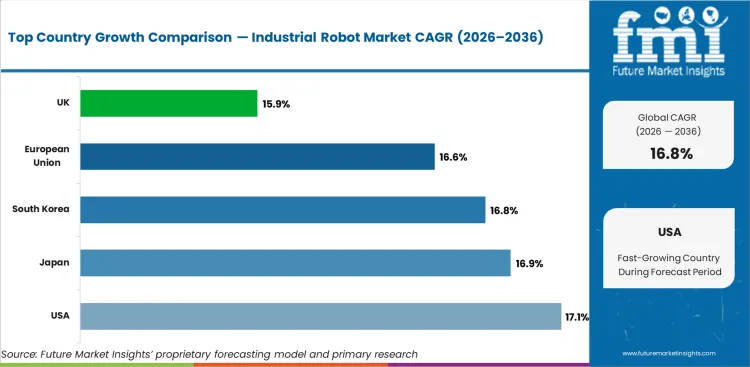
- The USA at 17.1% CAGR is reflecting reshoring, CHIPS Act fabs, EV gigafactories and labor shortage driving accelerated robot adoption.
- Japan’s 16.9% rate is driven by the world’s largest robot manufacturing base and domestic investment in automation of the automotive and electronics industries.
- South Korea (16.8%) is the most robot dense country in the world and continued growth of semiconductor/automotive installations.
- The European Union at 16.6% is supported by German automotive automation and EU manufacturing modernization investment.
The global industrial robot market is estimated at USD 8.29 billion in 2026 and is projected to expand at 16.8% CAGR from 2026 to 2036. The analysis covers key markets.
Demand Outlook for Industrial Robot Market in the USA
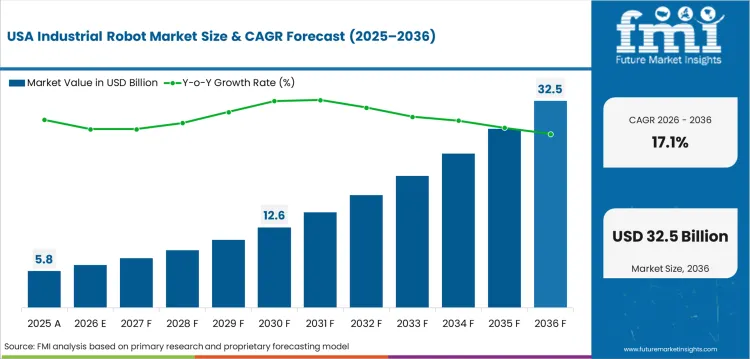
The USA is projected to expand at 17.1% CAGR through 2036. CHIPS Act semiconductor fab construction at Intel, TSMC, and Samsung, combined with IRA-incentivized EV gigafactory buildout by Tesla, Ford BlueOval, and Hyundai, creates concentrated robot demand. Manufacturing reshoring initiatives are adding robot installations across electronics, medical device, and consumer goods production.
- CHIPS Act fab projects at Intel (Ohio), TSMC (Arizona), and Samsung (Texas) each require 500 to 1,500 cleanroom-rated robots for wafer handling, inspection, and packaging automation.
- Tesla Gigafactory, Ford BlueOval City, and Hyundai Metaplant Georgia EV battery and vehicle assembly facilities create multi-thousand-robot installation projects.
- FANUC America (Rochester Hills, MI) and ABB Robotics (Auburn Hills, MI) operate US application engineering and integration support centers serving domestic manufacturing customers.
Future Outlook for Industrial Robot Market in Japan
Japan is projected to grow at 16.9% CAGR through 2036. Japan manufactures over 45% of the world's industrial robots through FANUC, Yaskawa, Kawasaki, and Mitsubishi Electric. Domestic automotive production at Toyota, Honda, and Nissan maintains high robot density, while semiconductor and electronics manufacturing adds installation volume.
- FANUC (Oshino) produces over 10,000 robots monthly from automated factories, with the largest global robot installed base and service network spanning 270 locations worldwide.
- Yaskawa Electric (Kitakyushu) Motoman robot production serves automotive, electronics, and general manufacturing with a portfolio spanning 3 kg to 900 kg payload.
- Toyota, Honda, and Nissan automotive body shops each deploy 400 to 1,000 robots per assembly plant, with EV production lines adding battery module assembly automation.
Opportunity Analysis of Industrial Robot Market in South Korea
South Korea is projected to expand at 16.8% CAGR through 2036. South Korea maintains the world's highest robot density at over 1,000 robots per 10,000 manufacturing employees. Samsung Electronics, Hyundai Motor, and LG Electronics manufacturing facilities are primary installation sites.
- Samsung Electronics semiconductor and display fabrication facilities deploy thousands of cleanroom-rated robots for wafer handling, panel transport, and automated inspection.
- Hyundai Motor Group Ulsan and Asan plants operate among the world's most automated automotive body shops with robot density exceeding 1,500 units per facility.
- Korean government Manufacturing Innovation 3.0 strategy supports SME robot adoption through subsidized installation programs targeting small and medium manufacturers.
In-depth Analysis of Industrial Robot Market in the European Union
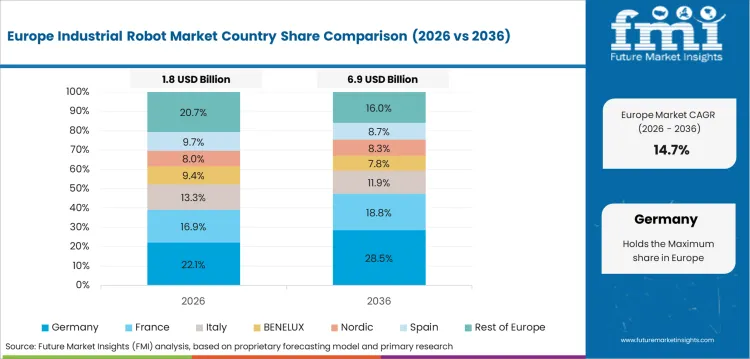
The European Union is projected to grow at 16.6% CAGR through 2036. German automotive manufacturing at BMW, Mercedes-Benz, and Volkswagen drives the highest robot density in Europe. KUKA (Augsburg, now Midea-owned) and ABB Robotics (Vasteras, Sweden) provide EU-manufactured robot supply.
- KUKA (Augsburg) produces articulated and collaborative robots for European automotive, electronics, and general manufacturing, with deep integration into BMW and Mercedes-Benz production systems.
- ABB Robotics (Vasteras, Sweden) provides industrial and collaborative robots with OmniCore controller technology serving European automotive, electronics, and food manufacturing.
- EU Recovery and Resilience Facility funding supports manufacturing modernization including industrial robot installation across member state SME manufacturing sectors.
Sales Analysis of Industrial Robot Market in the UK
The UK is projected to grow at 15.9% CAGR through 2036. UK automotive production at Nissan Sunderland, Jaguar Land Rover, and Mini Oxford creates robot installation demand. UK robot density remains below European averages, indicating growth potential as manufacturing modernization investment increases.
- Nissan Sunderland, JLR Solihull, and BMW Mini Oxford automotive production facilities maintain robot-intensive body welding, painting, and assembly operations.
- UK Made Smarter initiative supports manufacturing digitalization and automation adoption, with robot installation as a key technology investment category.
- UK robot density below 100 per 10,000 manufacturing employees, compared to over 400 in Germany and 1,000 in South Korea, indicates significant growth potential.
Competitive Landscape and Strategic Positioning
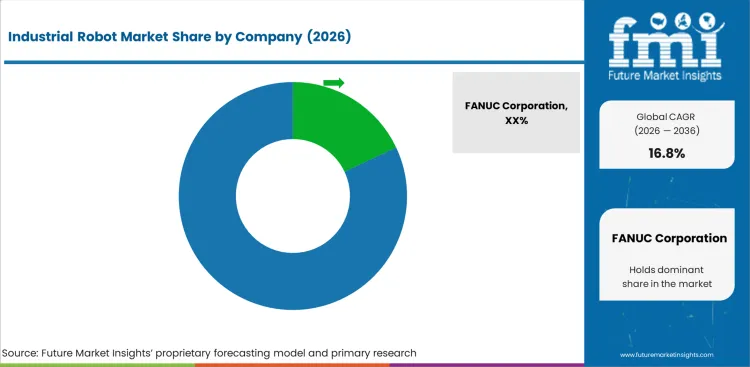
- FANUC Corporation leads with 18.0% market share, based on reliability, and has the broadest robot product line and the largest global installed base and brand preference.
- ABB, Yaskawa and KUKA compete with strong robot portfolios and deep auto/electronics manufacturing integration.
- Competition includes Japanese robot manufacturers, European industrial automation companies and upstart collaborative robot companies.
FANUC is the market leader with the widest payload range (0.5 to 2,300 kg), the highest reliability (MTBF more than 100,000 hours) and the largest global service network with 270 locations. Automated robot production at FANUC’s headquarters in Oshino, Japan gives scale advantages in manufacturing.
ABB has OmniCore controller tech and strong integration into European automotive. Yaskawa Motoman is competitive in medium payload applications. KUKA (Midea) has deep BMW and Mercedes integration. Universal Robots is the leader in collaborative robots.
The barriers to entry are very high due to requirements for precision mechanical engineering, servo drive technology, controller software development and global service network. Strategic priorities include AI-driven programming, mobile manipulation and SME market access.
Key Companies in the Industrial Robot Market
Key global companies leading the industrial robot market include:
- FANUC Corporation (Japan), ABB Ltd. (Switzerland), and Yaskawa Electric (Japan) hold leading positions through comprehensive robot portfolios and global manufacturing and service infrastructure.
- KUKA AG/Midea (Germany/China), Mitsubishi Electric (Japan), and Kawasaki Robotics (Japan) maintain strong positions through automotive integration and industrial robot manufacturing capability.
- Universal Robots (Denmark), Epson Robots (Japan), and Omron (Japan) serve collaborative, compact, and specialized robot segments.
Competitive Benchmarking: Industrial Robot Market
| Company | Payload Range | Automotive Integration | Cobot Portfolio | Geographic Reach |
|---|---|---|---|---|
| FANUC Corporation | 0.5 to 2,300 kg | Very Strong | CRX Series | Global (270 locations) |
| ABB Ltd. | 3 to 800 kg | Very Strong | GoFa/SWIFTI | Global |
| Yaskawa Electric | 3 to 900 kg | Strong | HC Series | Global |
| KUKA AG | 3 to 1,300 kg | Very Strong (BMW/MB) | LBR iiwa | Europe, Global |
| Mitsubishi Electric | 2 to 70 kg | Moderate | MELFA Assista | Asia, Global |
| Universal Robots | 3 to 20 kg (Cobot) | Limited | UR3/5/10/16/20 | Global |
| Kawasaki Robotics | 3 to 1,500 kg | Strong | CL Series | Global |
| Epson Robots | 1 to 20 kg (SCARA) | Limited | Limited | Global |
| Omron Corporation | 1 to 15 kg | Limited | TM Series | Global |
| Staubli Robotics | 1 to 190 kg | Moderate | Limited | Europe, Global |
Source: Future Market Insights competitive analysis, 2026.
Key Developments in Industrial Robot Market
- In 2025, FANUC launched the CRX-25iA collaborative robot, featuring a 25 kg payload and 1,889 mm reach, significantly expanding its cobot lineup for heavy-duty applications such as palletizing, machine tending, and large-part handling.
- In 2025, Universal Robots introduced the UR30, its highest payload collaborative robot to date with a 30 kg capacity, targeting demanding industrial tasks including machine tending, palletizing, and assembly in automotive and logistics sectors.
Key Players in the Industrial Robot Market
Major Global Players
- FANUC Corporation
- ABB Ltd.
- Yaskawa Electric Corporation
- KUKA AG (Midea Group)
- Mitsubishi Electric Corporation
- Universal Robots
Emerging Players/Startups
- Techman Robot (Quanta)
- Doosan Robotics
- Franka Emika
- Rokae (China)
- AUBO Robotics
Report Scope and Coverage
| Parameter | Details |
|---|---|
| Quantitative Units | USD 8.29 billion to USD 39.19 billion, at a CAGR of 16.8% |
| Market Definition | The industrial robot market includes programmable multi-function manipulators for manufacturing automation across automotive, electronics, metals, chemicals, food, and healthcare. |
| Regions Covered | North America, Latin America, Europe, East Asia, South Asia and Pacific, Middle East and Africa |
| Countries Covered | USA, Japan, South Korea, European Union, UK, 30 plus countries |
| Key Companies Profiled | FANUC Corporation, ABB Ltd., Yaskawa Electric Corporation, KUKA AG (Midea Group), Mitsubishi Electric Corporation, Universal Robots, Epson Robots, Omron Corporation, Kawasaki Robotics, Staubli Robotics |
| Forecast Period | 2026 to 2036 |
| Approach | Hybrid bottom-up methodology using manufacturing facility counts, robot density targets, and system pricing, triangulated with IFR installation data and manufacturer revenue. |
Segmentation
Industrial Robot Market Segmented by Product Type:
- Articulated Robot
- Six Axis Robots
- Dual Arm Robots
- SCARA Robot
- Assembly Robots
- Pick and Place Robots
- Scartesian Robots
- Linear Robots
- Gantry Robots
- Collaborative Robots
- Light Payload Cobots
- Heavy Payload Cobots
- Delta Robots
- High Speed Pick and Place Robots
- Packaging Robots
- Parallel Robot
- Cartesian Robot
- Cylindrical Robot
- Others
Industrial Robot Market Segmented by End Use:
- Automotive
- Electrical & Electronics
- Metals & Machinery
- Chemicals, Plastic & Rubber
- Food & Rubber
- Healthcare
- Construction
- Others
Industrial Robot Market Segmented by Technology:
- Automatic
- Robotics Technology
- Industrial Automation
- Machine Vision Integration
- Artificial Intelligence
- Adaptive Learning
- Predictive Maintenance
- Robotics Technology
- Semi-automatic
- Connectivity Technology
- Industrial Internet of Things
- Cloud Robotics
- Connectivity Technology
- Manual
- Control Technology
- Motion Control Systems
- Real Time Control
- Control Technology
Industrial Robot Market Segmented by Application:
- Material Handling
- Pick and Place
- Palletizing
- Assembly
- Electronics Assembly
- Automotive Assembly
- Welding
- Arc Welding
- Spot Welding
- Painting
- Coating and Finishing
- Inspection
- Quality Inspection
- Testing
Industrial Robot Market by Region:
- North America
- USA
- Canada
- Mexico
- Latin America
- Brazil
- Chile
- Rest of Latin America
- Western Europe
- Germany
- UK
- Italy
- Spain
- France
- Nordic
- BENELUX
- Rest of Western Europe
- Eastern Europe
- Russia
- Poland
- Hungary
- Balkan & Baltic
- Rest of Eastern Europe
- East Asia
- China
- Japan
- South Korea
- South Asia and Pacific
- India
- ASEAN
- Australia & New Zealand
- Rest of South Asia and Pacific
- Middle East & Africa
- Kingdom of Saudi Arabia
- Other GCC Countries
- Turkiye
- South Africa
- Other African Union
- Rest of Middle East & Africa
Research Sources and Bibliography
- 1. International Federation of Robotics. (2025). IFR World Robotics Report. IFR.
- 2. Organisation for Economic Co-operation and Development. (2025). OECD Manufacturing and Automation Data. OECD.
- 3. USA Bureau of Labor Statistics. (2025). BLS Manufacturing Employment Data. BLS.
- 4. European Commission. (2025). EC Industrial Strategy and Manufacturing Modernization Reports. EC.
- 5. World Bank. (2025). World Bank Manufacturing Sector Data. World Bank.
This bibliography is provided for reader reference. The full Future Market Insights report contains the complete reference list with publication dates, URLs, and supporting data for all cited works.
This Report Answers
- Estimating the size of the industrial robot market and revenue projections from 2026 to 2036.
- Segmentation by product type, end use, technology, and application.
- Insights across key regional markets.
- Analysis of automotive versus electronics and general manufacturing demand.
- Assessment of the competitive landscape across robot manufacturers and cobot specialists.
- Identification of investment opportunities in collaborative robots, AI vision, and emerging market automation.
- Robot density tracking and installation pipeline analysis.
- Delivery of data in PDF and Excel formats.
Frequently Asked Questions
What is the global market demand for Industrial Robots in 2026?
In 2026, the global industrial robot market is estimated at USD 8.29 billion.
How big will the Industrial Robot Market be in 2036?
By 2036, the market is projected to reach USD 39.19 billion.
How much is demand for the Industrial Robot Market expected to grow between 2026 and 2036?
Between 2026 and 2036, the market is projected to expand at a CAGR of 16.8%.
Which product type is expected to lead in the Industrial Robot Market in 2026?
Articulated robots are expected to hold 49.0% in 2026, with 6-axis configurations for welding, painting, and material handling.
What is causing demand to rise in the USA?
The USA is expected to grow at 17.1% CAGR through 2036, driven by reshoring, CHIPS Act fabs, and EV gigafactory construction.
What is causing demand to rise in Japan?
Japan is expected to grow at 16.9% CAGR through 2036, supported by the world's largest robot manufacturing base and domestic automotive automation.
What does this report mean by Industrial Robot Market definition?
The market includes programmable multi-function manipulators for manufacturing automation in automotive, electronics, metals, chemicals, food, and healthcare.
How does FMI make the Industrial Robot Market forecast and validate it?
Forecasting uses hybrid methodology with facility counts and robot density targets, validated against IFR installation data and manufacturer revenue.
Preview the report firsthand - request a free sample
Get SampleGet the brochure for pricing and purchase details.
Get PDFTable of Content
- Executive Summary
- Global Market Outlook
- Demand-side Trends
- Supply-side Trends
- Technology Roadmap Analysis
- Analysis and Recommendations
- Market Overview
- Market Coverage / Taxonomy
- Market Definition / Scope / Limitations
- Research Methodology
- Chapter Orientation
- Analytical Lens and Working Hypotheses
- Market Structure, Signals, and Trend Drivers
- Benchmarking and Cross-market Comparability
- Market Sizing, Forecasting, and Opportunity Mapping
- Research Design and Evidence Framework
- Desk Research Programme (Secondary Evidence)
- Company Annual and Sustainability Reports
- Peer-reviewed Journals and Academic Literature
- Corporate Websites, Product Literature, and Technical Notes
- Statutory Filings and Regulatory Disclosures
- Technical White Papers and Standards Notes
- Trade Journals, Industry Magazines, and Analyst Briefs
- Conference Proceedings, Webinars, and Seminar Materials
- Government Statistics Portals and Public Data Releases
- Press Releases and Reputable Media Coverage
- Specialist Newsletters and Curated Briefings
- Sector Databases and Reference Repositories
- FMI Internal Proprietary Databases and Historical Market Datasets
- Subscription Datasets and Paid Sources
- Social Channels, Communities, and Digital Listening Inputs
- Additional Desk Sources
- Expert Input and Fieldwork (Primary Evidence)
- Primary Modes
- Qualitative Interviews and Expert Elicitation
- Quantitative Surveys and Structured Data Capture
- Blended Approach
- Why Primary Evidence is Used
- Field Techniques
- Interviews
- Surveys
- Focus Groups
- Observational and In-context Research
- Social and Community Interactions
- Stakeholder Universe Engaged
- C-suite Leaders
- Board Members
- Presidents and Vice Presidents
- R&D and Innovation Heads
- Technical Specialists
- Domain Subject-matter Experts
- Scientists
- Physicians and Other Healthcare Professionals
- Governance, Ethics, and Data Stewardship
- Research Ethics
- Data Integrity and Handling
- Primary Modes
- Tooling, Models, and Reference Databases
- Desk Research Programme (Secondary Evidence)
- Demand in Optimistic Scenario
- Demand in Likely Scenario
- Demand in Conservative Scenario
- Opportunity Map Analysis
- Product Life Cycle Analysis
- Supply Chain Analysis
- Investment Feasibility Matrix
- Value Chain Analysis
- PESTLE and Porter’s Analysis
- Regulatory Landscape
- Regional Parent Market Outlook
- Production and Consumption Statistics
- Import and Export Statistics
- Global Market Analysis 2021 to 2025 and Forecast, 2026 to 2036
- Historical Market Size Value (USD Million) Analysis, 2021 to 2025
- Current and Future Market Size Value (USD Million) Projections, 2026 to 2036
- Y-o-Y Growth Trend Analysis
- Absolute $ Opportunity Analysis
- Global Market Pricing Analysis 2021 to 2025 and Forecast 2026 to 2036
- Global Market Analysis 2021 to 2025 and Forecast 2026 to 2036, By Product Type
- Introduction / Key Findings
- Historical Market Size Value (USD Million) Analysis By Product Type , 2021 to 2025
- Current and Future Market Size Value (USD Million) Analysis and Forecast By Product Type , 2026 to 2036
- Articulated Robot
- Six Axis Robots
- Dual Arm Robots
- SCARA Robot
- Assembly Robots
- Pick and Place Robots
- Scartesian Robots
- Linear Robots
- Gantry Robots
- Collaborative Robots
- Light Payload Cobots
- Heavy Payload Cobots
- Delta Robots
- High Speed Pick and Place Robots
- Packaging Robots
- Parallel Robot
- Cartesian Robot
- Cylindrical Robot
- Others
- Articulated Robot
- Y-o-Y Growth Trend Analysis By Product Type , 2021 to 2025
- Absolute $ Opportunity Analysis By Product Type , 2026 to 2036
- Global Market Analysis 2021 to 2025 and Forecast 2026 to 2036, By End Use
- Introduction / Key Findings
- Historical Market Size Value (USD Million) Analysis By End Use, 2021 to 2025
- Current and Future Market Size Value (USD Million) Analysis and Forecast By End Use, 2026 to 2036
- Automotive
- Electrical & Electronics
- Metals & Machinery
- Chemicals, Plastic & Rubber
- Food & Rubber
- Healthcare
- Construction
- Others
- Automotive
- Y-o-Y Growth Trend Analysis By End Use, 2021 to 2025
- Absolute $ Opportunity Analysis By End Use, 2026 to 2036
- Global Market Analysis 2021 to 2025 and Forecast 2026 to 2036, By Technology
- Introduction / Key Findings
- Historical Market Size Value (USD Million) Analysis By Technology, 2021 to 2025
- Current and Future Market Size Value (USD Million) Analysis and Forecast By Technology, 2026 to 2036
- Automatic
- Robotics Technology
- Industrial Automation
- Machine Vision Integration
- Artificial Intelligence
- Adaptive Learning
- Predictive Maintenance
- Semi-automatic
- Connectivity Technology
- Industrial Internet of Things
- Cloud Robotics
- Manual
- Control Technology
- Motion Control Systems
- Real Time Control
- Automatic
- Y-o-Y Growth Trend Analysis By Technology, 2021 to 2025
- Absolute $ Opportunity Analysis By Technology, 2026 to 2036
- Global Market Analysis 2021 to 2025 and Forecast 2026 to 2036, By Application
- Introduction / Key Findings
- Historical Market Size Value (USD Million) Analysis By Application, 2021 to 2025
- Current and Future Market Size Value (USD Million) Analysis and Forecast By Application, 2026 to 2036
- Material Handling
- Pick and Place
- Palletizing
- Assembly
- Electronics Assembly
- Automotive Assembly
- Welding
- Arc Welding
- Spot Welding
- Painting
- Coating and Finishing
- Inspection
- Quality Inspection
- Testing
- Material Handling
- Y-o-Y Growth Trend Analysis By Application, 2021 to 2025
- Absolute $ Opportunity Analysis By Application, 2026 to 2036
- Global Market Analysis 2021 to 2025 and Forecast 2026 to 2036, By Region
- Introduction
- Historical Market Size Value (USD Million) Analysis By Region, 2021 to 2025
- Current Market Size Value (USD Million) Analysis and Forecast By Region, 2026 to 2036
- North America
- Latin America
- Western Europe
- Eastern Europe
- East Asia
- South Asia and Pacific
- Middle East & Africa
- Market Attractiveness Analysis By Region
- North America Market Analysis 2021 to 2025 and Forecast 2026 to 2036, By Country
- Historical Market Size Value (USD Million) Trend Analysis By Market Taxonomy, 2021 to 2025
- Market Size Value (USD Million) Forecast By Market Taxonomy, 2026 to 2036
- By Country
- USA
- Canada
- Mexico
- By Product Type
- By End Use
- By Technology
- By Application
- By Country
- Market Attractiveness Analysis
- By Country
- By Product Type
- By End Use
- By Technology
- By Application
- Key Takeaways
- Latin America Market Analysis 2021 to 2025 and Forecast 2026 to 2036, By Country
- Historical Market Size Value (USD Million) Trend Analysis By Market Taxonomy, 2021 to 2025
- Market Size Value (USD Million) Forecast By Market Taxonomy, 2026 to 2036
- By Country
- Brazil
- Chile
- Rest of Latin America
- By Product Type
- By End Use
- By Technology
- By Application
- By Country
- Market Attractiveness Analysis
- By Country
- By Product Type
- By End Use
- By Technology
- By Application
- Key Takeaways
- Western Europe Market Analysis 2021 to 2025 and Forecast 2026 to 2036, By Country
- Historical Market Size Value (USD Million) Trend Analysis By Market Taxonomy, 2021 to 2025
- Market Size Value (USD Million) Forecast By Market Taxonomy, 2026 to 2036
- By Country
- Germany
- UK
- Italy
- Spain
- France
- Nordic
- BENELUX
- Rest of Western Europe
- By Product Type
- By End Use
- By Technology
- By Application
- By Country
- Market Attractiveness Analysis
- By Country
- By Product Type
- By End Use
- By Technology
- By Application
- Key Takeaways
- Eastern Europe Market Analysis 2021 to 2025 and Forecast 2026 to 2036, By Country
- Historical Market Size Value (USD Million) Trend Analysis By Market Taxonomy, 2021 to 2025
- Market Size Value (USD Million) Forecast By Market Taxonomy, 2026 to 2036
- By Country
- Russia
- Poland
- Hungary
- Balkan & Baltic
- Rest of Eastern Europe
- By Product Type
- By End Use
- By Technology
- By Application
- By Country
- Market Attractiveness Analysis
- By Country
- By Product Type
- By End Use
- By Technology
- By Application
- Key Takeaways
- East Asia Market Analysis 2021 to 2025 and Forecast 2026 to 2036, By Country
- Historical Market Size Value (USD Million) Trend Analysis By Market Taxonomy, 2021 to 2025
- Market Size Value (USD Million) Forecast By Market Taxonomy, 2026 to 2036
- By Country
- China
- Japan
- South Korea
- By Product Type
- By End Use
- By Technology
- By Application
- By Country
- Market Attractiveness Analysis
- By Country
- By Product Type
- By End Use
- By Technology
- By Application
- Key Takeaways
- South Asia and Pacific Market Analysis 2021 to 2025 and Forecast 2026 to 2036, By Country
- Historical Market Size Value (USD Million) Trend Analysis By Market Taxonomy, 2021 to 2025
- Market Size Value (USD Million) Forecast By Market Taxonomy, 2026 to 2036
- By Country
- India
- ASEAN
- Australia & New Zealand
- Rest of South Asia and Pacific
- By Product Type
- By End Use
- By Technology
- By Application
- By Country
- Market Attractiveness Analysis
- By Country
- By Product Type
- By End Use
- By Technology
- By Application
- Key Takeaways
- Middle East & Africa Market Analysis 2021 to 2025 and Forecast 2026 to 2036, By Country
- Historical Market Size Value (USD Million) Trend Analysis By Market Taxonomy, 2021 to 2025
- Market Size Value (USD Million) Forecast By Market Taxonomy, 2026 to 2036
- By Country
- Kingdom of Saudi Arabia
- Other GCC Countries
- Turkiye
- South Africa
- Other African Union
- Rest of Middle East & Africa
- By Product Type
- By End Use
- By Technology
- By Application
- By Country
- Market Attractiveness Analysis
- By Country
- By Product Type
- By End Use
- By Technology
- By Application
- Key Takeaways
- Key Countries Market Analysis
- USA
- Pricing Analysis
- Market Share Analysis, 2025
- By Product Type
- By End Use
- By Technology
- By Application
- Canada
- Pricing Analysis
- Market Share Analysis, 2025
- By Product Type
- By End Use
- By Technology
- By Application
- Mexico
- Pricing Analysis
- Market Share Analysis, 2025
- By Product Type
- By End Use
- By Technology
- By Application
- Brazil
- Pricing Analysis
- Market Share Analysis, 2025
- By Product Type
- By End Use
- By Technology
- By Application
- Chile
- Pricing Analysis
- Market Share Analysis, 2025
- By Product Type
- By End Use
- By Technology
- By Application
- Germany
- Pricing Analysis
- Market Share Analysis, 2025
- By Product Type
- By End Use
- By Technology
- By Application
- UK
- Pricing Analysis
- Market Share Analysis, 2025
- By Product Type
- By End Use
- By Technology
- By Application
- Italy
- Pricing Analysis
- Market Share Analysis, 2025
- By Product Type
- By End Use
- By Technology
- By Application
- Spain
- Pricing Analysis
- Market Share Analysis, 2025
- By Product Type
- By End Use
- By Technology
- By Application
- France
- Pricing Analysis
- Market Share Analysis, 2025
- By Product Type
- By End Use
- By Technology
- By Application
- India
- Pricing Analysis
- Market Share Analysis, 2025
- By Product Type
- By End Use
- By Technology
- By Application
- ASEAN
- Pricing Analysis
- Market Share Analysis, 2025
- By Product Type
- By End Use
- By Technology
- By Application
- Australia & New Zealand
- Pricing Analysis
- Market Share Analysis, 2025
- By Product Type
- By End Use
- By Technology
- By Application
- China
- Pricing Analysis
- Market Share Analysis, 2025
- By Product Type
- By End Use
- By Technology
- By Application
- Japan
- Pricing Analysis
- Market Share Analysis, 2025
- By Product Type
- By End Use
- By Technology
- By Application
- South Korea
- Pricing Analysis
- Market Share Analysis, 2025
- By Product Type
- By End Use
- By Technology
- By Application
- Russia
- Pricing Analysis
- Market Share Analysis, 2025
- By Product Type
- By End Use
- By Technology
- By Application
- Poland
- Pricing Analysis
- Market Share Analysis, 2025
- By Product Type
- By End Use
- By Technology
- By Application
- Hungary
- Pricing Analysis
- Market Share Analysis, 2025
- By Product Type
- By End Use
- By Technology
- By Application
- Kingdom of Saudi Arabia
- Pricing Analysis
- Market Share Analysis, 2025
- By Product Type
- By End Use
- By Technology
- By Application
- Turkiye
- Pricing Analysis
- Market Share Analysis, 2025
- By Product Type
- By End Use
- By Technology
- By Application
- South Africa
- Pricing Analysis
- Market Share Analysis, 2025
- By Product Type
- By End Use
- By Technology
- By Application
- USA
- Market Structure Analysis
- Competition Dashboard
- Competition Benchmarking
- Market Share Analysis of Top Players
- By Regional
- By Product Type
- By End Use
- By Technology
- By Application
- Competition Analysis
- Competition Deep Dive
- FANUC Corporation
- Overview
- Product Portfolio
- Profitability by Market Segments (Product/Age /Sales Channel/Region)
- Sales Footprint
- Strategy Overview
- Marketing Strategy
- Product Strategy
- Channel Strategy
- ABB Ltd.
- Yaskawa Electric Corporation
- KUKA AG (Midea Group)
- Mitsubishi Electric Corporation
- Universal Robots
- Epson Robots
- Omron Corporation
- Kawasaki Robotics
- Staubli Robotics
- FANUC Corporation
- Competition Deep Dive
- Assumptions & Acronyms Used


