

- Market Size (2026)
- USD 26.9 Bn
- Forecast (2036)
- USD 70.5 Bn
- CAGR (2026 to 2036)
- 10.1%
How big is the robot pedestal market in 2026?
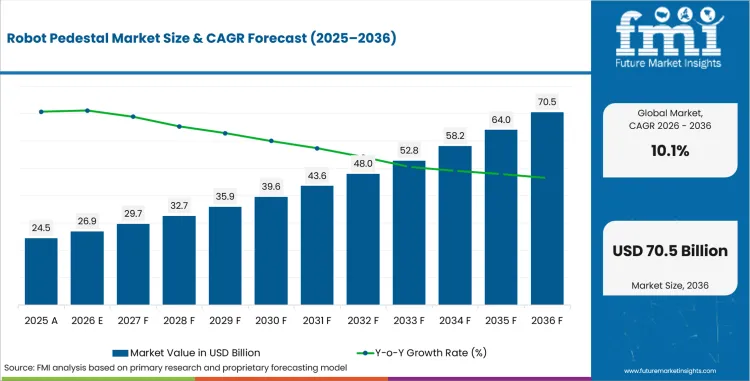
USD 26.9 billion in 2026, reaching USD 70.5 billion by 2036 at a 10.1% CAGR
The robot pedestal market was valued at USD 24.5 billion in 2025. The market is set to reach USD 26.9 billion by 2026-end and grow at a CAGR of 10.1% between 2026-2036 to reach USD 70.5 billion by 2036. Fixed Robot Pedestals will dominate with a 45.0% share, while Welding and Cutting will lead with a 30.0% share.
Key Takeaways, Market Size, and Forecast
- Robot Pedestal Market Value (2025): USD 24.5 Bn
- Robot Pedestal Market Forecast Value (2036): USD 70.5 Bn
- Robot Pedestal Market CAGR (2026 TO 2036): 10.1%
- Robot Pedestal Market Leading Product Segment: Fixed Robot Pedestals (45.0%)
- Robot Pedestal Market Key Growth Regions: USA, EU, Japan, South Korea, UK
- Robot Pedestal Market Key Players: RoboDK, KUKA AG, Fanuc Corporation, ABB Ltd, Yaskawa Electric Corporation, Other Companies (combined)
| Parameter | Details |
|---|---|
| Market Size in 2026 (Value) | USD 26.9 Bn |
| Market Forecast in 2036 (Value) | USD 70.5 Bn |
| CAGR (2026 to 2036) | 10.1% |
| Years Considered | 2021 to 2036 |
| Base Year | 2025 |
| Forecast Period | 2026 to 2036 |
| Units Considered | Value (USD Bn) |
| Leading Sub-Region | USA |
Summary of the Robot Pedestal Market
- Demand and Growth Drivers
- Rapid expansion of industrial robot installations across automotive, electronics, and general manufacturing is driving demand for robot pedestal and mounting systems that position robots at optimal working heights.
- Growth in collaborative robot (cobot) deployments requires dedicated pedestal solutions designed for lighter robot payloads with integrated safety features and adjustable positioning.
- Increasing adoption of robotic welding, material handling, and pick-and-place automation creates application-specific pedestal requirements for vibration damping, precision alignment, and load distribution.
- Product and Segment View
- Fixed robot pedestals represent 45.0% of product share, and are used to provide stable, permanently installed mounting platforms for industrial robots in high-volume manufacturing cells.
- Welding and cutting applications make up 30.0% share, as robotic welding cells require precisely positioned pedestals that hold their position during high-speed, high-vibration welding operations.
- The share of industrial manufacturing end-use is 55.0%. Automotive, electronics and general manufacturing are the main deployment environments for robot pedestal installations.
- Geography and Competitive Outlook
- The United States leads at 8.5% CAGR, driven by strong industrial robot adoption, reshoring investment in manufacturing and expansion of automotive production automation.
- The European Union follows at 8.2% CAGR, supported by established automotive manufacturing automation and growing Industry 4.0 investment across manufacturing sectors.
- Companies with engineered pedestal designs compatible with major robot brands and established manufacturing automation distribution are positioned to serve growing installation demand.
- Analyst Opinion
- Nikhil Kaitwade, Principal Consultant at FMI says, 'Pedestal manufacturers that can deliver precision-engineered mounting solutions compatible across major robot brands with integrated cable management and safety features are likely to capture growing demand from manufacturing automation integrators over the forecast period.'
- The robot pedestal market is expanding in direct proportion to industrial robot installations, as each new robot deployment typically requires a dedicated mounting and positioning system.
- Adoption is increasing due to growing cobot deployment that creates demand for lighter, more flexible pedestal designs with adjustable height and positioning capability.
- Demand is supported by automotive manufacturing automation investment that creates high-volume robotic welding and assembly cell installations requiring engineered pedestal solutions.
- Growth is attributable to the expansion of robotic automation beyond automotive into electronics, logistics, food and beverage, and pharmaceutical manufacturing sectors.
What is a robot pedestal and what does the market cover?
Engineered mounting platforms, stands and bases that position industrial and collaborative robots at optimal heights
The robot pedestal market encompasses engineered mounting platforms, stands, and base structures designed to position industrial and collaborative robots at optimal working heights and orientations within manufacturing and logistics environments. Products include fixed, adjustable, and mobile pedestals manufactured from steel, aluminum, and composite materials compatible with industrial, collaborative, and service robot platforms.
What is included in the robot pedestal market scope?
Fixed, adjustable and mobile robot pedestals in steel, aluminum and composite materials, 2026 to 2036.
Market scope covers all commercially traded robot pedestal products categorized by product (fixed robot pedestals, adjustable robot pedestals, mobile robot pedestals), application (welding and cutting, material handling, pick and place), end use (industrial manufacturing, logistics and warehousing, healthcare and pharmaceuticals), material (steel, aluminum, composite robot pedestals), robot compatibility (industrial robot compatible, collaborative robot compatible, service robot compatible), and technology (conventional pedestals, ergonomic and adjustable systems, advanced smart pedestals). Revenue is tracked from 2026 to 2036.
What is excluded from the robot pedestal market scope?
Industrial robots themselves, robot end-of-arm tooling, and general-purpose industrial workbenches
The scope does not include the industrial robots themselves, robot end-of-arm tooling, or general-purpose industrial workbenches not designed for robot mounting.
How was the robot pedestal market research conducted?
Primary interviews, desk research, bottom-up sizing, and quarterly validation
- Primary Research: FMI analysts conducted interviews with robot system integrators, manufacturing automation engineers, pedestal manufacturers, and robot OEM application specialists across key markets.
- Desk Research: Combined data from industrial robot installation databases, manufacturing automation investment tracking, and manufacturer revenue disclosures.
- Market Sizing and Forecasting: Pedestal sales by product types, robot compatibility categories, and geographic markets, with projections for robot installation growth.
- Data Validation: Quarterly comparison to robot shipment statistics, system integrator project data, and pedestal manufacturer production data.
Why is the robot pedestal market growing?
Rising industrial and collaborative robot installations driving pedestal demand
- With the industrial robot installation exceeding 500,000 units per year, a proportional demand is created for pedestal mounting systems to be installed for each new robot deployment.
- The adoption of collaborative robots is generating demand for lightweight, adjustable pedestal designs that allow flexible cell configurations with human workers in the same space.
- United States is a leader with 8.5% CAGR. This is driven by the growing adoption of industrial robots, manufacturing reshoring, and investments in automotive production automation.
The demand for robot pedestals is based on the number of industrial robots installed worldwide and the engineering requirement to position each robot at the correct working height and orientation for its specific application. Fixed robot pedestals represent 45.0% of product share, offering stable, fixed-in-place platforms designed for specific robot models and manufacturing cell configurations. These pedestals are expected to be capable of supporting robot dynamic loads, vibration and thermal cycling and maintaining accurate positional accuracy.
Welding & cutting applications are estimated to hold a share of 30.0% due to the need for robotic welding cells to have pedestals designed to work in high vibration environments while maintaining proper alignment. Material handling and pick and place applications are emerging segments as the use of robots extends beyond welding to general manufacturing and logistics operations. Each application develops unique pedestal engineering requirements for load capacity, vibration damping and positional accuracy.
Industrial manufacturing is 55.0% of end use share, and automotive, electronics and general manufacturing are the largest robot deployment environments. As robotic material handling and goods-to-person systems grow in distribution centers, so do logistics and warehousing applications. Healthcare and pharmaceutical applications have specific pedestal requirements for cleanroom compatibility and precision positioning.
How is the robot pedestal market segmented?
By product, application, end use, material, robot compatibility and technology
- Fixed robot pedestals lead with a 45.0% share of products, providing permanent, stable mounting platforms designed for specific robot models and manufacturing cell applications.
- Welding and cutting accounts for 30.0% of application share, which needs pedestals built for high-vibration welding environment with maintained alignment precision.
- Industrial manufacturing holds 55.0% share of end use. Automotive, electronics and general manufacturing generate the largest volumes of robot pedestal deployments.
Why do fixed robot pedestals lead the robot pedestal market?
They hold 45.0% share, led by permanent vibration-damped factory-floor mounts
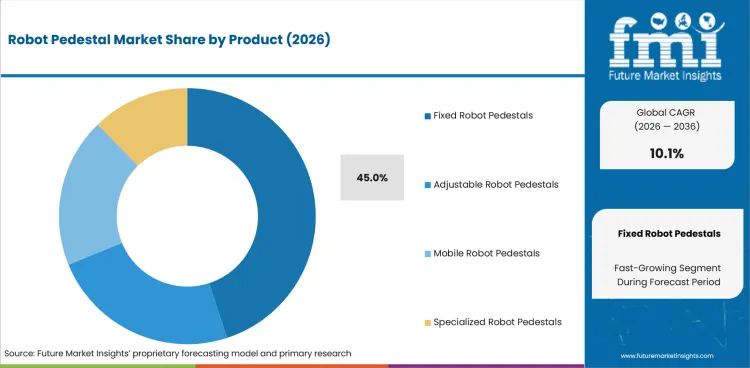
The robot pedestals are fixed, with 45.0% product share in 2026. These platforms are built for permanent installation on factory floors and provide vibration damped rigid mounting surfaces designed for specific robot models and payloads. Steel construction with precision-machined mounting interfaces allows compatibility with robot base bolt patterns.
The height of the pedestal is usually customized to position the robot at the best working envelope for its particular application; typically heights range from 200 mm to 2000 mm depending on the task and surrounding equipment. The base plate is secured to the factory floor to ensure the structural stability needed for high speed robot motion without positional drift.
How big is the welding and cutting segment in the robot pedestal market?
About 30.0% share, led by spatter- and heat-resistant welding-cell mounts
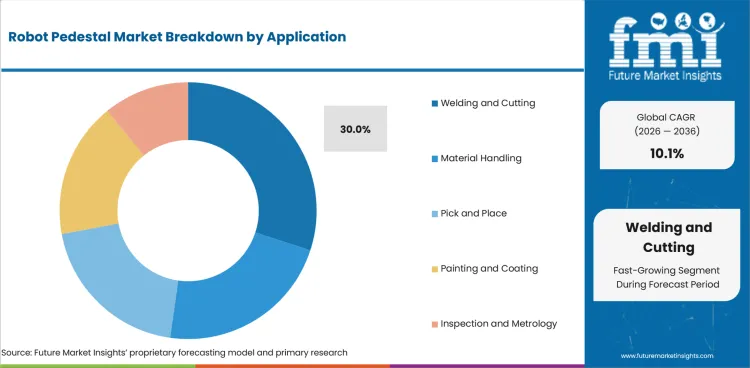
Application share of welding and cutting is 30.0% in 2026. Robotic welding cells require strict pedestal requirements such as resistance to weld spatter, thermal cycling and high frequency vibration generated from arc welding and resistance welding processes. The key to the weld quality and consistency are the pedestals that hold the sub-millimeter positional accuracy.
Continued growth in robotic welding applications across automotive, metal fabrication and structural steel will drive demand for pedestals, with the level of demand directly proportional to welding robot installations. Each new welding cell will typically contain one or more robot pedestals to position welding robots into the optimum orientation with respect to the workpiece fixture.
What drives and restrains the robot pedestal market?
Driven by rising industrial robot installations; restrained by custom-engineering complexity and longer lead times
- With the increase of industrial robot installations, comes a proportional need for pedestal mounting systems accompanying each new robot deployment.
- Application specific pedestal dimensions and mounting configurations require custom engineering, leading to design complexity and longer lead times.
- The rise of collaborative robots is also giving birth to new categories of pedestal products with adjustable height, integrated safety features and quick-reconfiguration capability.
The growth in the robot pedestal market is fuelled by the increasing industrial robot installation, growing cobot deployment and the investment in manufacturing automation. Custom engineering needs complicate matters, while standardized modular platforms and cobot-specific designs offer opportunities for scalable growth.
What drives demand?
Global industrial robot shipments exceeding 500,000 units a year
Demand is driven by global industrial robot shipments that have surpassed 500,000 units in recent years and continue to grow. Most robots need a pedestal or some sort of mounting. The more automation that is adopted, the more of these are needed.
What opportunity do cobot pedestals offer?
Rising collaborative robot deployment needing differentiated mounts
This growth is driven by the increasing deployment of collaborative robots that need different pedestal solutions than traditional industrial robots. Cobot pedestals are typically lighter, height adaptable, and designed with rounded edges and safety features suitable for environments of human-robot coexistence.
What opportunity does custom engineering create?
Need for application-specific pedestal engineering for diverse cells
Demand is influenced by the need for application-specific pedestal engineering that addresses vibration, load, environmental, and accuracy requirements unique to each manufacturing cell configuration. This custom engineering component creates value-added revenue but extends project timelines.
Where is demand expanding?
Robotic automation spreading into electronics, food and logistics
Demand is growing as robotic automation expands beyond automotive into electronics assembly, food and beverage packaging, pharmaceutical manufacturing and logistics operations, each creating new pedestal design requirements and installation volumes.
Which countries are growing fastest in the robot pedestal market?
USA 8.5%, EU 8.2%, Japan 8.0%, South Korea 8.0%, UK 7.9% through 2036
.webp "Top Country Growth Comparison Robot Pedestal Market Cagr (2026 2036)")
| Country | CAGR |
|---|---|
| USA | 8.5% |
| UK | 7.9% |
| EU | 8.2% |
| Japan | 8.0% |
| South Korea | 8.0% |
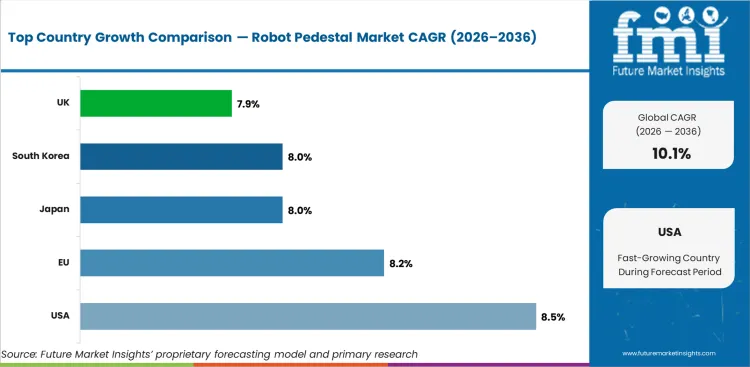
- Strong demand drivers, USA leading at 8.5% CAGR.
- EU (8.2%) led by increased market activity.
- Growth supported by Japan (8.0%) and South Korea (8.0%).
The global robot pedestal market is estimated to grow at 10.1% CAGR from 2026 to 2036. The study covers more than 30 countries, and the key markets are listed below.
How fast is the robot pedestal market growing in the United States?
8.5% CAGR through 2036, the fastest country-level market in the study
The United States leads at 8.5% CAGR through 2036. Industrial robot adoption growth, manufacturing reshoring, and automotive automation investment drive pedestal demand.
- Manufacturing reshoring investment under IRA and CHIPS Act provisions includes automation equipment procurement that encompasses robot pedestal systems.
- Automotive production automation at both established OEM plants and EV startup facilities creates concentrated robotic welding and assembly cell demand.
- System integrator networks provide engineering and installation services that include pedestal specification and procurement for each robot deployment.
What is the robot pedestal market outlook in the European Union?
8.2% CAGR, driven by Established automotive automation and Industry 4.0 investment
The European Union is projected to register 8.2% CAGR through 2036. Established automotive automation and Industry 4.0 investment drive pedestal demand.
- German automotive manufacturing maintains the highest robot density in Europe, creating sustained pedestal procurement demand for welding and assembly automation.
- Industry 4.0 investment programs across EU member states support manufacturing automation expansion that includes robot pedestal installation.
- European pedestal manufacturers provide engineered solutions meeting CE safety and quality requirements for manufacturing cell installations.
What is driving robot pedestal growth in Japan?
8.0% CAGR, driven by Domestic robot manufacturer leadership and manufacturing automation investment
Japan is projected to register 8.0% CAGR through 2036. Domestic robot manufacturer leadership and manufacturing automation investment sustain demand.
- Fanuc, Yaskawa, and other Japanese robot manufacturers create domestic pedestal demand through internal automation and customer installation projects.
- Automotive and electronics manufacturing in Japan maintains high robot density that requires ongoing pedestal replacement and new installation procurement.
- Japanese precision engineering standards create demand for high-accuracy pedestal products with documented performance specifications.
How is the robot pedestal market performing in South Korea?
8.0% CAGR, driven by Highest global robot density per worker and manufacturing automation investment
South Korea is projected to register 8.0% CAGR through 2036. Highest global robot density per worker and manufacturing automation investment drive demand.
- South Korea maintains the highest robot density per manufacturing worker globally, creating proportionally high pedestal installation and replacement demand.
- Automotive and electronics manufacturing automation investment by Hyundai, Samsung, and LG creates concentrated robot pedestal procurement.
- Domestic system integrators provide automation cell design and installation services including pedestal engineering and procurement.
What is the robot pedestal market forecast for the United Kingdom?
7.9% CAGR, driven by Manufacturing automation investment and growing robot adoption
The United Kingdom is projected to register 7.9% CAGR through 2036. Manufacturing automation investment and growing robot adoption drive pedestal demand.
- UK manufacturing automation investment is increasing robot density as facilities seek productivity improvements through automation deployment.
- Automotive manufacturing including EV production at Nissan, JLR, and startup facilities creates robot welding and assembly cell demand.
- UK system integrators provide robot cell engineering that includes pedestal specification and installation as part of turnkey automation projects.
Who are the leading companies in the robot pedestal market?
RoboDK, KUKA AG, Fanuc Corporation, ABB Ltd, and Yaskawa Electric Corporation
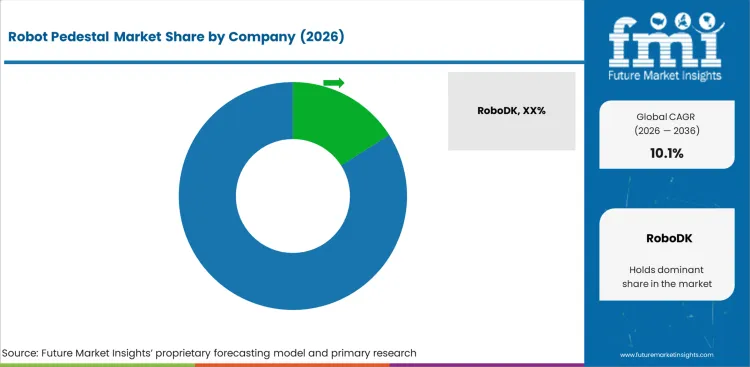
- KUKA AG and Fanuc Corporation maintain strong pedestal market positions through integrated robot and automation cell solutions that include proprietary mounting and positioning systems.
- ABB and Yaskawa Electric provide robot pedestal solutions as part of their comprehensive manufacturing automation portfolios.
- RoboDK serves the robot pedestal market through simulation and engineering software that supports pedestal design optimization for manufacturing cell configurations.
- System integrators and custom fabrication shops produce a significant volume of application-specific pedestals engineered to customer specifications.
Who are the key players in the robot pedestal market?
RoboDK, KUKA AG, Fanuc Corporation, ABB Ltd and Yaskawa Electric Corporation, plus regional players
Key global companies leading the robot pedestal market include:
- RoboDK (Canada), KUKA AG (Germany), Fanuc Corporation (Japan), ABB Ltd (Switzerland), and Yaskawa Electric Corporation (Japan) lead global robot pedestal markets through integrated robot and automation system portfolios, manufacturing cell engineering expertise, and established system integrator distribution networks.
- System integration companies and custom fabrication shops serve significant market share through application-specific pedestal engineering and manufacturing for customer automation cell configurations.
- Additional pedestal manufacturers are developing standardized modular platforms targeting the growing collaborative robot market segment where pre-engineered solutions reduce custom engineering requirements.
How do top robot pedestal companies compare?
RoboDK and KUKA AG lead globally; Fanuc Corporation, ABB Ltd and Yaskawa Electric Corporation are regional specialists
| Company | Robot Portfolio Integration | Cell Engineering Capability | System Integrator Network | Geographic Footprint |
|---|---|---|---|---|
| KUKA AG | High | High | Strong | Global |
| Fanuc | High | High | Strong | Global |
| ABB | High | High | Strong | Global |
| Yaskawa | High | High | Strong | Global |
| RoboDK | Medium | High | Moderate | Global |
Source: Future Market Insights competitive analysis, 2026.
Key Developments in Robot Pedestal Market
- In 2025, KUKA AG advanced its automation portfolio by expanding deployment of its iiQKA.OS2 operating system alongside the iiQWorks engineering suite and KR C5 controller platform, while also introducing new heavy-duty robots in the KR FORTEC PA and KR FORTEC ultra PA families to improve payload handling, cycle speed, and precision in automotive, battery, and photovoltaic applications.
- In 2025, ABB Robotics expanded its collaborative automation ecosystem by enhancing its GoFa™ cobot lineup with higher-precision motion control features and scaling its OmniVance™ application-ready cells, including arc welding and machine tending solutions, to improve deployment efficiency and production flexibility across industrial manufacturing environments.
Key Players in the Robot Pedestal Market
Major Global Players
- RoboDK
- KUKA AG
- Fanuc Corporation
- ABB Ltd
- Yaskawa Electric Corporation
- Other Companies (combined)
Emerging Players/Startups
- Figure AI
- Agility Robotics
- Bright Machines
- Vention
- Covariant
- Exotec
Robot Pedestal Market - Research Methodology
| Method | Description |
|---|---|
| Primary Research | FMI analysts conducted interviews with manufacturers, distributors, procurement specialists, and end-use operators across USA, UK, and EU to validate demand patterns and pricing structures for Fixed Robot Pedestals, and Adjustable Robot Pedestals and related product categories. |
| Desk Research | Combined trade statistics, regulatory filings, industry association data, and manufacturer disclosures to establish baseline parameters for Robot Pedestal across product, application, end use, material, robot compatibility, and technology segments. |
| Market Sizing & Forecasting | Bottom-up aggregation across Fixed Robot Pedestals, Adjustable Robot Pedestals, and Mobile Robot Pedestals product categories and Welding and Cutting, Material Handling, and Pick and Place application segments, triangulated with top-down macro indicators and regional adoption curves. |
| Data Validation | Cross-checked quarterly against production statistics, trade flow data, and manufacturer revenue disclosures for Robot Pedestal products. |
What does the robot pedestal market report cover?
2016 to 2025 history and 2026 to 2036 forecasts across all segments and 30+ countries
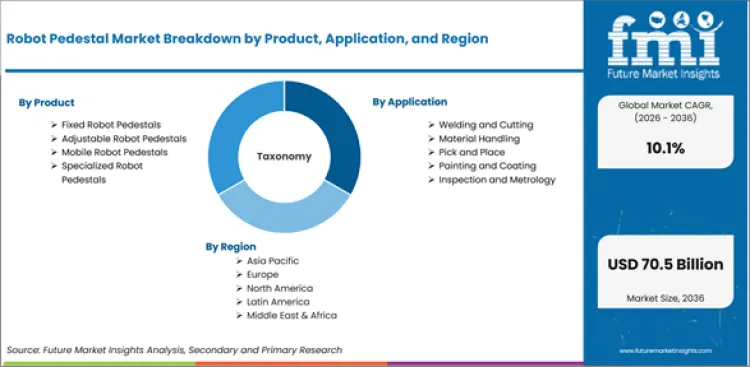
| Parameter | Details |
|---|---|
| Market size by 2036 | USD 70.5 Bn |
| Growth rate | 10.1% CAGR (2026 to 2036) |
| Forecast period | 2026 to 2036 |
| Base year value (2025) | USD 24.5 Bn |
| Key Segment Covered | Product, Application, End Use, Material, Robot Compatibility, Technology |
| Regions covered | North America, Latin America, Eastern Europe, Western Europe, East Asia, South Asia and Pacific, Middle East and Africa |
| Countries covered | USA, UK, EU, Japan, South Korea, 30 plus countries |
| Key companies profiled | RoboDK, KUKA AG, Fanuc Corporation, ABB Ltd, Yaskawa Electric Corporation, Other Companies (combined) |
| Approach | Hybrid bottom-up and top-down methodology starting with verified transaction data, projecting adoption velocity across segments and regions. |
Market Segmentation Analysis
Robot Pedestal Market Segmented by Product:
- Fixed Robot Pedestals
- Floor Mounted Pedestals
- High Stability Structures
- Permanent Installation
- Bolted Base Pedestals
- Heavy Duty Mounting
- Vibration Control
- Floor Mounted Pedestals
- Adjustable Robot Pedestals
- Manual Adjustable Pedestals
- Height Adjustment Systems
- Flexible Positioning
- Automated Adjustable Pedestals
- Motorized Adjustment
- Precision Alignment
- Manual Adjustable Pedestals
- Mobile Robot Pedestals
- Wheeled Pedestals
- Caster Mounted Systems
- Locking Mechanism
- AMR Integrated Pedestals
- Mobile Robot Platforms
- Flexible Deployment
- Wheeled Pedestals
- Specialized Robot Pedestals
- Modular Pedestals
- Reconfigurable Systems
- Quick Installation
- Application Specific Pedestals
- Cleanroom Pedestals
- Explosion Proof Pedestals
- Modular Pedestals
Robot Pedestal Market Segmented by Application:
- Welding and Cutting
- Arc Welding
- Automotive Welding
- Structural Fabrication
- Laser Cutting
- Precision Cutting
- Metal Processing
- Arc Welding
- Material Handling
- Loading and Unloading
- Palletizing
- Machine Tending
- Internal Logistics
- Warehouse Automation
- Conveyor Integration
- Loading and Unloading
- Pick and Place
- High Speed Operations
- Electronics Assembly
- Packaging Lines
- Precision Handling
- Small Component Handling
- Assembly Processes
- High Speed Operations
- Painting and Coating
- Industrial Coating
- Automotive Painting
- Surface Finishing
- Specialty Coating
- Chemical Coating
- Protective Layers
- Industrial Coating
- Inspection and Metrology
- Quality Inspection
- Vision Systems
- Defect Detection
- Measurement Systems
- Precision Testing
- Calibration
- Quality Inspection
Robot Pedestal Market Segmented by End Use:
- Industrial Manufacturing
- Automotive Industry
- Vehicle Assembly
- Chassis Manufacturing
- Electronics Industry
- Semiconductor Manufacturing
- Consumer Electronics
- General Manufacturing
- Metal Fabrication
- Machinery Production
- Automotive Industry
- Logistics and Warehousing
- Distribution Centers
- Sorting Systems
- Pallet Handling
- E Commerce Facilities
- Order Fulfillment
- Automated Storage
- Distribution Centers
- Healthcare and Pharmaceuticals
- Medical Device Manufacturing
- Precision Assembly
- Sterile Production
- Laboratory Automation
- Testing Systems
- Drug Development
- Medical Device Manufacturing
- Commercial and Service Sector
- Retail Automation
- Service Robots
- Customer Interaction
- Hospitality Automation
- Food Service Robots
- Cleaning Robots
- Retail Automation
- Research and Education
- Research Institutes
- Robotics Development
- Testing Labs
- Educational Institutions
- Training Systems
- Academic Research
- Research Institutes
Robot Pedestal Market Segmented by Material:
- Steel Robot Pedestals
- Mild Steel Structures
- Industrial Grade
- High Strength
- Stainless Steel Structures
- Corrosion Resistant
- Cleanroom Use
- Mild Steel Structures
- Aluminum Robot Pedestals
- Lightweight Structures
- Portable Design
- Corrosion Resistant
- Reinforced Aluminum
- High Durability
- Precision Use
- Lightweight Structures
- Composite Robot Pedestals
- Hybrid Materials
- Weight Optimization
- High Strength
- Advanced Materials
- Vibration Dampening
- Thermal Stability
- Hybrid Materials
Robot Pedestal Market Segmented by Robot Compatibility:
- Industrial Robot Compatible Pedestals
- Six Axis Robots
- Heavy Payload Robots
- Automotive Robots
- SCARA Robots
- Assembly Robots
- Electronics Use
- Six Axis Robots
- Collaborative Robot Compatible Pedestals
- Lightweight Cobots
- Flexible Deployment
- Human Collaboration
- Lightweight Cobots
- Service Robot Compatible Pedestals
- Mobile Robots
- Logistics Robots
- Delivery Robots
- Assistive Robots
- Healthcare Robots
- Hospitality Robots
- Mobile Robots
Robot Pedestal Market Segmented by Technology:
- Conventional Pedestals
- Fixed Structure Design
- Manual Installation
- Basic Support
- Fixed Structure Design
- Ergonomic and Adjustable Systems
- Height Adjustable Systems
- Operator Accessibility
- Maintenance Efficiency
- Vibration Control Systems
- Stability Enhancement
- Precision Operation
- Height Adjustable Systems
- Advanced Smart Pedestals
- Sensor Integrated Systems
- Real Time Monitoring
- Predictive Maintenance
- Modular Automation Systems
- Plug and Play Integration
- Smart Factory Compatibility
- Sensor Integrated Systems
Robot Pedestal Market by Region:
- North America
- USA
- Canada
- Mexico
- Latin America
- Brazil
- Chile
- Rest of Latin America
- Western Europe
- Germany
- UK
- Italy
- Spain
- France
- Nordic
- BENELUX
- Rest of Western Europe
- Eastern Europe
- Russia
- Poland
- Hungary
- Balkan & Baltic
- Rest of Eastern Europe
- East Asia
- China
- Japan
- South Korea
- South Asia and Pacific
- India
- ASEAN
- Australia & New Zealand
- Rest of South Asia and Pacific
- Middle East & Africa
- Kingdom of Saudi Arabia
- Other GCC Countries
- Türkiye
- South Africa
- Other African Union
- Rest of Middle East & Africa
Research Sources and Bibliography
- International Federation of Robotics. (2025). IFR World Robotics Report. IFR.
- International Organization for Standardization. (2025). ISO 10218: Safety Requirements for Industrial Robots. ISO.
- Robotic Industries Association. (2025). RIA North American Robotics Market Report. RIA.
- European Commission. (2025). EU Machinery Directive: Industrial Robot Safety Requirements. EC.
- International Organization for Standardization. (2025). ISO/TS 15066: Collaborative Robot Safety Requirements. ISO.
This bibliography is provided for reader reference.
This Report Answers
- Estimating the size of the robot pedestal market and projected revenue from 2026 to 2036.
- Segmentation by product, application, end use, material, robot compatibility, technology.
- Insights about more than 30 regional markets.
- Analysis of key market dynamics including demand drivers, restraints, and emerging opportunities.
- Assessment of the competitive landscape and strategic positioning of leading companies.
- Identifying investment opportunities across key product segments and geographic markets.
- Supply chain and distribution channel analysis.
- Delivery of data in PDF and Excel formats.
Frequently Asked Questions
How big is the robot pedestal market in 2026?
The global robot pedestal market is estimated to be valued at USD 26.9 billion in 2026.
What will be the size of the robot pedestal market in 2036?
The market size for the robot pedestal market is projected to reach USD 70.5 billion by 2036.
How much will the robot pedestal market growth be between 2026 and 2036?
The robot pedestal market is expected to grow at a 10.1% CAGR between 2026 and 2036.
What are the key products in the robot pedestal market?
The key products in the robot pedestal market are Fixed Robot Pedestals, Adjustable Robot Pedestals, Mobile Robot Pedestals and Specialized Robot Pedestals.
Which application segment is expected to contribute a significant share in the robot pedestal market in 2026?
In terms of application, the welding and cutting segment is expected to command 30.0% share in the robot pedestal market in 2026.
Preview the report firsthand - request a free sample
Get SampleGet the brochure for pricing and purchase details.
Get PDFTable of Content
- Key Takeaways
- Market Size and CAGR
- Top Growth Driver
- Fastest Growing Segment
- Leading Region
- Key Companies
- Emerging Opportunities
- Executive Summary
- Global Market Outlook
- Demand-side Trends
- Supply-side Trends
- Technology Roadmap Analysis
- Analysis and Recommendations
- Analyst Perspective (What is happening? Why now? What should investors know?)
- Key Questions Answered
- How large is the market?
- What is the CAGR?
- What are key trends?
- Which region dominates?
- Who are the leaders?
- Market Overview
- Market Coverage / Taxonomy
- Market Definition / Scope / Limitations
- Research Methodology
- Chapter Orientation
- Analytical Lens and Working Hypotheses
- Market Structure, Signals, and Trend Drivers
- Benchmarking and Cross-market Comparability
- Market Sizing, Forecasting, and Opportunity Mapping
- Research Design and Evidence Framework
- Desk Research Programme (Secondary Evidence)
- Expert Input and Fieldwork (Primary Evidence)
- Tooling, Models, and Reference Databases
- Data Engineering and Model Build
- Quality Assurance and Audit Trail
- Market Background
- Market Dynamics (Drivers, Restraints, Opportunity, Trends)
- Scenario Forecast (Optimistic, Likely, Conservative)
- Impact Analysis
- AI Impact
- Sustainability Impact
- Regulatory Impact
- Technology Impact
- Consumer / Buyer Analysis
- Purchase Drivers
- Adoption Barriers
- Buyer Journey
- Opportunity Map Analysis
- Product Life Cycle Analysis
- Supply Chain Analysis
- Investment Feasibility Matrix
- Value Chain Analysis
- PESTLE and Porter's Analysis
- Regulatory Landscape
- Regional Parent Market Outlook
- Production and Consumption Statistics
- Import and Export Statistics
- Global Market Analysis and Forecast, 2021 to 2036
- Historical Market Size Value (USD Million) Analysis, 2021 to 2025
- Current and Future Market Size Value (USD Million) Projections, 2026 to 2036
- Y-o-Y Growth Trend Analysis
- Absolute $ Opportunity Analysis
- Global Market Pricing Analysis, 2021 to 2036
- Global Market Analysis and Forecast, By Product, 2021 to 2036
- Introduction / Key Findings
- Historical Market Size Value (USD Million) Analysis By Product, 2021 to 2025
- Current and Future Market Size Value (USD Million) Analysis and Forecast By Product, 2026 to 2036
- Fixed Robot Pedestals
- Floor Mounted Pedestals
- Bolted Base Pedestals
- Adjustable Robot Pedestals
- Manual Adjustable Pedestals
- Automated Adjustable Pedestals
- Mobile Robot Pedestals
- Wheeled Pedestals
- AMR Integrated Pedestals
- Specialized Robot Pedestals
- Modular Pedestals
- Application Specific Pedestals
- Fixed Robot Pedestals
- Y-o-Y Growth Trend Analysis By Product, 2021 to 2025
- Absolute $ Opportunity Analysis By Product, 2026 to 2036
- Global Market Analysis and Forecast, By Application, 2021 to 2036
- Introduction / Key Findings
- Historical Market Size Value (USD Million) Analysis By Application, 2021 to 2025
- Current and Future Market Size Value (USD Million) Analysis and Forecast By Application, 2026 to 2036
- Welding and Cutting
- Arc Welding
- Laser Cutting
- Material Handling
- Loading and Unloading
- Internal Logistics
- Pick and Place
- High Speed Operations
- Precision Handling
- Painting and Coating
- Industrial Coating
- Specialty Coating
- Inspection and Metrology
- Quality Inspection
- Measurement Systems
- Welding and Cutting
- Y-o-Y Growth Trend Analysis By Application, 2021 to 2025
- Absolute $ Opportunity Analysis By Application, 2026 to 2036
- Global Market Analysis and Forecast, By End Use, 2021 to 2036
- Introduction / Key Findings
- Historical Market Size Value (USD Million) Analysis By End Use, 2021 to 2025
- Current and Future Market Size Value (USD Million) Analysis and Forecast By End Use, 2026 to 2036
- Industrial Manufacturing
- Automotive Industry
- Electronics Industry
- General Manufacturing
- Logistics and Warehousing
- Distribution Centers
- E Commerce Facilities
- Healthcare and Pharmaceuticals
- Medical Device Manufacturing
- Laboratory Automation
- Commercial and Service Sector
- Retail Automation
- Hospitality Automation
- Research and Education
- Research Institutes
- Educational Institutions
- Industrial Manufacturing
- Y-o-Y Growth Trend Analysis By End Use, 2021 to 2025
- Absolute $ Opportunity Analysis By End Use, 2026 to 2036
- Global Market Analysis and Forecast, By Material, 2021 to 2036
- Introduction / Key Findings
- Historical Market Size Value (USD Million) Analysis By Material, 2021 to 2025
- Current and Future Market Size Value (USD Million) Analysis and Forecast By Material, 2026 to 2036
- Steel Robot Pedestals
- Mild Steel Structures
- Stainless Steel Structures
- Aluminum Robot Pedestals
- Lightweight Structures
- Reinforced Aluminum
- Composite Robot Pedestals
- Hybrid Materials
- Advanced Materials
- Y-o-Y Growth Trend Analysis By Material, 2021 to 2025
- Absolute $ Opportunity Analysis By Material, 2026 to 2036
- Steel Robot Pedestals
- Global Market Analysis and Forecast, By Robot Compatibility
- Introduction / Key Findings
- Historical Market Size Value (USD Million) Analysis By Robot Compatibility, 2021 to 2025
- Current and Future Market Size Value (USD Million) Analysis and Forecast By Robot Compatibility, 2026 to 2036
- Industrial Robot Compatible Pedestals
- Six Axis Robots
- SCARA Robots
- Collaborative Robot Compatible Pedestals
- Lightweight Cobots
- Service Robot Compatible Pedestals
- Mobile Robots
- Assistive Robots
- Y-o-Y Growth Trend Analysis By Robot Compatibility, 2021 to 2025
- Absolute $ Opportunity Analysis By Robot Compatibility, 2026 to 2036
- Industrial Robot Compatible Pedestals
- Global Market Analysis and Forecast, By Technology
- Introduction / Key Findings
- Historical Market Size Value (USD Million) Analysis By Technology, 2021 to 2025
- Current and Future Market Size Value (USD Million) Analysis and Forecast By Technology, 2026 to 2036
- Conventional Pedestals
- Fixed Structure Design
- Ergonomic and Adjustable Systems
- Height Adjustable Systems
- Vibration Control Systems
- Advanced Smart Pedestals
- Sensor Integrated Systems
- Modular Automation Systems
- Y-o-Y Growth Trend Analysis By Technology, 2021 to 2025
- Absolute $ Opportunity Analysis By Technology, 2026 to 2036
- Conventional Pedestals
- Global Market Analysis and Forecast, By Region, 2021 to 2036
- Introduction
- Historical Market Size Value (USD Million) Analysis By Region, 2021 to 2025
- Current Market Size Value (USD Million) Analysis and Forecast By Region, 2026 to 2036
- North America
- Latin America
- Western Europe
- Eastern Europe
- East Asia
- South Asia and Pacific
- Middle East & Africa
- Market Attractiveness Analysis By Region
- North America Market Analysis and Forecast, By Country, 2021 to 2036
- Historical Market Size Value (USD Million) Trend Analysis By Market Taxonomy, 2021 to 2025
- Market Size Value (USD Million) Forecast By Market Taxonomy, 2026 to 2036
- By Country
- USA
- Canada
- Mexico
- By Product
- By Application
- By End Use
- By Material
- By Robot Compatibility
- By Technology
- By Country
- Market Attractiveness Analysis
- By Country
- By Product
- By Application
- By End Use
- By Material
- By Robot Compatibility
- By Technology
- Key Takeaways
- Latin America Market Analysis and Forecast, By Country
- Historical Market Size Value (USD Million) Trend Analysis By Market Taxonomy, 2021 to 2025
- Market Size Value (USD Million) Forecast By Market Taxonomy, 2026 to 2036
- By Country
- Brazil
- Chile
- Rest of Latin America
- By Product
- By Application
- By End Use
- By Material
- By Robot Compatibility
- By Technology
- By Country
- Market Attractiveness Analysis
- By Country
- By Product
- By Application
- By End Use
- By Material
- By Robot Compatibility
- By Technology
- Key Takeaways
- Western Europe Market Analysis and Forecast, By Country
- Historical Market Size Value (USD Million) Trend Analysis By Market Taxonomy, 2021 to 2025
- Market Size Value (USD Million) Forecast By Market Taxonomy, 2026 to 2036
- By Country
- Germany
- UK
- Italy
- Spain
- France
- Nordic
- BENELUX
- Rest of Western Europe
- By Product
- By Application
- By End Use
- By Material
- By Robot Compatibility
- By Technology
- By Country
- Market Attractiveness Analysis
- By Country
- By Product
- By Application
- By End Use
- By Material
- By Robot Compatibility
- By Technology
- Key Takeaways
- Eastern Europe Market Analysis and Forecast, By Country
- Historical Market Size Value (USD Million) Trend Analysis By Market Taxonomy, 2021 to 2025
- Market Size Value (USD Million) Forecast By Market Taxonomy, 2026 to 2036
- By Country
- Russia
- Poland
- Hungary
- Balkan & Baltic
- Rest of Eastern Europe
- By Product
- By Application
- By End Use
- By Material
- By Robot Compatibility
- By Technology
- By Country
- Market Attractiveness Analysis
- By Country
- By Product
- By Application
- By End Use
- By Material
- By Robot Compatibility
- By Technology
- Key Takeaways
- East Asia Market Analysis and Forecast, By Country
- Historical Market Size Value (USD Million) Trend Analysis By Market Taxonomy, 2021 to 2025
- Market Size Value (USD Million) Forecast By Market Taxonomy, 2026 to 2036
- By Country
- China
- Japan
- South Korea
- By Product
- By Application
- By End Use
- By Material
- By Robot Compatibility
- By Technology
- By Country
- Market Attractiveness Analysis
- By Country
- By Product
- By Application
- By End Use
- By Material
- By Robot Compatibility
- By Technology
- Key Takeaways
- South Asia and Pacific Market Analysis and Forecast, By Country
- Historical Market Size Value (USD Million) Trend Analysis By Market Taxonomy, 2021 to 2025
- Market Size Value (USD Million) Forecast By Market Taxonomy, 2026 to 2036
- By Country
- India
- ASEAN
- Australia & New Zealand
- Rest of South Asia and Pacific
- By Product
- By Application
- By End Use
- By Material
- By Robot Compatibility
- By Technology
- By Country
- Market Attractiveness Analysis
- By Country
- By Product
- By Application
- By End Use
- By Material
- By Robot Compatibility
- By Technology
- Key Takeaways
- Middle East & Africa Market Analysis and Forecast, By Country
- Historical Market Size Value (USD Million) Trend Analysis By Market Taxonomy, 2021 to 2025
- Market Size Value (USD Million) Forecast By Market Taxonomy, 2026 to 2036
- By Country
- Kingdom of Saudi Arabia
- Other GCC Countries
- Türkiye
- South Africa
- Other African Union
- Rest of Middle East & Africa
- By Product
- By Application
- By End Use
- By Material
- By Robot Compatibility
- By Technology
- By Country
- Market Attractiveness Analysis
- By Country
- By Product
- By Application
- By End Use
- By Material
- By Robot Compatibility
- By Technology
- Key Takeaways
- Key Countries Market Analysis
- USA
- Pricing Analysis
- Market Share Analysis, 2025
- By Product
- By Application
- By End Use
- By Material
- By Robot Compatibility
- By Technology
- Canada
- Pricing Analysis
- Market Share Analysis, 2025
- By Product
- By Application
- By End Use
- By Material
- By Robot Compatibility
- By Technology
- Mexico
- Pricing Analysis
- Market Share Analysis, 2025
- By Product
- By Application
- By End Use
- By Material
- By Robot Compatibility
- By Technology
- Brazil
- Pricing Analysis
- Market Share Analysis, 2025
- By Product
- By Application
- By End Use
- By Material
- By Robot Compatibility
- By Technology
- Chile
- Pricing Analysis
- Market Share Analysis, 2025
- By Product
- By Application
- By End Use
- By Material
- By Robot Compatibility
- By Technology
- Germany
- Pricing Analysis
- Market Share Analysis, 2025
- By Product
- By Application
- By End Use
- By Material
- By Robot Compatibility
- By Technology
- UK
- Pricing Analysis
- Market Share Analysis, 2025
- By Product
- By Application
- By End Use
- By Material
- By Robot Compatibility
- By Technology
- Italy
- Pricing Analysis
- Market Share Analysis, 2025
- By Product
- By Application
- By End Use
- By Material
- By Robot Compatibility
- By Technology
- Spain
- Pricing Analysis
- Market Share Analysis, 2025
- By Product
- By Application
- By End Use
- By Material
- By Robot Compatibility
- By Technology
- France
- Pricing Analysis
- Market Share Analysis, 2025
- By Product
- By Application
- By End Use
- By Material
- By Robot Compatibility
- By Technology
- India
- Pricing Analysis
- Market Share Analysis, 2025
- By Product
- By Application
- By End Use
- By Material
- By Robot Compatibility
- By Technology
- ASEAN
- Pricing Analysis
- Market Share Analysis, 2025
- By Product
- By Application
- By End Use
- By Material
- By Robot Compatibility
- By Technology
- Australia & New Zealand
- Pricing Analysis
- Market Share Analysis, 2025
- By Product
- By Application
- By End Use
- By Material
- By Robot Compatibility
- By Technology
- China
- Pricing Analysis
- Market Share Analysis, 2025
- By Product
- By Application
- By End Use
- By Material
- By Robot Compatibility
- By Technology
- Japan
- Pricing Analysis
- Market Share Analysis, 2025
- By Product
- By Application
- By End Use
- By Material
- By Robot Compatibility
- By Technology
- South Korea
- Pricing Analysis
- Market Share Analysis, 2025
- By Product
- By Application
- By End Use
- By Material
- By Robot Compatibility
- By Technology
- Russia
- Pricing Analysis
- Market Share Analysis, 2025
- By Product
- By Application
- By End Use
- By Material
- By Robot Compatibility
- By Technology
- Poland
- Pricing Analysis
- Market Share Analysis, 2025
- By Product
- By Application
- By End Use
- By Material
- By Robot Compatibility
- By Technology
- Hungary
- Pricing Analysis
- Market Share Analysis, 2025
- By Product
- By Application
- By End Use
- By Material
- By Robot Compatibility
- By Technology
- Kingdom of Saudi Arabia
- Pricing Analysis
- Market Share Analysis, 2025
- By Product
- By Application
- By End Use
- By Material
- By Robot Compatibility
- By Technology
- Türkiye
- Pricing Analysis
- Market Share Analysis, 2025
- By Product
- By Application
- By End Use
- By Material
- By Robot Compatibility
- By Technology
- South Africa
- Pricing Analysis
- Market Share Analysis, 2025
- By Product
- By Application
- By End Use
- By Material
- By Robot Compatibility
- By Technology
- USA
- Market Structure Analysis
- Competition Dashboard
- Competition Benchmarking
- Market Share Analysis of Top Players
- By Regional
- By Product
- By Application
- By End Use
- By Material
- By Robot Compatibility
- By Technology
- Emerging Startups
- Innovation Benchmarking
- Competition Analysis
- Competition Deep Dive
- RoboDK
- Overview
- Product Portfolio
- Profitability by Market Segments (Product/Region/Sales Channel)
- Sales Footprint
- Strategy Overview
- Marketing Strategy
- Product Strategy
- Channel Strategy
- KUKA AG
- Fanuc Corporation
- ABB Ltd
- Yaskawa Electric Corporation
- Other Companies (combined)
- RoboDK
- Case Studies
- Success Stories
- Recent Developments
- Competition Deep Dive
- Assumptions & Acronyms Used


