

- Market Size (2026)
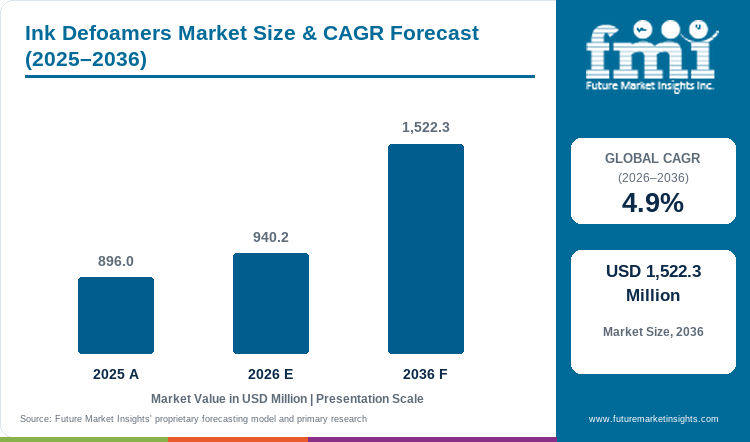
- USD 940.2 Mn
- Forecast (2036)
- USD 1522.3 Mn
- CAGR (2026 to 2036)
- 4.9%
How big is the Ink Defoamers Market in 2026?
USD 940.2 million in 2026 and USD 1,522.3 million by 2036, expanding at 4.9% CAGR.
The ink defoamers market is projected to expand at 4.9% CAGR between 2026 and 2036. Market value is estimated at USD 940.2 million in 2026 and USD 1,522.3 million by 2036. The market stood at USD 896.0 million in 2025. Water-based ink traps air during mixing and press circulation, creating a steady need for foam control that protects transfer quality. In March 2025, Evonik launched TEGO Foamex 8420 for difficult waterborne inks and overprint varnishes. The low-dose formula targets surfactant-rich systems, and ink additives help formulators manage foam without weakening press performance.
National rules are influencing which defoamer grades enter regular printing production and how quickly formulators can approve a change. South Korea is projected at 6.4% CAGR through 2036, compared with 4.4% for Japan. In May 2025, BfR issued printing-ink guidance under Germany's food-contact positive-list system. United States printers follow federal air rules that apply to wide-web flexographic and gravure lines. These requirements keep formulation records and plant checks central to approval decisions for new defoamer grades. Local laboratories support qualification work, while flexographic printing inks require dependable foam control during packaging runs.
Key Takeaways
- Foam-control demand in waterborne inks is driven by trapped air from surfactants and high-shear press circulation, which can disrupt transfer during production.
- Silicone defoamers are projected to hold 34.0% of chemistry revenue in 2026, attributable to low surface tension and fast bubble break.
- Water-based inks are expected to hold 35.0% of ink type demand in 2026, supported by surfactants that retain air during circulation.
- Flexographic printing is forecast to represent 31.0% of process demand in 2026, with pumped circulation increasing the need for foam control.
- Compatibility testing slows grade changes because poor fit can create surface craters and gloss loss or damage wetting and printing plates.
- Key companies in this market include BYK, Evonik, Dow, BASF, MÜNZING, Elementis, Shin-Etsu Chemical, Wacker Chemie, Ashland, and Kemira.
Analyst Perspective
"The commercial opportunity is strongest in water-based packaging inks that need reliable foam control across long press runs and frequent formulation changes. Wider adoption depends on proving resin and press compatibility while keeping food-contact or restricted-substance records complete for every approved grade."
- Nikhil Kaitwade, Principal Consultant, Future Market Insights
How is the ink defoamers market segmented?
The ink defoamers market is segmented by Chemistry, Ink Type, Printing Process, End Use, Sales Channel, and Region.
The ink defoamers market is segmented by chemistry, ink type, printing process, end use, sales channel, and region. Chemistry covers silicone, mineral oil, polyether, water-based, and silicone-free defoamers, while ink type covers water-based, solvent-based, UV, flexographic, and inkjet systems. Printing process includes flexographic, gravure, inkjet, offset, and screen printing across commercial and industrial applications. End use covers packaging, labels, publishing and commercial work, textiles, and industrial printing. Sales channels include ink makers, distributors, direct additive suppliers, and toll formulators across the regional market.
What makes silicone defoamers central to the chemistry category?
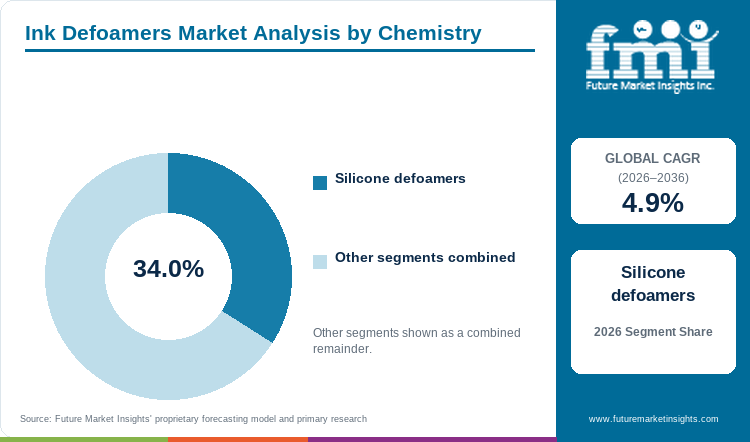
Silicone defoamers spread across the ink surface because low surface tension helps break bubbles during mixing and circulation. Modified siloxanes remain active under press shear, giving formulators stable foam control during longer production runs. Silicone fluids can work at low doses, but ink makers check wetting and surface behavior in the actual formula. Approval follows resin compatibility and substance review for the grade used in production.
- By chemistry, silicone defoamers are estimated to hold 34.0% in 2026 owing to low surface tension that speeds bubble break.
- In June 2025, Evonik launched TEGO Foamex 8051 for durable foam control under high shear in waterborne coating systems.
Why do water-based inks lead the ink type category?
Water-based formulas use surfactants that disperse pigments but can hold air during mixing and circulation. Press pumps draw air into the ink loop, creating microfoam that can reduce transfer quality or film coverage. These water-based inks must wet paper and board as well as film while the defoamer removes air without weakening surface wetting. Ink makers compare foam control with wetting performance before approving a grade.
- In 2026, water-based inks are projected to represent 35.0% of ink type demand as surfactants retain bubbles during circulation.
- In March 2025, Evonik introduced mass-balanced TEGO Foamex 812 eCO for coating and ink formulas requiring defoaming and food-contact compliance.
How does flexographic printing shape the printing process category?
Flexographic presses move thin ink through chambers and anilox rolls, which can pull air into the ink loop. Flexible packaging keeps many presses running for long periods, which raises the cost of unstable transfer during production. Press crews need fast bubble break that remains stable as ink moves repeatedly through pumps and chambers. Qualification tests confirm foam control does not reduce wetting or print quality.
- Flexographic printing is forecast to capture 31.0% of process demand in 2026, supported by foam-control needs during pumped circulation.
- In July 2026, BYK introduced DISPERBYK-2180 for aqueous printing and inkjet inks that need pigment stability across a wide pH range.
What supports packaging in the end use category?
Long packaging runs make transfer defects costly because one unstable formula can affect large volumes of printed material. Food packaging converters need raw-material records that support migration and substance reviews for food-contact applications. Paper and film behave differently during printing, so each defoamer must work with the selected ink and substrate. Approval data must connect foam control with the exact package and press conditions.
- Within end use, packaging is expected to reach 36.0% in 2026 as long print runs increase the cost of foam defects.
- In May 2025, Evonik launched four AERODISP dispersions for waterborne inkjet coatings that included selected grades for food-packaging applications.
Why do ink makers lead the sales channel category?
Ink makers control formulation records and test resin compatibility before approving a defoamer for production. Testing covers surfactant behavior during pigment grinding and the final let-down stage before the ink reaches the press. Digital label printing brings frequent formulation changes, which makes consistent internal approval records more important across repeat jobs. That control keeps defoamer selection close to the team responsible for formula performance.
- Ink makers are estimated to hold 42.0% of sales channel demand in 2026, enabled by their control of additive testing and approval.
- In August 2025, BYK expanded its presence in Brazil and identified printing-ink manufacturers among the additive customers it serves.
What are the drivers, restraints and opportunities in the Ink Defoamers Market?
Water-based ink raises foam-control needs, fit tests slow grade changes, and clear substance records can open more uses.
- Driver: Water-based packaging inks raise foam-control needs during high-shear mixing and continuous press circulation.
- Restraint: Poor ink compatibility can replace foam with craters or gloss defects while weakening wetting and damaging printing plates.
- Opportunity: Suppliers can pair silicone-free or low-mineral-oil choices with press data and local laboratory support.
Waterborne formulation keeps foam control tied to production quality
Water-based ink uses surfactants that keep pigments dispersed, but the same chemistry can retain air during high-shear mixing. Press pumps pull more air into circulation and create persistent foam during long packaging runs. Trapped air disrupts transfer and raises waste across demanding print jobs. Similar control problems affect anti-foaming agents used in other process fluids and coating systems. In April 2026, BASF presented water-based Joncryl resins for printing inks and barrier coatings at interpack. The presentation covered current packaging formulations that require careful control of foam and surface behavior. Ink makers test defoamers in the actual resin and pigment system before approving regular use. Successful press trials confirm clean transfer and give tested grades a clearer path toward production approval.
Compatibility testing keeps switching costs above the product price
Fast foam break does not prove a defoamer remains compatible with the ink formulation. The additive must spread evenly without separating from the resin or changing surface performance. Poor compatibility can create craters and gloss loss while weakening wetting or damaging printing plates during production. Packaging coatings face the same surface-control problem because visible defects can reduce pack quality. In February 2025, BYK described ECS work on defoamers and PFAS-free additive systems for coatings and printing uses. Each resin and pigment combination can respond differently during laboratory and press testing. Ink makers keep an approved grade until an alternative performs reliably in both stages. Testing time and qualification cost can outweigh a lower unit price and slow supplier switching.
Documented alternatives can open restricted-substance applications
Food-pack rules narrow chemistry choices because formulators must review substances before approving any replacement grade. Regulation (EU) 2025/40 was published in January 2025 and sets PFAS limits for food-contact packaging from August 2026. Short digital printing packaging runs create more frequent formulation changes and reward faster qualification of acceptable alternatives. Silicone-free or low-mineral-oil options become more useful when suppliers provide complete substance records. Press data must confirm that each alternative controls foam without weakening wetting or print quality. Chemistry claims cannot replace a production trial on the customer's actual press. Ink makers also need the approved formula to perform consistently in the final package. Successful press and pack results can move a tested grade toward regular commercial orders.
Which country CAGRs are profiled in the Ink Defoamers Market?
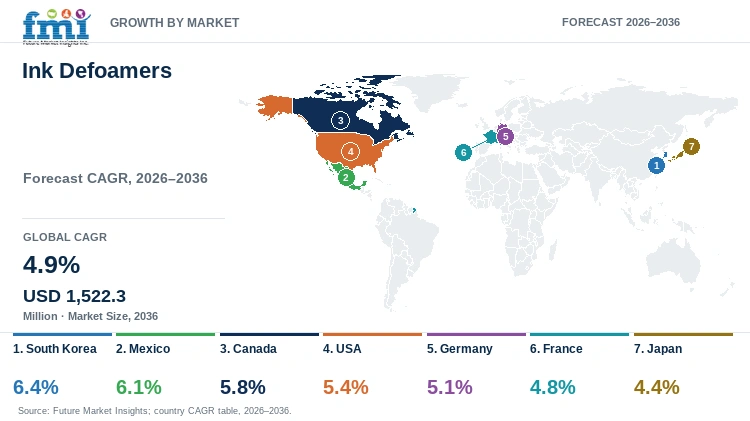
| Country | CAGR |
|---|---|
| South Korea | 6.4% |
| Mexico | 6.1% |
| Canada | 5.8% |
| USA | 5.4% |
| Germany | 5.1% |
| France | 4.8% |
| Japan | 4.4% |
How do country-level CAGRs compare in the Ink Defoamers Market?
The seven profiled countries follow different approval and supply conditions alongside regulatory and production factors that shape local ink defoamer demand.
- South Korea requires careful food-contact documentation, and fast packaging presses keep qualification speed and reliable foam control important for ink suppliers.
- Mexico's recovery targets keep packaging material choices under review, with local distribution and Spanish technical files helping speed plant qualification.
- Canada's food-pack safety reviews keep substance records central to additive changes, especially when plants compare new grades through press trials.
- United States printers balance federal solvent controls with press performance, so additive changes must support emissions goals without creating print defects.
- Germany's food-contact rules require detailed substance files, making migration review and documented press testing important before new grades enter production.
- France's mineral-oil limits influence carrier selection for packaging and public-printing inks, increasing the value of tested alternatives with clear records.
- Japan's positive-list system extends material review for food-contact packaging, so stable lots and exact change records can simplify later approvals.
The full report provides country-level CAGR analysis across North America, Latin America, Western Europe, Eastern Europe, East Asia, South Asia and Pacific, and the Middle East and Africa.
Country-wise Analysis
- South Korean packaging printers review food-contact records before additive changes on fast presses. Ink defoamer demand in South Korea is projected to rise at 6.4% CAGR through 2036 as product checks remain central. In June 2025, MFDS changed national food-contact standards covering utensils and food containers or packages. Local ink teams match product files with Korean requirements and customer press conditions. Water-based flexographic and gravure inks need quick sample checks because circulation can bring foam back during long runs. Documentation gaps can delay approval even when laboratory foam control looks acceptable. Local technical support helps answer compliance questions and keeps press qualification focused on the tested grade. Final qualification confirms stable foam control on the buyer's production line.
- Mexican ink makers rely on local distributors for inventory and technical support during press qualification. The Mexican ink defoamers market is estimated to post 6.1% CAGR through 2036, influenced by national packaging recovery goals. In September 2025, SEMARNAT reported that program members collected 34% of plastic packaging on average. National recovery goals keep material selection important as converters review packaging systems and supplier options. Service coverage varies outside major manufacturing hubs and can slow sample delivery or plant support. Spanish technical files speed initial checks before a grade enters production trials. Defoamer performance must remain stable as local water quality changes between production sites. Recurring orders depend on clean press results and dependable local supply once qualification is complete.
- Canadian food-pack ink teams review additive records before scheduling plant trials for each new grade. Ink defoamer sales in Canada are forecast to expand at 5.8% CAGR by 2036, supported by continuing safety reviews. In February 2026, Health Canada listed inks and food-packaging colorants among possible benzophenone exposure sources. That national review keeps substance records relevant when plants assess supplier or formulation changes. Local inventory can speed sample delivery, but it cannot prove compatibility inside a working ink system. Plant teams need data for the resin and pigment combination used in the printing process. Clear use records reduce repeated review once a grade passes technical and press testing. Reliable local support then helps approved products move into recurring plant orders.
- United States printers operate many flexographic and gravure lines under long-standing federal air requirements. Ink defoamer demand in the USA is expected to advance at 5.4% CAGR through 2036, with solvent rules shaping qualification. In October 2025, EPA updated its printing and publishing monitoring documents page. Federal guidance includes low or no VOC and HAP inks among available control options. Resin and pigment systems vary between plants, so one foam-control grade cannot suit every press condition. Application teams test each additive in the actual ink loop before regular production use. Local inventory and press support help plants pursue solvent goals without replacing foam with transfer defects. Qualification remains tied to stable production results on the customer's own equipment.
- German packaging ink teams screen substances before food-contact jobs move into regular production. The German ink defoamers market is anticipated to grow at 5.1% CAGR through 2036, reinforced by national substance rules. In May 2025, BfR issued technical guidance for printing-ink substance files under German requirements. The positive list connects additive selection with migration limits and health review for food-contact applications. Formula changes can reopen foam-control checks and require another wetting assessment or print trial. Technical files must match the exact grade used during qualification and customer testing. Clear records keep the review focused without weakening the required safety checks. Customers can protect print quality while updating approved ink files for later order cycles.
- French converters face mineral-oil limits for packaging and public-printing inks that use affected carrier materials. Defoamer sales in France are forecast to expand at 4.8% CAGR through 2036, constrained by those mineral-oil limits. France applied tighter MOAH and MOSH limits from January 2025 for covered packaging and printed materials. The rules make ink makers review carrier choices earlier during formulation and supplier qualification. A replacement defoamer must control foam across paper and board as well as flexible film without weakening wetting. Side-by-side press trials reveal whether a carrier change creates visible print defects. Suppliers need tested alternatives and clear records for each formulation and press trial. Complete evidence can shorten approval while preserving the required result during regular production.
- Japanese ink buyers value stable production lots and clear change records for food-contact packaging applications. Japan's ink defoamers market is projected to grow at 4.4% CAGR through 2036, tied to positive-list checks. Japan's revised food-contact positive list took effect in June 2025 and keeps material approval under national review. File checks follow basic foam-control testing as each new grade enters qualification. Formula changes can raise costs for packaging that requires consistent color and transfer performance. Technical files must match the exact grade used during each Japanese customer trial. Stable lots reduce repeated checks during production and later orders for the same packaging lines. Suppliers gain stronger order continuity when documentation and press performance remain consistent.
Who are the notable companies in the Ink Defoamers Market?
BYK, Evonik, Dow, BASF, MÜNZING, Elementis, Shin-Etsu Chemical, Wacker Chemie, Ashland, and Kemira are active within the defined ink defoamers supply boundary.
BYK and Evonik focus on printing-ink additives, while BASF and MÜNZING sell defoamers for printing applications. Dow, Shin-Etsu Chemical, and Wacker Chemie supply silicone chemistry across broader industrial uses. Elementis, Ashland, and Kemira serve wider process applications that can overlap with foam-control requirements. New sources need press evidence and substance records before ink makers consider recurring orders.
- BYK, Evonik, BASF, MÜNZING, and Elementis support ink and coating formulation through additive portfolios and technical application service.
- Dow, Shin-Etsu Chemical, and Wacker Chemie supply silicone chemistry and industrial foam-control products for broader formulation needs.
- Ashland and Kemira provide foam-control capabilities through wider process-chemical portfolios that serve multiple industrial applications.
Competitive Benchmarking: Ink Defoamers Market
| Company | Printing-Ink Application Depth | Chemistry Breadth | Compliance or Technical Evidence | Geographic Reach |
|---|---|---|---|---|
| BYK | High | High | High | Global |
| Evonik | High | High | High | Global |
| Dow | High | High | High | Global |
| BASF | High | High | High | Global |
| MÜNZING | High | High | High | Global |
| Elementis | Medium | High | Medium | Global |
| Shin-Etsu Chemical | Medium | High | Medium | Global |
| Wacker Chemie | Medium | High | Medium | Global |
| Ashland | Medium | Medium | Medium | Global |
| Kemira | Low | Medium | Medium | Global and regional process-chemical network |
High scores require current proof for ink or coating applications within the defined supply boundary. Medium scores require broader foam-control evidence that remains relevant to formulation or process use. Low scores require process-chemical evidence, while geographic reach is reported separately and does not affect the score.
Key Developments in the Ink Defoamers Market
- In February 2026, Evonik announced a new United States and Canada distribution network for its coatings and inks additives.
- In October 2025, BASF started a new Dilovası dispersion line that expands coatings supply across Türkiye and nearby markets.
- In January 2025, MÜNZING opened a Singapore base and warehouse that supports Asia Pacific additive supply and technical service.
Key Players in the Ink Defoamers Market
Printing-ink additive specialists
- BYK
- Evonik
- BASF
- MÜNZING
- Elementis
Silicone and foam-control platforms
- Dow
- Shin-Etsu Chemical
- Wacker Chemie
Broader process-chemical suppliers
- Ashland
- Kemira
Ink Defoamers Market - Report Scope
| Coverage field | Report scope |
|---|---|
| Market breakdown | By chemistry, ink type, printing process, end use, sales channel, and region. |
| Quantitative Units | USD million. |
| Market Definition | Commercial defoamers and antifoam additives used to control macrofoam and microfoam during ink manufacture, circulation, and printing are included. |
| Regions Covered | North America, Latin America, Western Europe, Eastern Europe, East Asia, South Asia and Pacific, and Middle East and Africa. |
| Countries Covered | South Korea, Mexico, Canada, USA, Germany, France, Japan, and 20+ countries included in the full report. |
| Key Companies Profiled | BYK, Evonik, Dow, BASF, MÜNZING, Elementis, Shin-Etsu Chemical, Wacker Chemie, Ashland, Kemira. |
| Forecast Period | 2026 to 2036. |
| Approach | Primary and secondary research with market triangulation. |
Ink Defoamers Market - Research Methodology
| Method | Approach |
|---|---|
| Primary Research | FMI analysts gathered input from manufacturers, service providers, technology developers, distributors, end users, procurement teams, and subject-matter experts. Interviews examined purchasing decisions, product or service evaluation, adoption barriers, approval requirements, pricing considerations, and expectations for technical or commercial support. Respondents were also asked what evidence is required before a trial, pilot, or initial order develops into regular purchasing. |
| Desk Research | Desk research covered government statistics, regulatory publications, trade data, industry associations, technical literature, standards, company filings, product information, and official corporate announcements. Sources were reviewed for relevance, publication date, geographic coverage, and consistency with the defined market scope. Claims relating to performance, applications, approvals, capacity, investment, and commercial activity were retained only when supported by credible public evidence. |
| Market Sizing and Forecasting | The market model combined the baseline value with historical performance, segment structure, pricing and volume indicators, adoption levels, company participation, and country-level demand conditions. Forecast assumptions considered economic activity, investment trends, regulatory developments, technology adoption, purchasing cycles, supply availability, and barriers to wider market use. Segment and regional estimates were reconciled before the final market total was calculated. |
| Data Validation | Estimates were checked against multiple independent indicators, including public data, company activity, trade patterns, industry developments, and findings from primary interviews. Validation also tested whether products, services, applications, and company revenues fell within the defined market boundaries. Adjacent categories, unsupported claims, overlapping revenues, and activities without direct market relevance were excluded to reduce double counting and maintain consistency across segments and countries. |
Ink Defoamers Market by Segments
Ink Defoamers Market segmented by Chemistry:
- Silicone defoamers
- Mineral oil defoamers
- Polyether defoamers
- Water-based defoamers
- Silicone-free defoamers
Ink Defoamers Market segmented by Ink Type:
- Water-based inks
- Solvent-based inks
- UV inks
- Flexographic inks
- Inkjet inks
Ink Defoamers Market segmented by Printing Process:
- Flexographic printing
- Gravure printing
- Inkjet printing
- Offset printing
- Screen printing
Ink Defoamers Market segmented by End Use:
- Packaging
- Labels
- Publishing and commercial
- Textiles
- Industrial printing
Ink Defoamers Market segmented by Sales Channel:
- Ink makers
- Distributors
- Direct additive suppliers
- Toll formulators
Ink Defoamers Market by Region:
- North America
- United States
- Canada
- Latin America
- Brazil
- Mexico
- Chile
- Rest of Latin America
- Western Europe
- Germany
- United Kingdom
- Italy
- Spain
- France
- Nordics
- Benelux
- Rest of Western Europe
- Eastern Europe
- Russia
- Poland
- Hungary
- Balkan and Baltic States
- Rest of Eastern Europe
- East Asia
- China
- Japan
- South Korea
- South Asia and Pacific
- India
- ASEAN
- Australia and New Zealand
- Rest of South Asia and Pacific
- Middle East and Africa
- Kingdom of Saudi Arabia
- Other GCC Countries
- Türkiye
- South Africa
- Other African Union Countries
- Rest of Middle East and Africa
Research Sources and Bibliography
- Evonik. (2025, March 10). Evonik launches TEGO Foamex 8420 for utmost defoaming challenges in waterborne overprint varnishes and inks.
- German Federal Institute for Risk Assessment. (2025, May 6). Technical guidance for printing inks.
- Evonik. (2025, June 4). Evonik Coating Additives launches TEGO Foamex 8051, a highly efficient, long-lasting siloxane defoamer.
- Evonik. (2025, March 12). Evonik Coating Additives launches first mass balanced products for coatings and inks.
- BYK. (2026, July 14). BYK portfolio extended by a more environmentally friendly, alkali-resistant wetting and dispersing additive for aqueous systems.
- Evonik. (2025, May 8). Evonik launches particle dispersion portfolio to enhance dot sharpness and resolution of inkjet ink receptive coatings.
- BYK. (2025, August 28). Strategic new course set in South America: Boosting BYK’s presence and customer proximity in Brazil.
- BASF. (2026, April 16). BASF at interpack 2026: Solutions for modern packaging concepts.
- BYK. (2025, February 13). Three days of trends, innovations, and expert lectures at the BYK booth at ECS 2025.
- European Parliament and Council of the European Union. (2025, January 22). Regulation (EU) 2025/40 on packaging and packaging waste.
- Ministry of Food and Drug Safety, Republic of Korea. (2025, June 27). Standards and specifications for utensils, containers and packages (No. 2024-29).
- Secretaría de Medio Ambiente y Recursos Naturales. (2025, September 4). Business and industry organizations report progress in plastics management and recovery.
- Health Canada. (2026, February 13). Benzophenone.
- U.S. Environmental Protection Agency. (2025, October 20). Printing and publishing - documents.
- French Ministry for Ecological Transition. (2025). Household packaging and graphic paper: Mineral-oil restrictions for packaging and public printing.
- Ministry of Health, Labour and Welfare, Japan. (2025, June). Positive list system for food utensils, containers, and packaging from June 1, 2025.
- BASF. (2025, October 7). BASF expands production capacity for dispersions for the architectural coatings and construction industries in Dilovası, Türkiye.
- Evonik. (2026, February 5). Evonik Coating Additives announces streamlined distribution network for the U.S. and Canada.
- MÜNZING. (2025, January 15). MÜNZING expands regional presence with the establishment of MÜNZING Singapore Pte Ltd.
- BASF. (2026, March 4). BASF inaugurates expanded dispersion production in Durban, South Africa, as it celebrates 60 years in the country.
- Ashland Inc. (2025, July 8). Ashland advances strategic manufacturing network optimization.
- Evonik. (2026, June 11). Evonik sets the standard - its siloxane coating and inks additive portfolio stands out for exceptional purity.
- BASF. (2026, May 13). American Coatings Show 2026: BASF debuts Efka PX 4720 to power ultra-matte UV coatings with CFRP technology.
- Ashland Inc. (2025, March 24). Ashland showcases additives for coatings and specialty markets at European Coatings Show.
- Dow. (2026, June 23). Dow expands product and innovation capabilities to support continued growth in specialty silicones markets.
- BASF. (2026, July 13). BASF expands certified biomass-balanced additives portfolio for architectural coatings.
- Elementis. (2025, July 31). Elementis announces its 2025 interim results.
- Shin-Etsu Chemical. (2025, November 7). Shin-Etsu Chemical develops recyclable thermoplastic silicone.
- Wacker Chemie. (2025, January 23). WACKER expands production capacity for specialty silicones in Asia.
- Ashland Inc. (2025, September 22). Ashland launches iSolve information portal for specialty additives customers.
- Kemira. (2025, March 20). Kemira invests in the expansion of paper and board chemical capacity in Thailand to serve the growing APAC market.
- Evonik. (2026, June 25). Evonik upgrades UV label and release liner coating capabilities in Shanghai.
- BYK. (2026, July 3). BYK team wins the ALTANA Innovation Award.
- Adhesive and Sealant Council. (2025, August 21). MÜNZING unveils expanded North American production headquarters in Clover, SC.
- MÜNZING. (n.d.). Clover, USA. Retrieved September 22, 2026.
This bibliography is provided for reader reference and is not exhaustive. The full report contains the complete reference list and detailed citations.
This Report Answers
- What are the ink defoamers market values for 2026 and 2036?
- Which ink formulation conditions sustain regular demand for foam-control additives?
- Which chemistry category is projected to hold 34.0% share in 2026?
- Why are water-based inks expected to hold 35.0% share in 2026?
- Why is flexographic printing forecast to hold 31.0% share in 2026?
- How do compatibility tests and substance rules slow defoamer supplier switching?
- How do the seven profiled country growth rates compare through 2036?
- Which companies supply printing-ink additives alongside silicone chemistry and foam-control products?
- What evidence should ink makers review before changing an approved defoamer grade?
Frequently Asked Questions
How big is the global ink defoamers market in 2026?
Ink defoamers are valued at USD 940.2 million in 2026 and projected at USD 1,522.3 million by 2036. Waterborne inks and packaging printing keep foam control tied to regular formulation work and press qualification.
What is the CAGR of the ink defoamers market from 2026 to 2036?
The ink defoamers market is projected to grow at 4.9% CAGR from 2026 to 2036. Stable foam control supports ink mixing and press circulation without creating wetting problems or visible surface defects.
Which chemistry segment leads the ink defoamers market in 2026?
Silicone defoamers lead the chemistry category and are projected to account for 34.0% of revenue in 2026. Low surface tension helps these products break bubbles quickly while using small doses in ink formulations and press work.
Which ink type segment leads the ink defoamers market in 2026?
Water-based inks are expected to hold 35.0% of ink type demand in 2026. Surfactants and press circulation can trap air, so ink makers need stable macrofoam and microfoam control during long production runs.
Which companies are active across the global ink defoamers market?
Key companies include BYK, Evonik, Dow, BASF, MÜNZING, Elementis, Shin-Etsu Chemical, Wacker Chemie, Ashland, and Kemira. Ink makers compare chemistry breadth and application support alongside product records and regional supply before approving new grades.
Preview the report firsthand - request a free sample
Get SampleGet the brochure for pricing and purchase details.
Get PDFTable of Content
- Key Takeaways
- Market Size and CAGR
- Top Growth Driver
- Fastest Growing Segment
- Leading Region
- Key Companies
- Emerging Opportunities
- Executive Summary
- Global Market Outlook
- Demand-side Trends
- Supply-side Trends
- Technology Roadmap Analysis
- Analysis and Recommendations
- Analyst Perspective (What is happening? Why now? What should investors know?)
- Key Questions Answered
- How large is the market?
- What is the CAGR?
- What are key trends?
- Which region dominates?
- Who are the leaders?
- Market Overview
- Market Coverage / Taxonomy
- Market Definition / Scope / Limitations
- Research Methodology
- Chapter Orientation
- Analytical Lens and Working Hypotheses
- Market Structure, Signals, and Trend Drivers
- Benchmarking and Cross-market Comparability
- Market Sizing, Forecasting, and Opportunity Mapping
- Research Design and Evidence Framework
- Desk Research Programme (Secondary Evidence)
- Expert Input and Fieldwork (Primary Evidence)
- Tooling, Models, and Reference Databases
- Data Engineering and Model Build
- Quality Assurance and Audit Trail
- Market Background
- Market Dynamics (Drivers, Restraints, Opportunity, Trends)
- Scenario Forecast (Optimistic, Likely, Conservative)
- Impact Analysis
- AI Impact
- Sustainability Impact
- Regulatory Impact
- Technology Impact
- Consumer / Buyer Analysis
- Purchase Drivers
- Adoption Barriers
- Buyer Journey
- Opportunity Map Analysis
- Product Life Cycle Analysis
- Supply Chain Analysis
- Investment Feasibility Matrix
- Value Chain Analysis
- PESTLE and Porter's Analysis
- Regulatory Landscape
- Regional Parent Market Outlook
- Production and Consumption Statistics
- Import and Export Statistics
- Global Market Analysis and Forecast, 2021 to 2036
- Historical Market Size Value (USD Million) Analysis, 2021 to 2025
- Current and Future Market Size Value (USD Million) Projections, 2026 to 2036
- Y-o-Y Growth Trend Analysis
- Absolute $ Opportunity Analysis
- Global Market Pricing Analysis, 2021 to 2036
- Global Market Analysis and Forecast, By Chemistry, 2021 to 2036
- Introduction / Key Findings
- Historical Market Size Value (USD Million) Analysis By Chemistry, 2021 to 2025
- Current and Future Market Size Value (USD Million) Analysis and Forecast By Chemistry, 2026 to 2036
- Silicone defoamers
- Mineral oil defoamers
- Polyether defoamers
- Water-based defoamers
- Silicone-free defoamers
- Y-o-Y Growth Trend Analysis By Chemistry, 2021 to 2025
- Absolute $ Opportunity Analysis By Chemistry, 2026 to 2036
- Global Market Analysis and Forecast, By Ink Type, 2021 to 2036
- Introduction / Key Findings
- Historical Market Size Value (USD Million) Analysis By Ink Type, 2021 to 2025
- Current and Future Market Size Value (USD Million) Analysis and Forecast By Ink Type, 2026 to 2036
- Water-based inks
- Solvent-based inks
- UV inks
- Flexographic inks
- Inkjet inks
- Y-o-Y Growth Trend Analysis By Ink Type, 2021 to 2025
- Absolute $ Opportunity Analysis By Ink Type, 2026 to 2036
- Global Market Analysis and Forecast, By Printing Process, 2021 to 2036
- Introduction / Key Findings
- Historical Market Size Value (USD Million) Analysis By Printing Process, 2021 to 2025
- Current and Future Market Size Value (USD Million) Analysis and Forecast By Printing Process, 2026 to 2036
- Flexographic printing
- Gravure printing
- Inkjet printing
- Offset printing
- Screen printing
- Y-o-Y Growth Trend Analysis By Printing Process, 2021 to 2025
- Absolute $ Opportunity Analysis By Printing Process, 2026 to 2036
- Global Market Analysis and Forecast, By End Use, 2021 to 2036
- Introduction / Key Findings
- Historical Market Size Value (USD Million) Analysis By End Use, 2021 to 2025
- Current and Future Market Size Value (USD Million) Analysis and Forecast By End Use, 2026 to 2036
- Packaging
- Labels
- Publishing and commercial
- Textiles
- Industrial printing
- Y-o-Y Growth Trend Analysis By End Use, 2021 to 2025
- Absolute $ Opportunity Analysis By End Use, 2026 to 2036
- Global Market Analysis and Forecast, By Sales Channel, 2021 to 2036
- Introduction / Key Findings
- Historical Market Size Value (USD Million) Analysis By Sales Channel, 2021 to 2025
- Current and Future Market Size Value (USD Million) Analysis and Forecast By Sales Channel, 2026 to 2036
- Ink makers
- Distributors
- Direct additive suppliers
- Toll formulators
- Y-o-Y Growth Trend Analysis By Sales Channel, 2021 to 2025
- Absolute $ Opportunity Analysis By Sales Channel, 2026 to 2036
- Global Market Analysis and Forecast, By Region, 2021 to 2036
- Introduction
- Historical Market Size Value (USD Million) Analysis By Region, 2021 to 2025
- Current Market Size Value (USD Million) Analysis and Forecast By Region, 2026 to 2036
- North America
- Latin America
- Western Europe
- Eastern Europe
- East Asia
- South Asia and Pacific
- Middle East and Africa
- Market Attractiveness Analysis By Region
- North America Market Analysis and Forecast, By Country, 2021 to 2036
- Historical Market Size Value (USD Million) Trend Analysis By Market Taxonomy, 2021 to 2025
- Market Size Value (USD Million) Forecast By Market Taxonomy, 2026 to 2036
- By Country
- United States
- Canada
- By Chemistry
- By Ink Type
- By Printing Process
- By End Use
- By Sales Channel
- By Country
- Market Attractiveness Analysis
- By Country
- By Chemistry
- By Ink Type
- By Printing Process
- By End Use
- By Sales Channel
- Key Takeaways
- Latin America Market Analysis and Forecast, By Country
- Historical Market Size Value (USD Million) Trend Analysis By Market Taxonomy, 2021 to 2025
- Market Size Value (USD Million) Forecast By Market Taxonomy, 2026 to 2036
- By Country
- Brazil
- Mexico
- Chile
- Rest of Latin America
- By Chemistry
- By Ink Type
- By Printing Process
- By End Use
- By Sales Channel
- By Country
- Market Attractiveness Analysis
- By Country
- By Chemistry
- By Ink Type
- By Printing Process
- By End Use
- By Sales Channel
- Key Takeaways
- Western Europe Market Analysis and Forecast, By Country
- Historical Market Size Value (USD Million) Trend Analysis By Market Taxonomy, 2021 to 2025
- Market Size Value (USD Million) Forecast By Market Taxonomy, 2026 to 2036
- By Country
- Germany
- United Kingdom
- Italy
- Spain
- France
- Nordics
- Benelux
- Rest of Western Europe
- By Chemistry
- By Ink Type
- By Printing Process
- By End Use
- By Sales Channel
- By Country
- Market Attractiveness Analysis
- By Country
- By Chemistry
- By Ink Type
- By Printing Process
- By End Use
- By Sales Channel
- Key Takeaways
- Eastern Europe Market Analysis and Forecast, By Country
- Historical Market Size Value (USD Million) Trend Analysis By Market Taxonomy, 2021 to 2025
- Market Size Value (USD Million) Forecast By Market Taxonomy, 2026 to 2036
- By Country
- Russia
- Poland
- Hungary
- Balkan and Baltic States
- Rest of Eastern Europe
- By Chemistry
- By Ink Type
- By Printing Process
- By End Use
- By Sales Channel
- By Country
- Market Attractiveness Analysis
- By Country
- By Chemistry
- By Ink Type
- By Printing Process
- By End Use
- By Sales Channel
- Key Takeaways
- East Asia Market Analysis and Forecast, By Country
- Historical Market Size Value (USD Million) Trend Analysis By Market Taxonomy, 2021 to 2025
- Market Size Value (USD Million) Forecast By Market Taxonomy, 2026 to 2036
- By Country
- China
- Japan
- South Korea
- By Chemistry
- By Ink Type
- By Printing Process
- By End Use
- By Sales Channel
- By Country
- Market Attractiveness Analysis
- By Country
- By Chemistry
- By Ink Type
- By Printing Process
- By End Use
- By Sales Channel
- Key Takeaways
- South Asia and Pacific Market Analysis and Forecast, By Country
- Historical Market Size Value (USD Million) Trend Analysis By Market Taxonomy, 2021 to 2025
- Market Size Value (USD Million) Forecast By Market Taxonomy, 2026 to 2036
- By Country
- India
- ASEAN
- Australia and New Zealand
- Rest of South Asia and Pacific
- By Chemistry
- By Ink Type
- By Printing Process
- By End Use
- By Sales Channel
- By Country
- Market Attractiveness Analysis
- By Country
- By Chemistry
- By Ink Type
- By Printing Process
- By End Use
- By Sales Channel
- Key Takeaways
- Middle East and Africa Market Analysis and Forecast, By Country
- Historical Market Size Value (USD Million) Trend Analysis By Market Taxonomy, 2021 to 2025
- Market Size Value (USD Million) Forecast By Market Taxonomy, 2026 to 2036
- By Country
- Kingdom of Saudi Arabia
- Other GCC Countries
- Türkiye
- South Africa
- Other African Union Countries
- Rest of Middle East and Africa
- By Chemistry
- By Ink Type
- By Printing Process
- By End Use
- By Sales Channel
- By Country
- Market Attractiveness Analysis
- By Country
- By Chemistry
- By Ink Type
- By Printing Process
- By End Use
- By Sales Channel
- Key Takeaways
- Key Countries Market Analysis
- United States
- Pricing Analysis
- Market Share Analysis, 2025
- By Chemistry
- By Ink Type
- By Printing Process
- By End Use
- By Sales Channel
- Canada
- Pricing Analysis
- Market Share Analysis, 2025
- By Chemistry
- By Ink Type
- By Printing Process
- By End Use
- By Sales Channel
- Mexico
- Pricing Analysis
- Market Share Analysis, 2025
- By Chemistry
- By Ink Type
- By Printing Process
- By End Use
- By Sales Channel
- Brazil
- Pricing Analysis
- Market Share Analysis, 2025
- By Chemistry
- By Ink Type
- By Printing Process
- By End Use
- By Sales Channel
- Chile
- Pricing Analysis
- Market Share Analysis, 2025
- By Chemistry
- By Ink Type
- By Printing Process
- By End Use
- By Sales Channel
- Germany
- Pricing Analysis
- Market Share Analysis, 2025
- By Chemistry
- By Ink Type
- By Printing Process
- By End Use
- By Sales Channel
- United Kingdom
- Pricing Analysis
- Market Share Analysis, 2025
- By Chemistry
- By Ink Type
- By Printing Process
- By End Use
- By Sales Channel
- Italy
- Pricing Analysis
- Market Share Analysis, 2025
- By Chemistry
- By Ink Type
- By Printing Process
- By End Use
- By Sales Channel
- Spain
- Pricing Analysis
- Market Share Analysis, 2025
- By Chemistry
- By Ink Type
- By Printing Process
- By End Use
- By Sales Channel
- France
- Pricing Analysis
- Market Share Analysis, 2025
- By Chemistry
- By Ink Type
- By Printing Process
- By End Use
- By Sales Channel
- India
- Pricing Analysis
- Market Share Analysis, 2025
- By Chemistry
- By Ink Type
- By Printing Process
- By End Use
- By Sales Channel
- ASEAN
- Pricing Analysis
- Market Share Analysis, 2025
- By Chemistry
- By Ink Type
- By Printing Process
- By End Use
- By Sales Channel
- Australia and New Zealand
- Pricing Analysis
- Market Share Analysis, 2025
- By Chemistry
- By Ink Type
- By Printing Process
- By End Use
- By Sales Channel
- China
- Pricing Analysis
- Market Share Analysis, 2025
- By Chemistry
- By Ink Type
- By Printing Process
- By End Use
- By Sales Channel
- Japan
- Pricing Analysis
- Market Share Analysis, 2025
- By Chemistry
- By Ink Type
- By Printing Process
- By End Use
- By Sales Channel
- South Korea
- Pricing Analysis
- Market Share Analysis, 2025
- By Chemistry
- By Ink Type
- By Printing Process
- By End Use
- By Sales Channel
- Russia
- Pricing Analysis
- Market Share Analysis, 2025
- By Chemistry
- By Ink Type
- By Printing Process
- By End Use
- By Sales Channel
- Poland
- Pricing Analysis
- Market Share Analysis, 2025
- By Chemistry
- By Ink Type
- By Printing Process
- By End Use
- By Sales Channel
- Hungary
- Pricing Analysis
- Market Share Analysis, 2025
- By Chemistry
- By Ink Type
- By Printing Process
- By End Use
- By Sales Channel
- Kingdom of Saudi Arabia
- Pricing Analysis
- Market Share Analysis, 2025
- By Chemistry
- By Ink Type
- By Printing Process
- By End Use
- By Sales Channel
- Türkiye
- Pricing Analysis
- Market Share Analysis, 2025
- By Chemistry
- By Ink Type
- By Printing Process
- By End Use
- By Sales Channel
- South Africa
- Pricing Analysis
- Market Share Analysis, 2025
- By Chemistry
- By Ink Type
- By Printing Process
- By End Use
- By Sales Channel
- United States
- Market Structure Analysis
- Competition Dashboard
- Competition Benchmarking
- Market Share Analysis of Top Players
- By Regional
- By Chemistry
- By Ink Type
- By Printing Process
- By End Use
- By Sales Channel
- Emerging Startups
- Innovation Benchmarking
- Competition Analysis
- Competition Deep Dive
- BYK
- Overview
- Product Portfolio
- Profitability by Market Segments
- Sales Footprint
- Strategy Overview
- Marketing Strategy
- Product Strategy
- Channel Strategy
- Evonik
- Dow
- BASF
- MÜNZING
- Elementis
- Shin-Etsu Chemical
- Wacker Chemie
- Ashland
- Kemira
- BYK
- Case Studies
- Success Stories
- Recent Developments
- Competition Deep Dive
- Assumptions & Acronyms Used


