

- Market Size (2026)
- USD 1460.6 Mn
- Forecast (2036)
- USD 2640.5 Mn
- CAGR (2026 to 2036)
- 6.1%
Insulated Oven Panels Market Size, Market Forecast and Outlook By FMI
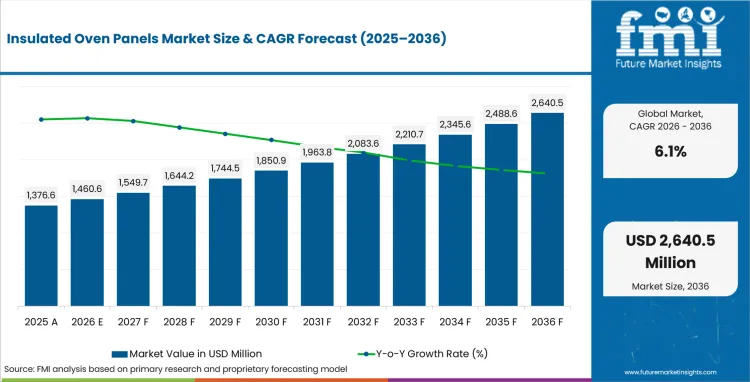
USD 1,460.6 million in 2026 and USD 2,640.5 million by 2036 at a 6.1% CAGR
The insulated oven panels market is estimated at USD 1,376.6 million in 2025 and is projected to reach USD 2,640.5 million by 2036 at 6.1% CAGR. Growth is supported by heat-loss control and OEM redesign work that move panels from casing parts into engineered energy-control components. Mineral Wool is estimated to hold 42.0% share in 2026 while Industrial Ovens are expected to contribute 38.5% share in 2026. Manufacturers connect panel selection with energy cost control and line stability in industrial insulation projects.
| Metric | Value |
|---|---|
| 2026 Market Size | USD 1,460.6 million |
| 2036 Market Size | USD 2,640.5 million |
| Forecast CAGR | 6.1% from 2026 to 2036 |
| Leading Core Material | Mineral Wool |
| Mineral Wool Share in 2026 | 42.0% |
| Leading Oven Type | Industrial Ovens |
| Industrial Ovens Share in 2026 | 38.5% |
| Fastest-growing Country | China |
| China CAGR | 7.0% by 2036 |
Summary of the Insulated Oven Panels Market
| Market Signal | Commercial Impact |
|---|---|
| Demand and Growth Drivers | Demand for insulated oven panels is being driven by the need for improved thermal efficiency, equipment upgrades, and stable process temperatures across industrial applications.
|
| Product and Segment View | Mineral wool panels, industrial ovens, medium-temperature panels, food and beverage applications, and direct OEM channels are expected to lead their respective segments.
|
| Geography and Growth Outlook | China and India are expected to remain the primary growth markets, supported by industrial modernization and expanding food processing investments.
|
| Competitive Landscape | Competition remains focused on thermal performance, material expertise, and engineering support for industrial insulation applications.
|
| Analyst Perspective | Insulated oven panels are increasingly becoming strategic engineering components that influence operational uptime, energy efficiency, and maintenance accessibility.
- Nikhil Kaitwade, Principal Consultant at Future Market Insights |
Demand is moving from simple enclosure replacement toward specification-led energy control. In January 2026, the USA Department of Energy announced USD 155.0 million for American industrial innovation. The funding fits oven-panel demand because heat containment is one of the lower-disruption changes available to process-heating plants.
UNIDO reported in March 2026 that global manufacturing production rose 0.5% in the fourth quarter of 2025. ROCKWOOL approved more than USD 100.0 million for a Mississippi production line in December 2024. These signals show why buyers view panels as a practical route to lower heat loss and steadier regional supply.
Which factors support expansion in the insulated oven panels market?
Oven retrofit economics and documented fire behavior support panel value across industrial heating lines.
- Market value gains support from replacement panels that reduce heat leakage without forcing full oven rebuilding.
- Supplier pricing reflects core material rating before skin design and joint sealing shape installed cost.
- Revenue improves due to OEMs specifying panel sets during chamber design and heater sizing before procurement begins.
- Buyer confidence rises after suppliers document service temperature along with fabrication tolerances and fire behavior.
Why is the insulated oven panels market growing?
Industrial heating buyers are reviewing the oven envelope before replacing burners or rebuilding full chambers. Adjacent thermal insulation materials remain part of specification planning because heat loss and chamber stability affect operating cost.
Energy-cost planning is moving oven panels into retrofit screening rather than treating them as spare parts. In June 2026, EIA expected Henry Hub gas prices to average USD 3.34/MMBtu in the second half of 2026. That forecast matters for gas-fired ovens because heat leakage becomes more visible when fuel planning tightens. Better panels help plants protect chamber stability during long production runs.
How is the insulated oven panels market segmented?
The industry is segmented by core material and oven type. It also covers temperature class, end use and sales channel.
- Mineral Wool is projected to account for 42.0% share in 2026 due to fire resistance and service access remaining central to oven-panel selection.
- Industrial Ovens are expected to represent 38.5% share in 2026 owing to factory drying and batch heating rooms that create a broad replacement pool.
- Medium Temperature panels are anticipated to hold 46.0% share in 2026 supported by process ovens that operate below furnace ranges.
- Food & Beverage is projected to secure 34.0% share in 2026 attributable to bakery and drying lines that need stable heat profiles.
- Direct OEM is estimated to account for 52.0% share in 2026 driven by panel dimensions that are usually decided during equipment design.
Which core material category holds a notable share in the insulated oven panels market?
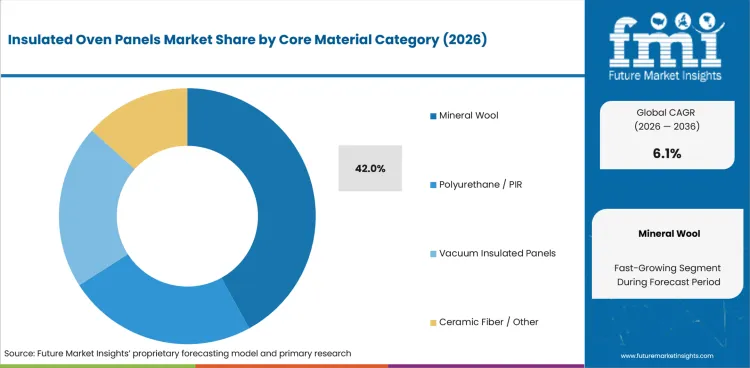
- Mineral Wool is projected to hold 42.0% share in 2026 due to non-combustible core performance and repair access remaining central to oven design.
- Polyurethane / PIR gains use in lower-temperature ovens that need thinner panels and lower installed weight.
How does the oven type segment perform in the insulated oven panels market?
- Industrial Ovens are expected to represent 38.5% share in 2026 supported by drying and heating systems used across factories.
- Laboratory ovens use smaller panel sets, so unit value remains lower despite tight chamber tolerances.
What drives demand across the temperature class segment in the insulated oven panels market?
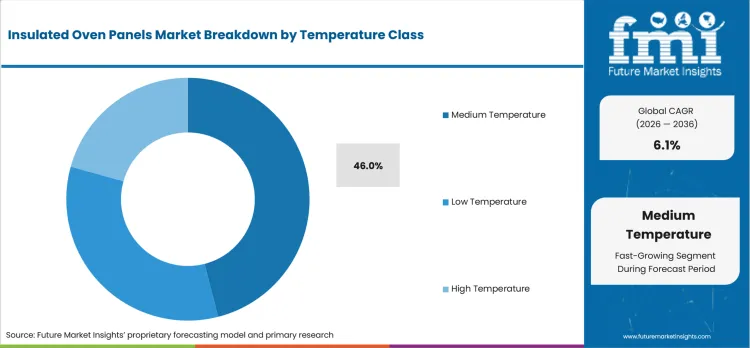
- Medium Temperature panels are anticipated to account for 46.0% share in 2026 owing to food and coating ovens alongside electronics heating lines.
- High Temperature panels require ceramic fiber or board reinforcement for harsh duty cycles and thermal shock exposure.
Which end-use segment shows a prominent position in the insulated oven panels market?
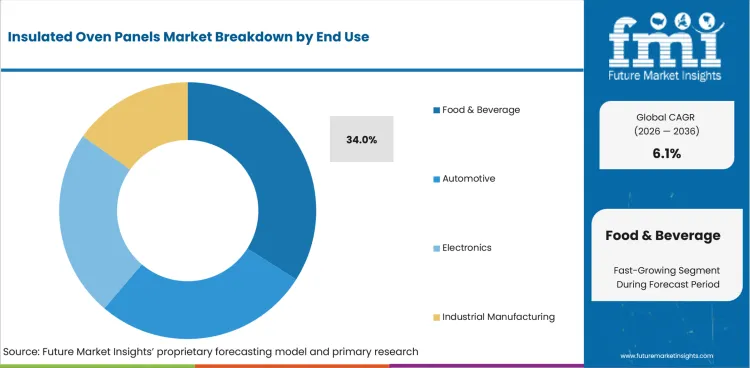
- Food & Beverage is projected to hold 34.0% share in 2026 attributable to stable heat needs in bakery and drying lines.
- Automotive users place more emphasis on paint curing ovens and repair access during line shutdowns.
How are buyers selecting across sales channel options in the insulated oven panels market?
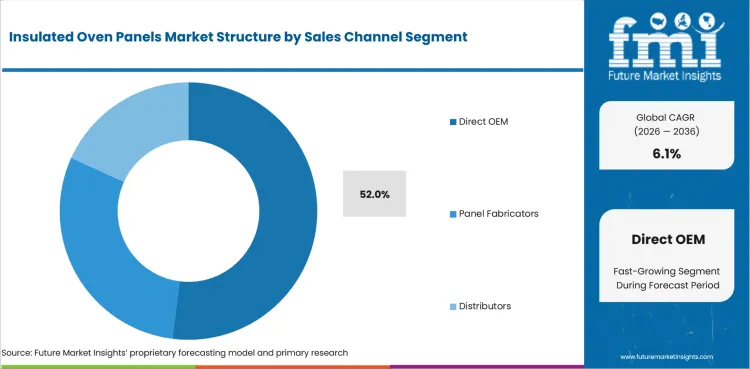
- Direct OEM is estimated to capture 52.0% share in 2026 driven by panel choices that are locked into oven drawings before procurement starts.
- Distributors remain useful for emergency panels and replacement stock after field damage appears during plant maintenance cycles.
What are the drivers, restraints and opportunities in the insulated oven panels market?
Energy-loss control and OEM specification support growth while specialty core costs still limit faster replacement.
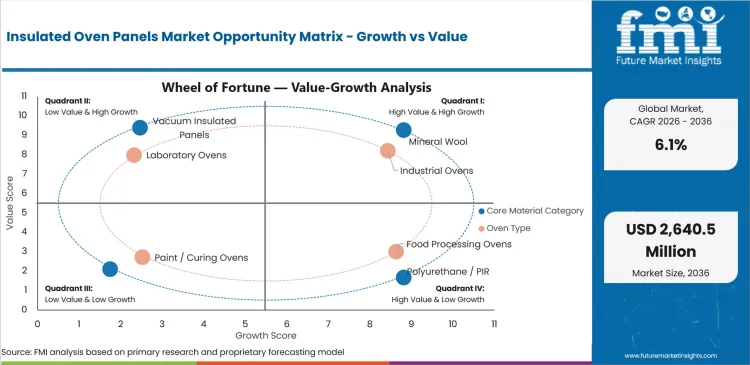
- Driver: Process-heat audits are expected to raise oven panel replacement as factories seek lower-cost heat leakage fixes before full chamber rebuilding.
- Restraint: Specialty core prices can delay replacement because smaller plants often apply strict payback rules to non-critical panel upgrades.
- Opportunity: Vacuum Insulated Panels create value in compact ovens that need more chamber volume without larger footprints.
Heat-Loss Retrofit Economics
Retrofit economics are strongest when panel replacement fits scheduled shutdowns and avoids chamber rebuilding. In May 2026, the USA Census Bureau reported that durable goods orders reached USD 346.0 billion in April. The figure points to active equipment spending across manufacturing. Oven panels can compete for that budget because they reduce heat leakage without forcing plants to replace the full oven. Adjacent technical insulation procurement follows the same need for documented service access and installed performance.
Fire-Rated Core Selection
Core selection becomes more important when ovens use coatings or combustible residues. In June 2026, Saint-Gobain completed the HKO divestment and described the unit as a high-temperature industrial insulation textile business with about EUR 45.0 million in 2025 sales. The detail is important for oven panels because severe-duty insulation remains a distinct supply category. Mineral wool and ceramic materials remain important in safety-reviewed oven assemblies.
Compact Oven Panel Design
Compact oven design gives thinner insulation systems a premium role in crowded production cells. In May 2025, Knauf Insulation confirmed that its planned Shotton rock mineral wool plant would have annual capacity above 100 thousand tonnes. The investment improves regional mineral wool availability but does not remove the cost barrier for vacuum panels. High temperature insulation suppliers still need edge protection and repair guidance before buyers accept premium panel designs.
Which countries are growing fastest in the insulated oven panels market?
China 7.0% CAGR, India 6.8% CAGR, United States 6.2% CAGR, South Korea 6.0% CAGR, Japan 5.7% CAGR, Germany 5.5% CAGR, France 5.3% CAGR, and United Kingdom 5.1% CAGR through 2036.
.webp "Top Country Growth Comparison Insulated Oven Panels Market Cagr (2026 2036)")
| Country | CAGR |
|---|---|
| China | 7.0% |
| India | 6.8% |
| United States | 6.2% |
| South Korea | 6.0% |
| Japan | 5.7% |
| Germany | 5.5% |
| France | 5.3% |
| United Kingdom | 5.1% |
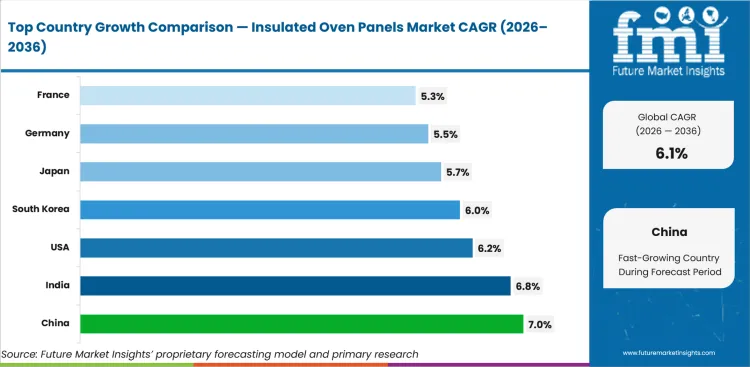
Source: Future Market Insights, 2026.
How do country-level CAGRs compare in the insulated oven panels market?
China and India show above-global growth profiles. The United Kingdom records the most cautious outlook among profiled countries.
- China is forecast to record 7.0% CAGR by 2036 supported by manufacturing scale that gives OEMs a larger oven replacement pool.
- India is projected to reach 6.8% CAGR by 2036 owing to food processing and industrial dryer investment that widens the opportunity base.
- The United States is expected to post 6.2% CAGR by 2036 due to retrofit demand that keeps process-heat efficiency in focus.
- South Korea is likely to reach 6.0% CAGR by 2036 attributable to electronics and automotive qualification needs that shape specification work.
- Japan is estimated at 5.7% CAGR by 2036 supported by precision manufacturing and laboratory oven demand that keeps replacement steady.
- Germany is forecast at 5.5% CAGR by 2036 led by automotive and industrial heating projects that support documented panel selection.
- France is projected at 5.3% CAGR by 2036 driven by food processing and aerospace-linked oven upgrades that sustain replacement demand.
- The United Kingdom is expected to reach 5.1% CAGR by 2036 shaped by retrofit work and maintenance budget discipline that keeps the outlook cautious.
How fast is the insulated oven panels market growing in China?
A 7.0% CAGR through 2036 reflects manufacturing scale and high oven use across automotive and electronics plants.
Country Market Snapshot Table
| Parameter | Value |
|---|---|
| Market Size in 2025 (Value) | USD 327.1 million |
| Market Size in 2026 (Value) | USD 350.0 million |
| Market Forecast in 2036 (Value) | USD 688.5 million |
| CAGR (2026 to 2036) | 7.0% |
| Years Considered | 2021 to 2036 |
| Base Year | 2025 |
| Forecast Period | 2026 to 2036 |
| Units Considered | Value (USD million) |
| Leading Sub-Region | Yangtze River Delta and Pearl River Delta oven corridors |
China Insulated Oven Panels Market Outlook
China’s demand is shaped by domestic oven OEMs and regional fabricators that serve automotive plants and electronics facilities. Buyers move between low-cost fabricated panels and documented thermal systems for export-oriented production.
Local fabrication shortens lead times for standard panels. Global suppliers retain an edge in fire-rated cores and ceramic fiber boards when projects require audited thermal performance.
Key Growth Drivers
- Automotive and electronics oven demand is expected to rise in plants that need curing and drying lines with repeatable thermal control. In January 2026, NBS reported 5.9% value-added growth among industrial enterprises above designated size for 2025. That wider production base gives oven OEMs a practical reason to refresh panels during line upgrades.
- Special-purpose machinery activity gives domestic oven builders a stronger equipment-order setting. NBS reported in January 2026 that special-purpose machinery value added increased 8.2% in December 2025. The gain supports demand for insulated panel sets used in new and redesigned ovens.
- Local oven builders are expected to increase panel volume by sourcing basic fabricated panels near industrial clusters.
- Export-oriented factories are expected to prefer documented cores due to global buyers reviewing fire behavior and repeatability.
Key Restraints
- Price pressure remains a restraint in standard oven builds that compete on thickness and installed cost. NBS reported in January 2026 that industrial enterprise profit grew only 0.6% in 2025. That narrow margin environment can push buyers toward cheaper panels before specialty cores are approved.
- Certification differences can slow oven projects due to overseas customers requiring clearer fire behavior and documentation checks.
- Small fabricators may compete mainly on thickness and price, which limits specialty core uptake in standard oven builds.
What makes China unique
China is distinct because domestic OEM scale and regional fabrication capacity create both volume demand and specification-led demand.
Key Companies
- Luyang Energy-Saving Materials Co., Ltd.
- ROCKWOOL China
- Morgan Thermal Ceramics China
- Knauf Insulation China
- Promat China
- Saint-Gobain China
Sales & Marketing Channels
- Direct OEM supply
- Local panel fabrication
- Industrial equipment distributors
- Automotive project contractors
- Electronics equipment integrators
- Maintenance contractors
Country Segment Breakdown Table
| Segment | Sub-Segments |
|---|---|
| By Core Material | Mineral Wool · Polyurethane / PIR · Vacuum Insulated Panels · Ceramic Fiber / Other |
| By Oven Type | Industrial Ovens · Food Processing Ovens · Laboratory Ovens · Paint / Curing Ovens |
| By Temperature Class | Low Temperature · Medium Temperature · High Temperature |
| By End Use | Food & Beverage · Automotive · Electronics · Industrial Manufacturing |
| By Sales Channel | Direct OEM · Panel Fabricators · Distributors |
| Key Sub-Regions Covered, Manufacturing and automation corridors | Yangtze River Delta and Pearl River Delta oven corridors |
Frequently Asked Questions
How fast is China insulated oven panels market growing?
Sales in China are expected to expand at 7.0% CAGR from 2026 to 2036.
Who leads China insulated oven panels market?
Luyang Energy-Saving Materials works with ROCKWOOL China and Morgan Thermal Ceramics China in local thermal material supply.
What is driving adoption in China insulated oven panels market?
Process-heat control and export documentation are the main adoption drivers in China.
What supports insulated oven panels growth in India?
A 6.8% CAGR through 2036 reflects food processing investment and wider manufacturing activity.
Country Market Snapshot Table
| Parameter | Value |
|---|---|
| Market Size in 2025 (Value) | USD 112.4 million |
| Market Size in 2026 (Value) | USD 120.0 million |
| Market Forecast in 2036 (Value) | USD 231.7 million |
| CAGR (2026 to 2036) | 6.8% |
| Years Considered | 2021 to 2036 |
| Base Year | 2025 |
| Forecast Period | 2026 to 2036 |
| Units Considered | Value (USD million) |
| Leading Sub-Region | Maharashtra, Gujarat, Tamil Nadu, and NCR industrial belts |
India Insulated Oven Panels Market Outlook
India’s insulated oven panel industry is concentrated in food processing and industrial drying lines. Automotive and electronics projects add specification work where downtime risk matters.
Local fabricators serve basic panel work in price-sensitive projects. Global suppliers gain relevance in high-temperature or fire-sensitive ovens that require documentation.
Key Growth Drivers
- New process ovens and retrofit work are expected to benefit from broader factory activity. According to PIB in June 2026, India’s IIP increased 4.9% in April 2026 under the new base series. The industrial gain gives oven-panel suppliers a clearer demand base across processing and drying lines.
- Factory-led demand becomes more relevant when manufacturing output expands beyond one end use. PIB stated in June 2026 that manufacturing output increased 6.2% in April 2026. That figure supports panel replacement across oven fleets used in food, automotive and industrial drying plants.
- Food processing expansion raises demand for bakery and drying oven panels in regional industrial belts.
- Saint-Gobain’s India expansion improves confidence in local insulation supply. In August 2025, the company began work on its fifth mineral wool insulation line in Chennai. The project gives oven-panel buyers a stronger regional supply reference for documented mineral wool assemblies.
Key Restraints
- Premium core uptake remains limited in cost-sensitive projects tied to uneven industrial inputs. PIB reported in June 2026 that mining output declined 5.1% in April 2026. The decline points to a more cautious purchasing setting for higher-cost core materials.
- Local fabrication quality varies across regions and can increase inspection effort for OEMs during panel approval work.
- Buyers may choose thinner panels due to lower upfront cost before lifecycle energy savings are clearly documented.
What makes India unique
India is unique because growth is visible but price discipline keeps supplier payback evidence central to the sale.
Key Companies
- Saint-Gobain India
- Murugappa Morgan Thermal Ceramics
- ROCKWOOL India
- Knauf India
- Promat India
- Alkegen India
Sales & Marketing Channels
- Direct OEM sales
- Local panel fabricators
- Industrial distributors
- Food processing contractors
- Automotive project channels
- Regional insulation dealers
Country Segment Breakdown Table
| Segment | Sub-Segments |
|---|---|
| By Core Material | Mineral Wool · Polyurethane / PIR · Vacuum Insulated Panels · Ceramic Fiber / Other |
| By Oven Type | Industrial Ovens · Food Processing Ovens · Laboratory Ovens · Paint / Curing Ovens |
| By Temperature Class | Low Temperature · Medium Temperature · High Temperature |
| By End Use | Food & Beverage · Automotive · Electronics · Industrial Manufacturing |
| By Sales Channel | Direct OEM · Panel Fabricators · Distributors |
| Key Sub-Regions Covered, Manufacturing and automation corridors | Maharashtra, Gujarat, Tamil Nadu, and NCR industrial belts |
Frequently Asked Questions
How fast is India insulated oven panels market growing?
Sales in India are expected to expand at 6.8% CAGR from 2026 to 2036.
Who leads India insulated oven panels market?
Saint-Gobain India and Murugappa Morgan Thermal Ceramics are visible alongside ROCKWOOL India in local thermal material supply.
What is driving adoption in India insulated oven panels market?
Food processing investment and factory upgrades are the main adoption drivers in India.
What is the insulated oven panels market outlook in the United States?
A 6.2% CAGR through 2036 reflects retrofit demand and food processing oven replacement.
Country Market Snapshot Table
| Parameter | Value |
|---|---|
| Market Size in 2025 (Value) | USD 291.9 million |
| Market Size in 2026 (Value) | USD 310.0 million |
| Market Forecast in 2036 (Value) | USD 565.7 million |
| CAGR (2026 to 2036) | 6.2% |
| Years Considered | 2021 to 2036 |
| Base Year | 2025 |
| Forecast Period | 2026 to 2036 |
| Units Considered | Value (USD million) |
| Leading Sub-Region | Midwest, Southeast, Gulf Coast, and California food corridors |
United States Insulated Oven Panels Market Outlook
Industry in United States is anchored by food processing ovens and industrial drying assets. Plant engineers often replace panels during maintenance windows because chamber rebuilding creates longer downtime.
OEM service channels matter because drawings and safety records must match existing ovens. Distributors remain useful for emergency panels after skin damage or insulation breakdown.
Key Growth Drivers
- Industrial equipment demand gives oven and component suppliers a stronger replacement setting. In May 2026, the USA Census Bureau reported durable goods orders up 7.9% in April 2026. That improvement supports panel upgrades tied to plant equipment budgets.
- Process-heat review keeps enclosure leakage visible during energy audits and maintenance planning. The DOE stated in June 2026 that process heat is the most significant energy-use source in industry. The point is directly relevant to oven panels because better enclosures reduce avoidable heat loss.
- Domestic mineral wool capacity supports fabricated panel supply for regional oven projects. ROCKWOOL approved a USD 100 million-plus Mississippi production line in December 2024. That investment gives buyers a stronger local supply signal for industrial insulation products.
- Food processors use panel replacement to protect baking and drying consistency across long production runs.
Key Restraints
- Electricity planning can complicate retrofit payback for plants that compare heater upgrades with enclosure work. In June 2026, EIA projected USA industrial electricity use at 1,066 billion kWh in 2026. That scale keeps energy-cost review important but can make project timing more cautious.
- Short shutdown windows can delay installation due to panels needing precise fitment in existing oven frames.
- Smaller plants may defer enclosure upgrades until seal damage affects production quality and routine maintenance budgets.
What makes United States unique
The United States is unique due to its retrofit pool and OEM service structure. Documentation often matters more than a low purchase price.
Key Companies
- ROCKWOOL Technical Insulation
- Owens Corning
- Knauf Insulation North America
- Kingspan Insulated Panels
- Morgan Thermal Ceramics
- Alkegen
Sales & Marketing Channels
- Direct OEM sales
- Industrial maintenance contractors
- Panel fabricator networks
- Distributor replacement channels
- Energy-audit retrofit proposals
- Plant engineering firms
Country Segment Breakdown Table
| Segment | Sub-Segments |
|---|---|
| By Core Material | Mineral Wool · Polyurethane / PIR · Vacuum Insulated Panels · Ceramic Fiber / Other |
| By Oven Type | Industrial Ovens · Food Processing Ovens · Laboratory Ovens · Paint / Curing Ovens |
| By Temperature Class | Low Temperature · Medium Temperature · High Temperature |
| By End Use | Food & Beverage · Automotive · Electronics · Industrial Manufacturing |
| By Sales Channel | Direct OEM · Panel Fabricators · Distributors |
| Key Sub-Regions Covered, Manufacturing and automation corridors | Midwest, Southeast, Gulf Coast, and California food corridors |
Frequently Asked Questions
How fast is United States insulated oven panels market growing?
Sales in United States are expected to expand at 6.2% CAGR from 2026 to 2036.
Who leads United States insulated oven panels market?
ROCKWOOL Technical Insulation and Owens Corning are visible alongside Knauf Insulation North America.
What is driving adoption in United States insulated oven panels market?
Retrofit demand and process-heat review are the main adoption drivers in the United States.
How is the insulated oven panels forecast developing in South Korea?
A 6.0% CAGR through 2036 reflects electronics and automotive oven qualification needs.
Country Market Snapshot Table
| Parameter | Value |
|---|---|
| Market Size in 2025 (Value) | USD 70.8 million |
| Market Size in 2026 (Value) | USD 75.0 million |
| Market Forecast in 2036 (Value) | USD 134.3 million |
| CAGR (2026 to 2036) | 6.0% |
| Years Considered | 2021 to 2036 |
| Base Year | 2025 |
| Forecast Period | 2026 to 2036 |
| Units Considered | Value (USD million) |
| Leading Sub-Region | Gyeonggi, Chungcheong, Ulsan, and Busan industrial clusters |
South Korea Insulated Oven Panels Market Outlook
South Korea’s market is shaped by large electronics and semiconductor buyers. Automotive oven programs add another route for qualified panel suppliers.
Replacement orders can be delayed during output softness. Once a core material is qualified, suppliers can defend premium positions across repeat oven programs.
Key Growth Drivers
- Electronics and automotive lines need stable thermal process control during qualified production. Statistics Korea reported in May 2026 that equipment investment increased 8.1% year over year in April 2026. That equipment cycle supports demand for panels that protect oven uniformity.
- Industrial project pipelines help future oven-panel work when new buildings and production areas move forward. In May 2026, Statistics Korea reported construction orders up 39.3% year over year in April 2026. That expansion can create later demand for drying and curing equipment.
- Approved vendor systems reward suppliers that provide thermal data and fire-performance documentation for qualification-led oven projects.
- Automotive curing and drying ovens sustain replacement demand due to scheduled maintenance cycles and coating quality checks.
Key Restraints
- Output volatility can slow discretionary replacement even when qualification needs remain intact. South Korea’s Ministry of Economy and Finance reported in June 2026 that overall industrial production fell 0.6% month on month in April 2026. That setback makes non-urgent panel upgrades easier to postpone.
- Supplier qualification can be slow for new specialty cores in semiconductor-linked ovens due to documentation and contamination concerns.
- Imported ceramic fiber boards can face lead-time pressure during high project activity and specification changes.
What makes South Korea unique
South Korea is unique because concentrated buyers approve materials slowly but order consistently once performance is proven.
Key Companies
- KCC Corporation
- Byucksan Corporation
- Morgan Thermal Ceramics Korea
- ROCKWOOL Asia
- Promat Asia Pacific
- Knauf Insulation
Sales & Marketing Channels
- Approved vendor programs
- OEM engineering channels
- Electronics equipment integrators
- Automotive maintenance contractors
- Technical insulation distributors
- Industrial EPC contractors
Country Segment Breakdown Table
| Segment | Sub-Segments |
|---|---|
| By Core Material | Mineral Wool · Polyurethane / PIR · Vacuum Insulated Panels · Ceramic Fiber / Other |
| By Oven Type | Industrial Ovens · Food Processing Ovens · Laboratory Ovens · Paint / Curing Ovens |
| By Temperature Class | Low Temperature · Medium Temperature · High Temperature |
| By End Use | Food & Beverage · Automotive · Electronics · Industrial Manufacturing |
| By Sales Channel | Direct OEM · Panel Fabricators · Distributors |
| Key Sub-Regions Covered, Manufacturing and automation corridors | Gyeonggi, Chungcheong, Ulsan, and Busan industrial clusters |
Frequently Asked Questions
How fast is South Korea insulated oven panels market growing?
Sales in South Korea are expected to expand at 6.0% CAGR from 2026 to 2036.
Who leads South Korea insulated oven panels market?
KCC Corporation, Byucksan Corporation and Morgan Thermal Ceramics Korea are visible suppliers or locally active thermal material companies.
What is driving adoption in South Korea insulated oven panels market?
Electronics qualification and automotive maintenance are the main adoption drivers in South Korea.
What is shaping insulated oven panels demand in Japan?
A 5.7% CAGR through 2036 reflects precision manufacturing and laboratory oven requirements.
Country Market Snapshot Table
| Parameter | Value |
|---|---|
| Market Size in 2025 (Value) | USD 89.9 million |
| Market Size in 2026 (Value) | USD 95.0 million |
| Market Forecast in 2036 (Value) | USD 165.4 million |
| CAGR (2026 to 2036) | 5.7% |
| Years Considered | 2021 to 2036 |
| Base Year | 2025 |
| Forecast Period | 2026 to 2036 |
| Units Considered | Value (USD million) |
| Leading Sub-Region | Kanto, Chubu, Kansai, and Kyushu manufacturing corridors |
Japan Insulated Oven Panels Market Outlook
Japan’s demand is tied to electronics and laboratory equipment. Food processing and automotive drying lines add steady replacement work.
OEM qualification remains central to procurement. Domestic high-temperature specialists support projects that need ceramic fiber and long service life.
Key Growth Drivers
- Controlled heating equipment remains relevant in Japan’s precision manufacturing base. METI reported in June 2026 that Japan’s production index reached 102.5 in April 2026. That level supports steady replacement demand for oven panels used in testing, drying and process heating.
- High-temperature insulation knowledge supports specialty oven panels in qualified equipment. Isolite states that its refractory ceramic fiber products provide high-temperature stability and thermal shock resistance. That capability fits ovens that need long service life and careful heat-cycle control.
- Electronics production supports compact panel designs that need predictable thermal response and clean chamber performance.
- Laboratory ovens require panel assemblies that maintain chamber stability and clean interiors for controlled testing routines.
Key Restraints
- Material changes face careful review because Japanese buyers protect qualification records for established equipment. METI’s June 2026 revised report showed industrial production rising 0.5% month over month in April 2026. The modest gain supports ongoing activity but does not remove buyer caution around unfamiliar panel cores.
- Long supplier approval cycles slow adoption of unfamiliar panel cores due to documentation reviews in qualified equipment.
- Imported specialty cores can face currency and lead-time pressure in smaller projects with limited procurement flexibility.
What makes Japan unique
Japan is distinct because precision-led oven buying gives domestic thermal material specialists a visible role in panel selection.
Key Companies
- Nichias Corporation
- Isolite Insulating Products Co., Ltd.
- Ibiden Co., Ltd.
- Morgan Thermal Ceramics Japan
- Promat Japan
- Shinagawa Refractories Co., Ltd.
Sales & Marketing Channels
- OEM engineering teams
- Laboratory equipment suppliers
- Electronics equipment integrators
- Technical distributors
- Maintenance service partners
- Industrial furnace suppliers
Country Segment Breakdown Table
| Segment | Sub-Segments |
|---|---|
| By Core Material | Mineral Wool · Polyurethane / PIR · Vacuum Insulated Panels · Ceramic Fiber / Other |
| By Oven Type | Industrial Ovens · Food Processing Ovens · Laboratory Ovens · Paint / Curing Ovens |
| By Temperature Class | Low Temperature · Medium Temperature · High Temperature |
| By End Use | Food & Beverage · Automotive · Electronics · Industrial Manufacturing |
| By Sales Channel | Direct OEM · Panel Fabricators · Distributors |
| Key Sub-Regions Covered, Manufacturing and automation corridors | Kanto, Chubu, Kansai, and Kyushu manufacturing corridors |
Frequently Asked Questions
How fast is Japan insulated oven panels market growing?
Sales in Japan are expected to expand at 5.7% CAGR from 2026 to 2036.
Who leads Japan insulated oven panels market?
Nichias and Isolite are visible alongside Ibiden in local thermal material supply.
What is driving adoption in Japan insulated oven panels market?
Precision manufacturing and laboratory oven qualification are the main adoption drivers in Japan.
How is Germany performing in the insulated oven panels market?
A 5.5% CAGR through 2036 reflects engineering-led procurement and automotive oven requirements.
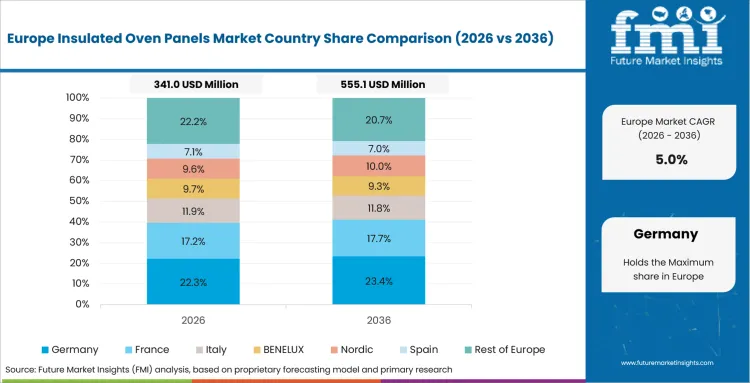
Country Market Snapshot Table
| Parameter | Value |
|---|---|
| Market Size in 2025 (Value) | USD 94.8 million |
| Market Size in 2026 (Value) | USD 100.0 million |
| Market Forecast in 2036 (Value) | USD 170.8 million |
| CAGR (2026 to 2036) | 5.5% |
| Years Considered | 2021 to 2036 |
| Base Year | 2025 |
| Forecast Period | 2026 to 2036 |
| Units Considered | Value (USD million) |
| Leading Sub-Region | Bavaria, Baden-Wuerttemberg, North Rhine-Westphalia, and Saxony |
Germany Insulated Oven Panels Market Outlook
Germany’s demand is tied to automotive paint lines and industrial drying. Electronics and engineered manufacturing add specification-led panel needs.
Replacement often waits for planned maintenance because production continuity matters. Suppliers with local application engineering gain better access than generic insulation sellers.
Key Growth Drivers
- Order backlogs support planned equipment work and make oven maintenance easier to schedule. Destatis reported in June 2026 that manufacturing order stock rose 8.4% year over year in April 2026. That backlog gives panel suppliers a demand setting for documented retrofit packages.
- Local high-temperature insulation assets keep specialty panel expertise close to German oven users. Saint-Gobain stated in June 2026 that HKO operated plants in Oberhausen, Beuren and Leinefelde before divestment. That presence supports German access to severe-duty insulation know-how.
- Automotive coating lines sustain demand for paint and curing oven panels due to repeatable thermal cycle requirements.
- Engineering-led procurement favors suppliers that document thermal ratings and fabrication tolerances before large oven upgrades.
Key Restraints
- Near-term order weakness can delay non-critical oven upgrades in plants with flexible maintenance timing. Destatis reported in June 2026 that new manufacturing orders fell 3.8% month on month in April 2026. That decline can push some panel replacements into later shutdown windows.
- Strict qualification slows new supplier entry into large industrial accounts due to fire behavior and service documentation requirements.
- Energy and labor costs can push oven panel work into maintenance budgets instead of larger capital programs.
What makes Germany unique
Germany is unique because specification discipline links panel choice to safety review and production continuity.
Key Companies
- Knauf Insulation Germany
- ROCKWOOL Germany
- Promat Germany
- Morgan Thermal Ceramics Porextherm GmbH
- HKO Group
- Frenzelit GmbH
Sales & Marketing Channels
- OEM engineering channels
- Automotive plant maintenance teams
- Certified panel fabricators
- Technical insulation distributors
- Industrial safety consultants
- Energy retrofit engineers
Country Segment Breakdown Table
| Segment | Sub-Segments |
|---|---|
| By Core Material | Mineral Wool · Polyurethane / PIR · Vacuum Insulated Panels · Ceramic Fiber / Other |
| By Oven Type | Industrial Ovens · Food Processing Ovens · Laboratory Ovens · Paint / Curing Ovens |
| By Temperature Class | Low Temperature · Medium Temperature · High Temperature |
| By End Use | Food & Beverage · Automotive · Electronics · Industrial Manufacturing |
| By Sales Channel | Direct OEM · Panel Fabricators · Distributors |
| Key Sub-Regions Covered, Manufacturing and automation corridors | Bavaria, Baden-Wuerttemberg, North Rhine-Westphalia, and Saxony |
Frequently Asked Questions
How fast is Germany insulated oven panels market growing?
Sales in Germany are expected to expand at 5.5% CAGR from 2026 to 2036.
Who leads Germany insulated oven panels market?
Knauf Insulation Germany works with ROCKWOOL Germany and Promat Germany in local thermal material supply.
What is driving adoption in Germany insulated oven panels market?
Automotive coating lines and engineering-led procurement are the main adoption drivers in Germany.
What supports insulated oven panel replacement in France?
A 5.3% CAGR through 2036 reflects food processing, aerospace and industrial oven maintenance.
Country Market Snapshot Table
| Parameter | Value |
|---|---|
| Market Size in 2025 (Value) | USD 64.6 million |
| Market Size in 2026 (Value) | USD 68.0 million |
| Market Forecast in 2036 (Value) | USD 114.0 million |
| CAGR (2026 to 2036) | 5.3% |
| Years Considered | 2021 to 2036 |
| Base Year | 2025 |
| Forecast Period | 2026 to 2036 |
| Units Considered | Value (USD million) |
| Leading Sub-Region | Ile-de-France, Auvergne-Rhone-Alpes, Hauts-de-France, and Grand Est |
France Insulated Oven Panels Market Outlook
France combines food processing scale with aerospace and coatings demand. Replacement work is more stable than new equipment volume because buyers protect product consistency and audit readiness.
Distributor and integrator channels are important for specialty cores. Local support improves buyer confidence when panel assemblies affect cleaning, thermal stability or fire behavior.
Key Growth Drivers
- Manufacturing output supports maintenance planning in oven-using plants. INSEE reported in March 2026 that French manufacturing output rebounded 0.6% in January 2026. The rebound gives suppliers a practical signal for replacement panels tied to active production lines.
- Transport equipment activity helps higher-specification oven projects that need curing and drying stability. INSEE stated in March 2026 that transport equipment production rose 9.9% in January 2026. That movement supports demand for panels used in paint, coating and component-treatment ovens.
- Food processors need cleanable panel skins and reliable seals for audit-ready ovens across long production schedules.
- Aerospace and coating applications support higher-specification panel assemblies due to tighter thermal control requirements.
Key Restraints
- Output revisions keep buyers cautious when panel replacement is not safety-critical. INSEE revised January manufacturing growth down by 0.4 points in April 2026. That revision supports a restrained view of discretionary upgrades.
- Smaller processors can delay full panel replacement during uneven output periods due to tighter cash planning.
- Specialty materials may face longer distributor lead times for non-standard dimensions and low-volume retrofit orders.
What makes France unique
France is unique because food processing demand and aerospace-linked oven work create a balanced medium-temperature panel base.
Key Companies
- Saint-Gobain ISOVER
- Promat France
- ROCKWOOL France
- Knauf Insulation France
- Morgan Advanced Materials France
- Deltec
Sales & Marketing Channels
- Equipment integrators
- Food plant maintenance contractors
- Technical insulation distributors
- OEM replacement programs
- Industrial project engineers
- Aerospace supply contractors
Country Segment Breakdown Table
| Segment | Sub-Segments |
|---|---|
| By Core Material | Mineral Wool · Polyurethane / PIR · Vacuum Insulated Panels · Ceramic Fiber / Other |
| By Oven Type | Industrial Ovens · Food Processing Ovens · Laboratory Ovens · Paint / Curing Ovens |
| By Temperature Class | Low Temperature · Medium Temperature · High Temperature |
| By End Use | Food & Beverage · Automotive · Electronics · Industrial Manufacturing |
| By Sales Channel | Direct OEM · Panel Fabricators · Distributors |
| Key Sub-Regions Covered, Manufacturing and automation corridors | Ile-de-France, Auvergne-Rhone-Alpes, Hauts-de-France, and Grand Est |
Frequently Asked Questions
How fast is France insulated oven panels market growing?
Sales in France are expected to expand at 5.3% CAGR from 2026 to 2036.
Who leads France insulated oven panels market?
Saint-Gobain ISOVER works with Promat France and ROCKWOOL France in local thermal material supply.
What is driving adoption in France insulated oven panels market?
Food processing demand and aerospace-linked oven work are the main adoption drivers in France.
How does the United Kingdom compare in the insulated oven panels market?
A 5.1% CAGR through 2036 reflects retrofit discipline and cautious industrial spending.
Country Market Snapshot Table
| Parameter | Value |
|---|---|
| Market Size in 2025 (Value) | USD 66.6 million |
| Market Size in 2026 (Value) | USD 70.0 million |
| Market Forecast in 2036 (Value) | USD 115.1 million |
| CAGR (2026 to 2036) | 5.1% |
| Years Considered | 2021 to 2036 |
| Base Year | 2025 |
| Forecast Period | 2026 to 2036 |
| Units Considered | Value (USD million) |
| Leading Sub-Region | Midlands, North West, Yorkshire, Scotland, and North Wales |
United Kingdom Insulated Oven Panels Market Outlook
The United Kingdom is a retrofit-sensitive market for insulated oven panels. Food and drink buyers often seek heat-loss reductions without changing core process layouts. Laboratory and specialty manufacturing facilities add smaller specification-led projects.
Panel projects are usually routed through OEM service teams and specialist fabricators. Payback discipline keeps buyer focus on downtime and maintenance access.
Key Growth Drivers
- Factory activity supports maintenance demand in oven-using production sites. ONS reported in February 2026 that production output rose 1.2% in Quarter 4 2025 compared with Quarter 3 2025. That recovery gives panel suppliers a clearer base for retrofit conversations.
- Manufacturing output gives oven-panel suppliers a more direct signal than total production alone. ONS reported in February 2026 that manufacturing output rose 0.9% in Quarter 4 2025. That increase supports replacement work tied to food, coating and industrial drying ovens.
- Knauf’s North Wales investment strengthens regional mineral wool confidence for panel buyers. In May 2025, the company confirmed Shotton as the location for its new rock mineral wool insulation plant. The site gives UK suppliers a clearer regional supply story for mineral wool panels.
- Food and drink ovens need cleanable panel assemblies that preserve heat profiles during long production runs.
Key Restraints
- Output volatility can keep capital spending cautious for non-urgent panel replacement. ONS reported in August 2025 that production output fell 1.3% in May 2025 before later recovery. That earlier decline explains why some buyers may wait for scheduled maintenance windows.
- Older oven assets create fitment issues for standardized panel formats during replacement and maintenance work.
- Maintenance budgets can limit adoption of higher-cost vacuum insulated panels when payback remains difficult to prove.
What makes United Kingdom unique
The United Kingdom is unique because retrofit economics must clear short shutdown windows and strict maintenance budgets.
Key Companies
- Knauf Insulation UK
- ROCKWOOL UK
- Promat UK
- Morgan Thermal Ceramics UK
- Kingspan Insulation
- Panel Systems Ltd.
Sales & Marketing Channels
- OEM service contracts
- Facilities management providers
- Mineral wool distributors
- Food plant maintenance teams
- Specialist panel fabricators
- Industrial maintenance contractors
Country Segment Breakdown Table
| Segment | Sub-Segments |
|---|---|
| By Core Material | Mineral Wool · Polyurethane / PIR · Vacuum Insulated Panels · Ceramic Fiber / Other |
| By Oven Type | Industrial Ovens · Food Processing Ovens · Laboratory Ovens · Paint / Curing Ovens |
| By Temperature Class | Low Temperature · Medium Temperature · High Temperature |
| By End Use | Food & Beverage · Automotive · Electronics · Industrial Manufacturing |
| By Sales Channel | Direct OEM · Panel Fabricators · Distributors |
| Key Sub-Regions Covered, Manufacturing and automation corridors | Midlands, North West, Yorkshire, Scotland, and North Wales |
Frequently Asked Questions
How fast is United Kingdom insulated oven panels market growing?
Sales in United Kingdom are expected to expand at 5.1% CAGR from 2026 to 2036.
Who leads United Kingdom insulated oven panels market?
Knauf Insulation UK works with ROCKWOOL UK and Promat UK in local thermal material supply.
What is driving adoption in United Kingdom insulated oven panels market?
Retrofit discipline and food plant maintenance are the main adoption drivers in the United Kingdom.
Who are the leading companies in the insulated oven panels market?
ROCKWOOL, Knauf Insulation, Morgan Advanced Materials, Saint-Gobain, Promat and Alkegen are included alongside regional fabricators and specialist thermal material suppliers.
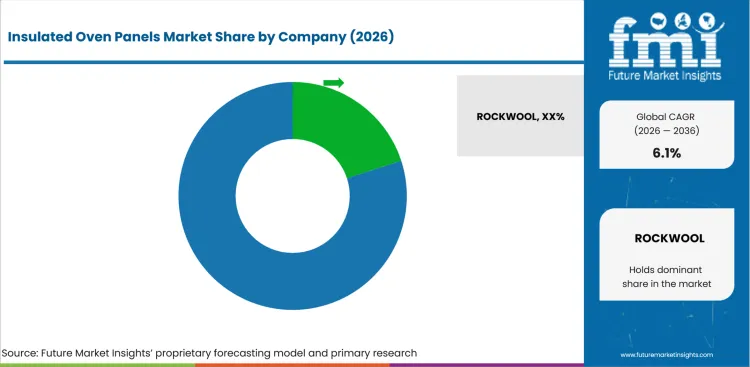
- Competition is based on thermal rating and fire behavior while panel fabrication support and regional service access shape final supplier selection.
- Global insulation companies gain advantage after OEMs ask for documented core performance and reliable supply.
- Specialist thermal material suppliers defend high-temperature applications with ceramic fiber and board portfolios due to severe-duty requirements.
- Regional fabricators compete in standard panels due to buyer value for fitment speed and local replacement access.
The competitive outlook in the market includes global insulation suppliers and thermal ceramics specialists. Regional panel fabricators remain important because ovens often need exact dimensions. Buyers compare performance data and fabrication support before switching materials. Oven OEMs also review adjacent OEM insulation portfolios during panel drawing standardization.
Manufacturing footprint matters for bulky panels and insulation boards. ROCKWOOL’s Mississippi investment and Knauf’s Shotton plan show how producers are improving regional mineral wool access. Similar channel needs appear in industrial pipe insulation projects that require local technical distributors.
Companies with verified mineral wool capacity and ceramic fiber depth are better placed for specification-led ovens. Morgan, Promat and Alkegen have relevance in severe-duty assemblies. Regional fabricators remain necessary for commercial convection ovens and industrial ovens that need dimensions matched to installed equipment.
How do top insulated oven panels market companies compare?
Global material suppliers compare favorably on core technology. Regional fabricators provide faster replacement access.
| Company | Core Material Depth | Oven/Heat Application Fit | OEM and Channel Control | Regional Reach | Geographic Footprint |
|---|---|---|---|---|---|
| ROCKWOOL | Very Strong | Strong | Strong | Very Strong | Global |
| Knauf Insulation | Very Strong | Moderate | Strong | Very Strong | Global |
| Morgan Advanced Materials | Very Strong | Very Strong | Moderate | Strong | Global |
| Saint-Gobain | Strong | Strong | Strong | Very Strong | Global |
| Promat | Strong | Very Strong | Moderate | Strong | Global |
| Alkegen | Very Strong | Very Strong | Moderate | Strong | Global |
| Luyang Energy-Saving Materials | Strong | Very Strong | Moderate | Strong | China and export markets |
| Nichias Corporation | Strong | Strong | Moderate | Strong | Japan and Asia |
| Isolite Insulating Products | Moderate | Very Strong | Moderate | Moderate | Japan |
| Owens Corning | Strong | Moderate | Strong | Strong | United States and global |
Source: Future Market Insights, 2026.
Who are the key players in the insulated oven panels market?
ROCKWOOL and Knauf Insulation are listed with Morgan Advanced Materials and Saint-Gobain. Promat, Alkegen and regional thermal material specialists complete the supplier set.
Key global companies leading the insulated oven panels market include:
- ROCKWOOL
- Knauf Insulation
- Morgan Advanced Materials
- Saint-Gobain
- Promat
- Alkegen
- Owens Corning
- Kingspan
- Luyang Energy-Saving Materials
- Nichias Corporation
Key Developments in Insulated Oven Panels Market
- In December 2024, ROCKWOOL approved a USD 100 million-plus investment in a Mississippi production line for industrial insulation products.
- In May 2025, Knauf Insulation confirmed Shotton in North Wales as the intended site for a new rock mineral wool insulation plant.
- In June 2026, Saint-Gobain divested HKO as a high-temperature industrial insulation textile business with German and French sites.
Key Players in the Insulated Oven Panels Market
Global Insulation Suppliers
- ROCKWOOL
- Knauf Insulation
- Saint-Gobain
- Owens Corning
- Kingspan
High-Temperature Specialists
- Morgan Advanced Materials
- Promat
- Alkegen
- Luyang Energy-Saving Materials
- Nichias Corporation
- Isolite Insulating Products
Regional Fabricators and Channel Companies
- Panel Systems Ltd.
- KCC Corporation
- Byucksan Corporation
- Frenzelit GmbH
- Murugappa Morgan Thermal Ceramics
- Shinagawa Refractories Co., Ltd.
Insulated Oven Panels Market - Report Scope
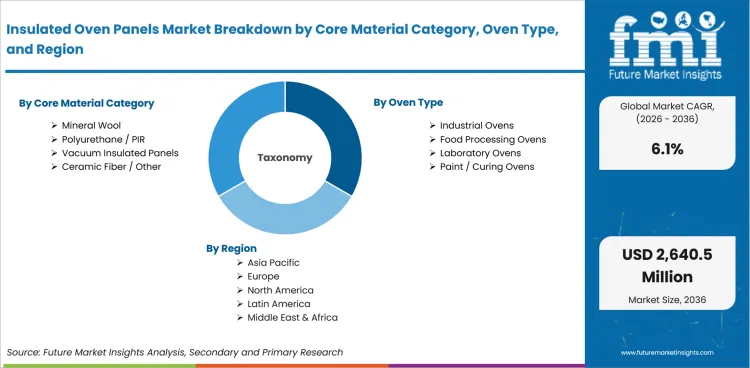
| Parameter | Details |
|---|---|
| Forecast period | 2026 to 2036 |
| Historical period | 2021 to 2025 |
| Quantitative unit | Revenue in USD million |
| By core material | Mineral Wool, Polyurethane / PIR, Vacuum Insulated Panels, Ceramic Fiber / Other |
| By oven type | Industrial Ovens, Food Processing Ovens, Laboratory Ovens, Paint / Curing Ovens |
| By temperature class | Low Temperature, Medium Temperature, High Temperature |
| By end use | Food & Beverage, Automotive, Electronics, Industrial Manufacturing |
| By sales channel | Direct OEM, Panel Fabricators, Distributors |
| Regions covered | North America, Latin America, Western Europe, Eastern Europe, East Asia, South Asia and Pacific, Middle East and Africa |
| Countries covered | United States, United Kingdom, Germany, France, Japan, China, South Korea, India |
| Key companies profiled | ROCKWOOL, Knauf Insulation, Morgan Advanced Materials, Saint-Gobain, Promat, Alkegen, Owens Corning, Kingspan |
| Approach | Bottom-up oven panel value modeling validated by supplier portfolio review and country manufacturing indicators |
Source: Future Market Insights, 2026.
Insulated Oven Panels Market Breakdown by Core Material, Oven Type, Temperature Class, End Use, Sales Channel, and Region
Insulated Oven Panels Market Segmented by Core Material
- Mineral Wool
- Polyurethane / PIR
- Vacuum Insulated Panels
- Ceramic Fiber / Other
Insulated Oven Panels Market Segmented by Oven Type
- Industrial Ovens
- Food Processing Ovens
- Laboratory Ovens
- Paint / Curing Ovens
Insulated Oven Panels Market Segmented by Temperature Class
- Low Temperature
- Medium Temperature
- High Temperature
Insulated Oven Panels Market Segmented by End Use
- Food & Beverage
- Automotive
- Electronics
- Industrial Manufacturing
Insulated Oven Panels Market Segmented by Sales Channel
- Direct OEM
- Panel Fabricators
- Distributors
Insulated Oven Panels Market by Region
- North America
- Latin America
- Western Europe
- Eastern Europe
- East Asia
- South Asia and Pacific
- Middle East and Africa
Research Sources and Bibliography
- Department for Energy Security and Net Zero. (2024, September). Energy Consumption in the UK 2024 methodology document. Government of the United Kingdom.
- Federal Statistical Office. (2026, June 18). Stock of orders in manufacturing in April 2026. Destatis.
- Federal Statistical Office. (2026, June 8). New orders in manufacturing in April 2026. Destatis.
- Isolite Insulating Products Co., Ltd. (2026). Refractory ceramic fiber products. Isolite Insulating Products.
- Knauf Insulation. (2025, May 19). Knauf Insulation announces new low-carbon rock mineral wool insulation plant in Shotton, North Wales. Knauf Insulation.
- Ministry of Economy and Finance. (2026, June 12). Current economic situation, June 2026. Government of South Korea.
- Ministry of Economy, Trade and Industry. (2026, June 12). Indices of Industrial Production, April 2026. Government of Japan.
- Morgan Advanced Materials. (2026). Thermal Products. Morgan Advanced Materials.
- National Bureau of Statistics of China. (2026, January 20). Industrial production operation in December 2025. National Bureau of Statistics of China.
- National Bureau of Statistics of China. (2026, January 28). Profit of industrial enterprises above the designated size in 2025. National Bureau of Statistics of China.
- National Fire Protection Association. (2016, March 31). Oven, furnace, and dryer explosion incidents. National Fire Protection Association.
- National Institute of Statistics and Economic Studies. (2026, March 5). In January 2026, manufacturing output rebounded. INSEE.
- National Institute of Statistics and Economic Studies. (2026, April 3). In February 2026, manufacturing output was stable. INSEE.
- Office for National Statistics. (2026, February 12). Index of Production, UK: December 2025. Office for National Statistics.
- Office for National Statistics. (2025, August 14). Index of Production, UK: June 2025. Office for National Statistics.
- Press Information Bureau. (2026, June 1). Index of Industrial Production records 4.9% growth in April 2026. Government of India.
- ROCKWOOL Group. (2024, December 10). ROCKWOOL to invest in new production line in Mississippi. ROCKWOOL Group.
- Saint-Gobain. (2026, June 1). Saint-Gobain divests HKO, a high-temperature industrial insulation textile business. Saint-Gobain.
- Saint-Gobain India. (2025, August 13). Saint-Gobain begins construction of new float glass and insulation lines in Chennai. Saint-Gobain India.
- Statistics Korea. (2026, May 29). Monthly industrial statistics, April 2026. Ministry of Data and Statistics.
- USA Department of Energy. (2026, January 22). Energy Department announces USD 155.0 million to advance American industrial innovation. USA Department of Energy.
- United Nations Industrial Development Organization. (2026, March 26). World manufacturing production and trade: Quarterly report Q4 2025. UNIDO Statistics Portal.
- USA Census Bureau. (2026, May 28). Monthly advance report on durable goods manufacturers shipments, inventories, and orders: April 2026. USA Census Bureau.
- USA Department of Energy. (2024, May). Pathways analysis summary: Decarbonization potential for industrial subsectors. USA Department of Energy.
- USA Department of Energy. (2026, June). Process heat basics. USA Department of Energy.
- USA Energy Information Administration. (2026, June 9). Short-Term Energy Outlook, June 2026. USA Energy Information Administration.
This bibliography is provided for reader reference and is not exhaustive. The full report contains detailed citations and market model notes.
This Report Answers
- The report estimates 2026 market size and forecasts insulated oven panel demand through 2036.
- The report reviews core material and oven type segmentation before assessing temperature class, end use and sales channel.
- The report evaluates process-heat energy control and fire-rated core selection during retrofit planning.
- The report assesses country-level growth across eight profiled markets.
- The report identifies companies active in mineral wool and ceramic fiber for oven panel supply.
- The report reviews sales channels that include direct OEM supply and regional panel fabricators.
- The report analyzes competitive positioning based on thermal data and local service access.
- The report covers post-2024 developments that influence industrial insulation supply and regional availability.
- The report explains exclusions that separate oven panels from building facade panels and loose insulation materials.
- The report delivers market data and supporting analysis in Word-ready report format.
Frequently Asked Questions
What is the growth prospect for insulated oven panels?
Demand for insulated oven panels is expected to rise steadily as industrial users reduce heat loss and refurbish aging oven enclosures.
Which companies are expected to shape the insulated oven panels market?
ROCKWOOL and Knauf Insulation are expected to shape specification-led competition. Morgan Advanced Materials and Saint-Gobain remain important in specialist thermal materials.
Why are oven OEMs important in insulated oven panel purchasing?
Oven OEMs are important because panel dimensions and core material choices are fixed during chamber design. Safety documentation is usually set at the same stage.
Why does mineral wool lead insulated oven panel demand?
Mineral wool leads demand because it combines non-combustible behavior with practical fabrication and service access in many industrial ovens.
Which oven applications create notable demand?
Industrial drying and food processing applications create recurring demand. Laboratory heating and paint curing add smaller specification-led projects.
How does regulation influence insulated oven panel selection?
Safety standards and insurer review influence core selection by placing more attention on fire behavior and documented service temperature.
Why are vacuum insulated panels used in some ovens?
Vacuum insulated panels are used in compact ovens that need thinner walls and more internal chamber volume.
What limits faster replacement of insulated oven panels?
Higher specialty core costs and fitment complexity limit faster replacement. Short shutdown windows add another constraint in older oven assets.
How do regional companies fit into this market?
Regional companies support fabrication and replacement access. They also give oven buyers local channel service for panels matched to installed equipment.
Preview the report firsthand - request a free sample
Get SampleGet the brochure for pricing and purchase details.
Get PDFTable of Content
- Key Takeaways
- Market Size and CAGR
- Top Growth Driver
- Fastest Growing Segment
- Leading Region
- Key Companies
- Emerging Opportunities
- Executive Summary
- Global Market Outlook
- Demand-side Trends
- Supply-side Trends
- Technology Roadmap Analysis
- Analysis and Recommendations
- Analyst Perspective (What is happening? Why now? What should investors know?)
- Key Questions Answered
- How large is the market?
- What is the CAGR?
- What are key trends?
- Which region dominates?
- Who are the leaders?
- Market Overview
- Market Coverage / Taxonomy
- Market Definition / Scope / Limitations
- Research Methodology
- Chapter Orientation
- Analytical Lens and Working Hypotheses
- Market Structure, Signals, and Trend Drivers
- Benchmarking and Cross-market Comparability
- Market Sizing, Forecasting, and Opportunity Mapping
- Research Design and Evidence Framework
- Desk Research Programme (Secondary Evidence)
- Expert Input and Fieldwork (Primary Evidence)
- Tooling, Models, and Reference Databases
- Data Engineering and Model Build
- Quality Assurance and Audit Trail
- Market Background
- Market Dynamics (Drivers, Restraints, Opportunity, Trends)
- Scenario Forecast (Optimistic, Likely, Conservative)
- Impact Analysis
- AI Impact
- Sustainability Impact
- Regulatory Impact
- Technology Impact
- Consumer / Buyer Analysis
- Purchase Drivers
- Adoption Barriers
- Buyer Journey
- Opportunity Map Analysis
- Product Life Cycle Analysis
- Supply Chain Analysis
- Investment Feasibility Matrix
- Value Chain Analysis
- PESTLE and Porter's Analysis
- Regulatory Landscape
- Regional Parent Market Outlook
- Production and Consumption Statistics
- Import and Export Statistics
- Global Market Analysis and Forecast, 2021 to 2036
- Historical Market Size Value (USD Million) & Volume (Unit) Analysis, 2021 to 2025
- Current and Future Market Size Value (USD Million) & Volume (Unit) Projections, 2026 to 2036
- Y-o-Y Growth Trend Analysis
- Absolute $ Opportunity Analysis
- Global Market Pricing Analysis, 2021 to 2036
- Global Market Analysis and Forecast, By Core Material, 2021 to 2036
- Introduction / Key Findings
- Historical Market Size Value (USD Million) & Volume (Unit) Analysis By Core Material, 2021 to 2025
- Current and Future Market Size Value (USD Million) & Volume (Unit) Analysis and Forecast By Core Material, 2026 to 2036
- Mineral Wool
- Polyurethane / PIR
- Vacuum Insulated Panels
- Ceramic Fiber / Other
- Mineral Wool
- Y-o-Y Growth Trend Analysis By Core Material, 2021 to 2025
- Absolute $ Opportunity Analysis By Core Material, 2026 to 2036
- Global Market Analysis and Forecast, By Oven Type, 2021 to 2036
- Introduction / Key Findings
- Historical Market Size Value (USD Million) & Volume (Unit) Analysis By Oven Type, 2021 to 2025
- Current and Future Market Size Value (USD Million) & Volume (Unit) Analysis and Forecast By Oven Type, 2026 to 2036
- Industrial Ovens
- Food Processing Ovens
- Laboratory Ovens
- Paint / Curing Ovens
- Industrial Ovens
- Y-o-Y Growth Trend Analysis By Oven Type, 2021 to 2025
- Absolute $ Opportunity Analysis By Oven Type, 2026 to 2036
- Global Market Analysis and Forecast, By Temperature Class, 2021 to 2036
- Introduction / Key Findings
- Historical Market Size Value (USD Million) & Volume (Unit) Analysis By Temperature Class, 2021 to 2025
- Current and Future Market Size Value (USD Million) & Volume (Unit) Analysis and Forecast By Temperature Class, 2026 to 2036
- Medium Temperature
- Low Temperature
- High Temperature
- Medium Temperature
- Y-o-Y Growth Trend Analysis By Temperature Class, 2021 to 2025
- Absolute $ Opportunity Analysis By Temperature Class, 2026 to 2036
- Global Market Analysis and Forecast, By End Use, 2021 to 2036
- Introduction / Key Findings
- Historical Market Size Value (USD Million) & Volume (Unit) Analysis By End Use, 2021 to 2025
- Current and Future Market Size Value (USD Million) & Volume (Unit) Analysis and Forecast By End Use, 2026 to 2036
- Food & Beverage
- Automotive
- Electronics
- Industrial Manufacturing
- Food & Beverage
- Y-o-Y Growth Trend Analysis By End Use, 2021 to 2025
- Absolute $ Opportunity Analysis By End Use, 2026 to 2036
- Global Market Analysis and Forecast, By Sales Channel, 2021 to 2036
- Introduction / Key Findings
- Historical Market Size Value (USD Million) & Volume (Unit) Analysis By Sales Channel, 2021 to 2025
- Current and Future Market Size Value (USD Million) & Volume (Unit) Analysis and Forecast By Sales Channel, 2026 to 2036
- Direct OEM
- Panel Fabricators
- Distributors
- Direct OEM
- Y-o-Y Growth Trend Analysis By Sales Channel, 2021 to 2025
- Absolute $ Opportunity Analysis By Sales Channel, 2026 to 2036
- Global Market Analysis and Forecast, By Region, 2021 to 2036
- Introduction
- Historical Market Size Value (USD Million) & Volume (Unit) Analysis By Region, 2021 to 2025
- Current Market Size Value (USD Million) & Volume (Unit) Analysis and Forecast By Region, 2026 to 2036
- North America
- Latin America
- Western Europe
- Eastern Europe
- East Asia
- South Asia and Pacific
- Middle East & Africa
- Market Attractiveness Analysis By Region
- North America Market Analysis and Forecast, By Country, 2021 to 2036
- Historical Market Size Value (USD Million) & Volume (Unit) Trend Analysis By Market Taxonomy, 2021 to 2025
- Market Size Value (USD Million) & Volume (Unit) Forecast By Market Taxonomy, 2026 to 2036
- By Country
- USA
- Canada
- Mexico
- By Core Material
- By Oven Type
- By Temperature Class
- By End Use
- By Sales Channel
- By Country
- Market Attractiveness Analysis
- By Country
- By Core Material
- By Oven Type
- By Temperature Class
- By End Use
- By Sales Channel
- Key Takeaways
- Latin America Market Analysis and Forecast, By Country
- Historical Market Size Value (USD Million) & Volume (Unit) Trend Analysis By Market Taxonomy, 2021 to 2025
- Market Size Value (USD Million) & Volume (Unit) Forecast By Market Taxonomy, 2026 to 2036
- By Country
- Brazil
- Chile
- Rest of Latin America
- By Core Material
- By Oven Type
- By Temperature Class
- By End Use
- By Sales Channel
- By Country
- Market Attractiveness Analysis
- By Country
- By Core Material
- By Oven Type
- By Temperature Class
- By End Use
- By Sales Channel
- Key Takeaways
- Western Europe Market Analysis and Forecast, By Country
- Historical Market Size Value (USD Million) & Volume (Unit) Trend Analysis By Market Taxonomy, 2021 to 2025
- Market Size Value (USD Million) & Volume (Unit) Forecast By Market Taxonomy, 2026 to 2036
- By Country
- Germany
- UK
- Italy
- Spain
- France
- Nordic
- BENELUX
- Rest of Western Europe
- By Core Material
- By Oven Type
- By Temperature Class
- By End Use
- By Sales Channel
- By Country
- Market Attractiveness Analysis
- By Country
- By Core Material
- By Oven Type
- By Temperature Class
- By End Use
- By Sales Channel
- Key Takeaways
- Eastern Europe Market Analysis and Forecast, By Country
- Historical Market Size Value (USD Million) & Volume (Unit) Trend Analysis By Market Taxonomy, 2021 to 2025
- Market Size Value (USD Million) & Volume (Unit) Forecast By Market Taxonomy, 2026 to 2036
- By Country
- Russia
- Poland
- Hungary
- Balkan & Baltic
- Rest of Eastern Europe
- By Core Material
- By Oven Type
- By Temperature Class
- By End Use
- By Sales Channel
- By Country
- Market Attractiveness Analysis
- By Country
- By Core Material
- By Oven Type
- By Temperature Class
- By End Use
- By Sales Channel
- Key Takeaways
- East Asia Market Analysis and Forecast, By Country
- Historical Market Size Value (USD Million) & Volume (Unit) Trend Analysis By Market Taxonomy, 2021 to 2025
- Market Size Value (USD Million) & Volume (Unit) Forecast By Market Taxonomy, 2026 to 2036
- By Country
- China
- Japan
- South Korea
- By Core Material
- By Oven Type
- By Temperature Class
- By End Use
- By Sales Channel
- By Country
- Market Attractiveness Analysis
- By Country
- By Core Material
- By Oven Type
- By Temperature Class
- By End Use
- By Sales Channel
- Key Takeaways
- South Asia and Pacific Market Analysis and Forecast, By Country
- Historical Market Size Value (USD Million) & Volume (Unit) Trend Analysis By Market Taxonomy, 2021 to 2025
- Market Size Value (USD Million) & Volume (Unit) Forecast By Market Taxonomy, 2026 to 2036
- By Country
- India
- ASEAN
- Australia & New Zealand
- Rest of South Asia and Pacific
- By Core Material
- By Oven Type
- By Temperature Class
- By End Use
- By Sales Channel
- By Country
- Market Attractiveness Analysis
- By Country
- By Core Material
- By Oven Type
- By Temperature Class
- By End Use
- By Sales Channel
- Key Takeaways
- Middle East & Africa Market Analysis and Forecast, By Country
- Historical Market Size Value (USD Million) & Volume (Unit) Trend Analysis By Market Taxonomy, 2021 to 2025
- Market Size Value (USD Million) & Volume (Unit) Forecast By Market Taxonomy, 2026 to 2036
- By Country
- Kingdom of Saudi Arabia
- Other GCC Countries
- Türkiye
- South Africa
- Other African Union
- Rest of Middle East & Africa
- By Core Material
- By Oven Type
- By Temperature Class
- By End Use
- By Sales Channel
- By Country
- Market Attractiveness Analysis
- By Country
- By Core Material
- By Oven Type
- By Temperature Class
- By End Use
- By Sales Channel
- Key Takeaways
- Key Countries Market Analysis
- USA
- Pricing Analysis
- Market Share Analysis, 2025
- By Core Material
- By Oven Type
- By Temperature Class
- By End Use
- By Sales Channel
- Canada
- Pricing Analysis
- Market Share Analysis, 2025
- By Core Material
- By Oven Type
- By Temperature Class
- By End Use
- By Sales Channel
- Mexico
- Pricing Analysis
- Market Share Analysis, 2025
- By Core Material
- By Oven Type
- By Temperature Class
- By End Use
- By Sales Channel
- Brazil
- Pricing Analysis
- Market Share Analysis, 2025
- By Core Material
- By Oven Type
- By Temperature Class
- By End Use
- By Sales Channel
- Chile
- Pricing Analysis
- Market Share Analysis, 2025
- By Core Material
- By Oven Type
- By Temperature Class
- By End Use
- By Sales Channel
- Germany
- Pricing Analysis
- Market Share Analysis, 2025
- By Core Material
- By Oven Type
- By Temperature Class
- By End Use
- By Sales Channel
- UK
- Pricing Analysis
- Market Share Analysis, 2025
- By Core Material
- By Oven Type
- By Temperature Class
- By End Use
- By Sales Channel
- Italy
- Pricing Analysis
- Market Share Analysis, 2025
- By Core Material
- By Oven Type
- By Temperature Class
- By End Use
- By Sales Channel
- Spain
- Pricing Analysis
- Market Share Analysis, 2025
- By Core Material
- By Oven Type
- By Temperature Class
- By End Use
- By Sales Channel
- France
- Pricing Analysis
- Market Share Analysis, 2025
- By Core Material
- By Oven Type
- By Temperature Class
- By End Use
- By Sales Channel
- India
- Pricing Analysis
- Market Share Analysis, 2025
- By Core Material
- By Oven Type
- By Temperature Class
- By End Use
- By Sales Channel
- ASEAN
- Pricing Analysis
- Market Share Analysis, 2025
- By Core Material
- By Oven Type
- By Temperature Class
- By End Use
- By Sales Channel
- Australia & New Zealand
- Pricing Analysis
- Market Share Analysis, 2025
- By Core Material
- By Oven Type
- By Temperature Class
- By End Use
- By Sales Channel
- China
- Pricing Analysis
- Market Share Analysis, 2025
- By Core Material
- By Oven Type
- By Temperature Class
- By End Use
- By Sales Channel
- Japan
- Pricing Analysis
- Market Share Analysis, 2025
- By Core Material
- By Oven Type
- By Temperature Class
- By End Use
- By Sales Channel
- South Korea
- Pricing Analysis
- Market Share Analysis, 2025
- By Core Material
- By Oven Type
- By Temperature Class
- By End Use
- By Sales Channel
- Russia
- Pricing Analysis
- Market Share Analysis, 2025
- By Core Material
- By Oven Type
- By Temperature Class
- By End Use
- By Sales Channel
- Poland
- Pricing Analysis
- Market Share Analysis, 2025
- By Core Material
- By Oven Type
- By Temperature Class
- By End Use
- By Sales Channel
- Hungary
- Pricing Analysis
- Market Share Analysis, 2025
- By Core Material
- By Oven Type
- By Temperature Class
- By End Use
- By Sales Channel
- Kingdom of Saudi Arabia
- Pricing Analysis
- Market Share Analysis, 2025
- By Core Material
- By Oven Type
- By Temperature Class
- By End Use
- By Sales Channel
- Türkiye
- Pricing Analysis
- Market Share Analysis, 2025
- By Core Material
- By Oven Type
- By Temperature Class
- By End Use
- By Sales Channel
- South Africa
- Pricing Analysis
- Market Share Analysis, 2025
- By Core Material
- By Oven Type
- By Temperature Class
- By End Use
- By Sales Channel
- USA
- Market Structure Analysis
- Competition Dashboard
- Competition Benchmarking
- Market Share Analysis of Top Players
- By Regional
- By Core Material
- By Oven Type
- By Temperature Class
- By End Use
- By Sales Channel
- Emerging Startups
- Innovation Benchmarking
- Competition Analysis
- Competition Deep Dive
- ROCKWOOL
- Overview
- Product Portfolio
- Profitability by Market Segments (Product/Region/Sales Channel)
- Sales Footprint
- Strategy Overview
- Marketing Strategy
- Product Strategy
- Channel Strategy
- Knauf Insulation
- Morgan Advanced Materials
- Saint-Gobain
- Promat
- Alkegen
- Luyang Energy-Saving Materials
- Nichias Corporation
- Isolite Insulating Products
- Owens Corning
- ROCKWOOL
- Case Studies
- Success Stories
- Recent Developments
- Competition Deep Dive
- Assumptions & Acronyms Used


