

- Market Size (2026)
- USD 538.2 Mn
- Forecast (2036)
- USD 1239.5 Mn
- CAGR (2026 to 2036)
- 8.7%
How big is Deck Ovens Market in 2026?
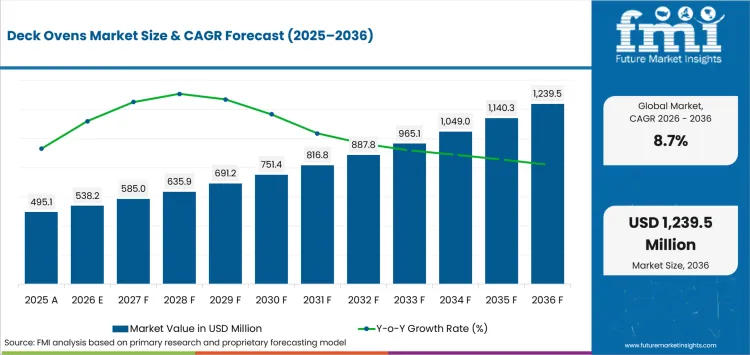
USD 538.2 million in 2026 and USD 1,239.5 million by 2036 at an 8.7% CAGR.
Demand for deck ovens is projected to rise, pushing valuation from USD 538.2 million in 2026 to reach USD 1,239.5 million by 2036 at 8.7% CAGR. Bakery processing equipment budgets increasingly favor recipe repeatability at sustained output. The USA Bureau of Labor Statistics projected about 36,500 baker openings each year from 2025 to 2035 in its August 2026 outlook. Staffing replacement strengthens the case for recipes and synchronized handling that let experienced operators supervise more output.
Replacement timing depends on installed capacity, utilities, and service because shutdown cost can outweigh a nominal efficiency gain. The UK Office for National Statistics placed the 2025 annual output index for bakery and farinaceous-product manufacturing at 98.8, with 2023 set at 100. That stable base can sustain commercial oven modernization without rapid volume expansion. Markets adding food capacity can convert growth into greenfield ovens faster than mature installed bases that depend on replacement economics.
Key Takeaways of Deck Ovens Market
- Bakery investment is concentrating on repeatable thermal control and synchronized handling that reduce manual intervention at sustained production rates.
- In 2026, tunnel - conveyor ovens are expected to lead equipment type with 30.0% share because continuous transfer keeps residence time aligned with line speed.
- 500-2,000 kg/hr systems are projected to hold 40.0% share in 2026 owing to their balance of industrial output, utility load, and product-change flexibility.
- The fully automatic - robotic segment is likely to capture 44.0% share in 2026 attributable to stored recipes and coordinated product movement during baking.
- Capital approval can slow where utility conversion, commissioning downtime, or recipe revalidation weakens the payback from an otherwise efficient replacement.
- Some of the key players in this market include AMF Bakery Systems, Bühler Group, MECATHERM, Reading Bakery Systems, Royal Kaak, Sveba Dahlen, GEA, and MIWE.
Analyst Perspective
"Deck-oven economics are set by usable bake time, recipe changeovers, utility conversion, and the shutdown window available for commissioning. Strong offers pair thermal proof with application trials and local service because energy savings lose value if restart work delays planned line speed."
- Nandini Roy Choudhury, Principal Consultant, Future Market Insights
How is the Deck Ovens Market segmented?
The deck ovens market is segmented by equipment type, capacity, automation level, end user, sales channel, and region.
Equipment type includes tunnel - conveyor, rack, deck, and hybrid & specialty ovens. Capacity spans below 500 kg/hr, 500-2,000 kg/hr, and above 2,000 kg/hr. Automation covers manual, semi-automatic, and fully automatic - robotic systems. End users are industrial, retail, artisan, and foodservice bakeries. Sales channels are direct OEM, dealer or distributor, and aftermarket or refurbished. Regions follow the report taxonomy.
Why does 500-2,000 kg/hr lead the Capacity category?
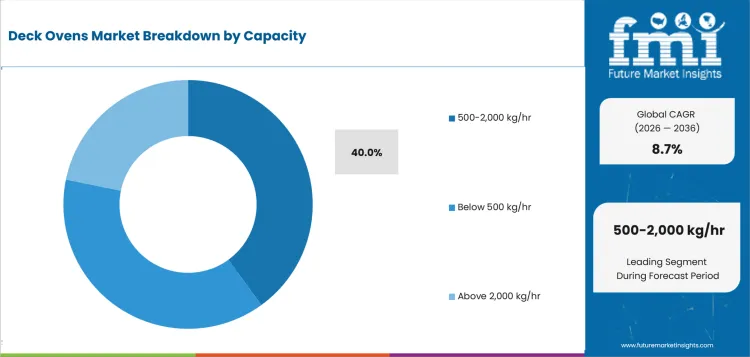
Mid-capacity projects provide industrial output without imposing the utility demand or shutdown exposure of the largest lines. Plants comparing food processing equipment also need room for SKU changes and staged expansion. A wider bakery mixes portfolio raises the value of usable changeover capacity over one peak recipe.
- By capacity, 500-2,000 kg/hr systems are estimated to hold 40.0% in 2026 owing to balanced throughput, site fit, and product-change flexibility.
- Sveba Dahlen stated in May 2025 that its IBIE exhibit would pair the Glimek BL180 bread line with a tunnel-oven mock-up demonstrating gas and electric configurations.
What makes Tunnel - conveyor ovens central to the Equipment type category?
Continuous bakeries synchronize residence time and heat transfer with forming, proofing, cooling, and conveyor systems during long production runs. Separate thermal zones let engineers tune the bake profile without stopping product flow or losing conveyor timing, unlike batch-oriented commercial convection ovens.
- Tunnel - conveyor ovens are set to lead the equipment type category with 30.0% share in 2026 due to continuous transfer on high-utilization lines.
- Reading Bakery Systems introduced the Emithermic XE Oven in May 2025 with centralized heat delivery and radiant panels for continuous cracker baking.
How do Fully automatic - robotic systems lead the Automation level category?
Automation earns approval once a bakery defines which recipe settings, product transfers, alarms, and sanitation records must repeat during long runs. Bakery ingredients systems set upstream dosing conditions. Dough processing systems then need to pass timing and product-flow data into oven controls.
- Based on automation level, fully automatic - robotic systems are projected to account for 44.0% in 2026 due to repeatable settings and synchronized handling.
- South Korea's MFDS amended HACCP rules in August 2025 to extend incentives where Smart HACCP automatically records at least 60% of critical control points.
What supports Industrial bakeries as the leading End user category?
Industrial bakeries run long hours, so thermal drift or sanitation delays affect more units than artisan batches. Frozen bakery programs add proofing, cooling, and maintenance dependencies to the oven decision. Larger bakery products portfolios increase the value of repeatable recipes at sustained line speed.
- By end user, industrial bakeries are forecast to represent 38.0% in 2026 driven by high utilization that raises the cost of thermal drift and downtime.
- The USA Bureau of Labor Statistics recorded 30% of bakers working in bakeries and tortilla manufacturing in 2025, where automated high-volume equipment is common.
What are the drivers, restraints and opportunities in the Deck Ovens Market?
Repeatable throughput raises the case for automation, while utility changes and production interruption slow replacement; heat recovery gives installed ovens a lower-disruption modernization route.
- Driver: Food manufacturers are tying automation spending to repeatable production, quality records, and hygiene control instead of treating the oven as an isolated heater.
- Restraint: Utility changes, product revalidation, and planned shutdowns can extend approval even where a replacement oven reduces energy use.
- Opportunity: Electric, fuel-flexible, and heat-recovery upgrades can modernize installed ovens without requiring a complete bakery-line rebuild.
Connected controls reduce repetitive manual intervention
Food factories get more from automation once oven settings, production data, and hygiene records use the same plant-control path. South Korea's Ministry of SMEs and Startups launched the K-Food Smart Manufacturing Alliance in June 2026 to develop an AI model linking demand, production, quality, and hygiene. Oven controls become easier to justify if recipe and alarm data can enter factory systems without another isolated operator screen.
Utility conversion and validation extend the approval cycle
Fuel conversion adds engineering work before a bakery can release capital, including burner changes, safety review, commissioning, and recipe verification. AMF Den Boer documented an October 2025 retrofit that replaced one tray-oven zone with twelve direct-hydrogen burners for a continuous two-week test. Fuel flexibility therefore depends on a planned shutdown and product revalidation even if the original oven body stays mechanically serviceable.
Heat recovery gives installed ovens another modernization route
Installed bakeries can recover waste heat without committing to a full thermal-section replacement. Sveba Dahlen introduced Exodraft SP80 and BP250 heat-recovery systems in July 2025 for tunnel, rack, and deck ovens using electric, oil, or gas heat. A staged retrofit gives engineering teams a smaller first capital step, but revenue depends on measured savings and a site layout that can accept the recovery equipment.
Which country CAGRs are profiled in the Deck Ovens Market?
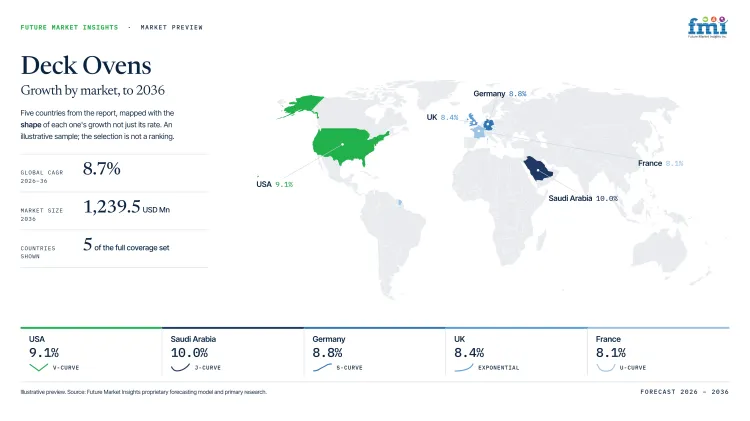
| Country | CAGR |
|---|---|
| Saudi Arabia | 10.0% |
| UAE | 9.7% |
| South Korea | 9.4% |
| USA | 9.1% |
| Germany | 8.8% |
| UK | 8.4% |
| France | 8.1% |
| Japan | 7.8% |
How do country-level CAGRs compare in the Deck Ovens Market?
A 2.2-point spread separates Saudi Arabia at 10.0% CAGR from Japan at 7.8%. Saudi Arabia, the UAE, and South Korea form the upper group as food capacity and automation advance projects. The USA and Germany follow on replacement demand, while the UK, France, and Japan depend more on installed-base renewal.
- Saudi Arabia favors greenfield bakery lines in industrial zones.
- UAE projects reward modular capacity for mixed operating formats.
- South Korea puts connected controls into factory tenders.
- USA replacements turn on labor coverage and uptime.
- Germany requires metered energy proof before retrofit approval.
- UK projects depend on short shutdown windows.
- France rewards service reach beyond bakery centers.
- Japan raises sanitation requirements for automated replacements.
Similar CAGRs can still produce different approval and service conditions. The full report provides country-level CAGR analysis across North America, Latin America, Western Europe, Eastern Europe, East Asia, South Asia and Pacific, and Middle East and Africa.
Country-wise Analysis
- Saudi food manufacturers are adding licensed production and storage capacity, expanding the pool of sites that can specify new thermal equipment. SFDA counted 624 licensed food factories and 5,344 food warehouses in 2025, giving oven companies a visible industrial base for service planning. By 2036, Saudi Arabia is projected to grow at 10.0% CAGR, propelled by new food capacity and industrial-cluster investment. Industrial zones improve project access for greenfield lines, though commissioning teams must handle utility work and seasonal production peaks. Companies with technicians and spare-parts coverage are better placed to protect restart schedules during high-volume periods.
- Central food factories, hospitality kitchens and regional distribution hubs produce different oven schedules in the UAE. The UAE deck ovens outlook is anticipated to advance at 9.7% CAGR over the assessment period, tied to a base of food-industry entrants. In July 2026, the Ministry of Economy and Tourism stated that the UAE Food Cluster had attracted more than 2,000 sector companies within two years. Free-zone access lowers entry friction for equipment companies serving distribution hubs. Mixed factory and foodservice requirements raise application-support costs, so local configuration and rapid service can outweigh the breadth of local inventory for customers.
- Food factories are expanding output while plant managers face quality and hygiene controls during equipment upgrades. Local electronics expertise gives oven controls a strong integration base, but imported platforms still require Korean service coverage. MFDS reported in May 2026 that total food-industry production increased 4.3% in 2025. The production gain gives plants a signal for automation planning in projects. Deck oven demand in South Korea is forecast to rise at 9.4% CAGR over the forecast period, helped by factory automation investment and continuing food output. Documented data interfaces can separate otherwise similar thermal systems during commercial plant qualification.
- Commercial bakeries operate large installed lines in which ovens work beside automated mixing, proofing, conveying, and packaging equipment. Deep field-service coverage is a direct replacement enabler, although shutdowns remain expensive at high-utilization plants. BLS payroll data placed bakery and tortilla manufacturing at about 349,000 employees in April 2026, showing the scale of production that must preserve uptime. Adoption of deck ovens in the USA is estimated to expand at 9.1% CAGR through 2036, because staffing replacement and high utilization raise the value of stable recipes. Recipe trials completed before installation can reduce restart risk at established high-volume plants.
- Bakery engineering teams put operating cost beside bake quality during replacement reviews, especially in mature plants with fixed product schedules. The Germany deck ovens sector is projected to record 8.8% CAGR during the assessment period, given an installed base that must improve efficiency without losing product profiles. Destatis recorded 5,484 food and feed manufacturing establishments with at least 20 employees in 2025, giving oven companies a large industrial customer base. Dense engineering coverage supports retrofit engineering, commissioning, and maintenance planning. Energy measurements and credible shutdown plans remain the qualification burden before a functioning oven is removed from production.
- Bakery projects compete for capital inside a mature manufacturing base, so replacement must prove value without relying on rapid capacity expansion. Experienced engineering contractors make retrofit execution easier, but compressed commissioning windows can delay approvals. In the UK, deck oven demand is predicted to advance at 8.4% CAGR through 2036, on the back of modernization in commercial and retail bakery operations. ONS reported in July 2026 that food manufacturing represented 22.9% of total UK manufacturers' sales in 2025. Local parts stocks reduce the operating risk attached to a short installation window and support replacement planning at established bakery sites.
- France's bakery retail network sustains small and mid-sized oven replacement, while scattered installations raise service costs for manufacturers without broad technician coverage outside major cities. INSEE counted 50,122 bakery-pastry outlets in its 2025 national equipment base, giving oven companies a large but geographically dispersed replacement pool for service planning. France is estimated to post 8.1% CAGR over the forecast period, aided by continuing replacement needs in retail bakeries, production sites, and regional pastry producers. Direct technical coverage or disciplined dealer networks improve access because service distance can outweigh equipment price on smaller projects needing rapid repair during peak trading.
- Food manufacturers face a labor-productivity constraint that keeps automation on the capital agenda, with sanitation rules adding qualification work. Deck oven sales in Japan are forecast to expand at 7.8% CAGR by 2036, owing to labor-saving investment and demand for consistent automated production. Local engineering quality favors advanced controls, but retrofit acceptance can take time in established plants. MAFF set a June 2025 target to lift food-manufacturing labor productivity 24% by fiscal 2029 compared with fiscal 2024. Japanese-language service and recipe transfer determine how quickly productivity targets convert into installed ovens in established production plants with strict acceptance routines.
Who are the notable companies in the Deck Ovens Market?
AMF Bakery Systems, Bühler Group, MECATHERM, Reading Bakery Systems, Royal Kaak, Sveba Dahlen, GEA, and MIWE are the notable companies serving this market.
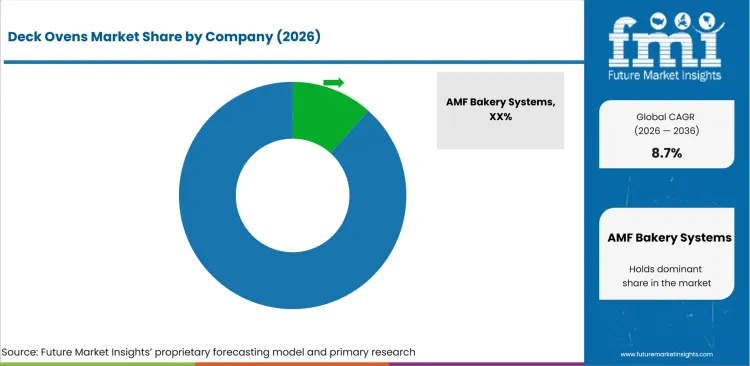
Competition separates by thermal architecture, production scale, and service model. Integrated groups can place ovens inside complete bakery lines, while specialists win narrower projects with deeper application or retrofit support. Entry barriers become visible during qualification because bake trials, utility design, sanitation access, spare-parts response, and commissioning competence determine whether the selected oven can hold planned line speed.
- AMF Bakery Systems, Bühler Group, MECATHERM, and GEA pursue industrial projects where the oven must coordinate with adjacent line equipment.
- Reading Bakery Systems and Royal Kaak focus on continuous bakery systems, modernization work, and complete-line engineering for high-utilization production.
- Sveba Dahlen and MIWE cover a wider mix of artisan, retail, and production ovens where local service influences replacement decisions.
Competitive Benchmarking: Deck Ovens Market
| Company | Thermal Platform Breadth | Line Integration Depth | Lifecycle Support Depth | Geographic Reach |
|---|---|---|---|---|
| AMF Bakery Systems | Medium | High | High | Global |
| Bühler Group | Medium | High | Medium | Global |
| MECATHERM | Medium | High | High | Global |
| Reading Bakery Systems | Medium | High | High | North America, Europe and Middle East |
| Royal Kaak | Medium | High | High | Europe, Africa and international markets |
| Sveba Dahlen | High | High | Medium | Europe, North America and international markets |
| GEA | High | High | High | Global |
| MIWE | High | Medium | High | Europe and North America |
Scoring basis: High thermal breadth requires at least three documented oven or heating architectures. Medium requires two and Low one. High line integration requires complete-line coordination plus connected controls. Medium requires one integration route and Low stand-alone equipment. High lifecycle support requires at least two routes among testing, monitoring, retrofit, training, local service, or spare parts. Medium requires one and Low a narrower path. Geographic reach states evidenced commercial or service coverage and does not imply market share.
Key Developments in the Deck Ovens Market
- In June 2025, AMF Bakery Systems and Puratos launched the Puratos Pilot Bakery - Powered by AMF in New Jersey for commercial-scale product testing and process refinement.
- In May 2025, MECATHERM presented the M-VT vertical oven and related energy-recovery technologies at iba for industrial bakery production lines.
- In May 2025, MIWE established MIWE France to manage local sales, planning, training, technical support, and service directly from the French market.
Key Players in the Deck Ovens Market
Integrated industrial bakery-line platforms
- AMF Bakery Systems
- Bühler Group
- MECATHERM
Continuous baking and line-integration specialists
- Reading Bakery Systems
- Royal Kaak
Multi-format and electric oven platforms
- Sveba Dahlen
- GEA
- MIWE
Deck Ovens Market - Report Scope
| Coverage field | Report scope |
|---|---|
| Market breakdown | By equipment type, capacity, automation level, end user, sales channel and region. |
| Quantitative Units | USD million. |
| Market Definition | Commercial and industrial bakery oven systems used for controlled batch or continuous baking in production, retail, artisan and foodservice bakery environments. |
| Regions Covered | North America, Latin America, Western Europe, Eastern Europe, East Asia, South Asia and Pacific and Middle East and Africa. |
| Countries Covered | Saudi Arabia, UAE, South Korea, USA, Germany, UK, France, Japan, and 20+ countries included in the full report. |
| Key Companies Profiled | AMF Bakery Systems, Bühler Group, MECATHERM, Reading Bakery Systems, Royal Kaak, Sveba Dahlen, GEA, MIWE. |
| Forecast Period | 2026 to 2036. |
| Approach | Primary and secondary research with market triangulation. |
Deck Ovens Market - Research Methodology
| Method | Approach |
|---|---|
| Primary Research | FMI analysts gathered input from manufacturers, service providers, technology developers, distributors, end users, procurement teams, and subject-matter experts. Interviews examined purchasing decisions, product or service evaluation, adoption barriers, approval requirements, pricing considerations, and expectations for technical or commercial support. Respondents were also asked what evidence is required before a trial, pilot, or initial order develops into regular purchasing. |
| Desk Research | Desk research covered government statistics, regulatory publications, trade data, industry associations, technical literature, standards, company filings, product information, and official corporate announcements. Sources were reviewed for relevance, publication date, geographic coverage, and consistency with the defined market scope. Claims relating to performance, applications, approvals, capacity, investment, and commercial activity were retained only when supported by credible public evidence. |
| Market Sizing and Forecasting | The market model combined the baseline value with historical performance, segment structure, pricing and volume indicators, adoption levels, company participation, and country-level demand conditions. Forecast assumptions considered economic activity, investment trends, regulatory developments, technology adoption, purchasing cycles, supply availability, and barriers to wider market use. Segment and regional estimates were reconciled before the final market total was calculated. |
| Data Validation | Estimates were checked against multiple independent indicators, including public data, company activity, trade patterns, industry developments, and findings from primary interviews. Validation also tested whether products, services, applications, and company revenues fell within the defined market boundaries. Adjacent categories, unsupported claims, overlapping revenues, and activities without direct market relevance were excluded to reduce double counting and maintain consistency across segments and countries. |
Deck Ovens Market by Segments
Deck Ovens Market segmented by Equipment Type:
- Tunnel - conveyor ovens
- Rack ovens
- Deck ovens
- Hybrid & specialty ovens
Deck Ovens Market segmented by Capacity:
- 500-2,000 kg/hr
- Below 500 kg/hr
- Above 2,000 kg/hr
Deck Ovens Market segmented by Automation Level:
- Fully automatic - robotic
- Semi-automatic
- Manual
Deck Ovens Market segmented by End User:
- Industrial bakeries
- In-store & retail bakeries
- Artisan bakeries
- Foodservice / QSR central kitchens
Deck Ovens Market segmented by Sales Channel:
- Direct OEM sales
- Dealers & distributors
- Aftermarket & refurbished
Deck Ovens Market by Region:
- North America
- United States
- Canada
- Latin America
- Brazil
- Mexico
- Argentina
- Chile
- Western Europe
- Germany
- France
- United Kingdom
- Italy
- Spain
- Benelux
- Nordics
- Eastern Europe
- Poland
- Czech Republic
- Romania
- Hungary
- East Asia
- China
- Japan
- South Korea
- South Asia and Pacific
- India
- ASEAN
- Australia and New Zealand
- Middle East and Africa
- GCC Countries
- South Africa
- Türkiye
- Israel
Research Sources and Bibliography
- USA Bureau of Labor Statistics. (2026, August 27). Bakers: Occupational Outlook Handbook.
- Office for National Statistics. (2026, August 14). IOP: 10.7: Manufacture of bakery and farinaceous products: CVMSA.
- Reading Bakery Systems. (2025, May 14). Visit RBS at iba 2025 to discover the future of baking.
- Sveba Dahlen. (2025, May 26). Experience Innovation at IBIE.
- Ministry of Food and Drug Safety, Republic of Korea. (2025, August 4). Partial amendment to Food and Livestock Product Safety Management Certification Standards (No. 2025-50).
- Ministry of SMEs and Startups, Republic of Korea. (2026, June 10). Three ministries join forces to launch K-Food Smart Manufacturing Alliance, backing the industry's AI transformation and global push.
- AMF Bakery Systems. (2026, June 30). Next level in hydrogen-fired bread baking with cutting edge design direct hydrogen-fired burners.
- Sveba Dahlen. (2025, July 1). Discover enhanced efficiency with Exodraft SP80 and BP250.
- Ministry of Economy & Tourism, United Arab Emirates. (2026, July 21). UAE Food Cluster organises business forum in Andhra Pradesh to foster new partnerships in food industries, agriculture, supply chains and modern AgriTech.
- USA Bureau of Labor Statistics. (2026, April). Employees on nonfarm payrolls by industry sector and selected industry detail.
- Institut national de la statistique et des études économiques. (2026, August 27). Dossier complet - France.
- Ministry of Agriculture, Forestry and Fisheries, Japan. (2025, June 13). Labor-saving investment promotion plan - food manufacturing industry.
- AMF Bakery Systems. (2025, June 9). AMF and Puratos launch joint pilot bakery facility to accelerate commercial baking innovation.
- MIWE Michael Wenz GmbH. (2025, May 19). MIWE establishes subsidiary in France.
- Bühler Group. (2025). Grains & Food - Annual Report 2025.
- Reading Bakery Systems. (2025, August 1). RBS expands customer care team to strengthen global support.
- WACHTEL ABT GmbH. (2025, February 4). WIESHEU and WACHTEL reorganize sales in Germany.
- WACHTEL ABT GmbH. (2025, May 14). Allround talent for baking quality and energy saving: ATLAS EVO 3.
- WIESHEU GmbH. (2025, May 13). Dibas blue2 PICCOLO C - Two first-class ovens.
- WIESHEU GmbH. (2026, April 24). Atollspeed AS301: The new high-speed oven generation brings together culinary versatility and speed.
- Lesaffre. (2025, December 15). Lesaffre opens new Industrial Baking Center™ in Shanghai.
- Bühler Group. (2026, May 7). Bühler launches innovations and releases major upgrades to its Grains & Food portfolio.
- MECATHERM. (2026, March 19). Driving sustainability into our Demo Center.
- GEA. (2025, May 28). New electric tunnel oven from GEA increases energy efficiency and precision.
- Saudi Food and Drug Authority. (2026, January 26). SFDA Reports 18% Growth in Licensed Factories and Warehouses During 2025.
- Federal Statistical Office of Germany. (2026). Employees and turnover of manufacturing establishments: Germany, years, economic activities (WZ2008), table 42271-0002.
- Office for National Statistics. (2026, July 24). UK manufacturers' sales by product: 2025.
- Ministry of Food and Drug Safety, Republic of Korea. (2026, May 29). 2025 food industry production performance increased 4.3% year on year.
- MECATHERM. (2025, May 18). iba 2025: MECATHERM opens up new horizons with innovations that promote sustainability in the bakery and pastry sector.
- Royal Kaak. (2025, September 18). Kaak Africa has officially started!
- The Middleby Corporation. (2025, October 14). Middleby Food Processing Launches State-of-the-Art Innovation Center in Italy.
- The Middleby Corporation. (2026, July 6). Middleby Completes Spin-off of Midera Food Processing.
- MIWE Michael Wenz GmbH. (n.d.). MIWE certifications - quality and environmental awareness.
- MIWE Michael Wenz GmbH. (2026, February 23). More oven in less space: MIWE presents the new MIWE thermo-static e+.
This Report Answers
- How large is the deck ovens market in 2026 and what value is forecast for 2036?
- Which operating conditions are moving commercial and industrial bakeries toward new ovens or retrofits?
- Why do tunnel - conveyor ovens account for 30.0% of equipment type demand in 2026?
- Why do fully automatic - robotic systems represent 44.0% of automation level demand in 2026?
- How does the 500-2,000 kg/hr capacity band affect bakery line design and utility planning?
- How do country growth rates differ among Saudi Arabia, the UAE, South Korea, the USA, Germany, the UK, France, and Japan?
- Which companies provide integrated ovens, complete bakery lines, retrofit services, or regional support?
- Which utility, shutdown, validation, and service constraints can delay oven investment?
Frequently Asked Questions
How big is the deck ovens market in 2026?
The deck ovens market is valued at USD 538.2 million in 2026 and is projected to reach USD 1,239.5 million by 2036. Growth is tied to bakery automation, repeatable thermal control, and installed-base modernization.
What is the CAGR of the deck ovens market from 2026 to 2036?
The deck ovens market is projected to grow at a CAGR of 8.7% between 2026 and 2036. Expansion is supported by industrial bakery automation, replacement projects, and demand for controllable production at sustained line speeds.
Which equipment type leads the deck ovens market?
The tunnel - conveyor ovens segment is expected to hold 30.0% of the deck ovens market in 2026, driven by continuous transfer and separate thermal zones. The format fits high-utilization lines that require stable residence time.
How much value will the deck ovens market add between 2026 and 2036?
The deck ovens market is expected to add USD 701.3 million between 2026 and 2036. New industrial lines, replacement ovens, and retrofit spending form the main routes to incremental value.
Which companies are active in the deck ovens market?
Key companies operating in the deck ovens market include AMF Bakery Systems, Bühler Group, MECATHERM, Reading Bakery Systems, Royal Kaak, Sveba Dahlen, GEA, and MIWE. Their positions differ by thermal platform, line integration, lifecycle support, and service coverage.
Preview the report firsthand - request a free sample
Get SampleGet the brochure for pricing and purchase details.
Get PDFTable of Content
- Key Takeaways
- Market Size and CAGR
- Top Growth Driver
- Fastest Growing Segment
- Leading Region
- Key Companies
- Emerging Opportunities
- Executive Summary
- Global Market Outlook
- Demand-side Trends
- Supply-side Trends
- Technology Roadmap Analysis
- Analysis and Recommendations
- Analyst Perspective (What is happening? Why now? What should investors know?)
- Key Questions Answered
- How large is the market?
- What is the CAGR?
- What are key trends?
- Which region dominates?
- Who are the leaders?
- Market Overview
- Market Coverage / Taxonomy
- Market Definition / Scope / Limitations
- Research Methodology
- Chapter Orientation
- Analytical Lens and Working Hypotheses
- Market Structure, Signals, and Trend Drivers
- Benchmarking and Cross-market Comparability
- Market Sizing, Forecasting, and Opportunity Mapping
- Research Design and Evidence Framework
- Desk Research Programme (Secondary Evidence)
- Expert Input and Fieldwork (Primary Evidence)
- Tooling, Models, and Reference Databases
- Data Engineering and Model Build
- Quality Assurance and Audit Trail
- Market Background
- Market Dynamics (Drivers, Restraints, Opportunity, Trends)
- Scenario Forecast (Optimistic, Likely, Conservative)
- Impact Analysis
- AI Impact
- Sustainability Impact
- Regulatory Impact
- Technology Impact
- Consumer / Buyer Analysis
- Purchase Drivers
- Adoption Barriers
- Buyer Journey
- Opportunity Map Analysis
- Product Life Cycle Analysis
- Supply Chain Analysis
- Investment Feasibility Matrix
- Value Chain Analysis
- PESTLE and Porter's Analysis
- Regulatory Landscape
- Regional Parent Market Outlook
- Production and Consumption Statistics
- Import and Export Statistics
- Global Market Analysis and Forecast, 2021 to 2036
- Historical Market Size Value (USD Million) Analysis, 2021 to 2025
- Current and Future Market Size Value (USD Million) Projections, 2026 to 2036
- Y-o-Y Growth Trend Analysis
- Absolute $ Opportunity Analysis
- Global Market Pricing Analysis, 2021 to 2036
- Global Market Analysis and Forecast, By Equipment Type, 2021 to 2036
- Introduction / Key Findings
- Historical Market Size Value (USD Million) Analysis By Equipment Type, 2021 to 2025
- Current and Future Market Size Value (USD Million) Analysis and Forecast By Equipment Type, 2026 to 2036
- Tunnel / conveyor ovens
- Rack ovens
- Deck ovens
- Hybrid & specialty ovens
- Tunnel / conveyor ovens
- Y-o-Y Growth Trend Analysis By Equipment Type, 2021 to 2025
- Absolute $ Opportunity Analysis By Equipment Type, 2026 to 2036
- Global Market Analysis and Forecast, By Capacity, 2021 to 2036
- Introduction / Key Findings
- Historical Market Size Value (USD Million) Analysis By Capacity, 2021 to 2025
- Current and Future Market Size Value (USD Million) Analysis and Forecast By Capacity, 2026 to 2036
- 500-2,000 kg/hr
- Below 500 kg/hr
- Above 2,000 kg/hr
- 500-2,000 kg/hr
- Y-o-Y Growth Trend Analysis By Capacity, 2021 to 2025
- Absolute $ Opportunity Analysis By Capacity, 2026 to 2036
- Global Market Analysis and Forecast, By Automation Level, 2021 to 2036
- Introduction / Key Findings
- Historical Market Size Value (USD Million) Analysis By Automation Level, 2021 to 2025
- Current and Future Market Size Value (USD Million) Analysis and Forecast By Automation Level, 2026 to 2036
- Fully automatic / robotic
- Semi-automatic
- Manual
- Fully automatic / robotic
- Y-o-Y Growth Trend Analysis By Automation Level, 2021 to 2025
- Absolute $ Opportunity Analysis By Automation Level, 2026 to 2036
- Global Market Analysis and Forecast, By End User, 2021 to 2036
- Introduction / Key Findings
- Historical Market Size Value (USD Million) Analysis By End User, 2021 to 2025
- Current and Future Market Size Value (USD Million) Analysis and Forecast By End User, 2026 to 2036
- Industrial bakeries
- In-store & retail bakeries
- Artisan bakeries
- Foodservice / QSR central kitchens
- Industrial bakeries
- Y-o-Y Growth Trend Analysis By End User, 2021 to 2025
- Absolute $ Opportunity Analysis By End User, 2026 to 2036
- Global Market Analysis and Forecast, By Sales Channel, 2021 to 2036
- Introduction / Key Findings
- Historical Market Size Value (USD Million) Analysis By Sales Channel, 2021 to 2025
- Current and Future Market Size Value (USD Million) Analysis and Forecast By Sales Channel, 2026 to 2036
- Direct OEM sales
- Dealers & distributors
- Aftermarket & refurbished
- Direct OEM sales
- Y-o-Y Growth Trend Analysis By Sales Channel, 2021 to 2025
- Absolute $ Opportunity Analysis By Sales Channel, 2026 to 2036
- Global Market Analysis and Forecast, By Region, 2021 to 2036
- Introduction
- Historical Market Size Value (USD Million) Analysis By Region, 2021 to 2025
- Current Market Size Value (USD Million) Analysis and Forecast By Region, 2026 to 2036
- North America
- Latin America
- Western Europe
- Eastern Europe
- East Asia
- South Asia and Pacific
- Middle East & Africa
- Market Attractiveness Analysis By Region
- North America Market Analysis and Forecast, By Country, 2021 to 2036
- Historical Market Size Value (USD Million) Trend Analysis By Market Taxonomy, 2021 to 2025
- Market Size Value (USD Million) Forecast By Market Taxonomy, 2026 to 2036
- By Country
- USA
- Canada
- By Equipment Type
- By Capacity
- By Automation Level
- By End User
- By Sales Channel
- By Country
- Market Attractiveness Analysis
- By Country
- By Equipment Type
- By Capacity
- By Automation Level
- By End User
- By Sales Channel
- Key Takeaways
- Latin America Market Analysis and Forecast, By Country
- Historical Market Size Value (USD Million) Trend Analysis By Market Taxonomy, 2021 to 2025
- Market Size Value (USD Million) Forecast By Market Taxonomy, 2026 to 2036
- By Country
- Brazil
- Mexico
- Chile
- Rest of Latin America
- By Equipment Type
- By Capacity
- By Automation Level
- By End User
- By Sales Channel
- By Country
- Market Attractiveness Analysis
- By Country
- By Equipment Type
- By Capacity
- By Automation Level
- By End User
- By Sales Channel
- Key Takeaways
- Western Europe Market Analysis and Forecast, By Country
- Historical Market Size Value (USD Million) Trend Analysis By Market Taxonomy, 2021 to 2025
- Market Size Value (USD Million) Forecast By Market Taxonomy, 2026 to 2036
- By Country
- Germany
- UK
- Italy
- Spain
- France
- Nordic
- BENELUX
- Rest of Western Europe
- By Equipment Type
- By Capacity
- By Automation Level
- By End User
- By Sales Channel
- By Country
- Market Attractiveness Analysis
- By Country
- By Equipment Type
- By Capacity
- By Automation Level
- By End User
- By Sales Channel
- Key Takeaways
- Eastern Europe Market Analysis and Forecast, By Country
- Historical Market Size Value (USD Million) Trend Analysis By Market Taxonomy, 2021 to 2025
- Market Size Value (USD Million) Forecast By Market Taxonomy, 2026 to 2036
- By Country
- Russia
- Poland
- Hungary
- Balkan & Baltic
- Rest of Eastern Europe
- By Equipment Type
- By Capacity
- By Automation Level
- By End User
- By Sales Channel
- By Country
- Market Attractiveness Analysis
- By Country
- By Equipment Type
- By Capacity
- By Automation Level
- By End User
- By Sales Channel
- Key Takeaways
- East Asia Market Analysis and Forecast, By Country
- Historical Market Size Value (USD Million) Trend Analysis By Market Taxonomy, 2021 to 2025
- Market Size Value (USD Million) Forecast By Market Taxonomy, 2026 to 2036
- By Country
- China
- Japan
- South Korea
- By Equipment Type
- By Capacity
- By Automation Level
- By End User
- By Sales Channel
- By Country
- Market Attractiveness Analysis
- By Country
- By Equipment Type
- By Capacity
- By Automation Level
- By End User
- By Sales Channel
- Key Takeaways
- South Asia and Pacific Market Analysis and Forecast, By Country
- Historical Market Size Value (USD Million) Trend Analysis By Market Taxonomy, 2021 to 2025
- Market Size Value (USD Million) Forecast By Market Taxonomy, 2026 to 2036
- By Country
- India
- ASEAN
- Australia & New Zealand
- Rest of South Asia and Pacific
- By Equipment Type
- By Capacity
- By Automation Level
- By End User
- By Sales Channel
- By Country
- Market Attractiveness Analysis
- By Country
- By Equipment Type
- By Capacity
- By Automation Level
- By End User
- By Sales Channel
- Key Takeaways
- Middle East & Africa Market Analysis and Forecast, By Country
- Historical Market Size Value (USD Million) Trend Analysis By Market Taxonomy, 2021 to 2025
- Market Size Value (USD Million) Forecast By Market Taxonomy, 2026 to 2036
- By Country
- Kingdom of Saudi Arabia
- Other GCC Countries
- Türkiye
- South Africa
- Other African Union
- Rest of Middle East & Africa
- By Equipment Type
- By Capacity
- By Automation Level
- By End User
- By Sales Channel
- By Country
- Market Attractiveness Analysis
- By Country
- By Equipment Type
- By Capacity
- By Automation Level
- By End User
- By Sales Channel
- Key Takeaways
- Key Countries Market Analysis
- USA
- Pricing Analysis
- Market Share Analysis, 2025
- By Equipment Type
- By Capacity
- By Automation Level
- By End User
- By Sales Channel
- Canada
- Pricing Analysis
- Market Share Analysis, 2025
- By Equipment Type
- By Capacity
- By Automation Level
- By End User
- By Sales Channel
- Mexico
- Pricing Analysis
- Market Share Analysis, 2025
- By Equipment Type
- By Capacity
- By Automation Level
- By End User
- By Sales Channel
- Brazil
- Pricing Analysis
- Market Share Analysis, 2025
- By Equipment Type
- By Capacity
- By Automation Level
- By End User
- By Sales Channel
- Chile
- Pricing Analysis
- Market Share Analysis, 2025
- By Equipment Type
- By Capacity
- By Automation Level
- By End User
- By Sales Channel
- Germany
- Pricing Analysis
- Market Share Analysis, 2025
- By Equipment Type
- By Capacity
- By Automation Level
- By End User
- By Sales Channel
- UK
- Pricing Analysis
- Market Share Analysis, 2025
- By Equipment Type
- By Capacity
- By Automation Level
- By End User
- By Sales Channel
- Italy
- Pricing Analysis
- Market Share Analysis, 2025
- By Equipment Type
- By Capacity
- By Automation Level
- By End User
- By Sales Channel
- Spain
- Pricing Analysis
- Market Share Analysis, 2025
- By Equipment Type
- By Capacity
- By Automation Level
- By End User
- By Sales Channel
- France
- Pricing Analysis
- Market Share Analysis, 2025
- By Equipment Type
- By Capacity
- By Automation Level
- By End User
- By Sales Channel
- India
- Pricing Analysis
- Market Share Analysis, 2025
- By Equipment Type
- By Capacity
- By Automation Level
- By End User
- By Sales Channel
- ASEAN
- Pricing Analysis
- Market Share Analysis, 2025
- By Equipment Type
- By Capacity
- By Automation Level
- By End User
- By Sales Channel
- Australia & New Zealand
- Pricing Analysis
- Market Share Analysis, 2025
- By Equipment Type
- By Capacity
- By Automation Level
- By End User
- By Sales Channel
- China
- Pricing Analysis
- Market Share Analysis, 2025
- By Equipment Type
- By Capacity
- By Automation Level
- By End User
- By Sales Channel
- Japan
- Pricing Analysis
- Market Share Analysis, 2025
- By Equipment Type
- By Capacity
- By Automation Level
- By End User
- By Sales Channel
- South Korea
- Pricing Analysis
- Market Share Analysis, 2025
- By Equipment Type
- By Capacity
- By Automation Level
- By End User
- By Sales Channel
- Russia
- Pricing Analysis
- Market Share Analysis, 2025
- By Equipment Type
- By Capacity
- By Automation Level
- By End User
- By Sales Channel
- Poland
- Pricing Analysis
- Market Share Analysis, 2025
- By Equipment Type
- By Capacity
- By Automation Level
- By End User
- By Sales Channel
- Hungary
- Pricing Analysis
- Market Share Analysis, 2025
- By Equipment Type
- By Capacity
- By Automation Level
- By End User
- By Sales Channel
- Kingdom of Saudi Arabia
- Pricing Analysis
- Market Share Analysis, 2025
- By Equipment Type
- By Capacity
- By Automation Level
- By End User
- By Sales Channel
- Türkiye
- Pricing Analysis
- Market Share Analysis, 2025
- By Equipment Type
- By Capacity
- By Automation Level
- By End User
- By Sales Channel
- South Africa
- Pricing Analysis
- Market Share Analysis, 2025
- By Equipment Type
- By Capacity
- By Automation Level
- By End User
- By Sales Channel
- USA
- Market Structure Analysis
- Competition Dashboard
- Competition Benchmarking
- Market Share Analysis of Top Players
- By Regional
- By Equipment Type
- By Capacity
- By Automation Level
- By End User
- By Sales Channel
- Emerging Startups
- Innovation Benchmarking
- Competition Analysis
- Competition Deep Dive
- AMF Bakery Systems
- Overview
- Product Portfolio
- Profitability by Market Segments
- Sales Footprint
- Strategy Overview
- Marketing Strategy
- Product Strategy
- Channel Strategy
- Buhler Group
- Baker Perkins
- Rademaker
- FRITSCH Group
- Rheon Automatic Machinery
- Mecatherm
- Middleby
- Reading Bakery Systems
- Kaak Group
- AMF Bakery Systems
- Case Studies
- Success Stories
- Recent Developments
- Competition Deep Dive
- Assumptions & Acronyms Used


