

- Industry Size (2025)
- USD 13.8 Mn
- Forecast (2035)
- USD 23.3 Mn
- CAGR (2025 to 2035)
- 5.4%
Demand for Automatic Identification System in Japan 2025 to 2035
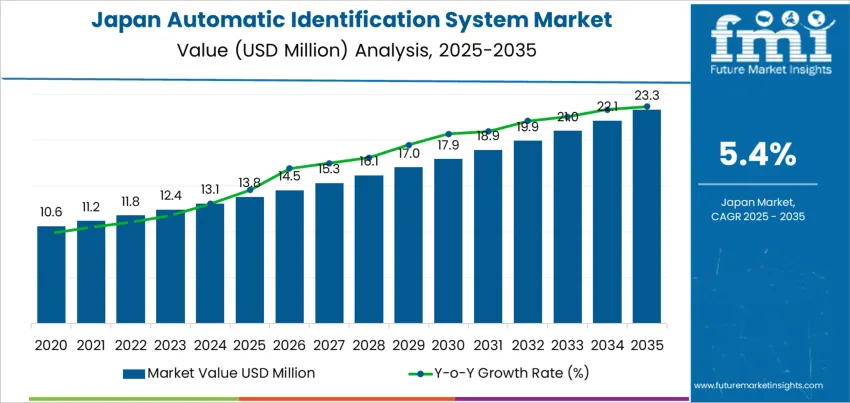
The Japan automatic identification system demand is valued at USD 13.8 million in 2025 and is forecasted to reach USD 23.3 million by 2035, reflecting a CAGR of 5.4%. Growth is shaped by the requirement for improved maritime navigation safety, compliance with vessel-tracking regulations, and increased coastal monitoring efficiency. Adoption strengthens as ports, fisheries, and maritime-security agencies reinforce digital oversight and collision-avoidance measures in congested waterways. Vessel-based AIS systems lead adoption. These units enable continuous transmission of vessel identity, heading, and operational status, supporting safe passage and incident prevention. Demand also gains from upgrades to legacy AIS equipment and integration with radar, electronic chart displays systems, and satellite-supported surveillance.
Kyushu & Okinawa, Kanto, and Kinki record the highest utilization due to significant shipping routes, dense port activities, and strong investments in maritime infrastructure. These areas maintain large fleets engaged in freight logistics, passenger transport, coastal fishing, and offshore operations. Key suppliers include Furuno Electric Co., Ltd.; Japan Radio Co., Ltd. (JRC); ComNav (Japan); Saab AB (Japan); and Garmin (Japan). Their systems support vessel-based tracking, enhanced situational awareness, and communication accuracy across commercial fleets and coastal transport networks.
Quick Stats for Japan Automatic Identification System Demand
- Japan Automatic Identification System Sales Value (2025): USD 13.8 million
- Japan Automatic Identification System Forecast Value (2035): USD 23.3 million
- Japan Automatic Identification System Forecast CAGR (2025–2035): 5.4%
- Leading Category in Japan Automatic Identification System Demand: Vessel-Based AIS
- Key Growth Regions in Japan Automatic Identification System Demand: Kyushu & Okinawa, Kanto, Kinki
- Top Players in Japan Automatic Identification System Demand: Furuno Electric Co., Ltd., Japan Radio Co., Ltd. (JRC), ComNav (Japan), Saab AB (Japan), Garmin (Japan)
What is the Growth Forecast for Automatic Identification System Industry in Japan through 2035?
Demand for Automatic Identification Systems in Japan shows a stronger growth pace in the later years of the forecast period. Early growth is guided by compliance-based deployments across commercial shipping fleets and designated coastal-monitoring zones. Installations support maritime safety tracking, collision-avoidance functions, and harbor-traffic coordination. The baseline expansion remains modest in the initial years due to the already well-equipped status of major ports and large vessels.
The second half of the decade reflects a broader installation footprint. Growth is supported by expanded monitoring policies for small and mid-size vessels, greater data-integration requirements for maritime logistics, and upgraded shore-based tracking systems. Digital modernization of Japan’s maritime infrastructure contributes to higher annual increments as data accuracy and situational-awareness improvements drive replacement demand. As a result, the later period contributes a larger share to cumulative gains, with adoption shifting from regulatory minimums to enhanced operational visibility. The comparison indicates a transition from steady foundational expansion to more technology-driven deployments as integration with navigation analytics and fleet-management systems becomes standardized.
Japan Automatic Identification System Key Takeaways
| Metric | Value |
|---|---|
| Japan Automatic Identification System Sales Value (2025) | USD 13.8 million |
| Japan Automatic Identification System Forecast Value (2035) | USD 23.3 million |
| Japan Automatic Identification System Forecast CAGR (2025-2035) | 5.4% |
Why is the Demand for Automatic Identification Systems in Japan Growing?
Demand for automatic identification systems in Japan is increasing because maritime operators, port authorities and coastal surveillance units require accurate vessel tracking to support navigation safety. Japan has busy shipping routes for commercial cargo, fishing fleets and passenger transport, which drives adoption of AIS transceivers and monitoring software that provide continuous vessel identification, heading and speed information. Ports and harbor administrations use AIS data to improve traffic coordination, detect congestion and manage docking schedules more efficiently. Offshore infrastructure, including energy facilities and undersea communication lines, relies on AIS monitoring to prevent vessel collisions in restricted zones.
Coast Guard and security agencies integrate AIS with radar and satellite data to support search and rescue and early response to unauthorized vessel entry. Fishing cooperatives also rely on AIS to demonstrate compliance with maritime rules and maintain transparency in catch operations. Constraints include high equipment cost for small fishing boats, limited digital skills in older fleets and patchy signal quality in areas with complex coastlines. Some vessels avoid AIS transmission due to privacy concerns or maintenance issues, which creates gaps that authorities must address through additional monitoring systems.
Which Categories and Applications Lead Demand for Automatic Identification Systems in Japan?
Demand for Automatic Identification Systems (AIS) in Japan is supported by maritime traffic density, coastal surveillance requirements, and international compliance with navigational safety standards. The technology strengthens collision avoidance, real-time vessel monitoring, and port-management efficiency across Japan’s extensive commercial shipping and fishing sectors. Government initiatives reinforce continuous tracking to protect territorial waters and ensure secure trade passage. Adoption aligns with the modernization of maritime logistics, automation in fleet coordination, and risk mitigation for high-value cargo routes. Integration with satellite AIS and enhanced communication systems supports data reliability under varying maritime conditions.
By Category, Vessel-Based AIS Leads
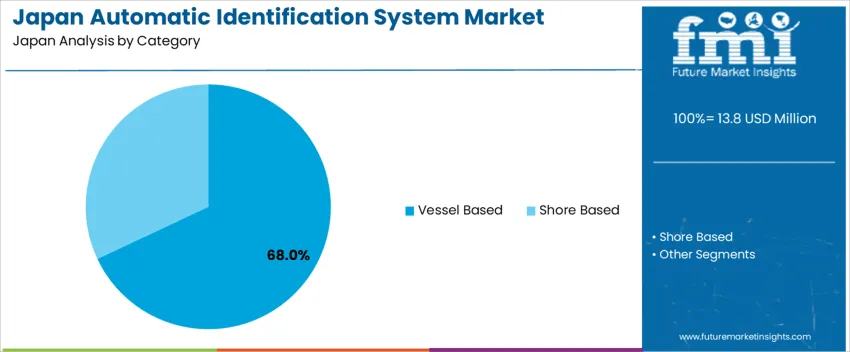
Vessel-based systems account for 68.0%, driven by regulatory enforcement for commercial ships, passenger ferries, and large fishing vessels navigating domestic and international waters. These systems transmit dynamic and static positioning data to prevent collisions and improve route planning. Shore-based systems hold 32.0%, supporting coastal monitoring, port-operations control, and maritime domain awareness. Port authorities and coastal security agencies rely on land-based infrastructure to detect non-compliant vessel activity. Category adoption reflects vessel-level responsibility for identification and communication, supported by national oversight enhancing situational awareness across busy Japanese waterways.
Key points:
- Vessel-installed units dominate due to regulatory mandates.
- Shore stations strengthen coastal security and operational coordination.
- Visibility and tracking reliability drive compliance.
By Application, Vessel Tracking Represents the Largest Share
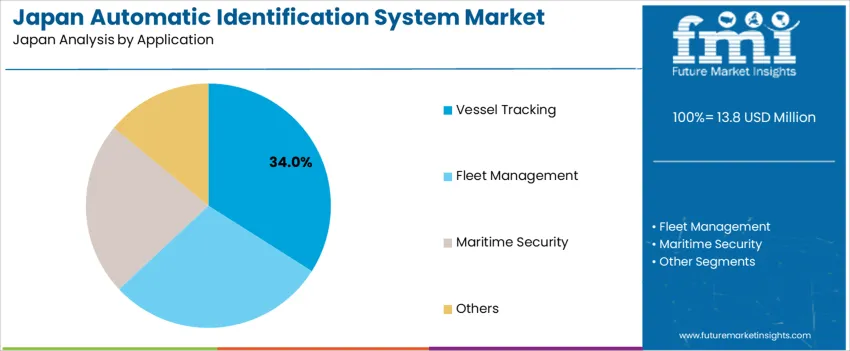
Vessel tracking accounts for 34.0%, ensuring safe navigation and optimized movement across trade lanes. Fleet management holds 29.0%, supporting fuel-efficiency monitoring and operational scheduling for commercial operators. Maritime security represents 23.0%, used to identify suspicious activity and enforce protective surveillance. Other applications hold 14.0%, involving search-and-rescue coordination and environmental monitoring. Application trends highlight AIS as a core element in Japan’s maritime governance strategy, enhancing operational efficiency and safety standards within regional and global shipping routes.
Key points:
- Tracking solutions support trade-route safety and compliance.
- Fleet management improves logistics performance.
- Security applications protect national waters and shipping assets.
What are the Drivers, Restraints, and Key Trends of the Demand for Automatic Identification Systems in Japan?
Growth of maritime traffic monitoring, expansion of coastal safety enforcement and increased use of AIS in port logistics are driving demand.
In Japan, AIS demand is shaped by the dense concentration of commercial shipping around major ports such as Tokyo Bay, Osaka Bay and Nagoya, where continuous vessel tracking is required for traffic management and collision prevention. The Japan Coast Guard uses AIS data to strengthen maritime patrol operations, particularly around territorial boundaries and busy fisheries in Hokkaido and Kyushu. Port logistics operators adopt AIS-integrated navigation tools to optimize berthing schedules and reduce congestion during container handling. Coastal ferry networks serving remote islands rely on AIS to maintain safe routing in narrow channels and weather-affected waters. These operational requirements support consistent procurement of AIS transponders and monitoring infrastructure nationwide.
Aging vessel fleets, limited digital capabilities in small fishing boats and cost sensitivity among regional operators restrain adoption.
Many small fishing boats and older domestic cargo vessels continue operating with dated navigation systems, making AIS upgrades slower without targeted support programs. Smaller operators in rural prefectures prioritize engine and hull maintenance over electronic modernization, limiting uptake despite safety benefits. Initial installation cost and training requirements create hesitation for boat owners with low seasonal income variance, especially in local fisheries. These financial and technology gaps contribute to uneven adoption across vessel categories.
Shift toward Class B AIS upgrades, increased integration with coastal radar networks and rising demand for data analytics in port operations define key trends.
Fishing cooperatives and community-based maritime associations are encouraging upgrades to Class B AIS units to improve vessel visibility in shared fishing zones. Port authorities strengthen situational awareness by integrating AIS feeds with radar and weather systems to support route optimization and incident response. Logistics operators are adopting AIS-based analytics to track turnaround time, fuel consumption and waiting periods, contributing to data-driven efficiency improvements. Research groups working on autonomous shipping trials also rely on AIS for communication between crewed and remotely operated vessels. These trends indicate steady, safety-oriented expansion of AIS use throughout Japan’s maritime and port ecosystems.
Analysis of the Demand for Automatic Identification Systems in Japan by Region
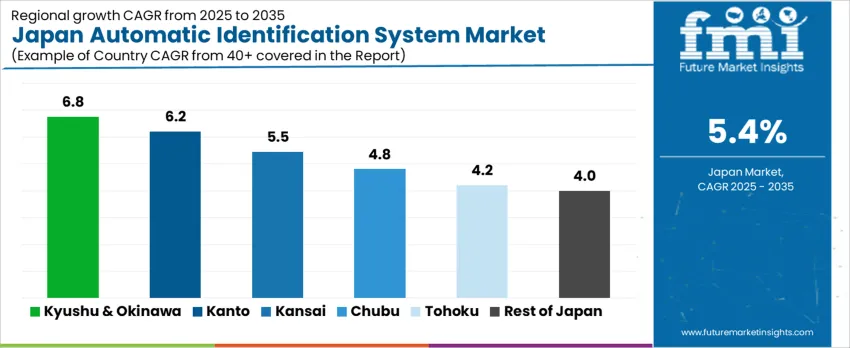
Automatic Identification Systems support maritime traffic monitoring, vessel identification, collision avoidance, and coastal logistics coordination in Japan’s operational waters. Demand follows port activity, coastal shipping volumes, and adoption of electronic navigation standards within fishing and commercial fleets. Procurement emphasizes signal reliability, integration with onboard communication, and stable data exchange with coastal monitoring infrastructure. Kyushu & Okinawa leads at 6.8% CAGR, reflecting dense maritime operations, followed by Kanto (6.2%), Kinki (5.5%), Chubu (4.8%), Tohoku (4.2%), and Rest of Japan (4.0%).
| Region | CAGR (2025-2035) |
|---|---|
| Kyushu & Okinawa | 6.8% |
| Kanto | 6.2% |
| Kinki | 5.5% |
| Chubu | 4.8% |
| Tohoku | 4.2% |
| Rest of Japan | 4.0% |
How is Kyushu & Okinawa driving demand for AIS?
Kyushu & Okinawa posts 6.8% CAGR, supported by busy coastal routes, fishery operations, and port handling at Hakata and Kagoshima. Smaller fishing vessels upgrade AIS to improve collision avoidance and regulatory compliance near traffic-dense straits. Cargo and passenger ferries traveling between islands require tracking systems that maintain stable broadcasting in varied weather conditions. Maritime distribution of fuel, materials, and food products relies on accurate vessel identification to coordinate port slots and reduce delay risk. Procurement emphasizes device durability, low-power functionality, and compatibility with existing radar and onboard systems. Regional monitoring stations expand digital mapping coverage to reduce blind zones near small ports. Growing tourism movement through ferry networks maintains consistent equipment renewal when fleets undergo modernization cycles.
- Fishing fleet compliance driving adoption
- Ferry operations requiring navigational visibility
- Port movements demanding traffic coordination
- Expanded coastal monitoring supporting upgraded AIS
How is Kanto shaping demand for AIS?
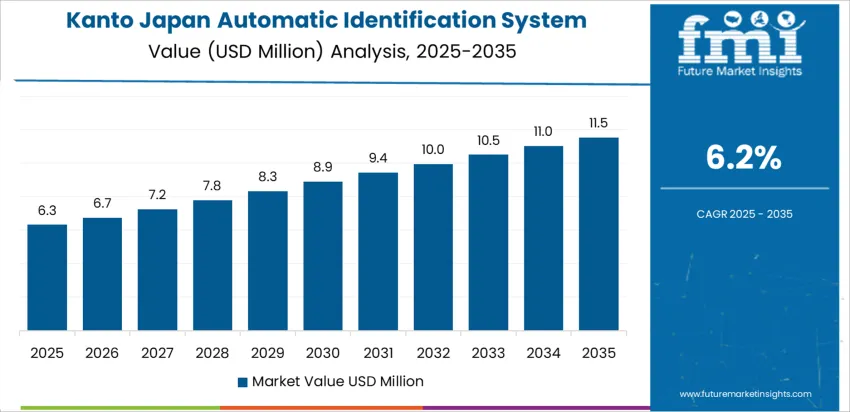
Kanto records 6.2% CAGR, driven by the Tokyo Bay shipping corridor where commercial vessel movements require continuous identification and stable tracking. Port operations in Yokohama and Chiba depend on AIS for queue management and berthing coordination. Large logistical vessels and container carriers maintain compliance with updated tracking protocols. Procurement focuses on integration with electronic chart display systems used in cargo fleets. Coastal patrol agencies rely on AIS data to monitor harbor safety and vessel routing. Upgrades replace earlier-generation transceivers with units offering improved range and signal processing to manage high-density maritime movement.
- Commercial fleet monitoring sustaining installations
- Port coordination influencing equipment purchases
- Compliance-driven upgrades improving tracking quality
- Digital navigation systems supporting compatibility adoption
How is Kinki influencing AIS demand?
Kinki expands at 5.5% CAGR, shaped by maritime activities around Osaka Bay, Kobe, and Wakayama ports. Cargo terminals and regional distribution operations require AIS to support safe entry and departure scheduling. Fishing fleets operating in offshore zones adopt identification devices to align with modern surveillance systems. Vessel operators favor equipment that withstands vibration and exposure associated with frequent docking movements. Training centers for maritime navigation in Osaka increase awareness of digital tracking requirements among new crew.
- Port entry management supporting reliable tracking
- Offshore fishing encouraging device upgrades
- Hardware durability valued for vessel longevity
- Navigation training reinforcing technology familiarity
How is Chubu contributing to AIS adoption?
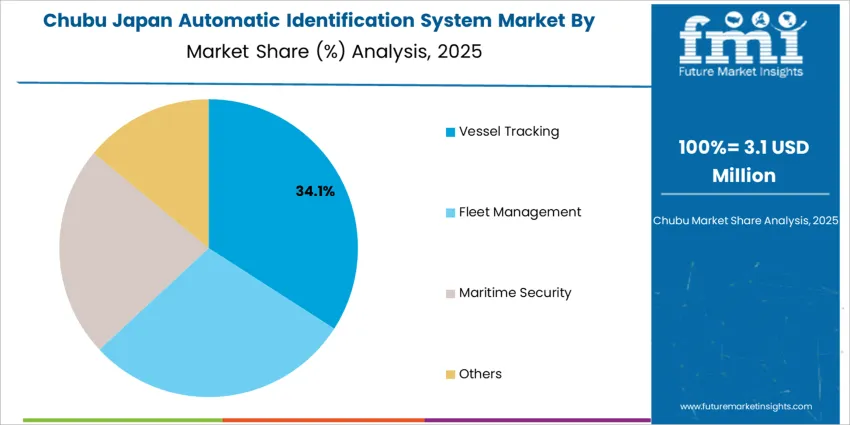
Chubu posts 4.8% CAGR, reflecting industrial exports through Nagoya Port and smaller cargo movements servicing regional manufacturing supply chains. AIS supports routing transparency for vessels carrying automotive and machinery shipments. Buyers evaluate compatibility with digital port-management tools used for schedule synchronization. Fishing communities use AIS for spatial awareness during coastal operations. Incremental modernization replaces older units based on maintenance cost reviews.
- Industrial shipping driving digital visibility needs
- Fishing operations requiring situational awareness
- Procurement supporting compatibility with port software
- Cost-focused replacement cycles influencing demand
How is Tohoku shaping AIS demand?
Tohoku posts 4.2% CAGR, influenced by regional fishing activity, seasonal offshore navigation, and modernization of coastal safety systems across Miyagi, Aomori, and Iwate. Long-distance fishing routes in the Pacific require continuous visibility to coordinate separation from cargo carriers traveling near major transit paths. Cold-season weather patterns create operational risks that require AIS transceivers with stable signal recovery and moisture-resistant build quality. Seafood distribution hubs depend on reliable vessel data for receiving schedules, enabling more predictable harbor entry and turnaround cycles. Smaller transport operators seek AIS upgrades when renewing vessel components to preserve safety compliance. Public-sector initiatives support digital mapping in coastal zones, introducing greater coverage in locations previously affected by blind spots. Maritime response teams use AIS data to support search operations and infrastructure monitoring.
- Fishing routes requiring consistent location data
- Port logistics benefiting from real-time vessel updates
- Hardware performance required in cold conditions
- Digital mapping expanding operational visibility
How is the Rest of Japan adopting AIS?
Rest of Japan records 4.0% CAGR, reflecting ongoing compliance upgrades in commercial fleets, cargo barges, and smaller passenger vessels operating away from Japan’s primary seaports. Demand is driven by adherence to safety protocols rather than fleet expansion, as vessel turnover remains gradual in regional waters. Procurement cycles prioritize durable AIS transceivers with standard functionality, limiting compatibility risks with existing navigation consoles. Operators focus on solutions that maintain appropriate transmission range for cross-coast and near-shore travel patterns, supporting communication with maritime authorities. Local shipyards integrate AIS during periodic retrofits when replacing antennas, power controls, or radar-adjacent installations. Training programs reinforce operational familiarity, ensuring crews manage identification workflows without advanced configurations. Coastal monitoring systems expand data reception capacity, enhancing oversight in developing ports and fishing zones.
- Steady replacement of legacy equipment maintaining compliance
- Limited-expansion fleets prioritizing basic tracking reliability
- Retrofit-linked procurement supporting phased modernization
- Coastal surveillance improvements supporting AIS continuity
What is the competitive landscape of demand for automatic identification systems in Japan?
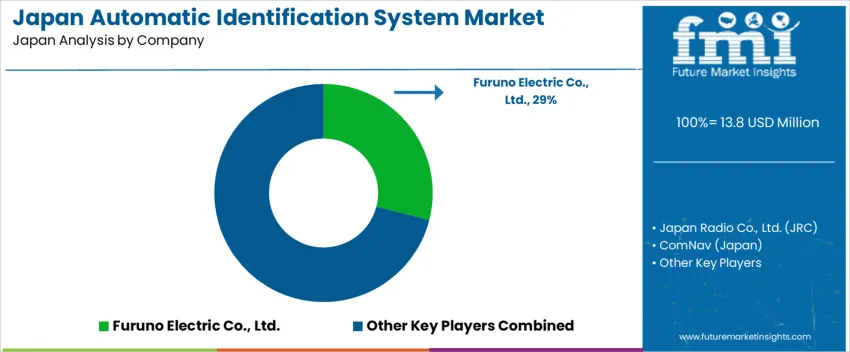
Demand for automatic identification systems in Japan is supported by suppliers providing Class-A and Class-B AIS transceivers to commercial fleets, coastal patrol vessels, and regulated fishing operations. Furuno Electric Co., Ltd. holds about 29.0% share, supported by stable signal reliability, consistent GNSS integration, and long-standing supply relationships with Japanese shipbuilders. Its terminals deliver precise vessel-position broadcasting and dependable reception under congested coastal tracking conditions.
Japan Radio Co., Ltd. (JRC) maintains strong participation with AIS equipment designed for commercial bridge systems where uninterrupted maritime communications and rigorous certification compliance are required. ComNav Japan supports selective deployment in fishing and coastal-cargo vessels through transceivers offering predictable transmission accuracy and straightforward onboard integration.
Saab AB Japan contributes presence in ports, pilot services, and government operations using AIS solutions that support port-traffic management and maritime-safety monitoring. Garmin Japan provides equipment suited to smaller vessels requiring stable AIS messaging and clear situational-awareness interfaces. Competition in Japan focuses on transmission reliability, VHF-band clarity, installation compatibility, signal-processing integrity, and long-term service availability. Demand remains steady where navigation-safety systems must ensure consistent vessel tracking throughout Japan’s dense coastal shipping environment.
Key Players in Japan Automatic Identification System Demand
- Furuno Electric Co., Ltd.
- Japan Radio Co., Ltd. (JRC)
- ComNav (Japan)
- Saab AB (Japan)
- Garmin (Japan)
Scope of the Report
| Items | Values |
|---|---|
| Quantitative Units | USD million |
| Category | Vessel Based, Shore Based |
| Application | Vessel Tracking, Fleet Management, Maritime Security, Others |
| Regions Covered | Kyushu & Okinawa, Kanto, Kinki, Chubu, Tohoku, Rest of Japan |
| Key Companies Profiled | Furuno Electric Co., Ltd., Japan Radio Co., Ltd. (JRC), ComNav (Japan), Saab AB (Japan), Garmin (Japan) |
| Additional Attributes | Dollar demand by AIS technology category and maritime applications; adoption supported by compliance with IMO and Japanese Coast Guard regulations; integration with navigation systems, radar, and coastal surveillance networks; key deployment in high-traffic zones including Kanto and Chubu ports; rising use in fisheries monitoring, marine safety, and vessel automation programs. |
Japan Automatic Identification System Demand by Segments
Category:
- Vessel Based
- Shore Based
Application:
- Vessel Tracking
- Fleet Management
- Maritime Security
- Others
Region:
- Kyushu & Okinawa
- Kanto
- Kinki
- Chubu
- Tohoku
- Rest of Japan
Frequently Asked Questions
How big is the demand for automatic identification system in Japan in 2025?
The demand for automatic identification system in Japan is estimated to be valued at USD 13.8 million in 2025.
What will be the size of automatic identification system in Japan in 2035?
The market size for the automatic identification system in Japan is projected to reach USD 23.3 million by 2035.
How much will be the demand for automatic identification system in Japan growth between 2025 and 2035?
The demand for automatic identification system in Japan is expected to grow at a 5.4% CAGR between 2025 and 2035.
What are the key product types in the automatic identification system in Japan?
The key product types in automatic identification system in Japan are vessel based and shore based.
Which application segment is expected to contribute significant share in the automatic identification system in Japan in 2025?
In terms of application, vessel tracking segment is expected to command 34.0% share in the automatic identification system in Japan in 2025.
Preview the report firsthand - request a free sample
Get SampleGet the brochure for pricing and purchase details.
Get PDFTable of Content
- Executive Summary
- Japan Market Outlook
- Demand-side Trends
- Supply-side Trends
- Technology Roadmap Analysis
- Analysis and Recommendations
- Market Overview
- Market Coverage / Taxonomy
- Market Definition / Scope / Limitations
- Market Background
- Market Dynamics
- Drivers
- Restraints
- Opportunity
- Trends
- Scenario Forecast
- Demand in Optimistic Scenario
- Demand in Likely Scenario
- Demand in Conservative Scenario
- Opportunity Map Analysis
- Product Life Cycle Analysis
- Supply Chain Analysis
- Investment Feasibility Matrix
- Value Chain Analysis
- PESTLE and Porter’s Analysis
- Regulatory Landscape
- Regional Parent Market Outlook
- Production and Consumption Statistics
- Import and Export Statistics
- Market Dynamics
- Japan Market Analysis 2020 to 2024 and Forecast, 2025 to 2035
- Historical Market Size Value (USD Million) Analysis, 2020 to 2024
- Current and Future Market Size Value (USD Million) Projections, 2025 to 2035
- Y-o-Y Growth Trend Analysis
- Absolute $ Opportunity Analysis
- Japan Market Pricing Analysis 2020 to 2024 and Forecast 2025 to 2035
- Japan Market Analysis 2020 to 2024 and Forecast 2025 to 2035, By Category
- Introduction / Key Findings
- Historical Market Size Value (USD Million) Analysis By Category , 2020 to 2024
- Current and Future Market Size Value (USD Million) Analysis and Forecast By Category , 2025 to 2035
- Vessel Based
- Shore Based
- Y-o-Y Growth Trend Analysis By Category , 2020 to 2024
- Absolute $ Opportunity Analysis By Category , 2025 to 2035
- Japan Market Analysis 2020 to 2024 and Forecast 2025 to 2035, By Application
- Introduction / Key Findings
- Historical Market Size Value (USD Million) Analysis By Application, 2020 to 2024
- Current and Future Market Size Value (USD Million) Analysis and Forecast By Application, 2025 to 2035
- Vessel Tracking
- Fleet Management
- Maritime Security
- Others
- Y-o-Y Growth Trend Analysis By Application, 2020 to 2024
- Absolute $ Opportunity Analysis By Application, 2025 to 2035
- Market Structure Analysis
- Competition Dashboard
- Competition Benchmarking
- Market Share Analysis of Top Players
- By Regional
- By Category
- By Application
- Competition Analysis
- Competition Deep Dive
- Furuno Electric Co., Ltd.
- Overview
- Product Portfolio
- Profitability by Market Segments (Product/Age /Sales Channel/Region)
- Sales Footprint
- Strategy Overview
- Marketing Strategy
- Product Strategy
- Channel Strategy
- Japan Radio Co., Ltd. (JRC)
- ComNav (Japan)
- Saab AB (Japan)
- Garmin (Japan)
- Furuno Electric Co., Ltd.
- Competition Deep Dive
- Assumptions & Acronyms Used
- Research Methodology


