

- Industry Size (2025)
- USD 14.9 Mn
- Forecast (2035)
- USD 17.9 Mn
- CAGR (2025 to 2035)
- 1.9%
Demand for Automatic Checkweigher in Japan Forecast and Outlook 2025 to 2035
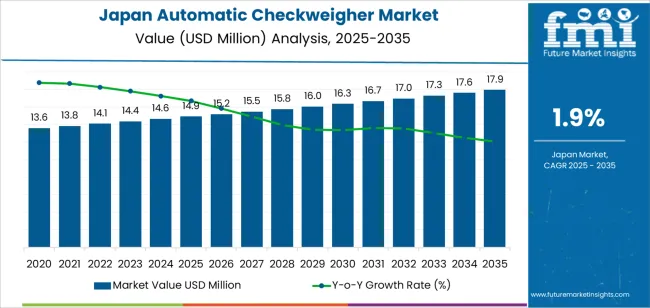
In 2025, automatic checkweigher demand in Japan is valued at USD 14.9 million and is projected to reach USD 17.9 million by 2035 at a CAGR of 1.9%. Growth momentum in the first half of the forecast remains controlled rather than rapid, with market value rising to about USD 16.3 million by 2030. This measured pace reflects the already high level of automation in Japanese food, pharmaceutical, and consumer goods packaging lines. Demand in this phase is driven mainly by replacement of aging systems, tighter weight accuracy requirements, and steady upgrades in hygiene grade equipment for ready to eat meals and medical packaging. Smaller processors adopt compact checkweighers for compliance rather than throughput expansion.
After 2030, momentum remains positive but restrained as the market advances from roughly USD 16.3 million to USD 17.9 million by 2035. Growth in this later stage comes less from new factory builds and more from technology refresh cycles, software driven inspection accuracy, and integration with vision and labeling systems. Snack foods, frozen meals, and over the counter pharmaceuticals remain the core demand centers. Domestic equipment makers and a limited number of global inspection specialists dominate supply. Competitive focus rests on higher weighing speed at lower vibration, improved rejection accuracy, and reduced floor space requirements. This steady momentum profile reflects a mature automation segment where gains are incremental and reliability driven.
Quick Stats of the Demand for Automatic Checkweighers in Japan
- Demand for Automatic Checkweighers in Japan Value (2025): USD 14.9 million
- Demand for Automatic Checkweighers in Japan Forecast Value (2035): USD 17.9 million
- Demand for Automatic Checkweighers in Japan Forecast CAGR (2025–2035): 1.9%
- Leading Type in Automatic Checkweighers Japan: Standalone Systems (62%)
- Key Growth Regions for Automatic Checkweighers in Japan: Kyushu & Okinawa, Kanto, Kinki, Chubu, Tohoku, Rest of Japan
- Top Players in Automatic Checkweighers Industry in Japan: METTLER TOLEDO, Ishida Co., Ltd., Anritsu Corporation, Bizerba, A&D Company, Limited
What is the Growth Forecast for Automatic Checkweigher in Japan through 2035?
The inflection point mapping for the automatic checkweigher demand curve in Japan shows a slow accumulation phase from 2020 to 2025, where the market rises from USD 13.6 million to USD 14.9 million. Yearly increments remain tightly compressed between USD 0.2 million and USD 0.3 million, indicating a pre inflection environment dominated by routine equipment replacement in food processing and pharmaceuticals. This phase reflects capacity maintenance rather than throughput expansion. The absence of step changes confirms that automation penetration was already mature in large factories, with limited new facility creation. The curve remains shallow, showing that demand drivers are operational continuity and compliance stability rather than structural industry expansion.
The inflection zone begins to emerge after 2028 and becomes statistically visible between 2030 and 2035. Demand moves from USD 16.0 million in 2030 to USD 17.9 million by 2035, with annual increments widening consistently toward USD 0.4 million. This shift reflects a change in demand quality rather than volume shock, driven by tighter quality control thresholds, higher SKU complexity, and increased integration of checkweighers into fully automated inspection lines. The slope of the curve steepens modestly but persistently, signaling a transition from maintenance-led purchasing to performance and compliance driven system upgrades. This inflection indicates structural upgrading, not cyclical acceleration.
Automatic Checkweigher Industry in Japan Key Takeaways
| Metric | Value |
|---|---|
| Industry Value (2025) | USD 14.9 million |
| Forecast Value (2035) | USD 17.9 million |
| Forecast CAGR (2025–2035) | 1.9% |
What Is Driving the Demand for Automatic Checkweighers in Japan?
Demand for automatic checkweighers in Japan arises from rising pressure on manufacturers across food & beverage, pharmaceutical, cosmetics, and consumer-goods sectors to ensure weight consistency, product safety, and compliance with strict quality standards. As production lines output large volumes, manual weighing becomes inefficient and error-prone. Automatic checkweighers make it possible to weigh each package dynamically on a conveyor line, rejecting units that fall outside target weight tolerances. This reduces product giveaway and waste, improves throughput, and helps companies maintain trust in product labeling and regulatory compliance. The increasing adoption of automation across packaging lines in Japan’s manufacturing industries has systematically expanded the base of potential users.
Future growth of automatic checkweighers in Japan is likely to be driven by several converging industry trends. The expansion of the food processing, pharmaceuticals, and e-commerce packaging markets will demand precise, high-speed weighing and inspection at scale. Advances in automation, robotics, and smart manufacturing (including integration with IoT and data analytics) will encourage manufacturers to upgrade legacy lines with combination systems that merge weighing with metal- or X-ray inspection. Growing labour constraints and a drive for efficiency will further sustain uptake of fully automatic systems over semi-automatic or manual alternatives. As quality assurance and regulatory compliance standards increase, automatic checkweighers will become an essential part of packaging machinery portfolios in Japan.
What Factors Are Affecting the Demand for Automatic Checkweigher in Japan in Terms of Type and Technology?
The demand for automatic checkweighers in Japan is shaped by system type and weighing technology. Standalone systems account for 62% of total demand, while combination systems serve integrated inspection and packaging lines. By technology, strain gauge checkweighers hold a 57% share, followed by electromagnetic force restoration systems. Equipment selection is guided by line speed, product weight variability, regulatory requirements, and integration needs with metal detection and vision inspection systems. These segments reflect how accuracy standards, automation levels, and production throughput targets influence adoption across food processing, pharmaceuticals, logistics, and consumer goods manufacturing environments nationwide.
What Drives the Leading Demand for Standalone Automatic Checkweigher Systems in Japan?
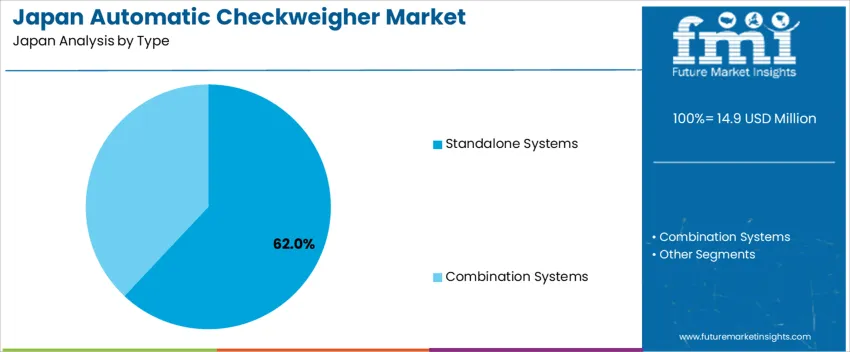
Standalone automatic checkweigher systems account for 62% of total demand in Japan. Their dominance reflects flexibility, lower capital cost, and ease of deployment across existing production lines. Standalone units are commonly installed at critical weight verification points without requiring full line reconfiguration. This allows manufacturers to improve quality control while maintaining current layout structures. These systems are widely used in food, pharmaceutical, and packaged consumer goods facilities where frequent product changeovers require adaptable equipment configurations.
Standalone systems also support independent performance validation and faster maintenance schedules. Downtime on weighing functions does not disrupt upstream or downstream inspection equipment. This improves operational resilience. Calibration routines are simpler, which supports consistent regulatory compliance during audits. Smaller manufacturers favor standalone systems for space efficiency and scalable investment planning. These operational advantages sustain their leading position across both original equipment installations and replacement purchases in Japan manufacturing facilities.
What Drives the Leading Demand for Strain Gauge Technology in Automatic Checkweighers in Japan?
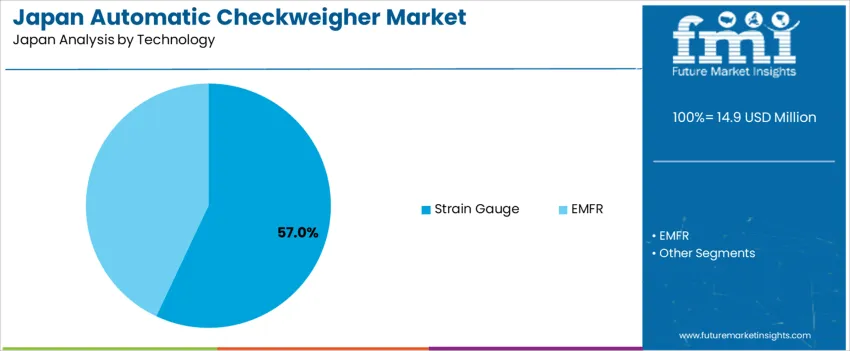
Strain gauge technology accounts for 57% of total automatic checkweigher demand in Japan. This leadership reflects proven reliability, consistent accuracy across wide weight ranges, and lower system cost compared with electromagnetic alternatives. Strain gauge sensors perform well in high speed packaging lines handling lightweight to mid weight products. These systems deliver stable weight readings under vibration and continuous motion conditions typical of automated conveyor environments.
The technology supports long service life with predictable calibration behavior. Parts availability and service familiarity across domestic maintenance providers further strengthen adoption. Strain gauge systems integrate efficiently with control units, rejection mechanisms, and data logging platforms used for compliance reporting. Installation complexity remains lower than EMFR systems, which supports rapid deployment across multiple production sites. These cost and performance advantages align with the operational priorities of Japanese manufacturers focused on throughput reliability and consistent product weight compliance.
What Forces Are Shaping the Demand for Automatic Checkweighers in Japan?
Demand for automatic checkweighers in Japan is shaped by strict weight compliance standards, high consumer sensitivity to underweight packaging, and dense high-speed manufacturing environments. Food, pharmaceuticals, cosmetics, and ready-to-eat meal producers rely on precise in-line weight inspection to avoid recalls and brand damage. Japan’s retail culture places strong emphasis on uniformity and accuracy, which reinforces investment in weight control systems. At the same time, export-oriented manufacturers must meet overseas packaging tolerances. These structural quality expectations turn checkweighers into essential production assets rather than optional inspection tools.
How Do Food Safety Culture and High-Speed Production Lines Drive Checkweigher Demand in Japan?
Japanese production lines operate at high speeds with minimal tolerance for error. Ready-to-eat meals, bento boxes, confectionery, beverages, and pharmaceutical blister packs move through compact, tightly synchronized lines. Automatic checkweighers ensure every unit complies with declared weight while maintaining throughput. Japans food safety culture emphasizes preventive control rather than post-production correction, which reinforces in-line inspection adoption. Central kitchens, convenience-store food suppliers, and contract manufacturers increase reliance on continuous automated weight control. These operating conditions make real-time checkweighing indispensable across large portions of the Japanese processing sector.
What Cost, Space, and Production Structure Constraints Limit Checkweigher Expansion in Japan?
Despite strong fundamentals, automatic checkweigher adoption faces several constraints in Japan. Factory floor space is limited, especially in older urban plants, which restricts installation of large inspection frames. Smaller food processors and regional manufacturers struggle with capital cost justification, especially where production volumes fluctuate seasonally. Frequent product changeovers in Japan’s small-batch production model require flexible systems, and not all machines justify reconfiguration cost. Aging factory infrastructure also complicates electrical upgrades and digital integration. These structural and investment constraints slow the pace of checkweigher penetration beyond core high-volume manufacturers.
How Are Automation, Data Integration, and Quality Transparency Reshaping Checkweigher Demand in Japan?
Automatic checkweighers in Japan are evolving from simple weight inspection tools into integrated quality-control nodes. Manufacturers demand automated rejection systems, production data logging, and connectivity with MES and traceability platforms. Weight data is increasingly used for yield optimization, material waste reduction, and audit readiness. Compact modular checkweighers suited for space-constrained lines are gaining preference. Dual-function systems combining metal detection and weight inspection also see rising demand. These trends show that Japanese users now view checkweighers as part of digital production control infrastructure rather than isolated quality devices.
What is the Demand for Automatic Checkweigher in Japan by Region?
| Region | CAGR (%) |
|---|---|
| Kyushu & Okinawa | 2.3% |
| Kanto | 2.2% |
| Kinki | 1.9% |
| Chubu | 1.7% |
| Tohoku | 1.5% |
| Rest of Japan | 1.4% |
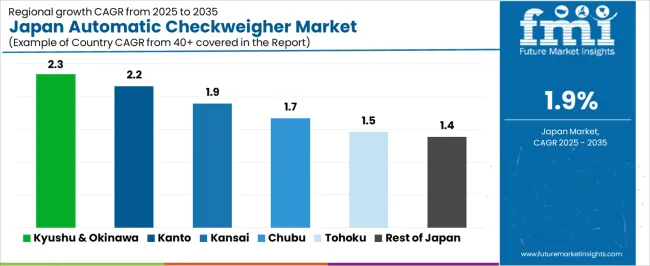
The demand for automatic checkweighers in Japan shows modest growth across regions, with the highest growth in Kyushu & Okinawa at 2.3% CAGR. This growth reflects gradual adoption of automated weighing systems by food, beverage, pharmaceutical, and logistics sectors aiming to ensure packaging compliance and quality control. In Kanto and Kinki regions the 2.2% and 1.9% CAGRs represent established manufacturing zones where incremental upgrades of packaging lines are occurring. Chubu, Tohoku, and Rest of Japan record lower growth (1.7% to 1.4%) possibly due to smaller scale operations, limited investment in automation, and slower expansion of packaged-goods manufacturing. Overall the trend indicates steady but conservative uptake of checkweighing automation across Japan, driven by regulatory compliance, efficiency gains, and growing emphasis on quality control in manufacturing.
What is Shaping Automatic Checkweigher Demand in Kyushu and Okinawa Regions of Japan?
Expansion across Kyushu and Okinawa reflects a CAGR of 2.3% through 2035 for automatic checkweigher demand, supported by food processing, seafood packaging, and regional beverage bottling operations. Weight compliance requirements in export oriented products sustain baseline equipment usage. Small and mid scale processors invest in compact checkweighing systems to meet retail packaging standards. Port based logistics also drive secondary demand for carton verification. Growth remains tied to quality control needs rather than production scale expansion, keeping equipment purchases focused on replacement and limited incremental automation across regional packaging lines.
- Food and seafood processors anchor primary equipment demand
- Export compliance sustains routine carton weight verification
- Compact systems suit small processor facility layouts
- Replacement driven purchases dominate equipment investment
How is Kanto Supporting Automatic Checkweigher Adoption in Japan?
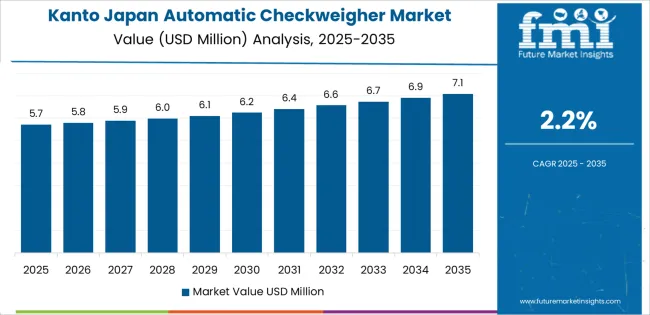
Kanto advances at a CAGR of 2.2% through 2035 for automatic checkweigher demand, driven by dense packaged food production, pharmaceutical filling lines, and ecommerce fulfillment packaging. High regulatory oversight strengthens adoption for in line weight inspection. Tokyo based manufacturing clusters integrate checkweighers into high speed conveyor systems. Equipment utilization remains high due to continuous production cycles. Leasing and service contracts reduce capital barriers for smaller co packers. Demand aligns with compliance automation needs rather than capacity addition, maintaining steady but controlled equipment expansion across metropolitan production networks.
- Pharmaceutical and food lines drive continuous system usage
- Regulatory compliance enforces in line inspection needs
- Conveyor integrated systems support high throughput operations
- Leasing models support small and mid scale adopters
Why is Automatic Checkweigher Demand Increasing Gradually in Kinki Region of Japan?
Kinki records a CAGR of 1.9% through 2035 for automatic checkweigher demand, shaped by steady food, cosmetics, and household product packaging activity. Osaka area manufacturers deploy checkweighers mainly for legal metrology compliance rather than process optimization. Line speeds remain moderate, limiting the need for advanced high capacity systems. Equipment purchasing follows structured replacement cycles tied to inspection schedules. Local distributors support calibration and service needs. Demand remains stable due to strict labeling accuracy requirements across consumer goods rather than aggressive manufacturing expansion.
- Legal metrology compliance drives consistent equipment usage
- Moderate line speeds limit need for high capacity systems
- Replacement cycles guide procurement timing
- Distributor service networks support ongoing calibration needs
What is Influencing Automatic Checkweigher Demand in Chubu Region of Japan?
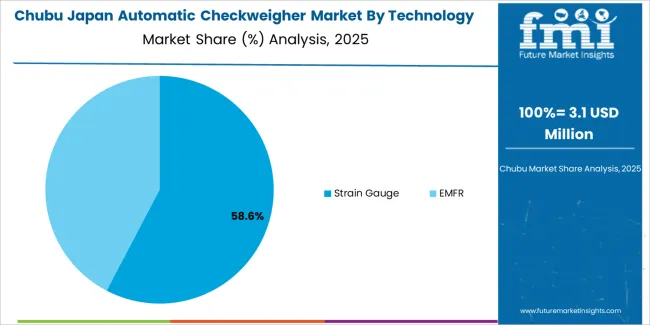
Chubu expands at a CAGR of 1.7% through 2035 for automatic checkweigher demand, influenced by automotive parts packaging, industrial components, and regional food processors. Weight verification focuses on kit assembly accuracy and packaged spare parts for export supply chains. Equipment adoption reflects manufacturing quality assurance programs rather than packaging volume growth. Investment priorities favor upstream production automation rather than end of line inspection equipment. Demand remains concentrated among tier one and tier two suppliers maintaining compliance with OEM packaging specifications for shipment accuracy and traceability.
- Automotive parts kitting supports targeted checkweigher usage
- Export packaging accuracy sustains baseline inspection demand
- OEM compliance standards guide equipment specification
- Upstream automation limits rapid end of line expansion
How is Automatic Checkweigher Demand Developing in Tohoku Region of Japan?
Tohoku shows a CAGR of 1.5% through 2035 for automatic checkweigher demand, supported by agricultural produce packaging, dairy processing, and regional ready meal producers. Manual weight checks still dominate small facilities, limiting automation speed. Adoption occurs mainly where regulatory audits require documented weight control. Cold chain distribution supports limited but consistent equipment use. Machine purchases remain conservative due to small production batches. Growth reflects incremental compliance upgrades rather than throughput driven expansion across rural food processing and cooperative packaging operations.
- Agricultural packaging sustains consistent inspection needs
- Manual checks still dominate small processing facilities
- Regulatory audits support selective automation adoption
- Small batch production limits high capacity system demand
What is Sustaining Automatic Checkweigher Demand in the Rest of Japan?
The rest of Japan reflects a CAGR of 1.4% through 2035 for automatic checkweigher demand, supported by dispersed food producers, municipal packaging units, and secondary manufacturing clusters. Most users operate on low throughput lines, favoring semi-automatic or refurbished equipment. Compliance with net weight labeling rules sustains baseline inspection needs. Equipment access relies heavily on regional distributors and service agents. Growth remains restrained due to limited capital budgets and low automation urgency in non-metropolitan processing zones compared with central industrial regions.
- Low throughput lines limit advanced system adoption
- Refurbished equipment supports cost control strategies
- Net weight compliance sustains baseline inspection demand
- Distributor service models support rural equipment access
What Is Driving the Demand for Automatic Checkweighers in Japan and Who Are the Key Players Shaping the Industry?
Demand for automatic checkweighers in Japan is rising as manufacturers and packagers place greater emphasis on weight accuracy, quality control and regulatory compliance. Producers in food, beverage and pharmaceuticals increasingly rely on in line weighing systems to ensure each package meets target weight specifications, reduce overfill and limit waste. Automated checkweighers enable high speed inspection and rejection of non conforming items, which supports efficient production under tight margins. Heightened consumer expectations for consistency and the need for greater throughput in modern packaging lines further drive adoption of dynamic checkweigher solutions.
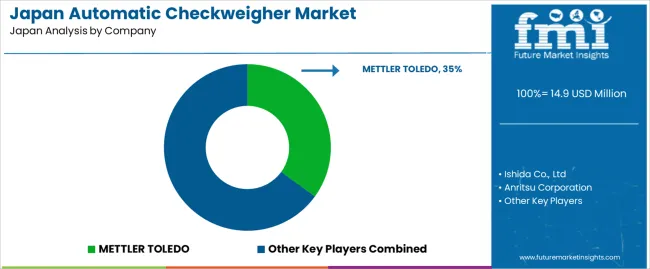
Among suppliers active in Japan, the global leader METTLER TOLEDO accounts for roughly 35 % of market share. Other notable players include Ishida Co., Ltd., Anritsu Corporation, Bizerba and A&D Company, Limited. Ishida and Anritsu supply locally tailored solutions suited to Japan’s food and packaging sectors. Bizerba and A&D offer precision weighing systems for industrial and consumer goods applications. These firms compete along dimensions of weighing accuracy, speed, system integration and reliability. Their combined presence shapes the checkweigher market in Japan by offering a mix of global standard and domestically adapted solutions.
Key Players in Automatic Checkweighers Industry in Japan
- METTLER TOLEDO
- Ishida Co., Ltd.
- Anritsu Corporation
- Bizerba
- A&D Company, Limited
Scope of the report
| Items | Values |
|---|---|
| Quantitative Units (2025) | USD million |
| Type | Standalone Systems, Combination Systems |
| Technology | Strain Gauge, EMFR (Electromagnetic Force Restoration) |
| Industry | Food & Beverages, Pharmaceuticals, Consumer Products, Cosmetics and Personal Care, Others |
| Region | Kyushu & Okinawa, Kanto, Kinki, Chubu, Tohoku, Rest of Japan |
| Countries Covered | Japan |
| Key Companies Profiled | METTLER TOLEDO, Ishida Co., Ltd., Anritsu Corporation, Bizerba, A&D Company, Limited |
| Additional Attributes | Dollar by sales by system type and technology; regional CAGR and adoption rate; standalone vs combination system penetration; leading technology adoption (strain gauge); industry-wise usage patterns; equipment replacement cycles; integration with metal detection, vision, and labeling systems; throughput and line speed optimization; floor space and compactness considerations; modular and dual-function systems; adoption by small vs large processors; regulatory compliance and quality assurance influence; automation integration with MES and data logging platforms; equipment service and maintenance trends; incremental vs new installation demand. |
Automatic Checkweighers Industry in Japan Segmentation
Type:
- Standalone Systems
- Combination Systems
Technology:
- Strain Gauge
- EMFR
Industry:
- Food & Beverages
- Pharmaceuticals
- Consumer Products
- Cosmetics and Personal Care
- Others
Region:
- Kyushu & Okinawa
- Kanto
- Kinki
- Chubu
- Tohoku
- Rest of Japan
Frequently Asked Questions
How big is the demand for automatic checkweigher in Japan in 2025?
The demand for automatic checkweigher in Japan is estimated to be valued at USD 14.9 million in 2025.
What will be the size of automatic checkweigher in Japan in 2035?
The market size for the automatic checkweigher in Japan is projected to reach USD 17.9 million by 2035.
How much will be the demand for automatic checkweigher in Japan growth between 2025 and 2035?
The demand for automatic checkweigher in Japan is expected to grow at a 1.9% CAGR between 2025 and 2035.
What are the key product types in the automatic checkweigher in Japan?
The key product types in automatic checkweigher in Japan are standalone systems and combination systems.
Which technology segment is expected to contribute significant share in the automatic checkweigher in Japan in 2025?
In terms of technology, strain gauge segment is expected to command 57.0% share in the automatic checkweigher in Japan in 2025.
Preview the report firsthand - request a free sample
Get SampleGet the brochure for pricing and purchase details.
Get PDFTable of Content
- Executive Summary
- Japan Market Outlook
- Demand-side Trends
- Supply-side Trends
- Technology Roadmap Analysis
- Analysis and Recommendations
- Market Overview
- Market Coverage / Taxonomy
- Market Definition / Scope / Limitations
- Market Background
- Market Dynamics
- Drivers
- Restraints
- Opportunity
- Trends
- Scenario Forecast
- Demand in Optimistic Scenario
- Demand in Likely Scenario
- Demand in Conservative Scenario
- Opportunity Map Analysis
- Product Life Cycle Analysis
- Supply Chain Analysis
- Investment Feasibility Matrix
- Value Chain Analysis
- PESTLE and Porter’s Analysis
- Regulatory Landscape
- Regional Parent Market Outlook
- Production and Consumption Statistics
- Import and Export Statistics
- Market Dynamics
- Japan Market Analysis 2020 to 2024 and Forecast, 2025 to 2035
- Historical Market Size Value (USD Million) Analysis, 2020 to 2024
- Current and Future Market Size Value (USD Million) Projections, 2025 to 2035
- Y-o-Y Growth Trend Analysis
- Absolute $ Opportunity Analysis
- Japan Market Pricing Analysis 2020 to 2024 and Forecast 2025 to 2035
- Japan Market Analysis 2020 to 2024 and Forecast 2025 to 2035, By Type
- Introduction / Key Findings
- Historical Market Size Value (USD Million) Analysis By Type , 2020 to 2024
- Current and Future Market Size Value (USD Million) Analysis and Forecast By Type , 2025 to 2035
- Standalone Systems
- Combination Systems
- Y-o-Y Growth Trend Analysis By Type , 2020 to 2024
- Absolute $ Opportunity Analysis By Type , 2025 to 2035
- Japan Market Analysis 2020 to 2024 and Forecast 2025 to 2035, By Technology
- Introduction / Key Findings
- Historical Market Size Value (USD Million) Analysis By Technology, 2020 to 2024
- Current and Future Market Size Value (USD Million) Analysis and Forecast By Technology, 2025 to 2035
- Strain Gauge
- EMFR
- Y-o-Y Growth Trend Analysis By Technology, 2020 to 2024
- Absolute $ Opportunity Analysis By Technology, 2025 to 2035
- Japan Market Analysis 2020 to 2024 and Forecast 2025 to 2035, By Industry
- Introduction / Key Findings
- Historical Market Size Value (USD Million) Analysis By Industry, 2020 to 2024
- Current and Future Market Size Value (USD Million) Analysis and Forecast By Industry, 2025 to 2035
- Food & Beverages
- Pharmaceuticals
- Consumer Products
- Cosmetics and Personal Care
- Others
- Y-o-Y Growth Trend Analysis By Industry, 2020 to 2024
- Absolute $ Opportunity Analysis By Industry, 2025 to 2035
- Market Structure Analysis
- Competition Dashboard
- Competition Benchmarking
- Market Share Analysis of Top Players
- By Regional
- By Type
- By Technology
- By Industry
- Competition Analysis
- Competition Deep Dive
- METTLER TOLEDO
- Overview
- Product Portfolio
- Profitability by Market Segments (Product/Age /Sales Channel/Region)
- Sales Footprint
- Strategy Overview
- Marketing Strategy
- Product Strategy
- Channel Strategy
- Ishida Co., Ltd
- Anritsu Corporation
- Bizerba
- A&D Company, Limited
- METTLER TOLEDO
- Competition Deep Dive
- Assumptions & Acronyms Used
- Research Methodology


