

- Industry Size (2025)
- USD 50.6 Mn
- Forecast (2035)
- USD 63.2 Mn
- CAGR (2025 to 2035)
- 2.3%
Demand for Banquet Cabinets in Japan Forecast and Outlook 2025 to 2035
The demand for banquet cabinets in Japan is expected to grow from USD 50.6 million in 2025 to USD 63.2 million by 2035, reflecting a CAGR of 2.3%. Banquet cabinets are essential in the hospitality and event sectors for efficiently organizing, storing, and serving food at large gatherings. As Japan’s event industry continues to grow, driven by both corporate and social functions, the need for high-quality banquet cabinets is increasing. These cabinets not only improve food storage and service efficiency but also help maintain proper food safety and hygiene standards, which are crucial for catering services and venues hosting events.
Technological innovations and design advancements are supporting the growth of the banquet cabinet sector. Manufacturers are increasingly focused on improving product functionality by incorporating features such as energy-efficient designs, modular systems, enhanced mobility, and easy-to-clean materials. These innovations help streamline the food service process, making banquet cabinets more adaptable to different event sizes and types. The shift toward more sustainable and eco-friendly products in the hospitality sector is likely to influence the demand for banquet cabinets, encouraging the development of cabinets made from environmentally friendly materials and those that minimize energy consumption.
Quick Stats of the Demand for Banquet Cabinets in Japan
- Demand for Banquet Cabinets in Japan Value (2025): USD 50.6 million
- Demand for Banquet Cabinets in Japan Forecast Value (2035): USD 63.2 million
- Demand for Banquet Cabinets in Japan Forecast CAGR (2025-2035): 2.3%
- Demand for Banquet Cabinets in Japan Leading Product: Electric Banquet Cabinets
- Demand for Banquet Cabinets in Japan Key Growth Regions: Kyushu & Okinawa, Kanto, Kansai, Chubu, Tohoku, Rest of Japan
- Demand for Banquet Cabinets in Japan Top Players: Alto-Shaam, Carter-Hoffmann, Hatco Corporation, Henny Penny, Hobart Corporation
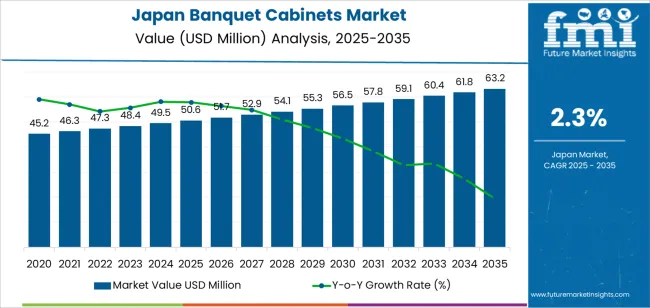
What is the Growth Forecast for the Demand for Banquet Cabinets in Japan through 2035?
From 2025 to 2030, demand for banquet cabinets in Japan is projected to grow from USD 50.6 million to USD 57.8 million, adding USD 7.2 million in value. This phase will experience significant growth, driven by an increasing number of large-scale events and the expansion of the hospitality sector. As the trend toward premium event management continues, there will be greater demand for banquet cabinets that offer efficient storage solutions and enhanced mobility. With events growing in size and complexity, the need for versatile, durable, and space-saving banquet cabinets will be crucial for managing food service operations smoothly. The growing preference for high-end events, where catering requirements are more demanding, will further push the adoption of advanced banquet cabinet solutions that can cater to the storage and service needs of premium venues and events.
From 2030 to 2035, the demand for banquet cabinets will continue to grow, from USD 57.8 million to USD 63.2 million, contributing USD 5.4 million in value. However, growth will slow during this phase as the hospitality sector matures and the demand stabilizes. The focus will shift to incremental product innovations aimed at improving functionality and user experience, with products designed to be even more efficient, durable, and easy to maintain. As event venues and planners continue to require high-quality banquet cabinets to support their catering operations, the sector will benefit from steady demand, ensuring consistent growth through the forecast period. Despite the slower pace, demand for high-quality banquet cabinets will remain strong.
Demand for Banquet Cabinets in Japan Key Takeaways
| Metric | Value |
|---|---|
| Demand for Banquet Cabinets in Japan Value (2025) | USD 50.6 million |
| Demand for Banquet Cabinets in Japan Forecast Value (2035) | USD 63.2 million |
| Demand for Banquet Cabinets in Japan Forecast CAGR (2025-2035) | 2.3% |
Why is the Demand for Banquet Cabinets in Japan Growing?
The demand for banquet cabinets in Japan is growing as the hospitality industry expands and large-scale events, banquets, and conferences become more frequent. Banquet cabinets are crucial for efficiently organizing and storing catering supplies, food, and beverages during events. These cabinets ensure that items are easily accessible and maintained at the right temperature, contributing to the smooth operation of large events. As Japan hosts more international conferences and events, the need for functional and well-organized storage solutions for banquet services is increasing.
A significant driver of this growth is the increasing number of hotels, resorts, and event venues in Japan that cater to large gatherings such as corporate events, weddings, and conventions. These venues require reliable and space-efficient storage solutions for food service and catering equipment. Banquet cabinets play a vital role in improving the efficiency of catering operations by ensuring that materials are organized and ready for use. This organized approach helps streamline the flow of events, ensuring that food and beverages are served at optimal temperatures and in a timely manner, which is critical in high-demand settings.
The growing emphasis on providing high-quality dining experiences at formal events is contributing to the rising demand for banquet cabinets. Not only are these cabinets functional, but they are also designed to enhance the overall presentation of banquet setups, contributing to the aesthetic appeal of events. As the demand for seamless, high-end event services continues to grow, particularly in the context of Japan's hospitality sector, the industry for banquet cabinets is expected to expand steadily through 2035, meeting the increasing needs for well-organized event management.
What is the Segment-Wise Analysis of Demand for Banquet Cabinets in Japan?
Demand for banquet cabinets in Japan is segmented by product type, end-use industry, capacity, and region. By product type, demand is divided into electric banquet cabinets and non-electric banquet cabinets, with electric banquet cabinets holding the largest share at 71%. The demand is also segmented by end-use industry, including hotels and restaurants, catering services, event management companies, hospitals and healthcare facilities, and educational institutions, with hotels and restaurants leading at 38%. Capacity-wise, demand is divided into 50-100 trays, more than 100 trays, and less than 50 trays. Regionally, demand is spread across Kyushu & Okinawa, Kanto, Kansai, Chubu, Tohoku, and the Rest of Japan.
Why Do Electric Banquet Cabinets Lead the Demand for Banquet Cabinets?
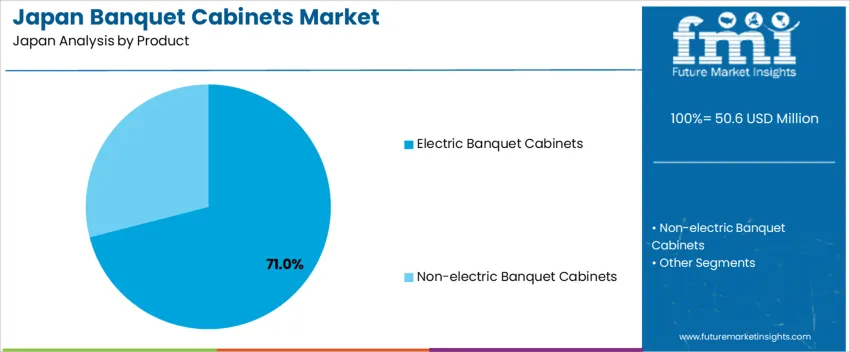
Electric banquet cabinets account for 71% of the demand for banquet cabinets in Japan. Their dominance is due to their ability to maintain precise temperatures and provide efficient heating for large quantities of food, making them ideal for high-volume service environments such as hotels, restaurants, and catering services. These cabinets offer a convenient solution for holding and transporting large quantities of food at a consistent temperature, ensuring food quality is preserved until service.
The demand for electric banquet cabinets is also driven by the growing need for more reliable and automated foodservice equipment in the hospitality industry, where efficiency and time-saving solutions are crucial. With Japan’s busy hospitality sector constantly seeking better ways to streamline operations, electric banquet cabinets continue to be the preferred choice. Their energy efficiency, consistent performance, and ability to accommodate large trays make them indispensable in foodservice operations.
What Drives Hotels and Restaurants to Lead the Demand for Banquet Cabinets?
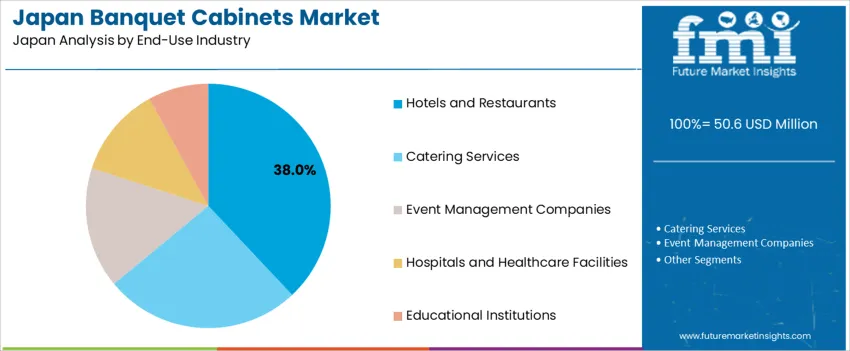
Hotels and restaurants account for 38% of the demand for banquet cabinets in Japan. This is largely due to the high volume of food service required in these industries, especially during large events, banquets, and conferences. Banquet cabinets are essential in these settings, as they allow food to be kept at the ideal temperature and ready for service, ensuring that large groups of guests are served efficiently and at the right temperature.
Electric banquet cabinets, in particular, are highly valued for their ability to maintain consistent heating and keep food fresh for extended periods. As the hospitality industry in Japan continues to grow, fueled by both local demand and international tourism, the need for banquet cabinets to streamline food service operations and meet the demands of large-scale catering increases. Hotels and restaurants continue to drive the industry demand for banquet cabinets, prioritizing quality, convenience, and efficiency in foodservice operations.
What are the Key Trends, Drivers, and Restraints in Demand for Banquet Cabinets in Japan?
The growth of tourism, domestic and international business travel, and frequent social events such as weddings, corporate gatherings, and conferences increases the need for efficient food storage and serving solutions. High-end hotels, banquet halls, restaurants and large-scale catering services require reliable cabinets to store, transport, and present food while maintaining quality, hygiene, and temperature control. As venues aim to deliver elevated guest experiences and efficient operations, banquet cabinets are becoming essential equipment for food service logistics. Despite growing demand, some constraints such as high initial cost, space limitations in compact venues, and maintenance requirements for quality cabinets may inhibit uptake among smaller or budget-constrained establishments.
Why is Demand for Banquet Cabinets Growing in Japan?
Demand for banquet cabinets is increasing because Japan’s hospitality and event management industry is undergoing expansion. Rising inbound and domestic tourism, growing interest in luxury and high-quality hospitality, and higher frequency of weddings and corporate events create consistent demand for banquet services. Venues need storage and food-holding solutions that support large-scale meal service while preserving food temperature and presentation, making banquet cabinets a practical requirement. Growing emphasis on guest experience, hygiene, and operational efficiency further encourage investment in durable, well-designed cabinets. Hotels and event venues view banquet cabinets as critical infrastructure to manage high-volume catering with consistency and reliability.
How are Technological & Industry Innovations Driving Banquet Cabinet Demand in Japan?
Advances in design, materials, and technology are enhancing the appeal of banquet cabinets in Japan. Modern cabinets increasingly feature temperature-controlled compartments (heated or insulated), modular shelving, ergonomic mobility, and easy-clean surfaces, which support efficient food storage, safe transport, and service hygiene. Some newer models include smart-storage capabilities, energy-efficient cooling or heating systems, and compact, space-efficient builds which suit Japanese venues where space is often limited.
The availability of customizable, multifunctional cabinets allows hospitality providers to adapt them for different event types, from small gatherings to large banquets, enhancing versatility. These innovations support improved service reliability, energy efficiency, and convenience, making banquet cabinets more attractive to hotels, restaurants, and catering businesses.
What are the Key Challenges and Risks That Could Limit Banquet Cabinet Demand in Japan?
First, high upfront cost of quality, durable or temperature-controlled cabinets may deter smaller restaurants or budget-conscious venues from investing. Second, many Japanese hospitality and event venues face space constraints; large or bulky cabinets, especially heavy steel or multi-tray units, may not fit well into compact kitchens or storage areas, limiting adoption.
Third, maintenance requirements and ongoing operating costs (for heating/cooling, cleaning, upkeep) add to the total cost of ownership, which may discourage long-term use. Fourth, for smaller-scale events or occasional catering, traditional serving methods might suffice, reducing perceived need for specialized storage equipment. Finally, economic fluctuations or shifts in event frequency, such as fewer large gatherings, could lower utilization rates, weakening demand over time.
What is the Regional Demand Outlook for Banquet Cabinets in Japan?
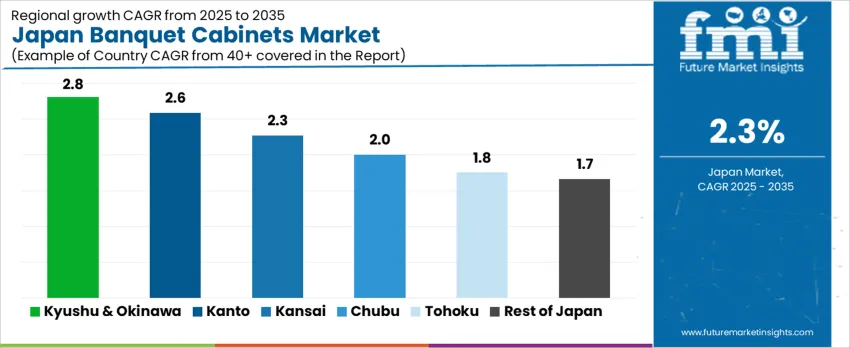
| Region | CAGR (%) |
|---|---|
| Kyushu & Okinawa | 2.8% |
| Kanto | 2.6% |
| Kansai | 2.3% |
| Chubu | 2.0% |
| Tohoku | 1.8% |
| Rest of Japan | 1.7% |
Demand for banquet cabinets in Japan is growing steadily, with Kyushu & Okinawa leading at a 2.8% CAGR, driven by the region's expanding tourism and hospitality sectors. Kanto follows with a 2.6% CAGR, fueled by the high number of event venues and corporate events in Tokyo. Kansai shows a 2.3% CAGR, supported by its strong focus on premium hospitality services and growing event hosting. Chubu experiences a 2.0% CAGR, with steady demand driven by the increasing number of hotels and event venues in cities like Nagoya. Tohoku sees a 1.8% CAGR, supported by the rise in local events and regional tourism. The Rest of Japan shows a 1.7% CAGR, with moderate but steady growth driven by expanding hospitality services in rural and suburban areas.
How is Demand for Banquet Cabinets Growing in Kyushu & Okinawa?
Kyushu & Okinawa leads the demand for banquet cabinets, growing at a 2.8% CAGR. The region’s increasing tourism industry, especially in Okinawa, drives the need for banquet cabinets used in hotels, resorts, and event venues. The rise in large-scale events, including conferences, corporate functions, and weddings, fuels the demand for these cabinets as they are essential for organizing catering and event supplies.
Kyushu, with its expanding hospitality sector, is seeing a growing number of venues and event spaces, further contributing to the need for banquet cabinets. The region’s focus on high-quality service in hospitality is driving the adoption of durable, efficient banquet cabinets for organizing and managing event logistics. As tourism and event activity continue to grow, Kyushu & Okinawa remains a key industry for banquet cabinets, and demand is expected to rise steadily as more venues are developed.
Why is Demand for Banquet Cabinets Rising in Kanto?
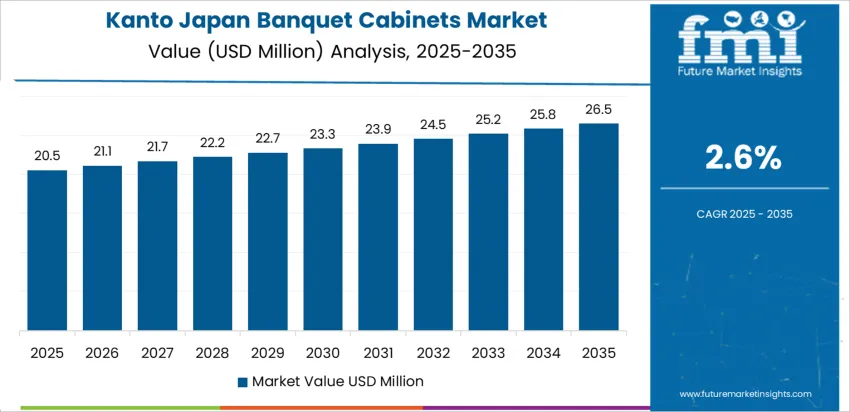
Kanto is experiencing steady demand for banquet cabinets, with a 2.6% CAGR. The region’s high concentration of event venues, hotels, and convention centers, particularly in Tokyo, is a major driver of demand. Kanto hosts a wide range of large-scale events, including corporate meetings, trade shows, weddings, and social gatherings, all of which require efficient storage and organization.
Banquet cabinets are essential in helping venues manage catering and service needs during these events. Kanto’s focus on providing high-quality service in the hospitality sector and its emphasis on premium event experiences drive demand for durable, functional, and aesthetically pleasing banquet cabinets. With a growing number of event spaces and venues catering to both business and leisure events, Kanto’s demand for banquet cabinets is expected to continue rising.
How is Demand for Banquet Cabinets Expanding in Kansai?
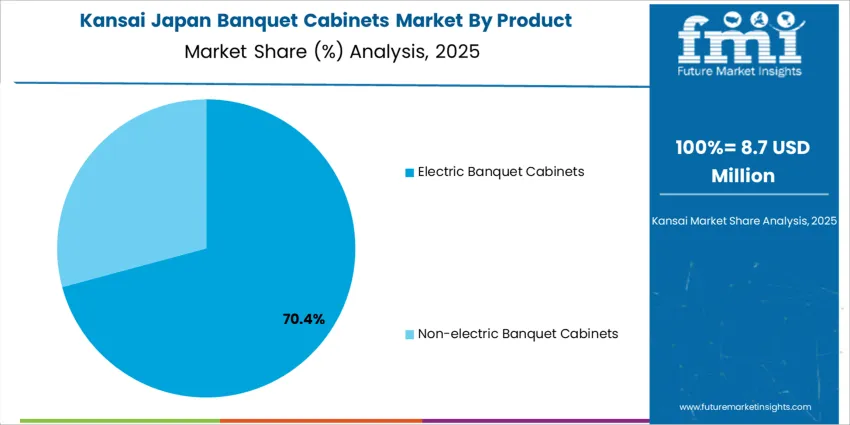
Kansai is seeing steady demand for banquet cabinets, with a 2.3% CAGR, driven by its strong hospitality and event-driven economy. The region, especially cities like Osaka and Kyoto, is home to numerous hotels, resorts, and event venues that cater to both business and leisure tourism. As more corporate conferences, trade shows, and weddings are held in Kansai, the need for banquet cabinets to help manage catering and event services is growing.
The region’s emphasis on providing quality service and its increasing focus on premium event spaces contribute to the adoption of banquet cabinets that offer durability, ease of use, and efficiency. Kansai’s mix of tourism, business events, and cultural celebrations further drives the demand for banquet cabinets. With the hospitality industry continuing to expand and evolve in Kansai, the region’s demand for banquet cabinets will likely see steady growth as event venues increase in number and scale.
Why is Demand for Banquet Cabinets Growing in Chubu?
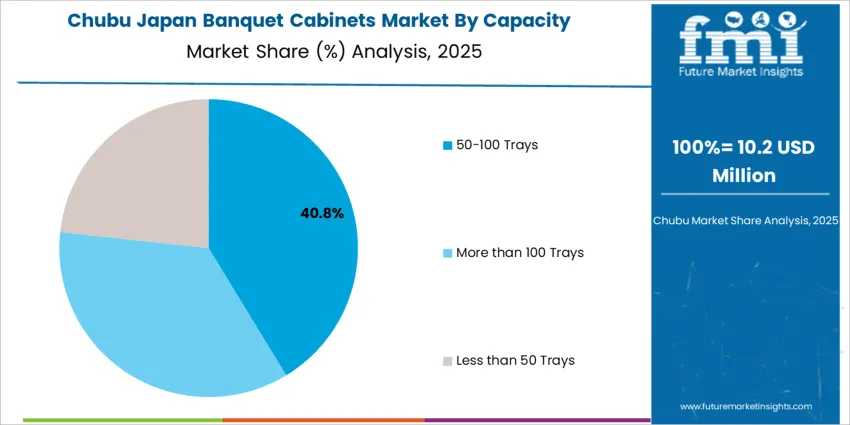
Chubu is experiencing moderate growth in demand for banquet cabinets, with a 2.0% CAGR. The region’s strong hospitality industry, especially in Nagoya, is contributing to this growth. As Chubu becomes an increasingly popular destination for both business and tourism, more venues and event spaces are emerging, boosting the need for banquet cabinets. Chubu hosts numerous conferences, corporate functions, and social gatherings, all of which require efficient catering and storage solutions.
Banquet cabinets are essential for organizing catering items, ensuring smooth event logistics. The region’s growing focus on tourism and event hosting in cities like Nagoya and surrounding areas is expected to drive the demand for banquet cabinets further. As the event sector expands and Chubu continues to develop its hospitality infrastructure, the demand for banquet cabinets in the region will see steady growth.
How is Demand for Banquet Cabinets Expanding in Tohoku?
Tohoku is seeing moderate demand for banquet cabinets, with a 1.8% CAGR. While the region’s hospitality and event industrys are smaller than those in urban centers, Tohoku is experiencing growth due to an increasing number of local events, including corporate meetings, conferences, and weddings. The region’s growing interest in tourism and regional gatherings contributes to the demand for banquet cabinets, which are essential for catering and organizing event services.
Tohoku’s hospitality sector is gradually developing, with more venues and hotels catering to visitors and local communities alike. As the event industry grows in the region, banquet cabinets will continue to be crucial for efficient service delivery and logistics management. While the pace of growth is slower compared to other regions, Tohoku’s expanding hospitality sector and increasing focus on local event hosting will drive steady demand for banquet cabinets over time.
Why is Demand for Banquet Cabinets Steady in the Rest of Japan?
The Rest of Japan is experiencing steady demand for banquet cabinets, with a 1.7% CAGR. While the industry in rural and suburban areas is smaller compared to urban centers, the increasing focus on local events, such as festivals, business conferences, and community gatherings, is driving demand for banquet cabinets. As more event venues open and expand in these areas, there is a growing need for solutions to organize and manage catering services efficiently.
Banquet cabinets are essential for providing well-structured service during these events, and their use is becoming more common in local hotels, community centers, and rural event spaces. The Rest of Japan’s steady development of hospitality infrastructure and its increasing participation in regional events will continue to support moderate demand for banquet cabinets.
What is the Competitive Landscape of Banquet Cabinets Demand in Japan?
The demand for banquet cabinets in Japan is rising as the hospitality and catering industries continue to focus on efficient and professional food service solutions. Banquet cabinets are critical for storing and transporting food at optimal temperatures while maintaining its quality and presentation during large events, banquets, and catering services. With Japan’s growing event sector and increased focus on high-end dining experiences, the need for durable, space-efficient, and energy-efficient banquet cabinets is expected to continue growing.
Leading companies in the banquet cabinet industry in Japan include Alto-Shaam, Carter-Hoffmann, Hatco Corporation, Henny Penny, and Hobart Corporation. Alto-Shaam holds the largest industry share of 35.0%, offering banquet cabinets known for their advanced technology, energy efficiency, and ability to maintain food quality. Carter-Hoffmann specializes in high-quality banquet cabinets with a focus on food safety and temperature control.
Hatco Corporation provides a range of banquet cabinets designed for durability and efficient storage, ensuring ease of use in high-volume settings. Henny Penny offers innovative banquet cabinet solutions with a focus on versatility and performance. Hobart Corporation delivers banquet cabinets that meet the needs of large-scale event catering, emphasizing energy efficiency and reliable food storage.
Competition in the banquet cabinet industry is driven by the need for reliable, efficient, and energy-saving foodservice equipment. Companies compete by offering cabinets that ensure optimal food quality and temperature during transport and service. Features such as temperature consistency, ease of use, durability, and hygiene standards are key differentiators.
Key Players in Japan Banquet Cabinets Demand
- lto-Shaam
- Carter-Hoffmann
- Hatco Corporation
- Henny Penny
- Hobart Corporation
Scope of Report
| Items | Values |
|---|---|
| Quantitative Units (2025) | USD million |
| Product | Electric Banquet Cabinets, Non-electric Banquet Cabinets |
| Capacity | 50-100 Trays, More than 100 Trays, Less than 50 Trays |
| End-Use Industry | Hotels and Restaurants, Catering Services, Event Management Companies, Hospitals and Healthcare Facilities, Educational Institutions |
| Region | Kyushu & Okinawa, Kanto, Kansai, Chubu, Tohoku, Rest of Japan |
| Countries Covered | Japan |
| Key Companies Profiled | Alto-Shaam, Carter-Hoffmann, Hatco Corporation, Henny Penny, Hobart Corporation |
| Additional Attributes | Dollar sales by product, capacity, and end-use industry; regional CAGR and adoption trends; demand trends in banquet cabinets; growth in hotels, catering, and event management sectors; technology adoption for electric and non-electric solutions; vendor offerings including banquet cabinet solutions; regulatory influences and industry standards |
Japan Banquet Cabinets Demand by Key Segments
Product
- Electric Banquet Cabinets
- Non-electric Banquet Cabinets
Capacity
- 50-100 Trays
- More than 100 Trays
- Less than 50 Trays
End-Use Industry
- Hotels and Restaurants
- Catering Services
- Event Management Companies
- Hospitals and Healthcare Facilities
- Educational Institutions
Region
- Kyushu & Okinawa
- Kanto
- Kansai
- Chubu
- Tohoku
- Rest of Japan
Frequently Asked Questions
How big is the demand for banquet cabinets in Japan in 2025?
The demand for banquet cabinets in Japan is estimated to be valued at USD 50.6 million in 2025.
What will be the size of banquet cabinets in Japan in 2035?
The market size for the banquet cabinets in Japan is projected to reach USD 63.2 million by 2035.
How much will be the demand for banquet cabinets in Japan growth between 2025 and 2035?
The demand for banquet cabinets in Japan is expected to grow at a 2.3% CAGR between 2025 and 2035.
What are the key product types in the banquet cabinets in Japan?
The key product types in banquet cabinets in Japan are electric banquet cabinets and non-electric banquet cabinets.
Which capacity segment is expected to contribute significant share in the banquet cabinets in Japan in 2025?
In terms of capacity, 50-100 trays segment is expected to command 42.0% share in the banquet cabinets in Japan in 2025.
Preview the report firsthand - request a free sample
Get SampleGet the brochure for pricing and purchase details.
Get PDFTable of Content
- Executive Summary
- Japan Market Outlook
- Demand-side Trends
- Supply-side Trends
- Technology Roadmap Analysis
- Analysis and Recommendations
- Market Overview
- Market Coverage / Taxonomy
- Market Definition / Scope / Limitations
- Market Background
- Market Dynamics
- Drivers
- Restraints
- Opportunity
- Trends
- Scenario Forecast
- Demand in Optimistic Scenario
- Demand in Likely Scenario
- Demand in Conservative Scenario
- Opportunity Map Analysis
- Product Life Cycle Analysis
- Supply Chain Analysis
- Investment Feasibility Matrix
- Value Chain Analysis
- PESTLE and Porter’s Analysis
- Regulatory Landscape
- Regional Parent Market Outlook
- Production and Consumption Statistics
- Import and Export Statistics
- Market Dynamics
- Japan Market Analysis 2020 to 2024 and Forecast, 2025 to 2035
- Historical Market Size Value (USD Million) Analysis, 2020 to 2024
- Current and Future Market Size Value (USD Million) Projections, 2025 to 2035
- Y-o-Y Growth Trend Analysis
- Absolute $ Opportunity Analysis
- Japan Market Pricing Analysis 2020 to 2024 and Forecast 2025 to 2035
- Japan Market Analysis 2020 to 2024 and Forecast 2025 to 2035, By Product
- Introduction / Key Findings
- Historical Market Size Value (USD Million) Analysis By Product , 2020 to 2024
- Current and Future Market Size Value (USD Million) Analysis and Forecast By Product , 2025 to 2035
- Electric Banquet Cabinets
- Non-electric Banquet Cabinets
- Y-o-Y Growth Trend Analysis By Product , 2020 to 2024
- Absolute $ Opportunity Analysis By Product , 2025 to 2035
- Japan Market Analysis 2020 to 2024 and Forecast 2025 to 2035, By Capacity
- Introduction / Key Findings
- Historical Market Size Value (USD Million) Analysis By Capacity, 2020 to 2024
- Current and Future Market Size Value (USD Million) Analysis and Forecast By Capacity, 2025 to 2035
- 50-100 Trays
- More than 100 Trays
- Less than 50 Trays
- Y-o-Y Growth Trend Analysis By Capacity, 2020 to 2024
- Absolute $ Opportunity Analysis By Capacity, 2025 to 2035
- Japan Market Analysis 2020 to 2024 and Forecast 2025 to 2035, By End-Use Industry
- Introduction / Key Findings
- Historical Market Size Value (USD Million) Analysis By End-Use Industry, 2020 to 2024
- Current and Future Market Size Value (USD Million) Analysis and Forecast By End-Use Industry, 2025 to 2035
- Hotels and Restaurants
- Catering Services
- Event Management Companies
- Hospitals and Healthcare Facilities
- Educational Institutions
- Y-o-Y Growth Trend Analysis By End-Use Industry, 2020 to 2024
- Absolute $ Opportunity Analysis By End-Use Industry, 2025 to 2035
- Market Structure Analysis
- Competition Dashboard
- Competition Benchmarking
- Market Share Analysis of Top Players
- By Regional
- By Product
- By Capacity
- By End-Use Industry
- Competition Analysis
- Competition Deep Dive
- lto-Shaam
- Overview
- Product Portfolio
- Profitability by Market Segments (Product/Age /Sales Channel/Region)
- Sales Footprint
- Strategy Overview
- Marketing Strategy
- Product Strategy
- Channel Strategy
- Carter-Hoffmann
- Hatco Corporation
- Henny Penny
- Hobart Corporation
- lto-Shaam
- Competition Deep Dive
- Assumptions & Acronyms Used
- Research Methodology


