

- Industry Size (2026)
- USD 245.37 Mn
- Forecast (2036)
- USD 435.29 Mn
- CAGR (2026 to 2036)
- 5.9%
Demand for Biochar Fertilizer in Japan Market Size, Market Forecast and Outlook By FMI
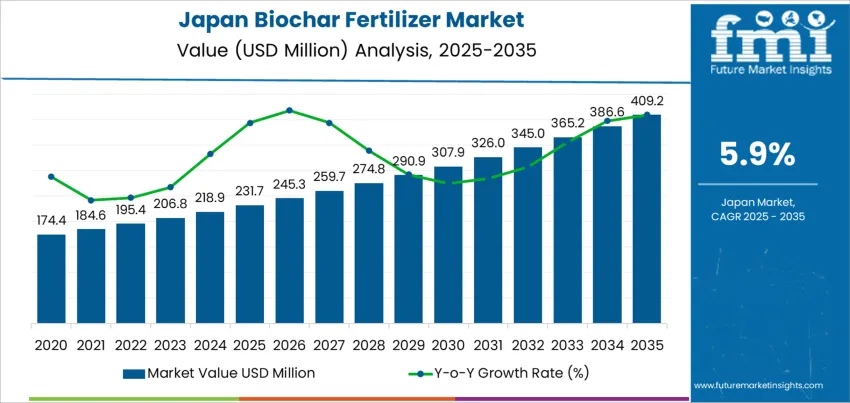
The demand for biochar fertilizer in japan market was valued at USD 231.70 million in 2025, projected to reach USD 245.37 million in 2026, and is forecast to expand to USD 435.29 million by 2036 at a 5.9% CAGR. As per FMI, the convergence of government-backed carbon credit incentive programs and the structural need for soil organic matter replenishment in intensively cultivated Japanese farmland is creating a durable procurement pipeline for biochar-based soil amendments. Agricultural cooperatives that integrated biochar into standard fertilizer rotation protocols are reporting improved water retention metrics across consecutive growing seasons.
Summary of Demand for Biochar Fertilizer in Japan Market
- Market Overview
- The market is valued at USD 231.70 million in 2025 and is projected to reach USD 435.29 million by 2036.
- The industry is expected to grow at a 5.9% CAGR from 2026 to 2036, creating an incremental opportunity of USD 189.92 million.
- The market is a cooperative-procurement-driven agricultural input category where demand is tied to soil health rehabilitation programs, carbon credit eligibility, and prefectural extension center recommendations.
- Demand and Growth Drivers
- Demand is driven by government-backed carbon credit programs that incentivize biochar application as a recognized soil carbon sequestration method.
- Agricultural cooperatives are converting pilot biochar trials into standardized soil amendment protocols, creating recurring procurement volumes.
- Expanding use in aquaculture water treatment and animal feed supplementation is broadening the addressable application base.
- Among key regions, Kyushu & Okinawa at 7.3% CAGR, Kanto at 6.7% CAGR, Kansai at 5.9% CAGR, Chubu at 5.2% CAGR, Tohoku at 4.6% CAGR, Rest of Japan at 4.3% CAGR.
- Product and Segment View
- The market includes organic, inorganic, and compound biochar fertilizer products produced from wood, crop residue, and other biomass feedstocks through pyrolysis processes.
- Applications span agricultural soil amendment, animal feed supplementation, and aquaculture water treatment systems.
- Organic leads by Nature with 43.0% share in 2026.
- Agriculture leads by Application with 58.0% share in 2026.
- The scope includes biochar-based soil conditioners and feed additives, excluding raw biomass, activated carbon for filtration, and charcoal cooking fuel.
- Geography and Competitive Outlook
- Kyushu & Okinawa leads at 7.3% CAGR, driven by horticultural and rice paddy operations that adopted biochar following prefectural recommendations.
- Kanto benefits from proximity to research institutions and a higher density of organic farming operations.
- Competition is shaped by pyrolysis technology, feedstock sourcing, and cooperative distribution access, with key players including Airex Energy, Biochar Supreme, Carbon Gold, American BioChar Company, Aries Clean Technologies.
- Analyst Opinion at FMI
- Nandini Roy Choudhury, Principal Consultant for Food & Beverage analysts observe that: 'In my analysis, I have observed that Japanese agricultural cooperatives are embedding biochar application protocols into their standard soil amendment programs, converting what was previously a niche carbon-sequestration input into a baseline fertility management tool. Procurement officers at prefectural agricultural extension centers who delay biochar integration into their fertilizer rotation schedules face measurable yield gaps against cooperatives that have already standardized pyrolyzed carbon inputs across rice paddy and horticultural field operations.'
- Strategic Implications / Executive Takeaways
- Agricultural cooperative procurement directors should standardize biochar application protocols across member farms to capture carbon credit eligibility and measurable soil health improvements.
- Biochar producers must secure long-term biomass feedstock supply agreements to ensure production continuity against seasonal availability fluctuations.
- Extension center program managers should integrate biochar performance data into fertilizer rotation recommendations to convert pilot-phase interest into recurring procurement commitments.
Demand for Biochar Fertilizer in Japan Market Key Takeaways
| Metric | Details |
|---|---|
| Industry Size (2026) | USD 245.37 million |
| Industry Value (2036) | USD 435.29 million |
| CAGR (2026-2036) | 5.9% |
Source: Future Market Insights, 2026
An absolute dollar opportunity of USD 189.92 million over the forecast period reflects the cumulative effect of carbon credit incentive structures, mandatory soil health rehabilitation programs in depleted farmland zones, and the expanding use of biochar in aquaculture and animal feed supplementation. FMI analysts observe that prefectural agricultural extension centers are transitioning from pilot biochar trials to standardized application recommendations, converting experimental interest into recurring procurement volume. The cost economics of biochar production from locally sourced biomass feedstock are improving as pyrolysis equipment scales down for cooperative-level deployment.
Regional demand across Japan reflects the distribution of intensive agricultural zones and the maturity of cooperative-level procurement programs. Kyushu & Okinawa at 7.3%, Kanto at 6.7%, Kansai at 5.9%, Chubu at 5.2%, Tohoku at 4.6%, Rest of Japan at 4.3%. Kyushu and Okinawa lead growth, supported by a concentrated base of horticultural and rice paddy operations that have adopted biochar as a standard soil amendment input following prefectural extension center endorsements. Kanto benefits from proximity to research institutions and a higher density of organic farming operations in Chiba, Ibaraki, and Tochigi prefectures. Chubu and Tohoku maintain steady growth as traditional rice cultivation regions integrate biochar into post-harvest soil rehabilitation protocols.
Demand for Biochar Fertilizer in Japan Market Definition
Biochar fertilizer is a carbon-rich soil amendment produced through the pyrolysis of organic biomass at temperatures between 300 and 700 degrees Celsius under oxygen-limited conditions. In agricultural applications, biochar functions as a soil conditioner that improves nutrient retention, water-holding capacity, and microbial activity. The product is applied in organic, inorganic, and compound formulations across crop cultivation, animal feed supplementation, and aquaculture operations. Procurement decisions in Japan are tied to agricultural cooperative recommendations, prefectural extension center guidelines, and carbon credit eligibility requirements.
Demand for Biochar Fertilizer in Japan Market Inclusions
Market scope includes organic, inorganic, and compound biochar fertilizer products used in agricultural soil amendment, animal feed supplementation, and fish farming applications. The scope covers biochar produced from wood, crop residue, and other biomass feedstocks distributed through agricultural cooperatives, direct sales, and specialty input suppliers across Japan.
Demand for Biochar Fertilizer in Japan Market Exclusions
The scope excludes raw biomass feedstock not subjected to pyrolysis, activated carbon products used in industrial filtration, and biochar used exclusively for non-agricultural carbon sequestration projects. Charcoal products marketed for cooking fuel or air purification are also excluded.
Demand for Biochar Fertilizer in Japan Market Research Methodology
- Primary Research: Analysts conducted structured interviews with procurement managers, distribution executives, and category specialists to map purchasing decision criteria, contract renewal cycles, and supplier qualification processes.
- Desk Research: Data collection aggregated publicly available trade statistics, regulatory filings, industry association reports, and company financial disclosures to establish baseline market parameters.
- Market-Sizing and Forecasting: Baseline values derive from a bottom-up aggregation of trade volumes, applying category-specific growth coefficients and regional penetration rates to project forward demand trajectories.
- Data Validation and Update Cycle: Projections are cross-checked against reported company revenues, trade body statistics, and periodic primary research updates to maintain forecast accuracy.
Why is the Demand for Biochar Fertilizer in Japan Growing?
The demand for biochar fertilizer in Japan is growing due to the increasing focus on sustainable agriculture and the need for environmentally friendly solutions to improve soil health and enhance crop yields. Biochar, a form of charcoal produced from organic materials, is used as a soil amendment to improve soil structure, water retention, and nutrient availability. As Japan's agricultural industry continues to shift toward more sustainable practices, biochar fertilizer is gaining traction as an effective and eco-friendly alternative to traditional chemical fertilizers.
A major driver behind this growth is Japan’s commitment to environmental durability and reducing the carbon footprint of agricultural practices. Biochar not only helps improve soil health but also sequesters carbon in the soil, contributing to efforts to mitigate climate change. The growing awareness of the environmental impacts of conventional fertilizers, such as water pollution and greenhouse gas emissions, is encouraging Japanese farmers to adopt biochar-based fertilizers that provide long-term benefits to both the environment and agricultural productivity.
The increasing demand for organic and sustainable food products is fueling the adoption of biochar fertilizers in Japan. With consumers becoming more health-conscious and environmentally aware, there is a rising preference for foods produced using sustainable farming practices. Biochar helps enhance soil fertility and reduce the reliance on synthetic fertilizers, making it an attractive option for organic farmers. As Japan continues to prioritize sustainable farming practices, the demand for biochar fertilizer is expected to grow steadily through 2035.
What is the Segment-Wise Analysis of Demand for Biochar Fertilizer in Japan?
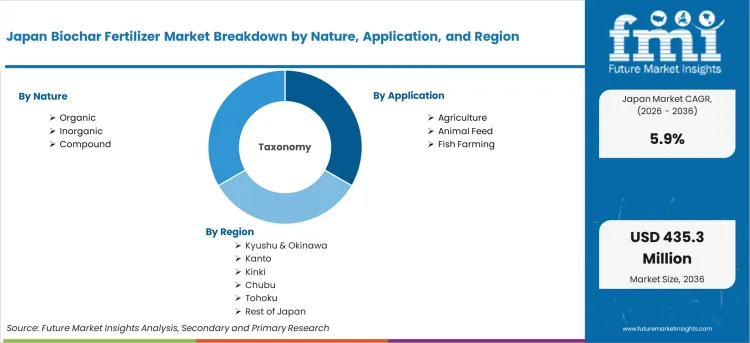
Demand for biochar fertilizer in Japan is segmented by nature, application, and region. By nature, demand is divided into organic, inorganic, and compound biochar fertilizers, with organic leading at 43%. The demand is also segmented by application, including agriculture, animal feed, and fish farming, with agriculture holding the largest share at 58%. Regionally, demand is distributed across Kyushu & Okinawa, Kanto, Kansai, Chubu, Tohoku, and the Rest of Japan.
Why Does Organic Biochar Fertilizer Lead the Demand for Biochar Fertilizer in Japan?
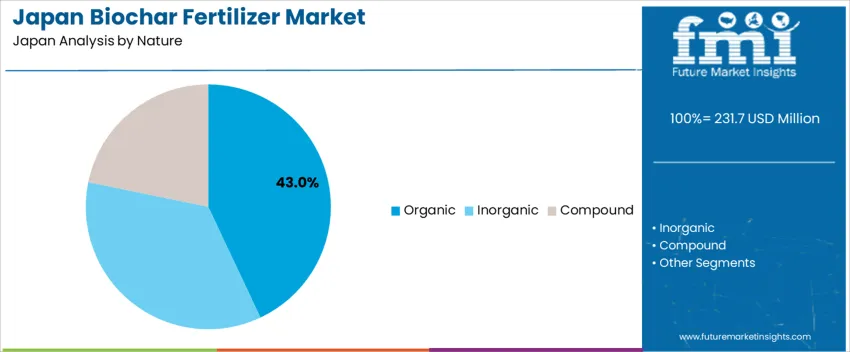
Organic biochar fertilizer accounts for 43% of the demand in Japan, driven by its eco-friendly nature and the increasing consumer and agricultural focus on durability. Organic fertilizers, including biochar, are highly valued for their ability to improve soil quality, enhance water retention, and reduce the need for synthetic chemical inputs, making them a preferred choice in organic farming practices. Organic biochar helps sequester carbon, contributing to carbon-neutral or carbon-negative farming practices, which aligns with Japan’s environmental goals.
As consumer demand for organic produce grows, farmers are increasingly turning to organic biochar fertilizers to enhance crop yields, improve soil health, and reduce environmental impact. The increasing emphasis on sustainable agriculture and the potential for organic farming to reduce greenhouse gas emissions further supports the demand for organic biochar fertilizers, ensuring their continued dominance in the market.
Why Does Agriculture Lead the Demand for Biochar Fertilizer in Japan?
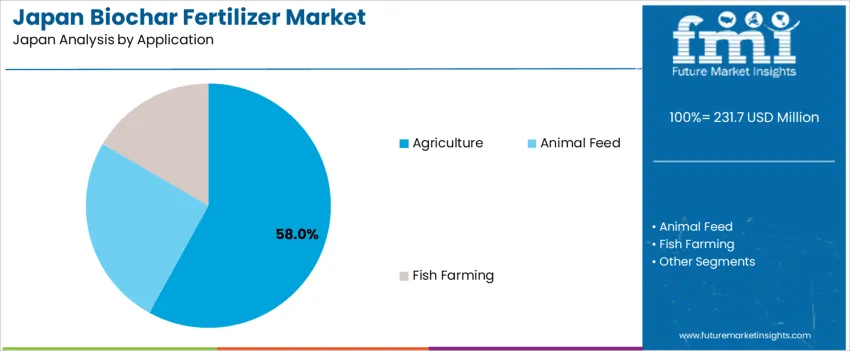
Agriculture accounts for 58% of the demand for biochar fertilizer in Japan, primarily due to the growing interest in sustainable farming practices and the need to improve soil quality. Biochar fertilizers are used in agriculture to enhance soil fertility, improve moisture retention, and increase crop yields. The ability of biochar to retain nutrients and reduce soil acidity makes it a valuable tool in enhancing soil health, particularly in regions with nutrient-poor or depleted soils.
As Japan's agricultural sector increasingly focuses on durability, farmers are turning to biochar fertilizers to improve the efficiency of their farming operations. The rise in demand for organic and eco-friendly products in the agricultural market, along with the government's support for sustainable farming initiatives, ensures that agriculture remains the largest driver of biochar fertilizer demand in Japan. This trend is expected to continue as environmental concerns and the need for sustainable agriculture practices grow.
What are the Key Trends, Drivers, and Restraints in Demand for Biochar Fertilizer in Japan?
Demand for biochar fertilizer in Japan is growing as Japanese agriculture and horticulture place greater emphasis on soil health, organic farming, and sustainable practices. Biochar, a stable, carbon-rich material produced via pyrolysis of biomass, is valued for improving soil structure, enhancing water retention, increasing nutrient holding capacity, and fostering beneficial soil microbial activity. These properties align well with Japan’s needs for high-yield crops, efficient land use, and maintenance of soil fertility under intensive farming. Growing awareness of environmental impact and interest in reducing chemical fertilizer use further drive adoption. However, production cost, limited supply of suitable feedstock, and inconsistency in biochar quality pose restraints to rapid uptake across all farms.
Why is Demand for Biochar Fertilizer Growing in Japan?
Demand rises because many Japanese farmers and horticultural producers aim to improve long-term soil productivity and manage soil degradation. Using biochar helps increase water retention, which is beneficial for crops especially under variable rainfall or irrigation regimes. Biochar also supports better nutrient retention and reduces leaching, making fertilizer use more efficient and reducing reliance on synthetic fertilizers. As organic and sustainable agriculture gain more attention among consumers and producers, biochar offers a complementary tool to compost and manure, helping meet demand for safer, chemical-reduced produce. Biochar’s potential for carbon sequestration resonates with climate and environmental goals, increasing its appeal.
How are Technological & Industry Innovations Driving Biochar Fertilizer Demand in Japan?
Advancements in pyrolysis technology and biochar production methods have improved the consistency, safety, and effectiveness of biochar fertilizers. Modern production from agricultural and forestry biomass waste enables efficient conversion while reducing waste disposal needs. Better processing yields biochar with improved porosity, stable carbon composition, and enhanced capacity for nutrient retention and water management. Innovations in combining biochar with organic or mineral fertilizers, creating blended soil amendments, improve nutrient use efficiency and lower the need for chemical fertilizers. These developments make biochar more user-friendly, scalable, and attractive for both large-scale farms and smallholders.
What are the Key Challenges and Risks That Could Limit Biochar Fertilizer Demand in Japan?
Despite its potential, several factors may limit biochar adoption in Japan. Production cost remains relatively high, making biochar more expensive than conventional fertilizers and limiting appeal for cost-sensitive farmers. Availability of suitable biomass feedstock and consistent quality across batches is a challenge. Variability in biochar properties due to different sources or pyrolysis methods can lead to inconsistent performance. Some soils or crop types may not benefit significantly, making return on investment uncertain. Also, widespread awareness and education about correct application methods are still limited, which can hinder effective use. Finally, logistics and supply chain for delivery and application at scale, especially for small or remote farms, may pose practical barriers.
What is the Regional Demand Outlook for Biochar Fertilizer in Japan?
.webp "Top Country Growth Comparison Japan Biochar Fertilizer Market Cagr (2026 2036)")
| Region | CAGR (%) |
|---|---|
| Kyushu & Okinawa | 7.3% |
| Kanto | 6.7% |
| Kansai | 5.9% |
| Chubu | 5.2% |
| Tohoku | 4.6% |
| Rest of Japan | 4.3% |
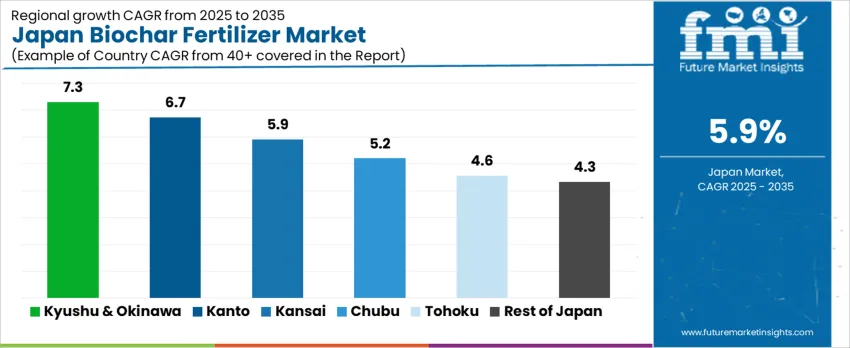
Demand for biochar fertilizer in Japan is growing steadily, with Kyushu & Okinawa leading at a 7.3% CAGR, driven by sustainable agriculture and eco-friendly farming practices. Kanto follows with a 6.7% CAGR, supported by its focus on organic farming and soil health. Kansai shows a 5.9% CAGR, fueled by its growing interest in sustainable farming and climate-smart agriculture. Chubu experiences a 5.2% CAGR, driven by the region’s agricultural base and focus on productivity. Tohoku and the Rest of Japan show moderate growth at 4.6% and 4.3% CAGR, respectively, with an increasing shift toward eco-friendly farming solutions. As sustainable agriculture continues to gain importance, demand for biochar fertilizer is expected to rise steadily across Japan.
How is Demand for Biochar Fertilizer Growing in Kyushu & Okinawa?
Kyushu & Okinawa leads the demand for biochar fertilizer, growing at a 7.3% CAGR. The region’s emphasis on sustainable agriculture and increasing interest in eco-friendly farming practices contribute to this rise. Kyushu & Okinawa, known for its agricultural production, particularly in fields like vegetables and fruits, is adopting biochar fertilizer to enhance soil quality and improve crop yields. The region's growing focus on organic farming and the need for environmentally responsible fertilizers are key drivers of this demand.
Local government initiatives aimed at promoting sustainable farming practices also support the use of biochar fertilizer. As farmers increasingly turn to biochar as a solution for soil health, water retention, and carbon sequestration, the demand for this fertilizer in Kyushu & Okinawa is expected to continue its strong growth, especially as durability becomes a more central focus in agriculture.
Why is Demand for Biochar Fertilizer Rising in Kanto?
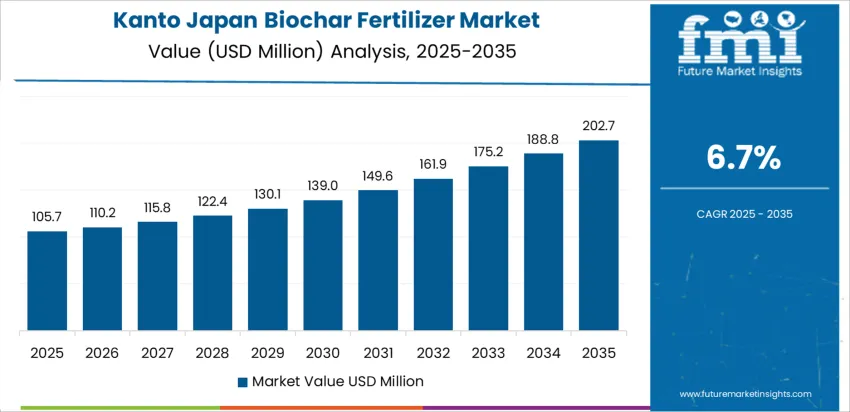
Kanto is experiencing steady demand for biochar fertilizer, with a 6.7% CAGR. The region’s large agricultural sector, particularly in areas surrounding Tokyo, is embracing biochar as a sustainable solution to improve soil fertility and reduce environmental impact. With a growing focus on organic farming and eco-friendly practices, biochar is gaining popularity for its ability to enhance soil structure, retain moisture, and boost nutrient availability.
Kanto's demand for biochar fertilizer is also driven by its growing awareness of carbon sequestration and soil health in farming practices. The agricultural sector in Kanto is increasingly turning to biochar to meet both environmental and productivity goals. The region’s strong consumer demand for sustainably grown produce is prompting farmers to adopt more environmentally friendly fertilizers. As demand for organic and sustainable agricultural products grows, biochar fertilizer adoption in Kanto is expected to rise.
How is Demand for Biochar Fertilizer Expanding in Kansai?
Kansai is seeing moderate demand for biochar fertilizer, with a 5.9% CAGR. The region’s agriculture, particularly in areas like Osaka and Kyoto, is increasingly turning to sustainable farming practices, and biochar is a key part of this shift. Biochar’s ability to improve soil health, retain moisture, and support organic farming has led to its growing popularity in Kansai. As organic farming methods gain traction, biochar fertilizer provides a solution for enhancing soil fertility while minimizing environmental impact.
Kansai’s farmers are increasingly incorporating biochar to meet consumer demand for sustainably produced crops. The region’s growing interest in climate-smart agriculture, along with government initiatives aimed at reducing environmental footprints, is expected to support the rise in biochar adoption. As demand for eco-friendly agricultural products continues to grow, biochar fertilizer usage in Kansai will likely continue expanding steadily.
Why is Demand for Biochar Fertilizer Growing in Chubu?
Chubu is experiencing steady demand for biochar fertilizer, with a 5.2% CAGR. The region’s strong agricultural base, particularly in rice and vegetable farming, is driving the adoption of biochar to enhance soil quality and increase productivity. Biochar is being increasingly used in Chubu to improve soil structure, increase water retention, and reduce the need for chemical fertilizers. As farmers focus on improving durability and organic farming practices, biochar is becoming an attractive option.
The region’s interest in climate-friendly farming techniques and eco-conscious consumer behavior also contributes to the growth of biochar fertilizer usage. Chubu’s emphasis on improving soil fertility to ensure long-term agricultural viability further drives the demand for biochar. As the region continues to adopt more sustainable farming practices, the demand for biochar fertilizer will rise steadily, contributing to both agricultural productivity and environmental stewardship.
How is Demand for Biochar Fertilizer Expanding in Tohoku?
Tohoku is seeing moderate demand for biochar fertilizer, with a 4.6% CAGR. The region’s agriculture, particularly in rice and fruit farming, is increasingly adopting biochar to enhance soil fertility and durability. Farmers in Tohoku are turning to biochar to improve soil health, retain moisture, and reduce the need for chemical fertilizers, especially as the region faces challenges like soil degradation and water scarcity. The government’s support for sustainable farming practices is also encouraging the use of biochar.
As Tohoku continues to modernize its farming techniques and focus on long-term soil health, the adoption of biochar fertilizer will likely grow. The region’s emphasis on organic farming and durability, alongside the growing demand for eco-friendly agricultural products, supports the steady growth of biochar fertilizer usage. As these trends continue, demand for biochar in Tohoku is expected to expand moderately.
Why is Demand for Biochar Fertilizer Steady in the Rest of Japan?
The Rest of Japan is experiencing steady demand for biochar fertilizer, with a 4.3% CAGR. While the market in rural and less industrialized areas is smaller compared to major urban regions, the growing shift toward sustainable and organic farming practices is driving the demand for biochar. Farmers in the Rest of Japan are increasingly adopting biochar to improve soil fertility, increase water retention, and reduce the dependency on synthetic fertilizers. As the demand for organically grown crops rises, biochar fertilizer is becoming a key component of farming practices in these regions.
Government support for sustainable agricultural practices and the growing awareness of environmental impact further contribute to biochar adoption. As rural and suburban areas in Japan continue to embrace digital farming technologies and sustainable practices, demand for biochar fertilizer is expected to continue rising steadily.
What is the Competitive Landscape of Japan Biochar Fertilizer Demand?
Demand for biochar fertilizer in Japan is rising sharply as interest grows in sustainable agriculture, soil health restoration, and carbon-negative farming practices. Biochar helps improve soil structure, increases water retention, and enhances nutrient retention, making it valuable for crop cultivation, horticulture, and even urban farming. With soil degradation concerns and climate goals prompting shifts toward environmentally friendly farming, Japanese farmers and agricultural cooperatives are increasingly turning to biochar as a soil amendment and fertilizer alternative.
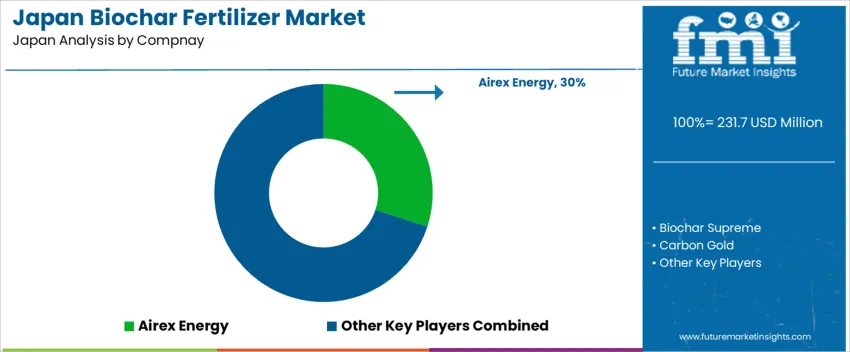
Major suppliers in the Japanese market include Airex Energy, Biochar Supreme, Carbon Gold, American BioChar Company, and Aries Clean Technologies. Airex Energy leads with a market share of 30.0%, offering biochar products tailored for agricultural use. Other companies supply a mix of standard and enhanced biochar fertilizers — some enriched with nutrients or beneficial microorganisms targeting both large-scale farms and smaller horticultural operations. These suppliers make biochar available for a variety of applications such as row crops, vegetable fields, rice paddies, and garden soil amendments.
Growth is driven by increasing demand for soil improvement, water-efficient agriculture, and reduced reliance on chemical fertilizers. Biochar’s ability to boost nutrient retention and moisture holding capacity improves crop yields and soil resilience. Government and industry initiatives supporting carbon sequestration and eco-friendly farming practices also encourage adoption of biochar solutions. Suppliers compete by offering high-quality biochar tailored to Japanese soil conditions, cost-effective packaging, and value-added variants, such as microbe-enhanced biochar. As awareness about sustainable agriculture and climate impact grows, biochar fertilizer is becoming a mainstream soil amendment in Japan.
Key Players in Japan Biochar Fertilizer Demand
- Airex Energy
- Biochar Supreme
- Carbon Gold
- American BioChar Company
- Aries Clean Technologies
Scope of the Report
| Metric | Value |
|---|---|
| Quantitative Units | USD 245.37 million to USD 435.29 million, at a CAGR of 5.9% |
| Market Definition | Biochar fertilizer encompasses pyrolysis-derived carbon soil amendments in organic, inorganic, and compound formulations for agricultural, aquaculture, and animal feed applications. |
| Segmentation | Nature: Organic, Inorganic, Compound; Application: Agriculture, Animal Feed, Fish Farming |
| Regions Covered | Kyushu & Okinawa, Kanto, Kansai, Chubu, Tohoku, Rest of Japan |
| Key Companies Profiled | Airex Energy, Biochar Supreme, Carbon Gold, American BioChar Company, Aries Clean Technologies |
| Forecast Period | 2026 to 2036 |
| Approach | Forecasting models apply a bottom-up methodology starting from trade volume baselines, applying category-specific growth coefficients and cross-validating against reported company financials and trade statistics. |
Japan Biochar Fertilizer Demand by Key Segments
Nature:
- Organic
- Inorganic
- Compound
Application:
- Agriculture
- Animal Feed
- Fish Farming
Region:
- Kyushu & Okinawa
- Kanto
- Kansai
- Chubu
- Tohoku
- Rest of Japan
Bibliography
- Ministry of Agriculture, Forestry and Fisheries, Japan. (2025). Annual Report on Food, Agriculture, and Rural Areas in Japan. MAFF.
- Japan Biochar Association. (2024). Biochar Application Guidelines for Agricultural Soil Amendment. JBA.
- Food and Agriculture Organization of the United Nations. (2024). Recarbonizing Global Soils: Technical Manual on Biochar. FAO.
- International Biochar Initiative. (2024). Standardized Product Definition and Product Testing Guidelines for Biochar. IBI.
- Organisation for Economic Co-operation and Development. (2024). OECD Environmental Performance Reviews: Japan. OECD.
This bibliography is provided for reader reference. The full Future Market Insights report contains the complete reference list with primary research documentation.
Frequently Asked Questions
How large is the demand for biochar fertilizer in japan market in 2026?
The demand for biochar fertilizer in japan market is estimated to be valued at USD 245.37 million in 2026.
What will be the market size of demand for biochar fertilizer in japan by 2036?
Market size for demand for biochar fertilizer in japan is projected to reach USD 435.29 million by 2036.
What is the expected CAGR for demand for biochar fertilizer in japan between 2026 and 2036?
The demand for biochar fertilizer in japan market is expected to grow at a CAGR of 5.9% between 2026 and 2036.
Which nature segment is poised to lead in 2026?
Organic accounts for 43.0% share in 2026, making it the leading nature segment.
Which application segment holds a leading position?
Agriculture holds 58.0% share in 2026, commanding the leading position by application.
Which region records the highest growth rate?
Kyushu & Okinawa records the highest CAGR at 7.3% during 2026 to 2036.
What is included in the scope of this report?
Market scope includes organic, inorganic, and compound biochar fertilizer products used in agricultural soil amendment, animal feed supplementation, and fish farming applications. The scope covers bio.
What is excluded from the scope of this report?
The scope excludes raw biomass feedstock not subjected to pyrolysis, activated carbon products used in industrial filtration, and biochar used exclusively for non-agricultural carbon sequestration pro.
Preview the report firsthand - request a free sample
Get SampleGet the brochure for pricing and purchase details.
Get PDFTable of Content
- Executive Summary
- Japan Market Outlook
- Demand-side Trends
- Supply-side Trends
- Technology Roadmap Analysis
- Analysis and Recommendations
- Market Overview
- Market Coverage / Taxonomy
- Market Definition / Scope / Limitations
- Research Methodology
- Chapter Orientation
- Analytical Lens and Working Hypotheses
- Market Structure, Signals, and Trend Drivers
- Benchmarking and Cross-market Comparability
- Market Sizing, Forecasting, and Opportunity Mapping
- Research Design and Evidence Framework
- Desk Research Programme (Secondary Evidence)
- Company Annual and Sustainability Reports
- Peer-reviewed Journals and Academic Literature
- Corporate Websites, Product Literature, and Technical Notes
- Earnings Decks and Investor Briefings
- Statutory Filings and Regulatory Disclosures
- Technical White Papers and Standards Notes
- Trade Journals, Industry Magazines, and Analyst Briefs
- Conference Proceedings, Webinars, and Seminar Materials
- Government Statistics Portals and Public Data Releases
- Press Releases and Reputable Media Coverage
- Specialist Newsletters and Curated Briefings
- Sector Databases and Reference Repositories
- FMI Internal Proprietary Databases and Historical Market Datasets
- Subscription Datasets and Paid Sources
- Social Channels, Communities, and Digital Listening Inputs
- Additional Desk Sources
- Expert Input and Fieldwork (Primary Evidence)
- Primary Modes
- Qualitative Interviews and Expert Elicitation
- Quantitative Surveys and Structured Data Capture
- Blended Approach
- Why Primary Evidence is Used
- Field Techniques
- Interviews
- Surveys
- Focus Groups
- Observational and In-context Research
- Social and Community Interactions
- Stakeholder Universe Engaged
- C-suite Leaders
- Board Members
- Presidents and Vice Presidents
- R&D and Innovation Heads
- Technical Specialists
- Domain Subject-matter Experts
- Scientists
- Physicians and Other Healthcare Professionals
- Governance, Ethics, and Data Stewardship
- Research Ethics
- Data Integrity and Handling
- Primary Modes
- Tooling, Models, and Reference Databases
- Desk Research Programme (Secondary Evidence)
- Data Engineering and Model Build
- Data Acquisition and Ingestion
- Cleaning, Normalisation, and Verification
- Synthesis, Triangulation, and Analysis
- Quality Assurance and Audit Trail
- Market Background
- Market Dynamics
- Drivers
- Restraints
- Opportunity
- Trends
- Scenario Forecast
- Demand in Optimistic Scenario
- Demand in Likely Scenario
- Demand in Conservative Scenario
- Opportunity Map Analysis
- Product Life Cycle Analysis
- Supply Chain Analysis
- Investment Feasibility Matrix
- Value Chain Analysis
- PESTLE and Porter’s Analysis
- Regulatory Landscape
- Regional Parent Market Outlook
- Production and Consumption Statistics
- Import and Export Statistics
- Market Dynamics
- Japan Market Analysis 2021 to 2025 and Forecast, 2026 to 2036
- Historical Market Size Value (USD Million) Analysis, 2021 to 2025
- Current and Future Market Size Value (USD Million) Projections, 2026 to 2036
- Y-o-Y Growth Trend Analysis
- Absolute $ Opportunity Analysis
- Japan Market Pricing Analysis 2021 to 2025 and Forecast 2026 to 2036
- Japan Market Analysis 2021 to 2025 and Forecast 2026 to 2036, By Nature
- Introduction / Key Findings
- Historical Market Size Value (USD Million) Analysis By Nature , 2021 to 2025
- Current and Future Market Size Value (USD Million) Analysis and Forecast By Nature , 2026 to 2036
- Organic
- Inorganic
- Compound
- Organic
- Y-o-Y Growth Trend Analysis By Nature , 2021 to 2025
- Absolute $ Opportunity Analysis By Nature , 2026 to 2036
- Japan Market Analysis 2021 to 2025 and Forecast 2026 to 2036, By Application
- Introduction / Key Findings
- Historical Market Size Value (USD Million) Analysis By Application, 2021 to 2025
- Current and Future Market Size Value (USD Million) Analysis and Forecast By Application, 2026 to 2036
- Agriculture
- Animal Feed
- Fish Farming
- Agriculture
- Y-o-Y Growth Trend Analysis By Application, 2021 to 2025
- Absolute $ Opportunity Analysis By Application, 2026 to 2036
- Japan Market Analysis 2021 to 2025 and Forecast 2026 to 2036, By Region
- Introduction
- Historical Market Size Value (USD Million) Analysis By Region, 2021 to 2025
- Current Market Size Value (USD Million) Analysis and Forecast By Region, 2026 to 2036
- Kyushu & Okinawa
- Kanto
- Kinki
- Chubu
- Tohoku
- Rest of Japan
- Market Attractiveness Analysis By Region
- Kyushu & Okinawa Market Analysis 2021 to 2025 and Forecast 2026 to 2036, By Country
- Historical Market Size Value (USD Million) Trend Analysis By Market Taxonomy, 2021 to 2025
- Market Size Value (USD Million) Forecast By Market Taxonomy, 2026 to 2036
- By Country
- By Nature
- By Application
- By Country
- Market Attractiveness Analysis
- By Country
- By Nature
- By Application
- Key Takeaways
- Kanto Market Analysis 2021 to 2025 and Forecast 2026 to 2036, By Country
- Historical Market Size Value (USD Million) Trend Analysis By Market Taxonomy, 2021 to 2025
- Market Size Value (USD Million) Forecast By Market Taxonomy, 2026 to 2036
- By Country
- By Nature
- By Application
- By Country
- Market Attractiveness Analysis
- By Country
- By Nature
- By Application
- Key Takeaways
- Kinki Market Analysis 2021 to 2025 and Forecast 2026 to 2036, By Country
- Historical Market Size Value (USD Million) Trend Analysis By Market Taxonomy, 2021 to 2025
- Market Size Value (USD Million) Forecast By Market Taxonomy, 2026 to 2036
- By Country
- By Nature
- By Application
- By Country
- Market Attractiveness Analysis
- By Country
- By Nature
- By Application
- Key Takeaways
- Chubu Market Analysis 2021 to 2025 and Forecast 2026 to 2036, By Country
- Historical Market Size Value (USD Million) Trend Analysis By Market Taxonomy, 2021 to 2025
- Market Size Value (USD Million) Forecast By Market Taxonomy, 2026 to 2036
- By Country
- By Nature
- By Application
- By Country
- Market Attractiveness Analysis
- By Country
- By Nature
- By Application
- Key Takeaways
- Tohoku Market Analysis 2021 to 2025 and Forecast 2026 to 2036, By Country
- Historical Market Size Value (USD Million) Trend Analysis By Market Taxonomy, 2021 to 2025
- Market Size Value (USD Million) Forecast By Market Taxonomy, 2026 to 2036
- By Country
- By Nature
- By Application
- By Country
- Market Attractiveness Analysis
- By Country
- By Nature
- By Application
- Key Takeaways
- Rest of Japan Market Analysis 2021 to 2025 and Forecast 2026 to 2036, By Country
- Historical Market Size Value (USD Million) Trend Analysis By Market Taxonomy, 2021 to 2025
- Market Size Value (USD Million) Forecast By Market Taxonomy, 2026 to 2036
- By Country
- By Nature
- By Application
- By Country
- Market Attractiveness Analysis
- By Country
- By Nature
- By Application
- Key Takeaways
- Key Countries Market Analysis
- Kyushu & Okinawa
- Pricing Analysis
- Market Share Analysis, 2025
- By Nature
- By Application
- Kanto
- Pricing Analysis
- Market Share Analysis, 2025
- By Nature
- By Application
- Kinki
- Pricing Analysis
- Market Share Analysis, 2025
- By Nature
- By Application
- Chubu
- Pricing Analysis
- Market Share Analysis, 2025
- By Nature
- By Application
- Tohoku
- Pricing Analysis
- Market Share Analysis, 2025
- By Nature
- By Application
- Rest of Japan
- Pricing Analysis
- Market Share Analysis, 2025
- By Nature
- By Application
- Kyushu & Okinawa
- Market Structure Analysis
- Competition Dashboard
- Competition Benchmarking
- Market Share Analysis of Top Players
- By Regional
- By Nature
- By Application
- Competition Analysis
- Competition Deep Dive
- Airex Energy
- Overview
- Product Portfolio
- Profitability by Market Segments (Product/Age /Sales Channel/Region)
- Sales Footprint
- Strategy Overview
- Marketing Strategy
- Product Strategy
- Channel Strategy
- Biochar Supreme
- Carbon Gold
- American BioChar Company
- Aries Clean Technologies
- Airex Energy
- Competition Deep Dive
- Assumptions & Acronyms Used


