

- Industry Size (2025)
- USD 491.4 Mn
- Forecast (2035)
- USD 609.4 Mn
- CAGR (2025 to 2035)
- 2.2%
Demand for Brushless Car Wash Machine in Japan Forecast and Outlook 2025 to 2035
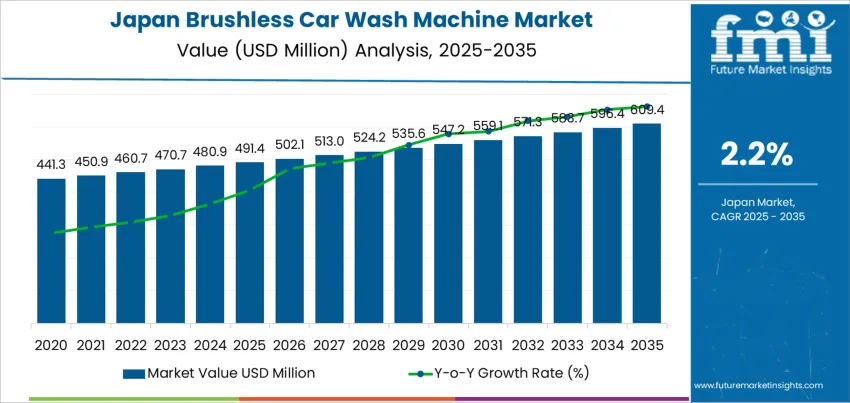
Demand for brushless car wash machines in Japan is valued at USD 491.4 million in 2025 and is projected to reach USD 609.4 million by 2035 at a CAGR of 2.2%. Early growth is shaped by stable vehicle ownership, limited space for manual washing in urban areas, and strong consumer preference for non-contact wash technology that avoids surface abrasion. Passenger vehicles account for about 30% of application demand, while commercial fleets support recurring service volume. Exterior wash systems dominate installations due to faster cycle times and lower labor reliance. Service stations and express wash formats drive most new placements, supported by replacement demand for aging tunnel systems installed during earlier retail fuel network expansion.
After 2030, value growth in Japan reflects gradual equipment upgrading rather than rapid site additions. Demand increases from about USD 547.2 million in 2030 toward USD 609.4 million by 2035 as operators prioritize water recycling efficiency, lower chemical consumption, and reduced energy use per wash cycle. Fleet operators for logistics, taxis, and municipal vehicles contribute steady commercial demand through multi-year service contracts. System reliability and uptime take priority in purchasing decisions as labor availability tightens. Key suppliers active in Japan include WashTec AG, PDQ Manufacturing Inc., Istobal S.A., Autec Car Wash Systems, and Ryko Solutions Inc. Competitive focus centers on wash consistency, drying efficiency, and remote diagnostics that support predictive maintenance scheduling across high-utilization sites.
Quick Stats of the Demand for Brushless Car Wash Machines in Japan
- Demand for Brushless Car Wash Machines in Japan Value (2025): USD 491.4 million
- Demand for Brushless Car Wash Machines in Japan Forecast Value (2035): USD 609.4 million
- Demand for Brushless Car Wash Machines in Japan Forecast CAGR (2025–2035): 2.2%
- Demand for Brushless Car Wash Machines in Japan Leading Application: Passenger Vehicle (30%)
- Demand for Brushless Car Wash Machines in Japan Key Growth Regions: Kyushu & Okinawa, Kanto, Kansai, Chubu, Tohoku, Rest of Japan
- Demand for Brushless Car Wash Machines in Japan Top Players: WashTec AG, PDQ Manufacturing Inc., Istobal S.A., Autec Car Wash Systems, Ryko Solutions Inc.
What is the Demand Forecast for Brushless Car Wash Machine in Japan through 2035?
Brushless car wash machines in Japan draw demand from automated service infrastructure, urban vehicle density, and labor optimization rather than from discretionary consumer equipment cycles. Demand increases from USD 491.4 million in 2025 to USD 524.2 million by 2028 and reaches USD 535.6 million by 2030, adding USD 44.2 million from the 2025 base. This phase reflects steady replacement of aging friction-based systems with touchless formats across fuel stations, fleet depots, and urban self-service wash centers. Growth is supported by rising preference for paint-safe cleaning, faster wash cycles, and reduced maintenance downtime. Value expansion remains controlled as installations are paced by site-level capital expenditure planning and space constraints.
From 2030 to 2035, the market expands from USD 535.6 million to USD 609.4 million, adding USD 73.8 million in the second half of the decade. This back weighted acceleration reflects higher deployment across commercial vehicle fleets, car rental hubs, and automated parking facilities where vehicle turnover intensity continues to rise. Advanced sensor-guided wash systems, water recycling integration, and chemical optimization platforms raise value per installation. As Japan continues to streamline urban vehicle servicing through automation and water-efficient infrastructure, brushless car wash machines shift from optional upgrades to standardized service assets, sustaining long-term demand growth through 2035.
Brushless Car Wash Machine Industry in Japan Key Takeaways
| Metric | Value |
|---|---|
| Industry Value (2025) | USD 491.4 million |
| Forecast Value (2035) | USD 609.4 million |
| Forecast CAGR (2025–2035) | 2.2% |
What Is Driving the Demand for Brushless Car Wash Machines in Japan?
The demand for brushless car wash machines in Japan has grown from structural shifts in urban mobility, vehicle ownership behavior, and service station operations. High population density, limited private washing space, and strict residential water use norms made home car washing less practical in many regions. Service stations and dedicated wash centers adopted automated systems to support fast turnover and consistent cleaning quality. Brushless systems gained preference over brush based units as concerns increased around paint damage on modern clear coat finishes and delicate exterior trims. Early adoption was strongest in metropolitan areas where time efficiency matters most. Fleet operators, taxi services, and rental agencies also shifted toward touch free systems to reduce surface wear and vehicle downtime.
Future demand for brushless car wash machines in Japan will be shaped by aging vehicle fleets, subscription wash services, and rising ownership of high value vehicles with sensitive finishes. As paint technologies evolve and surface coatings become thinner, demand for non contact cleaning will increase. Electric vehicles will reinforce this trend as owners prioritize careful exterior maintenance. Growth will also come from automated wash integration at fuel stations and retail parking complexes. Barriers include high installation cost, water recycling requirements, and chemical discharge regulation. Smaller operators may delay upgrades due to capital constraints. Market expansion will depend on cost reduction through modular systems and wider demonstration of long term paint protection benefits.
How Are Application and Wash Type Structuring the Demand for Brushless Car Wash Machines in Japan?
The demand for brushless car wash machines in Japan is structured by vehicle application and wash type. Passenger vehicles account for 30% of total demand, followed by commercial vehicles that include light trucks, delivery vans, and fleet operated transport units. By wash type, exterior washing represents 80.0% of total usage, while interior cleaning services form a smaller supporting segment. Demand behavior is shaped by urban vehicle density, vehicle ownership patterns, time efficiency requirements, and concern over surface paint protection. These segments reflect how vehicle usage profiles and primary cleaning priorities influence adoption of brushless washing systems across service stations, automated car wash centers, and fleet maintenance facilities in Japan.
Why Do Passenger Vehicles Lead the Brushless Car Wash Machine Application Demand in Japan?
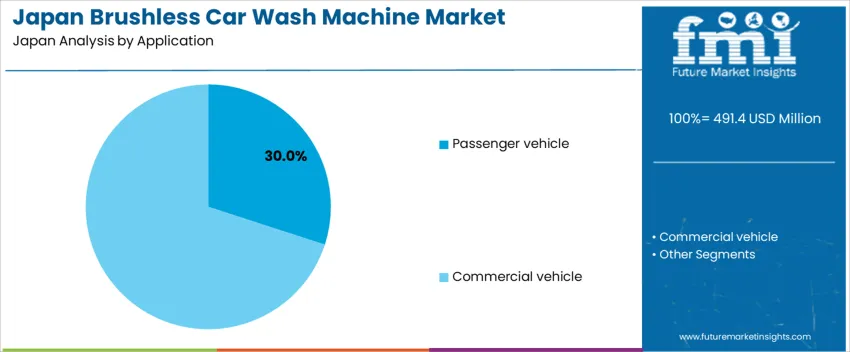
Passenger vehicles account for 30% of total brushless car wash machine demand in Japan due to high private vehicle ownership in suburban and regional areas combined with frequent urban usage. Daily exposure to road dust, rain residue, and airborne pollutants increases the need for regular exterior cleaning. Brushless systems are preferred by private car owners because they reduce the risk of surface scratches, clear coat damage, and mirror wear associated with mechanical brushes. This preference supports steady demand across automated wash centers and fuel station based washing units.
Passenger vehicle owners also value time efficiency, which aligns with quick cycle brushless washing formats. Subscription based car wash services and loyalty programs further encourage regular washing behavior. Compact car segments, which dominate Japanese roads, benefit from fast turnover in automated bays. These ownership patterns, surface protection concerns, and time saving preferences position passenger vehicles as the leading application segment in the Japan brushless car wash machine demand structure.
Why Does Exterior Washing Dominate the Brushless Car Wash Machine Wash Type Demand in Japan?
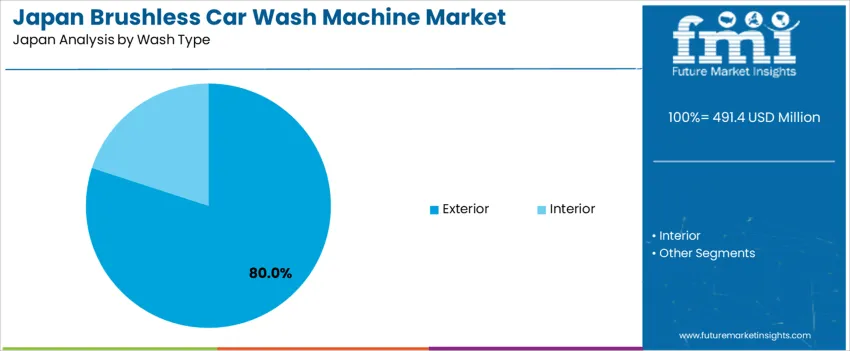
Exterior washing accounts for 80.0% of total brushless car wash machine demand in Japan due to its direct role in maintaining vehicle appearance, surface protection, and resale value. Road contamination from rain, dust, salt spray in coastal areas, and urban pollution requires frequent surface cleaning to prevent paint degradation and corrosion. Brushless exterior systems use high pressure water jets and chemical foams to remove dirt without physical contact, which aligns with consumer preferences for damage free cleaning.
Exterior washing also supports high throughput operations at service stations and automated car wash tunnels where speed and repeat volume are critical. Interior cleaning typically requires manual labor and longer service duration, which limits its automation scale. Insurance related vehicle inspections and resale preparation also prioritize exterior cleanliness. These operational efficiency, aesthetic maintenance, and corrosion prevention needs position exterior washing as the dominant wash type segment for brushless car wash machines in Japan.
Why Are Brushless Car Wash Machines in Japan Viewed as Paint Protection Systems Rather Than Cleaning Equipment?
Demand for brushless car wash machines in Japan is driven by consumer sensitivity to vehicle surface condition rather than speed of washing alone. Japanese car owners place high value on scratch-free finishes due to dense urban driving, narrow parking spaces, and frequent cosmetic detailing. Brush contact is associated with micro-swirls and coating damage, especially on dark-colored vehicles. Brushless systems reduce physical surface contact, which aligns with the strong domestic preference for preserving factory paint and aftermarket ceramic coatings. This shifts brushless systems into the category of protective maintenance tools rather than simple wash infrastructure.
How Do Gas Stations, Urban Land Constraints, and High Vehicle Turnover Shape Demand?
Gas stations are the primary deployment points for brushless car wash machines in Japan, where limited land availability restricts large tunnel installations. Compact, automated, touchless systems fit into tight forecourt layouts without disrupting fuel flow. High vehicle density in urban regions sustains frequent low-ticket wash usage rather than periodic deep cleaning. Leasing and fleet vehicles also move through rapid turnover cycles that require consistent cosmetic upkeep without risking surface wear. These spatial and usage patterns push demand toward compact, fast-cycle brushless systems suited for continuous urban throughput.
What Water Usage Controls, Operating Cost, and Cleaning Effectiveness Limit Expansion?
Brushless car wash adoption in Japan is restrained by water consumption regulation, energy cost, and perceived cleaning limitations. Some operators report reduced ability to remove heavy mud, road salt residue, or spring pollen buildup without mechanical action. High-pressure spray systems increase electricity and water recycling infrastructure cost. Chemical dependency for cleaning also raises operating expense and wastewater treatment complexity. In rural and industrial regions where vehicles accumulate heavy grime, operators still favor hybrid or soft-brush systems. These performance and cost tradeoffs limit universal replacement of traditional brush-based washing.
How Are AI Wash Profiling, Recycled Water Systems, and EV Compatibility Reshaping Demand?
Future demand in Japan is shifting toward brushless machines equipped with vehicle profiling sensors that adjust spray angle and pressure based on body geometry. Closed-loop recycled water systems are expanding to meet municipal discharge control standards. Electric vehicle ownership growth also favors brushless washing due to exposed sensors, cameras, and aerodynamic surfaces that are sensitive to physical contact. Digital payment integration and unmanned night operation improve revenue capture in labor-constrained regions. These shifts indicate brushless systems evolving into intelligent surface-care platforms rather than fixed mechanical wash equipment.
What is the Demand for Brushless Car Wash Machine in Japan by Region?
| Region | CAGR (%) |
|---|---|
| Kyushu & Okinawa | 2.7% |
| Kanto | 2.5% |
| Kansai | 2.2% |
| Chubu | 1.9% |
| Tohoku | 1.7% |
| Rest of Japan | 1.6% |
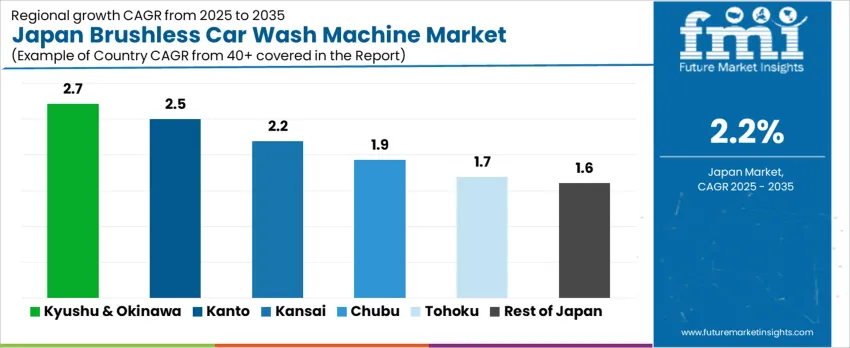
The demand for brushless car wash machines in Japan is growing at a moderate pace across all regions, with Kyushu & Okinawa leading at a 2.7% CAGR. Growth in this region is supported by rising vehicle ownership, increasing preference for automated car care, and expansion of service stations offering touchless wash solutions. Kanto follows at 2.5%, driven by dense urban vehicle populations, commercial fleet washing needs, and steady investment in automated car wash infrastructure. Kansai records 2.2% growth, supported by retail fuel station upgrades and consumer preference for scratch free cleaning systems. Chubu at 1.9% reflects moderate uptake linked to regional commercial vehicle activity. Tohoku and Rest of Japan, at 1.7% and 1.6%, show slower growth due to lower vehicle density and fewer new car wash installations.
How Is Service Station Modernization Supporting Demand in Kyushu And Okinawa?
Service infrastructure upgrading in Kyushu and Okinawa is advancing at a CAGR of 2.7% through 2035 for brushless car wash machine demand, supported by redevelopment of fuel stations, rising vehicle ownership, and tourism driven car rental activity. Automated wash solutions gain preference for reduced surface abrasion and faster service cycles. Coastal climate conditions also increase demand for frequent vehicle cleaning due to salt exposure. Small independent operators adopt compact brushless systems for limited space sites. Demand remains service driven, aligned with steady roadside station upgrades and growing preference for low maintenance automated wash formats.
- Tourism traffic supports rental vehicle wash demand
- Salt exposure increases routine cleaning frequency
- Compact systems suit independent service stations
- Automation supports faster customer turnaround
What Is Sustaining Brushless Car Wash Machine Uptake Across Kanto?
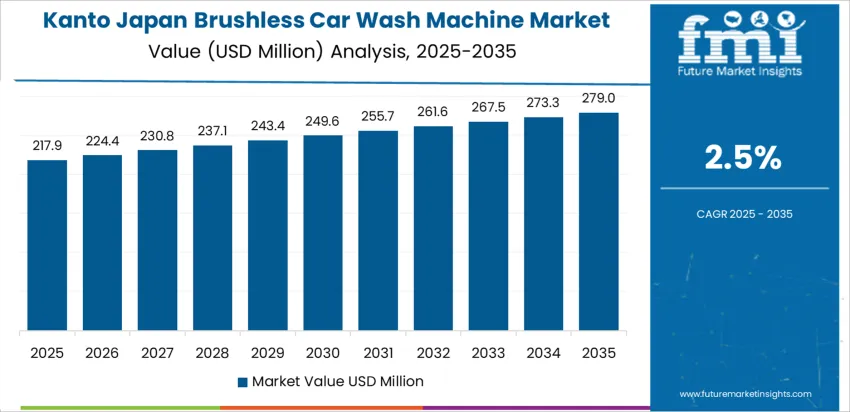
Urban mobility density in Kanto supports a CAGR of 2.5% through 2035 for brushless car wash machine demand, driven by high vehicle circulation, premium car ownership, and commercial fleet servicing. Customers favor touch free washing to protect high finish vehicle surfaces. Large scale fuel retailers integrate automated washes into loyalty based service models. Corporate fleet operators use brushless systems to manage uniform cleanliness across vehicles. Demand remains volume driven and convenience focused, shaped by dense traffic flow, time sensitive consumers, and continuous service throughput across metropolitan fueling and parking hubs.
- Premium vehicle ownership favors scratch free cleaning
- Fleet operators drive repeat automated wash usage
- Loyalty programs improve station level equipment utilization
- High traffic circulation sustains steady service volume
Why Is Kansai Showing Balanced Growth in Brushless Car Wash Adoption?
Retail service diversity in Kansai supports a CAGR of 2.2% through 2035 for brushless car wash machine demand, shaped by suburban fueling stations, car service centers, and used vehicle dealerships. Pre sale vehicle detailing supports consistent machine usage. Residential vehicle washing also gains share due to housing association restrictions on manual washing. Mid sized operators favor cost efficient brushless units with low water consumption. Demand remains replacement driven and moderate, aligned with dealership throughput, routine residential cleaning needs, and stable suburban vehicle servicing activity.
- Used car dealerships support recurring wash demand
- Housing restrictions drive offsite cleaning preference
- Water efficient machines suit suburban operators
- Replacement cycles guide steady equipment procurement
How Is Industrial Logistics Activity Shaping Demand in Chubu?
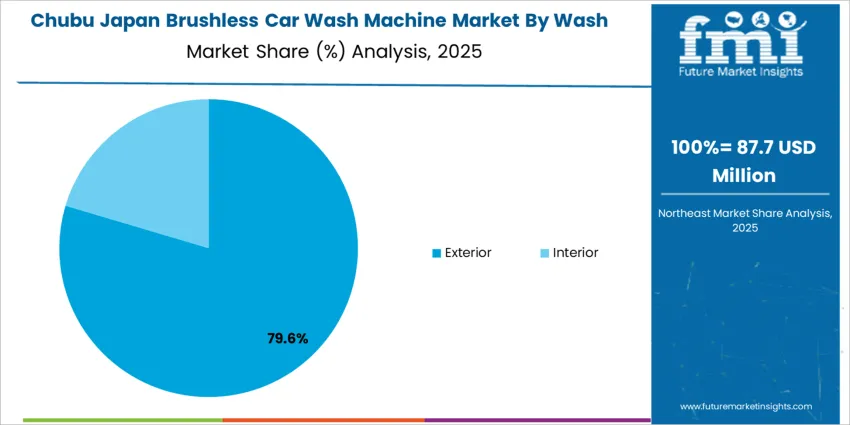
Manufacturing freight movement in Chubu supports a CAGR of 1.9% through 2035 for brushless car wash machine demand, driven by commercial vehicle fleets, parts logistics, and service depots tied to industrial supply chains. Delivery vans and car carrier vehicles require regular washing for branding and inspection readiness. Service depots install automated systems to manage routine fleet maintenance. Private passenger vehicle demand remains secondary. Demand stays operations led rather than retail led, with procurement linked to predictable fleet servicing schedules and controlled investment by industrial transport operators.
- Delivery fleets anchor routine machine utilization
- Branding requirements support frequent vehicle washing
- Depot based installations drive steady equipment demand
- Private car usage remains secondary to fleet needs
What Is Guiding Slower Brushless Car Wash Growth in Tohoku?
Vehicle servicing infrastructure in Tohoku supports a CAGR of 1.7% through 2035 for brushless car wash machine demand, shaped by lower vehicle density, seasonal road conditions, and stable household car ownership. Snow and road grit increase winter wash requirements, but overall demand remains moderate due to dispersed population. Independent service stations dominate installations. Manual washing methods still account for a significant share. Demand remains necessity driven and locally anchored, aligned with seasonal maintenance needs, road safety cleaning practices, and controlled capital spending by small station operators.
- Winter road conditions raise seasonal cleaning demand
- Independent stations dominate equipment ownership
- Manual washing remains widely practiced
- Dispersed population limits high throughput installations
Why Does the Rest of Japan Show the Slowest but Stable Adoption Trend?
Community level vehicle service across the rest of Japan reflects a CAGR of 1.6% through 2035 for brushless car wash machine demand, supported by small towns, agricultural vehicle cleaning, and low turnover fueling stations. Tractors, light trucks, and utility vehicles add limited application volume. Capital investment remains cautious among rural operators. Manual wash bays continue to meet basic needs. Demand stays stable and function driven, guided by routine agricultural and household vehicle care rather than adoption of premium automated washing infrastructure.
- Agricultural vehicles create limited offroad wash demand
- Rural stations show cautious capital investment behavior
- Manual bays remain dominant cleaning solution
- Low traffic volumes restrict rapid automation uptake
What Is Driving the Demand for Brushless Car Wash Machines in Japan and Who Are the Key Suppliers Shaping the Market?
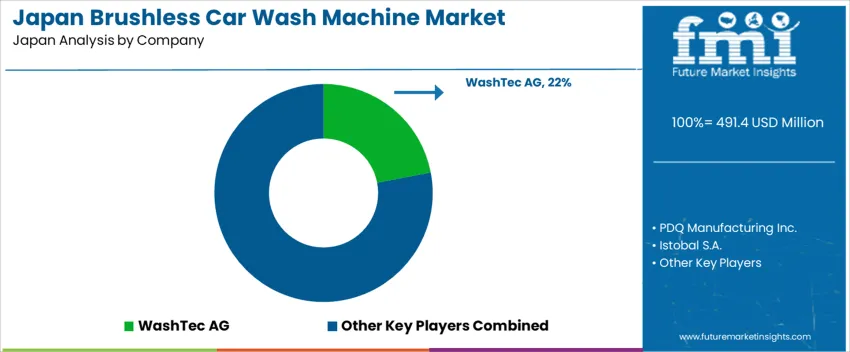
Demand for brushless car wash machines in Japan is rising as vehicle ownership increases and busy urban consumers look for convenient, fast, and low maintenance car washing solutions. Compact living spaces and limited off street parking in many Japanese cities make frequent wash and go services more appealing. Touchless wash systems appeal because they minimise potential surface damage and require little human labour. Growing environmental concern and stricter regulations on water use also support adoption of brushless systems, which typically use less water and employ efficient recycling or high pressure rinsing techniques. Fleet operators, rental car agencies, and used car dealers add demand as they seek scalable, consistent wash throughput.
Key suppliers active in, or influencing, the Japanese brushless car wash equipment market include WashTec AG, PDQ Manufacturing, Inc., Istobal S.A., Autec Car Wash Systems, and Ryko Solutions, Inc. WashTec leads globally with high speed, AI enhanced self service wash platforms and has significant export presence. PDQ specialises in in bay automatic and touchless car wash systems, known for reliability and water efficient performance. Istobal and Autec offer modular tunnel and gantry style wash systems adaptable to mixed vehicle sizes common in Japanese urban settings. Ryko supplies eco conscious, water efficient machines and supports maintenance friendly operations for fleet and commercial use. Together, these companies supply a mix of high capacity, water efficient, and low maintenance solutions that align with Japanese market requirements.
Key Players in Brushless Car Wash Machines Industry in Japan
- WashTec AG
- PDQ Manufacturing Inc.
- Istobal S.A.
- Autec Car Wash Systems
- Ryko Solutions Inc.
Scope of the Report
| Items | Values |
|---|---|
| Quantitative Units (2025) | USD million |
| Application | Passenger Vehicle, Commercial Vehicle |
| Wash Type | Exterior, Interior |
| Region | Kyushu & Okinawa, Kanto, Kinki, Chubu, Tohoku, Rest of Japan |
| Key Companies Profiled | WashTec AG, PDQ Manufacturing Inc., Istobal S.A., Autec Car Wash Systems, Ryko Solutions Inc. |
| Additional Attributes | Dollar by sales by vehicle type, wash type, and region. Includes passenger car and commercial fleet throughput, exterior wash frequency, interior cleaning service share, automated tunnel and gantry system adoption, service station integration, fleet contract utilization, subscription wash service impact, water recycling implementation, chemical consumption optimization, energy efficiency per wash, labor reduction impact, AI-guided wash systems, sensor profiling usage, maintenance cost savings, urban versus rural uptake differences, EV and high-value vehicle considerations, compact site deployment, seasonal wash intensity, and replacement cycles of legacy brush systems across Japan. |
Brushless Car Wash Machines Industry in Japan Segmentation
Application:
- Passenger vehicle
- Commercial vehicle
Wash Type:
- Exterior
- Interior
Region:
- Kyushu & Okinawa
- Kanto
- Kansai
- Chubu
- Tohoku
- Rest of Japan
Frequently Asked Questions
How big is the demand for brushless car wash machine in Japan in 2025?
The demand for brushless car wash machine in Japan is estimated to be valued at USD 491.4 million in 2025.
What will be the size of brushless car wash machine in Japan in 2035?
The market size for the brushless car wash machine in Japan is projected to reach USD 609.4 million by 2035.
How much will be the demand for brushless car wash machine in Japan growth between 2025 and 2035?
The demand for brushless car wash machine in Japan is expected to grow at a 2.2% CAGR between 2025 and 2035.
What are the key product types in the brushless car wash machine in Japan?
The key product types in brushless car wash machine in Japan are passenger vehicle and commercial vehicle.
Which wash type segment is expected to contribute significant share in the brushless car wash machine in Japan in 2025?
In terms of wash type, exterior segment is expected to command 80.0% share in the brushless car wash machine in Japan in 2025.
Preview the report firsthand - request a free sample
Get SampleGet the brochure for pricing and purchase details.
Get PDFTable of Content
- Executive Summary
- Japan Market Outlook
- Demand-side Trends
- Supply-side Trends
- Technology Roadmap Analysis
- Analysis and Recommendations
- Market Overview
- Market Coverage / Taxonomy
- Market Definition / Scope / Limitations
- Market Background
- Market Dynamics
- Drivers
- Restraints
- Opportunity
- Trends
- Scenario Forecast
- Demand in Optimistic Scenario
- Demand in Likely Scenario
- Demand in Conservative Scenario
- Opportunity Map Analysis
- Product Life Cycle Analysis
- Supply Chain Analysis
- Investment Feasibility Matrix
- Value Chain Analysis
- PESTLE and Porter’s Analysis
- Regulatory Landscape
- Regional Parent Market Outlook
- Production and Consumption Statistics
- Import and Export Statistics
- Market Dynamics
- Japan Market Analysis 2020 to 2024 and Forecast, 2025 to 2035
- Historical Market Size Value (USD Million) Analysis, 2020 to 2024
- Current and Future Market Size Value (USD Million) Projections, 2025 to 2035
- Y-o-Y Growth Trend Analysis
- Absolute $ Opportunity Analysis
- Japan Market Pricing Analysis 2020 to 2024 and Forecast 2025 to 2035
- Japan Market Analysis 2020 to 2024 and Forecast 2025 to 2035, By Application
- Introduction / Key Findings
- Historical Market Size Value (USD Million) Analysis By Application , 2020 to 2024
- Current and Future Market Size Value (USD Million) Analysis and Forecast By Application , 2025 to 2035
- Passenger vehicle
- Commercial vehicle
- Y-o-Y Growth Trend Analysis By Application , 2020 to 2024
- Absolute $ Opportunity Analysis By Application , 2025 to 2035
- Japan Market Analysis 2020 to 2024 and Forecast 2025 to 2035, By Wash Type
- Introduction / Key Findings
- Historical Market Size Value (USD Million) Analysis By Wash Type, 2020 to 2024
- Current and Future Market Size Value (USD Million) Analysis and Forecast By Wash Type, 2025 to 2035
- Exterior
- Interior
- Y-o-Y Growth Trend Analysis By Wash Type, 2020 to 2024
- Absolute $ Opportunity Analysis By Wash Type, 2025 to 2035
- Market Structure Analysis
- Competition Dashboard
- Competition Benchmarking
- Market Share Analysis of Top Players
- By Regional
- By Application
- By Wash Type
- Competition Analysis
- Competition Deep Dive
- WashTec AG
- Overview
- Product Portfolio
- Profitability by Market Segments (Product/Age /Sales Channel/Region)
- Sales Footprint
- Strategy Overview
- Marketing Strategy
- Product Strategy
- Channel Strategy
- PDQ Manufacturing Inc.
- Istobal S.A.
- Autec Car Wash Systems
- Ryko Solutions Inc.
- WashTec AG
- Competition Deep Dive
- Assumptions & Acronyms Used
- Research Methodology


