

- Industry Size (2025)
- USD 49.1 Bn
- Forecast (2035)
- USD 73.6 Bn
- CAGR (2025 to 2035)
- 4.1%
Demand for Process Automation and Instrumentation in Japan Forecast and Outlook 2025 to 2035
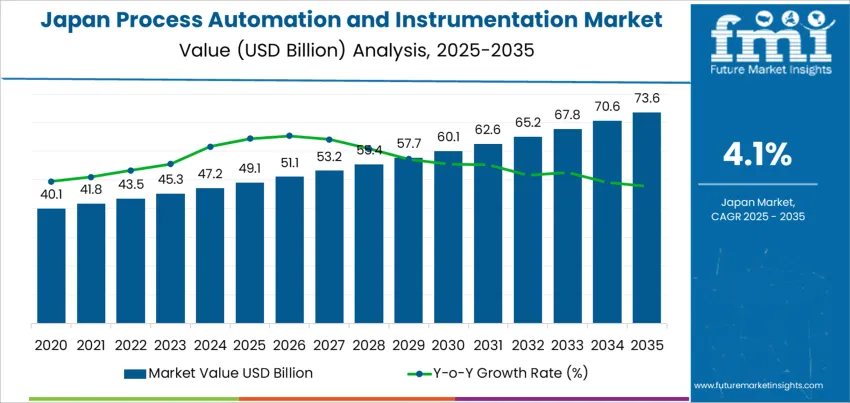
The industry for process automation and instrumentation in Japan is expected to experience steady growth from USD 49.1 billion in 2025 to USD 73.6 billion by 2035, reflecting a compound annual growth rate (CAGR) of 4.1%. These solutions are critical in improving efficiency, precision, and safety across industries like manufacturing, chemicals, pharmaceuticals, and energy. As the demand for automation systems and real-time monitoring solutions increases, Japan's focus on technological advancements and digital transformation will continue to fuel the adoption of process automation and instrumentation technologies.
The rise of smart manufacturing, IoT integration, and AI-driven solutions is expected to play a significant role in driving the demand for these technologies. Process automation and instrumentation solutions enable organizations to optimize operational processes, reduce downtime, and enhance quality control. Japan’s strong focus on sustainability and energy efficiency further supports the adoption of automated systems, especially in sectors such as automotive manufacturing, chemical production, and pharmaceuticals. As industries continue to prioritize digitization and advanced data analytics, the demand for these solutions will rise steadily.
Quick Stats of the Demand for Process Automation and Instrumentation in Japan
- Demand for Process Automation and Instrumentation in Japan Value (2025): USD 49.1 billion
- Demand for Process Automation and Instrumentation in Japan Forecast Value (2035): USD 73.6 billion
- Demand for Process Automation and Instrumentation in Japan Forecast CAGR (2025-2035): 4.1%
- Demand for Process Automation and Instrumentation in Japan Leading Operation Type: Automatic
- Demand for Process Automation and Instrumentation in Japan Key Growth Regions: Kyushu & Okinawa, Kanto, Kinki, Chubu, Tohoku, Rest of Japan
- Demand for Process Automation and Instrumentation in Japan Top Players: Emerson Electric Company, Mitsubishi Electric Company, Rockwell Automation Inc., Siemens AG, ABB Limited
What is the Growth Forecast for the Demand for Process Automation and Instrumentation in Japan through 2035?
Between 2025 and 2030, the demand for process automation and instrumentation in Japan is expected to grow from USD 49.1 billion to USD 51.1 billion. This phase will see moderate growth, driven by steady demand from industries like industrial automation, chemical production, and pharmaceutical manufacturing. The adoption of advanced sensors, automation systems, and data-driven solutions will gradually increase during this period. Companies will continue to focus on improving process efficiency, product quality, and safety standards. Incremental gains in demand will be fueled by the need for more precise control and optimized operations. The ongoing digital transformation and focus on sustainability in key sectors will further contribute to the steady rise in demand during this period.
From 2030 to 2035, the industry will experience accelerated growth, with demand rising from USD 51.1 billion to USD 73.6 billion. This sharp rise will be attributed to the continued digital transformation of industries and the growing adoption of intelligent automation solutions. Key drivers will include the increasing integration of AI and machine learning into industrial processes, which will enable greater precision and predictive maintenance capabilities. As IoT solutions become more widespread, companies will increasingly rely on real-time data to monitor operational performance and optimize processes. Sectors focused on sustainability and green manufacturing will increasingly integrate energy-efficient solutions, driving demand for more advanced automation technologies.
Demand for Process Automation and Instrumentation in Japan Key Takeaways
| Metric | Value |
|---|---|
| Demand for Process Automation and Instrumentation in Japan Value (2025) | USD 49.1 billion |
| Demand for Process Automation and Instrumentation in Japan Forecast Value (2035) | USD 73.6 billion |
| Demand for Process Automation and Instrumentation in Japan Forecast CAGR (2025-2035) | 4.1% |
Why is the Demand for Process Automation and Instrumentation in Japan Growing?
The demand for process automation and instrumentation in Japan is growing as industries increasingly adopt digital solutions to optimize production efficiency, reduce costs, and ensure product quality. Process automation systems, combined with advanced instrumentation, are essential for improving the control and monitoring of manufacturing processes in sectors such as automotive, chemicals, pharmaceuticals, and food processing. These solutions allow for better precision, real-time monitoring, and greater scalability in production, driving demand across various industries in Japan.
A major driver of this growth is the ongoing industrial automation trend, as Japanese manufacturers seek to enhance productivity and address labor shortages. Process automation enables companies to streamline operations, reduce human error, and increase overall throughput. With Japan’s aging workforce and the need for sustainable, cost-effective manufacturing solutions, automation is becoming a key enabler of competitiveness in industries ranging from electronics to energy.
The increasing focus on sustainability and energy efficiency is contributing to the adoption of process automation and instrumentation. These systems help optimize energy use, reduce waste, and improve environmental compliance, making them attractive to companies aiming to meet stricter environmental regulations. As Japanese industries continue to invest in smart manufacturing, data analytics, and IoT technologies, the demand for process automation and instrumentation is expected to grow steadily through 2035, driven by the need for more efficient, adaptable, and sustainable production methods.
What is the Segment-Wise Analysis of Demand for Process Automation and Instrumentation in Japan?
Demand for process automation and instrumentation in Japan is segmented by operation type, end-use industry, and region. By operation type, demand is divided into automatic, semi-automatic, and others, with automatic leading the demand at 45%. The demand is also segmented by end-use industry, including automotive, chemical, metal & mining, food & beverage, oil & gas, pharmaceutical, pulp & paper, and wastewater treatment, with the automotive industry leading the demand at 26.5%. Regionally, demand is divided into Kanto, Kinki, Chubu, Kyushu & Okinawa, Tohoku, and the Rest of Japan.
Why Does Automatic Lead the Operation Type Demand for Process Automation and Instrumentation?
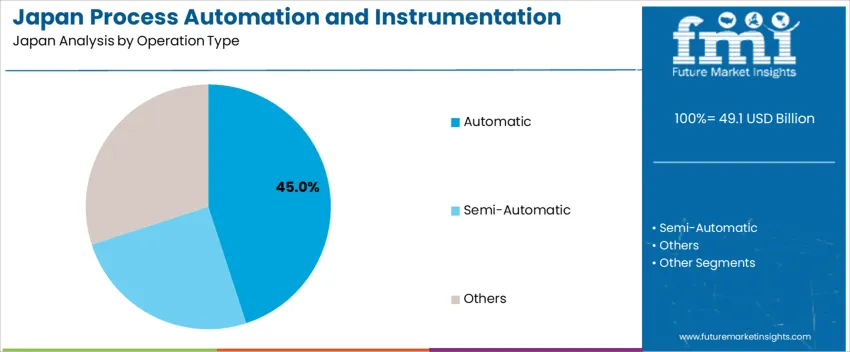
Automatic systems account for 45% of the demand for process automation and instrumentation in Japan. These systems are vital for ensuring efficiency and consistency across industries such as automotive, food & beverage, and pharmaceuticals. Automatic systems reduce human intervention, minimize errors, and enhance precision, making them ideal for high-throughput, repetitive tasks that require exactness. The adoption of Industry 4.0 and smart manufacturing further drives demand, as businesses seek to integrate automation with real-time data monitoring to improve decision-making. With Japan focusing on optimizing production, improving safety, and scaling operations, automatic systems are essential for enhancing productivity and reducing operational costs. As more industries embrace automation to stay competitive, automatic systems will continue to lead the demand for process automation solutions.
How Does the Automotive Industry Lead the End-Use Demand for Process Automation and Instrumentation?
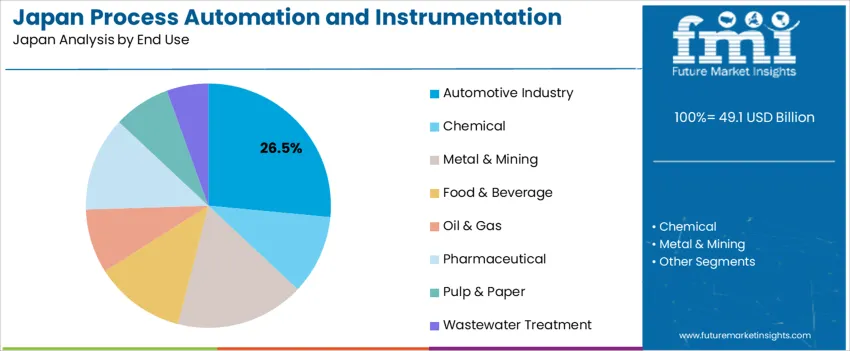
The automotive industry accounts for 26.5% of the demand for process automation and instrumentation in Japan. This sector relies heavily on automation technologies to streamline manufacturing and ensure high-quality standards in vehicle production. Automation is essential for processes such as welding, assembly line operations, and quality control, where precision and speed are crucial. With the rise of electric vehicles (EVs) and advanced manufacturing techniques, the automotive industry is adopting more sophisticated automation systems to maintain competitiveness. These systems help improve efficiency, reduce costs, and meet the growing demand for more complex vehicle designs. As the automotive industry continues to evolve and production demands increase, process automation and instrumentation solutions will be integral to supporting its growth and efficiency, keeping the sector at the forefront of technological advancements.
What are the Key Trends, Drivers, and Restraints in Demand for Process Automation and Instrumentation in Japan?
Demand for process automation and instrumentation in Japan is rising sharply as manufacturers across industries like automotive, electronics, pharmaceuticals, and food & beverage increasingly adopt “smart‑factory” and digital‑manufacturing models to boost efficiency. The push toward automation is supported by the growing use of industrial robotics, smart sensors and control systems. Automation helps ensure precision, consistency, safety, and quality control. However, the restraints include high capital investment costs for modern control systems and sensors, the complexity of integrating upgrades into legacy plants, and a shortage of skilled engineers familiar with advanced automation technologies.
Why is Demand for Process Automation and Instrumentation Growing in Japan?
Demand in Japan is growing due to the country’s ageing population and a shrinking workforce, making labor‑intensive, manual processes less sustainable. As a result, companies are seeking automation to remain competitive. Process instrumentation and automated control systems reduce reliance on manual labor while improving throughput, reducing errors, and ensuring consistent quality. High regulatory and quality standards in sectors like pharmaceuticals, electronics, and automotive manufacturing further drive uptake. The need for global competitiveness in Japanese manufacturing encourages the adoption of efficient, precise, and flexible automation solutions, making these systems essential.
How are Technological and Design Innovations Driving Growth of Process Automation and Instrumentation in Japan?
Technological advancements in sensor technology, networked control systems, data analytics, and automation software are accelerating the adoption of process instrumentation in Japan. Modern instruments, along with IoT connectivity, real‑time data collection, and analytics, enable predictive maintenance, process optimization, and energy efficiency. These solutions improve productivity and reduce downtime. Integration with robotics, automated control valves, and distributed‑control systems enables flexible, high‑precision operations. Modular and scalable solutions are making it easier for firms to retrofit older facilities rather than build new ones, further driving demand for automation and instrumentation.
What are the Key Challenges Limiting Wider Adoption of Process Automation and Instrumentation in Japan?
Despite the growing demand, several challenges limit wider adoption of process automation and instrumentation in Japan. High upfront costs for automation hardware, control systems, and associated software are a significant barrier, particularly for small and mid‑sized enterprises. Integrating new systems into legacy production lines can also be complex, requiring downtime and retraining. There is a shortage of skilled workers capable of maintaining and operating advanced automation technologies. The rapid pace of technological advancements may lead to concerns about obsolescence, further deterring firms from making large investments in automation systems.
What is the Regional Demand Outlook for Process Automation and Instrumentation in Japan?
| Region | CAGR (%) |
|---|---|
| Kyushu & Okinawa | 5.2% |
| Kanto | 4.7% |
| Kinki | 4.2% |
| Chubu | 3.7% |
| Tohoku | 3.2% |
| Rest of Japan | 3.1% |
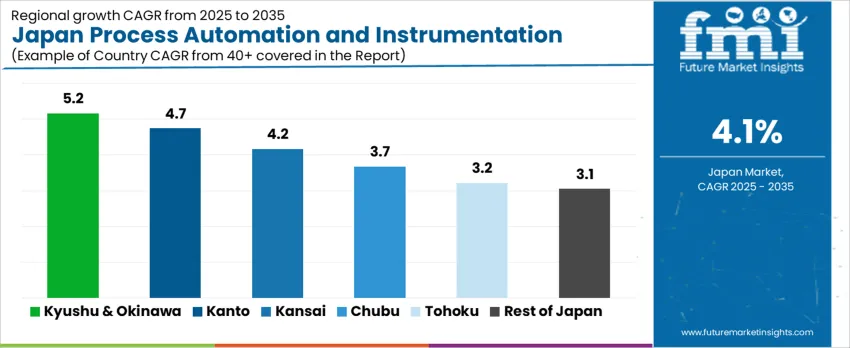
Demand for process automation and instrumentation in Japan is growing steadily, with Kyushu & Okinawa leading at a 5.2% CAGR. Kanto follows with a 4.7% CAGR, driven by its industrial base and focus on innovation. Kinki shows a 4.2% CAGR, supported by its large manufacturing sectors. Chubu experiences a 3.7% CAGR, with demand driven by automotive and industrial sectors. Tohoku and the Rest of Japan see moderate growth at 3.2% and 3.1%, respectively, as regional industries modernize and adopt automation solutions. As Japan’s industries continue to embrace automation and digital transformation, the demand for process automation and instrumentation systems will continue to rise across all regions.
What is Driving Process Automation and Instrumentation Demand in Kyushu & Okinawa?
Kyushu & Okinawa lead in demand for process automation and instrumentation with a 5.2% CAGR. This growth is fueled by the region’s emphasis on modernizing its manufacturing processes, particularly in industries like electronics, automotive, and food production. The rising labor costs and the need for increased production efficiency are pushing businesses to invest in automation technologies. The growing presence of global supply chains in Kyushu and Okinawa is accelerating the adoption of automated solutions to meet quality control, precision, and output demands. These areas are leveraging digital technologies to ensure optimal performance in both large-scale and smaller-scale operations. As the region continues to embrace automation, there will be greater reliance on advanced process instrumentation and control systems to monitor and enhance industrial operations.
How is Demand for Process Automation and Instrumentation Growing in Kanto?
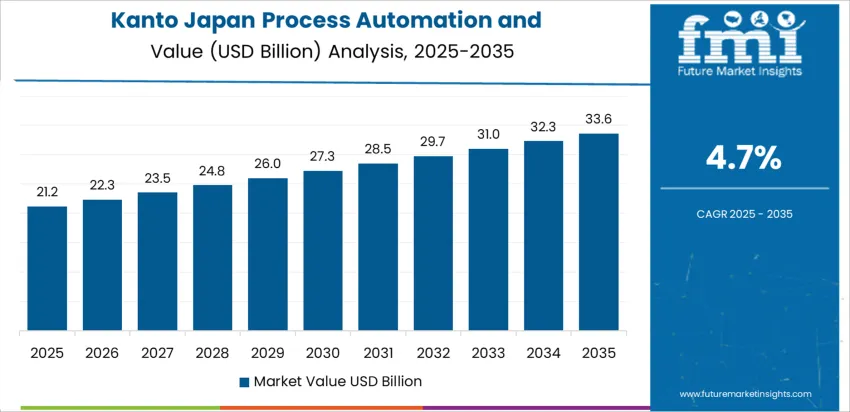
Kanto, home to major cities like Tokyo, is seeing strong demand for process automation and instrumentation with a 4.7% CAGR. The demand is primarily driven by the region’s focus on maintaining high standards of quality and precision in industries like automotive manufacturing, electronics, and pharmaceuticals. As the industrial and tech sectors in Kanto continue to grow, the need for automated systems that enhance efficiency, streamline production, and reduce manual errors is increasing. The rapid development of smart factories and the push towards Industry 4.0 in Kanto further drive the demand for digital solutions and automation technologies. Kanto’s technological innovation, especially in robotics, AI, and IoT, is reinforcing the demand for advanced process automation solutions, ensuring that the region remains at the forefront of automation adoption in Japan.
Why is Process Automation and Instrumentation Demand Growing in Kinki?
Kinki, which includes major manufacturing hubs like Osaka and Kobe, shows steady growth in demand for process automation and instrumentation with a 4.2% CAGR. The region’s industrial sectors, particularly in automotive, machinery, and electronics, are heavily investing in process automation to enhance efficiency, maintain competitiveness, and meet global manufacturing standards. The push for more advanced production systems, capable of handling complex tasks while maintaining high quality, is a key driver. The rise of digital transformation initiatives in Kinki has encouraged companies to embrace automation and instrumentation solutions for process monitoring, quality control, and data analytics. With increasing automation in factories and a focus on sustainable, efficient production, demand for process automation and instrumentation systems in Kinki is expected to remain strong.
How is Demand for Process Automation and Instrumentation Growing in Chubu?
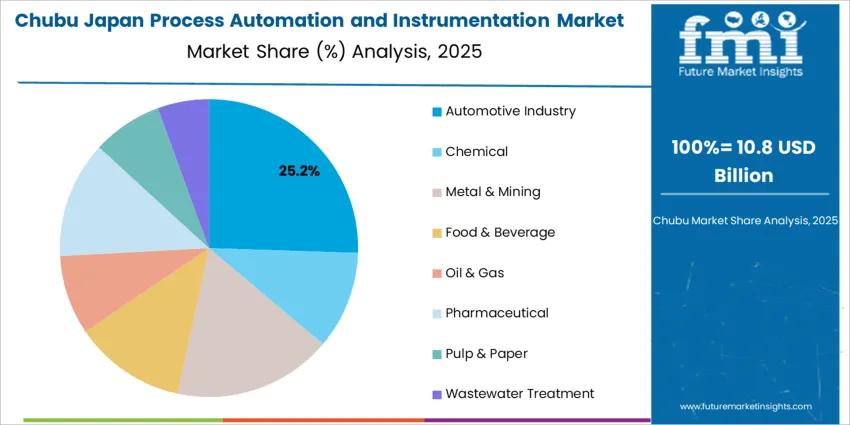
Chubu, known for its strong automotive manufacturing industry, sees moderate growth in demand for process automation and instrumentation with a 3.7% CAGR. The region is focused on improving production efficiency in industries like automotive, chemicals, and steel, all of which are increasingly adopting automated systems to streamline operations and reduce costs. As Chubu’s industries modernize and embrace automation technologies, the demand for advanced control systems, sensors, and monitoring equipment continues to rise. The region’s emphasis on enhancing manufacturing precision and maintaining high output levels, coupled with the adoption of robotics and automation in assembly lines, is contributing to the steady growth of process automation and instrumentation. As manufacturing processes become more digitized, Chubu will continue to see steady growth in demand for these solutions.
What is Supporting Process Automation and Instrumentation Demand in Tohoku?
Tohoku is seeing moderate growth in process automation and instrumentation demand, with a 3.2% CAGR. The region’s industrial base, primarily focused on traditional manufacturing sectors such as food processing, paper production, and small-scale manufacturing, is slowly embracing automation to improve productivity and quality. As labor shortages and the need for operational efficiency increase, companies in Tohoku are beginning to adopt process automation solutions to stay competitive. The region is investing in modernizing its industrial infrastructure to keep pace with the growing demand for automation. While growth is slower compared to other regions, Tohoku’s shift towards automating manufacturing processes will continue to drive demand for process automation and instrumentation systems, especially in manufacturing plants focused on precision and efficiency.
How is Demand for Process Automation and Instrumentation Growing in the Rest of Japan?
The Rest of Japan is seeing moderate growth in demand for process automation and instrumentation, with a 3.1% CAGR. This demand is primarily driven by small- to mid-sized industries in rural areas and peripheral regions, where automation technologies are being introduced incrementally. These industries are investing in process automation solutions to meet the increasing demand for efficiency and to address labor shortages. As businesses in the Rest of Japan look to reduce costs, improve consistency, and increase output, they are adopting advanced control systems, sensors, and automated processes. While the growth rate is slower compared to more industrialized regions like Kanto and Kyushu, the gradual shift towards automation in smaller enterprises is contributing to steady demand growth across these areas.
What is the Competitive Landscape of Process Automation and Instrumentation Demand in Japan?
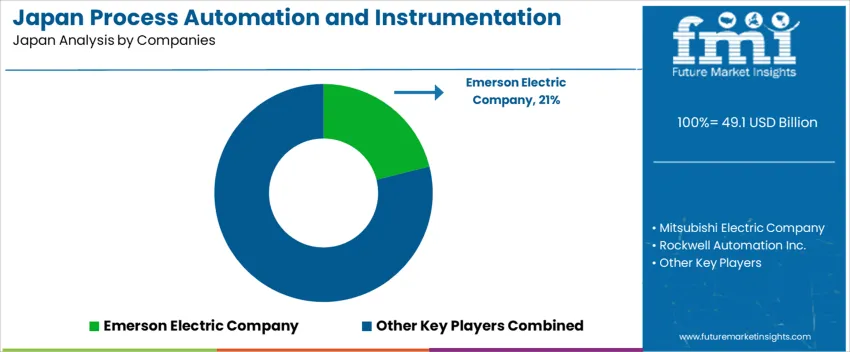
The demand for process automation and instrumentation in Japan is increasing as industries strive for greater efficiency, precision, and cost-effectiveness. Automation technologies are becoming integral to sectors such as manufacturing, chemical production, automotive, and energy. Japan's advanced industrial base and emphasis on innovation drive the demand for cutting-edge process control systems, measurement tools, and automation solutions. These solutions are vital for improving productivity, reducing operational risks, and enhancing product quality. The ongoing trend towards smart factories and digital transformation is further accelerating the adoption of automation and instrumentation in the region.
Leading companies in the process automation and instrumentation sector in Japan include Emerson Electric Company, Mitsubishi Electric Company, Rockwell Automation Inc., Siemens AG, and ABB Limited. Emerson Electric Company holds a significant industry share of 21.1%, offering advanced process control, measurement technologies, and automation solutions for various industries, including energy, chemicals, and manufacturing. Mitsubishi Electric Company provides automation solutions that integrate advanced control systems with energy-efficient technologies for industrial applications. Rockwell Automation Inc. focuses on smart automation and industrial control systems, helping companies optimize their production processes. Siemens AG offers integrated automation solutions, including hardware and software for process control, while ABB Limited delivers advanced robotics, automation systems, and instrumentation solutions for a wide range of industries.
Competition in the process automation and instrumentation industry in Japan is driven by the need for greater operational efficiency, the push for Industry 4.0 integration, and the demand for smart, connected systems. Companies compete by offering innovative solutions that improve productivity, reduce downtime, and enhance data analytics capabilities. The ability to integrate automation technologies with other digital systems, such as AI and IoT, is a key differentiator.
Key Players in Japan Process Automation and Instrumentation Demand
- Emerson Electric Company
- Mitsubishi Electric Company
- Rockwell Automation Inc.
- Siemens AG
- ABB Limited
Scope of Report
| Items | Values |
|---|---|
| Quantitative Units (2025) | USD billion |
| Operation Type | Automatic, Semi-Automatic, Others |
| End Use | Automotive Industry, Chemical, Metal & Mining, Food & Beverage, Oil & Gas, Pharmaceutical, Pulp & Paper, Wastewater Treatment |
| Solution | PLC, SCADA, DCS, HMI, APC, MES, Safety Automation |
| Instrument Type | Transmitters, Flow Meters, Analyzers, Controllers, Switches, Recorders, Vacuum Instruments |
| Region | Kyushu & Okinawa, Kanto, Kinki, Chubu, Tohoku, Rest of Japan |
| Countries Covered | Japan |
| Key Companies Profiled | Emerson Electric Company, Mitsubishi Electric Company, Rockwell Automation Inc., Siemens AG, ABB Limited |
| Additional Attributes | Dollar sales by operation type, end-use, solution, and instrument type; regional CAGR and adoption trends; demand trends in process automation and instrumentation; growth in automotive, oil & gas, and pharmaceutical industries; technology adoption for automation systems; vendor offerings including control systems, instrumentation, and automation solutions; regulatory influences and industry standards |
Japan Process Automation and Instrumentation Demand by Key Segments
Operation Type:
- Automatic
- Semi-Automatic
- Others
End Use:
- Automotive Industry
- Chemical
- Metal & Mining
- Food & Beverage
- Oil & Gas
- Pharmaceutical
- Pulp & Paper
- Wastewater Treatment
Solution:
- PLC
- SCADA
- DCS
- HMI
- APC
- MES
- Safety Automation
Instrument Type:
- Transmitters
- Flow Meters
- Analyzers
- Controllers
- Switches
- Recorders
- Vacuum Instruments
Region:
- Kyushu & Okinawa
- Kanto
- Kinki
- Chubu
- Tohoku
- Rest of Japan
Frequently Asked Questions
How big is the demand for process automation and instrumentation in Japan in 2025?
The demand for process automation and instrumentation in Japan is estimated to be valued at USD 49.1 billion in 2025.
What will be the size of process automation and instrumentation in Japan in 2035?
The market size for the process automation and instrumentation in Japan is projected to reach USD 73.6 billion by 2035.
How much will be the demand for process automation and instrumentation in Japan growth between 2025 and 2035?
The demand for process automation and instrumentation in Japan is expected to grow at a 4.1% CAGR between 2025 and 2035.
What are the key product types in the process automation and instrumentation in Japan?
The key product types in process automation and instrumentation in Japan are automatic, semi-automatic and others.
Which end use segment is expected to contribute significant share in the process automation and instrumentation in Japan in 2025?
In terms of end use, automotive industry segment is expected to command 26.5% share in the process automation and instrumentation in Japan in 2025.
Preview the report firsthand - request a free sample
Get SampleGet the brochure for pricing and purchase details.
Get PDFTable of Content
- Executive Summary
- Japan Market Outlook
- Demand-side Trends
- Supply-side Trends
- Technology Roadmap Analysis
- Analysis and Recommendations
- Market Overview
- Market Coverage / Taxonomy
- Market Definition / Scope / Limitations
- Market Background
- Market Dynamics
- Drivers
- Restraints
- Opportunity
- Trends
- Scenario Forecast
- Demand in Optimistic Scenario
- Demand in Likely Scenario
- Demand in Conservative Scenario
- Opportunity Map Analysis
- Product Life Cycle Analysis
- Supply Chain Analysis
- Investment Feasibility Matrix
- Value Chain Analysis
- PESTLE and Porter’s Analysis
- Regulatory Landscape
- Regional Parent Market Outlook
- Production and Consumption Statistics
- Import and Export Statistics
- Market Dynamics
- Japan Market Analysis 2020 to 2024 and Forecast, 2025 to 2035
- Historical Market Size Value (USD Million) Analysis, 2020 to 2024
- Current and Future Market Size Value (USD Million) Projections, 2025 to 2035
- Y-o-Y Growth Trend Analysis
- Absolute $ Opportunity Analysis
- Japan Market Pricing Analysis 2020 to 2024 and Forecast 2025 to 2035
- Japan Market Analysis 2020 to 2024 and Forecast 2025 to 2035, By Operation Type
- Introduction / Key Findings
- Historical Market Size Value (USD Million) Analysis By Operation Type , 2020 to 2024
- Current and Future Market Size Value (USD Million) Analysis and Forecast By Operation Type , 2025 to 2035
- Automatic
- Semi-Automatic
- Others
- Y-o-Y Growth Trend Analysis By Operation Type , 2020 to 2024
- Absolute $ Opportunity Analysis By Operation Type , 2025 to 2035
- Japan Market Analysis 2020 to 2024 and Forecast 2025 to 2035, By End Use
- Introduction / Key Findings
- Historical Market Size Value (USD Million) Analysis By End Use, 2020 to 2024
- Current and Future Market Size Value (USD Million) Analysis and Forecast By End Use, 2025 to 2035
- Automotive Industry
- Chemical
- Metal & Mining
- Food & Beverage
- Oil & Gas
- Pharmaceutical
- Pulp & Paper
- Wastewater Treatment
- Y-o-Y Growth Trend Analysis By End Use, 2020 to 2024
- Absolute $ Opportunity Analysis By End Use, 2025 to 2035
- Japan Market Analysis 2020 to 2024 and Forecast 2025 to 2035, By Solution
- Introduction / Key Findings
- Historical Market Size Value (USD Million) Analysis By Solution, 2020 to 2024
- Current and Future Market Size Value (USD Million) Analysis and Forecast By Solution, 2025 to 2035
- PLC
- SCADA
- DCS
- HMI
- APC
- MES
- Safety Automation
- Y-o-Y Growth Trend Analysis By Solution, 2020 to 2024
- Absolute $ Opportunity Analysis By Solution, 2025 to 2035
- Japan Market Analysis 2020 to 2024 and Forecast 2025 to 2035, By Instrument Type
- Introduction / Key Findings
- Historical Market Size Value (USD Million) Analysis By Instrument Type, 2020 to 2024
- Current and Future Market Size Value (USD Million) Analysis and Forecast By Instrument Type, 2025 to 2035
- Transmitters
- Flow Meters
- Analyzers
- Controllers
- Switches
- Recorders
- Vacuum Instruments
- Y-o-Y Growth Trend Analysis By Instrument Type, 2020 to 2024
- Absolute $ Opportunity Analysis By Instrument Type, 2025 to 2035
- Market Structure Analysis
- Competition Dashboard
- Competition Benchmarking
- Market Share Analysis of Top Players
- By Regional
- By Operation Type
- By End Use
- By Solution
- By Instrument Type
- Competition Analysis
- Competition Deep Dive
- Emerson Electric Company
- Overview
- Product Portfolio
- Profitability by Market Segments (Product/Age /Sales Channel/Region)
- Sales Footprint
- Strategy Overview
- Marketing Strategy
- Product Strategy
- Channel Strategy
- Mitsubishi Electric Company
- Rockwell Automation Inc.
- Siemens AG
- ABB Limited
- Emerson Electric Company
- Competition Deep Dive
- Assumptions & Acronyms Used
- Research Methodology


