

- Industry Size (2025)
- USD 374.8 Mn
- Forecast (2035)
- USD 518.6 Mn
- CAGR (2025 to 2035)
- 3.3%
Demand for Uncomplicated Urinary Tract Infection Treatment in Japan Forecast and Outlook 2025 to 2035
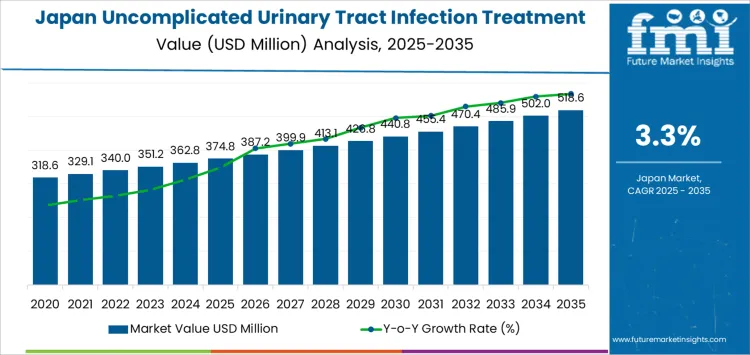
Demand for uncomplicated urinary tract infection treatment in Japan stands at USD 374.8 million in 2025 and is projected to rise to USD 518.6 million by 2035 at a CAGR of 3.3%. Growth is anchored in Japans aging population, high outpatient consultation rates, and routine antibiotic prescribing in primary care. Oral antibiotics remain the dominant treatment segment, with single dose fosfomycin and short course fluoroquinolones widely used in clinics.
Urban demand concentration is highest across Kanto, Kinki, and Chubu due to dense hospital networks and private clinics. Hospitals account for the largest end user share, followed by specialty urology clinics. Key pharmaceutical participants active in Japan include Astellas Pharma, Daiichi Sankyo, Shionogi, Pfizer Japan, and Bayer Yakuhin.
Quick Stats of the Demand for Uncomplicated Urinary Tract Infection Treatment in Japan
- Demand for Uncomplicated Urinary Tract Infection Treatment in Japan Value (2025): USD 374.8 million
- Demand for Uncomplicated Urinary Tract Infection Treatment in Japan Forecast Value (2035): USD 518.6 million
- Demand for Uncomplicated Urinary Tract Infection Treatment in Japan Forecast CAGR (2025 to 2035): 3.3%
- Demand for Uncomplicated Urinary Tract Infection Treatment in Japan Leading Drug Class: Sulfonamide (37%)
- Demand for Uncomplicated Urinary Tract Infection Treatment in Japan Key Growth Regions: Kyushu & Okinawa, Kanto, Kinki, Chubu
- Demand for Uncomplicated Urinary Tract Infection Treatment in Japan Top Players: Pfizer Inc., Merck & Co., Inc., AbbVie Inc., F. Hoffmann-La Roche Ltd., Johnson & Johnson
What is the Demand Forecast for Uncomplicated Urinary Tract Infection Treatment in Japan through 2035?
Between 2025 and 2030, demand expansion is led by rising diagnostic screening in women above 50 years and standardized treatment protocols in emergency and outpatient settings. Post 2030, volume growth stabilizes as antimicrobial stewardship programs limit broad spectrum prescribing, shifting demand toward targeted therapies and culture guided regimens. Pediatric and elderly patient segments drive most prescription continuity.
Distribution remains pharmacy centric, with hospital dispensing retaining control over first line therapies. Regional demand remains structurally stable, with incremental acceleration in suburban prefectures as access to primary care improves. Competitive focus shifts toward resistance management, formulation tolerability, and compliance driven dosing schedules rather than aggressive volume expansion.
The demand for uncomplicated urinary tract infection treatment in Japan stands at USD 374.8 million in 2025 and increases to USD 426.8 million by 2030, reflecting a net expansion of USD 52.0 million in the first half of the forecast period. The steady rise from USD 318.6 million in 2020 to current levels mirrors the sustained outpatient case burden managed through clinics, telemedicine prescriptions, and community pharmacies.
The Japan uncomplicated UTI treatment industry is shaped by an aging female population, high diagnostic access, and routine antibiotic stewardship protocols that favor early-stage intervention. Demand in this phase is reinforced by consistent primary care visitation rates and protocol-driven prescribing patterns rather than episodic disease outbreaks.
From 2030 to 2035, demand advances from USD 426.8 million to USD 518.6 million, adding a larger USD 91.8 million in incremental value over the second half of the outlook. Annual gains accelerate from roughly USD 14.0 million to over USD 16.6 million toward the end of the period. This phase reflects rising recurrence management, stronger diagnostic screening among elderly patients, and wider use of targeted oral therapies supported by antimicrobial resistance monitoring. Treatment volumes are also supported by expanded access through digital prescription platforms and after-hours clinics. By 2035, demand for uncomplicated UTI treatment in Japan remains structurally embedded in routine outpatient care frameworks rather than driven by short-term epidemiological fluctuations.
Uncomplicated Urinary Tract Infection Treatment Industry in Japan Key Takeaways
| Metric | Value |
|---|---|
| Industry Value (2025) | USD 374.8 million |
| Forecast Value (2035) | USD 518.6 million |
| Forecast CAGR (2025 to 2035) | 3.3% |
What Factors Are Shaping the Demand for Uncomplicated Urinary Tract Infection Treatment in Japan?
The demand for uncomplicated urinary tract infection treatment in Japan is strongly influenced by primary care visitation patterns, female workforce participation, and the structure of outpatient medical services. Historically, early stage UTI cases have been managed at neighborhood clinics and internal medicine practices rather than hospitals, which normalized fast access to oral drug therapy. High health awareness among women, routine gynecological consultations, and early symptom recognition supported consistent treatment volumes. Japans universal insurance system also reduced financial hesitation toward seeking care for mild infections. Over time, outpatient prescribing became standardized, with physicians favoring short course therapies to limit recurrence while maintaining patient compliance in busy urban lifestyles.
Future demand for uncomplicated urinary tract infection treatment in Japan will be shaped by population aging, telemedicine expansion, and tighter antimicrobial control policies. As elderly patients increasingly receive care at home or in assisted living facilities, primary care based UTI management will extend into home visit medicine and remote consultations. Digital health platforms will accelerate diagnosis and treatment initiation for low risk patients. Barriers include rising drug resistance that complicates first line therapy selection, increasing caution toward antibiotic overuse, and recurrent infection patterns among older adults. Long term demand will depend on how effectively Japan integrates early intervention, resistance control, and outpatient care efficiency within its evolving primary healthcare delivery system.
What Is the Structural Breakdown of the Demand for Uncomplicated Urinary Tract Infection Treatment in Japan by Drug Class and Distribution Channel?
The demand for uncomplicated urinary tract infection treatment in Japan is segmented by drug class and distribution channel. By drug class, treatment usage includes sulfonamides, penicillin, quinolones, tetracycline, and nitrofuran. By distribution channel, access is structured through gynecology and urology clinics, hospital pharmacies, retail pharmacies, and online drug stores.
These segment divisions reflect prescribing control, resistance monitoring, patient access norms, and insurance reimbursement structures across the Japanese healthcare system. Drug selection is closely guided by national antimicrobial guidelines and hospital stewardship programs. Distribution choice is shaped by diagnostic setting, severity of infection, refill behavior, and prescription tracking under the countrys tightly regulated pharmaceutical dispensing framework.
Why Does Sulfonamide Dominate the Demand for Uncomplicated Urinary Tract Infection Treatment in Japan by Drug Class?
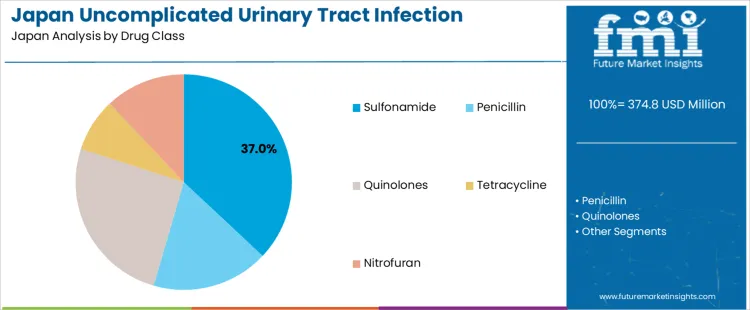
Sulfonamide accounts for 37% of the demand for uncomplicated urinary tract infection treatment in Japan, reflecting its long standing role in first line therapy for mild community acquired cases. Consumption intensity is supported by predictable susceptibility profiles in uncomplicated infections and strong physician familiarity with dosage protocols. Usage remains stable across outpatient settings where rapid symptom control and short treatment duration are prioritized. Procurement is anchored in national drug pricing schedules and generic supply frameworks. Price sensitivity remains moderate because reimbursement rates and clinical effectiveness dominate prescribing behavior. Specification control is strict due to formulation purity, bioavailability, and resistance risk management under Japan antimicrobial surveillance programs.
Sulfonamide contributes consistently to treatment volume due to its reliable clinical performance in low complexity cases and cost managed reimbursement structure. Repeat prescription frequency remains steady as recurrent infections form a stable outpatient treatment base. Buyers favor standardized generic versions to control unit cost and ensure consistent supply across urban and regional clinics. Margin structure remains narrow due to price ceilings under national insurance coverage. Regulatory exposure remains high due to pharmacovigilance reporting and resistance monitoring. Import reliance persists for selected active ingredients. Substitution pressure from quinolones continues, though stewardship restrictions limit unrestricted switching in primary care.
What Is Driving Gynecology and Urology Clinics to Lead the Demand for Uncomplicated Urinary Tract Infection Treatment in Japan by Distribution Channel?
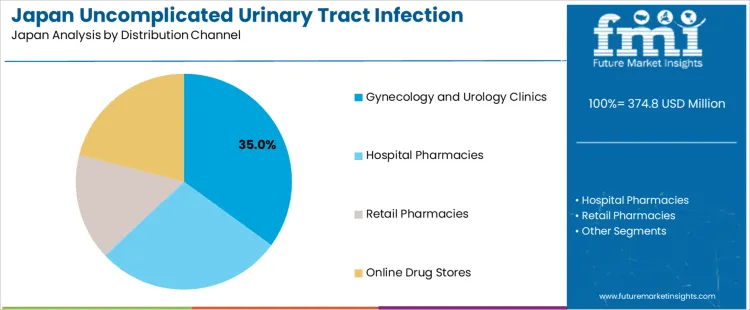
Gynecology and urology clinics represent 35.0% of the demand for uncomplicated urinary tract infection treatment in Japan, reflecting their central role in diagnosis and first line prescribing. Consumption per facility remains high due to routine outpatient consultation for female and elderly patients presenting with early symptoms. Usage intensity stays consistent because these clinics function as the primary access point for non-emergency urological complaints. Procurement is managed through clinic affiliated wholesalers supplying reimbursed medication stock. Price sensitivity remains limited because treatment decisions are guided by guideline compliance rather than cost competition. Specification sensitivity remains high due to dosage accuracy and adverse reaction prevention protocols.
Clinics generate stable recurring volume because patient revisit cycles and seasonal infection spikes maintain steady prescription flow. Repeat dispensing remains high for follow up treatment and recurrence management. Buyers favor streamlined supplier arrangements to reduce inventory complexity and ensure same day dispensing. Margin structure remains controlled due to fixed reimbursement pricing. Regulatory exposure remains elevated due to prescription audit requirements and controlled antibiotic supply rules. Import dependence varies by drug class but remains contracted. Substitution from hospital pharmacies remains limited to complicated cases requiring inpatient management. Online channels remain minor due to strict prescription authentication enforcement.
What Is Driving the Demand for Uncomplicated Urinary Tract Infection Treatment in Japan Primary Care System?
Demand for uncomplicated urinary tract infection treatment in Japan is shaped by high outpatient visitation rates, an aging female population, and strong emphasis on early-stage infection management. Clinics and community hospitals handle the majority of UTI cases through short-course oral therapies under standardized prescribing guidelines. Japan universal health coverage promotes early consultation, limiting progression to complicated infections. Seasonal dehydration, catheter use in elder care, and diabetes prevalence further sustain baseline case volume. Demand is therefore governed by primary care access, demographic structure, and prevention-focused clinical practice rather than hospitalization-driven infection management.
How Is Aging and Community-Based Care Influencing Treatment Demand?
Japan rapidly aging population directly strengthens demand for uncomplicated UTI treatment through community clinics and home-care programs. Elderly women in assisted living facilities and home-care environments are frequently treated at early symptom stages to prevent escalation. Caregivers and visiting nurses are trained to flag early infection signs, accelerating outpatient diagnosis. This shifts demand toward fast-acting oral antibiotics and symptom-relief therapies rather than inpatient intervention. The structure of community-based elder care therefore creates consistent, protocol-driven treatment demand outside hospital emergency settings.
Why Is Antibiotic Stewardship Shaping Prescribing Patterns?
Japan clinical guidelines emphasize targeted antibiotic use to reduce resistance development, shaping treatment selection for uncomplicated UTIs. Physicians increasingly rely on narrow-spectrum agents, shorter treatment durations, and culture-guided adjustments. Recurrent UTI management also favors rotation strategies and prophylactic approaches over repeated broad-spectrum prescribing. This stewardship focus maintains demand for specific first-line therapies while limiting growth of high-potency agents. Demand is therefore stabilized by guideline adherence and resistance prevention rather than by expanding drug class utilization.
How Do Resistance Trends, Diagnostic Limits, and Patient Expectations Restrain Expansion?
Demand growth for uncomplicated UTI treatment in Japan is restrained by rising antimicrobial resistance trends that complicate empirical therapy selection. Diagnostic confirmation in small clinics is not always immediate, delaying optimal treatment initiation. Patient expectations for quick symptom relief can also pressure clinicians into conservative follow-up rather than aggressive intervention. In addition, recurrence management increases monitoring burden without proportionate drug volume growth. These factors limit rapid expansion in treatment intensity despite stable clinical case incidence.
What is the Demand for Uncomplicated Urinary Tract Infection Treatment in Japan by Region?
| Region | CAGR (%) |
|---|---|
| Kyushu & Okinawa | 4.1% |
| Kanto | 3.8% |
| Kinki | 3.3% |
| Chubu | 2.9% |
| Tohoku | 2.6% |
| Rest of Japan | 2.4% |
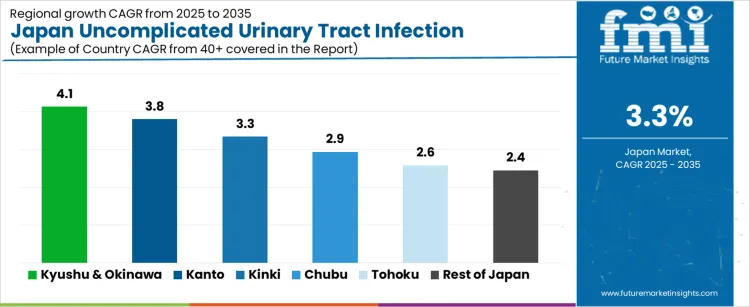
The demand for uncomplicated urinary tract infection treatment in Japan is increasing steadily across regions, led by Kyushu and Okinawa at a 4.1% CAGR. Growth in this region is supported by rising outpatient visits, higher diagnosis rates among aging populations, and improved access to primary care facilities. Kanto follows at 3.8%, driven by dense hospital networks, strong prescription volumes, and routine screening in urban clinics. Kinki records 3.3% growth, reflecting consistent use of first-line antibiotics and diagnostic testing in community healthcare. Chubu at 2.9% shows moderate uptake linked to regional healthcare utilization patterns. Tohoku and the Rest of Japan, at 2.6% and 2.4%, reflect slower growth shaped by lower population density, fewer outpatient facilities, and longer care access intervals.
How Is Coastal Healthcare Access in Kyushu and Okinawa Shaping Uncomplicated UTI Treatment Demand?
Demand for uncomplicated urinary tract infection treatment in Kyushu and Okinawa is advancing at a CAGR of 4.1% through 2035, supported by expanding primary care access, higher female outpatient visits, and improved pharmacy coverage across island and coastal communities. Urban centers such as Fukuoka and Naha are seeing steady growth in early diagnosis and rapid prescription cycles through clinics and retail pharmacies. Compared with Tohoku, uptake here is more strongly driven by accessibility rather than aging alone. Oral antibiotics and symptomatic relief medicines dominate treatment patterns across community healthcare settings.
- Primary care clinics anchor early diagnosis volumes
- Retail pharmacies support fast prescription turnover
- Female outpatient visits sustain steady demand
- Coastal urban centers dominate treatment activity
What Is Driving Uncomplicated UTI Treatment Utilization in High Density Kanto Healthcare Systems?
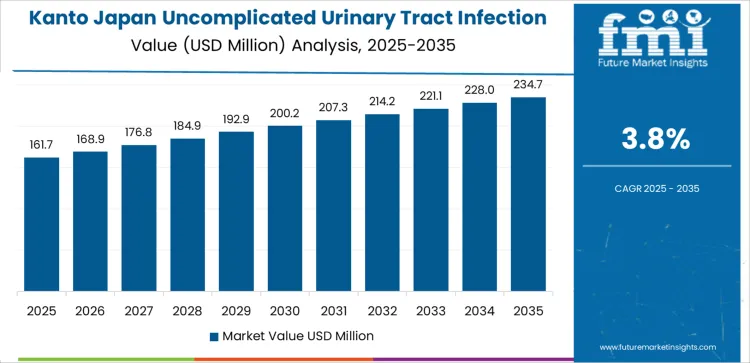
Demand for uncomplicated urinary tract infection treatment in Kanto is expanding at a CAGR of 3.8% through 2035, led by dense hospital networks, large outpatient populations, and strong digital prescription uptake across Tokyo and nearby prefectures. Kanto differs from Kyushu and Okinawa through higher dependence on hospital linked outpatient departments rather than small private clinics. Treatment volumes are supported by workplace health programs, fast diagnostic testing, and same day dispensing through chain pharmacies. Antibiotic stewardship programs remain active but have not slowed overall patient inflow.
- Hospital outpatient departments sustain bulk treatment volumes
- Digital prescriptions accelerate medicine access
- Workplace health programs expand testing frequency
- Chain pharmacies dominate dispensing networks
Why Is Regional Referral Care Supporting Moderate UTI Treatment Growth in Kinki?
Demand for uncomplicated urinary tract infection treatment in Kinki is advancing at a CAGR of 3.3% through 2035, supported by regional hospitals, women health clinics, and steady primary care access in Osaka, Kobe, and Kyoto. Kinki contrasts with Kanto through greater reliance on referral based care rather than direct hospital walk ins. Treatment demand is shaped by community clinics managing repeat infections and post diagnostic referrals for laboratory confirmation. Oral antimicrobials remain the dominant therapy, with increasing use of short course regimens guided by updated prescribing protocols.
- Women health clinics sustain routine diagnostic flow
- Referral care shapes treatment initiation patterns
- Short course regimens support prescription continuity
- Regional hospitals anchor secondary care volumes
How Is Industrial Workforce Healthcare Influencing UTI Treatment Demand in Chubu?
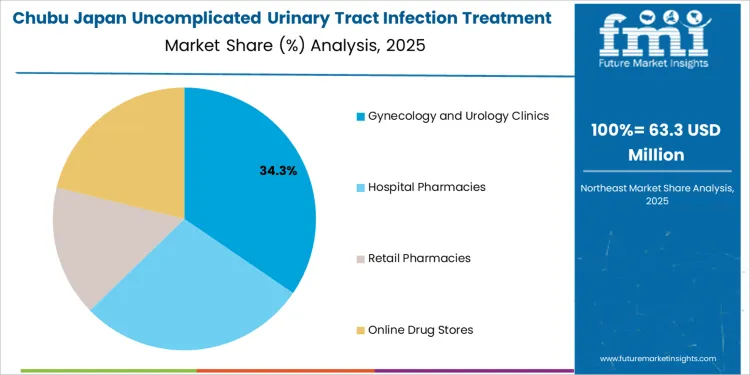
Demand for uncomplicated urinary tract infection treatment in Chubu is progressing at a CAGR of 2.9% through 2035, supported by factory worker health services, regional hospitals, and suburban clinic networks around Nagoya. This region differs from Kinki through stronger linkage between occupational health programs and outpatient infection management. Treatment volumes are supported by routine health screenings, same day consultations, and employer backed insurance coverage. Prescriptions are largely filled through hospital pharmacies and nearby retail outlets serving commuting populations.
- Occupational health services drive early patient detection
- Suburban clinics sustain steady outpatient flow
- Employer insurance supports treatment access
- Hospital pharmacies dominate initial dispensing
What Is Sustaining Gradual UTI Treatment Uptake Across Aging Care Networks in Tohoku?
Demand for uncomplicated urinary tract infection treatment in Tohoku is increasing at a CAGR of 2.6% through 2035, supported by aging population care, community hospitals, and regional public health programs. Tohoku contrasts with Kanto and Chubu through lower outpatient density but higher infection incidence among elderly patients. Treatment demand is shaped by long term care facilities, home based medical visits, and slow but steady diagnostic improvement. Budget sensitivity and longer care pathways continue to moderate faster treatment turnover.
- Elderly care facilities anchor recurring treatment needs
- Community hospitals sustain baseline patient volumes
- Home visits support low mobility patient access
- Public health programs guide screening frequency
How Do Low Density Medical Networks Shape UTI Treatment Demand in the Rest of Japan?
Demand for uncomplicated urinary tract infection treatment in the Rest of Japan is advancing at a CAGR of 2.4% through 2035, shaped by small hospitals, rural clinics, and limited specialist access across dispersed communities. This region contrasts with Kanto and Kyushu and Okinawa through slower diagnosis cycles and longer travel times for outpatient care. Treatment is primarily managed through community physicians and district hospital pharmacies. Procurement remains conservative, with medicine supply closely aligned to annual healthcare funding and distributor schedules.
- Rural clinics dominate first line treatment access
- District hospitals support basic diagnostic services
- Travel distance slows repeat visit frequency
- Distributor networks guide medicine availability
What Is Driving the Demand for Uncomplicated Urinary Tract Infection Treatment in Japan and Which Companies Shape Prescribing Access
The demand for uncomplicated urinary tract infection treatment in Japan is shaped by aging population growth, high outpatient visit volume among older women, and strict national antimicrobial stewardship protocols. Astellas Pharma holds a central domestic position through long standing urology focus and hospital channel penetration across primary and secondary care. Daiichi Sankyo supports demand through anti-infective supply chains used in community clinics and regional hospitals.
Meiji Seika Pharma maintains a strong role in oral antibiotic distribution tied to primary care prescribing. Pfizer participates through branded and generic anti-infective products supplied under Japanese labeling and pricing rules. Merck and Johnson and Johnson maintain selected hospital exposure through broader infectious disease and supportive care portfolios aligned with acute treatment settings.
Roche and AbbVie participate indirectly through hospital systems where diagnostic support and infusion related therapy intersect with complicated infection management pathways. Procurement and prescribing in Japan are governed by national treatment guidelines, resistance surveillance data, and biennial drug price revisions under the universal insurance system. First line therapy selection prioritizes narrow spectrum oral antibiotics, resistance profile alignment, and patient adherence in outpatient care.
Buyer preference in hospital formularies favors suppliers with stable domestic manufacturing, uninterrupted supply history, and local medical affairs support. Demand visibility is closely linked to demographic aging, outpatient urology visit rates, antimicrobial stewardship enforcement, and seasonal infection incidence patterns observed across metropolitan and regional healthcare networks.
Key Players in the Uncomplicated Urinary Tract Infection Treatment Industry in Japan
- Pfizer Inc.
- Merck & Co., Inc.
- AbbVie Inc.
- F. Hoffmann-La Roche Ltd.
- Johnson & Johnson
Scope of the report
| Items | Values |
|---|---|
| Quantitative Units (2025) | USD million |
| Drug Class | Sulfonamide, Penicillin, Quinolones, Tetracycline, Nitrofuran |
| Distribution Channel | Gynecology and Urology Clinics, Hospital Pharmacies, Retail Pharmacies, Online Drug Stores |
| End Use | Outpatient Care, Primary Care Clinics, Specialty Urology Clinics, Elderly Care Facilities |
| Regions Covered | Kyushu & Okinawa, Kanto, Kansai, Chubu, Tohoku, Rest of Japan |
| Key Companies Profiled | Pfizer Inc., Merck & Co., Inc., AbbVie Inc., F. Hoffmann-La Roche Ltd., Johnson & Johnson |
| Additional Attributes | Dollar by sales by drug class, distribution channel, and region; growth projections through 2035; outpatient prescribing trends; telemedicine and home-care influence; stewardship program impact; first-line versus targeted therapy adoption; seasonal and recurrent infection patterns; regional access and clinic density; hospital versus clinic prescription share; digital prescription penetration; adherence monitoring and treatment compliance; domestic versus imported active pharmaceutical ingredient use; generic versus branded product mix; pharmacy versus hospital dispensing dynamics; patient demographic influence including elderly and female population; regulatory and insurance reimbursement impact |
Uncomplicated Urinary Tract Infection Treatment Industry in Japan Segmentation
Drug Class:
- Sulfonamide
- Penicillin
- Quinolones
- Tetracycline
- Nitrofuran
Distribution Channel:
- Gynecology and Urology Clinics
- Hospital Pharmacies
- Retail Pharmacies
- Online Drug Stores
Region
- Kyushu & Okinawa
- Kanto
- Kansai
- Chubu
- Tohoku
- Rest of Japan
Frequently Asked Questions
How big is the demand for uncomplicated urinary tract infection treatment in Japan in 2025?
The demand for uncomplicated urinary tract infection treatment in Japan is estimated to be valued at USD 374.8 million in 2025.
What will be the size of uncomplicated urinary tract infection treatment in Japan in 2035?
The market size for the uncomplicated urinary tract infection treatment in Japan is projected to reach USD 518.6 million by 2035.
How much will be the demand for uncomplicated urinary tract infection treatment in Japan growth between 2025 and 2035?
The demand for uncomplicated urinary tract infection treatment in Japan is expected to grow at a 3.3% CAGR between 2025 and 2035.
What are the key product types in the uncomplicated urinary tract infection treatment in Japan?
The key product types in uncomplicated urinary tract infection treatment in Japan are sulfonamide, penicillin, quinolones, tetracycline and nitrofuran.
Which distribution channel segment is expected to contribute significant share in the uncomplicated urinary tract infection treatment in Japan in 2025?
In terms of distribution channel, gynecology and urology clinics segment is expected to command 35.0% share in the uncomplicated urinary tract infection treatment in Japan in 2025.
Preview the report firsthand - request a free sample
Get SampleGet the brochure for pricing and purchase details.
Get PDFTable of Content
- Executive Summary
- Japan Market Outlook
- Demand-side Trends
- Supply-side Trends
- Technology Roadmap Analysis
- Analysis and Recommendations
- Market Overview
- Market Coverage / Taxonomy
- Market Definition / Scope / Limitations
- Market Background
- Market Dynamics
- Drivers
- Restraints
- Opportunity
- Trends
- Scenario Forecast
- Demand in Optimistic Scenario
- Demand in Likely Scenario
- Demand in Conservative Scenario
- Opportunity Map Analysis
- Product Life Cycle Analysis
- Supply Chain Analysis
- Investment Feasibility Matrix
- Value Chain Analysis
- PESTLE and Porter’s Analysis
- Regulatory Landscape
- Regional Parent Market Outlook
- Production and Consumption Statistics
- Import and Export Statistics
- Market Dynamics
- Japan Market Analysis 2020 to 2024 and Forecast, 2025 to 2035
- Historical Market Size Value (USD Million) Analysis, 2020 to 2024
- Current and Future Market Size Value (USD Million) Projections, 2025 to 2035
- Y-o-Y Growth Trend Analysis
- Absolute $ Opportunity Analysis
- Japan Market Pricing Analysis 2020 to 2024 and Forecast 2025 to 2035
- Japan Market Analysis 2020 to 2024 and Forecast 2025 to 2035, By Drug Class
- Introduction / Key Findings
- Historical Market Size Value (USD Million) Analysis By Drug Class , 2020 to 2024
- Current and Future Market Size Value (USD Million) Analysis and Forecast By Drug Class , 2025 to 2035
- Sulfonamide
- Penicillin
- Quinolones
- Tetracycline
- Nitrofuran
- Y-o-Y Growth Trend Analysis By Drug Class , 2020 to 2024
- Absolute $ Opportunity Analysis By Drug Class , 2025 to 2035
- Japan Market Analysis 2020 to 2024 and Forecast 2025 to 2035, By Distribution Channel
- Introduction / Key Findings
- Historical Market Size Value (USD Million) Analysis By Distribution Channel, 2020 to 2024
- Current and Future Market Size Value (USD Million) Analysis and Forecast By Distribution Channel, 2025 to 2035
- Gynecology and Urology Clinics
- Hospital Pharmacies
- Retail Pharmacies
- Online Drug Stores
- Y-o-Y Growth Trend Analysis By Distribution Channel, 2020 to 2024
- Absolute $ Opportunity Analysis By Distribution Channel, 2025 to 2035
- Market Structure Analysis
- Competition Dashboard
- Competition Benchmarking
- Market Share Analysis of Top Players
- By Regional
- By Drug Class
- By Distribution Channel
- Competition Analysis
- Competition Deep Dive
- Pfizer Inc.
- Overview
- Product Portfolio
- Profitability by Market Segments (Product/Age /Sales Channel/Region)
- Sales Footprint
- Strategy Overview
- Marketing Strategy
- Product Strategy
- Channel Strategy
- Merck & Co., Inc.
- AbbVie Inc.
- F.Hoffmann-La Roche Ltd.
- Johnson & Johnson
- Pfizer Inc.
- Competition Deep Dive
- Assumptions & Acronyms Used
- Research Methodology


