

- Industry Size (2026)
- USD 3.6 Bn
- Forecast (2036)
- USD 5.8 Bn
- CAGR (2026 to 2036)
- 4.9%
Jib Cranes Market Forecast and Outlook 2026 to 2036
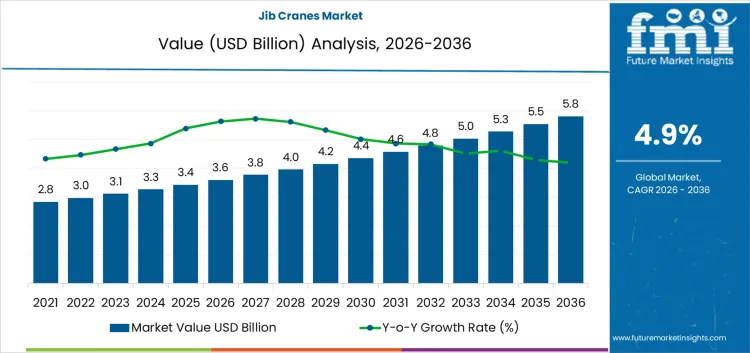
The jib cranes market expands from USD 3.6 billion in 2026 to USD 5.8 billion by 2036, representing a CAGR of 4.9%. Cost structure differences, particularly in steel fabrication, bearing assemblies, and installation labor, exert a greater influence on profitability than shipment volumes. Manufacturers with vertically integrated fabrication and standardized designs retain stronger pricing control, while assemblers reliant on outsourced structures face narrower margins. Value capture concentrates among suppliers that control engineering approvals and installation certification, since compliance documentation and site acceptance testing are embedded in contract pricing. Regional fabrication capacity and freight costs further shape competitive positioning and bid discipline.
Across the period, margin outcomes depend on contract structure and channel control rather than on headline project counts. Turnkey suppliers that bundle foundations, erection, and inspection services preserve higher contribution margins than component only vendors. Public and industrial tenders place downward pressure on unit prices, yet firms with proprietary mounting systems or load handling accessories defend spreads through specification control. Service, inspection, and modification work contributes a stable earnings layer that is less exposed to price competition. The market grows steadily in value, though economic returns remain concentrated among a limited group of manufacturers with fabrication scale and certification reach.
Quick Stats of the Jib Cranes Market
- Jib Cranes Market Value (2026): USD 3.6 billion
- Jib Cranes Forecast Value (2036): USD 5.8 billion
- Jib Cranes Forecast CAGR 2026 to 2036: 4.9%
- Leading Type in Jib Cranes Market: Freestanding Jib Cranes (42 % share)
- Leading End-Use Industry in Jib Cranes Market: Manufacturing (45 % share)
- Key Growth Regions in Jib Cranes Market: India, China, Brazil, USA, UK
- Top Players in Jib Cranes Market: Konecranes, Mitsubishi Logisnext, Demag Cranes & Components, Columbus McKinnon Corporation, ABUS Kransysteme, Terex Corporation, Yale (Harnischfeger Industries)
What is the Growth Forecast for Jib Cranes Market through 2036?
Between 2026 and 2031, the jib cranes market is projected to expand from USD 3.6 billion along a trajectory consistent with a 4.9% CAGR, reflecting steady investment in factory-level material handling rather than large-scale logistics infrastructure shifts. Jib cranes are typically purchased to solve localized lifting and positioning problems at specific workstations, assembly lines, and maintenance bays. Demand in this phase is therefore linked to incremental capacity additions, workshop modernization, and productivity improvement projects rather than to greenfield plant construction. Growth is supported by metalworking, automotive components, general manufacturing, and maintenance operations where simple, reliable lifting systems improve ergonomics and cycle times. Purchasing decisions emphasize robustness, ease of installation, and compatibility with existing floor layouts more than automation sophistication.
From 2031 to 2036, the market is expected to reach USD 5.8 billion, with expansion driven by gradual densification of production environments and higher expectations for workplace safety and handling efficiency. As factories adopt more compact and flexible layouts, point-of-use lifting solutions become more valuable than centralized overhead systems for many tasks. This increases the number of jib cranes per facility even when total floor space grows slowly. Replacement demand also becomes more visible as older mechanical units are upgraded to meet current safety standards. Competitive positioning depends on product reliability, installation support, and coverage of load ranges and mounting types rather than on technological differentiation, keeping the market oriented toward practical, application-specific solutions.
Jib Cranes Market Key Takeaways
| Metric | Value |
|---|---|
| Market Value (2026) | USD 3.6 billion |
| Forecast Value (2036) | USD 5.8 billion |
| Forecast CAGR 2026 to 2036 | 4.9% |
How Are Jib Cranes Enhancing Material Handling Efficiency?
Jib cranes are increasingly adopted to facilitate localized lifting, precise material placement, and efficient workflow in industrial, manufacturing, and warehouse environments. Historically, material handling relied on manual labor or basic hoists, which limited lifting capacity, precision, and operational safety. Modern jib cranes integrate rotary arms, electric or hydraulic hoists, and reinforced mounting systems to provide controlled lifting, extended reach, and durable operation under continuous use. Industrial manufacturers, warehouse operators, and construction firms prioritize load capacity, installation flexibility, and safety compliance. Early adoption focused on high-value production lines, while current demand spans assembly plants, logistics centers, and maintenance facilities, driven by increased automation, workplace safety standards, and efficiency optimization. Load rating, arm length, and rotation range influence supplier selection.
Rising industrial activity, demand for precise material handling, and workplace safety regulations are shaping market growth. Compared with conventional hoists, jib cranes emphasize controlled load movement, ergonomic operation, and adaptability to compact or specialized spaces. Cost structures depend on structural materials, hoist type, and installation requirements, concentrating margins among suppliers capable of delivering reliable, certified systems. Facility operators adopt these cranes to improve workflow efficiency, reduce labor strain, and ensure safe lifting operations. By 2036, jib cranes are expected to become standard in industrial, warehouse, and construction settings, supporting efficient material handling, operational safety, and enhanced productivity.
What Factors Are Shaping the Demand for Jib Cranes by Mounting Configuration and Industry Use in 2026?
The jib cranes market in 2026 is segmented by crane type and by end use industry. By mounting configuration, demand is divided into freestanding, wall mounted, folding, and articulating jib cranes, each offering different reach, load envelope, and installation requirements. By industry use, demand is organized around manufacturing, automotive, construction, and warehousing or logistics operations, which differ in floor layout, duty cycle, and handling patterns. These segments reflect how plant designers and facility managers balance coverage area, structural constraints, and capital cost while selecting lifting solutions that must integrate with existing workflows and safety practices.
Why Do Freestanding Jib Cranes Represent the Largest Share of Installations?
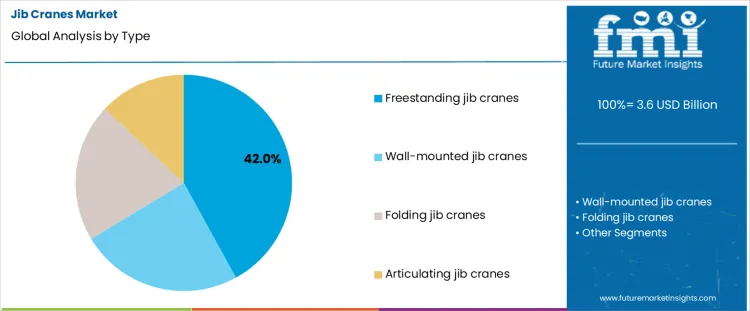
Freestanding jib cranes account for about 42% of demand in 2026, reflecting their independence from building structures and their ability to serve large circular work zones. These cranes are anchored to the floor with dedicated foundations, which allows them to operate in facilities where walls or columns cannot support additional loads. Their 360 degree rotation provides flexible coverage for machine tending, assembly stations, and material staging areas. Installation planning is straightforward because the crane does not depend on the condition or layout of existing walls. This autonomy also makes relocation or reconfiguration easier when production lines change. The combination of structural independence and wide service area keeps freestanding designs as the most common choice.
Wall mounted, folding, and articulating cranes address more constrained layouts. Wall mounted units save floor space but depend on building strength and limit rotation. Folding cranes are chosen where clearance is tight or where the arm must be stowed when not in use. Articulating cranes offer reach around obstacles and into machines, yet their multiple joints increase cost and maintenance needs. These designs solve specific access problems rather than providing general coverage. Their use is therefore driven by layout constraints and process details, which keeps their volumes lower than freestanding cranes that can be applied across a wide range of standard industrial floor plans.
Why Does Manufacturing Dominate Jib Crane Demand by End Use?
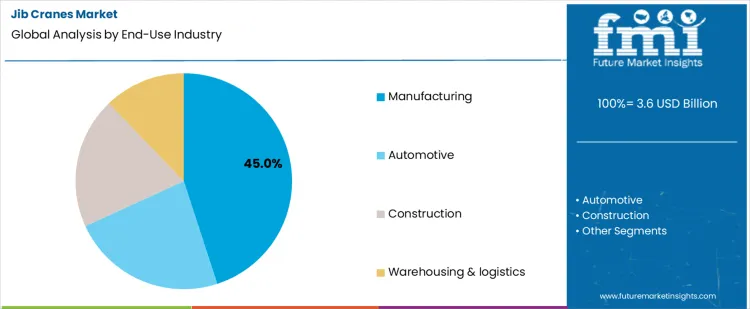
Manufacturing represents about 45% of demand in 2026 because factories involve frequent, repetitive handling of parts, tools, and assemblies at fixed workstations. Jib cranes are used to load and unload machines, position heavy components, and support assembly operations without tying up overhead cranes or forklifts. Their localized coverage improves workflow efficiency and reduces manual lifting risk. Production lines also evolve over time, and jib cranes can be added or repositioned as processes change. The high density of handling points in manufacturing plants creates steady demand for these compact lifting solutions, which explains why this sector absorbs the largest share of installations.
Automotive, construction, and warehousing or logistics follow different usage patterns. Automotive plants use jib cranes for specific cells or maintenance tasks, yet many lifts are handled by larger integrated systems. Construction sites rely more on mobile equipment and tower cranes, which limits the role of fixed jib systems. Warehousing focuses on pallet movement with forklifts and conveyors, using jib cranes mainly for maintenance or special handling. These sectors value jib cranes, but their workflows generate fewer fixed point lifting needs than general manufacturing, which keeps their overall demand at a lower level.
Why Are Shop Floor Reconfiguration and Point of Use Handling Needs Sustaining the Jib Cranes Market through 2036?
Demand follows how work is organized on factory floors rather than headline investment cycles. Assembly cells, machining centers, and maintenance bays increasingly rely on localized lifting to avoid waiting for shared overhead cranes. Jib cranes give operators immediate access to lifting capacity at the workstation, which shortens changeovers and reduces manual handling risk. As layouts are rebalanced for shorter batches and higher mix, fixed point lifting becomes more valuable than long travel systems. In older plants, retrofitting a wall or column mounted jib is simpler than modifying roof structures. Replacement demand from wear and collision damage also keeps volumes steady across industries.
What Space Constraints, Load Limits, and Capital Discipline Are Limiting Broader Deployment?
Limits come from geometry and economics. Jib cranes serve defined arcs and modest loads, which makes them unsuitable for many heavy or wide area lifts. Columns and walls must carry concentrated loads, and not every building can accept that without reinforcement. Floor space is often contested, and added columns can obstruct traffic or equipment. From a budgeting perspective, many managers prefer to stretch the use of existing overhead cranes rather than add multiple localized systems. In low utilization areas, payback is difficult to justify. These factors confine jib cranes to specific stations and prevent them from replacing broader material handling infrastructure.
How Are Workstation Automation and Safety Practices Changing Their Role?
The role is shifting toward integration with tasks rather than stand-alone lifting. In many plants, jib cranes are paired with balancers, manipulators, or vacuum grippers to support repetitive, precise movements rather than simple hoisting. This ties specification to ergonomics programs and injury reduction targets. Standardization of workstation modules also leads to repeatable crane configurations across lines. Some users prefer modular, bolt on designs to relocate equipment as layouts change. The category is moving from being a general utility item to being part of engineered work cells, where lifting, positioning, and operator interaction are designed as one system.
What is the Demand for Jib Cranes by Country?
| Country | CAGR (%) |
|---|---|
| USA | 4.5% |
| UK | 4.2% |
| China | 5.3% |
| India | 5.6% |
| Brazil | 4.9% |
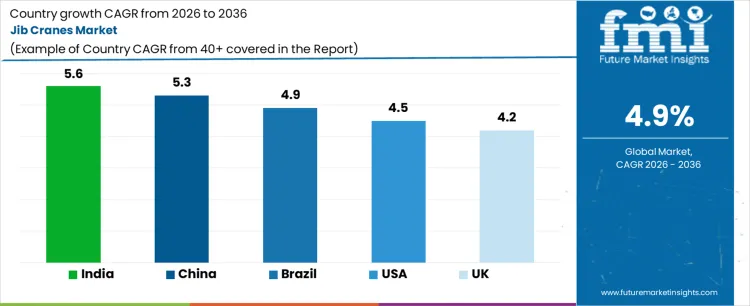
Demand for jib cranes is rising as manufacturing, construction, and logistics sectors adopt material handling solutions to enhance operational efficiency, workplace safety, and productivity. India leads with a 5.6% CAGR, driven by industrial expansion, increasing factory automation, and growing infrastructure projects. China follows at 5.3%, supported by large-scale industrial operations and adoption of advanced lifting equipment. Brazil records 4.9% growth, shaped by industrial modernization and logistics optimization. The USA grows at 4.5%, influenced by replacement demand and integration in manufacturing facilities. The UK shows 4.2% CAGR, reflecting steady adoption in industrial and commercial applications for material handling and lifting operations.
How is the United States experiencing growth in the jib cranes market?
United States is experiencing growth at a CAGR of 4.5%, driven by the expansion of manufacturing, warehousing, and logistics operations in regions such as Texas, California, and Illinois. Jib cranes are optimized for localized lifting, material handling, and operational flexibility within workshops and industrial plants. Demand is concentrated in automotive assembly plants, metal fabrication facilities, and logistics warehouses. Investments focus on structural reliability, load capacity, and compliance with OSHA and ANSI safety standards. Growth reflects modernization of industrial facilities, increasing automation in material handling, and rising demand for efficient lifting solutions.
- Manufacturing and logistics drive adoption.
- Cranes optimize localized lifting and flexibility.
- Industrial and warehouse hubs concentrate demand.
- Structural reliability and regulatory compliance guide investment.
How is the United Kingdom witnessing growth in the jib cranes market?
United Kingdom is witnessing growth at a CAGR of 4.2%, supported by industrial upgrades and increasing demand for efficient material handling in London, Birmingham, and Manchester. Jib cranes are optimized for workshop lifting, assembly line support, and ergonomic operation. Demand is concentrated in metal fabrication, manufacturing units, and warehouse operations. Investments prioritize load handling capacity, operational safety, and compliance with UK and EU industrial standards. Growth reflects modernization of production facilities, adoption of small-scale lifting solutions, and focus on workplace safety in industrial operations.
- Industrial upgrades drive adoption.
- Cranes enhance workshop lifting and assembly efficiency.
- Manufacturing hubs concentrate demand.
- Load capacity and safety compliance guide investment.
How is China experiencing growth in the jib cranes market?
China is experiencing growth at a CAGR of 5.3%, fueled by expansion of manufacturing clusters in Guangdong, Jiangsu, and Zhejiang, where automotive, electronics, and heavy machinery production are concentrated. Jib cranes are optimized for precise lifting, space-efficient operation, and durability under high-frequency use. Demand is concentrated in factory floors, workshops, and logistics centers. Investments focus on material quality, operational reliability, and compliance with national safety standards. Growth reflects rapid industrial expansion, adoption of compact lifting solutions, and increasing mechanization in manufacturing operations.
- Manufacturing cluster expansion drives adoption.
- Cranes optimize precise lifting and space efficiency.
- Factory floors and workshops concentrate demand.
- Material quality and safety compliance guide investment.
How is India witnessing growth in the jib cranes market?
India is witnessing growth at a CAGR of 5.6%, supported by industrial development in Pune, Bengaluru, and Ahmedabad and the rise of small and medium manufacturing units. Jib cranes are optimized for lifting in constrained spaces, ergonomic operation, and durability under high usage. Demand is concentrated in automotive workshops, fabrication units, and warehouse facilities. Investments prioritize structural reliability, operational efficiency, and compliance with Indian industrial safety standards. Growth reflects increasing industrial mechanization, adoption of small-scale lifting solutions, and the expansion of regional manufacturing hubs.
- Industrial development drives adoption.
- Cranes enhance lifting in constrained spaces.
- Workshops and warehouses concentrate demand.
- Reliability and safety compliance guide investment.
How is Brazil experiencing growth in the jib cranes market?
Brazil is experiencing growth at a CAGR of 4.9%, fueled by expansion of industrial manufacturing, logistics, and construction sectors in São Paulo, Rio de Janeiro, and Paraná. Jib cranes are optimized for efficient material handling, load capacity, and durability in humid and tropical conditions. Demand is concentrated in manufacturing plants, logistics hubs, and workshops. Investments focus on structural integrity, operational reliability, and compliance with national safety regulations. Growth reflects rising industrial activity, modernization of material handling infrastructure, and the adoption of compact lifting solutions in industrial operations.
- Industrial and logistics sectors drive adoption.
- Cranes optimize material handling and load capacity.
- Manufacturing and workshop hubs concentrate demand.
- Structural integrity and safety compliance guide investment.
Who Competes in the Jib Cranes Market and What Defines Their Capabilities?
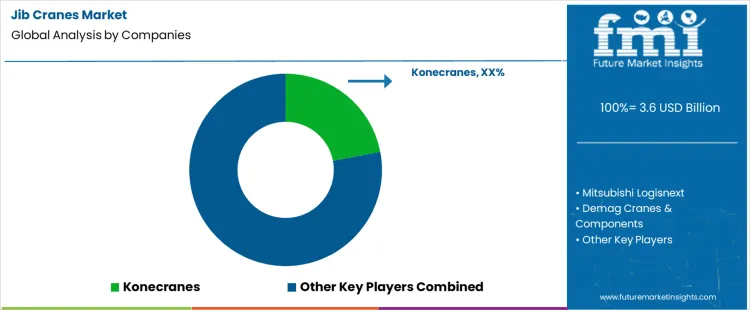
Competition in the jib cranes market is defined by load capacity ranges, installation flexibility, and durability for industrial material handling. Konecranes supplies jib crane systems engineered for smooth operation, long service life, and integration with facility workflows across manufacturing, maintenance, and warehouse environments. Mitsubishi Logisnext provides jib cranes with compact designs and reliable lifting mechanics, suitable for production cells and assembly lines. Demag Cranes & Components delivers modular jib crane solutions with robust drive systems and options for variable radius and height configurations. Columbus McKinnon Corporation offers a broad range of jib cranes, hoists, and trolleys designed for ease of installation and maintenance. ABUS Kransysteme supplies European-specification jib cranes with focus on precision and ergonomic handling.
Terex Corporation provides crane products with high structural strength and adaptability to industrial settings where heavy or frequent lifting is needed. Yale, part of Harnischfeger Industries, delivers jib crane systems emphasizing rugged construction and compatibility with other material handling equipment. Other regional and specialty manufacturers supply jib cranes tailored to specific industries, such as automotive plants, workshops, or marine facilities, with options for electric or manual rotation, wall-mounted or pillar-mounted bases, and integration with safety features. Competitive differentiation arises from maximum load ratings, ease of installation, service support networks, modularity for facility layouts, and compliance with relevant safety standards. Suppliers with extensive field service coverage and customization options maintain relevance across diverse industrial and commercial material handling applications.
Key Players in the Jib Cranes Market
- Konecranes
- Mitsubishi Logisnext
- Demag Cranes & Components
- Columbus McKinnon Corporation
- ABUS Kransysteme
- Terex Corporation
- Yale (part of Harnischfeger Industries)
Scope of the Report
| Items | Values |
|---|---|
| Quantitative Units (2026) | USD billion |
| Type | Freestanding Jib Cranes, Wall-Mounted Jib Cranes, Folding Jib Cranes, Articulating Jib Cranes |
| End-Use Industry | Manufacturing, Automotive, Construction, Warehousing and Logistics |
| Regions Covered | Asia Pacific, Europe, North America, Latin America, Middle East & Africa |
| Countries Covered | China, Japan, South Korea, India, Australia & New Zealand, ASEAN, Germany, United Kingdom, France, Italy, Spain, Nordic, BENELUX, United States, Canada, Mexico, Brazil, Chile, Saudi Arabia, Turkey, South Africa, and other regional markets |
| Key Companies Profiled | Konecranes, Mitsubishi Logisnext, Demag Cranes & Components, Columbus McKinnon Corporation, ABUS Kransysteme, Terex Corporation, Yale (Harnischfeger Industries) |
| Additional Attributes | Dollar sales by crane type and end-use industry, freestanding jib cranes forming the largest installation segment due to independence from building structures and wide service radius, manufacturing representing the largest end-use segment because of dense fixed-point handling needs, market economics shaped by steel fabrication, bearing assemblies, installation labor, and certification requirements, value capture concentrated among vertically integrated and turnkey suppliers bundling foundations, erection, and inspection services, steady contribution from service, inspection, and modification work, demand driven by shop-floor densification, workstation-level handling needs, and replacement of older units to meet safety standards, and competitive positioning based on load range coverage, installation support capability, modularity, and compliance with safety regulations rather than automation sophistication. |
Jib Cranes Market Segmentation
By Type:
- Freestanding jib cranes
- Wall-mounted jib cranes
- Folding jib cranes
- Articulating jib cranes
By End-Use Industry:
- Manufacturing
- Automotive
- Construction
- Warehousing & logistics
By Region
- Asia Pacific
- China
- Japan
- South Korea
- India
- Australia & New Zealand
- ASEAN
- Rest of Asia Pacific
- Europe
- Germany
- United Kingdom
- France
- Italy
- Spain
- Nordic
- BENELUX
- Rest of Europe
- North America
- United States
- Canada
- Mexico
- Latin America
- Brazil
- Chile
- Rest of Latin America
- Middle East & Africa
- Kingdom of Saudi Arabia
- Other GCC Countries
- Turkey
- South Africa
- Other African Union
- Rest of Middle East & Africa
Bibliography
- American Crane & Equipment Corporation. (2023). Jib crane systems: Applications and considerations in industrial settings. American Crane & Equipment Corporation.
- National Institute for Occupational Safety and Health (NIOSH). (2023). Crane safety and ergonomics in industrial operations. Centers for Disease Control and Prevention (CDC).
- European Union Agency for Safety and Health at Work (EU-OSHA). (2023). Workplace lifting equipment: Jib cranes and safety standards. EU-OSHA.
- International Organization for Standardization (ISO). (2023). ISO 4301: Cranes - Classification of types and structures. ISO.
- American National Standards Institute (ANSI). (2023). ANSI B30.11: Jib cranes - Design, construction, and installation. ANSI.
Frequently Asked Questions
How big is the jib cranes market in 2026?
The global jib cranes market is estimated to be valued at USD 3.6 billion in 2026.
What will be the size of jib cranes market in 2036?
The market size for the jib cranes market is projected to reach USD 5.8 billion by 2036.
How much will be the jib cranes market growth between 2026 and 2036?
The jib cranes market is expected to grow at a 4.9% CAGR between 2026 and 2036.
What are the key product types in the jib cranes market?
The key product types in jib cranes market are freestanding jib cranes, wall-mounted jib cranes, folding jib cranes and articulating jib cranes.
Which end-use industry segment to contribute significant share in the jib cranes market in 2026?
In terms of end-use industry, manufacturing segment to command 45.0% share in the jib cranes market in 2026.
Preview the report firsthand - request a free sample
Get SampleGet the brochure for pricing and purchase details.
Get PDFTable of Content
- Executive Summary
- Global Market Outlook
- Demand-side Trends
- Supply-side Trends
- Technology Roadmap Analysis
- Analysis and Recommendations
- Market Overview
- Market Coverage / Taxonomy
- Market Definition / Scope / Limitations
- Market Background
- Market Dynamics
- Drivers
- Restraints
- Opportunity
- Trends
- Scenario Forecast
- Demand in Optimistic Scenario
- Demand in Likely Scenario
- Demand in Conservative Scenario
- Opportunity Map Analysis
- Product Life Cycle Analysis
- Supply Chain Analysis
- Investment Feasibility Matrix
- Value Chain Analysis
- PESTLE and Porter’s Analysis
- Regulatory Landscape
- Regional Parent Market Outlook
- Production and Consumption Statistics
- Import and Export Statistics
- Market Dynamics
- Global Market Analysis 2021 to 2025 and Forecast, 2026 to 2036
- Historical Market Size Value (USD Million) Analysis, 2021 to 2025
- Current and Future Market Size Value (USD Million) Projections, 2026 to 2036
- Y-o-Y Growth Trend Analysis
- Absolute $ Opportunity Analysis
- Global Market Pricing Analysis 2021 to 2025 and Forecast 2026 to 2036
- Global Market Analysis 2021 to 2025 and Forecast 2026 to 2036, By Type
- Introduction / Key Findings
- Historical Market Size Value (USD Million) Analysis By Type, 2021 to 2025
- Current and Future Market Size Value (USD Million) Analysis and Forecast By Type, 2026 to 2036
- Freestanding jib cranes
- Wall-mounted jib cranes
- Folding jib cranes
- Articulating jib cranes
- Freestanding jib cranes
- Y-o-Y Growth Trend Analysis By Type, 2021 to 2025
- Absolute $ Opportunity Analysis By Type, 2026 to 2036
- Global Market Analysis 2021 to 2025 and Forecast 2026 to 2036, By End-Use Industry
- Introduction / Key Findings
- Historical Market Size Value (USD Million) Analysis By End-Use Industry, 2021 to 2025
- Current and Future Market Size Value (USD Million) Analysis and Forecast By End-Use Industry, 2026 to 2036
- Manufacturing
- Automotive
- Construction
- Warehousing & logistics
- Manufacturing
- Y-o-Y Growth Trend Analysis By End-Use Industry, 2021 to 2025
- Absolute $ Opportunity Analysis By End-Use Industry, 2026 to 2036
- Global Market Analysis 2021 to 2025 and Forecast 2026 to 2036, By Region
- Introduction
- Historical Market Size Value (USD Million) Analysis By Region, 2021 to 2025
- Current Market Size Value (USD Million) Analysis and Forecast By Region, 2026 to 2036
- North America
- Latin America
- Western Europe
- Eastern Europe
- East Asia
- South Asia and Pacific
- Middle East & Africa
- Market Attractiveness Analysis By Region
- North America Market Analysis 2021 to 2025 and Forecast 2026 to 2036, By Country
- Historical Market Size Value (USD Million) Trend Analysis By Market Taxonomy, 2021 to 2025
- Market Size Value (USD Million) Forecast By Market Taxonomy, 2026 to 2036
- By Country
- USA
- Canada
- Mexico
- By Type
- By End-Use Industry
- By Country
- Market Attractiveness Analysis
- By Country
- By Type
- By End-Use Industry
- Key Takeaways
- Latin America Market Analysis 2021 to 2025 and Forecast 2026 to 2036, By Country
- Historical Market Size Value (USD Million) Trend Analysis By Market Taxonomy, 2021 to 2025
- Market Size Value (USD Million) Forecast By Market Taxonomy, 2026 to 2036
- By Country
- Brazil
- Chile
- Rest of Latin America
- By Type
- By End-Use Industry
- By Country
- Market Attractiveness Analysis
- By Country
- By Type
- By End-Use Industry
- Key Takeaways
- Western Europe Market Analysis 2021 to 2025 and Forecast 2026 to 2036, By Country
- Historical Market Size Value (USD Million) Trend Analysis By Market Taxonomy, 2021 to 2025
- Market Size Value (USD Million) Forecast By Market Taxonomy, 2026 to 2036
- By Country
- Germany
- UK
- Italy
- Spain
- France
- Nordic
- BENELUX
- Rest of Western Europe
- By Type
- By End-Use Industry
- By Country
- Market Attractiveness Analysis
- By Country
- By Type
- By End-Use Industry
- Key Takeaways
- Eastern Europe Market Analysis 2021 to 2025 and Forecast 2026 to 2036, By Country
- Historical Market Size Value (USD Million) Trend Analysis By Market Taxonomy, 2021 to 2025
- Market Size Value (USD Million) Forecast By Market Taxonomy, 2026 to 2036
- By Country
- Russia
- Poland
- Hungary
- Balkan & Baltic
- Rest of Eastern Europe
- By Type
- By End-Use Industry
- By Country
- Market Attractiveness Analysis
- By Country
- By Type
- By End-Use Industry
- Key Takeaways
- East Asia Market Analysis 2021 to 2025 and Forecast 2026 to 2036, By Country
- Historical Market Size Value (USD Million) Trend Analysis By Market Taxonomy, 2021 to 2025
- Market Size Value (USD Million) Forecast By Market Taxonomy, 2026 to 2036
- By Country
- China
- Japan
- South Korea
- By Type
- By End-Use Industry
- By Country
- Market Attractiveness Analysis
- By Country
- By Type
- By End-Use Industry
- Key Takeaways
- South Asia and Pacific Market Analysis 2021 to 2025 and Forecast 2026 to 2036, By Country
- Historical Market Size Value (USD Million) Trend Analysis By Market Taxonomy, 2021 to 2025
- Market Size Value (USD Million) Forecast By Market Taxonomy, 2026 to 2036
- By Country
- India
- ASEAN
- Australia & New Zealand
- Rest of South Asia and Pacific
- By Type
- By End-Use Industry
- By Country
- Market Attractiveness Analysis
- By Country
- By Type
- By End-Use Industry
- Key Takeaways
- Middle East & Africa Market Analysis 2021 to 2025 and Forecast 2026 to 2036, By Country
- Historical Market Size Value (USD Million) Trend Analysis By Market Taxonomy, 2021 to 2025
- Market Size Value (USD Million) Forecast By Market Taxonomy, 2026 to 2036
- By Country
- Kingdom of Saudi Arabia
- Other GCC Countries
- Turkiye
- South Africa
- Other African Union
- Rest of Middle East & Africa
- By Type
- By End-Use Industry
- By Country
- Market Attractiveness Analysis
- By Country
- By Type
- By End-Use Industry
- Key Takeaways
- Key Countries Market Analysis
- USA
- Pricing Analysis
- Market Share Analysis, 2025
- By Type
- By End-Use Industry
- Canada
- Pricing Analysis
- Market Share Analysis, 2025
- By Type
- By End-Use Industry
- Mexico
- Pricing Analysis
- Market Share Analysis, 2025
- By Type
- By End-Use Industry
- Brazil
- Pricing Analysis
- Market Share Analysis, 2025
- By Type
- By End-Use Industry
- Chile
- Pricing Analysis
- Market Share Analysis, 2025
- By Type
- By End-Use Industry
- Germany
- Pricing Analysis
- Market Share Analysis, 2025
- By Type
- By End-Use Industry
- UK
- Pricing Analysis
- Market Share Analysis, 2025
- By Type
- By End-Use Industry
- Italy
- Pricing Analysis
- Market Share Analysis, 2025
- By Type
- By End-Use Industry
- Spain
- Pricing Analysis
- Market Share Analysis, 2025
- By Type
- By End-Use Industry
- France
- Pricing Analysis
- Market Share Analysis, 2025
- By Type
- By End-Use Industry
- India
- Pricing Analysis
- Market Share Analysis, 2025
- By Type
- By End-Use Industry
- ASEAN
- Pricing Analysis
- Market Share Analysis, 2025
- By Type
- By End-Use Industry
- Australia & New Zealand
- Pricing Analysis
- Market Share Analysis, 2025
- By Type
- By End-Use Industry
- China
- Pricing Analysis
- Market Share Analysis, 2025
- By Type
- By End-Use Industry
- Japan
- Pricing Analysis
- Market Share Analysis, 2025
- By Type
- By End-Use Industry
- South Korea
- Pricing Analysis
- Market Share Analysis, 2025
- By Type
- By End-Use Industry
- Russia
- Pricing Analysis
- Market Share Analysis, 2025
- By Type
- By End-Use Industry
- Poland
- Pricing Analysis
- Market Share Analysis, 2025
- By Type
- By End-Use Industry
- Hungary
- Pricing Analysis
- Market Share Analysis, 2025
- By Type
- By End-Use Industry
- Kingdom of Saudi Arabia
- Pricing Analysis
- Market Share Analysis, 2025
- By Type
- By End-Use Industry
- Turkiye
- Pricing Analysis
- Market Share Analysis, 2025
- By Type
- By End-Use Industry
- South Africa
- Pricing Analysis
- Market Share Analysis, 2025
- By Type
- By End-Use Industry
- USA
- Market Structure Analysis
- Competition Dashboard
- Competition Benchmarking
- Market Share Analysis of Top Players
- By Regional
- By Type
- By End-Use Industry
- Competition Analysis
- Competition Deep Dive
- Konecranes
- Overview
- Product Portfolio
- Profitability by Market Segments (Product/Age /Sales Channel/Region)
- Sales Footprint
- Strategy Overview
- Marketing Strategy
- Product Strategy
- Channel Strategy
- Mitsubishi Logisnext
- Demag Cranes & Components
- Columbus McKinnon Corporation
- ABUS Kransysteme
- Terex Corporation
- Yale (part of Harnischfeger Industries)
- Konecranes
- Competition Deep Dive
- Assumptions & Acronyms Used
- Research Methodology


