

- Market Size (2026)
- USD 727.4 Mn
- Forecast (2036)
- USD 2299.9 Mn
- CAGR (2026 to 2036)
- 12.2%
How big is Keto Bread Market in 2026?
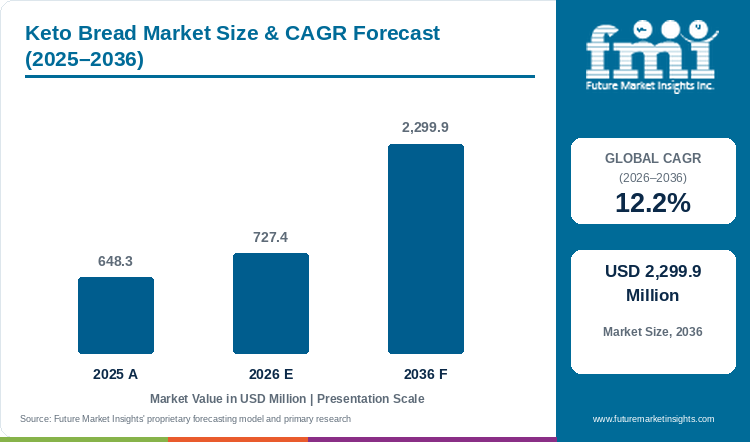
USD 727.4 million in 2026 and USD 2,299.9 million by 2036, expanding at 12.2% CAGR.
FMI values the keto bread market at USD 648.3 million in 2025 and USD 727.4 million in 2026. It is forecast to reach USD 2,299.9 million by 2036 at a 12.2% CAGR. Demand stems from preserving familiar bread occasions while lowering carbohydrate exposure. Operating conditions differ materially by country. U.S. shelves already contain dedicated keto loaves from established packaged-bread manufacturers, while Japan has a documented reduced-carbohydrate bread from Yamazaki Baking. [6][9][21] Germany adds a different test because nutrition comparisons remain visible at the shelf. [5] These conditions indicate that interest in lower-carbohydrate bakery products becomes revenue only when the proposition survives standard taste and value tests.
Key Takeaways
- Demand relies on recurring purchases driven by sensory quality matching conventional bread.
- Keto sliced bread leads Product Type with a 30.0% share in 2026 due to broad household usage.
- Conventional leads Claim / Nature with a 55.0% share by avoiding extra ingredient constraints.
- Frozen leads Format with a 29.0% share by extending holding time and reducing waste.
- Principal friction involves formulation trade-offs between carbohydrate reduction and acceptable price.
- Profiled companies include Grupo Bimbo and Flowers Foods alongside Yamazaki Baking.
Analyst Perspective
“Realized revenue will depend less on awareness of carbohydrate reduction than on product quality. Suppliers must deliver bread-like taste with credible nutrition claims. The price must survive routine grocery comparison.”
- Nandini Roy Choudhury, Principal Consultant, Future Market Insights
How is the keto bread market segmented?
Keto Bread Market is segmented by Product Type, Claim / Nature, Format, Packaging Format, Sales Channel, and Region.
Product Type includes keto sliced bread, keto buns and rolls, keto tortillas and wraps, and keto sweet bakery. Claim / Nature covers Conventional, Clean label, Organic, Gluten-free, and High-protein / fortified options. Format includes Frozen, Fresh, Ambient packaged, Chilled, and Par-baked / thaw-and-serve. Packaging Format includes Multipack, Single-serve, Family / loaf pack, and Bulk foodservice. Sales Channel includes Supermarkets and hypermarkets, Artisan and specialty bakeries, Convenience and forecourt, Online and DTC, and Foodservice distributors.
Why does Keto sliced bread lead demand within the Product Type category?
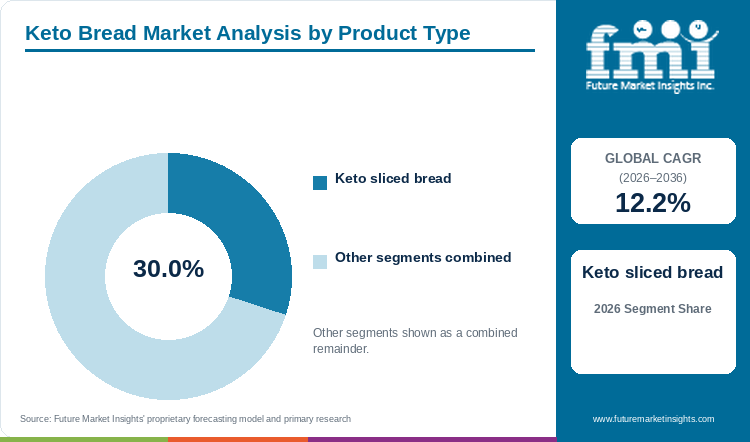
Keto sliced bread holds a 30.0% share in 2026
Sliced bread is the lowest-friction way to replace ordinary bread. The portion format and household storage routine are already familiar. It works across toast and sandwiches without requiring consumers to learn a new format. Direct product activity supports this substitution logic. Oroweat product information updated in June 2025 documents Superior Keto Sandwich Thins in a six-roll pre-sliced format manufactured by Bimbo Bakeries USA. [6]
- Keto sliced bread holds a 30.0% share in 2026. Its lead reflects broad day-to-day usage.
- Oroweat documents Superior Keto Sandwich Thins as a six-roll pre-sliced format, showing keto positioning carried into a familiar bread occasion. [6]
Why does Conventional lead demand within the Claim / Nature category?
Conventional holds a 55.0% share in 2026
Conventional products allow manufacturers to focus on carbohydrate reduction and sensory performance. This avoids layering additional claim systems onto the same formulation. Gluten-free bakery products must satisfy specific ingredient and cross-contact rules. Organic products also narrow ingredient and sourcing options. That extra complexity matters in low-carbohydrate bread because fiber and proteins already carry much of the burden of recreating volume.
- Conventional holds a 55.0% share in 2026. The segment benefits from wider formulation freedom.
- FDA guidance states that foods labeled gluten-free must meet specific conditions, including less than 20 ppm of unavoidable gluten. [3]
Why does Frozen lead demand within the Format category?
Frozen supply shifts part of the shelf-life problem to cold-chain control. That is useful for breads with specialized ingredient systems. Foodservice buyers want predictable stock with less daily spoilage. Frozen bakery market infrastructure is extensive among several profiled participants. Vandemoortele acquired Lizzi in February 2025, adding frozen bread production and retail distribution in Italy. [7]
- Frozen holds a 29.0% share in 2026. Its lead is linked to longer inventory windows.
- Vandemoortele acquired Lizzi in February 2025. Lizzi produces frozen bakery products including bread and serves both HoReCa and large-scale retail. [7]
Why does Multipack lead demand within the Packaging Format category?
Multipacks align with the repeat-use pattern of buns and thin sandwich formats. They give households several meal occasions from one purchase. They reduce the need for individually wrapped units. They also let brands present a familiar pack architecture beside mainstream bakery products. Bimbo Bakeries USA documents Oroweat keto sandwich thins in a six-roll format. [6]
- Multipack holds a 35.0% share in 2026. It balances household convenience with lower packaging burden.
- Oroweat product information updated in June 2025 documented a six-roll pre-sliced Superior Keto Sandwich Thins format. [6]
Why do Supermarkets and hypermarkets lead demand within the Sales Channel category?
Large grocery stores give keto bread the best chance to be evaluated beside mainstream loaves. That shelf comparison matters because purchase is often substitutive. Supermarkets also concentrate household traffic and support recurring replenishment. Warburtons promoted its protein-packed bread, pitta, bagel and flatbread range through major UK retailers in early 2025. [8] This illustrates how functional bakery market propositions use mainstream grocery distribution.
- Supermarkets and hypermarkets hold a 35.0% share in 2026. The channel leads because it combines scale and routine bread-shopping missions.
- Warburtons promoted a protein bakery range available through major UK retailers in early 2025, illustrating the mainstream retail route used by nutrition-positioned bread products. [8]
What are the drivers, restraints and opportunities in the Keto Bread Market?
Lower-carbohydrate meal substitution drives demand, formulation and taste trade-offs restrain repeat purchase, and protein-positioned products widen the addressable audience.
- Driver: Lower-carbohydrate meal planning creates demand for familiar bread substitutes that can stay within existing meal routines.
- Restraint: Higher fiber and protein loading can alter crumb, loaf volume and taste, weakening repeat purchase.
- Opportunity: Combining lower-carbohydrate positioning with protein can widen demand beyond strict keto users.
The American Diabetes Association 2024 guidance allows carbohydrate reduction as one approach for adults with diabetes. [1] Keto bread gives consumers a way to modify sandwiches without removing the bread occasion entirely. Current packaged-bread activity from Flowers Foods and Bimbo Bakeries USA shows how established bakery brands translate this need into familiar loaf and roll formats. [6][9] Demand is strongest where the product can replace a familiar staple.
The restraint appears at the formulation and repeat-purchase stage. A 2026 Annual Review of Food Science and Technology paper notes technological barriers to incorporating diverse plant proteins. [2] Keto formulations often depend heavily on fiber or protein to offset reduced available carbohydrate. That can alter crumb and volume. The problem is commercially important because nutrition-positioned bread still competes with standard loaves on familiar eating quality. A product can win initial trial on nutrition and still lose repeat purchase on texture.
The clearest opportunity is to move from a single diet claim toward a broader nutrition proposition. Flowers Foods introduced a keto-friendly Nature’s Own Wheat + Protein loaf in October 2025 with 22 grams of protein per two-slice serving. [9] Warburtons also markets a protein bakery products range through major retailers. [8] Suppliers that combine lower carbohydrate with protein may widen demand beyond strict keto users. Capture depends on disciplined formulation and transparent labeling.
Which country CAGRs are profiled in the Keto Bread Market?
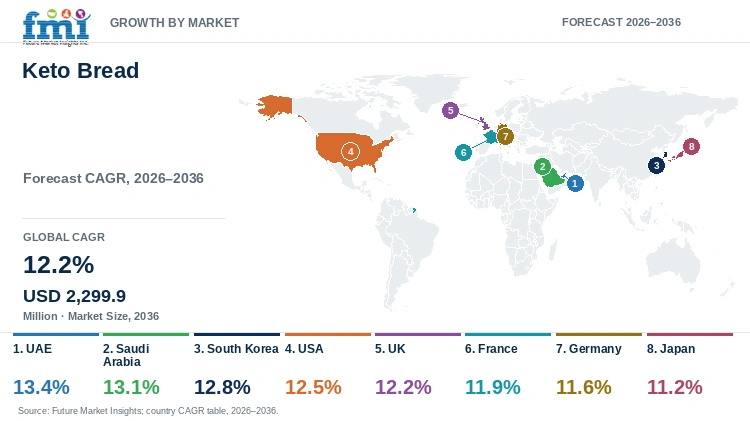
| Country | CAGR |
|---|---|
| UAE | 13.4% |
| Saudi Arabia | 13.1% |
| South Korea | 12.8% |
| USA | 12.5% |
| UK | 12.2% |
| France | 11.9% |
| Germany | 11.6% |
| Japan | 11.2% |
How do country-level CAGRs compare in the Keto Bread Market?
The profiled rates form a relatively tight band. UAE and Saudi Arabia sit above 13%. South Korea and the USA follow in the upper-12% range. UK is aligned with the overall market CAGR. France and Germany remain below that pace but still show double-digit growth. The spread between the highest and lowest profiled CAGRs is 2.2 percentage points. These percentages describe forecast growth rates. They do not represent absolute market size.
- The UAE combines strong nutrition-policy attention with current national diet data, making clear carbohydrate and nutrition communication more relevant to product positioning. [10]
- Saudi Arabia has a broad weight-management context, while mainstream retail execution still depends on taste, convenience and a clear reason to pay a premium. [11]
- South Korea combines high weight-control activity with mandatory nutrition labeling for breads, giving shoppers comparable carbohydrate information at the point of purchase. [12][13]
- The USA already has keto and keto-friendly bread products from national packaged-bread suppliers, reducing the need to explain the format from scratch. [6][9]
- The UK has nutrition-positioned bread in major supermarkets, giving keto products a familiar retail setting but leaving value and taste as central purchase tests. [8][14]
- France combines established cereal consumption with current public action to improve food composition, favoring substitution within familiar bread occasions rather than bread avoidance. [15][16]
- Germany gives nutrition comparison a visible role through Nutri-Score, while keto bread still has to meet ordinary expectations for crust, softness and eating quality. [5]
- Japan already has a reduced-carbohydrate bread from Yamazaki Baking, while food-labeling rules keep nutrient claims tied to defined labeling requirements. [18][21]
Country-wise Analysis
- UAE is likely to grow at 13.4% CAGR from 2026 to 2036. The health and nutrition context is unusually visible. The Ministry of Health and Prevention published results from the 2024 to 2025 National Health and Nutrition Survey in January 2026. It found that 27.3% of adults exceeded recommended sugar intake and average fiber intake was 23.1 grams per day. [10] Suppliers can use clear carbohydrate disclosure to make the nutrition proposition easier to compare. Taste profiles still need to suit routine household use rather than relying on a diet label alone.
- Saudi Arabia is set to grow at a 13.1% CAGR from 2026 to 2036. GASTAT reported obesity at 23.1% among people aged 15 and above and overweight status at 45.1% in its Health Determinants Statistics for 2024, figures also carried in its later annual reporting. [11] This creates a broad weight-management context. Lower-carbohydrate bakery can be considered as one substitution option. Keto bread must still compete with familiar flatbreads on taste and convenience, while retailers are likely to favor propositions that fit mainstream shopping missions.
- South Korea is likely to grow at 12.8% CAGR from 2026 to 2036. The Korea Disease Control and Prevention Agency reported in November 2025 that 34.4% of adults were obese and 65% had tried to lose or maintain weight. [12] The Ministry of Food and Drug Safety requires nutrition labeling for breads and lists carbohydrates among mandatory nutrients. [13] Suppliers therefore face a transparent comparison environment. Products need measurable carbohydrate positioning and credible substantiation.
- USA is anticipated to grow at 12.5% CAGR from 2026 to 2036. CDC data reported adult obesity prevalence of 40.3% during August 2021 to August 2023. [4] Direct market evidence is also visible. Flowers Foods introduced Nature’s Own Wheat + Protein in 2025, while Bimbo Bakeries USA documents Oroweat keto bread and sandwich thins under an established bread brand. [6][9] This combination reduces the education barrier. Shoppers can encounter keto formats in familiar bakery architecture, leaving price and taste as the main competitive tests.
- UK keto bread market is likely to grow at 12.2% CAGR from 2026 to 2036. Health Survey for England 2024, published in January 2026, reported obesity and overweight across the adult population as a continuing health issue. [14] Functional bakery is already present in mainstream grocery. Warburtons promotes a protein range through major retailers. [8] Suppliers entering with keto products will need to establish a clear carbohydrate benefit, with supermarket placement and recognizable formats remaining central to scale.
- France keto bread market is likely to grow at 11.9% CAGR from 2026 to 2036. French health policy updated in 2025 continued to push improvement in the nutritional quality of the food offer. [15] At the same time, the Ministry of Agriculture reported direct cereal consumption of 112 kg per person in 2023 to 2024. [16] Keto bread suppliers therefore have an opening to adapt a familiar staple rather than asking consumers to abandon bread. Ingredient quality will matter alongside carbohydrate reduction.
- Germany is likely to grow at an 11.6% CAGR from 2026 to 2036. Federal guidance updated in 2025 explains that Nutri-Score helps consumers compare the nutritional quality of foods within a product category. [5] Keto bread therefore faces two simultaneous tests. It must present a credible nutrition proposition while avoiding a noticeable sensory penalty. This favors formulations preserving crust and softness.
- Japan has the lowest profiled rate but still grows at an 11.2% CAGR from 2026 to 2036. The Ministry of Health, Labour and Welfare reported in March 2025 that 31.5% of men aged 20 and older had BMI of at least 25. [17] Yamazaki Baking sells a reduced-carbohydrate bread that it describes as 42% lower in carbohydrate than its cited standard-bread comparator. [21] Japanese food-labeling rules set defined requirements for nutrient-content claims. [18] Precise labeling and soft texture remain important conditions for expansion.
Who are the notable companies in the Keto Bread Market?
Grupo Bimbo, Flowers Foods, Aryzta, Lantmannen Unibake, Vandemoortele, Yamazaki Baking, Warburtons, King's Hawaiian, Europastry, and St Pierre Groupe are profiled across direct reduced-carbohydrate bread, frozen bakery, convenience bakery, and specialty bread formats.
Grupo Bimbo and Flowers Foods have direct keto or keto-friendly bread products in the United States. [6][9] Aryzta and Lantmannen Unibake bring convenience-bakery production, while Vandemoortele and Europastry add frozen and foodservice infrastructure. Yamazaki Baking adds a documented reduced-carbohydrate bread proposition in Japan. [21] Warburtons, King's Hawaiian and St Pierre Groupe contribute branded bread and specialty bakery formats.
- Direct reduced-carbohydrate product activity includes Grupo Bimbo and Flowers Foods.
- Frozen and convenience bakery platforms include Aryzta, Lantmannen Unibake, Vandemoortele and Europastry.
- Branded bread and specialty bakery formats include Yamazaki Baking, Warburtons, King's Hawaiian and St Pierre Groupe.
Competitive Benchmarking: Keto Bread Market
| Company | Reduced-Carb Product Evidence | Bread-Format Breadth | Frozen / Convenience Capability | Geographic Reach |
|---|---|---|---|---|
| Grupo Bimbo | High | High | Low | Global group; direct keto product activity in the United States |
| Flowers Foods | High | High | Low | United States |
| Aryzta | Low | Medium | Medium | Europe, Asia, Australia and New Zealand |
| Lantmannen Unibake | Low | High | High | Europe and international markets; presence in more than 20 countries |
| Vandemoortele | Low | High | High | Europe and United States |
| Yamazaki Baking | High | Medium | Medium | Japan with additional operations in Asia, United States and Europe |
| Warburtons | Low | High | Low | United Kingdom |
| King's Hawaiian | Low | High | Low | United States |
| Europastry | Low | High | High | Europe, Americas and other international markets |
| St Pierre Groupe | Low | High | Low | United States and selected European markets |
Scoring basis: Reduced-Carb Product Evidence is High when a current keto or reduced-carbohydrate bread product is documented. Bread-Format Breadth is High when multiple relevant bread formats are present. Frozen / Convenience Capability is High when frozen or convenience-bakery infrastructure is central to the platform. Low indicates a limited fit against the listed capability, not a market-share estimate.
Key Developments in the Keto Bread Market
- February 2025: Vandemoortele acquired Lizzi, adding frozen bakery production and distribution across bread, pizza, focaccia, pastry and patisserie in Italy. [7]
- October 2025: Flowers Foods introduced Nature’s Own Wheat + Protein, a keto-friendly loaf with 22 grams of protein per two-slice serving. [9]
- January 2026: Aryzta announced a new EUR 40 million bun bakery in Portugal, expanding industrial bun capacity within its convenience-bakery platform. [19]
Key Players in the Keto Bread Market
Direct Reduced-Carbohydrate Bread Participants
- Grupo Bimbo
- Flowers Foods
- Yamazaki Baking
Frozen and Convenience Bakery Platforms
- Aryzta
- Lantmannen Unibake
- Vandemoortele
- Europastry
Branded Bread and Specialty Bakery Participants
- Warburtons
- King's Hawaiian
- St Pierre Groupe
Keto Bread Market - Report Scope
| Coverage field | Report scope |
|---|---|
| Market breakdown | Product Type; Claim / Nature; Format; Packaging Format; Sales Channel |
| Quantitative Units | USD Million |
| Market Definition | Revenue from keto-positioned or very-low-carbohydrate bread and bread-format goods sold within the listed segmentation universe. |
| Regions Covered | North America; Latin America; Western Europe; Eastern Europe; East Asia; South Asia and Pacific; Middle East and Africa |
| Countries Covered | USA; Germany; France; UK; Saudi Arabia; UAE; Japan; South Korea |
| Key Companies Profiled | Grupo Bimbo; Flowers Foods; Aryzta; Lantmannen Unibake; Vandemoortele; Yamazaki Baking; Warburtons; King's Hawaiian; Europastry; St Pierre Groupe |
| Forecast Period | 2026 to 2036 |
| Approach | Primary and secondary research with market triangulation. |
Keto Bread Market - Research Methodology
| Method | Approach |
|---|---|
| Primary Research | FMI analysts gathered input from manufacturers, distributors, end users and subject-matter experts. |
| Desk Research | Desk research covered government statistics, regulatory publications, trade data and company filings. |
| Market Sizing and Forecasting | The market model combined baseline value with historical performance, segment structure and adoption levels. |
| Data Validation | Estimates were checked against multiple independent indicators including public data and company activity. |
Keto Bread Market by Segments
Keto Bread Market segmented by Product Type:
- Keto sliced bread
- Keto buns and rolls
- Keto tortillas and wraps
- Keto sweet bakery
Keto Bread Market segmented by Claim / Nature:
- Conventional
- Clean label
- Organic
- Gluten-free
- High-protein / fortified
Keto Bread Market segmented by Format:
- Frozen
- Fresh
- Ambient packaged
- Chilled
- Par-baked / thaw-and-serve
Keto Bread Market segmented by Packaging Format:
- Multipack
- Single-serve
- Family / loaf pack
- Bulk foodservice
Keto Bread Market segmented by Sales Channel:
- Supermarkets and hypermarkets
- Artisan and specialty bakeries
- Convenience and forecourt
- Online and DTC
- Foodservice distributors
Keto Bread Market by Region:
- North America
- United States
- Canada
- Latin America
- Brazil
- Mexico
- Argentina
- Chile
- Western Europe
- Germany
- France
- United Kingdom
- Italy
- Spain
- Benelux
- Nordics
- Eastern Europe
- Poland
- Czech Republic
- Romania
- Hungary
- East Asia
- China
- Japan
- South Korea
- South Asia and Pacific
- India
- ASEAN
- Australia and New Zealand
- Middle East and Africa
- GCC Countries
- South Africa
- Türkiye
- Israel
Research Sources and Bibliography
- American Diabetes Association (2024). Standards of Care in Diabetes.
- Annual Reviews (2026). Plant-Protein Fortification of Cereal Foods.
- U.S. Food and Drug Administration (n.d.). Gluten-Free Food Labeling Final Rule.
- Centers for Disease Control and Prevention (2024). Obesity Prevalence in Adults.
- Federal Ministry of Food and Agriculture, Germany (2025). Guidance for companies on the use of Nutri-Score.
- Oroweat / Bimbo Bakeries USA (2025, June 18). Oroweat Sandwich Thins, Superior Keto Rolls, product information.
- Vandemoortele (2025, February 14). Vandemoortele acquires Lizzi in Italy, a specialty player in frozen bakery.
- Warburtons (2025). Protein-packed bread, pitta, bagel and flatbread range promoted through major UK retailers.
- Flowers Foods (2025, October 27). Flowers Foods taps into higher-protein and sourdough trends with new products.
- Ministry of Health and Prevention, UAE (2026, January 6). National Health and Nutrition Survey 2024-2025 results.
- General Authority for Statistics, Saudi Arabia (2026). Annual Report 2024, including Health Determinants Statistics for 2024.
- Korea Disease Control and Prevention Agency (2025, November). One in Three Korean Adults Is Obese, a 30.8% Increase Over the Past Decade.
- Ministry of Food and Drug Safety, Republic of Korea (2025-2026). Food Labeling System and nutrition-labeling requirements for breads.
- NHS England (2026, January 27). Health Survey for England, 2024.
- Ministry of Health, France (2025). Collective action to improve the nutritional quality of food products.
- Ministry of Agriculture, Food and Food Sovereignty, France (2026, June 16). Food consumption infographic, including cereal consumption for 2023-2024.
- Ministry of Health, Labour and Welfare, Japan (2025, March 18). National Health and Nutrition Survey results.
- Consumer Affairs Agency, Japan (2025-2026). Food Labeling Standards and nutrient-content claim guidance.
- ARYZTA (2026, January 22). New EUR 40 million bun bakery in Portugal.
- ARYZTA (2026, August 26). New Perth bakery officially opened.
- Yamazaki Baking Co., Ltd. (n.d.). Health-support products: reduced-carbohydrate bread.
This Report Answers
- How large is the Keto Bread Market in 2026 and what value is forecast for 2036?
- Which consumer and nutrition pressures support demand for keto bread?
- Why does Keto sliced bread hold the leading position within Product Type?
- Why does Conventional lead the Claim / Nature category?
- How do the profiled country growth rates differ from 2026 to 2036?
- Which profiled companies supply keto or adjacent bread-format capabilities?
- What formulation and sensory constraints can limit adoption or repeat purchase?
- What should buyers evaluate before purchasing keto bread for retail use?
Frequently Asked Questions
How big is the Keto Bread Market in 2026, and what is forecast for 2036?
As per FMI, the market is valued at USD 727.4 million in 2026. It is forecast to reach USD 2,299.9 million by 2036.
What is the CAGR for the Keto Bread Market from 2026 to 2036?
The market is forecast to grow at a 12.2% CAGR from 2026 to 2036.
Which Product Type leads the Keto Bread Market in 2026?
Keto sliced bread leads Product Type with a 30.0% share in 2026. Its position reflects frequent household use.
Which Claim / Nature segment leads the Keto Bread Market in 2026?
As per FMI, Conventional leads Claim / Nature with a 55.0% share in 2026. The category gives manufacturers more formulation flexibility.
Which profiled countries have the highest growth rates in the Keto Bread Market?
UAE has the highest profiled CAGR at 13.4% from 2026 to 2036. Saudi Arabia follows at 13.1% and South Korea at 12.8%.
Which companies are active in the Keto Bread Market?
Profiled companies include Grupo Bimbo, Flowers Foods, Aryzta, Lantmannen Unibake, Vandemoortele, Yamazaki Baking, Warburtons, King's Hawaiian, Europastry and St Pierre Groupe.
Preview the report firsthand - request a free sample
Get SampleGet the brochure for pricing and purchase details.
Get PDFTable of Content
- Key Takeaways
- Market Size and CAGR
- Top Growth Driver
- Fastest Growing Segment
- Leading Region
- Key Companies
- Emerging Opportunities
- Executive Summary
- Global Market Outlook
- Demand-side Trends
- Supply-side Trends
- Technology Roadmap Analysis
- Analysis and Recommendations
- Analyst Perspective (What is happening? Why now? What should investors know?)
- Key Questions Answered
- How large is the market?
- What is the CAGR?
- What are key trends?
- Which region dominates?
- Who are the leaders?
- Market Overview
- Market Coverage / Taxonomy
- Market Definition / Scope / Limitations
- Research Methodology
- Chapter Orientation
- Analytical Lens and Working Hypotheses
- Market Structure, Signals, and Trend Drivers
- Benchmarking and Cross-market Comparability
- Market Sizing, Forecasting, and Opportunity Mapping
- Research Design and Evidence Framework
- Desk Research Programme (Secondary Evidence)
- Expert Input and Fieldwork (Primary Evidence)
- Tooling, Models, and Reference Databases
- Data Engineering and Model Build
- Quality Assurance and Audit Trail
- Market Background
- Market Dynamics (Drivers, Restraints, Opportunity, Trends)
- Scenario Forecast (Optimistic, Likely, Conservative)
- Impact Analysis
- AI Impact
- Sustainability Impact
- Regulatory Impact
- Technology Impact
- Consumer / Buyer Analysis
- Purchase Drivers
- Adoption Barriers
- Buyer Journey
- Opportunity Map Analysis
- Product Life Cycle Analysis
- Supply Chain Analysis
- Investment Feasibility Matrix
- Value Chain Analysis
- PESTLE and Porter's Analysis
- Regulatory Landscape
- Regional Parent Market Outlook
- Production and Consumption Statistics
- Import and Export Statistics
- Global Market Analysis and Forecast, 2021 to 2036
- Historical Market Size Value (USD Million) Analysis, 2021 to 2025
- Current and Future Market Size Value (USD Million) Projections, 2026 to 2036
- Y-o-Y Growth Trend Analysis
- Absolute $ Opportunity Analysis
- Global Market Pricing Analysis, 2021 to 2036
- Global Market Analysis and Forecast, By Product Type, 2021 to 2036
- Introduction / Key Findings
- Historical Market Size Value (USD Million) Analysis By Product Type, 2021 to 2025
- Current and Future Market Size Value (USD Million) Analysis and Forecast By Product Type, 2026 to 2036
- Keto sliced bread
- Keto buns and rolls
- Keto tortillas and wraps
- Keto sweet bakery
- Y-o-Y Growth Trend Analysis By Product Type, 2021 to 2025
- Absolute $ Opportunity Analysis By Product Type, 2026 to 2036
- Global Market Analysis and Forecast, By Claim / Nature, 2021 to 2036
- Introduction / Key Findings
- Historical Market Size Value (USD Million) Analysis By Claim / Nature, 2021 to 2025
- Current and Future Market Size Value (USD Million) Analysis and Forecast By Claim / Nature, 2026 to 2036
- Conventional
- Clean label
- Organic
- Gluten-free
- High-protein / fortified
- Y-o-Y Growth Trend Analysis By Claim / Nature, 2021 to 2025
- Absolute $ Opportunity Analysis By Claim / Nature, 2026 to 2036
- Global Market Analysis and Forecast, By Format, 2021 to 2036
- Introduction / Key Findings
- Historical Market Size Value (USD Million) Analysis By Format, 2021 to 2025
- Current and Future Market Size Value (USD Million) Analysis and Forecast By Format, 2026 to 2036
- Frozen
- Fresh
- Ambient packaged
- Chilled
- Par-baked / thaw-and-serve
- Y-o-Y Growth Trend Analysis By Format, 2021 to 2025
- Absolute $ Opportunity Analysis By Format, 2026 to 2036
- Global Market Analysis and Forecast, By Packaging Format, 2021 to 2036
- Introduction / Key Findings
- Historical Market Size Value (USD Million) Analysis By Packaging Format, 2021 to 2025
- Current and Future Market Size Value (USD Million) Analysis and Forecast By Packaging Format, 2026 to 2036
- Multipack
- Single-serve
- Family / loaf pack
- Bulk foodservice
- Y-o-Y Growth Trend Analysis By Packaging Format, 2021 to 2025
- Absolute $ Opportunity Analysis By Packaging Format, 2026 to 2036
- Global Market Analysis and Forecast, By Sales Channel, 2021 to 2036
- Introduction / Key Findings
- Historical Market Size Value (USD Million) Analysis By Sales Channel, 2021 to 2025
- Current and Future Market Size Value (USD Million) Analysis and Forecast By Sales Channel, 2026 to 2036
- Supermarkets and hypermarkets
- Artisan and specialty bakeries
- Convenience and forecourt
- Online and DTC
- Foodservice distributors
- Y-o-Y Growth Trend Analysis By Sales Channel, 2021 to 2025
- Absolute $ Opportunity Analysis By Sales Channel, 2026 to 2036
- Global Market Analysis and Forecast, By Region, 2021 to 2036
- Introduction
- Historical Market Size Value (USD Million) Analysis By Region, 2021 to 2025
- Current Market Size Value (USD Million) Analysis and Forecast By Region, 2026 to 2036
- North America
- Latin America
- Western Europe
- Eastern Europe
- East Asia
- South Asia and Pacific
- Middle East and Africa
- Market Attractiveness Analysis By Region
- North America Market Analysis and Forecast, By Country, 2021 to 2036
- Historical Market Size Value (USD Million) Trend Analysis By Market Taxonomy, 2021 to 2025
- Market Size Value (USD Million) Forecast By Market Taxonomy, 2026 to 2036
- By Country
- United States
- Canada
- By Product Type
- By Claim / Nature
- By Format
- By Packaging Format
- By Sales Channel
- By Country
- Market Attractiveness Analysis
- By Country
- By Product Type
- By Claim / Nature
- By Format
- By Packaging Format
- By Sales Channel
- Key Takeaways
- Latin America Market Analysis and Forecast, By Country
- Historical Market Size Value (USD Million) Trend Analysis By Market Taxonomy, 2021 to 2025
- Market Size Value (USD Million) Forecast By Market Taxonomy, 2026 to 2036
- By Country
- Brazil
- Mexico
- Argentina
- Chile
- By Product Type
- By Claim / Nature
- By Format
- By Packaging Format
- By Sales Channel
- By Country
- Market Attractiveness Analysis
- By Country
- By Product Type
- By Claim / Nature
- By Format
- By Packaging Format
- By Sales Channel
- Key Takeaways
- Western Europe Market Analysis and Forecast, By Country
- Historical Market Size Value (USD Million) Trend Analysis By Market Taxonomy, 2021 to 2025
- Market Size Value (USD Million) Forecast By Market Taxonomy, 2026 to 2036
- By Country
- Germany
- France
- United Kingdom
- Italy
- Spain
- Benelux
- Nordics
- By Product Type
- By Claim / Nature
- By Format
- By Packaging Format
- By Sales Channel
- By Country
- Market Attractiveness Analysis
- By Country
- By Product Type
- By Claim / Nature
- By Format
- By Packaging Format
- By Sales Channel
- Key Takeaways
- Eastern Europe Market Analysis and Forecast, By Country
- Historical Market Size Value (USD Million) Trend Analysis By Market Taxonomy, 2021 to 2025
- Market Size Value (USD Million) Forecast By Market Taxonomy, 2026 to 2036
- By Country
- Poland
- Czech Republic
- Romania
- Hungary
- By Product Type
- By Claim / Nature
- By Format
- By Packaging Format
- By Sales Channel
- By Country
- Market Attractiveness Analysis
- By Country
- By Product Type
- By Claim / Nature
- By Format
- By Packaging Format
- By Sales Channel
- Key Takeaways
- East Asia Market Analysis and Forecast, By Country
- Historical Market Size Value (USD Million) Trend Analysis By Market Taxonomy, 2021 to 2025
- Market Size Value (USD Million) Forecast By Market Taxonomy, 2026 to 2036
- By Country
- China
- Japan
- South Korea
- By Product Type
- By Claim / Nature
- By Format
- By Packaging Format
- By Sales Channel
- By Country
- Market Attractiveness Analysis
- By Country
- By Product Type
- By Claim / Nature
- By Format
- By Packaging Format
- By Sales Channel
- Key Takeaways
- South Asia and Pacific Market Analysis and Forecast, By Country
- Historical Market Size Value (USD Million) Trend Analysis By Market Taxonomy, 2021 to 2025
- Market Size Value (USD Million) Forecast By Market Taxonomy, 2026 to 2036
- By Country
- India
- ASEAN
- Australia and New Zealand
- By Product Type
- By Claim / Nature
- By Format
- By Packaging Format
- By Sales Channel
- By Country
- Market Attractiveness Analysis
- By Country
- By Product Type
- By Claim / Nature
- By Format
- By Packaging Format
- By Sales Channel
- Key Takeaways
- Middle East and Africa Market Analysis and Forecast, By Country
- Historical Market Size Value (USD Million) Trend Analysis By Market Taxonomy, 2021 to 2025
- Market Size Value (USD Million) Forecast By Market Taxonomy, 2026 to 2036
- By Country
- GCC Countries
- South Africa
- Türkiye
- Israel
- By Product Type
- By Claim / Nature
- By Format
- By Packaging Format
- By Sales Channel
- By Country
- Market Attractiveness Analysis
- By Country
- By Product Type
- By Claim / Nature
- By Format
- By Packaging Format
- By Sales Channel
- Key Takeaways
- Key Countries Market Analysis
- United States
- Pricing Analysis
- Market Share Analysis, 2025
- By Product Type
- By Claim / Nature
- By Format
- By Packaging Format
- By Sales Channel
- Canada
- Pricing Analysis
- Market Share Analysis, 2025
- By Product Type
- By Claim / Nature
- By Format
- By Packaging Format
- By Sales Channel
- Mexico
- Pricing Analysis
- Market Share Analysis, 2025
- By Product Type
- By Claim / Nature
- By Format
- By Packaging Format
- By Sales Channel
- Brazil
- Pricing Analysis
- Market Share Analysis, 2025
- By Product Type
- By Claim / Nature
- By Format
- By Packaging Format
- By Sales Channel
- Chile
- Pricing Analysis
- Market Share Analysis, 2025
- By Product Type
- By Claim / Nature
- By Format
- By Packaging Format
- By Sales Channel
- Germany
- Pricing Analysis
- Market Share Analysis, 2025
- By Product Type
- By Claim / Nature
- By Format
- By Packaging Format
- By Sales Channel
- United Kingdom
- Pricing Analysis
- Market Share Analysis, 2025
- By Product Type
- By Claim / Nature
- By Format
- By Packaging Format
- By Sales Channel
- Italy
- Pricing Analysis
- Market Share Analysis, 2025
- By Product Type
- By Claim / Nature
- By Format
- By Packaging Format
- By Sales Channel
- Spain
- Pricing Analysis
- Market Share Analysis, 2025
- By Product Type
- By Claim / Nature
- By Format
- By Packaging Format
- By Sales Channel
- France
- Pricing Analysis
- Market Share Analysis, 2025
- By Product Type
- By Claim / Nature
- By Format
- By Packaging Format
- By Sales Channel
- India
- Pricing Analysis
- Market Share Analysis, 2025
- By Product Type
- By Claim / Nature
- By Format
- By Packaging Format
- By Sales Channel
- ASEAN
- Pricing Analysis
- Market Share Analysis, 2025
- By Product Type
- By Claim / Nature
- By Format
- By Packaging Format
- By Sales Channel
- Australia and New Zealand
- Pricing Analysis
- Market Share Analysis, 2025
- By Product Type
- By Claim / Nature
- By Format
- By Packaging Format
- By Sales Channel
- China
- Pricing Analysis
- Market Share Analysis, 2025
- By Product Type
- By Claim / Nature
- By Format
- By Packaging Format
- By Sales Channel
- Japan
- Pricing Analysis
- Market Share Analysis, 2025
- By Product Type
- By Claim / Nature
- By Format
- By Packaging Format
- By Sales Channel
- South Korea
- Pricing Analysis
- Market Share Analysis, 2025
- By Product Type
- By Claim / Nature
- By Format
- By Packaging Format
- By Sales Channel
- Poland
- Pricing Analysis
- Market Share Analysis, 2025
- By Product Type
- By Claim / Nature
- By Format
- By Packaging Format
- By Sales Channel
- Hungary
- Pricing Analysis
- Market Share Analysis, 2025
- By Product Type
- By Claim / Nature
- By Format
- By Packaging Format
- By Sales Channel
- Türkiye
- Pricing Analysis
- Market Share Analysis, 2025
- By Product Type
- By Claim / Nature
- By Format
- By Packaging Format
- By Sales Channel
- South Africa
- Pricing Analysis
- Market Share Analysis, 2025
- By Product Type
- By Claim / Nature
- By Format
- By Packaging Format
- By Sales Channel
- UAE
- Pricing Analysis
- Market Share Analysis, 2025
- By Product Type
- By Claim / Nature
- By Format
- By Packaging Format
- By Sales Channel
- Saudi Arabia
- Pricing Analysis
- Market Share Analysis, 2025
- By Product Type
- By Claim / Nature
- By Format
- By Packaging Format
- By Sales Channel
- United States
- Market Structure Analysis
- Competition Dashboard
- Competition Benchmarking
- Market Share Analysis of Top Players
- By Regional
- By Product Type
- By Claim / Nature
- By Format
- By Packaging Format
- By Sales Channel
- Emerging Startups
- Innovation Benchmarking
- Competition Analysis
- Competition Deep Dive
- Grupo Bimbo
- Overview
- Product Portfolio
- Profitability by Market Segments
- Sales Footprint
- Strategy Overview
- Marketing Strategy
- Product Strategy
- Channel Strategy
- Flowers Foods
- Aryzta
- Lantmannen Unibake
- Vandemoortele
- Yamazaki Baking
- Warburtons
- King's Hawaiian
- Europastry
- St Pierre Groupe
- Grupo Bimbo
- Case Studies
- Success Stories
- Recent Developments
- Competition Deep Dive
- Assumptions & Acronyms Used


