

- Market Size (2026)
- USD 1120.6 Mn
- Forecast (2036)
- USD 1878.2 Mn
- CAGR (2026 to 2036)
- 5.3%
How big is Lifting Clamps Market in 2026?
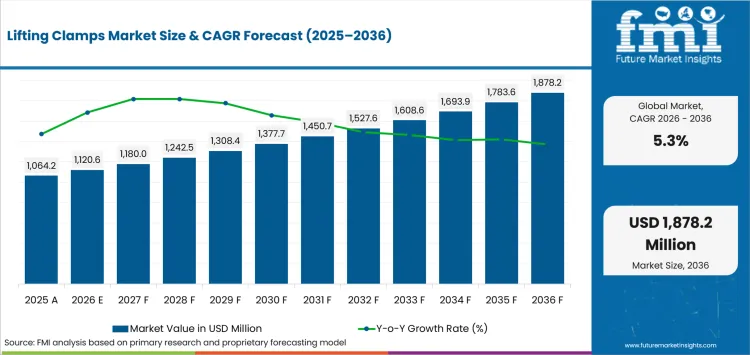
USD 1120.6 million in 2026 and USD 1878.2 million by 2036 at a 5.3% CAGR.
Demand for lifting clamps is projected to expand at a 5.3% CAGR through 2036, with valuation rising from USD 1120.6 million to USD 1878.2 million. Steel processing, fabrication and construction operations continue to require safe handling of plates and fabricated components throughout production and installation workflows. World Steel Association forecast global steel demand at 1,724 Mt in April 2026. That volume keeps plate moving within material handling systems coordinated with crane equipment and repeated temporary lifting points.
Market performance varies according to the pace of construction and industrial activity within individual regions. Dubai Municipality processed more than 30,000 building permit applications during the first half of 2025 and reported annual growth of 20%. A larger project pipeline increases demand for material-handling equipment during structural assembly and site operations. Contractors working against tight construction schedules often place greater value on immediate access to lifting equipment and replacement components to avoid delays during planned lifting activities.
Key Takeaways of Lifting Clamps Market
- Steel fabrication and construction sustain lifting clamp demand as plate and structural members require repeated temporary attachment during production and erection.
- By load capacity, the 1-5 ton class is estimated to hold 39.0% in 2026 owing to broad workshop compatibility.
- In 2026, cam jaw designs are expected to lead grip type with 37.0% share due to secure mechanical engagement on suitable plate surfaces.
- The sales channel category is forecast to be led by rigging distributors at 42.0% share in 2026 due to local stock and technical support.
- Inspection requirements and gripping-surface wear raise lifecycle costs as repeated service removes worn clamps from use and brings replacement spending forward.
- Columbus McKinnon Corporation, The Caldwell Group, Inc., pewag International GmbH, Aardwolf Industries LLC, Lift-All Company, Inc., Safety Clamps, Inc., Tiger Lifting and William Hackett serve the lifting clamps market.
Analyst Perspective
"Lifting clamps earn repeat orders as selected jaw geometry matches the plate surface and planned lift direction. Suppliers that pair model depth with inspection support reduce substitution risk and shorten replacement decisions for worn equipment."
- Nikhil Kaitwade, Principal Consultant, Future Market Insights
How is the Lifting Clamps Market segmented?
The lifting clamps market is segmented by clamp type, load capacity, grip type, end use, sales channel and region.
Clamp type covers vertical plate clamps, horizontal plate clamps, beam clamps, drum or pipe clamps, stone or slab clamps and universal clamps. Load capacity spans below 1 ton, 1-5 ton, 5-10 ton and above 10 ton. Grip type includes cam jaw, screw locking, automatic locking and non-marring pads. End use covers steel fabrication, construction, material handling, shipbuilding and stone and precast. Sales channel includes rigging distributors, direct manufacturer, rental or inspection and industrial catalog. Region is assessed separately.
What supports demand for vertical plate clamps within the clamp type category?
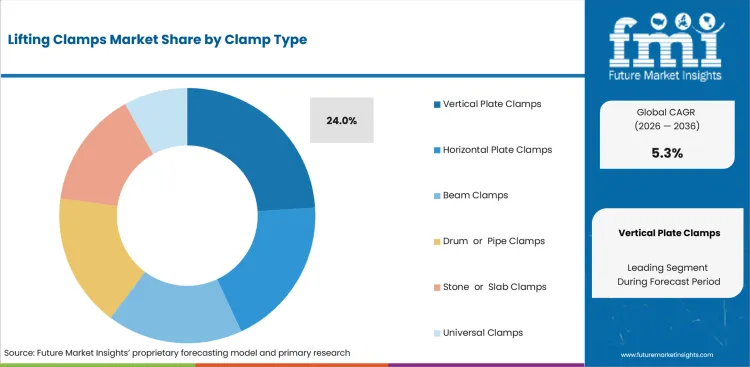
Vertical plate clamps turn stored plate upright for transfer without requiring a dedicated frame for each movement across fabrication stations. The Caldwell Group reported in July 2025 that Renfroe offers about 200 clamp types from 0.5 to 100 tons across varied lifting directions.
- Based on clamp type, vertical plate clamps are projected to account for 24.0% in 2026 due to their direct fit with recurring plate-transfer sequences.
- Fabrication crews use secured edge grips to rotate plate during cutting or assembly, concentrating demand around vertical duties beside steel coil handling workflows.
How do fabrication shops evaluate the 1-5 ton load-capacity class?
The 1-5 ton class covers common fabrication lifts without the extra mass and storage burden of high-capacity clamps. Distributors can hold several jaw openings across this range for recurring plate handling in general workshops.
- By load capacity, the 1-5 ton class is estimated to hold 39.0% in 2026 owing to broad compatibility with recurring workshop lifts.
- Kito Crosby launched a digital catalog in October 2025 covering more than 4,300 Crosby and Gunnebo Industries lifting products including Crosby IP. Searchable product ratings and enhanced navigation help distributors find and specify Crosby and Gunnebo Industries products across lifting, rigging, and securement applications.
What role does cam jaw play within the grip type category?
Grip choice determines how a clamp holds and releases plate during crane moves. OSHA issued a November 2025 citation over a July 2025 fatality incident involving lifting clamps and a steel I-beam at Kard Welding, linking discipline with clamp use.
- In 2026, cam jaw designs are expected to lead grip type with 37.0% share driven by familiar mechanical engagement on suitable plate surfaces.
- Automatic locking designs provide a separate grip route for repeated slab handling as crews value automatic engagement during pick-up and release during placement. Rubber-coated jaws address surface protection separately on delicate slabs.
What makes steel fabrication central to the end use category?
Steel fabrication generates repeated lifts as plate passes from steel production into cutting and assembly across multiple fabrication stages. Each station can require a different clamp opening or lift direction.
- The end use category is forecast to be led by steel fabrication at 29.0% share in 2026 due to recurring plate movement across production steps.
- Fabricators replace or service clamps as jaw wear and lift orientation change approved equipment needs. AISI reported in March 2026 that revised 2025 United States steel shipments reached 91.2 million tons and rose 5.1% from 2024.
What are the drivers, restraints and opportunities in the Lifting Clamps Market?
Fabrication throughput supports repeat purchases, inspection requirements raise lifecycle effort and stocked replacement networks reduce delays around active lifting work.
- Driver: Repeated plate and structural moves generate recurring clamp demand across fabrication and construction work.
- Restraint: Inspection and wear-part replacement add cost as secure attachment depends on verified clamp condition.
- Opportunity: Local stock can shorten replacement delays for common capacity bands near active industrial corridors.
Fabrication Activity Supports Repeat Clamp Purchases
Construction and fabrication programs raise clamp utilization as steel sections move across staging and assembly. The Office for National Statistics reported in February 2026 that annual construction output in Great Britain increased 1.8% during 2025. Recurring project work keeps bulk handling systems and reusable below-the-hook attachments cycling, bringing replacement decisions forward as operating hours accumulate.
Safety Standards Raise Qualification and Service Work
Lifting clamps remain subject to device-specific safety requirements that shape selection and service practice beyond the initial purchase. British Standards Institution published BS EN 13155:2020+A1:2025 in March 2026 covering safety requirements for plate clamps and other non-fixed load lifting attachments. Formal standards keep load ratings central to equipment acceptance and raise replacement work whenever a damaged clamp falls outside approved operating condition.
Stocked Service Networks Shorten Replacement Delays
Replacement speed becomes a commercial advantage once a damaged clamp is removed from service. The Caldwell Group expanded its In-Stock range in July 2026 and reported hundreds of stocked items, with many shipping within one business day. Local clamp stock also supports automated handling equipment during maintenance and exceptional lifts that need approved manual attachments.
Which country CAGRs are profiled in the Lifting Clamps Market?
| Country | CAGR |
|---|---|
| United Arab Emirates | 5.4% |
| United States | 4.8% |
| Netherlands | 4.7% |
| Germany | 4.4% |
| Japan | 4.1% |
How do country-level CAGRs compare in the Lifting Clamps Market?
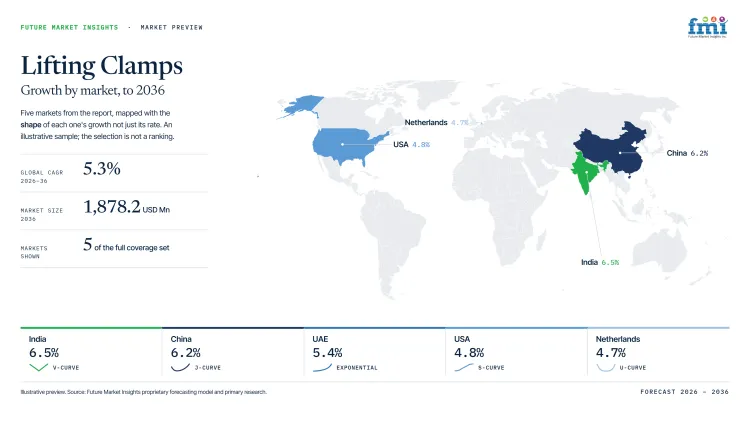
The profiled rates separate into a faster Gulf construction market and four mature industrial markets with narrower growth. The United Arab Emirates reaches 5.4%. The United States and Netherlands form a close middle pair. Germany and Japan form the lower band as replacement demand meets softer construction or manufacturing conditions.
- United Arab Emirates growth follows rapid project turnover and local replacement stocking.
- United States demand rests on broad fabricated-metal production and dispersed replacement cycles.
- Netherlands growth reflects compact logistics serving export-linked metalworking and maritime activity.
- Germany balances factory replacement demand against slower construction activity and strict qualification.
- Japan retains maintenance demand despite cyclical factory output and mature equipment fleets.
Similar growth rates conceal different stock, service and qualification requirements. The full report provides country-level CAGR analysis across North America, Latin America, Europe, East Asia, South Asia, Oceania and the Middle East and Africa.
Country-wise Analysis
- Abu Dhabi’s active development pipeline keeps lifting clamps in frequent use as contractors transfer structural steel between fabrication yards and construction sites under tightly sequenced crane schedules that increase local replacement urgency. The Department of Municipalities and Transport reported in March 2026 that more than 11,000 building permits were issued during 2025 with 15% annual growth and a measurable base for recurring plate-handling work. By 2036 the United Arab Emirates is projected to grow at 5.4% CAGR, aided by project turnover as heat exposure and dispersed sites increase field-service travel and favor nearby stock for clamp capacities.
- The United States combines a broad fabricated-metal base with widely separated industrial regions that generate many plant-level lifting-clamp replacement cycles across varied production scales and service territories across major manufacturing states nationwide. BLS data extracted in June 2026 recorded 61,435 private fabricated metal product manufacturing establishments during fourth-quarter 2025 and gives distributors a large addressable service base with varied clamp capacities and inspection schedules nationwide. Lifting clamps demand in the United States is forecast to rise at a 4.8% CAGR over the forecast period, supported by recurring industrial replacement as fragmented purchasing raises stock and application-support costs locally.
- Dutch metalworking operates around compact industrial and port corridors that shorten service travel for lifting-clamp distributors serving machinery and maritime accounts without a large nationwide warehouse network for specialized clamp capacities readily nearby. The Netherlands lifting clamps outlook is anticipated to advance at a 4.7% CAGR over the assessment period, supported by steady replacement demand despite smaller domestic scale limiting inventory depth for uncommon capacities locally. Statistics Netherlands reported in February 2026 that metal products manufacturing output increased 2.4% year on year during December 2025 and confirms an active operating base whose export exposure can shift clamp-order timing nationwide.
- Germany’s machinery and fabricated-metal clusters keep documented lifting equipment relevant across established production regions as distributors serve industrial replacement and construction applications with different project cycles and scheduled inspection requirements across industrial states. Destatis reported in February 2026 that construction production declined 1.7% during 2025 and gives project-focused distributors a direct reason to balance construction inventory against steadier factory replacement requirements across major industrial states nationwide. Germany is estimated to post 4.4% CAGR over the forecast period, shaped by recurring industrial replacement as softer construction activity limits faster expansion of project-oriented stock and rewards disciplined inventory planning across distributors.
- Japanese lifting-clamp demand comes from precision manufacturing and shipbuilding workflows that place strict limits on load orientation and gripping condition across established industrial regions with mature equipment fleets and scheduled inspection routines nationwide. METI reported in March 2026 that February industrial production indexed 102.3 and fell 2.1% month on month with fabricated metals the second-largest negative contributor and a source of near-term production variability nationally. Adoption of lifting clamps in Japan is estimated to expand at 4.1% CAGR through 2036, influenced by recurring maintenance needs as a mature installed base and cyclical factory output restrain wider inventory additions.
Who are the notable companies in the Lifting Clamps Market?
Columbus McKinnon Corporation, The Caldwell Group, Inc., pewag International GmbH, Aardwolf Industries LLC, Lift-All Company, Inc., Safety Clamps, Inc., Tiger Lifting and William Hackett are the notable companies serving this market.
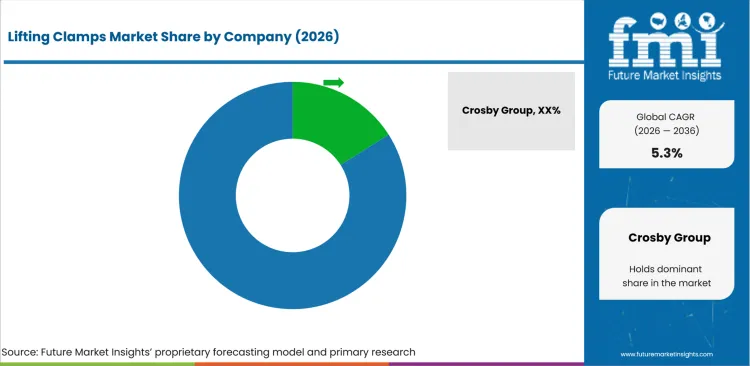
Competition spans diversified lifting groups and dedicated clamp makers beside application specialists. Entry barriers center on rated load coverage plus inspection support and model depth.
- Columbus McKinnon Corporation and The Caldwell Group, Inc. combine broad clamp ranges with documented training or inspection support.
- pewag International GmbH, Lift-All Company, Inc., Safety Clamps, Inc., Tiger Lifting and William Hackett cover plate or structural lifting.
- Aardwolf Industries LLC focuses on surface-sensitive slab handling outside conventional steel-plate duties.
Competitive Benchmarking: Lifting Clamps Market
| Company | Clamp Family Breadth | Capacity Coverage | Service Support | Geographic Reach |
|---|---|---|---|---|
| Columbus McKinnon Corporation | High | High | High | Global |
| The Caldwell Group, Inc. | High | High | High | North America and international sales |
| pewag International GmbH | High | Medium | Medium | Global |
| Aardwolf Industries LLC | Medium | Medium | Low | Global specialty distribution |
| Lift-All Company, Inc. | Medium | Medium | Medium | North America |
| Safety Clamps, Inc. | High | High | High | North America |
| Tiger Lifting | High | Medium | Medium | Europe, Asia, North America and Middle East |
| William Hackett | Medium | Medium | Medium | Europe and international distribution |
Key Developments in the Lifting Clamps Market
- In February 2026, Columbus McKinnon Corporation completed its acquisition of Kito Crosby Limited and added its lifting and securement portfolio. The combination widened access to rigging and below-the-hook equipment.
- In December 2025, The Caldwell Group, Inc. restructured Canadian coverage into dedicated sales and support regions. Canadian accounts gained training and technical assistance across Caldwell, Renfroe and RUD equipment.
- In September 2025, Tiger Lifting established Tiger MENA in the United Arab Emirates with clamps plus hoists and winches stocked for delivery. GCC and African customers gained a local replacement route.
Key Players in the Lifting Clamps Market
Plate and Structural Clamp Platforms
- Columbus McKinnon Corporation
- The Caldwell Group, Inc.
- Lift-All Company, Inc.
- Safety Clamps, Inc.
Multi-Application Clamp and Rigging Suppliers
- pewag International GmbH
- Tiger Lifting
- William Hackett
Stone and Surface-Sensitive Handling
- Aardwolf Industries LLC
Lifting Clamps Market - Report Scope
| Coverage field | Report scope |
|---|---|
| Market breakdown | By clamp type, load capacity, grip type, end use, sales channel and region. |
| Quantitative Units | Revenue in USD billion and CAGR in %. |
| Market Definition | Commercial below-the-hook lifting clamps for temporary attachment and movement of plate, structural shapes, pipes, drums, stone and precast loads. |
| Regions Covered | North America, Latin America, Europe, East Asia, South Asia and Pacific, and Middle East and Africa. |
| Countries Covered | United Arab Emirates, United States, Netherlands, Germany, Japan, and 20+ countries included in the full report. |
| Key Companies Profiled | Columbus McKinnon Corporation, The Caldwell Group, Inc., pewag International GmbH, Aardwolf Industries LLC, Lift-All Company, Inc., Safety Clamps, Inc., Tiger Lifting, William Hackett. |
| Forecast Period | 2026 to 2036. |
| Approach | Primary and secondary research with market triangulation. |
Lifting Clamps Market - Research Methodology
| Method | Approach |
|---|---|
| Primary Research | FMI analysts gathered input from manufacturers, service providers, technology developers, distributors, end users, procurement teams, and subject-matter experts. Interviews examined purchasing decisions, product or service evaluation, adoption barriers, approval requirements, pricing considerations, and expectations for technical or commercial support. Respondents were also asked what evidence is required before a trial, pilot, or initial order develops into regular purchasing. |
| Desk Research | Desk research covered government statistics, regulatory publications, trade data, industry associations, technical literature, standards, company filings, product information, and official corporate announcements. Sources were reviewed for relevance, publication date, geographic coverage, and consistency with the defined market scope. Claims relating to performance, applications, approvals, capacity, investment, and commercial activity were retained only when supported by credible public evidence. |
| Market Sizing and Forecasting | The market model combined the baseline value with historical performance, segment structure, pricing and volume indicators, adoption levels, company participation, and country-level demand conditions. Forecast assumptions considered economic activity, investment trends, regulatory developments, technology adoption, purchasing cycles, supply availability, and barriers to wider market use. Segment and regional estimates were reconciled before the final market total was calculated. |
| Data Validation | Estimates were checked against multiple independent indicators, including public data, company activity, trade patterns, industry developments, and findings from primary interviews. Validation also tested whether products, services, applications, and company revenues fell within the defined market boundaries. Adjacent categories, unsupported claims, overlapping revenues, and activities without direct market relevance were excluded to reduce double counting and maintain consistency across segments and countries. |
Lifting Clamps Market by Segments
Lifting Clamps Market segmented by Clamp Type:
- Vertical Plate Clamps
- Horizontal Plate Clamps
- Beam Clamps
- Drum or Pipe Clamps
- Stone or Slab Clamps
- Universal Clamps
Lifting Clamps Market segmented by Load Capacity:
- Below 1 Ton
- 1-5 Ton
- 5-10 Ton
- Above 10 Ton
Lifting Clamps Market segmented by Grip Type:
- Cam Jaw
- Screw Locking
- Automatic Locking
- Non-marring Pads
Lifting Clamps Market segmented by End Use:
- Steel Fabrication
- Construction
- Material Handling
- Shipbuilding
- Stone & Precast
Lifting Clamps Market segmented by Sales Channel:
- Rigging Distributors
- Direct Manufacturer
- Rental or Inspection
- Industrial Catalog
Lifting Clamps Market by Region:
- North America
- United States
- Canada
- Latin America
- Brazil
- Mexico
- Chile
- Rest of Latin America
- Western Europe
- Germany
- United Kingdom
- Italy
- Spain
- France
- Nordics
- Benelux
- Rest of Western Europe
- Eastern Europe
- Russia
- Poland
- Hungary
- Balkan and Baltic States
- Rest of Eastern Europe
- East Asia
- China
- Japan
- South Korea
- South Asia and Pacific
- India
- ASEAN
- Australia and New Zealand
- Rest of South Asia and Pacific
- Middle East and Africa
- Kingdom of Saudi Arabia
- Other GCC Countries
- Türkiye
- South Africa
- Other African Union Countries
- Rest of Middle East and Africa
Research Sources and Bibliography
- World Steel Association. (2026, April 14). worldsteel Short Range Outlook April 2026.
- Dubai Municipality. (2025, August 6). Dubai construction permits up 20% in H1 2025.
- The Caldwell Group, Inc. (2025, July 15). Caldwell Launches New "Big Book" Below-the-Hook Catalog.
- Kito Crosby. (2025, October 13). Kito Crosby launches new digital catalog, several website enhancements.
- Occupational Safety and Health Administration. (2025, November 13).Kard Welding, Inc..
- American Iron and Steel Institute. (2026, March 17). AISI Releases Revised 2025 Steel Shipment Data.
- Office for National Statistics. (2026, February 12). Construction output in Great Britain: December 2025, new orders and Construction Output Price Indices, October to December 2025.
- British Standards Institution. (2026, March 31). BS EN 13155:2020+A1:2025: Crane. Safety. Non-fixed load lifting attachments.
- The Caldwell Group, Inc. (2026, July 14). Caldwell Expands Range of In-Stock Products with Spreader and Lifting Beams.
- Abu Dhabi Department of Municipalities and Transport. (2026, March 13). Abu Dhabi Accelerates Urban Growth with 75 Million Square Metres of Approved Development in 2025.
- USA Bureau of Labor Statistics. (2026, June 23). Fabricated Metal Product Manufacturing: NAICS 332.
- Statistics Netherlands. (2026, February 10). Manufacturing output in December over 1 percent higher year on year.
- German Federal Statistical Office. (2026, February 6). Production in December 2025: -1.9% on the previous month.
- Ministry of Economy, Trade and Industry. (2026, March 31). Indices of Industrial Production.
- Columbus McKinnon Corporation. (2026). Camlok Lifting Clamps | A Columbus McKinnon Brand. Retrieved August 10, 2026.
- pewag International GmbH. (2026). Lifting Equipment. Retrieved August 10, 2026.
- Lift-All Company, Inc. (2026).Lifting Sling Catalog | Lift-All Company, Inc.. Retrieved August 10, 2026.
- Safety Clamps, Inc. (2026). Lifting Clamp Support - Safety Clamps, Inc.. Retrieved August 10, 2026.
- William Hackett. (2026).Lifting, Hoisting & Mooring Products | William Hackett | William Hackett. Retrieved August 10, 2026.
- Aardwolf Industries. (2025, June 1).10 Reasons Aardwolf Slab Lifters Are a Must for Stone Professionals.
- Kito Crosby. (2026, February 4). Columbus McKinnon completes acquisition of Kito Crosby.
- The Caldwell Group, Inc. (2025, December 18). The Caldwell Group Restructures Canada.
- Tiger Lifting. (2025, September 8). Tiger MENA - Middle East & North Africa is now established.
- The Caldwell Group, Inc. (2026, May 29). Lifting the Steel Industry: Central Steel & Supply Co. Trusts Caldwell Equipment.
- William Hackett. (2025, December 11). William Hackett and Vulcan Hoist strike strategic deal.
- pewag International GmbH. (2025, October 27). The Clamp You Use Could Make or Break Cleanroom Compliance.
- Columbus McKinnon Corporation. (2026). Lifting Clamps. Retrieved August 10, 2026.
- pewag International GmbH. (2026). Lifting Clamps | Plate & Structural Steel Clamps | pewag US. Retrieved August 10, 2026.
- William Hackett. (2026). WH UBC Universal Beam Clamp. Retrieved August 10, 2026.
- Lift-All Company, Inc. (2026). Plate Clamps for Safe Lifting | Lift-All Company, Inc.. Retrieved August 10, 2026.
- Safety Clamps, Inc. (2026). Safety Clamps, Inc. - Home of the Big Bite Lifting Clamps. Retrieved August 10, 2026.
- Tiger Lifting. (2026). Clamping. Retrieved August 10, 2026.
- Aardwolf Industries. (2026). Aardwolf Slab Lifter. Retrieved August 10, 2026.
This bibliography is provided for reader reference and is not exhaustive. The full report contains the complete reference list and detailed citations
This Report Answers
- How large is the lifting clamps market from 2026 to 2036?
- Which operating conditions sustain repeat lifting-clamp demand across fabrication and construction?
- How is demand divided by clamp type, capacity, grip, end use and channel?
- Why does the 1-5 ton class hold the largest 2026 load-capacity share?
- Which inspection and wear conditions raise lifecycle costs for lifting-clamp operators?
- How can local stock reduce replacement delays around active lifting work?
- How do profiled country CAGRs differ across the five selected markets?
- Which local conditions shape clamp demand in the five country profiles?
- Which companies cover plate, structural and surface-sensitive lifting applications?
- Which capability criteria distinguish competitors in the benchmark table?
Frequently Asked Questions
How big is the lifting clamps market in 2026?
The lifting clamps market is estimated at USD 1120.6 million in 2026 and is projected to reach USD 1878.2 million by 2036. Growth is driven by recurring demand for plate handling equipment across fabrication, manufacturing, and construction applications.
What is the CAGR of the lifting clamps market from 2026 to 2036?
The lifting clamps market is projected to grow at a CAGR of 5.3% between 2026 and 2036. Expansion is supported by ongoing equipment replacement and increasing lifting activity across industrial and construction sectors.
Which load capacity segment is projected to account for 39.0% of the lifting clamps market?
The 1-5 ton segment is projected to account for 39.0% of the market in 2026. Its leading share is driven by suitability for common workshop and fabrication tasks involving routine material handling operations.
Which grip type is projected to grow at 6.4% CAGR through 2036?
Automatic locking grip designs are projected to grow at a CAGR of 6.4% through 2036. Growth is supported by improved safety, secure attachment, and greater efficiency in repetitive lifting applications.
Which companies are active in the lifting clamps market?
Key companies operating in the market include Columbus McKinnon Corporation, The Caldwell Group, Inc., pewag International GmbH, Aardwolf Industries LLC, Lift-All Company, Inc., Safety Clamps, Inc., Tiger Lifting, and William Hackett. These companies compete through product range expansion, application-specific solutions, and regional distribution networks.
Preview the report firsthand - request a free sample
Get SampleGet the brochure for pricing and purchase details.
Get PDFTable of Content
- Key Takeaways
- Market Size and CAGR
- Top Growth Driver
- Fastest Growing Segment
- Leading Region
- Key Companies
- Emerging Opportunities
- Executive Summary
- Global Market Outlook
- Demand-side Trends
- Supply-side Trends
- Technology Roadmap Analysis
- Analysis and Recommendations
- Analyst Perspective (What is happening? Why now? What should investors know?)
- Key Questions Answered
- How large is the market?
- What is the CAGR?
- What are key trends?
- Which region dominates?
- Who are the leaders?
- Market Overview
- Market Coverage / Taxonomy
- Market Definition / Scope / Limitations
- Research Methodology
- Chapter Orientation
- Analytical Lens and Working Hypotheses
- Market Structure, Signals, and Trend Drivers
- Benchmarking and Cross-market Comparability
- Market Sizing, Forecasting, and Opportunity Mapping
- Research Design and Evidence Framework
- Desk Research Programme (Secondary Evidence)
- Expert Input and Fieldwork (Primary Evidence)
- Tooling, Models, and Reference Databases
- Data Engineering and Model Build
- Quality Assurance and Audit Trail
- Market Background
- Market Dynamics (Drivers, Restraints, Opportunity, Trends)
- Scenario Forecast (Optimistic, Likely, Conservative)
- Impact Analysis
- AI Impact
- Sustainability Impact
- Regulatory Impact
- Technology Impact
- Consumer / Buyer Analysis
- Purchase Drivers
- Adoption Barriers
- Buyer Journey
- Opportunity Map Analysis
- Product Life Cycle Analysis
- Supply Chain Analysis
- Investment Feasibility Matrix
- Value Chain Analysis
- PESTLE and Porter's Analysis
- Regulatory Landscape
- Regional Parent Market Outlook
- Production and Consumption Statistics
- Import and Export Statistics
- Global Market Analysis and Forecast, 2021 to 2036
- Historical Market Size Value (USD Million) Analysis, 2021 to 2025
- Current and Future Market Size Value (USD Million) Projections, 2026 to 2036
- Y-o-Y Growth Trend Analysis
- Absolute $ Opportunity Analysis
- Global Market Pricing Analysis, 2021 to 2036
- Global Market Analysis and Forecast, By Clamp Type, 2021 to 2036
- Introduction / Key Findings
- Historical Market Size Value (USD Million) Analysis By Clamp Type, 2021 to 2025
- Current and Future Market Size Value (USD Million) Analysis and Forecast By Clamp Type, 2026 to 2036
- Vertical Plate Clamps
- Horizontal Plate Clamps
- Beam Clamps
- Drum or Pipe Clamps
- Stone or Slab Clamps
- Universal Clamps
- Vertical Plate Clamps
- Y-o-Y Growth Trend Analysis By Clamp Type, 2021 to 2025
- Absolute $ Opportunity Analysis By Clamp Type, 2026 to 2036
- Global Market Analysis and Forecast, By Load Capacity, 2021 to 2036
- Introduction / Key Findings
- Historical Market Size Value (USD Million) Analysis By Load Capacity, 2021 to 2025
- Current and Future Market Size Value (USD Million) Analysis and Forecast By Load Capacity, 2026 to 2036
- 1-5 Ton
- Below 1 Ton
- 5-10 Ton
- Above 10 Ton
- 1-5 Ton
- Y-o-Y Growth Trend Analysis By Load Capacity, 2021 to 2025
- Absolute $ Opportunity Analysis By Load Capacity, 2026 to 2036
- Global Market Analysis and Forecast, By Grip Type, 2021 to 2036
- Introduction / Key Findings
- Historical Market Size Value (USD Million) Analysis By Grip Type, 2021 to 2025
- Current and Future Market Size Value (USD Million) Analysis and Forecast By Grip Type, 2026 to 2036
- Cam Jaw
- Screw Locking
- Automatic Locking
- Non-marring Pads
- Cam Jaw
- Y-o-Y Growth Trend Analysis By Grip Type, 2021 to 2025
- Absolute $ Opportunity Analysis By Grip Type, 2026 to 2036
- Global Market Analysis and Forecast, By End Use, 2021 to 2036
- Introduction / Key Findings
- Historical Market Size Value (USD Million) Analysis By End Use, 2021 to 2025
- Current and Future Market Size Value (USD Million) Analysis and Forecast By End Use, 2026 to 2036
- Steel Fabrication
- Construction
- Material Handling
- Shipbuilding
- Stone & Precast
- Steel Fabrication
- Y-o-Y Growth Trend Analysis By End Use, 2021 to 2025
- Absolute $ Opportunity Analysis By End Use, 2026 to 2036
- Global Market Analysis and Forecast, By Sales Channel, 2021 to 2036
- Introduction / Key Findings
- Historical Market Size Value (USD Million) Analysis By Sales Channel, 2021 to 2025
- Current and Future Market Size Value (USD Million) Analysis and Forecast By Sales Channel, 2026 to 2036
- Rigging Distributors
- Direct Manufacturer
- Rental or Inspection
- Industrial Catalog
- Rigging Distributors
- Y-o-Y Growth Trend Analysis By Sales Channel, 2021 to 2025
- Absolute $ Opportunity Analysis By Sales Channel, 2026 to 2036
- Global Market Analysis and Forecast, By Region, 2021 to 2036
- Introduction
- Historical Market Size Value (USD Million) Analysis By Region, 2021 to 2025
- Current Market Size Value (USD Million) Analysis and Forecast By Region, 2026 to 2036
- North America
- Latin America
- Western Europe
- Eastern Europe
- East Asia
- South Asia and Pacific
- Middle East & Africa
- Market Attractiveness Analysis By Region
- North America Market Analysis and Forecast, By Country, 2021 to 2036
- Historical Market Size Value (USD Million) Trend Analysis By Market Taxonomy, 2021 to 2025
- Market Size Value (USD Million) Forecast By Market Taxonomy, 2026 to 2036
- By Country
- USA
- Canada
- By Clamp Type
- By Load Capacity
- By Grip Type
- By End Use
- By Sales Channel
- By Country
- Market Attractiveness Analysis
- By Country
- By Clamp Type
- By Load Capacity
- By Grip Type
- By End Use
- By Sales Channel
- Key Takeaways
- Latin America Market Analysis and Forecast, By Country
- Historical Market Size Value (USD Million) Trend Analysis By Market Taxonomy, 2021 to 2025
- Market Size Value (USD Million) Forecast By Market Taxonomy, 2026 to 2036
- By Country
- Brazil
- Mexico
- Chile
- Rest of Latin America
- By Clamp Type
- By Load Capacity
- By Grip Type
- By End Use
- By Sales Channel
- By Country
- Market Attractiveness Analysis
- By Country
- By Clamp Type
- By Load Capacity
- By Grip Type
- By End Use
- By Sales Channel
- Key Takeaways
- Western Europe Market Analysis and Forecast, By Country
- Historical Market Size Value (USD Million) Trend Analysis By Market Taxonomy, 2021 to 2025
- Market Size Value (USD Million) Forecast By Market Taxonomy, 2026 to 2036
- By Country
- Germany
- UK
- Italy
- Spain
- France
- Nordic
- BENELUX
- Rest of Western Europe
- By Clamp Type
- By Load Capacity
- By Grip Type
- By End Use
- By Sales Channel
- By Country
- Market Attractiveness Analysis
- By Country
- By Clamp Type
- By Load Capacity
- By Grip Type
- By End Use
- By Sales Channel
- Key Takeaways
- Eastern Europe Market Analysis and Forecast, By Country
- Historical Market Size Value (USD Million) Trend Analysis By Market Taxonomy, 2021 to 2025
- Market Size Value (USD Million) Forecast By Market Taxonomy, 2026 to 2036
- By Country
- Russia
- Poland
- Hungary
- Balkan & Baltic
- Rest of Eastern Europe
- By Clamp Type
- By Load Capacity
- By Grip Type
- By End Use
- By Sales Channel
- By Country
- Market Attractiveness Analysis
- By Country
- By Clamp Type
- By Load Capacity
- By Grip Type
- By End Use
- By Sales Channel
- Key Takeaways
- East Asia Market Analysis and Forecast, By Country
- Historical Market Size Value (USD Million) Trend Analysis By Market Taxonomy, 2021 to 2025
- Market Size Value (USD Million) Forecast By Market Taxonomy, 2026 to 2036
- By Country
- China
- Japan
- South Korea
- By Clamp Type
- By Load Capacity
- By Grip Type
- By End Use
- By Sales Channel
- By Country
- Market Attractiveness Analysis
- By Country
- By Clamp Type
- By Load Capacity
- By Grip Type
- By End Use
- By Sales Channel
- Key Takeaways
- South Asia and Pacific Market Analysis and Forecast, By Country
- Historical Market Size Value (USD Million) Trend Analysis By Market Taxonomy, 2021 to 2025
- Market Size Value (USD Million) Forecast By Market Taxonomy, 2026 to 2036
- By Country
- India
- ASEAN
- Australia & New Zealand
- Rest of South Asia and Pacific
- By Clamp Type
- By Load Capacity
- By Grip Type
- By End Use
- By Sales Channel
- By Country
- Market Attractiveness Analysis
- By Country
- By Clamp Type
- By Load Capacity
- By Grip Type
- By End Use
- By Sales Channel
- Key Takeaways
- Middle East & Africa Market Analysis and Forecast, By Country
- Historical Market Size Value (USD Million) Trend Analysis By Market Taxonomy, 2021 to 2025
- Market Size Value (USD Million) Forecast By Market Taxonomy, 2026 to 2036
- By Country
- Kingdom of Saudi Arabia
- Other GCC Countries
- Türkiye
- South Africa
- Other African Union
- Rest of Middle East & Africa
- By Clamp Type
- By Load Capacity
- By Grip Type
- By End Use
- By Sales Channel
- By Country
- Market Attractiveness Analysis
- By Country
- By Clamp Type
- By Load Capacity
- By Grip Type
- By End Use
- By Sales Channel
- Key Takeaways
- Key Countries Market Analysis
- USA
- Pricing Analysis
- Market Share Analysis, 2025
- By Clamp Type
- By Load Capacity
- By Grip Type
- By End Use
- By Sales Channel
- Canada
- Pricing Analysis
- Market Share Analysis, 2025
- By Clamp Type
- By Load Capacity
- By Grip Type
- By End Use
- By Sales Channel
- Mexico
- Pricing Analysis
- Market Share Analysis, 2025
- By Clamp Type
- By Load Capacity
- By Grip Type
- By End Use
- By Sales Channel
- Brazil
- Pricing Analysis
- Market Share Analysis, 2025
- By Clamp Type
- By Load Capacity
- By Grip Type
- By End Use
- By Sales Channel
- Chile
- Pricing Analysis
- Market Share Analysis, 2025
- By Clamp Type
- By Load Capacity
- By Grip Type
- By End Use
- By Sales Channel
- Germany
- Pricing Analysis
- Market Share Analysis, 2025
- By Clamp Type
- By Load Capacity
- By Grip Type
- By End Use
- By Sales Channel
- UK
- Pricing Analysis
- Market Share Analysis, 2025
- By Clamp Type
- By Load Capacity
- By Grip Type
- By End Use
- By Sales Channel
- Italy
- Pricing Analysis
- Market Share Analysis, 2025
- By Clamp Type
- By Load Capacity
- By Grip Type
- By End Use
- By Sales Channel
- Spain
- Pricing Analysis
- Market Share Analysis, 2025
- By Clamp Type
- By Load Capacity
- By Grip Type
- By End Use
- By Sales Channel
- France
- Pricing Analysis
- Market Share Analysis, 2025
- By Clamp Type
- By Load Capacity
- By Grip Type
- By End Use
- By Sales Channel
- India
- Pricing Analysis
- Market Share Analysis, 2025
- By Clamp Type
- By Load Capacity
- By Grip Type
- By End Use
- By Sales Channel
- ASEAN
- Pricing Analysis
- Market Share Analysis, 2025
- By Clamp Type
- By Load Capacity
- By Grip Type
- By End Use
- By Sales Channel
- Australia & New Zealand
- Pricing Analysis
- Market Share Analysis, 2025
- By Clamp Type
- By Load Capacity
- By Grip Type
- By End Use
- By Sales Channel
- China
- Pricing Analysis
- Market Share Analysis, 2025
- By Clamp Type
- By Load Capacity
- By Grip Type
- By End Use
- By Sales Channel
- Japan
- Pricing Analysis
- Market Share Analysis, 2025
- By Clamp Type
- By Load Capacity
- By Grip Type
- By End Use
- By Sales Channel
- South Korea
- Pricing Analysis
- Market Share Analysis, 2025
- By Clamp Type
- By Load Capacity
- By Grip Type
- By End Use
- By Sales Channel
- Russia
- Pricing Analysis
- Market Share Analysis, 2025
- By Clamp Type
- By Load Capacity
- By Grip Type
- By End Use
- By Sales Channel
- Poland
- Pricing Analysis
- Market Share Analysis, 2025
- By Clamp Type
- By Load Capacity
- By Grip Type
- By End Use
- By Sales Channel
- Hungary
- Pricing Analysis
- Market Share Analysis, 2025
- By Clamp Type
- By Load Capacity
- By Grip Type
- By End Use
- By Sales Channel
- Kingdom of Saudi Arabia
- Pricing Analysis
- Market Share Analysis, 2025
- By Clamp Type
- By Load Capacity
- By Grip Type
- By End Use
- By Sales Channel
- Türkiye
- Pricing Analysis
- Market Share Analysis, 2025
- By Clamp Type
- By Load Capacity
- By Grip Type
- By End Use
- By Sales Channel
- South Africa
- Pricing Analysis
- Market Share Analysis, 2025
- By Clamp Type
- By Load Capacity
- By Grip Type
- By End Use
- By Sales Channel
- USA
- Market Structure Analysis
- Competition Dashboard
- Competition Benchmarking
- Market Share Analysis of Top Players
- By Regional
- By Clamp Type
- By Load Capacity
- By Grip Type
- By End Use
- By Sales Channel
- Emerging Startups
- Innovation Benchmarking
- Competition Analysis
- Competition Deep Dive
- Crosby Group
- Overview
- Product Portfolio
- Profitability by Market Segments
- Sales Footprint
- Strategy Overview
- Marketing Strategy
- Product Strategy
- Channel Strategy
- Terrier Lifting Clamps
- RUD
- J.C. Renfroe
- Camlok
- Columbus McKinnon
- Pewag
- Kito Crosby
- Yoke Industrial
- Aardwolf
- Crosby Group
- Case Studies
- Success Stories
- Recent Developments
- Competition Deep Dive
- Assumptions & Acronyms Used


