

- Market Size (2026)
- USD 202.4 Mn
- Forecast (2036)
- USD 497.0 Mn
- CAGR (2026 to 2036)
- 9.4%
How big is Lignin Carrier Materials Market in 2026?
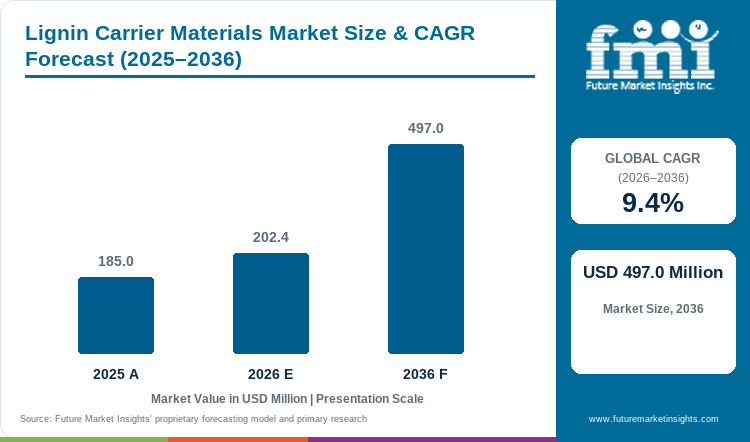
USD 202.4 Million in 2026 and USD 497.0 Million by 2036 at a 9.4% CAGR.
Sales of lignin carrier materials are estimated to rise at 9.4% CAGR through 2036, increasing valuation from USD 185.0 Million in 2025 to USD 202.4 Million in 2026 and reaching USD 497.0 Million by 2036. The market is moving beyond basic industrial uses of lignin. Agricultural formulators are looking at how lignin helps products disperse, bind, hold nutrients, and remain stable during storage and application. This is relevant alongside fertilizer additives, where the value of a co-formulant depends on what it does inside the finished product.
The path to adoption differs by country and by application. Broad-acre farming can use economical lignin grades when formulators have room to adjust dosage, solids, or processing conditions. Automated irrigation, seed treatment, and concentrated biological formulations are less forgiving. In these uses, sediment, uneven flow, or batch variation can quickly become an operating problem. As a result, tighter control of lignin chemistry becomes more valuable as the application becomes more demanding.
Key Takeaways
- Renewable carrier demand rises when lignin improves dispersion, binding, complexing, or suspension behavior inside agricultural formulations.
- Raw / Crude Extract Grades are estimated to hold 49.0% of Product Type demand in 2026 as high-volume programs prioritize functional performance at manageable treatment cost.
- Cereals & Grains account for 42.1% of Crop Type demand, supported by broad-acre programs where carrier economics scale across large planted areas.
- Feedstock and processing differences can alter lignin solubility and formulation behavior, increasing switching and qualification work for customers.
- The USA is forecast to expand at 9.1% CAGR through 2036, while South Korea follows at 8.8% as controlled agricultural systems raise the value of predictable dosing.
- Algaia, Gelymar, Kimitec, Seipasa, Borregaard, Ingevity, Acadian Plant Health, and Olmix Group are among the notable companies profiled in the market.
Analyst Perspective
“Lignin carrier materials win repeat business when they solve a clear formulation problem. The best opportunities are in applications where poor dispersion, sediment, weak binding, or inconsistent nutrient complexing creates extra work or affects product performance. Suppliers that can control these properties have a better chance of moving lignin from a broad industrial material into higher-value agricultural formulations.”
- Nikhil Kaitwade, Principal Consultant, Future Market Insights
How is the lignin carrier materials market segmented?
The lignin carrier materials market is segmented by Product Type, Crop Type, Application Method, Farm Type, Sales Channel, and Region.
The lignin carrier materials market is segmented by Product Type into Raw / Crude Extract Grades, Refined & Standardized Fractions, Formulated End-Use Blends, and Others. Crop Type includes Cereals & Grains, Fruits & Vegetables, Oilseeds & Pulses, Turf & Ornamentals, and Others. Application Method covers Soil Application, Foliar Application, Fertigation / Drip, Seed Application, and Others. Farm Type includes Large Commercial Farms, Mid-Size Farms, Smallholders, Greenhouses & Nurseries, and Others. Sales Channel comprises Agri-Input Distributors, Cooperatives, Agri-Retail Chains, Online / Direct-to-Farm, and Others.
Why do Raw / Crude Extract Grades lead demand within the Product Type category?
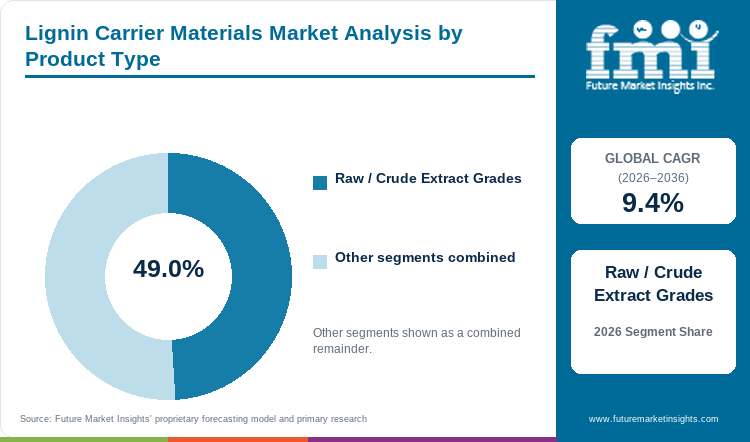
Raw / Crude Extract Grades lead because many agricultural formulations do not need highly processed lignin to perform the required job. In fertilizer and crop-protection products, formulators can often adjust pH, solids, or dosage to work with a broader material specification. That keeps processing costs lower and makes these grades attractive in large-volume applications. Refined fractions become more useful when the formulation has tighter limits on sediment, solubility, conductivity, or color.
- Raw / Crude Extract Grades are estimated to account for 49.0% of Product Type demand in 2026.
- Refined & Standardized Fractions gain commercial relevance as formulations become less tolerant of variability in solubility or solids behavior.
Why do Cereals & Grains lead demand within the Crop Type category?
Cereals & Grains lead because large planted areas make treatment cost and ease of use especially important. A lignin carrier used in a nutrient or crop-protection formulation can be applied across large acreage without becoming a major part of the total treatment cost. This favors grades that are easy to produce at scale and remain stable during storage, dilution, and field application. Fruits and vegetables can support more specialized formulations, but broad-acre crops create a larger base for recurring volume demand.
- Cereals & Grains are estimated to hold 42.1% of Crop Type demand in 2026.
- Broad-acre economics favor low-use-rate functional materials that maintain formulation performance without materially raising per-hectare treatment cost.
Why does Soil Application lead demand within the Application Method category?
Soil Application leads because it can work with a wider range of lignin grades. In soil-facing products, the main priorities are nutrient complexing, dispersion, granule integrity, and bulk handling. Appearance is usually less important than it is in some foliar products, and these applications can often accept higher solids or darker material. This gives both raw and standardized lignin grades a wider commercial window.
Fertigation and seed application are more demanding. Fine filters and emitters can be affected by small amounts of insoluble material, while seed coatings need even coverage and controlled loading. These requirements connect higher-specification lignin carriers with seed treatment materials used in more controlled application systems.
- Soil Application is estimated to account for 43.0% of Application Method demand in 2026.
- Fertigation and seed systems offer higher-specification opportunities because dosing equipment and coating uniformity expose material inconsistencies quickly.
Why do Large Commercial Farms lead demand within the Farm Type category?
Large Commercial Farms lead because they can spread the cost of product testing and qualification across much larger purchase volumes. Centralized crop programs also make it easier to standardize preferred inputs once they have performed well. A successful formulation can therefore move from a trial into repeat procurement more quickly. The same scale raises the cost of failure, because unstable mixtures, blocked equipment, or inconsistent handling can affect a large operating area.
Smallholders usually encounter lignin carriers as part of a finished agricultural product rather than buying the carrier itself. Mid-size farms sit between these two models and often depend more on distributor advice when choosing products.
- Large Commercial Farms are estimated to hold 44.8% of Farm Type demand in 2026.
- Centralized procurement allows technical evaluation costs to be spread across larger recurring volumes once a formulation is adopted.
Why do Agri-Input Distributors lead demand within the Sales Channel category?
Agri-Input Distributors lead because agricultural carrier materials often need more than simple product delivery. A formulation may require guidance on mixing order, water conditions, compatibility, or crop use. Distributors can provide this support while also holding local inventory and maintaining established relationships with growers and formulators.
Direct-to-farm and online sales work better once the formulation is already familiar to the buyer. During early adoption, distributors are more useful because they can help solve practical problems that appear during mixing or application.
- Agri-Input Distributors are estimated to account for 37.0% of Sales Channel demand in 2026.
- Local agronomic and formulation support reduces friction between material qualification and repeated farm use.
What are the drivers, restraints and opportunities in the Lignin Carrier Materials Market?
Renewable formulation demand supports lignin carrier adoption, material variability raises qualification costs, and tighter specification control opens higher-value agricultural applications.
- Driver: Biological and lower-input crop programs increase demand for renewable dispersants, binders, and complexing materials that help agricultural formulations remain usable through storage and field application.
- Restraint: Feedstock and processing differences can alter molecular characteristics, solubility, color, and impurity profile, increasing formulation work when customers change grades or suppliers.
- Opportunity: Refined and application-specific lignin fractions can move into fertigation, seed systems, concentrated nutrient products, and biological formulations where tighter material control has measurable value.
Demand starts with a practical formulation need. Lignosulfonates can provide water solubility, dispersibility, and chelation, which makes them useful in fertilizer and pesticide formulations. As biostimulants move into more crop programs, formulators still need supporting materials that keep active ingredients stable during storage, mixing, and field dilution. A lignin carrier earns its place when it can do this at a cost the buyer can justify.
The main restraint is variation between lignin materials. Feedstock source and isolation method can change molecular weight, functional groups, solids behavior, and solubility. Two grades sold under a similar broad description may therefore behave differently in the same formulation. A cheaper grade can become expensive if the customer has to repeat stability work or change dosage settings. This gives an advantage to suppliers that can keep material properties within a tighter range.
The clearest opportunity is in applications where small inconsistencies cause immediate problems. Controlled fertigation, seed coating, concentrated nutrient systems, and agricultural microbials can expose sedimentation or compatibility issues quickly. Similar formulation requirements are seen in humic and fulvic acid based biostimulants, where material behavior must fit existing nutrient and crop-input systems. Refined lignin fractions can earn a premium when they reduce adjustment work and make the finished formulation easier to use.
Which country CAGRs are profiled in the Lignin Carrier Materials Market?
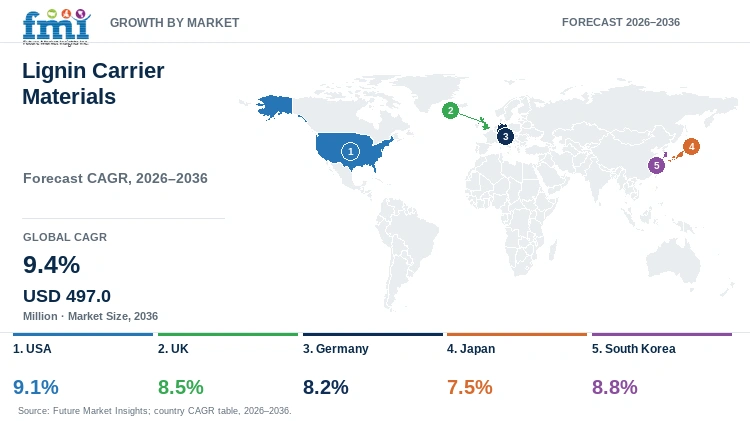
| Country | CAGR |
|---|---|
| USA | 9.1% |
| UK | 8.5% |
| Germany | 8.2% |
| Japan | 7.5% |
| South Korea | 8.8% |
How do country-level CAGRs compare in the Lignin Carrier Materials Market?
The five profiled countries show a 1.6 percentage-point gap between the USA at 9.1% and Japan at 7.5%. South Korea is close behind the USA at 8.8%, while the UK and Germany are forecast at 8.5% and 8.2%. These rates show how quickly demand is expected to grow, not the total size of each country market. Local regulation, farm structure, crop mix, application technology, and distribution determine how quickly interest turns into repeat purchases.
- USA exceeds South Korea by 0.3 percentage points, leaving application fit and customer concentration as important commercial differentiators between the two markets.
- South Korea exceeds the UK by 0.3 percentage points as smart-farming investment creates a distinct requirement for dosing-compatible inputs.
- The UK exceeds Germany by 0.3 percentage points, with integrated pest-management programs and farm-support structures shaping local conversion.
- Germany exceeds Japan by 0.7 percentage points, reflecting different farm structures and adoption conditions.
- Japan remains a growth market at 7.5% CAGR, but commercial conversion depends heavily on local performance fit.
Country-wise Analysis
- USA: Demand for Lignin Carrier Materials in the USA is forecast to expand at 9.1% CAGR from 2026 to 2036. Agricultural formulators work within a formal pesticide-registration system when changes affect regulated products. The EPA updated its biopesticide registration guidance in February 2026, keeping product chemistry and labeling requirements central to formulation decisions. Carrier suppliers benefit when consistent material reduces the amount of reformulation needed across large crop programs.
- UK: Demand for Lignin Carrier Materials in the UK is forecast to expand at 8.5% CAGR from 2026 to 2036. England's 2026 Sustainable Farming Incentive includes integrated pest-management and precision-farming actions. This supports lower-input crop programs, but carriers still need to fit real farm practices. Distributors matter because product choice is closely linked to local agronomy, crop needs, and ease of use.
- Germany: Demand for Lignin Carrier Materials in Germany is forecast to expand at 8.2% CAGR from 2026 to 2036. Germany has more than 276,000 farms with an average size of about 61 hectares, and cereals remain an important part of agricultural production. This creates a solid base for repeat nutrient and crop-protection programs. Suppliers serving these accounts need material that behaves consistently across large formulation batches and repeated seasonal use.
- Japan: Demand for Lignin Carrier Materials in Japan is forecast to expand at 7.5% CAGR from 2026 to 2036. Japan adopted the MIDORI BOOST plan in June 2026 to support green investment and climate-adaptation measures in food and agriculture. Lignin carriers can benefit where they help improve resource use without disrupting established production practices. Local performance therefore matters heavily in purchase decisions.
- South Korea: Demand for Lignin Carrier Materials in South Korea is forecast to expand at 8.8% CAGR from 2026 to 2036. The national 2025 to 2029 smart-farming plan targets wider use of controlled technology in greenhouses and major field crops. Automation makes carrier quality more visible because filters, emitters, mixing systems, and dosing equipment can be affected by sediment or poor solubility. This gives an advantage to grades designed for predictable flow and low residue.
Who are the notable companies in the Lignin Carrier Materials Market?
Algaia, Gelymar, Kimitec, Seipasa, Borregaard, Ingevity, Acadian Plant Health, and Olmix Group are the notable companies profiled in this market.
The competitive field includes direct lignin suppliers as well as companies active in natural functional materials and agricultural biosolutions. Borregaard and Ingevity have the clearest direct positions in lignin-based dispersants and biopolymers. Their strength comes from controlling material properties that matter inside demanding formulations. Algaia, Gelymar, and Olmix Group bring experience in natural-material processing and functional ingredients. Kimitec, Seipasa, and Acadian Plant Health operate closer to biological crop-input development and commercial agriculture.
- Direct lignin chemistry: Borregaard and Ingevity compete around lignin-based dispersants, material control, and formulation performance.
- Bio-based functional materials: Algaia, Gelymar, and Olmix Group contribute natural-material processing and functional-formulation expertise.
- Agricultural biosolution formulation and market access: Kimitec, Seipasa, and Acadian Plant Health operate close to crop-input development, validation, and commercial channels.
Competitive Benchmarking: Lignin Carrier Materials Market
| Company | Lignin-Based Carrier Depth | Agricultural Formulation Integration | Crop-Input Channel Access | Geographic Reach |
|---|---|---|---|---|
| Algaia | Unscored | Medium | Medium | Europe-based development with international customer activity |
| Gelymar | Unscored | Unscored | Unscored | Mexico and Central America customer engagement |
| Kimitec | Unscored | High | High | Spain-based agricultural development with international market activity |
| Seipasa | Unscored | High | High | European agricultural market access supported by registered biological products |
| Borregaard | High | High | Medium | Europe-based production with international agrochemical activity |
| Ingevity | High | High | Medium | North American base with international specialty-chemical reach |
| Acadian Plant Health | Unscored | High | High | North American base with international agricultural partnerships |
| Olmix Group | Unscored | High | High | Europe-based Plant Care operations with international agricultural activity |
Scoring basis: Lignin-Based Carrier Depth measures the extent of lignin chemistry used in dispersant, binder, complexing, or related co-formulant roles. Agricultural Formulation Integration measures participation in product development for crop-input systems. Crop-Input Channel Access reflects established routes to agricultural customers through products, partners, or distribution. High indicates broad capability within the benchmark dimension, Medium indicates a narrower position, and Low indicates a limited position.
Key Developments in the Lignin Carrier Materials Market
- In January 2026, Ingevity completed the sale of its North Charleston crude tall oil refinery assets and most of its Industrial Specialties product line while retaining other lignin-based dispersant products. The transaction sharpened the company's specialty lignin position around dispersant applications that require controlled chemistry.
- In March 2025, Seipasa introduced SeiZen with European registration under Product Function Category 6(B) for non-microbial plant biostimulants. The development illustrates how biological crop-input portfolios are moving toward more standardized regulatory and formulation requirements.
- In July 2025, Olmix Group obtained European PFC 6 certification for Cormin SW, a non-microbial biostimulant designed for bulk-blended fertilizer manufacturers. The development strengthens the link between bio-based functional materials and fertilizer systems where formulation compatibility and consistent handling determine commercial use.
Key Players in the Lignin Carrier Materials Market
Lignin Chemistry and Agrochemical Co-Formulant Platforms
- Borregaard
- Ingevity
Bio-Based Functional Materials and Carrier-Adjacent Platforms
- Algaia
- Gelymar
- Olmix Group
Agricultural Biosolution Formulators and Market Access
- Kimitec
- Seipasa
- Acadian Plant Health
Lignin Carrier Materials Market - Report Scope
| Coverage field | Report scope |
|---|---|
| Market breakdown | Product Type, Crop Type, Application Method, Farm Type, Sales Channel, and Region |
| Quantitative Units | USD Million |
| Market Definition | Revenue includes lignin-derived carrier materials sold into agricultural applications, including raw or crude grades, refined or standardized fractions, and formulated lignin-containing carrier blends. Downstream finished-product revenue and adjacent non-lignin carrier revenue are excluded. |
| Regions Covered | North America, Latin America, Western Europe, Eastern Europe, East Asia, South Asia and Pacific, Middle East and Africa |
| Countries Covered | USA, UK, Germany, Japan, South Korea, and more than twenty-five additional countries in the full report |
| Key Companies Profiled | Algaia, Gelymar, Kimitec, Seipasa, Borregaard, Ingevity, Acadian Plant Health, Olmix Group |
| Forecast Period | 2026 to 2036 |
| Approach | Market sizing combines supplier participation with product-grade demand, agricultural formulation use, application patterns, channel structure, and country adoption conditions. |
Lignin Carrier Materials Market - Research Methodology
| Method | Approach |
|---|---|
| Primary Research | Primary research covers lignin producers, agricultural formulators, distributors, agronomists, procurement teams, and farm operators. Interviews examine specification requirements, price sensitivity, application compatibility, purchasing behavior, and technical support needs. |
| Desk Research | Desk research covers peer-reviewed lignin literature, agricultural programs, pesticide and fertilizing-product regulation, company filings, current product documentation, and official corporate announcements. |
| Market Sizing and Forecasting | Market sizing applies bottom-up and top-down analysis across supplier participation, product-grade demand, agricultural formulation use, crop and farm patterns, channel structure, and country adoption conditions. |
| Data Validation | Estimates are checked against technical characteristics, commercial activity, application requirements, company participation, and country-level market conditions before forecast assumptions are finalized. |
Lignin Carrier Materials Market by Segments
Lignin Carrier Materials Market segmented by Product Type:
- Raw / Crude Extract Grades
- Refined & Standardized Fractions
- Formulated End-Use Blends
- Others
Lignin Carrier Materials Market segmented by Crop Type:
- Cereals & Grains
- Fruits & Vegetables
- Oilseeds & Pulses
- Turf & Ornamentals
- Others
Lignin Carrier Materials Market segmented by Application Method:
- Soil Application
- Foliar Application
- Fertigation / Drip
- Seed Application
- Others
Lignin Carrier Materials Market segmented by Farm Type:
- Large Commercial Farms
- Mid-Size Farms
- Smallholders
- Greenhouses & Nurseries
- Others
Lignin Carrier Materials Market segmented by Sales Channel:
- Agri-Input Distributors
- Cooperatives
- Agri-Retail Chains
- Online / Direct-to-Farm
- Others
Lignin Carrier Materials Market by Region:
- North America
- United States
- Canada
- Latin America
- Brazil
- Mexico
- Argentina
- Chile
- Western Europe
- Germany
- France
- United Kingdom
- Italy
- Spain
- Benelux
- Nordics
- Eastern Europe
- Poland
- Czech Republic
- Romania
- Hungary
- East Asia
- China
- Japan
- South Korea
- South Asia and Pacific
- India
- ASEAN
- Australia and New Zealand
- Middle East and Africa
- GCC Countries
- South Africa
- Türkiye
- Israel
Research Sources and Bibliography
- Liu, Y., Wang, G., Zhao, Y., Li, W., Ding, J., Sui, W., & Si, C. (2026, July 10). Multifunctional applications of lignosulfonates in agricultural production. International Journal of Biological Macromolecules.
- Ariyanta, H. A., Sari, F. P., Sohail, A., Restu, W. K., Septiyanti, M., Aryana, N., Fatriasari, W., & Kumar, A. (2023, June 15). Current roles of lignin for the agroindustry: Applications, challenges, and opportunities. International Journal of Biological Macromolecules.
- U.S. Environmental Protection Agency (2026, February 23). Biopesticide Registration.
- Rural Payments Agency (2026, August 28). SFI26 actions (print version).
- European Commission (2026, January 26). Germany - CAP Strategic Plan.
- Ministry of Agriculture, Forestry and Fisheries of Japan (2026, June 25). MIDORI BOOST plan decided.
- Republic of Korea Ministry of Agriculture, Food and Rural Affairs (2025, February 26). S. Korea's First Master Plan for Promotion of the Growth of the Smart-Farming Industry for the Years 2025-2029.
- Borregaard (2025, June 12). Sustainability highlights from Borregaard's Annual Report.
- Ingevity (2026, January 5). Ingevity announces successful completion of sale of North Charleston crude tall oil refinery and majority of Industrial Specialties product line.
- Algaia (2024, April 18). Official opening of the Saint Lô new pilot facility.
- Gelymar (2024, October 10). Gelymar at the Food Tech Summit & Expo 2024.
- Kimitec (2024, October 8-10). Fruit Attraction 2024.
- Seipasa (2025, March 28). Seipasa introduces SeiZen as a new biostimulant registered in Europe.
- Acadian Plant Health (2024, October 15). Acadian Plant Health and BASF Agricultural Solutions partner to innovate climate-resilient solutions for sustainable agriculture.
- Olmix Group (2024, February 15). Biosourced seed treatment: Olmix obtains European PFC6 validation for its biostimulant ingredient LINEW.
This bibliography is provided for reader reference and is not exhaustive. The full report contains the complete reference list and detailed citations.
This Report Answers
- What is the Lignin Carrier Materials Market size in 2026 and projected value in 2036?
- Which agricultural and formulation pressures support demand for lignin carrier materials?
- Why do Raw / Crude Extract Grades hold the leading Product Type position?
- How does Cereals & Grains demand influence downstream lignin carrier use?
- Why does Soil Application lead the Application Method category?
- How do CAGRs differ across USA, UK, Germany, Japan, and South Korea from 2026 to 2036?
- Which profiled companies supply lignin chemistry, bio-based functional materials, or agricultural formulation capabilities?
- What consistency and compatibility issues can limit broader adoption of lignin carrier materials?
Frequently Asked Questions
What is driving growth in the Lignin Carrier Materials Market?
Growth is supported by demand for renewable dispersants, binders, and complexing materials that improve fertilizer and crop-protection formulations. The commercial case is stronger when these functions are delivered with predictable material properties and without making the finished product harder to manufacture or use.
Who are the key players in the Lignin Carrier Materials Market?
The profiled companies include Algaia, Gelymar, Kimitec, Seipasa, Borregaard, Ingevity, Acadian Plant Health, and Olmix Group. Borregaard and Ingevity have direct lignin-based dispersant positions, while the other companies contribute natural functional materials, agricultural formulation experience, or market access.
What notable restraint affects the Lignin Carrier Materials Market?
Feedstock source and isolation method can change lignin chemistry enough to affect solubility, dispersion, and compatibility. This means customers may need extra formulation work when moving between grades or suppliers.
Why should executives track the Lignin Carrier Materials Market?
The market is forecast to rise from USD 202.4 Million in 2026 to USD 497.0 Million by 2036 at a 9.4% CAGR. The more important commercial shift is toward grades that deliver repeatable performance inside agricultural formulations rather than competing only on raw-material cost.
What business problem does the Lignin Carrier Materials Market address?
Lignin carrier materials help formulators control dispersion, binding, complexing, and handling inside agricultural inputs. The business need is simple: make the formulation easier to manufacture and use without adding unnecessary cost or instability.
What should agricultural formulators evaluate in the Lignin Carrier Materials Market?
Formulators should look at chemical consistency, solubility, solids handling, dosage behavior, and compatibility with the intended nutrient or crop-protection system before moving to larger purchase volumes.
Preview the report firsthand - request a free sample
Get SampleGet the brochure for pricing and purchase details.
Get PDFTable of Content
- Key Takeaways
- Market Size and CAGR
- Top Growth Driver
- Fastest Growing Segment
- Leading Region
- Key Companies
- Emerging Opportunities
- Executive Summary
- Global Market Outlook
- Demand-side Trends
- Supply-side Trends
- Technology Roadmap Analysis
- Analysis and Recommendations
- Analyst Perspective (What is happening? Why now? What should investors know?)
- Key Questions Answered
- How large is the market?
- What is the CAGR?
- What are key trends?
- Which region dominates?
- Who are the leaders?
- Market Overview
- Market Coverage / Taxonomy
- Market Definition / Scope / Limitations
- Research Methodology
- Chapter Orientation
- Analytical Lens and Working Hypotheses
- Market Structure, Signals, and Trend Drivers
- Benchmarking and Cross-market Comparability
- Market Sizing, Forecasting, and Opportunity Mapping
- Research Design and Evidence Framework
- Desk Research Programme (Secondary Evidence)
- Expert Input and Fieldwork (Primary Evidence)
- Tooling, Models, and Reference Databases
- Data Engineering and Model Build
- Quality Assurance and Audit Trail
- Market Background
- Market Dynamics (Drivers, Restraints, Opportunity, Trends)
- Scenario Forecast (Optimistic, Likely, Conservative)
- Impact Analysis
- AI Impact
- Sustainability Impact
- Regulatory Impact
- Technology Impact
- Consumer / Buyer Analysis
- Purchase Drivers
- Adoption Barriers
- Buyer Journey
- Opportunity Map Analysis
- Product Life Cycle Analysis
- Supply Chain Analysis
- Investment Feasibility Matrix
- Value Chain Analysis
- PESTLE and Porter's Analysis
- Regulatory Landscape
- Regional Parent Market Outlook
- Production and Consumption Statistics
- Import and Export Statistics
- Global Market Analysis and Forecast, 2021 to 2036
- Historical Market Size Value (USD Million) Analysis, 2021 to 2025
- Current and Future Market Size Value (USD Million) Projections, 2026 to 2036
- Y-o-Y Growth Trend Analysis
- Absolute $ Opportunity Analysis
- Global Market Pricing Analysis, 2021 to 2036
- Global Market Analysis and Forecast, By Product Type, 2021 to 2036
- Introduction / Key Findings
- Historical Market Size Value (USD Million) Analysis By Product Type, 2021 to 2025
- Current and Future Market Size Value (USD Million) Analysis and Forecast By Product Type, 2026 to 2036
- Raw / Crude Extract Grades
- Refined & Standardized Fractions
- Formulated End-Use Blends
- Others
- Y-o-Y Growth Trend Analysis By Product Type, 2021 to 2025
- Absolute $ Opportunity Analysis By Product Type, 2026 to 2036
- Global Market Analysis and Forecast, By Crop Type, 2021 to 2036
- Introduction / Key Findings
- Historical Market Size Value (USD Million) Analysis By Crop Type, 2021 to 2025
- Current and Future Market Size Value (USD Million) Analysis and Forecast By Crop Type, 2026 to 2036
- Cereals & Grains
- Fruits & Vegetables
- Oilseeds & Pulses
- Turf & Ornamentals
- Others
- Y-o-Y Growth Trend Analysis By Crop Type, 2021 to 2025
- Absolute $ Opportunity Analysis By Crop Type, 2026 to 2036
- Global Market Analysis and Forecast, By Application Method, 2021 to 2036
- Introduction / Key Findings
- Historical Market Size Value (USD Million) Analysis By Application Method, 2021 to 2025
- Current and Future Market Size Value (USD Million) Analysis and Forecast By Application Method, 2026 to 2036
- Soil Application
- Foliar Application
- Fertigation / Drip
- Seed Application
- Others
- Y-o-Y Growth Trend Analysis By Application Method, 2021 to 2025
- Absolute $ Opportunity Analysis By Application Method, 2026 to 2036
- Global Market Analysis and Forecast, By Farm Type, 2021 to 2036
- Introduction / Key Findings
- Historical Market Size Value (USD Million) Analysis By Farm Type, 2021 to 2025
- Current and Future Market Size Value (USD Million) Analysis and Forecast By Farm Type, 2026 to 2036
- Large Commercial Farms
- Mid-Size Farms
- Smallholders
- Greenhouses & Nurseries
- Others
- Y-o-Y Growth Trend Analysis By Farm Type, 2021 to 2025
- Absolute $ Opportunity Analysis By Farm Type, 2026 to 2036
- Global Market Analysis and Forecast, By Sales Channel, 2021 to 2036
- Introduction / Key Findings
- Historical Market Size Value (USD Million) Analysis By Sales Channel, 2021 to 2025
- Current and Future Market Size Value (USD Million) Analysis and Forecast By Sales Channel, 2026 to 2036
- Agri-Input Distributors
- Cooperatives
- Agri-Retail Chains
- Online / Direct-to-Farm
- Others
- Y-o-Y Growth Trend Analysis By Sales Channel, 2021 to 2025
- Absolute $ Opportunity Analysis By Sales Channel, 2026 to 2036
- Global Market Analysis and Forecast, By Region, 2021 to 2036
- Introduction
- Historical Market Size Value (USD Million) Analysis By Region, 2021 to 2025
- Current Market Size Value (USD Million) Analysis and Forecast By Region, 2026 to 2036
- North America
- Latin America
- Western Europe
- Eastern Europe
- East Asia
- South Asia and Pacific
- Middle East and Africa
- Market Attractiveness Analysis By Region
- North America Market Analysis and Forecast, By Country, 2021 to 2036
- Historical Market Size Value (USD Million) Trend Analysis By Market Taxonomy, 2021 to 2025
- Market Size Value (USD Million) Forecast By Market Taxonomy, 2026 to 2036
- By Country
- United States
- Canada
- By Product Type
- By Crop Type
- By Application Method
- By Farm Type
- By Sales Channel
- By Country
- Market Attractiveness Analysis
- By Country
- By Product Type
- By Crop Type
- By Application Method
- By Farm Type
- By Sales Channel
- Key Takeaways
- Latin America Market Analysis and Forecast, By Country
- Historical Market Size Value (USD Million) Trend Analysis By Market Taxonomy, 2021 to 2025
- Market Size Value (USD Million) Forecast By Market Taxonomy, 2026 to 2036
- By Country
- Brazil
- Mexico
- Argentina
- Chile
- By Product Type
- By Crop Type
- By Application Method
- By Farm Type
- By Sales Channel
- By Country
- Market Attractiveness Analysis
- By Country
- By Product Type
- By Crop Type
- By Application Method
- By Farm Type
- By Sales Channel
- Key Takeaways
- Western Europe Market Analysis and Forecast, By Country
- Historical Market Size Value (USD Million) Trend Analysis By Market Taxonomy, 2021 to 2025
- Market Size Value (USD Million) Forecast By Market Taxonomy, 2026 to 2036
- By Country
- Germany
- France
- United Kingdom
- Italy
- Spain
- Benelux
- Nordics
- By Product Type
- By Crop Type
- By Application Method
- By Farm Type
- By Sales Channel
- By Country
- Market Attractiveness Analysis
- By Country
- By Product Type
- By Crop Type
- By Application Method
- By Farm Type
- By Sales Channel
- Key Takeaways
- Eastern Europe Market Analysis and Forecast, By Country
- Historical Market Size Value (USD Million) Trend Analysis By Market Taxonomy, 2021 to 2025
- Market Size Value (USD Million) Forecast By Market Taxonomy, 2026 to 2036
- By Country
- Poland
- Czech Republic
- Romania
- Hungary
- By Product Type
- By Crop Type
- By Application Method
- By Farm Type
- By Sales Channel
- By Country
- Market Attractiveness Analysis
- By Country
- By Product Type
- By Crop Type
- By Application Method
- By Farm Type
- By Sales Channel
- Key Takeaways
- East Asia Market Analysis and Forecast, By Country
- Historical Market Size Value (USD Million) Trend Analysis By Market Taxonomy, 2021 to 2025
- Market Size Value (USD Million) Forecast By Market Taxonomy, 2026 to 2036
- By Country
- China
- Japan
- South Korea
- By Product Type
- By Crop Type
- By Application Method
- By Farm Type
- By Sales Channel
- By Country
- Market Attractiveness Analysis
- By Country
- By Product Type
- By Crop Type
- By Application Method
- By Farm Type
- By Sales Channel
- Key Takeaways
- South Asia and Pacific Market Analysis and Forecast, By Country
- Historical Market Size Value (USD Million) Trend Analysis By Market Taxonomy, 2021 to 2025
- Market Size Value (USD Million) Forecast By Market Taxonomy, 2026 to 2036
- By Country
- India
- ASEAN
- Australia and New Zealand
- By Product Type
- By Crop Type
- By Application Method
- By Farm Type
- By Sales Channel
- By Country
- Market Attractiveness Analysis
- By Country
- By Product Type
- By Crop Type
- By Application Method
- By Farm Type
- By Sales Channel
- Key Takeaways
- Middle East and Africa Market Analysis and Forecast, By Country
- Historical Market Size Value (USD Million) Trend Analysis By Market Taxonomy, 2021 to 2025
- Market Size Value (USD Million) Forecast By Market Taxonomy, 2026 to 2036
- By Country
- GCC Countries
- South Africa
- Türkiye
- Israel
- By Product Type
- By Crop Type
- By Application Method
- By Farm Type
- By Sales Channel
- By Country
- Market Attractiveness Analysis
- By Country
- By Product Type
- By Crop Type
- By Application Method
- By Farm Type
- By Sales Channel
- Key Takeaways
- Key Countries Market Analysis
- United States
- Pricing Analysis
- Market Share Analysis, 2025
- By Product Type
- By Crop Type
- By Application Method
- By Farm Type
- By Sales Channel
- Canada
- Pricing Analysis
- Market Share Analysis, 2025
- By Product Type
- By Crop Type
- By Application Method
- By Farm Type
- By Sales Channel
- Mexico
- Pricing Analysis
- Market Share Analysis, 2025
- By Product Type
- By Crop Type
- By Application Method
- By Farm Type
- By Sales Channel
- Brazil
- Pricing Analysis
- Market Share Analysis, 2025
- By Product Type
- By Crop Type
- By Application Method
- By Farm Type
- By Sales Channel
- Chile
- Pricing Analysis
- Market Share Analysis, 2025
- By Product Type
- By Crop Type
- By Application Method
- By Farm Type
- By Sales Channel
- Germany
- Pricing Analysis
- Market Share Analysis, 2025
- By Product Type
- By Crop Type
- By Application Method
- By Farm Type
- By Sales Channel
- United Kingdom
- Pricing Analysis
- Market Share Analysis, 2025
- By Product Type
- By Crop Type
- By Application Method
- By Farm Type
- By Sales Channel
- Italy
- Pricing Analysis
- Market Share Analysis, 2025
- By Product Type
- By Crop Type
- By Application Method
- By Farm Type
- By Sales Channel
- Spain
- Pricing Analysis
- Market Share Analysis, 2025
- By Product Type
- By Crop Type
- By Application Method
- By Farm Type
- By Sales Channel
- France
- Pricing Analysis
- Market Share Analysis, 2025
- By Product Type
- By Crop Type
- By Application Method
- By Farm Type
- By Sales Channel
- India
- Pricing Analysis
- Market Share Analysis, 2025
- By Product Type
- By Crop Type
- By Application Method
- By Farm Type
- By Sales Channel
- ASEAN
- Pricing Analysis
- Market Share Analysis, 2025
- By Product Type
- By Crop Type
- By Application Method
- By Farm Type
- By Sales Channel
- Australia and New Zealand
- Pricing Analysis
- Market Share Analysis, 2025
- By Product Type
- By Crop Type
- By Application Method
- By Farm Type
- By Sales Channel
- China
- Pricing Analysis
- Market Share Analysis, 2025
- By Product Type
- By Crop Type
- By Application Method
- By Farm Type
- By Sales Channel
- Japan
- Pricing Analysis
- Market Share Analysis, 2025
- By Product Type
- By Crop Type
- By Application Method
- By Farm Type
- By Sales Channel
- South Korea
- Pricing Analysis
- Market Share Analysis, 2025
- By Product Type
- By Crop Type
- By Application Method
- By Farm Type
- By Sales Channel
- Poland
- Pricing Analysis
- Market Share Analysis, 2025
- By Product Type
- By Crop Type
- By Application Method
- By Farm Type
- By Sales Channel
- Hungary
- Pricing Analysis
- Market Share Analysis, 2025
- By Product Type
- By Crop Type
- By Application Method
- By Farm Type
- By Sales Channel
- Türkiye
- Pricing Analysis
- Market Share Analysis, 2025
- By Product Type
- By Crop Type
- By Application Method
- By Farm Type
- By Sales Channel
- South Africa
- Pricing Analysis
- Market Share Analysis, 2025
- By Product Type
- By Crop Type
- By Application Method
- By Farm Type
- By Sales Channel
- United States
- Market Structure Analysis
- Competition Dashboard
- Competition Benchmarking
- Market Share Analysis of Top Players
- By Regional
- By Product Type
- By Crop Type
- By Application Method
- By Farm Type
- By Sales Channel
- Emerging Startups
- Innovation Benchmarking
- Competition Analysis
- Competition Deep Dive
- Algaia
- Overview
- Product Portfolio
- Profitability by Market Segments
- Sales Footprint
- Strategy Overview
- Marketing Strategy
- Product Strategy
- Channel Strategy
- Gelymar
- Kimitec
- Seipasa
- Borregaard
- Ingevity
- Acadian Plant Health
- Olmix Group
- Algaia
- Case Studies
- Success Stories
- Recent Developments
- Competition Deep Dive
- Assumptions & Acronyms Used


