

- Market Size (2026)
- USD 7.3 Bn
- Forecast (2036)
- USD 29.2 Bn
- CAGR (2026 to 2036)
- 14.8%
How big is Liquid Biopsy Market in 2026?
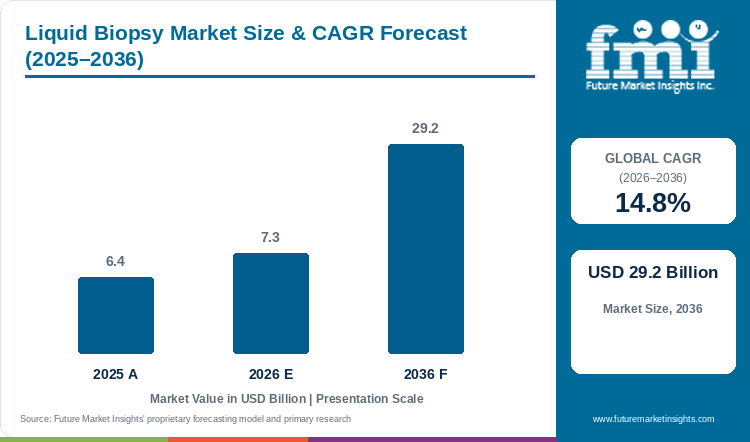
Demand is projected to expand at 14.8% CAGR from 2026 to 2036. Market value rises from USD 6.4 billion in 2025 to USD 7.3 billion in 2026 and USD 29.2 billion by 2036.
The liquid biopsy market is estimated at USD 7.3 billion in 2026 and is projected to reach USD 29.2 billion by 2036, with a CAGR of 14.8% over the forecast period. Demand centers on obtaining clinically useful information from blood and other body fluids, with applications differing according to the biomarker, cancer type and decision the test is intended to support. NCI describes biomarker testing as a means of identifying information that can help guide treatment, while recognizing that the usefulness of a result depends on the available therapeutic options and clinical setting. [1] This makes the market broader than a single technology or a general claim that blood testing can replace tissue sampling. In England, the NHS rollout of circulating tumor DNA testing for eligible lung and breast cancer patients illustrates a defined treatment-selection pathway. [3] FDA’s approval of Shield for a specified colorectal-cancer screening population demonstrates a separate application with its own conditions of use. [2] Commercial growth therefore depends on validated indications, workable laboratory services and timely reporting that can support the clinical decision for which a test is ordered.
Key Market Trends & Insights
- Treatment-selection testing is expanding the practical use of blood-based molecular information, while each assay still needs evidence for its intended cancer population and decision. [1][3]
- Screening, therapy selection and recurrence monitoring represent different clinical questions, so a result established in one setting cannot automatically be transferred to another. [2][4]
- Laboratory turnaround and the quality of the collected sample influence whether a molecular result arrives in time to inform the intended treatment discussion. [1][3]
Regional Highlights
- China and India have the highest profiled growth rates as oncology testing capacity and access develop within the market outlook.
- England’s NHS rollout provides a defined example of circulating tumor DNA testing entering a treatment-selection service for eligible lung and breast cancer patients. [3]
- The United States combines a substantial precision-oncology setting with product-specific FDA decisions that distinguish approved screening indications from other liquid biopsy applications. [1][2]
Market Size & Forecast
Table 1: Market Size and Forecast for Liquid Biopsy Market (USD billion and percentage), 2025 to 2036
| Metric | Value |
|---|---|
| 2025 market value | USD 6.4 billion |
| 2026 market value | USD 7.3 billion |
| 2036 market value | USD 29.2 billion |
| CAGR 2026 to 2036 | 14.8% |
| Revenue increase 2026 to 2036 | USD 21.9 billion |
| Market expansion 2026 to 2036 | 4.00 times |
Demand through 2036 depends on the role that liquid biopsy can establish within cancer diagnostics, with clinical evidence and laboratory delivery determining whether a result is useful for its intended purpose. Providers need appropriate sample handling and reporting that arrives in time for the relevant care discussion. Product-specific indications remain central to that service, including the circumstances in which a molecular finding supports treatment selection and those in which an uninformative result requires additional assessment or tissue testing. [1][2][3][4]
How does clinical utility shape liquid biopsy adoption?
A liquid biopsy result is useful when it addresses a defined clinical question within a suitable care pathway, rather than simply detecting a molecular signal. Official sources illustrate distinct settings: NCI discusses treatment-related biomarkers, FDA specifies Shield’s screening indication, and NHS England describes a treatment-selection rollout. These differences influence the evidence, laboratory service and interpretation required for commercial adoption. [1][2][3]
Table 2: Industry evidence relevant to the liquid biopsy market
| Indicator | Data point or observation | Market relevance | Source |
|---|---|---|---|
| Treatment selection | Molecular biomarkers can inform the choice of appropriate cancer treatment. | The result needs a relevant therapeutic context. | [1] |
| Screening authorization | Shield has a specified colorectal-cancer screening indication. | Approval does not establish general screening for every cancer. | [2] |
| Clinical service rollout | NHS England introduced ctDNA testing for eligible lung and breast cancer patients. | Laboratory capacity must connect with treatment decisions. | [3] |
Analyst Perspective
"Adoption is increasing due to clinical evidence demonstrating liquid biopsy utility for treatment selection, minimal residual disease monitoring, and recurrence surveillance."
- Anurag Sharma, Principal Consultant, FMI
How is the Liquid Biopsy Market segmented?
The market is segmented by Biomarker Type, Sample Type, End User, Application, Cancer Type, and Region.
Biomarker type identifies what is measured, while sample type identifies the material collected, making circulating tumor cells, nucleic acids and exosomes distinct analytical approaches within the same wider category. Application and cancer type locate the result within a clinical question, including treatment selection, monitoring or a separately validated screening use. End-user categories identify where the testing is developed, ordered or delivered, from academic research to clinical diagnostic services. These dimensions need to be read together when comparing demand, because a blood-based collection route can support different assays whose evidence and interpretation depend on the intended patient population and decision. [1][2][3][4]
Why does the circulating tumor cells segment lead demand by biomarker type?
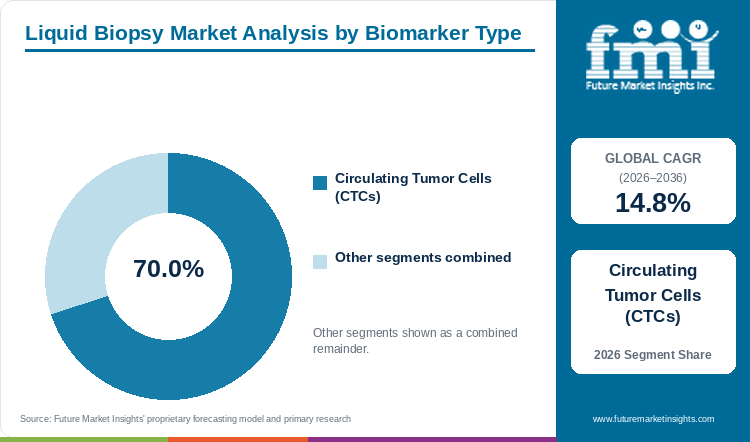
The Circulating Tumor Cells segment is projected to account for 70.0% of biomarker type demand in 2026.
Table 3: Biomarker Type Share for Liquid Biopsy Market (percentage share), 2026
| Biomarker Type | Estimated share (2026) |
|---|---|
| Circulating Tumor Cells | 70.0% |
| Other biomarker type segments | 30.0% |
| Total | 100.0% |
Table 4: Segment Position and Market Growth for Liquid Biopsy Market, 2026 to 2036
| Metric | Value |
|---|---|
| Global CAGR (2026 to 2036) | 14.8% |
| Profiled biomarker type segment | Circulating Tumor Cells |
Circulating tumor cells lead the biomarker mix in the stated market outlook, reflecting the role of tumor-derived cellular material within the covered liquid biopsy applications. Their analysis presents a different technical approach from testing circulating tumor DNA, so the segment’s commercial position should not be interpreted as evidence that every blood-based oncology assay measures the same target. The practical demand question is whether the selected biomarker provides useful information for the intended cancer population and clinical decision. NCI’s discussion of biomarker testing places the result within that treatment context. [1] Laboratories and purchasers consequently need to consider the particular assay, sample requirements and interpretation pathway rather than relying on the general liquid biopsy label to describe performance.
- Circulating tumor cells are projected to account for 70.0% of biomarker-type demand in 2026, reflecting the use of tumor-derived cellular material in the covered oncology applications. [1]
- Circulating tumor cells and circulating tumor DNA are distinct targets, with clinical performance depending on the particular assay and intended application. [1][4]
Why does the blood segment lead demand by sample type?
The Blood segment is projected to account for 87.4% of sample type demand in 2026.
Table 5: Sample Type Share for Liquid Biopsy Market (percentage share), 2026
| Sample Type | Estimated share (2026) |
|---|---|
| Blood | 87.4% |
| Other sample type segments | 12.6% |
| Total | 100.0% |
Blood leads the sample-type mix because it provides a practical collection route for several liquid biopsy approaches without requiring the same procedure as obtaining a tumor tissue sample. [1] This advantage is relevant when a clinician needs molecular information, although the amount and quality of tumor-derived material can vary with the disease and assay. A blood draw therefore begins a laboratory and interpretation pathway rather than guaranteeing an informative result. The NHS England ctDNA service illustrates the need to connect collection, analysis and reporting with treatment selection for eligible patients. [3] Commercial demand follows where this pathway can deliver useful findings within the time available for care decisions, while recognizing that additional assessment may still be needed.
- Blood is projected to represent 87.4% of sample-type demand in 2026, supported by a collection route that can provide molecular information without obtaining a tumor tissue sample. [1]
- Blood-based collection supports selected oncology testing pathways, but the clinical question and assay conditions determine whether a result is informative. [1][4]
What are the drivers, restraints, and opportunities in the Liquid Biopsy Market?
A laboratory’s analytical capability becomes commercially useful when an appropriate patient can receive a timely result that informs the decision for which testing was ordered. Providers can strengthen that connection by organizing collection, reporting and clinical interpretation around defined indications, allowing the value of a service to be assessed through its role in care and the evidence supporting that particular use. [1][2][3][4]
Driver
Oncology precision medicine creates demand for molecular information that can guide a defined treatment choice, particularly when a finding relates to an available therapy. [1] NHS England’s ctDNA rollout illustrates how eligible patients can receive blood-based testing within an organized treatment-selection service. [3] Commercial demand consequently depends on the connection between collection, laboratory capacity and reporting, giving providers a reason to build access around the decisions clinicians need to make within the available treatment window. [4]
Restraint
A low or absent tumor-derived signal can limit what an assay reveals, while the evidence supporting one cancer application cannot automatically establish usefulness in another. [1][4] Buyers also need to consider whether a result can be interpreted and acted on within the treatment pathway, including the need for further assessment after an uninformative finding. These constraints make clinical evidence and service integration central to adoption, even where the sample collection procedure itself is relatively straightforward.
Opportunity
Companion diagnostics connect a test result with treatment selection, creating an opportunity for liquid biopsy services whose intended use and evidence support that decision. [1][4] Providers can build the service around an appropriate patient group, with collection arrangements and reporting that oncology teams can use within the time available for care. This requires a clear account of what the assay measures and how a result is interpreted, including the follow-up needed when the finding does not resolve the clinical question. [3][4]
Which country CAGRs are profiled in the Liquid Biopsy Market?
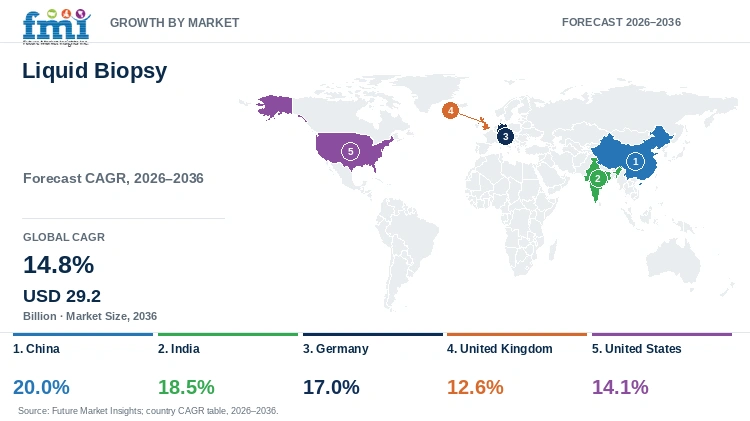
Table 6: Country CAGR Comparison for Liquid Biopsy Market (CAGR percentage), 2026 to 2036
| Country | CAGR | Forecast period |
|---|---|---|
| China | 20.0% | 2026 to 2036 |
| India | 18.5% | 2026 to 2036 |
| Germany | 17.0% | 2026 to 2036 |
| United Kingdom | 12.6% | 2026 to 2036 |
| United States | 14.1% | 2026 to 2036 |
Country-wise Analysis
China Liquid Biopsy Market Outlook (2026 to 2036)
China is projected to expand at a CAGR of 20.0% from 2026 to 2036, reflecting the growth of oncology testing and the development of liquid biopsy services within the market outlook. The commercial task is to connect laboratory capability with a specific clinical decision, because different biomarker technologies do not provide interchangeable information. Molecular testing can support treatment selection when the result relates to an available therapy, as NCI explains in its broader biomarker guidance. [1] Providers serving Chinese oncology centers therefore need a clear intended-use proposition and a workable collection-to-reporting process. Additional testing capacity becomes useful when clinicians can interpret the finding in the context of the patient’s cancer and the treatment options under consideration.
India Liquid Biopsy Market Outlook (2026 to 2036)
India’s liquid biopsy opportunity includes the expansion of molecular testing access across a healthcare market where the availability of specialist laboratories and oncology services can vary between locations. This makes sample transport and the time needed to obtain a result commercially relevant alongside assay performance, particularly when testing is ordered to support a treatment decision. The Indian market is forecast at a CAGR of 18.5% from 2026 to 2036. A blood-based route may simplify collection compared with obtaining tumor tissue in some circumstances, but it still requires suitable handling and clinical interpretation. [1] Providers that organize these steps coherently can address access constraints without implying that every patient or cancer indication is appropriate for the same test.
Germany Liquid Biopsy Market Outlook (2026 to 2036)
German demand sits within an established oncology setting where the clinical role of a test matters as much as its analytical capability, making treatment selection and the interpretation of molecular findings central to adoption. ESMO recommendations on circulating tumor DNA distinguish circumstances where evidence supports clinical use from questions that continue to require further validation. [4] Germany is projected to record a CAGR of 17.0% from 2026 to 2036. For laboratories and purchasers, growth therefore involves more than adding testing volume, because the report needs to arrive in a form that can inform the relevant care discussion. Clear intended use and a dependable link with oncology teams help define the commercial role of a service.
United Kingdom Liquid Biopsy Market Outlook (2026 to 2036)
England’s NHS rollout of ctDNA testing for eligible lung and breast cancer patients gives the United Kingdom market a concrete example of liquid biopsy entering an organized treatment-selection pathway. [3] The service illustrates how access depends on identifying suitable patients, collecting a sample and returning a result that can support the choice of therapy, rather than making testing available without a defined purpose. The United Kingdom market is projected at a CAGR of 12.6% from 2026 to 2036. Expansion across the broader market will still depend on the evidence and arrangements relevant to each application, because a service introduced for selected cancers does not establish an equivalent role for all tumor types or for general population screening.
United States Liquid Biopsy Market Outlook (2026 to 2036)
FDA’s July 2024 approval of Shield establishes a specified colorectal-cancer screening use in the United States, with conditions that differ from treatment-selection testing in patients who already have cancer. [2] This distinction matters commercially because screening eligibility, follow-up and performance requirements cannot be assumed from the broader liquid biopsy category. The United States market is projected to grow at a CAGR of 14.1% from 2026 to 2036. NCI’s biomarker resources also describe how molecular information can help guide treatment, illustrating another part of the demand base. [1] Suppliers consequently need to explain the particular decision their test supports and maintain a service model appropriate to that population, rather than positioning every blood-based assay as a universal replacement for other assessment.
Who are the notable companies in the Liquid Biopsy Market?
Guardant Health; F. Hoffmann-La Roche Ltd.; QIAGEN; Bio-Rad Laboratories; Thermo Fisher Scientific
Test providers and laboratory-platform suppliers participate at different stages of oncology blood testing, from sample preparation and molecular analysis to the clinical report. Buyers can begin the comparison with the intended use and supporting evidence, then examine the laboratory capability and turnaround required to make the result usable. A complete testing service and an analytical platform consequently answer different purchasing needs, with either offering needing a dependable connection to the clinical interpretation and action expected from the assay. [1][4]
Competitive Benchmarking: Liquid Biopsy Market
Table 7: Competitive positioning for the liquid biopsy market
| Company | Positioning | Commercial distinction |
|---|---|---|
| Guardant Health | Blood-based oncology testing | Develops liquid biopsy offerings including the FDA-approved Shield screening test. [2] |
| F. Hoffmann-La Roche Ltd. | Molecular diagnostics | Participates in oncology molecular testing and liquid biopsy technology. |
| QIAGEN | Molecular testing and sample technologies | Supplies technologies used in molecular analysis and liquid biopsy workflows. |
| Bio-Rad Laboratories | Molecular analysis systems | Provides analytical platforms relevant to liquid biopsy research and testing. |
| Thermo Fisher Scientific | Sequencing and molecular testing platforms | Supports oncology molecular analysis through laboratory technologies. |
Key Developments in the Liquid Biopsy Market
- FDA approved Shield in July 2024 for its specified colorectal-cancer screening population, establishing a defined indication rather than a general authorization for all liquid biopsy screening uses. [2]
- NHS England announced its ctDNA testing rollout in May 2025 for eligible lung and breast cancer patients, linking blood-based molecular analysis with treatment selection. [3]
- ESMO’s recommendations on circulating tumor DNA set out the relationship between available clinical evidence and intended use, providing a professional reference for evaluating different oncology applications. [4]
Key Players in the Liquid Biopsy Market
Blood-based oncology testing
- Guardant Health
Molecular diagnostics
- F. Hoffmann-La Roche Ltd.
Molecular testing and sample technologies
- QIAGEN
Molecular analysis systems
- Bio-Rad Laboratories
Sequencing and molecular testing platforms
- Thermo Fisher Scientific
Liquid Biopsy Market - Report Scope
Table 8: Report Scope for Liquid Biopsy Market, 2026 to 2036
| Coverage field | Report scope |
|---|---|
| Market | Liquid Biopsy Market |
| Historical reference year | 2025 |
| Base year | 2026 |
| Forecast period | 2026 to 2036 |
| Quantitative units | USD billion and percentage shares/CAGRs |
| 2026 market value | USD 7.3 billion |
| 2036 market value | USD 29.2 billion |
| Forecast CAGR | 14.8% from 2026 to 2036 |
| Segmentation | biomarker type, sample type, end user, application, cancer type |
| Country profiles | China, India, Germany, United Kingdom, United States |
Liquid Biopsy Market - Research Methodology
Table 9: Research Methodology for Liquid Biopsy Market, 2026 edition
| Method | Approach |
|---|---|
| Market definition | Products, services and commercial applications are separated according to their function and purchasing context. |
| Secondary research | FMI market coverage is assessed alongside official technical guidance, regulatory material and relevant first-party disclosures. |
| Segmentation | Demand is organized by the stated category axes, retaining the distinction between segment shares and growth rates. |
| Country assessment | Local care pathways, purchasing conditions and service availability inform the interpretation of each geographic outlook. |
| Competitive assessment | Participants are compared by relevant offering, customer setting and delivery capability rather than unsupported company rankings. |
| Consistency review | Market values, forecast periods, units, segment labels and country growth rates are checked for agreement throughout the analysis. |
Liquid Biopsy Market by Segments
Liquid Biopsy Market segmented by Biomarker Type:
- Circulating Tumor Cells (CTCs)
- Epithelial Tumor Cells
- Cancer Progression Monitoring
- Metastatic Disease Detection
- Stem Cell Like Tumor Cells
- Therapy Resistance Analysis
- Personalized Oncology Support
- Cancer Progression Monitoring
- Circulating Tumor Nucleic Acids
- Circulating Tumor DNA (ctDNA)
- Genetic Mutation Detection
- Minimal Residual Disease Monitoring
- Circulating Tumor RNA (ctRNA)
- Gene Expression Profiling
- Treatment Response Evaluation
- Circulating Tumor DNA (ctDNA)
- Exosomes
- Tumor Derived Exosomes
- Cell To Cell Communication Analysis
- Early Cancer Detection
- Extracellular Vesicle Biomarkers
- Non Invasive Molecular Profiling
- Precision Medicine Applications
- Tumor Derived Exosomes
- Epithelial Tumor Cells
Liquid Biopsy Market segmented by Sample Type:
- Blood
- Plasma Samples
- High Biomarker Availability
- Routine Diagnostic Collection
- Serum Samples
- Non Invasive Testing Method
- Cancer Monitoring Applications
- High Biomarker Availability
- Urine
- Urinary Biomarker Testing
- Urological Cancer Detection
- Easy Sample Collection
- Molecular Urine Analysis
- Mutation Detection Support
- Bladder Cancer Monitoring
- Urinary Biomarker Testing
- Others
- Saliva Samples
- Non Invasive Collection Method
- Genetic Biomarker Analysis
- Cerebrospinal Fluid Samples
- Neurological Cancer Detection
- Advanced Molecular Diagnostics
- Saliva Samples
- Plasma Samples
Liquid Biopsy Market segmented by End User:
- Hospitals
- Multispecialty Hospitals
- Advanced Oncology Diagnostics
- Integrated Cancer Care Services
- Cancer Treatment Hospitals
- Personalized Treatment Monitoring
- Inpatient Diagnostic Support
- Advanced Oncology Diagnostics
- Cancer Institutes
- Comprehensive Cancer Centers
- Precision Oncology Research
- Clinical Trial Programs
- Specialized Oncology Institutes
- Advanced Biomarker Testing
- Targeted Therapy Evaluation
- Comprehensive Cancer Centers
- Academic Institutes
- Medical Universities
- Cancer Biomarker Research
- Clinical Research Collaborations
- Genomics Research Centers
- Molecular Diagnostic Development
- Translational Oncology Studies
- Medical Universities
- Diagnostic Centers
- Independent Diagnostic Laboratories
- Routine Liquid Biopsy Testing
- High Throughput Sample Analysis
- Molecular Pathology Centers
- Advanced Genomic Profiling
- Companion Diagnostic Services
- Independent Diagnostic Laboratories
- Multispecialty Hospitals
Liquid Biopsy Market segmented by Application:
- Cancer Diagnosis
- Early Cancer Detection
- Non Invasive Screening Methods
- Tumor Identification Support
- Companion Diagnostics
- Targeted Therapy Selection
- Precision Medicine Applications
- Non Invasive Screening Methods
- Treatment Monitoring
- Therapy Response Monitoring
- Real Time Treatment Evaluation
- Drug Resistance Detection
- Minimal Residual Disease Monitoring
- Post Treatment Surveillance
- Relapse Risk Assessment
- Therapy Response Monitoring
- Recurrence Monitoring
- Post Treatment Follow Up
- Cancer Recurrence Detection
- Long Term Patient Monitoring
- Metastatic Disease Monitoring
- Tumor Progression Tracking
- Advanced Cancer Surveillance
- Post Treatment Follow Up
- Early Cancer Detection
Liquid Biopsy Market segmented by Cancer Type:
- Lung Cancer
- Non Small Cell Lung Cancer (NSCLC)
- EGFR Mutation Detection
- Targeted Therapy Guidance
- Small Cell Lung Cancer (SCLC)
- Aggressive Tumor Monitoring
- Therapeutic Response Evaluation
- EGFR Mutation Detection
- Breast Cancer
- HER2 Positive Breast Cancer
- Biomarker Based Therapy Selection
- Disease Progression Monitoring
- Triple Negative Breast Cancer
- Genetic Mutation Analysis
- Precision Oncology Support
- HER2 Positive Breast Cancer
- Colorectal Cancer
- Metastatic Colorectal Cancer
- KRAS And NRAS Mutation Testing
- Treatment Optimization
- Early Stage Colorectal Cancer
- Screening And Recurrence Monitoring
- Minimal Residual Disease Detection
- Metastatic Colorectal Cancer
- Others
- Prostate Cancer
- PSA And ctDNA Monitoring
- Therapy Response Analysis
- Pancreatic Cancer
- Early Detection Biomarkers
- High Risk Patient Screening
- Prostate Cancer
- Non Small Cell Lung Cancer (NSCLC)
Liquid Biopsy Market by Region
- North America
- United States
- Canada
- Latin America
- Brazil
- Mexico
- Argentina
- Chile
- Western Europe
- Germany
- France
- United Kingdom
- Italy
- Spain
- Benelux
- Nordics
- Eastern Europe
- Poland
- Czech Republic
- Romania
- Hungary
- East Asia
- China
- Japan
- South Korea
- South Asia and Pacific
- India
- ASEAN
- Australia and New Zealand
- Middle East and Africa
- GCC Countries
- South Africa
- Türkiye
- Israel
Research Sources and Bibliography
- [1] National Cancer Institute. Accessed 15 October 2026. Biomarker Testing for Cancer Treatment
- [2] US Food and Drug Administration. Accessed 15 October 2026. Shield: P230009
- [3] NHS England. Accessed 15 October 2026. NHS first in world to roll out revolutionary blood test for cancer patients
- [4] European Society for Medical Oncology. Accessed 15 October 2026. ESMO recommendations on the use of circulating tumour DNA assays for patients with cancer
This Report Answers
- How big is the liquid biopsy market in 2026?
- What is the market outlook through 2036?
- Which segments lead demand in 2026?
- Which countries are examined in the forecast?
- Which companies participate in the market?
Frequently Asked Questions
How big is the liquid biopsy market in 2026?
The market is estimated at USD 7.3 billion in 2026, compared with USD 6.4 billion in 2025.
What is the market outlook through 2036?
Market value is projected to reach USD 29.2 billion by 2036, with a CAGR of 14.8% from 2026 to 2036.
Which segments lead demand in 2026?
The Circulating Tumor Cells segment is projected to hold 70% of biomarker type demand in 2026. Blood is projected to hold 87.4% of sample type demand in 2026.
Which countries are examined in the forecast?
The country analysis covers China, India, Germany, United Kingdom, United States, considering local demand conditions and the outlook from 2026 to 2036.
Which companies participate in the market?
Relevant participants include Guardant Health, F. Hoffmann-La Roche Ltd., QIAGEN, Bio-Rad Laboratories, Thermo Fisher Scientific, whose portfolios serve different requirements within the market.
Preview the report firsthand - request a free sample
Get SampleGet the brochure for pricing and purchase details.
Get PDFTable of Content
- Key Takeaways
- Market Size and CAGR
- Top Growth Driver
- Fastest Growing Segment
- Leading Region
- Key Companies
- Emerging Opportunities
- Executive Summary
- Global Market Outlook
- Demand-side Trends
- Supply-side Trends
- Technology Roadmap Analysis
- Analysis and Recommendations
- Analyst Perspective (What is happening? Why now? What should investors know?)
- Key Questions Answered
- How large is the market?
- What is the CAGR?
- What are key trends?
- Which region dominates?
- Who are the leaders?
- Market Overview
- Market Coverage / Taxonomy
- Market Definition / Scope / Limitations
- Research Methodology
- Chapter Orientation
- Analytical Lens and Working Hypotheses
- Market Structure, Signals, and Trend Drivers
- Benchmarking and Cross-market Comparability
- Market Sizing, Forecasting, and Opportunity Mapping
- Research Design and Evidence Framework
- Desk Research Programme (Secondary Evidence)
- Expert Input and Fieldwork (Primary Evidence)
- Tooling, Models, and Reference Databases
- Data Engineering and Model Build
- Quality Assurance and Audit Trail
- Market Background
- Market Dynamics (Drivers, Restraints, Opportunity, Trends)
- Scenario Forecast (Optimistic, Likely, Conservative)
- Impact Analysis
- AI Impact
- Sustainability Impact
- Regulatory Impact
- Technology Impact
- Consumer / Buyer Analysis
- Purchase Drivers
- Adoption Barriers
- Buyer Journey
- Opportunity Map Analysis
- Product Life Cycle Analysis
- Supply Chain Analysis
- Investment Feasibility Matrix
- Value Chain Analysis
- PESTLE and Porter's Analysis
- Regulatory Landscape
- Regional Parent Market Outlook
- Production and Consumption Statistics
- Import and Export Statistics
- Global Market Analysis and Forecast, 2021 to 2036
- Historical Market Size Value (USD Billion) Analysis, 2021 to 2025
- Current and Future Market Size Value (USD Billion) Projections, 2026 to 2036
- Y-o-Y Growth Trend Analysis
- Absolute $ Opportunity Analysis
- Global Market Pricing Analysis, 2021 to 2036
- Global Market Analysis and Forecast, By Biomarker Type, 2021 to 2036
- Introduction / Key Findings
- Historical Market Size Value (USD Billion) Analysis By Biomarker Type, 2021 to 2025
- Current and Future Market Size Value (USD Billion) Analysis and Forecast By Biomarker Type, 2026 to 2036
- Circulating Tumor Cells (CTCs)
- Epithelial Tumor Cells
- Cancer Progression Monitoring
- Metastatic Disease Detection
- Stem Cell Like Tumor Cells
- Therapy Resistance Analysis
- Personalized Oncology Support
- Circulating Tumor Nucleic Acids
- Circulating Tumor DNA (ctDNA)
- Genetic Mutation Detection
- Minimal Residual Disease Monitoring
- Circulating Tumor RNA (ctRNA)
- Gene Expression Profiling
- Treatment Response Evaluation
- Exosomes
- Tumor Derived Exosomes
- Cell To Cell Communication Analysis
- Early Cancer Detection
- Extracellular Vesicle Biomarkers
- Non Invasive Molecular Profiling
- Precision Medicine Applications
- Y-o-Y Growth Trend Analysis By Biomarker Type, 2021 to 2025
- Absolute $ Opportunity Analysis By Biomarker Type, 2026 to 2036
- Global Market Analysis and Forecast, By Sample Type, 2021 to 2036
- Introduction / Key Findings
- Historical Market Size Value (USD Billion) Analysis By Sample Type, 2021 to 2025
- Current and Future Market Size Value (USD Billion) Analysis and Forecast By Sample Type, 2026 to 2036
- Blood
- Plasma Samples
- High Biomarker Availability
- Routine Diagnostic Collection
- Serum Samples
- Non Invasive Testing Method
- Cancer Monitoring Applications
- Urine
- Urinary Biomarker Testing
- Urological Cancer Detection
- Easy Sample Collection
- Molecular Urine Analysis
- Mutation Detection Support
- Bladder Cancer Monitoring
- Others
- Saliva Samples
- Non Invasive Collection Method
- Genetic Biomarker Analysis
- Cerebrospinal Fluid Samples
- Neurological Cancer Detection
- Advanced Molecular Diagnostics
- Y-o-Y Growth Trend Analysis By Sample Type, 2021 to 2025
- Absolute $ Opportunity Analysis By Sample Type, 2026 to 2036
- Global Market Analysis and Forecast, By End User, 2021 to 2036
- Introduction / Key Findings
- Historical Market Size Value (USD Billion) Analysis By End User, 2021 to 2025
- Current and Future Market Size Value (USD Billion) Analysis and Forecast By End User, 2026 to 2036
- Hospitals
- Multispecialty Hospitals
- Advanced Oncology Diagnostics
- Integrated Cancer Care Services
- Cancer Treatment Hospitals
- Personalized Treatment Monitoring
- Inpatient Diagnostic Support
- Cancer Institutes
- Comprehensive Cancer Centers
- Precision Oncology Research
- Clinical Trial Programs
- Specialized Oncology Institutes
- Advanced Biomarker Testing
- Targeted Therapy Evaluation
- Academic Institutes
- Medical Universities
- Cancer Biomarker Research
- Clinical Research Collaborations
- Genomics Research Centers
- Molecular Diagnostic Development
- Translational Oncology Studies
- Diagnostic Centers
- Independent Diagnostic Laboratories
- Routine Liquid Biopsy Testing
- High Throughput Sample Analysis
- Molecular Pathology Centers
- Advanced Genomic Profiling
- Companion Diagnostic Services
- Y-o-Y Growth Trend Analysis By End User, 2021 to 2025
- Absolute $ Opportunity Analysis By End User, 2026 to 2036
- Global Market Analysis and Forecast, By Application, 2021 to 2036
- Introduction / Key Findings
- Historical Market Size Value (USD Billion) Analysis By Application, 2021 to 2025
- Current and Future Market Size Value (USD Billion) Analysis and Forecast By Application, 2026 to 2036
- Cancer Diagnosis
- Early Cancer Detection
- Non Invasive Screening Methods
- Tumor Identification Support
- Companion Diagnostics
- Targeted Therapy Selection
- Precision Medicine Applications
- Treatment Monitoring
- Therapy Response Monitoring
- Real Time Treatment Evaluation
- Drug Resistance Detection
- Minimal Residual Disease Monitoring
- Post Treatment Surveillance
- Relapse Risk Assessment
- Recurrence Monitoring
- Post Treatment Follow Up
- Cancer Recurrence Detection
- Long Term Patient Monitoring
- Metastatic Disease Monitoring
- Tumor Progression Tracking
- Advanced Cancer Surveillance
- Y-o-Y Growth Trend Analysis By Application, 2021 to 2025
- Absolute $ Opportunity Analysis By Application, 2026 to 2036
- Global Market Analysis and Forecast, By Cancer Type, 2021 to 2036
- Introduction / Key Findings
- Historical Market Size Value (USD Billion) Analysis By Cancer Type, 2021 to 2025
- Current and Future Market Size Value (USD Billion) Analysis and Forecast By Cancer Type, 2026 to 2036
- Lung Cancer
- Non Small Cell Lung Cancer (NSCLC)
- EGFR Mutation Detection
- Targeted Therapy Guidance
- Small Cell Lung Cancer (SCLC)
- Aggressive Tumor Monitoring
- Therapeutic Response Evaluation
- Breast Cancer
- HER2 Positive Breast Cancer
- Biomarker Based Therapy Selection
- Disease Progression Monitoring
- Triple Negative Breast Cancer
- Genetic Mutation Analysis
- Precision Oncology Support
- Colorectal Cancer
- Metastatic Colorectal Cancer
- KRAS And NRAS Mutation Testing
- Treatment Optimization
- Early Stage Colorectal Cancer
- Screening And Recurrence Monitoring
- Minimal Residual Disease Detection
- Others
- Prostate Cancer
- PSA And ctDNA Monitoring
- Therapy Response Analysis
- Pancreatic Cancer
- Early Detection Biomarkers
- High Risk Patient Screening
- Y-o-Y Growth Trend Analysis By Cancer Type, 2021 to 2025
- Absolute $ Opportunity Analysis By Cancer Type, 2026 to 2036
- Global Market Analysis and Forecast, By Region, 2021 to 2036
- Introduction
- Historical Market Size Value (USD Billion) Analysis By Region, 2021 to 2025
- Current Market Size Value (USD Billion) Analysis and Forecast By Region, 2026 to 2036
- North America
- Latin America
- Western Europe
- Eastern Europe
- East Asia
- South Asia and Pacific
- Middle East & Africa
- Market Attractiveness Analysis By Region
- North America Market Analysis and Forecast, By Country, 2021 to 2036
- Historical Market Size Value (USD Billion) Trend Analysis By Market Taxonomy, 2021 to 2025
- Market Size Value (USD Billion) Forecast By Market Taxonomy, 2026 to 2036
- By Country
- USA
- Canada
- Mexico
- By Biomarker Type
- By Sample Type
- By End User
- By Application
- By Cancer Type
- By Country
- Market Attractiveness Analysis
- By Country
- By Biomarker Type
- By Sample Type
- By End User
- By Application
- By Cancer Type
- Key Takeaways
- Latin America Market Analysis and Forecast, By Country
- Historical Market Size Value (USD Billion) Trend Analysis By Market Taxonomy, 2021 to 2025
- Market Size Value (USD Billion) Forecast By Market Taxonomy, 2026 to 2036
- By Country
- Brazil
- Chile
- Rest of Latin America
- By Biomarker Type
- By Sample Type
- By End User
- By Application
- By Cancer Type
- By Country
- Market Attractiveness Analysis
- By Country
- By Biomarker Type
- By Sample Type
- By End User
- By Application
- By Cancer Type
- Key Takeaways
- Western Europe Market Analysis and Forecast, By Country
- Historical Market Size Value (USD Billion) Trend Analysis By Market Taxonomy, 2021 to 2025
- Market Size Value (USD Billion) Forecast By Market Taxonomy, 2026 to 2036
- By Country
- Germany
- UK
- Italy
- Spain
- France
- Nordic
- BENELUX
- Rest of Western Europe
- By Biomarker Type
- By Sample Type
- By End User
- By Application
- By Cancer Type
- By Country
- Market Attractiveness Analysis
- By Country
- By Biomarker Type
- By Sample Type
- By End User
- By Application
- By Cancer Type
- Key Takeaways
- Eastern Europe Market Analysis and Forecast, By Country
- Historical Market Size Value (USD Billion) Trend Analysis By Market Taxonomy, 2021 to 2025
- Market Size Value (USD Billion) Forecast By Market Taxonomy, 2026 to 2036
- By Country
- Russia
- Poland
- Hungary
- Balkan & Baltic
- Rest of Eastern Europe
- By Biomarker Type
- By Sample Type
- By End User
- By Application
- By Cancer Type
- By Country
- Market Attractiveness Analysis
- By Country
- By Biomarker Type
- By Sample Type
- By End User
- By Application
- By Cancer Type
- Key Takeaways
- East Asia Market Analysis and Forecast, By Country
- Historical Market Size Value (USD Billion) Trend Analysis By Market Taxonomy, 2021 to 2025
- Market Size Value (USD Billion) Forecast By Market Taxonomy, 2026 to 2036
- By Country
- China
- Japan
- South Korea
- By Biomarker Type
- By Sample Type
- By End User
- By Application
- By Cancer Type
- By Country
- Market Attractiveness Analysis
- By Country
- By Biomarker Type
- By Sample Type
- By End User
- By Application
- By Cancer Type
- Key Takeaways
- South Asia and Pacific Market Analysis and Forecast, By Country
- Historical Market Size Value (USD Billion) Trend Analysis By Market Taxonomy, 2021 to 2025
- Market Size Value (USD Billion) Forecast By Market Taxonomy, 2026 to 2036
- By Country
- India
- ASEAN
- Australia & New Zealand
- Rest of South Asia and Pacific
- By Biomarker Type
- By Sample Type
- By End User
- By Application
- By Cancer Type
- By Country
- Market Attractiveness Analysis
- By Country
- By Biomarker Type
- By Sample Type
- By End User
- By Application
- By Cancer Type
- Key Takeaways
- Middle East & Africa Market Analysis and Forecast, By Country
- Historical Market Size Value (USD Billion) Trend Analysis By Market Taxonomy, 2021 to 2025
- Market Size Value (USD Billion) Forecast By Market Taxonomy, 2026 to 2036
- By Country
- Kingdom of Saudi Arabia
- Other GCC Countries
- Türkiye
- South Africa
- Other African Union
- Rest of Middle East & Africa
- By Biomarker Type
- By Sample Type
- By End User
- By Application
- By Cancer Type
- By Country
- Market Attractiveness Analysis
- By Country
- By Biomarker Type
- By Sample Type
- By End User
- By Application
- By Cancer Type
- Key Takeaways
- Key Countries Market Analysis
- USA
- Pricing Analysis
- Market Share Analysis, 2025
- By Biomarker Type
- By Sample Type
- By End User
- By Application
- By Cancer Type
- Canada
- Pricing Analysis
- Market Share Analysis, 2025
- By Biomarker Type
- By Sample Type
- By End User
- By Application
- By Cancer Type
- Mexico
- Pricing Analysis
- Market Share Analysis, 2025
- By Biomarker Type
- By Sample Type
- By End User
- By Application
- By Cancer Type
- Brazil
- Pricing Analysis
- Market Share Analysis, 2025
- By Biomarker Type
- By Sample Type
- By End User
- By Application
- By Cancer Type
- Chile
- Pricing Analysis
- Market Share Analysis, 2025
- By Biomarker Type
- By Sample Type
- By End User
- By Application
- By Cancer Type
- Germany
- Pricing Analysis
- Market Share Analysis, 2025
- By Biomarker Type
- By Sample Type
- By End User
- By Application
- By Cancer Type
- UK
- Pricing Analysis
- Market Share Analysis, 2025
- By Biomarker Type
- By Sample Type
- By End User
- By Application
- By Cancer Type
- Italy
- Pricing Analysis
- Market Share Analysis, 2025
- By Biomarker Type
- By Sample Type
- By End User
- By Application
- By Cancer Type
- Spain
- Pricing Analysis
- Market Share Analysis, 2025
- By Biomarker Type
- By Sample Type
- By End User
- By Application
- By Cancer Type
- France
- Pricing Analysis
- Market Share Analysis, 2025
- By Biomarker Type
- By Sample Type
- By End User
- By Application
- By Cancer Type
- India
- Pricing Analysis
- Market Share Analysis, 2025
- By Biomarker Type
- By Sample Type
- By End User
- By Application
- By Cancer Type
- ASEAN
- Pricing Analysis
- Market Share Analysis, 2025
- By Biomarker Type
- By Sample Type
- By End User
- By Application
- By Cancer Type
- Australia & New Zealand
- Pricing Analysis
- Market Share Analysis, 2025
- By Biomarker Type
- By Sample Type
- By End User
- By Application
- By Cancer Type
- China
- Pricing Analysis
- Market Share Analysis, 2025
- By Biomarker Type
- By Sample Type
- By End User
- By Application
- By Cancer Type
- Japan
- Pricing Analysis
- Market Share Analysis, 2025
- By Biomarker Type
- By Sample Type
- By End User
- By Application
- By Cancer Type
- South Korea
- Pricing Analysis
- Market Share Analysis, 2025
- By Biomarker Type
- By Sample Type
- By End User
- By Application
- By Cancer Type
- Russia
- Pricing Analysis
- Market Share Analysis, 2025
- By Biomarker Type
- By Sample Type
- By End User
- By Application
- By Cancer Type
- Poland
- Pricing Analysis
- Market Share Analysis, 2025
- By Biomarker Type
- By Sample Type
- By End User
- By Application
- By Cancer Type
- Hungary
- Pricing Analysis
- Market Share Analysis, 2025
- By Biomarker Type
- By Sample Type
- By End User
- By Application
- By Cancer Type
- Kingdom of Saudi Arabia
- Pricing Analysis
- Market Share Analysis, 2025
- By Biomarker Type
- By Sample Type
- By End User
- By Application
- By Cancer Type
- Türkiye
- Pricing Analysis
- Market Share Analysis, 2025
- By Biomarker Type
- By Sample Type
- By End User
- By Application
- By Cancer Type
- South Africa
- Pricing Analysis
- Market Share Analysis, 2025
- By Biomarker Type
- By Sample Type
- By End User
- By Application
- By Cancer Type
- USA
- Market Structure Analysis
- Competition Dashboard
- Competition Benchmarking
- Market Share Analysis of Top Players
- By Regional
- By Biomarker Type
- By Sample Type
- By End User
- By Application
- By Cancer Type
- Emerging Startups
- Innovation Benchmarking
- Competition Analysis
- Competition Deep Dive
- Guardant Health
- Overview
- Product Portfolio
- Profitability by Market Segments
- Sales Footprint
- Strategy Overview
- Marketing Strategy
- Product Strategy
- Channel Strategy
- F. Hoffmann-La Roche Ltd.
- QIAGEN
- Bio-Rad Laboratories
- Thermo Fisher Scientific
- Guardant Health
- Case Studies
- Success Stories
- Recent Developments
- Competition Deep Dive
- Assumptions & Acronyms Used


