

- Market Size (2026)
- USD 82.4 Bn
- Forecast (2036)
- USD 242.5 Bn
- CAGR (2026 to 2036)
- 11.4%
How big is Oncology Precision Medicine Market in 2026?
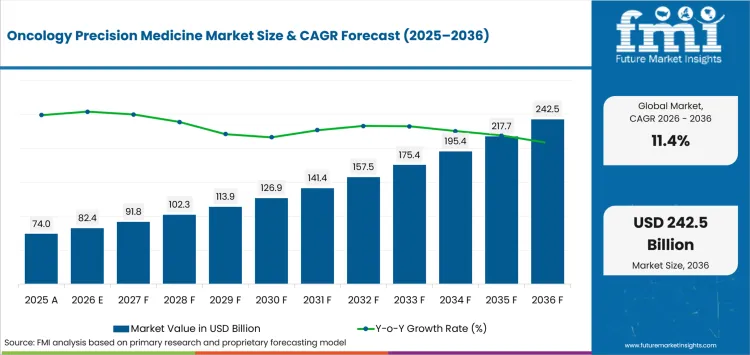
USD 82.4 billion in 2026 and USD 242.5 billion by 2036 at an 11.4% CAGR.
Demand for oncology precision medicine is projected to expand at an 11.4% CAGR between 2026 and 2036, increasing valuation from USD 82.4 billion in 2026 to USD 242.5 billion by 2036. Growth rests on the ability to pair a patient's tumor profile with a treatment, monitoring plan or trial pathway that can change care.
Clinical use is moving from isolated biomarker tests toward broader genomic workflows. The National Cancer Institute's NCI-MATCH trial enrolled 1,201 people across 38 treatment arms and used centrally vetted next-generation sequencing to assign therapy by molecular alteration. This model shows why buyers assess sample quality, assay validation, interpretation and turnaround time as one operating chain.
Key Takeaways
- Biomarker-directed care links molecular testing with treatment selection, disease monitoring and clinical trial enrollment.
- The market is projected to rise from USD 82.4 billion in 2026 to USD 242.5 billion by 2036 at an 11.4% CAGR.
- Targeted Therapeutics is estimated to account for 44.0% of Product Type demand in 2026 because treatment eligibility often depends on a defined biomarker.
- Lung Cancer is projected at 28.0% of Cancer Type demand, while Next-Generation Sequencing holds 38.0% of Technology demand in 2026.
- Hospitals represent 39.0% of End User demand and Treatment Selection accounts for 36.0% of Application demand in 2026.
- Limited tissue, slow reimbursement and delayed interpretation can weaken clinical use. Roche Holding AG, Thermo Fisher Scientific Inc., Illumina, Inc., AstraZeneca PLC, Pfizer Inc., Guardant Health, Inc., QIAGEN N.V., Foundation Medicine, Inc., Novartis AG and Abbott Laboratories serve key parts of the market.
Analyst Perspective
"Commercial adoption depends on whether a validated biomarker result reaches the treatment team before therapy is chosen. Diagnostic providers and drug developers therefore need evidence that supports reliable assays and a practical route from sample collection to clinical action."
- Anurag Sharma, Principal Consultant, Future Market Insights
How is the Oncology Precision Medicine Market segmented?
The oncology precision medicine market is segmented by product type, cancer type, technology, end user, application and region.
Oncology precision medicine follows the route from a treatment or test to the cancer setting, technical platform, buyer and clinical decision. Product Type separates therapies from diagnostic offerings. Cancer Type identifies the disease setting. Technology captures the assay route. End User shows where testing or treatment is delivered, while Application records the decision produced from the result.
Why do Targeted Therapeutics lead the Product Type category?
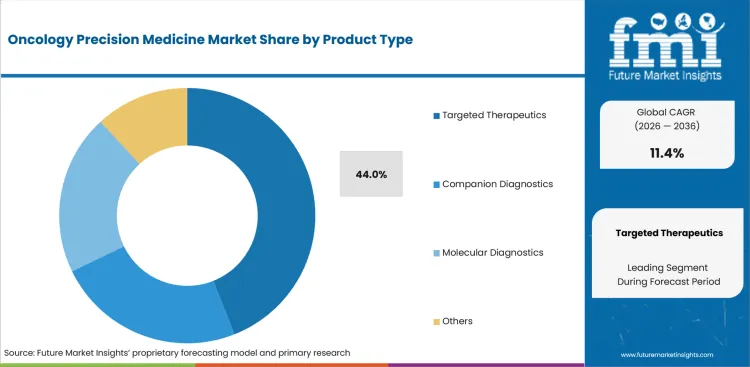
Targeted Therapeutics hold 44.0% share in 2026. Biomarker-directed drugs create the strongest commercial link between a molecular finding and an immediate treatment decision. Tyrosine Kinase Inhibitors and Monoclonal Antibodies anchor this category. Companion Diagnostics and Molecular Diagnostics support the same pathway through NGS, PCR, liquid biopsy and tissue biomarker testing. AI Decision Support and Genomic Data Analytics form the interpretation layer within Others.
- Targeted Therapeutics is projected to lead Product Type with 44.0% share in 2026 because the test result can determine whether a patient is eligible for a specific therapy.
- Companion Diagnostics, Molecular Diagnostics and Others extend the category through validated assays, liquid or tissue testing and genomic interpretation.
Why does Lung Cancer lead the Cancer Type category?
Lung Cancer holds 28.0% share in 2026. Molecular testing is established in non-small cell lung cancer, where a defined alteration can guide targeted treatment. The category also includes small cell lung cancer. Breast Cancer and Colorectal Cancer create separate testing pathways, while Others covers Prostate Cancer, Melanoma and Hematological Malignancies.
- Lung Cancer is projected to lead Cancer Type with 28.0% share in 2026 because molecular alterations can directly influence targeted therapy selection.
- Breast Cancer, Colorectal Cancer and Others widen demand as biomarker use extends across solid tumors and blood cancers.
Why does Next-Generation Sequencing lead the Technology category?
Next-Generation Sequencing accounts for 38.0% of Technology demand in 2026. The National Cancer Institute uses centrally vetted NGS assays in precision medicine trials, showing how one workflow can support molecular treatment assignment. Whole Genome Sequencing and Targeted Gene Panels form the leading group. PCR and Immunohistochemistry remain important for defined targets, while Liquid Biopsy and AI-Based Genomic Analytics extend testing beyond conventional tissue workflows.
- Next-Generation Sequencing is projected to lead Technology with 38.0% share in 2026 because one assay can examine several genomic features relevant to treatment selection.
- PCR, Immunohistochemistry and Other technologies remain useful when a defined alteration, protein marker, blood sample or interpretation layer fits the clinical question.
Why do Hospitals lead the End User category?
Hospitals hold 39.0% of End User demand in 2026 because oncology teams can connect pathology results with treatment planning and follow-up within one care pathway. Comprehensive Cancer Centers and Tertiary Care Hospitals form the leading group. Diagnostic Laboratories support outsourced testing, while Pharmaceutical & Biotechnology Companies use biomarker data for drug development and trial enrollment. Academic Research Institutes and Precision Medicine Centers support validation and specialist care.
- Hospitals are projected to represent 39.0% of End User demand in 2026 because they can connect testing with treatment selection and response assessment.
- Diagnostic Laboratories, therapy developers and specialist research centers extend demand beyond hospital-owned testing.
Why does Treatment Selection lead the Application category?
Treatment Selection represents 36.0% of Application demand in 2026. The USA Food and Drug Administration's companion diagnostic framework links validated test information with patient benefit, treatment risk and response monitoring. Targeted Therapy Selection and Immunotherapy Selection form the leading group. Companion Diagnostics support Biomarker Identification and Patient Stratification, while Disease Monitoring includes minimal residual disease and treatment response. Early Cancer Detection and Clinical Trial Enrollment create additional uses for molecular data.
- Treatment Selection is forecast to lead Application with 36.0% share in 2026 because the most immediate value of a biomarker result is choosing an appropriate therapy.
- Monitoring, early detection and trial enrollment create follow-on demand after the first treatment decision.
What are the drivers, restraints and opportunities in the Oncology Precision Medicine Market?
Biomarker-linked therapies expand testing demand while limited access can delay clinical action, creating an opening for platforms that connect genomic profiling with liquid biopsy and treatment monitoring.
- Driver: More therapeutic labels require validated biomarkers to identify patients who are likely to benefit from a defined treatment.
- Restraint: Limited tissue, uneven reimbursement and slow turnaround can keep a useful result from reaching the treatment team in time.
- Opportunity: Liquid biopsy and molecular residual disease testing extend precision oncology into response assessment and recurrence monitoring.
Biomarker-linked treatment is the central demand driver. The FDA companion diagnostic framework connects a test with the safe and effective use of a therapeutic product, while the National Cancer Institute uses molecular eligibility in precision medicine trials. Each new biomarker-linked therapy creates demand for a validated assay, laboratory capacity and an interpretable report.
Access remains uneven across care settings. The National Cancer Institute notes that biomarker testing is not available at every hospital, and some patients still require a tumor biopsy. Reimbursement, sample adequacy and result interpretation add further delay. A technically sound test has limited clinical value when the answer arrives after treatment has started.
Opportunity is moving toward connected platforms that cover more than the first treatment choice. Liquid biopsy can create a blood-based route when tissue is scarce, while molecular residual disease testing supports follow-up after therapy. Platforms that reduce handoffs between sample processing, analysis and clinical action can address a larger share of the oncology workflow.
Which country CAGRs are included in the Oncology Precision Medicine Market?
| Country | CAGR |
|---|---|
| South Korea | 12.5% |
| USA | 11.9% |
| Canada | 11.5% |
| UK | 11.3% |
| Australia | 11.1% |
| Germany | 11.0% |
| Japan | 10.6% |
How do country-level CAGRs compare in the Oncology Precision Medicine Market?
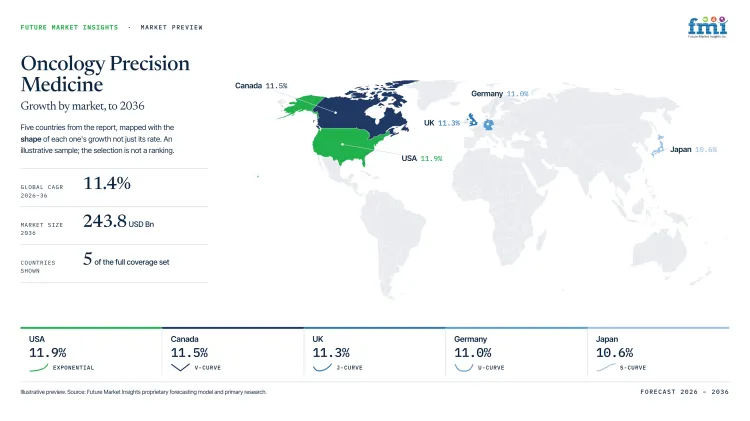
Seven country CAGRs span 1.9 percentage points, from South Korea at 12.5% to Japan at 10.6%. The ranking indicates expected expansion rather than current market size or installed testing capacity.
- The USA combines an established companion diagnostic framework with a national precision-trial laboratory network.
- Canada links companion diagnostics with risk-based device classification and evidence requirements for therapy selection.
- The UK uses the National Genomic Test Directory to define commissioned tests and patient eligibility within NHS pathways.
- Australia supports biomarker-led treatment through regulatory approvals and funded multigene panel testing for selected cancers.
- Germany is developing a structured genomic medicine pathway through the genomDE pilot and statutory insurance participation.
- Japan has a defined route for comprehensive genomic profiling and drug-linked companion diagnostics through PMDA review.
Similar growth rates can produce different entry conditions. Suppliers must account for local testing eligibility, reimbursement routes and the evidence required to connect a result with treatment. The full report provides country analysis across North America, Latin America, Europe, East Asia, South Asia and Pacific, and the Middle East and Africa.
Country-wise Analysis
- South Korea: The oncology precision medicine market is projected to record a 12.5% CAGR through 2036. The Ministry of Health and Welfare opened an NGS-panel-data-based cancer precision medicine program in April 2025, linking genomic data with national research activity. Commercial uptake still depends on hospital laboratory capacity and consistent interpretation.
- USA: The market is forecast to expand at an 11.9% CAGR through 2036. The FDA's authorized companion diagnostic list gives laboratories and therapy developers a defined regulatory route, while the NCI precision medicine trial network uses designated laboratories for molecular assignment. These pathways support NGS, companion diagnostics and biomarker-led treatment selection.
- Canada: Demand is projected to rise at an 11.5% CAGR through 2036. Health Canada's risk-based classification guidance includes genetic tests used as companion diagnostics in cancer and ties classification to the safe and effective use of a therapy. Adoption therefore depends on evidence quality and provincial access to testing.
- UK: The market is anticipated to advance at an 11.3% CAGR through 2036. NHS England updated the cancer National Genomic Test Directory in July 2026, setting out commissioned tests and eligible patients. This gives suppliers a structured route into genomic laboratory hubs, although use must fit NHS evidence and commissioning rules.
- Australia: The market is estimated to grow at an 11.1% CAGR through 2036. The TGA approved capmatinib for MET exon 14 skipping non-small cell lung cancer in June 2026, and its assessment discusses funded multigene panel testing. This supports demand for validated biomarker testing within targeted lung cancer pathways.
- Germany: The market is forecast to record an 11.0% CAGR through 2036. The federal genomDE pilot began in July 2024 and is designed to run for at least five years, with statutory health insurance funds covering eligible care. The program supports standardized genomic workflows across participating university hospitals.
- Japan: Demand is projected to increase at a 10.6% CAGR through 2036. PMDA reviews of FoundationOne CDx and drug-agnostic companion diagnostic use provide a defined setting for comprehensive genomic profiling and therapy matching. Local adoption depends on approved indications and the capacity to interpret broad panel results.
Who are the notable companies in the Oncology Precision Medicine Market?
Roche Holding AG, Thermo Fisher Scientific Inc., Illumina, Inc., AstraZeneca PLC, Pfizer Inc., Guardant Health, Inc., QIAGEN N.V., Foundation Medicine, Inc., Novartis AG and Abbott Laboratories are the notable companies serving the oncology precision medicine market.
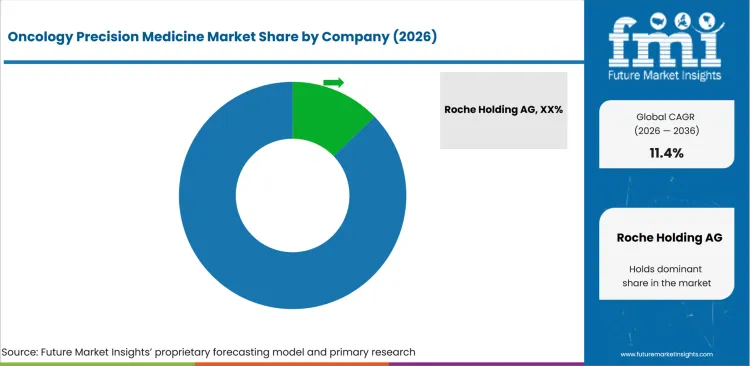
Competition spans precision-oncology diagnostics and biomarker-led therapeutics. Platform suppliers own assay, instrument or interpretation steps. Drug developers work with diagnostic partners to establish eligibility for specific therapies. Commercial position therefore depends on evidence that a product can enter routine clinical care and produce an answer within the treatment timeline.
- Roche Holding AG, Foundation Medicine, Inc., Thermo Fisher Scientific Inc., Illumina, Inc., QIAGEN N.V. and Abbott Laboratories build or support genomic, molecular and companion diagnostic workflows.
- Guardant Health, Inc. extends precision oncology through liquid biopsy, circulating tumor DNA and molecular residual disease testing.
- AstraZeneca PLC, Pfizer Inc. and Novartis AG connect biomarker strategy with targeted oncology therapeutics and patient selection.
Competitive Benchmarking: Oncology Precision Medicine Market
| Company | Precision-oncology depth | Diagnostic or biomarker capability | Primary coverage in this market |
|---|---|---|---|
| Roche Holding AG | High | High | Comprehensive genomic profiling, pathology and MRD |
| Thermo Fisher Scientific Inc. | High | High | NGS, PCR and companion diagnostics |
| Illumina, Inc. | High | High | NGS, comprehensive genomic profiling and companion diagnostics |
| AstraZeneca PLC | High | Medium | Targeted therapeutics, biomarker strategy and computational pathology |
| Pfizer Inc. | High | Medium | Biomarker-led oncology therapeutics |
| Guardant Health, Inc. | High | High | Liquid biopsy, ctDNA and MRD |
| QIAGEN N.V. | High | High | PCR, digital PCR, NGS and companion diagnostics |
| Foundation Medicine, Inc. | High | High | Tissue and liquid genomic profiling with MRD |
| Novartis AG | High | Medium | Precision oncology, targeted therapies and radioligand therapy |
| Abbott Laboratories | Medium | Medium | Molecular oncology, cancer testing and early detection |
Scoring basis: High indicates official evidence of a direct precision-oncology platform or coverage across at least two defined market functions. Medium indicates evidence in one approved function or an adjacent oncology use. The comparison is qualitative and does not represent market share, company revenue or a certification ranking.
Key Developments in the Oncology Precision Medicine Market
- In May 2026, Roche completed its acquisition of SAGA Diagnostics and gained the Pathlight molecular residual disease platform.
- In November 2025, Thermo Fisher Scientific reported FDA approval of the Oncomine Dx Target Test as a companion diagnostic for HER2-mutant non-small cell lung cancer treated with sevabertinib.
- In September 2025, Illumina announced pharmaceutical partnerships to develop KRAS companion diagnostics on TruSight Oncology Comprehensive.
Key Players in the Oncology Precision Medicine Market
Genomic Profiling and Companion Diagnostic Platforms
- Roche Holding AG
- Thermo Fisher Scientific Inc.
- Illumina, Inc.
- QIAGEN N.V.
- Foundation Medicine, Inc.
- Guardant Health, Inc.
- Abbott Laboratories
Biomarker-led Oncology Therapeutics
- AstraZeneca PLC
- Pfizer Inc.
- Novartis AG
Oncology Precision Medicine Market - Report Scope
| Coverage field | Report scope |
|---|---|
| Market breakdown | By Product Type, Cancer Type, Technology, End User, Application and Region. |
| Quantitative Units | USD billion. |
| Market Definition | The market covers targeted therapeutics, companion diagnostics, genomic testing, molecular diagnostics, treatment selection, disease monitoring and clinical research pathways in oncology. |
| Regions Covered | North America, Latin America, Europe, East Asia, South Asia and Pacific, and Middle East and Africa. |
| Countries Covered | South Korea, USA, Canada, UK, Australia, Germany, Japan and 20+ countries included in the full report. |
| Key Companies | Roche Holding AG, Thermo Fisher Scientific Inc., Illumina, Inc., AstraZeneca PLC, Pfizer Inc., Guardant Health, Inc., QIAGEN N.V., Foundation Medicine, Inc., Novartis AG and Abbott Laboratories. |
| Forecast Period | 2026 to 2036. |
| Approach | Primary and secondary research with market triangulation. |
Oncology Precision Medicine Market - Research Methodology
| Method | Approach |
|---|---|
| Primary Research | FMI analysts gathered input from therapeutic developers, diagnostic providers, hospitals, laboratories, academic centers and specialists. Interviews examined buying criteria, approvals, clinical evidence, reimbursement and adoption barriers. |
| Desk Research | Desk research covered regulatory publications, clinical program documents, scientific literature, company filings, product information and official corporate announcements. Claims were retained when they fell within the market definition and had credible public support. |
| Market Sizing and Forecasting | The market model combined the baseline value with therapy demand, testing capacity, technology adoption, pricing and product mix, company participation and country-level conditions. Segment and regional estimates were reconciled before the final total was calculated. |
| Data Validation | Estimates were checked against independent indicators, company activity, regulatory actions and primary interviews. Adjacent categories, unsupported claims and overlapping revenue were excluded to reduce double counting. |
Oncology Precision Medicine Market by Segments
Oncology Precision Medicine Market segmented by Product Type:
- Targeted Therapeutics
- Tyrosine Kinase Inhibitors
- Monoclonal Antibodies
- Companion Diagnostics
- NGS-Based Diagnostics
- PCR-Based Diagnostics
- Molecular Diagnostics
- Liquid Biopsy
- Tissue Biomarker Testing
- Others
- AI Decision Support
- Genomic Data Analytics
Oncology Precision Medicine Market segmented by Cancer Type:
- Lung Cancer
- Non-Small Cell Lung Cancer
- Small Cell Lung Cancer
- Breast Cancer
- HER2-Positive Breast Cancer
- Triple-Negative Breast Cancer
- Colorectal Cancer
- Metastatic Colorectal Cancer
- Early-Stage Colorectal Cancer
- Others
- Prostate Cancer
- Melanoma
- Hematological Malignancies
Oncology Precision Medicine Market segmented by Technology:
- Next-Generation Sequencing (NGS)
- Whole Genome Sequencing
- Targeted Gene Panels
- Polymerase Chain Reaction (PCR)
- Real-Time PCR
- Digital PCR
- Immunohistochemistry (IHC)
- PD-L1 Testing
- HER2 Testing
- Others
- Liquid Biopsy
- AI-Based Genomic Analytics
Oncology Precision Medicine Market segmented by End User:
- Hospitals
- Comprehensive Cancer Centers
- Tertiary Care Hospitals
- Diagnostic Laboratories
- Molecular Diagnostics Labs
- Reference Laboratories
- Pharmaceutical & Biotechnology Companies
- Drug Developers
- Clinical Research Organizations
- Others
- Academic Research Institutes
- Precision Medicine Centers
Oncology Precision Medicine Market segmented by Application:
- Treatment Selection
- Targeted Therapy Selection
- Immunotherapy Selection
- Companion Diagnostics
- Biomarker Identification
- Patient Stratification
- Disease Monitoring
- Minimal Residual Disease Monitoring
- Treatment Response Monitoring
- Others
- Early Cancer Detection
- Clinical Trial Enrollment
Oncology Precision Medicine Market by Region:
- North America
- United States
- Canada
- Latin America
- Brazil
- Chile
- Mexico
- Rest of Latin America
- Western Europe
- Germany
- United Kingdom
- Italy
- Spain
- France
- Nordics
- Benelux
- Rest of Western Europe
- Eastern Europe
- Russia
- Poland
- Hungary
- Balkan and Baltic States
- Rest of Eastern Europe
- East Asia
- China
- Japan
- South Korea
- South Asia and Pacific
- India
- ASEAN
- Australia and New Zealand
- Rest of South Asia and Pacific
- Middle East and Africa
- Kingdom of Saudi Arabia
- Other GCC Countries
- Türkiye
- South Africa
- Other African Union Countries
- Rest of Middle East and Africa
Research Sources and Bibliography
- National Cancer Institute. (2021, December 14). Biomarker Testing for Cancer Treatment.
- National Cancer Institute. (2025, July 30). Precision Medicine Trials.
- USA Food and Drug Administration. (n.d.). Companion Diagnostics.
- USA Food and Drug Administration. (2026, July 23). List of FDA-Authorized Companion Diagnostic Devices.
- USA Food and Drug Administration. (2020, April 13). Developing and Labeling In Vitro Companion Diagnostic Devices for a Specific Group of Oncology Therapeutic Products.
- NHS England. (2026, July 16). National Genomic Test Directories.
- Medical Device Coordination Group. (n.d.). Guidance on Classification Rules for In Vitro Diagnostic Medical Devices under Regulation (EU) 2017/746.
- Federal Ministry of Health, Germany. (n.d.). genomDE Pilot Project.
- Health Canada. (2026, June 19). Guidance on the Risk-Based Classification System for In Vitro Diagnostic Devices.
- Pharmaceuticals and Medical Devices Agency. (2018, December 13). FoundationOne CDx Cancer Genomic Profile Review Report.
- Pharmaceuticals and Medical Devices Agency. (2025, August 29). Evaluation Report on Applicability to Drug-Agnostic Companion Diagnostics.
- Therapeutic Goods Administration. (2026, July 13). Australian Public Assessment Report for Tabrecta.
- Ministry of Health and Welfare, Republic of Korea. (2025, April 21). NGS-Panel-Data-Based Cancer Precision Medicine Technology Development Program.
- Roche. (2026, April 16). Foundation Medicine Monitoring Portfolio and Pathlight Molecular Residual Disease Platform.
- Roche. (2026). Half-Year Report 2026.
- Thermo Fisher Scientific. (2025, November 20). Oncomine Dx Target Test Receives FDA Approval as a Companion Diagnostic for Non-Small Cell Lung Cancer.
- Illumina. (2025, September 23). Illumina Advances Personalized Cancer Care with New Pharma Development Partnerships.
- Guardant Health. (2026). Guardant Health and Collaborators to Present 38 Abstracts at the 2026 ASCO Annual Meeting.
- QIAGEN. (2025, June 15). QIAGEN and Incyte Announce Precision Medicine Collaboration for Companion Diagnostics.
- AstraZeneca. (2025, March 24). How Computational Pathology May Transform Cancer Diagnostics.
- Pfizer. (2023, April 27). Cancer Biomarkers: Paving the Way for Better Lung Cancer Treatment.
- Novartis. (n.d.). Personalized and Precision Medicine.
- Abbott. (n.d.). Exact Sciences and Cancer Testing.
This bibliography is provided for reader reference and is not exhaustive. The full report contains the complete reference list and detailed citations.
This Report Answers
- How large is the Oncology Precision Medicine Market in 2026 and 2036?
- What supports biomarker-linked adoption across oncology care?
- Which Product Type accounts for the largest 2026 share?
- How does Cancer Type shape demand for precision medicine?
- Which Technology category leads the market?
- How do End User and Application categories divide commercial demand?
- How do country growth rates affect market entry conditions?
- Which companies serve diagnostic and biomarker-led therapeutic workflows?
Frequently Asked Questions
How big is the oncology precision medicine market in 2026?
USD 82.4 billion represents the oncology precision medicine market value in 2026. Biomarker-linked care and broader genomic profiling support expansion toward USD 242.5 billion by 2036.
What is the CAGR of the oncology precision medicine market from 2026 to 2036?
An 11.4% CAGR is projected for the oncology precision medicine market between 2026 and 2036. Growth depends on timely testing, validated interpretation and access to therapies linked with molecular findings.
Which Product Type is projected to account for 44.0% of the oncology precision medicine market?
Targeted Therapeutics is projected to account for 44.0% of Product Type demand in 2026. The segment leads because therapy eligibility can depend directly on a defined tumor biomarker.
How much will the oncology precision medicine market add between 2026 and 2036?
USD 161.4 billion is expected to be added to the oncology precision medicine market between 2026 and 2036. The increase includes demand for targeted therapies, companion diagnostics, genomic testing and treatment monitoring.
Which companies are active in the oncology precision medicine market?
Ten companies active in the oncology precision medicine market include Roche Holding AG, Thermo Fisher Scientific Inc., Illumina, Inc., AstraZeneca PLC, Pfizer Inc., Guardant Health, Inc., QIAGEN N.V., Foundation Medicine, Inc., Novartis AG and Abbott Laboratories. The group spans genomic profiling, companion diagnostics, liquid biopsy and biomarker-led therapeutics.
Preview the report firsthand - request a free sample
Get SampleGet the brochure for pricing and purchase details.
Get PDFTable of Content
- Key Takeaways
- Market Size and CAGR
- Top Growth Driver
- Fastest Growing Segment
- Leading Region
- Key Companies
- Emerging Opportunities
- Executive Summary
- Global Market Outlook
- Demand-side Trends
- Supply-side Trends
- Technology Roadmap Analysis
- Analysis and Recommendations
- Analyst Perspective (What is happening? Why now? What should investors know?)
- Key Questions Answered
- How large is the market?
- What is the CAGR?
- What are key trends?
- Which region dominates?
- Who are the leaders?
- Market Overview
- Market Coverage / Taxonomy
- Market Definition / Scope / Limitations
- Research Methodology
- Chapter Orientation
- Analytical Lens and Working Hypotheses
- Market Structure, Signals, and Trend Drivers
- Benchmarking and Cross-market Comparability
- Market Sizing, Forecasting, and Opportunity Mapping
- Research Design and Evidence Framework
- Desk Research Programme (Secondary Evidence)
- Expert Input and Fieldwork (Primary Evidence)
- Tooling, Models, and Reference Databases
- Data Engineering and Model Build
- Quality Assurance and Audit Trail
- Market Background
- Market Dynamics (Drivers, Restraints, Opportunity, Trends)
- Scenario Forecast (Optimistic, Likely, Conservative)
- Impact Analysis
- AI Impact
- Sustainability Impact
- Regulatory Impact
- Technology Impact
- Consumer / Buyer Analysis
- Purchase Drivers
- Adoption Barriers
- Buyer Journey
- Opportunity Map Analysis
- Product Life Cycle Analysis
- Supply Chain Analysis
- Investment Feasibility Matrix
- Value Chain Analysis
- PESTLE and Porter's Analysis
- Regulatory Landscape
- Regional Parent Market Outlook
- Production and Consumption Statistics
- Import and Export Statistics
- Global Market Analysis and Forecast, 2021 to 2036
- Historical Market Size Value (USD Billion) Analysis, 2021 to 2025
- Current and Future Market Size Value (USD Billion) Projections, 2026 to 2036
- Y-o-Y Growth Trend Analysis
- Absolute $ Opportunity Analysis
- Global Market Pricing Analysis, 2021 to 2036
- Global Market Analysis and Forecast, By Product Type, 2021 to 2036
- Introduction / Key Findings
- Historical Market Size Value (USD Billion) Analysis By Product Type, 2021 to 2025
- Current and Future Market Size Value (USD Billion) Analysis and Forecast By Product Type, 2026 to 2036
- Targeted Therapeutics
- Tyrosine Kinase Inhibitors
- Monoclonal Antibodies
- Companion Diagnostics
- NGS-Based Diagnostics
- PCR-Based Diagnostics
- Molecular Diagnostics
- Liquid Biopsy
- Tissue Biomarker Testing
- Others
- AI Decision Support
- Genomic Data Analytics
- Targeted Therapeutics
- Y-o-Y Growth Trend Analysis By Product Type, 2021 to 2025
- Absolute $ Opportunity Analysis By Product Type, 2026 to 2036
- Global Market Analysis and Forecast, By Cancer Type, 2021 to 2036
- Introduction / Key Findings
- Historical Market Size Value (USD Billion) Analysis By Cancer Type, 2021 to 2025
- Current and Future Market Size Value (USD Billion) Analysis and Forecast By Cancer Type, 2026 to 2036
- Lung Cancer
- Non-Small Cell Lung Cancer
- Small Cell Lung Cancer
- Breast Cancer
- HER2-Positive Breast Cancer
- Triple-Negative Breast Cancer
- Colorectal Cancer
- Metastatic Colorectal Cancer
- Early-Stage Colorectal Cancer
- Others
- Prostate Cancer
- Melanoma
- Hematological Malignancies
- Lung Cancer
- Y-o-Y Growth Trend Analysis By Cancer Type, 2021 to 2025
- Absolute $ Opportunity Analysis By Cancer Type, 2026 to 2036
- Global Market Analysis and Forecast, By Technology, 2021 to 2036
- Introduction / Key Findings
- Historical Market Size Value (USD Billion) Analysis By Technology, 2021 to 2025
- Current and Future Market Size Value (USD Billion) Analysis and Forecast By Technology, 2026 to 2036
- Next-Generation Sequencing (NGS)
- Whole Genome Sequencing
- Targeted Gene Panels
- Polymerase Chain Reaction (PCR)
- Real-Time PCR
- Digital PCR
- Immunohistochemistry (IHC)
- PD-L1 Testing
- HER2 Testing
- Others
- Liquid Biopsy
- AI-Based Genomic Analytics
- Next-Generation Sequencing (NGS)
- Y-o-Y Growth Trend Analysis By Technology, 2021 to 2025
- Absolute $ Opportunity Analysis By Technology, 2026 to 2036
- Global Market Analysis and Forecast, By End User, 2021 to 2036
- Introduction / Key Findings
- Historical Market Size Value (USD Billion) Analysis By End User, 2021 to 2025
- Current and Future Market Size Value (USD Billion) Analysis and Forecast By End User, 2026 to 2036
- Hospitals
- Comprehensive Cancer Centers
- Tertiary Care Hospitals
- Diagnostic Laboratories
- Molecular Diagnostics Labs
- Reference Laboratories
- Pharmaceutical & Biotechnology Companies
- Drug Developers
- Clinical Research Organizations
- Others
- Academic Research Institutes
- Precision Medicine Centers
- Hospitals
- Y-o-Y Growth Trend Analysis By End User, 2021 to 2025
- Absolute $ Opportunity Analysis By End User, 2026 to 2036
- Global Market Analysis and Forecast, By Application, 2021 to 2036
- Introduction / Key Findings
- Historical Market Size Value (USD Billion) Analysis By Application, 2021 to 2025
- Current and Future Market Size Value (USD Billion) Analysis and Forecast By Application, 2026 to 2036
- Treatment Selection
- Targeted Therapy Selection
- Immunotherapy Selection
- Companion Diagnostics
- Biomarker Identification
- Patient Stratification
- Disease Monitoring
- Minimal Residual Disease Monitoring
- Treatment Response Monitoring
- Others
- Early Cancer Detection
- Clinical Trial Enrollment
- Treatment Selection
- Y-o-Y Growth Trend Analysis By Application, 2021 to 2025
- Absolute $ Opportunity Analysis By Application, 2026 to 2036
- Global Market Analysis and Forecast, By Region, 2021 to 2036
- Introduction
- Historical Market Size Value (USD Billion) Analysis By Region, 2021 to 2025
- Current Market Size Value (USD Billion) Analysis and Forecast By Region, 2026 to 2036
- North America
- Latin America
- Western Europe
- Eastern Europe
- East Asia
- South Asia and Pacific
- Middle East & Africa
- Market Attractiveness Analysis By Region
- North America Market Analysis and Forecast, By Country, 2021 to 2036
- Historical Market Size Value (USD Billion) Trend Analysis By Market Taxonomy, 2021 to 2025
- Market Size Value (USD Billion) Forecast By Market Taxonomy, 2026 to 2036
- By Country
- USA
- Canada
- By Product Type
- By Cancer Type
- By Technology
- By End User
- By Application
- By Country
- Market Attractiveness Analysis
- By Country
- By Product Type
- By Cancer Type
- By Technology
- By End User
- By Application
- Key Takeaways
- Latin America Market Analysis and Forecast, By Country
- Historical Market Size Value (USD Billion) Trend Analysis By Market Taxonomy, 2021 to 2025
- Market Size Value (USD Billion) Forecast By Market Taxonomy, 2026 to 2036
- By Country
- Brazil
- Mexico
- Chile
- Rest of Latin America
- By Product Type
- By Cancer Type
- By Technology
- By End User
- By Application
- By Country
- Market Attractiveness Analysis
- By Country
- By Product Type
- By Cancer Type
- By Technology
- By End User
- By Application
- Key Takeaways
- Western Europe Market Analysis and Forecast, By Country
- Historical Market Size Value (USD Billion) Trend Analysis By Market Taxonomy, 2021 to 2025
- Market Size Value (USD Billion) Forecast By Market Taxonomy, 2026 to 2036
- By Country
- Germany
- UK
- Italy
- Spain
- France
- Nordic
- BENELUX
- Rest of Western Europe
- By Product Type
- By Cancer Type
- By Technology
- By End User
- By Application
- By Country
- Market Attractiveness Analysis
- By Country
- By Product Type
- By Cancer Type
- By Technology
- By End User
- By Application
- Key Takeaways
- Eastern Europe Market Analysis and Forecast, By Country
- Historical Market Size Value (USD Billion) Trend Analysis By Market Taxonomy, 2021 to 2025
- Market Size Value (USD Billion) Forecast By Market Taxonomy, 2026 to 2036
- By Country
- Russia
- Poland
- Hungary
- Balkan & Baltic
- Rest of Eastern Europe
- By Product Type
- By Cancer Type
- By Technology
- By End User
- By Application
- By Country
- Market Attractiveness Analysis
- By Country
- By Product Type
- By Cancer Type
- By Technology
- By End User
- By Application
- Key Takeaways
- East Asia Market Analysis and Forecast, By Country
- Historical Market Size Value (USD Billion) Trend Analysis By Market Taxonomy, 2021 to 2025
- Market Size Value (USD Billion) Forecast By Market Taxonomy, 2026 to 2036
- By Country
- China
- Japan
- South Korea
- By Product Type
- By Cancer Type
- By Technology
- By End User
- By Application
- By Country
- Market Attractiveness Analysis
- By Country
- By Product Type
- By Cancer Type
- By Technology
- By End User
- By Application
- Key Takeaways
- South Asia and Pacific Market Analysis and Forecast, By Country
- Historical Market Size Value (USD Billion) Trend Analysis By Market Taxonomy, 2021 to 2025
- Market Size Value (USD Billion) Forecast By Market Taxonomy, 2026 to 2036
- By Country
- India
- ASEAN
- Australia & New Zealand
- Rest of South Asia and Pacific
- By Product Type
- By Cancer Type
- By Technology
- By End User
- By Application
- By Country
- Market Attractiveness Analysis
- By Country
- By Product Type
- By Cancer Type
- By Technology
- By End User
- By Application
- Key Takeaways
- Middle East & Africa Market Analysis and Forecast, By Country
- Historical Market Size Value (USD Billion) Trend Analysis By Market Taxonomy, 2021 to 2025
- Market Size Value (USD Billion) Forecast By Market Taxonomy, 2026 to 2036
- By Country
- Kingdom of Saudi Arabia
- Other GCC Countries
- Türkiye
- South Africa
- Other African Union
- Rest of Middle East & Africa
- By Product Type
- By Cancer Type
- By Technology
- By End User
- By Application
- By Country
- Market Attractiveness Analysis
- By Country
- By Product Type
- By Cancer Type
- By Technology
- By End User
- By Application
- Key Takeaways
- Key Countries Market Analysis
- USA
- Pricing Analysis
- Market Share Analysis, 2025
- By Product Type
- By Cancer Type
- By Technology
- By End User
- By Application
- Canada
- Pricing Analysis
- Market Share Analysis, 2025
- By Product Type
- By Cancer Type
- By Technology
- By End User
- By Application
- Mexico
- Pricing Analysis
- Market Share Analysis, 2025
- By Product Type
- By Cancer Type
- By Technology
- By End User
- By Application
- Brazil
- Pricing Analysis
- Market Share Analysis, 2025
- By Product Type
- By Cancer Type
- By Technology
- By End User
- By Application
- Chile
- Pricing Analysis
- Market Share Analysis, 2025
- By Product Type
- By Cancer Type
- By Technology
- By End User
- By Application
- Germany
- Pricing Analysis
- Market Share Analysis, 2025
- By Product Type
- By Cancer Type
- By Technology
- By End User
- By Application
- UK
- Pricing Analysis
- Market Share Analysis, 2025
- By Product Type
- By Cancer Type
- By Technology
- By End User
- By Application
- Italy
- Pricing Analysis
- Market Share Analysis, 2025
- By Product Type
- By Cancer Type
- By Technology
- By End User
- By Application
- Spain
- Pricing Analysis
- Market Share Analysis, 2025
- By Product Type
- By Cancer Type
- By Technology
- By End User
- By Application
- France
- Pricing Analysis
- Market Share Analysis, 2025
- By Product Type
- By Cancer Type
- By Technology
- By End User
- By Application
- India
- Pricing Analysis
- Market Share Analysis, 2025
- By Product Type
- By Cancer Type
- By Technology
- By End User
- By Application
- ASEAN
- Pricing Analysis
- Market Share Analysis, 2025
- By Product Type
- By Cancer Type
- By Technology
- By End User
- By Application
- Australia & New Zealand
- Pricing Analysis
- Market Share Analysis, 2025
- By Product Type
- By Cancer Type
- By Technology
- By End User
- By Application
- China
- Pricing Analysis
- Market Share Analysis, 2025
- By Product Type
- By Cancer Type
- By Technology
- By End User
- By Application
- Japan
- Pricing Analysis
- Market Share Analysis, 2025
- By Product Type
- By Cancer Type
- By Technology
- By End User
- By Application
- South Korea
- Pricing Analysis
- Market Share Analysis, 2025
- By Product Type
- By Cancer Type
- By Technology
- By End User
- By Application
- Russia
- Pricing Analysis
- Market Share Analysis, 2025
- By Product Type
- By Cancer Type
- By Technology
- By End User
- By Application
- Poland
- Pricing Analysis
- Market Share Analysis, 2025
- By Product Type
- By Cancer Type
- By Technology
- By End User
- By Application
- Hungary
- Pricing Analysis
- Market Share Analysis, 2025
- By Product Type
- By Cancer Type
- By Technology
- By End User
- By Application
- Kingdom of Saudi Arabia
- Pricing Analysis
- Market Share Analysis, 2025
- By Product Type
- By Cancer Type
- By Technology
- By End User
- By Application
- Türkiye
- Pricing Analysis
- Market Share Analysis, 2025
- By Product Type
- By Cancer Type
- By Technology
- By End User
- By Application
- South Africa
- Pricing Analysis
- Market Share Analysis, 2025
- By Product Type
- By Cancer Type
- By Technology
- By End User
- By Application
- USA
- Market Structure Analysis
- Competition Dashboard
- Competition Benchmarking
- Market Share Analysis of Top Players
- By Regional
- By Product Type
- By Cancer Type
- By Technology
- By End User
- By Application
- Emerging Startups
- Innovation Benchmarking
- Competition Analysis
- Competition Deep Dive
- Roche Holding AG
- Overview
- Product Portfolio
- Profitability by Market Segments
- Sales Footprint
- Strategy Overview
- Marketing Strategy
- Product Strategy
- Channel Strategy
- Thermo Fisher Scientific Inc.
- Illumina, Inc.
- AstraZeneca PLC
- Pfizer Inc.
- Guardant Health, Inc.
- QIAGEN N.V.
- Foundation Medicine, Inc.
- Novartis AG
- Abbott Laboratories
- Others
- Roche Holding AG
- Case Studies
- Success Stories
- Recent Developments
- Competition Deep Dive
- Assumptions & Acronyms Used


