

- Market Size (2026)
- USD 7.2 Bn
- Forecast (2036)
- USD 15.3 Bn
- CAGR (2026 to 2036)
- 7.8%
How big is Lithium Titanate Market in 2026?
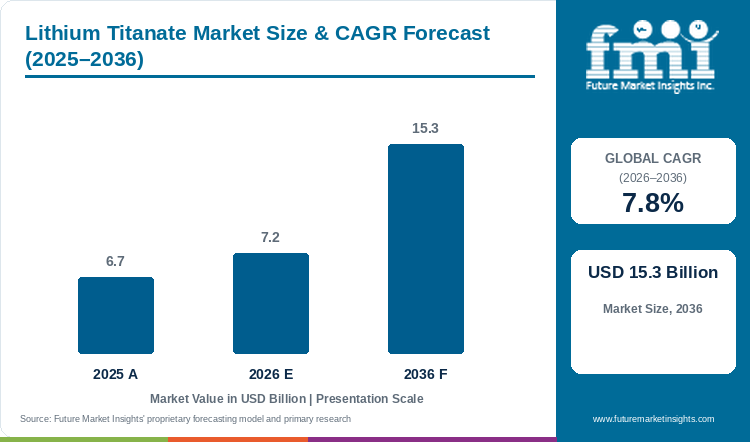
Global lithium titanate demand is forecast to compound at 7.8% per year from 2026 through 2036, advancing off a USD 6.7 Billion base in 2025 and an expected USD 7.2 Billion during 2026 before topping an anticipated USD 15.3 Billion in 2036.
Substituting conventional graphite anodes with zero-strain Li4Ti5O12 spinel nanocrystals suppresses metallic lithium dendrite plating during 10C opportunity charging and substantially reduces thermal runaway risks under tested high-rate commercial duty cycles when paired with liquid cooling and cell venting. Owing to this crystal stability, transit buses and automated port carriers can recharge in under ten minutes and operate down to minus 30 degrees Celsius without auxiliary pack heaters. According to FMI projections, worldwide lithium titanate shipments start at USD 6.7 Billion across 2025 while recording an estimated USD 7.2 Billion during 2026, then expand at an expected 7.8% CAGR to achieve a predicted USD 15.3 Billion in 2036 which represents an anticipated USD 8.1 Billion expansion in annual market value compared with 2026. In August 2026, the U.S. Energy Information Administration corroborated rapid stationary storage buildouts by reporting that U.S. utility-scale battery capacity grew at a 70% annual average rate to reach 43.6 GW at year-end 2025 and nearly 52 GW by June 2026 [1]. Raw lithium titanate powder is forecast to represent 38.3% of 2026 product type sales because cell manufacturers blend proprietary sub-micron slurries in-house on gigafactory coating lines. Across major countries, yearly expansion through 2036 is projected between 7.4% in France and 8.7% in South Korea, whereas lower 2.4-volt cell energy density and titanium dioxide precursor costs continue to restrict uptake in standard passenger electric cars.
Key Market Trends & Insights
- By product type: Lithium titanate powder (projected share of 38.3% in 2026) heads primary procurement because cell manufacturers control proprietary binder mixing and aluminum foil coating density.
- By application: Battery anodes (expected share of 37.0% in 2026) form the largest application segment as 1.55-volt intercalation plateaus curb solid-electrolyte interphase film buildup.
- By battery format: Prismatic cells (anticipated share of 40.8% in 2026) anchor pack integration through laser-welded aluminum cans that simplify liquid-cooled busbar assembly.
- By end use: Electric mobility (estimated share of 42.2% in 2026) drives commercial volume across 24/7 port straddle carriers and pantograph-charged municipal transit buses.
Regional Highlights
- Fastest national expansion: South Korea is predicted to pace major industrial battery markets on an 8.7% yearly growth trajectory through 2036 via semiconductor megafab UPS upgrades and indoor fire-safety retrofits.
- Western and East Asian trajectories: United Kingdom transit fleets are projected to grow 8.0% annually and American microgrids are expected to climb 7.9%, followed by anticipated German AGV plant demand (7.6%) alongside forecast Japanese rail packs (7.5%) and estimated French hybrid vessels (7.4%).
Market Size & Forecast
Table 1: Market Size and Forecast for the Lithium Titanate Market (USD billion and CAGR percentage), 2025 to 2036
| Metric | Value |
|---|---|
| 2025 Market Size | USD 6.7 Billion |
| Estimated Market Size in 2026 | USD 7.2 Billion |
| Projected Market Size by 2036 | USD 15.3 Billion |
| CAGR, 2026 to 2036 | 7.8% |
| Added Revenue, 2026 to 2036 | USD 8.1 Billion |
Maritime hybrid ferry operators and automated warehouse managers across Europe and East Asia face strict circularity mandates and fire-safety audits when operating conventional graphite-anode packs. In August 2025, EUR-Lex summaries of Regulation (EU) 2023/1542 confirmed a mandatory 65% recycling efficiency target for lithium-based batteries by year-end 2025 alongside 50% lithium recovery by 2027 and 2027 QR battery passports [2]. System integrators are consequently substituting standard graphite electrodes with long-lifecycle battery materials and hermetic prismatic LTO modules that operate across 20,000 cycles before replacement.
Spinel Powder Synthesis and High-Rate Cell Fleet Sizing
Table 2: Spinel Powder Synthesis and High-Rate Cell Fleet Sizing Indicators for the Lithium Titanate Market (USD Billion and operational ranges), mixed historical and forecast years from 2025 to 2036
| Metric | 2025 | 2026 | 2036 |
|---|---|---|---|
| Market size (USD Billion) | 6.7 | 7.2 | 15.3 |
| Annual battery-grade LTO powder synthesis (kilotons) | 145 to 168 | 156 to 182 | 310 to 360 |
| Active LTO transit and industrial fleet packs (thousand units) | 410 to 465 | 445 to 505 | 920 to 1,050 |
| Full-depth charge-discharge cycle life (cycles) | 15,000 to 20,000 | 16,000 to 22,000 | 22,000 to 30,000 |
Operational note: Powder synthesis ranges cover solid-state and solvothermal Li4Ti5O12 output across battery anode and fine ceramic kilns, while cycle life benchmarks reflect continuous 6C to 10C fast-charge testing against graphite-anode baselines.
Annual battery-grade LTO powder output moves off 145 to 168 kilotons in 2025 to an estimated 156 to 182 kilotons during 2026, and is predicted to hit 310 to 360 kilotons by 2036 while active LTO transit and industrial fleet packs scale from 445 to 505 thousand expected units toward 920 to 1,050 thousand projected units. Continuous surface-passivation upgrades are simultaneously forecast to lengthen full-depth charge-discharge cycle life from 16,000 to 22,000 cycles in 2026 up to an anticipated 22,000 to 30,000 cycles in 2036.
Gigafactory Slurry Coating & Pack Capital Expenditure Sizing
Table 3: Electrode Slurry & Pack Capital Expenditure Indicators for the Lithium Titanate Market (USD), mixed historical and forecast years from 2025 to 2036
| Metric | 2025 | 2026 | 2036 |
|---|---|---|---|
| Global high-power LTO cell & pack assembly lines (units) | 380 | 410 | 740 |
| Battery-grade LTO spinel powder price band (USD per kg) | 16.50 to 22.00 | 16.20 to 21.50 | 13.80 to 18.40 |
| Industrial prismatic LTO cell price band (USD per kWh) | 340 to 460 | 330 to 445 | 265 to 355 |
| Heavy-duty transit pantograph pack spend (USD per vehicle) | 48,000 to 82,000 | 46,500 to 79,000 | 38,000 to 64,000 |
Table 4: Segment Revenue Indicators for the Lithium Titanate Market (USD Billion and percentages), 2026
| Metric | Value | Basis |
|---|---|---|
| Market size, 2026 | USD 7.2 Billion | Report value |
| Electric mobility sector revenue, 2026 | USD 3.0 Billion | 42.2% share |
| Prismatic battery format revenue, 2026 | USD 2.9 Billion | 40.8% share |
| Lithium titanate powder revenue, 2026 | USD 2.8 Billion | 38.3% share |
Global high-power LTO cell and pack assembly lines are forecast to step up from 410 estimated units in 2026 to 740 projected units by 2036, narrowing battery-grade spinel powder prices from USD 16.20 to 21.50 per kilogram down to an anticipated USD 13.80 to 18.40 while prismatic cell pricing is expected to shift from USD 330 to 445 per kilowatt-hour to USD 265 to 355. Although heavy-duty transit pantograph pack spend per vehicle is predicted to moderate between USD 46,500 and USD 79,000 in 2026 down to USD 38,000 through USD 64,000 for 2036, 2026 segment turnover is estimated at USD 3.0 Billion for electric mobility alongside USD 2.9 Billion for prismatic format and USD 2.8 Billion for lithium titanate powder.
Analyst Perspective
"Heavy-duty fleet and grid engineers evaluate lithium titanate on total lifecycle cycles rather than upfront watt-hour cost as zero-strain fast charging enables multi-shift asset utilization. Suppressing interfacial gassing and managing titanium precursor expenses remain essential for broader industrial adoption."
- Nikhil Kaitwade, Principal Consultant, Future Market Insights.
How is the lithium titanate market segmented?
The lithium titanate market is segmented by product type, application, battery format, end use, and region. In 2026, lithium titanate powder is projected at 38.3%, battery anodes are expected at 37.0%, prismatic format is anticipated at 40.8%, and electric mobility is estimated at 42.2%.
By product type: Lithium titanate powder, lithium titanate cells, lithium titanate modules, and coated LTO material.
By application: Battery anodes, grid storage, fast-charge batteries, and specialty ceramics.
By battery format: Prismatic, pouch, cylindrical, and custom modules.
By end use: Electric mobility, energy storage systems, industrial equipment, and consumer electronics.
Why Does Lithium Titanate Powder Lead the Product Type Category?
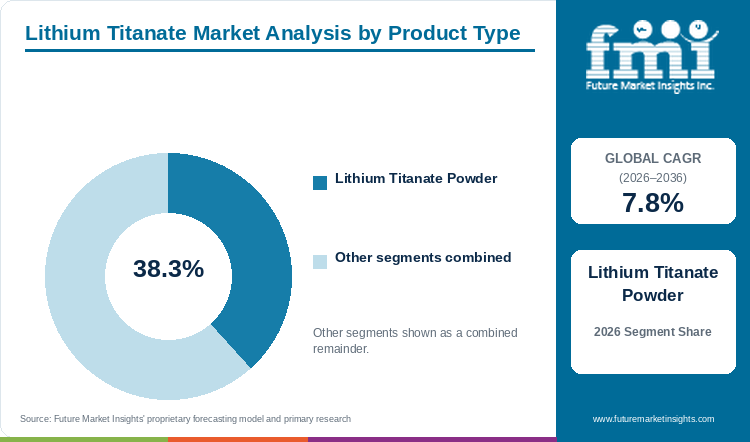
Lithium titanate powder is projected to represent 38.3% of the product type category in 2026, driven by custom slurry coating.
Table 5: Product Type Share for the Lithium Titanate Market (percentage share), 2026
| Product Type | Share (2026) |
|---|---|
| Lithium Titanate Powder | 38.3% |
| Other Segments Combined | 61.7%* |
| Total | 100.0% |
*Note: Combined 2026 revenue proportion for lithium titanate cells plus modules and coated LTO material.
Table 6: Product Type Leadership and Market Growth for the Lithium Titanate Market (segment and CAGR percentage), 2026 to 2036
| Metric | Value |
|---|---|
| Global CAGR (2026 to 2036) | 7.8% |
| Leading Segment | Lithium Titanate Powder |
Cell manufacturers prefer procuring raw sub-micron Li4Ti5O12 spinel powder so their electrode engineering teams can control conductive carbon ratios and binder rheology in-house. Unlike high-expansion silicon anode battery electrodes, phase-pure titanate crystals with narrow D50 particle distributions experience minimal volume change during lithiation and lower charge-transfer impedance. In-house slurry mixing lets battery plants customize electrode porosity for either high-pulse grid stabilization or sub-zero rail starting.
- Controlled tap density and sub-micron particle uniformity are expected to give lithium titanate powder 38.3% of 2026 product type revenue (USD 2.8 Billion projected).
- Ishihara Sangyo Kaisha supplies 99.9% to 99.99% purity titanium dioxide precursors including 0.07-micron PT-401M rutile and 343 m2/g PT-601A hydrolysis anatase grades engineered for high-reactivity titanate oxide synthesis [3].
What Drives Battery Anodes to the Forefront of the Application Segment?
Battery anodes are forecast to account for 37.0% of the application category in 2026, linked to zero-strain 1.55-volt intercalation plateaus.
Operating at a stable 1.55-volt potential versus lithium reference electrodes suppresses solid-electrolyte interphase film growth and curbs metallic dendrite formation during high-current charging. High-power cell builders pair defect-free spinel anodes with a thermally stable lithium ion battery separator to sustain continuous 10C pulse currents in hybrid locomotives and utility substations. Meanwhile, inorganic titanate calcination plants also process barium titanate alongside lead zirconate titanate for multilayer ceramic capacitors and piezoelectric sensors.
- Battery anodes are anticipated to claim 37.0% of 2026 application demand by absorbing high-current regenerative braking pulses without lattice expansion.
- In October 2025, Toshiba Corporation launched its SCiB 24V battery pack (P25H20-3) utilizing 20Ah-HP lithium titanate anode cells in a JIS D23 footprint with IPX9K/IPX7 waterproofing for automotive and electric boat fleets [4].
How Does Prismatic Format Maintain Its 40.8% Share in the Battery Format Segment?
Prismatic format is estimated to capture 40.8% of the battery format category in 2026, backed by rigid aluminum busbar cooling.
Laser-welded aluminum prismatic cans provide rigid mechanical containment and flat heat-transfer surfaces for liquid-cooled cold plates during continuous rapid cycling. Pack integrators bolt prismatic cells into heavy-duty lithium ion battery traction racks using low-resistance copper busbars that withstand marine vibration and railway shock loads. Hermetic metal enclosures with calibrated pressure-relief vents also simplify DNV and Bureau Veritas safety homologation in enclosed vessel engine rooms.
- Prismatic cells are predicted to secure 40.8% of 2026 battery format turnover (USD 2.9 Billion estimated) owing to high volumetric rack packing density in commercial vehicles and stationary cabinets.
- In November 2025, Leclanche SA and CINEA signed a EUR 74.2 Million EU Innovation Fund grant agreement under Project WILLpower to expand German cell production in Willstaett up to 2 GWh for railway and marine fleets [5].
What Positions Electric Mobility as the Leading End Use Category in 2026?
Electric mobility is predicted to command 42.2% within the 2026 end use category, stemming from pantograph-charged municipal bus deployments.
Municipal bus networks and automated port container terminals operate on continuous 24-hour schedules that cannot accommodate multi-hour depot plug-in charging delays. Whereas passenger cars prioritize high-energy silicon anode lithium ion battery cells, heavy commercial fleet operators specify high-rate titanate packs for six-minute opportunity charging via overhead pantographs at route terminals. Rapid pantograph recharging allows transit agencies to install smaller onboard battery packs that reduce vehicle curb weight and tire wear.
- Electric mobility is projected to generate 42.2% of 2026 end use demand (USD 3.0 Billion anticipated) across 24/7 port terminal tractors and automated warehouse shuttles.
- In March 2026, Microvast Holdings reported record full-year 2025 revenue of USD 427.5 Million (up 12.6% year-over-year) and positive adjusted EBITDA of USD 44.7 Million on commercial EV and fast-charging battery shipments [6].
What are the drivers, restraints, and opportunities in the lithium titanate market?
Zero-dendrite fast-charging stability propels lithium titanate adoption across heavy transit and grid storage fleets, whereas lower 2.4-volt cell energy density and high-temperature gassing require carbon-coated core-shell spinel engineering.
- Driver: Stringent fire-safety codes across maritime vessels and indoor warehouse fleets compel operators to replace graphite cells with low-dendrite LTO packs.
- Restraint: Lower nominal cell voltage of 2.4 volts and domestic pilot-line scale-up bottlenecks limit passenger vehicle range and raise kilowatt-hour costs.
- Opportunity: Carbon-coated core-shell LTO powders paired with 15-second UPS backup racks capture hyperscale data center and synchronous grid frequency budgets.
Growth Analysis and Future Potential: Ultra-Fast Charging and Zero-Strain Safety Catalysts
Transit authorities and automated guided vehicle operators are replacing conventional graphite-anode battery packs to reduce lithium plating and mitigate thermal runaway hazards under tested high-ampere charging and mechanical abuse conditions while retaining liquid cooling and pressure-relief venting. Continuous port crane and electric truck operations require zero-strain crystal lattices that absorb 10C current pulses without volume expansion. In May 2025, the International Energy Agency reported in its Global EV Outlook 2025 that global energy-sector battery demand hit the 1 TWh milestone (with electric truck battery demand surging over 75%) and is projected to triple past 3 TWh by 2030 [7]. Deploying prismatic titanate racks in a grid-tied battery energy storage system also delivers 20,000 cycles for utility synthetic inertia.
Risk Assessment and Operational Hurdles: Gravimetric Density Limits and Pilot Scale-Up Friction
Lower full-cell voltage alongside interfacial electrolyte decomposition and domestic pilot-line shortages restrict specialty lithium titanate adoption across wider mobility markets. Because the Li4Ti5O12 anode operates at 1.55 volts, full-cell nominal voltage reaches only 2.4 volts and caps gravimetric energy density between 65 and 95 watt-hours per kilogram. In February 2026, an Argonne National Laboratory and Li-Bridge study across 65 energy storage companies found that U.S. pre-production battery pilot line demand will reach 400 MWh by 2030 while existing supply is only 33.75 MWh (8.4% of demand) [8]. Preventing parasitic gassing also requires specialized battery electrolytes and strict dry-room moisture control.
Commercial Opportunity Analysis: Hyperscale UPS Backup and Carbon-Coated Core-Shell Powders
Rising artificial intelligence server rack power densities and sub-second grid frequency swings create high-margin demand for ultra-high-rate titanate storage cabinets and piezoelectric ceramics sensors. Material producers are commercializing carbon-coated core-shell Li4Ti5O12 powders and ready-to-use cast electrode sheets that boost electronic conductivity while blocking high-temperature gas generation. In September 2026, NEI Corporation updated its commercial NANOMYTE battery materials line featuring ultrafine BE-10 and carbon-coated BE-10C lithium titanate anode powders alongside BE-10E cast electrode sheets produced via solid-state synthesis [9]. Supplying pre-passivated powders and cast tapes enables cell builders to accelerate high-rate pouch and prismatic qualification.
Lithium Titanate Market by Country (2026 to 2036)
As per FMI estimates, South Korea is predicted to top major national lithium titanate markets at an 8.7% yearly pace through 2036, whereas French demand is forecast to progress at 7.4% per annum. National growth differences stem from semiconductor fab UPS fire codes and municipal bus pantograph infrastructure alongside domestic calcination capacity.
Table 7: Country CAGR and Primary Growth Levers for the Lithium Titanate Market (CAGR percentage and operational drivers), 2026 to 2036
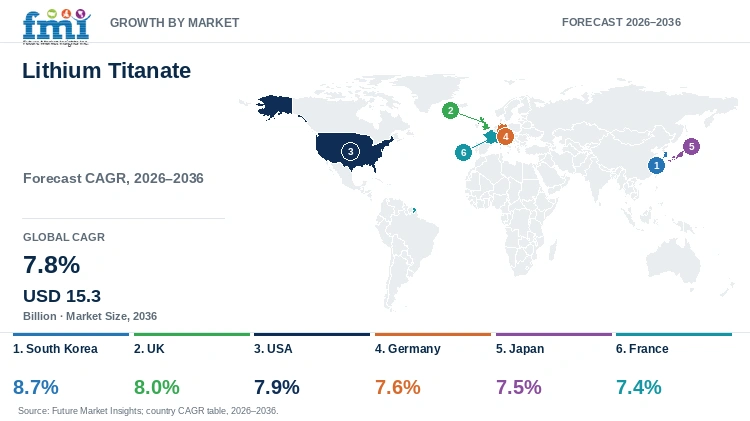
| Country | CAGR (2026 to 2036) | Primary Growth Lever |
|---|---|---|
| South Korea | 8.7% | Semiconductor fab UPS backup racks and KEPCO grid frequency regulation mandates |
| UK | 8.0% | Zero-emission double-deck bus pantograph fleets and Network Rail hybrid traction |
| USA | 7.9% | Defense tactical microgrids and cold-weather port and municipal bus electrification |
| Germany | 7.6% | Automotive plant intralogistics AGV fast-charging networks and industrial UPS |
| Japan | 7.5% | Shinkansen and regional rail regenerative braking packs and high-purity TiO2 synthesis |
| France | 7.4% | Maritime hybrid coastal ferries and SNCF regional non-electrified rail rolling stock |
Source: Future Market Insights analysis
South Korea Lithium Titanate Market Outlook (2026 to 2036)
South Korea diverges from the global lithium titanate market through mandatory post-fire indoor energy storage regulation across high-density semiconductor megafabs rather than transit bus fleets alone. Backed by wafer foundry backup retrofits, South Korean demand is predicted to expand on an 8.7% annual trajectory through 2036. U.S. Geological Survey Mineral Commodity Summaries released in February 2026 confirmed that batteries accounted for 88% of global lithium end use as non-U.S. world lithium production rose 31% to 290,000 metric tons and global consumption climbed 20% to 263,000 tons [10]. Although Korean cell assemblers confront raw precursor import reliance, domestic pack builders mitigate costs by localizing spray-dried sub-micron LTO slurry blending for 10C fab UPS cabinets.
Key takeaway: In South Korea, strict indoor battery fire-safety codes and semiconductor fab UPS upgrades drive rapid adoption of high-rate lithium titanate storage racks.
UK Lithium Titanate Market Outlook (2026 to 2036)
British lithium titanate demand is projected to climb at an 8.0% compound annual clip from 2026 to 2036 under municipal zero-emission bus and hybrid railway programs. Unlike global markets focused on stationary utility containers, on-the-ground British deployment centers on route-end overhead pantograph charging for double-deck urban buses and non-electrified branch rail lines. In March 2026, the UK Department for Transport published its 10-year zero-emission bus order pipeline projecting 23,381 new zero-emission buses entering service across Great Britain between 2026 and 2035 (including 12,673 double-deck and 6,726 single-deck buses) [11]. To overcome constrained depot transformer capacity, pack integrators supply compact 80-kilowatt-hour LTO traction modules that recharge via overhead pantographs in five minutes.
Key takeaway: In the UK, municipal bus pantograph charging networks and regional rail hybridization favor compact, ultra-fast-charging lithium titanate traction packs.
USA Lithium Titanate Market Outlook (2026 to 2036)
In June 2026, the Pacific Northwest National Laboratory commissioned a 16-machine dry-lab prismatic cell production line spanning 1,400 square feet at the Grid Storage Launchpad in Richland to scale metal-cased prismatic cells for grid storage [12]. Distinct from European and Asian transit markets, United States procurement is uniquely anchored by utility grid frequency regulation and defense tactical microgrids requiring sub-zero cold cranking without auxiliary battery heaters. Driven by these federal utility and defense budgets, industry expectations place American lithium titanate revenue expansion at 7.9% per annum through 2036. While domestic cell builders face precursor bottlenecks, Altairnano and Microvast Holdings expand domestic coating lines to deliver MIL-STD prismatic modules.
Key takeaway: In the USA, cold-weather transit reliability requirements and defense tactical power specifications sustain long-term procurement of domestic lithium titanate modules.
Germany Lithium Titanate Market Outlook (2026 to 2036)
Continuous 24/7 automated guided vehicle fleets inside automotive assembly plants and strict VdS industrial fire-insurance underwriting distinguish Germany from broader international battery markets. Because factory logistics directors are eliminating lead-acid battery swap rooms across high-bay warehouses, industry projections place German lithium titanate turnover on a 7.6% annual growth course through 2036. During July 2025, Japanese METI officials and international supply chain partners convened more than 200 delegates from over 70 battery companies to diversify global stationary and EV battery component and mineral refining ecosystems [13]. To satisfy VdS property insurers without losing floor space, Leclanche SA scales PFAS-free Willstaett cell production for German AGV and rail modules.
Key takeaway: In Germany, 24/7 automotive plant AGV automation and strict industrial fire-insurance standards drive demand for contact-charged lithium titanate battery modules.
Japan Lithium Titanate Market Outlook (2026 to 2036)
Long-term market forecasts put Japanese lithium titanate demand expansion at 7.5% per year through 2036 on high-speed railway regenerative braking recovery and domestic calcination leadership. Whereas most countries import processed anode materials, Japan uniquely combines domestic fine-ceramic TiO2 chemical synthesis with wayside and onboard Shinkansen traction storage. Japanese METI policymakers revised the national roadmap into the Battery and Power Industry Strategy in June 2026 to target 150 GWh per year of domestic battery capacity and high power-density storage for AI data centers [14]. To capture high-output applications, Japanese producers including Toshiba Corporation and Titan Kogyo synthesize titanate and niobium-titanium oxide anodes that boost volumetric cell capacity.
Key takeaway: In Japan, railway regenerative braking deployments and domestic leadership in doped titanate powder synthesis anchor steady high-margin LTO demand.
France Lithium Titanate Market Outlook (2026 to 2036)
Compared with global markets dominated by highway or grid storage, France is uniquely driven by regional diesel-electric train hybridization and zero-emission coastal passenger ferry mandates. In January 2025, the U.S. Department of Energy and Idaho National Laboratory released the Battery Energy Storage Systems Report documenting millisecond-to-second frequency and voltage regulation alongside supply-chain security requirements across utility-scale BESS deployments [15]. Supported by shipyard and SNCF rolling-stock orders alongside utility ancillary service upgrades, French lithium titanate turnover is estimated to rise by 7.4% per year between 2026 and 2036. Because strict Bureau Veritas marine containment rules delay uncertified cell formats, European pack builders supply pre-approved liquid-cooled LTO traction racks with redundant gas-venting manifolds.
Key takeaway: In France, regional hybrid train retrofits and zero-emission port vessel mandates compel operators to specify Bureau Veritas-certified lithium titanate traction racks.
Full report country CAGRs cover: North America; Latin America; Western Europe; Eastern Europe; East Asia; South Asia and Pacific; Middle East and Africa.
Who are the notable companies in the lithium titanate market?
Toshiba Corporation (SCiB), Microvast Holdings, Inc., Leclanche SA, Altairnano (Altair Nanotechnologies Inc.), Gree Altairnano New Energy Inc. (Yinlong Energy), Ishihara Sangyo Kaisha, Ltd. (ISK), Titan Kogyo, Ltd., and NEI Corporation are the notable companies in the lithium titanate market.
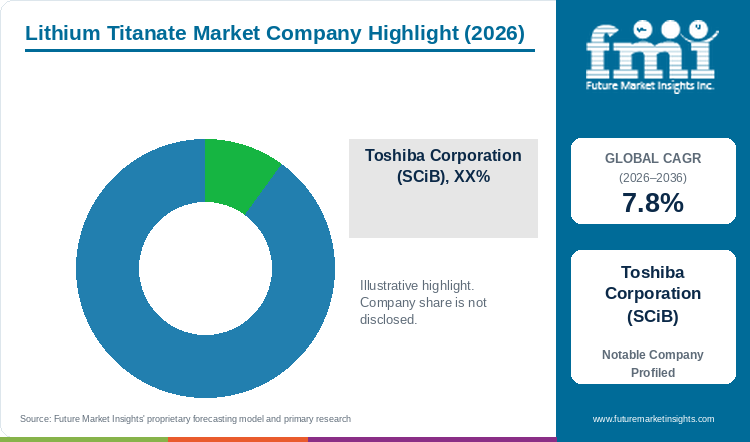
FMI analysts project that vendor positioning in the lithium titanate sector splits between vertically integrated high-power cell and traction rack manufacturers and upstream inorganic titanate powder synthesizers. Integrated battery producers such as Toshiba Corporation and Microvast Holdings alongside Leclanche SA combine proprietary anode slurry coating with hermetic prismatic and pouch cell assembly for rail and marine fleets. Upstream chemical manufacturers including Ishihara Sangyo Kaisha and Titan Kogyo together with NEI Corporation focus on hydrothermal and solid-state calcination of phase-pure sub-micron Li4Ti5O12 crystals. Fleet and utility procurement teams qualify suppliers on high-temperature gas suppression and verified 20,000-cycle warranty backing.
- Integrated High-Rate LTO Cell & Module Platforms: Toshiba Corporation (SCiB) and Microvast Holdings, Inc. alongside Leclanche SA manufacture complete prismatic and pouch LTO cells and liquid-cooled traction racks for rail and marine fleets.
- Grid & Heavy-Transit LTO Pack Specialists: Altairnano (Altair Nanotechnologies Inc.) and Gree Altairnano New Energy Inc. (Yinlong Energy) produce nano-structured LTO electrodes and containerized frequency-regulation storage banks.
- Specialty Titanate Powder & Nanomaterial Synthesizers: Ishihara Sangyo Kaisha, Ltd. (ISK) and Titan Kogyo, Ltd. together with NEI Corporation synthesize high-purity sub-micron lithium titanate spinel powders and surface-passivated anode slurries for global cell OEMs.
Competitive Benchmarking: Lithium Titanate Market
Table 8: Competitive Benchmarking for the Lithium Titanate Market (qualitative capability ratings), 2026
| Company | Spinel Powder & Anode Chemistry Depth | High-Rate Cell & Module Integration | Gas-Suppression & Cycle Life Validation | Geographic Reach |
|---|---|---|---|---|
| Toshiba Corporation (SCiB) | High | High | High | High |
| Microvast Holdings, Inc. | High | High | High | High |
| Leclanche SA | Medium | High | High | High |
| Altairnano (Altair Nanotechnologies Inc.) | High | High | High | Medium |
| Gree Altairnano New Energy Inc. (Yinlong Energy) | High | High | Medium | Medium |
| Ishihara Sangyo Kaisha, Ltd. (ISK) | High | Medium | High | High |
| Titan Kogyo, Ltd. | High | Medium | High | Medium |
| NEI Corporation | High | Medium | High | Medium |
Scoring basis: Spinel Powder & Anode Chemistry Depth receives a High mark when a supplier synthesizes proprietary sub-micron Li4Ti5O12 crystals or surface-coated active materials in-house. High-Rate Cell & Module Integration is High for manufacturers producing complete prismatic or pouch LTO cells and multi-kilowatt-hour rack systems, while upstream powder suppliers score Medium. Gas-Suppression & Cycle Life Validation and Geographic Reach reflect documented 15,000 to 20,000 cycle benchmarks above 55 degrees Celsius and multi-continental OEM qualification coverage.
Key Developments in the Lithium Titanate Market
- In June 2025, Toshiba Corporation started sample shipments of its 50Ah laminate SCiB Nb rechargeable lithium-ion cell featuring a niobium titanium oxide anode (350 Wh/L density and 10-minute 80% charge over 15,000 cycles) co-developed with CBMM and Sojitz [16].
- In April 2025, Toshiba Corporation launched the UL1973-certified Type4-23 SCiB LTO module (27.6V and 1,242 Wh) featuring an insulated aluminum baseplate that doubles heat dissipation for electric buses and stationary load leveling [17].
- In August 2025, Titan Kogyo, Ltd. detailed its baking-method and wet-method ultrafine titanium dioxide and fine-particle titanate production lines in Ube using proprietary particle-shape control and impurity-reduction technologies [18].
Key Players in the Lithium Titanate Market
Integrated High-Rate LTO Cell & Module Platforms
- Toshiba Corporation (SCiB)
- Microvast Holdings, Inc.
- Leclanche SA
Grid & Heavy-Transit LTO Pack Specialists
- Altairnano (Altair Nanotechnologies Inc.)
- Gree Altairnano New Energy Inc. (Yinlong Energy)
Specialty Titanate Powder & Nanomaterial Synthesizers
- Ishihara Sangyo Kaisha, Ltd. (ISK)
- Titan Kogyo, Ltd.
- NEI Corporation
Lithium Titanate Market - Report Scope
Table 9: Report Scope for the Lithium Titanate Market (coverage fields and definitions), 2026 to 2036
| Coverage field | Report scope |
|---|---|
| Market breakdown | Product Type; Application; Battery Format; End Use; Region |
| Quantitative Units | USD Billion |
| Market Definition | Includes manufacturer revenue from battery-grade and ceramic-grade lithium titanate powders, coated LTO anode materials, and factory-assembled LTO cells and modules. Category Scope Note: Captures upstream Li4Ti5O12 spinel powder and midstream cell/module turnover, excluding standalone downstream electric bus chassis, diesel-electric locomotives, and utility substation transformers. |
| Regions Covered | North America; Latin America; Western Europe; Eastern Europe; East Asia; South Asia and Pacific; Middle East and Africa |
| Countries Covered | South Korea, UK, USA, Germany, Japan, France, and additional countries in the full report |
| Key Companies Covered | Toshiba Corporation (SCiB), Microvast Holdings, Inc., Leclanche SA, Altairnano (Altair Nanotechnologies Inc.), Gree Altairnano New Energy Inc. (Yinlong Energy), Ishihara Sangyo Kaisha, Ltd. (ISK), Titan Kogyo, Ltd., NEI Corporation |
| Forecast Period | 2026 to 2036 |
| Approach | Primary and secondary research with market triangulation. |
Lithium Titanate Market - Research Methodology
Table 10: Research Methodology for the Lithium Titanate Market (research methods and approach), 2026 edition
| Method | Approach |
|---|---|
| Primary Research | Primary interviews were conducted with inorganic titanate chemical producers, battery anode slurry coaters, prismatic cell integrators, and transit fleet directors to validate cycle-life benchmarks and purchasing decisions. |
| Secondary Research | Secondary research included company annual reports, national laboratory electrochemical benchmarks, maritime and railway safety directives, patent filings, and technical catalogs relevant to the market. |
| Market Sizing and Forecasting | Market sizing and forecasting for the 2026 to 2036 forecast period were developed using top-down and bottom-up approaches to assess active LTO kiloton powder synthesis and cell price bands. |
| Data Triangulation and Validation | Data is validated against titanium dioxide precursor output, municipal pantograph bus tenders, and grid frequency-regulation storage installations without double counting downstream vehicle chassis value. |
| Country Forecasting Model | Country-level CAGRs are calibrated around the 7.8% global baseline using national stationary storage fire-safety mandates, zero-emission municipal bus pantograph registrations, hybrid rail retrofits, and domestic titanate calcination capacity. |
| Country Forecasting Model | Country-level CAGRs are calibrated around the 7.8% global baseline using national stationary storage fire-safety mandates, zero-emission municipal bus pantograph registrations, hybrid rail retrofits, and domestic titanate calcination capacity. |
| Operational Benchmark Traceability | Operational benchmarks in Tables 2, 3, and 4 (kiloton LTO powder output, 6C-10C cycle life, powder USD/kg bands, and prismatic cell USD/kWh bands) trace to EIA and PNNL storage studies, IEA and USGS battery statistics, METI strategy filings, and OEM technical datasheets. |
Lithium Titanate Market by Segments
Lithium Titanate Market segmented by Product Type:
- Lithium Titanate Powder
- Lithium Titanate Cells
- Lithium Titanate Modules
- Coated LTO Material
Lithium Titanate Market segmented by Application:
- Battery Anodes
- Grid Storage
- Fast-Charge Batteries
- Specialty Ceramics
Lithium Titanate Market segmented by Battery Format:
- Prismatic
- Pouch
- Cylindrical
- Custom Modules
Lithium Titanate Market segmented by End Use:
- Electric Mobility
- Energy Storage Systems
- Industrial Equipment
- Consumer Electronics
Lithium Titanate Market by Region
- North America
- United States
- Canada
- Latin America
- Brazil
- Mexico
- Argentina
- Chile
- Western Europe
- Germany
- France
- United Kingdom
- Italy
- Spain
- Benelux
- Nordics
- Eastern Europe
- Poland
- Czech Republic
- Romania
- Hungary
- East Asia
- China
- Japan
- South Korea
- South Asia and Pacific
- India
- ASEAN
- Australia and New Zealand
- Middle East and Africa
- GCC Countries
- South Africa
- Türkiye
- Israel
Research Sources and Bibliography
- [1] U.S. Energy Information Administration. (2026, August 7). Battery storage capacity averaged 70% growth over the last three years. U.S. Department of Energy.
- [2] Publications Office of the European Union. (2025, August 1). Sustainability rules for batteries and waste batteries — Summary of Regulation (EU) 2023/1542. EUR-Lex.
- [3] Ishihara Sangyo Kaisha, Ltd. (2025, June 25). High Purity Titanium Dioxide, CR-EL/PT Series. ISK Functional Materials.
- [4] Toshiba Corporation. (2025, October 16). Toshiba Launches New SCiB 24V Battery Pack for Automotive and Industrial Use—Driving Environmentally Conscious Mobility. Toshiba Corporate News.
- [5] Leclanche SA. (2025, November 10). Leclanche and CINEA Sign EUR 74.2 Million Grant Agreement to Support Sustainable Battery Production in Europe. Leclanche Press Releases.
- [6] Microvast Holdings, Inc. (2026, March 16). Microvast Reports 2025 Financial Results. Microvast Investor Relations.
- [7] International Energy Agency. (2025, May 14). Electric vehicle batteries - Global EV Outlook 2025. IEA.
- [8] Argonne National Laboratory. (2026, February 26). How do we bridge the battery scale-up gap?. U.S. Department of Energy Office of Science.
- [9] NEI Corporation. (2026, September 14). Battery Materials: Cathode, Anode, Electrode Sheet, Solid Electrolyte. NEI Corporation.
- [10] U.S. Geological Survey. (2026, February 15). Lithium, Mineral Commodity Summaries 2026. U.S. Department of the Interior.
- [11] UK Department for Transport. (2026, March 16). 10-year zero emission bus order pipeline. GOV.UK Official Guidance.
- [12] Pacific Northwest National Laboratory. (2026, June 1). New Prismatic Line Unlocks Powerful Possibilities for U.S. Battery Research. PNNL News & Media.
- [13] Ministry of Economy, Trade and Industry. (2025, July 3). METI Co-Hosts Conference on Battery and Critical Minerals Ecosystem in the Republic of India. METI Japan.
- [14] Ministry of Economy, Trade and Industry. (2026, June 2). Battery Industry Strategy Revised as the Battery and Power Industry Strategy. METI Japan.
- [15] U.S. Department of Energy. (2025, January 18). Battery Energy Storage Systems Report. Idaho National Laboratory / U.S. Department of Energy.
- [16] Toshiba Corporation. (2025, June 4). Toshiba Starts Sample Shipments of SCiB Nb, its Innovative Rechargeable Lithium-ion Battery with Niobium Titanium Oxide Anode. Toshiba Corporate News.
- [17] Toshiba Corporation. (2025, April 8). Toshiba Launches New SCiB Module with Double the Heat Dissipation Performance for EV Buses, Electric Ships, and Stationary Applications. Toshiba Corporate News.
- [18] Titan Kogyo, Ltd. (2025, August 15). Titanate - Products Information. Titan Kogyo, Ltd.
- [19] Contemporary Amperex Technology Co., Limited. (2026, March 10). Zero-Carbon Technology Powers All-Domain Growth: CATL Releases 2025 Annual Report. CATL News.
- [20] Contemporary Amperex Technology Co., Limited. (2026, April 21). CATL Unveils Six Major Innovations: Multi-Chemistry Systems to Redefine New Energy Mobility Experience. CATL News.
- [21] Clarios, LLC. (2026, March 14). Clarios Connected Services introduces Battery Manager Pro at TMC 2026. Clarios News.
This bibliography is provided for reader reference and is not exhaustive. The full report contains the complete reference list and detailed citations.
This Report Answers
- How large is the lithium titanate market in 2026 and what is forecast for 2036?
- Which ultra-fast transit charging and indoor fire-safety pressures support demand for lithium titanate?
- Why does lithium titanate powder lead the product type category?
- Why do battery anodes lead the application category globally?
- How do material and cell growth rates differ across South Korea, the UK, the USA, Germany, Japan, and France?
- Which leading companies supply battery-grade LTO spinel powders and high-rate cells today?
- What limits adoption or supplier switching in the lithium titanate market?
- What should buyers evaluate before purchasing lithium titanate powders or modules?
Frequently Asked Questions
How big is the lithium titanate market in 2026, and what is forecast for 2036?
Worldwide lithium titanate revenue is estimated at USD 7.2 Billion in 2026 (up from USD 6.7 Billion in 2025) and is projected to reach USD 15.3 Billion by 2036 on rising demand from pantograph-charged buses and utility frequency-regulation banks.
What is the CAGR for the lithium titanate market from 2026 to 2036?
According to FMI analysts, global demand is forecast to progress at a 7.8% CAGR over the ten-year period, representing an anticipated USD 8.1 Billion expansion in annual market revenue between 2026 and 2036.
Which product type segment leads the lithium titanate market?
Lithium titanate powder is projected to hold 38.3% of 2026 product type sales (an estimated USD 2.8 Billion) because battery gigafactories and fine ceramic plants mix proprietary sub-micron slurries on internal coating lines.
Which battery format segment leads the lithium titanate market?
Prismatic cells are anticipated to secure 40.8% of 2026 battery format turnover (a projected USD 2.9 Billion) as laser-welded aluminum cans simplify liquid thermal management and high-current busbar bolting.
Which country has a notable growth outlook during the assessment period?
Future Market Insights identifies South Korea as the fastest-growing national market with a predicted 8.7% CAGR through 2036, driven by semiconductor megafab UPS backup retrofits and indoor fire-safety codes.
Who are the key players in the market?
Active manufacturers include Toshiba Corporation (SCiB), Microvast Holdings, Inc., Leclanche SA, Altairnano (Altair Nanotechnologies Inc.), Gree Altairnano New Energy Inc. (Yinlong Energy), Ishihara Sangyo Kaisha, Ltd. (ISK), Titan Kogyo, Ltd., and NEI Corporation, supplying carbon-coated spinel powders and 10C prismatic traction racks.
Preview the report firsthand - request a free sample
Get SampleGet the brochure for pricing and purchase details.
Get PDFTable of Content
- Key Takeaways
- Market Size and CAGR
- Top Growth Driver
- Fastest Growing Segment
- Leading Region
- Key Companies
- Emerging Opportunities
- Executive Summary
- Global Market Outlook
- Demand-side Trends
- Supply-side Trends
- Technology Roadmap Analysis
- Analysis and Recommendations
- Analyst Perspective (What is happening? Why now? What should investors know?)
- Key Questions Answered
- How large is the market?
- What is the CAGR?
- What are key trends?
- Which region dominates?
- Who are the leaders?
- Market Overview
- Market Coverage / Taxonomy
- Market Definition / Scope / Limitations
- Research Methodology
- Chapter Orientation
- Analytical Lens and Working Hypotheses
- Market Structure, Signals, and Trend Drivers
- Benchmarking and Cross-market Comparability
- Market Sizing, Forecasting, and Opportunity Mapping
- Research Design and Evidence Framework
- Desk Research Programme (Secondary Evidence)
- Expert Input and Fieldwork (Primary Evidence)
- Tooling, Models, and Reference Databases
- Data Engineering and Model Build
- Quality Assurance and Audit Trail
- Market Background
- Market Dynamics (Drivers, Restraints, Opportunity, Trends)
- Scenario Forecast (Optimistic, Likely, Conservative)
- Impact Analysis
- AI Impact
- Sustainability Impact
- Regulatory Impact
- Technology Impact
- Consumer / Buyer Analysis
- Purchase Drivers
- Adoption Barriers
- Buyer Journey
- Opportunity Map Analysis
- Product Life Cycle Analysis
- Supply Chain Analysis
- Investment Feasibility Matrix
- Value Chain Analysis
- PESTLE and Porter's Analysis
- Regulatory Landscape
- Regional Parent Market Outlook
- Production and Consumption Statistics
- Import and Export Statistics
- Global Market Analysis and Forecast, 2021 to 2036
- Historical Market Size Value (USD Billion) Analysis, 2021 to 2025
- Current and Future Market Size Value (USD Billion) Projections, 2026 to 2036
- Y-o-Y Growth Trend Analysis
- Absolute $ Opportunity Analysis
- Global Market Pricing Analysis, 2021 to 2036
- Global Market Analysis and Forecast, By Product Type, 2021 to 2036
- Introduction / Key Findings
- Historical Market Size Value (USD Billion) Analysis By Product Type, 2021 to 2025
- Current and Future Market Size Value (USD Billion) Analysis and Forecast By Product Type, 2026 to 2036
- Lithium Titanate Powder
- Lithium Titanate Cells
- Lithium Titanate Modules
- Coated LTO Material
- Y-o-Y Growth Trend Analysis By Product Type, 2021 to 2025
- Absolute $ Opportunity Analysis By Product Type, 2026 to 2036
- Global Market Analysis and Forecast, By Application, 2021 to 2036
- Introduction / Key Findings
- Historical Market Size Value (USD Billion) Analysis By Application, 2021 to 2025
- Current and Future Market Size Value (USD Billion) Analysis and Forecast By Application, 2026 to 2036
- Battery Anodes
- Grid Storage
- Fast-Charge Batteries
- Specialty Ceramics
- Y-o-Y Growth Trend Analysis By Application, 2021 to 2025
- Absolute $ Opportunity Analysis By Application, 2026 to 2036
- Global Market Analysis and Forecast, By Battery Format, 2021 to 2036
- Introduction / Key Findings
- Historical Market Size Value (USD Billion) Analysis By Battery Format, 2021 to 2025
- Current and Future Market Size Value (USD Billion) Analysis and Forecast By Battery Format, 2026 to 2036
- Prismatic
- Pouch
- Cylindrical
- Custom Modules
- Y-o-Y Growth Trend Analysis By Battery Format, 2021 to 2025
- Absolute $ Opportunity Analysis By Battery Format, 2026 to 2036
- Global Market Analysis and Forecast, By End Use, 2021 to 2036
- Introduction / Key Findings
- Historical Market Size Value (USD Billion) Analysis By End Use, 2021 to 2025
- Current and Future Market Size Value (USD Billion) Analysis and Forecast By End Use, 2026 to 2036
- Electric Mobility
- Energy Storage Systems
- Industrial Equipment
- Consumer Electronics
- Y-o-Y Growth Trend Analysis By End Use, 2021 to 2025
- Absolute $ Opportunity Analysis By End Use, 2026 to 2036
- Global Market Analysis and Forecast, By Region, 2021 to 2036
- Introduction
- Historical Market Size Value (USD Billion) Analysis By Region, 2021 to 2025
- Current Market Size Value (USD Billion) Analysis and Forecast By Region, 2026 to 2036
- North America
- Latin America
- Western Europe
- Eastern Europe
- East Asia
- South Asia and Pacific
- Middle East and Africa
- Market Attractiveness Analysis By Region
- North America Market Analysis and Forecast, By Country, 2021 to 2036
- Historical Market Size Value (USD Billion) Trend Analysis By Market Taxonomy, 2021 to 2025
- Market Size Value (USD Billion) Forecast By Market Taxonomy, 2026 to 2036
- By Country
- United States
- Canada
- By Product Type
- By Application
- By Battery Format
- By End Use
- By Country
- Market Attractiveness Analysis
- By Country
- By Product Type
- By Application
- By Battery Format
- By End Use
- Key Takeaways
- Latin America Market Analysis and Forecast, By Country
- Historical Market Size Value (USD Billion) Trend Analysis By Market Taxonomy, 2021 to 2025
- Market Size Value (USD Billion) Forecast By Market Taxonomy, 2026 to 2036
- By Country
- Brazil
- Mexico
- Argentina
- Chile
- By Product Type
- By Application
- By Battery Format
- By End Use
- By Country
- Market Attractiveness Analysis
- By Country
- By Product Type
- By Application
- By Battery Format
- By End Use
- Key Takeaways
- Western Europe Market Analysis and Forecast, By Country
- Historical Market Size Value (USD Billion) Trend Analysis By Market Taxonomy, 2021 to 2025
- Market Size Value (USD Billion) Forecast By Market Taxonomy, 2026 to 2036
- By Country
- Germany
- France
- United Kingdom
- Italy
- Spain
- Benelux
- Nordics
- By Product Type
- By Application
- By Battery Format
- By End Use
- By Country
- Market Attractiveness Analysis
- By Country
- By Product Type
- By Application
- By Battery Format
- By End Use
- Key Takeaways
- Eastern Europe Market Analysis and Forecast, By Country
- Historical Market Size Value (USD Billion) Trend Analysis By Market Taxonomy, 2021 to 2025
- Market Size Value (USD Billion) Forecast By Market Taxonomy, 2026 to 2036
- By Country
- Poland
- Czech Republic
- Romania
- Hungary
- By Product Type
- By Application
- By Battery Format
- By End Use
- By Country
- Market Attractiveness Analysis
- By Country
- By Product Type
- By Application
- By Battery Format
- By End Use
- Key Takeaways
- East Asia Market Analysis and Forecast, By Country
- Historical Market Size Value (USD Billion) Trend Analysis By Market Taxonomy, 2021 to 2025
- Market Size Value (USD Billion) Forecast By Market Taxonomy, 2026 to 2036
- By Country
- China
- Japan
- South Korea
- By Product Type
- By Application
- By Battery Format
- By End Use
- By Country
- Market Attractiveness Analysis
- By Country
- By Product Type
- By Application
- By Battery Format
- By End Use
- Key Takeaways
- South Asia and Pacific Market Analysis and Forecast, By Country
- Historical Market Size Value (USD Billion) Trend Analysis By Market Taxonomy, 2021 to 2025
- Market Size Value (USD Billion) Forecast By Market Taxonomy, 2026 to 2036
- By Country
- India
- ASEAN
- Australia and New Zealand
- By Product Type
- By Application
- By Battery Format
- By End Use
- By Country
- Market Attractiveness Analysis
- By Country
- By Product Type
- By Application
- By Battery Format
- By End Use
- Key Takeaways
- Middle East and Africa Market Analysis and Forecast, By Country
- Historical Market Size Value (USD Billion) Trend Analysis By Market Taxonomy, 2021 to 2025
- Market Size Value (USD Billion) Forecast By Market Taxonomy, 2026 to 2036
- By Country
- GCC Countries
- South Africa
- Türkiye
- Israel
- By Product Type
- By Application
- By Battery Format
- By End Use
- By Country
- Market Attractiveness Analysis
- By Country
- By Product Type
- By Application
- By Battery Format
- By End Use
- Key Takeaways
- Key Countries Market Analysis
- United States
- Pricing Analysis
- Market Share Analysis, 2025
- By Product Type
- By Application
- By Battery Format
- By End Use
- Canada
- Pricing Analysis
- Market Share Analysis, 2025
- By Product Type
- By Application
- By Battery Format
- By End Use
- Mexico
- Pricing Analysis
- Market Share Analysis, 2025
- By Product Type
- By Application
- By Battery Format
- By End Use
- Brazil
- Pricing Analysis
- Market Share Analysis, 2025
- By Product Type
- By Application
- By Battery Format
- By End Use
- Chile
- Pricing Analysis
- Market Share Analysis, 2025
- By Product Type
- By Application
- By Battery Format
- By End Use
- Germany
- Pricing Analysis
- Market Share Analysis, 2025
- By Product Type
- By Application
- By Battery Format
- By End Use
- United Kingdom
- Pricing Analysis
- Market Share Analysis, 2025
- By Product Type
- By Application
- By Battery Format
- By End Use
- Italy
- Pricing Analysis
- Market Share Analysis, 2025
- By Product Type
- By Application
- By Battery Format
- By End Use
- Spain
- Pricing Analysis
- Market Share Analysis, 2025
- By Product Type
- By Application
- By Battery Format
- By End Use
- France
- Pricing Analysis
- Market Share Analysis, 2025
- By Product Type
- By Application
- By Battery Format
- By End Use
- India
- Pricing Analysis
- Market Share Analysis, 2025
- By Product Type
- By Application
- By Battery Format
- By End Use
- ASEAN
- Pricing Analysis
- Market Share Analysis, 2025
- By Product Type
- By Application
- By Battery Format
- By End Use
- Australia and New Zealand
- Pricing Analysis
- Market Share Analysis, 2025
- By Product Type
- By Application
- By Battery Format
- By End Use
- China
- Pricing Analysis
- Market Share Analysis, 2025
- By Product Type
- By Application
- By Battery Format
- By End Use
- Japan
- Pricing Analysis
- Market Share Analysis, 2025
- By Product Type
- By Application
- By Battery Format
- By End Use
- South Korea
- Pricing Analysis
- Market Share Analysis, 2025
- By Product Type
- By Application
- By Battery Format
- By End Use
- Poland
- Pricing Analysis
- Market Share Analysis, 2025
- By Product Type
- By Application
- By Battery Format
- By End Use
- Hungary
- Pricing Analysis
- Market Share Analysis, 2025
- By Product Type
- By Application
- By Battery Format
- By End Use
- Türkiye
- Pricing Analysis
- Market Share Analysis, 2025
- By Product Type
- By Application
- By Battery Format
- By End Use
- South Africa
- Pricing Analysis
- Market Share Analysis, 2025
- By Product Type
- By Application
- By Battery Format
- By End Use
- United States
- Market Structure Analysis
- Competition Dashboard
- Competition Benchmarking
- Market Share Analysis of Top Players
- By Regional
- By Product Type
- By Application
- By Battery Format
- By End Use
- Emerging Startups
- Innovation Benchmarking
- Competition Analysis
- Competition Deep Dive
- Toshiba Corporation (SCiB)
- Overview
- Product Portfolio
- Profitability by Market Segments
- Sales Footprint
- Strategy Overview
- Marketing Strategy
- Product Strategy
- Channel Strategy
- Microvast Holdings, Inc.
- Leclanche SA
- Altairnano (Altair Nanotechnologies Inc.)
- Gree Altairnano New Energy Inc. (Yinlong Energy)
- Ishihara Sangyo Kaisha, Ltd. (ISK)
- Titan Kogyo, Ltd.
- NEI Corporation
- Toshiba Corporation (SCiB)
- Case Studies
- Success Stories
- Recent Developments
- Competition Deep Dive
- Assumptions & Acronyms Used


