

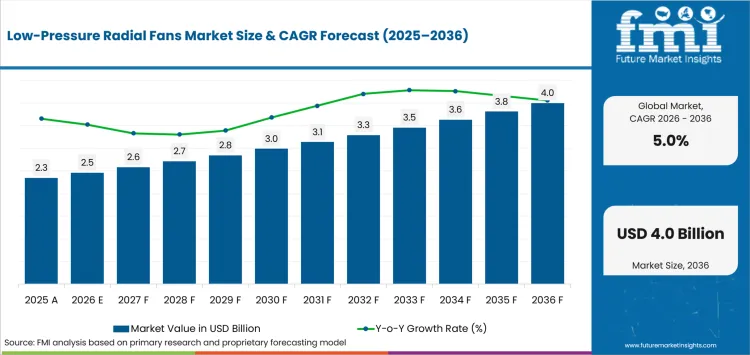
- Market Size (2026)
- USD 2.5 Bn
- Forecast (2036)
- USD 4.0 Bn
- CAGR (2026 to 2036)
- 5.0%
How big is Low-Pressure Radial Fans Market in 2026?
USD 2.5 billion in 2026 and USD 4.0 billion by 2036 at a 5.0% CAGR.
Demand for low-pressure radial fans is projected to expand at a 5.0% CAGR between 2026 and 2036, increasing valuation from USD 2.5 billion in 2026 to USD 4.0 billion by 2036. Engineers increasingly compare the energy used by the complete fan package at its operating point. The European Commission estimated in July 2026 that revised industrial-fan rules would cut EU electricity use by about 31 TWh annually by 2030. Documented part-load performance therefore has a direct place in fan selection.
USA market access is more document-intensive in California than in countries without a fan registration step. AMCA reported in April 2025 that 110,000 fan models from 33 manufacturers had been filed under Title 20. The filing puts efficiency documentation before sale for covered products. This adds channel cost where registration applies.
Key Takeaways
- Energy-performance rules are moving low-pressure radial fan selection toward documented duty-point performance and away from motor nameplate efficiency alone.
- By fan type, forward-curved radial fans are estimated to hold 25.0% in 2026 owing to packaging flexibility in compact ventilation assemblies.
- Direct drive is projected to account for 32.0% of drive type in 2026, driven by fewer mechanical wear parts and simpler speed-control integration.
- The below 5,000 m³/h category is anticipated to represent 24.0% of flow range in 2026 because smaller packaged and decentralized duties require modest air volumes.
- Retrofit conversion slows where duct geometry or service access prevents the selected fan from reaching its rated operating point.
- Some of the key players in this market include Ziehl-Abegg, ebm-papst, Systemair, Rosenberg Ventilatoren, Nicotra Gebhardt, Greenheck, Twin City Fan, Soler & Palau, Howden, and Cincinnati Fan.
Analyst Perspective
"Low-pressure radial fan bids should be compared at the installed duty point instead of headline efficiency. Engineering support earns its premium when it prevents a higher-efficiency fan from losing performance after installation."
- Nikhil Kaitwade, Principal Consultant, Future Market Insights
How is the low-pressure radial fans market segmented?
The market is analyzed by fan type, drive type, flow range, end use and sales channel.
Fan type includes forward-curved radial fans, backward-curved radial fans, radial blade fans, plug fans and inline radial fans. Drive type covers direct drive, belt drive, EC motor drive and variable frequency drive. Flow range runs from below 5,000 m³/h to above 75,000 m³/h. End use includes HVAC, industrial ventilation, dust collection, process cooling and commercial buildings. Sales channels are fan OEM direct, HVAC distributors, industrial suppliers and system integrators.
Why does direct drive lead the drive type category?
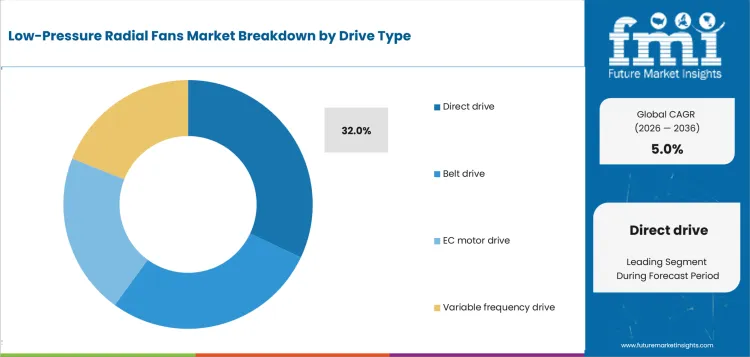
Direct drive removes belts and pulleys from the mechanical path between motor and impeller. Greenheck introduced Model IVE in June 2025 with a direct-drive plenum fan rated from 500 to 2,400 cfm. HVAC OEM engineers can pair this architecture with variable frequency drives or EC control without adding belt maintenance.
- Direct drive is forecast to lead drive type with a 32.0% share in 2026, supported by lower mechanical maintenance and simpler control integration.
- The direct-drive layout keeps speed control and service access inside one cabinet decision for compact ventilators.
What makes forward-curved radial fans central to the fan type category?
Forward-curved wheels fit compact housings that need useful airflow at low or moderate pressure. The compact housing is useful in packaged ventilation equipment where cabinet depth and noise limits can outweigh peak wheel efficiency during retrofit selection.
- By fan type, forward-curved radial fans are estimated to hold 25.0% in 2026 owing to packaging flexibility in compact ventilation assemblies.
- AMCA's current certified-products directory lists Nicotra India AT and ADH forward-curved centrifugal fan families. The directory also records an April 2026 proSELECTA catalog for certified performance data.
How does below 5,000 m³/h anchor the flow range category?
The lowest flow band covers many separate fans instead of one large central air mover. Small air handling units and local exhaust points can generate high unit frequency even with modest revenue per fan.
- The below 5,000 m³/h category is projected to capture 24.0% of flow range in 2026 because smaller packaged and decentralized duties require modest air volumes.
- Greenheck's January 2025 ERVi launch covered downstream units from 375 to 2,500 cfm. The 375-to-2,500 cfm range places compact fan assemblies inside decentralized ventilation equipment where several local units replace one central fan.
What supports HVAC as the leading end use?
HVAC engineers select radial fans against resistance from coils and filters inside air-moving equipment. Long operating hours magnify small efficiency losses in HVAC blower systems. Systemair's June 2026 Geniox HP DFN launch integrates an R290 heat pump with the air handler. Fan selection therefore becomes part of the same cabinet design.
- HVAC is anticipated to hold 31.0% of end use in 2026, driven by repeat fan specification in air handlers and packaged ventilation equipment.
- Coils and filters make the fan curve part of the same cabinet-level engineering decision with thermal components and controls.
What drives fan OEM direct in the sales channel category?
OEM-direct sales fit applications where fan curves and mounting details are fixed during equipment design. Direct engineering contact shortens the path between an airflow target and a released fan configuration.
- Fan OEM direct is estimated to lead sales channel with a 38.0% share in 2026, owing to engineered selection and configuration support during final specification.
- ebm-papst announced a third Indian manufacturing unit in April 2025 and said the plant would serve regional customers with localized production. Local production shortens the engineering-to-supply lead time for OEM programs that require fan adaptation near the equipment assembly base.
What are the drivers, restraints and opportunities in the Low-Pressure Radial Fans Market?
Energy-performance rules raise the value of documented fan selection, but installed system losses slow retrofits and favor direct-drive replacements that simplify maintenance.
- Driver: Part-load efficiency documentation is becoming a purchase requirement for covered fan classes and engineered HVAC specifications.
- Restraint: Existing ducts and access limits can move a replacement fan away from the operating point used in laboratory ratings.
- Opportunity: Direct-drive EC or VFD-ready radial modules can lower maintenance and preserve speed control in compact retrofit envelopes.
Fan rules now make duty-point records part of formal equipment comparison. Rosenberg's July 2025 AMCA accreditation for its medium and large air-performance test benches gives engineers independent data for scheduled speed changes. Building automation systems rely on defensible fan curves for planned speed adjustments.
Retrofit performance can break at the inlet or outlet despite a well-tested impeller. Loaded air filtration systems and tight elbows can shift actual pressure away from the rated point. Ziehl-Abegg's July 2025 retrofit program targets fan replacement without rebuilding the surrounding installation, which reduces disruption but does not remove system-effect risk.
Greenheck made direct-drive plenum fans standard on its ERVe platform in June 2026, removing belts from the downstream unit. Direct-drive architecture fits retrofits with limited maintenance access and retains electronic speed control. Energy recovery ventilator cores still require compatible power and verified installed performance for specification.
Which country CAGRs are profiled in the Low-Pressure Radial Fans Market?
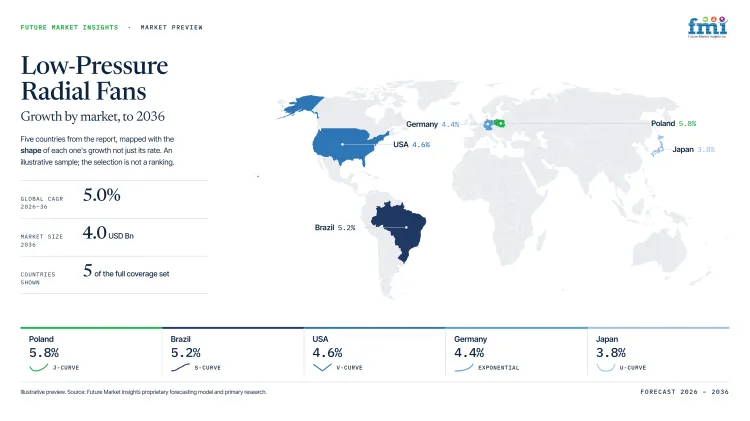
| Country | CAGR (2026 to 2036) |
|---|---|
| Poland | 5.8% |
| Brazil | 5.2% |
| Mexico | 5.1% |
| USA | 4.6% |
| Canada | 4.5% |
| Germany | 4.4% |
| Japan | 3.8% |
How do country-level CAGRs compare in the Low-Pressure Radial Fans Market?
Poland leads a compact upper group formed by Brazil and Mexico. USA, Canada and Germany form a narrow middle cluster within 0.2 percentage points. The distribution reflects different replacement cycles and project pipelines and does not measure current absolute market size.
- Poland’s aging public-building stock supports demand for compact ventilation replacements that fit within existing layouts.
- Brazil’s market remains more closely linked to new construction activity than to established replacement cycles.
- Mexico’s manufacturing strength increases demand for ventilation systems across industrial and production environments.
- The USA’s large installed base makes replacement and upgrade projects a key source of market activity.
- Canada’s extensive service footprint elevates the importance of parts availability and aftermarket support capabilities.
- Germany’s industrial profile sustains strong demand for ventilation solutions used in process-intensive applications.
- Japan’s mature building stock moderates unit-growth opportunities and shifts focus toward modernization and replacement projects.
Installed systems and approval paths can produce different entry conditions even at similar CAGRs. The full report provides country-level CAGR analysis across North America, Latin America, Western Europe, Eastern Europe, East Asia, South Asia and Pacific, and Middle East and Africa.
Country-wise Analysis
- Public-building renovation gives low-pressure radial fans a route into projects financed as whole-building efficiency work. Poland is projected to grow at 5.8% CAGR through 2036, driven by renovation programs that can include ventilation equipment. The Ministry of Climate and Environment opened an EPC/ESCO pilot for public-building energy upgrades on April 29 2025. Air conditioning systems can absorb the same renovation budget, so the fan case has to show savings at the installed duty point. Compact replacement packages reduce duct reconstruction and let local HVAC firms complete ventilation work inside a broader energy-performance contract under tight site access constraints.
- New Brazilian building rules set a future specification gate, but they do not pull existing buildings into mandatory upgrades. Resolution CGIEE No. 4 of September 26, 2025 applies to new residential and non-residential buildings. The low-pressure radial fans market in Brazil is anticipated to advance at 5.2% CAGR over the assessment period, supported by new-building efficiency requirements. The rule explicitly excludes existing buildings even after renovation, which limits its direct effect on replacement demand. Regional project execution and commissioning quality also vary, so entrants need distributors that can match rated fan curves to local design and installation practice before permit submission.
- Industrial fan replacement in Mexico often begins with the motor and electrical package to preserve voltage compatibility. Sales of low-pressure radial fans in Mexico are forecast to expand at 5.1% CAGR by 2036, owing to industrial replacement and motor-efficiency requirements. NOM-016-ENER-2025 was published on August 19, 2025 for specified three-phase induction motors from 0.746 kW to 373 kW. The rule does not rate the fan itself, so contractors still have to reconcile the electric motor with airflow and control requirements. Matched fan-drive documentation plus local stock gives distributors an advantage during maintenance shutdowns that imported lead times can delay.
- USA consulting engineers increasingly ask for test-based fan performance before a model enters an equipment schedule. The Department of Energy published a proposed standards determination for fans and blowers on May 16, 2025. Demand in the USA is predicted to advance at 4.6% CAGR through 2036, attributable to replacement work and formal efficiency representation. The proposal did not create a new efficiency standard, but it kept federal fan policy active and raised the value of traceable duty-point data. Regional service teams still have to resolve installed system losses that laboratory curves cannot capture, so complete test records reduce friction during engineering review.
- Whole-building benchmarking often places fan work inside broader Canadian energy plans. Canada is forecast to grow at 4.5% CAGR over the forecast period, reinforced by building-performance programs and retrofit planning. Natural Resources Canada updated its ENERGY STAR for Buildings page on July 4, 2025 and continues to provide Portfolio Manager for energy benchmarking. The national tool identifies poor building performance but does not by itself fund a fan replacement. Long capital cycles and wide service distances favor direct-drive packages that have accessible parts and technical support near major building portfolios during capital planning for equipment spread over large territories.
- German plant engineers can place fan replacement inside a federal efficiency project instead of treating the fan as an isolated component. KfW's May 2025 EEW guidance lists high-efficiency fans and variable-frequency drives under Module 1. The German low-pressure radial fans sector is projected to record 4.4% CAGR during the assessment period, shaped by industrial replacement and formal efficiency documentation. Funding is limited to qualifying replacement conditions, which makes equipment age part of commercial screening. Dust control systems can shift the required pressure point during a retrofit. Manufacturers with auditable curves and application support can resolve that change during plant upgrades.
- Mature building layouts leave little room for larger replacement assemblies, so Japanese mechanical rooms favor compact fan packages. Japan's MLIT states that energy-standard compliance became mandatory from April 2025 for covered building work. Noise control and limited service space narrow the acceptable equipment set in occupied buildings. Adoption of low-pressure radial fans in Japan is estimated to expand at 3.8% CAGR through 2036, aided by tighter building-efficiency compliance. OEMs still need fan curves that remain useful after filters and coils alter system resistance plus local engineering support that can avoid duct redesign. Local engineering support is especially valuable during occupied-building retrofit projects where downtime must remain limited.
Who are the notable companies in the Low-Pressure Radial Fans Market?
Ziehl-Abegg, ebm-papst, Systemair, Rosenberg Ventilatoren, Nicotra Gebhardt, Greenheck, Twin City Fan, Soler & Palau, Howden, and Cincinnati Fan are the notable companies serving this market.
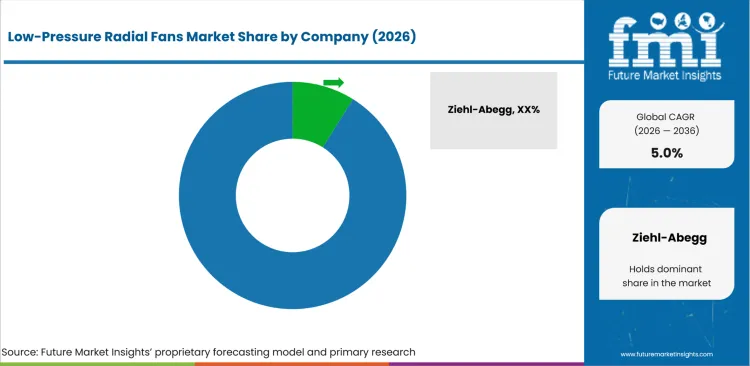
Low-pressure radial fan positions depend on how a model reaches specification. Ziehl-Abegg and ebm-papst sell integrated fan-motor platforms into OEM equipment. Rosenberg Ventilatoren and Nicotra Gebhardt cover centrifugal families with EC options. Systemair and Greenheck use commercial ventilation channels. Soler & Palau relies mainly on distribution. Twin City Fan, Howden and Cincinnati Fan focus on engineered industrial duties.
- OEM radial platforms include Ziehl-Abegg and ebm-papst. Rosenberg Ventilatoren and Nicotra Gebhardt also occupy this group.
- Commercial ventilation integration: Systemair, Greenheck and Soler & Palau.
- Industrial application engineering: Twin City Fan, Howden and Cincinnati Fan.
Competitive Benchmarking: Low-Pressure Radial Fans Market
| Company | Low-Pressure Radial Breadth | Integrated Variable-Speed Drive | OEM/System Integration Fit | Geographic Reach |
|---|---|---|---|---|
| Ziehl-Abegg | High | High | High | Europe, North America and Asia |
| ebm-papst | High | High | High | Global |
| Systemair | High | Medium | High | Europe, North America, Middle East, Asia, Australia and Africa |
| Rosenberg Ventilatoren | High | High | High | Europe with international OEM sales |
| Nicotra Gebhardt | High | High | High | Europe, North America and Asia-Pacific |
| Greenheck | High | High | High | North America with international project reach |
| Twin City Fan | High | Medium | Medium | North America with selected international projects |
| Soler & Palau | High | High | High | Europe, Americas and Asia-Pacific |
| Howden | Medium | Medium | Medium | Global industrial markets |
| Cincinnati Fan | High | Medium | Medium | Primarily North America with export sales |
Scoring basis: High radial breadth requires at least four documented centrifugal or radial families. Medium requires two or three. High variable-speed coverage requires integrated EC or PM drive evidence plus control support. Medium records a narrower EC or VFD route. High integration fit requires documented OEM or system-engineering support. Medium records a narrower application path. Low is used only for a documented limitation.
Key Developments in the Low-Pressure Radial Fans Market
- In August 2026, ebm-papst expanded its RadiPac centrifugal platform with the RadiPac C 630 for air-handling and FanGrid applications.
- In October 2025, Cincinnati Fan & Ventilator received ISO 9001:2015 registration for its industrial fan and blower quality-management scope.
- In August 2025, Systemair completed its acquisition of industrial-fan manufacturer NADI Airtechnics and added its fan competence to the group.
Key Players in the Low-Pressure Radial Fans Market
EC-Driven HVAC and OEM Radial Platforms
- Ziehl-Abegg
- ebm-papst
- Rosenberg Ventilatoren
- Nicotra Gebhardt
Commercial Ventilation and System-Integration Suppliers
- Systemair
- Greenheck
- Soler & Palau
Industrial and Application-Engineered Fan Specialists
- Twin City Fan
- Howden
- Cincinnati Fan
Low-Pressure Radial Fans Market - Report Scope
| Coverage field | Report scope |
|---|---|
| Market breakdown | By fan type, drive type, flow range, end use, sales channel and region. |
| Quantitative Units | USD billion. |
| Market Definition | Revenue includes low-pressure radial or centrifugal fan products and fan assemblies sold as standalone units or specified components. Complete downstream HVAC systems and axial fans are excluded. |
| Regions Covered | North America, Latin America, Western Europe, Eastern Europe, East Asia, South Asia and Pacific and Middle East and Africa. |
| Countries Covered | Poland, Brazil, Mexico, USA, Canada, Germany, Japan, and 20+ countries included in the full report. |
| Key Companies Profiled | Ziehl-Abegg, ebm-papst, Systemair, Rosenberg Ventilatoren, Nicotra Gebhardt, Greenheck, Twin City Fan, Soler & Palau, Howden, and Cincinnati Fan. |
| Forecast Period | 2026 to 2036. |
| Approach | Primary and secondary research with market triangulation. |
Low-Pressure Radial Fans Market - Research Methodology
| Method | Approach |
|---|---|
| Primary Research | FMI analysts gathered input from manufacturers, service providers, technology developers, distributors, end users, procurement teams, and subject-matter experts. Interviews examined purchasing decisions, product or service evaluation, adoption barriers, approval requirements, pricing considerations, and expectations for technical or commercial support. Respondents were also asked what evidence is required before a trial, pilot, or initial order develops into regular purchasing. |
| Desk Research | Desk research covered government statistics, regulatory publications, trade data, industry associations, technical literature, standards, company filings, product information, and official corporate announcements. Sources were reviewed for relevance, publication date, geographic coverage, and consistency with the defined market scope. Claims relating to performance, applications, approvals, capacity, investment, and commercial activity were retained only when supported by credible public evidence. |
| Market Sizing and Forecasting | The market model combined the baseline value with historical performance, segment structure, pricing and volume indicators, adoption levels, company participation, and country-level demand conditions. Forecast assumptions considered economic activity, investment trends, regulatory developments, technology adoption, purchasing cycles, supply availability, and barriers to wider market use. Segment and regional estimates were reconciled before the final market total was calculated. |
| Data Validation | Estimates were checked against multiple independent indicators, including public data, company activity, trade patterns, industry developments, and findings from primary interviews. Validation also tested whether products, services, applications, and company revenues fell within the defined market boundaries. Adjacent categories, unsupported claims, overlapping revenues, and activities without direct market relevance were excluded to reduce double counting and maintain consistency across segments and countries. |
Low-Pressure Radial Fans Market by Segments
Low-Pressure Radial Fans Market segmented by Fan Type:
- Forward-curved radial fans
- Backward-curved radial fans
- Radial blade fans
- Plug fans
- Inline radial fans
Low-Pressure Radial Fans Market segmented by Drive Type:
- Direct drive
- Belt drive
- EC motor drive
- Variable frequency drive
Low-Pressure Radial Fans Market segmented by Flow Range:
- Below 5,000 m³/h
- 5,000-25,000 m³/h
- 25,000-75,000 m³/h
- Above 75,000 m³/h
Low-Pressure Radial Fans Market segmented by End Use:
- HVAC
- Industrial ventilation
- Dust collection
- Process cooling
- Commercial buildings
Low-Pressure Radial Fans Market segmented by Sales Channel:
- Fan OEM direct
- HVAC distributors
- Industrial suppliers
- System integrators
Low-Pressure Radial Fans Market by Region:
- North America
- United States
- Canada
- Latin America
- Brazil
- Mexico
- Argentina
- Chile
- Western Europe
- Germany
- France
- United Kingdom
- Italy
- Spain
- Benelux
- Nordics
- Eastern Europe
- Poland
- Czech Republic
- Romania
- Hungary
- East Asia
- China
- Japan
- South Korea
- South Asia and Pacific
- India
- ASEAN
- Australia and New Zealand
- Middle East and Africa
- GCC Countries
- South Africa
- Türkiye
- Israel
Research Sources and Bibliography
- European Commission, Directorate-General for Energy. (2026, July 24). New ecodesign rules for industrial fans apply from 24 July.
- Air Movement and Control Association International. (2025, April 29). AMCA inmotion e-News - Spring 2025.
- Air Movement and Control Association International. (2026). Nicotra India Pvt. Ltd. certified centrifugal fan products.
- Greenheck. (2025, June). Greenheck’s New Model IVE Ventilator Delivers Indoor-Mounted Energy Recovery.
- Greenheck. (2025, January). Greenheck’s New ERVi Energy Recovery Ventilators Excel in Indoor Spaces.
- Systemair. (2026, June 18). Systemair introduces air handling unit with integrated heat pump using natural refrigerant R290.
- ebm-papst. (2025, April 3). ebm-papst announces its 3rd Manufacturing Unit in India.
- Rosenberg Ventilatoren GmbH. (2025, July 21). AMCA Accreditation.
- Ziehl-Abegg. (2025, July 17). Ziehl-Abegg Highlights Retrofit Innovation for Summer HVAC Efficiency.
- Greenheck. (2026, June 3). Greenheck Energy Recovery Ventilators Deliver More Airflow with Direct Drive Fans.
- Ministry of Climate and Environment, Poland. (2025, April 29). Poprawa efektywności energetycznej w budynkach użyteczności publicznej wraz z instalacją OZE: pilotaż EPC/ESCO.
- Ministry of Mines and Energy, Brazil. (2025, September 26). Resolução nº 4/2025.
- Diario Oficial de la Federación, Mexico. (2025, August 19). Norma Oficial Mexicana NOM-016-ENER-2025, Eficiencia energética de motores de corriente alterna, trifásicos, de inducción, tipo jaula de ardilla, en potencia nominal de 0,746 kW a 373 kW.
- USA Department of Energy. (2025, May 16). Fans and Blowers.
- Natural Resources Canada. (2025, July 4). ENERGY STAR for Buildings.
- KfW. (2025, May). Bundesförderung für Energieeffizienz in der Wirtschaft (295).
- Ministry of Land, Infrastructure, Transport and Tourism, Japan. (2025, April). Energy-efficiency standards compliance from April 2025.
- ebm-papst. (2026, August 4). More power for compact ventilation systems.
- EAGLE Registrations Inc. (2025, October 24). Certificate of Registration No. 7340: Cincinnati Fan & Ventilator, Inc.
- Systemair. (2025, August 11). Systemair has completed the acquisition of NADI Airtechnics.
- Air Movement and Control Association International. (2026). Ziehl-Abegg India Private Limited certified centrifugal fan products.
- Systemair. (2026, August 6). Systemair publishes Annual and Sustainability Report 2025/26.
- Air Movement and Control Association International. (2026). Rosenberg Ventilatoren GmbH certified products.
- Air Movement and Control Association International. (2026). Nicotra India Pvt. Ltd. certified fan license types.
- Air Movement and Control Association International. (2026). Greenheck India Pvt. Ltd. certified products.
- Air Movement and Control Association International. (2026). Twin City Fan Companies Ltd. certified products.
- Air Movement and Control Association International. (2026). Soler & Palau S.A. de C.V. certified products.
- Chart Industries, Inc. (2026, February 27). Annual report on Form 10-K for the year ended December 31, 2025.
- Air Movement and Control Association International. (2026). Cincinnati Fan & Ventilator Company certified products.
- Ziehl-Abegg. (2026, June 30). Ziehl-Abegg invests an additional €90 million.
- ebm-papst. (2026, June 2). Opening Romania.
- Systemair. (2026, July 23). Systemair acquires Canadian Temspec Incorporated.
- Greenheck. (2026, July 8). New Model IV Indoor Ventilator Offers Compact Outdoor Air Solution.
- Rosenberg Ventilatoren GmbH. (2025, November 6). EC Duct Fan KHAG(S).
- Soler & Palau. (2026, June 22). S&P publica una nueva Declaración Ambiental de Producto para sus ventiladores TGT y THGT.
- Ziehl-Abegg. (2026, August 24). Two Years Later: Ziehl-Abegg’s Winston-Salem Headquarters Driving Manufacturing Growth.
- Soler & Palau. (2026, April 8). S&P incorpora Magnelis® para aumentar la resistencia y durabilidad de sus gamas industriales.
- ebm-papst. (2026). Annual Press Conference 2026.
- ebm-papst. (2025, March 13). New RadiPac metal (model) for FFU.
- Air Movement and Control Association International. (2026, September 7). AMCA Accredited Laboratories.
- Twin City Fan Companies, Ltd. (2026, August). Twin City Fan Companies, Ltd. Announces Leadership Transition.
- Baker Hughes. (2026, July 16). Baker Hughes Completes Acquisition of Chart Industries.
This bibliography is provided for reader reference and is not exhaustive. The full report contains the complete reference list and detailed citations
This Report Answers
- How large is the low-pressure radial fans market in 2026 and 2036?
- Why is documented duty-point performance becoming more important?
- Why do forward-curved radial fans hold 25.0% in 2026?
- How does direct drive change maintenance and speed-control integration?
- Why does below 5,000 m³/h lead flow range?
- Why do country CAGRs differ among the seven profiles?
- Which companies serve OEM, commercial ventilation and industrial fan applications?
- Which installation conditions reduce replacement-fan efficiency?
Frequently Asked Questions
How big is the low-pressure radial fans market in 2026?
The low-pressure radial fans market is valued at USD 2.5 billion in 2026 and is projected to reach USD 4.0 billion by 2036. Documented energy performance and replacement activity support growth.
What is the CAGR of the low-pressure radial fans market from 2026 to 2036?
The low-pressure radial fans market is projected to grow at a CAGR of 5.0% between 2026 and 2036. Energy rules and demand for controllable direct-drive packages support expansion.
Which fan type leads the low-pressure radial fans market?
The forward-curved radial fans segment is expected to hold 25.0% of the low-pressure radial fans market in 2026, attributable to compact housings for low-to-moderate-pressure duties. Cabinet and acoustic limits favor its use in packaged equipment.
Which drive type leads the low-pressure radial fans market?
The direct drive segment is expected to hold 32.0% of the low-pressure radial fans market in 2026, driven by lower maintenance and simpler control integration. Electronic speed control also avoids belt servicing in packaged equipment.
Which countries are projected to record the highest growth in the low-pressure radial fans market?
Poland is projected to grow at 5.8% CAGR, followed by Brazil at 5.2% and Mexico at 5.1% through 2036. Faster project formation in renovation and new-building work supports the upper group.
Which companies are active in the low-pressure radial fans market?
Key companies operating in the market include Ziehl-Abegg, ebm-papst, Systemair, Rosenberg Ventilatoren, Nicotra Gebhardt, Greenheck, Twin City Fan, Soler & Palau, Howden, and Cincinnati Fan. Their positions differ by integration, channel reach and industrial application engineering.
Preview the report firsthand - request a free sample
Get SampleGet the brochure for pricing and purchase details.
Get PDFTable of Content
- Key Takeaways
- Market Size and CAGR
- Top Growth Driver
- Fastest Growing Segment
- Leading Region
- Key Companies
- Emerging Opportunities
- Executive Summary
- Global Market Outlook
- Demand-side Trends
- Supply-side Trends
- Technology Roadmap Analysis
- Analysis and Recommendations
- Analyst Perspective (What is happening? Why now? What should investors know?)
- Key Questions Answered
- How large is the market?
- What is the CAGR?
- What are key trends?
- Which region dominates?
- Who are the leaders?
- Market Overview
- Market Coverage / Taxonomy
- Market Definition / Scope / Limitations
- Research Methodology
- Chapter Orientation
- Analytical Lens and Working Hypotheses
- Market Structure, Signals, and Trend Drivers
- Benchmarking and Cross-market Comparability
- Market Sizing, Forecasting, and Opportunity Mapping
- Research Design and Evidence Framework
- Desk Research Programme (Secondary Evidence)
- Expert Input and Fieldwork (Primary Evidence)
- Tooling, Models, and Reference Databases
- Data Engineering and Model Build
- Quality Assurance and Audit Trail
- Market Background
- Market Dynamics (Drivers, Restraints, Opportunity, Trends)
- Scenario Forecast (Optimistic, Likely, Conservative)
- Impact Analysis
- AI Impact
- Sustainability Impact
- Regulatory Impact
- Technology Impact
- Consumer / Buyer Analysis
- Purchase Drivers
- Adoption Barriers
- Buyer Journey
- Opportunity Map Analysis
- Product Life Cycle Analysis
- Supply Chain Analysis
- Investment Feasibility Matrix
- Value Chain Analysis
- PESTLE and Porter's Analysis
- Regulatory Landscape
- Regional Parent Market Outlook
- Production and Consumption Statistics
- Import and Export Statistics
- Global Market Analysis and Forecast, 2021 to 2036
- Historical Market Size Value (USD Billion) Analysis, 2021 to 2025
- Current and Future Market Size Value (USD Billion) Projections, 2026 to 2036
- Y-o-Y Growth Trend Analysis
- Absolute $ Opportunity Analysis
- Global Market Pricing Analysis, 2021 to 2036
- Global Market Analysis and Forecast, By Fan Type, 2021 to 2036
- Introduction / Key Findings
- Historical Market Size Value (USD Billion) Analysis By Fan Type, 2021 to 2025
- Current and Future Market Size Value (USD Billion) Analysis and Forecast By Fan Type, 2026 to 2036
- Forward-curved radial fans
- Backward-curved radial fans
- Radial blade fans
- Plug fans
- Inline radial fans
- Forward-curved radial fans
- Y-o-Y Growth Trend Analysis By Fan Type, 2021 to 2025
- Absolute $ Opportunity Analysis By Fan Type, 2026 to 2036
- Global Market Analysis and Forecast, By Drive Type, 2021 to 2036
- Introduction / Key Findings
- Historical Market Size Value (USD Billion) Analysis By Drive Type, 2021 to 2025
- Current and Future Market Size Value (USD Billion) Analysis and Forecast By Drive Type, 2026 to 2036
- Direct drive
- Belt drive
- EC motor drive
- Variable frequency drive
- Direct drive
- Y-o-Y Growth Trend Analysis By Drive Type, 2021 to 2025
- Absolute $ Opportunity Analysis By Drive Type, 2026 to 2036
- Global Market Analysis and Forecast, By Flow Range, 2021 to 2036
- Introduction / Key Findings
- Historical Market Size Value (USD Billion) Analysis By Flow Range, 2021 to 2025
- Current and Future Market Size Value (USD Billion) Analysis and Forecast By Flow Range, 2026 to 2036
- Below 5,000 m³/h
- 5,000–25,000 m³/h
- 25,000–75,000 m³/h
- Above 75,000 m³/h
- Below 5,000 m³/h
- Y-o-Y Growth Trend Analysis By Flow Range, 2021 to 2025
- Absolute $ Opportunity Analysis By Flow Range, 2026 to 2036
- Global Market Analysis and Forecast, By End Use, 2021 to 2036
- Introduction / Key Findings
- Historical Market Size Value (USD Billion) Analysis By End Use, 2021 to 2025
- Current and Future Market Size Value (USD Billion) Analysis and Forecast By End Use, 2026 to 2036
- HVAC
- Industrial ventilation
- Dust collection
- Process cooling
- Commercial buildings
- HVAC
- Y-o-Y Growth Trend Analysis By End Use, 2021 to 2025
- Absolute $ Opportunity Analysis By End Use, 2026 to 2036
- Global Market Analysis and Forecast, By Sales Channel, 2021 to 2036
- Introduction / Key Findings
- Historical Market Size Value (USD Billion) Analysis By Sales Channel, 2021 to 2025
- Current and Future Market Size Value (USD Billion) Analysis and Forecast By Sales Channel, 2026 to 2036
- Fan OEM direct
- HVAC distributors
- Industrial suppliers
- System integrators
- Fan OEM direct
- Y-o-Y Growth Trend Analysis By Sales Channel, 2021 to 2025
- Absolute $ Opportunity Analysis By Sales Channel, 2026 to 2036
- Global Market Analysis and Forecast, By Region, 2021 to 2036
- Introduction
- Historical Market Size Value (USD Billion) Analysis By Region, 2021 to 2025
- Current Market Size Value (USD Billion) Analysis and Forecast By Region, 2026 to 2036
- North America
- Latin America
- Western Europe
- Eastern Europe
- East Asia
- South Asia and Pacific
- Middle East & Africa
- Market Attractiveness Analysis By Region
- North America Market Analysis and Forecast, By Country, 2021 to 2036
- Historical Market Size Value (USD Billion) Trend Analysis By Market Taxonomy, 2021 to 2025
- Market Size Value (USD Billion) Forecast By Market Taxonomy, 2026 to 2036
- By Country
- USA
- Canada
- By Fan Type
- By Drive Type
- By Flow Range
- By End Use
- By Sales Channel
- By Country
- Market Attractiveness Analysis
- By Country
- By Fan Type
- By Drive Type
- By Flow Range
- By End Use
- By Sales Channel
- Key Takeaways
- Latin America Market Analysis and Forecast, By Country
- Historical Market Size Value (USD Billion) Trend Analysis By Market Taxonomy, 2021 to 2025
- Market Size Value (USD Billion) Forecast By Market Taxonomy, 2026 to 2036
- By Country
- Brazil
- Mexico
- Chile
- Rest of Latin America
- By Fan Type
- By Drive Type
- By Flow Range
- By End Use
- By Sales Channel
- By Country
- Market Attractiveness Analysis
- By Country
- By Fan Type
- By Drive Type
- By Flow Range
- By End Use
- By Sales Channel
- Key Takeaways
- Western Europe Market Analysis and Forecast, By Country
- Historical Market Size Value (USD Billion) Trend Analysis By Market Taxonomy, 2021 to 2025
- Market Size Value (USD Billion) Forecast By Market Taxonomy, 2026 to 2036
- By Country
- Germany
- UK
- Italy
- Spain
- France
- Nordic
- BENELUX
- Rest of Western Europe
- By Fan Type
- By Drive Type
- By Flow Range
- By End Use
- By Sales Channel
- By Country
- Market Attractiveness Analysis
- By Country
- By Fan Type
- By Drive Type
- By Flow Range
- By End Use
- By Sales Channel
- Key Takeaways
- Eastern Europe Market Analysis and Forecast, By Country
- Historical Market Size Value (USD Billion) Trend Analysis By Market Taxonomy, 2021 to 2025
- Market Size Value (USD Billion) Forecast By Market Taxonomy, 2026 to 2036
- By Country
- Russia
- Poland
- Hungary
- Balkan & Baltic
- Rest of Eastern Europe
- By Fan Type
- By Drive Type
- By Flow Range
- By End Use
- By Sales Channel
- By Country
- Market Attractiveness Analysis
- By Country
- By Fan Type
- By Drive Type
- By Flow Range
- By End Use
- By Sales Channel
- Key Takeaways
- East Asia Market Analysis and Forecast, By Country
- Historical Market Size Value (USD Billion) Trend Analysis By Market Taxonomy, 2021 to 2025
- Market Size Value (USD Billion) Forecast By Market Taxonomy, 2026 to 2036
- By Country
- China
- Japan
- South Korea
- By Fan Type
- By Drive Type
- By Flow Range
- By End Use
- By Sales Channel
- By Country
- Market Attractiveness Analysis
- By Country
- By Fan Type
- By Drive Type
- By Flow Range
- By End Use
- By Sales Channel
- Key Takeaways
- South Asia and Pacific Market Analysis and Forecast, By Country
- Historical Market Size Value (USD Billion) Trend Analysis By Market Taxonomy, 2021 to 2025
- Market Size Value (USD Billion) Forecast By Market Taxonomy, 2026 to 2036
- By Country
- India
- ASEAN
- Australia & New Zealand
- Rest of South Asia and Pacific
- By Fan Type
- By Drive Type
- By Flow Range
- By End Use
- By Sales Channel
- By Country
- Market Attractiveness Analysis
- By Country
- By Fan Type
- By Drive Type
- By Flow Range
- By End Use
- By Sales Channel
- Key Takeaways
- Middle East & Africa Market Analysis and Forecast, By Country
- Historical Market Size Value (USD Billion) Trend Analysis By Market Taxonomy, 2021 to 2025
- Market Size Value (USD Billion) Forecast By Market Taxonomy, 2026 to 2036
- By Country
- Kingdom of Saudi Arabia
- Other GCC Countries
- Türkiye
- South Africa
- Other African Union
- Rest of Middle East & Africa
- By Fan Type
- By Drive Type
- By Flow Range
- By End Use
- By Sales Channel
- By Country
- Market Attractiveness Analysis
- By Country
- By Fan Type
- By Drive Type
- By Flow Range
- By End Use
- By Sales Channel
- Key Takeaways
- Key Countries Market Analysis
- USA
- Pricing Analysis
- Market Share Analysis, 2025
- By Fan Type
- By Drive Type
- By Flow Range
- By End Use
- By Sales Channel
- Canada
- Pricing Analysis
- Market Share Analysis, 2025
- By Fan Type
- By Drive Type
- By Flow Range
- By End Use
- By Sales Channel
- Mexico
- Pricing Analysis
- Market Share Analysis, 2025
- By Fan Type
- By Drive Type
- By Flow Range
- By End Use
- By Sales Channel
- Brazil
- Pricing Analysis
- Market Share Analysis, 2025
- By Fan Type
- By Drive Type
- By Flow Range
- By End Use
- By Sales Channel
- Chile
- Pricing Analysis
- Market Share Analysis, 2025
- By Fan Type
- By Drive Type
- By Flow Range
- By End Use
- By Sales Channel
- Germany
- Pricing Analysis
- Market Share Analysis, 2025
- By Fan Type
- By Drive Type
- By Flow Range
- By End Use
- By Sales Channel
- UK
- Pricing Analysis
- Market Share Analysis, 2025
- By Fan Type
- By Drive Type
- By Flow Range
- By End Use
- By Sales Channel
- Italy
- Pricing Analysis
- Market Share Analysis, 2025
- By Fan Type
- By Drive Type
- By Flow Range
- By End Use
- By Sales Channel
- Spain
- Pricing Analysis
- Market Share Analysis, 2025
- By Fan Type
- By Drive Type
- By Flow Range
- By End Use
- By Sales Channel
- France
- Pricing Analysis
- Market Share Analysis, 2025
- By Fan Type
- By Drive Type
- By Flow Range
- By End Use
- By Sales Channel
- India
- Pricing Analysis
- Market Share Analysis, 2025
- By Fan Type
- By Drive Type
- By Flow Range
- By End Use
- By Sales Channel
- ASEAN
- Pricing Analysis
- Market Share Analysis, 2025
- By Fan Type
- By Drive Type
- By Flow Range
- By End Use
- By Sales Channel
- Australia & New Zealand
- Pricing Analysis
- Market Share Analysis, 2025
- By Fan Type
- By Drive Type
- By Flow Range
- By End Use
- By Sales Channel
- China
- Pricing Analysis
- Market Share Analysis, 2025
- By Fan Type
- By Drive Type
- By Flow Range
- By End Use
- By Sales Channel
- Japan
- Pricing Analysis
- Market Share Analysis, 2025
- By Fan Type
- By Drive Type
- By Flow Range
- By End Use
- By Sales Channel
- South Korea
- Pricing Analysis
- Market Share Analysis, 2025
- By Fan Type
- By Drive Type
- By Flow Range
- By End Use
- By Sales Channel
- Russia
- Pricing Analysis
- Market Share Analysis, 2025
- By Fan Type
- By Drive Type
- By Flow Range
- By End Use
- By Sales Channel
- Poland
- Pricing Analysis
- Market Share Analysis, 2025
- By Fan Type
- By Drive Type
- By Flow Range
- By End Use
- By Sales Channel
- Hungary
- Pricing Analysis
- Market Share Analysis, 2025
- By Fan Type
- By Drive Type
- By Flow Range
- By End Use
- By Sales Channel
- Kingdom of Saudi Arabia
- Pricing Analysis
- Market Share Analysis, 2025
- By Fan Type
- By Drive Type
- By Flow Range
- By End Use
- By Sales Channel
- Türkiye
- Pricing Analysis
- Market Share Analysis, 2025
- By Fan Type
- By Drive Type
- By Flow Range
- By End Use
- By Sales Channel
- South Africa
- Pricing Analysis
- Market Share Analysis, 2025
- By Fan Type
- By Drive Type
- By Flow Range
- By End Use
- By Sales Channel
- USA
- Market Structure Analysis
- Competition Dashboard
- Competition Benchmarking
- Market Share Analysis of Top Players
- By Regional
- By Fan Type
- By Drive Type
- By Flow Range
- By End Use
- By Sales Channel
- Emerging Startups
- Innovation Benchmarking
- Competition Analysis
- Competition Deep Dive
- Ziehl-Abegg
- Overview
- Product Portfolio
- Profitability by Market Segments
- Sales Footprint
- Strategy Overview
- Marketing Strategy
- Product Strategy
- Channel Strategy
- ebm-papst
- Systemair
- Rosenberg Ventilatoren
- Nicotra Gebhardt
- Greenheck
- Twin City Fan
- Soler & Palau
- Howden
- Cincinnati Fan
- Ziehl-Abegg
- Case Studies
- Success Stories
- Recent Developments
- Competition Deep Dive
- Assumptions & Acronyms Used


