

- Industry Size (2026)
- USD 48 Mn
- Forecast (2036)
- USD 97.1 Mn
- CAGR (2026 to 2036)
- 7.3%
Low-Siloxane Cleanroom Wall Coatings Market Forecast and Outlook 2026 to 2036
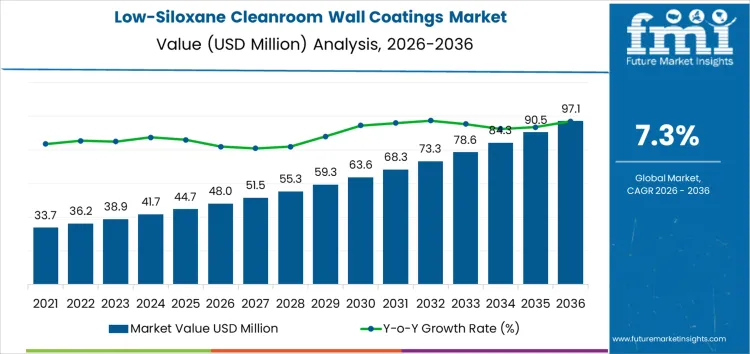
The Low-Siloxane Cleanroom Wall Coatings Market is valued at USD 48 million in 2026 and is projected to reach USD 97.1 million by 2036, reflecting a CAGR of 7.3%. Demand during this period is shaped by contamination control standards, cleanroom classification requirements, and surface maintenance protocols. Cost structures depend on coating chemistry, siloxane suppression performance, and durability under frequent cleaning cycles. Epoxy and polyurethane systems dominate where abrasion resistance and smooth finishes are required. Higher specification environments increase testing and qualification expense. Suppliers meeting low outgassing thresholds gain preference in ultra clean manufacturing and research facilities.
Between 2026 and 2036, adoption patterns vary by cleanroom class and operating discipline. Facilities operating under tighter particulate limits prioritize coatings that maintain surface integrity during repeated wipedown and chemical exposure. Once approved, wall coatings remain fixed due to recertification cost and operational disruption risk. Entry barriers persist through validation testing and performance documentation. Strategic tradeoffs emerge between cleanability, chemical resistance, and installation complexity. Firms aligning coating performance with specific cleanroom classes secure steadier demand. Competitive outcomes depend on reliability under daily operating conditions rather than installation scale or unit pricing.
Quick Stats for Low Siloxane Cleanroom Wall Coatings Market
- Low-Siloxane Cleanroom Wall Coatings Market Value (2026): USD 48 million
- Low-Siloxane Cleanroom Wall Coatings Market Forecast Value (2036): USD 97.1 million
- Low-Siloxane Cleanroom Wall Coatings Market Forecast CAGR (2026 to 2036): 7.3%
- Leading Coating Chemistry in Low Siloxane Cleanroom Wall Coatings Market: Low siloxane epoxy systems
- Leading Functional Performance in Low-Siloxane Cleanroom Wall Coatings Market: Low outgassing and low VOC performance with siloxane control
- Key Growth Regions in Low-Siloxane Cleanroom Wall Coatings Market: Asia Pacific, North America, Europe
- Top Players in Low Siloxane Cleanroom Wall Coatings Market: PPG Industries, AkzoNobel, Sherwin-Williams, Mankiewicz, RPM International
What Is the Growth Forecast for Low-Siloxane Cleanroom Wall Coatings Market through 2036?
Contamination control requirements and surface emission limits define the early growth phase of the Low-Siloxane Cleanroom Wall Coatings Market between 2026 and 2031. During this period, the market expands from USD 48 million to USD 64 million, adding USD 16 million in value. Annual progression from USD 31 million to USD 48 million reflects steady adoption across semiconductor fabrication, pharmaceutical production, and advanced electronics assembly environments. Historical growth was constrained by reliance on conventional epoxy and polyurethane wall systems with higher outgassing risk. Forward expansion in this phase is supported by tighter cleanroom classification standards, increased build out of controlled environments, and wider qualification of low siloxane coatings for walls and partitions.
Facility scale expansion and stricter operational protocols drive growth from 2031 to 2036. Over this period, the market increases from USD 64 million to USD 97.1 million, adding USD 35 million and representing the stronger expansion window. Annual values rise from USD 69 million to USD 97.1 million, indicating consistent year over year momentum. Earlier demand focused on critical production zones, while future growth reflects broader application across entire cleanroom envelopes. Larger cleanroom footprints, longer maintenance cycles, and higher sensitivity to surface contamination support sustained expansion as low siloxane wall coatings become standard materials in high specification cleanroom facilities.
Low-Siloxane Cleanroom Wall Coatings Market Key Takeaways
| Metric | Value |
|---|---|
| Market Value (2026) | USD 48 million |
| Forecast Value (2036) | USD 97.1 million |
| Forecast CAGR (2026 to 2036) | 7.3% |
What Is Driving Demand in the Low-Siloxane Cleanroom Wall Coatings Market?
Demand for low-siloxane cleanroom wall coatings arises from performance constraints encountered in controlled environments, not from general paint replacement. In semiconductor, pharmaceutical, and precision manufacturing cleanrooms, airborne molecular contaminants interfere with sensitive processes. Conventional coatings often contain siloxanes that outgas under temperature and humidity variations. These vapours deposit as thin films on optics, wafers, and precision instruments, causing defects, yield loss, and rework. Early adoption of low-siloxane coatings responded to specific contamination failures observed during production ramps, particularly in advanced logic and memory fabrication, rather than as a routine surface choice across all facilities.
Future demand will be shaped by tighter contamination control standards, documented process yield objectives, and facility certification criteria rather than aesthetic or basic protective needs alone. Facility planners and quality engineers are specifying wall coatings with quantified low emission profiles to meet stringent particle and vapour criteria documented in cleanroom classifications. Regulatory and customer quality expectations are embedding material outgassing limits into procurement specifications. Advances in coating formulations are reducing volatile constituents without compromising resistance to cleaning agents and frequent sanitation cycles. Adoption will follow formal contamination control plans and process performance metrics, aligning wall coating choice with documented yield and defect reduction outcomes rather than legacy coating defaults.
What Factors Are Affecting the Demand for Low-Siloxane Cleanroom Wall Coatings Market in Terms of Coating Chemistry and Functional Performance?
The Low-Siloxane Cleanroom Wall Coatings Market is driven by contamination control requirements, tighter outgassing limits, and expansion of semiconductor, pharmaceutical, and advanced manufacturing facilities. Demand focuses on coatings that minimize siloxane release while maintaining surface durability and cleanability. Adoption is shaped by cleanroom classification, cleaning frequency, and chemical exposure. Market leadership reflects compliance with particle and outgassing standards and proven long term performance rather than decorative finish or coating thickness.
What Is Driving Leadership by Coating Chemistry in the Low Siloxane Cleanroom Wall Coatings Market?
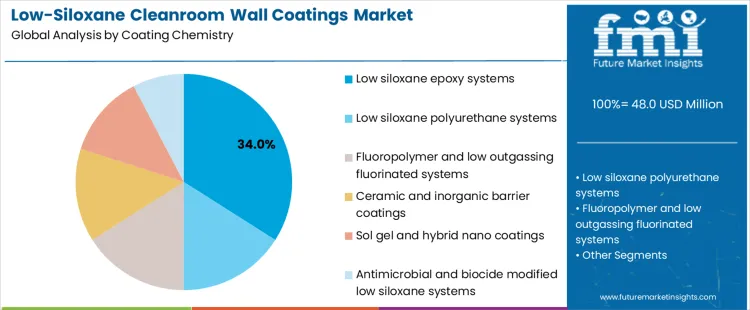
Low siloxane epoxy systems account for about 34% of demand because they provide a stable, low outgassing film with strong adhesion to common wall substrates. Cleanroom operators favor epoxy systems due to their dense crosslinked structure, which limits siloxane migration and particle shedding. These coatings deliver smooth, non-porous surfaces that support frequent wipedown without degradation. Predictable curing behavior and compatibility with existing application practices simplify qualification in regulated environments. Epoxy systems also offer resistance to common cleaning agents used in cleanrooms, supporting long service intervals. Extensive use in semiconductor fabs and pharmaceutical facilities reinforces confidence in their contamination control performance. These attributes position low siloxane epoxy coatings as the preferred chemistry where strict airborne molecular contamination limits apply.
Low siloxane polyurethane, fluoropolymer, ceramic, sol gel, and hybrid systems serve important but narrower roles. Polyurethanes provide flexibility but lower chemical resistance. Fluoropolymers excel in solvent resistance but add cost. Ceramic and inorganic coatings offer hardness but limited elasticity. Sol gel and antimicrobial systems address hygiene needs selectively. These chemistries complement epoxy dominance rather than displace it. Chemistry leadership therefore reflects balanced contamination control, durability, and qualification familiarity rather than specialization for a single performance metric.
What Is Driving Leadership by Functional Performance in the Low Siloxane Cleanroom Wall Coatings Market?
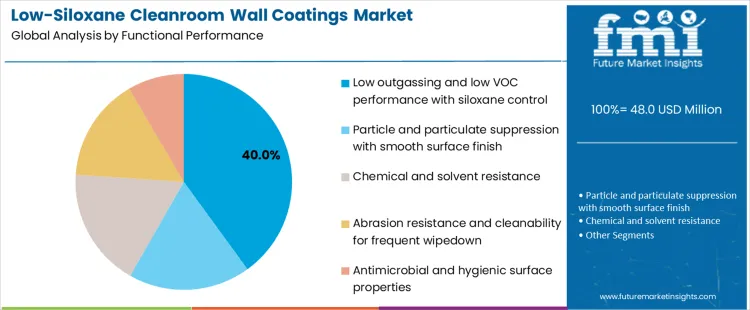
Low outgassing and low VOC performance with siloxane control represent about 40% of demand because airborne molecular contamination directly affects yield and reliability in cleanroom operations. Semiconductor and precision manufacturing environments are particularly sensitive to siloxane emissions that can interfere with lithography and deposition processes. Wall coatings contribute significantly to surface area exposure, making emission control critical. Facility owners prioritize coatings with documented outgassing data and stable long term behavior. Large wall coverage areas amplify the importance of this performance attribute, driving higher material volumes.
Particle suppression, chemical resistance, abrasion resistance, and antimicrobial performance represent secondary priorities. Smooth surfaces reduce particle generation during cleaning. Chemical resistance supports aggressive disinfectants. Abrasion resistance extends service life. Antimicrobial properties address hygiene concerns but are application specific. These functions are essential but typically specified after outgassing criteria are met. Functional performance leadership therefore reflects contamination risk mitigation and yield protection rather than the number of auxiliary performance features incorporated into the coating system.
How Are Low-Siloxane Cleanroom Wall Coatings Being Applied Across Controlled Environments?
Use appears in pharmaceutical, semiconductor, biotechnology, and medical device facilities where surface contamination and outgassing can compromise sterile conditions. Manufacturers adopt low-siloxane coatings to reduce volatile siloxane emissions that interfere with sensitive processes, such as wafer fabrication or sterile filling. Facility operators integrate these coatings on walls, ceilings, and partition surfaces to maintain cleanroom air purity and regulatory compliance. These applications reflect operational and contamination-control priorities rather than aesthetic objectives, with adoption driven by surface stability, process integrity, and environmental safety.
What Operational and Material Conditions Support Adoption of Low-Siloxane Cleanroom Wall Coatings?
Selection aligns with substrates requiring adhesion, chemical resistance, and low outgassing under controlled temperature and humidity. Coatings are formulated for uniform coverage, durability, and resistance to routine cleaning protocols without releasing siloxanes or particulates. Application processes monitor surface preparation, coating thickness, and curing to achieve consistent performance. Quality control evaluates outgassing, particulate generation, and chemical compatibility to meet ISO and GMP cleanroom standards. These conditions emerge from operational efficiency, contamination control, and regulatory compliance priorities in structured cleanroom workflows.
Which Practical Considerations Limit Wider Use of Low-Siloxane Cleanroom Wall Coatings?
Higher material cost and precise application requirements can limit adoption in smaller or less critical cleanrooms. Compatibility with primers, substrates, and cleaning chemicals must be verified. Surface preparation, curing, and post-application validation require skilled personnel and monitoring. Regulatory standards and certification vary by industry and region. These factors lead to selective deployment where contamination prevention, operational reliability, and compliance justify incremental cost and process management.
What is the Demand for Low Siloxane Cleanroom Wall Coatings by Country?
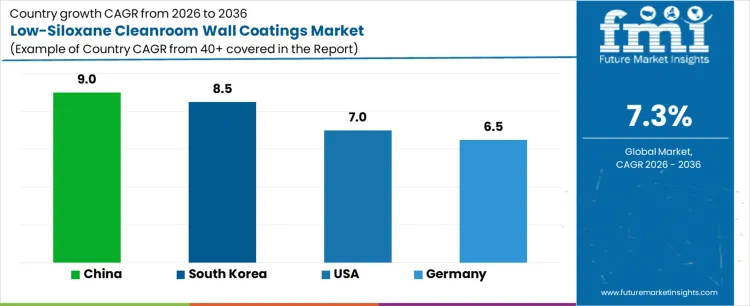
| Country | CAGR (%) |
|---|---|
| USA | 7.0% |
| China | 9.0% |
| South Korea | 8.5% |
| Germany | 6.5% |
The demand for low siloxane cleanroom wall coatings varies across countries, driven by semiconductor, pharmaceutical, and high tech manufacturing growth. China leads with a 9.0% CAGR, supported by rapid expansion of semiconductor fabs, pharmaceutical facilities, and adoption of advanced cleanroom standards. South Korea follows at 8.5%, driven by semiconductor and electronics manufacturing. The USA grows at 7.0%, reflecting steady adoption in pharmaceutical and high tech industries. Germany records 6.5%, shaped by mature cleanroom infrastructure and regulated industrial environments. These coatings help maintain contaminant free environments, enhance wall durability, and reduce maintenance in critical manufacturing facilities.
How Are Low-Siloxane Cleanroom Wall Coatings Expanding Applications in the United States?
In the United States, the Low-Siloxane Cleanroom Wall Coatings Market is growing at a CAGR of 7% through 2036, driven by expanding semiconductor manufacturing, pharmaceutical production, and biotechnology facilities. Contractors and cleanroom specialists are adopting low-siloxane coatings to reduce contamination, improve chemical resistance, and ensure compliance with ISO and GMP cleanroom standards. Demand is concentrated in semiconductor hubs, biopharmaceutical production clusters, and high-tech manufacturing zones. Compared to China, adoption emphasizes operational precision and regulatory compliance rather than large-volume industrial deployment. Domestic suppliers provide chemically resistant, high-performance coatings suitable for recurring wall maintenance and cleaning cycles.
- Semiconductor hubs, biopharmaceutical clusters, and high-tech zones drive adoption
- Coatings reduce contamination and improve chemical resistance
- Domestic suppliers provide high-performance, chemically resistant solutions
- Recurring wall maintenance and cleaning cycles sustain adoption
How Are Industrial Expansion and Regulatory Compliance Driving Growth in China?
In China, revenue is growing at a CAGR of 9% through 2036, supported by rapid expansion of electronics manufacturing, pharmaceutical facilities, and precision industries requiring contamination control. Manufacturers and construction contractors are adopting low-siloxane wall coatings to meet cleanroom standards, enhance chemical and abrasion resistance, and maintain long-term facility hygiene. Demand is concentrated in semiconductor clusters, pharmaceutical industrial zones, and high-tech production hubs. Compared to the USA, China emphasizes large-scale industrial integration and volume deployment. Domestic suppliers provide cost-effective, chemically compatible coatings suitable for recurring wall application and cleanroom maintenance.
- Semiconductor clusters, pharmaceutical zones, and high-tech hubs drive adoption
- Coatings enhance chemical resistance and maintain cleanroom hygiene
- Domestic suppliers provide cost-effective, chemically compatible solutions
- Recurring wall application and maintenance cycles sustain adoption
How Are Semiconductor and Biotech Industry Needs Driving Adoption in South Korea?
In South Korea, the market is expanding at a CAGR of 8.5% through 2036, fueled by growth in semiconductor fabrication, pharmaceutical cleanrooms, and biotechnology production facilities. Contractors are integrating low-siloxane coatings to reduce particle contamination, improve durability, and comply with industrial cleanroom regulations. Demand is concentrated in industrial clusters, semiconductor hubs, and pharmaceutical manufacturing facilities. Compared to Germany, adoption focuses on high-tech industrial requirements and production reliability. Domestic suppliers provide high-performance coatings suitable for recurring wall maintenance and cleaning operations.
- Industrial clusters, semiconductor hubs, and pharmaceutical facilities drive adoption
- Coatings reduce particle contamination and improve durability
- Domestic suppliers provide high-performance, reliable solutions
- Recurring wall maintenance and cleaning operations sustain adoption
How Are Compliance and Industrial Standards Supporting Growth in Germany?
In Germany, revenue is growing at a CAGR of 6.5% through 2036, supported by stringent EU cleanroom standards, semiconductor manufacturing regulations, and pharmaceutical industry requirements. Contractors and industrial cleanroom operators are adopting low-siloxane coatings to ensure chemical resistance, maintain hygiene, and comply with ISO and GMP certifications. Demand is concentrated in industrial production hubs, semiconductor fabrication zones, and pharmaceutical facilities. Compared to China, adoption emphasizes regulatory compliance and high-quality performance rather than large-volume deployment. Domestic suppliers provide certified, chemically resistant coatings suitable for recurring wall application and inspection cycles.
- Industrial production hubs, semiconductor zones, and pharmaceutical facilities drive adoption
- Coatings ensure chemical resistance and regulatory compliance
- Domestic suppliers provide certified, high-quality solutions
- Recurring wall application and inspection cycles sustain adoption
Which Strategic Approaches Define Competition in the Low-Siloxane Cleanroom Wall Coatings Market under Contamination Control Regimes?
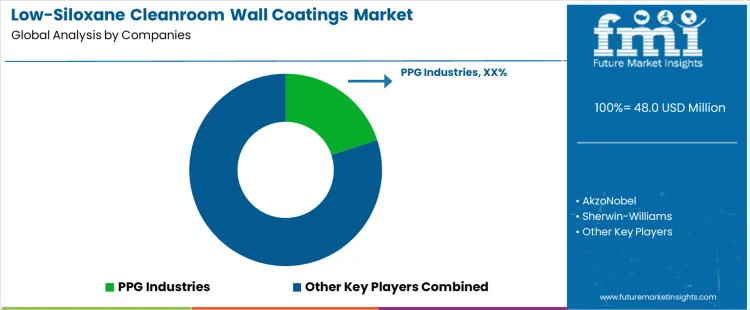
Competition in the Low-Siloxane Cleanroom Wall Coatings Market is driven by contamination risk management rather than decorative or corrosion performance. Coatings are specified to prevent airborne molecular contamination that can interfere with semiconductor yields, pharmaceutical sterility, or biotech processes. PPG Industries and AkzoNobel compete by engineering coatings with tightly controlled raw material profiles, low extractables, and predictable curing behavior that does not introduce volatile siloxanes into controlled environments. Their strategies emphasize qualification against cleanroom standards, compatibility with frequent wipe down protocols, and resistance to disinfectants. Selection decisions are often made by facility engineers and validation teams, where documented performance under real cleanroom conditions outweighs generic coating specifications.
A different competitive emphasis is evident among suppliers focused on specialty and retrofit applications. Sherwin Williams positions low siloxane coatings within broader cleanroom maintenance programs, supporting repainting and refurbishment without compromising contamination limits. Mankiewicz competes through niche industrial coatings tailored for electronics and precision manufacturing spaces, where coating uniformity and adhesion to specialized substrates are critical. RPM International, including Carboline and other specialist divisions, targets environments requiring chemical resistance alongside low siloxane performance. Across the market, competitive advantage depends on validation support, consistency across batches, and the ability to perform reliably under aggressive cleaning cycles. Success is defined by contamination avoidance, audit confidence, and long service intervals rather than coating aesthetics or rapid product turnover.
Key Players in the Low Siloxane Cleanroom Wall Coatings Market
- PPG Industries
- AkzoNobel
- Sherwin-Williams
- Mankiewicz (specialty industrial coatings)
- RPM International (incl. Carboline, specialist divisions)
Scope of the Report
| Items | Values |
|---|---|
| Quantitative Units (2026) | USD million |
| Type | Low siloxane epoxy systems, Low siloxane polyurethane systems, Fluoropolymer and low outgassing fluorinated systems, Ceramic and inorganic barrier coatings, Sol gel and hybrid nano coatings, Antimicrobial and biocide modified low siloxane systems |
| Application | Cleanroom wall and partition surfaces in semiconductor fabrication facilities, pharmaceutical and biotechnology cleanrooms, medical device manufacturing areas, aerospace and defense cleanrooms, optics and precision instrument manufacturing spaces |
| End Users | Semiconductor manufacturers, Pharmaceutical and biotechnology companies, Medical device manufacturers, Aerospace and defense manufacturers, Research laboratories and universities, Food technology facility operators |
| Regions Covered | Asia Pacific, Europe, North America, Latin America, Middle East and Africa |
| Countries Covered | China, South Korea, United States, Germany, Japan, India, United Kingdom, France, Italy, Taiwan, Singapore, GCC countries, and other cleanroom-intensive manufacturing regions |
| Key Companies Profiled | PPG Industries, AkzoNobel, Sherwin-Williams, Mankiewicz specialty industrial coatings, RPM International including Carboline and specialist divisions |
| Additional Attributes | Dollar by sales across coating chemistry end-use industry and cleanroom class, siloxane outgassing and airborne molecular contamination benchmarks, ISO and GMP cleanroom compliance requirements, validation and recertification protocols for wall coatings, resistance to frequent chemical wipedown and disinfectants, surface durability and maintenance interval considerations |
Low-Siloxane Cleanroom Wall Coatings Market Segmentation
End-use Industry:
- Semiconductor and integrated circuit fabrication facilities
- Pharmaceutical and biotechnology cleanrooms
- Medical device manufacturing facilities
- Aerospace and defense cleanrooms
- Optics and precision instrument manufacturing
- Food technology facilities, research laboratories, and universities
Coating Chemistry:
- Low siloxane epoxy systems
- Low siloxane polyurethane systems
- Fluoropolymer and low outgassing fluorinated systems
- Ceramic and inorganic barrier coatings
- Sol gel and hybrid nano coatings
- Antimicrobial and biocide modified low siloxane systems
Functional Performance:
- Low outgassing and low VOC performance with siloxane control
- Particle and particulate suppression with smooth surface finish
- Chemical and solvent resistance
- Abrasion resistance and cleanability for frequent wipedown
- Antimicrobial and hygienic surface properties
Cleanroom Class:
- ISO Class 1-3 (ultra-clean)
- ISO Class 4-6 (high-clean)
- ISO Class 7-9 (controlled, ambient)
Region
-
Asia Pacific
- China
- Japan
- South Korea
- India
- Australia & New Zealand
- ASEAN
- Rest of Asia Pacific
-
Europe
- Germany
- United Kingdom
- France
- Italy
- Spain
- Nordic
- BENELUX
- Rest of Europe
-
North America
- United States
- Canada
- Mexico
-
Latin America
- Brazil
- Chile
- Rest of Latin America
-
Middle East & Africa
- Kingdom of Saudi Arabia
- Other GCC Countries
- Turkey
- South Africa
- Other African Union
- Rest of Middle East & Africa
Frequently Asked Questions
How big is the low-siloxane cleanroom wall coatings market in 2026?
The global low-siloxane cleanroom wall coatings market is estimated to be valued at USD 48.0 million in 2026.
What will be the size of low-siloxane cleanroom wall coatings market in 2036?
The market size for the low-siloxane cleanroom wall coatings market is projected to reach USD 97.1 million by 2036.
How much will be the low-siloxane cleanroom wall coatings market growth between 2026 and 2036?
The low-siloxane cleanroom wall coatings market is expected to grow at a 7.3% CAGR between 2026 and 2036.
What are the key product types in the low-siloxane cleanroom wall coatings market?
The key product types in low-siloxane cleanroom wall coatings market are semiconductor and integrated circuit fabrication facilities, pharmaceutical and biotechnology cleanrooms, medical device manufacturing facilities, aerospace and defense cleanrooms, optics and precision instrument manufacturing and food technology facilities, research laboratories, and universities.
Which coating chemistry segment to contribute significant share in the low-siloxane cleanroom wall coatings market in 2026?
In terms of coating chemistry, low siloxane epoxy systems segment to command 34.0% share in the low-siloxane cleanroom wall coatings market in 2026.
Preview the report firsthand - request a free sample
Get SampleGet the brochure for pricing and purchase details.
Get PDFTable of Content
- Executive Summary
- Global Market Outlook
- Demand-side Trends
- Supply-side Trends
- Technology Roadmap Analysis
- Analysis and Recommendations
- Market Overview
- Market Coverage / Taxonomy
- Market Definition / Scope / Limitations
- Market Background
- Market Dynamics
- Drivers
- Restraints
- Opportunity
- Trends
- Scenario Forecast
- Demand in Optimistic Scenario
- Demand in Likely Scenario
- Demand in Conservative Scenario
- Opportunity Map Analysis
- Product Life Cycle Analysis
- Supply Chain Analysis
- Investment Feasibility Matrix
- Value Chain Analysis
- PESTLE and Porter’s Analysis
- Regulatory Landscape
- Regional Parent Market Outlook
- Production and Consumption Statistics
- Import and Export Statistics
- Market Dynamics
- Global Market Analysis 2021 to 2025 and Forecast, 2026 to 2036
- Historical Market Size Value (USD Million) Analysis, 2021 to 2025
- Current and Future Market Size Value (USD Million) Projections, 2026 to 2036
- Y-o-Y Growth Trend Analysis
- Absolute $ Opportunity Analysis
- Global Market Pricing Analysis 2021 to 2025 and Forecast 2026 to 2036
- Global Market Analysis 2021 to 2025 and Forecast 2026 to 2036, By End-use Industry
- Introduction / Key Findings
- Historical Market Size Value (USD Million) Analysis By End-use Industry , 2021 to 2025
- Current and Future Market Size Value (USD Million) Analysis and Forecast By End-use Industry , 2026 to 2036
- Semiconductor and integrated circuit fabrication facilities
- Pharmaceutical and biotechnology cleanrooms
- Medical device manufacturing facilities
- Aerospace and defense cleanrooms
- Optics and precision instrument manufacturing
- Food technology facilities, research laboratories, and universities
- Semiconductor and integrated circuit fabrication facilities
- Y-o-Y Growth Trend Analysis By End-use Industry , 2021 to 2025
- Absolute $ Opportunity Analysis By End-use Industry , 2026 to 2036
- Global Market Analysis 2021 to 2025 and Forecast 2026 to 2036, By Coating Chemistry
- Introduction / Key Findings
- Historical Market Size Value (USD Million) Analysis By Coating Chemistry, 2021 to 2025
- Current and Future Market Size Value (USD Million) Analysis and Forecast By Coating Chemistry, 2026 to 2036
- Low siloxane epoxy systems
- Low siloxane polyurethane systems
- Fluoropolymer and low outgassing fluorinated systems
- Ceramic and inorganic barrier coatings
- Sol gel and hybrid nano coatings
- Antimicrobial and biocide modified low siloxane systems
- Low siloxane epoxy systems
- Y-o-Y Growth Trend Analysis By Coating Chemistry, 2021 to 2025
- Absolute $ Opportunity Analysis By Coating Chemistry, 2026 to 2036
- Global Market Analysis 2021 to 2025 and Forecast 2026 to 2036, By Functional Performance
- Introduction / Key Findings
- Historical Market Size Value (USD Million) Analysis By Functional Performance, 2021 to 2025
- Current and Future Market Size Value (USD Million) Analysis and Forecast By Functional Performance, 2026 to 2036
- Low outgassing and low VOC performance with siloxane control
- Particle and particulate suppression with smooth surface finish
- Chemical and solvent resistance
- Abrasion resistance and cleanability for frequent wipedown
- Antimicrobial and hygienic surface properties
- Low outgassing and low VOC performance with siloxane control
- Y-o-Y Growth Trend Analysis By Functional Performance, 2021 to 2025
- Absolute $ Opportunity Analysis By Functional Performance, 2026 to 2036
- Global Market Analysis 2021 to 2025 and Forecast 2026 to 2036, By Cleanroom Class
- Introduction / Key Findings
- Historical Market Size Value (USD Million) Analysis By Cleanroom Class, 2021 to 2025
- Current and Future Market Size Value (USD Million) Analysis and Forecast By Cleanroom Class, 2026 to 2036
- ISO Class 1-3 (ultra-clean)
- ISO Class 4-6 (high-clean)
- ISO Class 7-9 (controlled,ambient)
- ISO Class 1-3 (ultra-clean)
- Y-o-Y Growth Trend Analysis By Cleanroom Class, 2021 to 2025
- Absolute $ Opportunity Analysis By Cleanroom Class, 2026 to 2036
- Global Market Analysis 2021 to 2025 and Forecast 2026 to 2036, By Region
- Introduction
- Historical Market Size Value (USD Million) Analysis By Region, 2021 to 2025
- Current Market Size Value (USD Million) Analysis and Forecast By Region, 2026 to 2036
- North America
- Latin America
- Western Europe
- Eastern Europe
- East Asia
- South Asia and Pacific
- Middle East & Africa
- Market Attractiveness Analysis By Region
- North America Market Analysis 2021 to 2025 and Forecast 2026 to 2036, By Country
- Historical Market Size Value (USD Million) Trend Analysis By Market Taxonomy, 2021 to 2025
- Market Size Value (USD Million) Forecast By Market Taxonomy, 2026 to 2036
- By Country
- USA
- Canada
- Mexico
- By End-use Industry
- By Coating Chemistry
- By Functional Performance
- By Cleanroom Class
- By Country
- Market Attractiveness Analysis
- By Country
- By End-use Industry
- By Coating Chemistry
- By Functional Performance
- By Cleanroom Class
- Key Takeaways
- Latin America Market Analysis 2021 to 2025 and Forecast 2026 to 2036, By Country
- Historical Market Size Value (USD Million) Trend Analysis By Market Taxonomy, 2021 to 2025
- Market Size Value (USD Million) Forecast By Market Taxonomy, 2026 to 2036
- By Country
- Brazil
- Chile
- Rest of Latin America
- By End-use Industry
- By Coating Chemistry
- By Functional Performance
- By Cleanroom Class
- By Country
- Market Attractiveness Analysis
- By Country
- By End-use Industry
- By Coating Chemistry
- By Functional Performance
- By Cleanroom Class
- Key Takeaways
- Western Europe Market Analysis 2021 to 2025 and Forecast 2026 to 2036, By Country
- Historical Market Size Value (USD Million) Trend Analysis By Market Taxonomy, 2021 to 2025
- Market Size Value (USD Million) Forecast By Market Taxonomy, 2026 to 2036
- By Country
- Germany
- UK
- Italy
- Spain
- France
- Nordic
- BENELUX
- Rest of Western Europe
- By End-use Industry
- By Coating Chemistry
- By Functional Performance
- By Cleanroom Class
- By Country
- Market Attractiveness Analysis
- By Country
- By End-use Industry
- By Coating Chemistry
- By Functional Performance
- By Cleanroom Class
- Key Takeaways
- Eastern Europe Market Analysis 2021 to 2025 and Forecast 2026 to 2036, By Country
- Historical Market Size Value (USD Million) Trend Analysis By Market Taxonomy, 2021 to 2025
- Market Size Value (USD Million) Forecast By Market Taxonomy, 2026 to 2036
- By Country
- Russia
- Poland
- Hungary
- Balkan & Baltic
- Rest of Eastern Europe
- By End-use Industry
- By Coating Chemistry
- By Functional Performance
- By Cleanroom Class
- By Country
- Market Attractiveness Analysis
- By Country
- By End-use Industry
- By Coating Chemistry
- By Functional Performance
- By Cleanroom Class
- Key Takeaways
- East Asia Market Analysis 2021 to 2025 and Forecast 2026 to 2036, By Country
- Historical Market Size Value (USD Million) Trend Analysis By Market Taxonomy, 2021 to 2025
- Market Size Value (USD Million) Forecast By Market Taxonomy, 2026 to 2036
- By Country
- China
- Japan
- South Korea
- By End-use Industry
- By Coating Chemistry
- By Functional Performance
- By Cleanroom Class
- By Country
- Market Attractiveness Analysis
- By Country
- By End-use Industry
- By Coating Chemistry
- By Functional Performance
- By Cleanroom Class
- Key Takeaways
- South Asia and Pacific Market Analysis 2021 to 2025 and Forecast 2026 to 2036, By Country
- Historical Market Size Value (USD Million) Trend Analysis By Market Taxonomy, 2021 to 2025
- Market Size Value (USD Million) Forecast By Market Taxonomy, 2026 to 2036
- By Country
- India
- ASEAN
- Australia & New Zealand
- Rest of South Asia and Pacific
- By End-use Industry
- By Coating Chemistry
- By Functional Performance
- By Cleanroom Class
- By Country
- Market Attractiveness Analysis
- By Country
- By End-use Industry
- By Coating Chemistry
- By Functional Performance
- By Cleanroom Class
- Key Takeaways
- Middle East & Africa Market Analysis 2021 to 2025 and Forecast 2026 to 2036, By Country
- Historical Market Size Value (USD Million) Trend Analysis By Market Taxonomy, 2021 to 2025
- Market Size Value (USD Million) Forecast By Market Taxonomy, 2026 to 2036
- By Country
- Kingdom of Saudi Arabia
- Other GCC Countries
- Turkiye
- South Africa
- Other African Union
- Rest of Middle East & Africa
- By End-use Industry
- By Coating Chemistry
- By Functional Performance
- By Cleanroom Class
- By Country
- Market Attractiveness Analysis
- By Country
- By End-use Industry
- By Coating Chemistry
- By Functional Performance
- By Cleanroom Class
- Key Takeaways
- Key Countries Market Analysis
- USA
- Pricing Analysis
- Market Share Analysis, 2025
- By End-use Industry
- By Coating Chemistry
- By Functional Performance
- By Cleanroom Class
- Canada
- Pricing Analysis
- Market Share Analysis, 2025
- By End-use Industry
- By Coating Chemistry
- By Functional Performance
- By Cleanroom Class
- Mexico
- Pricing Analysis
- Market Share Analysis, 2025
- By End-use Industry
- By Coating Chemistry
- By Functional Performance
- By Cleanroom Class
- Brazil
- Pricing Analysis
- Market Share Analysis, 2025
- By End-use Industry
- By Coating Chemistry
- By Functional Performance
- By Cleanroom Class
- Chile
- Pricing Analysis
- Market Share Analysis, 2025
- By End-use Industry
- By Coating Chemistry
- By Functional Performance
- By Cleanroom Class
- Germany
- Pricing Analysis
- Market Share Analysis, 2025
- By End-use Industry
- By Coating Chemistry
- By Functional Performance
- By Cleanroom Class
- UK
- Pricing Analysis
- Market Share Analysis, 2025
- By End-use Industry
- By Coating Chemistry
- By Functional Performance
- By Cleanroom Class
- Italy
- Pricing Analysis
- Market Share Analysis, 2025
- By End-use Industry
- By Coating Chemistry
- By Functional Performance
- By Cleanroom Class
- Spain
- Pricing Analysis
- Market Share Analysis, 2025
- By End-use Industry
- By Coating Chemistry
- By Functional Performance
- By Cleanroom Class
- France
- Pricing Analysis
- Market Share Analysis, 2025
- By End-use Industry
- By Coating Chemistry
- By Functional Performance
- By Cleanroom Class
- India
- Pricing Analysis
- Market Share Analysis, 2025
- By End-use Industry
- By Coating Chemistry
- By Functional Performance
- By Cleanroom Class
- ASEAN
- Pricing Analysis
- Market Share Analysis, 2025
- By End-use Industry
- By Coating Chemistry
- By Functional Performance
- By Cleanroom Class
- Australia & New Zealand
- Pricing Analysis
- Market Share Analysis, 2025
- By End-use Industry
- By Coating Chemistry
- By Functional Performance
- By Cleanroom Class
- China
- Pricing Analysis
- Market Share Analysis, 2025
- By End-use Industry
- By Coating Chemistry
- By Functional Performance
- By Cleanroom Class
- Japan
- Pricing Analysis
- Market Share Analysis, 2025
- By End-use Industry
- By Coating Chemistry
- By Functional Performance
- By Cleanroom Class
- South Korea
- Pricing Analysis
- Market Share Analysis, 2025
- By End-use Industry
- By Coating Chemistry
- By Functional Performance
- By Cleanroom Class
- Russia
- Pricing Analysis
- Market Share Analysis, 2025
- By End-use Industry
- By Coating Chemistry
- By Functional Performance
- By Cleanroom Class
- Poland
- Pricing Analysis
- Market Share Analysis, 2025
- By End-use Industry
- By Coating Chemistry
- By Functional Performance
- By Cleanroom Class
- Hungary
- Pricing Analysis
- Market Share Analysis, 2025
- By End-use Industry
- By Coating Chemistry
- By Functional Performance
- By Cleanroom Class
- Kingdom of Saudi Arabia
- Pricing Analysis
- Market Share Analysis, 2025
- By End-use Industry
- By Coating Chemistry
- By Functional Performance
- By Cleanroom Class
- Turkiye
- Pricing Analysis
- Market Share Analysis, 2025
- By End-use Industry
- By Coating Chemistry
- By Functional Performance
- By Cleanroom Class
- South Africa
- Pricing Analysis
- Market Share Analysis, 2025
- By End-use Industry
- By Coating Chemistry
- By Functional Performance
- By Cleanroom Class
- USA
- Market Structure Analysis
- Competition Dashboard
- Competition Benchmarking
- Market Share Analysis of Top Players
- By Regional
- By End-use Industry
- By Coating Chemistry
- By Functional Performance
- By Cleanroom Class
- Competition Analysis
- Competition Deep Dive
- PPG Industries
- Overview
- Product Portfolio
- Profitability by Market Segments (Product/Age /Sales Channel/Region)
- Sales Footprint
- Strategy Overview
- Marketing Strategy
- Product Strategy
- Channel Strategy
- AkzoNobel
- Sherwin-Williams
- Mankiewicz (specialty industrial coatings)
- RPM International (incl. Carboline, specialist divisions)
- PPG Industries
- Competition Deep Dive
- Assumptions & Acronyms Used
- Research Methodology


