

- Market Size (2026)
- USD 12.4 Bn
- Forecast (2036)
- USD 24.6 Bn
- CAGR (2026 to 2036)
- 7.1%
How big is Low Smoke Zero Halogen (LSZH) Cables Market in 2026?
USD 12.4 billion in 2026 and USD 24.6 billion by 2036 at a 7.1% CAGR.
Demand for low smoke zero halogen cables is projected to rise as dense buildings and digital facilities specify measured fire behavior alongside electrical performance. Sumitomo Electric reported in October 2025 that its 6,912-fiber data-center cable used a newly developed LSZH outer jacket that passed UL riser fire-safety requirements. That combination makes data center cabling qualification a product-design task rather than a material-label check.
Country conversion depends on project rules and the point at which engineers approve cable families for installation. Dubai's Media Office announced an AED 2 billion hyperscale data centre in April 2025 that du plans to develop with Microsoft as primary tenant. Projects of that scale create concentrated wire and cable packages where documented smoke performance can influence approved-product lists and order timing.
-cables-market-value-analysis.webp "Low Smoke Zero Halogen (lszh) Cables Market Value Analysis")
Key Takeaways of Low Smoke Zero Halogen (LSZH) Cables Market
- Fire-performance specifications expand addressable demand where occupied infrastructure requires low smoke and low corrosive-gas output during a fire.
- Control cables are projected to account for 28.0% share in 2026 as automation and safety circuits create repeatable qualified runs.
- Medium voltage is estimated to represent 62.0% of voltage demand in 2026 because infrastructure packages carry larger cable values and stricter engineering approval.
- EVA-based LSZH is anticipated to capture 46.0% by jacket material in 2026 as compound flexibility supports demanding cable constructions and installation needs.
- Separate fire-resistance tests and project-specific approvals can delay substitutions even where an LSZH material requirement is already accepted.
- Prysmian, Nexans, NKT, Sumitomo Electric, LS Cable & System, Belden, Southwire and KEI Industries form the controlled company set.
Analyst Perspective
"Commercial value depends on proving the complete cable construction against the electrical duty and required fire tests before tender submission. Cable makers that combine documented qualification with local engineering support reduce redesign risk and protect approved specifications during project changes."
- Sudip saha, Principal Consultant, Future Market Insights
How is the Low Smoke Zero Halogen (LSZH) Cables Market segmented?
The market is segmented by cable type, voltage, jacket material, end use, sales channel and region.
Cable type covers power, control, data or LAN, instrumentation, fiber optic and building-wire cables. Voltage includes low, medium and high voltage. Jacket material includes polyolefin LSZH, EVA-based LSZH, TPE or TPU LSZH and crosslinked LSZH. End use covers buildings and infrastructure, rail and metro, marine and offshore, data centers and industrial plants. Sales channels include cable OEM direct, electrical distributors, project or EPC supply and telecom channel.
Why do control cables lead demand within the cable type category?
-cables-market-analysis-by-cable-type.webp "Low Smoke Zero Halogen (lszh) Cables Market Analysis By Cable Type")
Control cables link sensors and safety devices to automation systems where a jacket change cannot compromise signal behavior or installation limits. Belden reported in June 2025 that its EN-IEC rated LSZH RS485 AWG18 cables support longer RS-485 runs with lower voltage drop and higher current for powered devices.
- By cable type, control cables are projected to account for 28.0% in 2026 as recurring automation circuits favor standardized qualified constructions.
- Plant engineers approve control cable around communication performance and fire documentation together, which rewards families that reduce repeated technical reviews across similar industrial installations and contractor teams.
Why does medium voltage lead demand within the voltage category?
Medium-voltage cable carries concentrated project value across substations and large facilities, so jacket selection is reviewed alongside fault duty and installation design. Southwire announced in November 2025 that a planned 340,000-square-foot Heflin expansion would increase medium-voltage cable production after commissioning at the expanded site.
- Medium voltage is estimated to represent 62.0% of voltage demand in 2026 because fewer circuit runs can still carry substantial project cable value.
- Engineering teams usually qualify medium-voltage constructions at project level, which makes complete test records and manufacturing consistency central to substitution decisions during phased infrastructure packages and scheduled outages.
What supports EVA-based LSZH within the jacket material category?
EVA-based LSZH compounds give commercial wire and cable designers a formulation route that balances flame response with flexibility across demanding indoor cable constructions. NKT reported in January 2026 that electrical fires account for roughly 25-30% of domestic fires across Europe while explaining stricter CPR fire-performance expectations.
- By jacket material, EVA-based LSZH is anticipated to capture 46.0% in 2026 as compound flexibility supports installation without abandoning defined fire-performance targets.
- Cable manufacturers still qualify the finished construction rather than the resin alone, so mechanical behavior and smoke testing determine whether an EVA formulation remains commercially usable across repeated product families.
Why does rail & metro lead demand within the end use category?
Rail and metro networks place fire-resistant cable families inside stations and tunnels where smoke behavior directly affects specification reviews for occupied transport infrastructure. Deutsche Bahn reported in June 2026 that its completed Hamburg-Berlin corridor renewal installed 165 kilometers of new track and 249 new switches across the route.
- Rail and metro is forecast to account for 35.0% of end-use demand in 2026 as renewal projects combine power and control cable packages.
- Transit authorities rely on approved product families for repeat projects, which favors cable makers with rail documentation and local technical support during design changes or urgent replacement work.
What are the drivers, restraints and opportunities in the Low Smoke Zero Halogen (LSZH) Cables Market?
Measured fire classes support specification-led demand while separate resistance requirements can extend qualification. Pre-qualified cable families create a route to faster project conversion.
- Driver: Measured smoke and acidity classes give engineers procurement criteria that distinguish qualified low-smoke cable constructions from generic fire claims.
- Restraint: LSZH chemistry does not replace separate resistance-to-fire and circuit-continuity requirements attached to critical electrical installations.
- Opportunity: Pre-qualified families can shorten technical review for rail and data-center projects that need repeatable power and communication cable packages.
Measured Fire Classes Strengthen Specification Discipline
Engineers can specify low-smoke cable more precisely once fire classifications state measurable smoke and acidity performance for construction products. Commission Delegated Regulation (EU) 2026/331 published in April 2026 includes cable classes that distinguish smoke production and acidity performance for installed products. Clear classes make low-voltage wire submissions easier to compare during tender review without treating every halogen-free construction as equivalent.
Separate Fire Requirements Extend Qualification
Low-smoke chemistry addresses one part of fire behavior but critical circuits can require a separate resistance-to-fire assessment before approval. Commission Delegated Regulation (EU) 2026/557 published in June 2026 defines fire-resistance classes for electrical power and communication installations including rated-voltage declarations for cables. Cable makers therefore need evidence for the complete duty because a low-smoke jacket alone cannot establish circuit continuity.
Pre-Qualified Families Improve Project Conversion
Data-center expansion creates an opening for suppliers that can match electrical duty with pre-approved fire documentation before construction schedules tighten. The UK government reported in November 2025 that grid connections were the single biggest blocker for AI Growth Zones and outlined measures to accelerate viable sites. Once power access advances, insulated wires and cables with established qualification records can move into project packages with fewer technical revisions.
Which country CAGRs are profiled in the Low Smoke Zero Halogen (LSZH) Cables Market?
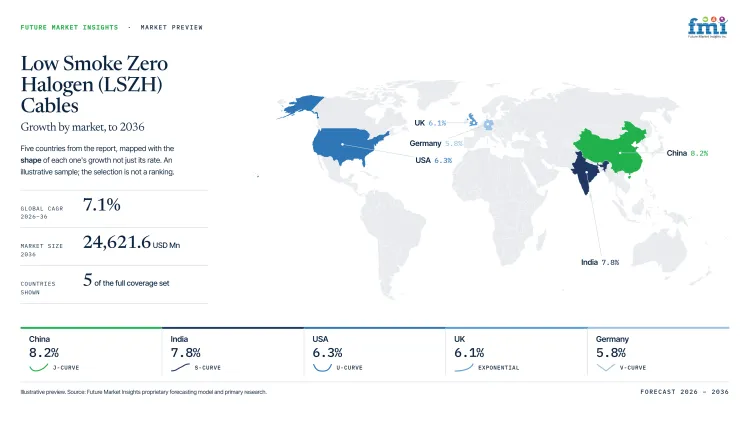
| Country | CAGR |
|---|---|
| UAE | 7.0% |
| USA | 6.3% |
| UK | 6.1% |
| Germany | 5.8% |
| Japan | 5.4% |
How do country-level CAGRs compare in the Low Smoke Zero Halogen (LSZH) Cables Market?
A 1.6 percentage-point range separates the five profiled markets from the UAE at 7.0% to Japan at 5.4%. The UAE forms the faster project-led tier while the USA and UK occupy a middle band. Germany and Japan show slower forecast pace as mature approval practices place greater weight on qualification depth.
- UAE projects concentrate orders in consultant-led metro and digital construction packages.
- USA adoption depends heavily on owner specifications across data-center and critical-facility projects.
- UK data-center schedules remain tied to power access and planning evidence.
- Germany's rail renewal favors documented fire classifications and local engineering support.
- Japan links data-center power planning with rigorous local technical qualification.
The spread reflects different conversion conditions rather than a simple ranking of present market size.
The full report provides country-level CAGR analysis across North America, Latin America, Europe, East Asia, South Asia, Oceania and the Middle East and Africa.
Country-wise Analysis
- UAE cable selection on major transport projects is consultant-led and depends on approved submittals that connect fire performance with installation requirements across each electrical package and tightly scheduled construction stage for major public projects. Low smoke zero halogen cable demand in the UAE is forecast to expand at 7.0% CAGR through 2036 as Dubai RTA began the 30-kilometer Blue Line with 14 stations in June 2025 across districts. Regional stock and fast EPC support help qualified families convert specifications into orders, although project documentation and compressed schedules penalize manufacturers that depend on distant technical approvals and slow substitution responses during tender changes.
- USA adoption is strongest in data centers and critical facilities where owners add low-smoke requirements beyond minimum electrical code and expect domestic inventory for rapid project changes across several cable functions and sites. The USA LSZH cable sector is projected to record 6.3% CAGR through 2036 as Berkeley Lab estimated in June 2026 that data centers could account for 11.8% of total USA electricity use by 2030. Local manufacturing and broad fiber optics channels improve availability for qualified cable families, yet optional LSZH specifications and entrenched installation practices can keep conventional constructions competitive on price-sensitive jobs requiring familiar terminations today.
- UK data-center cable packages pass through consultants and contractors that require clear product declarations before final schedules move into procurement across power and communications systems for large phased sites with tightly managed construction sequences. Adoption of LSZH cables in the UK is estimated to expand at 6.1% CAGR through 2036 as June 2025 AI Growth Zone guidance required sites to demonstrate 500 MW of power by 2030. Established contractor networks move approved cable families quickly once site conditions are fixed, although planning and grid uncertainty can delay construction packages before cable specifications become firm orders with committed delivery dates on projects.
- German rail projects favor precise documentation and local engineering support because cable substitutions must fit regulated construction requirements alongside strict infrastructure approval procedures and established maintenance practices across busy national routes and renewal programs. Germany is estimated to post 5.8% CAGR over the forecast period as Deutsche Bahn reported that its August 2025 Regensburg-Schwandorf line renewal completed 47 kilometers of track and replaced 28 switches across seven crossings. European manufacturing access shortens service response for qualified cable families, yet price pressure remains material because each offered construction still needs the exact fire class and project acceptance required for the installation.
- Japanese data-center projects combine local technical review with established contractor relationships, so new cable constructions need detailed qualification before they can displace familiar approved products across high-reliability electrical and communications systems serving major facilities. LSZH cable sales in Japan are forecast to expand at 5.4% CAGR by 2036 as METI and MIC published the Watt-Bit report in June 2025 to coordinate electricity and telecommunications infrastructure for data centers. Domestic engineering support strengthens access to high-reliability projects, although deep customer qualification and incumbent relationships can lengthen the time required for an alternative cable family to secure approval across established contractor networks.
Who are the notable companies in the Low Smoke Zero Halogen (LSZH) Cables Market?
Prysmian, Nexans, NKT, Sumitomo Electric, LS Cable & System, Belden, Southwire and KEI Industries are the notable companies serving this market.
-cables-market-analysis-by-company.webp "Low Smoke Zero Halogen (lszh) Cables Market Analysis By Company")
Competition spans integrated power-cable groups and specialized copper cabling systems manufacturers with different routes into project specifications. Entry barriers come from qualified fire-performance records and cable-system breadth plus the local support needed to preserve approved constructions during project changes.
- Prysmian, Nexans, NKT and Southwire compete across broad power and infrastructure cable platforms with established manufacturing access.
- Sumitomo Electric, LS Cable & System and Belden compete where data-center or control applications require specialized fire-performance documentation.
- KEI Industries adds a regional power and building-wire platform with current zero-halogen fire-resistant cable activity in India.
Competitive Benchmarking: Low Smoke Zero Halogen (LSZH) Cables Market
| Company | Fire-Performance Qualification Depth | Cable and Voltage Breadth | Project Delivery Readiness | Geographic Reach |
|---|---|---|---|---|
| Prysmian | High | High | High | Global |
| Nexans | High | High | High | Global |
| NKT | High | High | High | Europe and selected international markets |
| Sumitomo Electric | High | Medium | High | Asia, North America and Europe |
| LS Cable & System | Medium | High | High | Asia, Europe and North America |
| Belden | High | Medium | High | North America, Europe, Asia and Africa |
| Southwire | Medium | High | High | North America and selected international markets |
| KEI Industries | Medium | High | Medium | India and international export markets |
Key Developments in the Low Smoke Zero Halogen (LSZH) Cables Market
- In July 2026, Prysmian signed an agreement with Molex for optical cables used inside data centers for a period of up to ten years and announced plans to more than double USA fiber capacity.
- In August 2025, Belden launched Essential-Lite LSZH IEC-EN rated cables for standard indoor environments alongside other connectivity products for critical applications.
- In June 2025, Nexans completed its acquisition of Spanish low-voltage producer Cables RCT to strengthen fire-safety building cable capacity and Southern European access.
Key Players in the Low Smoke Zero Halogen (LSZH) Cables Market
Integrated Power and Infrastructure Cable Platforms
- Prysmian
- Nexans
- NKT
- Southwire
Data, Control and Fire-Performance Specialists
- Sumitomo Electric
- LS Cable & System
- Belden
Regional Power Cable Platforms
- KEI Industries
Low Smoke Zero Halogen (LSZH) Cables Market - Report Scope
| Coverage field | Report scope |
|---|---|
| Market breakdown | By cable type, voltage, jacket material, end use, sales channel and region. |
| Quantitative Units | Revenue in USD million and CAGR in %. |
| Market Definition | Commercial low smoke zero halogen cable revenue across power, control, data, instrumentation, fiber-optic and building-wire applications that use qualified low-smoke halogen-free constructions. |
| Regions Covered | North America, Latin America, Europe, East Asia, South Asia and Pacific and Middle East and Africa. |
| Countries Covered | United Arab Emirates, United States, United Kingdom, Germany, Japan, and 20+ countries included in the full report. |
| Key Companies Profiled | Prysmian, Nexans, NKT, Sumitomo Electric, LS Cable & System, Belden, Southwire, KEI Industries. |
| Forecast Period | 2026 to 2036. |
| Approach | Primary and secondary research with market triangulation. |
Low Smoke Zero Halogen (LSZH) Cables Market - Research Methodology
| Method | Approach |
|---|---|
| Primary Research | FMI analysts gathered input from manufacturers, service providers, technology developers, distributors, end users, procurement teams, and subject-matter experts. Interviews examined purchasing decisions, product or service evaluation, adoption barriers, approval requirements, pricing considerations, and expectations for technical or commercial support. Respondents were also asked what evidence is required before a trial, pilot, or initial order develops into regular purchasing. |
| Desk Research | Desk research covered government statistics, regulatory publications, trade data, industry associations, technical literature, standards, company filings, product information, and official corporate announcements. Sources were reviewed for relevance, publication date, geographic coverage, and consistency with the defined market scope. Claims relating to performance, applications, approvals, capacity, investment, and commercial activity were retained only when supported by credible public evidence. |
| Market Sizing and Forecasting | The market model combined the baseline value with historical performance, segment structure, pricing and volume indicators, adoption levels, company participation, and country-level demand conditions. Forecast assumptions considered economic activity, investment trends, regulatory developments, technology adoption, purchasing cycles, supply availability, and barriers to wider market use. Segment and regional estimates were reconciled before the final market total was calculated. |
| Data Validation | Estimates were checked against multiple independent indicators, including public data, company activity, trade patterns, industry developments, and findings from primary interviews. Validation also tested whether products, services, applications, and company revenues fell within the defined market boundaries. Adjacent categories, unsupported claims, overlapping revenues, and activities without direct market relevance were excluded to reduce double counting and maintain consistency across segments and countries. |
Low Smoke Zero Halogen (LSZH) Cables Market by Segments
Low Smoke Zero Halogen (LSZH) Cables Market segmented by Cable Type:
- Power Cables
- Control Cables
- Data / LAN Cables
- Instrumentation Cables
- Fiber Optic Cables
- Building Wires
Low Smoke Zero Halogen (LSZH) Cables Market segmented by Voltage:
- Low Voltage
- Medium Voltage
- High Voltage
Low Smoke Zero Halogen (LSZH) Cables Market segmented by Jacket Material:
- Polyolefin LSZH
- EVA-Based LSZH
- TPE / TPU LSZH
- Crosslinked LSZH
Low Smoke Zero Halogen (LSZH) Cables Market segmented by End Use:
- Buildings & Infrastructure
- Rail & Metro
- Marine & Offshore
- Data Centers
- Industrial Plants
Low Smoke Zero Halogen (LSZH) Cables Market segmented by Sales Channel:
- Cable OEM Direct
- Electrical Distributors
- Project / EPC Supply
- Telecom Channel
Low Smoke Zero Halogen (LSZH) Cables Market by Region:
- North America
- United States
- Canada
- Latin America
- Brazil
- Mexico
- Chile
- Rest of Latin America
- Western Europe
- Germany
- United Kingdom
- Italy
- Spain
- France
- Nordics
- Benelux
- Rest of Western Europe
- Eastern Europe
- Russia
- Poland
- Hungary
- Balkan and Baltic States
- Rest of Eastern Europe
- East Asia
- China
- Japan
- South Korea
- South Asia and Pacific
- India
- ASEAN
- Australia and New Zealand
- Rest of South Asia and Pacific
- Middle East and Africa
- Kingdom of Saudi Arabia
- Other GCC Countries
- Türkiye
- South Africa
- Other African Union Countries
- Rest of Middle East and Africa
Research Sources and Bibliography
- Sumitomo Electric Industries, Ltd.. (2025, October). SUMITOMO ELECTRIC TECHNICAL REVIEW No. 101: Highly Workable Small-Diameter 6912-Fiber-Count Outdoor/Indoor Cable Suitable for Data Center Wiring.
- Government of Dubai Media Office. (2025, April 22). Hamdan bin Mohammed witnesses announcement of AED2 billion hyperscale data centre at Dubai AI Week 2025.
- Belden. (2025, June 5). Belden Launches Solutions that Deliver Secure Power Connections in Harsh Conditions and Simplify Edge-to-Cloud Data Flow.
- Southwire. (2025, November 12). Southwire To Expand Operations in Heflin Ala..
- NKT. (2026, January 8). Beyond compliance: How CPR is redefining electrical fire protection.
- Deutsche Bahn AG. (2026, June 14). Bahnstrecke Hamburg - Berlin nach Korridorsanierung wieder in Betrieb.
- European Commission. (2026, April 21). Commission Delegated Regulation (EU) 2026/331 of 13 February 2026 supplementing Regulation (EU) 2024/3110 by determining classes of performance in relation to reaction to fire.
- European Commission. (2026, June 3). Commission Delegated Regulation (EU) 2026/557 of 16 March 2026 supplementing Regulation (EU) 2024/3110 by determining classes of performance in relation to resistance to fire.
- Department for Science, Innovation and Technology. (2025, November 13). Delivering AI Growth Zones.
- Roads and Transport Authority. (2025, June 9). Mohammed bin Rashid lays foundation stone for Dubai Metro Blue Line.
- Lawrence Berkeley National Laboratory. (2026, June). United States Data Center Energy Usage Report: 2025 Update.
- Department for Science, Innovation and Technology. (2025, June 13). AI Growth Zones: open for applications.
- Deutsche Bahn AG. (2026, March 27). Development of the infrastructure.
- Ministry of Economy, Trade and Industry. (2025, June 12). Report 1.0 of the Public-Private Advisory Council on Watt-Bit Collaboration Published.
- Prysmian. (2026, July 20). Prysmian to accelerate data center growth in Digital Solutions.
- Belden. (2025, August 28). Belden launches next-gen connectivity and cybersecurity products for critical applications.
- Nexans. (2025, June 2). Nexans further enhances its portfolio in electrification with the acquisition of Cables RCT in Spain.
- LS Cable & System. (2025, September 8). LS Cable & System researchers testing the performance of MV fire-resistant cables.
- KEI Industries. (2026, March 22). Everything You Need to Know About Zero Halogen Fire Resistant (ZHFR) Cables.
This bibliography is provided for reader reference and is not exhaustive. The full report contains the complete reference list and detailed citations.
This Report Answers
- How does specification-led fire performance affect low smoke zero halogen cable purchasing across major infrastructure projects?
- Which operating conditions explain the 7.1% forecast CAGR across the low smoke zero halogen cable market between 2026 and 2036?
- Why do control cables account for 28.0% of cable type demand across the low smoke zero halogen cable market in 2026?
- Why does medium voltage represent 62.0% of the voltage category across the low smoke zero halogen cable market during 2026?
- What makes EVA-based LSZH commercially important within qualified jacket material choices for infrastructure cable manufacturers and project engineers?
- How do the five profiled country CAGRs differ across project pipelines and local cable approval conditions?
- Which supplier capabilities influence access to specification-led cable projects and approved product lists across major infrastructure applications?
- Which qualification requirements restrict broader substitution of conventional cable with LSZH constructions across critical electrical applications?
- What should engineering teams compare before approving an alternative low smoke zero halogen cable family for project use?
Frequently Asked Questions
How big is the Low Smoke Zero Halogen (LSZH) Cables Market in 2026?
The low smoke zero halogen (LSZH) cables market is valued at USD 12.4 billion in 2026 and is projected to reach USD 24.6 billion by 2036. Growth is driven by increasing demand for fire-safe cable solutions across rail, metro, data center, and digital infrastructure projects.
What is the CAGR of the Low Smoke Zero Halogen (LSZH) Cables Market from 2026 to 2036?
The low smoke zero halogen (LSZH) cables market is projected to grow at a CAGR of 7.1% between 2026 and 2036. Expansion is supported by stringent fire-safety requirements and rising deployment of advanced electrical and communication networks.
Which cable type leads the Low Smoke Zero Halogen (LSZH) Cables Market?
Control cables are projected to account for 28.0% of the market in 2026. Their leading share is supported by growing use in automation systems that require reliable signal transmission and enhanced fire-performance characteristics.
Which end-use segment dominates the Low Smoke Zero Halogen (LSZH) Cables Market?
Rail and metro applications are projected to account for 35.0% of the market in 2026. Their dominance is driven by strict safety standards in enclosed transit environments and recurring demand for power and control cable installations.
Which companies are active in the Low Smoke Zero Halogen (LSZH) Cables Market?
Key companies operating in the market include Prysmian, Nexans, NKT, Sumitomo Electric, LS Cable & System, Belden, Southwire, and KEI Industries. These companies compete through broad cable portfolios, fire-safety expertise, and regional infrastructure project participation.
Preview the report firsthand - request a free sample
Get SampleGet the brochure for pricing and purchase details.
Get PDFTable of Content
- Key Takeaways
- Market Size and CAGR
- Top Growth Driver
- Fastest Growing Segment
- Leading Region
- Key Companies
- Emerging Opportunities
- Executive Summary
- Global Market Outlook
- Demand-side Trends
- Supply-side Trends
- Technology Roadmap Analysis
- Analysis and Recommendations
- Analyst Perspective (What is happening? Why now? What should investors know?)
- Key Questions Answered
- How large is the market?
- What is the CAGR?
- What are key trends?
- Which region dominates?
- Who are the leaders?
- Market Overview
- Market Coverage / Taxonomy
- Market Definition / Scope / Limitations
- Research Methodology
- Chapter Orientation
- Analytical Lens and Working Hypotheses
- Market Structure, Signals, and Trend Drivers
- Benchmarking and Cross-market Comparability
- Market Sizing, Forecasting, and Opportunity Mapping
- Research Design and Evidence Framework
- Desk Research Programme (Secondary Evidence)
- Expert Input and Fieldwork (Primary Evidence)
- Tooling, Models, and Reference Databases
- Data Engineering and Model Build
- Quality Assurance and Audit Trail
- Market Background
- Market Dynamics (Drivers, Restraints, Opportunity, Trends)
- Scenario Forecast (Optimistic, Likely, Conservative)
- Impact Analysis
- AI Impact
- Sustainability Impact
- Regulatory Impact
- Technology Impact
- Consumer / Buyer Analysis
- Purchase Drivers
- Adoption Barriers
- Buyer Journey
- Opportunity Map Analysis
- Product Life Cycle Analysis
- Supply Chain Analysis
- Investment Feasibility Matrix
- Value Chain Analysis
- PESTLE and Porter's Analysis
- Regulatory Landscape
- Regional Parent Market Outlook
- Production and Consumption Statistics
- Import and Export Statistics
- Global Market Analysis and Forecast, 2021 to 2036
- Historical Market Size Value (USD Million) Analysis, 2021 to 2025
- Current and Future Market Size Value (USD Million) Projections, 2026 to 2036
- Y-o-Y Growth Trend Analysis
- Absolute $ Opportunity Analysis
- Global Market Pricing Analysis, 2021 to 2036
- Global Market Analysis and Forecast, By Product Type, 2021 to 2036
- Introduction / Key Findings
- Historical Market Size Value (USD Million) Analysis By Product Type, 2021 to 2025
- Current and Future Market Size Value (USD Million) Analysis and Forecast By Product Type, 2026 to 2036
- Power cables
- Control cables
- Data or LAN cables
- Instrumentation cables
- Fiber optic cables
- Building wires
- Power cables
- Y-o-Y Growth Trend Analysis By Product Type, 2021 to 2025
- Absolute $ Opportunity Analysis By Product Type, 2026 to 2036
- Global Market Analysis and Forecast, By Voltage, 2021 to 2036
- Introduction / Key Findings
- Historical Market Size Value (USD Million) Analysis By Voltage, 2021 to 2025
- Current and Future Market Size Value (USD Million) Analysis and Forecast By Voltage, 2026 to 2036
- Low voltage
- Medium voltage
- High voltage
- Low voltage
- Y-o-Y Growth Trend Analysis By Voltage, 2021 to 2025
- Absolute $ Opportunity Analysis By Voltage, 2026 to 2036
- Global Market Analysis and Forecast, By Material Type, 2021 to 2036
- Introduction / Key Findings
- Historical Market Size Value (USD Million) Analysis By Material Type, 2021 to 2025
- Current and Future Market Size Value (USD Million) Analysis and Forecast By Material Type, 2026 to 2036
- Polyolefin LSZH
- EVA-based LSZH
- TPE or TPU LSZH
- Crosslinked LSZH
- Polyolefin LSZH
- Y-o-Y Growth Trend Analysis By Material Type, 2021 to 2025
- Absolute $ Opportunity Analysis By Material Type, 2026 to 2036
- Global Market Analysis and Forecast, By End Use, 2021 to 2036
- Introduction / Key Findings
- Historical Market Size Value (USD Million) Analysis By End Use, 2021 to 2025
- Current and Future Market Size Value (USD Million) Analysis and Forecast By End Use, 2026 to 2036
- Buildings & infrastructure
- Rail & metro
- Marine & offshore
- Data centers
- Industrial plants
- Buildings & infrastructure
- Y-o-Y Growth Trend Analysis By End Use, 2021 to 2025
- Absolute $ Opportunity Analysis By End Use, 2026 to 2036
- Global Market Analysis and Forecast, By Sales Channel, 2021 to 2036
- Introduction / Key Findings
- Historical Market Size Value (USD Million) Analysis By Sales Channel, 2021 to 2025
- Current and Future Market Size Value (USD Million) Analysis and Forecast By Sales Channel, 2026 to 2036
- Cable OEM direct
- Electrical distributors
- Project or EPC supply
- Telecom channel
- Cable OEM direct
- Y-o-Y Growth Trend Analysis By Sales Channel, 2021 to 2025
- Absolute $ Opportunity Analysis By Sales Channel, 2026 to 2036
- Global Market Analysis and Forecast, By Region, 2021 to 2036
- Introduction
- Historical Market Size Value (USD Million) Analysis By Region, 2021 to 2025
- Current Market Size Value (USD Million) Analysis and Forecast By Region, 2026 to 2036
- North America
- Latin America
- Western Europe
- Eastern Europe
- East Asia
- South Asia and Pacific
- Middle East & Africa
- Market Attractiveness Analysis By Region
- North America Market Analysis and Forecast, By Country, 2021 to 2036
- Historical Market Size Value (USD Million) Trend Analysis By Market Taxonomy, 2021 to 2025
- Market Size Value (USD Million) Forecast By Market Taxonomy, 2026 to 2036
- By Country
- USA
- Canada
- By Product Type
- By Voltage
- By Material Type
- By End Use
- By Sales Channel
- By Country
- Market Attractiveness Analysis
- By Country
- By Product Type
- By Voltage
- By Material Type
- By End Use
- By Sales Channel
- Key Takeaways
- Latin America Market Analysis and Forecast, By Country
- Historical Market Size Value (USD Million) Trend Analysis By Market Taxonomy, 2021 to 2025
- Market Size Value (USD Million) Forecast By Market Taxonomy, 2026 to 2036
- By Country
- Brazil
- Mexico
- Chile
- Rest of Latin America
- By Product Type
- By Voltage
- By Material Type
- By End Use
- By Sales Channel
- By Country
- Market Attractiveness Analysis
- By Country
- By Product Type
- By Voltage
- By Material Type
- By End Use
- By Sales Channel
- Key Takeaways
- Western Europe Market Analysis and Forecast, By Country
- Historical Market Size Value (USD Million) Trend Analysis By Market Taxonomy, 2021 to 2025
- Market Size Value (USD Million) Forecast By Market Taxonomy, 2026 to 2036
- By Country
- Germany
- UK
- Italy
- Spain
- France
- Nordic
- BENELUX
- Rest of Western Europe
- By Product Type
- By Voltage
- By Material Type
- By End Use
- By Sales Channel
- By Country
- Market Attractiveness Analysis
- By Country
- By Product Type
- By Voltage
- By Material Type
- By End Use
- By Sales Channel
- Key Takeaways
- Eastern Europe Market Analysis and Forecast, By Country
- Historical Market Size Value (USD Million) Trend Analysis By Market Taxonomy, 2021 to 2025
- Market Size Value (USD Million) Forecast By Market Taxonomy, 2026 to 2036
- By Country
- Russia
- Poland
- Hungary
- Balkan & Baltic
- Rest of Eastern Europe
- By Product Type
- By Voltage
- By Material Type
- By End Use
- By Sales Channel
- By Country
- Market Attractiveness Analysis
- By Country
- By Product Type
- By Voltage
- By Material Type
- By End Use
- By Sales Channel
- Key Takeaways
- East Asia Market Analysis and Forecast, By Country
- Historical Market Size Value (USD Million) Trend Analysis By Market Taxonomy, 2021 to 2025
- Market Size Value (USD Million) Forecast By Market Taxonomy, 2026 to 2036
- By Country
- China
- Japan
- South Korea
- By Product Type
- By Voltage
- By Material Type
- By End Use
- By Sales Channel
- By Country
- Market Attractiveness Analysis
- By Country
- By Product Type
- By Voltage
- By Material Type
- By End Use
- By Sales Channel
- Key Takeaways
- South Asia and Pacific Market Analysis and Forecast, By Country
- Historical Market Size Value (USD Million) Trend Analysis By Market Taxonomy, 2021 to 2025
- Market Size Value (USD Million) Forecast By Market Taxonomy, 2026 to 2036
- By Country
- India
- ASEAN
- Australia & New Zealand
- Rest of South Asia and Pacific
- By Product Type
- By Voltage
- By Material Type
- By End Use
- By Sales Channel
- By Country
- Market Attractiveness Analysis
- By Country
- By Product Type
- By Voltage
- By Material Type
- By End Use
- By Sales Channel
- Key Takeaways
- Middle East & Africa Market Analysis and Forecast, By Country
- Historical Market Size Value (USD Million) Trend Analysis By Market Taxonomy, 2021 to 2025
- Market Size Value (USD Million) Forecast By Market Taxonomy, 2026 to 2036
- By Country
- Kingdom of Saudi Arabia
- Other GCC Countries
- Türkiye
- South Africa
- Other African Union
- Rest of Middle East & Africa
- By Product Type
- By Voltage
- By Material Type
- By End Use
- By Sales Channel
- By Country
- Market Attractiveness Analysis
- By Country
- By Product Type
- By Voltage
- By Material Type
- By End Use
- By Sales Channel
- Key Takeaways
- Key Countries Market Analysis
- USA
- Pricing Analysis
- Market Share Analysis, 2025
- By Product Type
- By Voltage
- By Material Type
- By End Use
- By Sales Channel
- Canada
- Pricing Analysis
- Market Share Analysis, 2025
- By Product Type
- By Voltage
- By Material Type
- By End Use
- By Sales Channel
- Mexico
- Pricing Analysis
- Market Share Analysis, 2025
- By Product Type
- By Voltage
- By Material Type
- By End Use
- By Sales Channel
- Brazil
- Pricing Analysis
- Market Share Analysis, 2025
- By Product Type
- By Voltage
- By Material Type
- By End Use
- By Sales Channel
- Chile
- Pricing Analysis
- Market Share Analysis, 2025
- By Product Type
- By Voltage
- By Material Type
- By End Use
- By Sales Channel
- Germany
- Pricing Analysis
- Market Share Analysis, 2025
- By Product Type
- By Voltage
- By Material Type
- By End Use
- By Sales Channel
- UK
- Pricing Analysis
- Market Share Analysis, 2025
- By Product Type
- By Voltage
- By Material Type
- By End Use
- By Sales Channel
- Italy
- Pricing Analysis
- Market Share Analysis, 2025
- By Product Type
- By Voltage
- By Material Type
- By End Use
- By Sales Channel
- Spain
- Pricing Analysis
- Market Share Analysis, 2025
- By Product Type
- By Voltage
- By Material Type
- By End Use
- By Sales Channel
- France
- Pricing Analysis
- Market Share Analysis, 2025
- By Product Type
- By Voltage
- By Material Type
- By End Use
- By Sales Channel
- India
- Pricing Analysis
- Market Share Analysis, 2025
- By Product Type
- By Voltage
- By Material Type
- By End Use
- By Sales Channel
- ASEAN
- Pricing Analysis
- Market Share Analysis, 2025
- By Product Type
- By Voltage
- By Material Type
- By End Use
- By Sales Channel
- Australia & New Zealand
- Pricing Analysis
- Market Share Analysis, 2025
- By Product Type
- By Voltage
- By Material Type
- By End Use
- By Sales Channel
- China
- Pricing Analysis
- Market Share Analysis, 2025
- By Product Type
- By Voltage
- By Material Type
- By End Use
- By Sales Channel
- Japan
- Pricing Analysis
- Market Share Analysis, 2025
- By Product Type
- By Voltage
- By Material Type
- By End Use
- By Sales Channel
- South Korea
- Pricing Analysis
- Market Share Analysis, 2025
- By Product Type
- By Voltage
- By Material Type
- By End Use
- By Sales Channel
- Russia
- Pricing Analysis
- Market Share Analysis, 2025
- By Product Type
- By Voltage
- By Material Type
- By End Use
- By Sales Channel
- Poland
- Pricing Analysis
- Market Share Analysis, 2025
- By Product Type
- By Voltage
- By Material Type
- By End Use
- By Sales Channel
- Hungary
- Pricing Analysis
- Market Share Analysis, 2025
- By Product Type
- By Voltage
- By Material Type
- By End Use
- By Sales Channel
- Kingdom of Saudi Arabia
- Pricing Analysis
- Market Share Analysis, 2025
- By Product Type
- By Voltage
- By Material Type
- By End Use
- By Sales Channel
- Türkiye
- Pricing Analysis
- Market Share Analysis, 2025
- By Product Type
- By Voltage
- By Material Type
- By End Use
- By Sales Channel
- South Africa
- Pricing Analysis
- Market Share Analysis, 2025
- By Product Type
- By Voltage
- By Material Type
- By End Use
- By Sales Channel
- USA
- Market Structure Analysis
- Competition Dashboard
- Competition Benchmarking
- Market Share Analysis of Top Players
- By Regional
- By Product Type
- By Voltage
- By Material Type
- By End Use
- By Sales Channel
- Emerging Startups
- Innovation Benchmarking
- Competition Analysis
- Competition Deep Dive
- Prysmian Group
- Overview
- Product Portfolio
- Profitability by Market Segments
- Sales Footprint
- Strategy Overview
- Marketing Strategy
- Product Strategy
- Channel Strategy
- Nexans
- LS Cable & System
- Sumitomo Electric
- Furukawa Electric
- Leoni
- Belden
- NKT
- Southwire
- KEI Industries
- Prysmian Group
- Case Studies
- Success Stories
- Recent Developments
- Competition Deep Dive
- Assumptions & Acronyms Used


