

- Market Size (2026)
- USD 15.2 Mn
- Forecast (2036)
- USD 81.6 Mn
- CAGR (2026 to 2036)
- 18.3%
How big is Magnetogenetic Deep-Brain Stimulators Market in 2026?
Global magnetogenetic deep-brain stimulators market value is projected to climb from USD 12.8 million in 2025 to USD 15.2 million in 2026, advancing at an anticipated 18.3% CAGR to reach USD 81.6 million by 2036.
Neuroengineering laboratories are investigating wireless magnetic nanoparticle actuators in animal models because rigid metal electrodes trigger glial scarring and battery-replacement surgeries in movement-disorder patients. In April 2026, bioelectronics investigators at Yonsei University reported in Advanced Healthcare Materials that wireless magnetogenetic deep-brain stimulation of the subthalamic nucleus in Parkinsonian mice suppressed pathological beta-band oscillations and sustained motor recovery roughly fifteen times longer after field cessation than conventional wired electrical stimulation [1]. Because 2026 neuroscience literature characterizes magnetogenetics as experimental animal-model research facing biophysical and nanoparticle delivery hurdles prior to human trials, the global magnetogenetic deep-brain stimulators market value rises from USD 12.8 million in 2025 to an estimated USD 15.2 million in 2026 and reaches a projected industry valuation of USD 81.6 million by 2036 on an 18.3% CAGR (adding USD 66.4 million in annual market size) across preclinical laboratory coil rigs and R&D grant-funded nanoparticle kits plus research coil driver modules adapted from non-genetic TMS predicates. Within this preclinical research base, Magnetothermal Fe3O4 Nanoparticle + TRPV1 Ion-Channel Coupling occupies a projected 58.6% mechanism share in 2026 as laboratories model leadless alternatives to implanted deep-brain pulse generators.
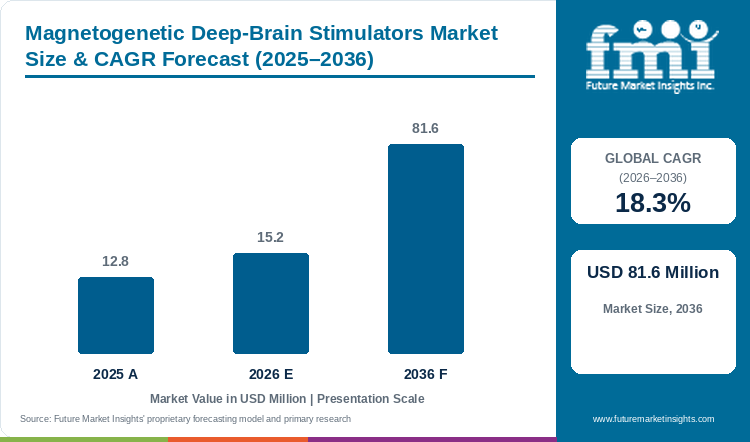
Key Market Trends & Insights
- By magneto-transduction mechanism: Magnetothermal Fe3O4 Nanoparticle + TRPV1 Ion-Channel Coupling occupies a projected 58.6% mechanism share in 2026 owing to localized 42-degree nanoscale heat transfer that gates heat-sensitive cation channels in rodent and primate circuits.
- By external magnetic field coil system: Alternating Magnetic Field (AMF, 100 - 500 kHz) Wearable Neck/Head Coil hardware collects an estimated 64.2% coil-system share during 2026 driven by resonant LC tank circuits that focus magnetic flux into subcortical targets.
- By target indication: Leadless Deep-Brain Stimulation in Parkinson's & Dystonia Models delivers an anticipated 52.4% target-indication share in 2026 attributed to intensive R&D grant funding for tetherless subthalamic and pallidal motor control.
- By regulatory pathway: FDA De Novo / 510(k) + CE MDR Class III Coil Predicate Pathways carry a forecast 78.6% regulatory-pathway share in 2026 because coil builders align field-driver safety dossiers with established non-genetic transcranial magnetic stimulation hardware predicates.
Regional Highlights
- East Asian and Alpine velocity: South Korea is projected to lead national growth at a 19.7% CAGR through 2036 ahead of Switzerland at 19.0% enabled by state-funded nanomedicine institutes and precision electromagnetic micromanipulation platforms.
- Western and Japanese progression: The United States is expected to expand at an 18.2% CAGR and Japan is forecast at 17.9%, whereas Germany is anticipated to advance at a 17.7% annual clip.
Market Size & Forecast
Table 1: Global Valuation Trajectory for Magnetogenetic Deep-Brain Stimulators (2025, 2026, and 2036 in USD Million with Ten-Year CAGR)
| Metric | Value |
|---|---|
| 2025 Market Size | USD 12.8 million |
| Estimated Market Size in 2026 | USD 15.2 million |
| Projected Market Size by 2036 | USD 81.6 million |
| CAGR, 2026 to 2036 | 18.3% |
| Added Annual Market Value, 2026 to 2036 | USD 66.4 million |
Neurotechnology laboratories are combining monodisperse iron-oxide nanodiscs with endogenous mechanosensitive ion channels in animal models to study transgene-free magnetic actuation. During April 2026, neurosurgical research teams at Maastricht University and FAU Erlangen-Nuremberg demonstrated in Advanced Science that 1.5-microgram stereotaxic injections of vortex-magnetized magnetite nanodiscs actuated at 5 Hz and 28 mT restored rotarod balance and gait symmetry in hemiparkinsonian mice with 90% dopaminergic cell loss [2]. These low-field preclinical actuation protocols guide translational engineers designing external coil drivers in parallel with clinical neurotech devices for future investigational basal-ganglia neuromodulation.
Nanoparticle Dose and Field-Coil Deployment Sizing
Table 2: Nanoparticle Dose and Field-Coil Deployment Sizing Across Magnetogenetic Deep-Brain Stimulators (2025 to 2036 Operational Ranges)
| Metric | 2025 | 2026 | 2036 |
|---|---|---|---|
| Market size (USD million) | 12.8 | 15.2 | 81.6 |
| Preclinical laboratory magnetogenetic coil rigs installed (units) | 185 to 220 | 220 to 265 | 1,150 to 1,380 |
| R&D grant-funded Fe3O4 & m-Torquer research kits dispensed (thousand vials) | 4.2 to 5.1 | 5.0 to 6.1 | 26.5 to 32.0 |
| Average preclinical coil rig & nano-kit spend per lab (USD thousand) | 58.0 to 69.0 | 57.5 to 68.5 | 59.0 to 71.0 |
Operational note: Market sizing in Tables 2 through 4 separates preclinical laboratory kHz AMF and torque field-coil rigs from R&D grant-funded superparamagnetic nanoparticle and viral-vector kits (NIH BRAIN and DARPA MOANA plus IBS Korea and DFG). It also distinguishes modular pulse-driver hardware adapted from approved patient-facing non-genetic TMS systems (BrainsWay Deep TMS and Magstim clinical consoles) while excluding clinical psychiatric TMS treatment revenues.
Stereotaxic infusions of polymer-coated magnetite nanoparticles remain chemically stable inside deep brain nuclei for months, which allows repeated wireless stimulation sessions without repeat craniotomies. In addition to this, translational laboratories integrate high-frequency resonant coil drivers with neuro-monitoring systems to synchronize subcortical ion-channel gating with cortical oscillations.
Per Capita & Functional Neurosurgery Center Sizing
Table 3: Per-Capita Spend and Stereotaxic Center Benchmarks for Magnetogenetic Deep-Brain Stimulators (2025 to 2036 in USD)
| Metric | 2025 | 2026 | 2036 |
|---|---|---|---|
| World population (billion) | 8.2 | 8.3 | 9.0 |
| Market value per 1,000,000 people (USD) | 1,561.0 | 1,831.3 | 9,066.7 |
| Annual preclinical equipment & R&D grant outlay per lab (USD thousand) | 36.5 to 44.0 | 39.0 to 47.5 | 88.0 to 108.0 |
| Magnetothermal TRPV1 & AMF wearable coil combined share (%) | 57.5% to 63.5% | 58.6% to 64.2% | 61.0% to 67.5% |
Table 4: Functional Neurosurgery and Connectomics Allocation Across Magnetogenetic Deep-Brain Stimulators (2026 USD and Share)
| Metric | 2026 Breakdown & Share | Institutional Reference Basis |
|---|---|---|
| Global magnetogenetic R&D & preclinical market size, 2026 | USD 15.2 million | Preclinical lab coil rigs (USD 6.8M), R&D grant nano/vector kits (USD 5.1M), & predicate coil driver modules (USD 3.3M) |
| Active preclinical neuro-magnetic & connectomics labs | 360 centers | University stereotaxic & animal-model connectomics registry (0 approved human magnetogenetic implants in 2026) |
| Magnetothermal Fe3O4 + TRPV1 mechanism share, 2026 | 58.6% (USD 8.9 million allocation) | 58.6% magneto-transduction mechanism allocation |
| AMF (100-500 kHz) wearable/arena coil share, 2026 | 64.2% (USD 9.8 million allocation) | 64.2% external coil system allocation |
Hospital bioengineering departments calibrate coil inductance and water-cooled impedance networks so alternating magnetic fields stay below peripheral nerve heating limits. Because patients with tremor or dystonia need comfortable outpatient sessions, hardware designers adapt lightweight helm geometries from non-invasive brain stimulation systems to support ambulatory subthalamic modulation.
Analyst Perspective
"While magnetogenetics remains in preclinical animal-model validation facing thermal dosimetry and nanoparticle delivery hurdles, wireless magnetic actuation eliminates the tether wires that limit rodent and primate deep-brain studies. Suppliers pairing monodisperse superparamagnetic iron-oxide cores with water-cooled resonant coils built on FDA-cleared magnetic stimulation hardware predicates will lead translational lab procurement through 2036."
- Anurag Sharma, Principal Consultant, Future Market Insights.
How is the magnetogenetic deep-brain stimulators market segmented?
The magnetogenetic deep-brain stimulators market is segmented by magneto-transduction mechanism, external magnetic field coil system, target indication, regulatory pathway, and region. In 2026, Magnetothermal Fe3O4 Nanoparticle + TRPV1 Ion-Channel Coupling is projected at 58.6%, Alternating Magnetic Field (AMF, 100 - 500 kHz) Wearable Neck/Head Coil at 64.2%, Leadless Deep-Brain Stimulation in Parkinson's & Dystonia at 52.4%, and FDA De Novo / 510(k) + CE MDR Class III at 78.6%.
By magneto-transduction mechanism: Magnetothermal Fe3O4 Nanoparticle + TRPV1 Ion-Channel Coupling, Magnetomechanical Torque-Gated Piezo/TRPV4 Activation, and Ferritin-Fused Intrinsic Magnetoreceptor Constructs.
By external magnetic field coil system: Alternating Magnetic Field (AMF, 100 - 500 kHz) Wearable Neck/Head Coil, and Low-Frequency Rotating Permanent-Magnet Array Helmet.
By target indication: Leadless Deep-Brain Stimulation in Parkinson's & Dystonia, Peripheral Adrenal & Vagal Autonomic Modulation, and Preclinical Free-Moving Primate & Rodent Connectomics.
By regulatory pathway: FDA De Novo / 510(k) + CE MDR Class III, and Investigational / Custom Compassionate Use.
Why does Magnetothermal Fe3O4 Nanoparticle + TRPV1 Ion-Channel Coupling lead the magneto-transduction mechanism category?
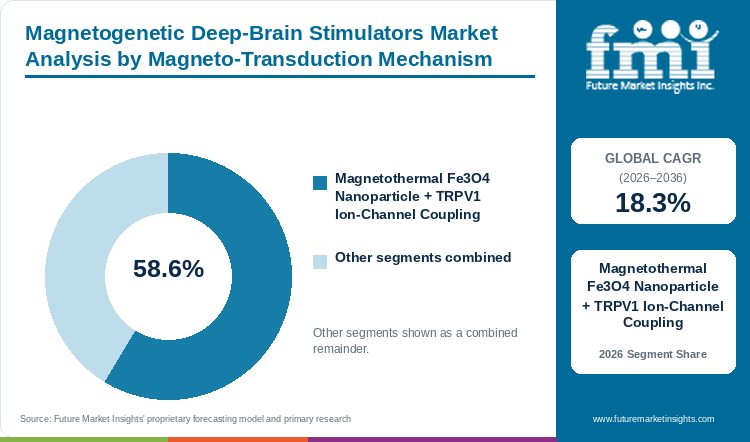
Magnetothermal Fe3O4 Nanoparticle + TRPV1 Ion-Channel Coupling occupies a projected 58.6% mechanism share in 2026 through rapid Néel-relaxation heating.
Table 5: Magneto-Transduction Mechanism Share for the Magnetogenetic Deep-Brain Stimulators Market (percentage share), 2026
| Magneto-Transduction Mechanism | Share (2026) |
|---|---|
| Magnetothermal Fe3O4 Nanoparticle + TRPV1 Ion-Channel Coupling | 58.6% |
| Other Segments Combined | 41.4%* |
| Total | 100.0% |
*Note: Remaining magneto-transduction mechanism categories sum to 100.0% of the category in 2026.
Table 6: Magneto-Transduction Mechanism Leadership and Market Growth for the Magnetogenetic Deep-Brain Stimulators Market (segment and CAGR percentage), 2026 to 2036
| Metric | Value |
|---|---|
| Global CAGR (2026 to 2036) | 18.3% |
| Leading Segment | Magnetothermal Fe3O4 Nanoparticle + TRPV1 Ion-Channel Coupling |
Monodisperse 20-nanometer magnetite cores convert 100 to 500 kHz alternating magnetic fields into localized nanoscale heat via Néel relaxation, which gates thermosensitive TRPV1 cation channels within milliseconds. Whereas genetically encoded ferritin constructs generate weaker magnetic moments, synthetic Fe3O4 nanoparticles produce high specific absorption rates that trigger reliable action potentials in deep dopaminergic nuclei and complement closed-loop brain-computer interfaces.
- Magnetothermal Fe3O4 Nanoparticle + TRPV1 Ion-Channel Coupling occupies a projected 58.6% mechanism share in 2026 owing to predictable thermal gating and commercial availability of antibody-conjugated iron-oxide cores.
- In January 2025, nanoscience teams at the National Center for Nanoscience and Technology reported in Science Advances that TRPV1-antibody-targeted nanoparticles reversed alpha-synuclein pathology and restored locomotor activity in Parkinsonian mice [3].
Why does Alternating Magnetic Field (AMF, 100 - 500 kHz) Wearable Neck/Head Coil define the largest coil system segment?
Alternating Magnetic Field (AMF, 100 - 500 kHz) Wearable Neck/Head Coil hardware collects an estimated 64.2% coil-system share in 2026.
Radiofrequency alternating magnetic fields between 100 and 500 kHz pass through skull bone and cerebral tissue with negligible attenuation, allowing collar and helmet coils to energize nanoparticles inside the subthalamic nucleus or vagal ganglia. While motorized permanent-magnet helmets work well for slow 0.5 to 10 Hz mechanical torque gating, solid-state AMF coils switch currents electronically in sub-millisecond bursts and pair directly with implantable brain-computer interface arrays.
- Alternating Magnetic Field (AMF, 100 - 500 kHz) Wearable Neck/Head Coil hardware collects an estimated 64.2% coil-system share in 2026 attributable to electronic pulse shaping and zero moving mechanical parts.
- In June 2025, biomedical engineers at National Yang Ming Chiao Tung University demonstrated in Advanced Healthcare Materials that alternating magnetic fields at 50 mT triggered millisecond-scale wireless deep-brain activity in the rodent amygdala [4].
What keeps Leadless Deep-Brain Stimulation in Parkinson's & Dystonia ahead by target indication?
Leadless Deep-Brain Stimulation in Parkinson's & Dystonia delivers an anticipated 52.4% target-indication share in 2026.
Advanced Parkinson's disease and generalized dystonia patients frequently decline conventional deep-brain surgery because subcutaneously tunneled extension wires and chest pulse generators carry hardware fracture and infection risks. Leadless magnetogenetic stimulation targets the subthalamic nucleus and internal globus pallidus through a single stereotaxic nanoparticle infusion, while peripheral autonomic protocols expand in parallel with vagus nerve stimulation devices.
- Leadless Deep-Brain Stimulation in Parkinson's & Dystonia delivers an anticipated 52.4% target-indication share in 2026 as translational grants prioritize wireless basal-ganglia motor control models.
- During April 2026, neurology authors from Charité-Universitätsmedizin Berlin and Brigham and Women's Hospital detailed in Clinical Neurophysiology Practice how connectomic deep-brain targeting guides Parkinson's disease and dystonia protocols [5].
Why does FDA De Novo / 510(k) + CE MDR Class III lead the regulatory pathway category?
FDA De Novo / 510(k) + CE MDR Class III pathways carry a forecast 78.6% regulatory-pathway share in 2026.
Because no combined gene-and-nanoparticle magnetogenetic therapy has yet received FDA or CE clinical approval, neuro-coil engineers design their external field-driver consoles and dosimetry software around established FDA De Novo or 510(k) non-genetic transcranial magnetic stimulation predicates and European Union MDR Class III active-device rules. University translational boards require cleared electromagnetic exposure safety dossiers and ISO 10993 chronic nanoparticle biocompatibility data before authorizing primate or future first-in-human protocols.
- FDA De Novo / 510(k) + CE MDR Class III pathways carry a forecast 78.6% regulatory-pathway share in 2026 as hardware manufacturers adapt power electronics from cleared transcranial magnetic coil systems.
- In September 2025, BrainsWay Ltd. received U.S. FDA 510(k) clearance for its non-genetic accelerated Deep TMS protocol in major depressive disorder following a multicenter randomized trial showing an 87.8% response rate, providing an external deep-coil regulatory predicate distinct from preclinical nanoparticle actuators [6].
What are the drivers, restraints, and opportunities in the magnetogenetic deep-brain stimulators market?
In the magnetogenetic deep-brain stimulators market, demand for leadless basal-ganglia neuromodulation is projected to accelerate system adoption whereas nanoparticle thermal dosimetry hurdles restrain rapid clinical conversion and transgene-free nanodiscs create outpatient opportunities.
- Driver: Elimination of intracranial electrode leads and surgical pulse-generator replacements drives neurosurgical investment in wireless magnetic nanoparticle stimulation.
- Restraint: Specific absorption rate heating thresholds and long-term central nervous system nanoparticle clearance audits prolong regulatory review timelines.
- Opportunity: Transgene-free magnetomechanical nanodiscs and intrinsic MagR-TRPV4 fusion actuators open non-viral outpatient neuromodulation pathways.
Growth Analysis and Future Potential: Qualitative Demand Catalysts
Chronic mechanical mismatch between rigid metal electrodes (elastic modulus above 70 GPa) and soft brain parenchyma triggers microglial encapsulation that degrades electrical stimulation over multi-year implants. Injectable superparamagnetic iron-oxide nanoparticles and piconewton torque actuators disperse uniformly inside target nuclei after a single micro-needle infusion, complementing cortical and subcortical brain implants across movement-disorder centers. In August 2025, pharmacology scientists at the Beijing Institute of Pharmacology and Toxicology reported in Brain Stimulation that linking the magnetoreceptor MagR to truncated TRPV4 channels created a single-component magnetogenetic actuator that rapidly modulated brain circuits in vivo [7]. Consequently, neuroscience institutes are expanding multi-year budgets for high-field magnetic stimulation rigs.
Risk Assessment of the Magnetogenetic Deep-Brain Stimulators Market: Operational and Formulation Friction
Uniform delivery of alternating magnetic flux to deep thalamic and subthalamic structures without overheating superficial cortical tissue remains a central engineering constraint for wearable coil designers. When coil currents exceed Brezovich electromagnetic exposure limits, eddy-current heating and nanoparticle aggregation can trigger off-target thermal stress unless clinicians monitor temperature via brain-computer interface recording platforms. In April 2025, functional neurosurgery investigators at Shahid Beheshti University of Medical Sciences noted in Frontiers in Human Neuroscience that magnetothermal neuromodulation requires tight control over nanoparticle concentration and magnetic exposure duration to prevent off-target thermal toxicity [8]. Because of this, hospital ethics boards mandate multi-month primate and rodent histology before clearing first-in-human trials.
Commercial Opportunity Analysis: Formulation Differentiation and Value-Add Formats
Platform developers can expand addressable clinical volume by commercializing antibody-guided magnetoacoustic and magnetomechanical nanocarriers that activate endogenous Piezo1 and TRPV4 channels without viral gene transfer. This non-viral transduction route simplifies combination-product toxicology and aligns nanoparticle delivery with neurovascular devices used in stereotaxic suites. In December 2025, researchers in ACS Nano demonstrated that phosphatidylserine-modified, anti-Piezo1-conjugated magnetic nanobubbles driven by transcranial magneto-acoustic fields rescued synaptic plasticity and cleared amyloid-beta pathology in deep brain regions of Alzheimer's disease mice [9]. Suppliers offering turnkey GMP magnetic nanodisc kits and resonant neck/head coils are well placed to capture translational neurology tenders.
Magnetogenetic Deep-Brain Stimulators Market by Country (2026 to 2036)
South Korea is projected to lead national magnetogenetic deep-brain stimulators growth at a 19.7% CAGR through 2036, followed by Switzerland at 19.0%.
As per FMI, South Korea sets the global pace in magnetogenetic deep-brain stimulators expansion across major research and healthcare systems at a 19.7% CAGR through 2036 before Switzerland (19.0%) and the United States (18.2%), whilst Japan advances at 17.9% and Germany progresses at 17.7%. National brain-mapping grants and precision electromagnetic coil fabrication as well as monodisperse iron-oxide synthesis infrastructure govern country-level valuation trajectories.
Table 7: National Compound Growth Trajectories and Clinical Catalysts Across Profiled Magnetogenetic Deep-Brain Stimulator Markets (2026 to 2036)
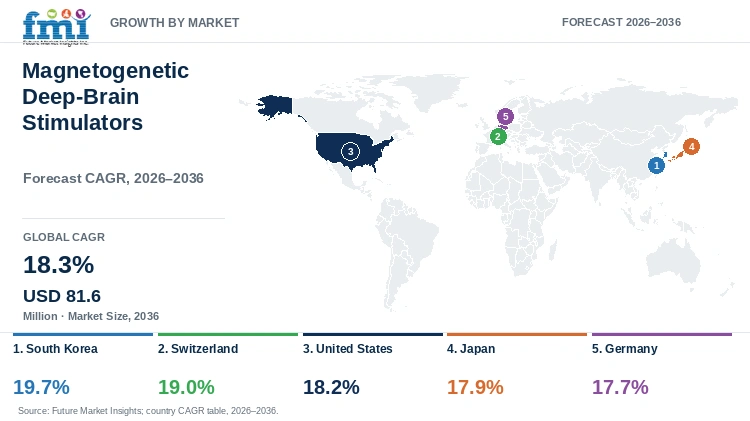
| Country | CAGR (2026 to 2036) | Primary Growth Lever |
|---|---|---|
| South Korea | 19.7% | IBS Center for Nanomedicine m-Torquer platforms and soft liquid-metal neural interface integration |
| Switzerland | 19.0% | ETH Zurich electromagnetic micromanipulation spin-outs and alpine translational neuroengineering |
| United States | 18.2% | DARPA MOANA / NIH BRAIN Initiative translational cohorts and FDA De Novo / 510(k) coil clearances |
| Japan | 17.9% | AMED Brain/MINDS non-human primate connectomics and super-aging Parkinson's neuromodulation |
| Germany | 17.7% | TU Munich, RWTH Aachen, and FAU Erlangen magnetoelectric and magnetomechanical STN DBS programs |
Source: Future Market Insights analysis
United States Magnetogenetic Deep-Brain Stimulators Market Outlook (2026 to 2036)
Federal defense and neuroscience funding through DARPA's MOANA program and the NIH BRAIN Initiative makes the United States the largest national buyer of preclinical magnetothermal nanoparticles and resonant field coils. In August 2026, a review in The Journal of Neuroscience (PMID 42557107) evaluated magnetogenetic tools for cellular-resolution noninvasive neuromodulation and emphasized that animal-model discoveries still face biophysical mechanism questions and nanoparticle delivery hurdles prior to human clinical trials [10]. The magnetogenetic deep-brain stimulators market value in the United States is projected to grow at an 18.2% annual rate through 2036 as university laboratories source monodisperse magnetite cores from Ocean NanoTech and nanoComposix along with high-frequency research coil amplifiers.
Key takeaway: In the United States, DARPA and NIH translational neurotechnology grants coupled with domestic GMP magnetite nanoparticle synthesis are projected to anchor commercial valuation growth.
Germany Magnetogenetic Deep-Brain Stimulators Market Outlook (2026 to 2036)
Germany's dense network of university neurosurgery laboratories in Munich and Aachen as well as Erlangen and Berlin sets the European benchmark for preclinical subthalamic nanoparticle stimulation. In August 2025, researchers at the Technical University of Munich and Maastricht University reported in Brain Stimulation that wireless subthalamic stimulation using magnetoelectric nanoparticles at 140 Hz improved locomotion in Parkinsonian mice with zero adverse astrogliosis over 18 months [11]. Germany's magnetogenetic deep-brain stimulators market size is anticipated to advance at a 17.7% annual pace through 2036 as multi-center DFG neuroengineering clusters fund rodent and primate connectomics rigs across Bavaria and North Rhine-Westphalia. Strict European Union MDR Class III toxicology audits still govern future human trial entry.
Key takeaway: In Germany, 18-month chronic biocompatibility validation at Technical University of Munich and RWTH Aachen neurosurgery centers is anticipated to drive clinical coil and nanodisc adoption.
Japan Magnetogenetic Deep-Brain Stimulators Market Outlook (2026 to 2036)
Japan's super-aging demographic profile and AMED Brain/MINDS marmoset and macaque connectomics programs create strong institutional laboratory demand for non-invasive and leadless basal-ganglia stimulation tools. In July 2025, a systematic review and meta-analysis of 20 randomized controlled trials across 693 Parkinson's disease patients published in Annals of Medicine and Surgery confirmed that non-genetic repetitive transcranial magnetic stimulation improved UPDRS-III motor scores [12]. Across Japan, the magnetogenetic deep-brain stimulators industry valuation is forecast to grow at a 17.9% yearly trajectory through 2036 as Tokyo and Osaka neuroscience institutes adapt magnetic coil drivers for primate magnetogenetic circuit mapping. Tight PMDA combination-product toxicology rules require multi-year primate safety dossiers prior to clinical trials.
Key takeaway: In Japan, national non-human primate connectomics initiatives and rising Parkinson's disease prevalence are forecast to sustain investment in wireless magnetic deep-brain stimulation platforms.
South Korea Magnetogenetic Deep-Brain Stimulators Market Outlook (2026 to 2036)
Pioneering work on nanoscale m-Torquer magnetic actuators and conformal liquid-metal neural interfaces at Yonsei University and the Institute for Basic Science makes South Korea the top-ranked national growth engine. In February 2026, a review in Life examined magnetic field-guided magnetic nanoparticles and exosome-magnetic complexes as targeted neurotherapeutics across Parkinson's disease and stroke as well as neuro-oncology pathways [13]. South Korea's magnetogenetic deep-brain stimulators market valuation is expected to climb at a leading 19.7% CAGR through 2036, fueled by Ministry of Science and ICT bio-nanotechnology grants in Seoul and Daejeon. Limited domestic venture reimbursement for pre-commercial gene-nanoparticle combinations still concentrates early purchasing inside flagship university medical centers.
Key takeaway: In South Korea, world-leading m-Torquer Piezo1 research at Yonsei University and IBS Center for Nanomedicine is expected to propel the highest national growth rate.
Switzerland Magnetogenetic Deep-Brain Stimulators Market Outlook (2026 to 2036)
Switzerland combines ETH Zurich's electromagnetic micromanipulation heritage, represented by spin-out MagnebotiX, with pharmaceutical translational screening centers in Basel and Geneva as well as Lausanne neurotechnology institutes. In February 2026, clinical neuroscientists published a step-by-step protocol in Nature Protocols detailing oscillatory brain-state-dependent magnetic stimulation synchronized with real-time electroencephalography [14]. The Swiss magnetogenetic deep-brain stimulators market size is predicted to rise at a 19.0% annual rate through 2036 as precision multi-axis magnetic field generators are deployed for free-moving rodent and primate circuit mapping across academic laboratories. High Swiss cleanroom fabrication costs and bilateral Swissmedic-MDR device alignment rules keep local manufacturers focused on high-margin research consoles for European neurobiology institutes.
Key takeaway: In Switzerland, electromagnetic micromanipulation platforms from Zurich spin-outs and state-dependent magnetic stimulation protocols are predicted to anchor research hardware demand.
Full report country CAGRs cover: North America; Latin America; Western Europe; Eastern Europe; East Asia; South Asia and Pacific; Middle East and Africa.
Who are the notable companies in the magnetogenetic deep-brain stimulators market?
MagnebotiX / Cellectricon Neuro-Magnetic Platforms, Magstim (Welcony - Magnetic Neuro-Coil Hardware), Ocean NanoTech, LLC (Monodisperse Superparamagnetic Fe3O4), nanoComposix (Fortis Life Sciences), BrainsWay Ltd. (Deep Transcranial Coil Ecosystem), and Rice University / DARPA MOANA Magnetogenetic Spin-Outs are the notable companies in the magnetogenetic deep-brain stimulators market.
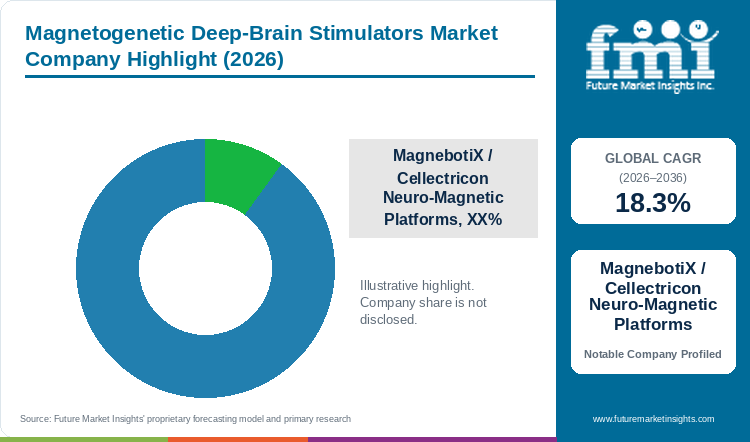
FMI analysis indicates that commercial participation in the magnetogenetic deep-brain stimulation sector separates into three distinct operational tiers. Preclinical electromagnetic micromanipulation and neuronal screening rig builders (MagnebotiX and Cellectricon) equip university connectomics suites, while R&D grant-funded nanochemistry and viral-actuator suppliers (Ocean NanoTech and nanoComposix along with Rice University / DARPA MOANA spin-outs) formulate monodisperse Fe3O4 nanoparticles for TRPV1 and Piezo1 tethering. Separately, approved patient-facing non-genetic transcranial magnetic stimulation manufacturers (Magstim within Welcony and BrainsWay Ltd.) build clinical TMS helmets that operate without nanoparticles or transgenes while supplying modular high-current pulse drivers and regulatory coil predicates for translational labs.
- Electromagnetic Field-Coil & Predicate Neuro-Magnetic Hardware Platforms: MagnebotiX / Cellectricon Neuro-Magnetic Platforms supply preclinical micromanipulation and screening rigs while Magstim (Welcony) and BrainsWay Ltd. manufacture approved patient-facing non-genetic TMS/Deep TMS systems and research coil drivers.
- Monodisperse Superparamagnetic Nanoparticle & Surface-Conjugation Specialists: Ocean NanoTech, LLC (Monodisperse Superparamagnetic Fe3O4) and nanoComposix (Fortis Life Sciences) synthesize water-soluble single-crystal magnetite cores with streptavidin and amine or carboxyl surface coatings for ion-channel tethering.
- Translational Magnetogenetic Actuator & Connectomics Spin-Outs: Rice University / DARPA MOANA Magnetogenetic Spin-Outs develop magnetothermal and magnetomechanical viral-nanoparticle constructs for leadless subcortical circuit control.
Competitive Benchmarking: Magnetogenetic Deep-Brain Stimulators Market
Table 8: Competitive Benchmarking for the Magnetogenetic Deep-Brain Stimulators Market (qualitative capability ratings), 2026
| Company | Magneto-Transduction & Nano-Core Precision | External AMF / Torque Coil Engineering | Translational & Clinical Reach | Geographic Reach |
|---|---|---|---|---|
| MagnebotiX / Cellectricon Neuro-Magnetic Platforms | Medium | High | High | High |
| Magstim (Welcony - Magnetic Neuro-Coil Hardware) | Medium | High | High | High |
| Ocean NanoTech, LLC (Monodisperse Superparamagnetic Fe3O4) | High | Medium | Medium | High |
| nanoComposix (Fortis Life Sciences) | High | Medium | High | High |
| BrainsWay Ltd. (Deep Transcranial Coil Ecosystem) | Medium | High | High | High |
| Rice University / DARPA MOANA Magnetogenetic Spin-Outs | High | High | Medium | Medium |
Evaluation basis: Capability tiers evaluate documented iron-oxide crystal monodispersity (10 to 30 nm), specific absorption rate stability under 100 to 500 kHz alternating magnetic fields, and multi-axis coil field depth. Ratings explicitly distinguish preclinical laboratory micromanipulation and nanoparticle reagent suppliers from patient-facing non-genetic TMS device manufacturers.
Key Developments in the Magnetogenetic Deep-Brain Stimulators Market
- BrainsWay Ltd. announced in November 2025 that the U.S. FDA cleared an expanded label for its Deep TMS system as an adjunct therapy for adolescents aged 15 to 21 with major depressive disorder based on real-world data from 1,120 patients across 35 centers [15].
- Magstim (Welcony) documented in April 2025 that its magnetic neurostimulation platforms surpassed 15,000 peer-reviewed scientific citations across four decades of translational brain stimulation research [16].
- Cellectricon AB presented its high-capacity neuroplasticity and neurodegeneration as well as neuroinflammation functional screening modules at the BIO International Convention in May 2025 and secured a Japanese patent grant in September 2026 [17].
Key Players in the Magnetogenetic Deep-Brain Stimulators Market
Electromagnetic Field-Coil & Deep Neuro-Magnetic Hardware Platforms
- MagnebotiX / Cellectricon Neuro-Magnetic Platforms
- Magstim (Welcony - Magnetic Neuro-Coil Hardware)
- BrainsWay Ltd. (Deep Transcranial Coil Ecosystem)
Monodisperse Superparamagnetic Nanoparticle & Surface-Conjugation Specialists
- Ocean NanoTech, LLC (Monodisperse Superparamagnetic Fe3O4)
- nanoComposix (Fortis Life Sciences)
Translational Magnetogenetic Actuator & Connectomics Spin-Outs
- Rice University / DARPA MOANA Magnetogenetic Spin-Outs
Magnetogenetic Deep-Brain Stimulators Market - Report Scope
Table 9: Report Scope for the Magnetogenetic Deep-Brain Stimulators Market (coverage fields and definitions), 2026 to 2036
| Coverage field | Report scope |
|---|---|
| Market breakdown | Magneto-Transduction Mechanism; External Magnetic Field Coil System; Target Indication; Regulatory Pathway; Region |
| Quantitative Units | USD Million |
| Market Definition | Includes commercial supplier and R&D grant contract valuation across three clearly separated tiers: (1) preclinical laboratory alternating and rotating magnetic field-coil rigs and neuronal screening platforms, (2) research-grade and GLP superparamagnetic Fe3O4/vortex nanodiscs and TRPV1/Piezo1/TRPV4/MagR viral-nanoparticle actuator kits funded by neuroscience grants, and (3) modular magnetic pulse-driver consoles adapted from approved patient-facing non-genetic TMS systems. Category Scope Note: No combined gene-and-nanoparticle magnetogenetic DBS therapy is approved for human clinical use in 2026 (J Neurosci PMID 42557107); excludes standalone psychiatric Deep TMS patient treatment service revenues, wired implantable pulse generators (IPGs), and diagnostic MRI scanners. |
| Regions Covered | North America; Latin America; Western Europe; Eastern Europe; East Asia; South Asia and Pacific; Middle East and Africa |
| Countries Covered | United States, Germany, Japan, South Korea, Switzerland, and additional countries in the full report |
| Key Companies Covered | MagnebotiX / Cellectricon Neuro-Magnetic Platforms, Magstim (Welcony - Magnetic Neuro-Coil Hardware), Ocean NanoTech, LLC (Monodisperse Superparamagnetic Fe3O4), nanoComposix (Fortis Life Sciences), BrainsWay Ltd. (Deep Transcranial Coil Ecosystem), Rice University / DARPA MOANA Magnetogenetic Spin-Outs |
| Forecast Period | 2026 to 2036 |
| Approach | Primary and secondary research with top-down and bottom-up market triangulation. |
Magnetogenetic Deep-Brain Stimulators Market - Research Methodology
Table 10: Research Methodology for the Magnetogenetic Deep-Brain Stimulators Market (research methods and approach), 2026 edition
| Method | Approach |
|---|---|
| Primary Research | Structured interviews with functional neurosurgeons, neural interface bioengineers, magnetic nanoparticle chemists, and electromagnetic coil designers across the United States, Germany, South Korea, Japan, and Switzerland to validate coil console pricing and nano-actuator dosing. |
| Secondary Research | Analysis of peer-reviewed preclinical magnetogenetic studies in The Journal of Neuroscience (PMID 42557107), Advanced Healthcare Materials, Advanced Science, Science Advances, Brain Stimulation, and ACS Nano as well as non-genetic TMS hardware predicate clearances (BrainsWay, Welcony/Magstim) and nanoparticle catalogs (nanoComposix, Ocean NanoTech). |
| Market Sizing and Forecasting | Separates preclinical laboratory field-coil equipment ($6.8M in 2026), R&D grant-funded nanoparticle and viral-vector kits ($5.1M), and research coil driver modules ($3.3M) from patient-facing non-genetic TMS treatment revenues. |
| Country Forecasting Model | Econometric country projections weight national brain-initiative grant funding (NIH BRAIN, DARPA MOANA, AMED Brain/MINDS, IBS Korea), Parkinson's and dystonia surgical candidate pools, and regulatory clearance pathways across five profiled countries. |
| Operational Benchmark Traceability | Nanoparticle dose and coil-system sizing indicators in Tables 2, 3, and 4 trace to Yonsei University m-Torquer cohorts (PMC13279859), Maastricht/FAU nanodisc studies (PMC13325837), and TUM chronic MENP evaluations (PMID 40803529). |
| Data Triangulation and Validation | Demand estimates are cross-checked against research-grade and GMP iron-oxide nanoparticle batch shipments and magnetic neuro-coil console installations without double counting conventional wired DBS leads. |
Magnetogenetic Deep-Brain Stimulators Market by Segments
Magnetogenetic Deep-Brain Stimulators Market segmented by Magneto-Transduction Mechanism:
- Magnetothermal Fe3O4 Nanoparticle + TRPV1 Ion-Channel Coupling
- Magnetomechanical Torque-Gated Piezo/TRPV4 Activation
- Ferritin-Fused Intrinsic Magnetoreceptor Constructs
Magnetogenetic Deep-Brain Stimulators Market segmented by External Magnetic Field Coil System:
- Alternating Magnetic Field (AMF, 100 - 500 kHz) Wearable Neck/Head Coil
- Low-Frequency Rotating Permanent-Magnet Array Helmet
Magnetogenetic Deep-Brain Stimulators Market segmented by Target Indication:
- Leadless Deep-Brain Stimulation in Parkinson's & Dystonia
- Peripheral Adrenal & Vagal Autonomic Modulation
- Preclinical Free-Moving Primate & Rodent Connectomics
Magnetogenetic Deep-Brain Stimulators Market segmented by Regulatory Pathway:
- FDA De Novo / 510(k) + CE MDR Class III
- Investigational / Custom Compassionate Use
Magnetogenetic Deep-Brain Stimulators Market by Region
- North America
- United States
- Canada
- Latin America
- Brazil
- Mexico
- Argentina
- Western Europe
- Germany
- Switzerland
- United Kingdom
- France
- Italy
- Netherlands
- Eastern Europe
- Poland
- Czech Republic
- Hungary
- East Asia
- South Korea
- Japan
- China
- South Asia and Pacific
- Australia
- India
- Singapore
- Middle East and Africa
- Israel
- GCC Countries
- South Africa
Research Sources and Bibliography
- [1] Lee, J., Lee, Y., Kim, E., Seo, H., Oh, M., Joo, H., Lee, S., Lee, J.-H., Jung, H. H., Kwak, M., & Park, J.-U. (2026, April 15). Soft Neural Interfaces for Circuit-Level Analysis of Magnetogenetic Deep Brain Stimulation in Parkinson's Disease Models. Advanced Healthcare Materials, 15(22), e05548 (PMC13279859).
- [2] Wolters, A., Signorelli, L., Herff, C., Gimple, S., Riemens, R., Kenis, G., Rijkers, K., Shabani, H., Sun, J.-J., Temel, Y., Clusmann, H., Gregurec, D., & Hescham, S.-A. (2026, April 03). Remote Magnetomechanical Neuromodulation Uncovers Therapeutic Mechanisms for Alleviating Parkinsonian Symptoms in Freely Moving Mice. Advanced Science, e75097 (PMC13325837).
- [3] Wu, J., Cui, X., Bao, L., Liu, G., Wang, X., & Chen, C. (2025, January 17). A nanoparticle-based wireless deep brain stimulation system that reverses Parkinson's disease. Science Advances, 11(3), eado4927 (PubMed PMID 39813330).
- [4] Cheng, C.-C., Chen, L.-L., Tseng, G.-J., Huang, J.-X., Ting, Y.-J., & Chiang, P.-H. (2025, June 16). Magnetic-Driven Torque-Induced Electrical Stimulation for Millisecond-Scale Wireless Neuromodulation. Advanced Healthcare Materials, 14(20), e2500805 (PubMed PMID 40522190).
- [5] Neumann, W.-J., & Darmani, G. (2026, April 10). Translational prospectives for deep brain stimulation and low-intensity focused ultrasound neuromodulation: IFCN Handbook chapter. Clinical Neurophysiology Practice, 11, 294-307 (PMC13094473).
- [6] BrainsWay Ltd. (2025, September 16). BrainsWay Receives FDA Clearance for Accelerated Deep TMS Protocol for Non-Invasive Treatment of Major Depressive Disorder (MDD). BrainsWay Investor Relations.
- [7] Liu, M.-N., Tian, X.-Y., Fang, W.-C., Song, R., Li, F., Wang, Z.-Y., Lu, G.-Y., Wu, N., Li, J., & Li, H. (2025, August 05). Magnetogenetics inspired by animal Magnetoreception: ΔTRPV4MagR as a novel magnetogenetic actuator enabling remote neuromodulation of brain circuits. Brain Stimulation, 18(5), 1455-1469 (PubMed PMID 40769384).
- [8] Alipour, M., Abdolmaleki, M., Shabanpour, Y., Zali, A., Ashrafi, F., Nohesara, S., & Hajipour-Verdom, B. (2025, April 28). Advances in magnetic field approaches for non-invasive targeting neuromodulation. Frontiers in Human Neuroscience, 19, 1489940 (PMC12066545).
- [9] Chu, F., Zhou, X., Ma, R., Liu, R., Liu, X., Zhu, K., Wang, Y., Wang, X., Li, Y., Zhang, S., Yin, T., & Liu, Z. (2025, December 16). Piezo1-Targeted Magnetoacoustic Nanobubbles Rescue Alzheimer's Pathology by Electromechanical Neuromodulation and Amyloid-β Clearance. ACS Nano, 20(2), 1962-1982 (PMC12825367).
- [10] Tran, T. T., et al. (2026, August 12). Magnetogenetics: Tools for Noninvasive Neuromodulation with Cellular Resolution. The Journal of Neuroscience (PubMed PMID 42557107).
- [11] Dominguez-Paredes, D., Temel, Y., Milojkovic, A., Mulder-Jongen, D., Kumari, P., Ries, M., Kozielski, K., & Jahanshahi, A. (2025, August 11). Magnetoelectric nanoparticle technology for mitigating motor deficits in Parkinsonian mice. Brain Stimulation, 18(5), 1551-1560 (PubMed PMID 40803529).
- [12] Khattak, M., Rukh, M., Javed, W., Mujahid, Iftikhar, M., Mumtaz, N., Ul Mulk, I., Haleem, S., Iram, S., Khan, Q. A., & Verma, R. (2025, July 09). Efficacy of repetitive transcranial magnetic stimulation in Parkinson's disease: an updated systematic review and meta-analysis of randomized controlled trials. Annals of Medicine and Surgery, 87(11), 7471-7479 (PMC12577920).
- [13] Chiang, M.-C., Yang, Y.-P., & Nicol, C. J. B. (2026, February 09). Magnetic Field-Guided Magnetic Nanoparticles as Neurotherapeutics for Neurological Disorders and Glioblastoma. Life, 16(2), 293 (PMC12942359).
- [14] Zrenner, C., Belardinelli, P., & Ziemann, U. (2026, February 27). Oscillatory brain state-dependent stimulation with transcranial magnetic stimulation combined with electroencephalography. Nature Protocols (PubMed PMID 41760982).
- [15] BrainsWay Ltd. (2025, November 13). BrainsWay Receives FDA Clearance of Deep TMS as Adjunct Therapy for Major Depressive Disorder (MDD) in Adolescents Aged 15 to 21. BrainsWay Investor Relations.
- [16] Magstim (Welcony). (2025, April 02). Magstim stimulators have been cited in over 15,000 studies. Magstim Official Newsroom.
- [17] Cellectricon AB. (2025, May 21). BIO 2025 - Cellectricon. Cellectricon AB News & Events.
- [18] BrainsWay Ltd. (2026, October 13). BrainsWay Reports Rise in Favorable Accelerated Deep TMS Coverage to Over 70 Million Covered Lives. BrainsWay News & Events.
- [19] nanoComposix (Fortis Life Sciences). (2026, February 19). Magnetic Iron Oxide Nanoparticles: Properties & Applications - nanoComposix. nanoComposix, a Fortis Life Sciences Company.
- [20] Ocean NanoTech, LLC. (2025, October 15). Iron Oxide Nanoparticles in Water - Ocean NanoTech, LLC. Ocean NanoTech Product Technical Library.
This bibliography is provided for reader reference and is not exhaustive. The full report contains the complete reference list and detailed citations.
This Report Answers
- How large is the magnetogenetic deep-brain stimulators market in 2026 and what is forecast for 2036?
- Which clinical and neuroengineering factors support demand for leadless magnetogenetic deep-brain stimulators?
- Why does Magnetothermal Fe3O4 Nanoparticle + TRPV1 Ion-Channel Coupling lead the magneto-transduction mechanism category?
- Why does Alternating Magnetic Field (AMF, 100 - 500 kHz) Wearable Neck/Head Coil lead the external coil system category?
- How do growth rates differ across South Korea, Switzerland, the United States, Japan, and Germany?
- Which notable companies supply magnetic neuro-coils, superparamagnetic Fe3O4 cores, and magnetogenetic platforms today?
- What limits rapid clinical conversion in the magnetogenetic deep-brain stimulators market?
- What should translational neurosurgery teams evaluate before procuring magnetogenetic stimulation hardware and nanoparticles?
Frequently Asked Questions
How big is the magnetogenetic deep-brain stimulators market in 2026, and what is forecast for 2036?
According to FMI, global market value for magnetogenetic deep-brain stimulators reaches an estimated USD 15.2 million in 2026 (comprising preclinical laboratory coil rigs and R&D grant-funded nanoparticle/vector kits plus research coil driver modules) from USD 12.8 million in 2025, and is projected to climb to an industry valuation of USD 81.6 million by 2036 as animal-model connectomics platforms progress toward translational safety studies.
What is the CAGR for the magnetogenetic deep-brain stimulators market from 2026 to 2036?
Future Market Insights projects an 18.3% ten-year compound annual pace between 2026 and 2036, generating an anticipated USD 66.4 million in added annual market value over the ten-year forecast horizon.
Which magneto-transduction mechanism segment leads the magnetogenetic deep-brain stimulators market?
Magnetothermal Fe3O4 Nanoparticle + TRPV1 Ion-Channel Coupling occupies a projected 58.6% mechanism share in 2026 owing to rapid Néel-relaxation heating that gates TRPV1 cation channels within milliseconds in preclinical models.
Which external magnetic field coil system segment leads the market?
Alternating Magnetic Field (AMF, 100 - 500 kHz) Wearable Neck/Head Coil hardware collects an estimated 64.2% coil-system share in 2026 driven by deep skull penetration and solid-state pulse control.
Which country has a notable growth outlook during the assessment period?
South Korea leads national growth projections at a 19.7% CAGR through 2036, supported by m-Torquer Piezo1 platforms and soft neural interface engineering at Yonsei University and the Institute for Basic Science.
Who are the key players in the market?
MagnebotiX / Cellectricon Neuro-Magnetic Platforms, Magstim (Welcony - Magnetic Neuro-Coil Hardware), Ocean NanoTech, LLC (Monodisperse Superparamagnetic Fe3O4), nanoComposix (Fortis Life Sciences), BrainsWay Ltd. (Deep Transcranial Coil Ecosystem), and Rice University / DARPA MOANA Magnetogenetic Spin-Outs anchor commercial supply across neuro-coil hardware and magnetic nanoparticle synthesis.
Preview the report firsthand - request a free sample
Get SampleGet the brochure for pricing and purchase details.
Get PDFTable of Content
- Key Takeaways
- Market Size and CAGR
- Top Growth Driver
- Fastest Growing Segment
- Leading Region
- Key Companies
- Emerging Opportunities
- Executive Summary
- Global Market Outlook
- Demand-side Trends
- Supply-side Trends
- Technology Roadmap Analysis
- Analysis and Recommendations
- Analyst Perspective (What is happening? Why now? What should investors know?)
- Key Questions Answered
- How large is the market?
- What is the CAGR?
- What are key trends?
- Which region dominates?
- Who are the leaders?
- Market Overview
- Market Coverage / Taxonomy
- Market Definition / Scope / Limitations
- Research Methodology
- Chapter Orientation
- Analytical Lens and Working Hypotheses
- Market Structure, Signals, and Trend Drivers
- Benchmarking and Cross-market Comparability
- Market Sizing, Forecasting, and Opportunity Mapping
- Research Design and Evidence Framework
- Desk Research Programme (Secondary Evidence)
- Expert Input and Fieldwork (Primary Evidence)
- Tooling, Models, and Reference Databases
- Data Engineering and Model Build
- Quality Assurance and Audit Trail
- Market Background
- Market Dynamics (Drivers, Restraints, Opportunity, Trends)
- Scenario Forecast (Optimistic, Likely, Conservative)
- Impact Analysis
- AI Impact
- Sustainability Impact
- Regulatory Impact
- Technology Impact
- Consumer / Buyer Analysis
- Purchase Drivers
- Adoption Barriers
- Buyer Journey
- Opportunity Map Analysis
- Product Life Cycle Analysis
- Supply Chain Analysis
- Investment Feasibility Matrix
- Value Chain Analysis
- PESTLE and Porter's Analysis
- Regulatory Landscape
- Regional Parent Market Outlook
- Production and Consumption Statistics
- Import and Export Statistics
- Global Market Analysis and Forecast, 2021 to 2036
- Historical Market Size Value (USD Million) Analysis, 2021 to 2025
- Current and Future Market Size Value (USD Million) Projections, 2026 to 2036
- Y-o-Y Growth Trend Analysis
- Absolute $ Opportunity Analysis
- Global Market Pricing Analysis, 2021 to 2036
- Global Market Analysis and Forecast, By Magneto-Transduction Mechanism, 2021 to 2036
- Introduction / Key Findings
- Historical Market Size Value (USD Million) Analysis By Magneto-Transduction Mechanism, 2021 to 2025
- Current and Future Market Size Value (USD Million) Analysis and Forecast By Magneto-Transduction Mechanism, 2026 to 2036
- Magnetothermal Fe3O4 Nanoparticle + TRPV1 Ion-Channel Coupling
- Magnetomechanical Torque-Gated Piezo/TRPV4 Activation
- Ferritin-Fused Intrinsic Magnetoreceptor Constructs
- Y-o-Y Growth Trend Analysis By Magneto-Transduction Mechanism, 2021 to 2025
- Absolute $ Opportunity Analysis By Magneto-Transduction Mechanism, 2026 to 2036
- Global Market Analysis and Forecast, By External Magnetic Field Coil System, 2021 to 2036
- Introduction / Key Findings
- Historical Market Size Value (USD Million) Analysis By External Magnetic Field Coil System, 2021 to 2025
- Current and Future Market Size Value (USD Million) Analysis and Forecast By External Magnetic Field Coil System, 2026 to 2036
- Alternating Magnetic Field (AMF, 100 - 500 kHz) Wearable Neck/Head Coil
- Low-Frequency Rotating Permanent-Magnet Array Helmet
- Y-o-Y Growth Trend Analysis By External Magnetic Field Coil System, 2021 to 2025
- Absolute $ Opportunity Analysis By External Magnetic Field Coil System, 2026 to 2036
- Global Market Analysis and Forecast, By Target Indication, 2021 to 2036
- Introduction / Key Findings
- Historical Market Size Value (USD Million) Analysis By Target Indication, 2021 to 2025
- Current and Future Market Size Value (USD Million) Analysis and Forecast By Target Indication, 2026 to 2036
- Leadless Deep-Brain Stimulation in Parkinson's & Dystonia
- Peripheral Adrenal & Vagal Autonomic Modulation
- Preclinical Free-Moving Primate & Rodent Connectomics
- Y-o-Y Growth Trend Analysis By Target Indication, 2021 to 2025
- Absolute $ Opportunity Analysis By Target Indication, 2026 to 2036
- Global Market Analysis and Forecast, By Regulatory Pathway, 2021 to 2036
- Introduction / Key Findings
- Historical Market Size Value (USD Million) Analysis By Regulatory Pathway, 2021 to 2025
- Current and Future Market Size Value (USD Million) Analysis and Forecast By Regulatory Pathway, 2026 to 2036
- FDA De Novo / 510(k) + CE MDR Class III
- Investigational / Custom Compassionate Use
- Y-o-Y Growth Trend Analysis By Regulatory Pathway, 2021 to 2025
- Absolute $ Opportunity Analysis By Regulatory Pathway, 2026 to 2036
- Global Market Analysis and Forecast, By Region, 2021 to 2036
- Introduction
- Historical Market Size Value (USD Million) Analysis By Region, 2021 to 2025
- Current Market Size Value (USD Million) Analysis and Forecast By Region, 2026 to 2036
- North America
- Latin America
- Western Europe
- Eastern Europe
- East Asia
- South Asia and Pacific
- Middle East and Africa
- Market Attractiveness Analysis By Region
- North America Market Analysis and Forecast, By Country, 2021 to 2036
- Historical Market Size Value (USD Million) Trend Analysis By Market Taxonomy, 2021 to 2025
- Market Size Value (USD Million) Forecast By Market Taxonomy, 2026 to 2036
- By Country
- United States
- Canada
- By Magneto-Transduction Mechanism
- By External Magnetic Field Coil System
- By Target Indication
- By Regulatory Pathway
- By Country
- Market Attractiveness Analysis
- By Country
- By Magneto-Transduction Mechanism
- By External Magnetic Field Coil System
- By Target Indication
- By Regulatory Pathway
- Key Takeaways
- Latin America Market Analysis and Forecast, By Country
- Historical Market Size Value (USD Million) Trend Analysis By Market Taxonomy, 2021 to 2025
- Market Size Value (USD Million) Forecast By Market Taxonomy, 2026 to 2036
- By Country
- Brazil
- Mexico
- Argentina
- By Magneto-Transduction Mechanism
- By External Magnetic Field Coil System
- By Target Indication
- By Regulatory Pathway
- By Country
- Market Attractiveness Analysis
- By Country
- By Magneto-Transduction Mechanism
- By External Magnetic Field Coil System
- By Target Indication
- By Regulatory Pathway
- Key Takeaways
- Western Europe Market Analysis and Forecast, By Country
- Historical Market Size Value (USD Million) Trend Analysis By Market Taxonomy, 2021 to 2025
- Market Size Value (USD Million) Forecast By Market Taxonomy, 2026 to 2036
- By Country
- Germany
- Switzerland
- United Kingdom
- France
- Italy
- Netherlands
- By Magneto-Transduction Mechanism
- By External Magnetic Field Coil System
- By Target Indication
- By Regulatory Pathway
- By Country
- Market Attractiveness Analysis
- By Country
- By Magneto-Transduction Mechanism
- By External Magnetic Field Coil System
- By Target Indication
- By Regulatory Pathway
- Key Takeaways
- Eastern Europe Market Analysis and Forecast, By Country
- Historical Market Size Value (USD Million) Trend Analysis By Market Taxonomy, 2021 to 2025
- Market Size Value (USD Million) Forecast By Market Taxonomy, 2026 to 2036
- By Country
- Poland
- Czech Republic
- Hungary
- By Magneto-Transduction Mechanism
- By External Magnetic Field Coil System
- By Target Indication
- By Regulatory Pathway
- By Country
- Market Attractiveness Analysis
- By Country
- By Magneto-Transduction Mechanism
- By External Magnetic Field Coil System
- By Target Indication
- By Regulatory Pathway
- Key Takeaways
- East Asia Market Analysis and Forecast, By Country
- Historical Market Size Value (USD Million) Trend Analysis By Market Taxonomy, 2021 to 2025
- Market Size Value (USD Million) Forecast By Market Taxonomy, 2026 to 2036
- By Country
- South Korea
- Japan
- China
- By Magneto-Transduction Mechanism
- By External Magnetic Field Coil System
- By Target Indication
- By Regulatory Pathway
- By Country
- Market Attractiveness Analysis
- By Country
- By Magneto-Transduction Mechanism
- By External Magnetic Field Coil System
- By Target Indication
- By Regulatory Pathway
- Key Takeaways
- South Asia and Pacific Market Analysis and Forecast, By Country
- Historical Market Size Value (USD Million) Trend Analysis By Market Taxonomy, 2021 to 2025
- Market Size Value (USD Million) Forecast By Market Taxonomy, 2026 to 2036
- By Country
- Australia
- India
- Singapore
- By Magneto-Transduction Mechanism
- By External Magnetic Field Coil System
- By Target Indication
- By Regulatory Pathway
- By Country
- Market Attractiveness Analysis
- By Country
- By Magneto-Transduction Mechanism
- By External Magnetic Field Coil System
- By Target Indication
- By Regulatory Pathway
- Key Takeaways
- Middle East and Africa Market Analysis and Forecast, By Country
- Historical Market Size Value (USD Million) Trend Analysis By Market Taxonomy, 2021 to 2025
- Market Size Value (USD Million) Forecast By Market Taxonomy, 2026 to 2036
- By Country
- Israel
- GCC Countries
- South Africa
- By Magneto-Transduction Mechanism
- By External Magnetic Field Coil System
- By Target Indication
- By Regulatory Pathway
- By Country
- Market Attractiveness Analysis
- By Country
- By Magneto-Transduction Mechanism
- By External Magnetic Field Coil System
- By Target Indication
- By Regulatory Pathway
- Key Takeaways
- Key Countries Market Analysis
- United States
- Pricing Analysis
- Market Share Analysis, 2025
- By Magneto-Transduction Mechanism
- By External Magnetic Field Coil System
- By Target Indication
- By Regulatory Pathway
- Canada
- Pricing Analysis
- Market Share Analysis, 2025
- By Magneto-Transduction Mechanism
- By External Magnetic Field Coil System
- By Target Indication
- By Regulatory Pathway
- Mexico
- Pricing Analysis
- Market Share Analysis, 2025
- By Magneto-Transduction Mechanism
- By External Magnetic Field Coil System
- By Target Indication
- By Regulatory Pathway
- Brazil
- Pricing Analysis
- Market Share Analysis, 2025
- By Magneto-Transduction Mechanism
- By External Magnetic Field Coil System
- By Target Indication
- By Regulatory Pathway
- Germany
- Pricing Analysis
- Market Share Analysis, 2025
- By Magneto-Transduction Mechanism
- By External Magnetic Field Coil System
- By Target Indication
- By Regulatory Pathway
- United Kingdom
- Pricing Analysis
- Market Share Analysis, 2025
- By Magneto-Transduction Mechanism
- By External Magnetic Field Coil System
- By Target Indication
- By Regulatory Pathway
- Italy
- Pricing Analysis
- Market Share Analysis, 2025
- By Magneto-Transduction Mechanism
- By External Magnetic Field Coil System
- By Target Indication
- By Regulatory Pathway
- France
- Pricing Analysis
- Market Share Analysis, 2025
- By Magneto-Transduction Mechanism
- By External Magnetic Field Coil System
- By Target Indication
- By Regulatory Pathway
- India
- Pricing Analysis
- Market Share Analysis, 2025
- By Magneto-Transduction Mechanism
- By External Magnetic Field Coil System
- By Target Indication
- By Regulatory Pathway
- China
- Pricing Analysis
- Market Share Analysis, 2025
- By Magneto-Transduction Mechanism
- By External Magnetic Field Coil System
- By Target Indication
- By Regulatory Pathway
- Japan
- Pricing Analysis
- Market Share Analysis, 2025
- By Magneto-Transduction Mechanism
- By External Magnetic Field Coil System
- By Target Indication
- By Regulatory Pathway
- South Korea
- Pricing Analysis
- Market Share Analysis, 2025
- By Magneto-Transduction Mechanism
- By External Magnetic Field Coil System
- By Target Indication
- By Regulatory Pathway
- Poland
- Pricing Analysis
- Market Share Analysis, 2025
- By Magneto-Transduction Mechanism
- By External Magnetic Field Coil System
- By Target Indication
- By Regulatory Pathway
- Hungary
- Pricing Analysis
- Market Share Analysis, 2025
- By Magneto-Transduction Mechanism
- By External Magnetic Field Coil System
- By Target Indication
- By Regulatory Pathway
- South Africa
- Pricing Analysis
- Market Share Analysis, 2025
- By Magneto-Transduction Mechanism
- By External Magnetic Field Coil System
- By Target Indication
- By Regulatory Pathway
- Switzerland
- Pricing Analysis
- Market Share Analysis, 2025
- By Magneto-Transduction Mechanism
- By External Magnetic Field Coil System
- By Target Indication
- By Regulatory Pathway
- United States
- Market Structure Analysis
- Competition Dashboard
- Competition Benchmarking
- Market Share Analysis of Top Players
- By Regional
- By Magneto-Transduction Mechanism
- By External Magnetic Field Coil System
- By Target Indication
- By Regulatory Pathway
- Emerging Startups
- Innovation Benchmarking
- Competition Analysis
- Competition Deep Dive
- MagnebotiX / Cellectricon Neuro-Magnetic Platforms
- Overview
- Product Portfolio
- Profitability by Market Segments
- Sales Footprint
- Strategy Overview
- Marketing Strategy
- Product Strategy
- Channel Strategy
- Magstim (Welcony - Magnetic Neuro-Coil Hardware)
- Ocean NanoTech, LLC (Monodisperse Superparamagnetic Fe3O4)
- nanoComposix (Fortis Life Sciences)
- BrainsWay Ltd. (Deep Transcranial Coil Ecosystem)
- Rice University / DARPA MOANA Magnetogenetic Spin-Outs
- MagnebotiX / Cellectricon Neuro-Magnetic Platforms
- Case Studies
- Success Stories
- Recent Developments
- Competition Deep Dive
- Assumptions & Acronyms Used


