
- Market Size (2026)
- USD 25.1 Bn
- Forecast (2036)
- USD 96.5 Bn
- CAGR (2026 to 2036)
- 14.4%
How big is the medical billing outsourcing market in 2026?
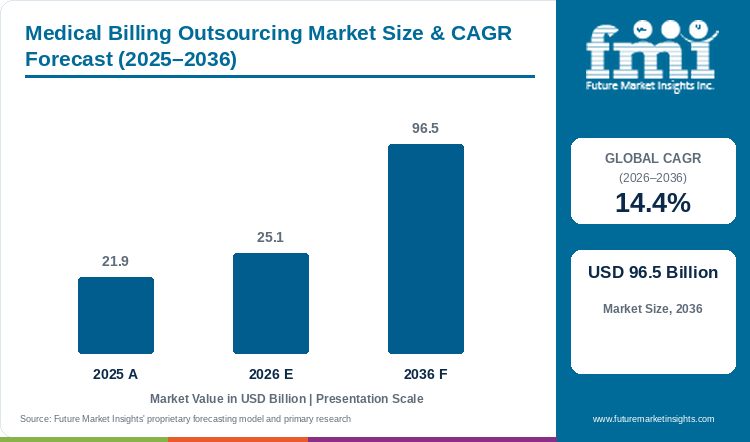
Demand is projected to expand at 14.4% CAGR from 2026 to 2036. Market value rises from USD 21.9 billion in 2025 to USD 25.06 billion in 2026 and USD 96.46 billion by 2036. [1]
Demand is estimated at USD 25.06 billion in 2026 and projected to reach USD 96.46 billion by 2036, at a CAGR of 14.4% from 2026 to 2036. [1] Medical billing outsourcing connects a provider's records with the administrative work needed to prepare, submit and follow up claims, making the division of responsibilities central to service selection. An external partner can supply specialist capacity, but the workflow still depends on complete documentation and a clear route for resolving questions that require input from the provider. [2][3][5] Integration with revenue management software gives financial teams another way to monitor activity. US guidance illustrates the operational context through CMS edits and HIPAA business-associate responsibilities, and AMA findings show continued pressure from prior authorization as a related administrative process. [2][3][4] Buyers therefore compare service coverage and account visibility as well as the initial fee. Back-end work has a substantial role because financial outcomes depend on what happens after submission, while integration can help preserve a usable connection between clinical information and billing activity. Over the forecast period, demand is likely to favor services that handle exceptions consistently and keep the provider informed about the work that remains unresolved. [1][5]
Key Market Trends and Insights
- Billing services are being connected with practice systems, helping providers retain visibility of financial work while external partners perform defined administrative tasks. [1][5]
- US coding and privacy guidance make accurate records and clear service responsibilities consequential to billing arrangements that handle protected healthcare information. [2][3]
- Administrative pressure extends across claims and related payer processes, encouraging providers to compare specialist support against the work retained by their own staff. [1][4]
Regional Highlights
- US demand develops within a complex payer environment, where coding edits, privacy responsibilities and the handling of incomplete records shape service selection. [1][2][3]
- Australia has the strongest profiled growth outlook, with practice-level support and more extensive organizational billing arrangements creating different service requirements. [1]
- Germany, Japan and China require services aligned with local documentation and payment processes, making workflow fit relevant when providers consider delegating administrative tasks. [1]
Market Size and Forecast
Table 1: Value outlook for the medical billing outsourcing market
| Metric | Value |
|---|---|
| 2025 market value | USD 21.9 billion [1] |
| 2026 market value | USD 25.06 billion [1] |
| 2036 market value | USD 96.46 billion [1] |
| CAGR 2026 to 2036 | 14.4% [1] |
| Revenue increase 2026 to 2036 | USD 71.4 billion [1] |
| Market expansion 2026 to 2036 | 3.85 times [1] |
The 14.4% CAGR from 2026 to 2036 outlook is supported by demand for specialist administrative capacity and connected account follow-up. Providers can delegate defined tasks while retaining the information and decisions that remain their responsibility, making integration and exception handling central to adoption. AI cloud contact centers may support communication around an account, although healthcare billing still requires a service arrangement that fits payer processes and maintains clear control over the information used to prepare and resolve claims. [1][2][3][4][5]
What do coding, privacy and administrative requirements show about outsourced billing?
CMS coding edits, HHS business-associate guidance and AMA administrative findings provide distinct views of the work surrounding healthcare payment. Integrated practice software and services show how clinical and financial activity can remain connected, although prior authorization and claim submission are separate processes. These references support service assessment through the tasks delegated, the records required and the route used to resolve incomplete or disputed information. [2][3][4][5]
Table 2: Industry evidence relevant to the medical billing outsourcing market
| Indicator | Data point or observation | Market relevance | Source |
|---|---|---|---|
| Coding edits | CMS maintains National Correct Coding Initiative edits | Claims need consistent coding review | [2] |
| Service responsibilities | HHS identifies billing within business-associate functions | Information handling belongs in the service arrangement | [3] |
| Administrative pressure | AMA reports continuing prior-authorization concerns | Related payer processes affect staff capacity | [4] |
Analyst Perspective
"Medical billing outsourcing is becoming a core revenue cycle strategy for healthcare providers. The service relationship needs clear responsibilities for billing tasks and follow up, so that providers can assess processing quality and maintain visibility into the progress of outstanding claims." [1]
— Sudip Saha, Senior Consultant, Future Market Insights
How is the medical billing outsourcing market segmented?
The market is segmented by Component, Service Type, End Use Verticals, and Region.
By component, coverage includes In-house Medical Billing, Outsourced Medical Billing. By service type, coverage includes Front End, Middle End, Back End. By end use verticals, coverage includes Hospital, Physician Office, Other End Users. Regional coverage follows the report's defined geographic markets. [1]
Why does the Outsourced medical billing segment lead demand within the component category?
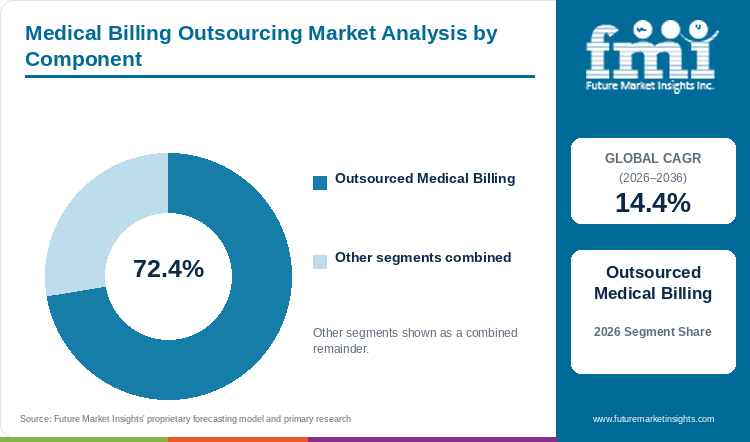
The Outsourced medical billing segment accounts for 72.4% of component demand in 2026. [1]
Outsourced billing gives a provider access to specialist administrative capacity without requiring every financial task to remain within its own staffing arrangement. The external service can handle defined stages of the workflow, while the provider supplies the records and decisions needed to resolve questions that arise during preparation or follow-up. [1][3][5] Its strong position reflects demand for that division of work rather than a claim that delegation removes the need for provider oversight. Connected practice systems can help maintain account visibility, and contract lifecycle management provides a related context for defining the service's responsibilities and review arrangements. Buyers therefore assess reporting, integration and exception handling alongside the scope of the administrative support being purchased. [2]
- The Outsourced medical billing segment is estimated to account for 72.4% of component demand in 2026, as providers seek specialist capacity for defined billing tasks while retaining their own record and oversight responsibilities. [1]
- Service arrangements need a clear handover for incomplete information, giving the provider a practical route to answer questions and monitor unresolved accounts. [2][3][5]
Table 3: Leading component share in 2026
| Segment | Share of demand |
|---|---|
| Outsourced medical billing | 72.4% [1] |
| Other component segments | 27.6% [1] |
| Total | 100.0% |
Why does the Back end segment lead demand within the service type category?
The Back end segment accounts for 53.7% of service type demand in 2026. [1]
Back-end billing work remains consequential after a claim has been submitted, because the account may still require payment review, correction or further communication before it is resolved. Providers need to understand what the external partner is doing at that stage and which questions require their own input, keeping outstanding work visible rather than judging the service solely through submission volume. [1][2][5] The segment's estimated share reflects this continuing administrative role. Clear information handling and service responsibilities remain relevant when staff communicate about an account, while practice-system integration can help connect the original record with subsequent billing activity. Dependable follow-up consequently requires both specialist work and a workable handover between the partner and the provider. [3]
- The Back end segment is estimated to account for 53.7% of service type demand in 2026, reflecting the continuing need to review payments, resolve exceptions and follow up accounts after claim submission. [1]
- Connected reporting can make back-end work visible to the provider, while accurate documentation remains necessary when a correction or further explanation is required. [2][5]
What are the drivers, restraints, and opportunities in the medical billing outsourcing market?
Driver
Providers face recurring administrative work that can require specialist knowledge of coding, payer requirements and account follow-up, supporting demand for external services with a defined operating role. Delegation can supply capacity where the organization's own staff need to focus on other tasks, while connected systems help retain financial visibility. The driver is a workable allocation of administrative responsibilities, with the service's usefulness depending on complete records and consistent handling of questions rather than the outsourcing decision alone. [1][2][3][4][5]
Restraint
Incomplete documentation and unclear responsibility for answering billing questions can limit an external service's effectiveness, because a partner may need information that remains within the provider's records. Integration and information-handling requirements also create implementation work, while different payment relationships prevent a single workflow from fitting every country or practice. These conditions encourage careful service definition and reporting, particularly when a provider wants to retain visibility of unresolved accounts after delegating their routine administration. [1][2][3][5]
Opportunity
Service providers can improve account visibility by connecting workflow updates with the practice systems already used by clinical and financial staff. Making exceptions understandable and returning them to the appropriate owner can help prevent unresolved work from becoming detached from the underlying record. No-code AI platforms illustrate a wider route toward accessible workflow automation, although healthcare billing requires controls and review that remain appropriate to the information and payer requirements involved in the particular service arrangement. [2][3][5]
Which country CAGRs are profiled in the medical billing outsourcing market?
Table 4: Country CAGR comparison for the medical billing outsourcing market
| Country or market | CAGR 2026 to 2036 |
|---|---|
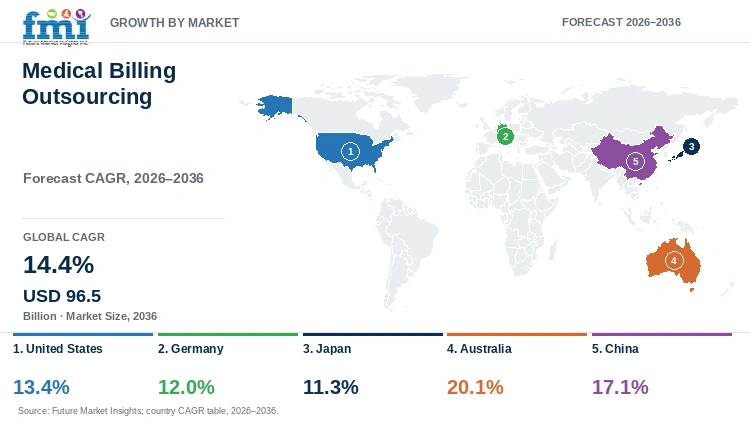
| United States | 13.4% [1] |
| Germany | 12.0% [1] |
| Japan | 11.3% [1] |
| Australia | 20.1% [1] |
| China | 17.1% [1] |
Country-wise Analysis
United States
US providers need billing partners to work across payer requirements while maintaining the connection between the clinical record and the submitted claim. CMS coding edits provide one example of the rules that billing operations must address, while HHS guidance identifies billing and claims administration among functions that can create a business-associate relationship under HIPAA. [2][3] Demand is projected at a CAGR of 13.4% from 2026 to 2036, with external service adoption linked to the practical burden of managing those workflows. The AMA's prior-authorization findings also show continuing administrative pressure, although that process needs to be distinguished from claim submission itself. Providers therefore compare a partner's workflow, account responsibilities and integration with the records used by clinical and financial staff. [1][4][5]
Germany
German providers evaluating external billing support need the service to reflect the relevant payment relationships and documentation practices, rather than importing a workflow designed around another country's payer system. A partner's usefulness depends on how consistently it receives the necessary records and resolves an exception without separating financial work from the care provider's responsibilities. [1] The forecast projects a CAGR of 12.0% from 2026 to 2036, with demand supported by administrative specialization and more connected practice systems. Buyers can examine the handover between staff and the external service, including how incomplete information is returned for resolution, while the organization retains a clear view of outstanding accounts and the communication needed to explain charges to patients or payers. [5]
Japan
Japan's healthcare billing environment creates a need for services that fit local documentation and payment processes, making operational familiarity consequential when a provider delegates financial work. The external partner needs a clear route for obtaining complete information and returning questions to the appropriate staff, because a billing exception may originate in a record that only the provider can clarify. [1] Market demand is projected at a CAGR of 11.3% from 2026 to 2036, with adoption influenced by administrative capacity and the integration of practice systems. Service selection therefore concerns the division of responsibilities and the reliability of account follow-up, while reporting needs to let the provider see what has been submitted, what remains unresolved and which action is required next. [5]
Australia
Australian providers considering outsourced billing support need a service that can handle the payment relationships relevant to their own practice, while keeping unresolved accounts visible to the staff responsible for follow-up. A smaller practice may use an external partner to obtain specialist administrative capacity, whereas a larger organization may need a more extensive connection between clinical information and financial systems. [1] The market is projected at a CAGR of 20.1% from 2026 to 2036, representing the strongest profiled growth outlook. Buyers can compare the completeness of record handovers and the handling of exceptions, while patient-facing communication remains important when a billing question needs an explanation of the charge or the next step in resolving the account. [5]
China
Healthcare organizations in China can evaluate external billing services through the growing need to coordinate administrative work across expanding facilities and more connected information systems. The service needs to fit local payment processes and the provider's own documentation practices, because outsourcing cannot resolve an exception without the information required to explain or correct the account. [1] Demand is projected to advance at a CAGR of 17.1% from 2026 to 2036, with specialization and workflow integration influencing adoption. Buyers can define which tasks are delegated and how questions return to clinical or administrative staff, while the reporting arrangement should preserve visibility of submitted charges, unresolved issues and follow-up responsibilities as the organization extends the service across additional sites. [5]
Who are the notable companies in the medical billing outsourcing market?
R1 RCM; athenahealth; eClinicalWorks; Experian Health; Quest Diagnostics
Competitive Benchmarking
R1 RCM and athenahealth address revenue-cycle work through services or integrated practice offerings, while eClinicalWorks and Experian Health add software and information capabilities supporting related workflows. Quest Diagnostics brings a diagnostic-services relationship with its own billing operations, making its commercial role different from a general outsourcing partner. Buyers can compare the actual service and integration being purchased, keeping provider responsibilities and account visibility central rather than assuming that every company participates through the same operating model. [1][5]
Table 5: Competitive positioning for the medical billing outsourcing market
| Company | Positioning | Evidence or purchasing distinction |
|---|---|---|
| R1 RCM | Revenue cycle management services | External management of healthcare revenue-cycle processes. [1] |
| athenahealth | Integrated clinical and billing services | athenaOne combines software and services for practice operations. [5] |
| eClinicalWorks | Practice systems and revenue-cycle services | Practice workflow and medical-billing service capabilities. [1] |
| Experian Health | Healthcare revenue-cycle technology | Information services supporting healthcare payment workflows. [1] |
| Quest Diagnostics | Diagnostic service billing operations | Billing relationships within a diagnostic services business. [1] |
Key Developments in the Medical Billing Outsourcing Market
- CMS continues to maintain National Correct Coding Initiative edits, providing an operational reference for billing teams reviewing the coding relationships within submitted healthcare claims. [2]
- The AMA's current publication on its 2025 prior-authorization survey reports continued physician concerns, illustrating administrative pressure around a payer process distinct from claim submission. [4]
- athenahealth's current athenaOne offering combines practice software and services, showing how clinical information and financial workflows can be connected within an integrated operating environment. [5]
Key Players in the Medical Billing Outsourcing Market
- R1 RCM
- athenahealth
- eClinicalWorks
- Experian Health
- Quest Diagnostics
Medical Billing Outsourcing Market Report Scope
Table 6: Report coverage for the medical billing outsourcing market
| Attribute | Coverage |
|---|---|
| Market | Medical Billing Outsourcing Market |
| Currency and unit | USD billion; market revenue |
| Historical reference year | 2025 |
| Base year | 2026 |
| Forecast period | 2026 to 2036 |
| Segmentation | Component, Service Type, End Use Verticals |
| Country profiles | United States; Germany; Japan; Australia; China |
| Competitive coverage | R1 RCM; athenahealth; eClinicalWorks; Experian Health; Quest Diagnostics |
| Geographic coverage | North America, Latin America, Europe, East Asia, South Asia and Pacific, Middle East and Africa |
Medical Billing Outsourcing Market Research Methodology
Table 7: Research methods for the medical billing outsourcing market
| Method | Approach |
|---|---|
| Market definition | Revenue coverage is defined around medical billing outsourcing offerings and their related commercial services, with adjacent markets retained as context. |
| Desk research | Public FMI outlooks, direct product documentation, institutional publications and official guidance provide the source base. |
| Segment assessment | Categories are assessed against their functional role, purchasing decisions and reported market structure, with shares kept within their own segmentation axes. |
| Country assessment | Country demand is examined through local customer requirements, industry composition and implementation conditions, with a consistent 2026 to 2036 forecast period. |
| Competitive comparison | Participants are compared through documented offerings and business roles; product features and service models are distinguished from market-share rankings. |
| Forecast assessment | The outlook considers adoption, replacement, integration effort and commercial constraints, expressing monetary forecasts and segment estimates in consistent units. |
Medical Billing Outsourcing Market by Segments
Medical Billing Outsourcing Market segmented by Component:
- In-house Medical Billing
- Outsourced Medical Billing
Medical Billing Outsourcing Market segmented by Service Type:
- Front End
- Middle End
- Back End
Medical Billing Outsourcing Market segmented by End Use Verticals:
- Hospital
- Physician Office
- Other End Users
Medical Billing Outsourcing Market by Region
North America
- United States
- Canada
- Mexico
Latin America
- Brazil
- Chile
- Rest of Latin America
Western Europe
- Germany
- United Kingdom
- Italy
- Spain
- France
- Nordic
- BENELUX
- Rest of Western Europe
Eastern Europe
- Russia
- Poland
- Hungary
- Balkan & Baltic
- Rest of Eastern Europe
East Asia
- China
- Japan
- South Korea
South Asia and Pacific
- India
- ASEAN
- Australia & New Zealand
- Rest of South Asia and Pacific
Middle East & Africa
- Kingdom of Saudi Arabia
- Other GCC Countries
- Turkiye
- South Africa
- Other African Union
- Rest of Middle East & Africa
Research Sources and Bibliography
[1] Future Market Insights. Accessed 14 October 2026. Medical Billing Outsourcing Market
[2] Centers for Medicare & Medicaid Services. Accessed 14 October 2026. National Correct Coding Initiative edits
[3] US Department of Health and Human Services. Accessed 14 October 2026. HIPAA business associates guidance
[4] American Medical Association. Accessed 14 October 2026. Prior-authorization survey findings
[5] athenahealth. Accessed 14 October 2026. athenaOne integrated software and services
This Report Answers
- How big is the medical billing outsourcing market in 2026?
- What is the outlook for the medical billing outsourcing market through 2036?
- Which component segment is highlighted?
- Which markets are included in the growth comparison?
- Which participants are included in the competitive assessment?
Table of Content
- Key Takeaways
- Market Size and CAGR
- Top Growth Driver
- Fastest Growing Segment
- Leading Region
- Key Companies
- Emerging Opportunities
- Executive Summary
- Global Market Outlook
- Demand-side Trends
- Supply-side Trends
- Technology Roadmap Analysis
- Analysis and Recommendations
- Analyst Perspective (What is happening? Why now? What should investors know?)
- Key Questions Answered
- How large is the market?
- What is the CAGR?
- What are key trends?
- Which region dominates?
- Who are the leaders?
Read More...
- Market Overview
- Market Coverage / Taxonomy
- Market Definition / Scope / Limitations
- Research Methodology
- Chapter Orientation
- Analytical Lens and Working Hypotheses
- Market Structure, Signals, and Trend Drivers
- Benchmarking and Cross-market Comparability
- Market Sizing, Forecasting, and Opportunity Mapping
- Research Design and Evidence Framework
- Desk Research Programme (Secondary Evidence)
- Expert Input and Fieldwork (Primary Evidence)
- Tooling, Models, and Reference Databases
- Data Engineering and Model Build
- Quality Assurance and Audit Trail
- Market Background
- Market Dynamics (Drivers, Restraints, Opportunity, Trends)
- Scenario Forecast (Optimistic, Likely, Conservative)
- Impact Analysis
- AI Impact
- Sustainability Impact
- Regulatory Impact
- Technology Impact
- Consumer / Buyer Analysis
- Purchase Drivers
- Adoption Barriers
- Buyer Journey
- Opportunity Map Analysis
- Product Life Cycle Analysis
- Supply Chain Analysis
- Investment Feasibility Matrix
- Value Chain Analysis
- PESTLE and Porter's Analysis
- Regulatory Landscape
- Regional Parent Market Outlook
- Production and Consumption Statistics
- Import and Export Statistics
- Global Market Analysis and Forecast, 2021 to 2036
- Historical Market Size Value (USD Billion) Analysis, 2021 to 2025
- Current and Future Market Size Value (USD Billion) Projections, 2026 to 2036
- Y-o-Y Growth Trend Analysis
- Absolute $ Opportunity Analysis
- Global Market Pricing Analysis, 2021 to 2036
- Global Market Analysis and Forecast, By Component, 2021 to 2036
- Introduction / Key Findings
- Historical Market Size Value (USD Billion) Analysis By Component, 2021 to 2025
- Current and Future Market Size Value (USD Billion) Analysis and Forecast By Component, 2026 to 2036
- In-house Medical Billing
- Outsourced Medical Billing
- Y-o-Y Growth Trend Analysis By Component, 2021 to 2025
- Absolute $ Opportunity Analysis By Component, 2026 to 2036
- Global Market Analysis and Forecast, By Service Type, 2021 to 2036
- Introduction / Key Findings
- Historical Market Size Value (USD Billion) Analysis By Service Type, 2021 to 2025
- Current and Future Market Size Value (USD Billion) Analysis and Forecast By Service Type, 2026 to 2036
- Front End
- Middle End
- Back End
- Y-o-Y Growth Trend Analysis By Service Type, 2021 to 2025
- Absolute $ Opportunity Analysis By Service Type, 2026 to 2036
- Global Market Analysis and Forecast, By End Use Verticals, 2021 to 2036
- Introduction / Key Findings
- Historical Market Size Value (USD Billion) Analysis By End Use Verticals, 2021 to 2025
- Current and Future Market Size Value (USD Billion) Analysis and Forecast By End Use Verticals, 2026 to 2036
- Hospital
- Physician Office
- Other End Users
- Y-o-Y Growth Trend Analysis By End Use Verticals, 2021 to 2025
- Absolute $ Opportunity Analysis By End Use Verticals, 2026 to 2036
- Global Market Analysis and Forecast, By Region, 2021 to 2036
- Introduction
- Historical Market Size Value (USD Billion) Analysis By Region, 2021 to 2025
- Current Market Size Value (USD Billion) Analysis and Forecast By Region, 2026 to 2036
- North America
- Latin America
- Western Europe
- Eastern Europe
- East Asia
- South Asia and Pacific
- Middle East & Africa
- Market Attractiveness Analysis By Region
- North America Market Analysis and Forecast, By Country, 2021 to 2036
- Historical Market Size Value (USD Billion) Trend Analysis By Market Taxonomy, 2021 to 2025
- Market Size Value (USD Billion) Forecast By Market Taxonomy, 2026 to 2036
- By Country
- United States
- Canada
- Mexico
- By Component
- By Service Type
- By End Use Verticals
- By Country
- Market Attractiveness Analysis
- By Country
- By Component
- By Service Type
- By End Use Verticals
- Key Takeaways
- Latin America Market Analysis and Forecast, By Country
- Historical Market Size Value (USD Billion) Trend Analysis By Market Taxonomy, 2021 to 2025
- Market Size Value (USD Billion) Forecast By Market Taxonomy, 2026 to 2036
- By Country
- Brazil
- Chile
- Rest of Latin America
- By Component
- By Service Type
- By End Use Verticals
- By Country
- Market Attractiveness Analysis
- By Country
- By Component
- By Service Type
- By End Use Verticals
- Key Takeaways
- Western Europe Market Analysis and Forecast, By Country
- Historical Market Size Value (USD Billion) Trend Analysis By Market Taxonomy, 2021 to 2025
- Market Size Value (USD Billion) Forecast By Market Taxonomy, 2026 to 2036
- By Country
- Germany
- United Kingdom
- Italy
- Spain
- France
- Nordic
- BENELUX
- Rest of Western Europe
- By Component
- By Service Type
- By End Use Verticals
- By Country
- Market Attractiveness Analysis
- By Country
- By Component
- By Service Type
- By End Use Verticals
- Key Takeaways
- Eastern Europe Market Analysis and Forecast, By Country
- Historical Market Size Value (USD Billion) Trend Analysis By Market Taxonomy, 2021 to 2025
- Market Size Value (USD Billion) Forecast By Market Taxonomy, 2026 to 2036
- By Country
- Russia
- Poland
- Hungary
- Balkan & Baltic
- Rest of Eastern Europe
- By Component
- By Service Type
- By End Use Verticals
- By Country
- Market Attractiveness Analysis
- By Country
- By Component
- By Service Type
- By End Use Verticals
- Key Takeaways
- East Asia Market Analysis and Forecast, By Country
- Historical Market Size Value (USD Billion) Trend Analysis By Market Taxonomy, 2021 to 2025
- Market Size Value (USD Billion) Forecast By Market Taxonomy, 2026 to 2036
- By Country
- China
- Japan
- South Korea
- By Component
- By Service Type
- By End Use Verticals
- By Country
- Market Attractiveness Analysis
- By Country
- By Component
- By Service Type
- By End Use Verticals
- Key Takeaways
- South Asia and Pacific Market Analysis and Forecast, By Country
- Historical Market Size Value (USD Billion) Trend Analysis By Market Taxonomy, 2021 to 2025
- Market Size Value (USD Billion) Forecast By Market Taxonomy, 2026 to 2036
- By Country
- India
- ASEAN
- Australia & New Zealand
- Rest of South Asia and Pacific
- By Component
- By Service Type
- By End Use Verticals
- By Country
- Market Attractiveness Analysis
- By Country
- By Component
- By Service Type
- By End Use Verticals
- Key Takeaways
- Middle East & Africa Market Analysis and Forecast, By Country
- Historical Market Size Value (USD Billion) Trend Analysis By Market Taxonomy, 2021 to 2025
- Market Size Value (USD Billion) Forecast By Market Taxonomy, 2026 to 2036
- By Country
- Kingdom of Saudi Arabia
- Other GCC Countries
- Turkiye
- South Africa
- Other African Union
- Rest of Middle East & Africa
- By Component
- By Service Type
- By End Use Verticals
- By Country
- Market Attractiveness Analysis
- By Country
- By Component
- By Service Type
- By End Use Verticals
- Key Takeaways
- Key Countries Market Analysis
- United States
- Pricing Analysis
- Market Share Analysis, 2025
- By Component
- By Service Type
- By End Use Verticals
- Canada
- Pricing Analysis
- Market Share Analysis, 2025
- By Component
- By Service Type
- By End Use Verticals
- Mexico
- Pricing Analysis
- Market Share Analysis, 2025
- By Component
- By Service Type
- By End Use Verticals
- Brazil
- Pricing Analysis
- Market Share Analysis, 2025
- By Component
- By Service Type
- By End Use Verticals
- Chile
- Pricing Analysis
- Market Share Analysis, 2025
- By Component
- By Service Type
- By End Use Verticals
- Germany
- Pricing Analysis
- Market Share Analysis, 2025
- By Component
- By Service Type
- By End Use Verticals
- United Kingdom
- Pricing Analysis
- Market Share Analysis, 2025
- By Component
- By Service Type
- By End Use Verticals
- Italy
- Pricing Analysis
- Market Share Analysis, 2025
- By Component
- By Service Type
- By End Use Verticals
- Spain
- Pricing Analysis
- Market Share Analysis, 2025
- By Component
- By Service Type
- By End Use Verticals
- France
- Pricing Analysis
- Market Share Analysis, 2025
- By Component
- By Service Type
- By End Use Verticals
- India
- Pricing Analysis
- Market Share Analysis, 2025
- By Component
- By Service Type
- By End Use Verticals
- ASEAN
- Pricing Analysis
- Market Share Analysis, 2025
- By Component
- By Service Type
- By End Use Verticals
- Australia & New Zealand
- Pricing Analysis
- Market Share Analysis, 2025
- By Component
- By Service Type
- By End Use Verticals
- China
- Pricing Analysis
- Market Share Analysis, 2025
- By Component
- By Service Type
- By End Use Verticals
- Japan
- Pricing Analysis
- Market Share Analysis, 2025
- By Component
- By Service Type
- By End Use Verticals
- South Korea
- Pricing Analysis
- Market Share Analysis, 2025
- By Component
- By Service Type
- By End Use Verticals
- Russia
- Pricing Analysis
- Market Share Analysis, 2025
- By Component
- By Service Type
- By End Use Verticals
- Poland
- Pricing Analysis
- Market Share Analysis, 2025
- By Component
- By Service Type
- By End Use Verticals
- Hungary
- Pricing Analysis
- Market Share Analysis, 2025
- By Component
- By Service Type
- By End Use Verticals
- Kingdom of Saudi Arabia
- Pricing Analysis
- Market Share Analysis, 2025
- By Component
- By Service Type
- By End Use Verticals
- South Africa
- Pricing Analysis
- Market Share Analysis, 2025
- By Component
- By Service Type
- By End Use Verticals
- Australia
- Pricing Analysis
- Market Share Analysis, 2025
- By Component
- By Service Type
- By End Use Verticals
- United States
- Market Structure Analysis
- Competition Dashboard
- Competition Benchmarking
- Market Share Analysis of Top Players
- By Regional
- By Component
- By Service Type
- By End Use Verticals
- Emerging Startups
- Innovation Benchmarking
- Competition Analysis
- Competition Deep Dive
- R1 RCM
- Overview
- Product Portfolio
- Profitability by Market Segments
- Sales Footprint
- Strategy Overview
- Marketing Strategy
- Product Strategy
- Channel Strategy
- athenahealth
- eClinicalWorks
- Experian Health
- Quest Diagnostics
- R1 RCM
- Case Studies
- Success Stories
- Recent Developments
- Competition Deep Dive
- Assumptions & Acronyms Used
List of Tables
- Table 1: Global Market Value (USD Billion) Forecast by Region, 2021 to 2036
- Table 2: Global Market Value (USD Billion) Forecast by Component, 2021 to 2036
- Table 3: Global Market Value (USD Billion) Forecast by Service Type, 2021 to 2036
- Table 4: Global Market Value (USD Billion) Forecast by End Use Verticals, 2021 to 2036
- Table 5: North America Market Value (USD Billion) Forecast by Country, 2021 to 2036
- Table 6: North America Market Value (USD Billion) Forecast by Component, 2021 to 2036
- Table 7: North America Market Value (USD Billion) Forecast by Service Type, 2021 to 2036
- Table 8: North America Market Value (USD Billion) Forecast by End Use Verticals, 2021 to 2036
- Table 9: Latin America Market Value (USD Billion) Forecast by Country, 2021 to 2036
- Table 10: Latin America Market Value (USD Billion) Forecast by Component, 2021 to 2036
- Table 11: Latin America Market Value (USD Billion) Forecast by Service Type, 2021 to 2036
- Table 12: Latin America Market Value (USD Billion) Forecast by End Use Verticals, 2021 to 2036
- Table 13: Western Europe Market Value (USD Billion) Forecast by Country, 2021 to 2036
- Table 14: Western Europe Market Value (USD Billion) Forecast by Component, 2021 to 2036
- Table 15: Western Europe Market Value (USD Billion) Forecast by Service Type, 2021 to 2036
- Table 16: Western Europe Market Value (USD Billion) Forecast by End Use Verticals, 2021 to 2036
- Table 17: Eastern Europe Market Value (USD Billion) Forecast by Country, 2021 to 2036
- Table 18: Eastern Europe Market Value (USD Billion) Forecast by Component, 2021 to 2036
- Table 19: Eastern Europe Market Value (USD Billion) Forecast by Service Type, 2021 to 2036
- Table 20: Eastern Europe Market Value (USD Billion) Forecast by End Use Verticals, 2021 to 2036
- Table 21: East Asia Market Value (USD Billion) Forecast by Country, 2021 to 2036
- Table 22: East Asia Market Value (USD Billion) Forecast by Component, 2021 to 2036
- Table 23: East Asia Market Value (USD Billion) Forecast by Service Type, 2021 to 2036
- Table 24: East Asia Market Value (USD Billion) Forecast by End Use Verticals, 2021 to 2036
- Table 25: South Asia and Pacific Market Value (USD Billion) Forecast by Country, 2021 to 2036
- Table 26: South Asia and Pacific Market Value (USD Billion) Forecast by Component, 2021 to 2036
- Table 27: South Asia and Pacific Market Value (USD Billion) Forecast by Service Type, 2021 to 2036
- Table 28: South Asia and Pacific Market Value (USD Billion) Forecast by End Use Verticals, 2021 to 2036
- Table 29: Middle East & Africa Market Value (USD Billion) Forecast by Country, 2021 to 2036
- Table 30: Middle East & Africa Market Value (USD Billion) Forecast by Component, 2021 to 2036
- Table 31: Middle East & Africa Market Value (USD Billion) Forecast by Service Type, 2021 to 2036
- Table 32: Middle East & Africa Market Value (USD Billion) Forecast by End Use Verticals, 2021 to 2036
List of Figures
- Figure 1: Global Market Pricing Analysis
- Figure 2: Global Market Value (USD Billion) Forecast 2021-2036
- Figure 3: Global Market Value Share and BPS Analysis by Component, 2026 and 2036
- Figure 4: Global Market Y-o-Y Growth Comparison by Component, 2026-2036
- Figure 5: Global Market Attractiveness Analysis by Component
- Figure 6: Global Market Value Share and BPS Analysis by Service Type, 2026 and 2036
- Figure 7: Global Market Y-o-Y Growth Comparison by Service Type, 2026-2036
- Figure 8: Global Market Attractiveness Analysis by Service Type
- Figure 9: Global Market Value Share and BPS Analysis by End Use Verticals, 2026 and 2036
- Figure 10: Global Market Y-o-Y Growth Comparison by End Use Verticals, 2026-2036
- Figure 11: Global Market Attractiveness Analysis by End Use Verticals
- Figure 12: Global Market Value (USD Billion) Share and BPS Analysis by Region, 2026 and 2036
- Figure 13: Global Market Y-o-Y Growth Comparison by Region, 2026-2036
- Figure 14: Global Market Attractiveness Analysis by Region
- Figure 15: North America Market Incremental Dollar Opportunity, 2026-2036
- Figure 16: Latin America Market Incremental Dollar Opportunity, 2026-2036
- Figure 17: Western Europe Market Incremental Dollar Opportunity, 2026-2036
- Figure 18: Eastern Europe Market Incremental Dollar Opportunity, 2026-2036
- Figure 19: East Asia Market Incremental Dollar Opportunity, 2026-2036
- Figure 20: South Asia and Pacific Market Incremental Dollar Opportunity, 2026-2036
- Figure 21: Middle East & Africa Market Incremental Dollar Opportunity, 2026-2036
- Figure 22: North America Market Value Share and BPS Analysis by Country, 2026 and 2036
- Figure 23: North America Market Value Share and BPS Analysis by Component, 2026 and 2036
- Figure 24: North America Market Y-o-Y Growth Comparison by Component, 2026-2036
- Figure 25: North America Market Attractiveness Analysis by Component
- Figure 26: North America Market Value Share and BPS Analysis by Service Type, 2026 and 2036
- Figure 27: North America Market Y-o-Y Growth Comparison by Service Type, 2026-2036
- Figure 28: North America Market Attractiveness Analysis by Service Type
- Figure 29: North America Market Value Share and BPS Analysis by End Use Verticals, 2026 and 2036
- Figure 30: North America Market Y-o-Y Growth Comparison by End Use Verticals, 2026-2036
- Figure 31: North America Market Attractiveness Analysis by End Use Verticals
- Figure 32: Latin America Market Value Share and BPS Analysis by Country, 2026 and 2036
- Figure 33: Latin America Market Value Share and BPS Analysis by Component, 2026 and 2036
- Figure 34: Latin America Market Y-o-Y Growth Comparison by Component, 2026-2036
- Figure 35: Latin America Market Attractiveness Analysis by Component
- Figure 36: Latin America Market Value Share and BPS Analysis by Service Type, 2026 and 2036
- Figure 37: Latin America Market Y-o-Y Growth Comparison by Service Type, 2026-2036
- Figure 38: Latin America Market Attractiveness Analysis by Service Type
- Figure 39: Latin America Market Value Share and BPS Analysis by End Use Verticals, 2026 and 2036
- Figure 40: Latin America Market Y-o-Y Growth Comparison by End Use Verticals, 2026-2036
- Figure 41: Latin America Market Attractiveness Analysis by End Use Verticals
- Figure 42: Western Europe Market Value Share and BPS Analysis by Country, 2026 and 2036
- Figure 43: Western Europe Market Value Share and BPS Analysis by Component, 2026 and 2036
- Figure 44: Western Europe Market Y-o-Y Growth Comparison by Component, 2026-2036
- Figure 45: Western Europe Market Attractiveness Analysis by Component
- Figure 46: Western Europe Market Value Share and BPS Analysis by Service Type, 2026 and 2036
- Figure 47: Western Europe Market Y-o-Y Growth Comparison by Service Type, 2026-2036
- Figure 48: Western Europe Market Attractiveness Analysis by Service Type
- Figure 49: Western Europe Market Value Share and BPS Analysis by End Use Verticals, 2026 and 2036
- Figure 50: Western Europe Market Y-o-Y Growth Comparison by End Use Verticals, 2026-2036
- Figure 51: Western Europe Market Attractiveness Analysis by End Use Verticals
- Figure 52: Eastern Europe Market Value Share and BPS Analysis by Country, 2026 and 2036
- Figure 53: Eastern Europe Market Value Share and BPS Analysis by Component, 2026 and 2036
- Figure 54: Eastern Europe Market Y-o-Y Growth Comparison by Component, 2026-2036
- Figure 55: Eastern Europe Market Attractiveness Analysis by Component
- Figure 56: Eastern Europe Market Value Share and BPS Analysis by Service Type, 2026 and 2036
- Figure 57: Eastern Europe Market Y-o-Y Growth Comparison by Service Type, 2026-2036
- Figure 58: Eastern Europe Market Attractiveness Analysis by Service Type
- Figure 59: Eastern Europe Market Value Share and BPS Analysis by End Use Verticals, 2026 and 2036
- Figure 60: Eastern Europe Market Y-o-Y Growth Comparison by End Use Verticals, 2026-2036
- Figure 61: Eastern Europe Market Attractiveness Analysis by End Use Verticals
- Figure 62: East Asia Market Value Share and BPS Analysis by Country, 2026 and 2036
- Figure 63: East Asia Market Value Share and BPS Analysis by Component, 2026 and 2036
- Figure 64: East Asia Market Y-o-Y Growth Comparison by Component, 2026-2036
- Figure 65: East Asia Market Attractiveness Analysis by Component
- Figure 66: East Asia Market Value Share and BPS Analysis by Service Type, 2026 and 2036
- Figure 67: East Asia Market Y-o-Y Growth Comparison by Service Type, 2026-2036
- Figure 68: East Asia Market Attractiveness Analysis by Service Type
- Figure 69: East Asia Market Value Share and BPS Analysis by End Use Verticals, 2026 and 2036
- Figure 70: East Asia Market Y-o-Y Growth Comparison by End Use Verticals, 2026-2036
- Figure 71: East Asia Market Attractiveness Analysis by End Use Verticals
- Figure 72: South Asia and Pacific Market Value Share and BPS Analysis by Country, 2026 and 2036
- Figure 73: South Asia and Pacific Market Value Share and BPS Analysis by Component, 2026 and 2036
- Figure 74: South Asia and Pacific Market Y-o-Y Growth Comparison by Component, 2026-2036
- Figure 75: South Asia and Pacific Market Attractiveness Analysis by Component
- Figure 76: South Asia and Pacific Market Value Share and BPS Analysis by Service Type, 2026 and 2036
- Figure 77: South Asia and Pacific Market Y-o-Y Growth Comparison by Service Type, 2026-2036
- Figure 78: South Asia and Pacific Market Attractiveness Analysis by Service Type
- Figure 79: South Asia and Pacific Market Value Share and BPS Analysis by End Use Verticals, 2026 and 2036
- Figure 80: South Asia and Pacific Market Y-o-Y Growth Comparison by End Use Verticals, 2026-2036
- Figure 81: South Asia and Pacific Market Attractiveness Analysis by End Use Verticals
- Figure 82: Middle East & Africa Market Value Share and BPS Analysis by Country, 2026 and 2036
- Figure 83: Middle East & Africa Market Value Share and BPS Analysis by Component, 2026 and 2036
- Figure 84: Middle East & Africa Market Y-o-Y Growth Comparison by Component, 2026-2036
- Figure 85: Middle East & Africa Market Attractiveness Analysis by Component
- Figure 86: Middle East & Africa Market Value Share and BPS Analysis by Service Type, 2026 and 2036
- Figure 87: Middle East & Africa Market Y-o-Y Growth Comparison by Service Type, 2026-2036
- Figure 88: Middle East & Africa Market Attractiveness Analysis by Service Type
- Figure 89: Middle East & Africa Market Value Share and BPS Analysis by End Use Verticals, 2026 and 2036
- Figure 90: Middle East & Africa Market Y-o-Y Growth Comparison by End Use Verticals, 2026-2036
- Figure 91: Middle East & Africa Market Attractiveness Analysis by End Use Verticals
- Figure 92: Global Market - Tier Structure Analysis
- Figure 93: Global Market - Company Share Analysis
Frequently Asked Questions
How big is the medical billing outsourcing market in 2026?
The market is estimated at USD 25.06 billion in 2026, compared with USD 21.9 billion in 2025. [1]
What is the outlook for the medical billing outsourcing market through 2036?
Revenue is projected to reach USD 96.46 billion by 2036, with a CAGR of 14.4% from 2026 to 2036. [1]
Which component segment is highlighted?
The Outsourced medical billing segment accounts for an estimated 72.4% share in 2026, reflecting the purchasing conditions described in the segment analysis. [1]
Which markets are included in the growth comparison?
The comparison profiles United States, Germany, Japan, Australia, China and presents their demand outlooks for 2026 to 2036. [1]
Which participants are included in the competitive assessment?
The assessment includes R1 RCM, athenahealth, eClinicalWorks, Experian Health, Quest Diagnostics, with positioning based on each participant's documented business role. [1]
Preview the report firsthand - request a free sample
Get SampleGet the brochure for pricing and purchase details.
Get PDF
