
- Market Size (2026)
- USD 4.2 Bn
- Forecast (2036)
- USD 7.5 Bn
- CAGR (2026 to 2036)
- 6.0%
How Big Is the Mining Safety Equipment Market in 2026?
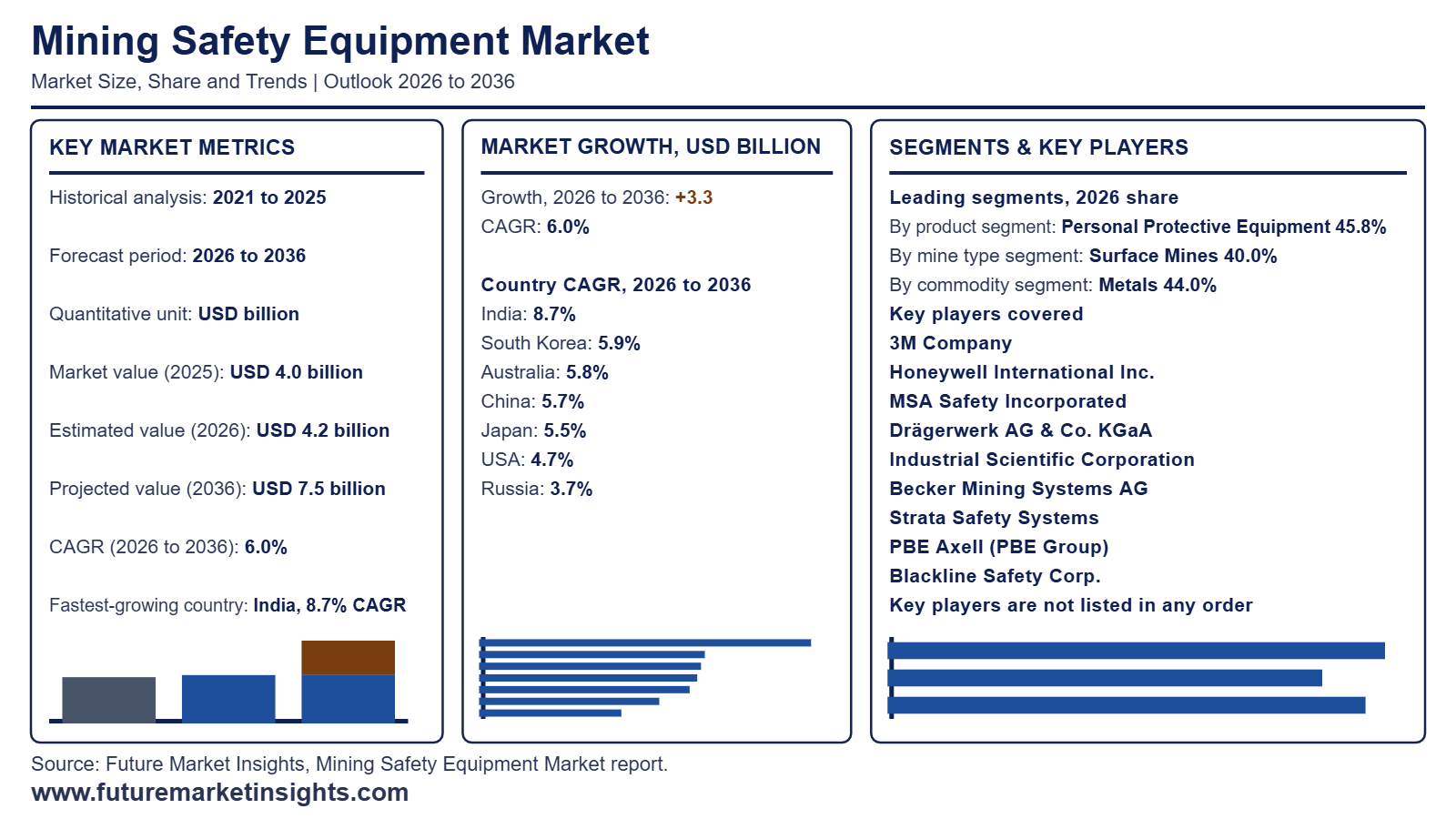
Assessed at USD 4.0 billion in 2025 and progressing to USD 4.2 billion in 2026, global mining safety equipment industry valuation is on course to reach USD 7.5 billion by 2036, aided by a forecast-period CAGR of 6.0%. FMI survey reflects that mandatory respirable dust rules, vehicle collision-avoidance mandates, and connected multi-gas monitoring generate an incremental opportunity of USD 3.3 billion between 2026 and 2036. Mine operators are increasing safety budgets across both recurring worker protective gear and engineered underground telemonitoring networks to prevent workplace fatalities and regulatory shutdowns.
| Market Metric | Valuation / Share / Forecast Benchmark |
|---|---|
| 2025 Market Size (Historical) | USD 4.0 billion |
| 2026 Market Size (Estimated) | USD 4.2 billion |
| 2036 Market Size (Projected) | USD 7.5 billion |
| Compound Annual Growth Rate (2026 to 2036) | 6.0% CAGR |
| Incremental Dollar Opportunity (2026 to 2036) | USD 3.3 billion |
| Dominant Product Segment (2026 Share) | Personal Protective Equipment (45.8% share in 2026) | Other Segment Combined (54.2%) |
| Leading Mine Type Segment (2026 Share) | Surface Mines (40.0% share in 2026) | Other Segment Combined (60.0%) |
| Leading Commodity Segment (2026 Share) | Metals (44.0% share in 2026) | Other Segment Combined (56.0%) |
| Leading Technology Segment (2026 Share) | Conventional Products (66.0% share in 2026) | Other Segment Combined (34.0%) |
| Fastest-Growing Country Markets (2026 to 2036) | India (8.7% CAGR), South Korea (5.9% CAGR), Australia (5.8% CAGR) |
| Leading Tier-1 Companies | 3M Company, Honeywell International Inc., MSA Safety Incorporated, Drägerwerk AG & Co. KGaA, Industrial Scientific Corporation, Becker Mining Systems AG, Strata Safety Systems, PBE Axell (PBE Group), Blackline Safety Corp. |
Source: Future Market Insights analysis of the mining safety equipment market, 2026.
Executive Market Overview
Demand for mining safety equipment is rising across open-pit and underground operations due to stricter national enforcement of respirable dust limits and powered-haulage collision controls. According to safety procurement surveys tracked by FMI analysts, mine operators are tying site access to certified respiratory headgear, multi-gas detectors, and vehicle proximity tags to prevent fatal accidents and costly regulatory citations beside respiratory protective equipment. Enforcement alerts released by the Mine Safety and Health Administration, U.S. Department of Labor (March 2025) recorded 10 U.S. miner fatalities over the first two months of 2025, including 4 powered-haulage deaths, while the Ministry of Coal, Government of India (March 2025) mandated comprehensive coal mine safety audits and underground environmental telemonitoring. Country-level growth analysis shows India leading expansion at an 8.7% CAGR ahead of South Korea at 5.9%, Australia at 5.8%, and China at 5.7%, whereas Japan at 5.5%, the USA at 4.7%, and Russia at 3.7% grow at a more moderate rate. India and East Asian mining markets outpace North America and Russia owing to mandatory digital safety portal rollouts, intelligent-mine hazard standards, and expanding coal and critical-mineral workforces.
Sales of connected wearable gas monitors and automated vehicle-proximity networks are also accelerating as mining companies transition from manual compliance logs to real-time cloud dashboards. In FMI's evaluation of industrial safety investments, buyers weigh intrinsic-safety approvals, sensor poison resistance, and underground wireless coverage before signing fleet-wide supply contracts. Comparative market research by FMI indicates that respiratory protective equipment is projected to grow at a 7.0% CAGR and gas leak detectors at 5.1% through 2036, compared with 6.0% for mining safety equipment and 5.0% for electrical safety personal protection equipment, on account of mining sites blending high-turnover personal protective consumables with capital-intensive collision-avoidance hardware. Product announcements from Industrial Scientific Corporation (September 2026) confirm the launch of its Tectra connected wearable gas monitor featuring automated calibration tracking. Market scope covers mining PPE, gas detectors, self-rescuers, proximity warning systems, and tracking hardware while excluding primary ventilation fans and non-mining industrial safety gear.
This Report Answers
- How large the mining safety equipment market is in 2026 and what it reaches by 2036
- Which product, mine type, commodity and technology segments lead in 2026
- What is driving mine safety equipment orders and what slows connected system rollouts
- Which countries grow fastest between 2026 and 2036
- What MSA Safety Incorporated, Honeywell International Inc., Industrial Scientific Corporation and Blackline Safety Corp. have launched
- How the mining safety equipment market is defined, segmented and measured
Analyst Perspective
"Mining safety equipment manufacturers will expand recurring revenue faster than unit hardware shipments by pairing intrinsically safe wearable gas monitors with automated calibration docks and LTE/5G underground proximity networks. Inconsistent underground wireless coverage remains the primary operational hurdle, as false proximity alarms or dropped telemetry links cause mine operators to revert to standalone conventional gear."
- Nikhil Kaitwade, Principal Consultant, Future Market Insights.
Key Market Trends & Insights
- Connected Multi-Gas Wearables With Automated Calibration Simplify Shift Compliance: Buyer adoption of cloud-linked wearable gas monitors is expanding because manual tabletop calibration logs fail to prevent workers from carrying drifted sensors underground. FMI observes that automated bump-test docks and live gas exposure alerts improve shift compliance across portable gas detection equipment. Product releases from Industrial Scientific Corporation (September 2026) introducing the Tectra connected safety platform and Blackline Safety Corp. (March 2026) shipping its G8 wearable monitor with push-to-talk radio and ZoneAware geofencing confirm strong buyer demand for connected wearables. Integrated voice-and-gas wearables are projected to drive multi-year subscription renewals through 2036.
- Non-Dispersive Infrared and Molecular Property Spectrometer Sensors Curb Poisoning: Equipment preference in underground ventilation monitoring is shifting from conventional catalytic-bead pellistors toward non-dispersive infrared and molecular property spectrometer combustible gas sensors. Analysts at FMI note that optical and spectrometer cells resist silicone and sulfide poisoning, which reduces maintenance callouts in remote underground headings in parallel with toxic gas detectors. Commercial launches from Honeywell International Inc. (March 2026) for its 4-Series NDIR hydrocarbon gas sensor and Industrial Scientific Corporation (January 2026) adding MPS LEL sensing to its Radius BZ1 area monitor demonstrate this technology transition. Poison-immune gas sensing is expected to lower sensor replacement costs for underground mines through 2036.
- Private LTE/5G Underground Networks Anchor Vehicle Proximity and Refuge Tracking: Strategic investments in ruggedized LTE and 5G underground wireless backbones are enabling mines to link vehicle collision-avoidance radars with real-time worker tracking tags. FMI's field assessment indicates that unified wireless networks allow control rooms to locate miners during emergencies and trigger automatic haul-truck slowdowns beside emergency lighting systems. Deployment records from Becker Mining Systems AG (March 2026) on its mining connectivity partnership with Ericsson and MSA Safety Incorporated (July 2026) completing its acquisition of Autronica Fire and Security confirm rising network integration. Connected safety backbones are anticipated to access large turnkey integration contracts through 2036.
What Are the Main Drivers, Restraints, and Opportunities?
Stricter respirable silica exposure limits and fatal powered-haulage accidents drive mandatory safety equipment procurement, whereas underground permissibility petitions and calibration upkeep restrain complex rollouts, leaving integrated telemonitoring and geofencing systems as the primary growth opportunity.
Driver: Mandatory Silica Exposure Controls and Powered-Haulage Fatality Prevention
Underground and open-pit mine operators are investing heavily in collision avoidance systems, wearable dust monitors, and personal escape apparatus to comply with stricter regulatory safety mandates and protect workforce health. Real-time gas sensors and proximity detection units prevent vehicle-pedestrian accidents and warn personnel of hazardous methane or silica dust concentrations before toxic thresholds occur. Comprehensive safety reports published by the Mine Safety and Health Administration (January 2026) revealed that mining sector fatalities dropped to historic lows following the rollout of automated vehicle detection rules. FMI trend analysis indicates that global mining companies will sustain steady safety equipment procurement to prevent operational shutdowns and comply with zero-harm corporate governance policies through 2036.
Restraint: Underground Permissibility Modifications and Calibration Maintenance Overhead
Market adoption of complex electronic safety hardware faces operational restraints in underground mines owing to lengthy regulatory variance petitions and daily calibration maintenance requirements. In FMI's view, when remote mine sites lack certified technicians to service gas-detector docking stations or must wait for federal permissibility sign-offs on modified machinery brakes, buyers postpone connected upgrades and stick with basic gear beside personal protective equipment. Regulatory filings in the U.S. Federal Register (September 2025) under Docket 2025-17803 show how Prairie Eagle Underground Mine had to petition MSHA under 30 CFR 75.1909(b)(6) to approve dual service brakes and a 10-mile-per-hour speed lock on six-wheel Getman RDG-1504S underground road builders. Certification bottlenecks and calibration upkeep continue to slow rapid technology replacement.
Opportunity: Intelligent Mine Telemonitoring, Geofencing, and Modular Refuge Shelters
Major growth opportunities are emerging for safety suppliers that deliver integrated environmental telemonitoring, opencast vehicle geofencing, and modular refuge chambers across Asian and Australian mining basins. FMI expects mine operators to link fixed methane and carbon monoxide sensors with worker positioning tags so dispatchers gain real-time hazard visibility in parallel with mine ventilation systems. Official parliamentary disclosures from the Ministry of Coal, Government of India (March 2025) confirm nationwide rollouts of underground environmental telemonitoring, opencast geofencing, and a coal safety portal launched in December 2024, while The State Council of the People's Republic of China (October 2026) confirmed 67 major accident hazard standards across 31 departments. Government-mandated digital safety upgrades are anticipated to drive strong Asia-Pacific procurement through 2036.
How Is the Mining Safety Equipment Market Segmented?
Mining Safety Equipment Market is segmented by Product, Mine Type, Commodity, Technology, and Region. Forecast period from 2026 to 2036.
| Segmentation Axis | Sub-Segments Covered | 2026 Leading Segment & Share | Other Segment Combined & Total |
|---|---|---|---|
| Product | Personal Protective Equipment, Gas Detection and Monitoring, Respiratory and Self-Rescue, Proximity Detection and Collision Avoidance, Tracking and Communication | Personal Protective Equipment (45.8% share in 2026) | Other Segment Combined (54.2%) | Total (100.0%) |
| Mine Type | Surface Mines, Underground Metal Mines, Underground Coal Mines, Quarries and Aggregates | Surface Mines (40.0% share in 2026) | Other Segment Combined (60.0%) | Total (100.0%) |
| Commodity | Metals, Coal, Gold and Precious Metals, Industrial Minerals | Metals (44.0% share in 2026) | Other Segment Combined (56.0%) | Total (100.0%) |
| Technology | Conventional Products, Fixed Connected Systems, Wearable Devices, AI Vision Systems | Conventional Products (66.0% share in 2026) | Other Segment Combined (34.0%) | Total (100.0%) |
| Region | North America, Latin America, Western Europe, Eastern Europe, East Asia, South Asia and Pacific, Middle East and Africa | South Asia and Pacific (led by India at 8.7% CAGR) | Global Coverage Across 7 Core Countries (100.0%) |
Source: Future Market Insights analysis of the mining safety equipment market, 2026.
Why Does the Personal Protective Equipment Segment Lead by Product?
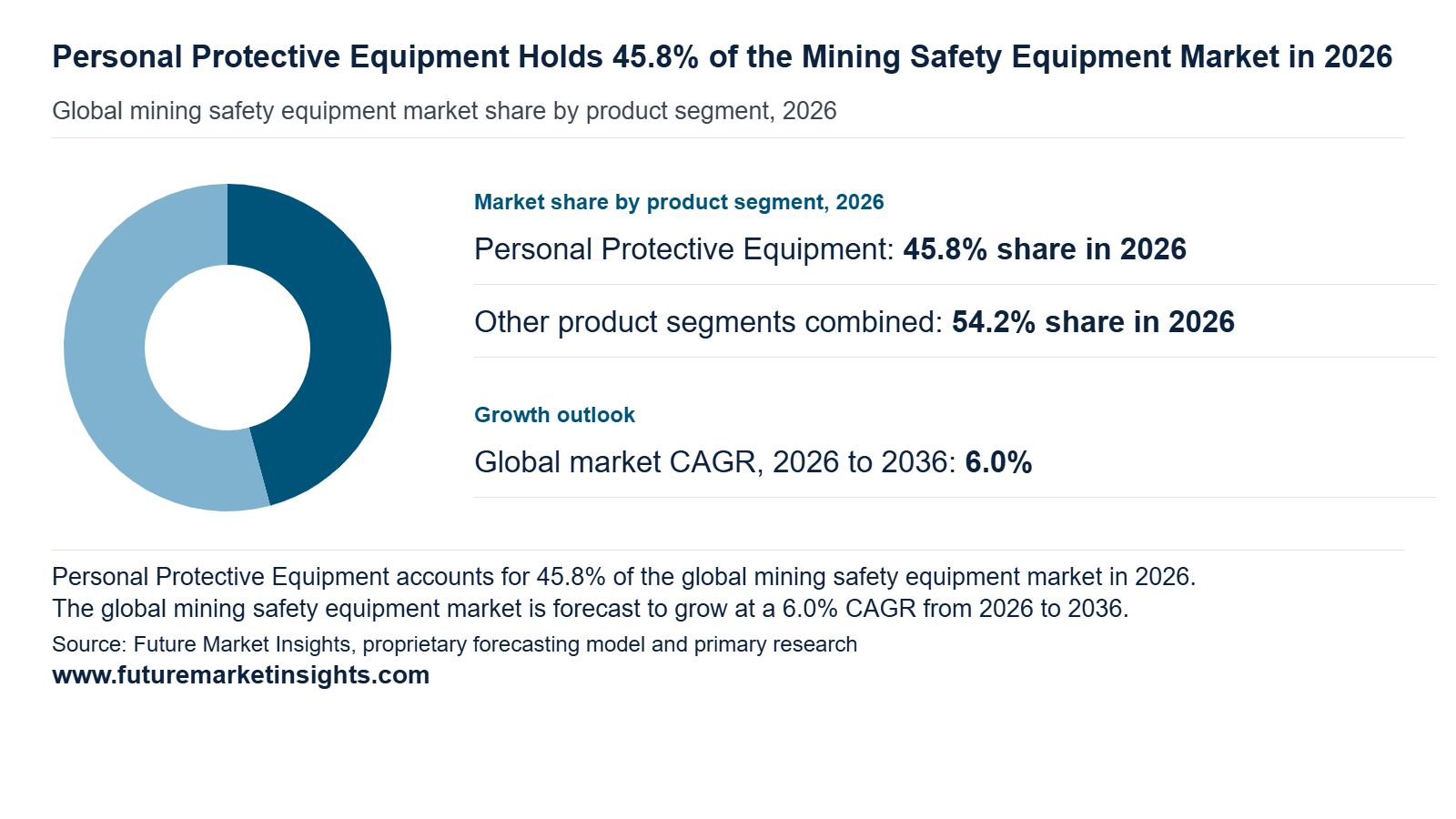
Mandatory per-worker safety rules place personal protective equipment at 45.8% of product revenue in 2026, ahead of gas detection and monitoring, respiratory and self-rescue, proximity detection and collision avoidance, and tracking and communication. Every miner, maintenance contractor, and site visitor must wear certified head, eye, hearing, hand, and foot protection before entering active pit or shaft zones, which generates high-volume recurring orders in parallel with above-the-waist protective gear. FMI believes that harsh rock-dust and moisture conditions also shorten helmet and boot replacement intervals compared with general manufacturing industries. Product announcements from MSA Safety Incorporated (September 2025) launching its V-Gard H2 safety helmet and technical specifications from 3M Company (2026) for the Versaflo M-940 mining lamp bracket kit on respiratory headgear show how brands tailor PPE.
What Keeps the Surface Mines Segment Ahead Within Mine Type?
In 2026, surface mines account for 40.0% of mine type demand, outpacing underground metal mines, underground coal mines, and quarries and aggregates due to the vast scale of open-pit workforces and mobile haulage fleets. Open-pit copper, iron ore, and coal mines operate hundreds of haul trucks, graders, and light utility vehicles across dusty haul roads where vehicle proximity radars, geofencing, and respiratory dust helmets are required simultaneously beside construction worker safety solutions. According to FMI's mine-type procurement analysis, surface operations generate larger bulk PPE and collision-avoidance tenders than smaller underground shafts. Annual safety filings from Resources Safety & Health Queensland (September 2025) recording 3 resources-sector fatalities in 2024 to 2025, including an August 2024 surface collision between a light vehicle and a haul truck, combined with opencast geofencing mandates from the Ministry of Coal, Government of India (March 2025), confirm why operators are upgrading open-pit safety gear. Large-scale open-pit fleet retrofits are expected to preserve surface mines leadership through 2036.
How Does the Metals Segment Shape Commodity Demand?
Sales across the commodity axis are led by metals mining, which holds 44.0% of segment demand in 2026 ahead of coal, gold and precious metals, and industrial minerals. Copper, iron ore, nickel, and zinc extraction combines massive open-pit haulage fleets with deep underground block-caving shafts, exposing crews to silica dust, diesel particulate emissions, blasting gases, and mobile machinery hazards that require multi-layered safety equipment in parallel with portable gas detection equipment. FMI analysts note that multinational base-metal producers enforce uniform global safety standards across all operating sites, lifting spend per worker. Connectivity deployments by Becker Mining Systems AG (March 2026) with Ericsson and collision-avoidance radar installations by PBE Axell, PBE Group (2026) across international metal mines demonstrate this high equipment intensity. Higher copper, iron ore, and battery-metal production is anticipated to keep metals as the largest commodity segment through 2036.
Why Is the Conventional Products Segment the Leading Technology?
Buyer preference for dependable, infrastructure-free life safety keeps conventional products at 66.0% of technology revenue in 2026, ahead of fixed connected systems, wearable devices, and AI vision systems. Standalone hard hats, non-networked respirators, self-contained self-rescuers, acoustic alarms, and portable gas detectors function immediately in remote exploration camps, small quarries, and newly blasted underground drifts where Wi-Fi or LTE coverage is unavailable beside personal protective equipment. FMI suggests that lower unit acquisition costs also make conventional gear the default choice for sub-contractors across developing mining regions. Technical documentation from Drägerwerk AG & Co. KGaA (2026) and Drägerwerk AG & Co. KGaA (2025) on standalone oxygen self-rescuers and X-am 2800 gas detectors, paired with refuge chamber manuals from Strata Safety Systems (August 2026), confirms the ongoing necessity of non-networked safety hardware. Universal site compatibility is forecast to maintain conventional products in the lead through 2036.
Regional & Country Outlook
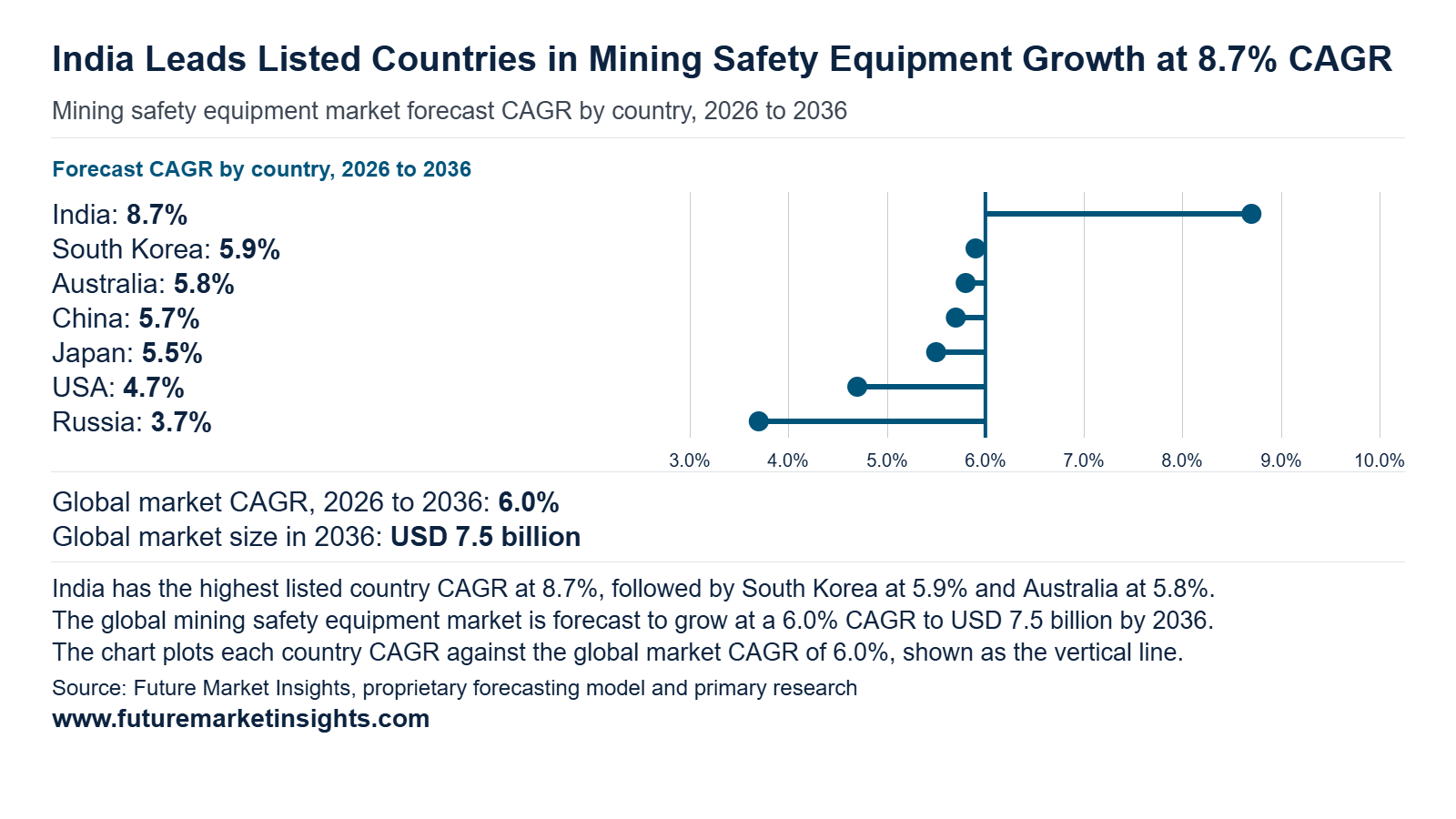
South Asia and Pacific, East Asia, and North America account for the largest regional expenditure on mining safety equipment, while Australia and Eurasia generate consistent replacement and compliance demand across surface and underground mining basins. FMI projects India to lead national growth at an 8.7% CAGR from 2026 to 2036, followed by South Korea at 5.9% and Australia at 5.8%. China advances at 5.7%, Japan at 5.5%, the USA at 4.7%, and Russia at 3.7%, reflecting a 5.0 percentage point growth spread across the seven profiled countries as national mine safety directorates tighten dust, methane, and vehicle-proximity enforcement.
| Country | 2026 Revenue | 2036 Revenue | 10-Year Addition | 2026 to 2036 CAGR | Global Share (2026 -> 2036) |
|---|---|---|---|---|---|
| India | USD 0.2 billion | USD 0.5 billion | +USD 0.3 billion | 8.7% | 4.8% -> 6.7% |
| South Korea | USD 0.2 billion | USD 0.4 billion | +USD 0.2 billion | 5.9% | 4.8% -> 5.3% |
| Australia | USD 0.9 billion | USD 1.6 billion | +USD 0.7 billion | 5.8% | 21.4% -> 21.3% |
| China | USD 0.5 billion | USD 0.9 billion | +USD 0.4 billion | 5.7% | 11.9% -> 12.0% |
| Japan | USD 0.2 billion | USD 0.3 billion | +USD 0.1 billion | 5.5% | 4.8% -> 4.0% |
| USA | USD 1.3 billion | USD 2.1 billion | +USD 0.8 billion | 4.7% | 31.0% -> 28.0% |
| Russia | USD 0.2 billion | USD 0.3 billion | +USD 0.1 billion | 3.7% | 4.8% -> 4.0% |
Source: Future Market Insights analysis of the mining safety equipment market, 2026.
USA
Demand for mining safety equipment across USA is projected to climb from USD 1.3 billion in 2026 to USD 2.1 billion by 2036, advancing at a 4.7% CAGR, contributing +USD 0.8 billion in incremental revenue. American safety procurement differs from rapidly expanding Asian mining markets because U.S. mine headcount is stable, meaning growth is driven by federal respirable crystalline silica enforcement and powered-haulage collision rules that force operators to upgrade toward higher-value powered respirators and proximity radars. According to FMI's U.S. regulatory tracking, mine safety directors prioritize NIOSH-approved respiratory helmets and MSHA-permissible gas monitors to prevent citations. Enforcement records from the Mine Safety and Health Administration, U.S. Department of Labor (2026) under Program Information Bulletin P26-01 detail operator obligations under the 30 CFR Part 60 silica standard, while the Mine Safety and Health Administration, U.S. Department of Labor (March 2025) fatality alert flagged 4 powered-haulage deaths out of 10 early-2025 fatalities. Mandatory silica exposure sampling and haul-truck proximity retrofits are expected to sustain U.S. equipment upgrades through 2036.
India
Demand for mining safety equipment across India is forecast to advance from USD 0.2 billion in 2026 to USD 0.5 billion by 2036, advancing at a 8.7% CAGR, contributing +USD 0.3 billion in incremental revenue. India outpaces all other profiled countries because state-owned coal enterprises and private open-cast contractors are simultaneously expanding production tonnage and transitioning from basic manual safety gear to mandatory digital telemonitoring and vehicle geofencing. FMI predicts that government-audited safety portals will compel third-party mine contractors to standardize PPE issuance and multi-gas monitoring across every shift. Parliamentary disclosures from the Ministry of Coal, Government of India (March 2025) confirm nationwide coal mine safety audits, the December 2024 launch of a national coal safety reporting portal, and active deployment of underground environmental telemonitoring and opencast geofencing. Higher domestic coal and metal output and local assembly by international safety brands will keep India as the fastest-growing country market through 2036.
South Korea
Demand for mining safety equipment across South Korea is estimated to rise from USD 0.2 billion in 2026 to USD 0.4 billion by 2036, advancing at a 5.9% CAGR, contributing +USD 0.2 billion in incremental revenue. South Korea's demand profile differs from coal-heavy mining nations because more than 92.0% of its active mines are non-metallic limestone quarries and industrial mineral sites, focusing buyer procurement on silica dust filtration, rockfall protection helmets, and compact multi-gas detectors rather than large coalbed methane networks. Based on FMI's East Asian market survey, resuming underground tungsten mining is also creating new demand for connected underground tracking and refuge hardware. Official registry figures from the Ministry of Trade, Industry and Energy of the Republic of Korea (2025) recorded 305 operating mines comprising 283 non-metal mines, 19 metal mines, and 3 coal mines. Stricter occupational dust standards and automated underground safety installations are projected to support South Korean market growth through 2036.
Australia
Demand for mining safety equipment across Australia is projected to expand from USD 0.9 billion in 2026 to USD 1.6 billion by 2036, advancing at a 5.8% CAGR, contributing +USD 0.7 billion in incremental revenue. Australian market dynamics stand apart from global averages because Western Australian and Queensland iron ore, coal, and gold mines operate massive fleets of autonomous and manned ultra-class haul trucks, making multi-zone vehicle collision avoidance, wearable gas docks, and powered dust hoods top capital priorities. FMI observes that state mining inspectorates conduct unannounced audits and enforce strict executive liability for workplace fatalities. Performance filings from Resources Safety & Health Queensland (September 2025) documented 3 resources-industry fatalities during 2024 to 2025, including an August 2024 surface collision between a light vehicle and a haul truck, prompting heightened haulage proximity enforcement. Zero-harm fleet mandates and subscription-based connected wearables will sustain strong Australian safety expenditure through 2036.
China
Demand for mining safety equipment across China is anticipated to grow from USD 0.5 billion in 2026 to USD 0.9 billion by 2036, advancing at a 5.7% CAGR, contributing +USD 0.4 billion in incremental revenue. China differs from decentralized Western safety markets because central regulators enforce top-down intelligent-mine construction standards that require underground coal and metal mines to link fixed methane sensors, rock-burst monitors, and worker positioning tags directly into government oversight networks. In FMI's assessment of Chinese industrial policy, phasing out small manual mines in favor of mechanized deep shafts is boosting demand for integrated gas drainage and telemonitoring packages. Policy releases from The State Council of the People's Republic of China (October 2026) confirm that 31 departments issued 67 major accident hazard standards in parallel with National Mine Safety Administration digital upgrade rules, while The State Council of the People's Republic of China (August 2026) set a 2030 target to drain 26.0 billion cubic meters of coalbed methane. Intelligent-mine compliance will anchor Chinese safety demand through 2036.
Japan
Demand for mining safety equipment across Japan is projected to climb from USD 0.2 billion in 2026 to USD 0.3 billion by 2036, advancing at a 5.5% CAGR, contributing +USD 0.1 billion in incremental revenue. Japan's market structure differs from high-volume extraction economies because domestic mining centers on specialized limestone quarries, high-grade underground gold operations, and government-led international coal-safety training and technology transfer programs. FMI notes that Japanese mine operators emphasize preventive self-inspection checklists, seismic and water-drainage monitoring, and high-durability respiratory protection. Regulatory documentation from the Ministry of Economy, Trade and Industry of Japan (August 2026) confirms ongoing safety audits by Regional Industrial Safety and Inspection Departments in parallel with mine pollution prevention and Asian coal-safety technical cooperation. Structured equipment replacement schedules and optical gas-sensor upgrades are anticipated to maintain steady Japanese growth through 2036.
Russia
Demand for mining safety equipment across Russia is forecast to advance from USD 0.2 billion in 2026 to USD 0.3 billion by 2036, advancing at a 3.7% CAGR, contributing +USD 0.1 billion in incremental revenue. Russia diverges from global connected-safety trends because Western trade sanctions restrict access to cloud-linked North American and European wearable platforms, pushing Russian coal and metal mines to rely on domestic or Asian standalone self-rescuers, cap-lamp tags, and fixed methane monitors. FMI's supply-chain analysis indicates that deep gassy coal seams in the Kuzbass basin still generate non-discretionary replacement demand for emergency escape breathing apparatus. Production reports from the International Energy Agency (December 2025) in its Coal 2025 study confirm that Russian coal mines maintained substantial underground and open-cut output despite export sanctions. Domestic safety manufacturing and mandatory methane-monitoring replacements will govern Russian procurement through 2036.
Competitive Environment and Notable Companies
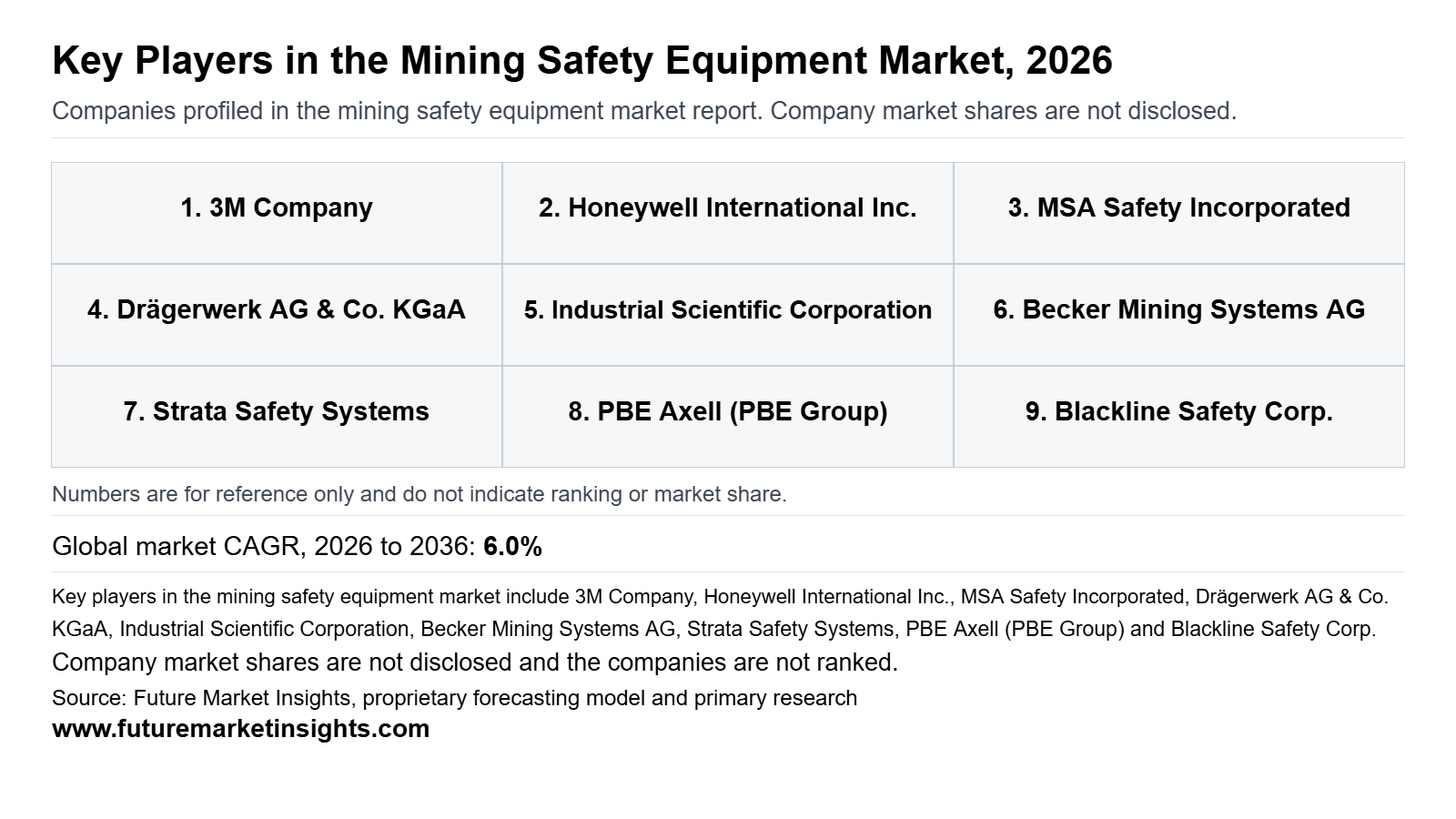
Notable companies operating in the global mining safety equipment market include 3M Company, Honeywell International Inc., MSA Safety Incorporated, Drägerwerk AG & Co. KGaA, Industrial Scientific Corporation, Becker Mining Systems AG, Strata Safety Systems, PBE Axell (PBE Group), and Blackline Safety Corp. Competition spans three commercial tiers across global personal protective equipment and escape-respirator manufacturers, portable and connected gas-detection specialists, and underground mine proximity, refuge-chamber, and communications network integrators.
How Are Companies Positioned in the Mining Safety Equipment Market?
Global protective equipment leaders including 3M Company (2026), MSA Safety Incorporated (September 2025), and Drägerwerk AG & Co. KGaA (2026) anchor personal protection, powered respirators, and underground escape apparatus. Gas-detection specialists such as Honeywell International Inc. (2026), Industrial Scientific Corporation (September 2026), and Blackline Safety Corp. (March 2026) compete on multi-gas portable detectors, area monitors, and cloud-connected wearables, while Becker Mining Systems AG (2026), Strata Safety Systems (2026), and PBE Axell, PBE Group (2026) supply mine-wide proximity detection, refuge chambers, and tagging networks. FMI's competitive evaluation shows that pairing hardware with automated compliance software is driving long-term customer retention.
What Matters When a Buyer Selects a Mining Safety Equipment Supplier?
Mine safety directors and ventilation engineers evaluate suppliers on MSHA, NIOSH, ATEX, and IECEx intrinsic-safety certifications, sensor resistance to catalytic poisoning, battery runtime across 12-hour shifts, and local calibration and spare-parts support. According to FMI's procurement survey insights, buyers selecting vehicle collision-avoidance systems require rugged CAN-bus machine interfacing and low false-alarm rates in high-dust open pits and narrow underground drifts.
Which Capabilities Distinguish Product Offers?
Product differentiation centers on poison-immune infrared gas sensing, automated calibration docks, and integrated voice-and-tracking wearables. Honeywell International Inc. (March 2026) offers its 4-Series NDIR hydrocarbon sensor and BW Ultra 5-gas detector, while Industrial Scientific Corporation (January 2026) pairs Radius BZ1 MPS LEL area monitors with Tectra wearables. In addition to this, Blackline Safety Corp. (March 2026) integrates gas detection with push-to-talk radio and ZoneAware geofencing in its G8 wearable, and Strata Safety Systems (2026) builds modular emergency refuge chambers. FMI observes that multi-sensor wearables with automated bump testing are rapidly replacing single-gas clip monitors.
How Does Geographic Reach Affect Competition?
Global safety manufacturers including 3M Company, Honeywell International Inc., MSA Safety Incorporated, and Drägerwerk AG & Co. KGaA distribute PPE and portable gas detectors through extensive industrial dealer networks across North America, Europe, Asia-Pacific, Latin America, and Africa. Specialized underground network and proximity integrators such as Becker Mining Systems AG, Strata Safety Systems, and PBE Axell maintain dedicated field engineering offices inside major coal and hard-rock mining hubs in the USA, Australia, South Africa, India, and Chile, while Blackline Safety Corp. and Industrial Scientific Corporation support cloud-connected fleets across more than 70 countries. FMI anticipates that local calibration servicing and regional regulatory approvals will decide tender awards through 2036.
| Verified Company Evidence (2025 to 2026) | Commercial Effect | Buyer Action |
|---|---|---|
| September 2026: Industrial Scientific Corporation launched the Tectra connected wearable multi-gas monitor with automated calibration tracking (Industrial Scientific Corporation, September 2026). | Streamlines daily shift bump-test compliance and live gas exposure alerts across underground and surface mining crews. | Pair connected multi-gas wearables with automated docking stations to eliminate manual calibration logs. |
| July 2026: MSA Safety Incorporated completed the acquisition of Autronica Fire and Security to expand its fixed fire and gas detection portfolio (MSA Safety Incorporated, July 2026). | Strengthens integrated fixed-and-portable hazard monitoring across mineral processing plants and mine surface infrastructure. | Evaluate unified fixed and portable gas detection ecosystems when tendering site-wide safety upgrades. |
| March 2026: Blackline Safety Corp. began shipping the G8 connected wearable gas monitor featuring integrated push-to-talk radio and ZoneAware geofencing (Blackline Safety Corp., March 2026). | Combines lone-worker gas detection, two-way voice communication, and blast-zone geofencing in a single device. | Deploy integrated voice-and-gas wearables to reduce the number of separate devices carried by open-pit and underground technicians. |
Source: Verified corporate disclosures and Future Market Insights analysis, 2026.
| Company | Core Positioning | Verified Activity & Source Attribution |
|---|---|---|
| 3M Company | Powered and supplied-air respirators (Versaflo), hearing, eye, and head protection for mining | Supplies Versaflo M-Series respiratory helmets and M-940 mining lamp brackets globally (3M Company, 2026). |
| Honeywell International Inc. | Portable multi-gas detectors (BW Ultra), fixed flame/gas sensors, and 4-Series NDIR cells | Launched poison-immune 4-Series NDIR hydrocarbon gas sensor in March 2026 (Honeywell International Inc., March 2026). |
| MSA Safety Incorporated | V-Gard mining helmets, ALTAIR connected gas detectors, self-rescuers, and fixed fire/gas systems | Launched V-Gard H2 safety helmet in September 2025 and acquired Autronica Fire and Security in July 2026 (MSA Safety Incorporated, July 2026). |
| Drägerwerk AG & Co. KGaA | Oxy K-Plus SCSR escape apparatus, BG ProAir closed-circuit respirators, X-am gas monitors, and refuge bays | Showcased X-am 2800 multi-gas detector and underground escape systems across 2025-2026 mining forums (Drägerwerk AG & Co. KGaA, 2026). |
| Industrial Scientific Corporation | Ventis Pro5, Tectra connected wearables, Radius BZ1 area monitors, and iNet subscription safety | Added MPS LEL sensor to Radius BZ1 in January 2026 and launched Tectra wearable in September 2026 (Industrial Scientific Corporation, September 2026). |
| Becker Mining Systems AG | PDS40 proximity detection, leaky-feeder/LTE/5G underground communications, and automation | Partnered with Ericsson in March 2026 to scale private 5G underground mining networks (Becker Mining Systems AG, March 2026). |
| Strata Safety Systems | Strata Protect collision avoidance, HazardAvert proximity warning, and emergency refuge chambers | Published updated refuge chamber engineering manuals in August 2026 and expanded collision-avoidance systems (Strata Safety Systems, August 2026). |
| PBE Axell (PBE Group) | PAS-Z proximity alert systems, underground leaky-feeder/fiber tagging, and environmental monitoring | Supplies multi-zone vehicle collision avoidance and personnel tracking across global surface and underground mines (PBE Axell, PBE Group, 2026). |
| Blackline Safety Corp. | Cloud-connected G7 and G8 wearable gas detectors, lone-worker monitoring, and area gas monitors | Began shipping G8 connected safety wearable with push-to-talk and geofencing in March 2026 (Blackline Safety Corp., March 2026). |
Source: Verified corporate disclosures and Future Market Insights analysis, 2026.
Key takeaways from the Mining Safety Equipment Market Report
- Worldwide demand is valued at USD 4.2 billion in 2026, expected to reach USD 7.5 billion by 2036.
- A ten-year expansion is expected to contribute USD 3.3 billion at a 6.0% CAGR.
- Personal Protective Equipment leads the product segment at 45.8% share in 2026.
- Surface Mines capture 40.0% of mine type demand in 2026.
- India is anticipated to lead national growth at 8.7% CAGR, followed by South Korea at 5.9% and Australia at 5.8%.
Mining Safety Equipment Market-Report Scope and Research Methodology
FMI analysts size the global mining safety equipment market through primary interviews with mine health and safety directors, underground ventilation engineers, open-pit fleet managers, and industrial safety equipment distributors, combined with desk research across mine safety directorate enforcement logs, occupational dust standards, and corporate financial filings. Core 2025 and 2026 valuations reconcile mining-attributable sales of personal protective equipment, portable and fixed gas detectors, respiratory and self-rescue apparatus, vehicle proximity and collision-avoidance systems, and underground tracking and refuge hardware across all seven tracked countries and regional clusters. Segment shares across product, mine type, commodity, and technology axes are cross-checked against active mine headcount registries and fleet safety retrofits, while excluding primary mine ventilation fans, general site civil fencing, non-mining construction PPE, and unrelated enterprise software to prevent double counting.
| Coverage Field | Report Scope |
|---|---|
| Market Definition | Revenue from mining-attributable personal protective equipment, gas detectors, respiratory/self-rescue gear, proximity detection systems, and tracking/communication hardware. |
| Product Segments | Personal Protective Equipment, Gas Detection and Monitoring, Respiratory and Self-Rescue, Proximity Detection and Collision Avoidance, and Tracking and Communication. |
| Mine Type Segments | Surface Mines, Underground Metal Mines, Underground Coal Mines, and Quarries and Aggregates. |
| Commodity Segments | Metals, Coal, Gold and Precious Metals, and Industrial Minerals. |
| Technology Segments | Conventional Products, Fixed Connected Systems, Wearable Devices, and AI Vision Systems. |
| Exclusions | Primary mine shaft ventilation fans, general non-mining industrial PPE, standard haulage vehicle mechanical brakes, and unrelated corporate IT software. |
| Quantitative Units | USD Billion for global market sizing; CAGR (%) for national growth comparisons. |
| Historical & Base Years | 2025 (Historical: USD 4.0 billion) and 2026 (Estimated Base Year: USD 4.2 billion). |
| Forecast Period | 2026 to 2036 (Projected 2036 Valuation: USD 7.5 billion at 6.0% CAGR; USD 3.3 billion incremental opportunity). |
| Regions Covered | North America, Latin America, Western Europe, Eastern Europe, East Asia, South Asia and Pacific, and Middle East and Africa. |
| Countries Profiled | USA, India, South Korea, Australia, China, Japan, and Russia. |
| Companies Covered | 3M Company, Honeywell International Inc., MSA Safety Incorporated, Drägerwerk AG & Co. KGaA, Industrial Scientific Corporation, Becker Mining Systems AG, Strata Safety Systems, PBE Axell (PBE Group), and Blackline Safety Corp. |
| Research Approach | Primary mine safety director and OEM interviews combined with secondary MSHA/DGMS/NMSA regulatory enforcement and corporate revenue triangulation. |
Source: Future Market Insights analysis of the mining safety equipment market, 2026.
Research Sources and Bibliography
- 3M Company. (2026). 3M Versaflo Mining Lamp Bracket Kit M-940 Technical Specifications. https://www.3m.com/3M/en_US/p/d/v101348121/
- Becker Mining Systems AG. (2026, March 12). Becker Mining Systems and Ericsson: Supporting the Digital Transformation in Mining. https://www.becker-mining.com/en/news/becker-mining-systems-and-ericsson-supporting-digital-transformation-mining
- Becker Mining Systems AG. (2026). PDS40 Proximity Detection System Solution for Underground and Surface Mining. https://www.becker-mining.com/en/products/pds40-solution
- Blackline Safety Corp.. (2026, March 10). Blackline Safety Now Shipping G8: Expanding Leadership in Connected Safety. https://www.blacklinesafety.com/about/press-releases/blackline-safety-now-shipping-g8-expanding-leadership-in-connected-safety
- Drägerwerk AG & Co. KGaA. (2025, September 1). Dräger Emergency and Safety Services Preview 2025: X-am 2800 Multi-Gas Detector. https://www.draeger.com/Content/Documents/Content/Draeger-ESS-Show-Preview-2025.pdf
- Drägerwerk AG & Co. KGaA. (2026). Emergency Preparedness and Underground Escape Equipment for Mining. https://www.draeger.com/en_aunz/Safety/Mining/Emergency-Preparedness/Escape-Underground
- Drägerwerk AG & Co. KGaA. (2026). Rental and Safety Services: Automated Safety Shop and Gas Monitor Calibration. https://www.draeger.com/en_uk/Safety/Rental-and-Safety-Services/Safety-Shop
- Honeywell International Inc.. (2026, March 4). Honeywell 4-Series NDIR Gas Sensor for Harsh Industrial and Mining Environments. https://automation.honeywell.com/us/en/products/sensing-solutions/sensors/gas-sensors/4r-ndir-gas-sensor
- Honeywell International Inc.. (2026). Honeywell BW Ultra Five-Gas Portable Detector for Confined Space and Mining. https://automation.honeywell.com/us/en/products/gas-and-flame-detection/portables/multi-gas/honeywell-bw-ultra-multi-gas-detector
- Industrial Scientific Corporation. (2026, January 20). Industrial Scientific Expands Area Monitoring Portfolio with MPS LEL Sensor. https://www.indsci.com/en/newsroom/industrial-scientific-expands-area-monitoring-portfolio-with-mps-lel-sensor
- Industrial Scientific Corporation. (2026, September 15). Industrial Scientific Redefines Connected Worker Safety with the Launch of Tectra. https://www.indsci.com/en/newsroom/industrial-scientific-redefines-connected-worker-safety-with-the-launch-of-tectra
- International Energy Agency. (2025, December 18). Coal 2025: Analysis and Forecast to 2028. https://iea.blob.core.windows.net/assets/113a8274-500c-4684-951f-947d25bef3c9/Coal2025.pdf
- Mine Safety and Health Administration, U.S. Department of Labor. (2025, March 5). MSHA Safety Alert: Mining Fatalities in Early 2025 and Powered Haulage Prevention. https://content.govdelivery.com/accounts/USDOL/bulletins/3d66325
- Mine Safety and Health Administration, U.S. Department of Labor. (2026). Program Information Bulletin No. P26-01: Respirable Crystalline Silica Standard (30 CFR Part 60). https://www.msha.gov/compliance-and-enforcement/compliance-assistance/program-information-bulletins/p26-01
- Ministry of Coal, Government of India. (2025, March 10). Safety Measures and Environmental Telemonitoring in Coal Mines. https://www.pib.gov.in/PressReleasePage.aspx?PRID=2109865®=3&lang=2
- Ministry of Economy, Trade and Industry of Japan. (2026, August 14). Mine Safety Policy and Regional Industrial Safety Inspections. https://www.meti.go.jp/english/policy/safety_security/industrial_safety/index.html
- Ministry of Trade, Industry and Energy of the Republic of Korea. (2025). General Status of Operating Mines in Korea. https://www.motie.go.kr/mine/emine/mineIntroduction/generalMine/generalMineStatus.jsp
- MSA Safety Incorporated. (2025, September 15). MSA Safety Debuts Two New Safety Solutions at National Safety Council Congress. https://investors.msasafety.com/news-releases/news-release-details/msa-safety-debuts-two-new-safety-solutions-national-safety/
- MSA Safety Incorporated. (2026, July 1). MSA Safety Completes Acquisition of Autronica Fire and Security. https://investors.msasafety.com/news-releases/news-release-details/msa-safety-completes-acquisition-autronica-fire-and-security/
- MSA Safety Incorporated. (2026). Annual Reports and Financial Information. https://investors.msasafety.com/financial-information/annual-reports/default.aspx
- PBE Axell, PBE Group. (2026). Collision Avoidance and Proximity Alert Systems for Surface and Underground Mining. https://pbeaxell.com/products/safety/collision-avoidance
- Resources Safety & Health Queensland. (2025, September 30). Resources Safety & Health Queensland Annual Report 2024-2025. https://qpc.qld.gov.au/wp-content/uploads/RSHQ-annual-report-2024-25.pdf
- Strata Safety Systems. (2026, August 1). Emergency Refuge Chamber Instruction and Engineering Manuals. https://www.strataworldwide.com/refuge-chamber-instruction-manuals
- Strata Safety Systems. (2026). Strata Launches Newly Designed Emergency Refuge Chamber (ERC). https://www.strataworldwide.com/news/strata-launches-newly-designed-emergency-refuge-chamber-erc
- Strata Safety Systems. (2026). Strata Protect Mining: Proximity Detection and Collision Avoidance. https://www.strataworldwide.com/mining/strata-protect-mining
- The State Council of the People's Republic of China. (2026, August 11). China Aims to Significantly Boost Coalbed Methane Extraction by 2030. https://english.www.gov.cn/news/202608/11/content_WS6a7b27cac6d00ca5f9a0c960.html
- The State Council of the People's Republic of China. (2026, October 22). China Steps Up Workplace Safety with Major Hazard Standards and Intelligent Mine Upgrades. https://english.www.gov.cn/news/202610/22/content_WS6ad9d55bc6d00ca5f9a0de6e.html
- U.S. Federal Register. (2025, September 16). Petition for Modification of Application of Mandatory Safety Standard: Prairie Eagle Underground Mine (Docket 2025-17803). https://www.govinfo.gov/content/pkg/FR-2025-09-16/pdf/2025-17803.pdf
Table of Content
- Key Takeaways
- Market Size and CAGR
- Top Growth Driver
- Fastest Growing Segment
- Leading Region
- Key Companies
- Emerging Opportunities
- Executive Summary
- Global Market Outlook
- Demand-side Trends
- Supply-side Trends
- Technology Roadmap Analysis
- Analysis and Recommendations
- Analyst Perspective (What is happening? Why now? What should investors know?)
- Key Questions Answered
- How large is the market?
- What is the CAGR?
- What are key trends?
- Which region dominates?
- Who are the leaders?
Read More...
- Market Overview
- Market Coverage / Taxonomy
- Market Definition / Scope / Limitations
- Research Methodology
- Chapter Orientation
- Analytical Lens and Working Hypotheses
- Market Structure, Signals, and Trend Drivers
- Benchmarking and Cross-market Comparability
- Market Sizing, Forecasting, and Opportunity Mapping
- Research Design and Evidence Framework
- Desk Research Programme (Secondary Evidence)
- Expert Input and Fieldwork (Primary Evidence)
- Tooling, Models, and Reference Databases
- Data Engineering and Model Build
- Quality Assurance and Audit Trail
- Market Background
- Market Dynamics (Drivers, Restraints, Opportunity, Trends)
- Scenario Forecast (Optimistic, Likely, Conservative)
- Impact Analysis
- AI Impact
- Sustainability Impact
- Regulatory Impact
- Technology Impact
- Consumer / Buyer Analysis
- Purchase Drivers
- Adoption Barriers
- Buyer Journey
- Opportunity Map Analysis
- Product Life Cycle Analysis
- Supply Chain Analysis
- Investment Feasibility Matrix
- Value Chain Analysis
- PESTLE and Porter's Analysis
- Regulatory Landscape
- Regional Parent Market Outlook
- Production and Consumption Statistics
- Import and Export Statistics
- Global Market Analysis and Forecast, 2021 to 2036
- Historical Market Size Value (USD Billion) Analysis, 2021 to 2025
- Current and Future Market Size Value (USD Billion) Projections, 2026 to 2036
- Y-o-Y Growth Trend Analysis
- Absolute $ Opportunity Analysis
- Global Market Pricing Analysis, 2021 to 2036
- Global Market Analysis and Forecast, By Product, 2021 to 2036
- Introduction / Key Findings
- Historical Market Size Value (USD Billion) Analysis By Product, 2021 to 2025
- Current and Future Market Size Value (USD Billion) Analysis and Forecast By Product, 2026 to 2036
- Personal Protective Equipment
- Gas Detection and Monitoring
- Respiratory and Self-Rescue
- Proximity Detection and Collision Avoidance
- Tracking and Communication
- Y-o-Y Growth Trend Analysis By Product, 2021 to 2025
- Absolute $ Opportunity Analysis By Product, 2026 to 2036
- Global Market Analysis and Forecast, By Mine Type, 2021 to 2036
- Introduction / Key Findings
- Historical Market Size Value (USD Billion) Analysis By Mine Type, 2021 to 2025
- Current and Future Market Size Value (USD Billion) Analysis and Forecast By Mine Type, 2026 to 2036
- Surface Mines
- Underground Metal Mines
- Underground Coal Mines
- Quarries and Aggregates
- Y-o-Y Growth Trend Analysis By Mine Type, 2021 to 2025
- Absolute $ Opportunity Analysis By Mine Type, 2026 to 2036
- Global Market Analysis and Forecast, By Commodity, 2021 to 2036
- Introduction / Key Findings
- Historical Market Size Value (USD Billion) Analysis By Commodity, 2021 to 2025
- Current and Future Market Size Value (USD Billion) Analysis and Forecast By Commodity, 2026 to 2036
- Metals
- Coal
- Gold and Precious Metals
- Industrial Minerals
- Y-o-Y Growth Trend Analysis By Commodity, 2021 to 2025
- Absolute $ Opportunity Analysis By Commodity, 2026 to 2036
- Global Market Analysis and Forecast, By Technology, 2021 to 2036
- Introduction / Key Findings
- Historical Market Size Value (USD Billion) Analysis By Technology, 2021 to 2025
- Current and Future Market Size Value (USD Billion) Analysis and Forecast By Technology, 2026 to 2036
- Conventional Products
- Fixed Connected Systems
- Wearable Devices
- AI Vision Systems
- Y-o-Y Growth Trend Analysis By Technology, 2021 to 2025
- Absolute $ Opportunity Analysis By Technology, 2026 to 2036
- Global Market Analysis and Forecast, By Region, 2021 to 2036
- Introduction
- Historical Market Size Value (USD Billion) Analysis By Region, 2021 to 2025
- Current Market Size Value (USD Billion) Analysis and Forecast By Region, 2026 to 2036
- North America
- Western Europe
- East Asia
- South Asia and Pacific
- Market Attractiveness Analysis By Region
- North America Market Analysis and Forecast, By Country, 2021 to 2036
- Historical Market Size Value (USD Billion) Trend Analysis By Market Taxonomy, 2021 to 2025
- Market Size Value (USD Billion) Forecast By Market Taxonomy, 2026 to 2036
- By Country
- United States
- Canada
- By Product
- By Mine Type
- By Commodity
- By Technology
- By Country
- Market Attractiveness Analysis
- By Country
- By Product
- By Mine Type
- By Commodity
- By Technology
- Key Takeaways
- Western Europe Market Analysis and Forecast, By Country
- Historical Market Size Value (USD Billion) Trend Analysis By Market Taxonomy, 2021 to 2025
- Market Size Value (USD Billion) Forecast By Market Taxonomy, 2026 to 2036
- By Country
- United Kingdom
- Germany
- France
- By Product
- By Mine Type
- By Commodity
- By Technology
- By Country
- Market Attractiveness Analysis
- By Country
- By Product
- By Mine Type
- By Commodity
- By Technology
- Key Takeaways
- East Asia Market Analysis and Forecast, By Country
- Historical Market Size Value (USD Billion) Trend Analysis By Market Taxonomy, 2021 to 2025
- Market Size Value (USD Billion) Forecast By Market Taxonomy, 2026 to 2036
- By Country
- China
- Japan
- South Korea
- By Product
- By Mine Type
- By Commodity
- By Technology
- By Country
- Market Attractiveness Analysis
- By Country
- By Product
- By Mine Type
- By Commodity
- By Technology
- Key Takeaways
- South Asia and Pacific Market Analysis and Forecast, By Country
- Historical Market Size Value (USD Billion) Trend Analysis By Market Taxonomy, 2021 to 2025
- Market Size Value (USD Billion) Forecast By Market Taxonomy, 2026 to 2036
- By Country
- India
- Australia
- Rest of world aggregate
- By Product
- By Mine Type
- By Commodity
- By Technology
- By Country
- Market Attractiveness Analysis
- By Country
- By Product
- By Mine Type
- By Commodity
- By Technology
- Key Takeaways
- Key Countries Market Analysis
- United States
- Pricing Analysis
- Market Share Analysis, 2025
- By Product
- By Mine Type
- By Commodity
- By Technology
- Canada
- Pricing Analysis
- Market Share Analysis, 2025
- By Product
- By Mine Type
- By Commodity
- By Technology
- Germany
- Pricing Analysis
- Market Share Analysis, 2025
- By Product
- By Mine Type
- By Commodity
- By Technology
- United Kingdom
- Pricing Analysis
- Market Share Analysis, 2025
- By Product
- By Mine Type
- By Commodity
- By Technology
- France
- Pricing Analysis
- Market Share Analysis, 2025
- By Product
- By Mine Type
- By Commodity
- By Technology
- India
- Pricing Analysis
- Market Share Analysis, 2025
- By Product
- By Mine Type
- By Commodity
- By Technology
- China
- Pricing Analysis
- Market Share Analysis, 2025
- By Product
- By Mine Type
- By Commodity
- By Technology
- Japan
- Pricing Analysis
- Market Share Analysis, 2025
- By Product
- By Mine Type
- By Commodity
- By Technology
- South Korea
- Pricing Analysis
- Market Share Analysis, 2025
- By Product
- By Mine Type
- By Commodity
- By Technology
- Australia
- Pricing Analysis
- Market Share Analysis, 2025
- By Product
- By Mine Type
- By Commodity
- By Technology
- United States
- Market Structure Analysis
- Competition Dashboard
- Competition Benchmarking
- Market Share Analysis of Top Players
- By Regional
- By Product
- By Mine Type
- By Commodity
- By Technology
- Emerging Startups
- Innovation Benchmarking
- Competition Analysis
- Competition Deep Dive
- 3M Company
- Overview
- Product Portfolio
- Profitability by Market Segments
- Sales Footprint
- Strategy Overview
- Marketing Strategy
- Product Strategy
- Channel Strategy
- Honeywell International Inc.
- MSA Safety Incorporated
- Drägerwerk AG & Co. KGaA
- Industrial Scientific Corporation
- Becker Mining Systems AG
- Strata Safety Systems
- PBE Axell (PBE Group)
- Blackline Safety Corp.
- 3M Company
- Case Studies
- Success Stories
- Recent Developments
- Competition Deep Dive
- Assumptions & Acronyms Used
List of Tables
- Table 1: Global Market Value (USD Billion) Forecast by Region, 2021 to 2036
- Table 2: Global Market Value (USD Billion) Forecast by Product, 2021 to 2036
- Table 3: Global Market Value (USD Billion) Forecast by Mine Type, 2021 to 2036
- Table 4: Global Market Value (USD Billion) Forecast by Commodity, 2021 to 2036
- Table 5: Global Market Value (USD Billion) Forecast by Technology, 2021 to 2036
- Table 6: North America Market Value (USD Billion) Forecast by Country, 2021 to 2036
- Table 7: North America Market Value (USD Billion) Forecast by Product, 2021 to 2036
- Table 8: North America Market Value (USD Billion) Forecast by Mine Type, 2021 to 2036
- Table 9: North America Market Value (USD Billion) Forecast by Commodity, 2021 to 2036
- Table 10: North America Market Value (USD Billion) Forecast by Technology, 2021 to 2036
- Table 11: Western Europe Market Value (USD Billion) Forecast by Country, 2021 to 2036
- Table 12: Western Europe Market Value (USD Billion) Forecast by Product, 2021 to 2036
- Table 13: Western Europe Market Value (USD Billion) Forecast by Mine Type, 2021 to 2036
- Table 14: Western Europe Market Value (USD Billion) Forecast by Commodity, 2021 to 2036
- Table 15: Western Europe Market Value (USD Billion) Forecast by Technology, 2021 to 2036
- Table 16: East Asia Market Value (USD Billion) Forecast by Country, 2021 to 2036
- Table 17: East Asia Market Value (USD Billion) Forecast by Product, 2021 to 2036
- Table 18: East Asia Market Value (USD Billion) Forecast by Mine Type, 2021 to 2036
- Table 19: East Asia Market Value (USD Billion) Forecast by Commodity, 2021 to 2036
- Table 20: East Asia Market Value (USD Billion) Forecast by Technology, 2021 to 2036
- Table 21: South Asia and Pacific Market Value (USD Billion) Forecast by Country, 2021 to 2036
- Table 22: South Asia and Pacific Market Value (USD Billion) Forecast by Product, 2021 to 2036
- Table 23: South Asia and Pacific Market Value (USD Billion) Forecast by Mine Type, 2021 to 2036
- Table 24: South Asia and Pacific Market Value (USD Billion) Forecast by Commodity, 2021 to 2036
- Table 25: South Asia and Pacific Market Value (USD Billion) Forecast by Technology, 2021 to 2036
List of Figures
- Figure 1: Global Market Pricing Analysis
- Figure 2: Global Market Value (USD Billion) Forecast 2021-2036
- Figure 3: Global Market Value Share and BPS Analysis by Product, 2026 and 2036
- Figure 4: Global Market Y-o-Y Growth Comparison by Product, 2026-2036
- Figure 5: Global Market Attractiveness Analysis by Product
- Figure 6: Global Market Value Share and BPS Analysis by Mine Type, 2026 and 2036
- Figure 7: Global Market Y-o-Y Growth Comparison by Mine Type, 2026-2036
- Figure 8: Global Market Attractiveness Analysis by Mine Type
- Figure 9: Global Market Value Share and BPS Analysis by Commodity, 2026 and 2036
- Figure 10: Global Market Y-o-Y Growth Comparison by Commodity, 2026-2036
- Figure 11: Global Market Attractiveness Analysis by Commodity
- Figure 12: Global Market Value Share and BPS Analysis by Technology, 2026 and 2036
- Figure 13: Global Market Y-o-Y Growth Comparison by Technology, 2026-2036
- Figure 14: Global Market Attractiveness Analysis by Technology
- Figure 15: Global Market Value (USD Billion) Share and BPS Analysis by Region, 2026 and 2036
- Figure 16: Global Market Y-o-Y Growth Comparison by Region, 2026-2036
- Figure 17: Global Market Attractiveness Analysis by Region
- Figure 18: North America Market Incremental Dollar Opportunity, 2026-2036
- Figure 19: Western Europe Market Incremental Dollar Opportunity, 2026-2036
- Figure 20: East Asia Market Incremental Dollar Opportunity, 2026-2036
- Figure 21: South Asia and Pacific Market Incremental Dollar Opportunity, 2026-2036
- Figure 22: North America Market Value Share and BPS Analysis by Country, 2026 and 2036
- Figure 23: North America Market Value Share and BPS Analysis by Product, 2026 and 2036
- Figure 24: North America Market Y-o-Y Growth Comparison by Product, 2026-2036
- Figure 25: North America Market Attractiveness Analysis by Product
- Figure 26: North America Market Value Share and BPS Analysis by Mine Type, 2026 and 2036
- Figure 27: North America Market Y-o-Y Growth Comparison by Mine Type, 2026-2036
- Figure 28: North America Market Attractiveness Analysis by Mine Type
- Figure 29: North America Market Value Share and BPS Analysis by Commodity, 2026 and 2036
- Figure 30: North America Market Y-o-Y Growth Comparison by Commodity, 2026-2036
- Figure 31: North America Market Attractiveness Analysis by Commodity
- Figure 32: North America Market Value Share and BPS Analysis by Technology, 2026 and 2036
- Figure 33: North America Market Y-o-Y Growth Comparison by Technology, 2026-2036
- Figure 34: North America Market Attractiveness Analysis by Technology
- Figure 35: Western Europe Market Value Share and BPS Analysis by Country, 2026 and 2036
- Figure 36: Western Europe Market Value Share and BPS Analysis by Product, 2026 and 2036
- Figure 37: Western Europe Market Y-o-Y Growth Comparison by Product, 2026-2036
- Figure 38: Western Europe Market Attractiveness Analysis by Product
- Figure 39: Western Europe Market Value Share and BPS Analysis by Mine Type, 2026 and 2036
- Figure 40: Western Europe Market Y-o-Y Growth Comparison by Mine Type, 2026-2036
- Figure 41: Western Europe Market Attractiveness Analysis by Mine Type
- Figure 42: Western Europe Market Value Share and BPS Analysis by Commodity, 2026 and 2036
- Figure 43: Western Europe Market Y-o-Y Growth Comparison by Commodity, 2026-2036
- Figure 44: Western Europe Market Attractiveness Analysis by Commodity
- Figure 45: Western Europe Market Value Share and BPS Analysis by Technology, 2026 and 2036
- Figure 46: Western Europe Market Y-o-Y Growth Comparison by Technology, 2026-2036
- Figure 47: Western Europe Market Attractiveness Analysis by Technology
- Figure 48: East Asia Market Value Share and BPS Analysis by Country, 2026 and 2036
- Figure 49: East Asia Market Value Share and BPS Analysis by Product, 2026 and 2036
- Figure 50: East Asia Market Y-o-Y Growth Comparison by Product, 2026-2036
- Figure 51: East Asia Market Attractiveness Analysis by Product
- Figure 52: East Asia Market Value Share and BPS Analysis by Mine Type, 2026 and 2036
- Figure 53: East Asia Market Y-o-Y Growth Comparison by Mine Type, 2026-2036
- Figure 54: East Asia Market Attractiveness Analysis by Mine Type
- Figure 55: East Asia Market Value Share and BPS Analysis by Commodity, 2026 and 2036
- Figure 56: East Asia Market Y-o-Y Growth Comparison by Commodity, 2026-2036
- Figure 57: East Asia Market Attractiveness Analysis by Commodity
- Figure 58: East Asia Market Value Share and BPS Analysis by Technology, 2026 and 2036
- Figure 59: East Asia Market Y-o-Y Growth Comparison by Technology, 2026-2036
- Figure 60: East Asia Market Attractiveness Analysis by Technology
- Figure 61: South Asia and Pacific Market Value Share and BPS Analysis by Country, 2026 and 2036
- Figure 62: South Asia and Pacific Market Value Share and BPS Analysis by Product, 2026 and 2036
- Figure 63: South Asia and Pacific Market Y-o-Y Growth Comparison by Product, 2026-2036
- Figure 64: South Asia and Pacific Market Attractiveness Analysis by Product
- Figure 65: South Asia and Pacific Market Value Share and BPS Analysis by Mine Type, 2026 and 2036
- Figure 66: South Asia and Pacific Market Y-o-Y Growth Comparison by Mine Type, 2026-2036
- Figure 67: South Asia and Pacific Market Attractiveness Analysis by Mine Type
- Figure 68: South Asia and Pacific Market Value Share and BPS Analysis by Commodity, 2026 and 2036
- Figure 69: South Asia and Pacific Market Y-o-Y Growth Comparison by Commodity, 2026-2036
- Figure 70: South Asia and Pacific Market Attractiveness Analysis by Commodity
- Figure 71: South Asia and Pacific Market Value Share and BPS Analysis by Technology, 2026 and 2036
- Figure 72: South Asia and Pacific Market Y-o-Y Growth Comparison by Technology, 2026-2036
- Figure 73: South Asia and Pacific Market Attractiveness Analysis by Technology
- Figure 74: Global Market - Tier Structure Analysis
- Figure 75: Global Market - Company Share Analysis
Frequently Asked Questions
How big is the mining safety equipment market in 2026?
Future Market Insights estimates the global mining safety equipment market valuation at USD 4.2 billion in 2026, advancing from USD 4.0 billion in 2025 as dust and haulage safety rules tighten.
What is the projected size and CAGR of the mining safety equipment market through 2036?
Global mining safety equipment sales are projected to reach USD 7.5 billion by 2036, expanding at a 6.0% CAGR from 2026 to 2036 and generating USD 3.3 billion in incremental opportunity.
Which Product segment leads the mining safety equipment market in 2026?
Personal Protective Equipment leads the product axis with a 45.8% revenue share in 2026 due to mandatory per-worker issuance of helmets, boots, glasses, and respiratory gear.
Which Mine Type segment captures the largest share of mining safety equipment demand?
Surface Mines hold 40.0% of mine type revenue in 2026 because large open-pit workforces and heavy haul-truck fleets require both worker PPE and vehicle proximity systems.
How much share does Metals hold in the mining safety equipment market?
Metals accounts for 44.0% of commodity revenue in 2026 as copper, iron ore, nickel, and zinc operations deploy comprehensive dust, gas, and vehicle-interaction controls.
Why does Conventional Products lead mining safety equipment technology segments?
Conventional Products capture 66.0% of 2026 technology revenue because standalone PPE, portable detectors, and self-rescuers operate reliably without underground wireless networks.
Which countries are projected to grow fastest in the mining safety equipment market?
India leads national growth at an 8.7% CAGR from 2026 to 2036, followed by South Korea at 5.9% and Australia at 5.8% as digital telemonitoring and proximity rules expand.
Which companies are profiled as key players in the mining safety equipment market?
Key profiled companies include 3M Company, Honeywell International Inc., MSA Safety Incorporated, Drägerwerk AG & Co. KGaA, Industrial Scientific Corporation, Becker Mining Systems AG, Strata Safety Systems, PBE Axell (PBE Group), and Blackline Safety Corp.
Preview the report firsthand - request a free sample
Get SampleGet the brochure for pricing and purchase details.
Get PDF
