

- Market Size (2026)
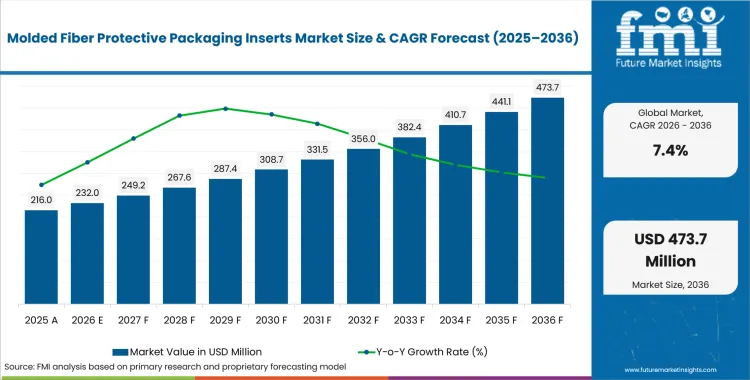
- USD 232.0 Mn
- Forecast (2036)
- USD 473.7 Mn
- CAGR (2026 to 2036)
- 7.4%
How big is the Molded Fiber Protective Packaging Inserts Market in 2026?
USD 232.0 million in 2026 and USD 473.7 million by 2036 at a 7.4% CAGR.
Sales of molded fiber protective packaging inserts are estimated to rise at 7.4% CAGR through 2036 across repeated consumer and food packaging programs. Industry valuation is projected to increase from USD 232.0 million in 2026 to USD 473.7 million by 2036. Brand packaging engineers use shaped fiber components to replace plastic trays without weakening drop protection or packing-line consistency across repeated product launches. Apple reported in April 2026 that its products were shipping in fiber-based packaging and paper versions had replaced plastic trays. The change shows how a high-volume electronics program converts a material target into exact component geometry and repeatable assembly requirements. Successful prototypes help insert manufacturers secure recurring orders by preserving protection and reliable nesting within broader molded fiber pulp packaging systems.
United States projects often prioritize quick tooling changes and nearby production capacity across short product cycles. European programs place greater weight on recyclable design and material separation within formal producer-responsibility rules. Regulation (EU) 2025/40 entered into force in February 2025 and applies broadly from August 2026. The regulation requires protective packaging design to align with recyclability and waste-prevention obligations across the regional market. A molded insert can pass transit testing in one region yet require different coating evidence or disposal instructions elsewhere. Local engineering support reduces qualification delays for protective paperboard programs serving several national customers and regional distribution routes.
Key Takeaways of Molded Fiber Protective Packaging Inserts Market
- Plastic-reduction programs increase demand for shaped fiber inserts that protect products and fit established paper-recovery routes across recurring packaging portfolios.
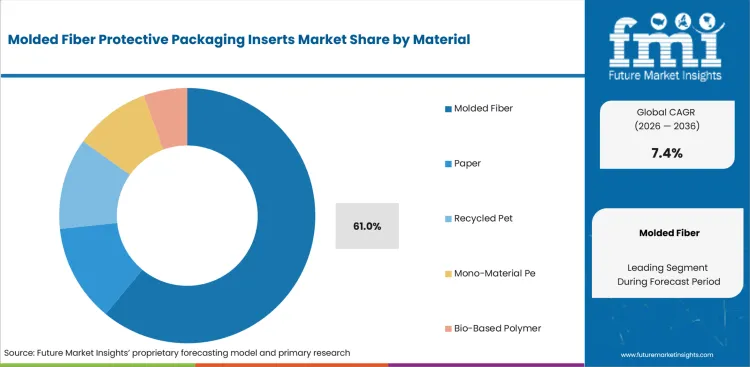
- Molded fiber is projected to hold 61.0% share in 2026 owing to custom geometry and established forming capacity across several protective applications.
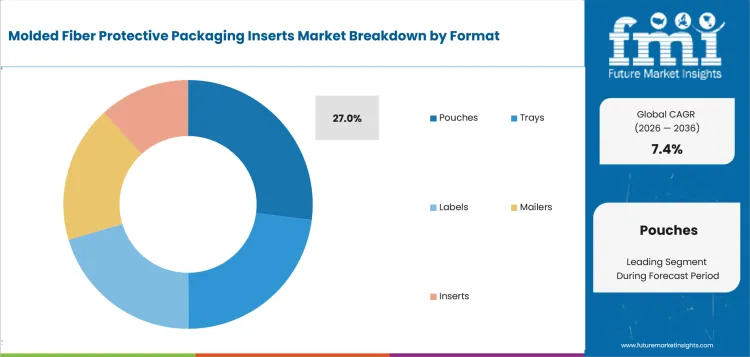
- By format, pouches are estimated to hold 27.0% share in 2026 owing to compact containment needs within mixed protective packaging systems.
- Grease-resistant designs are forecast to represent 26.0% share in 2026 within barrier or feature demand due to direct food-contact performance requirements.
- Dedicated tooling and moisture-sensitive strength limit adoption across short programs or products that face demanding storage and distribution conditions.
- Huhtamaki, Novolex, Hartmann Packaging, YFY Jupiter, PulPac, EnviroPAK, Keiding, and Matrix Pack focus on different combinations of forming capacity and structural design support.
Analyst Perspective
“Molded fiber inserts earn repeat orders through reliable product protection and predictable packing-line performance across repeated product programs. Packaging engineers need exact-fit geometry and compression recovery that remain stable through humidity and repeated handling. Regional tooling support matters equally as product dimensions change during active packaging programs and scheduled product revisions. Manufacturers that combine transport testing with nearby production can shorten redesign cycles without weakening recovery claims.”
- Nandini Roy Choudhury, Principal Analyst, Future Market Insights
How is the Molded Fiber Protective Packaging Inserts Market segmented?
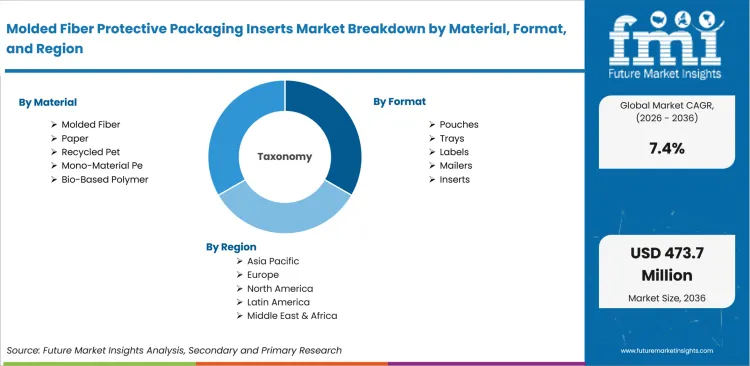
The molded fiber protective packaging inserts industry is segmented by material, format, barrier or feature, end use, and region.
The segmentation framework separates material from the physical format used inside a complete protective pack. Material identifies the forming substrate and determines stiffness, moisture behavior, and recovery options during shipment. Format describes the component geometry that positions products or separates accessories during packing and shipment. Barrier or feature distinguishes treatments such as grease resistance, traceability, or freshness indication that change testing and recycling documentation. End use identifies the product environment and approval route that determine protection levels and tooling volumes. Regional analysis compares production access, recovery rules, technical service, and purchasing routes across national packaging programs. Related molded pulp packaging applications show how these dimensions interact during commercial pack development for recurring packaging programs.
Why does molded fiber lead material demand in the molded fiber protective packaging inserts market?
Protective inserts must control product movement and absorb impact at defined contact points inside the outer pack. Production teams use wet-molded fibre processes to create ribs and nests within one formed component. YFY Jupiter reported in September 2025 that Vietnam granted a design patent for its molded pulp corner protector with an angled rib structure. The geometry limits outward expansion during impact and shows how structural features can improve protection without separate plastic pieces.
- By material, molded fiber is estimated to hold 61.0% share in 2026 owing to combined cushioning geometry and established paper-recovery routes. Formed ribs and nests reduce loose component counts during assembly and inspection across repeated production runs. The material accommodates tailored depths and wall profiles for electronics and appliances across other fragile product categories.
- Electronics and appliance packaging teams adopt molded fiber inserts through prototypes that survive drop and vibration testing across representative shipment routes. Recycled PET and mono-material PE remain practical for washable surfaces or heavy moisture exposure requiring intensive cleaning. Fiber gains preference across repeat programs that value nesting efficiency and direct disposal guidance more than very thin walls or transparent presentation.
Why do pouches remain central to the format category?
Pouches contain smaller products or accessories within a larger protective packaging system and reduce unused space around lightweight contents. Mondi announced in February 2025 that its paper-based stand-up pouch for dishwashing tabs contained more than 85% paper and entered Spain and Portugal. The launch shows how flexible paper structures can combine compact presentation with a defined recovery route. Packaging teams can add dry-molded fibre supports to limit movement around closures or fragile contents during parcel distribution.
- Pouches are projected to hold 27.0% share in 2026 owing to compact packs that separate accessories without large rigid components. Their position reflects broad use across personal care and household products with modest cushioning requirements. Packaging engineers compare seal integrity and puncture resistance alongside the insert geometry that controls movement inside the outer pack.
- Personal care and household-product manufacturers favor pouches for lightweight products that benefit from reduced shipment volume. Adoption slows for heavier items requiring deep ribs or rigid corner protection during parcel handling. Hybrid designs can pair flexible containment with shaped fiber supports around closures and other vulnerable contact points without increasing the outer package size.
How does grease-resistant functionality shape barrier or feature demand?
Food-contact inserts need grease resistance to retain strength around oils and prepared items during filling and distribution. Kiefel introduced its Dry Fiber technology in August 2025 with a roll-fed paper lid paired with a wet-formed margarine tray. The company stated that both components met barrier requirements and remained recyclable through the intended paper-recovery process. The example shows why barrier coatings must protect formed components without disrupting manufacturing or the intended paper-recovery route.
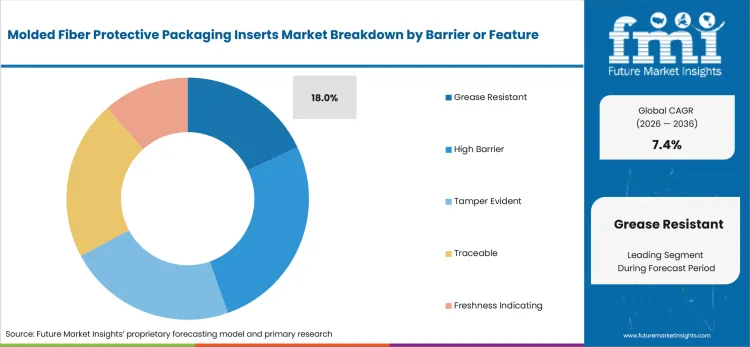
- The barrier or feature category is forecast to be led by grease-resistant designs at 18.0% share in 2026 due to direct oil and moisture exposure across food applications. The segment addresses a measurable operating condition across food distribution workflows instead of a broad material preference. Packaging manufacturers must balance surface resistance with repulpability so treatment does not weaken the recovery route presented to customers or regulators.
- Prepared-food processors adopt grease-resistant inserts through testing that confirms stable performance during filling and chilled distribution. Qualification becomes longer for products combining heat with oil and moisture exposure inside one pack. Coating records and stable production controls reduce repeated trials across several tray sizes or national food-contact reviews for the same customer.
What makes food central to the end use category?
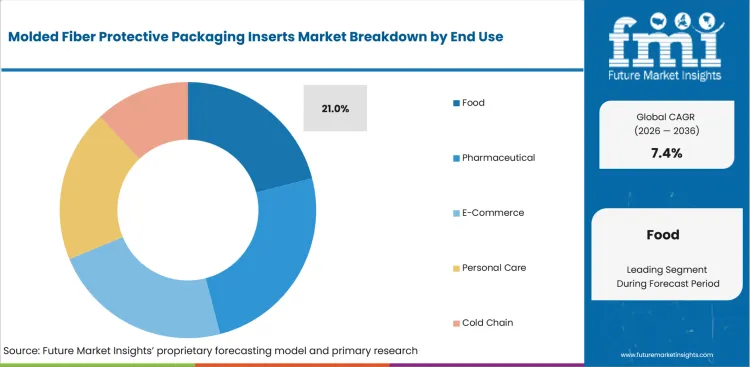
Food programs generate repeat demand for trays and separators that protect portions and maintain reliable packing speed. Novolex reported in May 2025 that Eco-Products and DNO Produce introduced a school-lunch pack using molded fiber cup bases with plant-based lidding film. The launch shows how one formed component can separate portions and support convenient service without a plastic tray. Approval across food packaging programs also depends on contact safety and temperature exposure during production and distribution.
- Food is likely to capture 21.0% share in 2026 attributable to recurring consumption and varied tray configurations across standardized packing programs. The category requires plastic replacement without disrupting portion control or case-packing routines during pack conversion. Consistent nesting and denesting performance also supports repeated output across automated or manually assisted food packing operations.
- Institutional kitchens and prepared-food manufacturers expand molded fiber use across programs that standardize dimensions for recurring menus or product families. Moisture and grease exposure create performance risks across hot and chilled applications during storage and distribution. Adoption improves through coordinated barrier treatment and tooling controls that preserve component strength and line performance across repeated production batches.
What are the drivers, restraints, and opportunities in the Molded Fiber Protective Packaging Inserts Market?
Plastic-reduction programs create demand for formed fiber inserts; dedicated tooling and moisture performance shape the pace of recurring adoption.
- Driver: Brand packaging redesigns create repeat demand for shaped fiber components that protect products across established packing operations.
- Restraint: Dedicated tooling and moisture-sensitive strength weaken the commercial case for short programs or frequently changing product dimensions.
- Opportunity: Improved paper barriers can extend formed fiber protection into products requiring grease or water-vapor resistance during distribution.
Large packaging programs support demand as plastic removal extends across several product families and packing sites. PulPac reported in October 2025 that HZ Green Pulp began full-scale commercial production of Dry Molded Fiber coffee lids in Malaysia. Commercial output shows that fiber forming can progress from machine installation into repeated production through standardized tooling and material support. Insert manufacturers can apply the same scale discipline by designing components around stable product geometry and confirmed packing volumes.
Dedicated tooling and uncertain moisture performance create a material restraint for short programs or products with frequent dimension changes. Each design requires geometry validation so stable production volumes can absorb mold and testing costs. The FDA stated in January 2025 that 35 PFAS-related food-contact notifications for grease-proofing paper and paperboard were no longer effective. Packaging manufacturers therefore need alternative barrier chemistry and documented migration performance for food-contact approval and commercialization.
Improved paper barriers is projected to offer a commercial opening for inserts used around food or moisture-sensitive products. Mondi reported in August 2025 that FunctionalBarrier Paper Ultimate provides oxygen and water-vapor protection with grease resistance on existing form-fill-seal equipment. The development shows how fiber structures can gain functional protection without extensive machinery replacement during commercialization. Molded insert producers can apply related advances across barrier packaging concepts if treatment stays compatible with forming and the intended recovery route.
Which country CAGRs are profiled in the Molded Fiber Protective Packaging Inserts Market?
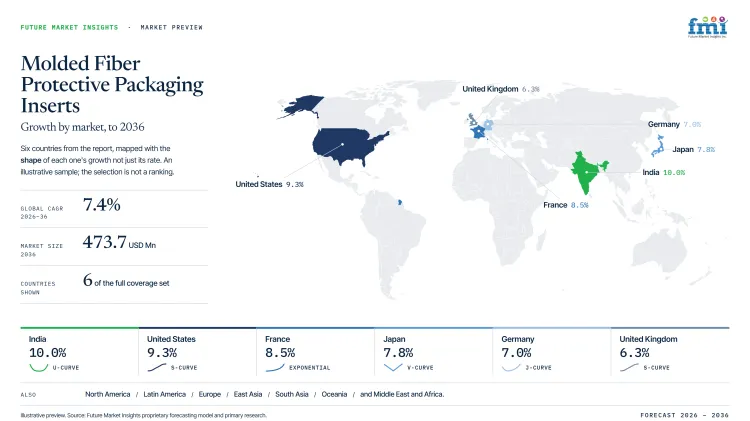
| Country | CAGR |
|---|---|
| India | 10.0% |
| United States | 9.3% |
| France | 8.5% |
| Germany | 7.0% |
| Japan | 7.8% |
| United Kingdom | 6.3% |
How do country-level CAGRs compare in the Molded Fiber Protective Packaging Inserts Market?
The country forecasts show gradual progression instead of separate growth tiers across the six national markets. India and the United States benefit from expanding capacity and product flows that can support recurring tooling programs. France and Japan combine established consumer packaging demand with detailed recovery or quality requirements that extend qualification. Germany and the United Kingdom rely on mature paper collection and formal packaging assessment routes. Similar growth rates can therefore produce different entry conditions across national packaging programs with distinct approval routes. Production distance and coating classification influence commercial timing alongside local engineering support and replacement-tool availability.
- India benefits from new regional molded fiber capacity near food and agricultural production centers across northern industrial corridors. Feedstock consistency and maintenance access remain less predictable beyond major centers that need rapid replacement-tool support.
- United States programs benefit from regional production and mature distribution testing across national product launches. Smaller brands face higher unit tooling costs across short runs with uncertain design stability and limited volume commitments.
- France combines established household collection with detailed material declarations that influence coating selection across recurring retail packaging programs. Packaging manufacturers need clear treatment records to preserve the recovery case for formed components during national approval.
- Japan rewards compact geometry and consistent dimensions across high-value product packs with limited storage space. Municipal paper-packaging collection varies across local systems and complicates uniform disposal guidance for national brands.
- Germany supports clean fiber components through mature recycling infrastructure and experienced packaging engineering across industrial distribution programs. Coated designs face demanding composition records and longer performance qualification during customer approval cycles and retailer programs.
- The United Kingdom applies a formal recyclability assessment to packaging structures and attached components supplied through household channels. Coatings can change classification and increase evidence requirements for nationwide product specifications and fee reporting.
Comparable CAGRs do not create identical market entry conditions across molded fiber protective packaging programs. Production distance and material rules change qualification timing across each national commercial route and recurring customer program. Technical service access can also alter commercial execution within the same forecast band and customer approval cycle. The full report provides country-level CAGR analysis across North America, Latin America, Europe, East Asia, South Asia, Oceania and the Middle East and Africa.
Country-wise Analysis
- India’s protective packaging route increasingly depends on local molded fiber capacity near food and agricultural production centers. In India the demand for molded fiber protective inserts is predicted to advance at 10.0% CAGR through 2036, supported by expanded regional forming capacity. Hartmann Packaging inaugurated a new production line at Sanauli in April 2026 and produced the first tray during the opening. The line shortens supply routes for recurring fiber packaging programs across northern India and nearby industrial centers. Local production improves replenishment speed and replacement-tool access for large customers operating several plants across scheduled production runs. Feedstock consistency and maintenance coverage remain less predictable across distant industrial corridors with limited technical service access. Packaging manufacturers should confirm tool-service responsibility and sample approval schedules for each design extended across several sites.
- United States programs combine mature distribution testing with regional molded fiber plants that support repeat production. Molded fiber protective insert demand in the United States is forecast to rise at 9.3% CAGR over the forecast period, underpinned by regional plants and established shipment testing. Huhtamaki acquired Zellwin Farms Company in April 2025 and added molded fiber manufacturing capacity in Florida. The transaction strengthens regional forming capability for recurring fiber products across southeastern distribution routes and established customer networks. Nearby production can shorten replacement-tool and delivery lead times for national accounts managing several formats. Dedicated molds remain expensive for smaller brands with unstable volumes or frequent dimension changes during active product programs. Commercial proposals should separate prototype charges from production pricing and define tool ownership during approval.
- France applies producer-responsibility reporting and household collection rules to packaging placed on the national market. By 2036 the molded fiber protective packaging inserts market in France is projected to grow at 8.5% CAGR, influenced by established recovery reporting and retail packaging redesigns. ADEME reported in April 2026 that 6,345 kilotonnes of household packaging and graphic paper entered the French market during 2024. The agency also recorded a 69.6% recycling rate for household packaging during that year. Established reporting gives clean fiber components a clear recovery route across recurring retail packaging programs. Applied coatings can create classification questions that require separate composition evidence during customer approval and material review. Manufacturers need French-language declarations and verified treatment details to extend one design across several national programs.
- Germany combines established paper collection with industrial packaging teams that expect detailed performance records during qualification. The German molded fiber protective packaging inserts sector is projected to record 7.0% CAGR during the assessment period, reinforced by mature collection systems and local packaging engineering. The German Environment Agency reported in May 2026 that packaging use reached 17.92 million tonnes during 2023. The agency also recorded a 69.4% recycling rate across packaging materials during the same period. Clean fiber inserts can enter a developed recovery system following successful protection and material qualification tests. Coated designs face closer composition review and longer documentation cycles during customer qualification and retail programs. Manufacturers should provide compression data and tool-maintenance plans alongside complete material declarations for recurring orders.
- Japan’s compact product packs reward precise nesting across warehouses and retail channels with limited storage space. Adoption of molded fiber protective inserts in Japan is estimated to expand at 7.8% CAGR through 2036, shaped by compact pack design and defined paper-collection routes. Japan’s Ministry of the Environment reported in March 2026 that 904 municipalities planned separate collection of paper containers and packaging during fiscal 2026. The plans covered an estimated 97,000 tonnes across participating municipalities and their planned collection systems. Municipal coverage provides a recovery route for suitable fiber components meeting local collection requirements and sorting practices. Moisture protection and inventory space remain practical constraints for nested stock across compact warehouses and production areas. Manufacturers need local engineering support for dimensional changes and clear disposal instructions across each customer program.
- United Kingdom packaging decisions increasingly use formal recyclability assessments that classify material structures and attached components. Molded fiber protective insert sales in the United Kingdom are forecast to expand at 6.3% CAGR by 2036, linked to formal recyclability assessments and retailer redesign programs. Defra updated its methodology in September 2025 and required liable producers to report packaging assessments from January 2025. The guidance separates paper-based packaging from fibre composites through documented composition and attached component content. The method gives clean molded fiber designs a defined recovery route across household packaging channels. Coatings or films can change classification and increase evidence requirements during nationwide product approval and fee reporting. Manufacturers should document treatment content and recovery claims for approval of national packaging specifications and recurring orders.
Who are the notable companies in the Molded Fiber Protective Packaging Inserts Market?
Huhtamaki, Novolex, Hartmann Packaging, YFY Jupiter, PulPac, EnviroPAK, Keiding, and Matrix Pack are the notable companies shaping this market.
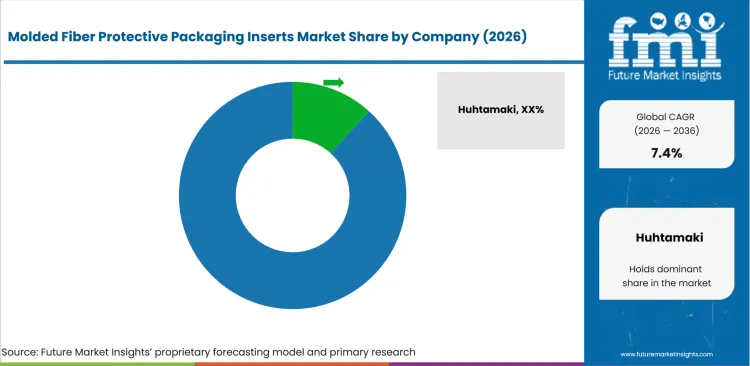
The competitive outlook combines scaled fiber manufacturers with specialist designers and technology licensors serving protective programs. Huhtamaki and Novolex join Hartmann Packaging in providing production capacity for recurring regional orders across food and consumer programs. YFY Jupiter and EnviroPAK connect structural design with tooling for complex protective packs and prototypes. Keiding focuses on thick-wall protection for industrial goods that require deep cushioning and stable blocking. PulPac licenses dry-forming technology to manufacturing partners and Matrix Pack operates wet and dry fiber production across several countries. A 2025 SEC filing confirmed that Pactiv Evergreen became a wholly owned Novolex subsidiary during April 2025. Selection across consumer electronics packaging programs depends on testing depth and reliable local tool support.
- Huhtamaki and Novolex join Hartmann Packaging in combining forming capacity with regional supply networks for recurring food and consumer packaging orders. Their scale matters for programs requiring production from several sites and coordinated replenishment with documented replacement-tool support across customer locations.
- YFY Jupiter and EnviroPAK join Keiding in structural engineering for products with demanding geometry or impact exposure. Their commercial value depends on prototype quality and physical testing that connects component design with the actual shipment route during production approval cycles.
- PulPac and Matrix Pack represent different routes to dry and wet fiber expansion across international programs. PulPac licenses production technology whereas Matrix Pack operates manufacturing sites that supply formed fiber products across several regions with direct international commercial fulfillment support.
Competitive Benchmarking: Molded Fiber Protective Packaging Inserts Market
| Company | Fiber Forming and Tooling | Insert Design and Validation | Manufacturing and Fulfillment Support | Geographic Reach |
|---|---|---|---|---|
| Huhtamaki | High | Medium | High | Global |
| Novolex | High | Medium | High | North America and Europe |
| Hartmann Packaging | High | High | High | Global |
| YFY Jupiter | High | High | High | Global |
| PulPac | Medium | High | Low | Global |
| EnviroPAK | High | High | Medium | North America |
| Keiding | Medium | High | Medium | North America |
| Matrix Pack | High | Medium | High | Global |
Key Developments in the Molded Fiber Protective Packaging Inserts Market
- In June 2025, Matrix Pack entered a strategic partnership with Stora Enso to accelerate formed fiber packaging development and production. The agreement combines renewable material expertise with wet and dry fiber manufacturing across an international facility network. The partners also planned closer fiber sourcing and supply-chain integration across partner operations and customer programs. The arrangement gives packaging programs a clearer route from material development into commercial production across several applications.
- In June 2026, PulPac reported that licensee HZ Green Pulp partnered with Hotpack Global through a newly announced joint venture. The arrangement connects commercial Dry Molded Fiber production in Malaysia with Hotpack’s foodservice portfolio and distribution reach. The partnership broadens regional access for formed fiber applications across established foodservice channels and preserves separation between technology ownership and finished-product fulfillment.
- In April 2025, Hartmann Packaging launched FiberWise as a molded fiber tray for fresh protein packaging. The company designed the tray to operate on existing production lines and support established sealing workflows. The launch expands formed fiber beyond conventional egg packaging into fresh protein applications served by existing sealing lines. Food processors gain a commercial conversion route that does not require complete replacement of existing packing equipment.
- In May 2026, PulPac signed Zipform Packaging as a licensee for Dry Molded Fiber technology. Zipform is developing a meat tray with integrated liquid management and planned broader market validation. The program connects product design with industrialization through PulPac’s partner network and planned production capacity. Fresh-food packaging manufacturers gain another route to test formed fiber functionality without immediate commitment to commercial output.
Key Players in the Molded Fiber Protective Packaging Inserts Market
Scaled Fiber Packaging Manufacturers
- Huhtamaki
- Novolex
- Hartmann Packaging
Design and Manufacturing Specialists
- YFY Jupiter
- EnviroPAK
- Keiding
- Matrix Pack
Dry Forming Technology Providers
- PulPac
Molded Fiber Protective Packaging Inserts Market - Report Scope
| Coverage field | Report scope |
|---|---|
| Market breakdown | Material, format, barrier or feature, end use, and region. |
| Quantitative Units | Revenue in USD Million, CAGR in %. |
| Market Definition | Commercial demand for molded fiber inserts that protect, position, separate, or cushion products inside primary and transport packaging. |
| Regions Covered | North America, Latin America, Europe, East Asia, South Asia, Oceania, and Middle East and Africa. |
| Countries Covered | India, United States, France, Germany, Japan, and United Kingdom, with 30+ countries covered in the full report. |
| Key Companies Profiled | Huhtamaki, Novolex, Hartmann Packaging, YFY Jupiter, PulPac, EnviroPAK, Keiding, and Matrix Pack. |
| Forecast Period | 2026 to 2036. |
| Approach | Hybrid bottom-up and top-down market sizing supported by primary interviews and official desk research. |
Molded Fiber Protective Packaging Inserts Market - Research Methodology
| Method | Approach |
|---|---|
| Primary Research | FMI analysts gathered input from manufacturers, service providers, technology developers, distributors, end users, procurement teams, and subject-matter experts. Interviews examined purchasing decisions, product or service evaluation, adoption barriers, approval requirements, pricing considerations, and expectations for technical or commercial support. Respondents were also asked what evidence is required before a trial, pilot, or initial order develops into regular purchasing. |
| Desk Research | Desk research covered government statistics, regulatory publications, trade data, industry associations, technical literature, standards, company filings, product information, and official corporate announcements. Sources were reviewed for relevance, publication date, geographic coverage, and consistency with the defined market scope. Claims relating to performance, applications, approvals, capacity, investment, and commercial activity were retained only when supported by credible public evidence. |
| Market Sizing and Forecasting | The market model combined the baseline value with historical performance, segment structure, pricing and volume indicators, adoption levels, company participation, and country-level demand conditions. Forecast assumptions considered economic activity, investment trends, regulatory developments, technology adoption, purchasing cycles, supply availability, and barriers to wider market use. Segment and regional estimates were reconciled before the final market total was calculated. |
| Data Validation | Estimates were checked against multiple independent indicators, including public data, company activity, trade patterns, industry developments, and findings from primary interviews. Validation also tested whether products, services, applications, and company revenues fell within the defined market boundaries. Adjacent categories, unsupported claims, overlapping revenues, and activities without direct market relevance were excluded to reduce double counting and maintain consistency across segments and countries. |
Molded Fiber Protective Packaging Inserts Market by Segments
Molded Fiber Protective Packaging Inserts Market segmented by Material:
- Paper
- Molded Fiber
- Recycled PET
- Mono-material PE
- Bio-based Polymer
Molded Fiber Protective Packaging Inserts Market segmented by Format:
- Pouches
- Trays
- Labels
- Mailers
- Inserts
Molded Fiber Protective Packaging Inserts Market segmented by Barrier or Feature:
- Grease Resistant
- High Barrier
- Tamper Evident
- Traceable
- Freshness Indicating
Molded Fiber Protective Packaging Inserts Market segmented by End Use:
- Food
- Pharmaceutical
- E-commerce
- Personal Care
- Cold Chain
Molded Fiber Protective Packaging Inserts Market by Region:
- North America
- United States
- Canada
- Mexico
- Latin America
- Brazil
- Chile
- Rest of Latin America
- Western Europe
- Germany
- United Kingdom
- Italy
- Spain
- France
- Nordic
- BENELUX
- Rest of Western Europe
- Eastern Europe
- Russia
- Poland
- Hungary
- Balkan and Baltic
- Rest of Eastern Europe
- East Asia
- China
- Japan
- South Korea
- South Asia and Pacific
- India
- ASEAN
- Australia and New Zealand
- Rest of South Asia and Pacific
- Middle East and Africa
- Kingdom of Saudi Arabia
- Other GCC Countries
- Türkiye
- South Africa
- Other African Union
- Rest of Middle East and Africa
Research Sources and Bibliography
- Apple. (2026, April 16). Apple accelerates environmental progress with highest-ever recycled material in its products.
- European Parliament and Council of the European Union. (2025, January 22). Regulation (EU) 2025/40 of the European Parliament and of the Council of 19 December 2024 on packaging and packaging waste, amending Regulation (EU) 2019/1020 and Directive (EU) 2019/904, and repealing Directive 94/62/EC.
- YFY Jupiter. (2025, September 1). YFY Jupiter has been granted a Vietnam design patent!
- Mondi. (2025, February 12). Mondi and Proquimia launch paper-based stand-up pouches for dishwashing tabs.
- Kiefel GmbH. (2025, August 22). Dry Fiber meets Wet Fiber: Kiefel presents “The Perfect Match” at Fachpack.
- Novolex. (2025, May 1). Eco-Products and DNO Produce help bring environmental sustainability to K-12 school cafeterias.
- PulPac. (2025, October 28). HZ Green Pulp enters full-scale production.
- USA Food and Drug Administration. (2025, January 3). FDA determines authorization for 35 food contact notifications related to PFAS are no longer effective.
- Mondi. (2025, August 14). Mondi ramps up FunctionalBarrier Paper Ultimate to meet growing demand for sustainable high-barrier paper-based packaging.
- Hartmann Packaging. (2026, April 27). Hartmann India celebrates inauguration of new production line in Sanauli.
- Huhtamaki. (2025, April 24). Huhtamaki acquires Zellwin Farms Company.
- ADEME. (2026, April 7). Emballages ménagers et papiers graphiques : données 2024.
- German Environment Agency. (2026, May 13). Verpackungsverbrauch 2023 gesunken, Recyclingquote gestiegen.
- Ministry of the Environment, Japan. (2026, March 31). Compilation Results of Projected Separate Collection Volumes for Fiscal Year 2026 and Beyond under the Containers and Packaging Recycling Act
- Department for Environment, Food & Rural Affairs. (2025, September 4). Recyclability assessment methodology: stages of recyclability and definitions.
- Pactiv Evergreen Inc. (2025, April 1). Current report on Form 8-K.
- Stora Enso. (2025, June 12). Stora Enso and Matrix Pack partner to accelerate formed fiber packaging innovation.
- PulPac. (2026, June 24). HZ strengthens Dry Molded Fiber offering through Hotpack partnership.
- Hartmann Packaging. (2025, April 9). Smart switch with FiberWise™.
- PulPac. (2026, May 4). Zipform Packaging becomes new PulPac licensee.
- EnviroPAK. (2025, May 15). Molded Fiber Packaging. It’s protection packed.
- Keiding, Inc. (2025, August 13). The Clear Choice: Why Thick-Wall Molded Pulp Outperforms Corrugated Die-Cuts.
- Matrix Pack. (2025, November 6). Astanor partners with Matrix Pack to further accelerate its industrial scale-up as part of its newly launched Growth Equity strategy.
This bibliography is provided for reader reference and is not exhaustive. The full report contains the complete reference list and detailed citations
This Report Answers
- How large is the molded fiber protective packaging inserts market in 2026 and 2036?
- Which packaging redesign pressures support investment in formed fiber protective components?
- Why does molded fiber account for the largest material share during 2026?
- How do pouches and grease-resistant features influence format and barrier demand?
- Which operating factors support food as the largest profiled end use category?
- How do country growth rates differ across India, the United States, France, Germany, Japan, and the United Kingdom?
- Which companies provide forming capacity, custom design, or licensed dry-forming technology?
- What limits qualification across moisture-sensitive products and short-volume programs?
- How can manufacturers align local tooling support with regional production and recycling requirements?
Frequently Asked Questions
How big is the Molded Fiber Protective Packaging Inserts Market in 2026?
The molded fiber protective packaging inserts market is valued at USD 232.0 million in 2026 and is forecast to reach USD 473.7 million by 2036.
What is the CAGR of the Molded Fiber Protective Packaging Inserts Market from 2026 to 2036?
The molded fiber protective packaging inserts market is projected to grow at a CAGR of 7.4% between 2026 and 2036, supported by brand packaging redesigns creating repeat demand for shaped fiber components that protect products across established packing operations.
Which material leads the Molded Fiber Protective Packaging Inserts Market?
Molded fiber accounts for 61.0% of the molded fiber protective packaging inserts market by material in 2026, driven by combined cushioning geometry and established paper-recovery routes across electronics, appliances, and other fragile product packaging programs.
Which country is growing fastest in the Molded Fiber Protective Packaging Inserts Market?
India is the fastest-growing country in the molded fiber protective packaging inserts market, expanding at a 10.0% CAGR through 2036, ahead of the market average of 7.4%, supported by expanded regional forming capacity near food and agricultural production centers across northern industrial corridors.
Who are the leading companies in the Molded Fiber Protective Packaging Inserts Market?
Leading companies in the molded fiber protective packaging inserts market include Huhtamaki, Novolex, Hartmann Packaging, YFY Jupiter, PulPac, EnviroPAK, Keiding, and Matrix Pack, competing across scaled fiber packaging manufacturing, custom design and validation services, and dry-forming technology licensing programs.
Preview the report firsthand - request a free sample
Get SampleGet the brochure for pricing and purchase details.
Get PDFTable of Content
- Key Takeaways
- Market Size and CAGR
- Top Growth Driver
- Fastest Growing Segment
- Leading Region
- Key Companies
- Emerging Opportunities
- Executive Summary
- Global Market Outlook
- Demand-side Trends
- Supply-side Trends
- Technology Roadmap Analysis
- Analysis and Recommendations
- Analyst Perspective (What is happening? Why now? What should investors know?)
- Key Questions Answered
- How large is the market?
- What is the CAGR?
- What are key trends?
- Which region dominates?
- Who are the leaders?
- Market Overview
- Market Coverage / Taxonomy
- Market Definition / Scope / Limitations
- Research Methodology
- Chapter Orientation
- Analytical Lens and Working Hypotheses
- Market Structure, Signals, and Trend Drivers
- Benchmarking and Cross-market Comparability
- Market Sizing, Forecasting, and Opportunity Mapping
- Research Design and Evidence Framework
- Desk Research Programme (Secondary Evidence)
- Expert Input and Fieldwork (Primary Evidence)
- Tooling, Models, and Reference Databases
- Data Engineering and Model Build
- Quality Assurance and Audit Trail
- Market Background
- Market Dynamics (Drivers, Restraints, Opportunity, Trends)
- Scenario Forecast (Optimistic, Likely, Conservative)
- Impact Analysis
- AI Impact
- Sustainability Impact
- Regulatory Impact
- Technology Impact
- Consumer / Buyer Analysis
- Purchase Drivers
- Adoption Barriers
- Buyer Journey
- Opportunity Map Analysis
- Product Life Cycle Analysis
- Supply Chain Analysis
- Investment Feasibility Matrix
- Value Chain Analysis
- PESTLE and Porter's Analysis
- Regulatory Landscape
- Regional Parent Market Outlook
- Production and Consumption Statistics
- Import and Export Statistics
- Global Market Analysis and Forecast, 2021 to 2036
- Historical Market Size Value (USD Million) Analysis, 2021 to 2025
- Current and Future Market Size Value (USD Million) Projections, 2026 to 2036
- Y-o-Y Growth Trend Analysis
- Absolute $ Opportunity Analysis
- Global Market Pricing Analysis, 2021 to 2036
- Global Market Analysis and Forecast, By Material, 2021 to 2036
- Introduction / Key Findings
- Historical Market Size Value (USD Million) Analysis By Material, 2021 to 2025
- Current and Future Market Size Value (USD Million) Analysis and Forecast By Material, 2026 to 2036
- Molded Fiber
- Paper
- Recycled Pet
- Mono-Material Pe
- Bio-Based Polymer
- Molded Fiber
- Y-o-Y Growth Trend Analysis By Material, 2021 to 2025
- Absolute $ Opportunity Analysis By Material, 2026 to 2036
- Global Market Analysis and Forecast, By Format, 2021 to 2036
- Introduction / Key Findings
- Historical Market Size Value (USD Million) Analysis By Format, 2021 to 2025
- Current and Future Market Size Value (USD Million) Analysis and Forecast By Format, 2026 to 2036
- Pouches
- Trays
- Labels
- Mailers
- Inserts
- Pouches
- Y-o-Y Growth Trend Analysis By Format, 2021 to 2025
- Absolute $ Opportunity Analysis By Format, 2026 to 2036
- Global Market Analysis and Forecast, By Barrier or Feature, 2021 to 2036
- Introduction / Key Findings
- Historical Market Size Value (USD Million) Analysis By Barrier or Feature, 2021 to 2025
- Current and Future Market Size Value (USD Million) Analysis and Forecast By Barrier or Feature, 2026 to 2036
- Grease Resistant
- High Barrier
- Tamper Evident
- Traceable
- Freshness Indicating
- Grease Resistant
- Y-o-Y Growth Trend Analysis By Barrier or Feature, 2021 to 2025
- Absolute $ Opportunity Analysis By Barrier or Feature, 2026 to 2036
- Global Market Analysis and Forecast, By End Use, 2021 to 2036
- Introduction / Key Findings
- Historical Market Size Value (USD Million) Analysis By End Use, 2021 to 2025
- Current and Future Market Size Value (USD Million) Analysis and Forecast By End Use, 2026 to 2036
- Food
- Pharmaceutical
- E-Commerce
- Personal Care
- Cold Chain
- Food
- Y-o-Y Growth Trend Analysis By End Use, 2021 to 2025
- Absolute $ Opportunity Analysis By End Use, 2026 to 2036
- Global Market Analysis and Forecast, By Region, 2021 to 2036
- Introduction
- Historical Market Size Value (USD Million) Analysis By Region, 2021 to 2025
- Current Market Size Value (USD Million) Analysis and Forecast By Region, 2026 to 2036
- North America
- Latin America
- Western Europe
- Eastern Europe
- East Asia
- South Asia and Pacific
- Middle East & Africa
- Market Attractiveness Analysis By Region
- North America Market Analysis and Forecast, By Country, 2021 to 2036
- Historical Market Size Value (USD Million) Trend Analysis By Market Taxonomy, 2021 to 2025
- Market Size Value (USD Million) Forecast By Market Taxonomy, 2026 to 2036
- By Country
- USA
- Canada
- By Material
- By Format
- By Barrier or Feature
- By End Use
- By Country
- Market Attractiveness Analysis
- By Country
- By Material
- By Format
- By Barrier or Feature
- By End Use
- Key Takeaways
- Latin America Market Analysis and Forecast, By Country
- Historical Market Size Value (USD Million) Trend Analysis By Market Taxonomy, 2021 to 2025
- Market Size Value (USD Million) Forecast By Market Taxonomy, 2026 to 2036
- By Country
- Brazil
- Mexico
- Chile
- Rest of Latin America
- By Material
- By Format
- By Barrier or Feature
- By End Use
- By Country
- Market Attractiveness Analysis
- By Country
- By Material
- By Format
- By Barrier or Feature
- By End Use
- Key Takeaways
- Western Europe Market Analysis and Forecast, By Country
- Historical Market Size Value (USD Million) Trend Analysis By Market Taxonomy, 2021 to 2025
- Market Size Value (USD Million) Forecast By Market Taxonomy, 2026 to 2036
- By Country
- Germany
- UK
- Italy
- Spain
- France
- Nordic
- BENELUX
- Rest of Western Europe
- By Material
- By Format
- By Barrier or Feature
- By End Use
- By Country
- Market Attractiveness Analysis
- By Country
- By Material
- By Format
- By Barrier or Feature
- By End Use
- Key Takeaways
- Eastern Europe Market Analysis and Forecast, By Country
- Historical Market Size Value (USD Million) Trend Analysis By Market Taxonomy, 2021 to 2025
- Market Size Value (USD Million) Forecast By Market Taxonomy, 2026 to 2036
- By Country
- Russia
- Poland
- Hungary
- Balkan & Baltic
- Rest of Eastern Europe
- By Material
- By Format
- By Barrier or Feature
- By End Use
- By Country
- Market Attractiveness Analysis
- By Country
- By Material
- By Format
- By Barrier or Feature
- By End Use
- Key Takeaways
- East Asia Market Analysis and Forecast, By Country
- Historical Market Size Value (USD Million) Trend Analysis By Market Taxonomy, 2021 to 2025
- Market Size Value (USD Million) Forecast By Market Taxonomy, 2026 to 2036
- By Country
- China
- Japan
- South Korea
- By Material
- By Format
- By Barrier or Feature
- By End Use
- By Country
- Market Attractiveness Analysis
- By Country
- By Material
- By Format
- By Barrier or Feature
- By End Use
- Key Takeaways
- South Asia and Pacific Market Analysis and Forecast, By Country
- Historical Market Size Value (USD Million) Trend Analysis By Market Taxonomy, 2021 to 2025
- Market Size Value (USD Million) Forecast By Market Taxonomy, 2026 to 2036
- By Country
- India
- ASEAN
- Australia & New Zealand
- Rest of South Asia and Pacific
- By Material
- By Format
- By Barrier or Feature
- By End Use
- By Country
- Market Attractiveness Analysis
- By Country
- By Material
- By Format
- By Barrier or Feature
- By End Use
- Key Takeaways
- Middle East & Africa Market Analysis and Forecast, By Country
- Historical Market Size Value (USD Million) Trend Analysis By Market Taxonomy, 2021 to 2025
- Market Size Value (USD Million) Forecast By Market Taxonomy, 2026 to 2036
- By Country
- Kingdom of Saudi Arabia
- Other GCC Countries
- Türkiye
- South Africa
- Other African Union
- Rest of Middle East & Africa
- By Material
- By Format
- By Barrier or Feature
- By End Use
- By Country
- Market Attractiveness Analysis
- By Country
- By Material
- By Format
- By Barrier or Feature
- By End Use
- Key Takeaways
- Key Countries Market Analysis
- USA
- Pricing Analysis
- Market Share Analysis, 2025
- By Material
- By Format
- By Barrier or Feature
- By End Use
- Canada
- Pricing Analysis
- Market Share Analysis, 2025
- By Material
- By Format
- By Barrier or Feature
- By End Use
- Mexico
- Pricing Analysis
- Market Share Analysis, 2025
- By Material
- By Format
- By Barrier or Feature
- By End Use
- Brazil
- Pricing Analysis
- Market Share Analysis, 2025
- By Material
- By Format
- By Barrier or Feature
- By End Use
- Chile
- Pricing Analysis
- Market Share Analysis, 2025
- By Material
- By Format
- By Barrier or Feature
- By End Use
- Germany
- Pricing Analysis
- Market Share Analysis, 2025
- By Material
- By Format
- By Barrier or Feature
- By End Use
- UK
- Pricing Analysis
- Market Share Analysis, 2025
- By Material
- By Format
- By Barrier or Feature
- By End Use
- Italy
- Pricing Analysis
- Market Share Analysis, 2025
- By Material
- By Format
- By Barrier or Feature
- By End Use
- Spain
- Pricing Analysis
- Market Share Analysis, 2025
- By Material
- By Format
- By Barrier or Feature
- By End Use
- France
- Pricing Analysis
- Market Share Analysis, 2025
- By Material
- By Format
- By Barrier or Feature
- By End Use
- India
- Pricing Analysis
- Market Share Analysis, 2025
- By Material
- By Format
- By Barrier or Feature
- By End Use
- ASEAN
- Pricing Analysis
- Market Share Analysis, 2025
- By Material
- By Format
- By Barrier or Feature
- By End Use
- Australia & New Zealand
- Pricing Analysis
- Market Share Analysis, 2025
- By Material
- By Format
- By Barrier or Feature
- By End Use
- China
- Pricing Analysis
- Market Share Analysis, 2025
- By Material
- By Format
- By Barrier or Feature
- By End Use
- Japan
- Pricing Analysis
- Market Share Analysis, 2025
- By Material
- By Format
- By Barrier or Feature
- By End Use
- South Korea
- Pricing Analysis
- Market Share Analysis, 2025
- By Material
- By Format
- By Barrier or Feature
- By End Use
- Russia
- Pricing Analysis
- Market Share Analysis, 2025
- By Material
- By Format
- By Barrier or Feature
- By End Use
- Poland
- Pricing Analysis
- Market Share Analysis, 2025
- By Material
- By Format
- By Barrier or Feature
- By End Use
- Hungary
- Pricing Analysis
- Market Share Analysis, 2025
- By Material
- By Format
- By Barrier or Feature
- By End Use
- Kingdom of Saudi Arabia
- Pricing Analysis
- Market Share Analysis, 2025
- By Material
- By Format
- By Barrier or Feature
- By End Use
- Türkiye
- Pricing Analysis
- Market Share Analysis, 2025
- By Material
- By Format
- By Barrier or Feature
- By End Use
- South Africa
- Pricing Analysis
- Market Share Analysis, 2025
- By Material
- By Format
- By Barrier or Feature
- By End Use
- USA
- Market Structure Analysis
- Competition Dashboard
- Competition Benchmarking
- Market Share Analysis of Top Players
- By Regional
- By Material
- By Format
- By Barrier or Feature
- By End Use
- Emerging Startups
- Innovation Benchmarking
- Competition Analysis
- Competition Deep Dive
- Huhtamaki
- Overview
- Product Portfolio
- Profitability by Market Segments
- Sales Footprint
- Strategy Overview
- Marketing Strategy
- Product Strategy
- Channel Strategy
- Pactiv Evergreen
- Hartmann Group
- UFP Technologies
- Sonoco
- PulPac
- EnviroPAK
- Keiding
- Huhtamaki
- Case Studies
- Success Stories
- Recent Developments
- Competition Deep Dive
- Assumptions & Acronyms Used


