

- Market Size (2026)
- USD 493.1 Mn
- Forecast (2036)
- USD 942.9 Mn
- CAGR (2026 to 2036)
- 6.7%
Multi-Material Joining Solutions for Axle Systems Market Size, Market Forecast and Outlook By FMI
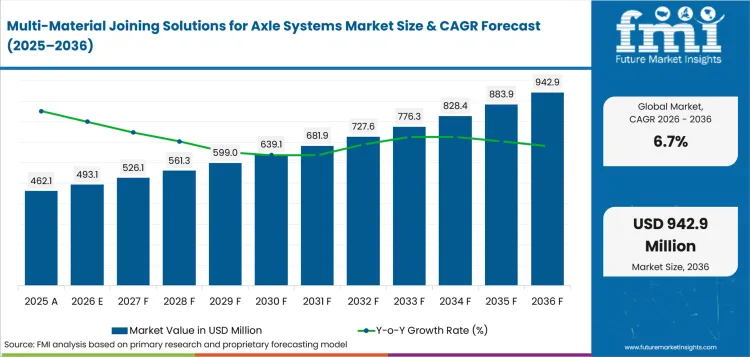
Multi-material joining solutions for axle systems market was valued at USD 462.1 million in 2025 and is expected to reach USD 493.1 million in 2026. Demand is forecast to reach USD 942.9 million by 2036 at 6.7% CAGR during the forecast period. OEM line fit is forecast to account for 72.0% share in 2026 as axle joints need early platform approval. Passenger vehicles are forecast to represent 58.0% share of vehicle type demand in 2026 due to high-volume electric and hybrid car platforms.
Key Takeaways, Market Size, and Forecast
- Market value stood at USD 462.1 million in 2025.
- Industry revenue is expected to reach USD 942.9 million by 2036.
- Market value is forecast to rise at 6.7% CAGR from 2026 to 2036.
- Market revenue is expected to add USD 449.8 million in incremental opportunity over 2026 to 2036.
- OEM line fit is forecast to hold 72.0% share in 2026 as axle joining needs early production approval.
- Passenger vehicles are expected to represent 58.0% share in 2026 as EV and hybrid platforms use mixed-material axle packages.
- China at 8.2% CAGR and India at 7.6% CAGR are forecast above the global pace during the forecast period.
Summary of the Multi-Material Joining Solutions for Axle Systems Market
- Demand and Expansion Drivers
- Electric axle design is creating new joining needs as motor load puts more stress on housings and brackets.
- Automakers are using mixed materials to reduce vehicle weight without weakening axle structures.
- Axle suppliers need joining routes that can handle vibration and road load across long vehicle use.
- Product and Segment View
- Structural adhesives help spread stress across wider contact areas in mixed-material axle parts.
- Self-pierce rivets give axle suppliers a faster joining route for coated sheets and metal stacks.
- Hybrid joining is useful when one method alone cannot meet strength and service needs.
- Geography and Competitive Outlook
- China and India are important markets because electric vehicle production is moving faster in both countries.
- Germany and Japan focus more on testing quality, so suppliers need clear proof before joining systems enter production.
- Leading suppliers stand out through bonding chemistry and factory automation support.
- Analyst Opinion
- Nikhil Kaitwade of FMI says, “Multi-material axle joining is becoming a platform engineering decision for automakers. Axle suppliers need joints able to hold fatigue loads across mixed metals and support fast plant validation. Companies combining adhesive performance with fastening automation will be preferred in new electric axle programs.”
- Multi-Material Joining Solutions for Axle Systems Market Value Analysis
- The multi-material joining solutions for axle systems market is moving from standard fastening into a more defined axle engineering input.
- Market value comes from electric axle designs that place higher load on housings and brackets.
- Structural adhesives are gaining use as automakers need wider stress spread across mixed-metal joints.
- Hybrid joining routes help suppliers meet production approval needs across mixed-material axle designs.
Axle joining is becoming a platform approval issue as EV layouts place higher torque near housings and mounts. In 2026, IEA reported that battery electric cars made up about 65% of electric car sales in 2025. That raises the need for mixed-material joints that manage fatigue across steel and aluminum. Factory joining is moving toward low-heat and traceable processes. Atlas Copco’s 2024 K-Flow brochure says flow-drill fastening can join different material combinations without a pre-hole. EJOT’s 2024 EuroBLECH release says FDS supports high-strength sheet metal joining. These methods help axle suppliers protect coated materials and shorten assembly steps. Company activity is supporting the same shift. In July 2025, KUKA received a follow-up order for 12 friction stir welding cells after an earlier 23-cell order. ZF secured a 2025 nomination for AxTrax 2 electric axles in India. These moves keep supplier selection tied to joining evidence and EV axle readiness.
Multi-Material Joining Solutions for Axle Systems Market Definition
The multi-material joining solutions for axle systems market refers to bonding and fastening methods used to connect different materials in axle assemblies. These solutions help join steel with aluminum and composite materials in parts such as axle housings, brackets, mounts, and cross-members. They are used when welding alone cannot provide the needed strength or process control.
Multi-Material Joining Solutions for Axle Systems Market Inclusions
Market scope covers multi-material joining solutions used in axle system assembly. The scope includes structural adhesives and self-pierce rivets. It also includes flow-drill screws, friction stir processes, and hybrid joining routes used for validated axle joints. Covered axle systems include electric axles, drive axles, dead axles, and trailer axles. Material scope includes aluminum steel stacks and steel composites. Aluminum composites and steel steel assemblies are included when used in axle housings, brackets, mounts, and load-bearing axle structures. Revenue scope covers 2026 to 2036. Key stakeholders include adhesive suppliers, fastening technology providers, robotic joining system manufacturers, axle system suppliers, automotive OEMs, tier suppliers, assembly tool providers, testing service providers, and automotive certification authorities.
Multi-Material Joining Solutions for Axle Systems Market Exclusions
Scope excludes general body-in-white joining unless used directly in axle assemblies. Standard wheel bolts and brake fasteners are excluded unless sold as part of a certified mixed-material axle joint package. General repair adhesives are excluded unless approved for axle-related service work.
Multi-Material Joining Solutions for Axle Systems Market Research Methodology
- Primary research: FMI analysts reviewed axle suppliers and joining tool firms active in automotive axle programs.
- Desk research: Official vehicle output data and EV sales evidence were checked with company disclosures.
- Market sizing and forecasting: Market size was built from axle program volumes and average joining content per axle.
- Data validation: Forecast checks used vehicle production trends and EV penetration across major automotive countries.
Why is the Multi-Material Joining Solutions for Axle Systems Market Expanding?
- EV axle load is increasing demand for mixed-material joints as motor weight and torque create higher local stress.
- Lightweight axle design supports structural bonding as automakers cut mass without weakening brackets and housings.
- Automotive axle redesign supports joining upgrades as drivetrain layouts become compact and torque-dense.
Axle joining demand is rising as EV and hybrid platforms change load paths near the drive unit. IEA reported battery electric cars made up about 65.0% of electric car sales in 2025. Heavier battery and motor layouts raise fatigue needs near axle mounting areas. Suppliers win program access if joints pass corrosion and vibration tests in one approved process. Bonding demand also connects with automotive adhesives & sealants as axle suppliers need wider stress spread across mixed-metal contact areas.
Factory joining is receiving attention as plants shift from single-material axle structures to mixed stacks. Atlas Copco stated in its 2024 K-Flow brochure that flow-drill fastening can join different material combinations without a pre-hole. EJOT stated in its 2024 EuroBLECH release that FDS flow-drilling screws support high-strength sheet-metal joining.
Market Segmentation Analysis
- Structural adhesives are forecast to hold 36.0% share in 2026.
- Electric axles are expected to account for 43.0% share in 2026.
- Aluminum steel stacks are forecast to represent 39.0% share in 2026.
- OEM line fit is expected to hold 72.0% share in 2026.
- Passenger vehicles are forecast to account for 58.0% share in 2026.
The market is divided into five primary segment groups based on joining method and axle type. Material stack and sales channel complete part of the structure. Vehicle type completes the segmentation scope. Joining method covers structural adhesives and self-pierce rivets. Flow-drill screws and friction stir complete the method scope. Hybrid joining is included for combined joining routes. Axle type covers electric axles and drive axles. Dead axles and trailer axles complete the axle scope. Material stack covers aluminum steel and steel composites. Aluminum composites and steel steel assemblies complete the material scope. Sales channel covers OEM line fit and tier integration. Retrofit repair and tooling service complete the channel scope. Vehicle type covers passenger vehicles and light trucks. Heavy trucks and buses complete the vehicle scope.
Insights into Multi-Material Joining Solutions for Axle Systems Market by Joining Method
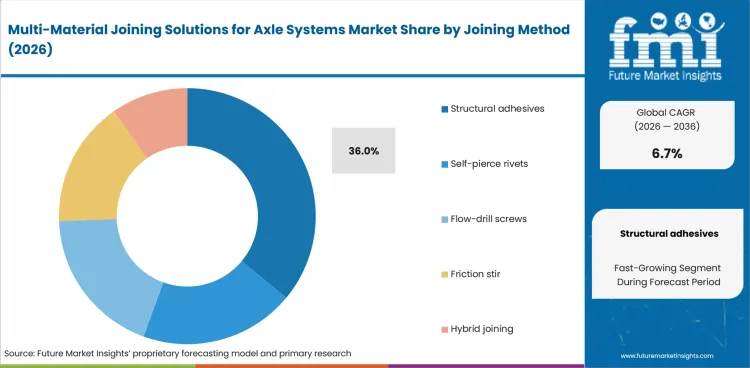
- Structural adhesives are expected to account for 36.0% share in 2026 as axle brackets need wider stress spread across steel and aluminum joints. Demand also connects with automotive adhesives and sealants market as bonding helps reduce drilling stress near load points.
- Self-pierce rivets support fast axle assembly since they join coated sheets without a full drilling step. Flow-drill screws add value in thicker material stacks because they create a firm joint with fewer process steps.
Insights into Multi-Material Joining Solutions for Axle Systems Market by Axle Type
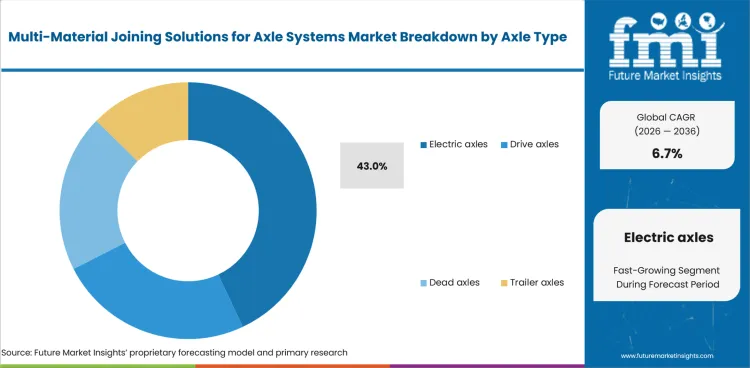
- Electric axles are forecast to hold 43.0% share in 2026 as compact drive units place more torque near housings and mounts. This makes electric drive axles for heavy-duty trucks outlook important for joining suppliers serving high-load platforms.
- Drive axles need joining routes that can manage vibration and road load over long service life. E-axle disconnect actuators raise the need for compact joints near moving driveline parts.
Insights into Multi-Material Joining Solutions for Axle Systems Market by Material Stack
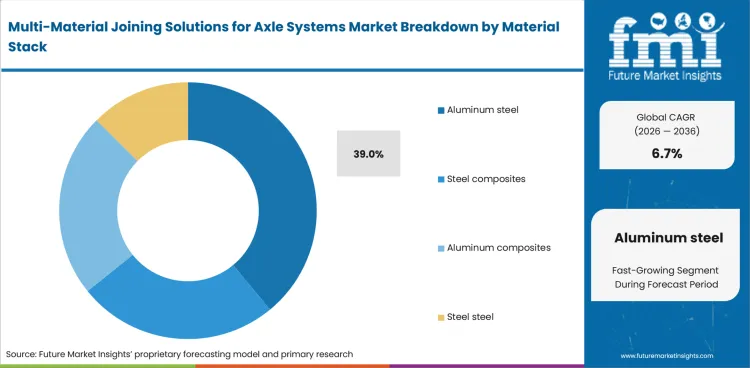
- Aluminum steel stacks are expected to represent 39.0% share in 2026 as automakers use aluminum for lower weight and steel for high-load areas. This mix needs joining methods that control corrosion and reduce heat damage.
- Steel composite and aluminum composite stacks support specialized axle designs that need stiffness with lower mass. Photo-activated debondable structural adhesives outlook add value where service access and controlled part removal are important.
Insights into Multi-Material Joining Solutions for Axle Systems Market by Sales Channel
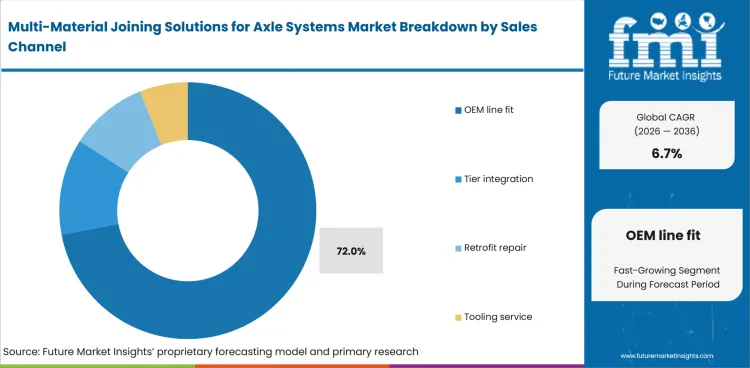
- OEM line fit is expected to hold 72.0% share in 2026 as axle joints must be approved before platform launch. Early validation gives suppliers a better chance to secure repeat program work.
- Tier integration supports axle suppliers that need joining tools and material support near assembly lines. Assembly fastening tools help control joint quality through repeatable force and process tracking.
Insights into Multi-Material Joining Solutions for Axle Systems Market by Vehicle Type
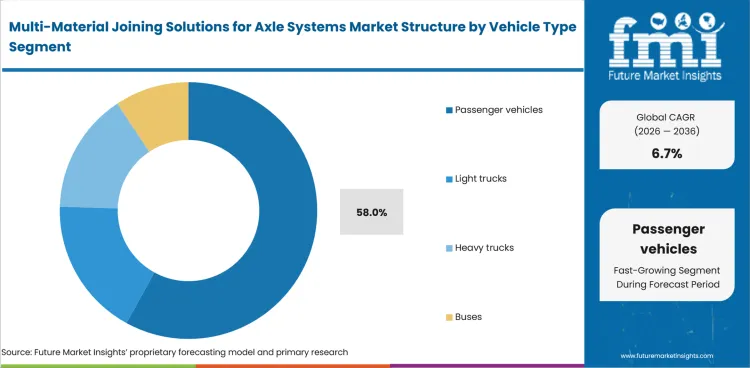
- Passenger vehicles are forecast to account for 58.0% share in 2026 as EV and hybrid platforms use mixed-material axle parts in high volumes. This supports demand tied to automotive axle and propeller shaft redesign.
- Light trucks and buses need stronger joints as axle parts face heavier loads and longer duty cycles. Active torque vectoring rear axle systems outlook add related demand for precise joining near drive housings.
Multi-Material Joining Solutions for Axle Systems Market Drivers, Restraints, and Opportunities
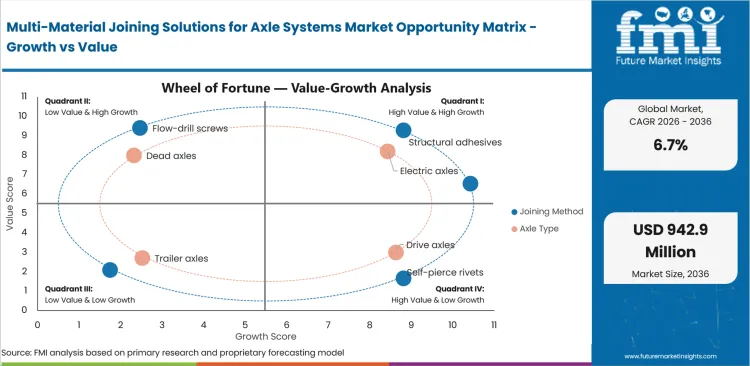
- Mixed-metal axle design is increasing demand for structural adhesives and automated fastening routes.
- Validation cost can slow smaller suppliers as axle joints must pass fatigue and corrosion checks.
- Low-heat fastening and service-friendly bonding create openings for suppliers with clear test evidence.
Mixed-Metal Axles Need Fatigue Control
Electric axle design places higher torque near housings and mounts. Sika states SikaPower structural adhesives support same-material and mixed-material joining in automotive structures. Stress distribution becomes important as aluminum parts meet steel load paths. Suppliers with industrial adhesives and axle test evidence can protect margins by selling approved material systems.
Validation Cost Slows Smaller Suppliers
Axle joints face road load and water exposure across long vehicle life. Flow-drill screws from EJOT create high-strength sheet metal joints without drilling or punching. Validation cost rises as each material stack needs pull-out and fatigue checks. Smaller suppliers lose ground without documented test history across several axle designs.
Automotive Adhesive Launches Support Lighter Assemblies
E-mobility joining programs are moving toward automated welding and validated axle systems. In July 2025, KUKA received a follow-up order for 12 friction stir welding cells after an earlier order for 23 cells. In April 2025, ZF secured a multi-year nomination to supply several thousand AxTrax 2 electric axles in India. AxTrax 2 delivers 210 kW of continuous power.
Competitive Landscape and Strategic Positioning
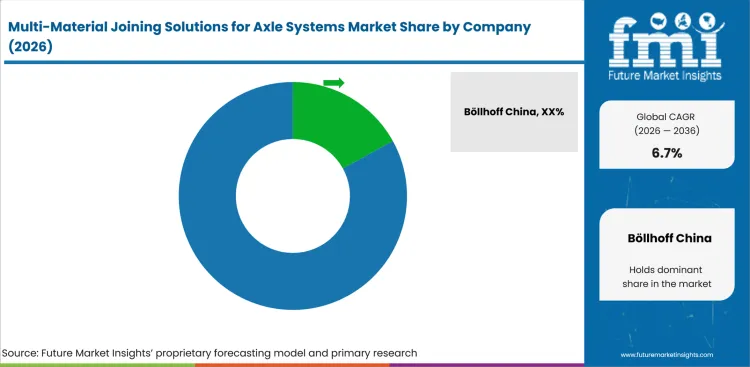
- Competition centers on approved joint performance and mixed-material testing evidence.
- Adhesive suppliers stand out by proving fatigue strength and corrosion resistance on axle material stacks.
- Fastening tool firms stand out with rivet force control and process traceability.
- Entry barriers include OEM validation and repeatable quality evidence.
Competitive positioning depends on joining evidence tied directly to axle load cases. Henkel and Sika have adhesive depth for mixed-material structures. Atlas Copco and Böllhoff support mechanical joining routes used in high-volume plants. EJOT supports flow-drill screw systems for sheet metal joints. KUKA adds factory automation depth for joining cells. Suppliers combining material support and validation support can defend premium pricing.
Adhesives for EV battery modules influence nearby material choices as platform engineers align bonding needs across underbody systems. Automotive axle and propeller shaft redesign keeps supplier selection tied to weight and torque targets. Suppliers with plant support and test documents can move earlier into platform planning.
Key Companies in the Multi-Material Joining Solutions for Axle Systems Market
- Adhesive specialists: Henkel AG & Co. KGaA and Sika AG lead through structural bonding chemistry and automotive approval depth.
- Fastening technology suppliers: Atlas Copco AB and Böllhoff Group serve axle joining needs through self-pierce riveting and assembly tooling.
- Automation and hybrid joining players: KUKA AG and 3M Company support factory joining through robotic cells and adhesive systems.
Competitive Benchmarking: Multi-Material Joining Solutions for Axle Systems Market
| Company | Adhesive Chemistry Depth | Mechanical Joining Automation | Axle Validation Support | Geographic Footprint |
|---|---|---|---|---|
| Henkel AG & Co. KGaA | High | Medium | High | Global with Europe depth |
| Sika AG | High | Medium | High | Global automotive presence |
| 3M Company | High | Medium | Medium | Global with United States strength |
| Atlas Copco AB | Medium | High | Medium | Global assembly tool presence |
| Böllhoff Group | Medium | High | Medium | Europe centered with global programs |
| EJOT SE & Co. KG | Medium | High | Medium | Europe centered fastening specialist |
| KUKA AG | Low | High | High | Global automation footprint |
Source: Future Market Insights competitive analysis, 2026.
Key Developments in Multi-Material Joining Solutions for Axle Systems Market
- In July 2025, KUKA received a follow-up order from a major USA automotive manufacturer for 12 friction stir welding cells after an earlier order for 23 cells.
- In April 2025, ZF secured a multi-year nomination to supply several thousand AxTrax 2 electric axles for intercity buses in India. AxTrax 2 delivers 210 kW of continuous power and integrates electric drive parts into an axle-based system.
Key Players in the Multi-Material Joining Solutions for Axle Systems Market
Major Global Players
- Henkel AG & Co. KGaA
- Sika AG
- 3M Company
- Atlas Copco AB
- KUKA AG
Specialist and Regional Players
- Böllhoff Group
- EJOT SE & Co. KG
- STANLEY Engineered Fastening
- Martinrea International Inc.
- Nedschroef Holding B.V.
Analysis of Multi-Material Joining Solutions for Axle Systems Market by Key Countries
.webp "Top Country Growth Comparison Multi Material Joining Solutions For Axle Systems Market Cagr (2026 2036)")
| Country | CAGR |
|---|---|
| United States | 5.8% |
| China | 8.2% |
| India | 7.6% |
| Germany | 6.1% |
| Japan | 5.4% |
| South Korea | 6.5% |
| Mexico | 6.9% |
Source: Future Market Insights, 2026.
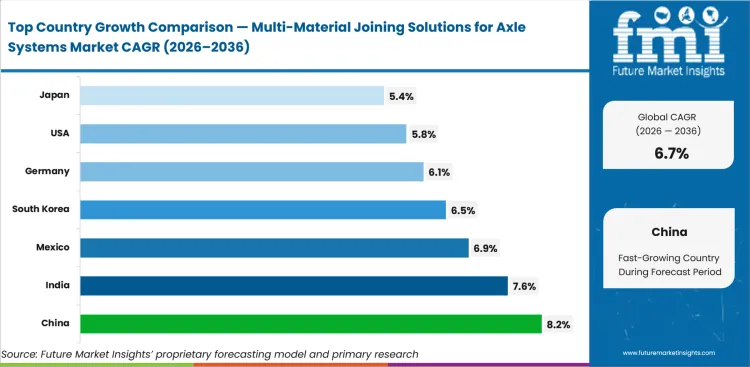
I checked the country evidence from official or high-authority sources before rewriting the section. Main source set used includes EPA for the United States, China’s State Council for CAAM vehicle data, India’s Ministry of Heavy Industries, VDA for Germany, Trade.gov for Japan, Korea.net for South Korea, and INEGI for Mexico.
Sales Analysis of Multi-Material Joining Solutions for Axle Systems Market in the United States
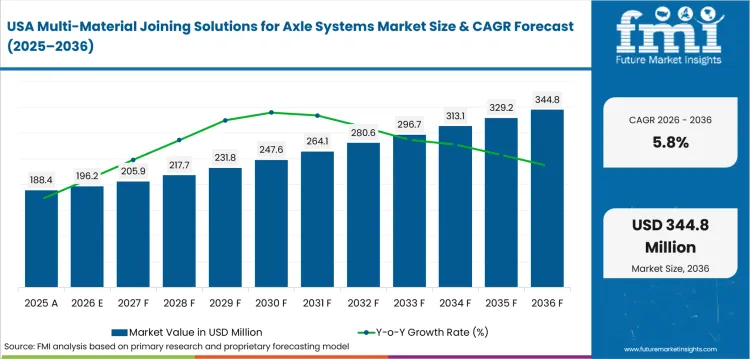
Established country market · 2026-2036
United States Market Outlook
The United States market is projected to expand at 5.8% CAGR from 2026 to 2036. Demand comes from pickup platforms and electric vehicle programs that need stronger axle joints.
Vehicle makers in the country use strict validation steps before axle systems enter production. Joining suppliers need fatigue proof and corrosion evidence before they can qualify for OEM line fit.
Key Growth Drivers
- EPA reported in February 2026 that truck SUVs held almost 50.0% of model year 2024 new vehicle production, creating demand for axle joints that can handle heavier vehicle structures.
- EPA reported model year 2024 car SUVs included 30.0% BEVs and 3.0% PHEVs, raising the need for joining routes around electric drive layouts.
- Pickup and SUV programs need joints that manage road load across steel and aluminum axle parts.
Key Restraints
- EPA data shows BEV and PHEV share is concentrated in car SUVs, which limits equal joining demand across all USA vehicle types.
- High validation cost can slow smaller suppliers because axle joints need proof under fatigue and corrosion testing.
What makes the United States unique
Pickup and SUV platforms make axle joining more load-sensitive than in many other countries. Suppliers must prove joint strength in vehicles that face higher weight and long service use.
Key Companies
- 3M Company
- STANLEY Engineered Fastening
Sales & Marketing Channels
- OEM line fit
- Tier supplier integration
- Tooling support contracts
- Repair and service networks
Market Taxonomy & Sub-Regions Covered
| Segment | Sub-Segments |
|---|---|
| By Joining Method | Structural Adhesives · Self-Pierce Rivets · Flow-Drill Screws · Friction Stir · Hybrid Joining |
| By Axle Type | Electric Axles · Drive Axles · Dead Axles · Trailer Axles |
| By Material Stack | Aluminum-Steel · Steel-Composites · Aluminum-Composites · Steel-Steel |
| By Sales Channel | OEM Line Fit · Tier Integration · Retrofit Repair · Tooling Service |
| By Vehicle Type | Passenger Vehicles · Light Trucks · Heavy Trucks · Buses |
| Key Sub-Regions Covered - States | Michigan · Ohio · Texas · Tennessee · California · Alabama |
Frequently Asked Questions
How fast is the United States market growing?
The United States market is projected to expand at 5.8% CAGR from 2026 to 2036.
Which segment leads the United States market?
OEM line fit leads because axle joining methods need approval before vehicle production begins.
What is driving demand in the United States?
Demand is led by pickup platforms and electric vehicle programs that need stronger mixed-material joints.
Sales Analysis of Multi-Material Joining Solutions for Axle Systems Market in China
Fastest-growing country market · 2026-2036
China Market Outlook
China is expected to expand at 8.2% CAGR through 2036. Vehicle production scale creates a large route for axle joining materials and fastening systems.
Electric vehicle platforms increase the need for compact axle housings and stronger bracket joints. Local suppliers also need fast process control because high-volume production leaves little room for rework.
Key Growth Drivers
- China’s State Council reported auto production of over 31.23 million units from January to November 2025, giving axle suppliers a wide production base.
- China’s State Council reported auto sales of nearly 31.13 million units during the same 2025 period, lifting demand for axle components and joining tools.
- Electric axle programs need low-heat joining routes that protect coated steel and aluminum parts.
Key Restraints
- China’s auto output scale keeps pricing pressure high, so joining suppliers must prove cost savings before premium systems are accepted.
- Local qualification can take longer because each axle material stack needs testing before use in mass production.
What makes China unique
China combines high vehicle output with fast EV platform cycles. This makes joining speed and process repeatability more important than small custom engineering work.
Key Companies
- Böllhoff China
- Bossard China
Sales & Marketing Channels
- OEM line fit
- Tier supplier programs
- Local automation integrators
- Industrial fastening distributors
Market Taxonomy & Sub-Regions Covered
| Segment | Sub-Segments |
|---|---|
| By Joining Method | Structural Adhesives · Self-Pierce Rivets · Flow-Drill Screws · Friction Stir · Hybrid Joining |
| By Axle Type | Electric Axles · Drive Axles · Dead Axles · Trailer Axles |
| By Material Stack | Aluminum-Steel · Steel-Composites · Aluminum-Composites · Steel-Steel |
| By Sales Channel | OEM Line Fit · Tier Integration · Retrofit Repair · Tooling Service |
| By Vehicle Type | Passenger Vehicles · Light Trucks · Heavy Trucks · Buses |
| Key Sub-Regions Covered (China) | Guangdong · Jiangsu · Zhejiang · Shanghai · Chongqing · Anhui |
Frequently Asked Questions
How fast is China’s market growing?
China is expected to expand at 8.2% CAGR through 2036.
Which segment leads the China market?
OEM line fit leads because axle suppliers need joining routes approved before high-volume vehicle production starts.
What is driving demand in China?
Demand is driven by large vehicle output and electric axle programs that need repeatable mixed-material joints.
Sales Analysis of Multi-Material Joining Solutions for Axle Systems Market in India
High-localization country market · 2026-2036
India Market Outlook
India is likely to post 7.6% CAGR in the sector by 2036. The market benefits from local EV manufacturing and bus electrification.
Axle suppliers need joining systems that can manage road load and high-duty use. Local material support also matters because vehicle makers are under pressure to raise domestic value addition.
Key Growth Drivers
- India’s Ministry of Heavy Industries stated the electric passenger car scheme requires minimum investment of Rs. 4,150.0 crore, creating room for local component and axle system capacity.
- The same scheme targets 25.0% domestic value addition in 3 years and 50.0% within 5 years, which can increase demand for local joining support.
- Electric buses and light commercial vehicles need stronger axle joints because load cycles are heavier than regular passenger car use.
Key Restraints
- Domestic value rules can limit suppliers that lack local testing, production support, or application engineering.
- Price-sensitive vehicle programs can delay premium adhesives unless suppliers prove longer service life.
What makes India unique
India’s axle joining demand is closely linked to localization. Suppliers need local line support and practical cost control before they can win larger vehicle programs.
Key Companies
- Atlas Copco India
- Sika India
Sales & Marketing Channels
- OEM line fit
- Tier supplier integration
- Industrial assembly tool sales
- Service and repair support
Market Taxonomy & Sub-Regions Covered
| Segment | Sub-Segments |
|---|---|
| By Joining Method | Structural Adhesives · Self-Pierce Rivets · Flow-Drill Screws · Friction Stir · Hybrid Joining |
| By Axle Type | Electric Axles · Drive Axles · Dead Axles · Trailer Axles |
| By Material Stack | Aluminum-Steel · Steel-Composites · Aluminum-Composites · Steel-Steel |
| By Sales Channel | OEM Line Fit · Tier Integration · Retrofit Repair · Tooling Service |
| By Vehicle Type | Passenger Vehicles · Light Trucks · Heavy Trucks · Buses |
| Key Sub-Regions Covered (India) | Maharashtra · Tamil Nadu · Karnataka · Gujarat · Haryana · Telangana |
Frequently Asked Questions
How fast is India’s market growing?
India is likely to post 7.6% CAGR in the sector by 2036.
Which segment leads the India market?
OEM line fit leads because vehicle makers need approved joints before local production begins.
What is driving demand in India?
Demand is led by EV localization and heavier-duty vehicle programs that need stronger axle joining systems.
Sales Analysis of Multi-Material Joining Solutions for Axle Systems Market in Germany
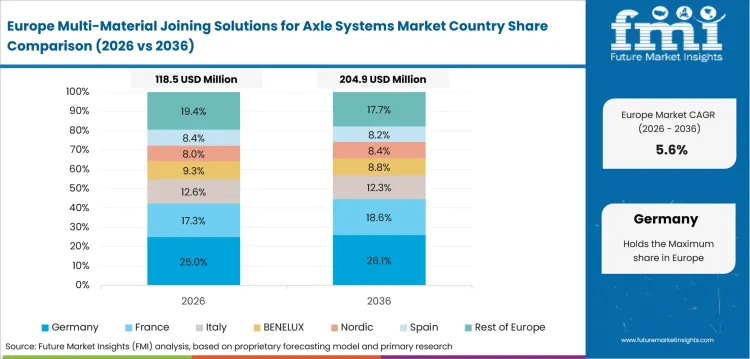
Engineering-led country market · 2026-2036
Germany Market Outlook
Germany is expected to record 6.1% CAGR in the market during the forecast period. Demand comes from electric vehicle output and deep joining validation capability.
Axle suppliers in Germany need tight process control before mixed-material designs enter production. This gives adhesive and robotic joining specialists a clear role in early platform planning.
Key Growth Drivers
- VDA reported in August 2025 that Germany produced 864,000 electric cars in the first half of 2025, creating demand for EV-ready axle joining systems.
- VDA reported BEV production of 635,000 units and PHEV production of 229,000 units in the first half of 2025, increasing mixed-material joining needs.
- German engineering programs favor low-heat joining because axle housings and brackets often use aluminum with steel load zones.
Key Restraints
- VDA data shows Germany has both BEV and PHEV production streams, so suppliers must qualify joints across more than one electric layout.
- High testing cost can slow new entrants because axle joints need long fatigue and corrosion evidence.
What makes Germany unique
Germany is a strong validation center for mixed-material joining. Suppliers often need proof from test cells before vehicle makers accept a new axle joining route.
Key Companies
- KUKA AG
- EJOT SE & Co. KG
Sales & Marketing Channels
- OEM line fit
- Robotic joining cells
- Tier supplier programs
- Engineering validation support
Market Taxonomy & Sub-Regions Covered
| Segment | Sub-Segments |
|---|---|
| By Joining Method | Structural Adhesives · Self-Pierce Rivets · Flow-Drill Screws · Friction Stir · Hybrid Joining |
| By Axle Type | Electric Axles · Drive Axles · Dead Axles · Trailer Axles |
| By Material Stack | Aluminum-Steel · Steel-Composites · Aluminum-Composites · Steel-Steel |
| By Sales Channel | OEM Line Fit · Tier Integration · Retrofit Repair · Tooling Service |
| By Vehicle Type | Passenger Vehicles · Light Trucks · Heavy Trucks · Buses |
| Key Sub-Regions Covered (Germany) | Bavaria · Baden-Württemberg · North Rhine-Westphalia · Lower Saxony · Saxony · Hesse |
Frequently Asked Questions
How fast is Germany’s market growing?
Germany is expected to record 6.1% CAGR in the market during the forecast period.
Which segment leads the Germany market?
OEM line fit leads because German axle programs need early proof for joint strength and corrosion control.
What is driving demand in Germany?
Demand is driven by electric car production and the need for validated low-heat joining.
Sales Analysis of Multi-Material Joining Solutions for Axle Systems Market in Japan
Precision-focused country market · 2026-2036
Japan Market Outlook
The industry outlook in Japan points to 5.4% CAGR through 2036. Demand is linked to high-quality vehicle manufacturing and careful supplier approval.
Axle suppliers in Japan often prefer proven joining systems with low rework risk. Structural adhesives and controlled fastening gain space where mixed-material joints must stay stable over long service life.
Key Growth Drivers
- Trade.gov reported in November 2025 that Japan sold 4,421,494 new passenger vehicles in 2024, creating a large base for axle-related joining demand.
- Trade.gov reported auto manufacturing made up 13.9% of Japan’s manufacturing GDP in 2024, reflecting deep local production capability.
- Passenger vehicle programs favor structural adhesives because bonding can spread stress across mixed-material axle brackets.
Key Restraints
- Trade.gov reported passenger vehicle sales declined 7.5% in 2024, which can slow near-term joining demand from new production programs.
- Supplier approval cycles are strict because axle joints need evidence on fatigue behavior and long-term corrosion control.
What makes Japan unique
Japan’s market is shaped by careful validation and low-defect production. Joining suppliers need process stability more than broad product claims.
Key Companies
- Nitto Denko Corporation
- Toagosei Co., Ltd.
Sales & Marketing Channels
- OEM line fit
- Tier supplier programs
- Adhesive distributors
- Technical service channels
Market Taxonomy & Sub-Regions Covered
| Segment | Sub-Segments |
|---|---|
| By Joining Method | Structural Adhesives · Self-Pierce Rivets · Flow-Drill Screws · Friction Stir · Hybrid Joining |
| By Axle Type | Electric Axles · Drive Axles · Dead Axles · Trailer Axles |
| By Material Stack | Aluminum-Steel · Steel-Composites · Aluminum-Composites · Steel-Steel |
| By Sales Channel | OEM Line Fit · Tier Integration · Retrofit Repair · Tooling Service |
| By Vehicle Type | Passenger Vehicles · Light Trucks · Heavy Trucks · Buses |
| Key Sub-Regions Covered (Japan) | Aichi · Shizuoka · Kanagawa · Tokyo · Saitama · Fukuoka |
Frequently Asked Questions
How fast is Japan’s market growing?
The industry outlook in Japan points to 5.4% CAGR through 2036.
Which segment leads the Japan market?
OEM line fit leads because Japanese vehicle makers approve joining systems before production starts.
What is driving demand in Japan?
Demand is led by passenger vehicle production and strict quality needs for mixed-material joints.
Sales Analysis of Multi-Material Joining Solutions for Axle Systems Market in South Korea
Export-oriented country market · 2026-2036
South Korea Market Outlook
Adoption in South Korea is anticipated to move ahead at 6.5% CAGR during the assessment period. Demand comes from export-focused vehicle production and EV assembly programs.
Axle joining suppliers must meet global quality checks because many vehicles are made for overseas markets. This creates demand for traceable fastening and bonding systems.
Key Growth Drivers
- Invest Korea reported in March 2026 that automobile production reached 361,000 units in January 2026, up 24.1% from a year earlier.
- Invest Korea reported January 2026 automobile exports of USD 6.1 billion, giving suppliers a route into export vehicle programs.
- EV export programs need approved bonding and fastening methods for compact axle layouts.
Key Restraints
- Export exposure can create order swings because axle suppliers depend on overseas demand.
- High OEM quality checks can limit smaller joining suppliers that lack process traceability.
What makes South Korea unique
South Korea’s joining demand is closely linked to export quality. Suppliers need clean process records and repeatable joints before they can enter vehicle programs.
Key Companies
- Korea Fastener Co., Ltd.
- Kiswel Ltd.
Sales & Marketing Channels
- OEM line fit
- Export vehicle platforms
- Tier supplier programs
- Industrial tool distributors
Market Taxonomy & Sub-Regions Covered
| Segment | Sub-Segments |
|---|---|
| By Joining Method | Structural Adhesives · Self-Pierce Rivets · Flow-Drill Screws · Friction Stir · Hybrid Joining |
| By Axle Type | Electric Axles · Drive Axles · Dead Axles · Trailer Axles |
| By Material Stack | Aluminum-Steel · Steel-Composites · Aluminum-Composites · Steel-Steel |
| By Sales Channel | OEM Line Fit · Tier Integration · Retrofit Repair · Tooling Service |
| By Vehicle Type | Passenger Vehicles · Light Trucks · Heavy Trucks · Buses |
| Key Sub-Regions Covered (South Korea) | Ulsan · Gyeonggi · Busan · Daegu · Incheon · Chungcheong |
Frequently Asked Questions
How fast is South Korea’s market growing?
South Korea is anticipated to move ahead at 6.5% CAGR during the assessment period.
Which segment leads the South Korea market?
OEM line fit leads because export vehicle programs need approved joining systems before shipment.
What is driving demand in South Korea?
Demand is driven by vehicle exports and EV production programs that need traceable joining quality.
Sales Analysis of Multi-Material Joining Solutions for Axle Systems Market in Mexico
Export-backed country market · 2026-2036
Mexico Market Outlook
Mexico is forecast to register 6.9% CAGR in this market over the study period. Demand comes from light vehicle production built for North American export programs.
Axle joining suppliers need systems that match OEM standards used in the United States and Canada. Local assembly lines also need short cycle times to support export schedules.
Key Growth Drivers
- INEGI reported in 2026 that Mexico produced 3,953,494 light vehicles in 2025, creating demand for axle assembly and joining systems.
- INEGI reported 3,385,785 light vehicle exports in 2025, linking joining demand to North American vehicle platforms.
- Light truck production favors aluminum steel stacks because vehicle makers need lower mass with strong load zones.
Key Restraints
- INEGI data shows 2025 light vehicle production fell 0.90%, which can delay new joining tool orders.
- INEGI data shows 2025 light vehicle exports fell 2.68%, adding pressure on suppliers tied to export programs.
What makes Mexico unique
Mexico’s market depends on export readiness. Joining suppliers must meet North American platform standards while keeping line cost under control.
Key Companies
- Martinrea International Inc.
- Nedschroef Holding B.V.
Sales & Marketing Channels
- OEM line fit
- Tier supplier integration
- Export platform programs
- Tooling service
Market Taxonomy & Sub-Regions Covered
| Segment | Sub-Segments |
|---|---|
| By Joining Method | Structural Adhesives · Self-Pierce Rivets · Flow-Drill Screws · Friction Stir · Hybrid Joining |
| By Axle Type | Electric Axles · Drive Axles · Dead Axles · Trailer Axles |
| By Material Stack | Aluminum-Steel · Steel-Composites · Aluminum-Composites · Steel-Steel |
| By Sales Channel | OEM Line Fit · Tier Integration · Retrofit Repair · Tooling Service |
| By Vehicle Type | Passenger Vehicles · Light Trucks · Heavy Trucks · Buses |
| Key Sub-Regions Covered (Mexico) | Nuevo León · Coahuila · Guanajuato · Puebla · San Luis Potosí · Estado de México |
Frequently Asked Questions
How fast is Mexico’s market growing?
Mexico is forecast to register 6.9% CAGR in this market over the study period.
Which segment leads the Mexico market?
OEM line fit leads because export programs need approved joining systems before production starts.
What is driving demand in Mexico?
Demand is driven by light vehicle production and export platforms that need consistent steel-aluminum joint quality.
Multi-Material Joining Solutions for Axle Systems Market Report Scope and Coverage
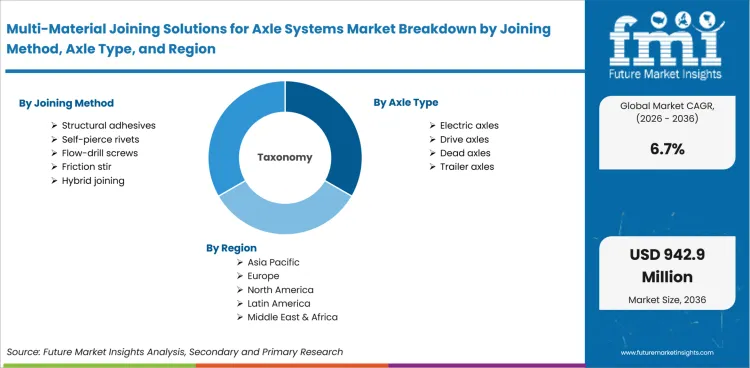
| Parameter | Details |
|---|---|
| Quantitative Units | USD 493.1 million to USD 942.9 million at 6.7% CAGR |
| Market Definition | Joining systems used to connect mixed-material axle assemblies through adhesives, rivets, screws, friction stir processes, and hybrid joining routes |
| Segments Covered | Joining method, axle type, material stack, sales channel, vehicle type, and region |
| Joining Method | Structural adhesives, self-pierce rivets, flow-drill screws, friction stir, and hybrid joining |
| Axle Type | Electric axles, drive axles, dead axles, and trailer axles |
| Material Stack | Aluminum steel, steel composites, aluminum composites, and steel steel assemblies |
| Sales Channel | OEM line fit, tier integration, retrofit repair, and tooling service |
| Vehicle Type | Passenger vehicles, light trucks, heavy trucks, and buses |
| Regions Covered | North America, Latin America, Western Europe, Eastern Europe, East Asia, South Asia and Pacific, Middle East and Africa |
| Countries Covered | United States, China, India, Germany, Japan, South Korea, Mexico, and more than 30.0 countries |
| Key Companies Profiled | Henkel AG & Co. KGaA, Sika AG, 3M Company, Atlas Copco AB, KUKA AG, Böllhoff Group, and EJOT SE & Co. KG |
| Forecast Period | 2026 to 2036 |
| Approach | Hybrid bottom-up and top-down method using vehicle production, axle program mix, joining content per axle, material stack use, and supplier activity |
| Base Year | 2025 |
Multi-Material Joining Solutions for Axle Systems Market Segmentation
Multi-Material Joining Solutions for Axle Systems Market Segmented by Joining Method
- Structural adhesives
- Self-pierce rivets
- Flow-drill screws
- Friction stir
- Hybrid joining
Multi-Material Joining Solutions for Axle Systems Market Segmented by Axle Type
- Electric axles
- Drive axles
- Dead axles
- Trailer axles
Multi-Material Joining Solutions for Axle Systems Market Segmented by Material Stack
- Aluminum steel
- Steel composites
- Aluminum composites
- Steel steel
Multi-Material Joining Solutions for Axle Systems Market Segmented by Sales Channel
- OEM line fit
- Tier integration
- Retrofit repair
- Tooling service
Multi-Material Joining Solutions for Axle Systems Market Segmented by Vehicle Type
- Passenger vehicles
- Light trucks
- Heavy trucks
- Buses
Multi-Material Joining Solutions for Axle Systems Market by Region
- North America
- Latin America
- Western Europe
- Eastern Europe
- East Asia
- South Asia and Pacific
- Middle East and Africa
Research Sources and Bibliography
- International Energy Agency. (2026, May 20). Trends in electric cars: Global EV Outlook 2026. International Energy Agency. USA Environmental Protection Agency. (2026, February). The 2025 EPA automotive trends report: Greenhouse gas emissions, fuel economy, and technology since 1975. USA Environmental Protection Agency.
- State Council of the People’s Republic of China. (2025, December 11). China’s auto output, sales both exceed 31 million units in January-November. State Council of the People’s Republic of China.
- Ministry of Heavy Industries. (2026, January 13). Year end review 2025: Ministry of Heavy Industries. Press Information Bureau.
- German Association of the Automotive Industry. (2025, August 4). Electric car production at record levels in first half of the year. VDA.
- Japan Automobile Manufacturers Association. (2025, September 26). The motor industry of Japan 2025. Japan Automobile Manufacturers Association.
- Ministry of Trade, Industry and Resources. (2026, February 19). January 2026 automobile exports reach $6.1 billion, second-highest January on record. Korea.net.
- Instituto Nacional de Estadística y Geografía. (2026, January 9). Registro administrativo de la industria automotriz de vehículos ligeros: Diciembre de 2025. INEGI.
- EJOT. (2024). EJOT press release EuroBLECH 2024. EJOT.
- Atlas Copco. (2024). K-Flow flow drill fastening. Atlas Copco.
- Sika. (2024, June). Committed to sustainable performance. Sika. https://www.sika.com/dam/dms/corporate/media/glo-sika-esg-presentation-june-2024.pdf
- KUKA. (2024, June 12). State-of-the-art KUKA welding technologies for e-mobility. KUKA
- KUKA. (2025, July 9). State-of-the-art welding technologies for e-mobility: KUKA receives follow-up order from major automotive manufacturer. KUKA
- ZF Group. (2025, April 16). India business win: ZF secures significant order for AxTrax 2 electric axle for commercial vehicles. ZF.
Report Answers
- What is the 2025 value of the multi-material joining solutions for axle systems industry?
- What revenue is forecast for the industry by 2036?
- Which joining method is expected to hold a strong share in 2026?
- Which axle type creates the main opportunity for mixed-material joining?
- Which sales channel is expected to lead during the forecast period?
- Which countries are forecast to move above the global pace?
- How do EV axle layouts affect adhesive and fastening demand?
- Which suppliers are active in structural bonding and fastening automation?
- Which company developments changed the market from 2024 to 2026?
- How did FMI size and validate the forecast?
Frequently Asked Questions
How large is the multi-material joining solutions for axle systems market in 2025?
Multi-material joining solutions for axle systems market stood at USD 462.1 million in 2025.
What is the market forecast for 2036?
Demand is forecast to reach USD 942.9 million by 2036 at 6.7% CAGR from 2026 to 2036.
Which joining method holds the main share?
Structural adhesives are forecast to hold 36.0% share in 2026 as axle joints need wider stress distribution across mixed materials.
Which axle type is important for joining suppliers?
Electric axles are expected to account for 43.0% share in 2026 as compact drive housings need stronger mixed-material joints.
Which sales channel leads demand?
OEM line fit is forecast to hold 72.0% share in 2026 as joining choices must be approved before vehicle launch.
Which vehicle type has the main demand share?
Passenger vehicles are forecast to represent 58.0% share in 2026 due to high-volume EV and hybrid platform output.
Which countries move faster than the global pace?
China and India are forecast above the global pace due to EV output and local axle sourcing. Mexico is expected to move faster due to export vehicle assembly.
Who are the key suppliers?
Henkel and Sika are key bonding suppliers. Atlas Copco and Böllhoff support fastening. EJOT supports flow-drill screws and KUKA supports automation.
Preview the report firsthand - request a free sample
Get SampleGet the brochure for pricing and purchase details.
Get PDFTable of Content
- Key Takeaways
- Market Size and CAGR
- Top Growth Driver
- Fastest Growing Segment
- Leading Region
- Key Companies
- Emerging Opportunities
- Executive Summary
- Global Market Outlook
- Demand-side Trends
- Supply-side Trends
- Technology Roadmap Analysis
- Analysis and Recommendations
- Analyst Perspective (What is happening? Why now? What should investors know?)
- Key Questions Answered
- How large is the market?
- What is the CAGR?
- What are key trends?
- Which region dominates?
- Who are the leaders?
- Market Overview
- Market Coverage / Taxonomy
- Market Definition / Scope / Limitations
- Research Methodology
- Chapter Orientation
- Analytical Lens and Working Hypotheses
- Market Structure, Signals, and Trend Drivers
- Benchmarking and Cross-market Comparability
- Market Sizing, Forecasting, and Opportunity Mapping
- Research Design and Evidence Framework
- Desk Research Programme (Secondary Evidence)
- Expert Input and Fieldwork (Primary Evidence)
- Tooling, Models, and Reference Databases
- Data Engineering and Model Build
- Quality Assurance and Audit Trail
- Market Background
- Market Dynamics (Drivers, Restraints, Opportunity, Trends)
- Scenario Forecast (Optimistic, Likely, Conservative)
- Impact Analysis
- AI Impact
- Sustainability Impact
- Regulatory Impact
- Technology Impact
- Consumer / Buyer Analysis
- Purchase Drivers
- Adoption Barriers
- Buyer Journey
- Opportunity Map Analysis
- Product Life Cycle Analysis
- Supply Chain Analysis
- Investment Feasibility Matrix
- Value Chain Analysis
- PESTLE and Porter's Analysis
- Regulatory Landscape
- Regional Parent Market Outlook
- Production and Consumption Statistics
- Import and Export Statistics
- Global Market Analysis and Forecast, 2021 to 2036
- Historical Market Size Value (USD Million) & Volume (Unit) Analysis, 2021 to 2025
- Current and Future Market Size Value (USD Million) & Volume (Unit) Projections, 2026 to 2036
- Y-o-Y Growth Trend Analysis
- Absolute $ Opportunity Analysis
- Global Market Pricing Analysis, 2021 to 2036
- Global Market Analysis and Forecast, By Joining Method, 2021 to 2036
- Introduction / Key Findings
- Historical Market Size Value (USD Million) & Volume (Unit) Analysis By Joining Method, 2021 to 2025
- Current and Future Market Size Value (USD Million) & Volume (Unit) Analysis and Forecast By Joining Method, 2026 to 2036
- Structural adhesives
- Self-pierce rivets
- Flow-drill screws
- Friction stir
- Hybrid joining
- Structural adhesives
- Y-o-Y Growth Trend Analysis By Joining Method, 2021 to 2025
- Absolute $ Opportunity Analysis By Joining Method, 2026 to 2036
- Global Market Analysis and Forecast, By Axle Type, 2021 to 2036
- Introduction / Key Findings
- Historical Market Size Value (USD Million) & Volume (Unit) Analysis By Axle Type, 2021 to 2025
- Current and Future Market Size Value (USD Million) & Volume (Unit) Analysis and Forecast By Axle Type, 2026 to 2036
- Electric axles
- Drive axles
- Dead axles
- Trailer axles
- Electric axles
- Y-o-Y Growth Trend Analysis By Axle Type, 2021 to 2025
- Absolute $ Opportunity Analysis By Axle Type, 2026 to 2036
- Global Market Analysis and Forecast, By Material Stack, 2021 to 2036
- Introduction / Key Findings
- Historical Market Size Value (USD Million) & Volume (Unit) Analysis By Material Stack, 2021 to 2025
- Current and Future Market Size Value (USD Million) & Volume (Unit) Analysis and Forecast By Material Stack, 2026 to 2036
- Aluminum steel
- Steel composites
- Aluminum composites
- Steel steel
- Aluminum steel
- Y-o-Y Growth Trend Analysis By Material Stack, 2021 to 2025
- Absolute $ Opportunity Analysis By Material Stack, 2026 to 2036
- Global Market Analysis and Forecast, By Sales Channel, 2021 to 2036
- Introduction / Key Findings
- Historical Market Size Value (USD Million) & Volume (Unit) Analysis By Sales Channel, 2021 to 2025
- Current and Future Market Size Value (USD Million) & Volume (Unit) Analysis and Forecast By Sales Channel, 2026 to 2036
- OEM line fit
- Tier integration
- Retrofit repair
- Tooling service
- OEM line fit
- Y-o-Y Growth Trend Analysis By Sales Channel, 2021 to 2025
- Absolute $ Opportunity Analysis By Sales Channel, 2026 to 2036
- Global Market Analysis and Forecast, By Vehicle Type, 2021 to 2036
- Introduction / Key Findings
- Historical Market Size Value (USD Million) & Volume (Unit) Analysis By Vehicle Type, 2021 to 2025
- Current and Future Market Size Value (USD Million) & Volume (Unit) Analysis and Forecast By Vehicle Type, 2026 to 2036
- Passenger vehicles
- Light trucks
- Heavy trucks
- Buses
- Passenger vehicles
- Y-o-Y Growth Trend Analysis By Vehicle Type, 2021 to 2025
- Absolute $ Opportunity Analysis By Vehicle Type, 2026 to 2036
- Global Market Analysis and Forecast, By Region, 2021 to 2036
- Introduction
- Historical Market Size Value (USD Million) & Volume (Unit) Analysis By Region, 2021 to 2025
- Current Market Size Value (USD Million) & Volume (Unit) Analysis and Forecast By Region, 2026 to 2036
- North America
- Latin America
- Western Europe
- Eastern Europe
- East Asia
- South Asia and Pacific
- Middle East & Africa
- Market Attractiveness Analysis By Region
- North America Market Analysis and Forecast, By Country, 2021 to 2036
- Historical Market Size Value (USD Million) & Volume (Unit) Trend Analysis By Market Taxonomy, 2021 to 2025
- Market Size Value (USD Million) & Volume (Unit) Forecast By Market Taxonomy, 2026 to 2036
- By Country
- USA
- Canada
- Mexico
- By Joining Method
- By Axle Type
- By Material Stack
- By Sales Channel
- By Vehicle Type
- By Country
- Market Attractiveness Analysis
- By Country
- By Joining Method
- By Axle Type
- By Material Stack
- By Sales Channel
- By Vehicle Type
- Key Takeaways
- Latin America Market Analysis and Forecast, By Country
- Historical Market Size Value (USD Million) & Volume (Unit) Trend Analysis By Market Taxonomy, 2021 to 2025
- Market Size Value (USD Million) & Volume (Unit) Forecast By Market Taxonomy, 2026 to 2036
- By Country
- Brazil
- Chile
- Rest of Latin America
- By Joining Method
- By Axle Type
- By Material Stack
- By Sales Channel
- By Vehicle Type
- By Country
- Market Attractiveness Analysis
- By Country
- By Joining Method
- By Axle Type
- By Material Stack
- By Sales Channel
- By Vehicle Type
- Key Takeaways
- Western Europe Market Analysis and Forecast, By Country
- Historical Market Size Value (USD Million) & Volume (Unit) Trend Analysis By Market Taxonomy, 2021 to 2025
- Market Size Value (USD Million) & Volume (Unit) Forecast By Market Taxonomy, 2026 to 2036
- By Country
- Germany
- UK
- Italy
- Spain
- France
- Nordic
- BENELUX
- Rest of Western Europe
- By Joining Method
- By Axle Type
- By Material Stack
- By Sales Channel
- By Vehicle Type
- By Country
- Market Attractiveness Analysis
- By Country
- By Joining Method
- By Axle Type
- By Material Stack
- By Sales Channel
- By Vehicle Type
- Key Takeaways
- Eastern Europe Market Analysis and Forecast, By Country
- Historical Market Size Value (USD Million) & Volume (Unit) Trend Analysis By Market Taxonomy, 2021 to 2025
- Market Size Value (USD Million) & Volume (Unit) Forecast By Market Taxonomy, 2026 to 2036
- By Country
- Russia
- Poland
- Hungary
- Balkan & Baltic
- Rest of Eastern Europe
- By Joining Method
- By Axle Type
- By Material Stack
- By Sales Channel
- By Vehicle Type
- By Country
- Market Attractiveness Analysis
- By Country
- By Joining Method
- By Axle Type
- By Material Stack
- By Sales Channel
- By Vehicle Type
- Key Takeaways
- East Asia Market Analysis and Forecast, By Country
- Historical Market Size Value (USD Million) & Volume (Unit) Trend Analysis By Market Taxonomy, 2021 to 2025
- Market Size Value (USD Million) & Volume (Unit) Forecast By Market Taxonomy, 2026 to 2036
- By Country
- China
- Japan
- South Korea
- By Joining Method
- By Axle Type
- By Material Stack
- By Sales Channel
- By Vehicle Type
- By Country
- Market Attractiveness Analysis
- By Country
- By Joining Method
- By Axle Type
- By Material Stack
- By Sales Channel
- By Vehicle Type
- Key Takeaways
- South Asia and Pacific Market Analysis and Forecast, By Country
- Historical Market Size Value (USD Million) & Volume (Unit) Trend Analysis By Market Taxonomy, 2021 to 2025
- Market Size Value (USD Million) & Volume (Unit) Forecast By Market Taxonomy, 2026 to 2036
- By Country
- India
- ASEAN
- Australia & New Zealand
- Rest of South Asia and Pacific
- By Joining Method
- By Axle Type
- By Material Stack
- By Sales Channel
- By Vehicle Type
- By Country
- Market Attractiveness Analysis
- By Country
- By Joining Method
- By Axle Type
- By Material Stack
- By Sales Channel
- By Vehicle Type
- Key Takeaways
- Middle East & Africa Market Analysis and Forecast, By Country
- Historical Market Size Value (USD Million) & Volume (Unit) Trend Analysis By Market Taxonomy, 2021 to 2025
- Market Size Value (USD Million) & Volume (Unit) Forecast By Market Taxonomy, 2026 to 2036
- By Country
- Kingdom of Saudi Arabia
- Other GCC Countries
- Türkiye
- South Africa
- Other African Union
- Rest of Middle East & Africa
- By Joining Method
- By Axle Type
- By Material Stack
- By Sales Channel
- By Vehicle Type
- By Country
- Market Attractiveness Analysis
- By Country
- By Joining Method
- By Axle Type
- By Material Stack
- By Sales Channel
- By Vehicle Type
- Key Takeaways
- Key Countries Market Analysis
- USA
- Pricing Analysis
- Market Share Analysis, 2025
- By Joining Method
- By Axle Type
- By Material Stack
- By Sales Channel
- By Vehicle Type
- Canada
- Pricing Analysis
- Market Share Analysis, 2025
- By Joining Method
- By Axle Type
- By Material Stack
- By Sales Channel
- By Vehicle Type
- Mexico
- Pricing Analysis
- Market Share Analysis, 2025
- By Joining Method
- By Axle Type
- By Material Stack
- By Sales Channel
- By Vehicle Type
- Brazil
- Pricing Analysis
- Market Share Analysis, 2025
- By Joining Method
- By Axle Type
- By Material Stack
- By Sales Channel
- By Vehicle Type
- Chile
- Pricing Analysis
- Market Share Analysis, 2025
- By Joining Method
- By Axle Type
- By Material Stack
- By Sales Channel
- By Vehicle Type
- Germany
- Pricing Analysis
- Market Share Analysis, 2025
- By Joining Method
- By Axle Type
- By Material Stack
- By Sales Channel
- By Vehicle Type
- UK
- Pricing Analysis
- Market Share Analysis, 2025
- By Joining Method
- By Axle Type
- By Material Stack
- By Sales Channel
- By Vehicle Type
- Italy
- Pricing Analysis
- Market Share Analysis, 2025
- By Joining Method
- By Axle Type
- By Material Stack
- By Sales Channel
- By Vehicle Type
- Spain
- Pricing Analysis
- Market Share Analysis, 2025
- By Joining Method
- By Axle Type
- By Material Stack
- By Sales Channel
- By Vehicle Type
- France
- Pricing Analysis
- Market Share Analysis, 2025
- By Joining Method
- By Axle Type
- By Material Stack
- By Sales Channel
- By Vehicle Type
- India
- Pricing Analysis
- Market Share Analysis, 2025
- By Joining Method
- By Axle Type
- By Material Stack
- By Sales Channel
- By Vehicle Type
- ASEAN
- Pricing Analysis
- Market Share Analysis, 2025
- By Joining Method
- By Axle Type
- By Material Stack
- By Sales Channel
- By Vehicle Type
- Australia & New Zealand
- Pricing Analysis
- Market Share Analysis, 2025
- By Joining Method
- By Axle Type
- By Material Stack
- By Sales Channel
- By Vehicle Type
- China
- Pricing Analysis
- Market Share Analysis, 2025
- By Joining Method
- By Axle Type
- By Material Stack
- By Sales Channel
- By Vehicle Type
- Japan
- Pricing Analysis
- Market Share Analysis, 2025
- By Joining Method
- By Axle Type
- By Material Stack
- By Sales Channel
- By Vehicle Type
- South Korea
- Pricing Analysis
- Market Share Analysis, 2025
- By Joining Method
- By Axle Type
- By Material Stack
- By Sales Channel
- By Vehicle Type
- Russia
- Pricing Analysis
- Market Share Analysis, 2025
- By Joining Method
- By Axle Type
- By Material Stack
- By Sales Channel
- By Vehicle Type
- Poland
- Pricing Analysis
- Market Share Analysis, 2025
- By Joining Method
- By Axle Type
- By Material Stack
- By Sales Channel
- By Vehicle Type
- Hungary
- Pricing Analysis
- Market Share Analysis, 2025
- By Joining Method
- By Axle Type
- By Material Stack
- By Sales Channel
- By Vehicle Type
- Kingdom of Saudi Arabia
- Pricing Analysis
- Market Share Analysis, 2025
- By Joining Method
- By Axle Type
- By Material Stack
- By Sales Channel
- By Vehicle Type
- Türkiye
- Pricing Analysis
- Market Share Analysis, 2025
- By Joining Method
- By Axle Type
- By Material Stack
- By Sales Channel
- By Vehicle Type
- South Africa
- Pricing Analysis
- Market Share Analysis, 2025
- By Joining Method
- By Axle Type
- By Material Stack
- By Sales Channel
- By Vehicle Type
- USA
- Market Structure Analysis
- Competition Dashboard
- Competition Benchmarking
- Market Share Analysis of Top Players
- By Regional
- By Joining Method
- By Axle Type
- By Material Stack
- By Sales Channel
- By Vehicle Type
- Emerging Startups
- Innovation Benchmarking
- Competition Analysis
- Competition Deep Dive
- Böllhoff Group
- Overview
- Product Portfolio
- Profitability by Market Segments (Product/Region/Sales Channel)
- Sales Footprint
- Strategy Overview
- Marketing Strategy
- Product Strategy
- Channel Strategy
- Henkel AG & Co. KGaA
- Sika AG
- 3M Company
- Atlas Copco AB
- KUKA AG
- EJOT SE & Co. KG
- STANLEY Engineered Fastening
- Martinrea International Inc.
- Nedschroef Holding B.V.
- Böllhoff Group
- Case Studies
- Success Stories
- Recent Developments
- Competition Deep Dive
- Assumptions & Acronyms Used


