

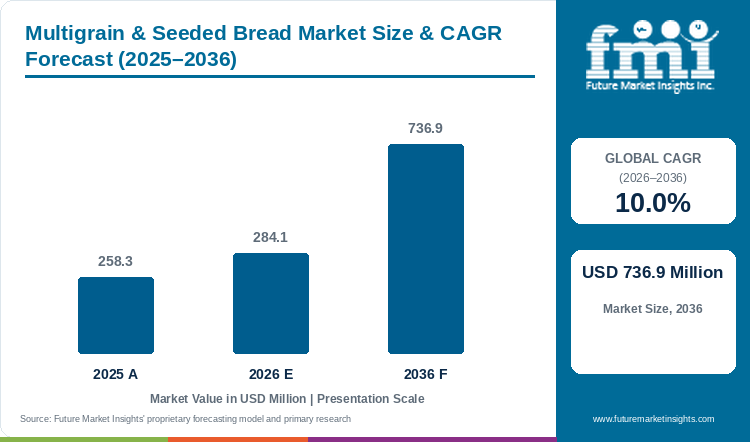
- Market Size (2026)
- USD 284.1 Mn
- Forecast (2036)
- USD 736.9 Mn
- CAGR (2026 to 2036)
- 10.0%
How big is Multigrain & Seeded Bread Market in 2026?
The Multigrain & Seeded Bread Market is Valued at USD 284.1 Million in 2026 and is forecast to reach USD 736.9 Million by 2036 at a 10.0% CAGR
The Multigrain & Seeded Bread Market was valued at USD 258.3 Million in 2025. It is valued at USD 284.1 Million in 2026 and is forecast to reach USD 736.9 Million by 2036 at a 10.0% CAGR. USDA Economic Research Service reported U.S. whole-grain intake of 0.43 ounce equivalents per 1,000 calories. The federal recommendation is 1.5. [1] Bread can help people eat more whole grains if it stays soft and tastes the way shoppers expect.
Sales grow for different reasons in each country. Modern grocery stores and online ordering are expanding in Saudi Arabia and the UAE, whereas shoppers in the UK and Germany face more pressure on household budgets. The same is true in France. Japan has demand for frozen bread but packing and shipping it are difficult, owing to regulations. FMI’s report on Whole wheat bread shows a similar pattern. Its nutritional value helps sales when the taste and price also meet local expectations.
Key Takeaways
- Shoppers are more likely to choose grains and seeds when they are in the loaves and rolls they already eat every day.
- Classic / original is projected to represent 39.0% of Product Type demand in 2026. Its familiar softness makes shoppers more willing to try bread with more grains.
- Conventional is expected to account for 56.0% of Claim / Nature demand in 2026. As per FMI, Bakers have more freedom to change the recipe and price.
- Fresh is projected to represent 36.0% of Format demand in 2026. Shoppers can judge its softness and crust at the shelf.
- Seed costs, careful sesame handling and short shelf life can make seeded bread hard to sell at a price shoppers can pay every day.
- The report covers Grupo Bimbo and Flowers Foods alongside Aryzta and Lantmannen Unibake. It also includes Vandemoortele and Yamazaki Baking. Warburtons and King's Hawaiian are covered along with Europastry and St Pierre Groupe.
Analyst Perspective
“Shoppers may try a seeded loaf for its grain content. They are more likely to buy it again if it tastes good and stays fresh. Bakers need to offer both at a price shoppers can pay for everyday bread.”
- Nandini Roy Choudhury, Principal Consultant, FMI
How is the multigrain & seeded bread market segmented?
The market is segmented by Product Type, Claim / Nature, Format, Packaging Format and Sales Channel.
Product Type includes Classic / original, Whole grain & seeded, Flavored & filled, Mini & snacking formats, and Premium / artisan. Claim / Nature includes Conventional, Clean label, Organic, Gluten-free, and High-protein / fortified. Format includes Fresh, Frozen, Ambient packaged, Chilled, and Par-baked / thaw-and-serve. Packaging Format includes Multipack, Single-serve, Family / loaf pack, and Bulk foodservice. Sales Channel includes Supermarkets & hypermarkets, Artisan & specialty bakeries, Convenience & forecourt, Online & DTC, and Foodservice distributors.
Why does Classic / original lead the Product Type category?
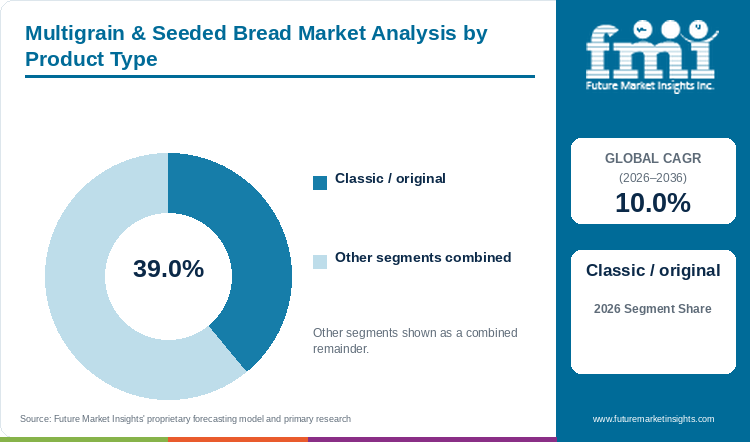
Classic/original gives shoppers the soft sliced bread they already use for toast and sandwiches. Seeds add texture while the bread can still be used for the same meals without extra preparation. Bakers can test recipes with more grains on their existing bread lines.
- Classic / original is projected to represent 39.0% of Product Type demand in 2026.
- Flowers Foods introduced its Nature's Own Keto Multi-Grain Loaf nationwide in April 2025. It promoted the loaf's softness and familiar flavor along with its grain content.
Why does Conventional remain central to the Claim / Nature category?
Conventional recipes let bakers add seeds or more grains while controlling ingredient costs. Organic certification and gluten-free food require different sourcing or production controls. These steps matter to some buyers but make it harder to match the price of everyday bread.
- Conventional is expected to account for 56.0% of Claim / Nature demand in 2026.
- Grupo Bimbo said in July 2025 that 99% of its daily-consumption products were free of artificial flavors and colorants. Its bread, buns and rolls were included.
What makes Fresh the leading Format?
Shoppers can check the softness and crust of fresh bread before buying it. Stores need frequent deliveries to sell it while it is fresh and reduce waste. Frozen baked goods can travel farther but need cold storage and careful thawing or finishing.
- Fresh is projected to represent 36.0% of Format demand in 2026.
- USDA Foreign Agricultural Service reported demand for frozen bread in Japan in November 2025. Packing and shipping it frozen are still difficult.
Why does Multipack lead the Packaging Format category?
Multipacks suit rolls, buns and smaller portions of bread. A household can open only what it needs. Retailers can show the price per pack so shoppers can compare seeded bread with standard bread.
- Multipack is expected to represent 41.0% of Packaging Format demand in 2026.
- Flowers Foods added organic Sandwich Rolls in a 21 Whole Grains and Seeds variety in April 2025. The rolls expanded its grain and seed range beyond sliced loaves.
What keeps Supermarkets & hypermarkets ahead in the Sales Channel category?
Supermarkets and hypermarkets sell seeded bread beside the bakery products shoppers already buy. Buyers can compare regular, organic and specialty loaves in one trip. Producers need regular deliveries and packaging that clearly explains the benefits of the grains or seeds.
- Supermarkets & hypermarkets are projected to account for 39.0% of Sales Channel demand in 2026.
- USDA Foreign Agricultural Service identified hypermarkets and supermarkets as preferred food stores in the UAE in December 2025. It also reported growth in food e-commerce.
What are the drivers, restraints and opportunities in the multigrain & seeded bread market?
Better nutrition supports demand. Price pressure, allergens and the need to keep bread fresh can limit growth. Smaller packs and bake-off formats offer ways to increase sales.
- Driver: Whole-grain advice encourages households to choose seeded bread as part of their usual meals.
- Restraint: Seed costs, allergen controls and short shelf life make it harder to manage prices and deliveries.
- Opportunity: Smaller loaves, seeded rolls and bake-off formats can help households and foodservice buyers waste less bread.
People eat fewer whole grains than recommended. This gives bakers a reason to offer bread with more grains. USDA Economic Research Service measured U.S. intake at 0.43 ounce equivalents per 1,000 calories in 2017-2018 against a 1.5 recommendation. Guidance in the UK and Germany also favors whole grains. Shoppers may follow that advice by buying a familiar loaf if they like its texture.
Seeded bread costs more to make and needs careful handling of allergens. The U.S. FDA identifies sesame as a major food allergen. Packaged products must clearly declare it. [2] Shoppers in the UK and Europe are also careful about price. Suppliers need to explain the benefits of the grains and keep the bread affordable for everyday buyers.
Smaller packs can help people living alone waste less bread and pay less per purchase. Flowers Foods added smaller loaf options in April 2025. These products can also be sold through online grocery in South Korea. USDA FAS reported that food accounted for about 30% of online sales in 2023. The packaging needs to keep bread in good condition during delivery.
Which country CAGRs are profiled in the multigrain & seeded bread market?
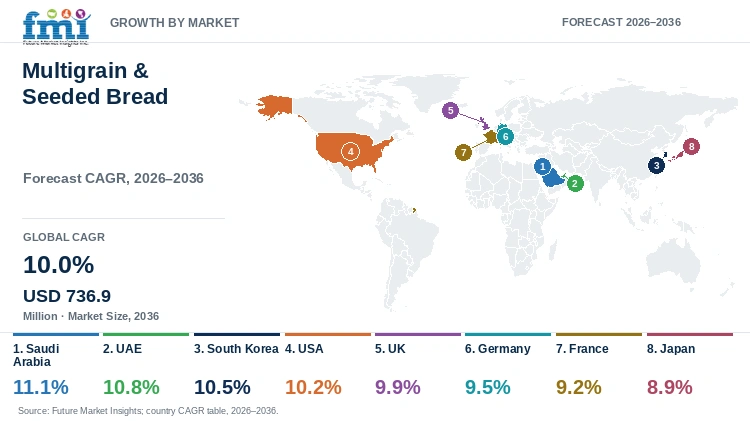
| Country | CAGR |
|---|---|
| Saudi Arabia | 11.1% |
| UAE | 10.8% |
| South Korea | 10.5% |
| USA | 10.2% |
| UK | 9.9% |
| Germany | 9.5% |
| France | 9.2% |
| Japan | 8.9% |
How do country-level CAGRs compare in the multigrain & seeded bread market?
Saudi Arabia has the fastest growth among the countries covered at an 11.1% CAGR. The UAE follows at 10.8%. South Korea and the USA also exceed 10.0%. Japan is expected to grow at 8.9%. The difference between Saudi Arabia and Japan is 2.2 percentage points. These rates show how fast each market grows. They do not show its size.
- Saudi Arabia: More modern grocery stores and online delivery make packaged seeded bread available to more shoppers.
- UAE: Hypermarkets give branded loaves access to more shoppers. Discount chains and private labels make it harder to charge higher prices.
- South Korea: Online grocery and smaller households create demand for packs that arrive fresh and can be eaten before the bread goes stale.
- USA: People eat fewer whole grains than recommended. This supports demand but shoppers still expect a soft sandwich loaf at a familiar price.
- UK: Wholegrain advice supports demand. Shoppers also compare prices with bread sold by discounters.
- Germany: Shoppers are used to wholegrain bread. Claims need to meet local definitions and the bread needs to offer the value shoppers expect.
- France: Advice to eat cereal bread supports seeded loaves. Cheaper distributor brands make it harder to charge a premium.
- Japan: Soft sliced bread fits local eating habits. Frozen bread is harder to pack and ship.
The country profiles below explain the main local conditions that affect multigrain and seeded bread sales.
Country-wise Analysis
- Saudi Arabia's food retail market exceeded USD 50 billion in 2024, according to USDA FAS. Online grocery sales were gaining share and baked goods sales were growing. Packaged seeded loaves can reach more shoppers through supermarkets and delivery apps. FMI forecasts an 11.1% CAGR from 2026 to 2036, though buyers comparing these loaves with standard bread still need clear labels and an affordable price.
- The UAE offers store and online sales opportunities for seeded rolls and multipacks, with growth projected at a 10.8% CAGR from 2026 to 2036. USDA FAS reported in December 2025 that shoppers preferred hypermarkets and supermarkets. Food e-commerce is also growing but branded products need competitive prices because shoppers can also buy from discounters and choose private labels.
- Smaller multigrain packs can suit South Korea's online grocery buyers better than a large loaf if they stay fresh during delivery. USDA FAS reported that food made up about 30% of online sales in 2023 and that people in their 30s living alone also bought groceries online frequently. For 2026 to 2036, South Korea's CAGR is forecast at 10.5%.
- The gap between recommended and actual whole-grain intake gives U.S. bakers a reason to add grains to everyday bread. Flowers Foods' 2025 launches show how this can be done in familiar soft loaves and sandwich rolls. The USA is projected to grow at a 10.2% CAGR from 2026 to 2036. Products containing sesame need accurate labels and retailers need bread that sells quickly enough at the price charged.
- The Eatwell Guide encourages higher-fibre and wholegrain choices in the UK. [3] Online grocery makes these products more available, whereas USDA FAS reported in November 2025 that shoppers were moving toward discounters and private labels. A clear grain claim helps shoppers understand the bread but its price also affects repeat purchases. The UK is forecast to record a 9.9% CAGR from 2026 to 2036.
- Bread labelled Vollkorn in Germany must meet a defined wholegrain level. [4] The German Nutrition Society recommends that at least one third of cereal products be wholegrain. Shoppers already know the category and expect a seeded loaf to offer both an accurate claim and good value compared with familiar local breads. Germany's growth forecast for 2026 to 2036 is a 9.5% CAGR.
- Price pressure in France was moving households toward distributor brands, according to USDA FAS in November 2025. Long-term bread demand had also fallen. Public guidance recommends whole or cereal starches such as cereal bread. France's forecast CAGR is 9.2% from 2026 to 2036, but shoppers need to see a difference in taste and quality before paying more for a multigrain loaf.
- Yamazaki Baking's soft sliced bread with twelve grains and sunflower seed gives Japanese shoppers a multigrain option in a format they already use. Japan's growth forecast is an 8.9% CAGR from 2026 to 2036. USDA FAS reported demand for frozen bread in November 2025 but noted problems with packaging and shipping. Smaller fresh packs can avoid some of these problems.
Who are the notable companies in the multigrain & seeded bread market?
Grupo Bimbo, Flowers Foods, Aryzta, Lantmannen Unibake, Vandemoortele, Yamazaki Baking, Warburtons, King's Hawaiian, Europastry and St Pierre Groupe
The companies covered sell bread in different ways. Grupo Bimbo and Flowers Foods distribute packaged bread widely. Aryzta and Vandemoortele supply frozen or bake-off products that stores finish near the time of sale. King's Hawaiian and St Pierre Groupe focus on branded rolls and buns. Buyers choose suppliers based on the shelf life and finishing work they can manage as well as how often deliveries can arrive.
- Scaled branded packaged-bread platforms: Grupo Bimbo, Flowers Foods, Yamazaki Baking and Warburtons.
- Bake-off and frozen bakery specialists: Aryzta, Lantmannen Unibake, Vandemoortele and Europastry.
- Specialty branded roll and brioche participants: King's Hawaiian and St Pierre Groupe.
Competitive Benchmarking: Multigrain & Seeded Bread Market
| Company | Multigrain & Seeded Bread Depth | Format & Finish Flexibility | Health & Claim Platform | Geographic Reach |
|---|---|---|---|---|
| Grupo Bimbo | Medium | High | High | Americas, Europe, Africa and Asia |
| Flowers Foods | High | High | High | United States; frozen distribution nationwide |
| Aryzta | Medium | High | Medium | Europe, Asia, Australia and New Zealand |
| Lantmannen Unibake | High | High | Medium | 60+ markets across multiple continents |
| Vandemoortele | High | High | High | Europe, United States and Asia |
| Yamazaki Baking | High | High | Medium | Japan, Asia, United States and France |
| Warburtons | High | Medium | High | United Kingdom retail and online channels |
| King's Hawaiian | Low | Medium | Low | United States retail and DTC |
| Europastry | High | High | High | 80+ countries across America, Europe and Asia |
| St Pierre Groupe | Medium | Medium | Medium | United Kingdom, United States, Europe and Middle East |
Scoring basis: High means the published information shows a broad product range or capability. Medium means a narrower range or reach. Low means limited documented presence in that area. The scores cover grain-and-seed products, format flexibility, health claims and geographic operations. They reflect the published evidence and do not represent market shares.
Key Developments in the Multigrain & Seeded Bread Market
- Flowers Foods launched a Nature's Own Keto Multi-Grain Loaf and Dave's Killer Bread organic Sandwich Rolls in April 2025. The rolls used 21 Whole Grains and Seeds. Smaller loaf options aimed to reduce waste and lower the price per purchase. These launches offered bread with more grains in familiar formats.
- Grupo Bimbo committed in July 2025 to remove artificial colorants from all its products by the end of 2026. It said 99% of daily-consumption products were already free of artificial flavors and colorants. These included bread, buns and rolls.
- Vandemoortele acquired Italy's Lizzi in February 2025. Lizzi made specialty frozen breads at four plants in northern Italy. It supplied foodservice buyers and large retailers. The purchase expanded Vandemoortele's frozen bakery production and sales network.
Key Players in the Multigrain & Seeded Bread Market
Scaled branded packaged-bread platforms
- Grupo Bimbo
- Flowers Foods
- Yamazaki Baking
- Warburtons
Bake-off and frozen bakery specialists
- Aryzta
- Lantmannen Unibake
- Vandemoortele
- Europastry
Specialty branded roll and brioche participants
- King's Hawaiian
- St Pierre Groupe
Multigrain & Seeded Bread Market - Report Scope
| Coverage field | Report scope |
|---|---|
| Market breakdown | Product Type; Claim / Nature; Format; Packaging Format; Sales Channel; Region |
| Quantitative Units | USD Million |
| Market Definition | Revenue from multigrain and seeded bread sold as qualifying loaves, rolls, buns, baguettes or portioned bread within the stated segmentation universe. Downstream sandwich or meal revenue, raw grain or seed ingredients, adjacent bakery categories and substitute breads outside the defined product boundary are excluded. |
| Regions Covered | North America; Latin America; Western Europe; Eastern Europe; East Asia; South Asia and Pacific; Middle East and Africa |
| Countries Covered | USA; Germany; France; UK; Saudi Arabia; UAE; Japan; South Korea |
| Key Companies Profiled | Grupo Bimbo, Flowers Foods, Aryzta, Lantmannen Unibake, Vandemoortele, Yamazaki Baking, Warburtons, King's Hawaiian, Europastry, St Pierre Groupe |
| Forecast Period | 2026 to 2036 |
| Approach | Primary and secondary research with market triangulation. |
Multigrain & Seeded Bread Market - Research Methodology
| Method | Approach |
|---|---|
| Primary Research | FMI analysts gathered input from manufacturers, distributors, end users, procurement teams and subject-matter experts. Interviews covered buying decisions, product evaluation, adoption barriers, approvals, prices and commercial support. |
| Desk Research | Desk research covered government statistics, regulations, trade data, industry associations, technical literature, standards, company filings, product information and official company announcements. |
| Market Sizing and Forecasting | The market model used the baseline value, historical performance, segment structure, prices, volumes, adoption levels, company activity and country demand conditions. Forecasts also considered economic activity, investment, regulation, technology adoption, buying cycles and supply conditions. |
| Data Validation | Estimates were checked against public data, company activity, trade patterns, industry developments and primary research. Products, applications and company revenues were also checked against the defined market scope. |
Multigrain & Seeded Bread Market by Segments
Multigrain & Seeded Bread Market segmented by Product Type:
- Classic / original
- Whole grain & seeded
- Flavored & filled
- Mini & snacking formats
- Premium / artisan
Multigrain & Seeded Bread Market segmented by Claim / Nature:
- Conventional
- Clean label
- Organic
- Gluten-free
- High-protein / fortified
Multigrain & Seeded Bread Market segmented by Format:
- Fresh
- Frozen
- Ambient packaged
- Chilled
- Par-baked / thaw-and-serve
Multigrain & Seeded Bread Market segmented by Packaging Format:
- Multipack
- Single-serve
- Family / loaf pack
- Bulk foodservice
Multigrain & Seeded Bread Market segmented by Sales Channel:
- Supermarkets & hypermarkets
- Artisan & specialty bakeries
- Convenience & forecourt
- Online & DTC
- Foodservice distributors
Multigrain & Seeded Bread Market by Region:
- North America
- United States
- Canada
- Latin America
- Brazil
- Mexico
- Argentina
- Chile
- Western Europe
- Germany
- France
- United Kingdom
- Italy
- Spain
- Benelux
- Nordics
- Eastern Europe
- Poland
- Czech Republic
- Romania
- Hungary
- East Asia
- China
- Japan
- South Korea
- South Asia and Pacific
- India
- ASEAN
- Australia and New Zealand
- Middle East and Africa
- GCC Countries
- South Africa
- Türkiye
- Israel
Research Sources and Bibliography
- USDA Economic Research Service (2024, May 13). Whole grain density increased in school foods after 2012.
- U.S. Food and Drug Administration (n.d.). The FASTER Act: Sesame Is the Ninth Major Food Allergen.
- Office for Health Improvement and Disparities (2024, January 2). The Eatwell Guide: how to use in promotional material.
- Deutsche Gesellschaft für Ernährung (n.d.). Vollkorn ist die beste Wahl.
- Manger Bouger (n.d.). Aller vers les féculents complets.
- Saudi Ministry of Health (n.d.). Nutrition for Students.
- UAE Ministry of Health and Prevention (2025, July 17). Healthy Diet and Physical Activity.
- USDA Foreign Agricultural Service (2025, September 24). Retail Foods Annual - Saudi Arabia.
- USDA Foreign Agricultural Service (2025, December 30). Retail Foods Annual - United Arab Emirates.
- USDA Foreign Agricultural Service (2024, December 30). South Korea Food Ecommerce Market.
- USDA Foreign Agricultural Service (2025, November 19). Retail Foods Annual - United Kingdom.
- USDA Foreign Agricultural Service (2025, September 24). Retail Foods Annual - Germany.
- USDA Foreign Agricultural Service (2025, November 19). Retail Foods Annual - France.
- USDA Foreign Agricultural Service (2025, November 19). Retail Foods Annual - Japan.
- Flowers Foods (2025, April 16). Flowers Foods Launches New Products and Line Expansions to Meet Consumer Needs.
- Flowers Foods (2024, April 22). Flowers Foods Doubles Down on Innovation, Introduces 11 New Products.
- Flowers Foods (n.d.). Consumers - Health, Nutrition & Wellness.
- Flowers Foods (n.d.). Flowers Foods At-A-Glance.
- Grupo Bimbo (2025, July 29). We are committed to removing artificial colorants from all our products by the end of 2026.
- Grupo Bimbo (n.d.). Our brands.
- ARYZTA (n.d.). Portfolio.
- ARYZTA (n.d.). Company profile.
- ARYZTA (2026, January 22). Full year 2025 targets achieved; Revenue growth & improved performance expected in 2026; New €40m bun bakery in Portugal.
- ARYZTA (2026, August 26). New Perth bakery officially opened.
- Lantmannen Unibake (n.d.). Multigrain bread with seeds.
- Lantmannen Unibake (2025, June 3). Lantmännen makes strategic and long-term investment in new production facility for bread.
- Vandemoortele (n.d.). Brown multigrain baguelino.
- Vandemoortele (2025, February 14). Vandemoortele acquires Lizzi in Italy, a specialty player in frozen Bakery.
- Vandemoortele (n.d.). About us.
- Yamazaki Baking (n.d.). (Twelve-Grain Bread).
- Yamazaki Baking (n.d.). Overseas Operations.
- Warburtons (n.d.). Seeded Bread.
- Warburtons (n.d.). Protein Power (500g).
- Warburtons (n.d.). Packaging Redesign Unveiled.
- King's Hawaiian (n.d.). Rolls, Buns & Loaves.
- King's Hawaiian (n.d.). Our Story.
- Europastry (n.d.). Classics.
- Europastry (n.d.). Our Story.
- St Pierre Groupe (n.d.). Products.
- St Pierre Groupe (n.d.). About us.
This bibliography is provided for reader reference and is not exhaustive. The full report contains the complete reference list and detailed citations.
This Report Answers
- How large is the Multigrain & Seeded Bread Market in 2026, and what value is forecast for 2036?
- Which nutrition, retail and convenience factors support demand for multigrain and seeded bread?
- Why does Classic / original lead the Product Type category?
- Why does Conventional lead the Claim / Nature category?
- How do the profiled country growth rates differ from 2026 to 2036?
- Which profiled companies supply packaged, seeded, multigrain or bake-off bread?
- What can stop buyers from choosing these products, adding more varieties or changing suppliers?
- What should buyers consider when purchasing multigrain and seeded bread for retail or foodservice?
Frequently Asked Questions
How big is the Multigrain & Seeded Bread Market in 2026, and what is forecast for 2036?
FMI says the market is valued at USD 284.1 Million in 2026 and is forecast to reach USD 736.9 Million by 2036. Sales depend on bread formats shoppers know and reliable deliveries.
What is the Multigrain & Seeded Bread Market CAGR from 2026 to 2036?
The market is forecast to grow at a 10.0% CAGR from 2026 to 2036. Recipes with more grains and wider availability in grocery stores support this growth.
Which Product Type segment leads the Multigrain & Seeded Bread Market?
Classic / original leads Product Type with a 39.0% share in 2026. Its soft sliced format works for toast and sandwiches.
Which Claim / Nature segment leads the Multigrain & Seeded Bread Market?
Conventional leads Claim / Nature with a 56.0% share in 2026. Bakers can control recipe costs and selling prices more easily.
Which profiled countries have the highest growth rates in the Multigrain & Seeded Bread Market?
FMI expects Saudi Arabia to have the highest growth rate among the countries covered at an 11.1% CAGR. The UAE follows at 10.8% and South Korea at 10.5% from 2026 to 2036.
Which companies are active in the Multigrain & Seeded Bread Market?
The report covers Grupo Bimbo and Flowers Foods alongside Aryzta and Lantmannen Unibake. It also includes Vandemoortele and Yamazaki Baking. Warburtons and King's Hawaiian are covered along with Europastry and St Pierre Groupe. Their products include packaged loaves as well as frozen bakery products and specialty rolls.
Preview the report firsthand - request a free sample
Get SampleGet the brochure for pricing and purchase details.
Get PDFTable of Content
- Key Takeaways
- Market Size and CAGR
- Top Growth Driver
- Fastest Growing Segment
- Leading Region
- Key Companies
- Emerging Opportunities
- Executive Summary
- Global Market Outlook
- Demand-side Trends
- Supply-side Trends
- Technology Roadmap Analysis
- Analysis and Recommendations
- Analyst Perspective (What is happening? Why now? What should investors know?)
- Key Questions Answered
- How large is the market?
- What is the CAGR?
- What are key trends?
- Which region dominates?
- Who are the leaders?
- Market Overview
- Market Coverage / Taxonomy
- Market Definition / Scope / Limitations
- Research Methodology
- Chapter Orientation
- Analytical Lens and Working Hypotheses
- Market Structure, Signals, and Trend Drivers
- Benchmarking and Cross-market Comparability
- Market Sizing, Forecasting, and Opportunity Mapping
- Research Design and Evidence Framework
- Desk Research Programme (Secondary Evidence)
- Expert Input and Fieldwork (Primary Evidence)
- Tooling, Models, and Reference Databases
- Data Engineering and Model Build
- Quality Assurance and Audit Trail
- Market Background
- Market Dynamics (Drivers, Restraints, Opportunity, Trends)
- Scenario Forecast (Optimistic, Likely, Conservative)
- Impact Analysis
- AI Impact
- Sustainability Impact
- Regulatory Impact
- Technology Impact
- Consumer / Buyer Analysis
- Purchase Drivers
- Adoption Barriers
- Buyer Journey
- Opportunity Map Analysis
- Product Life Cycle Analysis
- Supply Chain Analysis
- Investment Feasibility Matrix
- Value Chain Analysis
- PESTLE and Porter's Analysis
- Regulatory Landscape
- Regional Parent Market Outlook
- Production and Consumption Statistics
- Import and Export Statistics
- Global Market Analysis and Forecast, 2021 to 2036
- Historical Market Size Value (USD Million) Analysis, 2021 to 2025
- Current and Future Market Size Value (USD Million) Projections, 2026 to 2036
- Y-o-Y Growth Trend Analysis
- Absolute $ Opportunity Analysis
- Global Market Pricing Analysis, 2021 to 2036
- Global Market Analysis and Forecast, By Product Type, 2021 to 2036
- Introduction / Key Findings
- Historical Market Size Value (USD Million) Analysis By Product Type, 2021 to 2025
- Current and Future Market Size Value (USD Million) Analysis and Forecast By Product Type, 2026 to 2036
- Classic / original
- Whole grain & seeded
- Flavored & filled
- Mini & snacking formats
- Premium / artisan
- Y-o-Y Growth Trend Analysis By Product Type, 2021 to 2025
- Absolute $ Opportunity Analysis By Product Type, 2026 to 2036
- Global Market Analysis and Forecast, By Claim / Nature, 2021 to 2036
- Introduction / Key Findings
- Historical Market Size Value (USD Million) Analysis By Claim / Nature, 2021 to 2025
- Current and Future Market Size Value (USD Million) Analysis and Forecast By Claim / Nature, 2026 to 2036
- Conventional
- Clean label
- Organic
- Gluten-free
- High-protein / fortified
- Y-o-Y Growth Trend Analysis By Claim / Nature, 2021 to 2025
- Absolute $ Opportunity Analysis By Claim / Nature, 2026 to 2036
- Global Market Analysis and Forecast, By Format, 2021 to 2036
- Introduction / Key Findings
- Historical Market Size Value (USD Million) Analysis By Format, 2021 to 2025
- Current and Future Market Size Value (USD Million) Analysis and Forecast By Format, 2026 to 2036
- Fresh
- Frozen
- Ambient packaged
- Chilled
- Par-baked / thaw-and-serve
- Y-o-Y Growth Trend Analysis By Format, 2021 to 2025
- Absolute $ Opportunity Analysis By Format, 2026 to 2036
- Global Market Analysis and Forecast, By Packaging Format, 2021 to 2036
- Introduction / Key Findings
- Historical Market Size Value (USD Million) Analysis By Packaging Format, 2021 to 2025
- Current and Future Market Size Value (USD Million) Analysis and Forecast By Packaging Format, 2026 to 2036
- Multipack
- Single-serve
- Family / loaf pack
- Bulk foodservice
- Y-o-Y Growth Trend Analysis By Packaging Format, 2021 to 2025
- Absolute $ Opportunity Analysis By Packaging Format, 2026 to 2036
- Global Market Analysis and Forecast, By Sales Channel, 2021 to 2036
- Introduction / Key Findings
- Historical Market Size Value (USD Million) Analysis By Sales Channel, 2021 to 2025
- Current and Future Market Size Value (USD Million) Analysis and Forecast By Sales Channel, 2026 to 2036
- Supermarkets & hypermarkets
- Artisan & specialty bakeries
- Convenience & forecourt
- Online & DTC
- Foodservice distributors
- Y-o-Y Growth Trend Analysis By Sales Channel, 2021 to 2025
- Absolute $ Opportunity Analysis By Sales Channel, 2026 to 2036
- Global Market Analysis and Forecast, By Region, 2021 to 2036
- Introduction
- Historical Market Size Value (USD Million) Analysis By Region, 2021 to 2025
- Current Market Size Value (USD Million) Analysis and Forecast By Region, 2026 to 2036
- North America
- Latin America
- Western Europe
- Eastern Europe
- East Asia
- South Asia and Pacific
- Middle East and Africa
- Market Attractiveness Analysis By Region
- North America Market Analysis and Forecast, By Country, 2021 to 2036
- Historical Market Size Value (USD Million) Trend Analysis By Market Taxonomy, 2021 to 2025
- Market Size Value (USD Million) Forecast By Market Taxonomy, 2026 to 2036
- By Country
- United States
- Canada
- By Product Type
- By Claim / Nature
- By Format
- By Packaging Format
- By Sales Channel
- By Country
- Market Attractiveness Analysis
- By Country
- By Product Type
- By Claim / Nature
- By Format
- By Packaging Format
- By Sales Channel
- Key Takeaways
- Latin America Market Analysis and Forecast, By Country
- Historical Market Size Value (USD Million) Trend Analysis By Market Taxonomy, 2021 to 2025
- Market Size Value (USD Million) Forecast By Market Taxonomy, 2026 to 2036
- By Country
- Brazil
- Mexico
- Argentina
- Chile
- By Product Type
- By Claim / Nature
- By Format
- By Packaging Format
- By Sales Channel
- By Country
- Market Attractiveness Analysis
- By Country
- By Product Type
- By Claim / Nature
- By Format
- By Packaging Format
- By Sales Channel
- Key Takeaways
- Western Europe Market Analysis and Forecast, By Country
- Historical Market Size Value (USD Million) Trend Analysis By Market Taxonomy, 2021 to 2025
- Market Size Value (USD Million) Forecast By Market Taxonomy, 2026 to 2036
- By Country
- Germany
- France
- United Kingdom
- Italy
- Spain
- Benelux
- Nordics
- By Product Type
- By Claim / Nature
- By Format
- By Packaging Format
- By Sales Channel
- By Country
- Market Attractiveness Analysis
- By Country
- By Product Type
- By Claim / Nature
- By Format
- By Packaging Format
- By Sales Channel
- Key Takeaways
- Eastern Europe Market Analysis and Forecast, By Country
- Historical Market Size Value (USD Million) Trend Analysis By Market Taxonomy, 2021 to 2025
- Market Size Value (USD Million) Forecast By Market Taxonomy, 2026 to 2036
- By Country
- Poland
- Czech Republic
- Romania
- Hungary
- By Product Type
- By Claim / Nature
- By Format
- By Packaging Format
- By Sales Channel
- By Country
- Market Attractiveness Analysis
- By Country
- By Product Type
- By Claim / Nature
- By Format
- By Packaging Format
- By Sales Channel
- Key Takeaways
- East Asia Market Analysis and Forecast, By Country
- Historical Market Size Value (USD Million) Trend Analysis By Market Taxonomy, 2021 to 2025
- Market Size Value (USD Million) Forecast By Market Taxonomy, 2026 to 2036
- By Country
- China
- Japan
- South Korea
- By Product Type
- By Claim / Nature
- By Format
- By Packaging Format
- By Sales Channel
- By Country
- Market Attractiveness Analysis
- By Country
- By Product Type
- By Claim / Nature
- By Format
- By Packaging Format
- By Sales Channel
- Key Takeaways
- South Asia and Pacific Market Analysis and Forecast, By Country
- Historical Market Size Value (USD Million) Trend Analysis By Market Taxonomy, 2021 to 2025
- Market Size Value (USD Million) Forecast By Market Taxonomy, 2026 to 2036
- By Country
- India
- ASEAN
- Australia and New Zealand
- By Product Type
- By Claim / Nature
- By Format
- By Packaging Format
- By Sales Channel
- By Country
- Market Attractiveness Analysis
- By Country
- By Product Type
- By Claim / Nature
- By Format
- By Packaging Format
- By Sales Channel
- Key Takeaways
- Middle East and Africa Market Analysis and Forecast, By Country
- Historical Market Size Value (USD Million) Trend Analysis By Market Taxonomy, 2021 to 2025
- Market Size Value (USD Million) Forecast By Market Taxonomy, 2026 to 2036
- By Country
- GCC Countries
- South Africa
- Türkiye
- Israel
- By Product Type
- By Claim / Nature
- By Format
- By Packaging Format
- By Sales Channel
- By Country
- Market Attractiveness Analysis
- By Country
- By Product Type
- By Claim / Nature
- By Format
- By Packaging Format
- By Sales Channel
- Key Takeaways
- Key Countries Market Analysis
- United States
- Pricing Analysis
- Market Share Analysis, 2025
- By Product Type
- By Claim / Nature
- By Format
- By Packaging Format
- By Sales Channel
- Canada
- Pricing Analysis
- Market Share Analysis, 2025
- By Product Type
- By Claim / Nature
- By Format
- By Packaging Format
- By Sales Channel
- Mexico
- Pricing Analysis
- Market Share Analysis, 2025
- By Product Type
- By Claim / Nature
- By Format
- By Packaging Format
- By Sales Channel
- Brazil
- Pricing Analysis
- Market Share Analysis, 2025
- By Product Type
- By Claim / Nature
- By Format
- By Packaging Format
- By Sales Channel
- Chile
- Pricing Analysis
- Market Share Analysis, 2025
- By Product Type
- By Claim / Nature
- By Format
- By Packaging Format
- By Sales Channel
- Germany
- Pricing Analysis
- Market Share Analysis, 2025
- By Product Type
- By Claim / Nature
- By Format
- By Packaging Format
- By Sales Channel
- United Kingdom
- Pricing Analysis
- Market Share Analysis, 2025
- By Product Type
- By Claim / Nature
- By Format
- By Packaging Format
- By Sales Channel
- Italy
- Pricing Analysis
- Market Share Analysis, 2025
- By Product Type
- By Claim / Nature
- By Format
- By Packaging Format
- By Sales Channel
- Spain
- Pricing Analysis
- Market Share Analysis, 2025
- By Product Type
- By Claim / Nature
- By Format
- By Packaging Format
- By Sales Channel
- France
- Pricing Analysis
- Market Share Analysis, 2025
- By Product Type
- By Claim / Nature
- By Format
- By Packaging Format
- By Sales Channel
- India
- Pricing Analysis
- Market Share Analysis, 2025
- By Product Type
- By Claim / Nature
- By Format
- By Packaging Format
- By Sales Channel
- ASEAN
- Pricing Analysis
- Market Share Analysis, 2025
- By Product Type
- By Claim / Nature
- By Format
- By Packaging Format
- By Sales Channel
- Australia and New Zealand
- Pricing Analysis
- Market Share Analysis, 2025
- By Product Type
- By Claim / Nature
- By Format
- By Packaging Format
- By Sales Channel
- China
- Pricing Analysis
- Market Share Analysis, 2025
- By Product Type
- By Claim / Nature
- By Format
- By Packaging Format
- By Sales Channel
- Japan
- Pricing Analysis
- Market Share Analysis, 2025
- By Product Type
- By Claim / Nature
- By Format
- By Packaging Format
- By Sales Channel
- South Korea
- Pricing Analysis
- Market Share Analysis, 2025
- By Product Type
- By Claim / Nature
- By Format
- By Packaging Format
- By Sales Channel
- Poland
- Pricing Analysis
- Market Share Analysis, 2025
- By Product Type
- By Claim / Nature
- By Format
- By Packaging Format
- By Sales Channel
- Hungary
- Pricing Analysis
- Market Share Analysis, 2025
- By Product Type
- By Claim / Nature
- By Format
- By Packaging Format
- By Sales Channel
- Türkiye
- Pricing Analysis
- Market Share Analysis, 2025
- By Product Type
- By Claim / Nature
- By Format
- By Packaging Format
- By Sales Channel
- South Africa
- Pricing Analysis
- Market Share Analysis, 2025
- By Product Type
- By Claim / Nature
- By Format
- By Packaging Format
- By Sales Channel
- Saudi Arabia
- Pricing Analysis
- Market Share Analysis, 2025
- By Product Type
- By Claim / Nature
- By Format
- By Packaging Format
- By Sales Channel
- UAE
- Pricing Analysis
- Market Share Analysis, 2025
- By Product Type
- By Claim / Nature
- By Format
- By Packaging Format
- By Sales Channel
- United States
- Market Structure Analysis
- Competition Dashboard
- Competition Benchmarking
- Market Share Analysis of Top Players
- By Regional
- By Product Type
- By Claim / Nature
- By Format
- By Packaging Format
- By Sales Channel
- Emerging Startups
- Innovation Benchmarking
- Competition Analysis
- Competition Deep Dive
- Grupo Bimbo
- Overview
- Product Portfolio
- Profitability by Market Segments
- Sales Footprint
- Strategy Overview
- Marketing Strategy
- Product Strategy
- Channel Strategy
- Flowers Foods
- Aryzta
- Lantmannen Unibake
- Vandemoortele
- Yamazaki Baking
- Warburtons
- King's Hawaiian
- Europastry
- St Pierre Groupe
- Grupo Bimbo
- Case Studies
- Success Stories
- Recent Developments
- Competition Deep Dive
- Assumptions & Acronyms Used


