

- Market Size (2026)
- USD 530.1 Mn
- Forecast (2036)
- USD 1491.7 Mn
- CAGR (2026 to 2036)
- 10.9%
How big is Whole Wheat Bread Market in 2026?
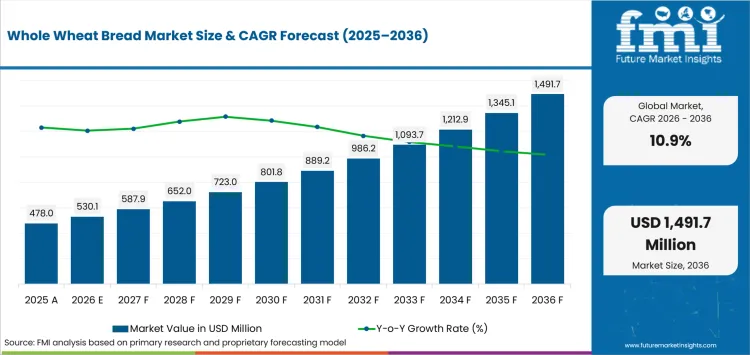
USD 530.1 million in 2026 and USD 1,491.7 million by 2036 at a 10.9% CAGR.
Demand for whole wheat bread is projected to expand at 10.9% CAGR between 2026 and 2036, increasing valuation from USD 530.1 million to USD 1,491.7 million. Federal nutrition guidance released by the USA Department of Health and Human Services in January 2026 prioritized fiber-rich whole grains over refined carbohydrates. That direction strengthens the substitution case for familiar sliced bread made with whole-wheat flour while taste and softness still determine repeat purchase.
Country conditions differ because whole-grain guidance reaches shoppers through different retail and institutional routes. In July 2025, the UAE Ministry of Health and Prevention advised consumers to check whether whole wheat appears first on baked-goods ingredient lists. The same guidance recommends bread with three to four grams of fiber per serving. That gives UAE brands a clearer shelf-communication route than markets where whole-grain positioning depends mainly on general nutrition education and bakery ingredients claims.
Key Takeaways of Whole Wheat Bread Market
- Whole-grain nutrition guidance is increasing the commercial relevance of bread that replaces refined loaves without changing familiar meal occasions.
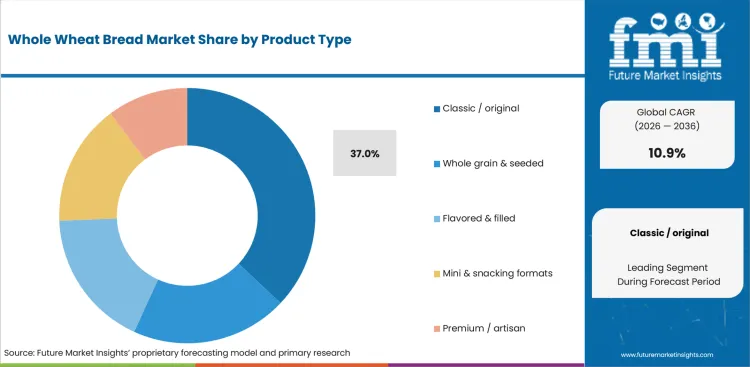
- Classic - original is projected to account for 37.0% of product type demand in 2026 because its sliced-loaf use requires little behavior change.
- Conventional is estimated to hold 48.0% of claim - nature demand in 2026 because mainstream pricing avoids an added certification premium.
- Fresh is forecast to represent 34.0% of format demand in 2026 owing to softness and immediate eating quality remaining central purchase tests.
- Bran alters dough handling and crumb texture, so manufacturers must protect loaf volume and shelf softness before nutrition positioning converts into repeat orders.
- Some of the key players in this market include Grupo Bimbo, Flowers Foods, ARYZTA, Lantmännen Unibake, Vandemoortele, Yamazaki Baking, Warburtons, and Hovis.
Analyst Perspective
"Whole wheat bread earns repeat purchase when its nutrition proposition clears the same texture and price tests used for everyday sliced bread. Manufacturers should evaluate flour behavior first, then match loaf size and replenishment frequency to the channel carrying the product."
- Nandini Roy Choudhury, Principal Consultant, Future Market Insights
How is the Whole Wheat Bread Market segmented?
The whole wheat bread market is segmented by product type, claim - nature, format, packaging format and sales channel.
Product type covers classic - original, whole grain & seeded, flavored & filled, mini & snacking formats and premium / artisan. Claim - nature covers conventional, clean label, organic, gluten-free and high-protein / fortified. Format includes fresh, frozen, ambient packaged, chilled and par-baked / thaw-and-serve. Packaging format includes multipack, single-serve, family / loaf pack and bulk foodservice. Sales channel covers supermarkets & hypermarkets, artisan & specialty bakeries, convenience & forecourt, online & DTC and foodservice distributors.
What makes Classic - Original central to the Product Type category?
Classic loaves preserve the sandwich and toast routines that already define household bread purchasing. Manufacturers can adjust fiber level or softness with bread improvers without asking shoppers to learn a different eating format.
- By product type, classic - original is estimated to hold 37.0% in 2026 owing to its direct fit with everyday sliced-bread occasions.
- Flowers Foods launched a Nature's Own 100% Whole Wheat small loaf in April 2025. The national line extension changed pack size while retaining the familiar whole-wheat loaf proposition, which gives smaller households a lower-waste entry point without a new eating occasion.
Why does Conventional lead the Claim - Nature category?
Conventional whole wheat bread gives large retail ranges a broad price ladder because the loaf does not require organic certification or another specialist claim. The commercial test is whether the formula protects softness and flavor at mainstream shelf prices.
- Conventional is set to lead claim - nature with 48.0% share in 2026 since broad retail distribution does not depend on a premium certification route.
- Hovis introduced Farmhouse Batch Wholemeal with Oats in June 2025 at an accessible price point. The launch placed a higher-fiber wholemeal loaf inside mainstream packaged bread instead of a specialist health channel, giving retailers another familiar wholemeal option.
How does Fresh Shape demand within the Format category?
Fresh bread is judged immediately on crumb softness and aroma, so poor dough control is visible before a nutrition claim can influence repurchase. Bakery enzymes and process control can protect texture but do not remove the need for disciplined replenishment.
- In 2026, fresh is expected to lead format with 34.0% share because immediate eating quality provides the simplest quality test for packaged whole-wheat loaves.
- Lantmännen Unibake announced a bread facility in Örebro in June 2025 and said the existing site produced over two million pieces daily. Scale increases the cost of inconsistent bake quality, while frozen dough moves final production closer to foodservice demand.
What supports Multipack leadership within Packaging format?
Multipack formats let bakeries change slice count and household inventory without reformulating the loaf. Smaller packs reduce exposure to staling for low-consumption households, while larger packs protect value perception for families buying bread frequently.
- By packaging format, multipack is forecast to represent 32.0% in 2026 because pack architecture can match household consumption without changing the core bread formula.
- Yamazaki Baking stated in its 2026 Investors Guide that it planned wider two-slice and three-slice Double Soft packs alongside a whole-wheat-flour variety. Pack size therefore becomes a practical route to trial and waste control for households that do not finish larger loaves quickly.
What are the drivers, restraints and opportunities in the Whole Wheat Bread Market?
Whole-grain nutrition guidance supports substitution, category weakness raises the repeat-purchase hurdle and institutional breakfast routes give brands another channel for wholemeal bread.
- Driver: Public nutrition guidance gives retailers and institutions a clearer reason to move grain choices toward whole-grain bread.
- Restraint: Traditional loaf demand weakens if shoppers reject price increases or sensory differences despite the nutritional proposition.
- Opportunity: School and institutional breakfast partnerships can put wholemeal bread into regular meal service beyond household grocery purchases.
School-meal standards provide a direct institutional route for whole-grain bread purchases in cafeterias. USDA Food and Nutrition Service guidance updated in September 2025 states that at least 80% of weekly grains offered in school lunch and breakfast programs must be whole grain-rich. That requirement keeps compliant loaves relevant to menu planning if bakeries can meet texture, portion and price specifications with clean-label enzymes or standard process controls.
Bread-category weakness raises the repeat-purchase hurdle even when nutrition positioning is credible. Flowers Foods said in May 2025 that first-quarter category declines were greater than expected and described the consumer environment as challenging. Whole-wheat loaves therefore compete for shelf space inside a pressured bread aisle. Bread preservatives can limit waste, but they cannot compensate for weak value perception or a loaf that misses familiar softness and flavor expectations.
Institutional partnerships provide a route that does not depend entirely on household shelf switching. Hovis committed in January 2026 to donate 1.5 million breakfasts through Magic Breakfast and placed the partnership on Hovis Wholemeal packs. That model gives wholemeal bread visibility inside regular breakfast provision and can support wider personalized bakery products or portion strategies where operators need predictable servings.
Which country CAGRs are profiled in the Whole Wheat Bread Market?
| Country | CAGR |
|---|---|
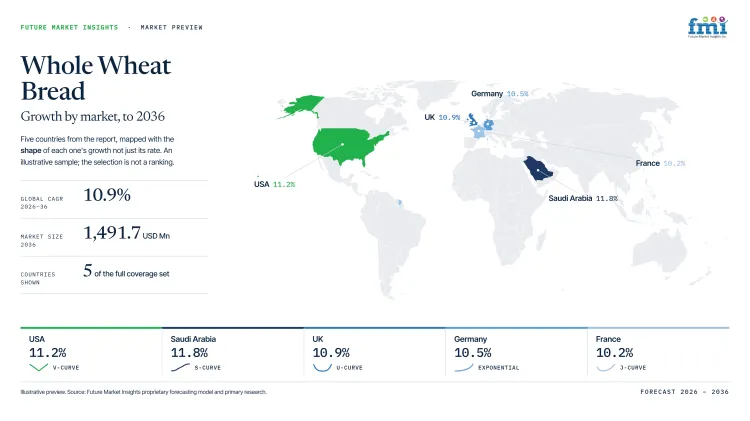
| Saudi Arabia | 11.8% |
| USA | 11.2% |
| UK | 10.9% |
| Germany | 10.5% |
| France | 10.2% |
How do country-level CAGRs compare in the Whole Wheat Bread Market?
The range spans 1.6 percentage points from Saudi Arabia at 11.8% to France at 10.2%. Saudi Arabia and USA form the upper pair above a UK-Germany middle band. France records the lowest CAGR and closes the range. The spacing separates purchase routes more clearly than market scale.
- Saudi health messaging names whole-grain bread while staple pricing governs frequent household repurchase.
- USA school-meal grain standards keep whole-grain bread relevant to institutional menu planning.
- UK mainstream grocery ranges make differentiation more important than wholemeal category education.
- Germany values whole-grain positioning alongside established bakery consumption and health awareness.
- France combines strong bakery traditions with growing interest in whole-wheat choices and nutrition.
Similar CAGRs create different entry conditions because local purchase routes differ materially. The full report provides country-level CAGR analysis across North America, Latin America, Europe, East Asia, South Asia, Oceania and the Middle East and Africa.
Country-wise Analysis
- Saudi retailers serve households with varied bread habits and package-size needs, so whole-wheat formats must address frequent staple purchases without losing affordability. The Saudi whole wheat bread outlook is anticipated to advance at 11.8% CAGR over the assessment period because public nutrition guidance gives shoppers a direct whole-grain cue. In March 2025, the Ministry of Health recommended whole-wheat bread alongside high-fiber whole grains in its Suhoor guidance. Seasonal demand can strengthen awareness, while frequent household replenishment makes premium pricing difficult. Local bakers therefore need accessible pack prices and dependable availability that fit routine grocery purchasing patterns profitably throughout the year across mainstream grocery and neighborhood bakery channels.
- USA supermarkets already carry bread types across several price points, so whole-wheat growth depends on replacing established refined or mixed-grain purchases rather than creating a new bread occasion. The USA market is projected to record 11.2% CAGR during the assessment period, aided by broader institutional alignment around whole-grain choices. In July 2026, the Department of Health and Human Services launched a hospital food pledge calling for whole grains over refined grains. National brands face intense shelf competition because shoppers compare promotion, softness and pack value closely. Large distribution networks make weak repeat velocity expensive for new loaf formats at national scale.
- UK wholemeal bread is familiar in packaged retail and public food guidance, so commercial differentiation depends on quality and pack economics more than basic category explanation. The UK whole wheat bread market is forecast to expand at 10.9% CAGR during the assessment period, supported by established consumption routes. In July 2026, the Department for Education updated its school food guide and identified wholegrain bread as a fiber source while requiring wholegrain starchy choices during the week. Household waste and mature category competition constrain faster conversion, leaving room for smaller loaves or premium wholemeal formats that earn a distinct purchase reason and retail.
- Germany's bread market has strong established consumption habits, making whole-wheat positioning compete with rye, mixed-grain and traditional bakery choices across retail channels. The Germany whole wheat bread market is expected to register 10.5% CAGR over the forecast period as health-oriented consumers increasingly value fiber and whole-grain content. Broad supermarket availability supports trial, but shoppers remain attentive to freshness, texture and price when choosing everyday bread. Established bakery traditions can limit rapid switching, while clear labeling and convenient pack formats provide brands with practical ways to differentiate whole-wheat loaves in mainstream grocery while premium segments can support margins for differentiated products.
- France combines strong bakery traditions with growing interest in nutrition, creating a market where whole-wheat bread must compete on taste, freshness and perceived quality as well as health credentials. The France whole wheat bread market is forecast to grow at 10.2% CAGR over the forecast period, supported by continued interest in balanced diets and higher-fiber choices. Consumers retain strong preferences for familiar bakery formats, which can slow substitution from refined products. Retailers and brands can therefore support conversion through accessible pricing, clear whole-grain communication and formats that preserve freshness across frequent shopping occasions for everyday household purchases across mainstream retail channels.
Who are the notable companies in the Whole Wheat Bread Market?
Grupo Bimbo, Flowers Foods, ARYZTA, Lantmännen Unibake, Vandemoortele, Yamazaki Baking, Warburtons, and Hovis are the notable companies profiled in this market.
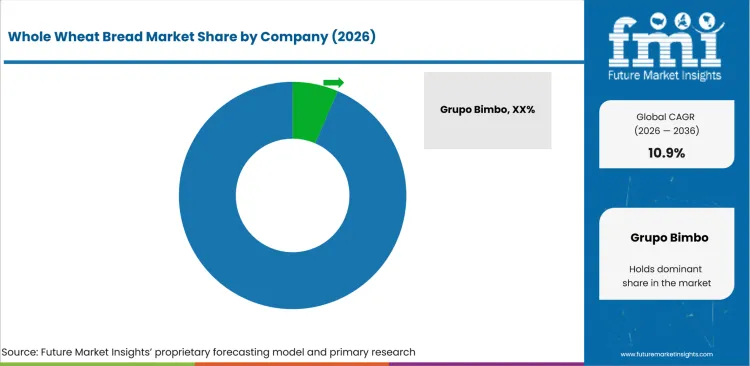
Large branded bread groups and frozen bakery platforms define competition in this exact market. US bread preservatives illustrate one shelf-life constraint inside a high-volume loaf category, but preservation does not replace texture. Frozen specialists can address foodservice and in-store bakery demand through frozen bakery products while packaged-bread companies defend household shelf space with national brands and pack architecture.
- Branded packaged-bread platforms: Grupo Bimbo, Flowers Foods, Yamazaki Baking, Warburtons and Hovis compete for recurring household bread purchases.
- Frozen and bake-off platforms: ARYZTA, Lantmännen Unibake and Vandemoortele serve retail bakery and foodservice operations that finish or distribute bread closer to consumption.
Competitive Benchmarking: Whole Wheat Bread Market
| Company | Wholegrain Assortment | Format Flexibility | Channel Breadth | Geographic Reach |
|---|---|---|---|---|
| Grupo Bimbo | High | High | High | Global |
| Flowers Foods | High | Medium | High | United States |
| ARYZTA | Medium | High | High | Europe, Asia-Pacific, Australia and New Zealand |
| Lantmännen Unibake | High | High | High | Europe, North America and selected international markets |
| Vandemoortele | Medium | High | High | Europe, United States and Asia |
| Yamazaki Baking | Medium | Medium | High | Japan and selected overseas markets |
| Warburtons | High | Medium | High | United Kingdom |
| Hovis | High | Low | Medium | United Kingdom |
Scoring basis: High assortment requires several documented wholegrain or wholemeal bread lines while Medium identifies a narrower documented range and Low one confirmed route. High format flexibility requires fresh plus frozen or bake-off coverage, Medium covers more than one fresh or packaged format and Low identifies one documented format. High channel breadth requires retail plus foodservice or professional bakery access, Medium covers one broad commercial route and Low one narrow route. Geographic reach records verified operating regions and is not scored as a capability. Source basis uses official company filings and newsrooms describing bread portfolios, formats and served regions.
Key Developments in the Whole Wheat Bread Market
- In September 2025, Lantmännen Unibake acquired Boboli Benelux B.V. and gained a Netherlands bakery serving retail and foodservice through bake-off production.
- In April 2025, Grupo Bimbo joined Mexico's Hecho en México initiative and added the national mark to two of its top-selling bread.
- In February 2025, Vandemoortele acquired Lizzi in Italy to expand frozen bread and sourdough production for retail and foodservice routes.
Key Players in the Whole Wheat Bread Market
Branded Packaged Bread Platforms
- Grupo Bimbo
- Flowers Foods
- Yamazaki Baking
- Warburtons
- Hovis
Frozen and Bake-Off Bread Platforms
- ARYZTA
- Lantmännen Unibake
- Vandemoortele
Whole Wheat Bread Market - Report Scope
| Coverage field | Report scope |
|---|---|
| Market breakdown | By product type, claim - nature, format, packaging format, sales channel and region. |
| Quantitative Units | USD Million. |
| Market Definition | Revenue from finished whole wheat bread sold by manufacturers and brands within the stated segmentation. Refined bread without a whole-wheat proposition and downstream meal revenue are excluded. |
| Regions Covered | North America, Latin America, Europe, East Asia, South Asia and Pacific, and Middle East and Africa. |
| Countries Covered | UAE, Saudi Arabia, South Korea, USA, UK, and 20+ countries included in the full report. |
| Key Companies Profiled | Grupo Bimbo, Flowers Foods, ARYZTA, Lantmännen Unibake, Vandemoortele, Yamazaki Baking, Warburtons, Hovis. |
| Forecast Period | 2026 to 2036. |
| Approach | Primary and secondary research with market triangulation. |
Whole Wheat Bread Market - Research Methodology
| Method | Approach |
|---|---|
| Primary Research | FMI analysts gathered input from manufacturers, service providers, technology developers, distributors, end users, procurement teams, and subject-matter experts. Interviews examined purchasing decisions, product or service evaluation, adoption barriers, approval requirements, pricing considerations, and expectations for technical or commercial support. Respondents were also asked what evidence is required before a trial, pilot, or initial order develops into regular purchasing. |
| Desk Research | Desk research covered government statistics, regulatory publications, trade data, industry associations, technical literature, standards, company filings, product information, and official corporate announcements. Sources were reviewed for relevance, publication date, geographic coverage, and consistency with the defined market scope. Claims relating to performance, applications, approvals, capacity, investment, and commercial activity were retained only when supported by credible public evidence. |
| Market Sizing and Forecasting | The market model combined the baseline value with historical performance, segment structure, pricing and volume indicators, adoption levels, company participation, and country-level demand conditions. Forecast assumptions considered economic activity, investment trends, regulatory developments, technology adoption, purchasing cycles, supply availability, and barriers to wider market use. Segment and regional estimates were reconciled before the final market total was calculated. |
| Data Validation | Estimates were checked against multiple independent indicators, including public data, company activity, trade patterns, industry developments, and findings from primary interviews. Validation also tested whether products, services, applications, and company revenues fell within the defined market boundaries. Adjacent categories, unsupported claims, overlapping revenues, and activities without direct market relevance were excluded to reduce double counting and maintain consistency across segments and countries. |
Whole Wheat Bread Market by Segments
Whole Wheat Bread Market segmented by Product Type:
- Classic - original
- Whole grain & seeded
- Flavored & filled
- Mini & snacking formats
- Premium / artisan
Whole Wheat Bread Market segmented by Claim - nature:
- Conventional
- Clean label
- Organic
- Gluten-free
- High-protein / fortified
Whole Wheat Bread Market segmented by Format:
- Fresh
- Frozen
- Ambient packaged
- Chilled
- Par-baked / thaw-and-serve
Whole Wheat Bread Market segmented by Packaging Format:
- Multipack
- Single-serve
- Family / loaf pack
- Bulk foodservice
Whole Wheat Bread Market segmented by Sales Channel:
- Supermarkets & hypermarkets
- Artisan & specialty bakeries
- Convenience & forecourt
- Online & DTC
- Foodservice distributors
Whole Wheat Bread Market by Region:
- North America
- United States
- Canada
- Latin America
- Brazil
- Mexico
- Argentina
- Chile
- Western Europe
- Germany
- France
- United Kingdom
- Italy
- Spain
- Benelux
- Nordics
- Eastern Europe
- Poland
- Czech Republic
- Romania
- Hungary
- East Asia
- China
- Japan
- South Korea
- South Asia and Pacific
- India
- ASEAN
- Australia and New Zealand
- Middle East and Africa
- GCC Countries
- South Africa
- Türkiye
- Israel
Research Sources and Bibliography
- USA Department of Health and Human Services. (2026, January 7). Kennedy, Rollins unveil historic reset of USA nutrition policy.
- UAE Ministry of Health and Prevention. (2025, July 17). Smart shopping and cooking for a healthy lifestyle.
- Flowers Foods. (2025, April 16). Flowers Foods launches new products and line expansions to meet consumer needs.
- Hovis. (2025, June). Hovis's fresh batch of innovations.
- Lantmännen Unibake. (2025, June 3). Lantmännen makes long-term investment in new production facility for bread.
- Yamazaki Baking Co., Ltd. (2026, May 1). Investors Guide 2025.
- USA Department of Agriculture, Food and Nutrition Service. (2025, September 26). Implementation Timeline for Updated Nutrition Requirements in School Meals.
- Flowers Foods. (2025, May 16). FLOWERS FOODS, INC. REPORTS FIRST QUARTER 2025 RESULTS.
- Hovis. (2026, January 19). Hovis partners with Magic Breakfast to tackle child morning hunger.
- UAE Ministry of Health and Prevention. (2025, July 17). Healthy diet and physical activity.
- Ministry of Health, Saudi Arabia. (2025, March 22). Suhoor.
- Korea Disease Control and Prevention Agency. (2025, August 1). 영양표시 읽는 법! 알려드리겠습니다!
- USA Department of Health and Human Services. (2026, July 8). Secretary Kennedy and Administrator Oz launch Make Hospital Food Healthier pledge.
- UK Department for Education. (2026, July 9). School food standards practical guide.
- Lantmännen Unibake. (2025, September 1). Lantmännen Unibake expands in savoury with acquisition of Boboli Benelux B.V.
- Grupo Bimbo. (2025, April 11). Nos sumamos a la iniciativa "Hecho en México".
- Vandemoortele. (2025, February 14). Vandemoortele acquires Lizzi in Italy, a specialty player in frozen Bakery.
- Grupo Bimbo. (2026, June 10). Portfolio free from artificial colors.
- ARYZTA. (2026, January 22). Full year 2025 targets achieved; revenue growth and improved performance expected in 2026.
- Hovis. (2025, October 12). Hovis targets sourdough market for the first time with new cob range.
- Lantmännen Unibake. (2025, December 23). Lantmännen Unibake signs agreement to expand in Italy.
- Vandemoortele. (2025, March 28). Vandemoortele and Délifrance intend to form a new frozen bakery player.
- Yamazaki Baking Co., Ltd. (2026, February 12). Supplementary Material for the Consolidated Financial Results for the Fiscal Year Ended December 31, 2025.
- Warburtons. (2026, January). WARBURTONS SECTION 172 STATEMENT.
- Flowers Foods. (2025, November 6). FLOWERS FOODS, INC. REPORTS THIRD QUARTER 2025 RESULTS.
This bibliography is provided for reader reference and is not exhaustive. The full report contains the complete reference list and detailed citations
This Report Answers
- How large is the whole wheat bread market in 2026 and how large is it projected to become by 2036?
- Which nutrition and product-performance conditions support demand for whole wheat bread?
- Why does classic - original lead product type demand in 2026?
- Why does conventional hold the largest claim - nature share in 2026?
- How do fresh formats and multipack packaging influence repeat purchase?
- How do the five profiled country CAGRs differ between UAE and UK?
- Which operating frictions limit conversion from whole-grain interest to regular bread purchases?
- Which companies are active in branded packaged bread and frozen bake-off routes?
- What recent company actions are changing product choice and bakery capacity?
Frequently Asked Questions
How big is the whole wheat bread market in 2026?
The whole wheat bread market is valued at USD 530.1 million in 2026 and is projected to reach USD 1,491.7 million by 2036. Whole-grain nutrition guidance supports growth while familiar bread use keeps the product inside regular meal occasions.
What is the CAGR of the whole wheat bread market from 2026 to 2036?
The whole wheat bread market is projected to grow at a CAGR of 10.9% between 2026 and 2036. Expansion depends on repeat purchase from shoppers who accept whole-wheat texture and price within everyday bread occasions.
Which product type leads the whole wheat bread market?
The classic - original segment is expected to hold 37.0% of the whole wheat bread market in 2026, attributable to its direct fit with toast and sandwich occasions. Familiar sliced-loaf use lowers the behavior change required for regular household repurchase.
Which claim - nature segment leads the whole wheat bread market?
The conventional segment is expected to hold 48.0% of the whole wheat bread market in 2026, supported by mainstream pricing and broad retail placement. Specialist organic or claim-led loaves carry extra certification and sourcing requirements that narrow mainstream price flexibility.
Which countries are projected to record the highest growth in the whole wheat bread market?
UAE is projected to grow at 12.2% CAGR, followed by Saudi Arabia at 11.8% and South Korea at 11.5% through 2036. Local nutrition guidance and packaged-food channels shape how whole-grain interest converts into bread purchases.
Which companies are active in the whole wheat bread market?
Key companies operating in the market include Grupo Bimbo, Flowers Foods, ARYZTA, Lantmännen Unibake, Vandemoortele, Yamazaki Baking, Warburtons, and Hovis. Their competitive positions differ by branded retail reach, bake-off production and wholegrain assortment.
Preview the report firsthand - request a free sample
Get SampleGet the brochure for pricing and purchase details.
Get PDFTable of Content
- Key Takeaways
- Market Size and CAGR
- Top Growth Driver
- Fastest Growing Segment
- Leading Region
- Key Companies
- Emerging Opportunities
- Executive Summary
- Global Market Outlook
- Demand-side Trends
- Supply-side Trends
- Technology Roadmap Analysis
- Analysis and Recommendations
- Analyst Perspective (What is happening? Why now? What should investors know?)
- Key Questions Answered
- How large is the market?
- What is the CAGR?
- What are key trends?
- Which region dominates?
- Who are the leaders?
- Market Overview
- Market Coverage / Taxonomy
- Market Definition / Scope / Limitations
- Research Methodology
- Chapter Orientation
- Analytical Lens and Working Hypotheses
- Market Structure, Signals, and Trend Drivers
- Benchmarking and Cross-market Comparability
- Market Sizing, Forecasting, and Opportunity Mapping
- Research Design and Evidence Framework
- Desk Research Programme (Secondary Evidence)
- Expert Input and Fieldwork (Primary Evidence)
- Tooling, Models, and Reference Databases
- Data Engineering and Model Build
- Quality Assurance and Audit Trail
- Market Background
- Market Dynamics (Drivers, Restraints, Opportunity, Trends)
- Scenario Forecast (Optimistic, Likely, Conservative)
- Impact Analysis
- AI Impact
- Sustainability Impact
- Regulatory Impact
- Technology Impact
- Consumer / Buyer Analysis
- Purchase Drivers
- Adoption Barriers
- Buyer Journey
- Opportunity Map Analysis
- Product Life Cycle Analysis
- Supply Chain Analysis
- Investment Feasibility Matrix
- Value Chain Analysis
- PESTLE and Porter's Analysis
- Regulatory Landscape
- Regional Parent Market Outlook
- Production and Consumption Statistics
- Import and Export Statistics
- Global Market Analysis and Forecast, 2021 to 2036
- Historical Market Size Value (USD Million) Analysis, 2021 to 2025
- Current and Future Market Size Value (USD Million) Projections, 2026 to 2036
- Y-o-Y Growth Trend Analysis
- Absolute $ Opportunity Analysis
- Global Market Pricing Analysis, 2021 to 2036
- Global Market Analysis and Forecast, By Product Type, 2021 to 2036
- Introduction / Key Findings
- Historical Market Size Value (USD Million) Analysis By Product Type, 2021 to 2025
- Current and Future Market Size Value (USD Million) Analysis and Forecast By Product Type, 2026 to 2036
- Classic / original
- Whole grain & seeded
- Flavored & filled
- Mini & snacking formats
- Premium / artisan
- Classic / original
- Y-o-Y Growth Trend Analysis By Product Type, 2021 to 2025
- Absolute $ Opportunity Analysis By Product Type, 2026 to 2036
- Global Market Analysis and Forecast, By Claim / Nature, 2021 to 2036
- Introduction / Key Findings
- Historical Market Size Value (USD Million) Analysis By Claim / Nature, 2021 to 2025
- Current and Future Market Size Value (USD Million) Analysis and Forecast By Claim / Nature, 2026 to 2036
- Conventional
- Clean label
- Organic
- Gluten-free
- High-protein / fortified
- Conventional
- Y-o-Y Growth Trend Analysis By Claim / Nature, 2021 to 2025
- Absolute $ Opportunity Analysis By Claim / Nature, 2026 to 2036
- Global Market Analysis and Forecast, By Format, 2021 to 2036
- Introduction / Key Findings
- Historical Market Size Value (USD Million) Analysis By Format, 2021 to 2025
- Current and Future Market Size Value (USD Million) Analysis and Forecast By Format, 2026 to 2036
- Fresh
- Frozen
- Ambient packaged
- Chilled
- Par-baked / thaw-and-serve
- Fresh
- Y-o-Y Growth Trend Analysis By Format, 2021 to 2025
- Absolute $ Opportunity Analysis By Format, 2026 to 2036
- Global Market Analysis and Forecast, By Packaging Format, 2021 to 2036
- Introduction / Key Findings
- Historical Market Size Value (USD Million) Analysis By Packaging Format, 2021 to 2025
- Current and Future Market Size Value (USD Million) Analysis and Forecast By Packaging Format, 2026 to 2036
- Multipack
- Single-serve
- Family / loaf pack
- Bulk foodservice
- Multipack
- Y-o-Y Growth Trend Analysis By Packaging Format, 2021 to 2025
- Absolute $ Opportunity Analysis By Packaging Format, 2026 to 2036
- Global Market Analysis and Forecast, By Sales Channel, 2021 to 2036
- Introduction / Key Findings
- Historical Market Size Value (USD Million) Analysis By Sales Channel, 2021 to 2025
- Current and Future Market Size Value (USD Million) Analysis and Forecast By Sales Channel, 2026 to 2036
- Supermarkets & hypermarkets
- Artisan & specialty bakeries
- Convenience & forecourt
- Online & DTC
- Foodservice distributors
- Supermarkets & hypermarkets
- Y-o-Y Growth Trend Analysis By Sales Channel, 2021 to 2025
- Absolute $ Opportunity Analysis By Sales Channel, 2026 to 2036
- Global Market Analysis and Forecast, By Region, 2021 to 2036
- Introduction
- Historical Market Size Value (USD Million) Analysis By Region, 2021 to 2025
- Current Market Size Value (USD Million) Analysis and Forecast By Region, 2026 to 2036
- North America
- Latin America
- Western Europe
- Eastern Europe
- East Asia
- South Asia and Pacific
- Middle East & Africa
- Market Attractiveness Analysis By Region
- North America Market Analysis and Forecast, By Country, 2021 to 2036
- Historical Market Size Value (USD Million) Trend Analysis By Market Taxonomy, 2021 to 2025
- Market Size Value (USD Million) Forecast By Market Taxonomy, 2026 to 2036
- By Country
- USA
- Canada
- By Product Type
- By Claim / Nature
- By Format
- By Packaging Format
- By Sales Channel
- By Country
- Market Attractiveness Analysis
- By Country
- By Product Type
- By Claim / Nature
- By Format
- By Packaging Format
- By Sales Channel
- Key Takeaways
- Latin America Market Analysis and Forecast, By Country
- Historical Market Size Value (USD Million) Trend Analysis By Market Taxonomy, 2021 to 2025
- Market Size Value (USD Million) Forecast By Market Taxonomy, 2026 to 2036
- By Country
- Brazil
- Mexico
- Chile
- Rest of Latin America
- By Product Type
- By Claim / Nature
- By Format
- By Packaging Format
- By Sales Channel
- By Country
- Market Attractiveness Analysis
- By Country
- By Product Type
- By Claim / Nature
- By Format
- By Packaging Format
- By Sales Channel
- Key Takeaways
- Western Europe Market Analysis and Forecast, By Country
- Historical Market Size Value (USD Million) Trend Analysis By Market Taxonomy, 2021 to 2025
- Market Size Value (USD Million) Forecast By Market Taxonomy, 2026 to 2036
- By Country
- Germany
- UK
- Italy
- Spain
- France
- Nordic
- BENELUX
- Rest of Western Europe
- By Product Type
- By Claim / Nature
- By Format
- By Packaging Format
- By Sales Channel
- By Country
- Market Attractiveness Analysis
- By Country
- By Product Type
- By Claim / Nature
- By Format
- By Packaging Format
- By Sales Channel
- Key Takeaways
- Eastern Europe Market Analysis and Forecast, By Country
- Historical Market Size Value (USD Million) Trend Analysis By Market Taxonomy, 2021 to 2025
- Market Size Value (USD Million) Forecast By Market Taxonomy, 2026 to 2036
- By Country
- Russia
- Poland
- Hungary
- Balkan & Baltic
- Rest of Eastern Europe
- By Product Type
- By Claim / Nature
- By Format
- By Packaging Format
- By Sales Channel
- By Country
- Market Attractiveness Analysis
- By Country
- By Product Type
- By Claim / Nature
- By Format
- By Packaging Format
- By Sales Channel
- Key Takeaways
- East Asia Market Analysis and Forecast, By Country
- Historical Market Size Value (USD Million) Trend Analysis By Market Taxonomy, 2021 to 2025
- Market Size Value (USD Million) Forecast By Market Taxonomy, 2026 to 2036
- By Country
- China
- Japan
- South Korea
- By Product Type
- By Claim / Nature
- By Format
- By Packaging Format
- By Sales Channel
- By Country
- Market Attractiveness Analysis
- By Country
- By Product Type
- By Claim / Nature
- By Format
- By Packaging Format
- By Sales Channel
- Key Takeaways
- South Asia and Pacific Market Analysis and Forecast, By Country
- Historical Market Size Value (USD Million) Trend Analysis By Market Taxonomy, 2021 to 2025
- Market Size Value (USD Million) Forecast By Market Taxonomy, 2026 to 2036
- By Country
- India
- ASEAN
- Australia & New Zealand
- Rest of South Asia and Pacific
- By Product Type
- By Claim / Nature
- By Format
- By Packaging Format
- By Sales Channel
- By Country
- Market Attractiveness Analysis
- By Country
- By Product Type
- By Claim / Nature
- By Format
- By Packaging Format
- By Sales Channel
- Key Takeaways
- Middle East & Africa Market Analysis and Forecast, By Country
- Historical Market Size Value (USD Million) Trend Analysis By Market Taxonomy, 2021 to 2025
- Market Size Value (USD Million) Forecast By Market Taxonomy, 2026 to 2036
- By Country
- Kingdom of Saudi Arabia
- Other GCC Countries
- Türkiye
- South Africa
- Other African Union
- Rest of Middle East & Africa
- By Product Type
- By Claim / Nature
- By Format
- By Packaging Format
- By Sales Channel
- By Country
- Market Attractiveness Analysis
- By Country
- By Product Type
- By Claim / Nature
- By Format
- By Packaging Format
- By Sales Channel
- Key Takeaways
- Key Countries Market Analysis
- USA
- Pricing Analysis
- Market Share Analysis, 2025
- By Product Type
- By Claim / Nature
- By Format
- By Packaging Format
- By Sales Channel
- Canada
- Pricing Analysis
- Market Share Analysis, 2025
- By Product Type
- By Claim / Nature
- By Format
- By Packaging Format
- By Sales Channel
- Mexico
- Pricing Analysis
- Market Share Analysis, 2025
- By Product Type
- By Claim / Nature
- By Format
- By Packaging Format
- By Sales Channel
- Brazil
- Pricing Analysis
- Market Share Analysis, 2025
- By Product Type
- By Claim / Nature
- By Format
- By Packaging Format
- By Sales Channel
- Chile
- Pricing Analysis
- Market Share Analysis, 2025
- By Product Type
- By Claim / Nature
- By Format
- By Packaging Format
- By Sales Channel
- Germany
- Pricing Analysis
- Market Share Analysis, 2025
- By Product Type
- By Claim / Nature
- By Format
- By Packaging Format
- By Sales Channel
- UK
- Pricing Analysis
- Market Share Analysis, 2025
- By Product Type
- By Claim / Nature
- By Format
- By Packaging Format
- By Sales Channel
- Italy
- Pricing Analysis
- Market Share Analysis, 2025
- By Product Type
- By Claim / Nature
- By Format
- By Packaging Format
- By Sales Channel
- Spain
- Pricing Analysis
- Market Share Analysis, 2025
- By Product Type
- By Claim / Nature
- By Format
- By Packaging Format
- By Sales Channel
- France
- Pricing Analysis
- Market Share Analysis, 2025
- By Product Type
- By Claim / Nature
- By Format
- By Packaging Format
- By Sales Channel
- India
- Pricing Analysis
- Market Share Analysis, 2025
- By Product Type
- By Claim / Nature
- By Format
- By Packaging Format
- By Sales Channel
- ASEAN
- Pricing Analysis
- Market Share Analysis, 2025
- By Product Type
- By Claim / Nature
- By Format
- By Packaging Format
- By Sales Channel
- Australia & New Zealand
- Pricing Analysis
- Market Share Analysis, 2025
- By Product Type
- By Claim / Nature
- By Format
- By Packaging Format
- By Sales Channel
- China
- Pricing Analysis
- Market Share Analysis, 2025
- By Product Type
- By Claim / Nature
- By Format
- By Packaging Format
- By Sales Channel
- Japan
- Pricing Analysis
- Market Share Analysis, 2025
- By Product Type
- By Claim / Nature
- By Format
- By Packaging Format
- By Sales Channel
- South Korea
- Pricing Analysis
- Market Share Analysis, 2025
- By Product Type
- By Claim / Nature
- By Format
- By Packaging Format
- By Sales Channel
- Russia
- Pricing Analysis
- Market Share Analysis, 2025
- By Product Type
- By Claim / Nature
- By Format
- By Packaging Format
- By Sales Channel
- Poland
- Pricing Analysis
- Market Share Analysis, 2025
- By Product Type
- By Claim / Nature
- By Format
- By Packaging Format
- By Sales Channel
- Hungary
- Pricing Analysis
- Market Share Analysis, 2025
- By Product Type
- By Claim / Nature
- By Format
- By Packaging Format
- By Sales Channel
- Kingdom of Saudi Arabia
- Pricing Analysis
- Market Share Analysis, 2025
- By Product Type
- By Claim / Nature
- By Format
- By Packaging Format
- By Sales Channel
- Türkiye
- Pricing Analysis
- Market Share Analysis, 2025
- By Product Type
- By Claim / Nature
- By Format
- By Packaging Format
- By Sales Channel
- South Africa
- Pricing Analysis
- Market Share Analysis, 2025
- By Product Type
- By Claim / Nature
- By Format
- By Packaging Format
- By Sales Channel
- USA
- Market Structure Analysis
- Competition Dashboard
- Competition Benchmarking
- Market Share Analysis of Top Players
- By Regional
- By Product Type
- By Claim / Nature
- By Format
- By Packaging Format
- By Sales Channel
- Emerging Startups
- Innovation Benchmarking
- Competition Analysis
- Competition Deep Dive
- Grupo Bimbo
- Overview
- Product Portfolio
- Profitability by Market Segments
- Sales Footprint
- Strategy Overview
- Marketing Strategy
- Product Strategy
- Channel Strategy
- Flowers Foods
- Aryzta
- Lantmannen Unibake
- Vandemoortele
- Yamazaki Baking
- Warburtons
- King's Hawaiian
- Europastry
- St Pierre Groupe
- Grupo Bimbo
- Case Studies
- Success Stories
- Recent Developments
- Competition Deep Dive
- Assumptions & Acronyms Used


