


Non-Vascular Stents Market
Non-Vascular Stents Market is segmented by Product Type (Ureteral Stents, Biliary Stents, Esophageal Stents, Colonic Stents, Bronchial Stents), Material (Non-Metallic Stents, Metal Stents, Hybrid Stents), Application (Malignant Obstructions, Benign Obstructions, Palliative Care), and Region. Forecast for 2026 to 2036.
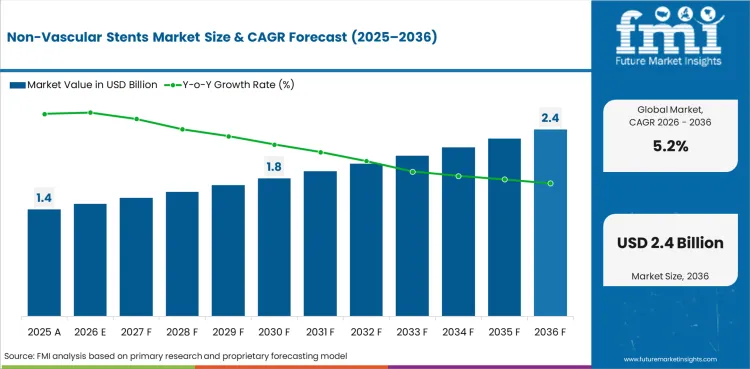
Non-Vascular Stents Market Size, Market Forecast and Outlook By FMI
Summary of the Non-Vascular Stents Market
- Demand and Growth Drivers
- Rising prevalence of gastrointestinal cancers, urological obstructions, and biliary strictures is increasing procedure volumes for non-vascular stent placements across hospitals and specialty clinics.
- Growth in minimally invasive therapeutic approaches is shifting procedural preferences toward stent-based interventions that reduce hospital stays and recovery times compared to open surgical alternatives.
- Advancement in biodegradable and drug-eluting stent platforms is expanding the clinical applicability of non-vascular stents beyond palliative care into curative treatment pathways.
- Product and Segment View
- Ureteral stents are expected to hold 38.7% of the product type segment in 2026, shaped by growing demand for urological interventions related to kidney stones and ureteral strictures.
- Non-metallic stents are expected to account for 52.2% of the material segment, supported by preference for biocompatible polymers and silicone-based designs in sensitive anatomical locations.
- Hospitals remain the primary end-user channel, with centralized procurement of stent inventories for gastroenterology, urology, and pulmonology departments.
- Geography and Competitive Outlook
- ANZ is expected to lead growth at 6.5% CAGR, supported by advanced healthcare infrastructure and high rates of endoscopic intervention adoption.
- China and South Korea are each expected to grow at 6.0%, reflecting expanding hospital capacity and increasing access to advanced endoscopic and urological procedures.
- Companies with broad product portfolios spanning multiple stent types and advanced material platforms are positioned to capture procurement preference across hospital networks.
- Analyst Opinion
- The non-vascular stents market is evolving from a procedure-driven commodity category into a technology-differentiated segment where material science and delivery system design increasingly influence procurement decisions.
- Adoption is increasing due to the shift toward outpatient and ambulatory surgical settings, which favors stent designs that simplify placement and reduce procedure times.
- Companies that can demonstrate clinical superiority in reducing restenosis rates and migration complications while maintaining competitive pricing are likely to strengthen their market position over the forecast period.
- Growth reflects the expanding scope of stent applications beyond traditional palliative care into curative and bridge-to-surgery indications, supported by evidence from multi-center clinical trials.
Non-Vascular Stents Market Definition
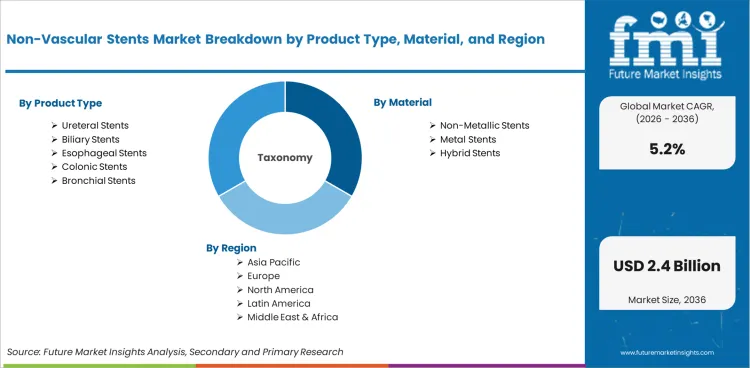
The non-vascular stents market includes tubular devices designed for placement within non-vascular luminal structures to maintain patency, relieve obstructions, and support tissue integrity. Product categories include ureteral stents, biliary stents, esophageal stents, colonic stents, and bronchial stents, manufactured from metallic, non-metallic, and hybrid materials.
Non-Vascular Stents Market Inclusions
Market scope covers all commercially traded non-vascular stent products categorized by product type (ureteral stents, biliary stents, esophageal stents, colonic stents, bronchial stents), material (non-metallic stents, metal stents, hybrid stents), application (malignant obstructions, benign obstructions, palliative care), technology (self-expanding stents, balloon-expandable stents, drug-eluting stents, biodegradable-bioresorbable stents, anti-reflux stents), and end user (hospitals, specialty clinics, ambulatory surgical centers). Revenue coverage spans 2026 to 2036.
Non-Vascular Stents Market Exclusions
The scope does not include vascular stents (coronary, peripheral, or neurovascular), urethral catheters, or temporary drainage tubes that do not function as structural support devices.
Non-Vascular Stents Market Research Methodology
- Primary Research: FMI analysts conducted interviews with interventional gastroenterologists, urologists, pulmonologists, and hospital procurement teams across major healthcare markets.
- Desk Research: Combined data from medical device regulatory filings, clinical trial registries, and hospital procedure volume databases.
- Market sizing and forecasting: Bottom-up aggregation from procedure volumes across product types, clinical indications, and regions with adoption velocity projections.
- Data validation: Cross-checked quarterly against device registration databases and manufacturer shipment disclosures.
Why is the Non-Vascular Stents Market Growing?
- Rising incidence of gastrointestinal malignancies and biliary obstructions is increasing the clinical requirement for stent-based palliative and curative interventions across hospitals globally.
- The shift toward minimally invasive procedures is creating preference for stent placement over surgical resection in cases where clinical outcomes are comparable and recovery times are shorter.
- Advancement in biodegradable polymer platforms is expanding the clinical scope of non-vascular stents into temporary applications where stent removal carries procedural risk.
Non-vascular stent demand is shaped by the intersection of rising chronic disease burden and the clinical preference for less invasive therapeutic approaches. Ureteral stents account for the largest share of product demand, reflecting the high and growing incidence of kidney stones and urinary tract obstructions that require stent placement to maintain urinary flow. Biliary stents represent the second major product category, deployed primarily in cases of malignant biliary obstruction associated with pancreatic and bile duct cancers.
Material selection remains a key differentiator in procurement decisions. Non-metallic stents made from silicone, polyurethane, and biodegradable polymers hold over half the material segment, reflecting clinical preference for biocompatible designs that reduce tissue irritation and simplify removal. Metal stents, particularly self-expanding nitinol designs, are preferred in malignant obstructions where long-term patency and radial force are critical to maintaining luminal opening.
The competitive landscape is shaped by the ability to offer clinically differentiated products across multiple anatomical applications. Companies with portfolios spanning gastrointestinal, urological, and pulmonary stent categories can capture broader hospital procurement contracts. Drug-eluting and biodegradable platforms represent the next frontier of differentiation, with several products in late-stage clinical development that aim to reduce restenosis and eliminate the need for stent removal procedures.
Market Segmentation Analysis
- Ureteral stents hold 38.7% of the product type segment, with demand shaped by high procedure volumes in urological interventions for kidney stones and strictures.
- Non-metallic stents account for 52.2% of the material segment, reflecting clinical preference for biocompatible polymer and silicone designs in sensitive luminal applications.
- Hospitals account for the largest share of end-user demand, with centralized stent inventories serving gastroenterology, urology, and pulmonology departments.
The non-vascular stents market is segmented by product type, material, application, technology, and end user. Product types include ureteral stents, biliary stents, esophageal stents, colonic stents, and bronchial stents. Material categories span non-metallic stents, metal stents, and hybrid stents.
Insights into the Ureteral Stents Product Type Segment
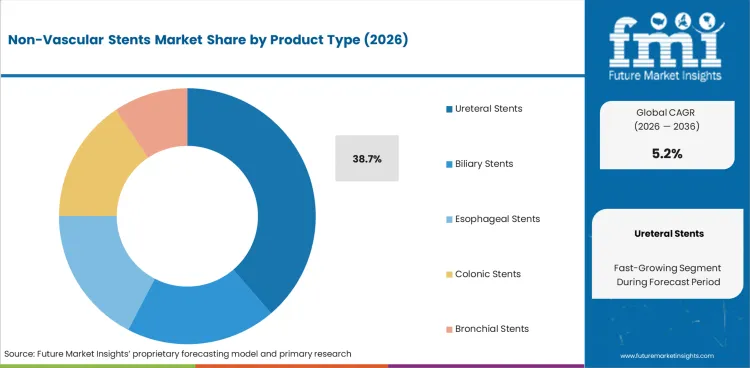
In 2026, ureteral stents are expected to account for 38.7% of the product type segment. Demand is shaped by the high global incidence of kidney stones and ureteral strictures, which require stent placement to maintain urine flow and prevent renal damage. Double-J ureteral stents remain the most widely used design, with polymer-based constructions preferred for their flexibility and patient comfort.
Advancement in stent coatings that reduce bacterial adhesion and encrustation is addressing one of the primary complications associated with prolonged ureteral stent placement. Biodegradable ureteral stents that eliminate the need for a removal procedure are in clinical development and represent a significant growth opportunity.
Insights into the Non-Metallic Stents Material Segment
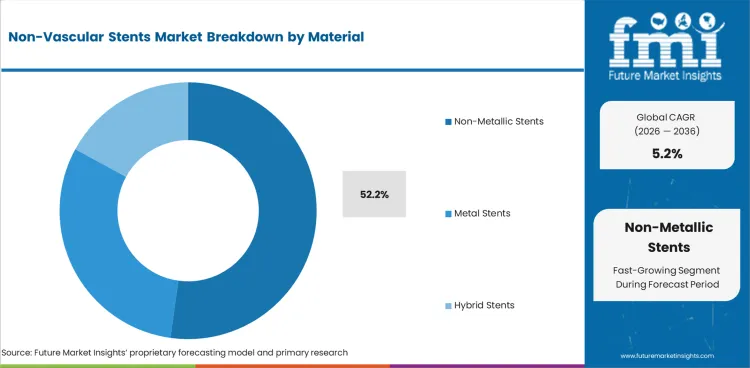
Non-metallic stents are expected to hold 52.2% of the material segment in 2026. Silicone and polyurethane remain the dominant materials for ureteral and biliary applications, offering flexibility, biocompatibility, and ease of insertion. The development of advanced polymer composites with enhanced radial strength is expanding the applicability of non-metallic designs into indications traditionally served by metal stents.
Biodegradable polymers represent the fastest-growing material subcategory, with clinical trials demonstrating feasibility in temporary stenting applications where the risk of a removal procedure outweighs the benefit.
Non-Vascular Stents Market Drivers, Restraints, and Opportunities
- Rising chronic disease burden and aging populations are increasing procedure volumes for stent-based interventions across gastroenterology, urology, and pulmonology.
- The higher cost of advanced stent platforms, including drug-eluting and biodegradable designs, limits adoption in price-sensitive healthcare systems with constrained reimbursement frameworks.
- The shift toward ambulatory surgical settings is creating demand for stent designs that simplify placement and reduce procedure times.
The non-vascular stents market is shaped by the convergence of rising disease burden, clinical preference for minimally invasive approaches, and material science innovation. While demographic and epidemiological trends support sustained volume growth, pricing pressure and reimbursement constraints in certain markets limit the commercial adoption of premium stent technologies.
Disease Burden and Procedure Volume Growth
Demand is shaped by rising global incidence of gastrointestinal cancers, biliary obstructions, kidney stones, and chronic respiratory conditions. As populations age and chronic disease prevalence increases, the clinical requirement for stent-based interventions grows correspondingly, creating a structural demand floor that is less sensitive to economic cycles than discretionary medical device purchases.
Reimbursement and Pricing Constraints
Adoption of premium stent technologies is constrained by reimbursement frameworks that do not differentiate between basic and advanced stent designs. In markets where procedure-based reimbursement covers a standard stent, hospitals have limited financial incentive to procure higher-cost drug-eluting or biodegradable alternatives, even when clinical outcomes may justify the additional cost.
Ambulatory and Outpatient Setting Expansion
Growth reflects the increasing proportion of stent procedures performed in ambulatory surgical centers and outpatient settings. Stent designs that enable faster placement, require less fluoroscopic guidance, and reduce post-procedural monitoring requirements are gaining traction as healthcare systems prioritize throughput and cost efficiency.
Biodegradable and Drug-Eluting Platform Development
Investment in next-generation stent platforms is creating opportunities for differentiation. Biodegradable stents that eliminate the need for removal procedures reduce both patient burden and healthcare resource utilization. Drug-eluting designs that reduce restenosis and tissue ingrowth are addressing the primary complication associated with long-term stent placement.
Analysis of Non-Vascular Stents Market By Key Countries
.webp "Top Country Growth Comparison Non Vascular Stents Market Cagr (2026 2036)")
| Country | CAGR |
|---|---|
| ANZ | 6.5% |
| China | 6.0% |
| South Korea | 6.0% |
| Spain | 5.7% |
| Germany | 4.4% |
| France | 3.8% |
| USA | 3.2% |
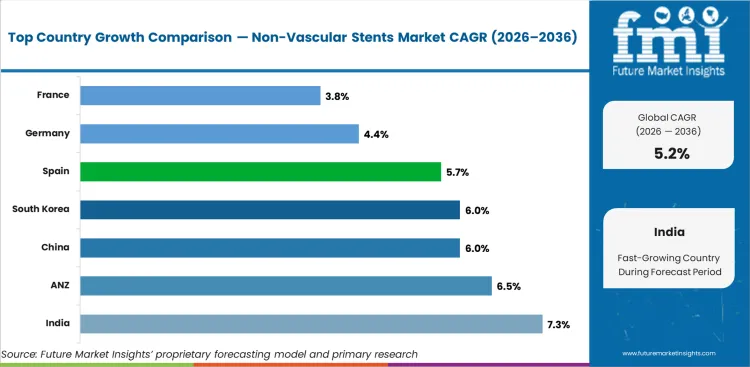
- ANZ leads growth at 6.5% CAGR, reflecting advanced endoscopic infrastructure and high adoption of minimally invasive urological and gastrointestinal procedures.
- China (6.0%) and South Korea (6.0%) are expanding rapidly, shaped by growing hospital capacity and increasing access to advanced endoscopic procedures.
- Spain at 5.7% shows strong demand supported by gastroenterology procedure volume growth and public health system investment in minimally invasive interventions.
- Germany at 4.4% reflects a mature market with established procurement channels and incremental growth from technology upgrades.
The global non-vascular stents market is expected to grow at 5.2% CAGR from 2026 to 2036. Demand varies by region based on disease burden, healthcare infrastructure maturity, and reimbursement frameworks.
Demand Outlook for Non-Vascular Stents Market in ANZ
ANZ is expected to grow at 6.5% through 2036, supported by advanced endoscopic infrastructure, high specialist density, and established clinical pathways for minimally invasive gastrointestinal and urological interventions.
- Advanced endoscopic infrastructure supports high procedure volumes.
- High specialist-to-population ratio enables rapid adoption of new stent technologies.
- Established clinical guidelines drive standardized stent procurement across hospital networks.
Future Outlook for Non-Vascular Stents Market in China
China is expected to grow at 6.0% through 2036, shaped by expanding hospital capacity, growing specialist training programs, and increasing access to advanced endoscopic and urological procedures across tier-2 and tier-3 cities.
- Hospital capacity expansion increases access to endoscopic procedures.
- Growing specialist training programs build clinical capability for stent placement.
- Domestic manufacturers are expanding product portfolios to compete with multinational suppliers.
Opportunity Analysis of Non-Vascular Stents Market in South Korea
South Korea is expected to grow at 6.0% through 2036, reflecting its advanced healthcare system, high adoption of minimally invasive techniques, and strong presence of domestic medical device manufacturers.
- Advanced healthcare system supports early adoption of next-generation stent designs.
- Strong domestic medical device manufacturing base enables competitive supply.
- High rates of endoscopic screening create downstream stent placement demand.
In-depth Analysis of Non-Vascular Stents Market in Spain
Spain is expected to grow at 5.7% through 2036, supported by gastroenterology procedure volume growth and public health system investment in endoscopic capabilities.
- Public health system procurement drives standardized stent utilization.
- Growing gastroenterology procedure volumes support biliary and esophageal stent demand.
- Aging population demographics increase the clinical need for palliative stenting.
Sales Analysis of Non-Vascular Stents Market in Germany
Germany is expected to grow at 4.4% through 2036, reflecting a mature market with established procurement channels and incremental growth driven by technology upgrades and clinical preference shifts toward advanced stent platforms.
- Mature healthcare infrastructure maintains steady replacement demand.
- Clinical preference shifts toward drug-eluting and biodegradable platforms.
- Strong regulatory framework ensures quality standards that favor established manufacturers.
In-depth Analysis of Non-Vascular Stents Market in the United States
The USA is expected to grow at 3.2% through 2036, reflecting a large installed base with moderate volume growth shaped by procedure mix shifts and incremental technology adoption.
- Large installed base maintains steady replacement and upgrade demand.
- Ambulatory surgical center expansion shifts procedure volumes from inpatient settings.
- Clinical preference for advanced stent materials supports premium product adoption.
Competitive Landscape and Strategic Positioning
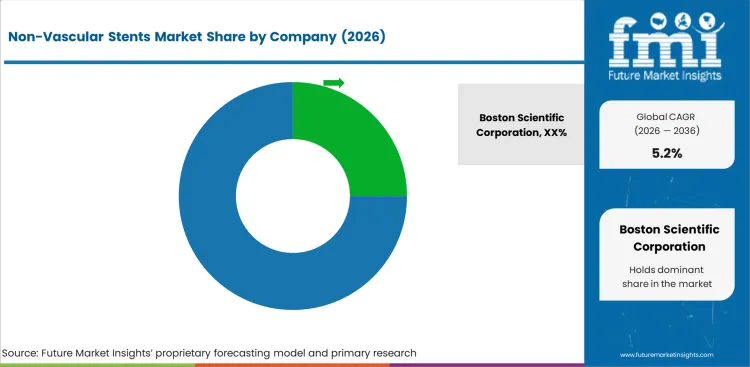
- Boston Scientific Corporation leads the market with a broad non-vascular stent portfolio spanning biliary, esophageal, ureteral, and colonic applications.
- Becton, Dickinson and Company, Medtronic, and Cook Medical offer diversified product lines that cover multiple anatomical indications and material platforms.
- Specialized players like ELLA-CS and Micro-Tech (Nanjing) compete on specific product categories and regional distribution strength.
Boston Scientific Corporation holds a leading position through its broad portfolio of self-expanding and fully covered stent systems across gastrointestinal and urological applications. The company's investment in drug-eluting and anti-migration technologies differentiates its product line in hospital procurement evaluations.
Medtronic and Cook Medical compete with established product lines in biliary and esophageal stenting, leveraging their global distribution networks and clinical training programs. Becton, Dickinson and Company (BD) has strengthened its position through acquisitions that expanded its endoscopic device portfolio.
CONMED Corporation and ELLA-CS serve mid-market segments with competitive pricing and focused product offerings. Micro-Tech (Nanjing) is expanding internationally from a strong domestic base in China, offering a growing range of gastrointestinal stent products.
Barriers to entry include regulatory approval timelines for Class III medical devices, clinical trial requirements for new stent designs, and established group purchasing organization contracts that favor incumbent suppliers. Strategic priorities include expanding biodegradable and drug-eluting product lines and strengthening ambulatory surgical center distribution channels.
Key Companies in the Non-Vascular Stents Market
Key global companies leading the non-vascular stents market include:
- Boston Scientific Corporation (USA), Becton, Dickinson and Company (USA), Medtronic (Ireland), and Cook Medical (USA) are global leaders with comprehensive stent portfolios, established clinical evidence, and broad hospital distribution networks.
- CONMED Corporation (USA), ELLA-CS, s.r.o. (Czech Republic), and Glaukos Corporation (USA) are regional and specialty players with focused product lines targeting specific clinical indications and price-sensitive market segments.
- HOBBS MEDICAL, INC (USA), Micro-Tech (Nanjing) Co., Ltd. (China), and Merit Medical Systems (USA) are emerging competitors expanding their non-vascular stent offerings through technology development and international distribution partnerships.
Competitive Benchmarking: Non-Vascular Stents Market
| Company | Product Portfolio Breadth | Clinical Evidence Base | Hospital Network Access | Geographic Reach |
|---|---|---|---|---|
| Boston Scientific | High | Strong | Strong | Global |
| BD | High | Strong | Strong | Global |
| Medtronic | High | Strong | Strong | Global |
| Cook Medical | High | Strong | Moderate | Global |
| CONMED Corporation | Medium | Moderate | Moderate | N. America, Europe |
| ELLA-CS | Medium | Moderate | Moderate | Europe |
| Glaukos Corporation | Low | Moderate | Moderate | N. America |
| HOBBS MEDICAL | Low | Low | Low | N. America |
| Micro-Tech (Nanjing) | Medium | Moderate | Moderate | Asia, Global |
| Merit Medical Systems | Medium | Moderate | Moderate | Global |
Source: Future Market Insights competitive analysis, 2026.
Key Players in the Non-Vascular Stents Market
Major Global Players
- Boston Scientific Corporation
- Becton, Dickinson and Company (BD)
- Medtronic
- Cook Medical
- CONMED Corporation
Emerging Players/Startups
- ELLA-CS, s.r.o.
- Glaukos Corporation
- HOBBS MEDICAL, INC
- Micro-Tech (Nanjing) Co., Ltd.
- Merit Medical Systems
Report Scope and Coverage
| Parameter | Details |
|---|---|
| Quantitative Units | USD 1.47 billion to USD 2.45 billion, at a CAGR of 5.2% |
| Market Definition | The non-vascular stents market encompasses tubular devices for placement within non-vascular luminal structures to maintain patency and relieve obstructions. |
| Regions Covered | North America, Latin America, Europe, East Asia, South Asia and Pacific, Middle East and Africa |
| Countries Covered | USA, Germany, France, Spain, UK, China, South Korea, Japan, India, ANZ, 30 plus countries |
| Key Companies Profiled | Boston Scientific, BD, Medtronic, Cook Medical, CONMED, ELLA-CS, Glaukos, HOBBS MEDICAL, Micro-Tech (Nanjing), Merit Medical Systems |
| Forecast Period | 2026 to 2036 |
| Approach | Hybrid bottom-up and top-down methodology starting with verified procedure volume data, projecting adoption across product types and regions. |
Market Segmentation Analysis
Non-Vascular Stents Market Segmented by Product Type:
- Ureteral Stents
- Biliary Stents
- Esophageal Stents
- Colonic Stents
- Bronchial Stents
Non-Vascular Stents Market Segmented by Material:
- Non-Metallic Stents
- Metal Stents
- Hybrid Stents
Non-Vascular Stents Market Segmented by Application:
- Malignant Obstructions
- Benign Obstructions
- Palliative Care
Non-Vascular Stents Market Segmented by Technology:
- Self-Expanding Stents
- Balloon-Expandable Stents
- Drug-Eluting Stents
- Biodegradable-Bioresorbable Stents
- Anti-Reflux Stents
Non-Vascular Stents Market Segmented by End User:
- Hospitals
- Specialty Clinics
- Ambulatory Surgical Centers
Non-Vascular Stents Market by Region:
- North America
- USA
- Canada
- Mexico
- Latin America
- Brazil
- Chile
- Rest of Latin America
- Western Europe
- Germany
- UK
- Italy
- Spain
- France
- Nordic
- BENELUX
- Rest of Western Europe
- Eastern Europe
- Russia
- Poland
- Hungary
- Balkan & Baltic
- Rest of Eastern Europe
- East Asia
- China
- Japan
- South Korea
- South Asia and Pacific
- India
- ASEAN
- Australia & New Zealand
- Rest of South Asia and Pacific
- Middle East & Africa
- Kingdom of Saudi Arabia
- Other GCC Countries
- Turkiye
- South Africa
- Other African Union
- Rest of Middle East & Africa
Research Sources and Bibliography
- 1. World Health Organization. (2025). WHO Global Cancer Statistics: Incidence and Mortality Trends. WHO.
- 2. USA Food and Drug Administration. (2024). FDA Medical Device Classification: Non-Vascular Stent Guidance. FDA.
- 3. European Medicines Agency. (2024). EMA Medical Device Regulation: Clinical Evidence Requirements. EMA.
- 4. American Gastroenterological Association. (2025). AGA Clinical Guidelines: Endoscopic Stent Placement. AGA.
- 5. International Agency for Research on Cancer. (2025). IARC Globocan Database: Cancer Incidence Data. IARC.
This bibliography is provided for reader reference.
This Report Answers
- Estimating the market size and revenue projections from 2026 to 2036.
- Segmentation by product type, material, application, technology, and end user.
- Regional and country-level insights across more than 30 markets.
- Technology analysis covering self-expanding, balloon-expandable, drug-eluting, and biodegradable stent platforms.
- Assessment of the competitive landscape and strategic positioning.
- Identification of investment opportunities across gastroenterology, urology, and pulmonology applications.
- Supply chain and procurement trend tracking.
- Delivery of data in PDF and Excel formats.
Frequently Asked Questions
What is the global market demand for Non-Vascular Stents in 2026?
In 2026, the global non-vascular stents market is expected to be worth USD 1.47 billion.
How big will the Non-Vascular Stents market be in 2036?
By 2036, the non-vascular stents market is expected to be worth USD 2.45 billion.
How much is demand for Non-Vascular Stents expected to grow between 2026 and 2036?
Between 2026 and 2036, the non-vascular stents market is expected to grow at a CAGR of 5.2%.
Which product type segment is likely to lead in 2026?
Ureteral stents are expected to hold 38.7% of the product type segment in 2026, driven by rising demand for urological interventions.
What is driving demand in ANZ?
ANZ is expected to grow at 6.5% CAGR through 2036, supported by advanced endoscopic infrastructure and high adoption of minimally invasive procedures.
What is driving demand in China?
China is expected to grow at 6.0% CAGR through 2036, shaped by expanding hospital capacity and increasing access to advanced endoscopic procedures.
What does this report mean by non-vascular stents market definition?
The non-vascular stents market includes tubular devices for placement within non-vascular luminal structures such as the ureter, bile duct, esophagus, colon, and bronchus to maintain patency and relieve obstructions.
How does FMI make the Non-Vascular Stents forecast?
Forecasting uses a hybrid bottom-up and top-down methodology, starting with verified procedure volume data and projecting adoption rates across product types and regions.
Table of Content
- Executive Summary
- Global Market Outlook
- Demand to side Trends
- Supply to side Trends
- Technology Roadmap Analysis
- Analysis and Recommendations
- Market Overview
- Market Coverage / Taxonomy
- Market Definition / Scope / Limitations
- Research Methodology
- Chapter Orientation
- Analytical Lens and Working Hypotheses
- Market Structure, Signals, and Trend Drivers
- Benchmarking and Cross-market Comparability
- Market Sizing, Forecasting, and Opportunity Mapping
- Research Design and Evidence Framework
- Desk Research Programme (Secondary Evidence)
- Company Annual and Sustainability Reports
- Peer-reviewed Journals and Academic Literature
- Corporate Websites, Product Literature, and Technical Notes
- Earnings Decks and Investor Briefings
- Statutory Filings and Regulatory Disclosures
- Technical White Papers and Standards Notes
- Trade Journals, Industry Magazines, and Analyst Briefs
- Conference Proceedings, Webinars, and Seminar Materials
- Government Statistics Portals and Public Data Releases
- Press Releases and Reputable Media Coverage
- Specialist Newsletters and Curated Briefings
- Sector Databases and Reference Repositories
- FMI Internal Proprietary Databases and Historical Market Datasets
- Subscription Datasets and Paid Sources
- Social Channels, Communities, and Digital Listening Inputs
- Additional Desk Sources
- Expert Input and Fieldwork (Primary Evidence)
- Primary Modes
- Qualitative Interviews and Expert Elicitation
- Quantitative Surveys and Structured Data Capture
- Blended Approach
- Why Primary Evidence is Used
- Field Techniques
- Interviews
- Surveys
- Focus Groups
- Observational and In-context Research
- Social and Community Interactions
- Stakeholder Universe Engaged
- C-suite Leaders
- Board Members
- Presidents and Vice Presidents
- R&D and Innovation Heads
- Technical Specialists
- Domain Subject-matter Experts
- Scientists
- Physicians and Other Healthcare Professionals
- Governance, Ethics, and Data Stewardship
- Research Ethics
- Data Integrity and Handling
- Primary Modes
- Tooling, Models, and Reference Databases
- Desk Research Programme (Secondary Evidence)
- Data Engineering and Model Build
- Data Acquisition and Ingestion
- Cleaning, Normalisation, and Verification
- Synthesis, Triangulation, and Analysis
- Quality Assurance and Audit Trail
- Market Background
- Market Dynamics
- Drivers
- Restraints
- Opportunity
- Trends
- Scenario Forecast
- Demand in Optimistic Scenario
- Demand in Likely Scenario
- Demand in Conservative Scenario
- Opportunity Map Analysis
- Product Life Cycle Analysis
- Supply Chain Analysis
- Investment Feasibility Matrix
- Value Chain Analysis
- PESTLE and Porter’s Analysis
- Regulatory Landscape
- Regional Parent Market Outlook
- Production and Consumption Statistics
- Import and Export Statistics
- Market Dynamics
- Global Market Analysis 2021 to 2025 and Forecast, 2026 to 2036
- Historical Market Size Value (USD Million) Analysis, 2021 to 2025
- Current and Future Market Size Value (USD Million) Projections, 2026 to 2036
- Y to o to Y Growth Trend Analysis
- Absolute $ Opportunity Analysis
- Global Market Pricing Analysis 2021 to 2025 and Forecast 2026 to 2036
- Global Market Analysis 2021 to 2025 and Forecast 2026 to 2036, By Product Type
- Introduction / Key Findings
- Historical Market Size Value (USD Million) Analysis By Product Type, 2021 to 2025
- Current and Future Market Size Value (USD Million) Analysis and Forecast By Product Type, 2026 to 2036
- Ureteral Stents
- Biliary Stents
- Esophageal Stents
- Colonic Stents
- Bronchial Stents
- Ureteral Stents
- Y to o to Y Growth Trend Analysis By Product Type, 2021 to 2025
- Absolute $ Opportunity Analysis By Product Type, 2026 to 2036
- Global Market Analysis 2021 to 2025 and Forecast 2026 to 2036, By Material
- Introduction / Key Findings
- Historical Market Size Value (USD Million) Analysis By Material, 2021 to 2025
- Current and Future Market Size Value (USD Million) Analysis and Forecast By Material, 2026 to 2036
- Non-Metallic Stents
- Metal Stents
- Hybrid Stents
- Non-Metallic Stents
- Y to o to Y Growth Trend Analysis By Material, 2021 to 2025
- Absolute $ Opportunity Analysis By Material, 2026 to 2036
- Global Market Analysis 2021 to 2025 and Forecast 2026 to 2036, By Application
- Introduction / Key Findings
- Historical Market Size Value (USD Million) Analysis By Application, 2021 to 2025
- Current and Future Market Size Value (USD Million) Analysis and Forecast By Application, 2026 to 2036
- Malignant Obstructions
- Benign Obstructions
- Palliative Care
- Malignant Obstructions
- Y to o to Y Growth Trend Analysis By Application, 2021 to 2025
- Absolute $ Opportunity Analysis By Application, 2026 to 2036
- Global Market Analysis 2021 to 2025 and Forecast 2026 to 2036, By Technology
- Introduction / Key Findings
- Historical Market Size Value (USD Million) Analysis By Technology, 2021 to 2025
- Current and Future Market Size Value (USD Million) Analysis and Forecast By Technology, 2026 to 2036
- Self-Expanding Stents
- Balloon-Expandable Stents
- Drug-Eluting Stents
- Biodegradable-Bioresorbable Stents
- Anti-Reflux Stents
- Self-Expanding Stents
- Y to o to Y Growth Trend Analysis By Technology, 2021 to 2025
- Absolute $ Opportunity Analysis By Technology, 2026 to 2036
- Global Market Analysis 2021 to 2025 and Forecast 2026 to 2036, By End User
- Introduction / Key Findings
- Historical Market Size Value (USD Million) Analysis By End User, 2021 to 2025
- Current and Future Market Size Value (USD Million) Analysis and Forecast By End User, 2026 to 2036
- Hospitals
- Specialty Clinics
- Ambulatory Surgical Centers
- Hospitals
- Y to o to Y Growth Trend Analysis By End User, 2021 to 2025
- Absolute $ Opportunity Analysis By End User, 2026 to 2036
- Global Market Analysis 2021 to 2025 and Forecast 2026 to 2036, By Region
- Introduction
- Historical Market Size Value (USD Million) Analysis By Region, 2021 to 2025
- Current Market Size Value (USD Million) Analysis and Forecast By Region, 2026 to 2036
- North America
- Latin America
- Western Europe
- Eastern Europe
- East Asia
- South Asia and Pacific
- Middle East & Africa
- Market Attractiveness Analysis By Region
- North America Market Analysis 2021 to 2025 and Forecast 2026 to 2036, By Country
- Historical Market Size Value (USD Million) Trend Analysis By Market Taxonomy, 2021 to 2025
- Market Size Value (USD Million) Forecast By Market Taxonomy, 2026 to 2036
- By Country
- USA
- Canada
- Mexico
- By Product Type
- By Material
- By Application
- By Technology
- By End User
- By Country
- Market Attractiveness Analysis
- By Country
- By Product Type
- By Material
- By Application
- By Technology
- By End User
- Key Takeaways
- Latin America Market Analysis 2021 to 2025 and Forecast 2026 to 2036, By Country
- Historical Market Size Value (USD Million) Trend Analysis By Market Taxonomy, 2021 to 2025
- Market Size Value (USD Million) Forecast By Market Taxonomy, 2026 to 2036
- By Country
- Brazil
- Chile
- Rest of Latin America
- By Product Type
- By Material
- By Application
- By Technology
- By End User
- By Country
- Market Attractiveness Analysis
- By Country
- By Product Type
- By Material
- By Application
- By Technology
- By End User
- Key Takeaways
- Western Europe Market Analysis 2021 to 2025 and Forecast 2026 to 2036, By Country
- Historical Market Size Value (USD Million) Trend Analysis By Market Taxonomy, 2021 to 2025
- Market Size Value (USD Million) Forecast By Market Taxonomy, 2026 to 2036
- By Country
- Germany
- UK
- Italy
- Spain
- France
- Nordic
- BENELUX
- Rest of Western Europe
- By Product Type
- By Material
- By Application
- By Technology
- By End User
- By Country
- Market Attractiveness Analysis
- By Country
- By Product Type
- By Material
- By Application
- By Technology
- By End User
- Key Takeaways
- Eastern Europe Market Analysis 2021 to 2025 and Forecast 2026 to 2036, By Country
- Historical Market Size Value (USD Million) Trend Analysis By Market Taxonomy, 2021 to 2025
- Market Size Value (USD Million) Forecast By Market Taxonomy, 2026 to 2036
- By Country
- Russia
- Poland
- Hungary
- Balkan & Baltic
- Rest of Eastern Europe
- By Product Type
- By Material
- By Application
- By Technology
- By End User
- By Country
- Market Attractiveness Analysis
- By Country
- By Product Type
- By Material
- By Application
- By Technology
- By End User
- Key Takeaways
- East Asia Market Analysis 2021 to 2025 and Forecast 2026 to 2036, By Country
- Historical Market Size Value (USD Million) Trend Analysis By Market Taxonomy, 2021 to 2025
- Market Size Value (USD Million) Forecast By Market Taxonomy, 2026 to 2036
- By Country
- China
- Japan
- South Korea
- By Product Type
- By Material
- By Application
- By Technology
- By End User
- By Country
- Market Attractiveness Analysis
- By Country
- By Product Type
- By Material
- By Application
- By Technology
- By End User
- Key Takeaways
- South Asia and Pacific Market Analysis 2021 to 2025 and Forecast 2026 to 2036, By Country
- Historical Market Size Value (USD Million) Trend Analysis By Market Taxonomy, 2021 to 2025
- Market Size Value (USD Million) Forecast By Market Taxonomy, 2026 to 2036
- By Country
- India
- ASEAN
- Australia & New Zealand
- Rest of South Asia and Pacific
- By Product Type
- By Material
- By Application
- By Technology
- By End User
- By Country
- Market Attractiveness Analysis
- By Country
- By Product Type
- By Material
- By Application
- By Technology
- By End User
- Key Takeaways
- Middle East & Africa Market Analysis 2021 to 2025 and Forecast 2026 to 2036, By Country
- Historical Market Size Value (USD Million) Trend Analysis By Market Taxonomy, 2021 to 2025
- Market Size Value (USD Million) Forecast By Market Taxonomy, 2026 to 2036
- By Country
- Kingdom of Saudi Arabia
- Other GCC Countries
- Turkiye
- South Africa
- Other African Union
- Rest of Middle East & Africa
- By Product Type
- By Material
- By Application
- By Technology
- By End User
- By Country
- Market Attractiveness Analysis
- By Country
- By Product Type
- By Material
- By Application
- By Technology
- By End User
- Key Takeaways
- Key Countries Market Analysis
- USA
- Pricing Analysis
- Market Share Analysis, 2025
- By Product Type
- By Material
- By Application
- By Technology
- By End User
- Canada
- Pricing Analysis
- Market Share Analysis, 2025
- By Product Type
- By Material
- By Application
- By Technology
- By End User
- Mexico
- Pricing Analysis
- Market Share Analysis, 2025
- By Product Type
- By Material
- By Application
- By Technology
- By End User
- Brazil
- Pricing Analysis
- Market Share Analysis, 2025
- By Product Type
- By Material
- By Application
- By Technology
- By End User
- Chile
- Pricing Analysis
- Market Share Analysis, 2025
- By Product Type
- By Material
- By Application
- By Technology
- By End User
- Germany
- Pricing Analysis
- Market Share Analysis, 2025
- By Product Type
- By Material
- By Application
- By Technology
- By End User
- UK
- Pricing Analysis
- Market Share Analysis, 2025
- By Product Type
- By Material
- By Application
- By Technology
- By End User
- Italy
- Pricing Analysis
- Market Share Analysis, 2025
- By Product Type
- By Material
- By Application
- By Technology
- By End User
- Spain
- Pricing Analysis
- Market Share Analysis, 2025
- By Product Type
- By Material
- By Application
- By Technology
- By End User
- France
- Pricing Analysis
- Market Share Analysis, 2025
- By Product Type
- By Material
- By Application
- By Technology
- By End User
- India
- Pricing Analysis
- Market Share Analysis, 2025
- By Product Type
- By Material
- By Application
- By Technology
- By End User
- ASEAN
- Pricing Analysis
- Market Share Analysis, 2025
- By Product Type
- By Material
- By Application
- By Technology
- By End User
- Australia & New Zealand
- Pricing Analysis
- Market Share Analysis, 2025
- By Product Type
- By Material
- By Application
- By Technology
- By End User
- China
- Pricing Analysis
- Market Share Analysis, 2025
- By Product Type
- By Material
- By Application
- By Technology
- By End User
- Japan
- Pricing Analysis
- Market Share Analysis, 2025
- By Product Type
- By Material
- By Application
- By Technology
- By End User
- South Korea
- Pricing Analysis
- Market Share Analysis, 2025
- By Product Type
- By Material
- By Application
- By Technology
- By End User
- Russia
- Pricing Analysis
- Market Share Analysis, 2025
- By Product Type
- By Material
- By Application
- By Technology
- By End User
- Poland
- Pricing Analysis
- Market Share Analysis, 2025
- By Product Type
- By Material
- By Application
- By Technology
- By End User
- Hungary
- Pricing Analysis
- Market Share Analysis, 2025
- By Product Type
- By Material
- By Application
- By Technology
- By End User
- Kingdom of Saudi Arabia
- Pricing Analysis
- Market Share Analysis, 2025
- By Product Type
- By Material
- By Application
- By Technology
- By End User
- Turkiye
- Pricing Analysis
- Market Share Analysis, 2025
- By Product Type
- By Material
- By Application
- By Technology
- By End User
- South Africa
- Pricing Analysis
- Market Share Analysis, 2025
- By Product Type
- By Material
- By Application
- By Technology
- By End User
- USA
- Market Structure Analysis
- Competition Dashboard
- Competition Benchmarking
- Market Share Analysis of Top Players
- By Regional
- By Product Type
- By Material
- By Application
- By Technology
- By End User
- Competition Analysis
- Competition Deep Dive
- Boston Scientific Corporation
- Overview
- Product Portfolio
- Profitability by Market Segments (Product/Age /Sales Channel/Region)
- Sales Footprint
- Strategy Overview
- Marketing Strategy
- Product Strategy
- Channel Strategy
- Becton, Dickinson and Company (BD)
- Medtronic
- Cook Medical
- CONMED Corporation
- ELLA - CS, s.r.o.
- Glaukos Corporation
- HOBBS MEDICAL, INC
- Micro-Tech (Nanjing) Co., Ltd.
- Merit Medical Systems
- Boston Scientific Corporation
- Competition Deep Dive
- Assumptions & Acronyms Used
List of Tables
- Table 1: Global Market Value (USD Million) Forecast by Region, 2021 to 2036
- Table 2: Global Market Value (USD Million) Forecast by Product Type, 2021 to 2036
- Table 3: Global Market Value (USD Million) Forecast by Material, 2021 to 2036
- Table 4: Global Market Value (USD Million) Forecast by Application, 2021 to 2036
- Table 5: Global Market Value (USD Million) Forecast by Technology, 2021 to 2036
- Table 6: Global Market Value (USD Million) Forecast by End User, 2021 to 2036
- Table 7: North America Market Value (USD Million) Forecast by Country, 2021 to 2036
- Table 8: North America Market Value (USD Million) Forecast by Product Type, 2021 to 2036
- Table 9: North America Market Value (USD Million) Forecast by Material, 2021 to 2036
- Table 10: North America Market Value (USD Million) Forecast by Application, 2021 to 2036
- Table 11: North America Market Value (USD Million) Forecast by Technology, 2021 to 2036
- Table 12: North America Market Value (USD Million) Forecast by End User, 2021 to 2036
- Table 13: Latin America Market Value (USD Million) Forecast by Country, 2021 to 2036
- Table 14: Latin America Market Value (USD Million) Forecast by Product Type, 2021 to 2036
- Table 15: Latin America Market Value (USD Million) Forecast by Material, 2021 to 2036
- Table 16: Latin America Market Value (USD Million) Forecast by Application, 2021 to 2036
- Table 17: Latin America Market Value (USD Million) Forecast by Technology, 2021 to 2036
- Table 18: Latin America Market Value (USD Million) Forecast by End User, 2021 to 2036
- Table 19: Western Europe Market Value (USD Million) Forecast by Country, 2021 to 2036
- Table 20: Western Europe Market Value (USD Million) Forecast by Product Type, 2021 to 2036
- Table 21: Western Europe Market Value (USD Million) Forecast by Material, 2021 to 2036
- Table 22: Western Europe Market Value (USD Million) Forecast by Application, 2021 to 2036
- Table 23: Western Europe Market Value (USD Million) Forecast by Technology, 2021 to 2036
- Table 24: Western Europe Market Value (USD Million) Forecast by End User, 2021 to 2036
- Table 25: Eastern Europe Market Value (USD Million) Forecast by Country, 2021 to 2036
- Table 26: Eastern Europe Market Value (USD Million) Forecast by Product Type, 2021 to 2036
- Table 27: Eastern Europe Market Value (USD Million) Forecast by Material, 2021 to 2036
- Table 28: Eastern Europe Market Value (USD Million) Forecast by Application, 2021 to 2036
- Table 29: Eastern Europe Market Value (USD Million) Forecast by Technology, 2021 to 2036
- Table 30: Eastern Europe Market Value (USD Million) Forecast by End User, 2021 to 2036
- Table 31: East Asia Market Value (USD Million) Forecast by Country, 2021 to 2036
- Table 32: East Asia Market Value (USD Million) Forecast by Product Type, 2021 to 2036
- Table 33: East Asia Market Value (USD Million) Forecast by Material, 2021 to 2036
- Table 34: East Asia Market Value (USD Million) Forecast by Application, 2021 to 2036
- Table 35: East Asia Market Value (USD Million) Forecast by Technology, 2021 to 2036
- Table 36: East Asia Market Value (USD Million) Forecast by End User, 2021 to 2036
- Table 37: South Asia and Pacific Market Value (USD Million) Forecast by Country, 2021 to 2036
- Table 38: South Asia and Pacific Market Value (USD Million) Forecast by Product Type, 2021 to 2036
- Table 39: South Asia and Pacific Market Value (USD Million) Forecast by Material, 2021 to 2036
- Table 40: South Asia and Pacific Market Value (USD Million) Forecast by Application, 2021 to 2036
- Table 41: South Asia and Pacific Market Value (USD Million) Forecast by Technology, 2021 to 2036
- Table 42: South Asia and Pacific Market Value (USD Million) Forecast by End User, 2021 to 2036
- Table 43: Middle East & Africa Market Value (USD Million) Forecast by Country, 2021 to 2036
- Table 44: Middle East & Africa Market Value (USD Million) Forecast by Product Type, 2021 to 2036
- Table 45: Middle East & Africa Market Value (USD Million) Forecast by Material, 2021 to 2036
- Table 46: Middle East & Africa Market Value (USD Million) Forecast by Application, 2021 to 2036
- Table 47: Middle East & Africa Market Value (USD Million) Forecast by Technology, 2021 to 2036
- Table 48: Middle East & Africa Market Value (USD Million) Forecast by End User, 2021 to 2036
List of Figures
- Figure 1: Global Market Pricing Analysis
- Figure 2: Global Market Value (USD Million) Forecast 2021-2036
- Figure 3: Global Market Value Share and BPS Analysis by Product Type, 2026 and 2036
- Figure 4: Global Market Y-o-Y Growth Comparison by Product Type, 2026-2036
- Figure 5: Global Market Attractiveness Analysis by Product Type
- Figure 6: Global Market Value Share and BPS Analysis by Material, 2026 and 2036
- Figure 7: Global Market Y-o-Y Growth Comparison by Material, 2026-2036
- Figure 8: Global Market Attractiveness Analysis by Material
- Figure 9: Global Market Value Share and BPS Analysis by Application, 2026 and 2036
- Figure 10: Global Market Y-o-Y Growth Comparison by Application, 2026-2036
- Figure 11: Global Market Attractiveness Analysis by Application
- Figure 12: Global Market Value Share and BPS Analysis by Technology, 2026 and 2036
- Figure 13: Global Market Y-o-Y Growth Comparison by Technology, 2026-2036
- Figure 14: Global Market Attractiveness Analysis by Technology
- Figure 15: Global Market Value Share and BPS Analysis by End User, 2026 and 2036
- Figure 16: Global Market Y-o-Y Growth Comparison by End User, 2026-2036
- Figure 17: Global Market Attractiveness Analysis by End User
- Figure 18: Global Market Value (USD Million) Share and BPS Analysis by Region, 2026 and 2036
- Figure 19: Global Market Y-o-Y Growth Comparison by Region, 2026-2036
- Figure 20: Global Market Attractiveness Analysis by Region
- Figure 21: North America Market Incremental Dollar Opportunity, 2026-2036
- Figure 22: Latin America Market Incremental Dollar Opportunity, 2026-2036
- Figure 23: Western Europe Market Incremental Dollar Opportunity, 2026-2036
- Figure 24: Eastern Europe Market Incremental Dollar Opportunity, 2026-2036
- Figure 25: East Asia Market Incremental Dollar Opportunity, 2026-2036
- Figure 26: South Asia and Pacific Market Incremental Dollar Opportunity, 2026-2036
- Figure 27: Middle East & Africa Market Incremental Dollar Opportunity, 2026-2036
- Figure 28: North America Market Value Share and BPS Analysis by Country, 2026 and 2036
- Figure 29: North America Market Value Share and BPS Analysis by Product Type, 2026 and 2036
- Figure 30: North America Market Y-o-Y Growth Comparison by Product Type, 2026-2036
- Figure 31: North America Market Attractiveness Analysis by Product Type
- Figure 32: North America Market Value Share and BPS Analysis by Material, 2026 and 2036
- Figure 33: North America Market Y-o-Y Growth Comparison by Material, 2026-2036
- Figure 34: North America Market Attractiveness Analysis by Material
- Figure 35: North America Market Value Share and BPS Analysis by Application, 2026 and 2036
- Figure 36: North America Market Y-o-Y Growth Comparison by Application, 2026-2036
- Figure 37: North America Market Attractiveness Analysis by Application
- Figure 38: North America Market Value Share and BPS Analysis by Technology, 2026 and 2036
- Figure 39: North America Market Y-o-Y Growth Comparison by Technology, 2026-2036
- Figure 40: North America Market Attractiveness Analysis by Technology
- Figure 41: North America Market Value Share and BPS Analysis by End User, 2026 and 2036
- Figure 42: North America Market Y-o-Y Growth Comparison by End User, 2026-2036
- Figure 43: North America Market Attractiveness Analysis by End User
- Figure 44: Latin America Market Value Share and BPS Analysis by Country, 2026 and 2036
- Figure 45: Latin America Market Value Share and BPS Analysis by Product Type, 2026 and 2036
- Figure 46: Latin America Market Y-o-Y Growth Comparison by Product Type, 2026-2036
- Figure 47: Latin America Market Attractiveness Analysis by Product Type
- Figure 48: Latin America Market Value Share and BPS Analysis by Material, 2026 and 2036
- Figure 49: Latin America Market Y-o-Y Growth Comparison by Material, 2026-2036
- Figure 50: Latin America Market Attractiveness Analysis by Material
- Figure 51: Latin America Market Value Share and BPS Analysis by Application, 2026 and 2036
- Figure 52: Latin America Market Y-o-Y Growth Comparison by Application, 2026-2036
- Figure 53: Latin America Market Attractiveness Analysis by Application
- Figure 54: Latin America Market Value Share and BPS Analysis by Technology, 2026 and 2036
- Figure 55: Latin America Market Y-o-Y Growth Comparison by Technology, 2026-2036
- Figure 56: Latin America Market Attractiveness Analysis by Technology
- Figure 57: Latin America Market Value Share and BPS Analysis by End User, 2026 and 2036
- Figure 58: Latin America Market Y-o-Y Growth Comparison by End User, 2026-2036
- Figure 59: Latin America Market Attractiveness Analysis by End User
- Figure 60: Western Europe Market Value Share and BPS Analysis by Country, 2026 and 2036
- Figure 61: Western Europe Market Value Share and BPS Analysis by Product Type, 2026 and 2036
- Figure 62: Western Europe Market Y-o-Y Growth Comparison by Product Type, 2026-2036
- Figure 63: Western Europe Market Attractiveness Analysis by Product Type
- Figure 64: Western Europe Market Value Share and BPS Analysis by Material, 2026 and 2036
- Figure 65: Western Europe Market Y-o-Y Growth Comparison by Material, 2026-2036
- Figure 66: Western Europe Market Attractiveness Analysis by Material
- Figure 67: Western Europe Market Value Share and BPS Analysis by Application, 2026 and 2036
- Figure 68: Western Europe Market Y-o-Y Growth Comparison by Application, 2026-2036
- Figure 69: Western Europe Market Attractiveness Analysis by Application
- Figure 70: Western Europe Market Value Share and BPS Analysis by Technology, 2026 and 2036
- Figure 71: Western Europe Market Y-o-Y Growth Comparison by Technology, 2026-2036
- Figure 72: Western Europe Market Attractiveness Analysis by Technology
- Figure 73: Western Europe Market Value Share and BPS Analysis by End User, 2026 and 2036
- Figure 74: Western Europe Market Y-o-Y Growth Comparison by End User, 2026-2036
- Figure 75: Western Europe Market Attractiveness Analysis by End User
- Figure 76: Eastern Europe Market Value Share and BPS Analysis by Country, 2026 and 2036
- Figure 77: Eastern Europe Market Value Share and BPS Analysis by Product Type, 2026 and 2036
- Figure 78: Eastern Europe Market Y-o-Y Growth Comparison by Product Type, 2026-2036
- Figure 79: Eastern Europe Market Attractiveness Analysis by Product Type
- Figure 80: Eastern Europe Market Value Share and BPS Analysis by Material, 2026 and 2036
- Figure 81: Eastern Europe Market Y-o-Y Growth Comparison by Material, 2026-2036
- Figure 82: Eastern Europe Market Attractiveness Analysis by Material
- Figure 83: Eastern Europe Market Value Share and BPS Analysis by Application, 2026 and 2036
- Figure 84: Eastern Europe Market Y-o-Y Growth Comparison by Application, 2026-2036
- Figure 85: Eastern Europe Market Attractiveness Analysis by Application
- Figure 86: Eastern Europe Market Value Share and BPS Analysis by Technology, 2026 and 2036
- Figure 87: Eastern Europe Market Y-o-Y Growth Comparison by Technology, 2026-2036
- Figure 88: Eastern Europe Market Attractiveness Analysis by Technology
- Figure 89: Eastern Europe Market Value Share and BPS Analysis by End User, 2026 and 2036
- Figure 90: Eastern Europe Market Y-o-Y Growth Comparison by End User, 2026-2036
- Figure 91: Eastern Europe Market Attractiveness Analysis by End User
- Figure 92: East Asia Market Value Share and BPS Analysis by Country, 2026 and 2036
- Figure 93: East Asia Market Value Share and BPS Analysis by Product Type, 2026 and 2036
- Figure 94: East Asia Market Y-o-Y Growth Comparison by Product Type, 2026-2036
- Figure 95: East Asia Market Attractiveness Analysis by Product Type
- Figure 96: East Asia Market Value Share and BPS Analysis by Material, 2026 and 2036
- Figure 97: East Asia Market Y-o-Y Growth Comparison by Material, 2026-2036
- Figure 98: East Asia Market Attractiveness Analysis by Material
- Figure 99: East Asia Market Value Share and BPS Analysis by Application, 2026 and 2036
- Figure 100: East Asia Market Y-o-Y Growth Comparison by Application, 2026-2036
- Figure 101: East Asia Market Attractiveness Analysis by Application
- Figure 102: East Asia Market Value Share and BPS Analysis by Technology, 2026 and 2036
- Figure 103: East Asia Market Y-o-Y Growth Comparison by Technology, 2026-2036
- Figure 104: East Asia Market Attractiveness Analysis by Technology
- Figure 105: East Asia Market Value Share and BPS Analysis by End User, 2026 and 2036
- Figure 106: East Asia Market Y-o-Y Growth Comparison by End User, 2026-2036
- Figure 107: East Asia Market Attractiveness Analysis by End User
- Figure 108: South Asia and Pacific Market Value Share and BPS Analysis by Country, 2026 and 2036
- Figure 109: South Asia and Pacific Market Value Share and BPS Analysis by Product Type, 2026 and 2036
- Figure 110: South Asia and Pacific Market Y-o-Y Growth Comparison by Product Type, 2026-2036
- Figure 111: South Asia and Pacific Market Attractiveness Analysis by Product Type
- Figure 112: South Asia and Pacific Market Value Share and BPS Analysis by Material, 2026 and 2036
- Figure 113: South Asia and Pacific Market Y-o-Y Growth Comparison by Material, 2026-2036
- Figure 114: South Asia and Pacific Market Attractiveness Analysis by Material
- Figure 115: South Asia and Pacific Market Value Share and BPS Analysis by Application, 2026 and 2036
- Figure 116: South Asia and Pacific Market Y-o-Y Growth Comparison by Application, 2026-2036
- Figure 117: South Asia and Pacific Market Attractiveness Analysis by Application
- Figure 118: South Asia and Pacific Market Value Share and BPS Analysis by Technology, 2026 and 2036
- Figure 119: South Asia and Pacific Market Y-o-Y Growth Comparison by Technology, 2026-2036
- Figure 120: South Asia and Pacific Market Attractiveness Analysis by Technology
- Figure 121: South Asia and Pacific Market Value Share and BPS Analysis by End User, 2026 and 2036
- Figure 122: South Asia and Pacific Market Y-o-Y Growth Comparison by End User, 2026-2036
- Figure 123: South Asia and Pacific Market Attractiveness Analysis by End User
- Figure 124: Middle East & Africa Market Value Share and BPS Analysis by Country, 2026 and 2036
- Figure 125: Middle East & Africa Market Value Share and BPS Analysis by Product Type, 2026 and 2036
- Figure 126: Middle East & Africa Market Y-o-Y Growth Comparison by Product Type, 2026-2036
- Figure 127: Middle East & Africa Market Attractiveness Analysis by Product Type
- Figure 128: Middle East & Africa Market Value Share and BPS Analysis by Material, 2026 and 2036
- Figure 129: Middle East & Africa Market Y-o-Y Growth Comparison by Material, 2026-2036
- Figure 130: Middle East & Africa Market Attractiveness Analysis by Material
- Figure 131: Middle East & Africa Market Value Share and BPS Analysis by Application, 2026 and 2036
- Figure 132: Middle East & Africa Market Y-o-Y Growth Comparison by Application, 2026-2036
- Figure 133: Middle East & Africa Market Attractiveness Analysis by Application
- Figure 134: Middle East & Africa Market Value Share and BPS Analysis by Technology, 2026 and 2036
- Figure 135: Middle East & Africa Market Y-o-Y Growth Comparison by Technology, 2026-2036
- Figure 136: Middle East & Africa Market Attractiveness Analysis by Technology
- Figure 137: Middle East & Africa Market Value Share and BPS Analysis by End User, 2026 and 2036
- Figure 138: Middle East & Africa Market Y-o-Y Growth Comparison by End User, 2026-2036
- Figure 139: Middle East & Africa Market Attractiveness Analysis by End User
- Figure 140: Global Market - Tier Structure Analysis
- Figure 141: Global Market - Company Share Analysis
Full Research Suite comprises of:

Market outlook & trends analysis
Interviews & case studies
Strategic recommendations
Vendor profiles & capabilities analysis
5-year forecasts
8 regions and 60+ country-level data splits
Market segment data splits
12 months of continuous data updates
DELIVERED AS:
PDF EXCEL ONLINE


