

- Market Size (2026)
- USD 1.4 Bn
- Forecast (2036)
- USD 2.4 Bn
- CAGR (2026 to 2036)
- 5.4%
OEM-Approved Collision Repair Adhesive Systems Market Size, Market Forecast and Outlook By FMI
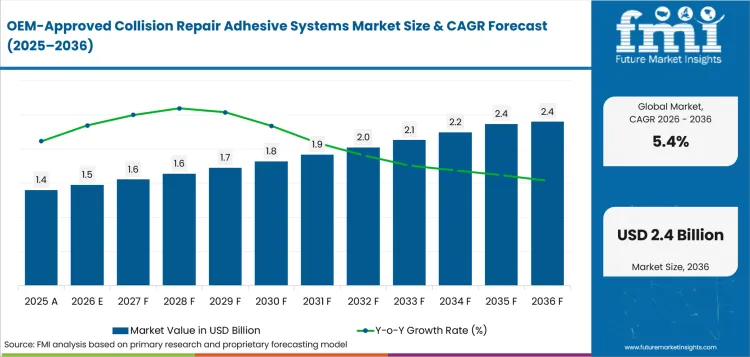
The OEM-approved collision repair adhesive systems market is expected to grow from USD 1.4 billion in 2026 to USD 2.4 billion by 2036, at a 5.4% CAGR, driven by certified body-shop repair procedures, mixed-material vehicle body repairs, and insurer-reviewed repair documentation, with two-part epoxy systems accounting for 44.8% share and passenger cars contributing 66.3% share as repair networks prioritize OEM procedure compliance and traceable adhesive use.
Key Takeaways, Market Size, and Forecast
- 2026 Market Size: USD 1.4 billion
- 2036 Market Size: USD 2.4 billion
- Forecast CAGR: 5.4% from 2026 to 2036
- Leading Adhesive Type: Two-part epoxy systems
- Two-part Epoxy Systems Share in 2026: 44.8%
- Leading Vehicle Class: Passenger cars
- Passenger Cars Share in 2026: 66.3%
- Leading Package Format: Cartridge systems
- Cartridge Systems Share in 2026: 62.7%
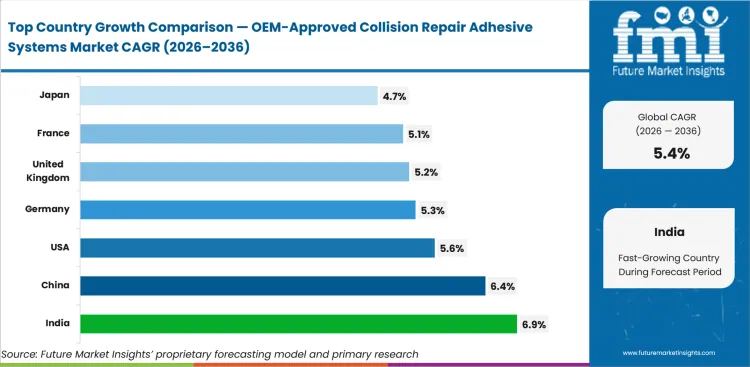
- Fastest-growing Country: India
- India CAGR: 6.9% through 2036
Summary of the OEM-Approved Collision Repair Adhesive Systems Market
- Demand and Growth Drivers
- Certified body shops need adhesives named in OEM repair files before bonded panel work can move ahead.
- Mixed-material vehicle bodies need careful bonding because steel and aluminum surfaces require different repair steps.
- Insurer-reviewed repair files are making traceable cartridges and clear cure records more important for body shops.
- Product and Segment View
- Two-part epoxy systems support structural panel repair because bonded joints must manage load and corrosion risk.
- Panel bonding stays important because outer panels need approved adhesive lines after collision damage.
- Cartridge systems help technicians reduce mix errors and keep adhesive use easier to record.
- Geography and Competitive Outlook
- India is receiving attention because rising vehicle density is increasing professional collision repair work.
- China is seeing more adhesive use as EV body repairs need controlled bonding and safer repair steps.
- Suppliers with OEM procedure coverage and training support are better placed in certified repair programs.
- Analyst Opinion
- Nikhil Kaitwade, Principal Consultant at FMI says, “OEM-approved collision repair adhesives are becoming a repair compliance product. Body shops want named products in repair procedures and safe use across mixed-material panels. Suppliers pairing verified bond strength with technician training are expected to see stronger acceptance in certified repair programs.”
- OEM-Approved Collision Repair Adhesive Systems Market Value Analysis
- The OEM-approved collision repair adhesive systems market is moving from simple repair material use into a more controlled repair process.
- Market value is rising as body shops need adhesives that match OEM repair files and insurer review needs.
- Cartridge systems are getting value because they help technicians mix materials correctly and record repair steps more easily.
- The market is supported by mixed-material vehicle bodies that need careful bonding for strength and corrosion protection.
Crashworthiness compliance is turning adhesive selection into a procedure-control issue for collision centers. Federal Motor Vehicle Safety Standard No. 214 sets side-impact strength requirements and limits forces in crash testing. Repair programs need adhesive choices that support OEM body structure intent. In September 2024, Tesla required only adhesives specified on its Service website for structural repairs. Tesla’s January 2026 Model Y Structural Pack repair procedure instructs technicians to apply structural adhesive to mating surfaces during wheelhouse repair and requires a minimum 25 mm overlap in specified areas. In September 2025, 3M stated that OEM product recommendations are tied to make and model with year and repair procedure. Adhesive suppliers get value by giving repair networks procedure-ready documentation instead of broad approval claims. In July 2025, Ford Crash Parts stated that all abraded surfaces must be coated with adhesive and e-coat should stay intact. Surface preparation now moves from a shop habit into a corrosion-risk control step for repair planners.
OEM-Approved Collision Repair Adhesive Systems Market Definition
The OEM-approved collision repair adhesive systems market refers to the professional repair business for adhesive products approved by vehicle makers for bonded body repair. These systems help repair shops restore panel strength and sealing quality after collision damage. Body shops use them when welding or mechanical fastening alone cannot protect the original vehicle repair design. Demand comes from certified repair centers that need safe bond strength, correct cure timing, and repair work that matches vehicle maker instructions.
OEM-Approved Collision Repair Adhesive Systems Market Inclusions
Market scope covers OEM-approved collision repair adhesive systems categorized by adhesive type, including two-part epoxy systems, polyurethane, acrylic, SMP systems, and hybrid systems; repair application, including panel bonding, seam sealing, plastic repair, glass bonding, and NVH repair; vehicle class, including passenger cars, light commercial vehicles, heavy vehicles, and EV platforms; repair route, including OEM certified shops, independent repair shops, dealer body shops, and insurance repair networks; and package format, including cartridge systems, bulk packs, repair kits, and aerosol formats. The scope also includes adhesive systems used within approved collision repair procedures where bonding strength, surface preparation, cure control, and repair documentation operate as part of one repair workflow. Revenue scope covers 2026 to 2036. The key stakeholders include collision repair adhesive suppliers, vehicle manufacturers, dealer body shops, certified repair centers, independent body shops, refinish distributors, auto glass repair networks, insurers, repair training providers, and automotive repair certification bodies.
OEM-Approved Collision Repair Adhesive Systems Market Exclusions
Scope excludes household glue, craft adhesives, non-automotive construction sealants, and adhesives used only in factory vehicle assembly. Paints and body fillers are excluded unless sold as part of a documented adhesive repair package. Mechanical fasteners and body panels are excluded unless supplied with a bonded repair kit. Windshield glass is excluded, but glass bonding urethane is included once specified for professional auto glass replacement.
OEM-Approved Collision Repair Adhesive Systems Market Research Methodology
- Primary Research: FMI analysts reviewed OEM repair procedure references and collision shop product catalogs.
- Desk Research: Public data from vehicle production bodies and official supplier releases were used for market checks.
- Market Sizing and Forecasting: Market size was estimated through repairable collision volume and adhesive use per job.
- Data Validation: Forecast checks compared vehicle parc trends, accident indicators, EV repair complexity, and supplier product activity.
Why is the OEM-Approved Collision Repair Adhesive Systems Market Growing?
- OEM repair files are making adhesive choice stricter as shops need materials named in approved repair steps.
- Mixed-material vehicle bodies need bonding systems that support steel and aluminum panel repair.
- Auto glass replacement uses bonding systems tied to windscreen adhesives and safe vehicle release timing.
Repair work is becoming more controlled because vehicle makers define how bonded panels should be replaced. Certified shops need adhesives with clear use instructions and documented cure steps. Demand for automotive repair and maintenance services supports this shift because repair records are becoming part of claim review and warranty checks. Adhesive suppliers with tested systems can support shops that need repeatable work on outer panels and structural joints. Clear repair steps reduce mistakes and help technicians finish bonded repairs with better confidence.
Material mix is another reason for higher adhesive use in collision repair. New vehicle bodies use more aluminum and high-strength steel to reduce weight and protect crash performance. Automotive lightweight materials make joining work more sensitive because each surface needs the right preparation method. Henkel introduced Teroson EP 52 in May 2026 as a structural adhesive with vibration damping and body joint strength in one product. For repair suppliers, the signal is clear. Bonding systems must now support strength and cabin comfort together.
EV repair adds another layer of care for body shops. Battery zones and mixed-material structures need controlled bonding work because heat and poor surface preparation can raise repair risk. Adhesives for electric vehicle power batteries show how bonding chemistry is moving closer to safety-critical vehicle areas. Collision repair adhesives benefit from the same shift because technicians need products that match approved repair files. Suppliers with clear training and simple packaging can reach more certified repair centers.
Market Segmentation Analysis
- Two-part epoxy systems are expected to account for 44.8% share in 2026.
- Panel bonding demand is anticipated at 38.6% share in 2026.
- Passenger cars are forecast to account for 66.3% share in 2026.
- OEM certified shops are expected to hold 57.4% share in 2026.
- Cartridge systems are anticipated to represent 62.7% share in 2026.
The market is divided into five primary segment groups based on adhesive type and repair application. Vehicle class, repair route and package format complete the structure. Adhesive type covers two-part epoxy systems and polyurethane. Acrylic, SMP systems and hybrid systems complete the material group. Repair application covers panel bonding and seam sealing. Plastic repair, glass bonding and NVH repair complete the application scope. Vehicle class covers passenger cars and light commercial vehicles. Heavy vehicles and EV platforms complete the vehicle scope. Repair route covers OEM certified shops and independent shops. Dealer body shops and insurance networks complete the repair route structure. Package format covers cartridge systems and bulk packs. Repair kits and aerosol formats complete the package view.
Insights into OEM-Approved Collision Repair Adhesive Systems Market by Adhesive Type
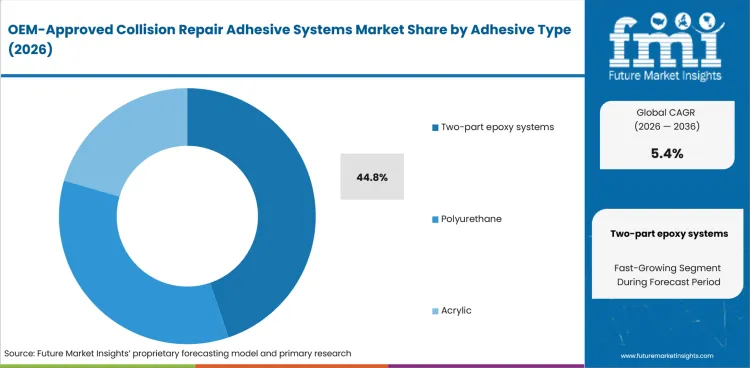
- Two-part epoxy systems are expected to hold 44.8% share in 2026 because structural joints need firm bonding and corrosion control.
- Polyurethane remains useful for glass and seam work because repair shops need flexible bonds and clear release timing.
Insights into OEM-Approved Collision Repair Adhesive Systems Market by Repair Application
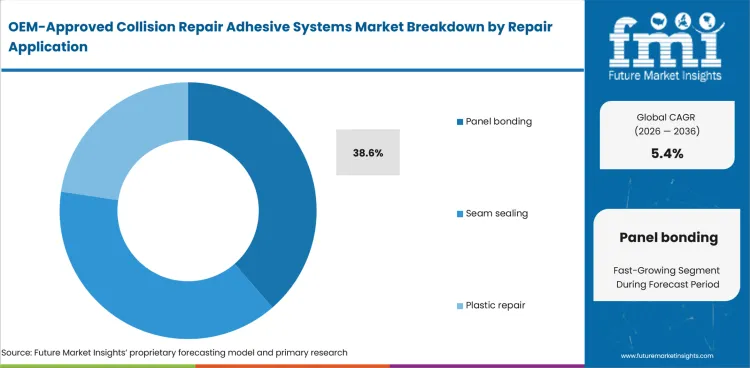
- Panel bonding is anticipated to account for 38.6% share in 2026 because outer-panel replacement needs approved bond lines.
- Seam sealing supports repeat repair demand because technicians must restore water sealing after metal panel replacement.
Insights into OEM-Approved Collision Repair Adhesive Systems Market by Vehicle Class
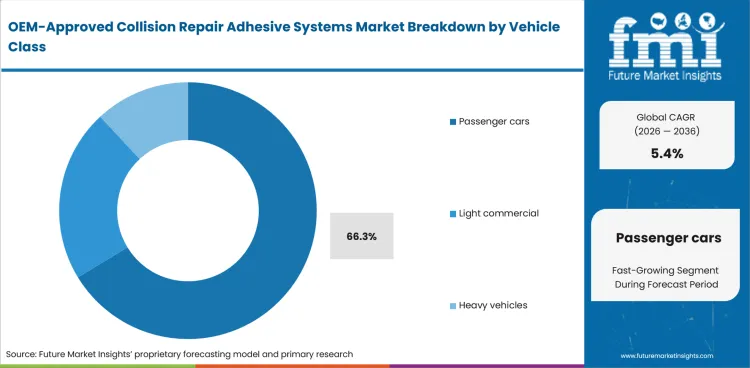
- Passenger cars are forecast to represent 66.3% share in 2026 because daily collision work creates steady adhesive use.
- EV platforms need tighter cure control because repairers must protect battery areas and mixed-material sections.
Insights into OEM-Approved Collision Repair Adhesive Systems Market by Repair Route
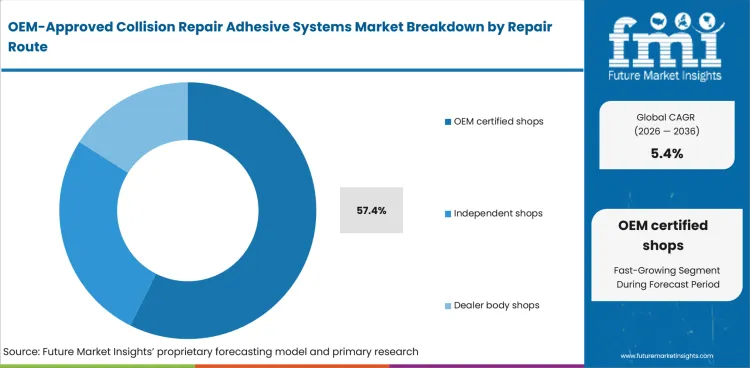
- OEM certified shops are expected to account for 57.4% share in 2026 because audits favor named adhesives and traceable lots.
- Independent shops can receive insurer acceptance through approved cartridges and clear bonding records for each repair.
Insights into OEM-Approved Collision Repair Adhesive Systems Market by Package Format
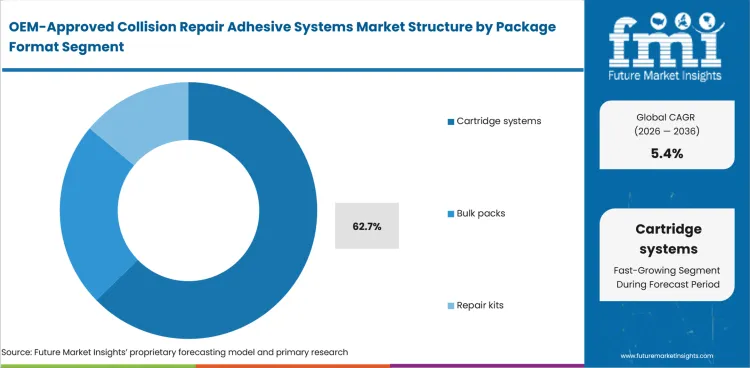
- Cartridge systems are anticipated to hold 62.7% share in 2026 because dual-pack dispensing reduces mix error.
- Repair kits help smaller shops because adhesives with mixers and prep aids arrive in one job-ready pack.
OEM-Approved Collision Repair Adhesive Systems Market Drivers, Restraints, and Opportunities
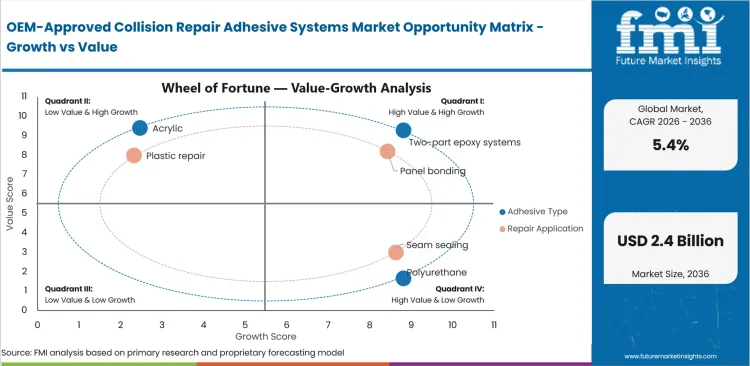
- OEM procedure audits increase demand for named adhesives with clear material records.
- Training cost can slow smaller shops because mixed-material repair needs careful surface preparation.
- Lower-odor and lower-VOC bonding systems create future scope as repair centers improve work conditions.
OEM Repair Files Tighten Material Choice
Repair material choice is becoming a controlled step inside certified body shops. Vehicle makers now give detailed instructions for panel bonding and structural repair. Shops cannot treat adhesive choice as a simple product swap because each bond line affects safety and corrosion control. Suppliers with OEM-ready documentation can support repairers during insurer review and shop audits. Clear instructions also reduce technician error during mixing and curing. This makes approval coverage a practical sales tool in professional repair networks.
Cartridge Systems Reduce Bay Risk
Cycle time pressure favors cartridges with controlled mix ratio and lower waste per repair. Dual-pack systems suit small panel jobs because technicians can dispense only the amount needed. Cartridge systems also reduce hand-mixing errors during quarter panel and roof skin work. Garage and service station operators get clearer work steps once adhesives arrive with matched tips and prep aids. Better mixing reliability supports consistent bond quality in insurer-audited jobs. This gives cartridge suppliers a stronger route into certified repair programs.
Mixed-Material Bodies Raise Training Cost
Mixed-material body structures raise the cost of wrong adhesive use. Aluminum panels and high-strength steel need different prep and cure discipline. EV protection zones make repair accuracy more important because battery areas need controlled heat exposure. Smaller shops may delay certification if training and tooling costs rise faster than repair volume. Product suppliers can reduce the barrier by offering short training modules and simple repair kits. The practical result is a market split between trained repair centers and low-complexity shops.
Cleaner Surface Preparation Opens Repair Workflow Scope
Surface preparation affects adhesive bond quality before any panel is fitted. PPG SEM launched a performance abrasives line in September 2024 for automotive collision repair. The line is designed for every repair stage and uses precision grain technology to support consistent sanding. Better surface preparation supports adhesive bonding because poor feather-edging can weaken the next repair step. This gives refinish-linked suppliers a route into adhesive workflow support. Shops benefit when sanding and refinish preparation follow one connected repair process.
Competitive Landscape and Strategic Positioning
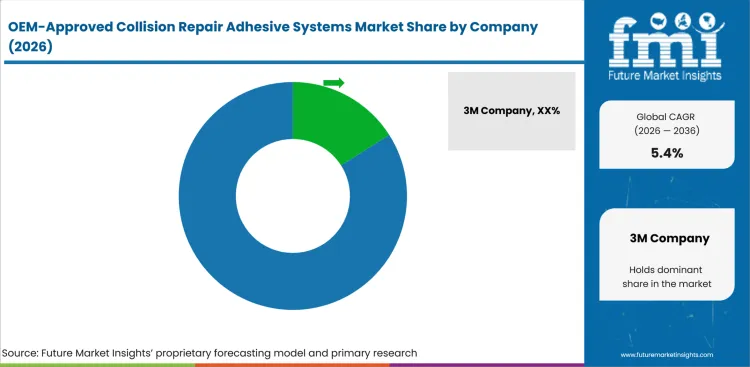
- Competition is centered on OEM procedure coverage and crash-durable bonding chemistry.
- Suppliers stand out with adhesives that match repair manuals and clean dispensing in busy bays.
- Entry barriers include OEM approval depth and liability exposure after structural repair.
- Cross-sector experience in aerospace adhesives and sealants can support quality language for critical bonding uses.
3M holds a strong position because its collision repair adhesive range is closely tied to OEM repair procedure use. Henkel has depth in structural bonding and vehicle repair materials through the Teroson portfolio. Sika supports collision and auto glass repair through polyurethane adhesive systems used by professional installers. Parker LORD Fusor and Bostik support repair adhesives and shop-ready dispensing. PPG SEM adds value through surface preparation products used before bonding and refinish work. DuPont supports broader automotive material needs connected with bonded vehicle structures.
Supplier positioning is now based on repair proof and shop usability. Certified repair centers need products that are easy to dispense and simple to document. Adhesive makers with training support can improve acceptance because technicians need repeatable steps across steel and composite repairs. In October 2025, PPG introduced MIX’N’SHAKE automated stirring technology for body shops. PPG stated that the system can boost productive work hours by up to 6% and reduce consumable waste by up to 10%. Competitive advantage is expected to come from complete repair workflows instead of adhesive chemistry. Shops will favor suppliers that reduce process mistakes and repair rework.
Key Companies in the OEM-Approved Collision Repair Adhesive Systems Market
Procedure Coverage Leaders
- 3M Company
- Henkel AG & Co. KGaA
- Sika AG
Repair Adhesive Specialists
- Parker Hannifin Corporation
- Bostik
Broader Material Suppliers
- PPG Industries Inc.
- DuPont
Competitive Benchmarking: OEM-Approved Collision Repair Adhesive Systems Market
| Company | OEM Procedure Depth | Repair Adhesive Range | Shop Training Support | Geographic Reach |
|---|---|---|---|---|
| 3M Company | High | High | High | Global repair network |
| Henkel AG & Co. KGaA | High | High | Medium | Global automotive base |
| Sika AG | High | High | Medium | Global aftermarket reach |
| Parker Hannifin Corporation | Medium | High | Medium | North America and Europe |
| Bostik | Medium | Medium | Medium | Europe and Asia centered |
| PPG Industries Inc. | Low | Medium | High | Global refinish network |
| DuPont | Medium | High | Medium | Global automotive materials reach |
Source: Future Market Insights competitive analysis, 2026.
Key Developments in OEM-Approved Collision Repair Adhesive Systems Market
- In March 2025, 3M updated its OEM Recommendations for Aftermarket Body Repair document.
- In May 2025, Sika Industry USA launched Sikaflex P2G Premium, a primerless auto glass replacement adhesive for direct-glazed automotive glass parts.
Key Players in the OEM-Approved Collision Repair Adhesive Systems Market
Major Global Players
- 3M Company
- Henkel AG & Co. KGaA
- Sika AG
- Parker Hannifin Corporation
- DuPont
Specialist and Regional Players
- Bostik
- PPG Industries Inc.
- SEM Products
- LORD Fusor
- Evercoat
Analysis of OEM-Approved Collision Repair Adhesive Systems Market by Key Countries
.webp "Top Country Growth Comparison OEM-Approved Collision Repair Adhesive Systems Market Cagr (2026 2036)")
| Country | CAGR |
|---|---|
| United States | 5.6% |
| China | 6.4% |
| India | 6.9% |
| Germany | 5.3% |
| Japan | 4.7% |
| United Kingdom | 5.2% |
| France | 5.1% |
Source: Future Market Insights, 2026.
Demand Outlook for OEM-Approved Collision Repair Adhesive Systems Market in the United States
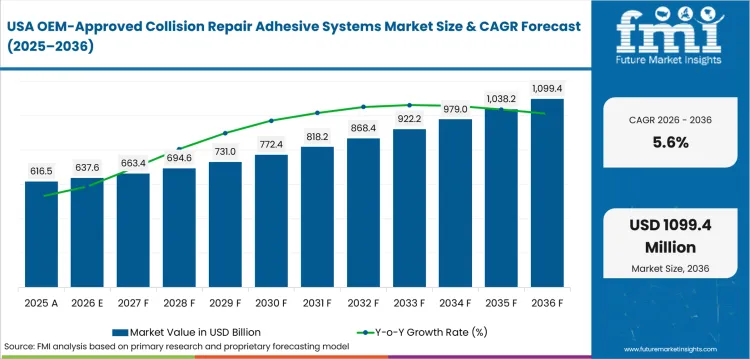
Large certified collision repair base · 2026 to 2036
Country Market Snapshot Table
| Parameter | Value |
|---|---|
| Market Size in 2025 Value | USD 340.0 million |
| Market Forecast in 2036 Value | USD 620.0 million |
| CAGR 2026-2036 | 5.6% |
| Years Considered | 2016-2036 |
| Base Year | 2025 |
| Forecast Period | 2026-2036 |
| Units Considered | Value USD Mn |
| Leading Sub-Region | Midwest collision repair corridor |
United States OEM-Approved Collision Repair Adhesive Systems Market Outlook
USA repair centers use OEM-approved adhesives to meet insurer file checks and certified repair needs. Bonded panel repair is becoming more common in shops handling aluminum and high-strength steel.
Repair networks prefer cartridge systems because controlled dispensing reduces mix errors. Dealer body shops and certified collision centers are expected to drive steady use of approved adhesive systems.
Key Growth Drivers
- Certified repair networks need documented adhesive use as NHTSA estimated 36,640 USA traffic fatalities in 2025. Collision repair files need safer repair steps after serious vehicle damage.
- Large vehicle sales keep repair material demand active as OICA listed 16.7 million motor vehicle sales in the United States in 2025. A broad vehicle parc creates repeat panel bonding and glass repair work.
- Dealer body shops prefer cartridge systems because controlled dispensing reduces waste and improves repair repeatability.
- Insurer-approved repair programs need adhesive products with OEM procedure references and clear technician instructions.
Key Restraints
- Product liability risk can slow approval of new adhesive systems in structural panel repair.
- Smaller body shops face higher training costs before using adhesives on mixed-material vehicles.
- Training cost can limit smaller repair shops. 3M listed its five- day Collision Repair Instructor Training course fee at USD 4,750 in 2024.
What makes United States unique
The United States is unique because insurer repair networks and OEM-certified body shops make adhesive documentation part of repair approval.
Key Companies
- 3M Company
- PPG Industries Inc.
- DuPont
- Parker Hannifin Corporation
- ITW Evercoat
Sales & Marketing Channels
- OEM-certified collision networks
- Dealer body shop programs
- Insurance direct repair programs
- Automotive refinish distributors
Country Segment Breakdown Table
| Segment | Sub-Segments |
|---|---|
| By Adhesive Type | Two-part epoxy systems · Polyurethane · Acrylic · SMP systems · Hybrid systems |
| By Repair Application | Panel bonding · Seam sealing · Plastic repair · Glass bonding · NVH repair |
| By Vehicle Class | Passenger cars · Light commercial · Heavy vehicles · EV platforms |
| By Repair Route | OEM certified shops · Independent shops · Dealer body shops · Insurance networks |
| By Package Format | Cartridge systems · Bulk packs · Repair kits · Aerosol formats |
| Key Sub-Regions Covered by States and Corridors | Michigan · Ohio · Indiana · Illinois · Texas · California · Tennessee |
Frequently Asked Questions
How fast is the United States OEM-approved collision repair adhesive systems market expanding?
The United States market is forecast to expand at 5.6% CAGR from 2026 to 2036. Demand reflects certified repair needs and insurer documentation.
Who leads the United States OEM-approved collision repair adhesive systems market?
3M Company and PPG Industries Inc. are active through repair materials and refinish channels. DuPont supports automotive bonding products.
What is driving adoption in the United States?
Certified collision programs need adhesive systems with OEM repair references. Insurer file checks make product traceability more important.
Sales Analysis of OEM-Approved Collision Repair Adhesive Systems Market in China
EV repair scale and large vehicle sales · 2026 to 2036
Country Market Snapshot Table
| Parameter | Value |
|---|---|
| Market Size in 2025 Value | USD 200.0 million |
| Market Forecast in 2036 Value | USD 400.0 million |
| CAGR 2026-2036 | 6.4% |
| Years Considered | 2016-2036 |
| Base Year | 2025 |
| Forecast Period | 2026-2036 |
| Units Considered | Value USD Mn |
| Leading Sub-Region | Yangtze River Delta repair corridor |
China OEM-Approved Collision Repair Adhesive Systems Market Outlook
China has a large repair pool because vehicle sales and EV platforms are expanding together. Body shops need bonding systems for aluminum closures and protected battery areas.
Approved adhesives are becoming more important in dealer repair networks. Technicians need simple cure guidance because repair volume is high and material mistakes can increase rework.
Key Growth Drivers
- Large vehicle sales create broad collision repair demand as China reported 34.4 million auto sales in 2025. Repair networks need adhesive systems for recurring panel and glass repair work.
- EV repair complexity is rising as China recorded 16.49 million NEV sales in 2025. Battery-area repair needs controlled bonding and clear surface preparation steps.
- Dealer service networks need approved products to reduce rework after structural repair.
- Cartridge systems help large repair groups keep mixing and application steps consistent across branches.
Key Restraints
- Repair training gaps can limit correct structural adhesive use outside certified networks.
- Local price pressure can push smaller shops toward lower-cost products with weaker process guidance.
- Supplier margin pressure can affect local service depth. Sika reported Asia Pacific sales declined by 5.3% in local currencies in 2025.
What makes China unique
China is unique because large vehicle sales and EV body repair needs create a wide market for approved bonding systems.
Key Companies
- Shanghai Huitian New Material Co. Ltd.
- Kangda New Materials Group Co. Ltd.
- Wanhua Chemical Group Co. Ltd.
- Guangzhou Baiyun Chemical Industry Co. Ltd.
- H.B. Fuller Company
Sales & Marketing Channels
- Dealer repair networks
- EV service groups
- Automotive adhesive distributors
- Regional body shop training partners
Country Segment Breakdown Table
| Segment | Sub-Segments |
|---|---|
| By Adhesive Type | Two-part epoxy systems · Polyurethane · Acrylic · SMP systems · Hybrid systems |
| By Repair Application | Panel bonding · Seam sealing · Plastic repair · Glass bonding · NVH repair |
| By Vehicle Class | Passenger cars · Light commercial · Heavy vehicles · EV platforms |
| By Repair Route | OEM certified shops · Independent shops · Dealer body shops · Insurance networks |
| By Package Format | Cartridge systems · Bulk packs · Repair kits · Aerosol formats |
| Key Sub-Regions Covered by Provinces and Municipalities | Shanghai · Jiangsu · Zhejiang · Guangdong · Chongqing · Hubei · Shandong |
Frequently Asked Questions
How fast is the China OEM-approved collision repair adhesive systems market expanding?
China is expected to expand at 6.4% CAGR from 2026 to 2036. EV repair complexity is expected to raise approved adhesive use.
Who leads the China OEM-approved collision repair adhesive systems market?
Shanghai Huitian New Material Co. Ltd. and Kangda New Materials Group Co. Ltd. are active in adhesive supply. Wanhua Chemical Group Co. Ltd. supports material depth.
What is driving adoption in China?
EV body repairs and mixed-material structures are raising demand for adhesive systems with clear use instructions.
Demand Outlook for OEM-Approved Collision Repair Adhesive Systems Market in India
Utility vehicle repair and dealer network expansion · 2026 to 2036
Country Market Snapshot Table
| Parameter | Value |
|---|---|
| Market Size in 2025 Value | USD 70.0 million |
| Market Forecast in 2036 Value | USD 145.0 million |
| CAGR 2026-2036 | 6.9% |
| Years Considered | 2016-2036 |
| Base Year | 2025 |
| Forecast Period | 2026-2036 |
| Units Considered | Value USD Mn |
| Leading Sub-Region | Western and Southern automotive corridor |
India OEM-Approved Collision Repair Adhesive Systems Market Outlook
India’s repair market is moving from basic panel work toward process-controlled repair. Dealer workshops and larger service chains are using approved adhesives to improve repair quality.
Utility vehicle demand is increasing the need for stronger panel bonding. Cartridge systems are useful because they make mixing easier for technicians in developing repair networks.
Key Growth Drivers
- Passenger vehicle repair volume is expanding as SIAM reported 4.3 million passenger vehicle sales in FY 2024-25. Higher vehicle density creates more body repair opportunities.
- Utility vehicles need stronger panel repair as SIAM stated utility vehicles contributed 65.0% of passenger vehicle sales in FY 2024-25. Larger panels raise the need for reliable bonding systems.
- Dealer collision centers use approved adhesives to protect warranty-sensitive repair work.
- Cartridge systems suit Indian repair networks because technicians need simple mixing and lower material waste.
Key Restraints
- Smaller garages may avoid structural adhesives if technician training is limited.
- Price sensitivity can slow use of full OEM-approved repair kits in routine body work.
- Automotive adhesives still form a smaller supplier revenue block. Pidilite stated industrial adhesives including automotive contributed 5.1% of company sales in 2024-25.
What makes India unique
India is unique because utility vehicle demand and dealer service expansion are creating more complex collision repair needs.
Key Companies
- Pidilite Industries Limited
- Anabond Limited
- Metlok Private Limited
- Astral Limited
- Ralli Bondite Private Limited
Sales & Marketing Channels
- Dealer body shop programs
- Automotive paint and refinish distributors
- Independent garage networks
- Technical training centers
Country Segment Breakdown Table
| Segment | Sub-Segments |
|---|---|
| By Adhesive Type | Two-part epoxy systems · Polyurethane · Acrylic · SMP systems · Hybrid systems |
| By Repair Application | Panel bonding · Seam sealing · Plastic repair · Glass bonding · NVH repair |
| By Vehicle Class | Passenger cars · Light commercial · Heavy vehicles · EV platforms |
| By Repair Route | OEM certified shops · Independent shops · Dealer body shops · Insurance networks |
| By Package Format | Cartridge systems · Bulk packs · Repair kits · Aerosol formats |
| Key Sub-Regions Covered by States and Corridors | Maharashtra · Tamil Nadu · Karnataka · Gujarat · Haryana · Delhi NCR · Telangana |
Frequently Asked Questions
How fast is the India OEM-approved collision repair adhesive systems market expanding?
India is forecast to expand at 6.9% CAGR from 2026 to 2036. Utility vehicle repair and dealer service expansion are expected to lift demand.
Who leads the India OEM-approved collision repair adhesive systems market?
Pidilite Industries Limited and Anabond Limited are active adhesive suppliers. Metlok Private Limited serves technical bonding applications.
What is driving adoption in India?
Dealer repair centers need adhesive systems that improve bonded panel quality. Cartridge systems make repair work easier for technicians.
Opportunity Analysis of OEM-Approved Collision Repair Adhesive Systems Market in Germany
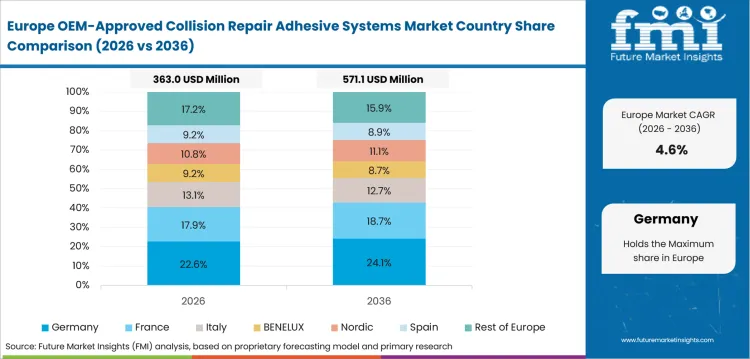
Premium vehicle repair and EV body complexity · 2026 to 2036
Country Market Snapshot Table
| Parameter | Value |
|---|---|
| Market Size in 2025 Value | USD 120.0 million |
| Market Forecast in 2036 Value | USD 210.0 million |
| CAGR 2026-2036 | 5.3% |
| Years Considered | 2016-2036 |
| Base Year | 2025 |
| Forecast Period | 2026-2036 |
| Units Considered | Value USD Mn |
| Leading Sub-Region | Bavaria and Baden-Württemberg repair corridor |
Germany OEM-Approved Collision Repair Adhesive Systems Market Outlook
Germany has a technically demanding repair market because premium vehicles use complex body structures. Body shops need bonding systems that protect crash performance and corrosion resistance after repair.
Certified repair centers use approved adhesives to meet OEM repair steps. EV and hybrid platforms are expected to make repair documentation more important across dealer and independent networks.
Key Growth Drivers
- Premium repair demand stays active as KBA reported 2.9 million passenger car registrations in Germany during 2025. A large premium vehicle pool supports approved adhesive use.
- EV repair complexity is increasing as KBA reported 545,142 BEV registrations in 2025. Battery-electric body repairs need careful bonding and surface preparation.
- Certified body shops use documented products to match OEM repair procedures.
- Technical repair training improves the use of procedure-based adhesives in structural panel work.
Key Restraints
- High labor cost can make bonded repair work expensive for price-sensitive vehicle owners.
- Strict work quality expectations raise documentation needs for each bonded repair job.
- Automotive demand weakness can slow supplier planning. Henkel reported its automotive business declined in the first quarter of 2026.
What makes Germany unique
Germany is unique because premium vehicle repair and technical training depth make adhesive approval central to body shop decisions.
Key Companies
- Henkel AG & Co. KGaA
- Ruderer Klebetechnik GmbH
- Adolf Würth GmbH & Co. KG
- MIPA SE
- Weicon GmbH & Co. KG
Sales & Marketing Channels
- OEM-certified body shop networks
- Automotive paint distributors
- Dealer collision repair programs
- Technical workshop training partners
Country Segment Breakdown Table
| Segment | Sub-Segments |
|---|---|
| By Adhesive Type | Two-part epoxy systems · Polyurethane · Acrylic · SMP systems · Hybrid systems |
| By Repair Application | Panel bonding · Seam sealing · Plastic repair · Glass bonding · NVH repair |
| By Vehicle Class | Passenger cars · Light commercial · Heavy vehicles · EV platforms |
| By Repair Route | OEM certified shops · Independent shops · Dealer body shops · Insurance networks |
| By Package Format | Cartridge systems · Bulk packs · Repair kits · Aerosol formats |
| Key Sub-Regions Covered by States and Corridors | Bavaria · Baden-Württemberg · North Rhine-Westphalia · Lower Saxony · Hesse · Saxony · Hamburg |
Frequently Asked Questions
How fast is the Germany OEM-approved collision repair adhesive systems market expanding?
Germany is expected to record 5.3% CAGR from 2026 to 2036. Premium vehicle repair complexity is expected to keep demand active.
Who leads the Germany OEM-approved collision repair adhesive systems market?
Henkel AG & Co. KGaA and Ruderer Klebetechnik GmbH are active suppliers. Adolf Würth GmbH & Co. KG serves workshop material channels.
What is driving adoption in Germany?
Premium vehicles and EV platforms need repair materials with clear approval. Body shops use approved adhesives to protect repair quality.
Future Outlook for OEM-Approved Collision Repair Adhesive Systems Market in Japan
Precision repair culture and compact shop workflows · 2026 to 2036
Country Market Snapshot Table
| Parameter | Value |
|---|---|
| Market Size in 2025 Value | USD 80.0 million |
| Market Forecast in 2036 Value | USD 133.0 million |
| CAGR 2026-2036 | 4.7% |
| Years Considered | 2016-2036 |
| Base Year | 2025 |
| Forecast Period | 2026-2036 |
| Units Considered | Value USD Mn |
| Leading Sub-Region | Tokai vehicle repair corridor |
Japan OEM-Approved Collision Repair Adhesive Systems Market Outlook
Japan’s repair market values clean work and controlled material use. Body shops need compact cartridge systems because repair bays often manage limited storage and tight job schedules.
Hybrid and compact vehicle repairs are expected to keep adhesive use steady. Approved repair steps matter because technicians need predictable cure timing and low-waste application.
Key Growth Drivers
- Vehicle repair demand stays steady as Japan’s official automobile registration data showed 4,565,777 new vehicle sales in 2025. shops need approved materials for repeated panel and glass repairs.
- Used vehicle work supports repair material demand as JAMA reported 6.5 million used motor vehicle sales in Japan in 2024. Older vehicles create steady demand for repair-ready adhesive systems.
- Compact repair bays favor cartridges that reduce waste and simplify storage.
- Hybrid vehicle repairs increase the need for careful bonding near mixed-material body sections.
Key Restraints
- Careful repair culture can slow acceptance of unfamiliar adhesive systems.
- Smaller repair shops may prefer familiar mechanical repair methods for non-structural jobs.
- Model-specific validation can slow adhesive use. Nitto stated its automotive adhesive sheet benefit differs by car model in its 2025 integrated report.
What makes Japan unique
Japan is unique because repair shops value process control and compact product formats suited to clean body shop workflows.
Key Companies
- ThreeBond Co. Ltd.
- Cemedine Co. Ltd.
- Konishi Co. Ltd.
- Nitto Denko Corporation
- Sunstar Engineering Inc.
Sales & Marketing Channels
- Dealer collision centers
- Specialist adhesive distributors
- Auto glass repair networks
- Workshop tool and material suppliers
Country Segment Breakdown Table
| Segment | Sub-Segments |
|---|---|
| By Adhesive Type | Two-part epoxy systems · Polyurethane · Acrylic · SMP systems · Hybrid systems |
| By Repair Application | Panel bonding · Seam sealing · Plastic repair · Glass bonding · NVH repair |
| By Vehicle Class | Passenger cars · Light commercial · Heavy vehicles · EV platforms |
| By Repair Route | OEM certified shops · Independent shops · Dealer body shops · Insurance networks |
| By Package Format | Cartridge systems · Bulk packs · Repair kits · Aerosol formats |
| Key Sub-Regions Covered by Prefectures and Corridors | Aichi · Tokyo · Kanagawa · Shizuoka · Osaka · Hiroshima · Fukuoka |
Frequently Asked Questions
How fast is the Japan OEM-approved collision repair adhesive systems market expanding?
Japan is forecast to expand at 4.7% CAGR from 2026 to 2036. Repair demand is expected to stay steady across hybrid and compact vehicles.
Who leads the Japan OEM-approved collision repair adhesive systems market?
ThreeBond Co. Ltd. and Cemedine Co. Ltd. are active adhesive suppliers. Konishi Co. Ltd. supports local bonding applications.
What is driving adoption in Japan?
Compact repair bays need low-waste cartridges and clear repair steps. Hybrid vehicle repairs increase the need for careful bonding work.
Future Outlook for OEM-Approved Collision Repair Adhesive Systems Market in the United Kingdom
Insurer review and EV repair training · 2026 to 2036
Country Market Snapshot Table
| Parameter | Value |
|---|---|
| Market Size in 2025 Value | USD 70.0 million |
| Market Forecast in 2036 Value | USD 122.0 million |
| CAGR 2026-2036 | 5.2% |
| Years Considered | 2016-2036 |
| Base Year | 2025 |
| Forecast Period | 2026-2036 |
| Units Considered | Value USD Mn |
| Leading Sub-Region | Midlands collision repair corridor |
United Kingdom OEM-Approved Collision Repair Adhesive Systems Market Outlook
United Kingdom repair demand is guided by insurer-approved networks and EV repair training. Body shops need approved bonding systems for panel work and electric vehicle body sections.
Repair centers are expected to prioritize materials that reduce process errors. Refinish distributors and insurer repair programs create clear routes for adhesive system supply.
Key Growth Drivers
- New car registrations support repair pipeline renewal as SMMT reported 2.02 million new car registrations in the United Kingdom in 2025. Newer vehicles carry more complex bonding needs.
- Electrified repair work is expanding as SMMT reported almost 500,000 new BEVs joined UK roads in 2025. EV body repair increases demand for approved adhesive systems.
- Insurer repair networks favor products with clear repair records and approved use steps.
- Dealer body shops need approved bonding products for warranty-sensitive panel replacement.
Key Restraints
- Repair labor shortages can slow training for bonded structural repair.
- Smaller workshops may delay adhesive upgrades due to tooling and certification costs.
- Tooling cost can limit smaller repair shops. Mirka states its power tools have a two- year warranty with 1 extra year after registration within thirty days.
What makes United Kingdom unique
The United Kingdom is unique because insurer repair reviews and EV repair certification shape material choice in professional body shops.
Key Companies
- U-POL Limited
- INDASA Abrasives UK Ltd.
- Mirka UK Ltd.
- Farecla Products Ltd.
- HB Body UK Limited
Sales & Marketing Channels
- Insurer-approved repair networks
- Automotive refinish distributors
- Dealer body shop groups
- Auto glass repair chains
Country Segment Breakdown Table
| Segment | Sub-Segments |
|---|---|
| By Adhesive Type | Two-part epoxy systems · Polyurethane · Acrylic · SMP systems · Hybrid systems |
| By Repair Application | Panel bonding · Seam sealing · Plastic repair · Glass bonding · NVH repair |
| By Vehicle Class | Passenger cars · Light commercial · Heavy vehicles · EV platforms |
| By Repair Route | OEM certified shops · Independent shops · Dealer body shops · Insurance networks |
| By Package Format | Cartridge systems · Bulk packs · Repair kits · Aerosol formats |
| Key Sub-Regions Covered by Nations and Corridors | West Midlands · East Midlands · Greater London · North West England · Scotland · Wales · Northern Ireland |
Frequently Asked Questions
How fast is the United Kingdom OEM-approved collision repair adhesive systems market expanding?
The United Kingdom market is forecast to expand at 5.2% CAGR from 2026 to 2036. Insurer repair networks are expected to guide product use.
Who leads the United Kingdom OEM-approved collision repair adhesive systems market?
U-POL Limited and INDASA Abrasives UK Ltd. are active in repair materials. Mirka UK Ltd. supports repair preparation workflows.
What is driving adoption in the United Kingdom?
Insurer-approved repair networks need clear documentation. EV repair training is expected to raise demand for approved bonding systems.
Sales Analysis of OEM-Approved Collision Repair Adhesive Systems Market in France
Electrified vehicle repairs and refinish distribution · 2026 to 2036
Country Market Snapshot Table
| Parameter | Value |
|---|---|
| Market Size in 2025 Value | USD 60.0 million |
| Market Forecast in 2036 Value | USD 104.0 million |
| CAGR 2026-2036 | 5.1% |
| Years Considered | 2016-2036 |
| Base Year | 2025 |
| Forecast Period | 2026-2036 |
| Units Considered | Value USD Mn |
| Leading Sub-Region | Île-de-France and northern repair corridor |
France OEM-Approved Collision Repair Adhesive Systems Market Outlook
France has a repair market with strong refinish distribution and growing electrified vehicle work. Body shops need adhesives that fit approved repair methods and prepare bonded panels for paint.
Dealer repair centers and independent body shops are expected to use more approved adhesives. Electrified vehicle repair is raising the need for cleaner documentation and better technician guidance.
Key Growth Drivers
- EV body repair is becoming more important as ACEA reported battery-electric registrations in France rose 12.5% in 2025. Electric vehicle repairs need controlled bonding near protected body areas.
- Hybrid repair work is expanding as ACEA reported hybrid-electric registrations in France increased 21.6% in 2025. Mixed powertrain repairs raise demand for clear adhesive use steps.
- Refinish distributors can move adhesive systems into body shops through existing material supply routes.
- Dealer repair centers need approved products for warranty-sensitive panel and glass jobs.
Key Restraints
- Independent workshops may need more training before using structural adhesives confidently.
- Full repair kits can cost more than basic sealers used in non-structural repair.
- Advanced adhesive systems can need broader technical support. Bostik’s 2025 engineering adhesives catalogue states Polytec PT expanded its portfolio into a 360° solution portfolio.
What makes France unique
France is unique because refinish distribution depth and electrified vehicle repair needs create a practical route for approved adhesive systems.
Key Companies
- Bostik SA
- Axalta Coating Systems France
- BASF France S.A.S.
- Cromology Services
- Motip Dupli France
Sales & Marketing Channels
- Refinish distributor networks
- Dealer collision repair programs
- Auto glass repair networks
- Independent body shop suppliers
Country Segment Breakdown Table
| Segment | Sub-Segments |
|---|---|
| By Adhesive Type | Two-part epoxy systems · Polyurethane · Acrylic · SMP systems · Hybrid systems |
| By Repair Application | Panel bonding · Seam sealing · Plastic repair · Glass bonding · NVH repair |
| By Vehicle Class | Passenger cars · Light commercial · Heavy vehicles · EV platforms |
| By Repair Route | OEM certified shops · Independent shops · Dealer body shops · Insurance networks |
| By Package Format | Cartridge systems · Bulk packs · Repair kits · Aerosol formats |
| Key Sub-Regions Covered by Regions and Corridors | Île-de-France · Hauts-de-France · Auvergne-Rhône-Alpes · Grand Est · Normandy · Occitanie · Nouvelle-Aquitaine |
Frequently Asked Questions
How fast is the France OEM-approved collision repair adhesive systems market expanding?
France is expected to record 5.1% CAGR from 2026 to 2036. Electrified vehicle repairs are expected to guide demand.
Who leads the France OEM-approved collision repair adhesive systems market?
Bostik SA and Axalta Coating Systems France are active in repair material channels. BASF France S.A.S. supports refinish-linked repair demand.
What is driving adoption in France?
Electrified vehicle repairs need controlled bonding steps. Refinish distributors help bring adhesive systems into professional body shops.
Report Scope and Coverage
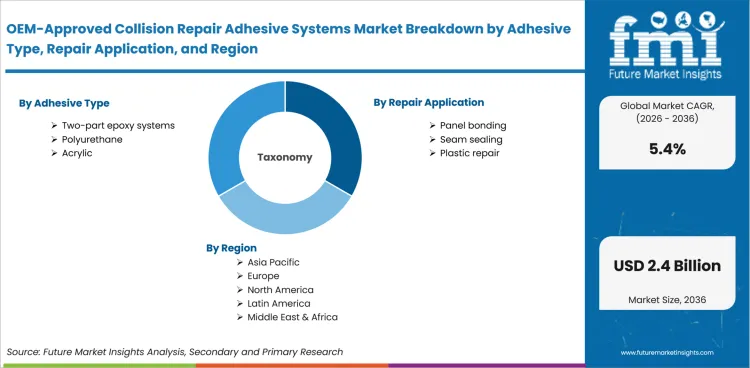
| Parameter | Details |
|---|---|
| Market Size by 2036 | USD 2.4 billion |
| Growth Rate | 5.4% CAGR from 2026 to 2036 |
| Forecast Period | 2026 to 2036 |
| Market Size in 2026 | USD 1.4 billion |
| By Adhesive Type | Two-part epoxy systems, polyurethane, acrylic, SMP systems, hybrid systems |
| By Vehicle Class | Passenger cars, SUVs, light commercial vehicles, heavy vehicles, electric vehicles |
| By Repair Route | OEM-certified collision centers, dealer body shops, independent repair shops, insurance network shops |
| By Repair Application | Panel bonding, seam sealing, plastic repair, glass bonding, NVH repair |
| By Package Format | Cartridges, dual syringes, bulk packs, repair kits |
| Regions Covered | North America, Latin America, Europe, East Asia, South Asia and Pacific, Middle East & Africa |
| Countries Covered | United States, China, India, Germany, Japan, South Korea, United Kingdom, 30 plus countries |
| Key Companies Profiled | 3M Company, Henkel AG & Co. KGaA, Sika AG, Parker Hannifin Corporation, DuPont, Bostik, PPG Industries Inc., SEM Products, LORD Fusor, Evercoat |
| Approach | Hybrid bottom-up and top-down methodology using vehicle production, premium feature fitment, cabin filter replacement value, OEM fragrance package availability, and aftermarket refill sales |
Source: Future Market Insights, 2026.
OEM-Approved Collision Repair Adhesive Systems Market Breakdown by Adhesive Type, Repair Application, Vehicle Class, Repair Route, Package Format, and Region
OEM-Approved Collision Repair Adhesive Systems Market Segmented by Adhesive Type
- Two-part epoxy systems
- Polyurethane
- Acrylic
- SMP systems
- Hybrid systems
OEM-Approved Collision Repair Adhesive Systems Market Segmented by Repair Application
- Panel bonding
- Seam sealing
- Plastic repair
- Glass bonding
- NVH repair
OEM-Approved Collision Repair Adhesive Systems Market Segmented by Vehicle Class
- Passenger cars
- Light commercial
- Heavy vehicles
- EV platforms
OEM-Approved Collision Repair Adhesive Systems Market Segmented by Repair Route
- OEM certified shops
- Independent shops
- Dealer body shops
- Insurance networks
OEM-Approved Collision Repair Adhesive Systems Market Segmented by Package Format
- Cartridge systems
- Bulk packs
- Repair kits
- Aerosol formats
OEM-Approved Collision Repair Adhesive Systems Market by Region
- North America
- Latin America
- Western Europe
- Eastern Europe
- East Asia
- South Asia and Pacific
- Middle East & Africa
Research Sources and Bibliography
- Bostik. (2025). Engineering adhesives product catalogue 2025. Bostik.
- Electronic Code of Federal Regulations. (2026). 49 CFR § 571.214 - Standard No. 214; Side impact protection. eCFR.
- European Automobile Manufacturers’ Association. (2026, January 27). New car registrations: +1.8% in 2025; battery-electric 17.4% market share. ACEA.
- Ford Crash Parts. (2025, July). On Target: For Ford and Lincoln wholesalers and the collision repair industry. Ford Crash Parts.
- Henkel. (2026, May 7). Henkel delivers good organic sales growth in the first quarter of 2026. Henkel.
- Henkel. (2026, May 12). New Henkel automotive adhesive: One product, twice the power. Henkel.
- International Organization of Motor Vehicle Manufacturers. (2026, April 23). Auto industry growth shifted east in 2025 amid global repositioning. OICA.
- Japan Automobile Manufacturers Association. (2025, September 26). The motor industry of Japan 2025. JAMA.
- Kraftfahrt-Bundesamt. (2026, January 6). Fahrzeugzulassungen im Dezember 2025 - Jahresbilanz. KBA.
- Kraftfahrt-Bundesamt. (2026, January 16). Neuzulassungen von Personenkraftwagen insgesamt im Jahresverlauf 2025 sowie mit Elektro (BEV). KBA.
- National Highway Traffic Safety Administration. (2026, April 1). 2025 traffic death estimates & 2024 FARS. NHTSA.
- Nitto Denko Corporation. (2025, July 31). Nitto Group integrated report 2025. Nitto Denko Corporation.
- Pidilite Industries Limited. (2025). Annual report 2024-25. Pidilite Industries Limited.
- PPG. (2024, September 26). PPG’s SEM Products business launches performance abrasives product line. PPG.
- Sika. (2026, February 21). Record results in 2025 - Sika remains on growth trajectory. Sika.
- Sika Industry USA. (2025, May 22). Sika launches new Sikaflex® P2G Premium, primerless auto glass replacement adhesive. Sika.
- Society of Indian Automobile Manufacturers. (2025, April 15). Performance of auto industry in March 2025. SIAM.
- Society of Motor Manufacturers and Traders. (2026, January 6). UK new car market breaches two million as almost one in four buyers go electric. SMMT.
- Tesla. (2024, September 17). Tesla approved collision center operating standards. Tesla.
This Report Answers
- What is the 2026 value of the OEM-approved collision repair adhesive systems market?
- What value can the market reach by 2036?
- What CAGR is expected from 2026 to 2036?
- Which adhesive type is expected to lead demand in 2026?
- Which repair application accounts for a major share of demand?
- Which country is expected to post the faster pace during the forecast period?
- How do OEM-certified repair programs influence adhesive selection?
- How do cartridge systems affect repair bay cycle time and mix reliability?
- Which companies are active in OEM-approved collision repair adhesive systems?
- How was the market estimate built and checked?
Frequently Asked Questions
What is the OEM-approved collision repair adhesive systems market size in 2026?
OEM-approved collision repair adhesive systems market is expected to reach USD 1.4 billion in 2026.
What is the market forecast for 2036?
Industry revenue is forecast to reach USD 2.4 billion by 2036.
What CAGR is expected for the market?
Demand is expected to expand at 5.4% CAGR from 2026 to 2036.
Which adhesive type holds a leading share?
Two-part epoxy systems are expected to hold 44.8% share in 2026 due to structural panel bonding needs.
Which repair application leads demand?
Panel bonding is anticipated to account for 38.6% share in 2026 as outer-panel replacement needs approved bond lines.
Which vehicle class contributes the main share?
Passenger cars are forecast to account for 66.3% share in 2026 as daily collision repair volume supports demand.
Which package format is most used?
Cartridge systems are expected to represent 62.7% share in 2026 due to controlled mixing and lower material waste.
Which country has the faster pace?
India is likely to post 6.9% CAGR from 2026 to 2036 as vehicle density raises professional collision repair work.
Why do OEM approvals matter in collision repair adhesives?
OEM approval gives body shops a documented repair path for bonded panels and insurer-reviewed repair files.
Which suppliers are active in this market?
3M Company and Henkel are active global suppliers. Sika, Parker Hannifin, Bostik, PPG Industries, and DuPont support related repair adhesive demand.
Preview the report firsthand - request a free sample
Get SampleGet the brochure for pricing and purchase details.
Get PDFTable of Content
- Executive Summary
- Global Market Outlook
- Demand-side Trends
- Supply-side Trends
- Technology Roadmap Analysis
- Analysis and Recommendations
- Market Overview
- Market Coverage / Taxonomy
- Market Definition / Scope / Limitations
- Research Methodology
- Chapter Orientation
- Analytical Lens and Working Hypotheses
- Market Structure, Signals, and Trend Drivers
- Benchmarking and Cross-market Comparability
- Market Sizing, Forecasting, and Opportunity Mapping
- Research Design and Evidence Framework
- Desk Research Programme (Secondary Evidence)
- Company Annual and Sustainability Reports
- Peer-reviewed Journals and Academic Literature
- Corporate Websites, Product Literature, and Technical Notes
- Earnings Decks and Investor Briefings
- Statutory Filings and Regulatory Disclosures
- Technical White Papers and Standards Notes
- Trade Journals, Industry Magazines, and Analyst Briefs
- Conference Proceedings, Webinars, and Seminar Materials
- Government Statistics Portals and Public Data Releases
- Press Releases and Reputable Media Coverage
- Specialist Newsletters and Curated Briefings
- Sector Databases and Reference Repositories
- FMI Internal Proprietary Databases and Historical Market Datasets
- Subscription Datasets and Paid Sources
- Social Channels, Communities, and Digital Listening Inputs
- Additional Desk Sources
- Expert Input and Fieldwork (Primary Evidence)
- Primary Modes
- Qualitative Interviews and Expert Elicitation
- Quantitative Surveys and Structured Data Capture
- Blended Approach
- Why Primary Evidence is Used
- Field Techniques
- Interviews
- Surveys
- Focus Groups
- Observational and In-context Research
- Social and Community Interactions
- Stakeholder Universe Engaged
- C-suite Leaders
- Board Members
- Presidents and Vice Presidents
- R&D and Innovation Heads
- Technical Specialists
- Domain Subject-matter Experts
- Scientists
- Collision Repair Managers and Automotive Materials Specialists
- Governance, Ethics, and Data Stewardship
- Research Ethics
- Data Integrity and Handling
- Primary Modes
- Tooling, Models, and Reference Databases
- Desk Research Programme (Secondary Evidence)
- Data Engineering and Model Build
- Data Acquisition and Ingestion
- Cleaning, Normalisation, and Verification
- Synthesis, Triangulation, and Analysis
- Quality Assurance and Audit Trail
- Market Background
- Market Dynamics
- Drivers
- Restraints
- Opportunity
- Trends
- Scenario Forecast
- Demand in Optimistic Scenario
- Demand in Likely Scenario
- Demand in Conservative Scenario
- Opportunity Map Analysis
- Product Life Cycle Analysis
- Supply Chain Analysis
- Investment Feasibility Matrix
- Value Chain Analysis
- PESTLE and Porter’s Analysis
- Regulatory Landscape
- Regional Parent Market Outlook
- Production and Consumption Statistics
- Import and Export Statistics
- Market Dynamics
- Global Market Analysis 2016 to 2025 and Forecast, 2026 to 2036
- Historical Market Size Value (USD Million) Analysis, 2016 to 2025
- Current and Future Market Size Value (USD Million) Projections, 2026 to 2036
- Y-o-Y Growth Trend Analysis
- Absolute $ Opportunity Analysis
- Global Market Pricing Analysis 2016 to 2025 and Forecast 2026 to 2036
- Global Market Analysis 2016 to 2025 and Forecast 2026 to 2036, By Adhesive Type
- Introduction / Key Findings
- Historical Market Size Value (USD Million) Analysis By Adhesive Type, 2016 to 2025
- Current and Future Market Size Value (USD Million) Analysis and Forecast By Adhesive Type, 2026 to 2036
- Two-part epoxy systems
- Polyurethane
- Acrylic
- Two-part epoxy systems
- Y-o-Y Growth Trend Analysis By Adhesive Type, 2016 to 2025
- Absolute $ Opportunity Analysis By Adhesive Type, 2026 to 2036
- Global Market Analysis 2016 to 2025 and Forecast 2026 to 2036, By Repair Application
- Introduction / Key Findings
- Historical Market Size Value (USD Million) Analysis By Repair Application, 2016 to 2025
- Current and Future Market Size Value (USD Million) Analysis and Forecast By Repair Application, 2026 to 2036
- Panel bonding
- Seam sealing
- Plastic repair
- Panel bonding
- Y-o-Y Growth Trend Analysis By Repair Application, 2016 to 2025
- Absolute $ Opportunity Analysis By Repair Application, 2026 to 2036
- Global Market Analysis 2016 to 2025 and Forecast 2026 to 2036, By Vehicle Class
- Introduction / Key Findings
- Historical Market Size Value (USD Million) Analysis By Vehicle Class, 2016 to 2025
- Current and Future Market Size Value (USD Million) Analysis and Forecast By Vehicle Class, 2026 to 2036
- Passenger cars
- Light commercial
- Heavy vehicles
- Passenger cars
- Y-o-Y Growth Trend Analysis By Vehicle Class, 2016 to 2025
- Absolute $ Opportunity Analysis By Vehicle Class, 2026 to 2036
- Global Market Analysis 2016 to 2025 and Forecast 2026 to 2036, By Repair Route
- Introduction / Key Findings
- Historical Market Size Value (USD Million) Analysis By Repair Route, 2016 to 2025
- Current and Future Market Size Value (USD Million) Analysis and Forecast By Repair Route, 2026 to 2036
- OEM certified shops
- Independent shops
- Dealer body shops
- OEM certified shops
- Y-o-Y Growth Trend Analysis By Repair Route, 2016 to 2025
- Absolute $ Opportunity Analysis By Repair Route, 2026 to 2036
- Global Market Analysis 2016 to 2025 and Forecast 2026 to 2036, By Package Format
- Introduction / Key Findings
- Historical Market Size Value (USD Million) Analysis By Package Format, 2016 to 2025
- Current and Future Market Size Value (USD Million) Analysis and Forecast By Package Format, 2026 to 2036
- Cartridge systems
- Bulk packs
- Repair kits
- Cartridge systems
- Y-o-Y Growth Trend Analysis By Package Format, 2016 to 2025
- Absolute $ Opportunity Analysis By Package Format, 2026 to 2036
- Global Market Analysis 2016 to 2025 and Forecast 2026 to 2036, By Region
- Introduction
- Historical Market Size Value (USD Million) Analysis By Region, 2016 to 2025
- Current Market Size Value (USD Million) Analysis and Forecast By Region, 2026 to 2036
- North America
- Latin America
- Western Europe
- Eastern Europe
- East Asia
- South Asia and Pacific
- Middle East & Africa
- Market Attractiveness Analysis By Region
- North America Market Analysis 2016 to 2025 and Forecast 2026 to 2036, By Country
- Historical Market Size Value (USD Million) Trend Analysis By Market Taxonomy, 2016 to 2025
- Market Size Value (USD Million) Forecast By Market Taxonomy, 2026 to 2036
- By Country
- USA
- Canada
- Mexico
- By Adhesive Type
- By Repair Application
- By Vehicle Class
- By Repair Route
- By Package Format
- By Country
- Market Attractiveness Analysis
- By Country
- By Adhesive Type
- By Repair Application
- By Vehicle Class
- By Repair Route
- By Package Format
- Key Takeaways
- Latin America Market Analysis 2016 to 2025 and Forecast 2026 to 2036, By Country
- Historical Market Size Value (USD Million) Trend Analysis By Market Taxonomy, 2016 to 2025
- Market Size Value (USD Million) Forecast By Market Taxonomy, 2026 to 2036
- By Country
- Brazil
- Chile
- Rest of Latin America
- By Adhesive Type
- By Repair Application
- By Vehicle Class
- By Repair Route
- By Package Format
- By Country
- Market Attractiveness Analysis
- By Country
- By Adhesive Type
- By Repair Application
- By Vehicle Class
- By Repair Route
- By Package Format
- Key Takeaways
- Western Europe Market Analysis 2016 to 2025 and Forecast 2026 to 2036, By Country
- Historical Market Size Value (USD Million) Trend Analysis By Market Taxonomy, 2016 to 2025
- Market Size Value (USD Million) Forecast By Market Taxonomy, 2026 to 2036
- By Country
- Germany
- UK
- Italy
- Spain
- France
- Nordic
- BENELUX
- Rest of Western Europe
- By Adhesive Type
- By Repair Application
- By Vehicle Class
- By Repair Route
- By Package Format
- By Country
- Market Attractiveness Analysis
- By Country
- By Adhesive Type
- By Repair Application
- By Vehicle Class
- By Repair Route
- By Package Format
- Key Takeaways
- Eastern Europe Market Analysis 2016 to 2025 and Forecast 2026 to 2036, By Country
- Historical Market Size Value (USD Million) Trend Analysis By Market Taxonomy, 2016 to 2025
- Market Size Value (USD Million) Forecast By Market Taxonomy, 2026 to 2036
- By Country
- Russia
- Poland
- Hungary
- Balkan & Baltic
- Rest of Eastern Europe
- By Adhesive Type
- By Repair Application
- By Vehicle Class
- By Repair Route
- By Package Format
- By Country
- Market Attractiveness Analysis
- By Country
- By Adhesive Type
- By Repair Application
- By Vehicle Class
- By Repair Route
- By Package Format
- Key Takeaways
- East Asia Market Analysis 2016 to 2025 and Forecast 2026 to 2036, By Country
- Historical Market Size Value (USD Million) Trend Analysis By Market Taxonomy, 2016 to 2025
- Market Size Value (USD Million) Forecast By Market Taxonomy, 2026 to 2036
- By Country
- China
- Japan
- South Korea
- By Adhesive Type
- By Repair Application
- By Vehicle Class
- By Repair Route
- By Package Format
- By Country
- Market Attractiveness Analysis
- By Country
- By Adhesive Type
- By Repair Application
- By Vehicle Class
- By Repair Route
- By Package Format
- Key Takeaways
- South Asia and Pacific Market Analysis 2016 to 2025 and Forecast 2026 to 2036, By Country
- Historical Market Size Value (USD Million) Trend Analysis By Market Taxonomy, 2016 to 2025
- Market Size Value (USD Million) Forecast By Market Taxonomy, 2026 to 2036
- By Country
- India
- ASEAN
- Australia & New Zealand
- Rest of South Asia and Pacific
- By Adhesive Type
- By Repair Application
- By Vehicle Class
- By Repair Route
- By Package Format
- By Country
- Market Attractiveness Analysis
- By Country
- By Adhesive Type
- By Repair Application
- By Vehicle Class
- By Repair Route
- By Package Format
- Key Takeaways
- Middle East & Africa Market Analysis 2016 to 2025 and Forecast 2026 to 2036, By Country
- Historical Market Size Value (USD Million) Trend Analysis By Market Taxonomy, 2016 to 2025
- Market Size Value (USD Million) Forecast By Market Taxonomy, 2026 to 2036
- By Country
- Kingdom of Saudi Arabia
- Other GCC Countries
- Turkiye
- South Africa
- Other African Union
- Rest of Middle East & Africa
- By Adhesive Type
- By Repair Application
- By Vehicle Class
- By Repair Route
- By Package Format
- By Country
- Market Attractiveness Analysis
- By Country
- By Adhesive Type
- By Repair Application
- By Vehicle Class
- By Repair Route
- By Package Format
- Key Takeaways
- Key Countries Market Analysis
- USA
- Pricing Analysis
- Market Share Analysis, 2025
- By Adhesive Type
- By Repair Application
- By Vehicle Class
- By Repair Route
- By Package Format
- Canada
- Pricing Analysis
- Market Share Analysis, 2025
- By Adhesive Type
- By Repair Application
- By Vehicle Class
- By Repair Route
- By Package Format
- Mexico
- Pricing Analysis
- Market Share Analysis, 2025
- By Adhesive Type
- By Repair Application
- By Vehicle Class
- By Repair Route
- By Package Format
- Brazil
- Pricing Analysis
- Market Share Analysis, 2025
- By Adhesive Type
- By Repair Application
- By Vehicle Class
- By Repair Route
- By Package Format
- Chile
- Pricing Analysis
- Market Share Analysis, 2025
- By Adhesive Type
- By Repair Application
- By Vehicle Class
- By Repair Route
- By Package Format
- Germany
- Pricing Analysis
- Market Share Analysis, 2025
- By Adhesive Type
- By Repair Application
- By Vehicle Class
- By Repair Route
- By Package Format
- UK
- Pricing Analysis
- Market Share Analysis, 2025
- By Adhesive Type
- By Repair Application
- By Vehicle Class
- By Repair Route
- By Package Format
- Italy
- Pricing Analysis
- Market Share Analysis, 2025
- By Adhesive Type
- By Repair Application
- By Vehicle Class
- By Repair Route
- By Package Format
- Spain
- Pricing Analysis
- Market Share Analysis, 2025
- By Adhesive Type
- By Repair Application
- By Vehicle Class
- By Repair Route
- By Package Format
- France
- Pricing Analysis
- Market Share Analysis, 2025
- By Adhesive Type
- By Repair Application
- By Vehicle Class
- By Repair Route
- By Package Format
- India
- Pricing Analysis
- Market Share Analysis, 2025
- By Adhesive Type
- By Repair Application
- By Vehicle Class
- By Repair Route
- By Package Format
- ASEAN
- Pricing Analysis
- Market Share Analysis, 2025
- By Adhesive Type
- By Repair Application
- By Vehicle Class
- By Repair Route
- By Package Format
- Australia & New Zealand
- Pricing Analysis
- Market Share Analysis, 2025
- By Adhesive Type
- By Repair Application
- By Vehicle Class
- By Repair Route
- By Package Format
- China
- Pricing Analysis
- Market Share Analysis, 2025
- By Adhesive Type
- By Repair Application
- By Vehicle Class
- By Repair Route
- By Package Format
- Japan
- Pricing Analysis
- Market Share Analysis, 2025
- By Adhesive Type
- By Repair Application
- By Vehicle Class
- By Repair Route
- By Package Format
- South Korea
- Pricing Analysis
- Market Share Analysis, 2025
- By Adhesive Type
- By Repair Application
- By Vehicle Class
- By Repair Route
- By Package Format
- Russia
- Pricing Analysis
- Market Share Analysis, 2025
- By Adhesive Type
- By Repair Application
- By Vehicle Class
- By Repair Route
- By Package Format
- Poland
- Pricing Analysis
- Market Share Analysis, 2025
- By Adhesive Type
- By Repair Application
- By Vehicle Class
- By Repair Route
- By Package Format
- Hungary
- Pricing Analysis
- Market Share Analysis, 2025
- By Adhesive Type
- By Repair Application
- By Vehicle Class
- By Repair Route
- By Package Format
- Kingdom of Saudi Arabia
- Pricing Analysis
- Market Share Analysis, 2025
- By Adhesive Type
- By Repair Application
- By Vehicle Class
- By Repair Route
- By Package Format
- Turkiye
- Pricing Analysis
- Market Share Analysis, 2025
- By Adhesive Type
- By Repair Application
- By Vehicle Class
- By Repair Route
- By Package Format
- South Africa
- Pricing Analysis
- Market Share Analysis, 2025
- By Adhesive Type
- By Repair Application
- By Vehicle Class
- By Repair Route
- By Package Format
- USA
- Market Structure Analysis
- Competition Dashboard
- Competition Benchmarking
- Market Share Analysis of Top Players
- By Region
- By Adhesive Type
- By Repair Application
- By Vehicle Class
- By Repair Route
- By Package Format
- Competition Analysis
- Competition Deep Dive
- 3M Company
- Overview
- Product Portfolio
- Profitability by Market Segments (Adhesive Type/Repair Application/Vehicle Class/Repair Route/Package Format/Region)
- Sales Footprint
- Strategy Overview
- Marketing Strategy
- Product Strategy
- Channel Strategy
- Henkel AG & Co. KGaA
- Sika AG
- Parker Hannifin Corporation
- DuPont
- 3M Company
- Competition Deep Dive
- Assumptions & Acronyms Used


