

- Industry Size (2026)
- USD 847.68 Mn
- Forecast (2036)
- USD 1.16 Bn
- CAGR (2026 to 2036)
- 3.2%
Oven Bag Market Size, Market Forecast and Outlook By FMI
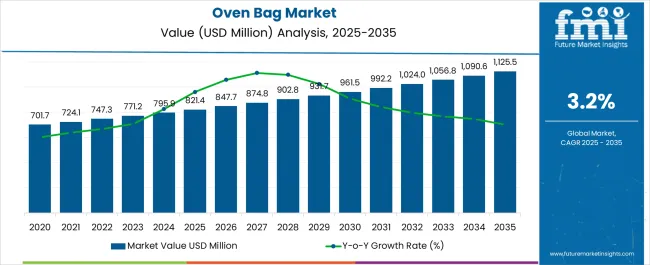
The oven bag market was valued at USD 821.40 million in 2025, projected to reach USD 847.68 million in 2026, and is forecast to expand to USD 1.16 billion by 2036 at a 3.2% CAGR. Based on FMI's analysis, FMI analysts observe that the oven bag market is a mature, steady-growth consumable category driven by household cooking convenience preferences and foodservice operational efficiency requirements. The market tracks household formation rates and food-at-home spending patterns, with demand peaking during holiday cooking seasons (Thanksgiving and Christmas in North America and Europe).
Summary of Oven Bag Market
- Market Snapshot
- The oven bag market is valued at USD 821.40 million in 2025 and is projected to reach USD 1.16 billion by 2036.
- The industry is expected to grow at a 3.2% CAGR from 2026 to 2036, creating an incremental opportunity of USD 313.85 million.
- The market is positioned within the food packaging and cooking consumables sector, where regulatory compliance, technology standards, and procurement cycles define competitive dynamics.
- Demand and Growth Drivers
- Holiday cooking seasonality driving retail volume: Reynolds Consumer Products reports that approximately 40% of annual US oven bag retail sales occur in the eight-week period between early November and late December, driven by Thanksgiving turkey preparation and Christmas roasting.
- Foodservice rotisserie and prepared foods expansion: Grocery store rotisserie chicken programs in the United States, which produce over 1 billion birds annually according to the National Chicken Council, increasingly use oven bags for cooking standardization and moisture retention.
- Sustainable packaging material transition: Consumer and regulatory pressure for reduced plastic usage is driving development of compostable and bio-based oven bag alternatives.
- As per FMI, among key countries, USA leads at 2.3% CAGR, followed by Germany at 2.0%, China at 5.7%, and India at 6.5%.
- Product and Segment View
- The market includes oven bags are heat-resistant, food-safe plastic bags designed for cooking meats, poultry, vegetables, and other foods inside conventional and convection ovens.
- Nylon leads by Material with 33.2% share in 2026.
- Baking Bags leads by Bag Type with 52.9% share in 2026.
- Scope includes oven bags and cooking bags sold globally through retail grocery stores, foodservice distributors, and e-commerce platforms. The scope excludes aluminum foil wraps, parchment paper, silicone baking mats, and general-purpose food storage bags not rated for oven temperatures.
- Geography and Competitive Outlook
- USA and Germany are the fastest-growing markets, while Spain and India represent mature demand bases.
- Competition is shaped by Sirane Ltd and Terinex compete in the European retail and foodservice segments.
- Key companies include Reynolds Consumer Products, Flexipol Packaging Limited, Extra Packaging Corp, Sunkey Plastic Packaging Co. Ltd, Sirane Ltd, Terinex LTD, Yin Tian Industrial Co. Ltd, M&Q Packaging Ltd.
- Analyst Opinion at FMI
- Ismail Sutaria, Principal Consultant for Packaging, opines: 'The transition underway is the shift from basic nylon oven bags to multi-layer films that combine heat resistance with enhanced barrier properties, self-venting features, and printed cooking instructions. Premium oven bags with built-in thermometer windows and pre-measured seasoning compartments are emerging in European retail markets at 2x to 3x the price of standard bags. However, the overall market growth rate remains constrained by the maturity of the product category and competition from alternative cooking methods including air fryers, instant pots, and sheet-pan cooking techniques that have gained consumer popularity.'
- Strategic Implications / Executive Takeaways
- Procurement directors should evaluate supplier qualification timelines against project schedules to avoid delays tied to sourcing dependencies in oven bag.
- Engineering teams must integrate evolving regulatory and performance specifications into design phases to maintain compliance across target markets.
- Operations leaders should benchmark current installed equipment against next-generation specifications to identify upgrade windows that align with maintenance and capital planning cycles.
The transition underway is the shift from basic nylon oven bags to multi-layer films that combine heat resistance with enhanced barrier properties, self-venting features, and printed cooking instructions. Premium oven bags with built-in thermometer windows and pre-measured seasoning compartments are emerging in European retail markets at 2x to 3x the price of standard bags. However, the overall market growth rate remains constrained by the maturity of the product category and competition from alternative cooking methods including air fryers, instant pots, and sheet-pan cooking techniques that have gained consumer popularity.
As per FMI, country-level growth trajectories reflect distinct market structures. USA leads at 2.3% CAGR, Germany registers at 2.0% CAGR, China registers at 5.7% CAGR, Spain registers at 3.4% CAGR, India registers at 6.5% CAGR.
Oven Bag Market Key Takeaways
| Metric | Details |
|---|---|
| Industry Size (2026) | USD 847.68 Million |
| Industry Value (2036) | USD 1.16 Billion |
| CAGR (2026-2036) | 3.2% |
Source: Future Market Insights, 2026
Oven Bag Market Definition
Oven bags are heat-resistant, food-safe plastic bags designed for cooking meats, poultry, vegetables, and other foods inside conventional and convection ovens. These bags are manufactured from nylon, polyester (PET), and polyethylene terephthalate films that withstand temperatures up to 200 to 230 degrees Celsius without melting or releasing harmful chemicals. Oven bags seal moisture and flavor inside the cooking vessel, reduce cooking times by 20% to 30%, and minimize oven cleaning by containing grease and food splatter. The category includes baking bags, roasting bags, slow-cooker liners, and turkey-size bags sold through retail grocery and foodservice supply channels.
Oven Bag Market Inclusions
Market scope covers oven bags and cooking bags sold globally through retail grocery stores, foodservice distributors, and e-commerce platforms. The report includes regional and country-level market sizes, forecast values from 2026 to 2036, segmentation by material, bag type, and end use, along with competitive landscape and consumer usage trend analysis.
Oven Bag Market Exclusions
The scope excludes aluminum foil wraps, parchment paper, silicone baking mats, and general-purpose food storage bags not rated for oven temperatures. Sous vide bags designed for water bath cooking below 100 degrees Celsius and vacuum sealer bags without oven-safe ratings are also omitted.
Oven Bag Market Research Methodology
- Primary Research: Analysts engaged with food packaging and cooking consumables specialists, procurement managers, and end-user operators to map purchase decision triggers and replacement cycles.
- Desk Research: Data collection aggregated regulatory filings, trade body publications, company annual reports, and government statistics across all covered regions.
- Market-Sizing and Forecasting: Baseline values derive from a bottom-up aggregation of product shipments and contract values, applying region-specific adoption curves to project forward demand through 2036.
- Data Validation and Update Cycle: Projections are cross-validated against publicly reported revenue guidance from leading industry participants and independent tracking data.
Beacons to Guide the Oven Bag Market Forward
- Oven bags provide customers with a practical and efficient cooking option that helps simplify meal preparation and requires little work.
- The accelerating trend of pre-prepared and ready-to-cook meals fuels oven bag demand. Such bags facilitate the cooking of pre-marinated or seasoned foods, providing consumers with convenient options for quick and hassle-free meal preparation.
- Oven bags are becoming heavily popular as a protective cooking method, fuels the market expansion as concerns about food safety and cleanliness surge.
Possible Impediments to Oven Bag Market Growth
- The idea of oven bags may not be recognizable to some people, as they impede market penetration in some areas by preferring more conventional cooking techniques, which
- As customers and regulatory agencies place greater emphasis on sustainability, manufacturers may be under pressure for creating eco-friendly substitutes.
Category-wise Insights
The below section shows the leading segment. Based on the bag type, the baking bag segment is accounted to hold a market share of 52.9% in 2025. Based on end-use, the food service outlets segment is accounted to hold a market share of 49.8% in 2025.
The ease of usage and adaptability of baking bags in cooking a wide range of foods exponentiates the market appeal.
Food service establishments use oven bags because of their effectiveness and reliability in cooking food.
| Category | Market Share in 2026 |
|---|---|
| Baking Bag | 52.9% |
| Food Service Outlets | 49.8% |
Baking Bag Segment to Hold a Significant Share in the Market
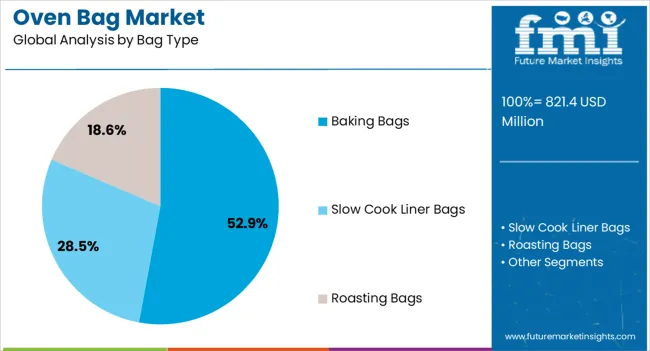
Based on the bag type, the baking bag sector is accounted to hold a market share of 52.9% in 2026. Baking bags are a convenient and mess-free way to cook various meals, including meats, vegetables, and sweets.
The bags are specially made for using it in baking applications. Baking bags are popular because of their adaptability, simplicity of use, and capacity in retaining tastes and juices throughout cooking.
Food Service Outlets Segment to Hold a Dominant Share in the Market
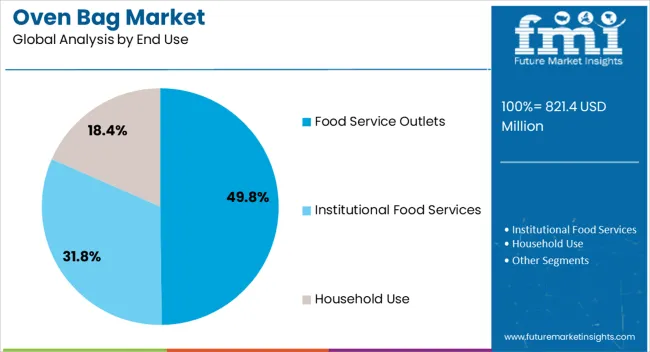
Based on end-user, food service outlets are accounted to hold a market share of 49.8% in 2026. Food service outlets are any number of businesses that largely use oven bags for different types of cooking, including bakeries, cafes, restaurants, and catering services.
Food service establishments easily make and provide a wide variety of foods to their patrons with the use of oven bags. Oven bag usage in these establishments is considerably high.
Country-wise Insights
The table describes about the top five countries ranked by revenue, with India holding the top position.
Oven bags are the most popular in India due to their extensive usage in regular cooking and holiday celebrations. Oven bags are now essential in the homes of India because of their rich culinary history and exponential need for easy cooking options.
The bags thus provide a hassle-free method of making tasty meals that enhance flavor and keep moisture.
.webp "Top Country Growth Comparison Oven Bag Market Cagr (2026 2036)")
| Countries | CAGR |
|---|---|
| United States | 2.3% |
| Germany | 2% |
| China | 5.7% |
| Spain | 3.4% |
| India | 6.5% |
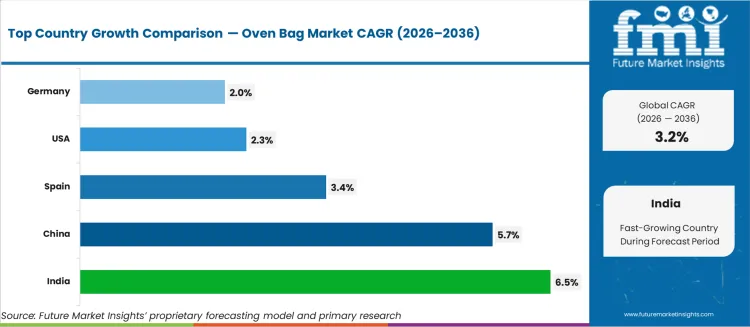
Convenient Home Cooking Surges the United States Market
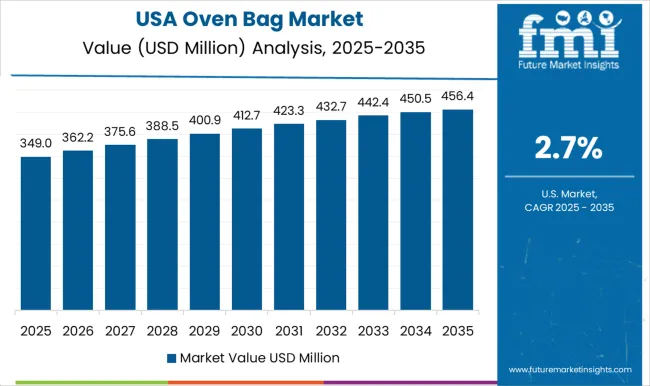
In the United States, consumers predominantly use oven bags for convenient home cooking. The bags offer a hassle-free solution for roasting meats, vegetables, and other dishes in the oven, reducing preparation time and cleanup efforts.
Busy lifestyles broadly focus on convenience, and oven bags have become a popular choice among households in America for preparing delicious and moist meals with minimal fuss.
Gourmet Cooking and Food Culture Improve the Market in Germany
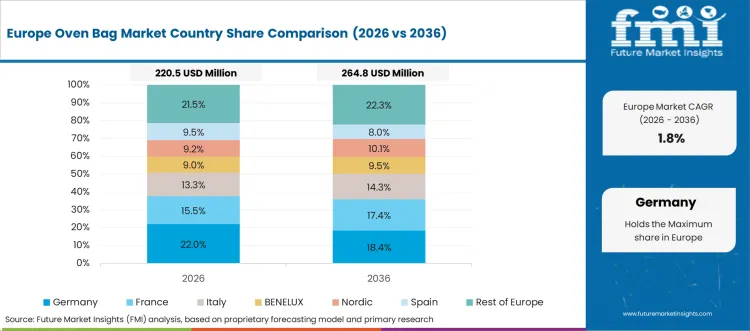
The oven bag market in Germany is often utilized for gourmet cooking and complementing the rich food culture of Germany. The population of Germany values high-quality ingredients and culinary traditions.
The oven bags offer a convenient way of enhancing flavors and retaining moisture in various dishes. For example- From succulent roasts to savory braises, oven bags cater to discerning palates and love flavorful, home-cooked meals of Germany
Rapid Urbanization and Busy Lifestyles of China Treats as an Advantage to the Oven Bag Market
The oven bag market caters to the needs of urban dwellers with busy lifestyles. With rapid urbanization and a growing middle class, convenience became predominant in households in China.
Oven bags save time for cooking delicious meals without extensive preparation or cleanup. Whether roasting meats or steaming vegetables, oven bags offer the consumers of China a convenient way to enjoy home-cooked meals amidst their bustling schedules.
Traditional and Festive Cooking Impresses the Market in Spain
In Spain, the oven bag market is often used for traditional and festive cooking. The population of Spain has a culinary heritage in their genes, and oven bags play a role in preparing traditional dishes such as roasted meats, seafood, and vegetables for family gatherings and celebrations.
For example - Whether it is a special holiday meal or a casual get-together, oven bags prepare flavorful and succulent dishes central to the vibrant food culture of Spain
Boom in Festive Celebrations and Everyday Cooking Escalates the Market in India
The oven bag market is mainly used for festive celebrations and everyday cooking. The households rely on oven bags to prepare dishes ranging from traditional curries and tandoori specialties to baked goods and roasted delicacies.
Oven bags offer the consumers of India a convenient and efficient way of creating flavorful dishes while preserving moisture and enhancing flavors whether they are celebrating festivals or cooking daily meals.
Competitive Landscape
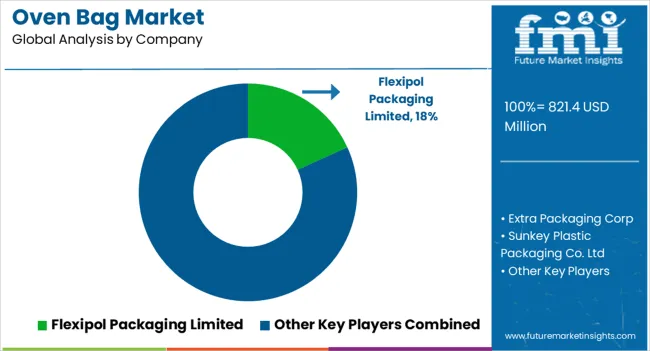
Multinational firms and local producers fight for market share that defines the competitive environment of the oven bag industry. While regional producers concentrate on specialized products or niche markets, multinational corporations use their worldwide presence and resources to maintain a sizable market share.
Some of the key developments are
- In 2025, Extra Packaging Corp. incorporated more environmentally friendly options in response to a surge in consumer demand for eco-friendly packaging options. Oven bags were introduced as they are made of recyclable materials that lessen environmental impact or use eco-friendly production techniques.
- In 2025, Sunkey Plastic Packaging Co., Ltd. improved the functionality and performance of its oven bags.
Key Coverage in the Oven Bag Industry Report
- Adjacent Study on Oven Bag Market
- Myanmar Oven Bag Market
- Oven Bags and Pouches Market Size, Current Insights, and Demographic Trends
- Global Oven Bag Sales Market
- Key Strategies in the Global Oven Bag Market
Scope of the Report
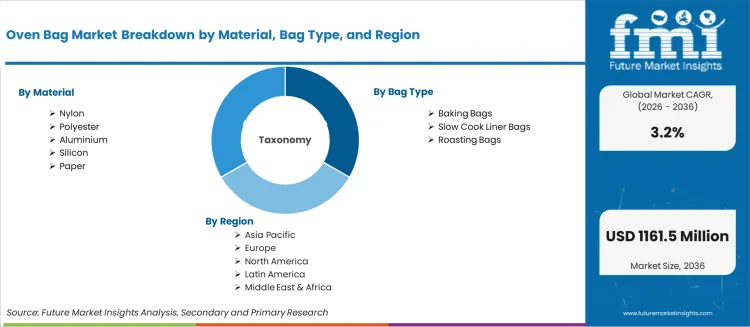
| Metric | Value |
|---|---|
| Quantitative Units | USD 847.68 Million to USD 1.16 Billion, at a CAGR of 3.2% |
| Market Definition | Oven bags are heat-resistant, food-safe plastic bags designed for cooking meats, poultry, vegetables, and other foods inside conventional and convection ovens. These bags are manufactured from nylon, polyester (PET), and polyethylene terephthalate films that withstand temperatures up to 200 to 230 degrees Celsius without melting or releasing harmful chemicals. |
| Material Segmentation | Nylon, Polyester, Aluminium, Silicon, Paper |
| Bag Type Segmentation | Baking Bags, Slow Cook Liner Bags, Roasting Bags |
| End Use Segmentation | Food Service Outlets, Institutional Food Services, Household Use |
| Regions Covered | North America, Latin America, Europe, East Asia, South Asia, Oceania, Middle East & Africa |
| Countries Covered | USA, Germany, China, Spain, India, and 40 plus countries |
| Key Companies Profiled | Reynolds Consumer Products, Flexipol Packaging Limited, Extra Packaging Corp, Sunkey Plastic Packaging Co. Ltd, Sirane Ltd, Terinex LTD, Yin Tian Industrial Co. Ltd, M&Q Packaging Ltd, Xiong Xian Xinhuarui Plastic Co Ltd, Huangshan Sinoflex Packaging Co. Ltd |
| Forecast Period | 2026 to 2036 |
| Approach | Forecasting models apply a bottom-up methodology starting with installed base and shipment data, projecting adoption rates based on regulatory and technology curves. |
Key Segments
By Material:
- Nylon
- Polyester
- Aluminium
- Silicon
- Paper
By Bag Type:
- Roasting Bags
- Baking Bags
- Slow Cook Liner Bags
By End Use:
- Food Service Outlets
- Full Service Restaurants (FSR)
- Quick Service Restaurants (QSR)
- Catering Services
- Hotels and Lodgings
- Food Courts
- Others (Café, Pub, Bar, etc.)
- Institutional Food Services
- Hospitals
- Schools
- Offices
- Household Use
By Region:
- North America
- Latin America
- Western Europe
- Eastern Europe
- South Asia and Pacific
- East Asia
- The Middle East and Africa
Bibliography
- 1. National Chicken Council. (2024). Broiler Chicken Industry Key Facts 2024. NCC.
- 2. European Parliament. (2019). Directive (EU) 2019/904 on Reduction of Impact of Certain Plastic Products. EUR-Lex.
- 3. Reynolds Consumer Products Inc. (2024). Annual Report 2023. Reynolds.
- 4. Sirane Ltd. (2024). Sustainable Food Packaging Solutions Catalog. Sirane.
- 5. European Committee for Standardization. (2023). EN 13432: Packaging Recoverable Through Composting. CEN.
- 6. United States Department of Agriculture. (2024). Food Safety and Inspection Service: Safe Minimum Internal Temperatures. USDA.
This bibliography is provided for reader reference. The full Future Market Insights report contains the complete reference list with primary research documentation.
Frequently Asked Questions
How large is the demand for Oven Bag in the global market in 2026?
Demand for oven bag in the global market is estimated to be valued at USD 847.68 million in 2026.
What will be the market size of Oven Bag in the global market by 2036?
Market size for oven bag is projected to reach USD 1.16 billion by 2036.
What is the expected demand growth for Oven Bag in the global market between 2026 and 2036?
Demand for oven bag is expected to grow at a CAGR of 3.2% between 2026 and 2036.
Which Material is poised to lead global sales by 2026?
Nylon accounts for 33.2% share in 2026, driven by established adoption patterns across primary end-use applications.
What is driving demand in USA?
USA leads with a 2.3% CAGR through 2036, driven by expanding capacity and increasing regulatory alignment with international standards.
What is the Germany growth outlook in this report?
Germany is projected to grow at a CAGR of 2.0% during 2026 to 2036.
What is Oven Bag and what is it mainly used for?
Oven bags are heat-resistant, food-safe plastic bags designed for cooking meats, poultry, vegetables, and other foods inside conventional and convection ovens. These bags are manufactured from nylon, polyester (PET), and polyethylene terephthalate films that withstand temperatures up to 200 to 230 degrees Celsius without melting or releasing harmful chemicals.
How does FMI build and validate the Oven Bag forecast?
Future Market Insights analysis applies a bottom-up methodology starting with global installed base metrics and cross-validates projections against reported industry expenditure and regulatory compliance data.
Preview the report firsthand - request a free sample
Get SampleGet the brochure for pricing and purchase details.
Get PDFTable of Content
- Executive Summary
- Global Market Outlook
- Demand-side Trends
- Supply-side Trends
- Technology Roadmap Analysis
- Analysis and Recommendations
- Market Overview
- Market Coverage / Taxonomy
- Market Definition / Scope / Limitations
- Research Methodology
- Chapter Orientation
- Analytical Lens and Working Hypotheses
- Market Structure, Signals, and Trend Drivers
- Benchmarking and Cross-market Comparability
- Market Sizing, Forecasting, and Opportunity Mapping
- Research Design and Evidence Framework
- Desk Research Programme (Secondary Evidence)
- Company Annual and Sustainability Reports
- Peer-reviewed Journals and Academic Literature
- Corporate Websites, Product Literature, and Technical Notes
- Earnings Decks and Investor Briefings
- Statutory Filings and Regulatory Disclosures
- Technical White Papers and Standards Notes
- Trade Journals, Industry Magazines, and Analyst Briefs
- Conference Proceedings, Webinars, and Seminar Materials
- Government Statistics Portals and Public Data Releases
- Press Releases and Reputable Media Coverage
- Specialist Newsletters and Curated Briefings
- Sector Databases and Reference Repositories
- FMI Internal Proprietary Databases and Historical Market Datasets
- Subscription Datasets and Paid Sources
- Social Channels, Communities, and Digital Listening Inputs
- Additional Desk Sources
- Expert Input and Fieldwork (Primary Evidence)
- Primary Modes
- Qualitative Interviews and Expert Elicitation
- Quantitative Surveys and Structured Data Capture
- Blended Approach
- Why Primary Evidence is Used
- Field Techniques
- Interviews
- Surveys
- Focus Groups
- Observational and In-context Research
- Social and Community Interactions
- Stakeholder Universe Engaged
- C-suite Leaders
- Board Members
- Presidents and Vice Presidents
- R&D and Innovation Heads
- Technical Specialists
- Domain Subject-matter Experts
- Scientists
- Physicians and Other Healthcare Professionals
- Governance, Ethics, and Data Stewardship
- Research Ethics
- Data Integrity and Handling
- Primary Modes
- Tooling, Models, and Reference Databases
- Desk Research Programme (Secondary Evidence)
- Data Engineering and Model Build
- Data Acquisition and Ingestion
- Cleaning, Normalisation, and Verification
- Synthesis, Triangulation, and Analysis
- Quality Assurance and Audit Trail
- Market Background
- Market Dynamics
- Drivers
- Restraints
- Opportunity
- Trends
- Scenario Forecast
- Demand in Optimistic Scenario
- Demand in Likely Scenario
- Demand in Conservative Scenario
- Opportunity Map Analysis
- Product Life Cycle Analysis
- Supply Chain Analysis
- Investment Feasibility Matrix
- Value Chain Analysis
- PESTLE and Porter’s Analysis
- Regulatory Landscape
- Regional Parent Market Outlook
- Production and Consumption Statistics
- Import and Export Statistics
- Market Dynamics
- Global Market Analysis 2021 to 2025 and Forecast, 2026 to 2036
- Historical Market Size Value (USD Million) Analysis, 2021 to 2025
- Current and Future Market Size Value (USD Million) Projections, 2026 to 2036
- Y-o-Y Growth Trend Analysis
- Absolute $ Opportunity Analysis
- Global Market Pricing Analysis 2021 to 2025 and Forecast 2026 to 2036
- Global Market Analysis 2021 to 2025 and Forecast 2026 to 2036, By Material
- Introduction / Key Findings
- Historical Market Size Value (USD Million) Analysis By Material , 2021 to 2025
- Current and Future Market Size Value (USD Million) Analysis and Forecast By Material , 2026 to 2036
- Nylon
- Polyester
- Aluminium
- Silicon
- Paper
- Nylon
- Y-o-Y Growth Trend Analysis By Material , 2021 to 2025
- Absolute $ Opportunity Analysis By Material , 2026 to 2036
- Global Market Analysis 2021 to 2025 and Forecast 2026 to 2036, By Bag Type
- Introduction / Key Findings
- Historical Market Size Value (USD Million) Analysis By Bag Type, 2021 to 2025
- Current and Future Market Size Value (USD Million) Analysis and Forecast By Bag Type, 2026 to 2036
- Baking Bags
- Slow Cook Liner Bags
- Roasting Bags
- Baking Bags
- Y-o-Y Growth Trend Analysis By Bag Type, 2021 to 2025
- Absolute $ Opportunity Analysis By Bag Type, 2026 to 2036
- Global Market Analysis 2021 to 2025 and Forecast 2026 to 2036, By End Use
- Introduction / Key Findings
- Historical Market Size Value (USD Million) Analysis By End Use, 2021 to 2025
- Current and Future Market Size Value (USD Million) Analysis and Forecast By End Use, 2026 to 2036
- Food Service Outlets
- Institutional Food Services
- Household Use
- Food Service Outlets
- Y-o-Y Growth Trend Analysis By End Use, 2021 to 2025
- Absolute $ Opportunity Analysis By End Use, 2026 to 2036
- Global Market Analysis 2021 to 2025 and Forecast 2026 to 2036, By Region
- Introduction
- Historical Market Size Value (USD Million) Analysis By Region, 2021 to 2025
- Current Market Size Value (USD Million) Analysis and Forecast By Region, 2026 to 2036
- North America
- Latin America
- Western Europe
- Eastern Europe
- East Asia
- South Asia and Pacific
- Middle East & Africa
- Market Attractiveness Analysis By Region
- North America Market Analysis 2021 to 2025 and Forecast 2026 to 2036, By Country
- Historical Market Size Value (USD Million) Trend Analysis By Market Taxonomy, 2021 to 2025
- Market Size Value (USD Million) Forecast By Market Taxonomy, 2026 to 2036
- By Country
- USA
- Canada
- Mexico
- By Material
- By Bag Type
- By End Use
- By Country
- Market Attractiveness Analysis
- By Country
- By Material
- By Bag Type
- By End Use
- Key Takeaways
- Latin America Market Analysis 2021 to 2025 and Forecast 2026 to 2036, By Country
- Historical Market Size Value (USD Million) Trend Analysis By Market Taxonomy, 2021 to 2025
- Market Size Value (USD Million) Forecast By Market Taxonomy, 2026 to 2036
- By Country
- Brazil
- Chile
- Rest of Latin America
- By Material
- By Bag Type
- By End Use
- By Country
- Market Attractiveness Analysis
- By Country
- By Material
- By Bag Type
- By End Use
- Key Takeaways
- Western Europe Market Analysis 2021 to 2025 and Forecast 2026 to 2036, By Country
- Historical Market Size Value (USD Million) Trend Analysis By Market Taxonomy, 2021 to 2025
- Market Size Value (USD Million) Forecast By Market Taxonomy, 2026 to 2036
- By Country
- Germany
- UK
- Italy
- Spain
- France
- Nordic
- BENELUX
- Rest of Western Europe
- By Material
- By Bag Type
- By End Use
- By Country
- Market Attractiveness Analysis
- By Country
- By Material
- By Bag Type
- By End Use
- Key Takeaways
- Eastern Europe Market Analysis 2021 to 2025 and Forecast 2026 to 2036, By Country
- Historical Market Size Value (USD Million) Trend Analysis By Market Taxonomy, 2021 to 2025
- Market Size Value (USD Million) Forecast By Market Taxonomy, 2026 to 2036
- By Country
- Russia
- Poland
- Hungary
- Balkan & Baltic
- Rest of Eastern Europe
- By Material
- By Bag Type
- By End Use
- By Country
- Market Attractiveness Analysis
- By Country
- By Material
- By Bag Type
- By End Use
- Key Takeaways
- East Asia Market Analysis 2021 to 2025 and Forecast 2026 to 2036, By Country
- Historical Market Size Value (USD Million) Trend Analysis By Market Taxonomy, 2021 to 2025
- Market Size Value (USD Million) Forecast By Market Taxonomy, 2026 to 2036
- By Country
- China
- Japan
- South Korea
- By Material
- By Bag Type
- By End Use
- By Country
- Market Attractiveness Analysis
- By Country
- By Material
- By Bag Type
- By End Use
- Key Takeaways
- South Asia and Pacific Market Analysis 2021 to 2025 and Forecast 2026 to 2036, By Country
- Historical Market Size Value (USD Million) Trend Analysis By Market Taxonomy, 2021 to 2025
- Market Size Value (USD Million) Forecast By Market Taxonomy, 2026 to 2036
- By Country
- India
- ASEAN
- Australia & New Zealand
- Rest of South Asia and Pacific
- By Material
- By Bag Type
- By End Use
- By Country
- Market Attractiveness Analysis
- By Country
- By Material
- By Bag Type
- By End Use
- Key Takeaways
- Middle East & Africa Market Analysis 2021 to 2025 and Forecast 2026 to 2036, By Country
- Historical Market Size Value (USD Million) Trend Analysis By Market Taxonomy, 2021 to 2025
- Market Size Value (USD Million) Forecast By Market Taxonomy, 2026 to 2036
- By Country
- Kingdom of Saudi Arabia
- Other GCC Countries
- Turkiye
- South Africa
- Other African Union
- Rest of Middle East & Africa
- By Material
- By Bag Type
- By End Use
- By Country
- Market Attractiveness Analysis
- By Country
- By Material
- By Bag Type
- By End Use
- Key Takeaways
- Key Countries Market Analysis
- USA
- Pricing Analysis
- Market Share Analysis, 2025
- By Material
- By Bag Type
- By End Use
- Canada
- Pricing Analysis
- Market Share Analysis, 2025
- By Material
- By Bag Type
- By End Use
- Mexico
- Pricing Analysis
- Market Share Analysis, 2025
- By Material
- By Bag Type
- By End Use
- Brazil
- Pricing Analysis
- Market Share Analysis, 2025
- By Material
- By Bag Type
- By End Use
- Chile
- Pricing Analysis
- Market Share Analysis, 2025
- By Material
- By Bag Type
- By End Use
- Germany
- Pricing Analysis
- Market Share Analysis, 2025
- By Material
- By Bag Type
- By End Use
- UK
- Pricing Analysis
- Market Share Analysis, 2025
- By Material
- By Bag Type
- By End Use
- Italy
- Pricing Analysis
- Market Share Analysis, 2025
- By Material
- By Bag Type
- By End Use
- Spain
- Pricing Analysis
- Market Share Analysis, 2025
- By Material
- By Bag Type
- By End Use
- France
- Pricing Analysis
- Market Share Analysis, 2025
- By Material
- By Bag Type
- By End Use
- India
- Pricing Analysis
- Market Share Analysis, 2025
- By Material
- By Bag Type
- By End Use
- ASEAN
- Pricing Analysis
- Market Share Analysis, 2025
- By Material
- By Bag Type
- By End Use
- Australia & New Zealand
- Pricing Analysis
- Market Share Analysis, 2025
- By Material
- By Bag Type
- By End Use
- China
- Pricing Analysis
- Market Share Analysis, 2025
- By Material
- By Bag Type
- By End Use
- Japan
- Pricing Analysis
- Market Share Analysis, 2025
- By Material
- By Bag Type
- By End Use
- South Korea
- Pricing Analysis
- Market Share Analysis, 2025
- By Material
- By Bag Type
- By End Use
- Russia
- Pricing Analysis
- Market Share Analysis, 2025
- By Material
- By Bag Type
- By End Use
- Poland
- Pricing Analysis
- Market Share Analysis, 2025
- By Material
- By Bag Type
- By End Use
- Hungary
- Pricing Analysis
- Market Share Analysis, 2025
- By Material
- By Bag Type
- By End Use
- Kingdom of Saudi Arabia
- Pricing Analysis
- Market Share Analysis, 2025
- By Material
- By Bag Type
- By End Use
- Turkiye
- Pricing Analysis
- Market Share Analysis, 2025
- By Material
- By Bag Type
- By End Use
- South Africa
- Pricing Analysis
- Market Share Analysis, 2025
- By Material
- By Bag Type
- By End Use
- USA
- Market Structure Analysis
- Competition Dashboard
- Competition Benchmarking
- Market Share Analysis of Top Players
- By Regional
- By Material
- By Bag Type
- By End Use
- Competition Analysis
- Competition Deep Dive
- Reynolds Consumer Products
- Overview
- Product Portfolio
- Profitability by Market Segments (Product/Age /Sales Channel/Region)
- Sales Footprint
- Strategy Overview
- Marketing Strategy
- Product Strategy
- Channel Strategy
- Flexipol Packaging Limited
- Extra Packaging Corp
- Sunkey Plastic Packaging Co. Ltd
- Sirane Ltd
- Terinex LTD
- Yin Tian Industrial Co. Ltd
- M&Q Packaging Ltd
- Xiong Xian Xinhuarui Plastic Co Ltd
- Huangshan Sinoflex Packaging Co. Ltd
- Reynolds Consumer Products
- Competition Deep Dive
- Assumptions & Acronyms Used


