

- Market Size (2026)
- USD 399.6 Mn
- Forecast (2036)
- USD 686.5 Mn
- CAGR (2026 to 2036)
- 5.6%
How big is Oxygen-Scavenger Paper Packaging Market in 2026?
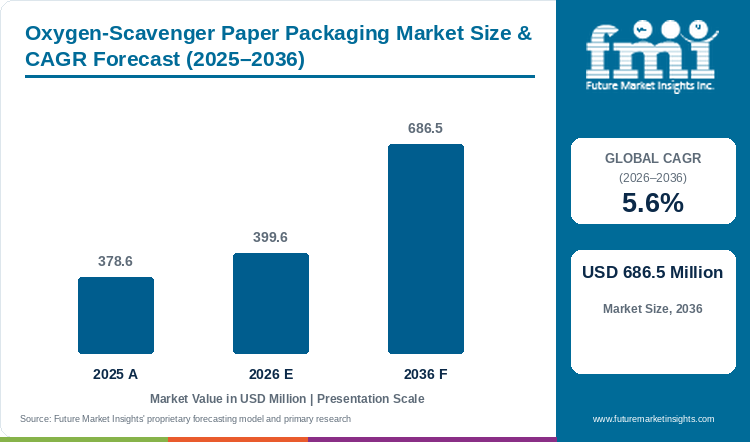
Demand for oxygen-scavenger paper packaging is projected to expand at 5.6% CAGR between 2026 and 2036. Industry value grows from USD 378.6 million in 2025 to USD 399.6 million in 2026 and is projected to reach USD 686.5 million by 2036.
The oxygen-scavenger paper packaging market is valued at USD 399.6 million in 2026, against USD 378.6 million in 2025, and is projected to reach USD 686.5 million by 2036 at 5.6% CAGR. As per FMI, iron-based systems will account for 45.1% of scavenger chemistry demand in 2026 as food manufacturers integrate active packaging formats into established packing lines. Indonesia generates 23 million to 48 million tonnes of food loss and waste every year, equal to 115 to 184 kg per person, which is creating demand for longer shelf-life packaging.[1] OxySorb states that oxygen can be reduced to 0.01% inside sealed packs, with absorber capacities ranging from 20 cc to 3,000 cc to match container volume without changing the complete paper pack.[2]
Key Market Trends & Insights
- By scavenger chemistry, iron-based systems led the market with 45.1% share in 2026, supported by its use in moisture-activated absorber packets.
- By paper substrate, coated paper accounted for 36.0% of demand in 2026, as a functional layer can be applied during established paper converting operations.
- By integration method, sachet and pad inserts represented 31.2% in 2026, while available absorber sizes from 20 cc to 3,000 cc supports use across different pack volumes.
- By end use, food and beverage held 48.0% share in 2026, aligned with food-loss reduction programs and longer distribution requirement.
Regional Highlights
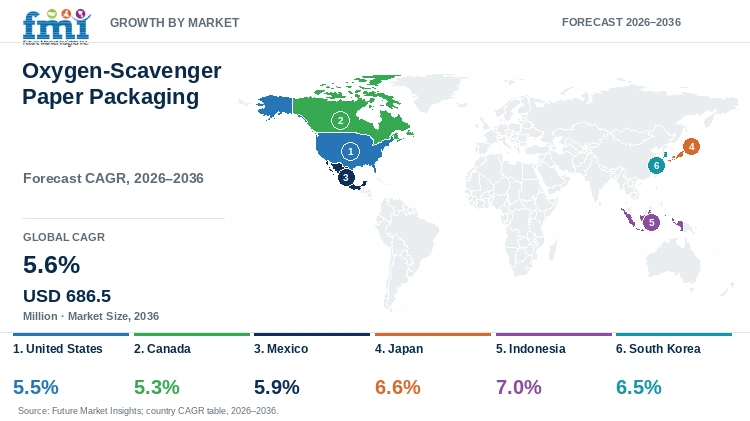
- Fastest-growing profiled country: Indonesia (7.0% CAGR, 2026 to 2036).
- Japan and South Korea are projected at 6.6% and 6.5%, respectively, while Canada records the lowest profiled CAGR at 5.3%.
Market Size & Forecast
Table 1: Market Size and Forecast for the Oxygen-Scavenger Paper Packaging Market (USD million and percentage), 2025 to 2036
| Metric | Value |
|---|---|
| 2025 Market Size | USD 378.6 million |
| Estimated Market Size in 2026 | USD 399.6 million |
| Projected Market Size by 2036 | USD 686.5 million |
| CAGR, 2026 to 2036 | 5.6% |
| Added Revenue, 2026 to 2036 | USD 286.9 million |
| Market Expansion Multiple | 1.72x |
Sachet and pad inserts are expected to hold 31.2% of demand by integration method in 2026, as packers can change absorber capacity without changing the carton or paper liner. Japan recorded 38.97 million tonnes of municipal waste and 851 grams per person per day, keeping recovery performance as an important requirement for active paper structures.[3]Indonesia follows a different demand pattern, where the government has set a food-rescue target of 3% to 5% per year during 2025 to 2029.[4]These conditions are expected to keep insert formats preferred for immediate use, while coated and embedded formats will grow where repulping performance is already proven in commercial paper packaging applications.
Packaging Recovery and Oxygen-Control Readiness
Oxygen-scavenger paper packaging creates value when oxygen removal, absorber size and paper recovery works in one packaging structure. Lower residual oxygen protects flavour and colour, while suitable packet capacity avoids the use of more than one absorber. Paper recovery becomes the final buying condition after product use, due to which suppliers providing both protection and repulping evidence are expected to receive wider commercial orders.
Table 2: Packaging Recovery and Oxygen-Control Readiness for the Oxygen-Scavenger Paper Packaging Market (percentages, tonnes, grams, kilograms, and packet capacities), mixed reporting years from 2025 to 2026
| Indicator | Data Point | Why It Matters | Source |
|---|---|---|---|
| Global market expansion | USD 399.6 million in 2026 to USD 686.5 million by 2036 | Adds USD 286.9 million in forecast revenue as active paper formats enter more food packs. | Report estimate |
| Iron-based chemistry share | 45.1% in 2026 | Shows present preference for absorber chemistry that can be used in packets and pads. | Report estimate |
| Residual oxygen performance | As low as 0.01% | Supports oxidation control in sealed packs where flavour and colour stability affects shelf life. | [2] |
| Available absorber capacity | 20 cc to 3,000 cc | Allows capacity to be selected according to headspace and container size. | [2] |
| Indonesia food loss and waste | 23 to 48 million tonnes per year; 115 to 184 kg per person | Creates measurable demand for packaging which can reduce quality loss during storage and distribution. | [1] |
| Indonesia food-rescue target | 3% to 5% per year, 2025 to 2029 | Connects shelf-life packaging with a stated national food-recovery program. | [4] |
| Japan municipal waste | 38.97 million tonnes; 851 grams per person per day | Increases the requirement for active paper structures which can be separated or recovered. | [3] |
| Packaging direction | 40 attendees from 20 countries at the May 2025 WPO meeting | Shows that recycling, food waste and packaging rules are being reviewed together across markets. | [5] |
Analyst Perspective
“Food brands will move first where longer shelf life recovers the added absorber and testing cost. Packs combining measurable oxygen control with paper recovery will receive the largest repeat orders from food brands.”
- Nandini Roy Choudhury, Principal Consultant, Future Market Insights.
How is the oxygen-scavenger paper packaging market segmented?
Oxygen-scavenger paper packaging market is segmented on the basis of scavenger chemistry, paper substrate, integration method, end use and region. Iron-based systems is projected to hold 45.1% share in 2026, while coated paper is estimated at 36.0%. Sachet and pad inserts accounts for 31.2% and food and beverage is expected to hold 48.0% during the same year.
By scavenger chemistry: iron-based systems, ascorbate and organic systems, enzyme-based systems, polymer-integrated systems, and bio-scavengers.
By paper substrate: kraft, coated paper, paperboard, corrugated liner, and multilayer bio-papers.
By integration method: sachet and pad inserts, coatings, embedded layers, and labels and patches.
By end use: food and beverage, pharmaceuticals and nutraceuticals, pet food, and industrial and chemical.
By region: North America, Latin America, Western Europe, Eastern Europe, East Asia, South Asia and Pacific, and Middle East and Africa.
Why do iron-based systems retain a notable chemistry share?
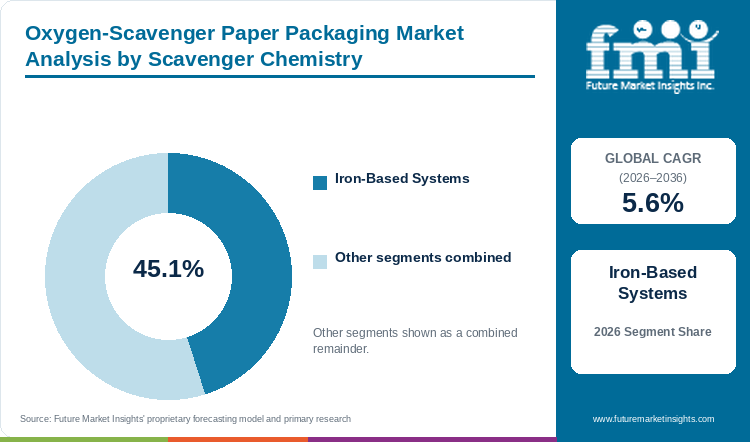
Iron-based systems are projected to hold 45.1% of scavenger chemistry revenue in 2026, owing to dependable oxygen absorption performance.
Table 3: Scavenger Chemistry Share for the Oxygen-Scavenger Paper Packaging Market (percentage share), 2026
| Scavenger Chemistry | Share (2026) |
|---|---|
| Iron-Based Systems | 45.1% |
| Other Segments Combined | 54.9%* |
| Total | 100.0% |
*Calculated as the balance remaining after deducting the leading segment's reported share from 100.0%.
Table 4: Scavenger Chemistry Leadership and Market Growth for the Oxygen-Scavenger Paper Packaging Market (segment and CAGR percentage), 2026 to 2036
| Metric | Value |
|---|---|
| Global CAGR (2026 to 2036) | 5.6% |
| Leading Segment | Iron-Based Systems |
Iron-based oxygen scavengers contain iron powder which reacts with oxygen after moisture enters the packet. These packets are widely adopted across food packaging and commercial bakery lines as the absorber capacity can be selected according to headspace volume. In the FMI report, iron-based systems will hold 45.1% in 2026, owing to its known performance and easier use on existing filling lines.
- Iron-based systems account for 45.1% in 2026 because their capacity can be selected for a defined pack volume.
- Mitsubishi Gas Chemical states that its AGELESS iron-based absorbers reduce residual oxygen inside sealed packaging to below 0.1%.[6]
What supports coated paper as a preferred substrate choice?
With an estimated 36.0% share in 2026, coated paper leads paper substrate demand, supported by seamless integration into existing converting lines.
Coated paper carries the active material on its surface and can be converted into wraps, liners and cartons, functioning alongside advanced barrier coated papers to restrict moisture and gas ingress. Paper converters can apply the functional layer during coating operation, due to which separate packet placement is not required. However, the coating has to disperse or separate during repulping. According to FMI, coated paper will account for 36.0% of paper substrate demand in 2026 as converters prefer formats which can be produced on existing equipment.
- Coated paper represents 36.0% in 2026 as converters can apply functional layers during established coating operations.
- The American Forest & Paper Association reported that the U.S. paper recycling rate reached 61% to 65% in 2025, highlighting established recovery infrastructure for fiber packaging.[7]
Why are sachet and pad inserts used in active packs?
Sachet and pad inserts are anticipated to capture 31.2% of integration method revenue in 2026, driven by modular capacity selection for varied containers.
Sachet and pad inserts are placed inside sealed packs for absorbing oxygen which remains after filling, providing dependable protection when paired with paper-based primary pouches or modifying external flexible packaging structures. Packers can select the absorber according to headspace without changing the complete carton or liner. FMI research indicates that sachet and pad inserts will hold 31.2% in 2026, as easier insertion and different packet sizes supports use across several pack volumes.
- Sachet and pad inserts hold 31.2% in 2026 because packers can match capacity to headspace and shelf life.
- Drycon lists 20 cc, 30 cc, and 50 cc packet formats for food and nutraceutical packaging.[8]
How does food and beverage use shape end-use demand?
Food and beverage is projected to represent 48.0% of end-use demand in 2026, reflecting commercial urgency to curb packaged-product oxidation and food loss.
Food products containing fats, flavours, colours and vitamins can lose quality when oxygen remains inside the pack. Bakery products, dry foods and nutrient-sensitive products therefore use oxygen scavengers where longer storage is required. FMI data suggests that food and beverage will hold 48.0% of end-use revenue in 2026 as packed-sustainable packaging distribution expands across longer commercial supply routes.
- Food and beverage accounts for 48.0% in 2026 as shelf-life protection can reduce loss before sale.
- The World Packaging Organisation connected packaging development with food-waste reduction and recycling during 2025.[5]
What are the drivers, restraints, and opportunities in the oxygen-scavenger paper packaging market?
In the oxygen-scavenger paper packaging market, shelf-life protection is the key driver, coating recovery is the key restraint, and food-waste reduction is the key opportunity.
- Driver: Oxygen removal protects flavour, colour, nutrients, and product stability during extended storage.
- Restraint: Barrier coatings and embedded reactive layers can reduce repulping yield or complicate food-contact qualification.
- Opportunity: Fibre-based active packs can serve brands seeking product protection with lower dependence on plastic structures.
Shelf-Life Protection Expands Use
Longer shelf life is one of the primary factors driving oxygen-scavenger paper packaging demand. In December 2025, the U.S. Environmental Protection Agency updated its 2030 Food Loss and Waste Reduction Goal, highlighting active packaging and preservation technologies that extend product shelf life across commercial supply chains.[9]Food manufacturers are expected to deploy these active inserts alongside smart food packaging solutions where the reduction in product loss covers the absorber and testing cost. Oxygen absorbers remove oxygen remaining after sealing, due to which flavour, colour and fat quality can be retained for a longer period. Wider application in dry foods and bakery products is likely to propel market growth over the forecast period.
Coating Recovery Limits Adoption
Barrier coatings, adhesives and reactive layers can affect paper recovery after product use, particularly when converters laminate functional films onto polycoated paper packaging substrates. Paper mills require recovered fibre to meet composition and chemical specifications, whereas some active layers can leave residue or reduce fibre yield. U.S. EPA guidance describes the accepted requirements for recovered paper grades.[10]Difficulty in combining oxygen protection with repulping performance may limit adoption among brands making recyclable packaging claims.
Food-Loss Programs Create Openings
Food-loss programs are creating new avenues for oxygen-scavenger paper packaging manufacturers. In March 2026, the United Nations Environment Programme, marking the International Day of Zero Waste, reported that food loss and waste generates up to 10% of global greenhouse gas emissions, driving commercial demand for active preservation solutions.[11]Paper inserts and coated liners are therefore expected to gain wider use where manufacturers require extended shelf life without compromising the recyclability of kraft papers and virgin board. Oxygen control cannot remove transport losses, but it can reduce oxidation in dry foods, bakery products and nutrient-sensitive products.
Which country CAGRs are profiled in the oxygen-scavenger paper packaging market?
Table 5: Country CAGR Comparison for the Oxygen-Scavenger Paper Packaging Market (CAGR percentage), 2026 to 2036
| Country | CAGR |
|---|---|
| United States | 5.5% |
| Canada | 5.3% |
| Mexico | 5.9% |
| Japan | 6.6% |
| Indonesia | 7.0% |
| South Korea | 6.5% |
How do country-level CAGRs compare in this market?
Commercial conditions differ across the profiled countries owing to established recovery programs and producer responsibility rules. As per the analysis from FMI, Indonesia leads the profiled countries at 7.0% CAGR, followed by Japan at 6.6% and South Korea at 6.5% through 2036. Demand in Indonesia is linked with food-loss reduction and longer domestic distribution, whereas Japan and South Korea place higher requirements on material separation and recovery. Canada will grow at 5.3% CAGR as environmental claims require stronger product and recovery evidence.
- United States demand is supported by established recovered-paper collection and expansion of packaging producer-responsibility programs.
- Canada market is influenced by provincial recycling programs and increasing examination of recyclable and compostable packaging claims.
- Mexico packaging demand is supported by expansion of packaged-food distribution and national waste-prevention requirement.
- Japan has separate collection and recycling obligations for paper containers, due to which recoverable active packs can gain wider use.
- Indonesia is witnessing increasing requirement for longer storage packaging as the country is focusing on reduction of food loss.
- South Korea applies producer responsibility and material separation rules, which is influencing the development of fibre-based packaging.
Full report country CAGRs cover: North America; Latin America; Western Europe; Eastern Europe; East Asia; South Asia and Pacific; Middle East and Africa.
Country-wise Analysis
- Demand for oxygen-scavenger paper packaging in the United States is forecast to rise at 5.5% CAGR over the forecast period. The U.S. EPA estimated that USD 36.5 billion to USD 43.4 billion is required for modernizing recycling collection and processing infrastructure.[12] Paper, cardboard and packaging are included among materials having national end markets, accelerating the commercialization of aseptic paper packaging and high-recovery cartonboards. Availability of recovered-paper collection supports the use of fibre packs, however coatings and oxygen absorber inserts requires acceptance by paper mills. Oregon also started packaging producer fees in July 2025. Growing focus on recovered paper along with producer responsibility is expected to support oxygen-scavenger paper packaging demand in the United States.
- Canada oxygen-scavenger paper packaging market is estimated to post 5.3% CAGR over the forecast period. Provincial recovery programs are increasing attention on packaging material and environmental claims. In March 2026, the Competition Bureau stated that environmental claims for products requires adequate testing.[13] Oxygen-scavenger paper packaging manufacturers therefore requires evidence for oxygen absorption as well as recyclable or compostable statements. Fibre-based packs can reduce use of plastic material, however the complete construction needs to meet the stated recovery claim. Increasing requirement for tested product and environmental performance is anticipated to support steady market growth in Canada.
- The Mexico oxygen-scavenger paper packaging sector is projected to record 5.9% CAGR during the assessment period. Mexico’s General Law for the Prevention and Comprehensive Management of Waste covers prevention, recovery and management of municipal and special-handling waste, with official regulatory provisions updated in May 2025.[14] Oxygen-scavenger paper packs can protect dry foods during regional distribution where heat and delivery period can increase oxidation. Availability of affordable paper converters and separate handling of reactive inserts is expected to increase product use. Expansion of packaged-food distribution is likely to propel the Mexico oxygen-scavenger paper packaging market growth.
- Japan oxygen-scavenger paper packaging market is projected to grow at 6.6% CAGR through 2036. In June 2025, Japan's Ministry of the Environment reported that national food loss and waste stood at approximately 4.64 million tonnes in FY2023, with commercial businesses generating 2.31 million tonnes.[15] Japan’s Container and Packaging Recycling Act assigns sorting to consumers and municipalities, while businesses supports recycling cost. Oxygen absorbers already have use in food packaging, due to which paper sachets, liners and coated cartons can gain wider application. However, mixed materials requires suitable separation and recycling performance. Presence of established food-packaging and recovery systems is expected to support the Japan market growth.
- Adoption of oxygen-scavenger paper packaging in Indonesia is estimated to expand at 7.0% CAGR through 2036. In November 2025, the National Food Agency reported that up to 31% of food is lost along national supply chains and expanded its food rescue movement across 17 provinces.[16] Oxygen-scavenger paper packaging can reduce oxidation in dry foods, bakery products and nutrient-sensitive products during long domestic distribution. Paper inserts and coated liners can also be added with limited change in packing operation. Increasing requirement for reducing packaged-food loss is expected to drive the market growth in Indonesia.
- Sales of oxygen-scavenger paper packaging in South Korea are forecast to expand at 6.5% CAGR through 2036. Packaging rules requires material identification and recovery obligations for designated producers. A 2025 packaging regulation review hosted by the Korean Ministry of Government Legislation noted that 50% of paper used in the European Union goes into packaging.[17] South Korean food exporters are therefore expected to increase testing of fibre formats which provides barrier and oxygen-control performance. Coatings and labels which can be used on automated packing lines are likely to receive higher demand. Expansion of export-oriented food packaging is anticipated to support the market revenue growth.
Who are the notable companies in the oxygen-scavenger paper packaging market?
Mitsubishi Gas Chemical, Sealed Air, Multisorb Technologies, Mondi, Stora Enso, Ahlstrom, Nippon Paper Industries, and Amcor are notable companies profiled in this market.
Oxygen-scavenger paper packaging market is moderately fragmented as chemistry suppliers, paper manufacturers and packaging converters serves different parts of the pack. Mitsubishi Gas Chemical and Multisorb Technologies offers oxygen-control products, while Mondi, Stora Enso, Ahlstrom and Nippon Paper Industries supplies paper materials. Sealed Air and Amcor provides finished packaging and converting capability. As noted by FMI, suppliers having food-contact evidence, packing-line support and paper recovery performance are expected to gain repeat orders through 2036.
- Oxygen-control companies: Mitsubishi Gas Chemical and Multisorb Technologies are offering oxygen absorber technologies in different formats.
- Paper companies: Mondi, Stora Enso, Ahlstrom and Nippon Paper Industries are supplying fibre substrates, coated papers and converting capability.
- Packaging companies: Sealed Air and Amcor are integrating active materials with filling, sealing and finished packaging requirement.
Competitive Benchmarking: Oxygen-Scavenger Paper Packaging Market
Table 6: Competitive Benchmarking for the Oxygen-Scavenger Paper Packaging Market (qualitative capability ratings), 2026
| Company | Scavenger Depth | Paper Capability | Current Activity | Geographic Reach |
|---|---|---|---|---|
| Mitsubishi Gas Chemical | High | Medium | High | High |
| Sealed Air | Medium | High | High | High |
| Multisorb Technologies | High | Medium | Medium | Medium |
| Mondi | Medium | High | High | High |
| Stora Enso | Medium | High | High | High |
| Ahlstrom | Medium | High | Medium | High |
| Nippon Paper Industries | Medium | High | Medium | High |
| Amcor | Medium | High | High | High |
High indicates wider company activity and geographic presence, whereas Medium indicates narrower product or regional activity. The ratings compares scavenger depth, paper capability, current activity and reach, and does not indicate market share, product quality or company rank.
Key Developments in the Oxygen-Scavenger Paper Packaging Market
- In September 2025, Stora Enso completed the acquisition of Junnikkala Oy, adding sawmill integration that supports its renewable-materials platform.[18]
- In June 2025, Mondi completed the acquisition of Schumacher Packaging assets, expanding corrugated converting capacity in Western Europe.[19]
- In May 2025, Amcor completed its combination with Berry Global, creating a broader packaging platform with food and healthcare exposure.[20]
- In April 2025, Ahlstrom published updated sustainability targets covering product circularity and lower-impact fibre solutions.[21]
Key Players in the Oxygen-Scavenger Paper Packaging Market
Oxygen-Control Technology Providers
- Mitsubishi Gas Chemical
- Multisorb Technologies
- Sealed Air
Paper and Fibre Platform Companies
- Mondi
- Stora Enso
- Ahlstrom
- Nippon Paper Industries
Packaging Integrators
- Amcor
Oxygen-Scavenger Paper Packaging Market - Report Scope
Table 7: Report Scope for the Oxygen-Scavenger Paper Packaging Market (coverage fields and definitions), 2026 to 2036
| Coverage field | Report scope |
|---|---|
| Market breakdown | Scavenger chemistry; paper substrate; integration method; end use; region |
| Quantitative units | USD million |
| Market definition | First-sale revenue from paper or paperboard packaging that incorporates an oxygen-scavenging insert, coating, embedded layer, label, or patch. |
| Exclusions | Standalone plastic oxygen-barrier films, oxygen scavengers for boilers or water treatment, and packaging without a paper component. |
| Regions covered | North America; Latin America; Western Europe; Eastern Europe; East Asia; South Asia and Pacific; Middle East and Africa |
| Countries covered | United States; Canada; Mexico; Japan; Indonesia; South Korea |
| Forecast period | 2026 to 2036 |
| Key companies profiled | Mitsubishi Gas Chemical, Sealed Air, Multisorb Technologies, Mondi, Stora Enso, Ahlstrom, Nippon Paper Industries, Amcor |
Oxygen-Scavenger Paper Packaging Market - Research Methodology
Table 8: Research Methodology for the Oxygen-Scavenger Paper Packaging Market (research methods and approach), 2026 edition
| Method | Approach |
|---|---|
| Primary Research | Primary research includes interviews with oxygen absorber manufacturers, paper companies, packaging converters, distributors, food manufacturers and industry experts. Interviews covers product demand, absorber selection, pricing, adoption barriers, food-contact requirement and technical support. Respondents were also asked about factors which changes a trial order into regular purchasing. |
| Desk Research | Desk research covers government publications, recycling regulations, industry associations, technical literature, company filings, product pages and official company announcements. Information related to oxygen absorption, paper recovery, food applications, capacity and company developments were reviewed according to publication date and market relevance. |
| Market Sizing and Forecasting | Market sizing combines the base-year value with historical demand, segment share, product price, adoption level, company participation and country demand conditions. The forecast considers packaged-food growth, fibre packaging use, recycling rules, technology adoption, supply availability and barriers affecting wider use. Segment and regional values are compared before calculating the final market size. |
| Data Validation | Market estimates are checked with public data, company activity, industry developments and primary research findings. Products and company revenue are reviewed according to the defined oxygen-scavenger paper packaging market. Adjacent products, overlapping revenue and activities having no direct market relevance are excluded for reducing double counting. |
Oxygen-Scavenger Paper Packaging Market by Segments
Oxygen-Scavenger Paper Packaging Market segmented by Scavenger Chemistry:
- Iron-Based Systems
- Ascorbate / Organic Systems
- Enzyme-Based Systems
- Polymer-Integrated Systems
- Bio-Scavengers
Oxygen-Scavenger Paper Packaging Market segmented by Paper Substrate:
- Kraft
- Coated Paper
- Paperboard
- Corrugated Liner
- Multilayer Bio-Papers
Oxygen-Scavenger Paper Packaging Market segmented by Integration Method:
- Sachet / Pad Inserts
- Coatings
- Embedded Layers
- Labels / Patches
Oxygen-Scavenger Paper Packaging Market segmented by End Use:
- Food & Beverage
- Pharma & Nutraceuticals
- Pet Food
- Industrial & Chemical
Oxygen-Scavenger Paper Packaging Market by Region
- North America
- United States
- Canada
- Latin America
- Mexico
- Brazil
- Argentina
- Chile
- Western Europe
- Germany
- France
- United Kingdom
- Italy
- Spain
- Benelux
- Nordics
- Eastern Europe
- Poland
- Czech Republic
- Romania
- Hungary
- East Asia
- Japan
- South Korea
- South Asia and Pacific
- ASEAN
- Australia and New Zealand
- Middle East and Africa
- GCC Countries
- South Africa
- Türkiye
- Israel
Research Sources and Bibliography
- [1] Badan Pangan Nasional. (2025, June 19). Hari Gastronomi Berkelanjutan 2025: Gerakan kurangi limbah makanan.
- [2] OxySorb. (2026). Oxygen absorber packets for long-term food storage.
- [3] Ministry of Economy, Trade and Industry, Japan. (2025). Current conditions surrounding the Containers and Packaging Recycling System.
- [4] Badan Pangan Nasional. (2025). Rencana Aksi Nasional Penyelamatan Pangan 2025-2029: Sasaran reduksi susut dan sisa pangan.
- [5] World Packaging Organisation. (2025). 2025 WPO Global Sustainability Report.
- [6] Mitsubishi Gas Chemical Company, Inc. (2025). AGELESS oxygen absorber for food preservation.
- [7] American Forest & Paper Association. (2026). Paper industry announces 2025 U.S. paper recycling rates.
- [8] Drycon. (2026). Oxygen absorber packets manufacturer and supplier.
- [9] U.S. Environmental Protection Agency. (2025, December 4). United States 2030 food loss and waste reduction goal.
- [10] U.S. Environmental Protection Agency. (2026). Paper grades and collection.
- [11] United Nations Environment Programme. (2026, March 30). Food waste in focus as the world marks the International Day of Zero Waste.
- [12] U.S. Environmental Protection Agency. (2026, July 31). U.S. recycling infrastructure assessment and state data collection reports.
- [13] Competition Bureau Canada. (2026, March 26). Environmental claims and greenwashing.
- [14] Procuraduría Federal de Protección al Ambiente. (2025, May 28). Ley General para la Prevención y Gestión Integral de los Residuos.
- [15] Ministry of the Environment, Japan. (2025, June 27). MOE Japan discloses the estimated amount of Japan's food loss and waste generated in FY2023.
- [16] Badan Pangan Nasional. (2025, November 7). Bapanas perluas gerakan selamatkan pangan di 17 provinsi.
- [17] European Union. (2025, January 22). Regulation (EU) 2025/40 on packaging and packaging waste.
- [18] Stora Enso. (2025, September). Stora Enso completes acquisition of Junnikkala Oy.
- [19] Mondi plc. (2025, June). Mondi completes acquisition of Schumacher Packaging assets.
- [20] Amcor plc. (2025, May). Amcor completes combination with Berry Global.
- [21] Ahlstrom. (2025, April). Ahlstrom publishes updated sustainability targets.
This bibliography is provided for reader reference. The full report contains the complete reference list and detailed citations.
This Report Answers
- How large is the oxygen-scavenger paper packaging market during 2026?
- What value is projected for the market by 2036?
- Which scavenger chemistry holds a notable market share?
- Which paper substrate holds a notable share in 2026?
- Which countries show a notable expansion outlook through 2036?
- Which companies are notable in oxygen-scavenger paper packaging?
Frequently Asked Questions
How large is the oxygen-scavenger paper packaging market in 2026?
Future Market Insights estimates the market will reach USD 399.6 million in 2026. The market is projected to expand further and reach USD 686.5 million by 2036.
What CAGR is projected for the market through 2036?
As per FMI, oxygen-scavenger paper packaging demand is projected to expand at a 5.6% CAGR between 2026 and 2036. Growth is supported by the adoption of active preservation solutions to curb oxidation in food distribution.
Which scavenger chemistry holds a notable share in 2026?
The analysis projects iron-based systems to hold 45.1% of scavenger chemistry revenue in 2026. The segment benefits from established cost efficiency, dependable moisture activation, and versatile packet formats.
Which substrate holds a notable market share in 2026?
Coated paper is estimated to account for 36.0% of paper substrate demand in 2026. Demand is driven by ease of applying active barrier layers during standard converting operations without requiring separate insert machinery.
Which country has a notable expansion outlook through 2036?
Indonesia is predicted to expand at a 7.0% CAGR during the 2026 to 2036 assessment period. Expansion is supported by national food-loss reduction mandates, extended domestic distribution corridors, and growing packaged food production.
Which companies are active in the Oxygen-Scavenger Paper Packaging Market during 2026?
Notable industry participants include Mitsubishi Gas Chemical, Sealed Air, Multisorb Technologies, Mondi, Stora Enso, Ahlstrom, Nippon Paper Industries, and Amcor. These companies are focusing on food-contact compliance, enhanced scavenging capacity, and repulpable barrier coating technologies.
Preview the report firsthand - request a free sample
Get SampleGet the brochure for pricing and purchase details.
Get PDFTable of Content
- Key Takeaways
- Market Size and CAGR
- Top Growth Driver
- Fastest Growing Segment
- Leading Region
- Key Companies
- Emerging Opportunities
- Executive Summary
- Global Market Outlook
- Demand-side Trends
- Supply-side Trends
- Technology Roadmap Analysis
- Analysis and Recommendations
- Analyst Perspective (What is happening? Why now? What should investors know?)
- Key Questions Answered
- How large is the market?
- What is the CAGR?
- What are key trends?
- Which region dominates?
- Who are the leaders?
- Market Overview
- Market Coverage / Taxonomy
- Market Definition / Scope / Limitations
- Research Methodology
- Chapter Orientation
- Analytical Lens and Working Hypotheses
- Market Structure, Signals, and Trend Drivers
- Benchmarking and Cross-market Comparability
- Market Sizing, Forecasting, and Opportunity Mapping
- Research Design and Evidence Framework
- Desk Research Programme (Secondary Evidence)
- Expert Input and Fieldwork (Primary Evidence)
- Tooling, Models, and Reference Databases
- Data Engineering and Model Build
- Quality Assurance and Audit Trail
- Market Background
- Market Dynamics (Drivers, Restraints, Opportunity, Trends)
- Scenario Forecast (Optimistic, Likely, Conservative)
- Impact Analysis
- AI Impact
- Sustainability Impact
- Regulatory Impact
- Technology Impact
- Consumer / Buyer Analysis
- Purchase Drivers
- Adoption Barriers
- Buyer Journey
- Opportunity Map Analysis
- Product Life Cycle Analysis
- Supply Chain Analysis
- Investment Feasibility Matrix
- Value Chain Analysis
- PESTLE and Porter's Analysis
- Regulatory Landscape
- Regional Parent Market Outlook
- Production and Consumption Statistics
- Import and Export Statistics
- Global Market Analysis and Forecast, 2021 to 2036
- Historical Market Size Value (USD Million) Analysis, 2021 to 2025
- Current and Future Market Size Value (USD Million) Projections, 2026 to 2036
- Y-o-Y Growth Trend Analysis
- Absolute $ Opportunity Analysis
- Global Market Pricing Analysis, 2021 to 2036
- Global Market Analysis and Forecast, By Scavenger Chemistry, 2021 to 2036
- Introduction / Key Findings
- Historical Market Size Value (USD Million) Analysis By Scavenger Chemistry, 2021 to 2025
- Current and Future Market Size Value (USD Million) Analysis and Forecast By Scavenger Chemistry, 2026 to 2036
- Iron-Based Systems
- Ascorbate / Organic Systems
- Enzyme-Based Systems
- Polymer-Integrated Systems
- Bio-Scavengers
- Y-o-Y Growth Trend Analysis By Scavenger Chemistry, 2021 to 2025
- Absolute $ Opportunity Analysis By Scavenger Chemistry, 2026 to 2036
- Global Market Analysis and Forecast, By Paper Substrate, 2021 to 2036
- Introduction / Key Findings
- Historical Market Size Value (USD Million) Analysis By Paper Substrate, 2021 to 2025
- Current and Future Market Size Value (USD Million) Analysis and Forecast By Paper Substrate, 2026 to 2036
- Kraft
- Coated Paper
- Paperboard
- Corrugated Liner
- Multilayer Bio-Papers
- Y-o-Y Growth Trend Analysis By Paper Substrate, 2021 to 2025
- Absolute $ Opportunity Analysis By Paper Substrate, 2026 to 2036
- Global Market Analysis and Forecast, By Integration Method, 2021 to 2036
- Introduction / Key Findings
- Historical Market Size Value (USD Million) Analysis By Integration Method, 2021 to 2025
- Current and Future Market Size Value (USD Million) Analysis and Forecast By Integration Method, 2026 to 2036
- Sachet / Pad Inserts
- Coatings
- Embedded Layers
- Labels / Patches
- Y-o-Y Growth Trend Analysis By Integration Method, 2021 to 2025
- Absolute $ Opportunity Analysis By Integration Method, 2026 to 2036
- Global Market Analysis and Forecast, By End Use, 2021 to 2036
- Introduction / Key Findings
- Historical Market Size Value (USD Million) Analysis By End Use, 2021 to 2025
- Current and Future Market Size Value (USD Million) Analysis and Forecast By End Use, 2026 to 2036
- Food & Beverage
- Pharma & Nutraceuticals
- Pet Food
- Industrial & Chemical
- Y-o-Y Growth Trend Analysis By End Use, 2021 to 2025
- Absolute $ Opportunity Analysis By End Use, 2026 to 2036
- Global Market Analysis and Forecast, By Region, 2021 to 2036
- Introduction
- Historical Market Size Value (USD Million) Analysis By Region, 2021 to 2025
- Current Market Size Value (USD Million) Analysis and Forecast By Region, 2026 to 2036
- North America
- Latin America
- Western Europe
- Eastern Europe
- East Asia
- South Asia and Pacific
- Middle East and Africa
- Market Attractiveness Analysis By Region
- North America Market Analysis and Forecast, By Country, 2021 to 2036
- Historical Market Size Value (USD Million) Trend Analysis By Market Taxonomy, 2021 to 2025
- Market Size Value (USD Million) Forecast By Market Taxonomy, 2026 to 2036
- By Country
- United States
- Canada
- By Scavenger Chemistry
- By Paper Substrate
- By Integration Method
- By End Use
- By Country
- Market Attractiveness Analysis
- By Country
- By Scavenger Chemistry
- By Paper Substrate
- By Integration Method
- By End Use
- Key Takeaways
- Latin America Market Analysis and Forecast, By Country
- Historical Market Size Value (USD Million) Trend Analysis By Market Taxonomy, 2021 to 2025
- Market Size Value (USD Million) Forecast By Market Taxonomy, 2026 to 2036
- By Country
- Mexico
- Brazil
- Argentina
- Chile
- By Scavenger Chemistry
- By Paper Substrate
- By Integration Method
- By End Use
- By Country
- Market Attractiveness Analysis
- By Country
- By Scavenger Chemistry
- By Paper Substrate
- By Integration Method
- By End Use
- Key Takeaways
- Western Europe Market Analysis and Forecast, By Country
- Historical Market Size Value (USD Million) Trend Analysis By Market Taxonomy, 2021 to 2025
- Market Size Value (USD Million) Forecast By Market Taxonomy, 2026 to 2036
- By Country
- Germany
- France
- United Kingdom
- Italy
- Spain
- Benelux
- Nordics
- By Scavenger Chemistry
- By Paper Substrate
- By Integration Method
- By End Use
- By Country
- Market Attractiveness Analysis
- By Country
- By Scavenger Chemistry
- By Paper Substrate
- By Integration Method
- By End Use
- Key Takeaways
- Eastern Europe Market Analysis and Forecast, By Country
- Historical Market Size Value (USD Million) Trend Analysis By Market Taxonomy, 2021 to 2025
- Market Size Value (USD Million) Forecast By Market Taxonomy, 2026 to 2036
- By Country
- Poland
- Czech Republic
- Romania
- Hungary
- By Scavenger Chemistry
- By Paper Substrate
- By Integration Method
- By End Use
- By Country
- Market Attractiveness Analysis
- By Country
- By Scavenger Chemistry
- By Paper Substrate
- By Integration Method
- By End Use
- Key Takeaways
- East Asia Market Analysis and Forecast, By Country
- Historical Market Size Value (USD Million) Trend Analysis By Market Taxonomy, 2021 to 2025
- Market Size Value (USD Million) Forecast By Market Taxonomy, 2026 to 2036
- By Country
- Japan
- South Korea
- By Scavenger Chemistry
- By Paper Substrate
- By Integration Method
- By End Use
- By Country
- Market Attractiveness Analysis
- By Country
- By Scavenger Chemistry
- By Paper Substrate
- By Integration Method
- By End Use
- Key Takeaways
- South Asia and Pacific Market Analysis and Forecast, By Country
- Historical Market Size Value (USD Million) Trend Analysis By Market Taxonomy, 2021 to 2025
- Market Size Value (USD Million) Forecast By Market Taxonomy, 2026 to 2036
- By Country
- ASEAN
- Australia and New Zealand
- By Scavenger Chemistry
- By Paper Substrate
- By Integration Method
- By End Use
- By Country
- Market Attractiveness Analysis
- By Country
- By Scavenger Chemistry
- By Paper Substrate
- By Integration Method
- By End Use
- Key Takeaways
- Middle East and Africa Market Analysis and Forecast, By Country
- Historical Market Size Value (USD Million) Trend Analysis By Market Taxonomy, 2021 to 2025
- Market Size Value (USD Million) Forecast By Market Taxonomy, 2026 to 2036
- By Country
- GCC Countries
- South Africa
- Türkiye
- Israel
- By Scavenger Chemistry
- By Paper Substrate
- By Integration Method
- By End Use
- By Country
- Market Attractiveness Analysis
- By Country
- By Scavenger Chemistry
- By Paper Substrate
- By Integration Method
- By End Use
- Key Takeaways
- Key Countries Market Analysis
- United States
- Pricing Analysis
- Market Share Analysis, 2025
- By Scavenger Chemistry
- By Paper Substrate
- By Integration Method
- By End Use
- Canada
- Pricing Analysis
- Market Share Analysis, 2025
- By Scavenger Chemistry
- By Paper Substrate
- By Integration Method
- By End Use
- Mexico
- Pricing Analysis
- Market Share Analysis, 2025
- By Scavenger Chemistry
- By Paper Substrate
- By Integration Method
- By End Use
- Brazil
- Pricing Analysis
- Market Share Analysis, 2025
- By Scavenger Chemistry
- By Paper Substrate
- By Integration Method
- By End Use
- Chile
- Pricing Analysis
- Market Share Analysis, 2025
- By Scavenger Chemistry
- By Paper Substrate
- By Integration Method
- By End Use
- Germany
- Pricing Analysis
- Market Share Analysis, 2025
- By Scavenger Chemistry
- By Paper Substrate
- By Integration Method
- By End Use
- United Kingdom
- Pricing Analysis
- Market Share Analysis, 2025
- By Scavenger Chemistry
- By Paper Substrate
- By Integration Method
- By End Use
- Italy
- Pricing Analysis
- Market Share Analysis, 2025
- By Scavenger Chemistry
- By Paper Substrate
- By Integration Method
- By End Use
- Spain
- Pricing Analysis
- Market Share Analysis, 2025
- By Scavenger Chemistry
- By Paper Substrate
- By Integration Method
- By End Use
- France
- Pricing Analysis
- Market Share Analysis, 2025
- By Scavenger Chemistry
- By Paper Substrate
- By Integration Method
- By End Use
- ASEAN
- Pricing Analysis
- Market Share Analysis, 2025
- By Scavenger Chemistry
- By Paper Substrate
- By Integration Method
- By End Use
- Australia and New Zealand
- Pricing Analysis
- Market Share Analysis, 2025
- By Scavenger Chemistry
- By Paper Substrate
- By Integration Method
- By End Use
- Japan
- Pricing Analysis
- Market Share Analysis, 2025
- By Scavenger Chemistry
- By Paper Substrate
- By Integration Method
- By End Use
- South Korea
- Pricing Analysis
- Market Share Analysis, 2025
- By Scavenger Chemistry
- By Paper Substrate
- By Integration Method
- By End Use
- Poland
- Pricing Analysis
- Market Share Analysis, 2025
- By Scavenger Chemistry
- By Paper Substrate
- By Integration Method
- By End Use
- Hungary
- Pricing Analysis
- Market Share Analysis, 2025
- By Scavenger Chemistry
- By Paper Substrate
- By Integration Method
- By End Use
- Türkiye
- Pricing Analysis
- Market Share Analysis, 2025
- By Scavenger Chemistry
- By Paper Substrate
- By Integration Method
- By End Use
- South Africa
- Pricing Analysis
- Market Share Analysis, 2025
- By Scavenger Chemistry
- By Paper Substrate
- By Integration Method
- By End Use
- Indonesia
- Pricing Analysis
- Market Share Analysis, 2025
- By Scavenger Chemistry
- By Paper Substrate
- By Integration Method
- By End Use
- United States
- Market Structure Analysis
- Competition Dashboard
- Competition Benchmarking
- Market Share Analysis of Top Players
- By Regional
- By Scavenger Chemistry
- By Paper Substrate
- By Integration Method
- By End Use
- Emerging Startups
- Innovation Benchmarking
- Competition Analysis
- Competition Deep Dive
- Mitsubishi Gas Chemical
- Overview
- Product Portfolio
- Profitability by Market Segments
- Sales Footprint
- Strategy Overview
- Marketing Strategy
- Product Strategy
- Channel Strategy
- Sealed Air
- Multisorb Technologies
- Mondi
- Stora Enso
- Ahlstrom
- Nippon Paper Industries
- Amcor
- Mitsubishi Gas Chemical
- Case Studies
- Success Stories
- Recent Developments
- Competition Deep Dive
- Assumptions & Acronyms Used


