

- Industry Size (2026)
- USD 3.13 Bn
- Forecast (2036)
- USD 6.76 Bn
- CAGR (2026 to 2036)
- 8.00%
Paediatric Oncology Therapeutics Market Size, Market Forecast and Outlook By FMI
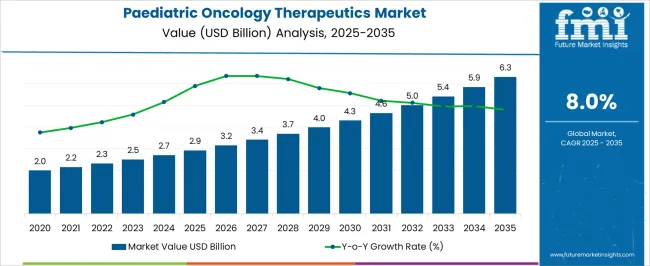
The paediatric oncology therapeutics market was valued at USD 2.90 billion in 2025, projected to reach USD 3.13 billion in 2026, and is forecast to expand to USD 6.76 billion by 2036 at a 8.00% CAGR. Structural shifts in end-use procurement cycles and tightening performance specifications across downstream sectors are accelerating capital allocation toward paediatric oncology therapeutics categories. Procurement teams operating across global supply chains now require standardized compliance certifications, compressing qualification timelines and elevating minimum specification thresholds for approved supplier lists.
Summary of Paediatric Oncology Therapeutics Market
- Market Snapshot
- The paediatric oncology therapeutics market is valued at USD 2.90 billion in 2025 and is projected to reach USD 6.76 billion by 2036.
- The industry is expected to grow at a 8.00% CAGR from 2026 to 2036, creating an incremental opportunity of USD 3.63 billion.
- The market operates as a specification-driven procurement category where compliance certifications, material performance standards, and supply chain integration define competitive positioning.
- Demand and Growth Drivers
- Demand is rising as downstream industries face tightening performance specifications and mandatory compliance requirements across procurement cycles.
- Technology upgrades and process automation are accelerating adoption of higher-specification paediatric oncology therapeutics products across manufacturing operations.
- Infrastructure expansion programs in emerging economies are creating greenfield demand that bypasses legacy supplier constraints.
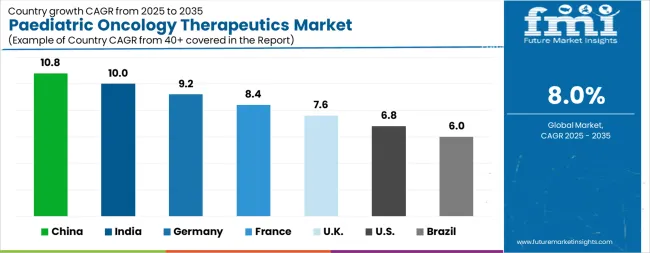
- Among key countries, China at 10.80%, India at 10.00%, Germany at 9.20%, France at 8.40%, UK at 7.60%, USA at 6.80%, Brazil at 6.00%.
- Product and Segment View
- The market includes paediatric oncology therapeutics products segmented across indication, treatment categories serving diverse industrial and commercial applications.
- Leukemia leads by indication with 30.2% share in 2026.
- Chemotherapy leads by treatment with 43.8% share in 2026.
- The scope covers Leukemia, Central Nervous System, Bone Tumors, Inflammatory Disorders configurations among other formats, while excluding unrelated commodity categories and non-specialized alternatives.
- Geography and Competitive Outlook
- China and India are the fastest-growing markets due to infrastructure expansion and rising industrial demand, while North America and Europe remain high-value mature demand bases.
- Competition is shaped by vertical integration capabilities, specification compliance certifications, and established procurement channel relationships, with key players including Pfizer Inc., Novartis AG, F. Hoffmann-La Roche Ltd., Bristol Myers Squibb Company, Merck & Co., Inc., Sanofi S.A., AbbVie Inc..
- Market consolidation trends are evident as leading suppliers acquire complementary capabilities to meet broadening customer specification requirements.
- Analyst Opinion at FMI
- Sabyasachi Ghosh, Principal Consultant for Healthcare observe that: 'As per FMI analysis, the paediatric oncology therapeutics market is transitioning from a volume-driven procurement model to a specification-led qualification framework. Buyers who delay integration of higher-performance paediatric oncology therapeutics solutions into their supply chains face material cost escalation as compliance timelines compress. FMI analysts observe that suppliers lacking certified production capabilities will find themselves excluded from approved vendor lists as downstream operators enforce tighter material specifications.'
- Strategic Implications / Executive Takeaways
- Procurement directors must transition vendor qualification processes to prioritize lifecycle cost models and specification compliance certifications over lowest unit price evaluations.
- Capital project teams should mandate compatibility with next-generation performance standards in all new equipment procurement specifications entering the 2027 tender cycle.
- Supply chain architects must develop multi-source qualification programs to mitigate concentration risk across critical paediatric oncology therapeutics supply categories.
Paediatric Oncology Therapeutics Market Key Takeaways
| Metric | Details |
|---|---|
| Industry Size (2026) | USD 3.13 billion |
| Industry Value (2036) | USD 6.76 billion |
| CAGR (2026-2036) | 8.00% |
Source: Future Market Insights, 2026
Capital expenditure planning cycles across verticals consuming paediatric oncology therapeutics products have shifted from discretionary upgrades to mandated replacements. Regulatory frameworks governing material performance, safety testing, and environmental compliance are tightening across all major consumption regions. Buyers evaluating supplier contracts increasingly weight lifecycle cost models over upfront unit pricing, favoring suppliers with vertically integrated operations and certified testing capabilities.
Regional deployment parameters reflect differentiated adoption velocities. China sets the pace with a 10.80% CAGR, followed by India at 10.00% as infrastructure expansion programs bypass legacy procurement constraints. Germany operations advance at a 9.20% rate, supported by regulatory compliance mandates. France tracks at 8.40%. UK networks maintain a 7.60% expansion trajectory. USA registers a 6.80% pace. Brazil expands at a 6.00% trajectory.
Paediatric Oncology Therapeutics Market Definition
Paediatric Oncology Therapeutics constitutes the material, product, or technology category defined by its primary industrial function within downstream manufacturing and end-use sectors. The scope encompasses standardized and specialty configurations compliant with global performance and safety specifications. Core inclusions govern products meeting defined procurement parameters across industrial, commercial, and institutional buyer categories.
Paediatric Oncology Therapeutics Market Inclusions
Market scope includes Leukemia, Central Nervous System, Bone Tumors, Inflammatory Disorders, Respiratory Disorders configurations and related product variants. Global and regional market sizes, forecast period 2026 to 2036, and segment breakdowns by indication, treatment are fully incorporated within the analytical boundary.
Paediatric Oncology Therapeutics Market Exclusions
Standard commodity alternatives lacking specialized performance certifications are excluded. Downstream finished goods, standalone accessory components, and non-standardized custom fabrications fall outside the analytical parameters. Legacy product formats without current industry specification compliance are explicitly omitted from the valuation.
Paediatric Oncology Therapeutics Market Research Methodology
- Primary Research: Analysts engaged with procurement specification leads, technical managers, and supply chain directors across key consumption sectors to map decision gates triggering product upgrades and supplier requalification.
- Desk Research: Data collection phases aggregated regulatory compliance frameworks, industry standards ratification schedules, and published procurement guidelines from major institutional buyers.
- Market-Sizing and Forecasting: Baseline values derive from a bottom-up aggregation of product volumes and contract values, applying region-specific adoption curves to project future demand velocity.
- Data Validation and Update Cycle: Projections are tested against publicly reported expenditure guidance from leading industrial consumers and trade association production statistics.
Why is the Paediatric Oncology Therapeutics Market Growing?
The Paediatric Oncology Therapeutics market is advancing steadily, fueled by the increasing incidence of childhood cancers and the urgent need for effective, age-appropriate treatment options. Rising investments in research and development are expanding the therapeutic pipeline, with a focus on targeted therapies, immunotherapies, and precision medicine approaches tailored for paediatric patients. Improvements in early diagnostic technologies and growing awareness among healthcare providers and parents are also contributing to higher treatment adoption rates.
In addition, global health organizations and governments are strengthening support for paediatric oncology care through funding initiatives, awareness programs, and better access to treatment facilities. While challenges remain, such as treatment-related side effects and limited availability of paediatric-specific formulations, technological advancements and novel drug development are helping overcome these barriers. Increasing collaboration between pharmaceutical companies, research institutes, and regulatory agencies is fostering innovation and accelerating clinical trials.
As survivorship rates improve, demand for therapies that minimize long-term complications is shaping the market’s evolution Collectively, these factors are expected to sustain the growth of the Paediatric Oncology Therapeutics market across both developed and emerging healthcare systems.
Segmental Analysis
The paediatric oncology therapeutics market is segmented by indication, treatment, and geographic regions. By indication, paediatric oncology therapeutics market is divided into Leukemia, Central Nervous System (CNS) Disorders, Bone Tumors, Inflammatory Disorders, Respiratory Disorders, and Retinoblastoma. In terms of treatment, paediatric oncology therapeutics market is classified into Chemotherapy, Radiotheraphy, Tumor Surgery, Blood And Marrow Transplantation, and Drug Therapy. Regionally, the paediatric oncology therapeutics industry is classified into North America, Latin America, Western Europe, Eastern Europe, Balkan & Baltic Countries, Russia & Belarus, Central Asia, East Asia, South Asia & Pacific, and the Middle East & Africa.
Insights into the Leukemia Indication Segment
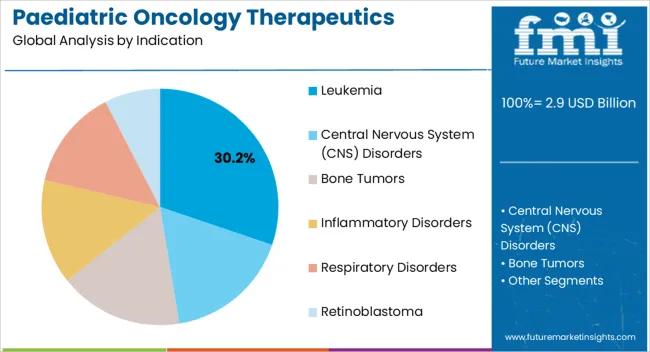
The leukemia indication segment is projected to account for 30.2% of the Paediatric Oncology Therapeutics market revenue in 2026, making it the leading indication. The high prevalence of leukemia among children compared to other cancer types is driving demand for specialized therapeutic interventions. Leukemia treatment protocols have become increasingly effective due to advancements in targeted therapies, stem cell transplantation, and supportive care measures, which are improving survival outcomes.
The integration of genetic and molecular diagnostics is further refining treatment approaches, allowing for more precise and personalized therapy regimens. Governments and non-profit organizations are also enhancing awareness and improving access to early screening programs, which increases the likelihood of timely interventions.
The psychological and clinical complexities of treating paediatric leukemia necessitate continuous innovations in therapy design to reduce toxicity and long-term side effects As investment in research accelerates and global efforts expand to develop paediatric-specific drug formulations, leukemia is expected to remain the most significant contributor to the paediatric oncology therapeutics market, reinforcing its leadership in the years ahead.
Insights into the Chemotherapy Treatment Segment
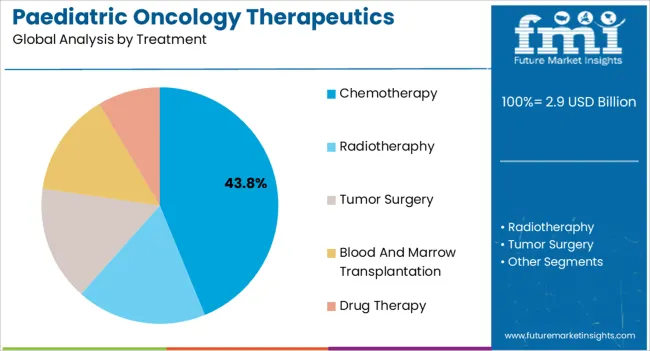
The chemotherapy treatment segment is expected to hold 43.8% of the Paediatric Oncology Therapeutics market revenue in 2026, consolidating its position as the leading treatment approach. Despite the emergence of advanced therapies, chemotherapy continues to be the standard of care due to its proven efficacy in treating a wide range of childhood cancers, including leukemia, lymphomas, and solid tumors. The segment’s dominance is reinforced by its established role in combination regimens, where chemotherapy is administered alongside radiation, targeted therapies, or immunotherapies to improve patient outcomes.
Ongoing advancements in dosage optimization and supportive care are mitigating adverse effects, making chemotherapy safer and more tolerable for paediatric patients. The widespread availability of chemotherapy drugs, coupled with healthcare systems’ familiarity with their administration, further supports their continued preference.
Moreover, affordability compared to advanced biologics ensures accessibility in both developed and developing markets While innovations in targeted and precision therapies are reshaping the future, chemotherapy’s critical role in front-line treatment and relapse management ensures it will remain a cornerstone of paediatric oncology therapeutics over the forecast period.
Market Overview
Paediatric Oncology Therapeutics Market Overview
Children are affected by different forms of cancer than adults, there also exists a major difference between children and adults regarding treatment and development of new oncology therapies. The prominent variation is the concept of survival.
With adult cancer patients, it is acceptable to look to immediate, 5 and 10-year survival rates, along with quality of life, for the best approximations of therapeutic success. On the other hand, a child cancer patient receives treatment to be cured.
A typical difference between adult and pediatric oncologists is in treatment protocols; pediatric protocols are much more vigorous, often hitting patients “as hard as possible” to achieve a successful, long-term cure.
Analysis of Paediatric Oncology Therapeutics Market By Key Countries
.webp "Top Country Growth Comparison Paediatric Oncology Therapeutics Market Cagr (2026 2036)")
| Country | CAGR |
|---|---|
| China | 10.8% |
| India | 10.0% |
| Germany | 9.2% |
| France | 8.4% |
| UK | 7.6% |
| USA | 6.8% |
| Brazil | 6.0% |
Country-wise Analysis
The Paediatric Oncology Therapeutics Market is expected to register a CAGR of 8.0% during the forecast period, exhibiting varied country level momentum. China leads with the highest CAGR of 10.8%, followed by India at 10.0%. Developed markets such as Germany, France, and the UK continue to expand steadily, while the USA is likely to grow at consistent rates. Brazil posts the lowest CAGR at 6.0%, yet still underscores a broadly positive trajectory for the global Paediatric Oncology Therapeutics Market. In 2026, Germany held a dominant revenue in the Western Europe market and is expected to grow with a CAGR of 9.2%. The USA Paediatric Oncology Therapeutics Market is estimated to be valued at USD 1.1 billion in 2026 and is anticipated to reach a valuation of USD 2.1 billion by 2036. Sales are projected to rise at a CAGR of 6.8% over the forecast period between 2026 and 2036. While Japan and South Korea markets are estimated to be valued at USD 151.3 million and USD 100.9 million respectively in 2026.
Key Players in the Paediatric Oncology Therapeutics Market
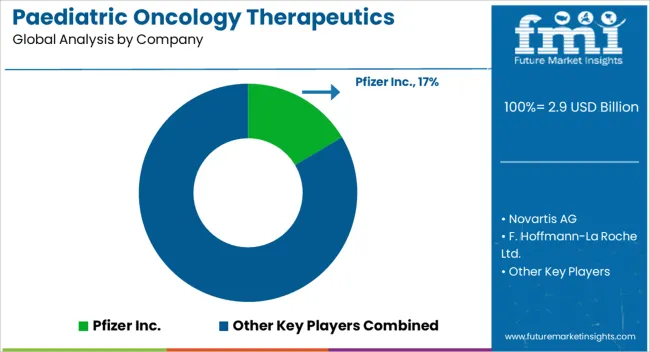
- Pfizer Inc.
- Novartis AG
- F. Hoffmann-La Roche Ltd.
- Bristol Myers Squibb Company
- Merck & Co., Inc.
- Sanofi S.A.
- AbbVie Inc.
- Takeda Pharmaceutical Company Limited
- GlaxoSmithKline plc
- AstraZeneca plc
Scope of the Report
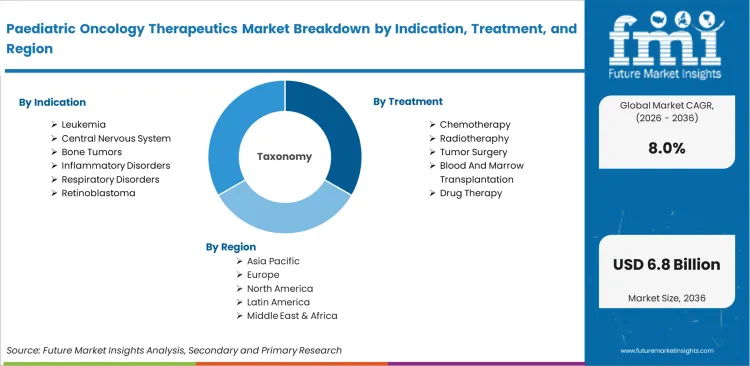
| Metric | Value |
|---|---|
| Quantitative Units | USD 3.13 billion to USD 6.76 billion, at a CAGR of 8.00% |
| Market Definition | Paediatric Oncology Therapeutics encompasses the material, product, or technology category serving downstream industrial, commercial, and institutional end-use sectors under defined performance and safety specifications. |
| Indication Segmentation | Leukemia, Central Nervous System, Bone Tumors, Inflammatory Disorders, Respiratory Disorders, Retinoblastoma |
| Treatment Segmentation | Chemotherapy, Radiotheraphy, Tumor Surgery, Blood And Marrow Transplantation, Drug Therapy |
| Regions Covered | North America, Latin America, Europe, East Asia, South Asia, Oceania, Middle East & Africa |
| Countries Covered | China, India, Germany, France, UK, USA, Brazil, and 40 plus countries |
| Key Companies Profiled | Pfizer Inc., Novartis AG, F. Hoffmann-La Roche Ltd., Bristol Myers Squibb Company, Merck & Co., Inc., Sanofi S.A., AbbVie Inc., Takeda Pharmaceutical Company Limited, GlaxoSmithKline plc, AstraZeneca plc |
| Forecast Period | 2026 to 2036 |
| Approach | Forecasting models apply a bottom-up methodology starting with global installed base metrics and projecting conversion rates to higher-specification product categories. |
Paediatric Oncology Therapeutics Market by Segments
Indication:
- Leukemia
- Central Nervous System (CNS) Disorders
- Bone Tumors
- Inflammatory Disorders
- Respiratory Disorders
- Retinoblastoma
Treatment:
- Chemotherapy
- Radiotheraphy
- Tumor Surgery
- Blood And Marrow Transplantation
- Drug Therapy
Region:
- North America
- USA
- Canada
- Mexico
- Latin America
- Brazil
- Chile
- Rest of Latin America
- Western Europe
- Germany
- UK
- Italy
- Spain
- France
- Nordic
- BENELUX
- Rest of Western Europe
- Eastern Europe
- Russia
- Poland
- Hungary
- Balkan & Baltic
- Rest of Eastern Europe
- East Asia
- China
- Japan
- South Korea
- South Asia and Pacific
- India
- ASEAN
- Australia & New Zealand
- Rest of South Asia and Pacific
- Middle East & Africa
- Kingdom of Saudi Arabia
- Other GCC Countries
- Turkiye
- South Africa
- Other African Union
- Rest of Middle East & Africa
Bibliography
- 1. Organisation for Economic Co-operation and Development. (2025, June). Industrial performance and competitiveness indicators. OECD.
- 2. World Bank Group. (2025). Global economic prospects: Industrial supply chains and trade facilitation. World Bank.
- 3. United Nations Industrial Development Organization. (2025). Industrial development report: Manufacturing and global value chains. UNIDO.
- 4. International Organization for Standardization. (2025). ISO standards catalogue: Materials testing and quality management. ISO.
- 5. European Commission, Directorate-General for Internal Market, Industry, Entrepreneurship and SMEs. (2025). Single market for goods: Industrial product compliance. European Commission.
- 6. USA Bureau of Labor Statistics. (2025). Producer price indexes for intermediate demand. USA Department of Labor.
This bibliography is provided for reader reference. The full Future Market Insights report contains the complete reference list with primary research documentation.
Frequently Asked Questions
How large is the demand for Paediatric Oncology Therapeutics in the global market in 2026?
Demand for Paediatric Oncology Therapeutics in the global market is estimated to be valued at USD 3.13 billion in 2026.
What will be the market size of Paediatric Oncology Therapeutics in the global market by 2036?
Market size for Paediatric Oncology Therapeutics is projected to reach USD 6.76 billion by 2036.
What is the expected demand growth for Paediatric Oncology Therapeutics in the global market between 2026 and 2036?
Demand for Paediatric Oncology Therapeutics is expected to grow at a CAGR of 8.00% between 2026 and 2036.
Which Indication is poised to lead global sales by 2026?
Leukemia accounts for 30.2% in 2026, driven by established procurement specifications and downstream integration requirements.
What is driving demand in China?
China leads with a 10.80% CAGR as greenfield industrial facilities deploying modern procurement frameworks create scaled demand for specification-compliant paediatric oncology therapeutics products.
What is the India growth outlook in this report?
India is projected to grow at a CAGR of 10.00% during 2026 to 2036.
What is Paediatric Oncology Therapeutics and what is it mainly used for?
Paediatric Oncology Therapeutics constitutes the specialized material, product, or technology category designed for defined industrial, commercial, and institutional applications. End-use sectors primarily deploy it to meet performance, safety, and regulatory compliance requirements.
How does FMI build and validate the Paediatric Oncology Therapeutics forecast?
Forecasting models apply a bottom-up methodology starting with global installed base metrics and cross-validate projections against quarterly industry production and trade volumes.
Preview the report firsthand - request a free sample
Get SampleGet the brochure for pricing and purchase details.
Get PDFTable of Content
- Executive Summary
- Global Market Outlook
- Demand-side Trends
- Supply-side Trends
- Analysis and Recommendations
- Market Overview
- Market Coverage / Taxonomy
- Market Definition / Scope / Limitations
- Research Methodology
- Chapter Orientation
- Analytical Lens and Working Hypotheses
- Market Structure, Signals, and Trend Drivers
- Market Sizing, Forecasting, and Opportunity Mapping
- Research Design and Evidence Framework
- Desk Research Programme (Secondary Evidence)
- Company Annual and Sustainability Reports
- Peer-reviewed Journals and Academic Literature
- Corporate Websites, Product Literature, and Technical Notes
- Earnings Decks and Investor Briefings
- Statutory Filings and Regulatory Disclosures
- Technical White Papers and Standards Notes
- Trade Journals, Industry Magazines, and Analyst Briefs
- Conference Proceedings, Webinars, and Seminar Materials
- Government Statistics Portals and Public Data Releases
- Press Releases and Reputable Media Coverage
- Specialist Newsletters and Curated Briefings
- Sector Databases and Reference Repositories
- FMI Internal Proprietary Databases and Historical Market Datasets
- Subscription Datasets and Paid Sources
- Social Channels, Communities, and Digital Listening Inputs
- Additional Desk Sources
- Expert Input and Fieldwork (Primary Evidence)
- Primary Modes
- Qualitative Interviews and Expert Elicitation
- Quantitative Surveys and Structured Data Capture
- Blended Approach
- Why Primary Evidence is Used
- Field Techniques
- Interviews
- Surveys
- Focus Groups
- Observational and In-context Research
- Social and Community Interactions
- Stakeholder Universe Engaged
- C-suite Leaders
- Board Members
- Presidents and Vice Presidents
- R&D and Innovation Heads
- Technical Specialists
- Domain Subject-matter Experts
- Scientists
- Physicians and Other Healthcare Professionals
- Governance, Ethics, and Data Stewardship
- Research Ethics
- Data Integrity and Handling
- Primary Modes
- Tooling, Models, and Reference Databases
- Desk Research Programme (Secondary Evidence)
- Data Engineering and Model Build
- Data Acquisition and Ingestion
- Cleaning, Normalisation, and Verification
- Synthesis, Triangulation, and Analysis
- Quality Assurance and Audit Trail
- Market Background
- Market Dynamics
- Drivers
- Restraints
- Opportunity
- Trends
- Scenario Forecast
- Demand in Optimistic Scenario
- Demand in Likely Scenario
- Demand in Conservative Scenario
- Opportunity Map Analysis
- Product Life Cycle Analysis
- Supply Chain Analysis
- Investment Feasibility Matrix
- Value Chain Analysis
- PESTLE and Porter’s Analysis
- Regulatory Landscape
- Regional Parent Market Outlook
- Production and Consumption Statistics
- Import and Export Statistics
- Market Dynamics
- Global Market Analysis 2021 to 2025 and Forecast, 2026 to 2036
- Historical Market Size Value (USD Million) Analysis, 2021 to 2025
- Current and Future Market Size Value (USD Million) Projections, 2026 to 2036
- Y-o-Y Growth Trend Analysis
- Absolute $ Opportunity Analysis
- Global Market Pricing Analysis 2021 to 2025 and Forecast 2026 to 2036
- Global Market Analysis 2021 to 2025 and Forecast 2026 to 2036, By Indication
- Introduction / Key Findings
- Historical Market Size Value (USD Million) Analysis By Indication , 2021 to 2025
- Current and Future Market Size Value (USD Million) Analysis and Forecast By Indication , 2026 to 2036
- Leukemia
- Central Nervous System
- Bone Tumors
- Inflammatory Disorders
- Respiratory Disorders
- Retinoblastoma
- Leukemia
- Y-o-Y Growth Trend Analysis By Indication , 2021 to 2025
- Absolute $ Opportunity Analysis By Indication , 2026 to 2036
- Global Market Analysis 2021 to 2025 and Forecast 2026 to 2036, By Treatment
- Introduction / Key Findings
- Historical Market Size Value (USD Million) Analysis By Treatment, 2021 to 2025
- Current and Future Market Size Value (USD Million) Analysis and Forecast By Treatment, 2026 to 2036
- Chemotherapy
- Radiotheraphy
- Tumor Surgery
- Blood And Marrow Transplantation
- Drug Therapy
- Chemotherapy
- Y-o-Y Growth Trend Analysis By Treatment, 2021 to 2025
- Absolute $ Opportunity Analysis By Treatment, 2026 to 2036
- Global Market Analysis 2021 to 2025 and Forecast 2026 to 2036, By Region
- Introduction
- Historical Market Size Value (USD Million) Analysis By Region, 2021 to 2025
- Current Market Size Value (USD Million) Analysis and Forecast By Region, 2026 to 2036
- North America
- Latin America
- Western Europe
- Eastern Europe
- East Asia
- South Asia and Pacific
- Middle East & Africa
- Market Attractiveness Analysis By Region
- North America Market Analysis 2021 to 2025 and Forecast 2026 to 2036, By Country
- Historical Market Size Value (USD Million) Trend Analysis By Market Taxonomy, 2021 to 2025
- Market Size Value (USD Million) Forecast By Market Taxonomy, 2026 to 2036
- By Country
- USA
- Canada
- Mexico
- By Indication
- By Treatment
- By Country
- Market Attractiveness Analysis
- By Country
- By Indication
- By Treatment
- Key Takeaways
- Latin America Market Analysis 2021 to 2025 and Forecast 2026 to 2036, By Country
- Historical Market Size Value (USD Million) Trend Analysis By Market Taxonomy, 2021 to 2025
- Market Size Value (USD Million) Forecast By Market Taxonomy, 2026 to 2036
- By Country
- Brazil
- Chile
- Rest of Latin America
- By Indication
- By Treatment
- By Country
- Market Attractiveness Analysis
- By Country
- By Indication
- By Treatment
- Key Takeaways
- Western Europe Market Analysis 2021 to 2025 and Forecast 2026 to 2036, By Country
- Historical Market Size Value (USD Million) Trend Analysis By Market Taxonomy, 2021 to 2025
- Market Size Value (USD Million) Forecast By Market Taxonomy, 2026 to 2036
- By Country
- Germany
- UK
- Italy
- Spain
- France
- Nordic
- BENELUX
- Rest of Western Europe
- By Indication
- By Treatment
- By Country
- Market Attractiveness Analysis
- By Country
- By Indication
- By Treatment
- Key Takeaways
- Eastern Europe Market Analysis 2021 to 2025 and Forecast 2026 to 2036, By Country
- Historical Market Size Value (USD Million) Trend Analysis By Market Taxonomy, 2021 to 2025
- Market Size Value (USD Million) Forecast By Market Taxonomy, 2026 to 2036
- By Country
- Russia
- Poland
- Hungary
- Balkan & Baltic
- Rest of Eastern Europe
- By Indication
- By Treatment
- By Country
- Market Attractiveness Analysis
- By Country
- By Indication
- By Treatment
- Key Takeaways
- East Asia Market Analysis 2021 to 2025 and Forecast 2026 to 2036, By Country
- Historical Market Size Value (USD Million) Trend Analysis By Market Taxonomy, 2021 to 2025
- Market Size Value (USD Million) Forecast By Market Taxonomy, 2026 to 2036
- By Country
- China
- Japan
- South Korea
- By Indication
- By Treatment
- By Country
- Market Attractiveness Analysis
- By Country
- By Indication
- By Treatment
- Key Takeaways
- South Asia and Pacific Market Analysis 2021 to 2025 and Forecast 2026 to 2036, By Country
- Historical Market Size Value (USD Million) Trend Analysis By Market Taxonomy, 2021 to 2025
- Market Size Value (USD Million) Forecast By Market Taxonomy, 2026 to 2036
- By Country
- India
- ASEAN
- Australia & New Zealand
- Rest of South Asia and Pacific
- By Indication
- By Treatment
- By Country
- Market Attractiveness Analysis
- By Country
- By Indication
- By Treatment
- Key Takeaways
- Middle East & Africa Market Analysis 2021 to 2025 and Forecast 2026 to 2036, By Country
- Historical Market Size Value (USD Million) Trend Analysis By Market Taxonomy, 2021 to 2025
- Market Size Value (USD Million) Forecast By Market Taxonomy, 2026 to 2036
- By Country
- Kingdom of Saudi Arabia
- Other GCC Countries
- Turkiye
- South Africa
- Other African Union
- Rest of Middle East & Africa
- By Indication
- By Treatment
- By Country
- Market Attractiveness Analysis
- By Country
- By Indication
- By Treatment
- Key Takeaways
- Key Countries Market Analysis
- USA
- Pricing Analysis
- Market Share Analysis, 2025
- By Indication
- By Treatment
- Canada
- Pricing Analysis
- Market Share Analysis, 2025
- By Indication
- By Treatment
- Mexico
- Pricing Analysis
- Market Share Analysis, 2025
- By Indication
- By Treatment
- Brazil
- Pricing Analysis
- Market Share Analysis, 2025
- By Indication
- By Treatment
- Chile
- Pricing Analysis
- Market Share Analysis, 2025
- By Indication
- By Treatment
- Germany
- Pricing Analysis
- Market Share Analysis, 2025
- By Indication
- By Treatment
- UK
- Pricing Analysis
- Market Share Analysis, 2025
- By Indication
- By Treatment
- Italy
- Pricing Analysis
- Market Share Analysis, 2025
- By Indication
- By Treatment
- Spain
- Pricing Analysis
- Market Share Analysis, 2025
- By Indication
- By Treatment
- France
- Pricing Analysis
- Market Share Analysis, 2025
- By Indication
- By Treatment
- India
- Pricing Analysis
- Market Share Analysis, 2025
- By Indication
- By Treatment
- ASEAN
- Pricing Analysis
- Market Share Analysis, 2025
- By Indication
- By Treatment
- Australia & New Zealand
- Pricing Analysis
- Market Share Analysis, 2025
- By Indication
- By Treatment
- China
- Pricing Analysis
- Market Share Analysis, 2025
- By Indication
- By Treatment
- Japan
- Pricing Analysis
- Market Share Analysis, 2025
- By Indication
- By Treatment
- South Korea
- Pricing Analysis
- Market Share Analysis, 2025
- By Indication
- By Treatment
- Russia
- Pricing Analysis
- Market Share Analysis, 2025
- By Indication
- By Treatment
- Poland
- Pricing Analysis
- Market Share Analysis, 2025
- By Indication
- By Treatment
- Hungary
- Pricing Analysis
- Market Share Analysis, 2025
- By Indication
- By Treatment
- Kingdom of Saudi Arabia
- Pricing Analysis
- Market Share Analysis, 2025
- By Indication
- By Treatment
- Turkiye
- Pricing Analysis
- Market Share Analysis, 2025
- By Indication
- By Treatment
- South Africa
- Pricing Analysis
- Market Share Analysis, 2025
- By Indication
- By Treatment
- USA
- Market Structure Analysis
- Competition Dashboard
- Competition Benchmarking
- Market Share Analysis of Top Players
- By Regional
- By Indication
- By Treatment
- Competition Analysis
- Competition Deep Dive
- Pfizer Inc.
- Overview
- Product Portfolio
- Profitability by Market Segments (Product/Age /Sales Channel/Region)
- Sales Footprint
- Strategy Overview
- Marketing Strategy
- Product Strategy
- Channel Strategy
- Novartis AG
- F. Hoffmann-La Roche Ltd.
- Bristol Myers Squibb Company
- Merck & Co., Inc.
- Sanofi S.A.
- AbbVie Inc.
- Takeda Pharmaceutical Company Limited
- GlaxoSmithKline plc
- AstraZeneca plc
- Pfizer Inc.
- Competition Deep Dive
- Assumptions & Acronyms Used


