

- Market Size (2026)
- USD 725.2 Mn
- Forecast (2036)
- USD 1881.0 Mn
- CAGR (2026 to 2036)
- 10.0%
How big is Pain au Chocolat Market in 2026?
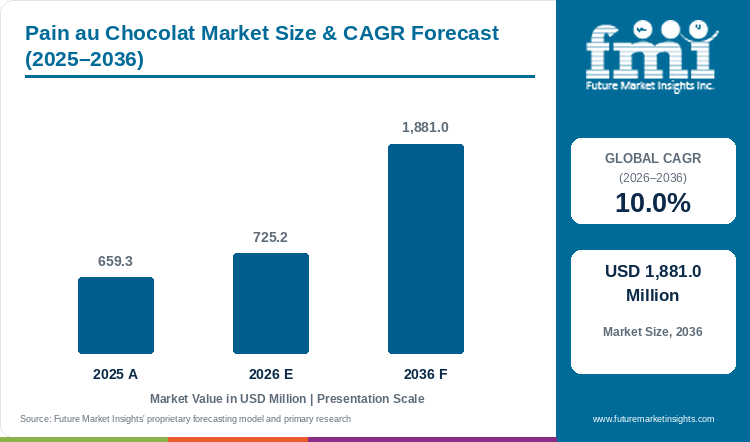
Assessed at USD 659.3 million in 2025 and progressing to USD 725.2 million in 2026, the pain au chocolat market valuation is on course to reach USD 1,881.0 million by 2036, supported by a forecast-period CAGR of 10.0%.
The global pain au chocolat market was valued at USD 659.3 million in 2025 and is estimated to reach USD 725.2 million in 2026. The market is projected to reach USD 1,881.0 million by 2036, expanding at a compound annual growth rate (CAGR) of 10.0% between 2026 and 2036. Classic original bars are projected to capture 34.0% of 2026 demand, since twin-baton laminated yeast-leavened pastry remains the foundational morning SKU behind European bakery counters. Demand for the format is supported by bake-off economics, as frozen laminated batons let café chains serve warm viennoiserie from a two-person shift without an in-house laminator [8]. That labor decoupling runs ahead of the frozen pastries market at 5.4% CAGR, because ordinary frozen pastry substitutes dessert labor while pain au chocolat creates a morning traffic occasion coffee alone cannot carry [4]. The supply side is reorganizing around that oven, with Bridor agreeing in March 2026 to acquire Spain's Panamar Bakery Group after committing EUR 100 million to its Falaise plant conversion in April 2025 [1] [9], Vandemoortele clearing EU and UK competition approvals for the Délifrance takeover in December 2025 and August 2026 [6] [7], and Europastry reporting EUR 1.63 billion 2025 revenue growth of 8% in March 2026 [8]. Coffee retail buyers award volume to laminated suppliers who hold butter-fat crystal stability through freezer logistics, and the consolidation now funding bake-off capacity decides who owns the European morning tray through 2036.
Key Market Trends & Insights
- By product type: Classic & Original is projected to capture 34.0% in 2026 because twin-baton laminated yeast-leavened pastry remains the foundational morning SKU across cafés and hotel buffets.
- By claim / nature: Conventional formulations are estimated to command 49.0% in 2026 as high-volume retail and foodservice operators balance pure-butter and pastry-margarine lamination costs.
- By format: Fresh units are expected to concentrate 38.0% in 2026 because daily in-store supermarket bake-off counters and artisan boulangeries command premium per-piece pricing.
- By packaging format: Multipack configurations are forecast to generate 35.0% in 2026 owing to household breakfast stocking of four-to-eight-count ambient and freezer-to-oven packs.
- By sales channel: Supermarkets & Hypermarkets are anticipated to account for 37.0% in 2026 through combined in-store bakery bake-off tables and packaged grocery aisles.
Regional Highlights
- Top national expansion: The UAE is projected to lead national growth at an 11.3% CAGR through 2036 under luxury hospitality breakfast buffets and cold-chain bakery hubs.
- Broader country progression: Saudi Arabia is expected to expand at 10.9% CAGR ahead of South Korea at 10.6% CAGR and the USA at 10.3% CAGR as freezer-to-oven ready-to-bake formats scale nationwide.
Market Size & Forecast
Table 1: Market Size and Forecast for the Pain au Chocolat Market (USD million and CAGR percentage), 2025 to 2036
| Metric | Value |
|---|---|
| 2025 Market Size | USD 659.3 million |
| Estimated Market Size in 2026 | USD 725.2 million |
| Projected Market Size by 2036 | USD 1,881.0 million |
| CAGR, 2026 to 2036 | 10.0% |
| Added Revenue, 2026 to 2036 | USD 1,155.8 million |
Input-cost management across bake-stable dark chocolate batons (bâtons de chocolat) and laminating butter has become the central profitability variable for industrial viennoiserie producers. Because two dark chocolate bars account for 10% to 12% of finished pastry weight, multi-year spikes in cocoa solids pricing directly squeeze wholesale contract margins. International Cocoa Organization (ICCO) statistics published in May 2026 confirmed persistent structural price elevation across global cocoa bean and cocoa butter markets [2], while a July 2026 study in the Journal of Food Science demonstrated spectral pattern monitoring to prevent fat bloom defects during industrial chocolate production [3]. so commercial pastry manufacturers are reformulating bake-stable chocolate fillings and precision baton weights to protect retail price points without losing rich cocoa flavor.
Unit Production Volume and Cocoa-Lamination Sizing
Table 2: Commercial Unit Production and Laminated Dough Volume Sizing for the Pain au Chocolat Market (USD million and thousand metric tons), 2025 to 2036
| Metric | 2025 | 2026 | 2036 |
|---|---|---|---|
| Market size (USD million) | 659.3 | 725.2 | 1,881.0 |
| Commercial pain au chocolat volume (billion units) | 1.65 to 1.95 | 1.80 to 2.15 | 4.45 to 5.25 |
| Finished laminated pastry weight (thousand MT) | 115.5 to 136.5 | 126.0 to 150.5 | 311.5 to 367.5 |
| Bake-stable chocolate baton requirement (thousand MT) | 13.8 to 16.4 | 15.1 to 18.1 | 37.4 to 44.1 |
Operational note: Unit and tonnage ranges apply standard commercial pain au chocolat weights of 65 to 75 grams per finished piece (plus 30 to 35 grams for mini hotel formats) containing two 5.0-to-6.5-gram bake-stable dark chocolate batons (10% to 12% of dough weight).
Plasticity and crystal stability of laminating fat during high-speed sheeting and -18-degree-Celsius blast freezing govern whether frozen dough units bake into flaky honeycomb layers or leak oil onto oven trays. If the fat layer fractures during cold rolling or melts prematurely during proofing, steam escapes and the pastry collapses around the chocolate bars. In February 2025, a rheological investigation in Food Research International showed that large-amplitude oscillatory shear (LAOS) testing accurately predicts puff pastry margarine lamination performance and baked lift [4]. In addition to this, a January 2026 study in Food Research International engineered monoglyceride oleogel crystallization to create functional frozen specialty fats for laminated pastries [5] and broaden cost-effective options across pastry margarine and butter-blend lines.
Per Capita & In-Store Bake-Off Facility Sizing
Table 3: Per Capita and Retail/Foodservice Outlet Spending Indicators for the Pain au Chocolat Market (USD and percentage), 2025 to 2036
| Metric | 2025 | 2026 | 2036 |
|---|---|---|---|
| World population (billion) | 8.2 | 8.3 | 9.0 |
| Spend per 1,000 people (USD) | 80.4 | 87.4 | 209.0 |
| Annual wholesale spend per bake-off outlet (USD) | 2,650 to 3,400 | 2,850 to 3,650 | 6,400 to 8,200 |
| Pre-proofed freezer-to-oven share of frozen units (%) | 54.0% to 58.0% | 56.0% to 60.0% | 68.0% to 73.0% |
Table 4: Retail Bake-Off & Hospitality Outlet Spending Indicators for the Pain au Chocolat Market (USD million and outlet benchmarks), 2026
| Metric | Value | Institutional Reference Basis |
|---|---|---|
| Market size, 2026 | USD 725.2 million | 2026 global pain au chocolat revenue baseline |
| Qualified retail bake-off & hotel outlets | 235,000 outlets | Global supermarket in-store bakeries and coffee chains |
| Average annual wholesale spend per outlet | USD 3,086 | Annualized outlet procurement of pain au chocolat units |
| Supermarkets & Hypermarkets revenue, 2026 | USD 268.3 million | 37.0% sales-channel segment allocation |
Corporate consolidation among Europe's largest frozen bakery groups is reshaping supplier negotiations for supermarket bake-off chains and hospitality distributors. Large retail grocers require suppliers with multi-plant cold-chain redundancy capable of delivering millions of pre-proofed freezer-to-oven pucks on daily schedules. In December 2025, the European Commission approved Vandemoortele's acquisition of Délifrance subject to laminated-dough plant divestitures in Avignon and Béthune [6], followed in August 2026 by the UK Competition and Markets Authority requiring the sale of a UK pastry plant to protect buyer competition [7]. Combined with Europastry's March 2026 report of EUR 1.63 billion in 2025 annual revenue [8], these scale moves confirm that multi-factory hubs lead frozen bakery products fulfillment.
Analyst Perspective
"Supermarket in-store bakeries and coffee chains are rapidly converting from unproofed frozen dough to pre-proofed, pre-glazed freezer-to-oven pain au chocolat units. Manufacturers that lock in European AOP butter and sustainable bake-stable cocoa batons while delivering 18-minute oven-ready convenience capture the highest-margin retail and hospitality tenders."
- Nandini Roy Choudhury, Principal Consultant, Future Market Insights.
How is the pain au chocolat market segmented?
The pain au chocolat market is segmented by product type, claim / nature, format, packaging format, and sales channel. In 2026, Classic & Original is projected at 34.0%, Conventional at 49.0%, Fresh at 38.0%, Multipack at 35.0%, and Supermarkets & Hypermarkets at 37.0%.
By product type: Classic & Original, Whole Grain & Seeded, Flavored & Filled, Mini & Snacking, and Premium & Artisan.
By claim / nature: Conventional, Clean Label, Organic, Gluten-Free, and High-Protein & Fortified.
By format: Fresh, Frozen, Ambient Packaged, Chilled, and Par-Baked.
By packaging format: Multipack, Single-Serve, Family Pack, and Bulk Foodservice.
By sales channel: Supermarkets & Hypermarkets, Artisan Bakeries, Convenience & Forecourt, Online & DTC, and Foodservice Distributors.
Why does Classic & Original lead the product type category?
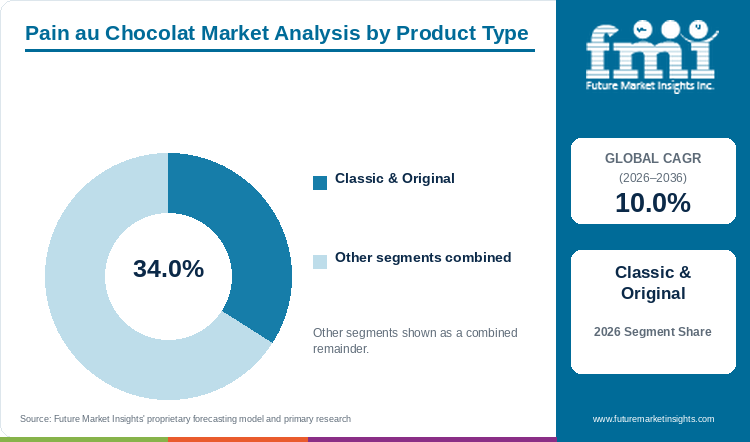
Classic & Original units are projected to capture 34.0% of product type demand in 2026, supported by universal café menu placement and standardized twin-baton lamination.
Table 5: Product Type Share for the Pain au Chocolat Market (percentage share), 2026
| Product Type | Share (2026) |
|---|---|
| Classic & Original | 34.0% |
| Other Segments Combined | 66.0%* |
| Total | 100.0% |
*Note: Remaining product type categories sum to 100.0% of 2026 global pain au chocolat market value.
Table 6: Product Type Leadership and Market Growth for the Pain au Chocolat Market (segment and CAGR percentage), 2026 to 2036
| Metric | Value |
|---|---|
| Global CAGR (2026 to 2036) | 10.0% |
| Leading Segment | Classic & Original |
Coffee chains and supermarket bake-off counters build their morning pastry planograms around Classic & Original rectangular laminated dough enclosing two dark chocolate batons (44% to 55% cocoa solids) because it generates the highest daily turn and lowest staling waste. Whereas seasonal fruit-filled or nut-topped pastries require separate allergen handling and suffer unpredictable afternoon markdowns, Classic & Original pairs directly with plain croissants and flat croissants in morning breakfast deals. As a result, industrial bakeries dedicate their highest-speed sheeting lines to standardized 70-gram Classic & Original pucks with pre-applied egg-free glaze.
- Classic & Original is projected to secure 34.0% of the product type segment in 2026 by serving as the core sweet morning pastry across retail and hospitality channels.
- Groupe Le Duff announced a EUR 100 million investment in April 2025 to convert its Falaise site in Normandy into a high-capacity Bridor viennoiserie production plant supplying classic laminated pastries [9].
Why does Conventional define the largest claim / nature segment?
Conventional formulations are estimated to secure 49.0% of the claim / nature category in 2026, driven by mainstream retail price ceilings and hybrid lamination economics.
Mainstream grocery multipacks and workplace or school catering contracts operate under strict per-unit cost ceilings that make organic butter and organic chocolate batons prohibitively expensive for everyday volume. Conventional formulations allow industrial bakers to combine standard milling wheat flour and commercial baking chocolate bars with either dairy butter or structured laminating fats to keep four-packs affordable. In addition to this cost advantage, lipid innovations—such as a March 2025 study in Current Research in Food Science on wax-based bigel laminating fat replacers [10]—enable Conventional producers to reduce saturated fat content while preserving flaky lift.
- Conventional options are estimated to command 49.0% of the claim / nature segment in 2026 because mainstream grocery shoppers prioritize everyday multipack affordability.
- Lantmännen announced a group-wide health and labeling initiative in February 2026 focused on salt reduction and clearer nutritional energy declarations across its mainstream bakery assortments [11].
What keeps Fresh ahead by format?
Fresh units are expected to command 38.0% of format demand in 2026, reflecting higher per-piece selling prices at artisan bakeries and in-store bake-off counters.
Warm, freshly baked pain au chocolat sold from artisan boulangeries and supermarket in-store bakery tables commands two-to-three times the per-piece retail price of ambient bagged pastries. Consumers willingly pay a premium for crisp, shattering outer pastry layers and warm, melted chocolate centers that cannot be replicated in long-life ambient pouches. To capture this high-margin morning spend without scratch labor, supermarkets and cafés bake off pre-proofed frozen dough pucks in glass-door convection ovens throughout the morning rush.
- Fresh products are expected to hold 38.0% of the format segment in 2026 because freshly baked viennoiserie captures premium morning foodservice and in-store bakery spend.
- Europastry reported EUR 1.63 billion in 2025 revenue in March 2026 (an 8% annual increase), driven by rapid expansion of its ready-to-bake frozen viennoiserie supplied to fresh bake-off outlets [8].
Why does Multipack lead the packaging format category?
Multipack configurations are forecast to generate 35.0% of packaging format demand in 2026, owing to household breakfast and school-lunchbox stocking.
Household grocery shoppers purchasing pastries for weekday family breakfasts and children's school snacks overwhelmingly prefer four-count to eight-count Multipack formats over single loose units. Multipack trays and flow-wrapped bags span both bagged four-packs at the in-store bakery table and individually wrapped ambient or freezer-to-oven boxes in grocery aisles. so manufacturers engineer Multipack barrier films and industrial chocolate fillings to retain crumb softness across multi-week home storage.
- Multipack offerings are forecast to account for 35.0% of the packaging format segment in 2026 as grocery retailers expand multi-unit family value packs across ambient and frozen aisles.
- General Mills introduced eight-count Pillsbury Frozen Grands! Croissants in Butter and Chocolate varieties in September 2026, demonstrating how countable freezer-to-oven household multipacks expand retail morning pastry penetration [12].
What gives Supermarkets & Hypermarkets the leading position in sales channel?
Supermarkets & Hypermarkets are anticipated to account for 37.0% of sales channel demand in 2026, reinforced by dual merchandising across in-store bake-off and packaged aisles.
Supermarkets & Hypermarkets dominate total category sales because modern grocery chains capture both immediate morning impulse buyers at self-service bake-off bins and weekly pantry stock-up shoppers in packaged aisles. By contracting bulk private-label volumes from industrial European viennoiserie manufacturers, supermarkets price freshly baked four-packs aggressively to drive store footfall. Besides this pricing advantage, clear clamshell packaging and front-of-store oven aroma convert routine grocery trips into repeat viennoiserie purchases.
- Supermarkets & Hypermarkets are anticipated to capture 37.0% of the sales channel segment in 2026 through integrated bake-off and packaged retail merchandising.
- The UK Competition and Markets Authority closed its Cérélia / Jus-Rol merger remedy enforcement in March 2025 following the completed divestment of the UK and Ireland retail dough business to Brioche UK Limited to preserve supermarket pastry competition [13].
What are the drivers, restraints, and opportunities in the pain au chocolat market?
In the pain au chocolat market, pre-proofed freezer-to-oven bake-off conversion and café culture expansion are projected to propel sales whereas cocoa and butter price volatility restrains margins and plant-based/oleogel lamination creates clean-label growth opportunities.
- Driver: Elimination of skilled bakery labor via pre-proofed freezer-to-oven (FTO) laminated units enables convenience stores and hotels to bake fresh pain au chocolat in 18 minutes.
- Restraint: Elevated cocoa-bean and Charentes-Poitou butter costs combined with sub-zero (-18°C) cold-chain distribution expenses squeeze wholesale and retail operating margins.
- Opportunity: Plant-based oleogel laminating fats and sourdough-fermented clean-label doughs unlock vegan retail and airline catering segments.
Growth Analysis and Future Potential: Qualitative Demand Catalysts
Widespread labor shortages in retail and hospitality kitchens are accelerating conversion from unproofed frozen dough to pre-proofed, pre-glazed freezer-to-oven (FTO) pain au chocolat units. With FTO technology, store staff transfer frozen pucks directly from -18-degree-Celsius cartons onto baking sheets and pull golden, flaky pastries from convection ovens in 18 minutes without overnight proofing cabinets. To capture this surging bake-off demand, Groupe Le Duff committed EUR 100 million in April 2025 to convert its Falaise site in Normandy into an automated Bridor pastry plant [9] and agreed to acquire Spain's Panamar Bakery Group in March 2026 [1]. Similarly, Lantmännen announced a major bakery production facility investment in May 2025 [14] and agreed to acquire bakery ingredients distributor Leipurin in August 2025 [15] to expand pan-European laminated supply.
Risk Assessment of the Pain au Chocolat Market: Operational and Formulation Friction
Simultaneous cost inflation across cocoa solids and dairy laminating butter paired with strict antitrust scrutiny of supplier mergers represent the primary restraints on industry profitability. International Cocoa Organization data in May 2026 confirmed structurally elevated global cocoa prices [2], forcing pastry manufacturers either to negotiate retail price increases or trim chocolate baton weight toward the 8% minimum threshold. Meanwhile, rapid consolidation among frozen viennoiserie leaders has triggered regulatory intervention to prevent supplier concentration. When Vandemoortele acquired Délifrance in December 2025, both the European Commission [6] and the UK Competition and Markets Authority in August and October 2026 [7] [16] required plant divestitures in France and the UK to protect supermarket and foodservice buyer choice.
Commercial Opportunity Analysis: Formulation Differentiation and Value-Add Formats
Formulation of plant-based vegan pastries and oleogel-laminated doughs that match pure-butter flake while reducing saturated fat and dairy cost offers a major growth avenue for manufacturers. Recent lipid engineering breakthroughs—including March 2025 wax-based bigel laminating fat replacers [10] and January 2026 monoglyceride oleogel frozen specialty fats [5]—prevent oil leakage during baking and cut saturated fatty acids. Combined with corporate sustainability initiatives such as Grupo Bimbo's June 2025 regenerative-wheat and renewable-energy milestones [17] and cross-selling with phyllo pastry assortments, clean-label and plant-based formats command 15% to 25% wholesale price premiums.
Pain au Chocolat Market by Country (2026 to 2036)
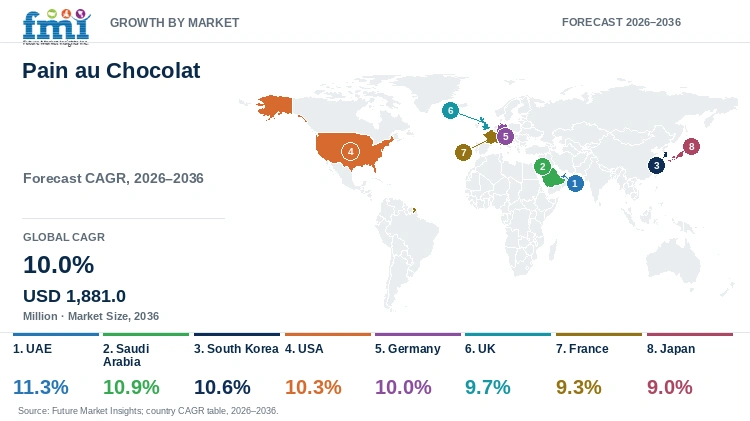
As per FMI, the UAE is projected to lead pain au chocolat expansion across tracked national markets at an 11.3% CAGR from 2026 to 2036. Saudi Arabia follows at 10.9% and South Korea reaches 10.6% ahead of the USA at 10.3% and Germany at 10.0%. Meanwhile, the UK (9.7%) and France (9.3%) as well as Japan (9.0%) post sustained commercial gains.
Table 7: Country CAGR and Primary Growth Levers for the Pain au Chocolat Market (CAGR percentage), 2026 to 2036
| Country | CAGR (2026 to 2036) | Primary Growth Lever |
|---|---|---|
| UAE | 11.3% | Luxury hotel breakfast buffets and cold-chain bakery hubs |
| Saudi Arabia | 10.9% | Hospitality tourism megaprojects and drive-thru coffee culture |
| South Korea | 10.6% | Premium boulangerie café chains and convenience-store bake-off |
| USA | 10.3% | Supermarket freezer-to-oven multipacks and warehouse-club trays |
| Germany | 10.0% | Discount supermarket in-store bake-off stations (Backstationen) and frozen dough logistics |
| UK | 9.7% | Grocery in-store bakery morning pastry promotions and CMA-regulated frozen supply competition |
| France | 9.3% | AOP Charentes-Poitou butter viennoiserie premiumization and industrial export scaling |
| Japan | 9.0% | Record inbound hotel tourism and chilled/ambient chocolate pastry packs |
Source: Future Market Insights analysis
UAE Pain au Chocolat Market Outlook (2026 to 2036)
Pain au chocolat demand in the UAE is projected to expand at an 11.3% CAGR from 2026 to 2036. Unlike European markets driven by grocery multipacks, the UAE market is propelled by five-star hotel breakfast buffets and luxury café franchises in Dubai and Abu Dhabi that demand pure-butter pastries. Gulf bakery-cafe expansion reported during the year continued to lift laminated pastry placements across Dubai and Doha retail channels. Cold-chain foodservice distributors import pre-proofed European AOP-butter pucks so hotel kitchens bake flawless 24-layer pastries without local lamination staff.
Key takeaway: In the UAE, record luxury tourism visitation and cold-chain bakery investments are projected to drive top-ranked foodservice viennoiserie growth.
Saudi Arabia Pain au Chocolat Market Outlook (2026 to 2036)
Saudi Arabia's pain au chocolat market is uniquely bifurcated between booming specialty drive-thru coffee chains serving freshly baked frozen pucks and modern hypermarkets selling ambient single-serve school snack packs. Market value in the Saudi Arabia pain au chocolat sector is forecast to climb at a 10.9% CAGR through 2036. In January 2026, the General Authority for Statistics documented rapid Q3 2025 expansion across licensed tourist hospitality establishments [20], while a February 2026 PeerJ field study in Al-Dawadmi addressed domestic wheat drought resilience [21]. Although sub-zero cold-chain freight across desert highways adds distribution cost, Red Sea and Riyadh hospitality openings sustain double-digit frozen bake-off procurement across commercial foodservice channels.
Key takeaway: In Saudi Arabia, booming specialty coffee-shop culture and hospitality megaproject catering are forecast to accelerate frozen and packaged pastry demand.
South Korea Pain au Chocolat Market Outlook (2026 to 2036)
What sets South Korea apart from Western markets is its rapid dessert-café innovation cycle, where boutique boulangeries and convenience stores market both classic butter-laminated pain au chocolat and trendy flat-pressed or cream-filled chocolate viennoiserie. To reduce reliance on imported wheat for domestic baking, a June 2026 study in BMC Plant Biology detailed South Korea's speed-breeding framework for releasing hexaploid wheat cultivars with superior baking quality [22]. Market value in the South Korea pain au chocolat sector is anticipated to advance at a 10.6% CAGR between 2026 and 2036. Specialty café chains across Seoul and Busan rely on imported and domestic pre-glazed freezer-to-oven pucks to command premium per-piece prices.
Key takeaway: In South Korea, premium café boulangerie expansion and convenience-store bake-off upgrades are expected to sustain double-digit revenue growth.
USA Pain au Chocolat Market Outlook (2026 to 2036)
Unlike Europe where consumers buy single fresh pastries daily from corner bakeries, consumption in the USA is driven by multi-count warehouse-club clamshell trays and retail freezer-to-oven family boxes baked at home on weekends. Supported by a USD 1.5 trillion national restaurant sector in 2025 [23] and broad domestic wheat flour milling capacity [24], US grocers and fast-casual bakery cafés are rapidly scaling laminated chocolate pastries. Market value in the USA pain au chocolat sector is estimated to progress at a 10.3% CAGR from 2026 to 2036. General Mills' September 2026 launch of eight-count Pillsbury Frozen Grands! Chocolate Croissants [12] and Bridor's North America foodservice expansion [1] confirm strong household and café adoption.
Key takeaway: In the USA, warehouse-club bakery merchandising and freezer-to-oven retail multipacks are estimated to propel household viennoiserie penetration.
Germany Pain au Chocolat Market Outlook (2026 to 2036)
Germany's viennoiserie market is structurally defined by automated self-service bake-off walls (Backstationen) inside discount supermarkets, where shoppers use tongs to bag warm Schokobrötchen and pain au chocolat baked hourly from frozen pucks. Market value for pain au chocolat in Germany is projected to grow at a 10.0% CAGR over the 2026 to 2036 forecast period. Because discount retailers compete fiercely on sub-euro retail unit prices while facing volatile butter costs, a March 2025 study by researchers at the Technical University of Munich in Germany demonstrated wax-based bigel oleogels as laminating fat replacers in laminated pastries [10]. This combination of high-volume discounter bake-off stations and lipid engineering sustains steady unit growth across Germany.
Key takeaway: In Germany, discount supermarket self-service bake-off stations and lipid-lamination innovation are projected to sustain high-volume unit growth.
UK Pain au Chocolat Market Outlook (2026 to 2036)
Pain au chocolat market value in the UK is expected to rise at a 9.7% CAGR from 2026 through 2036. In the UK, supermarket in-store bakeries and commuter rail-station coffee chains have turned pain au chocolat into a mainstream weekday breakfast staple. Because national grocery chains rely heavily on outsourced frozen dough and bake-off supply, UK antitrust regulators actively police supplier consolidation—evidenced by the March 2025 Cérélia / Jus-Rol divestment closure [13] and the August and October 2026 UK CMA orders requiring Vandemoortele / Délifrance to divest a UK pastry plant [7] [16]. Combined with resilient domestic bakery output reported by the UK ONS in July 2026 [25], active supplier competition keeps UK retail bake-off pricing sharp.
Key takeaway: In the UK, supermarket in-store bakery promotions and competitive frozen bake-off supply tenders are expected to anchor steady retail expansion.
France Pain au Chocolat Market Outlook (2026 to 2036)
As the birthplace of pain au chocolat (chocolatine), France is mature in unit volume yet expands in value through AOP Charentes-Poitou pure-butter premiumization and frozen export production. In February 2025, INRAE researchers in France published a 90-sample wheat and flour dataset to help millers standardize protein tenacity across domestic harvests [26], while Groupe Le Duff announced a EUR 100 million conversion of its Falaise plant in Normandy for Bridor in April 2025 [9]. Domestic pain au chocolat market value in France is forecast to advance at a 9.3% CAGR between 2026 and 2036. European Commission merger remedies on Vandemoortele / Délifrance at Avignon and Béthune in December 2025 [6] further sustain competitive domestic lamination capacity.
Key takeaway: In France, AOP pure-butter premiumization and major Normandy industrial plant investments are forecast to sustain domestic and export leadership.
Japan Pain au Chocolat Market Outlook (2026 to 2036)
Japan's pain au chocolat market combines exacting artisan standards at commuter train-station boulangeries and department-store food halls (depachika) with booming western-style hotel breakfast buffet demand from international tourists. Market value for pain au chocolat in Japan is projected to increase at a 9.0% CAGR from 2026 to 2036. In January 2026, the Japan National Tourism Organization reported that annual inbound international visitors reached an all-time high of 42.68 million in 2025 [27], which boosted hotel pastry procurement across Tokyo and Osaka. European frozen bake-off specialists such as ARYZTA AG and Bridor as well as domestic packaged bakery leaders supply kitchens in Japan with pure-butter laminated pucks that overcome severe baker labor shortages.
Key takeaway: In Japan, record 42.68 million inbound tourist arrivals and commuter-station boulangerie culture are projected to support premium bake-off demand.
Full report country CAGRs cover: North America; Latin America; Western Europe; Eastern Europe; East Asia; South Asia and Pacific; Middle East and Africa.
Who are the notable companies in the pain au chocolat market?
Bridor, Délifrance (Vandemoortele Group), Lantmännen Unibake, Vandemoortele, Cérélia, Europastry, ARYZTA AG, General Mills, Groupe Le Duff, and Grupo Bimbo are the notable companies in the pain au chocolat market.
FMI analysis indicates that the competitive arena divides between specialized European frozen viennoiserie manufacturers supplying pre-proofed bake-off units and multinational packaged-bakery groups marketing ambient and freezer-to-oven household multipacks.
- European Frozen Viennoiserie & Bake-Off Leaders: Bridor (Groupe Le Duff) and Vandemoortele as well as Délifrance (acquired by Vandemoortele in December 2025) and Europastry operate high-speed multi-layer lamination lines supplying pure-butter pain au chocolat globally.
- International Frozen Bakery & Retail Dough Platforms: Lantmännen Unibake and ARYZTA AG as well as Cérélia supply supermarket in-store bakeries and chilled/frozen home-bake pastry channels across Europe and North America.
- Multinational Packaged & Retail Bakery Groups: Grupo Bimbo and General Mills use vast ambient grocery route-to-market networks and retail freezer-door distribution to market family multipacks and single-serve chocolate pastries.
Competitive Benchmarking: Pain au Chocolat Market
Table 8: Competitive Benchmarking for the Pain au Chocolat Market (qualitative capability ratings across key players), 2026
| Company | Named Pain au Chocolat Depth | Freezer-to-Oven Formats | Retail & Hospitality Access | Geographic Reach |
|---|---|---|---|---|
| Bridor | High | High | High | France and Spain (Panamar) plus North America and 100+ hospitality export markets |
| Délifrance (Vandemoortele Group) | High | High | High | France and Europe plus Middle East and Asia-Pacific foodservice and retail bake-off |
| Lantmännen Unibake | High | High | High | Nordics and Europe plus UK and USA professional bakery channels |
| Vandemoortele | High | High | High | Belgium and France plus European and US (Banneton) frozen bakery networks |
| Cérélia | Medium | Medium | High | Continental Europe and North America plus UK chilled/frozen retail dough channels |
| Europastry | High | High | High | Spain and Europe plus the Americas and 80+ international frozen bakery markets |
| ARYZTA AG | High | High | High | Switzerland and Germany plus European and Asian foodservice/retail channels |
| General Mills | Medium | High | High | USA and Canada plus international retail freezer-door and foodservice channels |
| Groupe Le Duff | High | High | High | Global bakery-café (Brioche Dorée) and industrial viennoiserie via Bridor |
| Grupo Bimbo | Medium | Medium | High | The Americas and Europe plus Asian packaged retail and in-store bakery networks |
Scoring basis: Capability tiers evaluate documented pain au chocolat SKU depth (including AOP Charentes-Poitou butter and mini hotel formats) and pre-proofed freezer-to-oven (FTO) technology. Portfolio ratings incorporate recent M&A and antitrust remedies, including Vandemoortele's December 2025 acquisition of Délifrance (subject to EC and UK CMA plant divestments in 2025–2026) and Bridor's March 2026 agreement to acquire Panamar Bakery Group in Spain.
Key Developments in the Pain au Chocolat Market
- Bridor (subsidiary of Groupe Le Duff) announced an agreement in March 2026 to acquire Spain's Panamar Bakery Group (EUR 600 million revenue, 29 bakeries), following Groupe Le Duff's April 2025 announcement of a EUR 100 million investment to convert its Falaise site in Normandy into an industrial Bridor pastry plant [1] [9].
- Vandemoortele received conditional European Commission approval in December 2025 for its acquisition of Délifrance (subject to divesting Avignon and Béthune laminated dough sites) and UK Competition and Markets Authority clearance in August 2026 subject to divesting its Worcester UK plant [6] [7].
- Europastry reported EUR 1.63 billion in 2025 revenue in March 2026, representing an 8% annual increase propelled by international frozen viennoiserie and bake-off expansion [8].
- General Mills launched eight-count Pillsbury Frozen Grands! Croissants in Butter and Chocolate varieties in September 2026 to broaden freezer-to-oven household chocolate pastry packs across US grocery retail [12].
Key Players in the Pain au Chocolat Market
European Frozen Viennoiserie & Bake-Off Leaders
- Bridor
- Délifrance (Vandemoortele Group)
- Vandemoortele
- Europastry
International Frozen Bakery & Retail Dough Platforms
- Lantmännen Unibake
- ARYZTA AG
- Cérélia
Multinational Packaged & Retail Bakery Groups
- Groupe Le Duff
- Grupo Bimbo
- General Mills
Pain au Chocolat Market - Report Scope
Table 9: Report Scope for the Pain au Chocolat Market (coverage fields and definitions), 2026 to 2036
| Coverage field | Report scope |
|---|---|
| Market breakdown | Product Type; Claim / Nature; Format; Packaging Format; Sales Channel |
| Quantitative Units | USD Million |
| Market Definition | Includes commercial manufacturer and primary bake-off revenue from pain au chocolat (chocolatine) products across fresh and frozen (unproofed or pre-proofed freezer-to-oven) as well as chilled and ambient packaged formats. Category Scope Note: Excludes plain croissants and fruit/savory danishes as well as non-laminated chocolate buns and downstream café beverage bundles. |
| Regions Covered | North America; Latin America; Western Europe; Eastern Europe; East Asia; South Asia and Pacific; Middle East and Africa |
| Countries Covered | UAE, Saudi Arabia, South Korea, USA, Germany, UK, France, Japan, and additional countries in the full report |
| Key Companies Covered | Bridor, Délifrance (Vandemoortele Group), Lantmännen Unibake, Vandemoortele, Cérélia, Europastry, ARYZTA AG, General Mills, Groupe Le Duff, Grupo Bimbo |
| Forecast Period | 2026 to 2036 |
| Approach | Primary and secondary research with top-down frozen-bakery/viennoiserie parent reconciliation and bottom-up unit and bake-off outlet triangulation. |
Pain au Chocolat Market - Research Methodology
Table 10: Research Methodology for the Pain au Chocolat Market (research methods and analytical approach), 2026 to 2036
| Method | Approach |
|---|---|
| Primary Research | Structured interviews with industrial lamination plant directors and supermarket in-store bakery category buyers as well as hotel executive pastry chefs and cold-chain distributors to validate 65-to-75-gram unit weights and FTO conversion rates. |
| Secondary Research | Analysis of European Commission and UK CMA pastry merger inquiry filings paired with ICCO quarterly cocoa bulletins and peer-reviewed lipid lamination studies in Food Research International. |
| Market Sizing and Forecasting | Top-down reconciliation against the global frozen bakery market (USD 55,500.0 million in 2026) and frozen pastries/viennoiserie parent pool cross-checked against bottom-up commercial unit volumes (1.80 to 2.15 billion units in 2026) and wholesale price per piece. |
| Country Forecasting Model | Econometric national projections weight supermarket in-store bake-off station density and specialty coffee-shop outlet growth paired with inbound hotel tourism arrivals and cold-chain bakery capacity across eight core countries. |
| Operational Benchmark Traceability | Unit volumes and chocolate baton requirements in Tables 2 through 4 trace to industrial viennoiserie line specifications and ICCO cocoa statistics paired with EC/CMA merger capacity disclosures. |
| Data Triangulation and Validation | Revenues are isolated to qualifying pain au chocolat SKUs across retail and foodservice supply while strictly excluding plain croissants and raw bulk chocolate/butter sales to prevent double counting. |
Pain au Chocolat Market by Segments
Pain au Chocolat Market segmented by Product Type:
- Classic & Original
- Whole Grain & Seeded
- Flavored & Filled
- Mini & Snacking
- Premium & Artisan
Pain au Chocolat Market segmented by Claim / Nature:
- Conventional
- Clean Label
- Organic
- Gluten-Free
- High-Protein & Fortified
Pain au Chocolat Market segmented by Format:
- Fresh
- Frozen
- Ambient Packaged
- Chilled
- Par-Baked
Pain au Chocolat Market segmented by Packaging Format:
- Multipack
- Single-Serve
- Family Pack
- Bulk Foodservice
Pain au Chocolat Market segmented by Sales Channel:
- Supermarkets & Hypermarkets
- Artisan Bakeries
- Convenience & Forecourt
- Online & DTC
- Foodservice Distributors
Pain au Chocolat Market by Region
- North America
- United States
- Canada
- Latin America
- Brazil
- Mexico
- Argentina
- Chile
- Western Europe
- Germany
- France
- United Kingdom
- Italy
- Spain
- Benelux
- Nordics
- Eastern Europe
- Poland
- Czech Republic
- Romania
- Hungary
- East Asia
- China
- Japan
- South Korea
- South Asia and Pacific
- India
- ASEAN
- Australia and New Zealand
- Middle East and Africa
- GCC Countries
- South Africa
- Türkiye
- Israel
Research Sources and Bibliography
- [1] Groupe Le Duff. (2026, March 23). BRIDOR strengthens its position as a global player in the premium bakery-viennese pastry sector with the acquisition of the PANAMAR bakery Group (SPAIN). Groupe Le Duff News.
- [2] International Cocoa Organization. (2026, May 29). May 2026 Quarterly Bulletin of Cocoa Statistics. International Cocoa Organization (ICCO).
- [3] Küçükduman, Y., Korkmaz, İ. D., Çiftçi, H. G., İpkin, G., Argün, S., Kara, Z. P., Özel, G. B., Ülkü, Ö. T., Toker, Ö. S., & Mutlu, Z. (2026, July 1). Spectral Pattern of Chocolate Production: Early Detection of Quality Problems. Journal of Food Science, 91(7), e71269 (PubMed PMID 42474115).
- [4] Chakraborty, A., Blecker, C., Van Hoed, V., Barthelemy, P., Detry, R., & Danthine, S. (2025, February 24). Predicting puff pastry margarine performances based on LAOS output. Food Research International, 206, 116062 (PubMed PMID 40058917).
- [5] An, Y., Han, Y., Liu, Z., Su, J., Zhang, J., Liu, K., & Li, L. (2026, January 12). Tailoring monoglyceride oleogel crystallization by eutectic and crystal nucleation disturbance: functional frozen specialty fat for use in croissants. Food Research International, 228, 118357 (PubMed PMID 41703828).
- [6] European Commission. (2025, December 17). Commission approves Vandemoortele's acquisition of Délifrance, subject to conditions. European Commission Press Corner.
- [7] Competition and Markets Authority. (2026, August 20). Vandemoortele required to sell UK plant following pastry merger investigation. GOV.UK.
- [8] Europastry, S.A. (2026, March 25). Europastry continues to grow and reaches €1.63 billion in revenue in 2025, an 8% increase compared to 2024. Europastry Corporate Newsroom.
- [9] Groupe Le Duff. (2025, April 24). LE DUFF Group is accelerating its global growth. Groupe Le Duff News.
- [10] Steinkellner, C., Kroll, L., & Franke, K. (2025, March 25). Bigels containing different wax-based oleogels as laminating fat replacers in croissants. Current Research in Food Science, 10, 101042 (PubMed PMID 40231316).
- [11] Lantmännen ek för. (2026, February 17). Lantmännen steps up health effort with lower salt and clearer energy labeling. Lantmännen Newsroom.
- [12] General Mills, Inc. (2026, September 3). Pillsbury Introduces Frozen Grands! Croissants in Butter and Chocolate Varieties. General Mills Press Releases.
- [13] Competition and Markets Authority. (2025, March 7). Cérélia / Jus-Rol merger inquiry. GOV.UK.
- [14] Lantmännen ek för. (2025, May 28). Lantmännen makes strategic and long-term investment in new production facility for bread. Lantmännen Newsroom.
- [15] Lantmännen ek för. (2025, August 15). Lantmännen signs agreement to acquire Leipurin. Lantmännen Newsroom.
- [16] Competition and Markets Authority. (2026, October 7). Vandemoortele / Délifrance merger inquiry. GOV.UK.
- [17] Grupo Bimbo, S.A.B. de C.V. (2025, June 5). Grupo Bimbo reports progress in its sustainability strategy. Grupo Bimbo Press Releases.
- [18] Dubai Department of Economy and Tourism. (2026, February 9). Dubai welcomes 19.59 million visitors in third record year. Government of Dubai.
- [19] Government of Dubai Media Office. (2025, February 19). Dubai Industrial City attracts more than AED 350 million F&B investments in 2024. Government of Dubai.
- [20] General Authority for Statistics. (2026, January 8). GASTAT: Publishes Tourism Establishments Statistics for Q3 of 2025. Kingdom of Saudi Arabia.
- [21] Alqahtani, M. M. (2026, February 24). Improving drought tolerance in some wheat genotypes with foliar application of silicon nanoparticles in Al-Dawadmi, Saudi Arabia. PeerJ, 14, e20823 (PubMed PMID 41769396).
- [22] Cha, J.-K., Park, H., Kwon, Y., Lee, S.-M., Kim, W.-J., & Lee, J.-H. (2026, June 8). From lab to field: accelerated cultivar release via integrated speed breeding framework in wheat (Triticum aestivum L.). BMC Plant Biology, 26(1), 1364 (PubMed PMID 42252417).
- [23] National Restaurant Association. (2025, February 6). Restaurant Industry Poised for Growth in 2025: Industry Expected to Employ 15.9 Million People and Reach $1.5 Trillion in Sales. National Restaurant Association.
- [24] U.S. Department of Agriculture, National Agricultural Statistics Service. (2025, May 1). Flour Milling Products 2024 Summary. USDA NASS.
- [25] Office for National Statistics. (2026, July 24). UK manufacturers' sales by product: 2025. UK Office for National Statistics.
- [26] Munch, M., Rezette, L., Buche, P., Chambrey, B., Deborde, C., Dervaux, S., et al. (2025, February 7). Dataset for common wheat (Triticum aestivum L.) grain and flour characterization using classical and advanced analyses. Data in Brief, 59, 111375 (PubMed PMID 40034728).
- [27] Japan National Tourism Organization. (2026, January 21). 訪日外客数(2025年12月推計値)12月:3,617,700人、12月過去最高を更新 2025年計:42,683,600人、年間で4,200万人を突破し過去最多. Japan National Tourism Organization (JNTO).
This bibliography is provided for reader reference and is not exhaustive. The full report contains the complete list of sources and detailed citations.
This Report Answers
- How large is the pain au chocolat market in 2026 and what is forecast for 2036?
- Which bake-off labor and cocoa/butter cost pressures shape demand for pain au chocolat?
- Why does Classic & Original lead the product type category?
- Why does Fresh lead the format category globally?
- How do growth rates differ across the UAE and Saudi Arabia versus South Korea and the USA?
- Which leading European and global bakery companies supply pain au chocolat today?
- What limits adoption or supplier switching in the pain au chocolat market?
- What should retail and hospitality buyers evaluate before contracting a pain au chocolat supplier?
Frequently Asked Questions
How big is the pain au chocolat market in 2026, and what is forecast for 2036?
According to FMI, the global pain au chocolat market value is estimated to reach USD 725.2 million in 2026 and is projected to climb to an industry valuation of USD 1,881.0 million by 2036 from a 2025 baseline of USD 659.3 million.
What is the CAGR for the pain au chocolat market from 2026 to 2036?
Future Market Insights projects a 10.0% compound annual growth rate between 2026 and 2036, representing USD 1,155.8 million in incremental market value over the forecast decade.
Which product type segment leads the pain au chocolat market?
Classic & Original pastries are projected to capture 34.0% of product type demand in 2026 because twin-bar dark chocolate laminated viennoiserie anchors morning café and supermarket assortments.
Which format segment leads the pain au chocolat market?
Fresh units are estimated to secure 38.0% of the format category in 2026 owing to premium per-piece pricing across artisan bakeries and supermarket in-store bake-off counters.
Which country has a notable growth outlook during the assessment period?
The UAE is projected to lead national growth at an 11.3% CAGR through 2036, supported by record international tourism buffets and luxury café expansion across Dubai and Abu Dhabi.
Who are the key players in the market?
Bridor, Délifrance (Vandemoortele Group), Lantmännen Unibake, Vandemoortele, Cérélia, Europastry, ARYZTA AG, General Mills, Groupe Le Duff, and Grupo Bimbo are the notable companies in the market.
Preview the report firsthand - request a free sample
Get SampleGet the brochure for pricing and purchase details.
Get PDFTable of Content
- Key Takeaways
- Market Size and CAGR
- Top Growth Driver
- Fastest Growing Segment
- Leading Region
- Key Companies
- Emerging Opportunities
- Executive Summary
- Global Market Outlook
- Demand-side Trends
- Supply-side Trends
- Technology Roadmap Analysis
- Analysis and Recommendations
- Analyst Perspective (What is happening? Why now? What should investors know?)
- Key Questions Answered
- How large is the market?
- What is the CAGR?
- What are key trends?
- Which region dominates?
- Who are the leaders?
- Market Overview
- Market Coverage / Taxonomy
- Market Definition / Scope / Limitations
- Research Methodology
- Chapter Orientation
- Analytical Lens and Working Hypotheses
- Market Structure, Signals, and Trend Drivers
- Benchmarking and Cross-market Comparability
- Market Sizing, Forecasting, and Opportunity Mapping
- Research Design and Evidence Framework
- Desk Research Programme (Secondary Evidence)
- Expert Input and Fieldwork (Primary Evidence)
- Tooling, Models, and Reference Databases
- Data Engineering and Model Build
- Quality Assurance and Audit Trail
- Market Background
- Market Dynamics (Drivers, Restraints, Opportunity, Trends)
- Scenario Forecast (Optimistic, Likely, Conservative)
- Impact Analysis
- AI Impact
- Sustainability Impact
- Regulatory Impact
- Technology Impact
- Consumer / Buyer Analysis
- Purchase Drivers
- Adoption Barriers
- Buyer Journey
- Opportunity Map Analysis
- Product Life Cycle Analysis
- Supply Chain Analysis
- Investment Feasibility Matrix
- Value Chain Analysis
- PESTLE and Porter's Analysis
- Regulatory Landscape
- Regional Parent Market Outlook
- Production and Consumption Statistics
- Import and Export Statistics
- Global Market Analysis and Forecast, 2021 to 2036
- Historical Market Size Value (USD Million) Analysis, 2021 to 2025
- Current and Future Market Size Value (USD Million) Projections, 2026 to 2036
- Y-o-Y Growth Trend Analysis
- Absolute $ Opportunity Analysis
- Global Market Pricing Analysis, 2021 to 2036
- Global Market Analysis and Forecast, By Product Type, 2021 to 2036
- Introduction / Key Findings
- Historical Market Size Value (USD Million) Analysis By Product Type, 2021 to 2025
- Current and Future Market Size Value (USD Million) Analysis and Forecast By Product Type, 2026 to 2036
- Classic & Original
- Whole Grain & Seeded
- Flavored & Filled
- Mini & Snacking
- Premium & Artisan
- Y-o-Y Growth Trend Analysis By Product Type, 2021 to 2025
- Absolute $ Opportunity Analysis By Product Type, 2026 to 2036
- Global Market Analysis and Forecast, By Claim / Nature, 2021 to 2036
- Introduction / Key Findings
- Historical Market Size Value (USD Million) Analysis By Claim / Nature, 2021 to 2025
- Current and Future Market Size Value (USD Million) Analysis and Forecast By Claim / Nature, 2026 to 2036
- Conventional
- Clean Label
- Organic
- Gluten-Free
- High-Protein & Fortified
- Y-o-Y Growth Trend Analysis By Claim / Nature, 2021 to 2025
- Absolute $ Opportunity Analysis By Claim / Nature, 2026 to 2036
- Global Market Analysis and Forecast, By Format, 2021 to 2036
- Introduction / Key Findings
- Historical Market Size Value (USD Million) Analysis By Format, 2021 to 2025
- Current and Future Market Size Value (USD Million) Analysis and Forecast By Format, 2026 to 2036
- Fresh
- Frozen
- Ambient Packaged
- Chilled
- Par-Baked
- Y-o-Y Growth Trend Analysis By Format, 2021 to 2025
- Absolute $ Opportunity Analysis By Format, 2026 to 2036
- Global Market Analysis and Forecast, By Packaging Format, 2021 to 2036
- Introduction / Key Findings
- Historical Market Size Value (USD Million) Analysis By Packaging Format, 2021 to 2025
- Current and Future Market Size Value (USD Million) Analysis and Forecast By Packaging Format, 2026 to 2036
- Multipack
- Single-Serve
- Family Pack
- Bulk Foodservice
- Y-o-Y Growth Trend Analysis By Packaging Format, 2021 to 2025
- Absolute $ Opportunity Analysis By Packaging Format, 2026 to 2036
- Global Market Analysis and Forecast, By Sales Channel, 2021 to 2036
- Introduction / Key Findings
- Historical Market Size Value (USD Million) Analysis By Sales Channel, 2021 to 2025
- Current and Future Market Size Value (USD Million) Analysis and Forecast By Sales Channel, 2026 to 2036
- Supermarkets & Hypermarkets
- Artisan Bakeries
- Convenience & Forecourt
- Online & DTC
- Foodservice Distributors
- Y-o-Y Growth Trend Analysis By Sales Channel, 2021 to 2025
- Absolute $ Opportunity Analysis By Sales Channel, 2026 to 2036
- Global Market Analysis and Forecast, By Region, 2021 to 2036
- Introduction
- Historical Market Size Value (USD Million) Analysis By Region, 2021 to 2025
- Current Market Size Value (USD Million) Analysis and Forecast By Region, 2026 to 2036
- North America
- Latin America
- Western Europe
- Eastern Europe
- East Asia
- South Asia and Pacific
- Middle East and Africa
- Market Attractiveness Analysis By Region
- North America Market Analysis and Forecast, By Country, 2021 to 2036
- Historical Market Size Value (USD Million) Trend Analysis By Market Taxonomy, 2021 to 2025
- Market Size Value (USD Million) Forecast By Market Taxonomy, 2026 to 2036
- By Country
- United States
- Canada
- By Product Type
- By Claim / Nature
- By Format
- By Packaging Format
- By Sales Channel
- By Country
- Market Attractiveness Analysis
- By Country
- By Product Type
- By Claim / Nature
- By Format
- By Packaging Format
- By Sales Channel
- Key Takeaways
- Latin America Market Analysis and Forecast, By Country
- Historical Market Size Value (USD Million) Trend Analysis By Market Taxonomy, 2021 to 2025
- Market Size Value (USD Million) Forecast By Market Taxonomy, 2026 to 2036
- By Country
- Brazil
- Mexico
- Argentina
- Chile
- By Product Type
- By Claim / Nature
- By Format
- By Packaging Format
- By Sales Channel
- By Country
- Market Attractiveness Analysis
- By Country
- By Product Type
- By Claim / Nature
- By Format
- By Packaging Format
- By Sales Channel
- Key Takeaways
- Western Europe Market Analysis and Forecast, By Country
- Historical Market Size Value (USD Million) Trend Analysis By Market Taxonomy, 2021 to 2025
- Market Size Value (USD Million) Forecast By Market Taxonomy, 2026 to 2036
- By Country
- Germany
- France
- United Kingdom
- Italy
- Spain
- Benelux
- Nordics
- By Product Type
- By Claim / Nature
- By Format
- By Packaging Format
- By Sales Channel
- By Country
- Market Attractiveness Analysis
- By Country
- By Product Type
- By Claim / Nature
- By Format
- By Packaging Format
- By Sales Channel
- Key Takeaways
- Eastern Europe Market Analysis and Forecast, By Country
- Historical Market Size Value (USD Million) Trend Analysis By Market Taxonomy, 2021 to 2025
- Market Size Value (USD Million) Forecast By Market Taxonomy, 2026 to 2036
- By Country
- Poland
- Czech Republic
- Romania
- Hungary
- By Product Type
- By Claim / Nature
- By Format
- By Packaging Format
- By Sales Channel
- By Country
- Market Attractiveness Analysis
- By Country
- By Product Type
- By Claim / Nature
- By Format
- By Packaging Format
- By Sales Channel
- Key Takeaways
- East Asia Market Analysis and Forecast, By Country
- Historical Market Size Value (USD Million) Trend Analysis By Market Taxonomy, 2021 to 2025
- Market Size Value (USD Million) Forecast By Market Taxonomy, 2026 to 2036
- By Country
- China
- Japan
- South Korea
- By Product Type
- By Claim / Nature
- By Format
- By Packaging Format
- By Sales Channel
- By Country
- Market Attractiveness Analysis
- By Country
- By Product Type
- By Claim / Nature
- By Format
- By Packaging Format
- By Sales Channel
- Key Takeaways
- South Asia and Pacific Market Analysis and Forecast, By Country
- Historical Market Size Value (USD Million) Trend Analysis By Market Taxonomy, 2021 to 2025
- Market Size Value (USD Million) Forecast By Market Taxonomy, 2026 to 2036
- By Country
- India
- ASEAN
- Australia and New Zealand
- By Product Type
- By Claim / Nature
- By Format
- By Packaging Format
- By Sales Channel
- By Country
- Market Attractiveness Analysis
- By Country
- By Product Type
- By Claim / Nature
- By Format
- By Packaging Format
- By Sales Channel
- Key Takeaways
- Middle East and Africa Market Analysis and Forecast, By Country
- Historical Market Size Value (USD Million) Trend Analysis By Market Taxonomy, 2021 to 2025
- Market Size Value (USD Million) Forecast By Market Taxonomy, 2026 to 2036
- By Country
- GCC Countries
- South Africa
- Türkiye
- Israel
- By Product Type
- By Claim / Nature
- By Format
- By Packaging Format
- By Sales Channel
- By Country
- Market Attractiveness Analysis
- By Country
- By Product Type
- By Claim / Nature
- By Format
- By Packaging Format
- By Sales Channel
- Key Takeaways
- Key Countries Market Analysis
- United States
- Pricing Analysis
- Market Share Analysis, 2025
- By Product Type
- By Claim / Nature
- By Format
- By Packaging Format
- By Sales Channel
- Canada
- Pricing Analysis
- Market Share Analysis, 2025
- By Product Type
- By Claim / Nature
- By Format
- By Packaging Format
- By Sales Channel
- Mexico
- Pricing Analysis
- Market Share Analysis, 2025
- By Product Type
- By Claim / Nature
- By Format
- By Packaging Format
- By Sales Channel
- Brazil
- Pricing Analysis
- Market Share Analysis, 2025
- By Product Type
- By Claim / Nature
- By Format
- By Packaging Format
- By Sales Channel
- Chile
- Pricing Analysis
- Market Share Analysis, 2025
- By Product Type
- By Claim / Nature
- By Format
- By Packaging Format
- By Sales Channel
- Germany
- Pricing Analysis
- Market Share Analysis, 2025
- By Product Type
- By Claim / Nature
- By Format
- By Packaging Format
- By Sales Channel
- United Kingdom
- Pricing Analysis
- Market Share Analysis, 2025
- By Product Type
- By Claim / Nature
- By Format
- By Packaging Format
- By Sales Channel
- Italy
- Pricing Analysis
- Market Share Analysis, 2025
- By Product Type
- By Claim / Nature
- By Format
- By Packaging Format
- By Sales Channel
- Spain
- Pricing Analysis
- Market Share Analysis, 2025
- By Product Type
- By Claim / Nature
- By Format
- By Packaging Format
- By Sales Channel
- France
- Pricing Analysis
- Market Share Analysis, 2025
- By Product Type
- By Claim / Nature
- By Format
- By Packaging Format
- By Sales Channel
- India
- Pricing Analysis
- Market Share Analysis, 2025
- By Product Type
- By Claim / Nature
- By Format
- By Packaging Format
- By Sales Channel
- ASEAN
- Pricing Analysis
- Market Share Analysis, 2025
- By Product Type
- By Claim / Nature
- By Format
- By Packaging Format
- By Sales Channel
- Australia and New Zealand
- Pricing Analysis
- Market Share Analysis, 2025
- By Product Type
- By Claim / Nature
- By Format
- By Packaging Format
- By Sales Channel
- China
- Pricing Analysis
- Market Share Analysis, 2025
- By Product Type
- By Claim / Nature
- By Format
- By Packaging Format
- By Sales Channel
- Japan
- Pricing Analysis
- Market Share Analysis, 2025
- By Product Type
- By Claim / Nature
- By Format
- By Packaging Format
- By Sales Channel
- South Korea
- Pricing Analysis
- Market Share Analysis, 2025
- By Product Type
- By Claim / Nature
- By Format
- By Packaging Format
- By Sales Channel
- Poland
- Pricing Analysis
- Market Share Analysis, 2025
- By Product Type
- By Claim / Nature
- By Format
- By Packaging Format
- By Sales Channel
- Hungary
- Pricing Analysis
- Market Share Analysis, 2025
- By Product Type
- By Claim / Nature
- By Format
- By Packaging Format
- By Sales Channel
- Türkiye
- Pricing Analysis
- Market Share Analysis, 2025
- By Product Type
- By Claim / Nature
- By Format
- By Packaging Format
- By Sales Channel
- South Africa
- Pricing Analysis
- Market Share Analysis, 2025
- By Product Type
- By Claim / Nature
- By Format
- By Packaging Format
- By Sales Channel
- UAE
- Pricing Analysis
- Market Share Analysis, 2025
- By Product Type
- By Claim / Nature
- By Format
- By Packaging Format
- By Sales Channel
- Saudi Arabia
- Pricing Analysis
- Market Share Analysis, 2025
- By Product Type
- By Claim / Nature
- By Format
- By Packaging Format
- By Sales Channel
- United States
- Market Structure Analysis
- Competition Dashboard
- Competition Benchmarking
- Market Share Analysis of Top Players
- By Regional
- By Product Type
- By Claim / Nature
- By Format
- By Packaging Format
- By Sales Channel
- Emerging Startups
- Innovation Benchmarking
- Competition Analysis
- Competition Deep Dive
- Bridor
- Overview
- Product Portfolio
- Profitability by Market Segments
- Sales Footprint
- Strategy Overview
- Marketing Strategy
- Product Strategy
- Channel Strategy
- Délifrance (Vandemoortele Group)
- Lantmännen Unibake
- Vandemoortele
- Cérélia
- Europastry
- ARYZTA AG
- General Mills
- Groupe Le Duff
- Grupo Bimbo
- Bridor
- Case Studies
- Success Stories
- Recent Developments
- Competition Deep Dive
- Assumptions & Acronyms Used


