

- Market Size (2026)
- USD 782.7 Mn
- Forecast (2036)
- USD 1262.8 Mn
- CAGR (2026 to 2036)
- 4.9%
How big is Pallet Labels Market in 2026?
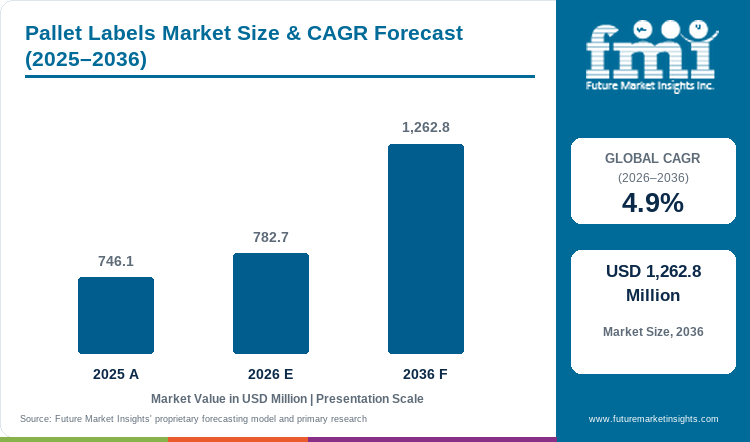
USD 782.7 million in 2026 and USD 1,262.8 million by 2036 at a 4.9% CAGR.
Sales of pallet labels are estimated to rise at 4.9% CAGR through 2036. Valuation rises from USD 746.1 million in 2025 to USD 782.7 million in 2026 and reaches USD 1,262.8 million by 2036. Warehouse teams test label materials to make sure codes stay clear and labels stay attached during handling. In March 2026, cab said pallet labels are important for internal handling and external shipping. Repeat orders depend on labels that work physically and carry the right shipment data.
Mature logistics networks follow different national rules and working methods. Finland is projected at 6.2% CAGR versus 4.5% for Germany through 2036. In November 2025, GS1 Germany began a pallet-load-height project with 11 industrial and retail companies. The project aims to align national practice with the European EUL1 standard. Mature networks therefore need coordinated changes before a shared pallet process becomes routine. Suppliers must support the local standards used at receiving sites.
Key Takeaways
- Warehouse automation and shipment-data rules raise demand for pallet labels that stay readable at dispatch and receiving.
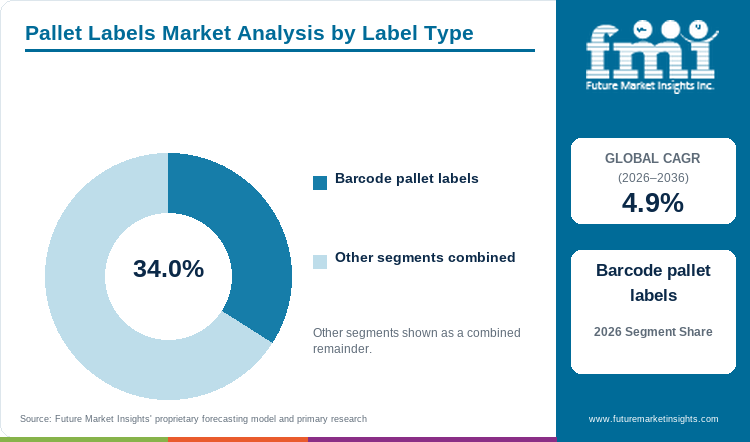
- Based on label type, barcode pallet labels are projected to account for 34.0% in 2026, supported by wide scanner use and SSCC workflows.
- By material, paper is estimated to hold 43.0% in 2026, influenced by clear printing and lower cost on dry routes.
- In 2026, warehousing is expected to lead end use with 29.0% share, linked to repeated pallet identification at warehouse handoffs.
- Poor adhesion, weak barcode quality, wrong printer settings, or shipment-data errors can slow use at receiving sites.
- Some of the key players in this market include Avery Dennison, UPM Adhesive Materials, CCL Industries, Zebra Technologies, SATO, Brady Corporation, TSC Auto ID, Toshiba Tec, HERMA and cab Produkttechnik GmbH & Co KG.
Analyst Perspective
"Pallet label suppliers earn repeat business when printed labels stay readable, stay attached and match the shipment record. Buyers test the label, printer, warehouse data and receiving process as one working system."
- Nandini Roy Choudhury, Principal Consultant, Future Market Insights
How is the pallet labels market segmented?
Pallet Labels Market is segmented by Label Type, Material, End Use, Printing, Sales Channel and Region.
The pallet labels market is segmented by label type, material, end use, printing, sales channel and region. Label type covers barcode, RFID, thermal transfer, direct thermal and weather-resistant labels. Material covers paper, polypropylene, polyester, synthetic paper and specialty adhesive stock. End use covers warehousing, food and beverage logistics, retail distribution, pharma logistics and manufacturing plants. Printing shows how the label is made. Sales channel shows how the label is bought.
What makes barcode pallet labels central to the label type category?
Barcode pallet labels work with common readers and GS1 logistics IDs. Warehouses do not need an RFID reader at every handoff. Warehouse teams can keep current barcode printers and focus on better templates and print checks. In September 2025, GS1 Finland said SSCC can identify a pallet through a GS1-128 barcode or RFID tag.
- Barcode pallet labels are set to lead the label type category with 34.0% share in 2026, attributable to common scanners.
- Receiving teams use the visible label for put-away and exception handling before paying for more complex non-line-of-sight reading.
Why does paper lead the material category?
Paper works well on many single-use pallet routes because it prints clear codes at low cost. Direct thermal and thermal-transfer systems also use familiar thermal labels in dry warehouses. In May 2026, Avery Dennison announced OCC-E certification and How2Recycle pre-qualification for two thermal paper label constructions used in logistics and shipping.
- By material, paper is forecast to represent 43.0% in 2026, shaped by clear print quality and lower cost on dry routes.
- Moisture, rubbing, cold surfaces and outdoor storage increase the need for film and specialty adhesive stocks.
How does warehousing shape demand within the end use category?
Warehouses build, stage, receive and redirect pallets. One site can therefore create several label events. Operators match shipping labels with inventory and order records before a load leaves the dock. In June 2025, Zebra said Lorsa used warehouse traceability tools to cut one inventory process from four hours to 20 minutes.
- Warehousing is set to lead the end use category with 29.0% share in 2026, tied to repeated pallet identification and receiving control.
- Food, pharma, retail and plant logistics need tighter traceability. Warehouse handoffs still create the most repeated label use.
What supports on-demand labels within the printing category?
A final SSCC can be created only after the logistics unit is formed. Variable data is therefore printed close to dispatch. Browser-based digital label printing can also reduce differences between local templates. In May 2025, SATO and Loftware launched cloud-connected printing that lets approved templates print through supported SATO devices without local printer drivers.
- By printing, on-demand labels are forecast to represent 42.0% in 2026, driven by pallet-specific identity and shipment data.
- Pre-printed formats carry fixed information. Encoded media adds write-and-check steps that need tighter system control.
What drives label converters within the sales channel category?
Converters combine facestock, adhesive, coating, liner and roll format for each surface and printer. Trials for self-adhesive labels cover rough wood, stretch film and cold surfaces. In March 2026, UPM Adhesive Materials announced a New Delhi terminal with slitting capability and label-material stock tailored for regional converters.
- The sales channel category is forecast to be led by label converters at 38.0% share in 2026, enabled by application-specific construction work.
- Industrial distributors and printer OEMs handle routine orders. Converters handle custom trials that need extra testing.
What are the drivers, restraints and opportunities in the Pallet Labels Market?
Standardized shipment identity supports recurring demand, verification failures slow conversion and staged RFID upgrades raise value in suitable workflows.
- Driver: Logistics networks need one pallet ID that links physical movement with warehouse and shipment data.
- Restraint: Buyers must test barcode quality, label adhesion, templates and receiving-system compatibility before wider use.
- Opportunity: RFID upgrades can speed data capture without forcing warehouses to replace every barcode process.
Warehouses exchange more shipment data before goods reach the receiving dock. Standard pallet identity therefore becomes more important. In July 2026, GS1 Germany revised guidance for transport, warehousing and co-packing with standard EDI messages. Each new pallet still needs a readable physical label, which keeps demand for barcode consumables active. Converters and printer vendors also keep templates aligned with trading-partner data. Retail and third-party logistics sites need the same identifier to work between facilities and carriers. Once a template passes these checks, it becomes a repeat operating supply. Shared warehouse networks serving many customers create the clearest repeat-purchase need.
Receiving failures can start with the printed label or the shipment data. GS1 US reported in September 2025 that 70% of logistics operations had weekly barcode readability issues. It cited poor label quality, inconsistent labeling and old scanning systems. A correct ID can still cause manual work if contrast, placement, or scanner settings are wrong. Poor output can also force staff to rekey data during busy receiving periods. Warehouse teams therefore test media, print quality and templates before wider use. These checks slow supplier changes. They also favor vendors that can solve both label and data problems.
RFID gives warehouses an upgrade path when routes need faster reads or have poor line of sight. In June 2025, TSC Auto ID added RFID options and upgrade kits to its MB241 industrial printer series. The update included encode-during-print support. Warehouses can add RFID printers at selected stations while keeping barcode output for customers that still need visible SSCC labels. A pilot can test reader coverage and exception rates before wider use. This step-by-step approach lowers replacement risk and lets operators compare read-rate gains with hardware and integration costs. Suppliers can earn higher-value work by testing the combined barcode and RFID workflow at scale.
Which country CAGRs are profiled in the Pallet Labels Market?
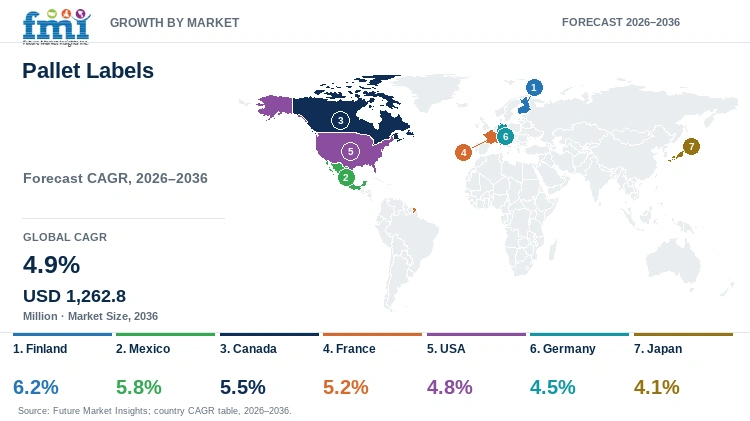
| Country | CAGR |
|---|---|
| Finland | 6.2% |
| Mexico | 5.8% |
| Canada | 5.5% |
| France | 5.2% |
| USA | 4.8% |
| Germany | 4.5% |
| Japan | 4.1% |
How do country-level CAGRs compare in the Pallet Labels Market?
The country CAGRs span 2.1 percentage points. Finland and Mexico form the upper group, while Japan marks the lower end. The spread shows forecast speed, not current revenue or installed volume. Mature printer fleets still create repeat label demand even when replacement and integration move more slowly.
- Finland’s automated logistics environment relies on standardized pallet marking for efficient warehouse operations.
- Mexico balances domestic retail requirements with the complexities of export and cross-border distribution.
- Canada’s traceability requirements are reinforced by labeling needs under demanding cold-weather conditions.
- In France, shipment-unit identification is typically managed separately from product-level identifiers.
- Large-scale supply chains in the USA depend heavily on SSCC-based pallet tracking and traceability.
- Germany continues to align pallet-labeling practices with established EDI and digital logistics systems.
- Japan is advancing shared logistics data standards to support collaborative and joint transportation networks.
Similar CAGRs can still hide different testing and replacement needs. The full report provides country-level CAGR analysis across North America, Latin America, Western Europe, Eastern Europe, East Asia, South Asia and Pacific and the Middle East and Africa.
Country-wise Analysis
- US logistics networks use SSCC labels to connect pallet movement with electronic shipment records. By 2036, USA is projected to grow at 4.8% CAGR, reinforced by retailer and logistics requirements. GS1 US published updated SSCC guidance in May 2026. The guidance says an SSCC identifies one logistics unit and is usually encoded in a GS1-128 barcode on the logistics label. The main challenge is keeping the same process at supplier and receiving sites. Large networks also need replacement stock that works the same way on installed printers. National accounts favor vendors that can control templates, media supply and print checks in several warehouses.
- German industrial and retail networks are using common data rules while keeping many existing warehouse systems. Germany's pallet labels outlook is anticipated to advance at 4.5% CAGR over the assessment period, influenced by the need to match pallet handling with those rules. In July 2026, GS1 Germany revised guidance for transport, warehousing and co-packing with standard EDI messages. Suppliers must support current printers, scanners and ERP links while cutting manual data entry. Local service helps teams move templates and test printers. Customer-specific formats can still slow change at receiving sites that serve several retail accounts with different data rules.
- Japanese logistics operators are sharing more shipment data as joint transport programs expand. Pallet label sales in Japan are forecast to expand at 4.1% CAGR by 2036, shaped by national work on logistics data standards. Japan's Ministry of Land, Infrastructure, Transport and Tourism revised the Logistics Information Standard Guideline to version 3.00 in February 2025. Older systems still need extra work at each handoff. Shared transport makes duplicate or mismatched labels harder to isolate. Each participant must keep the same ID during transfer. Local support must connect print output with shared transport data at every carrier handoff.
- Canadian food and consumer-goods routes cover long distances and use formal traceability records. Canada is estimated to post 5.5% CAGR over the forecast period, driven by ID needs in interprovincial and imported food flows. The Canadian Food Inspection Agency updated its traceability fact sheet in January 2026. Covered food businesses generally trace regulated products one step back and one step forward. Cold and moisture create another label test. Long winter routes make lifted labels and condensation costly to fix after dispatch. Suppliers need durable media and matching records before national accounts expand repeat orders through their networks.
- Finnish retail logistics uses standard pallet marking and digital orders in highly automated networks. Adoption of pallet labels in Finland is estimated to expand at 6.2% CAGR through 2036, enabled by common SSCC use. GS1 Finland stated in September 2025 that SSCC identifies pallets and other logistics units. The code can be carried in GS1-128 or RFID. Automated receiving has little room for missing or unreadable labels. Golli also links pallet marking with delivery messages for retail suppliers. The label-and-message process exposes errors at receiving, so suppliers must prove print quality and correct placement before wider use.
- French logistics teams keep the product ID separate from the ID for a shipment unit. In France, pallet label demand is predicted to advance at 5.2% CAGR through 2036, linked to traceability and mixed-load needs. GS1 France updated its ID guidance in May 2026. The guidance says SSCC identifies a shipping unit regardless of its contents. Mixed pallets need a shipment ID even when product codes stay the same. Customers also check label materials for recycling needs. Reusable transport items add tests for removal and adhesion. Converters can pair smart labels with clear ID rules so automated flows do not mix product and pallet identity.
- Mexican manufacturers and distributors serve local retail chains as well as export and border routes. Pallet label sales in Mexico are forecast to expand at 5.8% CAGR by 2036, supported by standard IDs used in stock control and distribution. GS1 Mexico stated in May 2026 that its IDs help automate inventory control, cut distribution errors and meet retail-chain rules. Border traffic raises the value of common templates for repeat routes. Cross-border customers may also need bilingual fields. Transit conditions and customer formats still vary. Local converter stock and printed labels that follow retailer data rules can improve restocking for exporters.
Who are the notable companies in the Pallet Labels Market?
Avery Dennison, UPM Adhesive Materials, CCL Industries, Zebra Technologies, SATO, Brady Corporation, TSC Auto ID, Toshiba Tec, HERMA and cab Produkttechnik GmbH & Co KG are active within the defined pallet labels supply boundary.
Companies compete in four main roles: label materials, label converting, printing and industrial ID systems. Avery Dennison, UPM Adhesive Materials, CCL Industries and HERMA supply materials or convert labels. Zebra Technologies, SATO, TSC Auto ID, Toshiba Tec and cab Produkttechnik GmbH & Co KG focus on printing or software links. Brady Corporation supplies industrial ID, printing and workflow tools. Customers compare full-system testing and local stock support.
- Materials and converting: Avery Dennison, UPM Adhesive Materials, CCL Industries and HERMA.
- Industrial print and encode systems: Zebra Technologies, SATO, TSC Auto ID, Toshiba Tec and cab Produkttechnik GmbH & Co KG.
- Identification and workflow systems: Brady Corporation combines printers, supplies, scanning, RFID and workflow software.
Competitive Benchmarking: Pallet Labels Market
| Company | Media & Adhesive Depth | Print & Encode | Workflow Integration | Geographic Reach |
|---|---|---|---|---|
| Avery Dennison | High | Medium | High | Global |
| UPM Adhesive Materials | High | Low | Medium | Global |
| CCL Industries | High | Medium | Medium | Global |
| Zebra Technologies | Low | High | High | Global |
| SATO | Medium | High | High | Global |
| Brady Corporation | Medium | High | High | Global |
| TSC Auto ID | Low | High | High | Global |
| Toshiba Tec | Low | High | Medium | Global |
| HERMA | High | Medium | Medium | Europe and international |
| cab Produkttechnik GmbH & Co KG | Low | High | High | Europe and international |
Scoring basis: A High media-depth score needs broad proof of facestock, adhesive, or converted-label supply. Medium shows a narrower material range. Low means limited public proof. High print and encode needs industrial barcode or RFID printing. High workflow integration needs software, verification, or data-capture links. Medium and Low scores show narrower public proof.
Key Developments in the Pallet Labels Market
- In September 2026, Avery Dennison announced AD Visi active Bluetooth Low Energy labels. The labels target time-sensitive and high-value shipments, including pallets and returnable transport items.
- In October 2025, UPM Adhesive Materials announced plans for a new terminal near Hanoi. The site will slit and distribute label material for customers in northern Vietnam.
- In July 2025, SATO started a new Thailand factory with annual capacity of 7,000,000 square meters for printer labels and tags.
Key Players in the Pallet Labels Market
Label material and converting companies
- Avery Dennison
- UPM Adhesive Materials
- CCL Industries
- HERMA
Industrial print and encode companies
- Zebra Technologies
- SATO
- TSC Auto ID
- Toshiba Tec
- cab Produkttechnik GmbH & Co KG
Identification and workflow company
- Brady Corporation
Pallet Labels Market - Report Scope
| Coverage field | Report scope |
|---|---|
| Market breakdown | By label type, material, end use, printing, sales channel and region. |
| Quantitative Units | USD million. |
| Market Definition | Pallet labels used to identify logistics units through barcode, RFID, thermal, durable, or related pallet-label constructions are included. |
| Regions Covered | North America, Latin America, Western Europe, Eastern Europe, East Asia, South Asia and Pacific and Middle East and Africa. |
| Countries Covered | Finland, Mexico, Canada, France, USA, Germany, Japan and 20+ countries included in the full report. |
| Key Companies Profiled | Avery Dennison, UPM Adhesive Materials, CCL Industries, Zebra Technologies, SATO, Brady Corporation, TSC Auto ID, Toshiba Tec, HERMA, cab Produkttechnik GmbH & Co KG. |
| Forecast Period | 2026 to 2036. |
| Approach | Primary and secondary research with market triangulation. |
Pallet Labels Market - Research Methodology
| Method | Approach |
|---|---|
| Primary Research | FMI analysts gathered input from manufacturers, service providers, technology developers, distributors, end users, procurement teams and subject-matter experts. Interviews examined purchasing decisions, product or service evaluation, adoption barriers, approval requirements, pricing considerations and expectations for technical or commercial support. Respondents were also asked what evidence is required before a trial, pilot, or initial order develops into regular purchasing. |
| Desk Research | Desk research covered government statistics, regulatory publications, trade data, industry associations, technical literature, standards, company filings, product information and official corporate announcements. Sources were reviewed for relevance, publication date, geographic coverage and consistency with the defined market scope. Claims relating to performance, applications, approvals, capacity, investment and commercial activity were retained only when supported by credible public evidence. |
| Market Sizing and Forecasting | The market model combined the baseline value with historical performance, segment structure, pricing and volume indicators, adoption levels, company participation and country-level demand conditions. Forecast assumptions considered economic activity, investment trends, regulatory developments, technology adoption, purchasing cycles, supply availability and barriers to wider market use. Segment and regional estimates were reconciled before the final market total was calculated. |
| Data Validation | Estimates were checked against multiple independent indicators, including public data, company activity, trade patterns, industry developments and findings from primary interviews. Validation also tested whether products, services, applications and company revenues fell within the defined market boundaries. Adjacent categories, unsupported claims, overlapping revenues and activities without direct market relevance were excluded to reduce double counting and maintain consistency across segments and countries. |
Pallet Labels Market by Segments
Pallet Labels Market segmented by Label Type:
- Barcode pallet labels
- RFID pallet labels
- Thermal transfer labels
- Direct thermal labels
- Weather-resistant labels
Pallet Labels Market segmented by Material:
- Paper
- Polypropylene
- Polyester
- Synthetic paper
- Specialty adhesive stock
Pallet Labels Market segmented by End Use:
- Warehousing
- Food and beverage logistics
- Retail distribution
- Pharma logistics
- Manufacturing plants
Pallet Labels Market segmented by Printing:
- On-demand labels
- Pre-printed labels
- RFID encoded labels
- Color-coded labels
Pallet Labels Market segmented by Sales Channel:
- Label converters
- Industrial distributors
- Printer OEM consumables
- E-commerce - catalog
Pallet Labels Market by Region:
- North America
- United States
- Canada
- Latin America
- Brazil
- Mexico
- Chile
- Rest of Latin America
- Western Europe
- Germany
- United Kingdom
- Italy
- Spain
- France
- Nordics
- Benelux
- Rest of Western Europe
- Eastern Europe
- Russia
- Poland
- Hungary
- Balkan and Baltic States
- Rest of Eastern Europe
- East Asia
- China
- Japan
- South Korea
- South Asia and Pacific
- India
- ASEAN
- Australia and New Zealand
- Rest of South Asia and Pacific
- Middle East and Africa
- Kingdom of Saudi Arabia
- Other GCC Countries
- Türkiye
- South Africa
- Other African Union Countries
- Rest of Middle East and Africa
Research Sources and Bibliography
- cab Produkttechnik GmbH & Co KG. (2026, March 26). Labeling in logistics: A closer look at product identities.
- GS1 Germany. (2025, November 6). Harmonization in European supply chains: Industry starts project for a common pallet load height.
- GS1 Finland. (2025, September 18). SSCC: A solution for identifying logistics units.
- Avery Dennison. (2026, May 21). Avery Dennison achieves industry-first OCC-E certification and How2Recycle pre-qualification for thermal labels.
- Zebra Technologies. (2025, June 4). Lorsa modernizes warehouse operations with Zebra Technologies traceability solutions.
- SATO. (2025, May 21). Loftware and SATO unveil cloud-connected label printing solution for supply chain efficiency and agility.
- UPM Adhesive Materials. (2026, March 30). UPM strengthens presence in India with a new Adhesive Materials terminal near New Delhi.
- GS1 Germany. (2026, July 31). GS1 Germany simplifies digital information flow in logistics.
- GS1 US & VDC Research. (2025, September 25). Advancing logistics operations through intelligent data capture.
- TSC Auto ID. (2025, June 25). TSC Auto ID augments MB241 Series with RFID technology.
- GS1 US. (2026, May 22). Serialized Shipping Container Codes (SSCC).
- Ministry of Land, Infrastructure, Transport and Tourism, Japan. (2025, February 7). Logistics Information Standard Guideline revised to version 3.00.
- Canadian Food Inspection Agency. (2026, January 30). Fact sheet: Traceability.
- GS1 France. (2026, May 5). What is the difference between the GTIN, GLN and SSCC?
- GS1 Mexico. (2026, May 6). How GS1 membership improves your company’s logistics.
- CCL Industries. (2026, April 13). 2025 annual report.
- Avery Dennison. (2026, September 15). Avery Dennison announces new Active Bluetooth Low Energy label range.
- UPM Adhesive Materials. (2025, October 9). UPM Adhesive Materials expands its footprint in Southeast Asia with a new terminal in Northern Vietnam.
- Brady Corporation. (2026, August 3). Brady Corporation completes acquisition of Honeywell Technologies’ Productivity Solutions and Services business.
- SATO. (2025, August 8). SATO significantly expands production capacity for printer labels and tags.
- UPM Adhesive Materials. (2025, August 7). UPM Adhesive Materials invests in Malaysia factory to accelerate growth in Southeast Asia.
- Avery Dennison. (2026, April 27). Avery Dennison announces strategic $75 million investment in Wiliot to scale Physical AI.
- HERMA. (2026, August 26). HERMA Labels expands its linerless range.
- TSC Auto ID. (2026, May 20). TSC Auto ID and TEKLYNX expand RAIN RFID capabilities with enhanced CODESOFT functionalities.
- cab Produkttechnik GmbH & Co KG. (2025, August 12). Labelexpo and Fachpack 2025: Marking with labels.
- Avery Dennison. (2026, June 18). Avery Dennison launches Pathfinder Edge for retail and logistics.
- UPM Adhesive Materials. (2025, September 15). UPM Adhesive Materials showcases logistics label material solutions at Labelexpo Europe 2025.
- Zebra Technologies. (2025, March 31). Bohn modernizes its distribution centers with Zebra RFID solutions.
- SATO. (2025, February 11). SATO unveils cost-effective industrial label printer in APAC.
- TSC Auto ID. (2026, April 23). TSC Auto ID strengthens TH and DH Series with new RFID models and accessories.
- HERMA. (2025, December 3). DHL adopts InNo-Liner solution from cab and HERMA.
- cab Produkttechnik GmbH & Co KG. (2025, November 13). cab and LRS unveil label printing integration.
- Toshiba Tec. (2025, May 15). Toshiba expands its industrial 4-inch next-gen barcode label printer portfolio.
This bibliography is provided for reader reference and is not exhaustive. The full report contains the complete reference list and detailed citations
This Report Answers
- How large is the pallet labels market in 2026 and 2036?
- Which operating conditions support repeat pallet-label purchasing?
- Which label type accounts for 34.0% of revenue in the 2026 base year?
- Why does warehousing account for 29.0% of end-use demand?
- How do country CAGRs differ among Finland, Mexico, Canada, France, USA, Germany and Japan?
- Which conditions slow qualification of pallet labels at receiving sites?
- Which companies supply label materials, printers, encoding and workflow systems?
- How are RFID and cloud printing changing pallet-label workflows?
Frequently Asked Questions
How big is the pallet labels market in 2026?
The pallet labels market is valued at USD 782.7 million in 2026 and is projected to reach USD 1,262.8 million by 2036. Warehouse automation keeps pallet identification tied to repeat label purchases.
What is the CAGR of the pallet labels market from 2026 to 2036?
The pallet labels market is projected to grow at 4.9% CAGR between 2026 and 2036. Growth depends on clear scanning, strong adhesion and correct shipment data at warehouse handoffs.
Which label type leads the pallet labels market in 2026?
The barcode pallet labels segment is projected to account for 34.0% of label type revenue in the pallet labels market in 2026. Common scanners and SSCC workflows reduce changeover work in mature logistics networks.
Which material segment leads the pallet labels market in 2026?
The paper segment is estimated to hold 43.0% of material revenue in the pallet labels market in 2026. Paper gives clear barcode printing at a lower cost on dry, shorter logistics routes.
Which countries are projected to record high growth in the pallet labels market?
Finland is projected at 6.2% CAGR, followed by Mexico at 5.8% and Canada at 5.5% through 2036. Automation, retail rules, traceability and transport conditions create different growth paths in each country.
Which companies are active in the pallet labels market?
Key companies operating in the pallet labels market include Avery Dennison, UPM Adhesive Materials, CCL Industries, Zebra Technologies, SATO, Brady Corporation, TSC Auto ID, Toshiba Tec, HERMA and cab Produkttechnik GmbH & Co KG. They compete in materials, industrial printing, encoding and workflow support.
Preview the report firsthand - request a free sample
Get SampleGet the brochure for pricing and purchase details.
Get PDFTable of Content
- Key Takeaways
- Market Size and CAGR
- Top Growth Driver
- Fastest Growing Segment
- Leading Region
- Key Companies
- Emerging Opportunities
- Executive Summary
- Global Market Outlook
- Demand-side Trends
- Supply-side Trends
- Technology Roadmap Analysis
- Analysis and Recommendations
- Analyst Perspective (What is happening? Why now? What should investors know?)
- Key Questions Answered
- How large is the market?
- What is the CAGR?
- What are key trends?
- Which region dominates?
- Who are the leaders?
- Market Overview
- Market Coverage / Taxonomy
- Market Definition / Scope / Limitations
- Research Methodology
- Chapter Orientation
- Analytical Lens and Working Hypotheses
- Market Structure, Signals, and Trend Drivers
- Benchmarking and Cross-market Comparability
- Market Sizing, Forecasting, and Opportunity Mapping
- Research Design and Evidence Framework
- Desk Research Programme (Secondary Evidence)
- Expert Input and Fieldwork (Primary Evidence)
- Tooling, Models, and Reference Databases
- Data Engineering and Model Build
- Quality Assurance and Audit Trail
- Market Background
- Market Dynamics (Drivers, Restraints, Opportunity, Trends)
- Scenario Forecast (Optimistic, Likely, Conservative)
- Impact Analysis
- AI Impact
- Sustainability Impact
- Regulatory Impact
- Technology Impact
- Consumer / Buyer Analysis
- Purchase Drivers
- Adoption Barriers
- Buyer Journey
- Opportunity Map Analysis
- Product Life Cycle Analysis
- Supply Chain Analysis
- Investment Feasibility Matrix
- Value Chain Analysis
- PESTLE and Porter's Analysis
- Regulatory Landscape
- Regional Parent Market Outlook
- Production and Consumption Statistics
- Import and Export Statistics
- Global Market Analysis and Forecast, 2021 to 2036
- Historical Market Size Value (USD Million) Analysis, 2021 to 2025
- Current and Future Market Size Value (USD Million) Projections, 2026 to 2036
- Y-o-Y Growth Trend Analysis
- Absolute $ Opportunity Analysis
- Global Market Pricing Analysis, 2021 to 2036
- Global Market Analysis and Forecast, By Label Type, 2021 to 2036
- Introduction / Key Findings
- Historical Market Size Value (USD Million) Analysis By Label Type, 2021 to 2025
- Current and Future Market Size Value (USD Million) Analysis and Forecast By Label Type, 2026 to 2036
- Barcode pallet labels
- RFID pallet labels
- Thermal transfer labels
- Direct thermal labels
- Weather-resistant labels
- Y-o-Y Growth Trend Analysis By Label Type, 2021 to 2025
- Absolute $ Opportunity Analysis By Label Type, 2026 to 2036
- Global Market Analysis and Forecast, By Material, 2021 to 2036
- Introduction / Key Findings
- Historical Market Size Value (USD Million) Analysis By Material, 2021 to 2025
- Current and Future Market Size Value (USD Million) Analysis and Forecast By Material, 2026 to 2036
- Paper
- Polypropylene
- Polyester
- Synthetic paper
- Specialty adhesive stock
- Y-o-Y Growth Trend Analysis By Material, 2021 to 2025
- Absolute $ Opportunity Analysis By Material, 2026 to 2036
- Global Market Analysis and Forecast, By End Use, 2021 to 2036
- Introduction / Key Findings
- Historical Market Size Value (USD Million) Analysis By End Use, 2021 to 2025
- Current and Future Market Size Value (USD Million) Analysis and Forecast By End Use, 2026 to 2036
- Warehousing
- Food and beverage logistics
- Retail distribution
- Pharma logistics
- Manufacturing plants
- Y-o-Y Growth Trend Analysis By End Use, 2021 to 2025
- Absolute $ Opportunity Analysis By End Use, 2026 to 2036
- Global Market Analysis and Forecast, By Printing, 2021 to 2036
- Introduction / Key Findings
- Historical Market Size Value (USD Million) Analysis By Printing, 2021 to 2025
- Current and Future Market Size Value (USD Million) Analysis and Forecast By Printing, 2026 to 2036
- On-demand labels
- Pre-printed labels
- RFID encoded labels
- Color-coded labels
- Y-o-Y Growth Trend Analysis By Printing, 2021 to 2025
- Absolute $ Opportunity Analysis By Printing, 2026 to 2036
- Global Market Analysis and Forecast, By Sales Channel, 2021 to 2036
- Introduction / Key Findings
- Historical Market Size Value (USD Million) Analysis By Sales Channel, 2021 to 2025
- Current and Future Market Size Value (USD Million) Analysis and Forecast By Sales Channel, 2026 to 2036
- Label converters
- Industrial distributors
- Printer OEM consumables
- E-commerce - catalog
- Y-o-Y Growth Trend Analysis By Sales Channel, 2021 to 2025
- Absolute $ Opportunity Analysis By Sales Channel, 2026 to 2036
- Global Market Analysis and Forecast, By Region, 2021 to 2036
- Introduction
- Historical Market Size Value (USD Million) Analysis By Region, 2021 to 2025
- Current Market Size Value (USD Million) Analysis and Forecast By Region, 2026 to 2036
- North America
- Latin America
- Western Europe
- Eastern Europe
- East Asia
- South Asia and Pacific
- Middle East and Africa
- Market Attractiveness Analysis By Region
- North America Market Analysis and Forecast, By Country, 2021 to 2036
- Historical Market Size Value (USD Million) Trend Analysis By Market Taxonomy, 2021 to 2025
- Market Size Value (USD Million) Forecast By Market Taxonomy, 2026 to 2036
- By Country
- United States
- Canada
- By Label Type
- By Material
- By End Use
- By Printing
- By Sales Channel
- By Country
- Market Attractiveness Analysis
- By Country
- By Label Type
- By Material
- By End Use
- By Printing
- By Sales Channel
- Key Takeaways
- Latin America Market Analysis and Forecast, By Country
- Historical Market Size Value (USD Million) Trend Analysis By Market Taxonomy, 2021 to 2025
- Market Size Value (USD Million) Forecast By Market Taxonomy, 2026 to 2036
- By Country
- Brazil
- Mexico
- Chile
- Rest of Latin America
- By Label Type
- By Material
- By End Use
- By Printing
- By Sales Channel
- By Country
- Market Attractiveness Analysis
- By Country
- By Label Type
- By Material
- By End Use
- By Printing
- By Sales Channel
- Key Takeaways
- Western Europe Market Analysis and Forecast, By Country
- Historical Market Size Value (USD Million) Trend Analysis By Market Taxonomy, 2021 to 2025
- Market Size Value (USD Million) Forecast By Market Taxonomy, 2026 to 2036
- By Country
- Germany
- United Kingdom
- Italy
- Spain
- France
- Nordics
- Benelux
- Rest of Western Europe
- By Label Type
- By Material
- By End Use
- By Printing
- By Sales Channel
- By Country
- Market Attractiveness Analysis
- By Country
- By Label Type
- By Material
- By End Use
- By Printing
- By Sales Channel
- Key Takeaways
- Eastern Europe Market Analysis and Forecast, By Country
- Historical Market Size Value (USD Million) Trend Analysis By Market Taxonomy, 2021 to 2025
- Market Size Value (USD Million) Forecast By Market Taxonomy, 2026 to 2036
- By Country
- Russia
- Poland
- Hungary
- Balkan and Baltic States
- Rest of Eastern Europe
- By Label Type
- By Material
- By End Use
- By Printing
- By Sales Channel
- By Country
- Market Attractiveness Analysis
- By Country
- By Label Type
- By Material
- By End Use
- By Printing
- By Sales Channel
- Key Takeaways
- East Asia Market Analysis and Forecast, By Country
- Historical Market Size Value (USD Million) Trend Analysis By Market Taxonomy, 2021 to 2025
- Market Size Value (USD Million) Forecast By Market Taxonomy, 2026 to 2036
- By Country
- China
- Japan
- South Korea
- By Label Type
- By Material
- By End Use
- By Printing
- By Sales Channel
- By Country
- Market Attractiveness Analysis
- By Country
- By Label Type
- By Material
- By End Use
- By Printing
- By Sales Channel
- Key Takeaways
- South Asia and Pacific Market Analysis and Forecast, By Country
- Historical Market Size Value (USD Million) Trend Analysis By Market Taxonomy, 2021 to 2025
- Market Size Value (USD Million) Forecast By Market Taxonomy, 2026 to 2036
- By Country
- India
- ASEAN
- Australia and New Zealand
- Rest of South Asia and Pacific
- By Label Type
- By Material
- By End Use
- By Printing
- By Sales Channel
- By Country
- Market Attractiveness Analysis
- By Country
- By Label Type
- By Material
- By End Use
- By Printing
- By Sales Channel
- Key Takeaways
- Middle East and Africa Market Analysis and Forecast, By Country
- Historical Market Size Value (USD Million) Trend Analysis By Market Taxonomy, 2021 to 2025
- Market Size Value (USD Million) Forecast By Market Taxonomy, 2026 to 2036
- By Country
- Kingdom of Saudi Arabia
- Other GCC Countries
- Türkiye
- South Africa
- Other African Union Countries
- Rest of Middle East and Africa
- By Label Type
- By Material
- By End Use
- By Printing
- By Sales Channel
- By Country
- Market Attractiveness Analysis
- By Country
- By Label Type
- By Material
- By End Use
- By Printing
- By Sales Channel
- Key Takeaways
- Key Countries Market Analysis
- United States
- Pricing Analysis
- Market Share Analysis, 2025
- By Label Type
- By Material
- By End Use
- By Printing
- By Sales Channel
- Canada
- Pricing Analysis
- Market Share Analysis, 2025
- By Label Type
- By Material
- By End Use
- By Printing
- By Sales Channel
- Mexico
- Pricing Analysis
- Market Share Analysis, 2025
- By Label Type
- By Material
- By End Use
- By Printing
- By Sales Channel
- Brazil
- Pricing Analysis
- Market Share Analysis, 2025
- By Label Type
- By Material
- By End Use
- By Printing
- By Sales Channel
- Chile
- Pricing Analysis
- Market Share Analysis, 2025
- By Label Type
- By Material
- By End Use
- By Printing
- By Sales Channel
- Germany
- Pricing Analysis
- Market Share Analysis, 2025
- By Label Type
- By Material
- By End Use
- By Printing
- By Sales Channel
- United Kingdom
- Pricing Analysis
- Market Share Analysis, 2025
- By Label Type
- By Material
- By End Use
- By Printing
- By Sales Channel
- Italy
- Pricing Analysis
- Market Share Analysis, 2025
- By Label Type
- By Material
- By End Use
- By Printing
- By Sales Channel
- Spain
- Pricing Analysis
- Market Share Analysis, 2025
- By Label Type
- By Material
- By End Use
- By Printing
- By Sales Channel
- France
- Pricing Analysis
- Market Share Analysis, 2025
- By Label Type
- By Material
- By End Use
- By Printing
- By Sales Channel
- India
- Pricing Analysis
- Market Share Analysis, 2025
- By Label Type
- By Material
- By End Use
- By Printing
- By Sales Channel
- ASEAN
- Pricing Analysis
- Market Share Analysis, 2025
- By Label Type
- By Material
- By End Use
- By Printing
- By Sales Channel
- Australia and New Zealand
- Pricing Analysis
- Market Share Analysis, 2025
- By Label Type
- By Material
- By End Use
- By Printing
- By Sales Channel
- China
- Pricing Analysis
- Market Share Analysis, 2025
- By Label Type
- By Material
- By End Use
- By Printing
- By Sales Channel
- Japan
- Pricing Analysis
- Market Share Analysis, 2025
- By Label Type
- By Material
- By End Use
- By Printing
- By Sales Channel
- South Korea
- Pricing Analysis
- Market Share Analysis, 2025
- By Label Type
- By Material
- By End Use
- By Printing
- By Sales Channel
- Russia
- Pricing Analysis
- Market Share Analysis, 2025
- By Label Type
- By Material
- By End Use
- By Printing
- By Sales Channel
- Poland
- Pricing Analysis
- Market Share Analysis, 2025
- By Label Type
- By Material
- By End Use
- By Printing
- By Sales Channel
- Hungary
- Pricing Analysis
- Market Share Analysis, 2025
- By Label Type
- By Material
- By End Use
- By Printing
- By Sales Channel
- Kingdom of Saudi Arabia
- Pricing Analysis
- Market Share Analysis, 2025
- By Label Type
- By Material
- By End Use
- By Printing
- By Sales Channel
- Türkiye
- Pricing Analysis
- Market Share Analysis, 2025
- By Label Type
- By Material
- By End Use
- By Printing
- By Sales Channel
- South Africa
- Pricing Analysis
- Market Share Analysis, 2025
- By Label Type
- By Material
- By End Use
- By Printing
- By Sales Channel
- Finland
- Pricing Analysis
- Market Share Analysis, 2025
- By Label Type
- By Material
- By End Use
- By Printing
- By Sales Channel
- United States
- Market Structure Analysis
- Competition Dashboard
- Competition Benchmarking
- Market Share Analysis of Top Players
- By Regional
- By Label Type
- By Material
- By End Use
- By Printing
- By Sales Channel
- Emerging Startups
- Innovation Benchmarking
- Competition Analysis
- Competition Deep Dive
- Avery Dennison
- Overview
- Product Portfolio
- Profitability by Market Segments
- Sales Footprint
- Strategy Overview
- Marketing Strategy
- Product Strategy
- Channel Strategy
- UPM Adhesive Materials
- CCL Industries
- Zebra Technologies
- SATO
- Brady Corporation
- TSC Auto ID
- Toshiba Tec
- HERMA
- cab Produkttechnik GmbH & Co KG
- Avery Dennison
- Case Studies
- Success Stories
- Recent Developments
- Competition Deep Dive
- Assumptions & Acronyms Used


