

- Market Size (2026)
- USD 209.8 Mn
- Forecast (2036)
- USD 559.2 Mn
- CAGR (2026 to 2036)
- 10.3%
How big is Pediatric High-Calorie Snack Market in 2026?
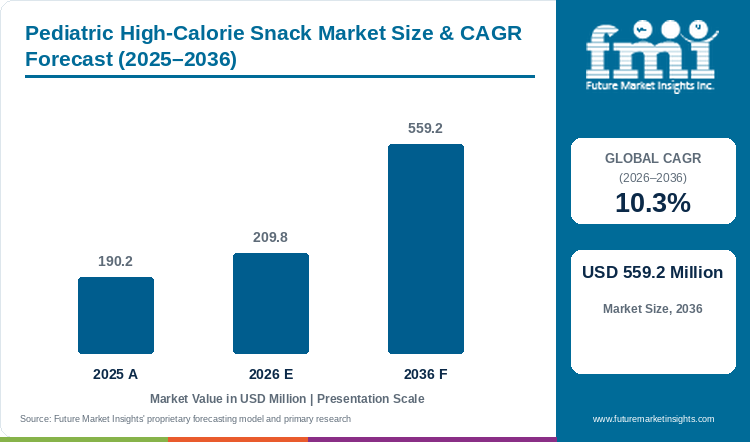
Sales in the pediatric high-calorie snack market are projected to grow at 10.3% CAGR through 2036. Market size rises from USD 190.2 million in 2025 to USD 209.8 million in 2026 and is expected to reach USD 559.2 million by 2036.
The global pediatric high-calorie snack market was valued at USD 190.2 million in 2025 and is projected to grow from USD 209.8 million in 2026 to USD 559.2 million by 2036, at 10.3% CAGR from 2026 to 2036, as per FMI. Calorie-dense bars and bites accounted for the leading 44.1% share in 2026 as measured solid portions can be added between meals. AAP reported that faltering weight affects around 5%-10% of children in primary care and 3%-5% in referral settings.[1] The AAP dietary toolkit states that high-energy oral clinical nutrition supplements can provide 25%-50% of estimated energy and protein needs.[2] Kate Farms launched Kids Nutrition in select Walmart stores and Walmart.com during September 2025, with each serving providing 8 g protein and 27 vitamins and minerals.[4] Defined clinical need, measured calorie delivery and wider retail access are expected to support the pediatric high-calorie snack market growth.
Key Market Trends & Insights
- By product type, calorie-dense bars and bites led the market with a share of 44.1% in 2026, owing to portable portions used between meals.
- By calorie level, 150-250 kcal per serving accounted for 50.8% of demand in 2026, supported by controlled energy addition through several textures.
- By use case, weight-gain support represented the leading 54.7% share in 2026, aligned with feeding plans which can be reviewed against growth measures.
- By end user, home and caregiver held a 46.1% share in 2026, as most product timing and continued use takes place outside the clinic.
- By sales channel, online and DTC led with a 46.0% share in 2026, supported by searchable assortments, home delivery and repeat ordering.
Regional Highlights
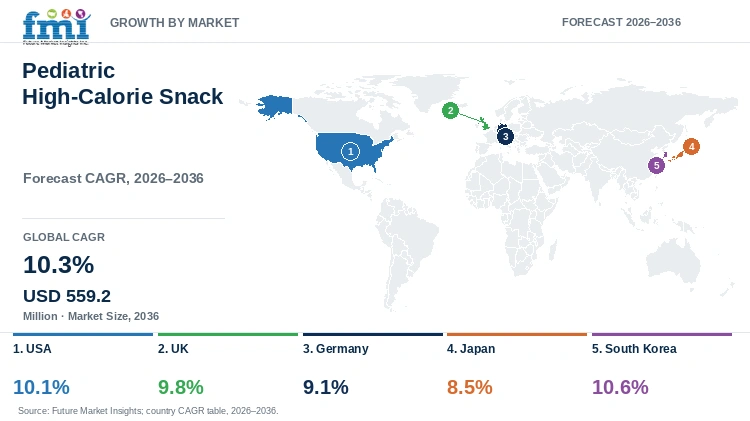
- Fastest-growing profiled country: South Korea (10.6% CAGR, 2026 to 2036).
- By country: USA (10.1%) and UK (9.8%) follow, while Japan records the moderate CAGR at 8.5%.
Market Size & Forecast
Table 1: Market Size and Forecast for the Pediatric High-Calorie Snack Market (USD million and percentage), 2025 to 2036
| Metric | Value |
|---|---|
| 2025 Market Size | USD 190.2 million |
| Estimated Market Size in 2026 | USD 209.8 million |
| Projected Market Size by 2036 | USD 559.2 million |
| CAGR, 2026 to 2036 | 10.3% |
| Added Revenue, 2026 to 2036 | USD 349.4 million |
| Market Expansion Multiple | 2.7x |
Pediatric high-calorie snack demand is connected with children requiring additional energy and the ability of caregivers to continue a feeding plan. The UK National Child Measurement Programme measured 1,145,893 children during 2024-2025, equal to 94.1% of eligible children in England.[9] Germany had 10.8 million children below 14 years at the end of 2025, representing 12.9% of its population.[10] Japan applies the 2025 Dietary Reference Intakes for five fiscal years, which provides age-specific energy and nutrient reference values.[11] These figures do not represent direct snack users, but it shows the child populations where catch-up nutrition needs can be identified. Product acceptance and continued household purchase will decide how much clinical need changes into repeated snack use.
Clinical Need and Addressable Demand
Pediatric high-calorie snacks are used when ordinary food volume is not providing the required intake. The addressable market is smaller than the complete child population and depends on identified faltering weight, measured calorie need, transition from enteral nutrition devices, and continued oral feeding. Clinical guidance provides the entry point, whereas product texture, serving calories, taste and household availability decides continued use. The indicators below connects diagnosis, calorie contribution and national child-monitoring activity with the market forecast.
Table 2: Clinical Need and Addressable Demand Indicators for the Pediatric High-Calorie Snack Market (children, percentages, calories, protein, nutrients, and products), mixed reporting years from 2025 to 2026
| Indicator | Data Point | Why It Matters | Source |
|---|---|---|---|
| Faltering-weight occurrence | 5%-10% in primary care; 3%-5% in referral settings | Provides a measurable clinical population requiring assessment. | [1] |
| Oral supplement contribution | 25%-50% of estimated energy and protein needs | Shows how supplements can contribute without replacing all ordinary food. | [2] |
| Kids Nutrition serving | 8 g protein; 27 vitamins and minerals | Connects one measured serving with protein and micronutrient delivery. | [4] |
| UK child measurement | 1,145,893 children; 94.1% of eligible children | Shows the scale of national child-weight monitoring. | [9] |
| Germany child population | 10.8 million below 14 years; 12.9% of population | Provides a national base for age-specific nutrition demand. | [10] |
| South Korea restricted products | 5,312 products listed for August 2026 | Separates ordinary high-calorie snacks from nutrition-positioned products. | [3] |
Analyst Perspective
“I see demand moving towards measured calorie snacks which can support growth without replacing the child’s regular meal. Wider texture choice and regular home availability will decide whether clinical need becomes continued product use.”
- Nandini Roy Choudhury, Principal Consultant, Future Market Insights.
How is the pediatric high-calorie snack market segmented?
Pediatric high-calorie snack market is segmented by five primary categories and region: product type, calorie level, use case, end user, sales channel, and region. In 2026, calorie-dense bars and bites are projected at 44.1%, the 150-250 kcal band at 50.8%, and weight-gain support at 54.7%.
By product type: calorie-dense bars and bites; nutrition puddings and smoothies; fortified cookies and bakery; savory fortified snacks; others.
By calorie level: 150-250 kcal per serving; more than 250 kcal per serving; others.
By use case: weight-gain support; tube-wean transition; everyday catch-up nutrition.
By end user: home and caregiver; feeding clinics and hospitals; others.
By sales channel: online and DTC; retail pharmacy; supermarkets and hypermarkets; specialty and health stores; others.
By region: North America; Latin America; Western Europe; Eastern Europe; East Asia; South Asia and Pacific; Middle East and Africa.
Why do calorie-dense bars and bites retain product type demand?
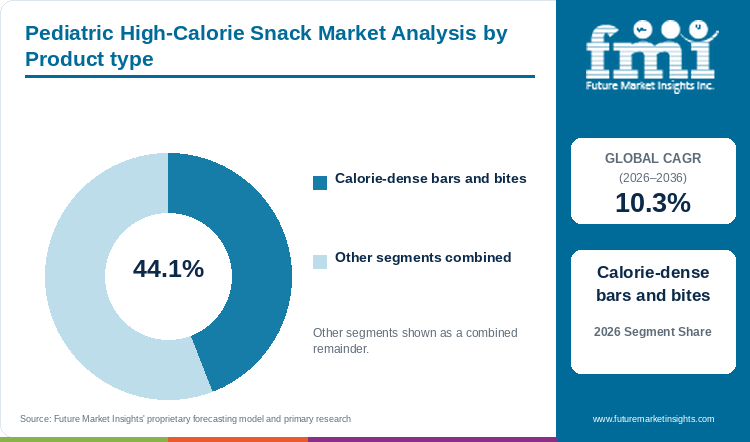
Based on product type, calorie-dense bars and bites are projected to account for 44.1% in 2026, driven by portable measured portions.
Table 3: Product Type Share for the Pediatric High-Calorie Snack Market (percentage share), 2026
| Product Type | Share (2026) |
|---|---|
| Calorie-dense bars and bites | 44.1% |
| Other Segments Combined | 55.9%* |
| Total | 100.0% |
*Calculated as the balance remaining after deducting the leading segment’s reported share from 100.0%.
Table 4: Product Type Leadership and Market Growth for the Pediatric High-Calorie Snack Market (segment and CAGR percentage), 2026 to 2036
| Metric | Value |
|---|---|
| Global CAGR (2026 to 2036) | 10.3% |
| Leading Segment | Calorie-dense bars and bites |
| Leading Segment Share (2026) | 44.1% |
| Estimated Market Size in 2026 | USD 209.8 million |
Calorie-dense bars and bites provide additional calories in a small solid portion. These products are used between regular meals and does not require mixing or preparation. Bars and bites are also easy to carry during school and travel, due to which caregivers are preferring these products for clinical nutrition and scheduled snack intake. According to FMI, measured and portable calorie portions are expected to support the calorie-dense bars and bites segment growth.
- Calorie-dense bars and bites hold 44.1% of product type demand in 2026 because their serving form supports scheduled use.
- In March 2026, AAP recommended increased food calories for children having faltering weight and supported regular nutrition follow-up.
What supports the 150-250 kcal band as a preferred calorie level?
By calorie level, 150-250 kcal per serving is estimated to hold 50.8% in 2026, owing to controlled energy addition.
In the FMI report, the 150-250 kcal range adds a meaningful calorie amount while preserving room for ordinary meals. The calorie range is available through bars, puddings, smoothies, and specialized medical foods. Caregivers can change the food texture without making a large change in the planned calorie amount. Wider availability of controlled serving formats is anticipated to support the 150-250 kcal segment growth.
- The 150-250 kcal band represents 50.8% of calorie level demand in 2026 because one serving is easier to schedule.
- Commercial formulations in this energy band provide 8 g protein and 27 vitamins and minerals per serving to deliver concentrated nourishment.
How does weight-gain support meet a defined use case?
In 2026, weight-gain support is expected to lead use case demand with 54.7% share, supported by measurable growth objectives.
Weight-gain support products are used when a child is not meeting the expected growth or calorie requirement. These products are generally added between meals and its response is checked during regular weight and growth follow-up. This gives a direct application within dietary supplements instead of using the product for ordinary wellness. FMI research indicates that defined growth objectives are likely to propel the weight-gain support segment growth.
- Weight-gain support contributes 54.7% of use case demand in 2026 because the intervention can be reviewed against growth measures.
- NASPGHAN reported in March 2026 that faltering weight affects around 5%-10% of young pediatric patients and requires targeted management.[5]
Why does home and caregiver use remain commercially relevant?
Home and caregiver use is likely to capture 46.1% share in 2026, enabled by daily control of timing and replenishment.
FMI data suggests that clinical advice starts the feeding plan, but most snack use takes place at home. Caregivers control the product timing, serving amount and repeat purchase during the complete feeding period. Taste refusal, appetite displacement and preparation burden can interrupt the continued product use. Easy preparation and wider household availability of functional foods options is expected to support the home and caregiver segment growth.
- Home and caregiver use holds 46.1% of end user demand in 2026 because the regimen is executed between clinical reviews.
- In March 2026, Nestlé introduced Compleat Paediatric Oral Blends in an on-the-go pouch for children requiring specialized medical nutrition.[6]
What drives online and DTC use in the sales channel?
Online and DTC is projected to hold 46.0% share in 2026, reinforced by searchable assortments and repeat delivery.
Online and DTC channels provides wider selection of specialized nutraceuticals and pediatric nutrition products by calorie level, age group, flavor and ingredient type. Local stores may not carry every specialized product, whereas online platforms allows caregivers to identify and reorder the selected product. As noted by FMI, online and DTC is projected to hold 46.0% of sales channel demand in 2026. Regular delivery is expected to support continued use when the snack is consumed several times during a week.
- Online and DTC accounts for 46.0% of sales channel demand in 2026 because specialized products benefit from recurring delivery.
- In May 2025, Else Nutrition expanded its children’s ready-to-drink shakes into 1,000 U.S. retail stores, supporting wider product availability.[7]
What are the drivers, restraints, and opportunities in the pediatric high-calorie snack market?
In the pediatric high-calorie snack market, defined calorie pathways are driving adoption, whereas high cost and reduced appetite can limit continued use. Availability of varied low-volume formats is expected to create new growth opportunities.
- Driver: faltering-weight guidance gives clinicians and caregivers a clearer trigger for higher-energy foods and oral supplementation.
- Restraint: out-of-pocket cost, limited coverage, appetite displacement and taste fatigue can interrupt sustained use.
- Opportunity: bars, bites, puddings and compact drinks can match calorie targets to different ages, textures and routines.
Clinical Pathways Define Calorie Use
Clear diagnosis and nutrition guidance is one of the primary factor driving the pediatric high-calorie snack market. In 2025, the American Society for Parenteral and Enteral Nutrition (ASPEN) published clinical guidance emphasizing protocolized calorie supplementation for pediatric growth faltering and disease-related undernutrition.[17] The guidance also supports dietary supplements and oral nutritional supplementation incorporating plant-based protein when ordinary food intake is not sufficient. Availability of a defined nutrition route gives pediatricians and caregivers a reason for using calorie-dense food between meals. Increasing use of documented calorie plans is expected to drive the pediatric high-calorie snack market growth.
Cost and Appetite Limit Persistence
High product cost and reduced meal appetite are factors which may limit continued use of pediatric high-calorie snacks. WHO and UNICEF issued 233-page implementation guidance in September 2026 covering identification, referral and nutritional management of young children with wasting.[8] The guidance indicates that nutrition use requires assessment and continued care instead of unrestricted calorie addition. Cost, appetite displacement and product fatigue can break the feeding plan, which may hamper the pediatric high-calorie snack market growth.
Format Variety Opens New Use
Product variety is creating new opportunities in the pediatric high-calorie snack market. In August 2026, Abbott announced the elimination of synthetic food dyes across its U.S. pediatric nutrition portfolio, including PediaSure, to align with caregiver demand for cleaner formulations.[18] The transition supports greater household confidence in daily snack and shake regimens. Expansion of portable and familiar food formats drawing on active sports nutrition approaches is expected to create new growth opportunities in the pediatric high-calorie snack market.
Which country CAGRs are profiled in the pediatric high-calorie snack market?
Table 5: Country CAGR Comparison for the Pediatric High-Calorie Snack Market (CAGR percentage), 2026 to 2036
| Country | CAGR, 2026-2036 |
|---|---|
| USA | 10.1% |
| UK | 9.8% |
| Germany | 9.1% |
| Japan | 8.5% |
| South Korea | 10.6% |
How do country-level CAGRs compare in the pediatric high-calorie snack market?
Country demand conditions differ as variation in pediatric nutrition guidance, food labeling, and product availability shapes local uptake. As per the analysis from FMI, South Korea and the USA are expected to record comparatively stronger expansion. Japan and Germany will grow through controlled nutrition and clinical use, where product selection remains tied with age and feeding need. Country demand is likely to depend on suitable product availability and the ability of caregivers to continue the selected feeding plan.
- USA demand is supported by a 2026 faltering-weight guideline and a defined role for calorie-dense foods and oral supplements.
- UK demand is shaped by national child-measurement data and stronger nutrition requirements in early-years settings from September 2025.
- Germany is preparing standardized definitions, diagnostic algorithms and referral criteria for pediatric faltering growth and malnutrition.
- Japan applies the 2025 dietary reference intakes during fiscal 2025-2029, supporting age-specific nutrient and serving decisions.
- South Korea is extending mandatory nutrition labels to 259 processed-food categories during 2026, increasing product-data visibility.
Full report country CAGRs cover: North America; Latin America; Western Europe; Eastern Europe; East Asia; South Asia and Pacific; Middle East and Africa.
Country-wise Analysis
- The USA pediatric high-calorie snack market is forecast to rise at 10.1% CAGR through 2036, supported by defined faltering-weight criteria. In March 2026, AAP and NASPGHAN issued eight key action statements and three z-score based diagnostic criteria. The guidance recommends increased food calories and supports oral nutrition supplements when required. High-energy oral supplements can provide 25%-50% of estimated energy and protein needs under established pediatric care protocols. These products can be added between meals when ordinary food volume is not sufficient. Product cost and limited coverage may affect continued purchase. Availability of several serving sizes is expected to support the USA market growth.
- The UK pediatric high-calorie snack market is anticipated to advance at 9.8% CAGR over the assessment period, influenced by national child-weight monitoring. The 2024-2025 National Child Measurement Programme evaluated children across England, tracking weight trajectories among reception and year 6 pupils. Wider measurement is increasing attention towards child weight and nutrition requirement, although the programme does not prescribe high-calorie snacks. Products having clear age, calorie and serving information can be used when a separate catch-up nutrition need is identified. These factors are anticipated to support measured UK market growth.
- Germany is estimated to post 9.1% CAGR over the forecast period, supported by a large child population and structured nutrition monitoring. Federal statistical records indicate that children below 14 years account for nearly 13% of the German population, expanding the pediatric base for clinical monitoring. A broad pediatric population supports demand for age-specific nutrition products through retail and professional channels. High-calorie products still requires a defined dietary reason and clear serving information. Availability of supervised nutrition formats is anticipated to support the Germany pediatric high-calorie snack market growth.
- Pediatric high-calorie snack demand in Japan is forecast to rise at 8.5% CAGR over the forecast period, owing to age-specific nutrition references. The Ministry of Health, Labour and Welfare establishes quantitative reference values for energy and nutrients across pediatric growth stages. Measured calorie servings can be used when ordinary food volume does not provide the required intake. However, products need to fit into the child’s complete diet instead of promoting uncontrolled calorie addition. Age-based serving information is expected to support gradual pediatric high-calorie snack adoption in Japan.
- Adoption of pediatric high-calorie snacks in South Korea is estimated to expand at 10.6% CAGR through 2036, supported by stronger child-food controls. Regulatory standards restrict low-nutrient, energy-dense foods in school zones, encouraging caregivers to choose certified nutritional formulations. The restriction creates a clear difference between ordinary high-calorie snacks and products having a defined nutrition purpose. Specialized products can receive attention when labels explain calorie amount, protein, micronutrients and intended age. Online and retail channels can also support regular product access after selection. These factors are likely to propel the South Korea pediatric high-calorie snack market growth.
Who are the notable companies in the pediatric high-calorie snack market?
Abbott, Danone Nutricia, Else Nutrition, Nestlé Health Science, Healthy Heights, Kate Farms, Mead Johnson Nutrition, and Medtrition are notable companies profiled in this market.
Pediatric high-calorie snack market is moderately fragmented with presence of broad early life nutrition platforms, medical nutrition suppliers and caregiver-focused brands. Abbott, Nestlé Health Science and Mead Johnson Nutrition provides wider pediatric nutrition portfolios through healthcare and retail channels. Danone Nutricia, Kate Farms and Medtrition are focusing on medical nutrition and concentrated delivery formats. An FMI analyst notes that companies are expanding retail access, nutrition research and product variety in order to increase its customer base.
- Broad pediatric platforms: Abbott, Nestlé Health Science and Mead Johnson Nutrition combine pediatric science with wide healthcare or retail reach.
- Medical nutrition specialists: Danone Nutricia, Kate Farms and Medtrition support supervised nutrition or concentrated delivery formats.
- Caregiver-oriented growth nutrition: Else Nutrition and Healthy Heights emphasize home use, taste acceptance and repeat ordering.
Competitive Benchmarking: Pediatric High-Calorie Snack Market
Table 6: Competitive Benchmarking for the Pediatric High-Calorie Snack Market (qualitative capability ratings), 2026
| Company | Low-volume delivery | Clinical pathway | Replenishment | Reach |
|---|---|---|---|---|
| Abbott | High | High | High | High |
| Danone Nutricia | High | High | Medium | High |
| Else Nutrition | Medium | Low | High | Medium |
| Nestlé Health Science | Medium | High | Medium | High |
| Healthy Heights | Medium | Low | High | Medium |
| Kate Farms | High | High | High | Medium |
| Mead Johnson Nutrition | Medium | Medium | High | High |
| Medtrition | High | Medium | Medium | Medium |
Scoring basis: High indicates broad current evidence for the named capability; Medium indicates narrower evidence; Low indicates limited direct evidence. Ratings describe public capability breadth, not product quality, company rank or market share.
Key Developments in the Pediatric High-Calorie Snack Market
- In September 2026, Danone inaugurated its largest specialized medical nutrition production line in France to expand high-energy oral and enteral capacity.[14]
- In June 2026, Else Nutrition commenced a commercial manufacturing drive across North America to rebuild retail inventory and support recurring orders.[13]
- In April 2026, Mead Johnson Nutrition entered a five-year scientific agreement with Mass General Brigham to advance clinical nutrition research.[12]
- In April 2026, Nestlé Health Science and Nestlé Nutrition combined operations into a unified platform to coordinate pediatric medical and family nutrition portfolios.[15]
Key Players in the Pediatric High-Calorie Snack Market
Broad pediatric nutrition platforms
- Abbott
- Nestlé Health Science
- Mead Johnson Nutrition
Clinical and medical nutrition specialists
- Danone Nutricia
- Kate Farms
- Medtrition
Caregiver-focused growth nutrition
- Else Nutrition
- Healthy Heights
Pediatric High-Calorie Snack Market - Report Scope
Table 7: Report Scope for the Pediatric High-Calorie Snack Market (coverage fields and definitions), 2026 to 2036
| Coverage field | Report scope |
|---|---|
| Market breakdown | Product type; calorie level; use case; end user; sales channel; region |
| Quantitative units | USD million |
| Market definition | Supplier-level revenue from pediatric products formulated to add measured calories through snacks or oral nutrition formats. |
| Exclusions | Ordinary children’s confectionery, infant formula, adult nutrition, tube-feeding equipment and downstream care services. |
| Regions | North America; Latin America; Western Europe; Eastern Europe; East Asia; South Asia and Pacific; Middle East and Africa |
| Countries profiled | USA; UK; Germany; Japan; South Korea |
| Forecast period | 2026 to 2036 |
Pediatric High-Calorie Snack Market - Research Methodology
Table 8: Research Methodology for the Pediatric High-Calorie Snack Market (research methods and approach), 2026 edition
| Method | Approach |
|---|---|
| Primary Research | The research study includes primary interviews with manufacturers, distributors, end users, procurement teams and industry experts. Interviews covers purchasing decision, product evaluation, adoption barriers, pricing and support requirement. Respondents are also asked about factors which converts an initial order into regular purchase. |
| Desk Research | Desk research includes government statistics, regulatory publications, industry associations, technical literature, company filings, product information and official company announcements. Sources are reviewed according to publication date, geographic coverage and relevance with the pediatric high-calorie snack market. |
| Market Sizing and Forecasting | Market sizing combines the base value with historical performance, segment structure, product price, volume indicators, company participation and country demand. Forecast assumptions includes economic conditions, regulation, product availability, sales channels and barriers affecting wider use. |
| Data Validation | Market estimates are checked with government data, company activity, industry developments and primary research findings. Adjacent products, overlapping revenue and unsupported claims are excluded in order to maintain the defined market boundary. |
Pediatric High-Calorie Snack Market by Segments
Product type
- Calorie-dense bars and bites
- Nutrition puddings and smoothies
- Fortified cookies and bakery
- Savory fortified snacks
- Others
Calorie level
- 150-250 kcal per serving
- More than 250 kcal per serving
- Others
Use case
- Weight-gain support
- Tube-wean transition
- Everyday catch-up nutrition
End user
- Home and caregiver
- Feeding clinics and hospitals
- Others
Sales channel
- Online and DTC
- Retail pharmacy
- Supermarkets and hypermarkets
- Specialty and health stores
- Others
Pediatric High-Calorie Snack Market by Region
- North America
- United States
- Canada
- Latin America
- Brazil
- Mexico
- Argentina
- Chile
- Western Europe
- Germany
- France
- United Kingdom
- Italy
- Spain
- Benelux
- Nordics
- Eastern Europe
- Poland
- Czech Republic
- Romania
- Hungary
- East Asia
- Japan
- South Korea
- South Asia and Pacific
- ASEAN
- Australia and New Zealand
- Middle East and Africa
- GCC Countries
- South Africa
- Türkiye
- Israel
Research Sources and Bibliography
- [1] American Academy of Pediatrics. (2026, March 16). New clinical practice guideline defines “faltering weight,” recommends treatment options.
- [2] American Academy of Pediatrics, & North American Society for Pediatric Gastroenterology, Hepatology and Nutrition. (2026, March 16). Clinical practice guideline for diagnosis and management of faltering weight.
- [3] Ministry of Food and Drug Safety, Republic of Korea. (2026, July 28). August list of high-calorie, low-nutrient foods and high-caffeine children’s foods restricted from school and quality-store sales.
- [4] Kate Farms. (2025, September 23). Kate Farms launches Kids Nutrition line to Walmart.
- [5] North American Society for Pediatric Gastroenterology, Hepatology and Nutrition. (2026, March 18). Joint clinical practice guideline for diagnosis and management of faltering weight.
- [6] Nestlé Health Science. (2026, March 30). Nestlé introduces an innovative complete nutritional solution for children with special medical nutrition needs.
- [7] Else Nutrition Holdings Inc. (2025, May 27). Else Nutrition expands nationwide with Kids ready-to-drink shakes in 1,000 leading U.S. retailer stores.
- [8] World Health Organization, & United Nations Children’s Fund. (2026, September 17). Implementation guidance on the management of wasting and nutritional oedema in infants and children aged under 5 years.
- [9] Office for Health Improvement and Disparities. (2025, November 4). National Child Measurement Programme annual report, academic year 2024 to 2025, England.
- [10] Statistisches Bundesamt. (2026, September 15). 12.9% of Germany’s population was under 14 years of age at the end of 2025.
- [11] Ministry of Health, Labour and Welfare, Japan. (2025). Dietary Reference Intakes for Japanese, 2025 edition.
- [12] Reckitt. (2026, April 15). Mead Johnson Nutrition and Mass General Brigham expand research program with five-year commitment.
- [13] Else Nutrition Holdings Inc. (2026, June 1). Else Nutrition kicks off a manufacturing drive in Q2 2026.
- [14] Danone. (2026, September 15). Danone inaugurates its largest medical nutrition production line in France.
- [15] Nestlé Health Science. (2026). Nestlé Health Science and Nestlé Nutrition combine their businesses.
- [16] Nestlé Health Science. (2025, November 7). Nestlé Health Science becomes global partner to Special Olympics.
- [17] American Society for Parenteral and Enteral Nutrition. (2025). Clinical practice recommendations for pediatric malnutrition screening and energy management.
- [18] Abbott. (2026, August 4). Abbott eliminates synthetic dyes across U.S. pediatric and adult nutrition portfolio.
This bibliography is provided for reader reference. The full report contains the complete reference list and detailed citations.
This Report Answers
- How large is the pediatric high-calorie snack market during 2026?
- What value is projected for the pediatric high-calorie snack market by 2036?
- Which product type holds a notable market share during 2026?
- Which calorie level accounts for a notable market share during 2026?
- Which country has a notable pediatric high-calorie snack expansion outlook?
- Which companies are notable in the pediatric high-calorie snack market?
Frequently Asked Questions
How large is the pediatric high-calorie snack market in 2026?
The pediatric high-calorie snack market is estimated to reach USD 209.8 million in 2026. The market is projected to reach USD 559.2 million by 2036.
What CAGR is projected for pediatric high-calorie snacks through 2036?
As per FMI, the pediatric high-calorie snack market is projected to grow at 10.3% CAGR from 2026 to 2036. Growth is supported by measured calorie addition for children having faltering weight.
Which product type holds a notable share during 2026?
Calorie-dense bars and bites are projected to account for 44.1% of product type demand in 2026. The segment benefits from portable portions which can be served between regular meals.
Which calorie level holds a notable market share during 2026?
The 150–250 kcal per serving band is estimated to hold 50.8% of calorie level demand in 2026. Demand is supported by controlled calorie addition through bars, puddings and compact drinks.
Which country has a notable expansion outlook through 2036?
Future Market Insights projects South Korea to register 10.6% CAGR from 2026 to 2036. Growth is supported by stronger child-food controls and wider visibility of nutrition information.
Who are notable companies in the pediatric high-calorie snack market?
Key participants include Abbott, Danone Nutricia, Else Nutrition, Nestlé Health Science, Healthy Heights, Kate Farms, Mead Johnson Nutrition, and Medtrition. These companies are focusing on product variety, nutrition evidence and wider household availability.
Preview the report firsthand - request a free sample
Get SampleGet the brochure for pricing and purchase details.
Get PDFTable of Content
- Key Takeaways
- Market Size and CAGR
- Top Growth Driver
- Fastest Growing Segment
- Leading Region
- Key Companies
- Emerging Opportunities
- Executive Summary
- Global Market Outlook
- Demand-side Trends
- Supply-side Trends
- Technology Roadmap Analysis
- Analysis and Recommendations
- Analyst Perspective (What is happening? Why now? What should investors know?)
- Key Questions Answered
- How large is the market?
- What is the CAGR?
- What are key trends?
- Which region dominates?
- Who are the leaders?
- Market Overview
- Market Coverage / Taxonomy
- Market Definition / Scope / Limitations
- Research Methodology
- Chapter Orientation
- Analytical Lens and Working Hypotheses
- Market Structure, Signals, and Trend Drivers
- Benchmarking and Cross-market Comparability
- Market Sizing, Forecasting, and Opportunity Mapping
- Research Design and Evidence Framework
- Desk Research Programme (Secondary Evidence)
- Expert Input and Fieldwork (Primary Evidence)
- Tooling, Models, and Reference Databases
- Data Engineering and Model Build
- Quality Assurance and Audit Trail
- Market Background
- Market Dynamics (Drivers, Restraints, Opportunity, Trends)
- Scenario Forecast (Optimistic, Likely, Conservative)
- Impact Analysis
- AI Impact
- Sustainability Impact
- Regulatory Impact
- Technology Impact
- Consumer / Buyer Analysis
- Purchase Drivers
- Adoption Barriers
- Buyer Journey
- Opportunity Map Analysis
- Product Life Cycle Analysis
- Supply Chain Analysis
- Investment Feasibility Matrix
- Value Chain Analysis
- PESTLE and Porter's Analysis
- Regulatory Landscape
- Regional Parent Market Outlook
- Production and Consumption Statistics
- Import and Export Statistics
- Global Market Analysis and Forecast, 2021 to 2036
- Historical Market Size Value (USD Million) Analysis, 2021 to 2025
- Current and Future Market Size Value (USD Million) Projections, 2026 to 2036
- Y-o-Y Growth Trend Analysis
- Absolute $ Opportunity Analysis
- Global Market Pricing Analysis, 2021 to 2036
- Global Market Analysis and Forecast, By Product type, 2021 to 2036
- Introduction / Key Findings
- Historical Market Size Value (USD Million) Analysis By Product type, 2021 to 2025
- Current and Future Market Size Value (USD Million) Analysis and Forecast By Product type, 2026 to 2036
- Calorie-dense bars and bites
- Nutrition puddings and smoothies
- Fortified cookies and bakery
- Savory fortified snacks
- Others
- Y-o-Y Growth Trend Analysis By Product type, 2021 to 2025
- Absolute $ Opportunity Analysis By Product type, 2026 to 2036
- Global Market Analysis and Forecast, By Calorie level, 2021 to 2036
- Introduction / Key Findings
- Historical Market Size Value (USD Million) Analysis By Calorie level, 2021 to 2025
- Current and Future Market Size Value (USD Million) Analysis and Forecast By Calorie level, 2026 to 2036
- 150-250 kcal per serving
- More than 250 kcal per serving
- Others
- Y-o-Y Growth Trend Analysis By Calorie level, 2021 to 2025
- Absolute $ Opportunity Analysis By Calorie level, 2026 to 2036
- Global Market Analysis and Forecast, By Use case, 2021 to 2036
- Introduction / Key Findings
- Historical Market Size Value (USD Million) Analysis By Use case, 2021 to 2025
- Current and Future Market Size Value (USD Million) Analysis and Forecast By Use case, 2026 to 2036
- Weight-gain support
- Tube-wean transition
- Everyday catch-up nutrition
- Y-o-Y Growth Trend Analysis By Use case, 2021 to 2025
- Absolute $ Opportunity Analysis By Use case, 2026 to 2036
- Global Market Analysis and Forecast, By End user, 2021 to 2036
- Introduction / Key Findings
- Historical Market Size Value (USD Million) Analysis By End user, 2021 to 2025
- Current and Future Market Size Value (USD Million) Analysis and Forecast By End user, 2026 to 2036
- Home and caregiver
- Feeding clinics and hospitals
- Others
- Y-o-Y Growth Trend Analysis By End user, 2021 to 2025
- Absolute $ Opportunity Analysis By End user, 2026 to 2036
- Global Market Analysis and Forecast, By Sales channel, 2021 to 2036
- Introduction / Key Findings
- Historical Market Size Value (USD Million) Analysis By Sales channel, 2021 to 2025
- Current and Future Market Size Value (USD Million) Analysis and Forecast By Sales channel, 2026 to 2036
- Online and DTC
- Retail pharmacy
- Supermarkets and hypermarkets
- Specialty and health stores
- Others
- Y-o-Y Growth Trend Analysis By Sales channel, 2021 to 2025
- Absolute $ Opportunity Analysis By Sales channel, 2026 to 2036
- Global Market Analysis and Forecast, By Region, 2021 to 2036
- Introduction
- Historical Market Size Value (USD Million) Analysis By Region, 2021 to 2025
- Current Market Size Value (USD Million) Analysis and Forecast By Region, 2026 to 2036
- North America
- Latin America
- Western Europe
- Eastern Europe
- East Asia
- South Asia and Pacific
- Middle East and Africa
- Market Attractiveness Analysis By Region
- North America Market Analysis and Forecast, By Country, 2021 to 2036
- Historical Market Size Value (USD Million) Trend Analysis By Market Taxonomy, 2021 to 2025
- Market Size Value (USD Million) Forecast By Market Taxonomy, 2026 to 2036
- By Country
- United States
- Canada
- By Product type
- By Calorie level
- By Use case
- By End user
- By Sales channel
- By Country
- Market Attractiveness Analysis
- By Country
- By Product type
- By Calorie level
- By Use case
- By End user
- By Sales channel
- Key Takeaways
- Latin America Market Analysis and Forecast, By Country
- Historical Market Size Value (USD Million) Trend Analysis By Market Taxonomy, 2021 to 2025
- Market Size Value (USD Million) Forecast By Market Taxonomy, 2026 to 2036
- By Country
- Brazil
- Mexico
- Argentina
- Chile
- By Product type
- By Calorie level
- By Use case
- By End user
- By Sales channel
- By Country
- Market Attractiveness Analysis
- By Country
- By Product type
- By Calorie level
- By Use case
- By End user
- By Sales channel
- Key Takeaways
- Western Europe Market Analysis and Forecast, By Country
- Historical Market Size Value (USD Million) Trend Analysis By Market Taxonomy, 2021 to 2025
- Market Size Value (USD Million) Forecast By Market Taxonomy, 2026 to 2036
- By Country
- Germany
- France
- United Kingdom
- Italy
- Spain
- Benelux
- Nordics
- By Product type
- By Calorie level
- By Use case
- By End user
- By Sales channel
- By Country
- Market Attractiveness Analysis
- By Country
- By Product type
- By Calorie level
- By Use case
- By End user
- By Sales channel
- Key Takeaways
- Eastern Europe Market Analysis and Forecast, By Country
- Historical Market Size Value (USD Million) Trend Analysis By Market Taxonomy, 2021 to 2025
- Market Size Value (USD Million) Forecast By Market Taxonomy, 2026 to 2036
- By Country
- Poland
- Czech Republic
- Romania
- Hungary
- By Product type
- By Calorie level
- By Use case
- By End user
- By Sales channel
- By Country
- Market Attractiveness Analysis
- By Country
- By Product type
- By Calorie level
- By Use case
- By End user
- By Sales channel
- Key Takeaways
- East Asia Market Analysis and Forecast, By Country
- Historical Market Size Value (USD Million) Trend Analysis By Market Taxonomy, 2021 to 2025
- Market Size Value (USD Million) Forecast By Market Taxonomy, 2026 to 2036
- By Country
- Japan
- South Korea
- By Product type
- By Calorie level
- By Use case
- By End user
- By Sales channel
- By Country
- Market Attractiveness Analysis
- By Country
- By Product type
- By Calorie level
- By Use case
- By End user
- By Sales channel
- Key Takeaways
- South Asia and Pacific Market Analysis and Forecast, By Country
- Historical Market Size Value (USD Million) Trend Analysis By Market Taxonomy, 2021 to 2025
- Market Size Value (USD Million) Forecast By Market Taxonomy, 2026 to 2036
- By Country
- ASEAN
- Australia and New Zealand
- By Product type
- By Calorie level
- By Use case
- By End user
- By Sales channel
- By Country
- Market Attractiveness Analysis
- By Country
- By Product type
- By Calorie level
- By Use case
- By End user
- By Sales channel
- Key Takeaways
- Middle East and Africa Market Analysis and Forecast, By Country
- Historical Market Size Value (USD Million) Trend Analysis By Market Taxonomy, 2021 to 2025
- Market Size Value (USD Million) Forecast By Market Taxonomy, 2026 to 2036
- By Country
- GCC Countries
- South Africa
- Türkiye
- Israel
- By Product type
- By Calorie level
- By Use case
- By End user
- By Sales channel
- By Country
- Market Attractiveness Analysis
- By Country
- By Product type
- By Calorie level
- By Use case
- By End user
- By Sales channel
- Key Takeaways
- Key Countries Market Analysis
- United States
- Pricing Analysis
- Market Share Analysis, 2025
- By Product type
- By Calorie level
- By Use case
- By End user
- By Sales channel
- Canada
- Pricing Analysis
- Market Share Analysis, 2025
- By Product type
- By Calorie level
- By Use case
- By End user
- By Sales channel
- Mexico
- Pricing Analysis
- Market Share Analysis, 2025
- By Product type
- By Calorie level
- By Use case
- By End user
- By Sales channel
- Brazil
- Pricing Analysis
- Market Share Analysis, 2025
- By Product type
- By Calorie level
- By Use case
- By End user
- By Sales channel
- Chile
- Pricing Analysis
- Market Share Analysis, 2025
- By Product type
- By Calorie level
- By Use case
- By End user
- By Sales channel
- Germany
- Pricing Analysis
- Market Share Analysis, 2025
- By Product type
- By Calorie level
- By Use case
- By End user
- By Sales channel
- United Kingdom
- Pricing Analysis
- Market Share Analysis, 2025
- By Product type
- By Calorie level
- By Use case
- By End user
- By Sales channel
- Italy
- Pricing Analysis
- Market Share Analysis, 2025
- By Product type
- By Calorie level
- By Use case
- By End user
- By Sales channel
- Spain
- Pricing Analysis
- Market Share Analysis, 2025
- By Product type
- By Calorie level
- By Use case
- By End user
- By Sales channel
- France
- Pricing Analysis
- Market Share Analysis, 2025
- By Product type
- By Calorie level
- By Use case
- By End user
- By Sales channel
- ASEAN
- Pricing Analysis
- Market Share Analysis, 2025
- By Product type
- By Calorie level
- By Use case
- By End user
- By Sales channel
- Australia and New Zealand
- Pricing Analysis
- Market Share Analysis, 2025
- By Product type
- By Calorie level
- By Use case
- By End user
- By Sales channel
- Japan
- Pricing Analysis
- Market Share Analysis, 2025
- By Product type
- By Calorie level
- By Use case
- By End user
- By Sales channel
- South Korea
- Pricing Analysis
- Market Share Analysis, 2025
- By Product type
- By Calorie level
- By Use case
- By End user
- By Sales channel
- Poland
- Pricing Analysis
- Market Share Analysis, 2025
- By Product type
- By Calorie level
- By Use case
- By End user
- By Sales channel
- Hungary
- Pricing Analysis
- Market Share Analysis, 2025
- By Product type
- By Calorie level
- By Use case
- By End user
- By Sales channel
- Türkiye
- Pricing Analysis
- Market Share Analysis, 2025
- By Product type
- By Calorie level
- By Use case
- By End user
- By Sales channel
- South Africa
- Pricing Analysis
- Market Share Analysis, 2025
- By Product type
- By Calorie level
- By Use case
- By End user
- By Sales channel
- United States
- Market Structure Analysis
- Competition Dashboard
- Competition Benchmarking
- Market Share Analysis of Top Players
- By Regional
- By Product type
- By Calorie level
- By Use case
- By End user
- By Sales channel
- Emerging Startups
- Innovation Benchmarking
- Competition Analysis
- Competition Deep Dive
- Abbott
- Overview
- Product Portfolio
- Profitability by Market Segments
- Sales Footprint
- Strategy Overview
- Marketing Strategy
- Product Strategy
- Channel Strategy
- Danone Nutricia
- Else Nutrition
- Nestlé Health Science
- Healthy Heights
- Kate Farms
- Mead Johnson Nutrition
- Medtrition
- Abbott
- Case Studies
- Success Stories
- Recent Developments
- Competition Deep Dive
- Assumptions & Acronyms Used


