

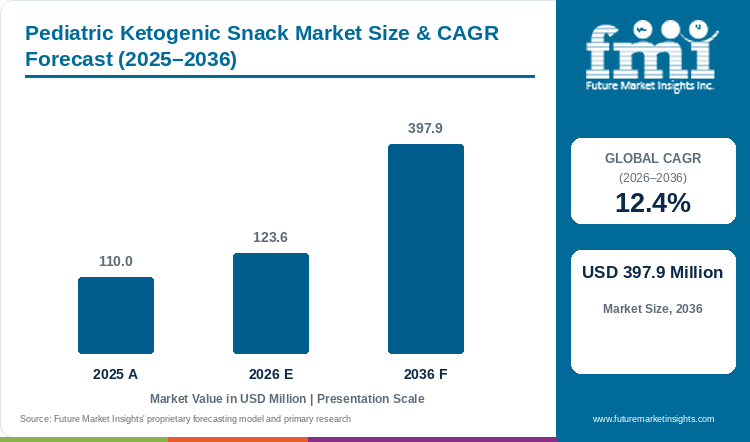
- Market Size (2026)
- USD 123.6 Mn
- Forecast (2036)
- USD 397.9 Mn
- CAGR (2026 to 2036)
- 12.4%
How big is Pediatric Ketogenic Snack Market in 2026?
Demand for pediatric ketogenic snacks is projected to expand at 12.4% CAGR between 2026 and 2036. Industry value grows from USD 110.0 million in 2025 to USD 123.6 million in 2026 and is projected to reach USD 397.9 million by 2036.
Increasing use of medically supervised ketogenic dietary therapy has created requirement for foods that can be included without changing the prescribed ratio. Pediatric ketogenic snacks are measured foods prepared as part of pediatric nutrition and are available in bars, bites, cookies, puddings and drink mixes. These products contains calculated fat, protein and carbohydrate and are generally used between the main meals. A March 2026 prospective study included 136 children and reported higher proportion of children with at least 50% seizure reduction after six months of ketogenic diet therapy[1]. Families following the therapy cannot use an ordinary snack because a small change can disturb the daily food calculation. Analyst at FMI notes that due to this requirement, measured and portable snacks are facing increasing demand during school, travel and household routine.
Availability of medical foods and specialist dietetic services is different from one country to another, owing to which product use and repeat purchase also follows a different pattern. South Korea market is projected to grow at 12.5% CAGR, whereas the USA market is estimated at 11.9% CAGR through 2036. The UK is forecast at 11.6%, Germany at 11.3% and Japan at 10.7% CAGR. In 2026, Chelsea and Westminster Hospital introduced a pediatric ketogenic diet pilot service supported by neurologist, dietitian and nurse and stated that seizure reduction is recorded in about half of children starting the diet[2]. Increasing specialist initiation is opening the market for ratio-defined foods. However, regular supply, reimbursement record, ratio information and age suitability will decide whether the same snack is purchased for long-term use.
Key Takeaways
- Specialist dietary therapy is expanding repeat demand for measured snacks that fit daily pediatric epilepsy routines.
- By product type, keto bars and bites are projected to account for 44.1% in 2026, supported by portable portions.
- The ketogenic ratio category is forecast to be led by the 3:1 ratio at 47.3% share in 2026, owing to balanced protein provision.
- Drug-resistant epilepsy is estimated to hold 56.0% of indication demand in 2026, owing to specialist referral after medicine failure.
- South Korea is forecast at 12.5% CAGR, while the USA is projected at 11.9% CAGR through distinct specialist access routes.
- Notable companies in the Pediatric Ketogenic Snack Market include Danone Nutricia, Ajinomoto Cambrooke, Vitaflo, Dr. Schär, and Solace Nutrition.
Analyst Perspective
“Demand will increase for measured snacks that keeps the prescribed food plan unchanged. Portable formats with regular availability will create the next growth opportunity.”
- Nandini Roy Choudhury, Principal Consultant, Future Market Insights.
How is the pediatric ketogenic snack market segmented?
Pediatric ketogenic snack market is segmented by product type, ketogenic ratio, indication, end user, sales channel, and region. Each category reflects the product format, prescribed ratio, clinical use, purchasing user and distribution route followed during pediatric ketogenic dietary therapy.
By product type, the market includes keto bars and bites, keto cookies and bakery, keto puddings and creams, keto drink mixes, and others.
By ketogenic ratio, the market includes 3:1 ratio, 2:1 ratio, 4:1 ratio, and others.
By indication, the market includes drug-resistant epilepsy, GLUT1 deficiency, and other metabolic conditions.
By end user, the market includes home and caregiver, hospitals and keto clinics, and others.
By sales channel, the market includes hospital pharmacy, retail pharmacy, online, institutional tender, and others.
By region, the market includes North America, Latin America, Western Europe, Eastern Europe, East Asia, South Asia and Pacific, and Middle East and Africa.
Why do keto bars and bites hold notable product type demand?
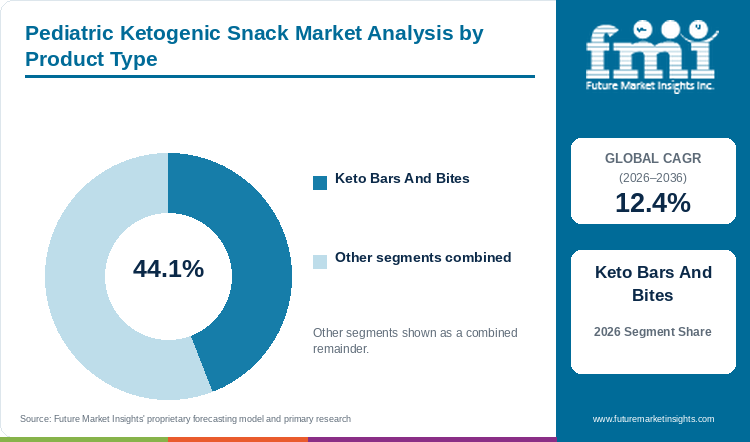
Based on product type, keto bars and bites are projected to account for 44.1% in 2026, driven by portable portion control.
Keto bars and bites gives one fixed portion which can be carried without repeated weighing. These products are being used during school, travel and other smaller eating occasions where preparation of a separate recipe is difficult. In 2026, KetoVie listed six KetoVie Café foods in its clinical resources, including cinnamon donut delights, creamy cereal, pizza petites and raspberry muffins[3]. Increasing availability of ready-to-use kids food and beverages is providing more food choice to families. Also, compact packs and measured portions reduces the preparation work for caregivers.
- Keto bars and bites are projected at 44.1% of product type demand in 2026, owing to fixed and portable portions.
- One measured portion reduces repeated weighing during school and travel. FMI notes that due to these advantages, bars and bites are gaining preference where convenience is required but the prescribed ratio cannot be changed.
What supports the 3:1 ratio as a preferred ketogenic option?
By ketogenic ratio, the 3:1 ratio is estimated to hold 47.3% in 2026, supported by pediatric protein requirements.
The 3:1 ketogenic ratio provides three parts fat for one part protein and carbohydrate and can include formulations prepared with MCT oil. Children requiring higher protein inclusion may use this ratio instead of stricter 4:1 plans. In August 2025, Nestlé Health Science listed K.Yo as a 3:1 semi-solid food in three flavors, with 308 to 310 kcal and 30 g fat in each 100 g pot[4]. The fixed nutrient value allows a dietitian to place the product within the daily calculation without making another recipe. In addition to this, softer texture provides an option for younger children.
- The 3:1 ratio is estimated at 47.3% of ketogenic ratio demand in 2026, supported by higher protein flexibility.
- Higher protein inclusion gives the 3:1 ratio use across more pediatric plans plus increasing food variety is expected to upkeep the demand for 3:1 ratio products.
How does drug-resistant epilepsy shape the indication category today?
In 2026, drug-resistant epilepsy is expected to lead indication demand with 56.0% share, owing to specialist dietary referrals.
Drug-resistant epilepsy becomes one of the primary indication for ketogenic dietary therapy when suitable antiseizure medicines does not provide sustained control. Children continuing the therapy requires calculated meals and snacks throughout the day. An October 2025 prospective study of 268 children reported 50.78% seizure-response rate in ketogenic-diet group compared with 29.29% in medicine-adjustment group after six months[5]. Clinical work around developmental and epileptic encephalopathies is bringing more severe pediatric cases under specialist dietary care. As the therapy continues between hospital reviews, the requirement for measured snacks also remains recurring. This long treatment period is supporting drug-resistant epilepsy segment in the market.
- Drug-resistant epilepsy is forecast at 56.0% of indication demand in 2026, owing to specialist referral after medicine failure.
- Longer therapy creates snack requirement between meals and clinical reviews.
Why does home and caregiver use lead the end user category?
By end user, home and caregiver is forecast to represent 49.4% in 2026, due to daily household administration.
Majority of pediatric ketogenic meals and snacks are given at home after the child returns from clinic. Home and caregiver segment manages weighing, meal timing, storage and repeated purchase during the therapy period. In October 2025, the Epilepsy Foundation published caregiver guidance covering ketogenic diet, modified Atkins diet, low-glycemic-index treatment and MCT diet for childhood seizure management[6]. Availability of pediatric supplements and clearer caregiver information is making restricted food plans easier to continue at home. Apart from that, ready portions reduce the need to prepare every small eating occasion from the beginning. Daily household administration is therefore keeping home and caregiver demand ahead of one-time clinical use.
- Home and caregiver use is forecast at 49.4% of end user demand in 2026, due to daily household administration.
- Caregivers arrange meal timing and repeated purchase after clinic initiation.
Which conditions keep hospital pharmacy relevant within sales channels?
Hospital pharmacy is expected to hold 44.9% share in 2026, owing to specialist initiation and clinical purchasing documentation.
Clinical nutrition products used in ketogenic dietary therapy are generally selected under neurologist and dietitian supervision. Hospital pharmacy is important at the beginning of treatment because ratio, nutrient value, allergens and age suitability are checked before a product enters the food plan. A March 2026 NHS primary-care document requires monthly ketogenic-product prescriptions, weekly review for six weeks and consultant-led multidisciplinary review at three months[7]. Such prescription and review requirement keeps defined products inside formal supply channels.
- Hospital pharmacy is projected at 44.9% of sales channel demand in 2026, owing to specialist initiation.
- Hospital selection depends on ratio, age suitability and medical-use information. Also, purchasing records and medical-use information supports product approval by hospitals.
What are the drivers, restraints, and opportunities in the pediatric ketogenic snack market?
Earlier specialist use is the key driver for pediatric ketogenic snacks, whereas exact ratio management and treatment side effects may hamper product use. Increasing availability of portable and ratio-defined foods is expected to create growth opportunities in the market.
- Driver: Earlier specialist consideration expands the number of children entering medically supervised ketogenic dietary therapy.
- Restraint: Exact ratio management and treatment side effects can interrupt use and limit product substitution.
- Opportunity: Portable documented formats are projected to reduce preparation work during home and school routines.
Earlier Specialist Use Expands Demand
Specialists are considering ketogenic dietary therapy earlier for children where medicine does not provide suitable seizure control. The American Epilepsy Society guideline published in April 2026 covers 18 treatment questions and includes dietary therapy for infants and children with drug-resistant epilepsy[8]. Entry into therapy at an earlier age increases the number of meals and snacks that caregivers needs to calculate every day. Growing neurology services is also bringing more families under dietitian follow-up. In addition, longer continuation of therapy creates repeated purchase of ratio-defined foods. Earlier specialist consideration is therefore a major factor driving pediatric ketogenic snack demand.
Monitoring Limits Everyday Substitution
Regular monitoring of growth, tolerance, hydration and nutrient intake remains necessary during ketogenic dietary therapy. A September 2025 meta-analysis reported constipation in 37.5%, anorexia in 19.5% and diarrhea in 18.9% of included pediatric cases[9]. These side effects can reduce food intake and may limiting the use of some snack formats. Ordinary low-carbohydrate foods also cannot replace medical foods for orphan diseases where a small substitution can change the prescribed ratio. Families may also stop a product when texture or tolerance is not suitable for the child. Monitoring burden, treatment side effects and limited replacement options are the main factors hampering everyday product use.
Portable Formats Reduce Preparation Work
School and travel occasions are opening application for portable bars, bites, puddings and oral clinical nutrition supplements. These formats reduces preparation of smaller food portions and can be kept ready for the planned snack time. In 2026, Nutricia reported that its ketogenic range is supported by more than 35 scientific studies covering over 1,400 patients and includes ready-made ratios for classical, MCT, modified and low-glycemic-index diets[10]. Presence of different ratios gives dietitians more scope to select a suitable format for the child. Manufacturers offering clear nutrient values, smaller packs and regular availability can gain from this requirement. Portable documented formats will therefore create new avenues in school and household use.
Which country CAGRs are profiled in the pediatric ketogenic snack market?
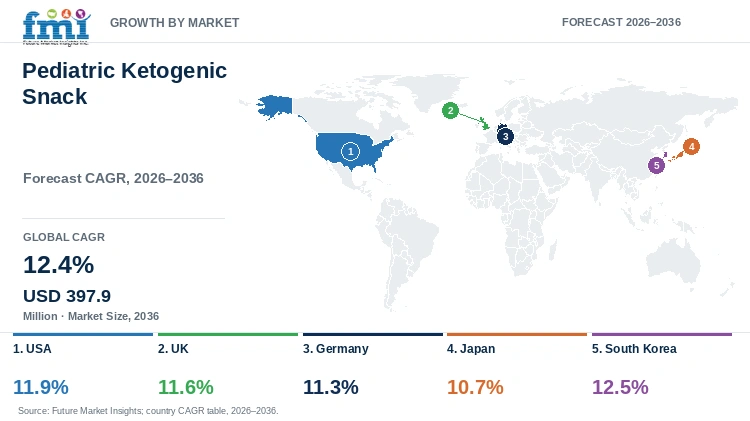
| Country | CAGR |
|---|---|
| USA | 11.9% |
| UK | 11.6% |
| Germany | 11.3% |
| Japan | 10.7% |
| South Korea | 12.5% |
How do country-level CAGRs compare in the pediatric ketogenic snack market?
Country demand for pediatric ketogenic snacks differs according to specialist referral, prescription route and availability of medical foods. Hospital initiation remains common, whereas repeated purchase shifts to pharmacies and households after the diet is established.
Pediatric ketogenic snack suppliers are increasing ratio information, reimbursement records and caregiver instructions in order to support repeat product use after clinical selection.
- USA demand uses medical-food supervision, hospital supply, specialty pharmacy, and direct ordering after specialist selection.
- UK demand follows specialist dietetic services and prescription routes for qualifying foods used in ketogenic therapy.
- Germany demand uses food-for-special-medical-purposes channels and ratio-specific products for therapeutic ketogenic diets.
- Japan demand remains linked to hospital-led initiation, localized instructions, and family training before home use expands.
- South Korea demand is supported by tertiary pediatric centers with experience in long-term ketogenic therapy.
Full report country CAGRs cover: North America; Latin America; Western Europe; Eastern Europe; East Asia; South Asia and Pacific; Middle East and Africa.
Country-wise Analysis
- The USA pediatric ketogenic snack market is forecast to rise at 11.9% CAGR through 2036. In November 2025, Johns Hopkins Children’s Center reported that its pediatric epilepsy team had used ketogenic diet therapy for more than 1,500 children since 1994[11]. Long clinical use has created familiarity with ratio-specific medical nutrition products among specialist centers. Hospitals and medical-food suppliers supports the first product selection, while direct ordering helps the family continue with the same food at home. Wider therapy experience, established medical-food routes and repeated household purchase are likely to upkeep demand in the country.
- The UK pediatric ketogenic snack market is anticipated to advance at 11.6% CAGR through 2036. The 2026 Epilepsy12 audit included 3,709 children and young people and reported that 88.1% had access to an epilepsy specialist nurse during first year of care[12]. Specialist contact provides a route for referral, dietetic review and prescription of qualifying foods. Therapeutic food delivery for clinical nutrition also supports use during school and travel after the diet is established. Prescription route and continued dietetic contact are giving measured snacks a wider place in long-term home care.
- Germany pediatric ketogenic snack sales are forecast to grow at 11.3% CAGR through 2036. A 2026 German Society for Neuropediatrics education module reported adverse effects in 80% of infants receiving ketogenic nutrition therapy and medical intervention in 46%[13]. High monitoring requirement makes clearly measured food more suitable than loosely prepared alternatives. Kanso bars, cookies and other health and wellness foods are adding variety within specialist supply. Defined ratios, visible nutrient values and regular clinical review will continue to influence product selection in Germany.
- Japan pediatric ketogenic snack market is estimated to grow at 10.7% CAGR through 2036. In October 2025, the Japan Epilepsy Society stated that epilepsy affects around 1% of population and about one million people in Japan[14]. Hospital assessment and family training remains important before a measured snack is included at home. Japanese-language instruction, familiar texture and early life nutrition support can improve continued use among younger patients. The market has growth scope with specialist awareness; however, household suitability and product acceptance will decide the pace of repeat demand.
- South Korea pediatric ketogenic snack market is estimated to post 12.5% CAGR through 2036. A January 2025 study from Severance Children’s Hospital enrolled 15 pediatric patients in a C10-enriched ketogenic-diet trial, of which 10 completed both treatment periods[15]. Tertiary hospitals has an important role in patient selection, monitoring and caregiver education. After initiation, fixed-ratio fortified foods can enter school and home routines where the same portion is required repeatedly. Strong hospital experience and transfer of therapy into daily household use is giving South Korea a favorable demand outlook.
Who are the notable companies in the pediatric ketogenic snack market?
Notable companies include Danone Nutricia (KetoCal), Ajinomoto Cambrooke (KetoVie), Vitaflo / Nestlé Health Science, Dr. Schär (Kanso), Solace Nutrition, Medtrition, Abbott, and Ketolibriyum.
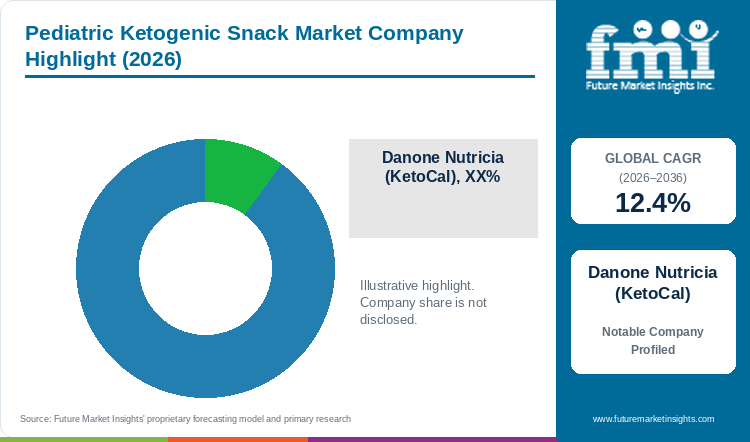
Pediatric ketogenic snack market is moderately fragmented with therapy-specific nutrition companies, specialized ketogenic food manufacturers and broader clinical nutrition suppliers. Danone Nutricia, Ajinomoto Cambrooke and Vitaflo are competing through fixed-ratio nutrition products and specialist support. Dr. Schär is expanding food variety through Kanso, whereas Solace Nutrition is focusing on adjunct products. Abbott and Medtrition has wider clinical nutrition channels and Ketolibriyum follows a Canadian prepared-food route. Key players are focusing on pack size, ratio information, reimbursement record and regular product supply in order to serve families after clinical selection.
- Therapy-specific platforms: Danone Nutricia, Ajinomoto Cambrooke, and Vitaflo compete through ratio-defined medical nutrition portfolios.
- Specialized food and adjunct suppliers: Dr. Schär and Solace Nutrition add snack variety and MCT-focused support products.
- Broader clinical and direct routes: Abbott, Medtrition, and Ketolibriyum provide adjacent channels within the defined boundary.
Competitive Benchmarking: Pediatric Ketogenic Snack Market
| Company | Format Breadth | Ratio Precision | Clinical Access | Geographic Reach |
|---|---|---|---|---|
| Danone Nutricia (KetoCal) | High | High | High | High |
| Ajinomoto Cambrooke (KetoVie) | High | High | High | High |
| Vitaflo / Nestlé Health Science | High | High | High | High |
| Dr. Schär (Kanso) | High | Medium | High | Medium |
| Solace Nutrition | Medium | Low | Medium | Low |
| Medtrition | Low | Low | Medium | Medium |
| Abbott | Medium | Medium | High | High |
| Ketolibriyum | Low | Low | Low | Low |
High holds wider documented format, ratio, specialist access or geographic presence. Medium holds a narrower supported role, whereas Low holds limited market-specific evidence. These ratings does not indicate product quality, company revenue or verified market share.
Key Developments in the Pediatric Ketogenic Snack Market
- In August 2026, Ajinomoto Cambrooke reported a temporary shortage of KetoVie 4:1 Plant-Based Protein and listed three available alternative KetoVie formulas[16].
- In February 2026, Dr. Schär reported USD 9.5 million invested during 2025 and around USD 30.3 million planned for 2026[17].
- In October 2025, Vitaflo added berry flavor to its 3:1 K.Yo semi-solid range through UK prescribing channels[18].
- In August 2025, Ajinomoto Cambrooke introduced a 12-pack KetoVie configuration for smaller storage and out-of-pocket purchases[19].
Key Players in the Pediatric Ketogenic Snack Market
Therapy-Specific Ketogenic Nutrition Platforms
- Danone Nutricia (KetoCal)
- Ajinomoto Cambrooke (KetoVie)
- Vitaflo / Nestlé Health Science
Specialized Ketogenic Food and Adjunct Formats
- Dr. Schär (Kanso)
- Solace Nutrition
Broader Clinical and Direct-to-Consumer Participants
- Medtrition
- Abbott
- Ketolibriyum
Pediatric Ketogenic Snack Market - Report scope
| Coverage field | Report scope |
|---|---|
| Market breakdown | Product type; ketogenic ratio; indication; end user; sales channel; and region. |
| Quantitative units | USD million. |
| Market definition | Revenue includes pediatric ketogenic snacks and snack-preparation products used in medically directed ketogenic dietary therapy. |
| Exclusions | General consumer keto foods, ingredients, primary sole-source feeds outside the snack universe, and downstream meal-service value. |
| Regions covered | North America; Latin America; Western Europe; Eastern Europe; East Asia; South Asia and Pacific; Middle East and Africa. |
| Countries covered | USA, UK, Germany, Japan, South Korea, and more than twenty-five additional countries in the full report. |
| Forecast period | 2026 to 2036. |
| Proprietary estimates | Forecast values and segment shares are proprietary analytical estimates, not government statistics or direct global share measurements. |
Pediatric Ketogenic Snack Market - Research Methodology
| Method | Approach |
|---|---|
| Primary Research | Primary research includes interviews with manufacturers, distributors, specialist clinics, caregivers, end users and industry experts. These interviews covers purchasing decision, product evaluation, pricing, adoption barriers, reimbursement and approval requirement. |
| Desk Research | Desk research covers government and regulatory publications, clinical organizations, official company information, announcements and technical literature. Each source was checked for date, country and direct relevance to pediatric ketogenic snacks. |
| Market Sizing and Forecasting | Market sizing combines the base value with historical demand, product type, ketogenic ratio, indication, pricing, company participation and country conditions. Segment and regional values were then reconciled with the final pediatric ketogenic snack market value. |
| Data Validation | Market estimates were checked with public information, company developments and primary interviews. General keto foods, overlapping revenue and products outside the pediatric snack definition were removed from the calculation. |
Pediatric Ketogenic Snack Market by Segments
Product Type
- Keto Bars And Bites
- Keto Cookies & Bakery
- Keto Puddings & Creams
- Keto Drink Mixes
- Others
Ketogenic Ratio
- 3:1 ratio
- 2:1 ratio
- 4:1 ratio
- Others
Indication
- Drug-resistant epilepsy
- GLUT1 Deficiency
- Other Metabolic Conditions
End User
- Home and caregiver
- Hospitals & Keto Clinics
- Others
Sales Channel
- Hospital pharmacy
- Retail Pharmacy
- Online
- Institutional Tender
- Others
Pediatric Ketogenic Snack Market by Region
- North America
- United States
- Canada
- Latin America
- Brazil
- Mexico
- Argentina
- Chile
- Western Europe
- Germany
- France
- United Kingdom
- Italy
- Spain
- Benelux
- Nordics
- Eastern Europe
- Poland
- Czech Republic
- Romania
- Hungary
- East Asia
- China
- Japan
- South Korea
- South Asia and Pacific
- India
- ASEAN
- Australia and New Zealand
- Middle East and Africa
- GCC Countries
- South Africa
- Türkiye
- Israel
Research Sources and Bibliography
- [1] Han, R., et al. (2026, March 5). Real-world outcomes of ketogenic diet therapy in children with drug-resistant epilepsy in a prospective cohort study. Scientific Reports, 16, 8877.
- [2] Chelsea and Westminster Hospital NHS Foundation Trust. (2026). Ketogenic diet for epilepsy (children).
- [3] Ajinomoto Cambrooke, Inc. (2026). Documents and resources: KetoVie Café product information sheets.
- [4] Nestlé Health Science UK. (2025, August). K.Yo ketogenic diet food for special medical purposes.
- [5] Hu, W., et al. (2025, October 7). Add-on ketogenic diet versus antiseizure medications alone in children with developmental and epileptic encephalopathies. Frontiers in Neurology, 16, 1677046.
- [6] Epilepsy Foundation. (2025, October 17). Supporting your child with epilepsy: The role of diet in seizure management.
- [7] Cambridge University Hospitals NHS Foundation Trust. (2026, March). Information for general practice: Ketogenic diet therapy.
- [8] Freedman, D., et al. (2026, April 8). American Epilepsy Society clinical practice guideline: Infantile epilepsy. Epilepsy Currents, 26(3), 174–202.
- [9] Liu, J., et al. (2025, September 10). Impact of a high-fat, low-carbohydrate ketogenic diet on seizure frequency in children with drug-resistant epilepsy. Frontiers in Nutrition, 12, 1634041.
- [10] Nutricia. (2026). Ketogenic product range.
- [11] Johns Hopkins Medicine. (2025, November 11). Johns Hopkins Children’s Center doctors cure young patient of seizures using keto diet.
- [12] Royal College of Paediatrics and Child Health. (2026, July). Epilepsy12 2026 combined organisational and clinical audit.
- [13] Gesellschaft für Neuropädiatrie. (2026, June). Ketogene Ernährungstherapie: FoBI Updatemodul Epilepsie.
- [14] Japan Epilepsy Society. (2025, October). Presidential remarks.
- [15] Shin, H. J., et al. (2025, January 27). Decanoic acid-enriched ketogenic diet in refractory epilepsy. Frontiers in Neurology, 16, 1524799.
- [16] Ajinomoto Cambrooke, Inc. (2026, August). KetoVie 4:1 Plant-Based Protein temporary shortage notice.
- [17] Dr. Schär. (2026, February 25). Our 2025: Growing with vision, investing in the future.
- [18] NHS Business Services Authority. (2025, October 1). K.Yo semi-solid food 100 g pots berry, 4 pot.
- [19] GLUT1 deficiency Foundation. (2025, August 7). New GLUT1 community-inspired product available.
- [20] Vitaflo USA. (2025, July). K.Flo medical necessity and insurance support templates.
- [21] Ajinomoto Cambrooke, Inc. (2025, June). Celebrating 25 years of medical nutrition.
- [22] Solace Nutrition. (2025, January). NanoVM 4-8 product label update.
This bibliography is provided for reader reference. The full report contains the complete reference list and detailed citations.
This Report Answers
- What is the Pediatric Ketogenic Snack Market size in 2026?
- What value is the Pediatric Ketogenic Snack Market forecast by 2036?
- Which product type holds notable market share during 2026?
- Which ketogenic ratio holds notable market share during 2026?
- Which countries show notable Pediatric Ketogenic Snack Market growth?
- Which companies are notable in the Pediatric Ketogenic Snack Market?
Frequently Asked Questions
How large is the Pediatric Ketogenic Snack Market in 2026?
Future Market Insights estimates the Pediatric Ketogenic Snack Market at USD 123.6 million in 2026 and projects it to reach USD 397.9 million by 2036.
What CAGR is projected for pediatric ketogenic snacks through 2036?
As per FMI analysis, pediatric ketogenic snack demand is projected to grow at 12.4% CAGR from 2026 to 2036.
Which product type holds notable market share during 2026?
Future Market Insights projects keto bars and bites to hold 44.1% of product type demand in 2026 owing to measured and portable portions.
Which ketogenic ratio holds notable market share during 2026?
FMI estimates the 3:1 ratio to account for 47.3% of ketogenic ratio demand in 2026 as it allows higher protein than stricter 4:1 plans.
Which country has a notable growth outlook through 2036?
FMI analysis predicts South Korea pediatric ketogenic snack demand to expand at 12.5% CAGR through 2036, supported by tertiary pediatric centers and home transfer.
Who are the key companies in pediatric ketogenic snacks?
Future Market Insights identifies Danone Nutricia, Ajinomoto Cambrooke, Vitaflo, Dr. Schär and Solace Nutrition among the notable pediatric ketogenic snack companies.
Preview the report firsthand - request a free sample
Get SampleGet the brochure for pricing and purchase details.
Get PDFTable of Content
- Key Takeaways
- Market Size and CAGR
- Top Growth Driver
- Fastest Growing Segment
- Leading Region
- Key Companies
- Emerging Opportunities
- Executive Summary
- Global Market Outlook
- Demand-side Trends
- Supply-side Trends
- Technology Roadmap Analysis
- Analysis and Recommendations
- Analyst Perspective (What is happening? Why now? What should investors know?)
- Key Questions Answered
- How large is the market?
- What is the CAGR?
- What are key trends?
- Which region dominates?
- Who are the leaders?
- Market Overview
- Market Coverage / Taxonomy
- Market Definition / Scope / Limitations
- Research Methodology
- Chapter Orientation
- Analytical Lens and Working Hypotheses
- Market Structure, Signals, and Trend Drivers
- Benchmarking and Cross-market Comparability
- Market Sizing, Forecasting, and Opportunity Mapping
- Research Design and Evidence Framework
- Desk Research Programme (Secondary Evidence)
- Expert Input and Fieldwork (Primary Evidence)
- Tooling, Models, and Reference Databases
- Data Engineering and Model Build
- Quality Assurance and Audit Trail
- Market Background
- Market Dynamics (Drivers, Restraints, Opportunity, Trends)
- Scenario Forecast (Optimistic, Likely, Conservative)
- Impact Analysis
- AI Impact
- Sustainability Impact
- Regulatory Impact
- Technology Impact
- Consumer / Buyer Analysis
- Purchase Drivers
- Adoption Barriers
- Buyer Journey
- Opportunity Map Analysis
- Product Life Cycle Analysis
- Supply Chain Analysis
- Investment Feasibility Matrix
- Value Chain Analysis
- PESTLE and Porter's Analysis
- Regulatory Landscape
- Regional Parent Market Outlook
- Production and Consumption Statistics
- Import and Export Statistics
- Global Market Analysis and Forecast, 2021 to 2036
- Historical Market Size Value (USD Million) Analysis, 2021 to 2025
- Current and Future Market Size Value (USD Million) Projections, 2026 to 2036
- Y-o-Y Growth Trend Analysis
- Absolute $ Opportunity Analysis
- Global Market Pricing Analysis, 2021 to 2036
- Global Market Analysis and Forecast, By Product Type, 2021 to 2036
- Introduction / Key Findings
- Historical Market Size Value (USD Million) Analysis By Product Type, 2021 to 2025
- Current and Future Market Size Value (USD Million) Analysis and Forecast By Product Type, 2026 to 2036
- Keto Bars And Bites
- Keto Cookies & Bakery
- Keto Puddings & Creams
- Keto Drink Mixes
- Others
- Y-o-Y Growth Trend Analysis By Product Type, 2021 to 2025
- Absolute $ Opportunity Analysis By Product Type, 2026 to 2036
- Global Market Analysis and Forecast, By Ketogenic Ratio, 2021 to 2036
- Introduction / Key Findings
- Historical Market Size Value (USD Million) Analysis By Ketogenic Ratio, 2021 to 2025
- Current and Future Market Size Value (USD Million) Analysis and Forecast By Ketogenic Ratio, 2026 to 2036
- 3:1 ratio
- 2:1 ratio
- 4:1 ratio
- Others
- Y-o-Y Growth Trend Analysis By Ketogenic Ratio, 2021 to 2025
- Absolute $ Opportunity Analysis By Ketogenic Ratio, 2026 to 2036
- Global Market Analysis and Forecast, By Indication, 2021 to 2036
- Introduction / Key Findings
- Historical Market Size Value (USD Million) Analysis By Indication, 2021 to 2025
- Current and Future Market Size Value (USD Million) Analysis and Forecast By Indication, 2026 to 2036
- Drug-resistant epilepsy
- GLUT1 Deficiency
- Other Metabolic Conditions
- Y-o-Y Growth Trend Analysis By Indication, 2021 to 2025
- Absolute $ Opportunity Analysis By Indication, 2026 to 2036
- Global Market Analysis and Forecast, By End User, 2021 to 2036
- Introduction / Key Findings
- Historical Market Size Value (USD Million) Analysis By End User, 2021 to 2025
- Current and Future Market Size Value (USD Million) Analysis and Forecast By End User, 2026 to 2036
- Home and caregiver
- Hospitals & Keto Clinics
- Others
- Y-o-Y Growth Trend Analysis By End User, 2021 to 2025
- Absolute $ Opportunity Analysis By End User, 2026 to 2036
- Global Market Analysis and Forecast, By Sales Channel, 2021 to 2036
- Introduction / Key Findings
- Historical Market Size Value (USD Million) Analysis By Sales Channel, 2021 to 2025
- Current and Future Market Size Value (USD Million) Analysis and Forecast By Sales Channel, 2026 to 2036
- Hospital pharmacy
- Retail Pharmacy
- Online
- Institutional Tender
- Others
- Y-o-Y Growth Trend Analysis By Sales Channel, 2021 to 2025
- Absolute $ Opportunity Analysis By Sales Channel, 2026 to 2036
- Global Market Analysis and Forecast, By Region, 2021 to 2036
- Introduction
- Historical Market Size Value (USD Million) Analysis By Region, 2021 to 2025
- Current Market Size Value (USD Million) Analysis and Forecast By Region, 2026 to 2036
- North America
- Latin America
- Western Europe
- Eastern Europe
- East Asia
- South Asia and Pacific
- Middle East and Africa
- Market Attractiveness Analysis By Region
- North America Market Analysis and Forecast, By Country, 2021 to 2036
- Historical Market Size Value (USD Million) Trend Analysis By Market Taxonomy, 2021 to 2025
- Market Size Value (USD Million) Forecast By Market Taxonomy, 2026 to 2036
- By Country
- United States
- Canada
- By Product Type
- By Ketogenic Ratio
- By Indication
- By End User
- By Sales Channel
- By Country
- Market Attractiveness Analysis
- By Country
- By Product Type
- By Ketogenic Ratio
- By Indication
- By End User
- By Sales Channel
- Key Takeaways
- Latin America Market Analysis and Forecast, By Country
- Historical Market Size Value (USD Million) Trend Analysis By Market Taxonomy, 2021 to 2025
- Market Size Value (USD Million) Forecast By Market Taxonomy, 2026 to 2036
- By Country
- Brazil
- Mexico
- Argentina
- Chile
- By Product Type
- By Ketogenic Ratio
- By Indication
- By End User
- By Sales Channel
- By Country
- Market Attractiveness Analysis
- By Country
- By Product Type
- By Ketogenic Ratio
- By Indication
- By End User
- By Sales Channel
- Key Takeaways
- Western Europe Market Analysis and Forecast, By Country
- Historical Market Size Value (USD Million) Trend Analysis By Market Taxonomy, 2021 to 2025
- Market Size Value (USD Million) Forecast By Market Taxonomy, 2026 to 2036
- By Country
- Germany
- France
- United Kingdom
- Italy
- Spain
- Benelux
- Nordics
- By Product Type
- By Ketogenic Ratio
- By Indication
- By End User
- By Sales Channel
- By Country
- Market Attractiveness Analysis
- By Country
- By Product Type
- By Ketogenic Ratio
- By Indication
- By End User
- By Sales Channel
- Key Takeaways
- Eastern Europe Market Analysis and Forecast, By Country
- Historical Market Size Value (USD Million) Trend Analysis By Market Taxonomy, 2021 to 2025
- Market Size Value (USD Million) Forecast By Market Taxonomy, 2026 to 2036
- By Country
- Poland
- Czech Republic
- Romania
- Hungary
- By Product Type
- By Ketogenic Ratio
- By Indication
- By End User
- By Sales Channel
- By Country
- Market Attractiveness Analysis
- By Country
- By Product Type
- By Ketogenic Ratio
- By Indication
- By End User
- By Sales Channel
- Key Takeaways
- East Asia Market Analysis and Forecast, By Country
- Historical Market Size Value (USD Million) Trend Analysis By Market Taxonomy, 2021 to 2025
- Market Size Value (USD Million) Forecast By Market Taxonomy, 2026 to 2036
- By Country
- China
- Japan
- South Korea
- By Product Type
- By Ketogenic Ratio
- By Indication
- By End User
- By Sales Channel
- By Country
- Market Attractiveness Analysis
- By Country
- By Product Type
- By Ketogenic Ratio
- By Indication
- By End User
- By Sales Channel
- Key Takeaways
- South Asia and Pacific Market Analysis and Forecast, By Country
- Historical Market Size Value (USD Million) Trend Analysis By Market Taxonomy, 2021 to 2025
- Market Size Value (USD Million) Forecast By Market Taxonomy, 2026 to 2036
- By Country
- India
- ASEAN
- Australia and New Zealand
- By Product Type
- By Ketogenic Ratio
- By Indication
- By End User
- By Sales Channel
- By Country
- Market Attractiveness Analysis
- By Country
- By Product Type
- By Ketogenic Ratio
- By Indication
- By End User
- By Sales Channel
- Key Takeaways
- Middle East and Africa Market Analysis and Forecast, By Country
- Historical Market Size Value (USD Million) Trend Analysis By Market Taxonomy, 2021 to 2025
- Market Size Value (USD Million) Forecast By Market Taxonomy, 2026 to 2036
- By Country
- GCC Countries
- South Africa
- Türkiye
- Israel
- By Product Type
- By Ketogenic Ratio
- By Indication
- By End User
- By Sales Channel
- By Country
- Market Attractiveness Analysis
- By Country
- By Product Type
- By Ketogenic Ratio
- By Indication
- By End User
- By Sales Channel
- Key Takeaways
- Key Countries Market Analysis
- United States
- Pricing Analysis
- Market Share Analysis, 2025
- By Product Type
- By Ketogenic Ratio
- By Indication
- By End User
- By Sales Channel
- Canada
- Pricing Analysis
- Market Share Analysis, 2025
- By Product Type
- By Ketogenic Ratio
- By Indication
- By End User
- By Sales Channel
- Mexico
- Pricing Analysis
- Market Share Analysis, 2025
- By Product Type
- By Ketogenic Ratio
- By Indication
- By End User
- By Sales Channel
- Brazil
- Pricing Analysis
- Market Share Analysis, 2025
- By Product Type
- By Ketogenic Ratio
- By Indication
- By End User
- By Sales Channel
- Chile
- Pricing Analysis
- Market Share Analysis, 2025
- By Product Type
- By Ketogenic Ratio
- By Indication
- By End User
- By Sales Channel
- Germany
- Pricing Analysis
- Market Share Analysis, 2025
- By Product Type
- By Ketogenic Ratio
- By Indication
- By End User
- By Sales Channel
- United Kingdom
- Pricing Analysis
- Market Share Analysis, 2025
- By Product Type
- By Ketogenic Ratio
- By Indication
- By End User
- By Sales Channel
- Italy
- Pricing Analysis
- Market Share Analysis, 2025
- By Product Type
- By Ketogenic Ratio
- By Indication
- By End User
- By Sales Channel
- Spain
- Pricing Analysis
- Market Share Analysis, 2025
- By Product Type
- By Ketogenic Ratio
- By Indication
- By End User
- By Sales Channel
- France
- Pricing Analysis
- Market Share Analysis, 2025
- By Product Type
- By Ketogenic Ratio
- By Indication
- By End User
- By Sales Channel
- India
- Pricing Analysis
- Market Share Analysis, 2025
- By Product Type
- By Ketogenic Ratio
- By Indication
- By End User
- By Sales Channel
- ASEAN
- Pricing Analysis
- Market Share Analysis, 2025
- By Product Type
- By Ketogenic Ratio
- By Indication
- By End User
- By Sales Channel
- Australia and New Zealand
- Pricing Analysis
- Market Share Analysis, 2025
- By Product Type
- By Ketogenic Ratio
- By Indication
- By End User
- By Sales Channel
- China
- Pricing Analysis
- Market Share Analysis, 2025
- By Product Type
- By Ketogenic Ratio
- By Indication
- By End User
- By Sales Channel
- Japan
- Pricing Analysis
- Market Share Analysis, 2025
- By Product Type
- By Ketogenic Ratio
- By Indication
- By End User
- By Sales Channel
- South Korea
- Pricing Analysis
- Market Share Analysis, 2025
- By Product Type
- By Ketogenic Ratio
- By Indication
- By End User
- By Sales Channel
- Poland
- Pricing Analysis
- Market Share Analysis, 2025
- By Product Type
- By Ketogenic Ratio
- By Indication
- By End User
- By Sales Channel
- Hungary
- Pricing Analysis
- Market Share Analysis, 2025
- By Product Type
- By Ketogenic Ratio
- By Indication
- By End User
- By Sales Channel
- Türkiye
- Pricing Analysis
- Market Share Analysis, 2025
- By Product Type
- By Ketogenic Ratio
- By Indication
- By End User
- By Sales Channel
- South Africa
- Pricing Analysis
- Market Share Analysis, 2025
- By Product Type
- By Ketogenic Ratio
- By Indication
- By End User
- By Sales Channel
- United States
- Market Structure Analysis
- Competition Dashboard
- Competition Benchmarking
- Market Share Analysis of Top Players
- By Regional
- By Product Type
- By Ketogenic Ratio
- By Indication
- By End User
- By Sales Channel
- Emerging Startups
- Innovation Benchmarking
- Competition Analysis
- Competition Deep Dive
- Danone Nutricia (KetoCal)
- Overview
- Product Portfolio
- Profitability by Market Segments
- Sales Footprint
- Strategy Overview
- Marketing Strategy
- Product Strategy
- Channel Strategy
- Ajinomoto Cambrooke (KetoVie)
- Vitaflo / Nestlé Health Science
- Dr. Schär (Kanso)
- Solace Nutrition
- Medtrition
- Abbott
- Ketolibriyum
- Danone Nutricia (KetoCal)
- Case Studies
- Success Stories
- Recent Developments
- Competition Deep Dive
- Assumptions & Acronyms Used


