

- Market Size (2026)
- USD 190.9 Mn
- Forecast (2036)
- USD 447.8 Mn
- CAGR (2026 to 2036)
- 8.9%
How Big is the Piping Gel Market in 2026?
The piping gel market is estimated at USD 190.9 million in 2026.
The global piping gel market was valued at USD 175.3 million in 2025 and is estimated to reach USD 190.9 million in 2026. The market is projected to reach USD 447.8 million by 2036, expanding at a compound annual growth rate (CAGR) of 8.9% between 2026 and 2036. Standard grade accounted for the largest share of the Product Type breakdown, contributing 40.0% of total revenue in 2026. Piping gels are typically based on sweeteners and texturising ingredients, and suppliers of these ingredients are reporting steady demand. Ingredion reported that net sales in its Texture & Healthful Solutions segment rose by 5.0% to USD 627.0 million in the second quarter of 2026, its ninth consecutive quarter of volume growth[5]. Corn, a key raw material for glucose syrups and starches, is in ample supply. In October 2026, the US Department of Agriculture (USDA) raised its US corn yield forecast to 181.2 bushels per acre and its production forecast to 16.03 billion bushels[6]. Colour requirements are also changing, as the US Food and Drug Administration (FDA) aims to eliminate six remaining petroleum-based synthetic dyes from the food supply by the end of 2026[8], and FD&C Red No. 3 must be removed from foods by January 15, 2027[3].
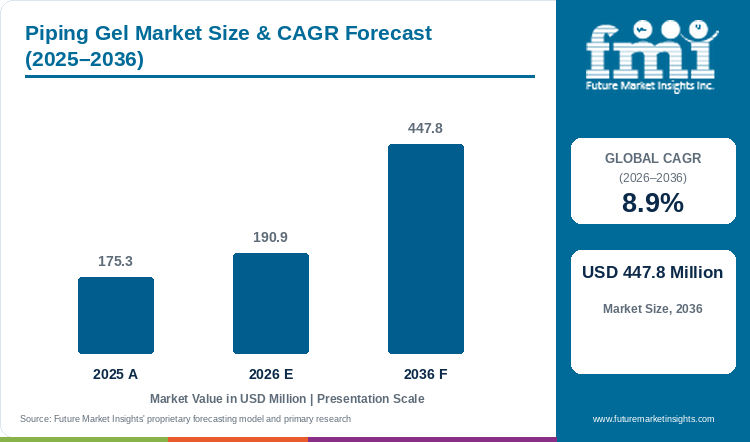
Table 1: Piping Gel Market Size and Forecast (USD million), 2025 to 2036
| Market size and forecast | Value |
|---|---|
| 2025 market size | USD 175.3 million |
| Estimated market size in 2026 | USD 190.9 million |
| Projected market size by 2036 | USD 447.8 million |
| CAGR (2026-2036) | 8.9% |
| Added revenue, 2026 to 2036 | USD 256.9 million |
Key Market Trends & Insights
- By Product Type: The Standard grade segment accounted for the largest share of the Product Type breakdown in 2026, representing 40.0% of total market revenue.
- By Form: Powder / dry products held the leading market position with a share of 42.0% in 2026.
- By Application: Bread & rolls remained the largest application segment, accounting for 30.0% of the market in 2026.
Regional Highlights
- Fastest-growing country: The UAE is expected to record the highest growth rate among the eight profiled countries, with a projected CAGR of 10.2% between 2026 and 2036.
- Growth across other countries: Saudi Arabia is projected to expand at a CAGR of 9.9%, followed by South Korea at 9.5% and the USA at 9.2%. Japan is expected to register comparatively slower growth, with a CAGR of 7.9% during the forecast period.
Raw material supply supports stable piping gel costs. DTN reported that USDA raised its 2026-27 US corn ending stocks forecast to 1.849 billion bushels from 1.567 billion bushels in September, and lowered the projected season-average farm price by 10 cents to USD 4.7 per bushel[6]. The Food and Agriculture Organization of the United Nations (FAO) recorded a 5.6% monthly rise in maize prices in September 2026 to a three-year high[7], although USDA's larger October crop estimate points to ample US supply. Product texture defines how a gel is used. Bakbel describes its ready-to-use piping gel as having a short, paste-like texture intended for writing and decorating[2], which makes release from the nozzle and line retention central to its specification.
Texture ingredient suppliers are expanding. Ingredion's Texture & Healthful Solutions segment raised its operating income by 5.0% to USD 117.0 million in the second quarter of 2026, driven by volume growth but partly offset by unfavourable price mix and higher tapioca costs[5]. The company expects full-year 2026 capital expenditure of approximately USD 450.0 million to USD 490.0 million[5]. On the application side, FunCakes identifies decoration and the attachment of wafer images among the uses of its clear piping gel[1], linking the gel with edible sheets and films. Secure attachment without a visible border of excess gel is the practical test.
Colour changes affect tinted gels. DecoPac's Summer 2025 catalogue uses clear vanilla piping gel with selected golden colours to create a honey-like effect[4], showing how a clear base supports coloured finishes. The FDA's April 2025 plan covers FD&C Green No. 3, Red No. 40, Yellow No. 5, Yellow No. 6, Blue No. 1 and Blue No. 2[8], and in July 2025 the FDA approved gardenia (genipin) blue, its fourth colour from natural sources in two months, noting that about 40.0% of the food industry had committed to a voluntary phase-out of petroleum-based dyes[9]. Each new colour mixture needs assessment for shade and gel behaviour at the proposed dosage.
Table 2: Supporting Industry Indicators for the Piping Gel Market, 2025 to 2026, with a 2027 Reformulation Deadline
| Indicator | Data point | Why it matters | Source |
|---|---|---|---|
| Texture ingredient sales | Ingredion's Texture & Healthful Solutions net sales rose by 5.0% to USD 627.0 million in Q2 2026. | Demand for texturising ingredients is growing. | [5] |
| Texture ingredient profit | The segment's operating income rose by 5.0% to USD 117.0 million, partly offset by higher tapioca costs. | Input costs affect gel ingredient pricing. | [5] |
| Supplier investment | Ingredion expects 2026 capital expenditure of approximately USD 450.0 million to USD 490.0 million. | Investment supports texturiser supply. | [5] |
| US corn production | USDA raised its 2026 US corn production forecast to 16.03 billion bushels and yield to 181.2 bushels per acre. | Corn is a key raw material for glucose syrup and starch. | [6] |
| US corn stocks and price | USDA raised 2026-27 corn ending stocks to 1.849 billion bushels and cut the farm price to USD 4.7 per bushel. | Ample corn supply supports stable sweetener costs. | [6] |
| World maize prices | FAO maize prices rose by 5.6% in September 2026 to a three-year high. | World prices remain volatile. | [7] |
| Synthetic dye phase-out | FDA aims to eliminate six remaining synthetic dyes from the food supply by the end of 2026. | Coloured gel mixtures need natural alternatives. | [8] |
| Affected colour transition | FDA's January 2025 Red No. 3 revocation sets January 15, 2027 for food reformulation. | Tinted gels containing Red No. 3 require replacement. | [3] |
| Natural colour approvals | FDA approved gardenia (genipin) blue in July 2025, its fourth natural-source colour in two months. | New colours widen the options for tinted gels. | [9] |
| Edible attachment | FunCakes specifies clear piping gel for attaching decorations and wafer images. | Attachment is a distinct functional use. | [1] |
Demand Intensity Analysis
A comparison of supplier growth with market growth puts the piping gel forecast in context. Ingredion's Texture & Healthful Solutions net sales rose by 5.0% in the second quarter of 2026[5], while FMI estimates that the piping gel market grew by approximately 8.9% between 2025 and 2026. The piping gel market is therefore growing faster than Ingredion's texture business, reflecting demand for decorated bakery products. The segment's operating margin of approximately 18.7% (USD 117.0 million on USD 627.0 million) shows the value suppliers place on specialised texture functions.
Raw material conditions provide another reference point. USDA's October forecast raised US corn ending stocks by approximately 18.0%, from 1.567 billion bushels to 1.849 billion bushels, and lowered the farm price to USD 4.7 per bushel[6]. Abundant corn supply supports stable costs for glucose syrups and starches, while tapioca costs have moved the other way[5]. Standard grade represented USD 76.4 million of the market in 2026.
The timing of colour regulation is also relevant. The end-2026 target for the six synthetic dyes is about two months away, and the Red No. 3 deadline follows on January 15, 2027[3][8]. Bakeries using tinted gels based on these colours need replacements qualified for shade and behaviour within this period.
Segment values show where demand is concentrated. Direct to industrial bakeries accounted for USD 99.3 million by Sales Channel in 2026, while Powder / dry represented USD 80.2 million and Bread & rolls USD 57.3 million. FMI projects USD 256.9 million in added revenue between 2026 and 2036, with the market reaching approximately 2.3 times its 2026 value.
Table 3: Demand Intensity Metrics for the Piping Gel Market, 2025 to 2036
| Demand intensity metric | Value | Basis |
|---|---|---|
| FMI market growth, 2025 to 2026 | Approximately +8.9% | USD 175.3 million to USD 190.9 million. |
| Ingredion T&HS net sales growth, Q2 2026 | +5.0% | USD 627.0 million against USD 599.0 million. |
| Ingredion T&HS operating margin, Q2 2026 | Approximately 18.7% | USD 117.0 million on USD 627.0 million. |
| US corn ending stocks revision, October 2026 | Approximately +18.0% | 1.849 billion bushels against 1.567 billion bushels. |
| US corn season-average farm price, 2026-27 | USD 4.7 per bushel | Down 10 cents from September. |
| Synthetic dyes targeted for elimination | Six | FDA target of the end of 2026. |
| Standard grade revenue, 2026 | USD 76.4 million | 40.0% of piping gel revenue. |
| Direct to industrial bakeries revenue, 2026 | USD 99.3 million | 52.0% of market revenue. |
| Added revenue, 2026 to 2036 | USD 256.9 million | FMI piping gel market forecast. |
| Market expansion multiple | Approximately 2.3 times | Projected 2036 market value relative to 2026. |
Analyst Perspective
"Corn supply is plentiful and texturiser makers are growing, so the cost base for piping gel is stable. The commercial challenge is colour: tinted gels must be reformulated before the US synthetic dye deadlines without changing how they pipe."
- Nandini Roy Choudhury, Principal Analyst at Future Market Insights
How is the piping gel market segmented?
The piping gel market is segmented by product type, form, application, claim and sales channel. Product Type describes the grade and Form the delivered condition of the gel. Application identifies the bakery item being decorated, while Claim and Sales Channel add composition and supply requirements.
Why does Standard grade anchor the Product Type category?
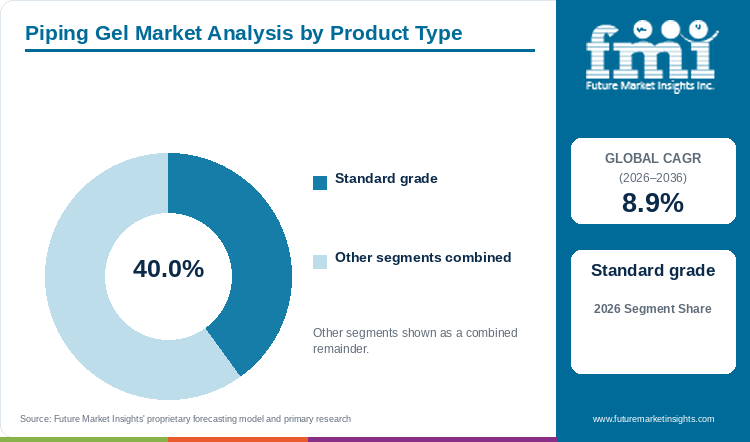
Standard grade holds 40.0% of Product Type revenue in 2026.
Standard grade gels generated approximately USD 76.4 million in 2026, as recurring decoration depends on a familiar response through the chosen nozzle or spatula. Decorators learn how an approved gel releases and holds its line, so a standard grade with consistent texture limits adjustment between batches. Hold and line definition should be assessed after the product has been handled, not just at the moment of application.
- Standard grade holds 40.0% of Product Type revenue in 2026.
- Hold and line definition are assessed after the product has been handled.
How does Powder / dry retain the largest Form position?
Powder / dry accounts for 42.0% of Form revenue in 2026.
Powder / dry formats accounted for approximately USD 80.2 million in 2026. A dry preparation must be mixed to the required consistency before use, so the prepared mixture, rather than the dry ingredient alone, has to pass the application test. Storage and transport benefits are weighed against mixing labour and the consistency of each batch. With corn-based ingredients in ample supply[6], the cost of dry gel bases is likely to remain stable.
- Powder / dry accounts for 42.0% of Form revenue in 2026.
- The prepared mixture, rather than the dry ingredient alone, must pass the application trial.
What supports the Bread & rolls lead in Application?
Bread & rolls represent 30.0% of Application revenue in 2026.
Bread and rolls accounted for approximately USD 57.3 million in 2026. For gel-based finishes on these products, the receiving surface and available area determine the placement method, as a crust or glazed surface affects adhesion and the visibility of a line. Trials on representative items show whether the decoration holds through cooling, packing and display.
- Bread & rolls represent 30.0% of Application revenue in 2026.
- The receiving surface and available area determine the placement method for gel-based decoration.
Why is Conventional still the principal Claim category?
Conventional holds 58.0% of Claim revenue in 2026.
Conventional formulations held approximately USD 110.7 million of revenue in 2026, with clarity, texture and adhesion defining the initial brief. A transparent base can be tinted to create effects, but the customised mixture needs a defined addition method. As six synthetic dyes are phased out in the US[8], producers of tinted conventional gels will increasingly use natural colours, which may change both shade and behaviour.
- Conventional holds 58.0% of Claim revenue in 2026.
- The customized mixture needs a defined addition method as well as an approved clear base.
Why do industrial bakery relationships dominate Sales Channel?
Direct to industrial bakeries contributes 52.0% of Sales Channel revenue in 2026.
Direct supply to industrial bakeries accounted for approximately USD 99.3 million in 2026. Repeated industrial decorating operations define the functional specification around which direct gel supply is organised, with application amount and holding conditions providing a reference for repeat deliveries. Direct relationships also help manage the current colour reformulation, as suppliers can qualify replacement shades on the customer's own products.
- Direct to industrial bakeries contributes 52.0% of Sales Channel revenue in 2026.
- Application amount and holding conditions provide a reference for repeat deliveries.
What are the drivers, restraints and opportunities in the piping gel market?
A versatile decorating gel can support several practical finishing tasks, but small differences in gel behaviour are visible in detailed decoration, while colour customisation can create effects from an established clear base.
A versatile decorating gel can support several practical finishing tasks
Clear piping gels serve attachment, transparent effects and piped outlines, giving the category several practical uses within one product. As a bakery ingredient, a single gel can attach edible images, create a glossy accent and carry a written message. Stable raw material costs, supported by a large US corn crop[6], help suppliers offer this versatility at consistent prices.
Small differences in gel behaviour are visible in detailed decoration
Detailed lines reveal small changes in gel behaviour. The material may spread after placement, resist flow through a fine nozzle or lose definition after handling, and these differences are more visible in writing than in broad coverage. Input costs add a further restraint, as Ingredion reported higher tapioca costs in the second quarter of 2026[5] and world maize prices reached a three-year high in September[7]. A change of supplier or formula needs a trial on the actual design and tool.
Colour customisation can create effects from an established clear base
Specified colour additions extend an approved clear base into additional decorative effects when the resulting mixture keeps its handling behaviour. DecoPac's honey-like effect, made with clear vanilla gel and golden colours[4], is an example. New natural food colors, including gardenia (genipin) blue approved in July 2025[9], widen the range of shades available as synthetic dyes are phased out[8].
Which country CAGRs are profiled in the piping gel market?
Table 4: Country growth outlook for the piping gel market
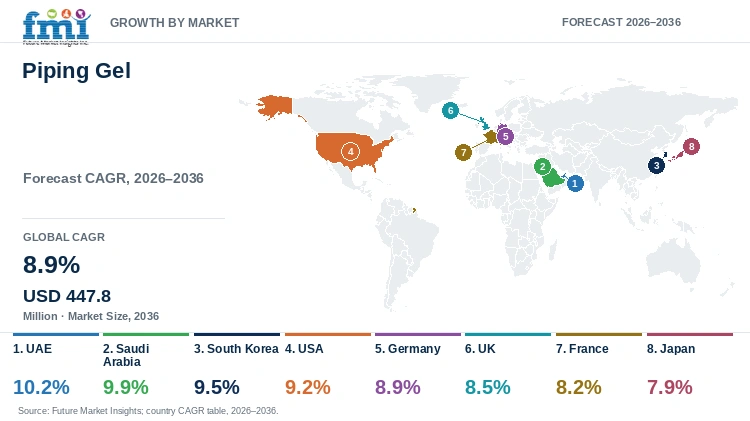
| Country | CAGR |
|---|---|
| UAE | 10.2% |
| Saudi Arabia | 9.9% |
| South Korea | 9.5% |
| USA | 9.2% |
| Germany | 8.9% |
| UK | 8.5% |
| France | 8.2% |
| Japan | 7.9% |
UAE
- The UAE is the fastest-growing market among the profiled countries, with a projected CAGR of 10.2% from 2026 to 2036. Varied occasion-design schedules in the UAE create separate requirements for visible writing and unobtrusive image attachment, so a clear gel that performs both tasks can simplify stock. Trials should include transport and display, as warm conditions can affect hold.
Saudi Arabia
- Saudi Arabia is forecast to grow at a CAGR of 9.9% from 2026 to 2036. Defined line dimensions and attachment areas provide a repeatable production reference for gel-decorated items in Saudi Arabia, allowing the amount used per item to be measured. This reference makes it easier to compare suppliers and to check new deliveries against the approved standard.
South Korea
- With a projected CAGR of 9.5% from 2026 to 2036, South Korea ranks third among the profiled countries. The nozzle used for a fine design is part of the gel specification for compact South Korean bakery items, as small differences in flow are visible at this scale. Gel and tool need to be qualified together.
USA
- The USA market is forecast to grow at a CAGR of 9.2% from 2026 to 2036. Coloured piping-gel mixtures in the USA need review where the FDA's plans affect their formulation, as six synthetic dyes are targeted for elimination by the end of 2026 and Red No. 3 must be removed from foods by January 15, 2027[3][8]. On the cost side, USDA's forecast of a 16.03 billion bushel corn crop[6] supports stable supply of corn-based gel ingredients.
Germany
- Germany is projected to grow at a CAGR of 8.9% from 2026 to 2036. The quantity needed for a clear outline or secure attachment gives German bakeries a starting point for comparing gels on cost per decorated item. Consistent texture between deliveries then keeps that quantity stable over time.
UK
- The UK market is projected to grow at a CAGR of 8.5% from 2026 to 2036. Intermittent use changes the pack decision for a UK decorating business, as a smaller format may suit occasional work while a bulk tub suits frequent use. Storage after opening also needs to keep the gel in a usable condition.
France
- France is projected to grow at a CAGR of 8.2% from 2026 to 2036. Excess gel can overwhelm a narrow line or transparent accent in a French pastry design, so establishing the right amount for each element is part of the specification. Trials should assess the finished pastry after assembly and holding.
Japan
- Japan is expected to register the slowest growth among the profiled countries, with a forecast CAGR of 7.9% from 2026 to 2036. Small edible-image applications in Japan require secure attachment without a visible border of excess gel, and individual wrapping provides the final check on whether the image stays in place.
Who are the notable companies in the piping gel market?
FunCakes; Bakels / Bakbel; Chef Rubber; DecoPac; Ma Baker and Chef
FunCakes, Bakels through Bakbel, Chef Rubber, DecoPac and Ma Baker and Chef each offer identifiable piping gels for writing, decoration or attachment. Upstream, texture and sweetener suppliers such as Ingredion, whose Texture & Healthful Solutions segment reported Q2 2026 net sales of USD 627.0 million[5], provide the ingredients on which these gels are based.
The connection with confectionery decoration is found in the finishing detail, as a line needs definition and an attached image needs a clean edge. Suppliers whose gels deliver both reliably are easier to compare on cost per decorated item.
Competitive Benchmarking: Piping Gel Market
Table 5: Company capabilities in the piping gel market
| Company | Product capability | Application emphasis |
|---|---|---|
| FunCakes | Clear Piping Gel | Edible attachment and transparent effects |
| Bakels / Bakbel | Ready-to-use Piping Gel | Writing and decorating pastry surfaces |
| Chef Rubber | Clear Piping Gel | Edible decoration and attachment |
| DecoPac | Clear/Vanilla Piping Gel | Messages and decorative accents |
| Ma Baker and Chef | Piping Gel | Writing, outlines and edible attachment |
Key Developments in the Piping Gel Market
- In January 2025, the FDA revoked the food authorisation of FD&C Red No. 3, setting January 15, 2027 as the reformulation deadline for foods[3].
- In April 2025, the FDA announced plans to eliminate six remaining synthetic dyes from the food supply by the end of 2026[8].
- In the summer of 2025, DecoPac's catalogue showed a honey-like effect made with clear vanilla piping gel and golden colours[4].
- In August 2026, Ingredion reported a 5.0% increase in Texture & Healthful Solutions net sales for the second quarter[5].
- In October 2026, USDA raised its US corn production forecast to 16.03 billion bushels, with a yield of 181.2 bushels per acre[6].
Key Players in the Piping Gel Market
- FunCakes
- Bakels / Bakbel
- Chef Rubber
- DecoPac
- Ma Baker and Chef
Piping Gel Market - Report Scope
Table 6: Report scope for the piping gel market
| Coverage field | Report scope |
|---|---|
| Market breakdown | Product Type; Form; Application; Claim; Sales Channel; Region |
| Quantitative Units | USD Million |
| Market Definition | Revenue from edible piping gels and qualifying gel-based bakery finishing or decorating preparations sold within the stated product, form, application, claim, and channel categories. Finished bakery sales, non-gel chocolate/fat coatings, unrelated fillings and improvers, and other substitute products are excluded; only qualifying gel portions of a broader bundled offering are eligible. |
| Regions Covered | North America; Latin America; Western Europe; Eastern Europe; East Asia; South Asia and Pacific; Middle East and Africa |
| Countries Covered | UAE; Saudi Arabia; South Korea; USA; Germany; UK; France; Japan |
| Key Companies Profiled | FunCakes; Bakels / Bakbel; Chef Rubber; DecoPac; Ma Baker and Chef |
| Forecast Period | 2026 to 2036 |
| Approach | Market assessment supported by official technical and regulatory publications, company product information and country operating conditions. |
Piping Gel Market - Research Methodology
Table 7: Research approach for the piping gel market
| Method | Approach |
|---|---|
| Market definition | The assessment covers edible piping gels and the qualifying gel-based decorating preparations within the stated bakery applications and sales channels. |
| Desk research | Government and regulatory publications, technical literature and official product information establish the application and supply context. |
| Commercial assessment | The review considers prepared-gel texture, line definition, transparency, adhesion, color addition, application quantity and the appearance of the complete decoration after handling. |
| Comparability | Market values, segment allocations and country growth rates use consistent units and the stated 2026 to 2036 forecast period. Company comparisons describe product roles and purchasing relevance. |
Piping Gel Market by Segments
Product Type
- Standard grade
- Premium / specialty grade
- Organic certified
- Clean label grade
Form
- Powder / dry
- Liquid
- Paste / semi-solid
- Granules / pieces
Application
- Bread & rolls
- Cakes & muffins
- Biscuits & cookies
- Viennoiserie & pastry
- Other bakery & snacks
Claim
- Conventional
- Clean label
- Organic
- Non-GMO / identity preserved
Sales Channel
- Direct to industrial bakeries
- Ingredient distributors
- Foodservice & artisan supply
- Online B2B
Piping Gel Market by Region
- North America
- United States
- Canada
- Latin America
- Brazil
- Mexico
- Argentina
- Chile
- Western Europe
- Germany
- France
- United Kingdom
- Italy
- Spain
- Benelux
- Nordics
- Eastern Europe
- Poland
- Czech Republic
- Romania
- Hungary
- East Asia
- China
- Japan
- South Korea
- South Asia and Pacific
- India
- ASEAN
- Australia and New Zealand
- Middle East and Africa
- GCC Countries
- South Africa
- Türkiye
- Israel
Research Sources and Bibliography
- [1] FunCakes. (n.d.). Clear Piping Gel.
- [2] Bakbel. (n.d.). Piping Gel.
- [3] U.S. Food and Drug Administration. (2025, January 15). FD&C Red No. 3.
- [4] DecoPac. (2025). Summer 2025 decorating catalog.
- [5] Ingredion Incorporated. (2026, August 4). Ingredion Incorporated reports second quarter 2026 results (Form 8-K, Exhibit 99).
- [6] DTN Staff. (2026, October 9). DTN Progressive Farmer. USDA raises corn yield 2.7 bpa to 181.2.
- [7] Food and Agriculture Organization of the United Nations. (2026, October 2). FAO Food Price Index.
- [8] U.S. Food and Drug Administration. (2025, April 22). HHS, FDA to phase out petroleum-based synthetic dyes in nation's food supply.
- [9] U.S. Food and Drug Administration. (2025, July 14). FDA approves gardenia (genipin) blue color additive while encouraging faster phase-out of FD&C Red No. 3.
Future Market Insights. (2026). Piping Gel Market: Global Industry Analysis and Opportunity Assessment 2036.
This Report Answers
- What is the piping gel market value in 2026 and the forecast for 2036?
- Which bakery operating pressures support demand for gel-based finishing?
- Why does Standard grade lead Product Type revenue?
- What explains the Powder / dry position among supplied forms?
- How do piping gel growth rates differ across the eight profiled countries?
- Which companies offer piping gel for writing and edible attachment?
Frequently Asked Questions
How big is the piping gel market in 2026, and what is forecast for 2036?
The market is valued at USD 190.9 million in 2026 and is expected to reach USD 447.8 million by 2036.
What is the expected piping gel market CAGR from 2026 to 2036?
The market is forecast to grow at a CAGR of 8.9% from 2026 to 2036.
Which Product Type segment leads the piping gel market?
Standard grade leads Product Type with 40.0% of 2026 revenue.
Which Form segment has the largest piping gel share?
Powder / dry leads Form with 42.0% in 2026.
Which profiled countries show the strongest piping gel growth rates?
The UAE leads at 10.2%, followed by Saudi Arabia at 9.9% and South Korea at 9.5% from 2026 to 2036.
Which companies participate in the piping gel market?
The report profiles FunCakes, Bakels / Bakbel, Chef Rubber, DecoPac and Ma Baker and Chef, which offer named gels for writing, decoration and edible attachment.
Preview the report firsthand - request a free sample
Get SampleGet the brochure for pricing and purchase details.
Get PDFTable of Content
- Key Takeaways
- Market Size and CAGR
- Top Growth Driver
- Fastest Growing Segment
- Leading Region
- Key Companies
- Emerging Opportunities
- Executive Summary
- Global Market Outlook
- Demand-side Trends
- Supply-side Trends
- Technology Roadmap Analysis
- Analysis and Recommendations
- Analyst Perspective (What is happening? Why now? What should investors know?)
- Key Questions Answered
- How large is the market?
- What is the CAGR?
- What are key trends?
- Which region dominates?
- Who are the leaders?
- Market Overview
- Market Coverage / Taxonomy
- Market Definition / Scope / Limitations
- Research Methodology
- Chapter Orientation
- Analytical Lens and Working Hypotheses
- Market Structure, Signals, and Trend Drivers
- Benchmarking and Cross-market Comparability
- Market Sizing, Forecasting, and Opportunity Mapping
- Research Design and Evidence Framework
- Desk Research Programme (Secondary Evidence)
- Expert Input and Fieldwork (Primary Evidence)
- Tooling, Models, and Reference Databases
- Data Engineering and Model Build
- Quality Assurance and Audit Trail
- Market Background
- Market Dynamics (Drivers, Restraints, Opportunity, Trends)
- Scenario Forecast (Optimistic, Likely, Conservative)
- Impact Analysis
- AI Impact
- Sustainability Impact
- Regulatory Impact
- Technology Impact
- Consumer / Buyer Analysis
- Purchase Drivers
- Adoption Barriers
- Buyer Journey
- Opportunity Map Analysis
- Product Life Cycle Analysis
- Supply Chain Analysis
- Investment Feasibility Matrix
- Value Chain Analysis
- PESTLE and Porter's Analysis
- Regulatory Landscape
- Regional Parent Market Outlook
- Production and Consumption Statistics
- Import and Export Statistics
- Global Market Analysis and Forecast, 2021 to 2036
- Historical Market Size Value (USD Million) Analysis, 2021 to 2025
- Current and Future Market Size Value (USD Million) Projections, 2026 to 2036
- Y-o-Y Growth Trend Analysis
- Absolute $ Opportunity Analysis
- Global Market Pricing Analysis, 2021 to 2036
- Global Market Analysis and Forecast, By Product Type, 2021 to 2036
- Introduction / Key Findings
- Historical Market Size Value (USD Million) Analysis By Product Type, 2021 to 2025
- Current and Future Market Size Value (USD Million) Analysis and Forecast By Product Type, 2026 to 2036
- Standard grade
- Premium / specialty grade
- Organic certified
- Clean label grade
- Y-o-Y Growth Trend Analysis By Product Type, 2021 to 2025
- Absolute $ Opportunity Analysis By Product Type, 2026 to 2036
- Global Market Analysis and Forecast, By Form, 2021 to 2036
- Introduction / Key Findings
- Historical Market Size Value (USD Million) Analysis By Form, 2021 to 2025
- Current and Future Market Size Value (USD Million) Analysis and Forecast By Form, 2026 to 2036
- Powder / dry
- Liquid
- Paste / semi-solid
- Granules / pieces
- Y-o-Y Growth Trend Analysis By Form, 2021 to 2025
- Absolute $ Opportunity Analysis By Form, 2026 to 2036
- Global Market Analysis and Forecast, By Application, 2021 to 2036
- Introduction / Key Findings
- Historical Market Size Value (USD Million) Analysis By Application, 2021 to 2025
- Current and Future Market Size Value (USD Million) Analysis and Forecast By Application, 2026 to 2036
- Bread & rolls
- Cakes & muffins
- Biscuits & cookies
- Viennoiserie & pastry
- Other bakery & snacks
- Y-o-Y Growth Trend Analysis By Application, 2021 to 2025
- Absolute $ Opportunity Analysis By Application, 2026 to 2036
- Global Market Analysis and Forecast, By Claim, 2021 to 2036
- Introduction / Key Findings
- Historical Market Size Value (USD Million) Analysis By Claim, 2021 to 2025
- Current and Future Market Size Value (USD Million) Analysis and Forecast By Claim, 2026 to 2036
- Conventional
- Clean label
- Organic
- Non-GMO / identity preserved
- Y-o-Y Growth Trend Analysis By Claim, 2021 to 2025
- Absolute $ Opportunity Analysis By Claim, 2026 to 2036
- Global Market Analysis and Forecast, By Sales Channel, 2021 to 2036
- Introduction / Key Findings
- Historical Market Size Value (USD Million) Analysis By Sales Channel, 2021 to 2025
- Current and Future Market Size Value (USD Million) Analysis and Forecast By Sales Channel, 2026 to 2036
- Direct to industrial bakeries
- Ingredient distributors
- Foodservice & artisan supply
- Online B2B
- Y-o-Y Growth Trend Analysis By Sales Channel, 2021 to 2025
- Absolute $ Opportunity Analysis By Sales Channel, 2026 to 2036
- Global Market Analysis and Forecast, By Region, 2021 to 2036
- Introduction
- Historical Market Size Value (USD Million) Analysis By Region, 2021 to 2025
- Current Market Size Value (USD Million) Analysis and Forecast By Region, 2026 to 2036
- North America
- Latin America
- Western Europe
- Eastern Europe
- East Asia
- South Asia and Pacific
- Middle East and Africa
- Market Attractiveness Analysis By Region
- North America Market Analysis and Forecast, By Country, 2021 to 2036
- Historical Market Size Value (USD Million) Trend Analysis By Market Taxonomy, 2021 to 2025
- Market Size Value (USD Million) Forecast By Market Taxonomy, 2026 to 2036
- By Country
- United States
- Canada
- By Product Type
- By Form
- By Application
- By Claim
- By Sales Channel
- By Country
- Market Attractiveness Analysis
- By Country
- By Product Type
- By Form
- By Application
- By Claim
- By Sales Channel
- Key Takeaways
- Latin America Market Analysis and Forecast, By Country
- Historical Market Size Value (USD Million) Trend Analysis By Market Taxonomy, 2021 to 2025
- Market Size Value (USD Million) Forecast By Market Taxonomy, 2026 to 2036
- By Country
- Brazil
- Mexico
- Argentina
- Chile
- By Product Type
- By Form
- By Application
- By Claim
- By Sales Channel
- By Country
- Market Attractiveness Analysis
- By Country
- By Product Type
- By Form
- By Application
- By Claim
- By Sales Channel
- Key Takeaways
- Western Europe Market Analysis and Forecast, By Country
- Historical Market Size Value (USD Million) Trend Analysis By Market Taxonomy, 2021 to 2025
- Market Size Value (USD Million) Forecast By Market Taxonomy, 2026 to 2036
- By Country
- Germany
- France
- United Kingdom
- Italy
- Spain
- Benelux
- Nordics
- By Product Type
- By Form
- By Application
- By Claim
- By Sales Channel
- By Country
- Market Attractiveness Analysis
- By Country
- By Product Type
- By Form
- By Application
- By Claim
- By Sales Channel
- Key Takeaways
- Eastern Europe Market Analysis and Forecast, By Country
- Historical Market Size Value (USD Million) Trend Analysis By Market Taxonomy, 2021 to 2025
- Market Size Value (USD Million) Forecast By Market Taxonomy, 2026 to 2036
- By Country
- Poland
- Czech Republic
- Romania
- Hungary
- By Product Type
- By Form
- By Application
- By Claim
- By Sales Channel
- By Country
- Market Attractiveness Analysis
- By Country
- By Product Type
- By Form
- By Application
- By Claim
- By Sales Channel
- Key Takeaways
- East Asia Market Analysis and Forecast, By Country
- Historical Market Size Value (USD Million) Trend Analysis By Market Taxonomy, 2021 to 2025
- Market Size Value (USD Million) Forecast By Market Taxonomy, 2026 to 2036
- By Country
- China
- Japan
- South Korea
- By Product Type
- By Form
- By Application
- By Claim
- By Sales Channel
- By Country
- Market Attractiveness Analysis
- By Country
- By Product Type
- By Form
- By Application
- By Claim
- By Sales Channel
- Key Takeaways
- South Asia and Pacific Market Analysis and Forecast, By Country
- Historical Market Size Value (USD Million) Trend Analysis By Market Taxonomy, 2021 to 2025
- Market Size Value (USD Million) Forecast By Market Taxonomy, 2026 to 2036
- By Country
- India
- ASEAN
- Australia and New Zealand
- By Product Type
- By Form
- By Application
- By Claim
- By Sales Channel
- By Country
- Market Attractiveness Analysis
- By Country
- By Product Type
- By Form
- By Application
- By Claim
- By Sales Channel
- Key Takeaways
- Middle East and Africa Market Analysis and Forecast, By Country
- Historical Market Size Value (USD Million) Trend Analysis By Market Taxonomy, 2021 to 2025
- Market Size Value (USD Million) Forecast By Market Taxonomy, 2026 to 2036
- By Country
- GCC Countries
- South Africa
- Türkiye
- Israel
- By Product Type
- By Form
- By Application
- By Claim
- By Sales Channel
- By Country
- Market Attractiveness Analysis
- By Country
- By Product Type
- By Form
- By Application
- By Claim
- By Sales Channel
- Key Takeaways
- Key Countries Market Analysis
- United States
- Pricing Analysis
- Market Share Analysis, 2025
- By Product Type
- By Form
- By Application
- By Claim
- By Sales Channel
- Canada
- Pricing Analysis
- Market Share Analysis, 2025
- By Product Type
- By Form
- By Application
- By Claim
- By Sales Channel
- Mexico
- Pricing Analysis
- Market Share Analysis, 2025
- By Product Type
- By Form
- By Application
- By Claim
- By Sales Channel
- Brazil
- Pricing Analysis
- Market Share Analysis, 2025
- By Product Type
- By Form
- By Application
- By Claim
- By Sales Channel
- Chile
- Pricing Analysis
- Market Share Analysis, 2025
- By Product Type
- By Form
- By Application
- By Claim
- By Sales Channel
- Germany
- Pricing Analysis
- Market Share Analysis, 2025
- By Product Type
- By Form
- By Application
- By Claim
- By Sales Channel
- United Kingdom
- Pricing Analysis
- Market Share Analysis, 2025
- By Product Type
- By Form
- By Application
- By Claim
- By Sales Channel
- Italy
- Pricing Analysis
- Market Share Analysis, 2025
- By Product Type
- By Form
- By Application
- By Claim
- By Sales Channel
- Spain
- Pricing Analysis
- Market Share Analysis, 2025
- By Product Type
- By Form
- By Application
- By Claim
- By Sales Channel
- France
- Pricing Analysis
- Market Share Analysis, 2025
- By Product Type
- By Form
- By Application
- By Claim
- By Sales Channel
- India
- Pricing Analysis
- Market Share Analysis, 2025
- By Product Type
- By Form
- By Application
- By Claim
- By Sales Channel
- ASEAN
- Pricing Analysis
- Market Share Analysis, 2025
- By Product Type
- By Form
- By Application
- By Claim
- By Sales Channel
- Australia and New Zealand
- Pricing Analysis
- Market Share Analysis, 2025
- By Product Type
- By Form
- By Application
- By Claim
- By Sales Channel
- China
- Pricing Analysis
- Market Share Analysis, 2025
- By Product Type
- By Form
- By Application
- By Claim
- By Sales Channel
- Japan
- Pricing Analysis
- Market Share Analysis, 2025
- By Product Type
- By Form
- By Application
- By Claim
- By Sales Channel
- South Korea
- Pricing Analysis
- Market Share Analysis, 2025
- By Product Type
- By Form
- By Application
- By Claim
- By Sales Channel
- Poland
- Pricing Analysis
- Market Share Analysis, 2025
- By Product Type
- By Form
- By Application
- By Claim
- By Sales Channel
- Hungary
- Pricing Analysis
- Market Share Analysis, 2025
- By Product Type
- By Form
- By Application
- By Claim
- By Sales Channel
- Türkiye
- Pricing Analysis
- Market Share Analysis, 2025
- By Product Type
- By Form
- By Application
- By Claim
- By Sales Channel
- South Africa
- Pricing Analysis
- Market Share Analysis, 2025
- By Product Type
- By Form
- By Application
- By Claim
- By Sales Channel
- UAE
- Pricing Analysis
- Market Share Analysis, 2025
- By Product Type
- By Form
- By Application
- By Claim
- By Sales Channel
- Saudi Arabia
- Pricing Analysis
- Market Share Analysis, 2025
- By Product Type
- By Form
- By Application
- By Claim
- By Sales Channel
- United States
- Market Structure Analysis
- Competition Dashboard
- Competition Benchmarking
- Market Share Analysis of Top Players
- By Regional
- By Product Type
- By Form
- By Application
- By Claim
- By Sales Channel
- Emerging Startups
- Innovation Benchmarking
- Competition Analysis
- Competition Deep Dive
- FunCakes
- Overview
- Product Portfolio
- Profitability by Market Segments
- Sales Footprint
- Strategy Overview
- Marketing Strategy
- Product Strategy
- Channel Strategy
- Bakels / Bakbel
- Chef Rubber
- DecoPac
- Ma Baker and Chef
- FunCakes
- Case Studies
- Success Stories
- Recent Developments
- Competition Deep Dive
- Assumptions & Acronyms Used


