

- Market Size (2026)
- USD 87.3 Mn
- Forecast (2036)
- USD 185.0 Mn
- CAGR (2026 to 2036)
- 7.8%
How big is Gelatin Sheets Market in 2026?
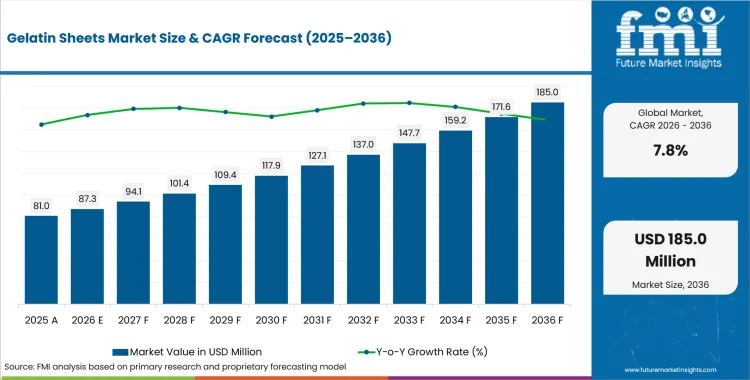
USD 87.3 million in 2026 and USD 185.0 million by 2036 at a 7.8% CAGR.
Demand for gelatin sheets is projected to grow from USD 87.3 million in 2026 to USD 185.0 million by 2036 at 7.8% CAGR. Food manufacturers reorder leaf formats after sheet weight and Bloom strength remain repeatable. SGS issued GELNER an FSSC 22000 certificate on June 20, 2025 covering edible gelatin in powder and leaf forms. Current certification lowers source-change risk after recipe approval.
Country demand converts differently because production scale and food controls change qualification frequency. USDA NASS reported 103 million hundredweight of USA flour production in the first quarter of 2026. The figure does not prove gelatin consumption, but it identifies a large industrial bakery base where qualified gelling inputs can earn repeat orders. Gulf imports add source and halal checks before customer trials.
Key Takeaways
- Demand rises where pastry and foodservice operators need repeatable gel strength from portioned ingredients that reduce weighing variation.
- By product type, standard grade is projected to account for 44.0% in 2026 due to broad specifications that fit routine food use.
- In 2026, powder - dry is expected to lead form with 38.0% share because bulk plants favor metered dosing and compact storage.
- Bread & rolls is set to lead the application category with 35.0% share in 2026 due to formal ingredient specifications in repeated production.
- Animal-source, halal and labeling records can lengthen approval after a gelatin grade passes a customer formulation trial.
- Some of the key players in this market include GELITA AG, GELNER Gıda A.Ş., Hebei Haodong Biological Technology Co., Ltd., Nitta Gelatin Inc., Rousselot (Darling Ingredients), PB Leiner (Tessenderlo Group), Lapi Gelatine S.p.A., and India Gelatine & Chemicals Limited.
Analyst Perspective
"Gelatin-sheet purchasing starts with repeatable gel strength, but source records determine how far an accepted grade can travel. Companies comparing collagen supply and leaf formats should price qualification time alongside the ingredient because stable documentation protects repeat orders."
- Nandini Roy Choudhury, Principal Consultant, Future Market Insights
How is the gelatin sheets market segmented?
The gelatin sheets market is segmented by product type, form, application, claim, sales channel and region.
Product type covers standard, premium - specialty, organic certified and clean label grades. Form includes powder - dry, liquid, paste - semi-solid and granules - pieces. Applications cover bread & rolls, cakes & muffins, biscuits & cookies, viennoiserie & pastry and other bakery & snacks. Claims cover conventional, clean label, organic and non-GMO - identity preserved. Sales channels include direct industrial bakery, distributors, foodservice & artisan supply and online B2B.
Why does standard grade lead the product type category?
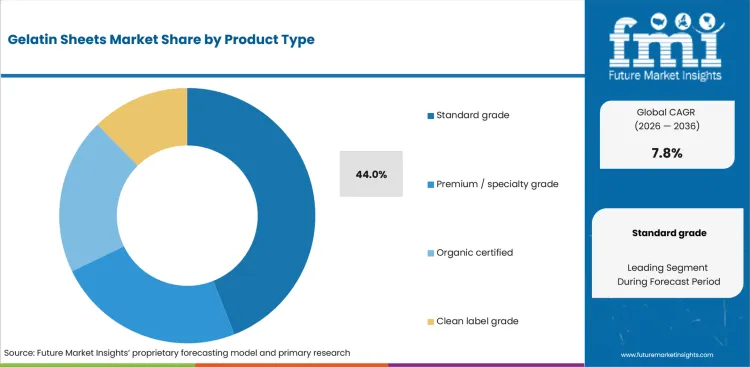
Standard grade gives routine food programs a broad specification before customers pay for narrower source or claim requirements. Current gelatin specifications still need repeatable Bloom strength because small strength changes alter texture and dose calculations in an approved recipe.
- Based on product type, standard grade is projected to account for 44.0% in 2026 due to broad fit with routine food specifications.
- At IFT FIRST in July 2026, GELITA scheduled food and beverage technical sessions covering gelatin formulation and manufacturability. The event shows why standard grades need application evidence before a customer changes a familiar gelling step.
Why does powder - dry lead the form category?
Dry formats fit bulk ingredient rooms because automated weighing systems can meter repeat doses without liquid-transfer equipment. Related food hydrocolloids face the same plant requirement: the chosen format must disperse predictably after storage and routine handling.
- By form, powder - dry is estimated to hold 38.0% in 2026 owing to compact storage and metered bulk handling.
- Nitta Gelatin announced on February 2, 2025 that its Indian subsidiary had approval to expand gelatin production in Kerala. The capacity action supports industrial programs that need stable dry-gelatin availability after specification approval.
Why do bread & rolls lead the application category?
Bread plants evaluate gelatin inside a wider industrial bakery production program where ingredient changes must survive repeated mixing, proofing and packing schedules. Bread recipes still require application-specific gelatin performance because bread texture may need a different gelling contribution from pastry fillings.
- By application, bread & rolls is forecast to represent 35.0% in 2026 driven by high-volume lines that formalize ingredient specifications.
- UK bread and flour guidance published on April 23, 2025 sets composition and labeling requirements for commercial products. Those controls raise the cost of changing an ingredient without documentation that fits the revised formula.
Why does conventional lead the claim category?
Conventional grades let formulators qualify function before adding organic or identity-preserved records to the purchase decision. Interest in clean-label ingredients raises the value of narrower claims, but each added claim needs evidence that follows the approved batch.
- The conventional segment is likely to capture 50.0% share in 2026 attributable to routine applications that do not require premium certification.
- The FDA updated its healthy nutrient-content claim notice on February 24, 2025 before the new criteria took effect on April 28. Reformulating packaged foods therefore keeps claim decisions tied to documented ingredient changes.
Why does direct to industrial bakeries lead the sales channel category?
Direct accounts keep trials, specifications and annual volume planning inside one commercial relationship. That route fits bakery ingredient supply because technical questions and delivery terms are resolved before recurring plant orders begin.
- Direct to industrial bakeries is set to lead the sales channel with 56.0% share in 2026 due to joint technical approval and volume planning.
- Nitta Gelatin announced its September 2025 return to SupplySide Global with technical teams presenting gelatin and collagen ingredients to commercial formulators. The selling model illustrates why direct accounts value application access before committing recurring volumes.
What are the drivers, restraints and opportunities in the Gelatin Sheets Market?
Repeat production supports qualified gelatin-sheet demand, animal-source records can delay import approval, and certified bovine leaf grades provide a route into narrower customer programs.
- Driver: Repeat production keeps qualified gelatin specifications on approved lists after food plants validate dose, hydration and finished texture.
- Restraint: Animal-source and halal records can delay import approval even after the ingredient passes a technical formulation trial.
- Opportunity: Certified bovine leaf grades can enter source-controlled programs if current certificates travel with each commercial specification.
Repeat Production Keeps Qualified Specifications on Approved Lists
Repeat orders follow once a gelatin grade performs within the approved recipe window. The broader food stabilizers category follows the same purchasing logic. Nitta Gelatin announced in February 2025 that its Indian subsidiary had approval to expand gelatin production in Kerala. Added capacity earns orders only after customers qualify the grade.
Animal-Source Records Extend Qualification
Animal-derived ingredients retain destination-specific source records after technical approval. Other food stabilizer systems can face fewer origin documents. Saudi food-clearance requirements published in April 2025 call for a halal slaughter certificate for raw gelatine intended for food. Recognized documentation therefore precedes commercial ordering.
Certified Leaf Grades Serve Narrower Programs
Source-controlled programs give certified leaf formats a route into recipes specifying animal origin. Demand for functional food ingredients depends on documents that survive customer review. GELNER’s grass-fed certificate lists edible bovine powder and leaf gelatin with a first issue date of July 25, 2025. It carries value where customer rules exclude unverified alternatives.
Which country CAGRs are profiled in the Gelatin Sheets Market?
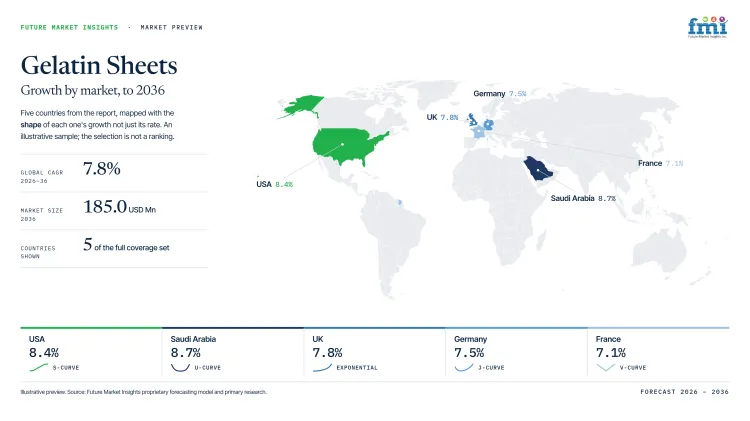
| Country | CAGR |
|---|---|
| UAE | 9.1% |
| Saudi Arabia | 8.7% |
| USA | 8.4% |
| South Korea | 8.1% |
| UK | 7.8% |
| Germany | 7.5% |
| France | 7.1% |
| Japan | 6.8% |
How do country-level CAGRs compare in the Gelatin Sheets Market?
The 2.3 percentage-point spread separates Gulf growth from mature European and Japanese markets. UAE and Saudi Arabia gain from hospitality and import-led supply. USA and South Korea follow through commercial bakery scale. European markets and Japan grow more slowly through established food systems.
- UAE: hospitality clusters reward nearby specialty stock.
- Saudi Arabia: local inventory reduces import lead times.
- USA: multi-site bakeries justify plant-level application support.
- South Korea: rapid launches favor quick sample conversion.
- UK: mixed foodservice accounts require flexible pack sizes.
- Germany: quality systems reward specification repeatability.
- France: pastry specialists value portioning precision.
- Japan: distributor relationships raise switching costs.
Comparable CAGRs produce different economics because qualification costs vary. The full report provides country-level CAGR analysis across North America, Latin America, Western Europe, Eastern Europe, East Asia, South Asia and Pacific, and Middle East and Africa.
Country-wise Analysis
- UAE importers handle specialty food ingredients through conformity checks that can hold stock before hotel or bakery trials begin. The Emirates International Accreditation Centre issued a July 9, 2025 circular moving halal food testing into its general food-testing scheme from 2026. Gelatin sheets demand in the UAE is forecast to rise at 9.1% CAGR through 2036, propelled by premium hotel desserts and imported specialty ingredients. Local distributors can precheck certificates and keep approved leaf formats near major hospitality centers with frequent replenishment. Stale test references can delay clearance, so document control determines whether faster hospitality growth becomes repeat commercial business.
- Before a Saudi bakery or hotel trial begins, importers check animal source and halal status for raw gelatine entering food use. The February 6, 2025 Saudi Food and Drug Authority circular identified additional food products requiring halal certificates from bodies designated by the Saudi Halal Center. Recognized local agents can verify the certifier before shipment and reduce avoidable inventory holds. The Saudi Arabia gelatin sheets outlook is anticipated to advance at 8.7% CAGR over the assessment period, driven by premium imported ingredients and hospitality purchasing. An unrecognized certificate can still delay clearance even after the sheet passes a technical trial.
- Commercial bakeries in the USA run standardized recipes and expect ingredient changes to survive plant-scale throughput before broad rollout. The Bureau of Labor Statistics counted about 262,400 bakers in 2025 and placed 30% in bakeries and tortilla manufacturing. Gelatin sheet sales in the USA are forecast to expand at 8.4% CAGR by 2036, reflecting premium bakery and foodservice use within that operating base. Local technical teams can test Bloom strength and hydration close to customer plants before national account rollout. Powder and plant-derived gelling alternatives keep price pressure high, particularly in larger automated accounts with established dosing systems nationally.
- South Korean food companies turn new bakery and dessert concepts quickly, which leaves little time to correct missing import or label records. Local technical partners can translate specifications and answer formulation questions before a trial moves into commercial packaging. The Ministry of Food and Drug Safety amended Food Labeling Standards on August 29, 2025 to expand electronic information through QR codes and related barcodes. Demand for gelatin sheets in South Korea is predicted to advance at 8.1% CAGR through 2036, attributable to premium bakery development and rapid product turnover. Remote support can interrupt launch schedules if documentation questions surface after sample approval.
- UK bakery and foodservice channels range from industrial plants to hotel pastry kitchens, so one grade must fit different pack and service routines. Food Standards Agency allergen guidance updated on March 14, 2025 requires businesses to provide allergen information and manage regulated allergens during preparation. UK gelatin sheet demand is expected to maintain 7.8% CAGR through 2036, aided by premium pastry and dessert programs. National distributors can hold local stock and answer specification questions for both account types before new listings. Fragmented approval routines raise service costs because industrial technical reviews and chef-led purchasing rarely follow the same commercial timetable.
- German packaged-food manufacturers use mature quality systems that can turn nutrition-label changes into formal formulation reviews for established recipes. Experienced application laboratories shorten technical review and give imported gelatin a route into disciplined commercial trials with local technical records. The federal food ministry published updated Nutri-Score cooperation material on January 29, 2025 and confirmed the revised calculation transition ending January 1, 2026. Germany is positioned to record 7.5% CAGR during the assessment period, helped by premium bakery output and structured ingredient qualification. Bovine-source evidence must still clear each customer system before a formulation change becomes a recurring commercial customer order.
- French pastry specialists value predictable sheet handling because portioning errors can change set and texture in chilled desserts. A March 14, 2025 Légifrance order set the state-recommended Nutri-Score presentation and tied its use to the collective trademark rules. Gelatin sheet demand in France is likely to register 7.1% CAGR over the assessment period, tied to professional pastry and premium dessert production. Specialist distributors provide strong chef access and can place samples close to professional kitchens for rapid recipe trials. Competing confectionery ingredients and hydrocolloids are tested recipe by recipe, so leaf producers must prove handling consistency instead of relying on category familiarity.
- Japanese pastry and packaged-food companies usually approve ingredients through detailed specifications before a new grade reaches routine production. Domestic gelatin expertise gives formulators nearby technical support and makes established distributor service a practical purchasing advantage. The Consumer Affairs Agency announced a partial amendment of the Food Labeling Standards on April 1, 2026 and issued revised related notices. Adoption of gelatin sheets in Japan is estimated to expand at 6.8% CAGR through 2036, supported by professional pastry use and long familiarity with leaf formats. Imported grades face demanding document and service expectations, which makes distributor quality more important than headline price alone.
Who are the notable companies in the Gelatin Sheets Market?
GELITA AG, GELNER Gıda A.Ş., Hebei Haodong Biological Technology Co., Ltd., Nitta Gelatin Inc., Rousselot (Darling Ingredients), PB Leiner (Tessenderlo Group), Lapi Gelatine S.p.A., and India Gelatine & Chemicals Limited are notable companies serving this market.
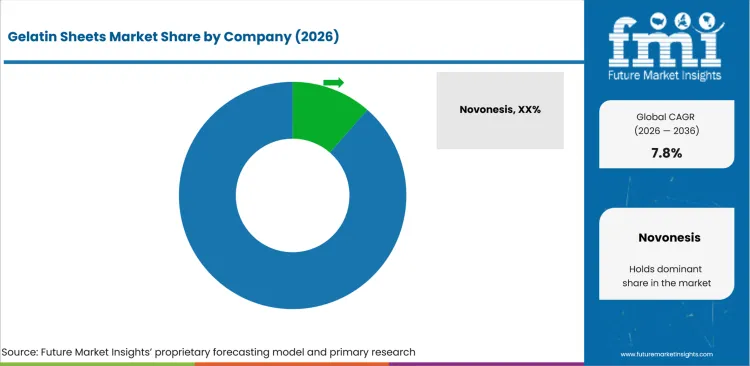
Direct leaf-format evidence is strongest for GELITA, GELNER, Hebei Haodong and India Gelatine. Nitta, Rousselot, PB Leiner and Lapi compete through broader gelatin manufacturing, food-quality systems and application support. Entry depends on format evidence and repeatable food-grade quality, not corporate size alone.
- Direct leaf-format evidence: GELITA AG, GELNER Gıda A.Ş., Hebei Haodong Biological Technology Co., Ltd., and India Gelatine & Chemicals Limited.
- Broader gelatin platforms: Nitta Gelatin Inc., Rousselot (Darling Ingredients), PB Leiner (Tessenderlo Group), and Lapi Gelatine S.p.A.
Competitive Benchmarking: Gelatin Sheets Market
| Company | Leaf-Format Evidence | Food-Quality Documentation | Application Support Depth | Geographic Reach |
|---|---|---|---|---|
| GELITA AG | High | High | High | Global |
| GELNER Gıda A.Ş. | High | High | Medium | Europe, Middle East and international |
| Hebei Haodong Biological Technology Co., Ltd. | High | High | Medium | China-led export markets |
| Nitta Gelatin Inc. | Medium | High | High | Japan and international |
| Rousselot (Darling Ingredients) | Low | High | High | Global |
| PB Leiner (Tessenderlo Group) | Low | High | High | Europe, Americas and Asia |
| Lapi Gelatine S.p.A. | Low | High | High | Europe with international sales |
| India Gelatine & Chemicals Limited | High | Medium | Medium | India and export markets |
Scoring basis: High leaf evidence requires a current official source naming leaf or sheet gelatin. Medium reflects narrower evidence. Technical support and geographic reach are rated from current documented coverage.
Key Developments in the Gelatin Sheets Market
- In August 2026, GELITA AG increased its SelJel shareholding to near-full ownership. The change tightens governance around a gelatin manufacturing asset, though public material does not identify added leaf-specific capacity.
- In December 2025, Darling Ingredients signed a definitive agreement with Tessenderlo Group to combine Rousselot and PB Leiner. The proposed company would consolidate broad gelatin capacity, subject to the completion conditions disclosed by both groups.
- In June 2026, PB Leiner announced acquisition of the remaining minority stake in its Brazilian joint venture. Greater ownership control can simplify regional gelatin investment decisions, but the announcement specifies no new leaf-gelatin capacity.
Key Players in the Gelatin Sheets Market
Direct Leaf and Sheet Evidence
- GELITA AG
- GELNER Gıda A.Ş.
- Hebei Haodong Biological Technology Co., Ltd.
- Nitta Gelatin Inc.
Broader Food-Grade Gelatin Platforms
- Rousselot (Darling Ingredients)
- PB Leiner (Tessenderlo Group)
- Lapi Gelatine S.p.A.
- India Gelatine & Chemicals Limited
Gelatin Sheets Market - Report Scope
| Coverage field | Report scope |
|---|---|
| Market breakdown | By product type, form, application, claim, sales channel and region. |
| Quantitative Units | USD million. |
| Market Definition | Revenue from gelatin sheets and the supplied gelatin-format categories used in bakery, pastry and related food applications within the stated taxonomy. |
| Regions Covered | North America, Latin America, Western Europe, Eastern Europe, East Asia, South Asia and Pacific, and Middle East and Africa. |
| Countries Covered | UAE, Saudi Arabia, USA, South Korea, UK, Germany, France, Japan, and 20+ countries included in the full report. |
| Key Companies Profiled | GELITA AG, GELNER Gıda A.Ş., Hebei Haodong Biological Technology Co., Ltd., Nitta Gelatin Inc., Rousselot (Darling Ingredients), PB Leiner (Tessenderlo Group), Lapi Gelatine S.p.A., and India Gelatine & Chemicals Limited. |
| Forecast Period | 2026 to 2036. |
| Approach | Primary and secondary research with market triangulation. |
Gelatin Sheets Market - Research Methodology
| Method | Approach |
|---|---|
| Primary Research | FMI analysts gathered input from manufacturers, service providers, technology developers, distributors, end users, procurement teams, and subject-matter experts. Interviews examined purchasing decisions, product or service evaluation, adoption barriers, approval requirements, pricing considerations, and expectations for technical or commercial support. Respondents were also asked what evidence is required before a trial, pilot, or initial order develops into regular purchasing. |
| Desk Research | Desk research covered government statistics, regulatory publications, trade data, industry associations, technical literature, standards, company filings, product information, and official corporate announcements. Sources were reviewed for relevance, publication date, geographic coverage, and consistency with the defined market scope. Claims relating to performance, applications, approvals, capacity, investment, and commercial activity were retained only when supported by credible public evidence. |
| Market Sizing and Forecasting | The market model combined the baseline value with historical performance, segment structure, pricing and volume indicators, adoption levels, company participation, and country-level demand conditions. Forecast assumptions considered economic activity, investment trends, regulatory developments, technology adoption, purchasing cycles, supply availability, and barriers to wider market use. Segment and regional estimates were reconciled before the final market total was calculated. |
| Data Validation | Estimates were checked against multiple independent indicators, including public data, company activity, trade patterns, industry developments, and findings from primary interviews. Validation also tested whether products, services, applications, and company revenues fell within the defined market boundaries. Adjacent categories, unsupported claims, overlapping revenues, and activities without direct market relevance were excluded to reduce double counting and maintain consistency across segments and countries. |
Gelatin Sheets Market by Segments
Gelatin Sheets Market segmented by Product Type:
- standard grade
- premium - specialty grade
- organic certified
- clean label grade
Gelatin Sheets Market segmented by Form:
- powder - dry
- liquid
- paste - semi-solid
- granules - pieces
Gelatin Sheets Market segmented by Application:
- bread & rolls
- cakes & muffins
- biscuits & cookies
- viennoiserie & pastry
- other bakery & snacks
Gelatin Sheets Market segmented by Claim:
- conventional
- clean label
- organic
- non-GMO - identity preserved
Gelatin Sheets Market segmented by Sales Channel:
- direct to industrial bakeries
- ingredient distributors
- foodservice & artisan supply
- online B2B
Gelatin Sheets Market by Region:
- North America
- United States
- Canada
- Latin America
- Brazil
- Mexico
- Argentina
- Chile
- Western Europe
- Germany
- France
- United Kingdom
- Italy
- Spain
- Benelux
- Nordics
- Eastern Europe
- Poland
- Czech Republic
- Romania
- Hungary
- East Asia
- China
- Japan
- South Korea
- South Asia and Pacific
- India
- ASEAN
- Australia and New Zealand
- Middle East and Africa
- GCC Countries
- South Africa
- Türkiye
- Israel
Research Sources and Bibliography
- SGS United Kingdom Ltd. (2025, June 20). FSSC 22000 Certificate TR24/00000081 for GELNER GIDA ANONIM SIRKETI.
- USA Department of Agriculture, National Agricultural Statistics Service. (2026, May 1). Flour Milling Products.
- GELITA. (2026, July 13-15). GELITA at IFT FIRST.
- Nitta Gelatin NA, Inc. (2025, February 2). Nitta Gelatin India Announces Production Expansion.
- Department for Environment, Food & Rural Affairs and Food Standards Agency. (2025, April 23). Bread and flour: labelling and composition.
- USA Food and Drug Administration. (2025, February 24). FDA Finalizes Updated “Healthy” Nutrient Content Claim.
- Nitta Gelatin NA, Inc. (2025, September 29). We’re coming to Supply Side West! - Booth 7312.
- Saudi Food and Drug Authority. (2025, April). Conditions and Requirements for Food Clearance.
- TQN Academy Training Certification Testing and Conformity Assessment Inc. (2025, July 25). Grass Fed Certificate of Conformity: Edible Bovine Gelatine (Powder and Leaf).
- Emirates International Accreditation Centre. (2025, July 9). Discontinuation of the Accreditation Scheme for Halal Food Testing.
- Saudi Food and Drug Authority. (2025, February 6). Other food products that require a halal certificate from bodies designated by the Saudi Halal Center.
- USA Bureau of Labor Statistics. (2026, August 27). Bakers.
- Ministry of Food and Drug Safety, South Korea. (2025, August 29). Food Labeling Standards, Notice No. 2025-60.
- Food Standards Agency. (2025, March 14). Allergen guidance for food businesses.
- Federal Ministry of Food and Agriculture, Germany. (2025, January 29). Internationale Zusammenarbeit beim Nutri-Score.
- Légifrance. (2025, March 14). Arrêté du 14 mars 2025 fixant la forme de présentation complémentaire à la déclaration nutritionnelle.
- Consumer Affairs Agency, Japan. (2026, April 1). Partial Amendment of the Food Labeling Standards.
- GELITA. (2026, August 26). From Partnership to Near-Full Ownership: GELITA Strengthens SelJel Integration.
- Darling Ingredients Inc. (2025, December 10). Darling Ingredients and Tessenderlo Group Sign Definitive Agreement to form New Company to Accelerate Growth in Attractive Collagen-Based Health, Wellness and Nutrition Sector.
- Tessenderlo Group. (2026, June 15). PB Leiner acquiring remaining minority stake in Brazilian joint venture and closing of the CINIS Fertilizer AB asset transfer agreement within Tessenderlo Kerley International.
- The Food Safety Agency of the Republic of Azerbaijan. (2025). Approval Register of Food Establishments Exporting to the Republic of Azerbaijan from Foreign Countries.
- Halal Feed and Food Inspection Authority. (2025, August). Halal Process Certificate for GELNER Gıda A.Ş.
- Lapi Gelatine. (2025, January 29). Trade Shows: expanding our presence in 2025.
- Lapi Gelatine. (2025, February 24). Lapi Gelatine CRIBIS Prime Company for the Third Consecutive Year: A Testament to Our Longstanding Reliability.
- Lapi Gelatine. (2025, January 21). Lapi Gelatine renews ASC Certification. Reinforcing our commitment to Responsible Aquaculture.
- Nitta Gelatin Inc. (2025, November 12). Formulation of the Long-Term Management Vision.
- Nitta Gelatin Inc. (2026, May 14). Consolidated Financial Results for the Fiscal Year Ended March 31, 2026.
- Securities and Exchange Board of India. (2025, March 7). India Gelatine & Chemicals Ltd: Letter of Offer.
- India Gelatine & Chemicals Limited. (2025, May 22). 53rd Annual Report 2024-25.
- GELITA. (2026). GELITA Leaf Gelatin.
- GELNER Gıda A.Ş. (2026). Our Certificates and Standards.
- Nitta Gelatin Inc. (2026). Gelatin business activities.
- Tessenderlo Group. (2026). Our activities: PB Leiner.
- Lapi Gelatine. (2026). Products.
This bibliography is provided for reader reference and is not exhaustive. The full report contains the complete reference list and detailed citations.
This Report Answers
- What are the gelatin sheets market values in 2026 and 2036?
- Why does repeat dosing support gelatin-sheet purchasing?
- Why does standard grade lead product type in 2026?
- How does powder - dry handling differ from leaf formats?
- Why do bread & rolls lead application in 2026?
- How do CAGRs differ among the eight profiled countries?
- Which companies document leaf gelatin directly?
- What should manufacturers compare before changing a gelatin specification?
Frequently Asked Questions
How big is the gelatin sheets market in 2026?
The gelatin sheets market is valued at USD 87.3 million in 2026 and is projected to reach USD 185.0 million by 2036. Repeat orders follow stable gel strength and source records.
What is the CAGR of the gelatin sheets market from 2026 to 2036?
The gelatin sheets market is projected to grow at 7.8% CAGR between 2026 and 2036. Expansion depends on repeat production plus food-safety and source documentation.
Which product type leads the gelatin sheets market?
Standard grade is expected to hold 44.0% in 2026 driven by broad fit with routine food specifications. Narrower grades require additional certification and source records.
Which form leads the gelatin sheets market?
Powder - dry is expected to hold 38.0% in 2026 attributable to bulk handling and metered dosing. Leaf formats retain value for controlled pastry portions.
Which countries are projected to record the highest growth in the gelatin sheets market?
UAE is projected at 9.1% CAGR followed by Saudi Arabia at 8.7% and USA at 8.4% through 2036. Hospitality demand and qualification requirements shape each route.
Which companies are active in the gelatin sheets market?
Key companies operating in the market include GELITA AG, GELNER Gıda A.Ş., Hebei Haodong Biological Technology Co., Ltd., Nitta Gelatin Inc., Rousselot (Darling Ingredients), PB Leiner (Tessenderlo Group), Lapi Gelatine S.p.A., and India Gelatine & Chemicals Limited. They differ in leaf evidence and technical reach.
Preview the report firsthand - request a free sample
Get SampleGet the brochure for pricing and purchase details.
Get PDFTable of Content
- Key Takeaways
- Market Size and CAGR
- Top Growth Driver
- Fastest Growing Segment
- Leading Region
- Key Companies
- Emerging Opportunities
- Executive Summary
- Global Market Outlook
- Demand-side Trends
- Supply-side Trends
- Technology Roadmap Analysis
- Analysis and Recommendations
- Analyst Perspective (What is happening? Why now? What should investors know?)
- Key Questions Answered
- How large is the market?
- What is the CAGR?
- What are key trends?
- Which region dominates?
- Who are the leaders?
- Market Overview
- Market Coverage / Taxonomy
- Market Definition / Scope / Limitations
- Research Methodology
- Chapter Orientation
- Analytical Lens and Working Hypotheses
- Market Structure, Signals, and Trend Drivers
- Benchmarking and Cross-market Comparability
- Market Sizing, Forecasting, and Opportunity Mapping
- Research Design and Evidence Framework
- Desk Research Programme (Secondary Evidence)
- Expert Input and Fieldwork (Primary Evidence)
- Tooling, Models, and Reference Databases
- Data Engineering and Model Build
- Quality Assurance and Audit Trail
- Market Background
- Market Dynamics (Drivers, Restraints, Opportunity, Trends)
- Scenario Forecast (Optimistic, Likely, Conservative)
- Impact Analysis
- AI Impact
- Sustainability Impact
- Regulatory Impact
- Technology Impact
- Consumer / Buyer Analysis
- Purchase Drivers
- Adoption Barriers
- Buyer Journey
- Opportunity Map Analysis
- Product Life Cycle Analysis
- Supply Chain Analysis
- Investment Feasibility Matrix
- Value Chain Analysis
- PESTLE and Porter's Analysis
- Regulatory Landscape
- Regional Parent Market Outlook
- Production and Consumption Statistics
- Import and Export Statistics
- Global Market Analysis and Forecast, 2021 to 2036
- Historical Market Size Value (USD Million) Analysis, 2021 to 2025
- Current and Future Market Size Value (USD Million) Projections, 2026 to 2036
- Y-o-Y Growth Trend Analysis
- Absolute $ Opportunity Analysis
- Global Market Pricing Analysis, 2021 to 2036
- Global Market Analysis and Forecast, By Product Type, 2021 to 2036
- Introduction / Key Findings
- Historical Market Size Value (USD Million) Analysis By Product Type, 2021 to 2025
- Current and Future Market Size Value (USD Million) Analysis and Forecast By Product Type, 2026 to 2036
- Standard grade
- Premium / specialty grade
- Organic certified
- Clean label grade
- Standard grade
- Y-o-Y Growth Trend Analysis By Product Type, 2021 to 2025
- Absolute $ Opportunity Analysis By Product Type, 2026 to 2036
- Global Market Analysis and Forecast, By Form, 2021 to 2036
- Introduction / Key Findings
- Historical Market Size Value (USD Million) Analysis By Form, 2021 to 2025
- Current and Future Market Size Value (USD Million) Analysis and Forecast By Form, 2026 to 2036
- Powder / dry
- Liquid
- Paste / semi-solid
- Granules / pieces
- Powder / dry
- Y-o-Y Growth Trend Analysis By Form, 2021 to 2025
- Absolute $ Opportunity Analysis By Form, 2026 to 2036
- Global Market Analysis and Forecast, By Application, 2021 to 2036
- Introduction / Key Findings
- Historical Market Size Value (USD Million) Analysis By Application, 2021 to 2025
- Current and Future Market Size Value (USD Million) Analysis and Forecast By Application, 2026 to 2036
- Bread & rolls
- Cakes & muffins
- Biscuits & cookies
- Viennoiserie & pastry
- Other bakery & snacks
- Bread & rolls
- Y-o-Y Growth Trend Analysis By Application, 2021 to 2025
- Absolute $ Opportunity Analysis By Application, 2026 to 2036
- Global Market Analysis and Forecast, By Claim, 2021 to 2036
- Introduction / Key Findings
- Historical Market Size Value (USD Million) Analysis By Claim, 2021 to 2025
- Current and Future Market Size Value (USD Million) Analysis and Forecast By Claim, 2026 to 2036
- Conventional
- Clean label
- Organic
- Non-GMO / identity preserved
- Conventional
- Y-o-Y Growth Trend Analysis By Claim, 2021 to 2025
- Absolute $ Opportunity Analysis By Claim, 2026 to 2036
- Global Market Analysis and Forecast, By Sales Channel, 2021 to 2036
- Introduction / Key Findings
- Historical Market Size Value (USD Million) Analysis By Sales Channel, 2021 to 2025
- Current and Future Market Size Value (USD Million) Analysis and Forecast By Sales Channel, 2026 to 2036
- Direct to industrial bakeries
- Ingredient distributors
- Foodservice & artisan supply
- Online B2B
- Direct to industrial bakeries
- Y-o-Y Growth Trend Analysis By Sales Channel, 2021 to 2025
- Absolute $ Opportunity Analysis By Sales Channel, 2026 to 2036
- Global Market Analysis and Forecast, By Region, 2021 to 2036
- Introduction
- Historical Market Size Value (USD Million) Analysis By Region, 2021 to 2025
- Current Market Size Value (USD Million) Analysis and Forecast By Region, 2026 to 2036
- North America
- Latin America
- Western Europe
- Eastern Europe
- East Asia
- South Asia and Pacific
- Middle East & Africa
- Market Attractiveness Analysis By Region
- North America Market Analysis and Forecast, By Country, 2021 to 2036
- Historical Market Size Value (USD Million) Trend Analysis By Market Taxonomy, 2021 to 2025
- Market Size Value (USD Million) Forecast By Market Taxonomy, 2026 to 2036
- By Country
- USA
- Canada
- By Product Type
- By Form
- By Application
- By Claim
- By Sales Channel
- By Country
- Market Attractiveness Analysis
- By Country
- By Product Type
- By Form
- By Application
- By Claim
- By Sales Channel
- Key Takeaways
- Latin America Market Analysis and Forecast, By Country
- Historical Market Size Value (USD Million) Trend Analysis By Market Taxonomy, 2021 to 2025
- Market Size Value (USD Million) Forecast By Market Taxonomy, 2026 to 2036
- By Country
- Brazil
- Mexico
- Chile
- Rest of Latin America
- By Product Type
- By Form
- By Application
- By Claim
- By Sales Channel
- By Country
- Market Attractiveness Analysis
- By Country
- By Product Type
- By Form
- By Application
- By Claim
- By Sales Channel
- Key Takeaways
- Western Europe Market Analysis and Forecast, By Country
- Historical Market Size Value (USD Million) Trend Analysis By Market Taxonomy, 2021 to 2025
- Market Size Value (USD Million) Forecast By Market Taxonomy, 2026 to 2036
- By Country
- Germany
- UK
- Italy
- Spain
- France
- Nordic
- BENELUX
- Rest of Western Europe
- By Product Type
- By Form
- By Application
- By Claim
- By Sales Channel
- By Country
- Market Attractiveness Analysis
- By Country
- By Product Type
- By Form
- By Application
- By Claim
- By Sales Channel
- Key Takeaways
- Eastern Europe Market Analysis and Forecast, By Country
- Historical Market Size Value (USD Million) Trend Analysis By Market Taxonomy, 2021 to 2025
- Market Size Value (USD Million) Forecast By Market Taxonomy, 2026 to 2036
- By Country
- Russia
- Poland
- Hungary
- Balkan & Baltic
- Rest of Eastern Europe
- By Product Type
- By Form
- By Application
- By Claim
- By Sales Channel
- By Country
- Market Attractiveness Analysis
- By Country
- By Product Type
- By Form
- By Application
- By Claim
- By Sales Channel
- Key Takeaways
- East Asia Market Analysis and Forecast, By Country
- Historical Market Size Value (USD Million) Trend Analysis By Market Taxonomy, 2021 to 2025
- Market Size Value (USD Million) Forecast By Market Taxonomy, 2026 to 2036
- By Country
- China
- Japan
- South Korea
- By Product Type
- By Form
- By Application
- By Claim
- By Sales Channel
- By Country
- Market Attractiveness Analysis
- By Country
- By Product Type
- By Form
- By Application
- By Claim
- By Sales Channel
- Key Takeaways
- South Asia and Pacific Market Analysis and Forecast, By Country
- Historical Market Size Value (USD Million) Trend Analysis By Market Taxonomy, 2021 to 2025
- Market Size Value (USD Million) Forecast By Market Taxonomy, 2026 to 2036
- By Country
- India
- ASEAN
- Australia & New Zealand
- Rest of South Asia and Pacific
- By Product Type
- By Form
- By Application
- By Claim
- By Sales Channel
- By Country
- Market Attractiveness Analysis
- By Country
- By Product Type
- By Form
- By Application
- By Claim
- By Sales Channel
- Key Takeaways
- Middle East & Africa Market Analysis and Forecast, By Country
- Historical Market Size Value (USD Million) Trend Analysis By Market Taxonomy, 2021 to 2025
- Market Size Value (USD Million) Forecast By Market Taxonomy, 2026 to 2036
- By Country
- Kingdom of Saudi Arabia
- Other GCC Countries
- Türkiye
- South Africa
- Other African Union
- Rest of Middle East & Africa
- By Product Type
- By Form
- By Application
- By Claim
- By Sales Channel
- By Country
- Market Attractiveness Analysis
- By Country
- By Product Type
- By Form
- By Application
- By Claim
- By Sales Channel
- Key Takeaways
- Key Countries Market Analysis
- USA
- Pricing Analysis
- Market Share Analysis, 2025
- By Product Type
- By Form
- By Application
- By Claim
- By Sales Channel
- Canada
- Pricing Analysis
- Market Share Analysis, 2025
- By Product Type
- By Form
- By Application
- By Claim
- By Sales Channel
- Mexico
- Pricing Analysis
- Market Share Analysis, 2025
- By Product Type
- By Form
- By Application
- By Claim
- By Sales Channel
- Brazil
- Pricing Analysis
- Market Share Analysis, 2025
- By Product Type
- By Form
- By Application
- By Claim
- By Sales Channel
- Chile
- Pricing Analysis
- Market Share Analysis, 2025
- By Product Type
- By Form
- By Application
- By Claim
- By Sales Channel
- Germany
- Pricing Analysis
- Market Share Analysis, 2025
- By Product Type
- By Form
- By Application
- By Claim
- By Sales Channel
- UK
- Pricing Analysis
- Market Share Analysis, 2025
- By Product Type
- By Form
- By Application
- By Claim
- By Sales Channel
- Italy
- Pricing Analysis
- Market Share Analysis, 2025
- By Product Type
- By Form
- By Application
- By Claim
- By Sales Channel
- Spain
- Pricing Analysis
- Market Share Analysis, 2025
- By Product Type
- By Form
- By Application
- By Claim
- By Sales Channel
- France
- Pricing Analysis
- Market Share Analysis, 2025
- By Product Type
- By Form
- By Application
- By Claim
- By Sales Channel
- India
- Pricing Analysis
- Market Share Analysis, 2025
- By Product Type
- By Form
- By Application
- By Claim
- By Sales Channel
- ASEAN
- Pricing Analysis
- Market Share Analysis, 2025
- By Product Type
- By Form
- By Application
- By Claim
- By Sales Channel
- Australia & New Zealand
- Pricing Analysis
- Market Share Analysis, 2025
- By Product Type
- By Form
- By Application
- By Claim
- By Sales Channel
- China
- Pricing Analysis
- Market Share Analysis, 2025
- By Product Type
- By Form
- By Application
- By Claim
- By Sales Channel
- Japan
- Pricing Analysis
- Market Share Analysis, 2025
- By Product Type
- By Form
- By Application
- By Claim
- By Sales Channel
- South Korea
- Pricing Analysis
- Market Share Analysis, 2025
- By Product Type
- By Form
- By Application
- By Claim
- By Sales Channel
- Russia
- Pricing Analysis
- Market Share Analysis, 2025
- By Product Type
- By Form
- By Application
- By Claim
- By Sales Channel
- Poland
- Pricing Analysis
- Market Share Analysis, 2025
- By Product Type
- By Form
- By Application
- By Claim
- By Sales Channel
- Hungary
- Pricing Analysis
- Market Share Analysis, 2025
- By Product Type
- By Form
- By Application
- By Claim
- By Sales Channel
- Kingdom of Saudi Arabia
- Pricing Analysis
- Market Share Analysis, 2025
- By Product Type
- By Form
- By Application
- By Claim
- By Sales Channel
- Türkiye
- Pricing Analysis
- Market Share Analysis, 2025
- By Product Type
- By Form
- By Application
- By Claim
- By Sales Channel
- South Africa
- Pricing Analysis
- Market Share Analysis, 2025
- By Product Type
- By Form
- By Application
- By Claim
- By Sales Channel
- USA
- Market Structure Analysis
- Competition Dashboard
- Competition Benchmarking
- Market Share Analysis of Top Players
- By Regional
- By Product Type
- By Form
- By Application
- By Claim
- By Sales Channel
- Emerging Startups
- Innovation Benchmarking
- Competition Analysis
- Competition Deep Dive
- Novonesis
- Overview
- Product Portfolio
- Profitability by Market Segments
- Sales Footprint
- Strategy Overview
- Marketing Strategy
- Product Strategy
- Channel Strategy
- IFF
- Kerry Group
- AB Enzymes
- Amano Enzyme
- Palsgaard
- Corbion
- BASF
- Puratos
- DSM-Firmenich
- Novonesis
- Case Studies
- Success Stories
- Recent Developments
- Competition Deep Dive
- Assumptions & Acronyms Used


