

- Market Size (2026)
- USD 1018.0 Mn
- Forecast (2036)
- USD 3807.2 Mn
- CAGR (2026 to 2036)
- 14.1%
How big is Pistachio Paste & Cream Market in 2026?
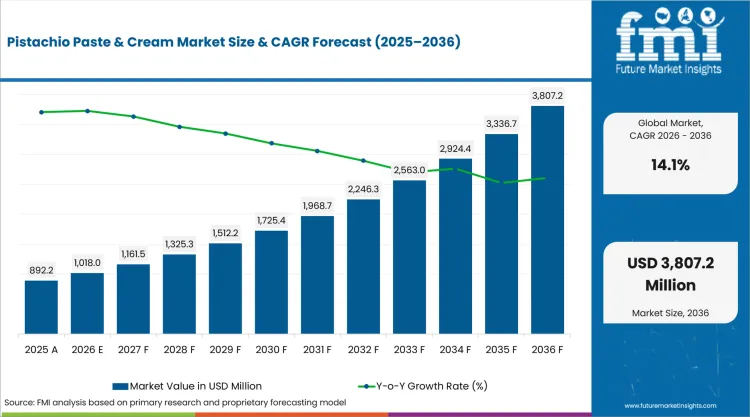
USD 1,018.0 million in 2026 and USD 3,807.2 million by 2036 at a 14.1% CAGR.
Demand for pistachio paste & cream is projected to rise from USD 1,018.0 million in 2026 to USD 3,807.2 million by 2036 at a 14.1% CAGR. Industrial bakery ingredients convert pistachio interest into repeat orders after fillings meet dosing, bake-stability, and lot-consistency requirements. USDA NASS recorded 1.58 billion pounds of utilized in-shell pistachios in California for 2025. That crop scale gives processors substantial raw material for standardized pastes and creams, though grade and origin still affect delivered cost.
Commercial adoption also depends on documentation because pistachio enters finished foods as a declared tree nut. In January 2025, the FDA issued Edition 5 of its food-allergen labeling guidance and clarified how major-allergen food sources must appear on labels. Ingredient qualification therefore extends beyond flavor and texture to cross-contact records and label-ready specifications. Strong allergen files can shorten approval work for industrial bakery accounts using shared production lines.
Key Takeaways
- Pistachio demand converts most reliably where process-ready pastes, creams, and dry systems fit established bakery lines.
- By product type, standard grade is estimated to hold 36.0% in 2026 owing to controlled recipe cost and repeatable processing.
- In 2026, powder - dry is expected to lead form with 47.0% share because dry handling simplifies storage and metering.
- Bread & rolls are projected to hold 38.0% of application demand in 2026 owing to frequent filled and flavored production runs.
- High pistachio input costs and allergen controls can lengthen qualification and weaken the economics of short shared-line runs.
- Some of the key players in this market include Barry Callebaut, Puratos, Dawn Foods, Zeelandia, CSM Ingredients, Bakels, AGRANA, Zentis, Fabbri 1905, and Irca Group.
Analyst Perspective
"Pistachio fillings earn repeat orders after a bakery proves depositing behavior, bake performance, and allergen control on the intended line. The best commercial fit is a format that protects flavor and yield without forcing repeated formulation work at each plant."
- Nandini Roy Choudhury, Principal Consultant, Future Market Insights
How is the pistachio paste & cream market segmented?
The market is segmented by product type, form, application, claim, and sales channel.
Product type includes standard grade, premium - specialty grade, organic grade, and clean label formulations. Form includes liquid, semi-solid - paste, powder - dry, and granules - pieces. Application includes bread & rolls, cakes & muffins, biscuits & cookies, viennoiserie & pastry, and other bakery and snack uses. Claim includes conventional, clean label, organic, and non-GMO - identity preserved. Sales channel includes direct to industrial bakeries, distributors & ingredient blenders, foodservice & artisan supply, and online B2B.
What makes standard grade central to the product type category?
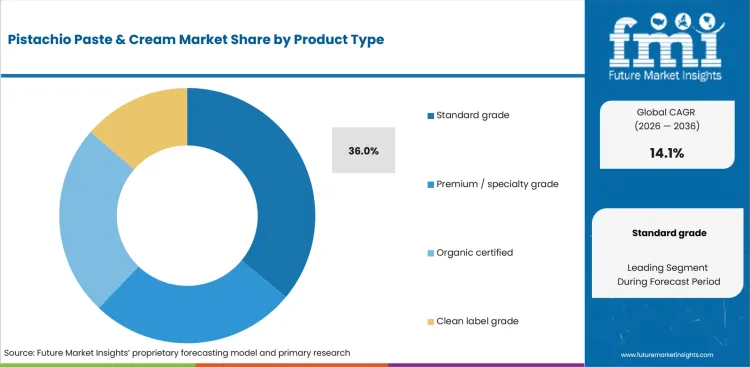
Industrial bakers use standard grade where pistachio character must fit a fixed recipe cost and a repeatable filling specification. Formulators can adjust pistachio solids and the fat system to suit depositing or bake conditions without the higher nut loading common in premium grades.
- Based on product type, standard grade is projected to account for 36.0% in 2026 due to repeatable processing at commercially workable inclusion rates.
- Puratos launched Carat Supercrem Pistachio on February 4, 2025 as a ready-to-use pastry filling containing 13% pistachio. The launch gives high-volume pastry programs a formulated route that reduces filling-development work before plant trials.
Why does powder - dry lead the form category?
Dry systems suit bakeries and premix plants that meter ingredients before hydration or fat addition. Sealed dry packs simplify warehouse handling and avoid pumping equipment used for viscous creams. Semi-solid paste fits direct filling better when stronger nut intensity is the main requirement.
- By form, powder - dry is estimated to hold 47.0% in 2026 owing to storage simplicity and controlled metering in centralized dry-mix workflows.
- Irca Group introduced Vegan Cream on April 23, 2025 as a customizable powdered pastry mix prepared with plant beverages or water. The system shows how dry bases can move from storage into cream preparation without specialized pumping equipment.
How do bread & rolls anchor the application category?
Filled rolls and brioche let processors use pistachio without changing the base dough line. Deposited centers or post-bake fillings keep inclusion weight under control and preserve a visible premium cue. That production flexibility gives bread programs more repeat occasions than formats tied to a single seasonal dessert.
- In 2026, bread & rolls are expected to lead application with 38.0% share because frequent production schedules support repeated use of pistachio fillings.
- Dawn Foods expanded its Delicream range with a pistachio filling on June 2, 2026. The ready-to-use format gives professional bakeries another way to add pistachio without developing a filling from raw nuts.
What supports conventional as the leading claim category?
Conventional formulations give bakery manufacturers the widest room to balance pistachio intensity, sweetness, shelf life, and cost. Organic or identity-preserved variants narrow sourcing and add certification work. Those claims need enough finished-product premium to recover the extra qualification cost.
- The conventional segment is likely to capture 56.0% share in 2026 attributable to broader sourcing choices and fewer certification constraints.
- The Organic Trade Association stated on March 4, 2026 that USA certified organic sales grew 6.8% in 2025. That growth supports a premium claim route, but conventional formulations retain a cost and sourcing advantage for mainstream bakery programs.
What are the drivers, restraints and opportunities in the Pistachio Paste & Cream Market?
Process-ready pistachio formats are widening bakery use, while allergen control and agricultural input costs slow qualification. Documented plant-based, organic, and halal variants provide the clearest premium expansion routes.
- Driver: Ready-to-use fillings and controlled dry systems let bakers use pistachio without developing every formulation from raw nuts.
- Restraint: Pistachio cost exposure and allergen segregation raise the commercial burden of short runs and shared production lines.
- Opportunity: Verified claim variants can earn premium placement where certification and process performance are strong enough for repeat orders.
Process-ready formats turn flavor interest into repeat production
Bakery demand becomes repeatable after pistachio flavor can run at line speed with predictable deposit weight and finished texture. Fabbri 1905 said on January 16, 2026 that its Simple range added a pistachio variety containing 21% pistachio for fast professional preparation. The launch targets foodservice more directly than industrial bakery, but it documents a move toward fewer preparation steps for a high-interest flavor. Prepared pistachio creams and pastes follow the same purchasing logic once yield and line behavior are proven.
Allergen controls and input economics raise the approval threshold
Shared bakery plants carry costs beyond the nut because line changeovers require label accuracy, cross-contact controls, and cleaning. Japan's Consumer Affairs Agency stated on January 23, 2025 that policymakers planned to add pistachio to the recommended allergen-labeling list during fiscal 2025. The agency also noted cross-reactivity between pistachio and cashew. Greater allergen scrutiny raises the value of complete ingredient records and can make short promotional runs less attractive when cleaning time cannot be recovered.
Verified claims widen premium applications
Claim-led growth depends on certification that bakery and foodservice operators can place in their own product files. A Halal Italia certificate dated January 15, 2026 lists several Fabbri 1905 pistachio products including Delipaste Pure Pistachio and Pistachio & Kataifi. The certificate gives importers a clearer qualification route for halal-oriented programs. Commercial value is strongest where certification comes with suitable pack sizes and proven application performance because the claim alone does not solve bake stability or delivered cost.
Which country CAGRs are profiled in the Pistachio Paste & Cream Market?
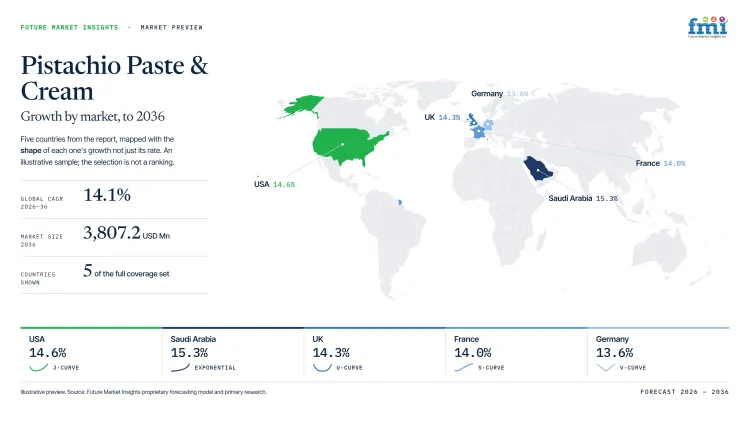
| Country | CAGR |
|---|---|
| UAE | 15.6% |
| Saudi Arabia | 15.3% |
| South Korea | 14.9% |
| USA | 14.6% |
| UK | 14.3% |
| France | 14.0% |
| Germany | 13.6% |
| Japan | 13.3% |
How do country-level CAGRs compare in the Pistachio Paste & Cream Market?
The eight profiled forecasts span 2.3 percentage points from the UAE to Japan. UAE and Saudi Arabia form the upper group. South Korea and the USA follow through different commercial routes. The UK and France occupy the middle, with Germany and Japan advancing more slowly.
- UAE: distributor stock supports fast menu turnover.
- Saudi Arabia: hotel expansion broadens professional trial points.
- South Korea: trend speed rewards local adaptation.
- USA: domestic processing shortens selected supply routes.
- UK: high-throughput chains prefer lower-preparation formats.
- France: premium pastry supports higher nut loading.
- Germany: specification stability outweighs novelty in industrial accounts.
- Japan: smaller trials favor disciplined distributor inventory.
Comparable CAGRs can therefore produce different entry costs and service requirements. The full report provides country-level CAGR analysis across North America, Latin America, Western Europe, Eastern Europe, East Asia, South Asia and Pacific, and Middle East and Africa.
Country-wise Analysis
- California processors operate beside the largest USA pistachio supply base, giving ingredient makers shorter raw-material routes while national bakery accounts still demand lot consistency and tree-nut segregation. USDA NASS listed 521,000 harvested pistachio acres in its 2025 California overview, and pistachio paste & cream demand in the USA is forecast to rise at 14.6% CAGR over the forecast period because domestic processing depth supports industrial sweet-bakery use. Local supply improves production planning, but crop-price exposure and shared-line allergen controls remain material frictions, so national accounts place more weight on technical response and consistent specifications than on orchard proximity alone.
- German bakery manufacturers work within a mature certification culture, where organic and allergen records can influence approval even though conventional pistachio creams retain the larger commercial base. Destatis stated in February 2026 that 11.1% of Germany's agricultural area was organically farmed in 2024, while the German pistachio paste & cream sector is projected to record 13.6% CAGR during the assessment period attributable to premium bakery demand and established ingredient distribution. Certified sourcing supports premium recipes, but higher nut loading narrows margins, so entrants need separate offers for mainstream production and documented premium lines instead of one undifferentiated range.
- French pastry programs judge pistachio ingredients on flavor clarity and finished appearance, giving premium pastry a natural route for higher-value fillings while industrial buyers still test bake stability at production scale. Agence Bio's April 2026 EU sector report said organic bakery and fresh pastry represented nearly 8% of the French organic market in 2024, and pistachio paste & cream sales in France are forecast to expand at 14.0% CAGR by 2036 aided by premium patisserie and industrial pastry demand. Dense professional distribution supports trial activity, but higher nut inclusion raises recipe cost, so broad rollout depends on proving sensory performance under repeatable plant conditions.
- UK bakery and foodservice operators use pistachio in doughnuts, pastries, cookies, and layered desserts, but commercial rollout is closely tied to allergen communication and shared-line cleaning. Food Standards Agency guidance updated on March 5, 2025 encourages written information for the 14 regulated allergens in out-of-home service, while pistachio paste & cream demand in the UK is predicted to advance at 14.3% CAGR through 2036 helped by specialty bakery demand and professional ingredient distribution. Clear ingredient files support qualification, yet cleaning labor and downtime remain frictions, so ready-to-use formats gain an advantage by reducing on-site formulation work before service at scale.
- Saudi bakery demand is closely linked to hotels, restaurant groups, and premium dessert operators that require imported fillings to perform consistently through multiple outlets and replenishment cycles. The General Authority for Statistics documented hotel room occupancy of about 63% in Q1 2025, up 2.1 percentage points year over year, while Saudi Arabia's outlook is anticipated to advance at 15.3% CAGR over the assessment period supported by hospitality expansion and distributor access. Halal documentation and shelf life aid qualification, but freight cost and inventory gaps can disrupt short-notice launches, making regional stock and application support important competitive conditions.
- Dubai's hotel and specialty-dessert channel can turn a visible flavor into menu demand quickly, raising the value of nearby inventory and application support for imported pistachio ingredients. On February 9, 2026, Dubai's Department of Economy and Tourism said the city welcomed 19.59 million international overnight visitors in 2025, while pistachio paste & cream demand in the UAE is forecast to rise at 15.6% CAGR over the forecast period propelled by premium hospitality. Concentrated foodservice demand supports rapid trials, but imported supply and fast menu rotation shorten product life, so distributors with technical chefs can respond faster than remote exporters carrying no local stock.
- Japanese pastry programs place unusual weight on restrained sweetness, color, and label accuracy, so imported pistachio systems often need sensory adjustment and localized records before wider rollout. The Consumer Affairs Agency said on January 23, 2025 that policymakers intended to add pistachio to the recommended allergen-labeling list during fiscal 2025, while Japan is estimated to post 13.3% CAGR over the forecast period tied to premium confectionery and specialty bakery use. Disciplined distribution supports controlled launches, but import cost and smaller trial volumes slow conversion, so application guidance must reduce reformulation work without forcing customers into oversized inventory commitments for national rollout.
- South Korean dessert operators respond quickly to imported visual concepts, but overseas pistachio spreads must clear importer and labeling requirements before commercial sale and fast café rollout. The MFDS import-food database records a Turkish pistachio kataifi spread with a certificate issued on December 8, 2025, while South Korea is expected to maintain 14.9% CAGR through 2036 because novelty-led bakery demand can scale through dense urban foodservice networks. Regulated import channels provide a clear route to market, but overseas supply and Korean-language compliance remain frictions, so local partners need disciplined stock planning to replenish fast sellers without carrying obsolete inventory.
Who are the notable companies in the Pistachio Paste & Cream Market?
Barry Callebaut, Puratos, Dawn Foods, Zeelandia, CSM Ingredients, Bakels, AGRANA, Zentis, Fabbri 1905, and Irca Group are notable companies active in this market.
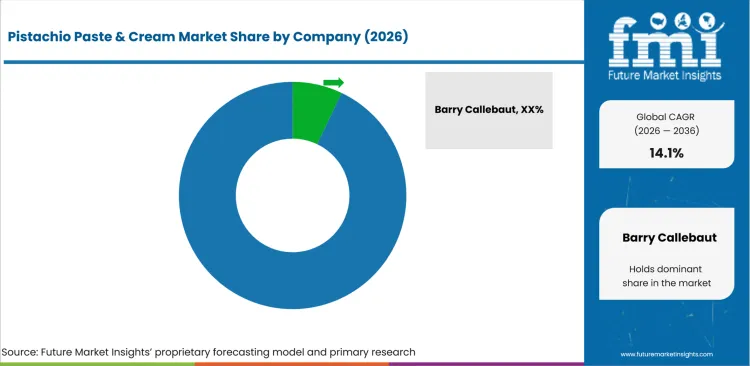
Dedicated nut processors compete on pistachio content and sensory control. Bakery ingredient groups compete on filling behavior, documentation, and application support. Entry still depends on a usable production specification.
- Barry Callebaut, Fabbri 1905, and Irca Group compete most directly through pistachio pastes, creams, and related nut systems.
- Puratos, Dawn Foods, Zeelandia, CSM Ingredients, and Bakels compete through bakery filling platforms and professional application support.
- AGRANA and Zentis participate through customized preparations and industrial bakery-filling capabilities.
Competitive Benchmarking: Pistachio Paste & Cream Market
Ratings reflect documented exact-market capability. High marks direct pistachio or closely matching filling evidence. Medium marks a credible adjacent platform. Low marks limited documented participation, not missing evidence.
| Company | Pistachio Portfolio | Bakery Process Versatility | Claim / Quality Evidence | Geographic Reach |
|---|---|---|---|---|
| Barry Callebaut | High | High | High | Global |
| Puratos | High | High | High | Global |
| Dawn Foods | High | High | Medium | North America, Europe and AMEAP |
| Zeelandia | Medium | High | Medium | Europe and international markets |
| CSM Ingredients | High | High | Medium | Europe and international markets |
| Bakels | Medium | High | Medium | Global bakery network |
| AGRANA | Medium | High | High | Global food-ingredient network |
| Zentis | Medium | High | Medium | Europe and North America |
| Fabbri 1905 | High | High | High | Europe and international professional channels |
| Irca Group | High | High | High | Global; more than 100 countries |
Key Developments in the Pistachio Paste & Cream Market
- In May 2026, CSM Ingredients launched Creami with pistachio and Crunchy Pistachio with kataifi. The range gives professional bakery customers bake-stable and ready-to-apply filling formats in major European markets.
- In January 2026, Irca Group introduced TasteLab Pistachio in North America around creams, pastes, inclusions, and decorations. The program gives manufacturers application support when comparing several pistachio formats.
- In January 2026, Puratos acquired Vör Foods, whose portfolio includes pistachio nut pastes and fillings. The acquisition added a dedicated SQF nut facility and shorter USA lead times.
Key Players in the Pistachio Paste & Cream Market
Dedicated nut and pistachio systems
- Barry Callebaut
- Fabbri 1905
- Irca Group
Bakery filling and application platforms
- Puratos
- Dawn Foods
- Zeelandia
- CSM Ingredients
- Bakels
Customized preparation and industrial formulation platforms
- AGRANA
- Zentis
Pistachio Paste & Cream Market - Report Scope
| Coverage field | Report scope |
|---|---|
| Market breakdown | By product type, form, application, claim, sales channel, and region. |
| Quantitative Units | USD million and CAGR in %. |
| Market Definition | Revenue from pistachio paste & cream and associated pistachio ingredient formats included within the stated segmentation. Downstream finished-product revenue and adjacent substitute ingredients are excluded. |
| Regions Covered | North America; Latin America; Western Europe; Eastern Europe; East Asia; South Asia and Pacific; Middle East and Africa |
| Countries Covered | USA; Germany; France; UK; Saudi Arabia; UAE; Japan; South Korea; more than twenty-five additional countries in the full report |
| Key Companies Profiled | Barry Callebaut; Puratos; Dawn Foods; Zeelandia; CSM Ingredients; Bakels; AGRANA; Zentis; Fabbri 1905; Irca Group |
| Forecast Period | 2026 to 2036 |
| Approach | Hybrid bottom-up and top-down sizing that reconciles supplier activity, segment structure, end-use demand, country operating conditions, and verified external indicators. |
Pistachio Paste & Cream Market - Research Methodology
| Method | Approach |
|---|---|
| Primary Research | FMI analysts gathered input from manufacturers, service providers, technology developers, distributors, end users, procurement teams, and subject-matter experts. Interviews examined purchasing decisions, product or service evaluation, adoption barriers, approval requirements, pricing considerations, and expectations for technical or commercial support. Respondents were also asked what evidence is required before a trial, pilot, or initial order develops into regular purchasing. |
| Desk Research | Desk research covered government statistics, regulatory publications, trade data, industry associations, technical literature, standards, company filings, product information, and official corporate announcements. Sources were reviewed for relevance, publication date, geographic coverage, and consistency with the defined market scope. Claims relating to performance, applications, approvals, capacity, investment, and commercial activity were retained only when supported by credible public evidence. |
| Market Sizing and Forecasting | The market model combined the baseline value with historical performance, segment structure, pricing and volume indicators, adoption levels, company participation, and country-level demand conditions. Forecast assumptions considered economic activity, investment trends, regulatory developments, technology adoption, purchasing cycles, supply availability, and barriers to wider market use. Segment and regional estimates were reconciled before the final market total was calculated. |
| Data Validation | Estimates were checked against multiple independent indicators, including public data, company activity, trade patterns, industry developments, and findings from primary interviews. Validation also tested whether products, services, applications, and company revenues fell within the defined market boundaries. Adjacent categories, unsupported claims, overlapping revenues, and activities without direct market relevance were excluded to reduce double counting and maintain consistency across segments and countries. |
Pistachio Paste & Cream Market by Segments
Pistachio Paste & Cream Market segmented by Product Type:
- Standard grade
- Premium - specialty grade
- Organic grade
- Clean label formulations
Pistachio Paste & Cream Market segmented by Form:
- Liquid
- Semi-solid - paste
- Powder - dry
- Granules - pieces
Pistachio Paste & Cream Market segmented by Application:
- Bread & rolls
- Cakes & muffins
- Biscuits & cookies
- Viennoiserie & pastry
- Other bakery and snack uses
Pistachio Paste & Cream Market segmented by Claim:
- Conventional
- Clean label
- Organic
- Non-GMO - identity preserved
Pistachio Paste & Cream Market segmented by Sales Channel:
- Direct to industrial bakeries
- Distributors & ingredient blenders
- Foodservice & artisan supply
- Online B2B
Pistachio Paste & Cream Market by Region:
- North America
- United States
- Canada
- Latin America
- Brazil
- Mexico
- Argentina
- Chile
- Western Europe
- Germany
- France
- United Kingdom
- Italy
- Spain
- Benelux
- Nordics
- Eastern Europe
- Poland
- Czech Republic
- Romania
- Hungary
- East Asia
- China
- Japan
- South Korea
- South Asia and Pacific
- India
- ASEAN
- Australia and New Zealand
- Middle East and Africa
- GCC Countries
- South Africa
- Türkiye
- Israel
Research Sources and Bibliography
- USA Department of Agriculture, National Agricultural Statistics Service. (2026, September 2). 2025 State Agriculture Overview: California
- USA Food and Drug Administration. (2025, January). Guidance for Industry: Questions and Answers Regarding Food Allergen Labeling (Edition 5)
- Puratos. (2025, February 4). Nieuw product: Carat Supercrem Pistachio
- Irca Group. (2025, April 23). Vegan Pastry
- Dawn Foods. (2026, June 2). Dawn Foods Expands Delicream Range With Three New Flavours
- Organic Trade Association. (2026, March 4). USA Organic Marketplace Achieved Significant Growth in 2025
- Fabbri 1905. (2026, January 16). Fabbri 1905 entra nel mondo dello street food e ridefinisce il fuoricasa Made in Italy
- Consumer Affairs Agency, Government of Japan. (2025, January 23). Arai Consumer Affairs Agency Commissioner Press Conference Summary
- Halal Italia. (2026, January 15). Certification of Halal Product - Certificate No. 1017
- German Federal Statistical Office. (2026, February 17). Organic Farming in the EU 2024
- Agence Bio. (2026, April). Organic Sector in the European Union
- Food Standards Agency. (2025, March 5). Updated industry guidance issued for food allergen information in the out-of-home sector
- General Authority for Statistics, Saudi Arabia. (2025, July 3). GASTAT publishes Tourism Establishments Statistics for Q1 2025
- Dubai Department of Economy and Tourism. (2026, February 9). Dubai welcomes 19.59 million visitors in third record year
- Ministry of Food and Drug Safety, Republic of Korea. (2025, December 8). Imported food record: Pistachio Kataifi Spread
- CSM Ingredients. (2026, May 12). CSM Ingredients launches Creami, a comprehensive range of indulgent fillings for bakery, pastry and confectionery professionals
- Irca Group. (2026, January 26). Welcome to TasteLab Pistachio
- Puratos. (2026, January 21). Puratos acquires Vör Foods, accelerating USA nut-based innovation
- Puratos. (2026, January 23). Puratos Strengthens Its Presence in Italy with the Creation of Puratos Cascarano
- Irca Group. (2026, June 29). CVC Capital Partners agrees to acquire Irca from Advent
- Irca Group. (2025, April 11). What’s Behind Dubai Bliss
- Puratos. (2025, September 12). Puratos and Guelph Announced Strategic Joint Venture to Ignite a New Chapter for Asia Pacific Bakery Industry
- Nexture / CSM Ingredients. (2025, November 10). Nexture announces the acquisition of Frulact
- Puratos. (2026, March 10). Puratos to Acquire Dawn Foods, Bringing Together Complementary Capabilities in Professional Bakery
- CSM Ingredients. (2025, November 18). CSM Ingredients - a Nexture company - opens new GBP3m state-of-the-art customer focused product development centre in the UK
This bibliography is provided for reader reference and is not exhaustive. The full report contains the complete reference list and detailed citations
This Report Answers
- Which companies compete in this category?
- How do country CAGRs compare?
- How do allergen controls affect approval?
- Why do bread & rolls lead?
- Why does powder - dry lead?
- Why does standard grade lead?
- What secures repeat bakery orders?
- How large is the market?
Frequently Asked Questions
How big is the pistachio paste & cream market in 2026?
The pistachio paste & cream market is valued at USD 1,018.0 million in 2026 and is projected to reach USD 3,807.2 million by 2036. Growth depends on process-ready ingredients that industrial bakeries can qualify for repeat production.
What is the CAGR of the pistachio paste & cream market from 2026 to 2036?
The pistachio paste & cream market is projected to grow at a CAGR of 14.1% between 2026 and 2036. Expansion follows wider bakery use of ready-to-apply pistachio creams, pastes, and dry systems.
Which product type leads the pistachio paste & cream market?
The standard grade segment is expected to hold 36.0% of the pistachio paste & cream market in 2026, driven by controlled recipe cost and repeatable processing. Premium grades remain important where higher nut content supports premium pricing.
Which form leads the pistachio paste & cream market?
The powder - dry segment is expected to hold 47.0% of the pistachio paste & cream market in 2026, supported by easier storage and controlled metering. Liquid and paste formats retain an advantage for direct filling.
Which companies are active in the pistachio paste & cream market?
Key companies operating in the pistachio paste & cream market include Barry Callebaut, Puratos, Dawn Foods, Zeelandia, CSM Ingredients, Bakels, AGRANA, Zentis, Fabbri 1905, and Irca Group. They compete through nut systems, bakery fillings, and application support.
Preview the report firsthand - request a free sample
Get SampleGet the brochure for pricing and purchase details.
Get PDFTable of Content
- Key Takeaways
- Market Size and CAGR
- Top Growth Driver
- Fastest Growing Segment
- Leading Region
- Key Companies
- Emerging Opportunities
- Executive Summary
- Global Market Outlook
- Demand-side Trends
- Supply-side Trends
- Technology Roadmap Analysis
- Analysis and Recommendations
- Analyst Perspective (What is happening? Why now? What should investors know?)
- Key Questions Answered
- How large is the market?
- What is the CAGR?
- What are key trends?
- Which region dominates?
- Who are the leaders?
- Market Overview
- Market Coverage / Taxonomy
- Market Definition / Scope / Limitations
- Research Methodology
- Chapter Orientation
- Analytical Lens and Working Hypotheses
- Market Structure, Signals, and Trend Drivers
- Benchmarking and Cross-market Comparability
- Market Sizing, Forecasting, and Opportunity Mapping
- Research Design and Evidence Framework
- Desk Research Programme (Secondary Evidence)
- Expert Input and Fieldwork (Primary Evidence)
- Tooling, Models, and Reference Databases
- Data Engineering and Model Build
- Quality Assurance and Audit Trail
- Market Background
- Market Dynamics (Drivers, Restraints, Opportunity, Trends)
- Scenario Forecast (Optimistic, Likely, Conservative)
- Impact Analysis
- AI Impact
- Sustainability Impact
- Regulatory Impact
- Technology Impact
- Consumer / Buyer Analysis
- Purchase Drivers
- Adoption Barriers
- Buyer Journey
- Opportunity Map Analysis
- Product Life Cycle Analysis
- Supply Chain Analysis
- Investment Feasibility Matrix
- Value Chain Analysis
- PESTLE and Porter's Analysis
- Regulatory Landscape
- Regional Parent Market Outlook
- Production and Consumption Statistics
- Import and Export Statistics
- Global Market Analysis and Forecast, 2021 to 2036
- Historical Market Size Value (USD Million) Analysis, 2021 to 2025
- Current and Future Market Size Value (USD Million) Projections, 2026 to 2036
- Y-o-Y Growth Trend Analysis
- Absolute $ Opportunity Analysis
- Global Market Pricing Analysis, 2021 to 2036
- Global Market Analysis and Forecast, By Product Type, 2021 to 2036
- Introduction / Key Findings
- Historical Market Size Value (USD Million) Analysis By Product Type, 2021 to 2025
- Current and Future Market Size Value (USD Million) Analysis and Forecast By Product Type, 2026 to 2036
- Standard grade
- Premium / specialty grade
- Organic certified
- Clean label grade
- Standard grade
- Y-o-Y Growth Trend Analysis By Product Type, 2021 to 2025
- Absolute $ Opportunity Analysis By Product Type, 2026 to 2036
- Global Market Analysis and Forecast, By Form, 2021 to 2036
- Introduction / Key Findings
- Historical Market Size Value (USD Million) Analysis By Form, 2021 to 2025
- Current and Future Market Size Value (USD Million) Analysis and Forecast By Form, 2026 to 2036
- Powder / dry
- Liquid
- Paste / semi-solid
- Granules / pieces
- Powder / dry
- Y-o-Y Growth Trend Analysis By Form, 2021 to 2025
- Absolute $ Opportunity Analysis By Form, 2026 to 2036
- Global Market Analysis and Forecast, By Application, 2021 to 2036
- Introduction / Key Findings
- Historical Market Size Value (USD Million) Analysis By Application, 2021 to 2025
- Current and Future Market Size Value (USD Million) Analysis and Forecast By Application, 2026 to 2036
- Bread & rolls
- Cakes & muffins
- Biscuits & cookies
- Viennoiserie & pastry
- Other bakery & snacks
- Bread & rolls
- Y-o-Y Growth Trend Analysis By Application, 2021 to 2025
- Absolute $ Opportunity Analysis By Application, 2026 to 2036
- Global Market Analysis and Forecast, By Claim, 2021 to 2036
- Introduction / Key Findings
- Historical Market Size Value (USD Million) Analysis By Claim, 2021 to 2025
- Current and Future Market Size Value (USD Million) Analysis and Forecast By Claim, 2026 to 2036
- Conventional
- Clean label
- Organic
- Non-GMO / identity preserved
- Conventional
- Y-o-Y Growth Trend Analysis By Claim, 2021 to 2025
- Absolute $ Opportunity Analysis By Claim, 2026 to 2036
- Global Market Analysis and Forecast, By Sales Channel, 2021 to 2036
- Introduction / Key Findings
- Historical Market Size Value (USD Million) Analysis By Sales Channel, 2021 to 2025
- Current and Future Market Size Value (USD Million) Analysis and Forecast By Sales Channel, 2026 to 2036
- Direct to industrial bakeries
- Ingredient distributors
- Foodservice & artisan supply
- Online B2B
- Direct to industrial bakeries
- Y-o-Y Growth Trend Analysis By Sales Channel, 2021 to 2025
- Absolute $ Opportunity Analysis By Sales Channel, 2026 to 2036
- Global Market Analysis and Forecast, By Region, 2021 to 2036
- Introduction
- Historical Market Size Value (USD Million) Analysis By Region, 2021 to 2025
- Current Market Size Value (USD Million) Analysis and Forecast By Region, 2026 to 2036
- North America
- Latin America
- Western Europe
- Eastern Europe
- East Asia
- South Asia and Pacific
- Middle East & Africa
- Market Attractiveness Analysis By Region
- North America Market Analysis and Forecast, By Country, 2021 to 2036
- Historical Market Size Value (USD Million) Trend Analysis By Market Taxonomy, 2021 to 2025
- Market Size Value (USD Million) Forecast By Market Taxonomy, 2026 to 2036
- By Country
- USA
- Canada
- By Product Type
- By Form
- By Application
- By Claim
- By Sales Channel
- By Country
- Market Attractiveness Analysis
- By Country
- By Product Type
- By Form
- By Application
- By Claim
- By Sales Channel
- Key Takeaways
- Latin America Market Analysis and Forecast, By Country
- Historical Market Size Value (USD Million) Trend Analysis By Market Taxonomy, 2021 to 2025
- Market Size Value (USD Million) Forecast By Market Taxonomy, 2026 to 2036
- By Country
- Brazil
- Mexico
- Chile
- Rest of Latin America
- By Product Type
- By Form
- By Application
- By Claim
- By Sales Channel
- By Country
- Market Attractiveness Analysis
- By Country
- By Product Type
- By Form
- By Application
- By Claim
- By Sales Channel
- Key Takeaways
- Western Europe Market Analysis and Forecast, By Country
- Historical Market Size Value (USD Million) Trend Analysis By Market Taxonomy, 2021 to 2025
- Market Size Value (USD Million) Forecast By Market Taxonomy, 2026 to 2036
- By Country
- Germany
- UK
- Italy
- Spain
- France
- Nordic
- BENELUX
- Rest of Western Europe
- By Product Type
- By Form
- By Application
- By Claim
- By Sales Channel
- By Country
- Market Attractiveness Analysis
- By Country
- By Product Type
- By Form
- By Application
- By Claim
- By Sales Channel
- Key Takeaways
- Eastern Europe Market Analysis and Forecast, By Country
- Historical Market Size Value (USD Million) Trend Analysis By Market Taxonomy, 2021 to 2025
- Market Size Value (USD Million) Forecast By Market Taxonomy, 2026 to 2036
- By Country
- Russia
- Poland
- Hungary
- Balkan & Baltic
- Rest of Eastern Europe
- By Product Type
- By Form
- By Application
- By Claim
- By Sales Channel
- By Country
- Market Attractiveness Analysis
- By Country
- By Product Type
- By Form
- By Application
- By Claim
- By Sales Channel
- Key Takeaways
- East Asia Market Analysis and Forecast, By Country
- Historical Market Size Value (USD Million) Trend Analysis By Market Taxonomy, 2021 to 2025
- Market Size Value (USD Million) Forecast By Market Taxonomy, 2026 to 2036
- By Country
- China
- Japan
- South Korea
- By Product Type
- By Form
- By Application
- By Claim
- By Sales Channel
- By Country
- Market Attractiveness Analysis
- By Country
- By Product Type
- By Form
- By Application
- By Claim
- By Sales Channel
- Key Takeaways
- South Asia and Pacific Market Analysis and Forecast, By Country
- Historical Market Size Value (USD Million) Trend Analysis By Market Taxonomy, 2021 to 2025
- Market Size Value (USD Million) Forecast By Market Taxonomy, 2026 to 2036
- By Country
- India
- ASEAN
- Australia & New Zealand
- Rest of South Asia and Pacific
- By Product Type
- By Form
- By Application
- By Claim
- By Sales Channel
- By Country
- Market Attractiveness Analysis
- By Country
- By Product Type
- By Form
- By Application
- By Claim
- By Sales Channel
- Key Takeaways
- Middle East & Africa Market Analysis and Forecast, By Country
- Historical Market Size Value (USD Million) Trend Analysis By Market Taxonomy, 2021 to 2025
- Market Size Value (USD Million) Forecast By Market Taxonomy, 2026 to 2036
- By Country
- Kingdom of Saudi Arabia
- Other GCC Countries
- Türkiye
- South Africa
- Other African Union
- Rest of Middle East & Africa
- By Product Type
- By Form
- By Application
- By Claim
- By Sales Channel
- By Country
- Market Attractiveness Analysis
- By Country
- By Product Type
- By Form
- By Application
- By Claim
- By Sales Channel
- Key Takeaways
- Key Countries Market Analysis
- USA
- Pricing Analysis
- Market Share Analysis, 2025
- By Product Type
- By Form
- By Application
- By Claim
- By Sales Channel
- Canada
- Pricing Analysis
- Market Share Analysis, 2025
- By Product Type
- By Form
- By Application
- By Claim
- By Sales Channel
- Mexico
- Pricing Analysis
- Market Share Analysis, 2025
- By Product Type
- By Form
- By Application
- By Claim
- By Sales Channel
- Brazil
- Pricing Analysis
- Market Share Analysis, 2025
- By Product Type
- By Form
- By Application
- By Claim
- By Sales Channel
- Chile
- Pricing Analysis
- Market Share Analysis, 2025
- By Product Type
- By Form
- By Application
- By Claim
- By Sales Channel
- Germany
- Pricing Analysis
- Market Share Analysis, 2025
- By Product Type
- By Form
- By Application
- By Claim
- By Sales Channel
- UK
- Pricing Analysis
- Market Share Analysis, 2025
- By Product Type
- By Form
- By Application
- By Claim
- By Sales Channel
- Italy
- Pricing Analysis
- Market Share Analysis, 2025
- By Product Type
- By Form
- By Application
- By Claim
- By Sales Channel
- Spain
- Pricing Analysis
- Market Share Analysis, 2025
- By Product Type
- By Form
- By Application
- By Claim
- By Sales Channel
- France
- Pricing Analysis
- Market Share Analysis, 2025
- By Product Type
- By Form
- By Application
- By Claim
- By Sales Channel
- India
- Pricing Analysis
- Market Share Analysis, 2025
- By Product Type
- By Form
- By Application
- By Claim
- By Sales Channel
- ASEAN
- Pricing Analysis
- Market Share Analysis, 2025
- By Product Type
- By Form
- By Application
- By Claim
- By Sales Channel
- Australia & New Zealand
- Pricing Analysis
- Market Share Analysis, 2025
- By Product Type
- By Form
- By Application
- By Claim
- By Sales Channel
- China
- Pricing Analysis
- Market Share Analysis, 2025
- By Product Type
- By Form
- By Application
- By Claim
- By Sales Channel
- Japan
- Pricing Analysis
- Market Share Analysis, 2025
- By Product Type
- By Form
- By Application
- By Claim
- By Sales Channel
- South Korea
- Pricing Analysis
- Market Share Analysis, 2025
- By Product Type
- By Form
- By Application
- By Claim
- By Sales Channel
- Russia
- Pricing Analysis
- Market Share Analysis, 2025
- By Product Type
- By Form
- By Application
- By Claim
- By Sales Channel
- Poland
- Pricing Analysis
- Market Share Analysis, 2025
- By Product Type
- By Form
- By Application
- By Claim
- By Sales Channel
- Hungary
- Pricing Analysis
- Market Share Analysis, 2025
- By Product Type
- By Form
- By Application
- By Claim
- By Sales Channel
- Kingdom of Saudi Arabia
- Pricing Analysis
- Market Share Analysis, 2025
- By Product Type
- By Form
- By Application
- By Claim
- By Sales Channel
- Türkiye
- Pricing Analysis
- Market Share Analysis, 2025
- By Product Type
- By Form
- By Application
- By Claim
- By Sales Channel
- South Africa
- Pricing Analysis
- Market Share Analysis, 2025
- By Product Type
- By Form
- By Application
- By Claim
- By Sales Channel
- USA
- Market Structure Analysis
- Competition Dashboard
- Competition Benchmarking
- Market Share Analysis of Top Players
- By Regional
- By Product Type
- By Form
- By Application
- By Claim
- By Sales Channel
- Emerging Startups
- Innovation Benchmarking
- Competition Analysis
- Competition Deep Dive
- Barry Callebaut
- Overview
- Product Portfolio
- Profitability by Market Segments
- Sales Footprint
- Strategy Overview
- Marketing Strategy
- Product Strategy
- Channel Strategy
- Puratos
- Dawn Foods
- Zeelandia
- CSM Ingredients
- Bakels
- AGRANA
- Zentis
- Fabbri 1905
- Irca Group
- Barry Callebaut
- Case Studies
- Success Stories
- Recent Developments
- Competition Deep Dive
- Assumptions & Acronyms Used


