

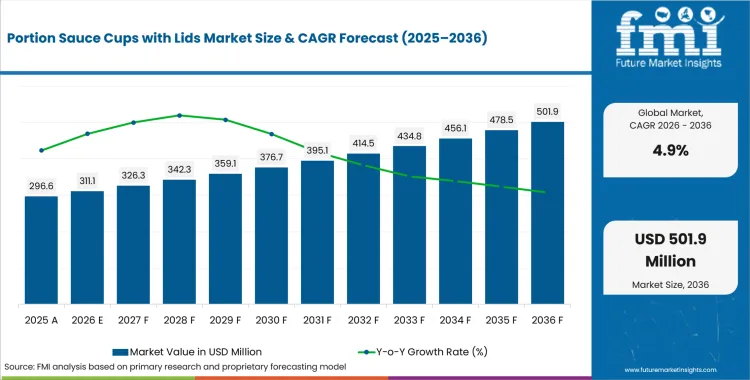
- Market Size (2026)
- USD 311.1 Mn
- Forecast (2036)
- USD 501.9 Mn
- CAGR (2026 to 2036)
- 4.9%
How big is Portion Sauce Cups with Lids Market in 2026?
USD 311.1 million in 2026 and USD 501.9 million by 2036 at a 4.9% CAGR.
Demand for portion sauce cups with lids is projected to expand at 4.9% CAGR between 2026 and 2036. Off-premises traffic keeps sealed condiment portions in repeated use. In April 2025 the National Restaurant Association reported that nearly 75% of USA restaurant traffic occurred off-premises. Loose lids or inconsistent fills become costly at that transaction volume.
Material rules alter the usable cup-and-lid specification by jurisdiction. CalRecycle confirmed in its May 2025 legislative report that EPS foodservice ware had not met the required 25% recycling rate. California therefore restricts sales of EPS takeout containers and cups. Resin choice affects legal access alongside sealing and temperature performance.
Key Takeaways
- Off-premises traffic keeps sealed sauce portions in routine use after the meal leaves the restaurant counter.
- By product type, PP portion cups are estimated to hold 36.0% in 2026 owing to heat tolerance and familiar matched-closure production.
- Paperboard is set to lead the material category with 28.0% share in 2026 due to printable rigid walls and lower polymer content.
- In 2026, standard meal formats are expected to lead the format size category with 43.0% share because compact portions fit individual prepared-meal orders.
- Material substitution can raise cost or leakage risk if a lower-plastic cup does not retain barrier performance and secure lid engagement.
- Some of the key players in this market include Genpak, Dart Container, Sabert, Novolex, Huhtamaki, Duni, Berry Global, Pactiv Evergreen, Graphic Packaging, and Detmold Group.
Analyst Perspective
"Chain operators pay for the cup and lid as one operating system. A cheaper cup loses its advantage if crews fight nested stacks or lids leak in transit. Material conversion should start with sauce barrier and closure force before recovery claims enter the specification."
- Nandini Roy Choudhury, Principal Consultant, Future Market Insights
How is the portion sauce cups with lids market segmented?
The portion sauce cups with lids market is segmented by product type, material, format size, end use and sales channel.
Product type includes PP portion cups, paper portion cups, compostable cups and dual-dip formats. Material covers paperboard, molded fiber & bagasse, rPET & PP, compostable polymers and aluminium. Format size covers standard meal, single-serve and family & catering. End use includes QSR chains, delivery platforms, coffee & beverage, institutional catering and retail deli. Sales channels include broadline foodservice distributors, direct chain contracts, packaging distributors and online sales.
Why do PP portion cups lead the product type category?
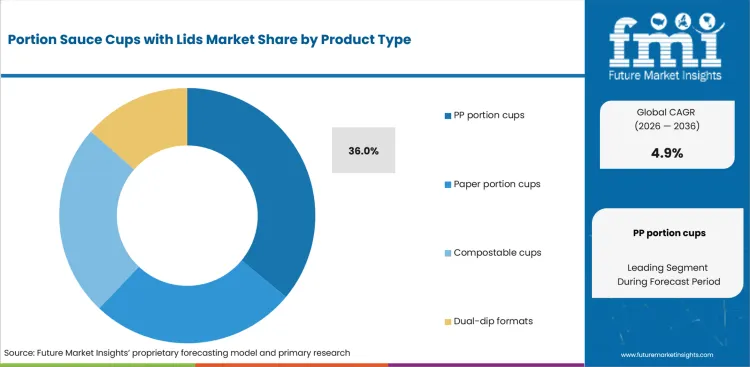
PP fits high-volume filling and closure lines. Plastic portion cups nest tightly and support matched closures for hot or cold sauces. Berry Global received APR Design for Recyclability recognition for Versalite polypropylene cups in April 2025.
- Based on product type, PP portion cups are projected to account for 36.0% in 2026 due to fast sauce handling and familiar matched-lid production.
- Operators test denesting and closure force because extra handling can erase a low unit-price advantage during peak service. Store crews also need predictable cup release from nested stacks.
What makes paperboard central to the material category?
Paperboard cuts visible plastic without giving up a rigid printable wall. Paper cups still need barriers and rims that resist sauce contact. Huhtamaki launched ProDairy cups in February 2025 with less than 10% plastic and a rim designed for reliable sealing.
- By material, paperboard is estimated to hold 28.0% in 2026 owing to printable rigid structures with lower polymer content.
- Sauce service requires coating and lid trials because oil or acidity can expose weak barriers quickly. The rim must also hold closure pressure without softening during storage.
How does standard meal hold the format size lead?
Standard meal cups pair one sauce or dressing portion with one prepared order. The size limits bag space without becoming too small for dips. Takeaway containers face the same transport test. In May 2025 the National Restaurant Association found 90% of off-premises customers would order more variety if packaging protected food quality.
- In 2026, standard meal formats are expected to lead the format size category with 43.0% share because compact portions fit individual prepared-meal orders.
- One approved size can serve several menu items and reduce case complexity, which is the primary driver behind segment’s demand.
What supports QSR chains in the end use category?
QSR chains turn cup size and lid fit into a store-level specification. Foodservice disposables must work under short ticket times. In April 2025 the National Restaurant Association reported that 65% of limited-service operators offered delivery. Portable packaging therefore has to hold through a service channel used by most limited-service operators.
- QSR chains are set to lead the end use category with 28.0% share in 2026 due to standardized menus and repeated condiment use.
- One chain approval can apply the same portion and closure rule to many stores.
Why do broadline foodservice distributors lead the sales channel category?
Broadline distributors place cups beside food and operating supplies on one replenishment schedule. Disposable cups benefit from local inventory during stock shortages. IFDA reported in September 2025 that restaurant operators used 3.1 distributors on average versus 2.8 before the pandemic.
- Broadline foodservice distributors are projected to hold 33.0% share in 2026 owing to consolidated case purchasing and local replenishment.
- Local availability can outweigh a small unit-price difference during urgent replenishment. Restaurants also need the distributor to stock the matching lid rather than a cup alone.
What are the drivers, restraints and opportunities in the Portion Sauce Cups with Lids Market?
Off-premises ordering sustains unit demand. Packaging rules raise specification costs and lower-plastic cup-and-lid systems offer the clearest conversion opening.
- Driver: Takeout and delivery consume a cup-and-lid set each time sauce travels separately from a prepared meal.
- Restraint: Jurisdiction-specific material rules force manufacturers and restaurant groups to maintain more than one approved packaging specification.
- Opportunity: Paperboard, fiber and compostable systems can replace plastic formats after closure performance and local recovery routes are verified.
Off-Premises Ordering Keeps Portion Demand Repetitive
Each sauce packed separately consumes another cup-and-lid set. The National Restaurant Association found in April 2025 that 47% of adults picked up takeout at least weekly. Compostable foodservice packaging must survive the same filling and transport routine before it can replace incumbent formats.
Material Rules Raise the Cost of Maintaining One Specification
Packaging law can split one foodservice specification into several legal variants. EU Regulation 2025/40 restricts individual plastic portions for sauces and condiments in certain HORECA uses from January 2030. Takeaway ready-prepared food is exempt from that restriction. Molded fiber pulp packaging therefore needs application-level mapping before a restaurant group approves a replacement.
Lower-Plastic Systems Offer a Reachable Replacement Route
Alternative cups need sauce-contact and lid-retention tests before a restaurant group changes material. Sabert disclosed in April 2026 that it launched 481 products during 2025. Biodegradable food packaging has a clearer sales case in locations that can support the disposal claim printed on the pack.
Which country CAGRs are profiled in the Portion Sauce Cups with Lids Market?
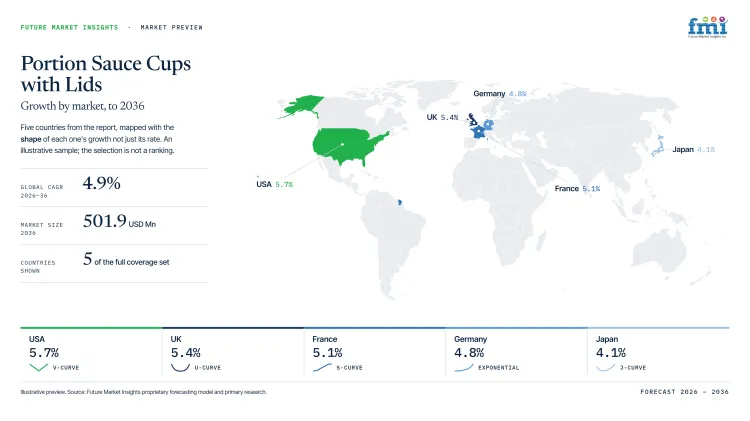
| Country | CAGR |
|---|---|
| Saudi Arabia | 6.6% |
| UAE | 6.3% |
| South Korea | 6.0% |
| USA | 5.7% |
| UK | 5.4% |
| France | 5.1% |
| Germany | 4.8% |
| Japan | 4.1% |
How do country-level CAGRs compare in the Portion Sauce Cups with Lids Market?
The 2.5-point spread divides the profile into three growth bands instead of one regional pattern. Saudi Arabia and UAE sit above 6% as hospitality and food-delivery channels replace packaging quickly. South Korea and USA form the middle band near 6%. The four slower markets have mature service systems or more complex material rules, which lengthen qualification without removing repeat sauce-cup use.
- Saudi Arabia’s strong hospitality activity helps sustain demand for room-service and foodservice packaging formats.
- The UAE’s recycled-material exemptions are reshaping material-selection and substitution decisions across the packaging value chain.
- South Korea’s rapid-delivery ecosystem is shortening replenishment cycles and increasing distributor responsiveness requirements.
- The USA’s multi-state restaurant and retail chains favor packaging solutions with flexible material specifications.
- The UK’s weight-based fee structures encourage the adoption of lighter, compliance-ready packaging formats.
- France’s reuse-focused dining regulations create distinct approval pathways for dine-in and takeaway applications.
- Germany’s levy and reporting requirements heighten the importance of accurate packaging-volume management.
- Japan’s established foodservice practices tend to slow the replacement of familiar packaging formats with new alternatives.
The rate order reflects replacement friction as much as foodservice activity. The full report provides country-level CAGR analysis across North America, Latin America, Western Europe, Eastern Europe, East Asia, South Asia and Pacific, and the Middle East and Africa.
Country-wise Analysis
- Saudi foodservice packaging demand follows a hospitality base that is adding licensed restaurants and lodging sites. The Saudi Arabia portion sauce cups with lids sector is projected to record 6.6% CAGR during the assessment period, attributable to a larger hospitality account base. GASTAT reported in January 2026 that licensed tourism hospitality facilities reached 5,622 in Q3 2025 and rose 40.6% year over year. More outlets increase the number of kitchens that need stocked condiment formats. Food-contact documentation and secure seals under hot delivery conditions remain the main entry tests. Manufacturers with local case inventory can serve multi-site operators without forcing each location to manage a separate cup-and-lid system.
- Delivery and takeaway dominate many UAE restaurant orders, so cup performance is tested in transit. PLA cups require product-by-product review before they replace plastic formats. Portion sauce cup demand in UAE is forecast to rise at 6.3% CAGR over the forecast period, driven by frequent takeaway use and material screening. Emirates News Agency confirmed in December 2025 that the second federal restriction phase would start on January 1 2026 and cover beverage cups and lids plus Styrofoam food containers. The rule does not automatically capture every sauce cup used by foodservice operators. Concentrated distributor networks make local stock access easier during urgent replenishment periods. Manufacturers still need clear scope mapping and reliable lid retention for hot delivery orders.
- South Korean delivery platforms keep small food containers in frequent circulation through dense urban restaurant networks. Portion sauce cup demand in South Korea is forecast to rise at 6.0% CAGR over the forecast period, supported by high delivery use and plastic-reduction policy. The Ministry of Climate Energy and Environment published a December 2025 draft target to cut virgin-resource-based waste plastic 30% from the 2030 business-as-usual level. The target raises pressure to reduce material use without weakening closure performance. Thin-wall formats lose their advantage if lids loosen during courier handling. Manufacturers that document lower material use and maintain familiar merchant handling have a clearer route into platform-linked restaurant accounts.
- For multi-state restaurant chains in the USA, sauce cups are repeat stock carried through broad distribution. State packaging rules can change acceptable materials from one jurisdiction to another. The USA portion sauce cups with lids outlook is anticipated to advance at 5.7% CAGR over the assessment period, owing to large off-premises volumes and national distribution. National Restaurant Association data released in September 2025 put limited-service food and nonalcohol beverage costs at a median 32.4% of sales in 2024. Fixed portions protect food-cost discipline across high-volume restaurant operations and standardized menus. Large chains favor cup families that preserve filling motion and lid feel as material specifications change. Crew retraining can erase a unit-price saving during repeated service.
- Producer-responsibility fees now enter UK packaging decisions alongside foodservice performance. The UK portion sauce cups with lids sector is projected to record 5.4% CAGR during the assessment period, given established takeaway demand and wide distribution. Defra published EPR packaging base-fee guidance in June 2025 and confirmed coverage of UK organisations that import or supply packaging. Material choice therefore affects compliance cost as well as cup performance. National differences in single-use rules complicate maintaining one UK-wide packaging specification consistently. Distributors with clear material classification can shorten the changeover for restaurant groups. A replacement still has to denest quickly and seal under peak service. Poor line handling can erase savings from a lower-fee material during repeated takeaway orders.
- French takeaway packaging is evaluated separately from the reusable serviceware used for many dine-in meals. Paper cup converters therefore have room to refine coatings and closure rims without treating every restaurant use alike. Adoption of portion sauce cups with lids in France is projected to expand at 5.1% CAGR through 2036, supported by takeaway occasions and a longer conversion window. France's ecological transition ministry said in December 2025 that the complete plastic-content ban for single-use cups moved from January 2026 to January 2030. The extension reduces immediate replacement pressure but does not remove sauce-barrier testing. Companies entering France need precise polymer-content documentation and formats designed for takeaway service instead of broad claims for every foodservice setting.
- German foodservice packaging carries a reporting obligation alongside its physical performance requirements. Germany is anticipated to post 4.8% CAGR over the forecast period, attributable to steady takeaway use and compliance-led replacement. The Umweltbundesamt stated in May 2025 that quantity reports above 100 kilograms could be filed through DIVID without external examiner confirmation for that year. The relief did not remove existing Single-Use Plastic Fund duties for obligated businesses. Local distributors can simplify material changes by stocking clearly classified alternatives. Paper or fiber cups still need proof against sauce contact and closure pressure. Manufacturers that treat reporting and line testing as separate approval tasks can avoid confusing administrative relief with product qualification.
- Municipal collection rules give Japanese restaurant groups different recovery options for plastic and paper packaging. Disposable lids therefore need disposal instructions that fit local collection practice. Portion sauce cup sales in Japan are forecast to expand at 4.1% CAGR by 2036, driven by gradual material change and uneven recovery coverage. Japan's Ministry of the Environment reported in March 2026 that 82.4% of municipalities planned separate collection of plastic packaging in fiscal 2026. Only 51.9% planned the same transition for paper packaging during the survey period. The gap weakens simple material-switch claims that ignore operating and recovery conditions. Restaurant groups also protect established handling routines that perform reliably during peak service. Manufacturers need closure performance and recovery guidance to align before a new format can replace an incumbent cup.
Who are the notable companies in the Portion Sauce Cups with Lids Market?
Genpak, Dart Container, Sabert, Novolex, Huhtamaki, Duni, Berry Global, Pactiv Evergreen, Graphic Packaging, and Detmold Group are the notable companies profiled in this market.
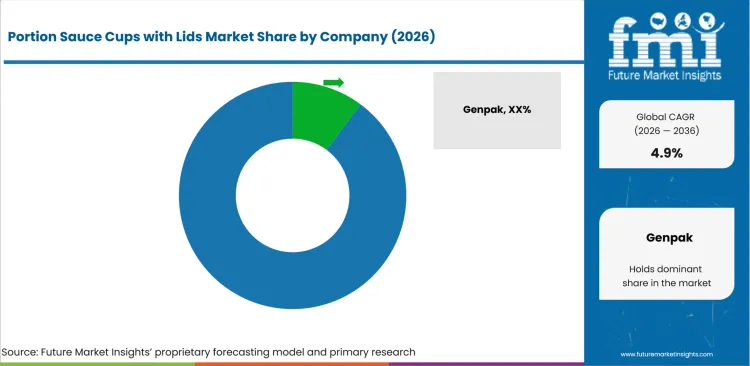
Direct portion-cup producers compete beside larger foodservice packaging groups. Genpak and Dart Container have direct small-cup exposure along with Sabert and Pactiv Evergreen. Novolex, Huhtamaki and Duni bring broader foodservice reach. Berry Global represents legacy rigid-cup operations now owned by Amcor. Graphic Packaging and Detmold Group are stronger in paperboard or fiber conversion.
- Portion-cup and closure specialists include Genpak, Dart Container, Sabert and Pactiv Evergreen.
- Multi-material foodservice platforms include Novolex, Huhtamaki and Duni.
- Conversion and alternative-material platforms include Berry Global, Graphic Packaging and Detmold Group.
Competitive Benchmarking: Portion Sauce Cups with Lids Market
| Company | Small-Format Cup-and-Lid Depth | Alternative-Material Readiness | Foodservice Channel Breadth | Geographic Reach |
|---|---|---|---|---|
| Genpak | Medium | High | Medium | North America |
| Dart Container | High | High | High | North America and selected international markets |
| Sabert | High | High | High | North America, Europe and Asia |
| Novolex | High | High | High | North America and Europe |
| Huhtamaki | Medium | High | High | Global |
| Duni | Medium | High | High | Europe and Asia-Pacific with wider market coverage |
| Berry Global | Medium | Medium | High | Global |
| Pactiv Evergreen | High | Medium | High | USA, Canada and Mexico |
| Graphic Packaging | Medium | High | High | North America and international markets |
| Detmold Group | High | High | Medium | Australia, New Zealand and Asia-Pacific |
Scoring basis: High small-format depth requires several documented cup-and-closure formats. Medium reflects narrower cup or lid coverage. Low identifies one documented format. High alternative-material readiness requires several lower-plastic routes. Medium reflects one verified route and Low reflects a documented limitation. High channel breadth requires direct restaurant or distributor evidence. Medium reflects narrower coverage and Low identifies a limited documented channel.
Key Developments in the Portion Sauce Cups with Lids Market
- In May 2025, Dart Container received TÜV Austria OK Compost HOME certification for selected molded-fiber products plus APR recyclability recognition for clear polypropylene cups. The certifications give restaurant accounts third-party evidence for material claims.
- In April 2025, Novolex completed its combination with Pactiv Evergreen and retained the Novolex name. The transaction placed more foodservice brands and substrates under one manufacturing and distribution platform.
- In May 2025, Graphic Packaging launched a paperboard sushi packaging portfolio for European foodservice operators facing single-use plastic restrictions. The range uses rigid paperboard formats for regulatory replacement and leak control.
Key Players in the Portion Sauce Cups with Lids Market
Portion-Cup and Closure Specialists
- Genpak
- Dart Container
- Sabert
- Pactiv Evergreen
Multi-Material Foodservice Platforms
- Novolex
- Huhtamaki
- Duni
Resin, Paperboard and Fiber Conversion Platforms
- Berry Global
- Graphic Packaging
- Detmold Group
Portion Sauce Cups with Lids Market - Report Scope
| Coverage field | Report scope |
|---|---|
| Market breakdown | By product type, material, format size, end use, sales channel and region. |
| Quantitative Units | USD million |
| Market Definition | Commercial sales of portion-sized sauce and condiment cups supplied with or for compatible lids. Sauces, meals, reusable ramekins, sachets and unrelated food containers are excluded. |
| Regions Covered | North America; Latin America; Western Europe; Eastern Europe; East Asia; South Asia and Pacific; Middle East and Africa |
| Countries Covered | Saudi Arabia, UAE, South Korea, USA, UK, France, Germany, Japan, and more than twenty-two additional countries in the full report |
| Key Companies Profiled | Genpak, Dart Container, Sabert, Novolex, Huhtamaki, Duni, Berry Global, Pactiv Evergreen, Graphic Packaging, and Detmold Group. |
| Forecast Period | 2026 to 2036. |
| Approach | Hybrid bottom-up and top-down sizing using product volume, price, channel, end-use and country checks within the defined revenue boundary. |
Portion Sauce Cups with Lids Market - Research Methodology
| Method | Approach |
|---|---|
| Primary Research | FMI analysts gathered input from manufacturers, service providers, technology developers, distributors, end users, procurement teams, and subject-matter experts. Interviews examined purchasing decisions, product or service evaluation, adoption barriers, approval requirements, pricing considerations, and expectations for technical or commercial support. Respondents were also asked what evidence is required before a trial, pilot, or initial order develops into regular purchasing. |
| Desk Research | Desk research covered government statistics, regulatory publications, trade data, industry associations, technical literature, standards, company filings, product information, and official corporate announcements. Sources were reviewed for relevance, publication date, geographic coverage, and consistency with the defined market scope. Claims relating to performance, applications, approvals, capacity, investment, and commercial activity were retained only when supported by credible public evidence. |
| Market Sizing and Forecasting | The market model combined the baseline value with historical performance, segment structure, pricing and volume indicators, adoption levels, company participation, and country-level demand conditions. Forecast assumptions considered economic activity, investment trends, regulatory developments, technology adoption, purchasing cycles, supply availability, and barriers to wider market use. Segment and regional estimates were reconciled before the final market total was calculated. |
| Data Validation | Estimates were checked against multiple independent indicators, including public data, company activity, trade patterns, industry developments, and findings from primary interviews. Validation also tested whether products, services, applications, and company revenues fell within the defined market boundaries. Adjacent categories, unsupported claims, overlapping revenues, and activities without direct market relevance were excluded to reduce double counting and maintain consistency across segments and countries. |
Portion Sauce Cups with Lids Market by Segments
Portion Sauce Cups with Lids Market segmented by Product Type:
- PP portion cups
- Paper portion cups
- Compostable cups
- Dual-dip formats
Portion Sauce Cups with Lids Market segmented by Material:
- Paperboard
- Molded fiber & bagasse
- rPET & PP
- Compostable polymers
- Aluminium
Portion Sauce Cups with Lids Market segmented by Format Size:
- Standard meal
- Single-serve
- Family & catering
Portion Sauce Cups with Lids Market segmented by End Use:
- QSR chains
- Delivery platforms
- Coffee & beverage
- Institutional catering
- Retail deli
Portion Sauce Cups with Lids Market segmented by Sales Channel:
- Broadline foodservice distributors
- Direct chain contracts
- Packaging distributors
- Online
Portion Sauce Cups with Lids Market by Region:
- North America
- USA
- Canada
- Latin America
- Brazil
- Mexico
- Argentina
- Chile
- Western Europe
- Germany
- France
- UK
- Italy
- Spain
- Benelux
- Nordics
- Eastern Europe
- Poland
- Czech Republic
- Romania
- Hungary
- East Asia
- China
- Japan
- South Korea
- South Asia and Pacific
- India
- ASEAN
- Australia and New Zealand
- Middle East and Africa
- GCC Countries
- South Africa
- Türkiye
- Israel
Research Sources and Bibliography
- National Restaurant Association. (2025, April 16). From Trend to Transformation: Off-Premises Dining Now Essential for Restaurant Consumers, Operators.
- California Department of Resources Recycling and Recovery. (2025, May). Building California’s Circular Economy: Plastic Pollution Prevention and Packaging Producer Responsibility Act Implementation: Report to the Legislature.
- Amcor. (2025, April 16). Berry Global’s Versalite Cups Receive the APR Design for Recyclability Recognition.
- Huhtamaki. (2025, February 28). Huhtamaki launches recyclable single coated paper cups for yogurt and dairy.
- National Restaurant Association. (2025, May 21). Increased sales come in the right packages.
- Graphic Packaging. (2025, June 1). Join Us at IDDBA 2025 in New Orleans.
- International Foodservice Distributors Association. (2025, September 30). Aligning Distributor Strategies with Operator Needs.
- National Restaurant Association. (2025, April 15). Off-Premises Restaurant Trends 2025.
- European Union. (2025, January 22). Regulation (EU) 2025/40 on packaging and packaging waste.
- Sabert Corporation. (2026, April 30). Sabert Corporation Releases 2025 Sustainability Report and Announces New 2030 Goal.
- General Authority for Statistics. (2026, January 8). GASTAT Publishes Tourism Establishments Statistics for Q3 of 2025.
- Emirates News Agency. (2025, December 16). Second phase of nationwide ban on import, trade of single-use consumer plastic products, bags begins.
- Ministry of Climate, Energy and Environment, Republic of Korea. (2025, December 23). Public Forum for the Formulation of a Comprehensive Plastic Reduction Plan.
- National Restaurant Association. (2025, September 10). Restaurant operators kept food cost ratios in check in 2024.
- Department for Environment, Food & Rural Affairs. (2025, June 27). Extended Producer Responsibility for Packaging: 2025 base fees.
- Ministères Transition écologique. (2025, December 31). Report de l’échéance d’interdiction des gobelets en plastique à usage unique.
- Umweltbundesamt. (2025, May 2). Single-Use Plastic Fund: UBA waives requirement to verify quantities in 2025.
- Ministry of the Environment, Japan. (2026, March 31). Collection forecast results under the Containers and Packaging Recycling Law for fiscal 2026 onward.
- Dart Container. (2025, May 12). Dart products earn sustainability recognition.
- Novolex. (2025, April 1). Novolex and Pactiv Evergreen Inc. Complete Combination, Creating a Leading Manufacturer in Food, Beverage and Specialty Packaging.
- Graphic Packaging. (2025, May 14). Graphic Packaging launches new portfolio of paperboard sushi packaging to support the regulatory compliance of European foodservice operators.
- Genpak. (2025, November 14). Genpak Delivers Packaging Efficiency to Emerging Restaurant Group.
- Duni Group. (2025, June 3). Duni Group Acquires Majority Stake in LinePack Oy.
- Amcor. (2025, April 30). Amcor completes combination with Berry Global.
- Duni Group. (2025, December 8). Duni Group Launches New Packaging Series with Enhanced Performance and Reduced Climate Impact.
- Sabert Corporation. (2026, August 18). Sabert Opens Fifth USA Distribution Facility in Georgia to Meet Growing Customer Demand.
- Graphic Packaging. (2025, August 20). Graphic Packaging Adds PaperSeal Pressed MAP Tray to Award-Winning Food Packaging Portfolio.
- Detmold Group. (2026, July 20). Detpak opens new manufacturing facility in Spartanburg, South Carolina.
- Huhtamaki. (2025, July 16). Huhtamaki launches new compostable ice cream cups.
- Duni Group. (2025, January 31). Duni Group completes the acquisition of Poppies.
- Berry Global. (2025, March 6). Berry’s Reusable Cups Support Returnable Cup Initiative.
This Report Answers
- How large is the market in 2026 and 2036?
- Why do sealed sauce portions remain in repeat use?
- Why do PP portion cups lead product type?
- Why does paperboard lead the material category?
- Why do standard meal formats lead format size?
- How do country CAGRs differ?
- Which companies have direct cup and closure exposure?
- How do packaging rules change material selection?
Frequently Asked Questions
How big is the portion sauce cups with lids market in 2026?
The portion sauce cups with lids market is valued at USD 311.1 million in 2026 and is projected to reach USD 501.9 million by 2036. Off-premises restaurant traffic keeps sealed condiment portions in repeated use.
What is the CAGR of the portion sauce cups with lids market from 2026 to 2036?
The portion sauce cups with lids market is projected to grow at a CAGR of 4.9% between 2026 and 2036. Expansion depends on repeat takeaway use and material changes that preserve secure lid fit.
Which product type leads the portion sauce cups with lids market?
The PP portion cups segment is expected to hold 36.0% of the portion sauce cups with lids market in 2026, driven by heat tolerance and familiar matched-lid production. High-volume foodservice lines also benefit from predictable denesting and closure force.
Which material leads the portion sauce cups with lids market?
The paperboard segment is expected to hold 28.0% of the portion sauce cups with lids market in 2026, supported by printable rigid walls and lower polymer content. Sauce-contact barriers and reliable rims remain central to qualification.
Which countries are projected to record the highest growth in the portion sauce cups with lids market?
Saudi Arabia is projected to grow at 6.6% CAGR, followed by UAE at 6.3% and South Korea at 6.0% through 2036. Hospitality expansion and high off-premises use support the faster profiles.
Which companies are active in the portion sauce cups with lids market?
Key companies operating in the market include Genpak, Dart Container, Sabert, Novolex, Huhtamaki, Duni, Berry Global, Pactiv Evergreen, Graphic Packaging, and Detmold Group. Their positions differ by cup-and-lid depth, material range and foodservice distribution reach.
Preview the report firsthand - request a free sample
Get SampleGet the brochure for pricing and purchase details.
Get PDFTable of Content
- Key Takeaways
- Market Size and CAGR
- Top Growth Driver
- Fastest Growing Segment
- Leading Region
- Key Companies
- Emerging Opportunities
- Executive Summary
- Global Market Outlook
- Demand-side Trends
- Supply-side Trends
- Technology Roadmap Analysis
- Analysis and Recommendations
- Analyst Perspective (What is happening? Why now? What should investors know?)
- Key Questions Answered
- How large is the market?
- What is the CAGR?
- What are key trends?
- Which region dominates?
- Who are the leaders?
- Market Overview
- Market Coverage / Taxonomy
- Market Definition / Scope / Limitations
- Research Methodology
- Chapter Orientation
- Analytical Lens and Working Hypotheses
- Market Structure, Signals, and Trend Drivers
- Benchmarking and Cross-market Comparability
- Market Sizing, Forecasting, and Opportunity Mapping
- Research Design and Evidence Framework
- Desk Research Programme (Secondary Evidence)
- Expert Input and Fieldwork (Primary Evidence)
- Tooling, Models, and Reference Databases
- Data Engineering and Model Build
- Quality Assurance and Audit Trail
- Market Background
- Market Dynamics (Drivers, Restraints, Opportunity, Trends)
- Scenario Forecast (Optimistic, Likely, Conservative)
- Impact Analysis
- AI Impact
- Sustainability Impact
- Regulatory Impact
- Technology Impact
- Consumer / Buyer Analysis
- Purchase Drivers
- Adoption Barriers
- Buyer Journey
- Opportunity Map Analysis
- Product Life Cycle Analysis
- Supply Chain Analysis
- Investment Feasibility Matrix
- Value Chain Analysis
- PESTLE and Porter's Analysis
- Regulatory Landscape
- Regional Parent Market Outlook
- Production and Consumption Statistics
- Import and Export Statistics
- Global Market Analysis and Forecast, 2021 to 2036
- Historical Market Size Value (USD Million) Analysis, 2021 to 2025
- Current and Future Market Size Value (USD Million) Projections, 2026 to 2036
- Y-o-Y Growth Trend Analysis
- Absolute $ Opportunity Analysis
- Global Market Pricing Analysis, 2021 to 2036
- Global Market Analysis and Forecast, By Product Type, 2021 to 2036
- Introduction / Key Findings
- Historical Market Size Value (USD Million) Analysis By Product Type, 2021 to 2025
- Current and Future Market Size Value (USD Million) Analysis and Forecast By Product Type, 2026 to 2036
- PP portion cups
- Paper portion cups
- Compostable cups
- Dual-dip formats
- PP portion cups
- Y-o-Y Growth Trend Analysis By Product Type, 2021 to 2025
- Absolute $ Opportunity Analysis By Product Type, 2026 to 2036
- Global Market Analysis and Forecast, By Material, 2021 to 2036
- Introduction / Key Findings
- Historical Market Size Value (USD Million) Analysis By Material, 2021 to 2025
- Current and Future Market Size Value (USD Million) Analysis and Forecast By Material, 2026 to 2036
- Paperboard
- Molded fiber & bagasse
- rPET & PP
- Compostable polymers
- Aluminium
- Paperboard
- Y-o-Y Growth Trend Analysis By Material, 2021 to 2025
- Absolute $ Opportunity Analysis By Material, 2026 to 2036
- Global Market Analysis and Forecast, By Format Size, 2021 to 2036
- Introduction / Key Findings
- Historical Market Size Value (USD Million) Analysis By Format Size, 2021 to 2025
- Current and Future Market Size Value (USD Million) Analysis and Forecast By Format Size, 2026 to 2036
- Standard meal
- Single-serve
- Family & catering
- Standard meal
- Y-o-Y Growth Trend Analysis By Format Size, 2021 to 2025
- Absolute $ Opportunity Analysis By Format Size, 2026 to 2036
- Global Market Analysis and Forecast, By End Use, 2021 to 2036
- Introduction / Key Findings
- Historical Market Size Value (USD Million) Analysis By End Use, 2021 to 2025
- Current and Future Market Size Value (USD Million) Analysis and Forecast By End Use, 2026 to 2036
- QSR chains
- Delivery platforms
- Coffee & beverage
- Institutional catering
- Retail deli
- QSR chains
- Y-o-Y Growth Trend Analysis By End Use, 2021 to 2025
- Absolute $ Opportunity Analysis By End Use, 2026 to 2036
- Global Market Analysis and Forecast, By Sales Channel, 2021 to 2036
- Introduction / Key Findings
- Historical Market Size Value (USD Million) Analysis By Sales Channel, 2021 to 2025
- Current and Future Market Size Value (USD Million) Analysis and Forecast By Sales Channel, 2026 to 2036
- Broadline foodservice distributors
- Direct chain contracts
- Packaging distributors
- Online
- Broadline foodservice distributors
- Y-o-Y Growth Trend Analysis By Sales Channel, 2021 to 2025
- Absolute $ Opportunity Analysis By Sales Channel, 2026 to 2036
- Global Market Analysis and Forecast, By Region, 2021 to 2036
- Introduction
- Historical Market Size Value (USD Million) Analysis By Region, 2021 to 2025
- Current Market Size Value (USD Million) Analysis and Forecast By Region, 2026 to 2036
- North America
- Latin America
- Western Europe
- Eastern Europe
- East Asia
- South Asia and Pacific
- Middle East & Africa
- Market Attractiveness Analysis By Region
- North America Market Analysis and Forecast, By Country, 2021 to 2036
- Historical Market Size Value (USD Million) Trend Analysis By Market Taxonomy, 2021 to 2025
- Market Size Value (USD Million) Forecast By Market Taxonomy, 2026 to 2036
- By Country
- USA
- Canada
- By Product Type
- By Material
- By Format Size
- By End Use
- By Sales Channel
- By Country
- Market Attractiveness Analysis
- By Country
- By Product Type
- By Material
- By Format Size
- By End Use
- By Sales Channel
- Key Takeaways
- Latin America Market Analysis and Forecast, By Country
- Historical Market Size Value (USD Million) Trend Analysis By Market Taxonomy, 2021 to 2025
- Market Size Value (USD Million) Forecast By Market Taxonomy, 2026 to 2036
- By Country
- Brazil
- Mexico
- Chile
- Rest of Latin America
- By Product Type
- By Material
- By Format Size
- By End Use
- By Sales Channel
- By Country
- Market Attractiveness Analysis
- By Country
- By Product Type
- By Material
- By Format Size
- By End Use
- By Sales Channel
- Key Takeaways
- Western Europe Market Analysis and Forecast, By Country
- Historical Market Size Value (USD Million) Trend Analysis By Market Taxonomy, 2021 to 2025
- Market Size Value (USD Million) Forecast By Market Taxonomy, 2026 to 2036
- By Country
- Germany
- UK
- Italy
- Spain
- France
- Nordic
- BENELUX
- Rest of Western Europe
- By Product Type
- By Material
- By Format Size
- By End Use
- By Sales Channel
- By Country
- Market Attractiveness Analysis
- By Country
- By Product Type
- By Material
- By Format Size
- By End Use
- By Sales Channel
- Key Takeaways
- Eastern Europe Market Analysis and Forecast, By Country
- Historical Market Size Value (USD Million) Trend Analysis By Market Taxonomy, 2021 to 2025
- Market Size Value (USD Million) Forecast By Market Taxonomy, 2026 to 2036
- By Country
- Russia
- Poland
- Hungary
- Balkan & Baltic
- Rest of Eastern Europe
- By Product Type
- By Material
- By Format Size
- By End Use
- By Sales Channel
- By Country
- Market Attractiveness Analysis
- By Country
- By Product Type
- By Material
- By Format Size
- By End Use
- By Sales Channel
- Key Takeaways
- East Asia Market Analysis and Forecast, By Country
- Historical Market Size Value (USD Million) Trend Analysis By Market Taxonomy, 2021 to 2025
- Market Size Value (USD Million) Forecast By Market Taxonomy, 2026 to 2036
- By Country
- China
- Japan
- South Korea
- By Product Type
- By Material
- By Format Size
- By End Use
- By Sales Channel
- By Country
- Market Attractiveness Analysis
- By Country
- By Product Type
- By Material
- By Format Size
- By End Use
- By Sales Channel
- Key Takeaways
- South Asia and Pacific Market Analysis and Forecast, By Country
- Historical Market Size Value (USD Million) Trend Analysis By Market Taxonomy, 2021 to 2025
- Market Size Value (USD Million) Forecast By Market Taxonomy, 2026 to 2036
- By Country
- India
- ASEAN
- Australia & New Zealand
- Rest of South Asia and Pacific
- By Product Type
- By Material
- By Format Size
- By End Use
- By Sales Channel
- By Country
- Market Attractiveness Analysis
- By Country
- By Product Type
- By Material
- By Format Size
- By End Use
- By Sales Channel
- Key Takeaways
- Middle East & Africa Market Analysis and Forecast, By Country
- Historical Market Size Value (USD Million) Trend Analysis By Market Taxonomy, 2021 to 2025
- Market Size Value (USD Million) Forecast By Market Taxonomy, 2026 to 2036
- By Country
- Kingdom of Saudi Arabia
- Other GCC Countries
- Türkiye
- South Africa
- Other African Union
- Rest of Middle East & Africa
- By Product Type
- By Material
- By Format Size
- By End Use
- By Sales Channel
- By Country
- Market Attractiveness Analysis
- By Country
- By Product Type
- By Material
- By Format Size
- By End Use
- By Sales Channel
- Key Takeaways
- Key Countries Market Analysis
- USA
- Pricing Analysis
- Market Share Analysis, 2025
- By Product Type
- By Material
- By Format Size
- By End Use
- By Sales Channel
- Canada
- Pricing Analysis
- Market Share Analysis, 2025
- By Product Type
- By Material
- By Format Size
- By End Use
- By Sales Channel
- Mexico
- Pricing Analysis
- Market Share Analysis, 2025
- By Product Type
- By Material
- By Format Size
- By End Use
- By Sales Channel
- Brazil
- Pricing Analysis
- Market Share Analysis, 2025
- By Product Type
- By Material
- By Format Size
- By End Use
- By Sales Channel
- Chile
- Pricing Analysis
- Market Share Analysis, 2025
- By Product Type
- By Material
- By Format Size
- By End Use
- By Sales Channel
- Germany
- Pricing Analysis
- Market Share Analysis, 2025
- By Product Type
- By Material
- By Format Size
- By End Use
- By Sales Channel
- UK
- Pricing Analysis
- Market Share Analysis, 2025
- By Product Type
- By Material
- By Format Size
- By End Use
- By Sales Channel
- Italy
- Pricing Analysis
- Market Share Analysis, 2025
- By Product Type
- By Material
- By Format Size
- By End Use
- By Sales Channel
- Spain
- Pricing Analysis
- Market Share Analysis, 2025
- By Product Type
- By Material
- By Format Size
- By End Use
- By Sales Channel
- France
- Pricing Analysis
- Market Share Analysis, 2025
- By Product Type
- By Material
- By Format Size
- By End Use
- By Sales Channel
- India
- Pricing Analysis
- Market Share Analysis, 2025
- By Product Type
- By Material
- By Format Size
- By End Use
- By Sales Channel
- ASEAN
- Pricing Analysis
- Market Share Analysis, 2025
- By Product Type
- By Material
- By Format Size
- By End Use
- By Sales Channel
- Australia & New Zealand
- Pricing Analysis
- Market Share Analysis, 2025
- By Product Type
- By Material
- By Format Size
- By End Use
- By Sales Channel
- China
- Pricing Analysis
- Market Share Analysis, 2025
- By Product Type
- By Material
- By Format Size
- By End Use
- By Sales Channel
- Japan
- Pricing Analysis
- Market Share Analysis, 2025
- By Product Type
- By Material
- By Format Size
- By End Use
- By Sales Channel
- South Korea
- Pricing Analysis
- Market Share Analysis, 2025
- By Product Type
- By Material
- By Format Size
- By End Use
- By Sales Channel
- Russia
- Pricing Analysis
- Market Share Analysis, 2025
- By Product Type
- By Material
- By Format Size
- By End Use
- By Sales Channel
- Poland
- Pricing Analysis
- Market Share Analysis, 2025
- By Product Type
- By Material
- By Format Size
- By End Use
- By Sales Channel
- Hungary
- Pricing Analysis
- Market Share Analysis, 2025
- By Product Type
- By Material
- By Format Size
- By End Use
- By Sales Channel
- Kingdom of Saudi Arabia
- Pricing Analysis
- Market Share Analysis, 2025
- By Product Type
- By Material
- By Format Size
- By End Use
- By Sales Channel
- Türkiye
- Pricing Analysis
- Market Share Analysis, 2025
- By Product Type
- By Material
- By Format Size
- By End Use
- By Sales Channel
- South Africa
- Pricing Analysis
- Market Share Analysis, 2025
- By Product Type
- By Material
- By Format Size
- By End Use
- By Sales Channel
- USA
- Market Structure Analysis
- Competition Dashboard
- Competition Benchmarking
- Market Share Analysis of Top Players
- By Regional
- By Product Type
- By Material
- By Format Size
- By End Use
- By Sales Channel
- Emerging Startups
- Innovation Benchmarking
- Competition Analysis
- Competition Deep Dive
- Genpak
- Overview
- Product Portfolio
- Profitability by Market Segments
- Sales Footprint
- Strategy Overview
- Marketing Strategy
- Product Strategy
- Channel Strategy
- Dart Container
- Sabert
- Novolex
- Huhtamaki
- Duni
- Berry Global
- Pactiv Evergreen
- Graphic Packaging
- Detmold Group
- Genpak
- Case Studies
- Success Stories
- Recent Developments
- Competition Deep Dive
- Assumptions & Acronyms Used


