

- Market Size (2026)
- USD 0.37 Bn
- Forecast (2036)
- USD 1.33 Bn
- CAGR (2026 to 2036)
- 13.6%
Pouch Cell Power Tool Batteries Market Size, Market Forecast and Outlook By FMI
USD 0.37 billion in 2026 and USD 1.33 billion by 2036 at a 13.6% CAGR.
The pouch cell power tool batteries industry value is forecast to grow from USD 0.33 billion in 2025 to USD 1.33 billion by 2036 at 13.6% CAGR as professional users shift toward compact high-discharge cordless platforms. Compact packs are forecast to represent 46.0% share in 2026 because drills and impact drivers benefit first from lower pack weight. Multi-layer pouch packs are expected to secure 72.0% share in 2026 due to their role in stacked-cell branded battery launches.
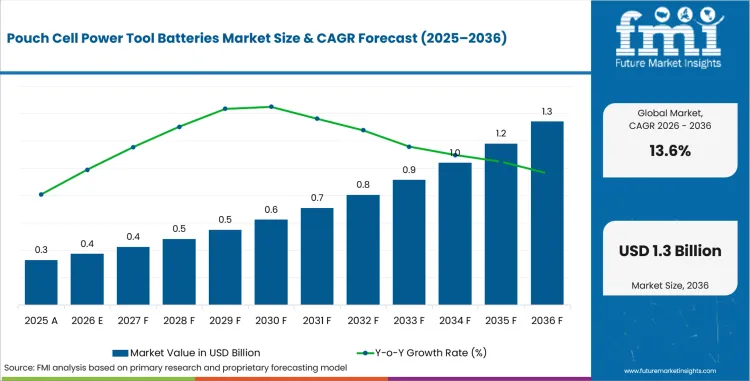
Pouch Cell Power Tool Batteries Market Overview: Size and Forecast
- 2025 Market Size: USD 0.33 billion
- 2026 Market Size: USD 0.37 billion
- 2036 Market Size: USD 1.33 billion
- Forecast CAGR: 13.6% from 2026 to 2036
- Leading Capacity: Compact
- Compact Share in 2026: 46.0%
- Leading Pack Architecture: Multi-layer Pouch
- Multi-layer Pouch Share in 2026: 72.0%
- Fastest-growing Country: India
- India CAGR: 15.8% by 2036
Summary of the Pouch Cell Power Tool Batteries Market
- Demand and Growth Drivers
- Demand is rising as professional contractors adopt compact pouch packs in drills, impact drivers, and fastening tools where lower weight improves daily productivity.
- Sales are expanding through OEM kit bundles because tool brands use pouch batteries to differentiate premium 18V and 20V cordless platforms.
- Adoption is strongest in high-use trade applications as users buy spare packs to reduce charging downtime across construction, repair, and maintenance shifts.
- Industry growth is supported by faster battery replacement cycles as pouch packs move from niche upgrades into dealer, online, and service-channel sales.
- Product and Segment View
- Compact packs are projected to lead the Capacity segment with 46.0% share as pouch designs cut weight in drill and driver kits.
- Multi-layer Pouch leads the Pack Architecture segment with 72.0% share because stacked cells define the premium pouch pack format.
- Drilling tools are expected to lead Tool Category demand with 34.0% share since compact batteries fit the most common cordless use case.
- OEM Kits are forecast to lead Sales Channel demand with 58.0% share as brands bundle pouch packs with premium tool launches.
- Professional Trades are projected to hold 62.0% share by Buyer Type as contractors pay for runtime and tool balance.
- Geography and Competitive Outlook
- China is expected to record 14.7% CAGR through 2036 as battery cell supply and power tool assembly sit close together.
- The United States is projected to record 13.8% CAGR through 2036 with strong pro-channel exposure from DEWALT and Milwaukee.
- India is forecast to grow faster than all selected countries at 15.8% CAGR as premium cordless tools expand in metro construction.
- Competition is led by branded tool OEMs, while ATL and LG Energy Solution remain relevant as upstream pouch cell suppliers.
- Analyst Opinion
- Nandini Roy Choudhury, Principal Consultant at FMI, says, "I see pouch-cell power tool batteries as a margin test for cordless brands. The winning pack is not just the one with the highest amp-hour label. Buyers want a battery that keeps an impact wrench compact, charges quickly enough for a second shift, and survives heat under repeated high-current draw. That creates pressure on pack design, cell sourcing, cooling layout, and warranty control at the same time. DEWALT showed that compact pouch packs can change user perception. Milwaukee then widened the debate by pairing FORGE batteries with demanding trade tools. Clients should watch the cost gap between pouch and tabless cylindrical cells. If that gap narrows, pouch packs are expected to move deeper into midrange cordless kits."
- Which factors support expansion in the pouch cell power tool batteries market?
- Compact pack handling, OEM kit bundling, and safety-documented replacement packs support market value across professional cordless tool channels.
- Market value is supported by branded pouch packs sold through premium cordless tool kits and replacement battery channels.
- Supplier pricing reflects pouch cell quality, thermal design, protection electronics, charger compatibility, and warranty coverage before amp-hour claims affect purchase decisions.
- Revenue improves when professional users add spare compact packs after adopting 18V or 20V cordless platforms for drills, drivers, and fastening tools.
- Buyer trust rises when suppliers provide UN 38.3 transport documentation, cell traceability, safety testing, and clear compatibility guidance.
- Format competition remains important because pouch packs must defend their weight and power benefits against tabless cylindrical battery systems.
Pack safety is the main pressure point for pouch cell power tool batteries as retailers and professional buyers review lithium-ion replacement packs more closely. IEA reported global battery cell manufacturing capacity above 3 TWh in 2024, giving tool brands a broader supply pool than the first pouch launch cycle. Product differentiation is also moving beyond amp-hour labels. DEWALT uses pouch cell technology in XR POWERSTACK packs to reduce resistance and heat build-up. Milwaukee positions REDLITHIUM FORGE batteries for high-output M18 applications. Suppliers that prove thermal control, UN 38.3 transport documentation, and charger compatibility can secure stronger dealer confidence.
Why is the pouch cell power tool batteries market growing?
Compact high-discharge packs change user comfort as lighter batteries improve balance in drills and impact drivers.
- Premium tool brands use pouch packs to protect ecosystem loyalty through batteries that fit existing cordless platforms.
- Construction repair and maintenance work supports replacement pack purchases as users need charged spares across work shifts.
- Safety rules raise supplier screening since lithium batteries must pass transport and hazard documentation requirements.
- Format competition sharpens buying decisions as pouch packs compete with tabless cylindrical batteries in heavy tools.
Professional buyers are treating the battery as part of the tool’s work output. The shift is clear in compact drills and impact drivers, where a smaller pack changes wrist fatigue over a long day. In February 2025, the UK Office for National Statistics reported that repair and maintenance rose 8.5% in 2024 as new work fell 5.3%. That pattern favors replacement batteries and compact cordless tools used on occupied sites. Buyers in this setting value pack size and low downtime more than headline capacity. Suppliers that prove heat control and cycle life gain a better chance of repeat pack sales. Battery format choice is expected to become a brand strategy issue. DEWALT states that XR POWERSTACK uses pouch cell technology to maximize power in a compact size, while Milwaukee positions REDLITHIUM FORGE for demanding high-output M18 applications. In January 2026, IATA guidance stated that lithium cell and battery types must pass the applicable UN 38.3 transport tests before transport. This gives large brands an advantage since pack documentation and traceability matter before products reach a dealer shelf. Smaller brands face a harder qualification burden.
How is the pouch cell power tool batteries market segmented?
The pouch cell power tool batteries industry is segmented by capacity, pack architecture, tool category, sales channel, buyer type, and region.
- With an estimated 46.0% share in 2026, Compact packs are expected to lead Capacity demand through lower tool weight and better handling.
- Multi-layer Pouch packs are projected to account for 72.0% of Pack Architecture demand in 2026 as stacked cells define branded premium packs.
- Drilling buyers are forecast to push Drilling tools to 34.0% of Tool Category demand in 2026 since drill kits carry the widest battery attach rate.
- OEM Kits are anticipated to represent 58.0% of Sales Channel demand in 2026 with pouch batteries bundled into premium tool launches.
- Professional Trades are expected to hold 62.0% of Buyer Type demand in 2026 as contractors value runtime certainty and battery interchange.
Segmentation shows that this is not a mass battery replacement story yet. The market is concentrated in compact and midrange packs that let brands show a clear user benefit. DEWALT’s 20V MAX XR 5Ah product page says its multi-layered pouch cell design gives greater conductive area than standard cylindrical cells. That detail explains why compact and midrange packs lead before high-output packs scale fully. The buyer sees value when a lighter battery keeps the same tool platform useful across more tasks. Over the forecast decade, premium OEM kits are expected to introduce most users to pouch packs before replacement sales deepen.
Why do compact packs lead the pouch cell power tool batteries market?
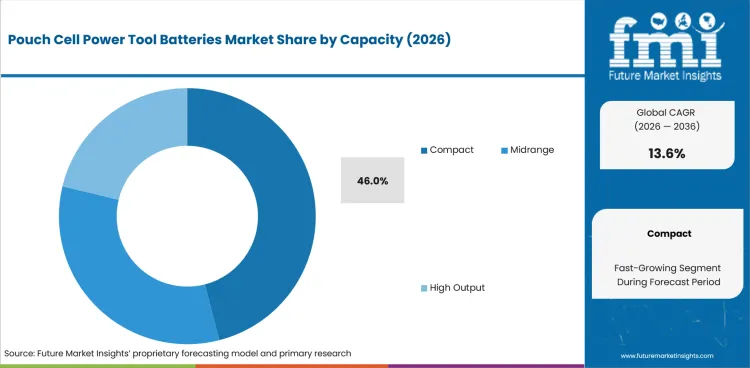
- Compact packs are projected to account for 46.0% of Capacity demand in 2026 as stacked cells let brands cut pack size without making drills feel underpowered.
- Trade users compare compact pouch packs by tool balance and charge recovery. The deciding point is often the second battery in the kit, not the first tool purchase.
Why does multi-layer pouch architecture lead the pouch cell power tool batteries market?
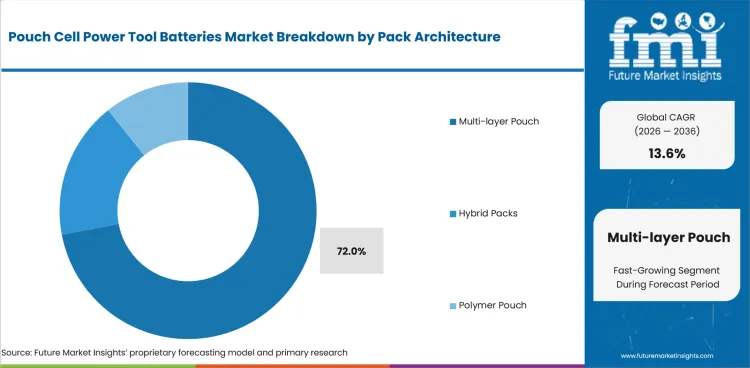
- Multi-layer Pouch is estimated to represent 72.0% of Pack Architecture demand in 2026 as flat stacked cells reduce electrical resistance inside compact packs.
- Pouch architecture needs stronger swelling control than cylindrical cells. This makes enclosure design and thermal management more important in replacement packs.
Why do drilling tools lead the pouch cell power tool batteries market?
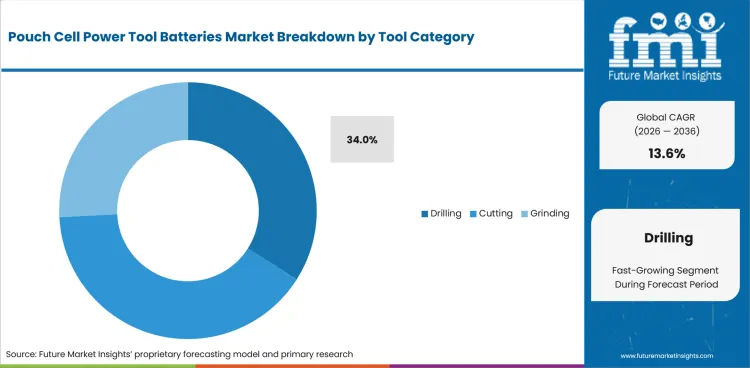
- Drilling tools are expected to account for 34.0% of Tool Category demand in 2026 as drills and impact drivers are the highest-volume premium cordless kits.
- Drill buyers notice battery weight quickly during overhead work. That makes pouch packs easier to justify than in tools used on benches or floors.
Why do OEM kits lead pouch cell power tool battery sales?
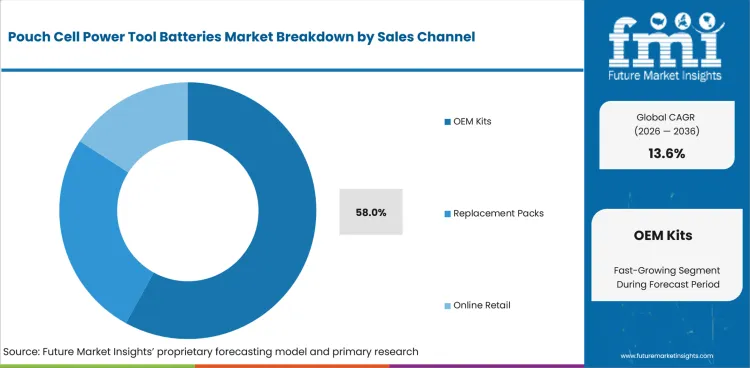
- OEM Kits are anticipated to hold 58.0% of Sales Channel demand in 2026 as brands introduce pouch packs through premium bundles with compatible chargers.
- Replacement packs follow after users test the first kit battery. This creates a delayed revenue layer for dealers and online sellers.
Why do professional trades lead the pouch cell power tool batteries market?
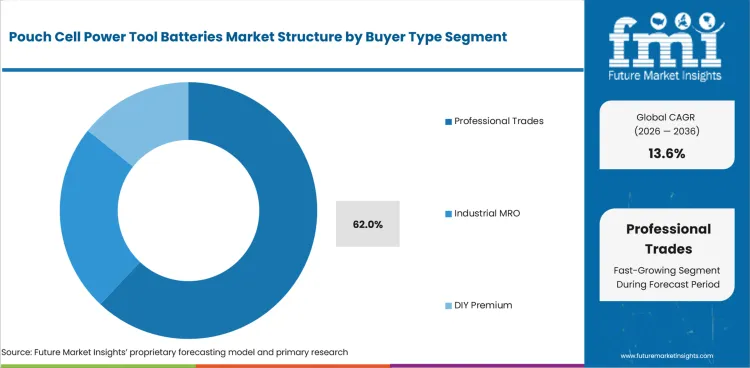
- Professional Trades are projected to represent 62.0% of Buyer Type demand in 2026 as contractors gain the most from shorter charging gaps.
- Professional buyers often standardize around one battery platform. This makes backward compatibility more important than the lowest pack price.
What are the drivers, restraints, and opportunities in the pouch cell power tool batteries market?
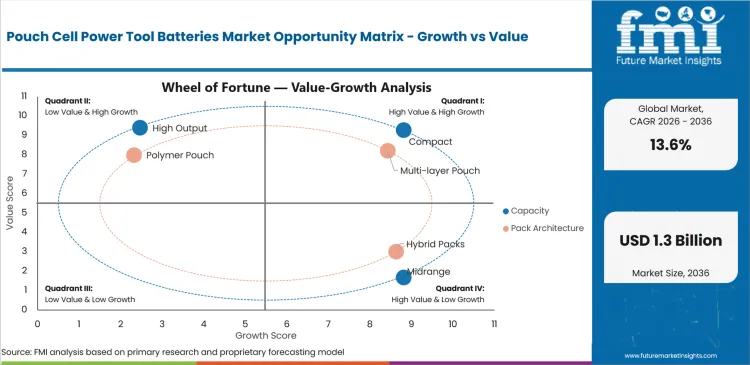
Compact pack ergonomics and high-discharge performance support adoption while pouch swelling, heat exposure, and safety documentation create qualification pressure.
- Driver: Compact pack ergonomics lift value as pouch cells reduce size in high-use cordless drills and impact drivers.
- Driver: Pro tool platform loyalty expands replacement demand as users buy spare packs after adopting pouch kits.
- Driver: Battery cost declines improve the premium pack equation as lithium-ion battery prices fell below USD 140 per kWh in 2023.
- Restraint: Pack swelling and heat exposure raise warranty risk when pouch cells operate under repeated high-current loads.
- Opportunity: Early premium channels in India and China create room for certified replacement packs with stronger safety documents.
Compact Pack Ergonomics
Compact pack ergonomics are the clearest growth route for pouch-cell power tool batteries. Users feel the difference in overhead fastening and repetitive drilling before they study cell chemistry. DEWALT’s XR POWERSTACK messaging links pouch cell technology with compact size and lower heat build-up, turning the battery into a direct handling benefit. This works best when a user keeps the same 20V or 18V platform and upgrades the pack first. Brands must prove the user gets smaller size without losing punch, while dealers must explain the difference in practical tool tasks.
High-Draw Heat Control
High-draw heat control decides whether pouch packs move beyond compact tools. Milwaukee’s June 2024 FORGE HD12.0 release said the pack delivers 50.0% more power than the M18 REDLITHIUM HIGH OUTPUT HD12.0 battery. This signals a push into saws, grinders, and outdoor equipment where heat and sustained load decide user trust. The mechanism is not only higher capacity. It is the ability to keep discharge steady without forcing the tool to slow down. Suppliers with better cooling paths and cell monitoring gain an advantage in professional accounts.
Safety Qualification Burden
Safety qualification is the main restraint for smaller pack sellers. Lithium packs carry transport, storage, and recall risk that grows when battery energy density rises. The USA Consumer Product Safety Commission says battery hazards include overheating, fire, electrical shock, thermal burns, and high-velocity ejected internal components. That warning affects dealer confidence and online platform screening. Pouch packs need strict cell matching and enclosure design because swelling risk is more visible than in rigid cylindrical cells. The practical result is higher documentation cost for pack assemblers.
Who are the leading companies in the pouch cell power tool batteries market?
Stanley Black & Decker / DEWALT, Techtronic Industries / Milwaukee Tool, Chervon / FLEX, Bosch Power Tools, Makita, HiKOKI, Amperex Technology Limited, LG Energy Solution, SK On, and EVE Energy are key companies in the pouch cell power tool batteries market.
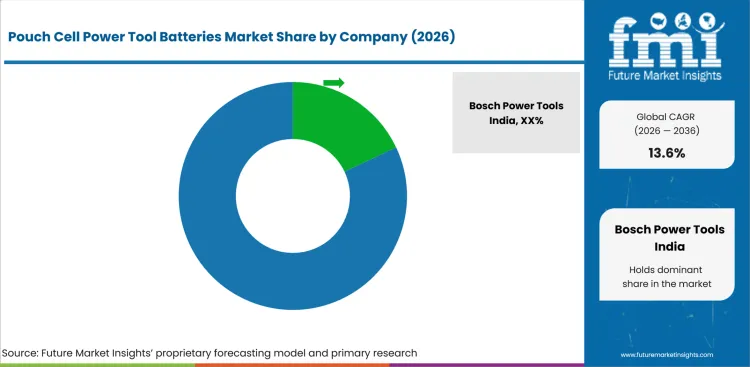
- Tool OEMs compete through battery platform compatibility, compact pack handling, charger fit, and dealer-channel visibility.
- Cell suppliers compete through pouch customization, safety records, energy density, and ability to meet pack integrator specifications.
- Pack specialists compete through cell matching, protection electronics, casing strength, UN 38.3 documentation, and replacement-pack availability.
- Entry barriers remain high because battery safety failures can damage the tool brand, warranty economics, and the retail channel.
Competition is led by branded cordless tool OEMs because users buy batteries inside established 18V, 20V, and 24V platforms. A pouch pack has limited value if it does not fit the user’s existing tool set and charger. DEWALT holds the clearest pouch identity through POWERSTACK, while Milwaukee pushes high-output competition through FORGE batteries. Chervon / FLEX also supports the premium compact-power route through stacked lithium branding.
Cell suppliers and replacement-pack specialists have a narrower opening. ATL, LG Energy Solution, SK On, and EVE Energy support the upstream pouch cell pool, but pack-level acceptance depends on safety files, cell matching, battery management electronics, casing strength, and transport documentation. Suppliers that prove repeat safety across transport, charging, impact, heat, and warranty claims are better positioned for professional tool channels.
How do top pouch cell power tool battery companies compare?
DEWALT leads pouch-specific brand depth, while Milwaukee has stronger high-draw tool positioning through FORGE packs.
| Company | Pouch Pack Brand Depth | High-Draw Thermal Control | Platform Compatibility Proof | Geographic Footprint |
|---|---|---|---|---|
| Stanley Black & Decker / DEWALT | High | Strong | Strong | Global |
| Techtronic Industries / Milwaukee | High | High | Strong | Global |
| Chervon / FLEX | Strong | Strong | Moderate | North America and Europe |
| Amperex Technology Limited | High | Medium | Low | Global cell supply |
| LG Energy Solution | High | Strong | Low | Global cell supply |
| SK On | High | Strong | Low | Global cell supply |
| EVE Energy | Medium | Medium | Low | China and global cell supply |
| Bosch Power Tools | Low | Strong | Strong | Global |
| Makita | Low | Strong | Strong | Global |
| HiKOKI | Low | Medium | Strong | Japan and global channels |
Source: Future Market Insights competitive analysis, 2026. Ratings reflect relative positioning based on pouch pack brand depth, high-draw thermal control, and platform compatibility proof.
Key Developments in Pouch Cell Power Tool Batteries Market
- In June 2024, DEWALT introduced the XR POWERPACK tabless cell battery within the XR portfolio. The move placed tabless and POWERSTACK pouch batteries in the same premium platform debate.
- In June 2024, Milwaukee launched the M18 REDLITHIUM FORGE HD12.0 battery with 50.0% more power than M18 HIGH OUTPUT HD12.0. This raised high-output expectations for cordless pack formats.
- In August 2024, DEWALT launched high-torque impact wrenches that gain up to 28.0% more torque when paired with XR POWERSTACK oil-resistant 5Ah battery. This tied pouch packs to demanding fastening work.
- In February 2025, Milwaukee introduced cordless roll groovers with FORGE XC8.0 and HD12.0 batteries in the kits. This showed high-output packs moving into specialty trade tools.
Who are the key players in the pouch cell power tool batteries market?
Tool OEMs
- Stanley Black & Decker / DEWALT
- Techtronic Industries / Milwaukee Tool
- Chervon / FLEX
- Bosch Power Tools
- Makita
- HiKOKI
Cell Suppliers
- Amperex Technology Limited
- LG Energy Solution
- SK On
- EVE Energy
Pack and Channel Specialists
- Regional pack assemblers
- Distributor private-label suppliers
- Service-channel replacement pack suppliers
Analysis of Pouch Cell Power Tool Batteries Market By Key Countries
India 15.8% CAGR, China 14.7% CAGR, United States 13.8% CAGR, South Korea 13.4% CAGR, Germany 12.6% CAGR, United Kingdom 12.2% CAGR, France 11.9% CAGR, and Japan 10.8% CAGR through 2036.
.webp "Top Country Growth Comparison Pouch Cell Power Tool Batteries Market Cagr (2026 2036)")
| Country | CAGR |
|---|---|
| India | 15.8% |
| China | 14.7% |
| United States | 13.8% |
| South Korea | 13.4% |
| Germany | 12.6% |
| United Kingdom | 12.2% |
| France | 11.9% |
| Japan | 10.8% |
Source: Future Market Insights, 2026.
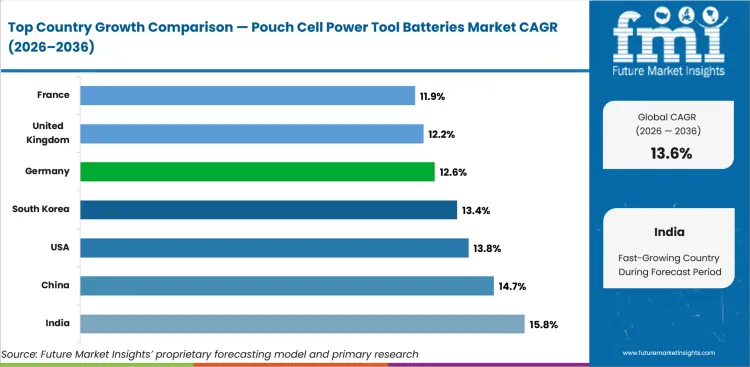
How do country-level CAGRs compare in the pouch cell power tool batteries market?
India leads selected country growth because premium cordless penetration is still early, while Japan records the most cautious outlook because cylindrical platforms remain deeply established.
- India is forecast to record 15.8% CAGR by 2036 as premium cordless tools expand in metro construction and dealer-led power tool channels.
- China is expected to expand at 14.7% CAGR through 2036 as local pouch cell supply and power tool assembly sit close together.
- The United States is projected to grow at 13.8% CAGR by 2036 as DEWALT, Milwaukee, and FLEX strengthen premium pro-channel exposure.
- South Korea is forecast to record 13.4% CAGR through 2036 as pouch cell engineering depth supports indirect demand from global OEM sourcing.
- Germany is expected to advance at 12.6% CAGR by 2036 as industrial MRO buyers and EU battery rules raise documentation needs.
- The United Kingdom is projected to rise at 12.2% CAGR through 2036 as repair work and trade-counter retail support compact cordless use.
- France is forecast to grow at 11.9% CAGR by 2036 as building merchants and online retailers support selective premium pack adoption.
- Japan is expected to expand at 10.8% CAGR through 2036 as compact jobsite needs support cautious adoption within established cordless platforms.
What is the pouch cell power tool batteries market outlook in the United States?
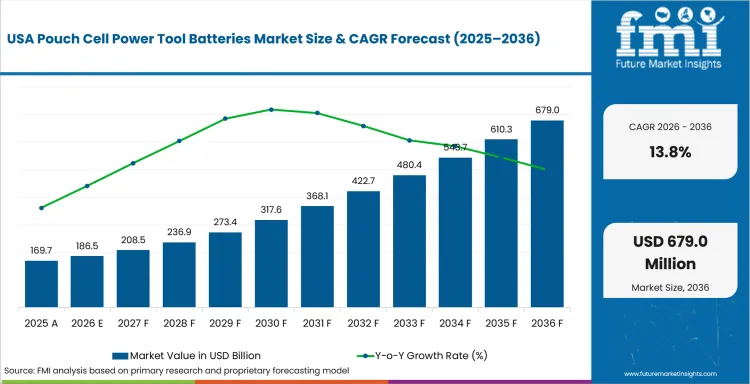
A 13.8% CAGR through 2036 reflects strong professional tool ecosystems and wider battery supply investment.
Country Market Snapshot Table
| Parameter | Value |
|---|---|
| Market Size in 2025 (Value) | USD 84.4 million |
| Market Size in 2026 (Value) | USD 96.0 million |
| Market Forecast in 2036 (Value) | USD 349.7 million |
| CAGR (2026 to 2036) | 13.8% |
| Years Considered | 2021 to 2036 |
| Base Year | 2025 |
| Forecast Period | 2026 to 2036 |
| Units Considered | Value (USD million) |
| Leading Sub-Region | South Atlantic and national pro-tool retail networks |
United States Pouch Cell Power Tool Batteries Market Outlook
United States pouch cell power tool battery demand is shaped by professional 20V and 18V cordless platforms sold through home centers and specialist dealers. Contractors already using DEWALT, Milwaukee, Bosch, Makita, or FLEX tools are expected to test pouch packs when the packs fit existing chargers and tools.
Retailers are expected to screen replacement packs more closely as lithium battery safety concerns rise. Brands with verified transport testing, warranty clarity, and platform compatibility should gain stronger shelf acceptance.
Key Growth Drivers
- USA Census Bureau reported private construction spending at an annual rate of USD 1,639.7 billion in April 2026, supporting contractor demand for spare cordless batteries.
- The USA Department of Energy selected 25 battery materials and manufacturing projects across 14 states for over USD 3.0 billion in September 2024, improving the wider battery supply environment.
- Home-center visibility gives pouch packs faster trial among contractors who already compare premium cordless kits at the counter.
- DEWALT and Milwaukee make the United States the clearest market for the pouch versus tabless cylindrical battery debate.
Key Restraints
- CPSC reannounced a recall covering about 429,200 wireless portable power banks in April 2026, showing why retailers are cautious with lithium-ion packs.
- Lower-cost cylindrical replacement packs keep price pressure high for users who need spare batteries but do not need lighter pack weight.
- Product liability exposure limits weakly documented aftermarket packs because professional dealers need traceable cells and UN 38.3 transport evidence.
What makes United States unique
The United States is unique because branded cordless platforms, home-center retail, and professional contractor accounts make battery upgrades visible at scale.
Key Companies
- Stanley Black & Decker / DEWALT
- Techtronic Industries / Milwaukee Tool
- Chervon / FLEX
- Bosch Tools North America
- Makita USAA.
- Metabo HPT
Sales & Marketing Channels
- Home center retail
- Specialist tool dealers
- Direct pro-account sales
- Online replacement pack sales
- Distributor-led jobsite demos
- OEM kit bundles
Country Segment Breakdown Table
| Segment | Sub-Segments |
|---|---|
| By Capacity | Compact · Midrange · High Output |
| By Pack Architecture | Multi-layer Pouch · Hybrid Packs · Polymer Pouch |
| By Tool Category | Drilling · Cutting · Grinding · Outdoor Equipment · Specialty |
| By Sales Channel | OEM Kits · Replacement Packs · Online Retail |
| By Buyer Type | Professional Trades · Industrial MRO · DIY Premium |
| Key Sub-Regions Covered, Professional Tool and Battery Supply Corridors | South Atlantic · Midwest · Texas · California · Pacific Northwest · Northeast trade corridors |
Frequently Asked Questions
How fast is United States pouch cell power tool batteries market growing?
United States is projected to grow at 13.8% CAGR from 2026 to 2036 as cordless tool batteries move into premium professional use.
Who leads United States pouch cell power tool batteries market?
Stanley Black & Decker / DEWALT, Techtronic Industries / Milwaukee Tool, and Chervon / FLEX compete through platform compatibility, battery safety, and channel access.
What is driving adoption in United States pouch cell power tool batteries market?
Adoption is supported by compact pack handling, branded cordless tool ecosystems, and stronger documentation around lithium-ion battery safety.
How is the pouch cell power tool batteries market performing in the United Kingdom?
A 12.2% CAGR through 2036 is supported by repair work, trade-counter retail, and compact cordless use in occupied sites.
Country Market Snapshot Table
| Parameter | Value |
|---|---|
| Market Size in 2025 (Value) | USD 18.7 million |
| Market Size in 2026 (Value) | USD 21.0 million |
| Market Forecast in 2036 (Value) | USD 66.4 million |
| CAGR (2026 to 2036) | 12.2% |
| Years Considered | 2021 to 2036 |
| Base Year | 2025 |
| Forecast Period | 2026 to 2036 |
| Units Considered | Value (USD million) |
| Leading Sub-Region | London, Midlands, and national trade-counter corridors |
United Kingdom Pouch Cell Power Tool Batteries Market Outlook
United Kingdom demand is shaped by renovation work, smaller trade crews, and strong online trade retail. Compact pouch packs are expected to fit contractors working in tight interior spaces where tool balance matters.
Premium adoption is expected to remain selective because buyers compare pouch packs against existing 18V and 20V ecosystems. Trade counters can support conversion when they explain charger compatibility and runtime gains clearly.
Key Growth Drivers
- ONS reported annual construction output increased by 1.8% in 2025 compared with 2024, supporting tool replacement across repair and contractor channels.
- The Department for Business and Trade reported total construction output grew 1.2% in Q2 2025, with repair and maintenance rising 1.4%.
- Trade counters make premium pack comparisons visible at the point of sale for contractors and maintenance teams.
- Existing 18V and 20V tool ecosystems support replacement pack purchases when users add batteries after the first kit purchase.
Key Restraints
- OPSS reported 211 fires involving e-bike and e-scooter products in the UK in 2024, keeping lithium-ion battery safety under closer review.
- Price-sensitive DIY buyers delay premium pouch upgrades when standard battery packs remain compatible with older tools.
- Imported pack dependence exposes distributors to freight and currency swings when spare batteries are purchased separately.
What makes United Kingdom unique
The United Kingdom is unique because trade-counter retail and renovation-heavy workflows create steady demand for compact spare battery packs.
Key Companies
- Stanley Black & Decker UK
- Milwaukee Tool UK
- Bosch Professional UK
- Makita UK
- FLEX Power Tools UK
- Hilti Great Britain
Sales & Marketing Channels
- Trade counters
- Online pro retailers
- Construction supply merchants
- Dealer bundle promotions
- Maintenance contractor accounts
- OEM service channels
Country Segment Breakdown Table
| Segment | Sub-Segments |
|---|---|
| By Capacity | Compact · Midrange · High Output |
| By Pack Architecture | Multi-layer Pouch · Hybrid Packs · Polymer Pouch |
| By Tool Category | Drilling · Cutting · Grinding · Outdoor Equipment · Specialty |
| By Sales Channel | OEM Kits · Replacement Packs · Online Retail |
| By Buyer Type | Professional Trades · Industrial MRO · DIY Premium |
| Key Sub-Regions Covered, Professional Tool and Battery Supply Corridors | London · Midlands · North West · Scotland · South East · Yorkshire |
Frequently Asked Questions
How fast is United Kingdom pouch cell power tool batteries market growing?
United Kingdom is projected to grow at 12.2% CAGR from 2026 to 2036 as cordless tool batteries move into premium professional use.
Who leads United Kingdom pouch cell power tool batteries market?
Stanley Black & Decker UK, Milwaukee Tool UK, and Bosch Professional UK compete through platform compatibility, battery safety, and channel access.
What is driving adoption in United Kingdom pouch cell power tool batteries market?
Adoption is supported by compact pack handling, branded cordless tool ecosystems, and stronger documentation around lithium-ion battery safety.
What is the pouch cell power tool batteries market forecast for Germany?
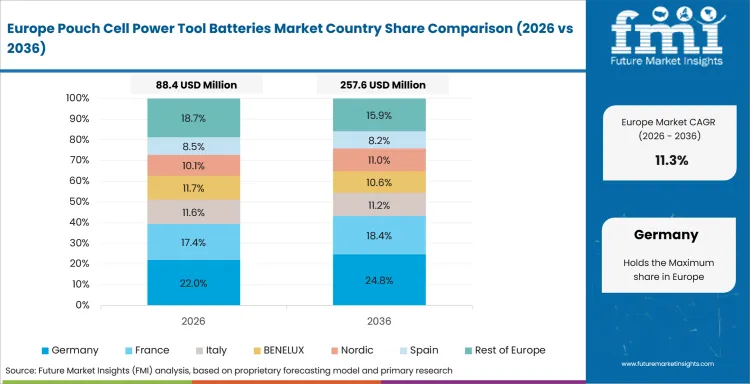
A 12.6% CAGR through 2036 reflects industrial MRO use, safety documentation, and EU battery-rule pressure.
Country Market Snapshot Table
| Parameter | Value |
|---|---|
| Market Size in 2025 (Value) | USD 24.9 million |
| Market Size in 2026 (Value) | USD 28.0 million |
| Market Forecast in 2036 (Value) | USD 91.7 million |
| CAGR (2026 to 2036) | 12.6% |
| Years Considered | 2021 to 2036 |
| Base Year | 2025 |
| Forecast Period | 2026 to 2036 |
| Units Considered | Value (USD million) |
| Leading Sub-Region | North Rhine-Westphalia and southern industrial tool clusters |
Germany Pouch Cell Power Tool Batteries Market Outlook
Germany demand is shaped by industrial maintenance buyers and professional trades that scrutinize battery quality. Pouch packs are expected to gain trial where compact tools reduce fatigue in plant maintenance and installation work.
The market is expected to move cautiously because German buyers ask for safety files and service support before adopting new pack formats. Specialist dealers are expected to remain important in battery qualification.
Key Growth Drivers
- Destatis reported the main construction industry production index reached 100.8 in April 2026, supporting cordless tool use in building and civil engineering work.
- The European Commission stated in April 2026 that portable batteries in products sold in the EU must generally be removable and replaceable by consumers.
- Industrial MRO buyers value compact cordless tools when maintenance tasks require overhead fastening and limited-access drilling.
- Specialist dealer advice supports premium battery qualification because buyers need clear proof of charger fit and thermal behavior.
Key Restraints
- Eurostat construction-cost data placed Germany’s construction cost index at 122.5 in December 2025, keeping premium battery conversion under cost scrutiny.
- Proven cylindrical pack use slows pouch conversion because many German buyers wait for field evidence before switching battery formats.
- Strict warranty expectations raise the cost of new battery formats because suppliers must support long service claims and traceability.
What makes Germany unique
Germany is unique because industrial users place unusual weight on safety documentation, dealer expertise, and product responsibility under EU battery rules.
Key Companies
- Bosch Power Tools
- Festool GmbH
- Metabowerke GmbH
- FLEX-Elektrowerkzeuge GmbH
- Makita Werkzeug GmbH
- Milwaukee Tool Germany
Sales & Marketing Channels
- Industrial distributors
- Specialist tool dealers
- OEM platform bundles
- Contractor demonstration days
- Maintenance fleet accounts
- Online pro retailers
Country Segment Breakdown Table
| Segment | Sub-Segments |
|---|---|
| By Capacity | Compact · Midrange · High Output |
| By Pack Architecture | Multi-layer Pouch · Hybrid Packs · Polymer Pouch |
| By Tool Category | Drilling · Cutting · Grinding · Outdoor Equipment · Specialty |
| By Sales Channel | OEM Kits · Replacement Packs · Online Retail |
| By Buyer Type | Professional Trades · Industrial MRO · DIY Premium |
| Key Sub-Regions Covered, Professional Tool and Battery Supply Corridors | North Rhine-Westphalia · Bavaria · Baden-Wurttemberg · Lower Saxony · Hesse · Berlin-Brandenburg |
Frequently Asked Questions
How fast is Germany pouch cell power tool batteries market growing?
Germany is projected to grow at 12.6% CAGR from 2026 to 2036 as cordless tool batteries move into premium professional use.
Who leads Germany pouch cell power tool batteries market?
Bosch Power Tools, Festool GmbH, and Metabowerke GmbH compete through platform compatibility, battery safety, and channel access.
What is driving adoption in Germany pouch cell power tool batteries market?
Adoption is supported by compact pack handling, branded cordless tool ecosystems, and stronger documentation around lithium-ion battery safety.
How is the pouch cell power tool batteries market growing in France?
An 11.9% CAGR through 2036 reflects selective premium adoption across renovation, public works, and building merchant channels.
Country Market Snapshot Table
| Parameter | Value |
|---|---|
| Market Size in 2025 (Value) | USD 14.3 million |
| Market Size in 2026 (Value) | USD 16.0 million |
| Market Forecast in 2036 (Value) | USD 49.3 million |
| CAGR (2026 to 2036) | 11.9% |
| Years Considered | 2021 to 2036 |
| Base Year | 2025 |
| Forecast Period | 2026 to 2036 |
| Units Considered | Value (USD million) |
| Leading Sub-Region | Ile-de-France and Auvergne-Rhone-Alpes contractor corridors |
France Pouch Cell Power Tool Batteries Market Outlook
France demand is shaped by professional building merchants and selective contractor upgrades. Pouch packs need a clear cost justification because many users continue to buy standard battery formats when jobsite benefits are not obvious.
Compact batteries are expected to gain attention in finishing, renovation, and installation work. Online tool retailers can support comparison if warranty terms and charger compatibility are stated clearly.
Key Growth Drivers
- INSEE reported manufacturing output increased by 0.4% in April 2026, supporting the industrial base for tool and equipment demand.
- The European Commission confirmed in April 2026 that EU battery rules cover removability and replacement expectations for portable batteries in products.
- Professional building merchants can introduce pouch packs through premium cordless kits and replacement-battery bundles.
- Online retailers make pack comparison easier for small contractors who evaluate weight, runtime, and charger compatibility before purchase.
Key Restraints
- Eurostat labour-cost data placed France industry labour cost growth at 2.8% year over year in December 2025, keeping contractors selective on premium pack upgrades.
- Cost-sensitive small contractors often keep standard cylindrical packs longer when pouch benefits are not visible on daily tasks.
- Replacement pack buyers avoid weak warranty terms because battery failures can interrupt contractor work and raise dealer returns.
What makes France unique
France is unique because premium pouch packs need a practical cost justification before contractors move beyond established cordless battery formats.
Key Companies
- Stanley Black & Decker France
- Milwaukee Tool France
- Bosch Professional France
- Makita France
- Hilti France
- FLEX France
Sales & Marketing Channels
- Building merchants
- Online tool retailers
- Dealer bundles
- Electrical contractor suppliers
- OEM service networks
- Specialist pro stores
Country Segment Breakdown Table
| Segment | Sub-Segments |
|---|---|
| By Capacity | Compact · Midrange · High Output |
| By Pack Architecture | Multi-layer Pouch · Hybrid Packs · Polymer Pouch |
| By Tool Category | Drilling · Cutting · Grinding · Outdoor Equipment · Specialty |
| By Sales Channel | OEM Kits · Replacement Packs · Online Retail |
| By Buyer Type | Professional Trades · Industrial MRO · DIY Premium |
| Key Sub-Regions Covered, Professional Tool and Battery Supply Corridors | Ile-de-France · Auvergne-Rhone-Alpes · Hauts-de-France · Grand Est · Provence-Alpes-Cote d Azur · Nouvelle-Aquitaine |
Frequently Asked Questions
How fast is France pouch cell power tool batteries market growing?
France is projected to grow at 11.9% CAGR from 2026 to 2036 as cordless tool batteries move into premium professional use.
Who leads France pouch cell power tool batteries market?
Stanley Black & Decker France, Milwaukee Tool France, and Bosch Professional France compete through platform compatibility, battery safety, and channel access.
What is driving adoption in France pouch cell power tool batteries market?
Adoption is supported by compact pack handling, branded cordless tool ecosystems, and stronger documentation around lithium-ion battery safety.
What is the pouch cell power tool batteries market outlook in Japan?
A 10.8% CAGR through 2036 reflects compact jobsite needs and cautious adoption within established cordless platforms.
Country Market Snapshot Table
| Parameter | Value |
|---|---|
| Market Size in 2025 (Value) | USD 16.2 million |
| Market Size in 2026 (Value) | USD 18.0 million |
| Market Forecast in 2036 (Value) | USD 50.2 million |
| CAGR (2026 to 2036) | 10.8% |
| Years Considered | 2021 to 2036 |
| Base Year | 2025 |
| Forecast Period | 2026 to 2036 |
| Units Considered | Value (USD million) |
| Leading Sub-Region | Tokyo, Osaka, and Nagoya professional tool corridors |
Japan Pouch Cell Power Tool Batteries Market Outlook
Japan demand is shaped by dense urban jobsites and a established cordless tool culture. Pouch packs can develop where compact batteries improve tool balance without raising service risk.
Buyers are expected to favor trusted OEM packs because service life, charger compatibility, and safety records matter more than low replacement price. Domestic dealers and service centers remain important to format acceptance.
Key Growth Drivers
- Statistics Bureau of Japan reported total building floor space started at 102.74 million square meters in 2024, supporting ongoing cordless tool use.
- Cabinet Office machinery orders data showed private-sector core machinery orders rose 13.6% in February 2026, supporting equipment investment signals.
- Dense jobsite spaces favor compact battery packs because lighter tools reduce fatigue during renovation and installation work.
- Branded service support improves user trust in new pack formats when buyers compare Makita, HiKOKI, and imported platforms.
Key Restraints
- MLIT housing-start data placed Japan housing starts at 62,569 units in April 2026, limiting near-term residential tool replacement pressure.
- Established cylindrical battery ecosystems slow pouch adoption because existing Makita and HiKOKI users need clear platform benefits.
- Lower construction starts reduce near-term tool replacement pressure when buyers extend the use of existing battery platforms.
What makes Japan unique
Japan is unique because quality expectations and service-center trust decide whether new battery formats move beyond limited premium use.
Key Companies
- Makita Corporation
- Koki Holdings / HiKOKI
- Panasonic Energy
- Kyocera Industrial Tools
- Bosch Japan
- Stanley Black & Decker Japan
Sales & Marketing Channels
- Domestic tool dealers
- Branded service centers
- Online specialist retailers
- Contractor supply houses
- OEM kit bundles
- Urban hardware chains
Country Segment Breakdown Table
| Segment | Sub-Segments |
|---|---|
| By Capacity | Compact · Midrange · High Output |
| By Pack Architecture | Multi-layer Pouch · Hybrid Packs · Polymer Pouch |
| By Tool Category | Drilling · Cutting · Grinding · Outdoor Equipment · Specialty |
| By Sales Channel | OEM Kits · Replacement Packs · Online Retail |
| By Buyer Type | Professional Trades · Industrial MRO · DIY Premium |
| Key Sub-Regions Covered, Professional Tool and Battery Supply Corridors | Tokyo · Osaka · Nagoya · Yokohama · Fukuoka · Sapporo |
Frequently Asked Questions
How fast is Japan pouch cell power tool batteries market growing?
Japan is projected to grow at 10.8% CAGR from 2026 to 2036 as cordless tool batteries move into premium professional use.
Who leads Japan pouch cell power tool batteries market?
Makita Corporation, Koki Holdings / HiKOKI, and Panasonic Energy compete through platform compatibility, battery safety, and channel access.
What is driving adoption in Japan pouch cell power tool batteries market?
Adoption is supported by compact pack handling, branded cordless tool ecosystems, and stronger documentation around lithium-ion battery safety.
How fast is the pouch cell power tool batteries market growing in China?
A 14.7% CAGR through 2036 reflects local pouch cell supply, export assembly, and fast replacement-pack distribution.
Country Market Snapshot Table
| Parameter | Value |
|---|---|
| Market Size in 2025 (Value) | USD 54.1 million |
| Market Size in 2026 (Value) | USD 62.0 million |
| Market Forecast in 2036 (Value) | USD 244.4 million |
| CAGR (2026 to 2036) | 14.7% |
| Years Considered | 2021 to 2036 |
| Base Year | 2025 |
| Forecast Period | 2026 to 2036 |
| Units Considered | Value (USD million) |
| Leading Sub-Region | Guangdong, Jiangsu, and Zhejiang battery-tool supply clusters |
China Pouch Cell Power Tool Batteries Market Outlook
China demand is shaped by battery cell production depth and large power tool assembly capacity. Pouch packs can scale faster because cell sourcing, pack assembly, and export channels operate close together.
Domestic premium cordless tools create one demand layer, but export-oriented tool and pack assembly creates the larger commercial path. Safety documentation and cell matching are expected to separate credible suppliers from low-cost sellers.
Key Growth Drivers
- NBS reported buildings under construction by real estate development enterprises covered 6,598.90 million square meters in 2025, supporting tool use across construction activity.
- IEA reported that about 85% of global battery cell manufacturing capacity was located in China in 2024, giving pack assemblers local cell depth.
- Local pouch cell supply shortens sourcing cycles for pack assemblers serving branded and export-oriented cordless tool programs.
- E-commerce channels speed replacement pack availability by making compatible batteries visible to contractors and small workshops.
Key Restraints
- NBS reported the floor space of buildings newly started fell 20.4% in 2025, limiting domestic construction-led power tool demand.
- Cell oversupply pushes pack prices down quickly because smaller assemblers compete on low-cost replacement batteries.
- Safety concerns limit weak aftermarket suppliers in export markets because buyers require test documents and stable cell matching.
What makes China unique
China is unique because pouch cell availability and power tool assembly meet inside the same large supply-chain base.
Key Companies
- Chervon Holdings
- Positec Group
- Amperex Technology Limited
- EVE Energy Co., Ltd.
- Sunwoda Electronic Co., Ltd.
- Tianjin Lishen Battery
Sales & Marketing Channels
- OEM export supply
- Domestic e-commerce
- Pack assembly partnerships
- Tool brand sourcing offices
- Cross-border retail channels
- Distributor private labels
Country Segment Breakdown Table
| Segment | Sub-Segments |
|---|---|
| By Capacity | Compact · Midrange · High Output |
| By Pack Architecture | Multi-layer Pouch · Hybrid Packs · Polymer Pouch |
| By Tool Category | Drilling · Cutting · Grinding · Outdoor Equipment · Specialty |
| By Sales Channel | OEM Kits · Replacement Packs · Online Retail |
| By Buyer Type | Professional Trades · Industrial MRO · DIY Premium |
| Key Sub-Regions Covered, Professional Tool and Battery Supply Corridors | Guangdong · Zhejiang · Jiangsu · Shanghai · Shandong · Chongqing |
Frequently Asked Questions
How fast is China pouch cell power tool batteries market growing?
China is projected to grow at 14.7% CAGR from 2026 to 2036 as cordless tool batteries move into premium professional use.
Who leads China pouch cell power tool batteries market?
Chervon Holdings, Positec Group, and Amperex Technology Limited compete through platform compatibility, battery safety, and channel access.
What is driving adoption in China pouch cell power tool batteries market?
Adoption is supported by compact pack handling, branded cordless tool ecosystems, and stronger documentation around lithium-ion battery safety.
What is the pouch cell power tool batteries market forecast for South Korea?
A 13.4% CAGR through 2036 reflects pouch cell engineering depth and indirect demand from global OEM sourcing.
Country Market Snapshot Table
| Parameter | Value |
|---|---|
| Market Size in 2025 (Value) | USD 13.2 million |
| Market Size in 2026 (Value) | USD 15.0 million |
| Market Forecast in 2036 (Value) | USD 52.7 million |
| CAGR (2026 to 2036) | 13.4% |
| Years Considered | 2021 to 2036 |
| Base Year | 2025 |
| Forecast Period | 2026 to 2036 |
| Units Considered | Value (USD million) |
| Leading Sub-Region | Seoul Capital Area and battery engineering corridors |
South Korea Pouch Cell Power Tool Batteries Market Outlook
South Korea is more important as a pouch cell technology base than as a final power tool battery retail market. LG Energy Solution, SK On, and Samsung SDI give pack designers a strong upstream reference point.
Direct tool battery demand is smaller than the country’s role in cell supply and engineering support. Premium pouch pack use is expected to depend on OEM sourcing programs and export pack partnerships.
Key Growth Drivers
- InvestKOREA reported battery sector exports reached USD 9.83 billion in 2023 and were expected at USD 8.21 billion in 2024, showing supplier scale.
- The Ministry of Data and Statistics reported Korea’s production index at 119.4 in April 2026, supporting industrial tool and maintenance activity.
- Korean suppliers bring strong quality systems for branded buyers that need pouch cell consistency and traceability.
- Global OEM sourcing creates indirect demand beyond domestic tool sales because battery expertise feeds compact pack design.
Key Restraints
- KDI reported total industrial production fell 1.3% month over month in January 2026, showing cyclical pressure on domestic tool-pack qualification.
- EV and ESS customers receive higher priority than tool pack buyers when premium pouch cell supply is allocated.
- Premium cell cost can limit use in mass replacement packs because tool batteries compete with lower-priced cylindrical formats.
What makes South Korea unique
South Korea is unique because pouch cell expertise matters more than domestic power tool retail volume.
Key Companies
- LG Energy Solution
- SK On
- Samsung SDI
- Kokam
- LS Materials
- Korean pack engineering suppliers
Sales & Marketing Channels
- Cell supply agreements
- OEM engineering programs
- Export pack partnerships
- Distributor import channels
- Industrial buyer accounts
- Battery qualification programs
Country Segment Breakdown Table
| Segment | Sub-Segments |
|---|---|
| By Capacity | Compact · Midrange · High Output |
| By Pack Architecture | Multi-layer Pouch · Hybrid Packs · Polymer Pouch |
| By Tool Category | Drilling · Cutting · Grinding · Outdoor Equipment · Specialty |
| By Sales Channel | OEM Kits · Replacement Packs · Online Retail |
| By Buyer Type | Professional Trades · Industrial MRO · DIY Premium |
| Key Sub-Regions Covered, Professional Tool and Battery Supply Corridors | Seoul Capital Area · Gyeonggi · Incheon · Ulsan · Daegu · Busan |
Frequently Asked Questions
How fast is South Korea pouch cell power tool batteries market growing?
South Korea is projected to grow at 13.4% CAGR from 2026 to 2036 as cordless tool batteries move into premium professional use.
Who leads South Korea pouch cell power tool batteries market?
LG Energy Solution, SK On, and Samsung SDI compete through platform compatibility, battery safety, and channel access.
What is driving adoption in South Korea pouch cell power tool batteries market?
Adoption is supported by compact pack handling, branded cordless tool ecosystems, and stronger documentation around lithium-ion battery safety.
How is the pouch cell power tool batteries market performing in India?
A 15.8% CAGR through 2036 reflects early premium cordless penetration and metro construction-led tool upgrades.
Country Market Snapshot Table
| Parameter | Value |
|---|---|
| Market Size in 2025 (Value) | USD 8.6 million |
| Market Size in 2026 (Value) | USD 10.0 million |
| Market Forecast in 2036 (Value) | USD 43.4 million |
| CAGR (2026 to 2036) | 15.8% |
| Years Considered | 2021 to 2036 |
| Base Year | 2025 |
| Forecast Period | 2026 to 2036 |
| Units Considered | Value (USD million) |
| Leading Sub-Region | Delhi NCR, Mumbai, Bengaluru, and metro construction corridors |
India Pouch Cell Power Tool Batteries Market Outlook
India demand is shaped by metro construction, dealer-led premium tool sales, and online access to replacement batteries. Pouch packs are expected to remain concentrated among professional users before wider DIY adoption develops.
Domestic battery policy gives pack assembly a longer-term supply frame, although imported lithium-ion cells still shape near-term pricing. Warranty support and dealer guidance remain important in hot and dusty work conditions.
Key Growth Drivers
- PIB reported that the PLI ACC scheme carries an outlay of INR 18,100 crore to establish 50 GWh of domestic ACC capacity.
- PIB reported India’s construction sector was estimated to grow 9.4% in FY 2024-25, supporting power tool upgrades in urban projects.
- Online retail improves access to premium replacement batteries where branded dealership coverage remains uneven across cities.
- Domestic battery policy supports future pack assembly localization as suppliers seek lower import dependence for cordless tool packs.
Key Restraints
- PIB reported that 40 GWh of the 50 GWh ACC target had been awarded by February 2026, showing that local cell capacity remains in rollout mode.
- Premium pouch packs face strong price resistance outside metro contractors because low-cost cordless kits remain widely available.
- Imported cell dependence keeps replacement pack pricing volatile when distributors cannot secure stable local cell supply.
What makes India unique
India is unique because premium cordless adoption is still early, so platform upgrades and battery localization can develop together.
Key Companies
- Bosch Power Tools India
- Stanley Black & Decker India
- Makita Power Tools India
- Hilti India
- Milwaukee Tool India distributors
- Okaya Power Group
Sales & Marketing Channels
- Urban tool dealers
- E-commerce marketplaces
- Contractor distributor networks
- OEM kit bundles
- Service-center replacement sales
- Industrial procurement channels
Country Segment Breakdown Table
| Segment | Sub-Segments |
|---|---|
| By Capacity | Compact · Midrange · High Output |
| By Pack Architecture | Multi-layer Pouch · Hybrid Packs · Polymer Pouch |
| By Tool Category | Drilling · Cutting · Grinding · Outdoor Equipment · Specialty |
| By Sales Channel | OEM Kits · Replacement Packs · Online Retail |
| By Buyer Type | Professional Trades · Industrial MRO · DIY Premium |
| Key Sub-Regions Covered, Professional Tool and Battery Supply Corridors | Delhi NCR · Mumbai · Bengaluru · Pune · Hyderabad · Chennai |
Frequently Asked Questions
How fast is India pouch cell power tool batteries market growing?
India is projected to grow at 15.8% CAGR from 2026 to 2036 as cordless tool batteries move into premium professional use.
Who leads India pouch cell power tool batteries market?
Bosch Power Tools India, Stanley Black & Decker India, and Makita Power Tools India compete through platform compatibility, battery safety, and channel access.
What is driving adoption in India pouch cell power tool batteries market?
Adoption is supported by compact pack handling, branded cordless tool ecosystems, and stronger documentation around lithium-ion battery safety.
Pouch Cell Power Tool Batteries Market - Report Scope
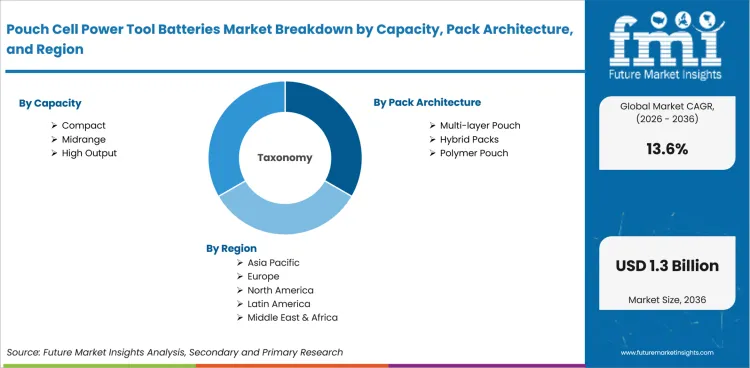
| Item | Value |
|---|---|
| Market size by 2036 | USD 1.33 billion |
| Growth rate | 13.6% CAGR from 2026 to 2036 |
| Forecast period | 2026 to 2036 |
| Base year value (2025) | USD 0.33 billion |
| By capacity | Compact, midrange, high output |
| By pack architecture | Multi-layer pouch, hybrid packs, polymer pouch |
| By tool category | Drilling, cutting, grinding, outdoor equipment, specialty |
| By sales channel | OEM kits, replacement packs, online retail |
| By buyer type | Professional trades, industrial MRO, DIY premium |
| Regions covered | North America, Latin America, Europe, East Asia, South Asia and Pacific, Middle East and Africa |
| Countries covered | United States, United Kingdom, Germany, France, Japan, China, South Korea, India |
| Key companies profiled | DEWALT, Milwaukee Tool, Chervon, Bosch Power Tools, Makita, ATL, LG Energy Solution, SK On, EVE Energy |
| Approach | Bottom-up product-boundary approach using verified product evidence, pack pricing, cordless platform penetration, battery attach rates, and country-level adoption velocity |
Pouch Cell Power Tool Batteries Market - Scope & Definition
| Attribute | Detail |
|---|---|
| Market Definition | Rechargeable lithium-ion power tool battery packs that use pouch or stacked pouch cell formats for cordless tools and jobsite equipment |
| Functions Covered | Portable energy storage, high-current discharge, fast charging support, pack protection, battery management, cordless tool runtime |
| Applications Covered | Cordless drills, impact drivers, grinders, saws, routers, outdoor equipment, specialty jobsite tools, and replacement battery packs |
| End-Use Industries | Construction, electrical contracting, plumbing, industrial maintenance, woodworking, renovation, outdoor maintenance, and professional trades |
| Grades Covered | Compact, midrange, high output, multi-layer pouch, hybrid pouch, and polymer pouch battery pack formats |
| Inclusions | Branded OEM pouch-cell power tool packs, stacked-cell battery packs, hybrid pouch packs, replacement packs, battery management electronics, and sales through OEM kits and replacement channels |
| Exclusions | Cylindrical-only cordless tool batteries, EV pouch cells, stationary storage packs, phone pouch cells, chargers sold separately, disposable batteries, and non-tool lithium-ion packs |
Pouch Cell Power Tool Batteries Market - Research Methodology
| Method | Description |
|---|---|
| Primary Research | FMI analyst interviews with cordless tool distributors, battery pack integrators, repair technicians, jobsite procurement teams, and professional trade users across key markets |
| Desk Research | Review of official battery supply data, construction statistics, product pages, safety guidance, company releases, customs classifications, and battery regulation materials |
| Market Sizing & Forecasting | Bottom-up model combining cordless tool platform revenue, battery attach rates, replacement purchase frequency, pack pricing, and pouch-cell penetration by country |
| Data Validation | Cross-verification against battery manufacturing scale, lithium-ion price movement, company product launches, safety documentation, and country-level construction or battery policy signals |
Pouch Cell Power Tool Batteries Market Breakdown by Capacity, Pack Architecture, Tool Category, Sales Channel, Buyer Type, and Region
Pouch Cell Power Tool Batteries Market Segmented by Capacity
- Compact
- Midrange
- High Output
Pouch Cell Power Tool Batteries Market Segmented by Pack Architecture
- Multi-layer Pouch
- Hybrid Packs
- Polymer Pouch
Pouch Cell Power Tool Batteries Market Segmented by Tool Category
- Drilling
- Cutting
- Grinding
- Outdoor Equipment
- Specialty
Pouch Cell Power Tool Batteries Market Segmented by Sales Channel
- OEM Kits
- Replacement Packs
- Online Retail
Pouch Cell Power Tool Batteries Market Segmented by Buyer Type
- Professional Trades
- Industrial MRO
- DIY Premium
Pouch Cell Power Tool Batteries Market by Region
- North America
- United States
- Canada
- Mexico
- Latin America
- Brazil
- Chile
- Rest of Latin America
- Western Europe
- Germany
- UK
- Italy
- Spain
- France
- Nordic
- BENELUX
- Rest of Western Europe
- Eastern Europe
- Russia
- Poland
- Hungary
- Balkan & Baltic
- Rest of Eastern Europe
- East Asia
- China
- Japan
- South Korea
- South Asia and Pacific
- India
- ASEAN
- Australia & New Zealand
- Rest of South Asia and Pacific
- Middle East & Africa
- Kingdom of Saudi Arabia
- Other GCC Countries
- Turkiye
- South Africa
- Other African Union
- Rest of Middle East & Africa
Research Sources and Bibliography
- International Energy Agency. (2025, May 14). Global EV Outlook 2025. International Energy Agency.
- International Energy Agency. (2026, May 20). Global EV Outlook 2026: Electric vehicle batteries. International Energy Agency.
- USA Census Bureau. (2026, June 1). Monthly construction spending, April 2026. USA Census Bureau.
- USA Department of Energy. (2024, September 20). Biden-Harris administration announces over $3 billion to support America’s battery manufacturing sector. USA Department of Energy.
- USA Consumer Product Safety Commission. (2026, April 16). Casely reannounces recall of wireless portable power banks due to fire and burn hazards. CPSC.
- Office for National Statistics. (2026, February 12). Construction output in Great Britain: December 2025, new orders and construction output price indices. ONS.
- Department for Business and Trade. (2025, September 3). Construction building materials commentary: August 2025. GOV.UK.
- Office for Product Safety and Standards. (2025, July 30). OPSS Delivery Report 2024 to 2025. GOV.UK.
- Federal Statistical Office of Germany. (2026). Production index in main construction industry. Destatis.
- European Commission. (2026, April 28). Commission seeks views on battery removability exemptions. European Commission.
- Eurostat. (2026). Construction cost index for Germany, December 2025. Eurostat.
- Institut national de la statistique et des etudes economiques. (2026, June 5). In April 2026, manufacturing output increased by 0.4%. INSEE.
- Eurostat. (2026). Labour cost index for industry in France, December 2025. Eurostat.
- Statistics Bureau of Japan. (2025, September). Statistical Handbook of Japan 2025. Statistics Bureau of Japan.
- Ministry of Land, Infrastructure, Transport and Tourism. (2026). Current survey on construction statistics: Housing starts. MLIT Japan.
- Cabinet Office of Japan. (2026). Machinery orders in February 2026. Economic and Social Research Institute.
- National Bureau of Statistics of China. (2026, January 20). Investment in real estate development for 2025. NBS China.
- International Energy Agency. (2025, May 14). Battery manufacturing and supply chains in Global EV Outlook 2025. International Energy Agency.
- Korea Development Institute. (2026, April). Monthly economic trends, April 2026. KDI.
- Ministry of Data and Statistics. (2026). Economic and financial data for Korea: Production index, April 2026. Republic of Korea.
- InvestKOREA. (2025). Battery industry. Korea Trade-Investment Promotion Agency.
- Press Information Bureau. (2026, February 6). Production-linked incentive for ACC battery manufacturing. Government of India.
- Press Information Bureau. (2025, May 30). Provisional estimates of annual gross domestic product for FY 2024-25. Government of India.
- Press Information Bureau. (2026, February 10). PLI-ACC scheme. Government of India.
- International Air Transport Association. (2026, January 1). Lithium Battery Guidance Document. IATA.
- USA Consumer Product Safety Commission. (2024). Batteries. CPSC.
- DEWALT. (2024, June 17). DEWALT introduces XR POWERPACK tabless cell battery within next generation XR portfolio. DEWALT.
- Milwaukee Tool. (2024, June 26). Milwaukee unlocks a new level of battery power for the M18 system. Milwaukee Tool.
- DEWALT. (2024, August 29). DEWALT unveils its highest rated max torque fastening solutions. DEWALT.
- Milwaukee Tool. (2025, February 9). Milwaukee introduces first cordless roll groovers. Milwaukee Tool.
- LG Energy Solution. (2024, April 4). LG Energy Solution’s USD 5.5 billion stand-alone battery manufacturing complex in Arizona takes shape. LG Energy Solution.
- LG Energy Solution. (2024, March 13). How does LG Energy Solution make pouch-type batteries? LG Energy Solution.
- Amperex Technology Limited. (2026). Products. Amperex Technology Limited.
This bibliography is provided for reader reference and includes the sources used to verify official statistics, company developments, battery safety claims, and regulatory statements.
This Report Answers
- What is the global Pouch Cell Power Tool Batteries Market size in 2026 and how large is it forecast to become by 2036?
- What CAGR is expected for pouch-cell power tool batteries during the 2026 to 2036 forecast period?
- Which capacity segment is expected to lead pouch-cell power tool battery demand in 2026?
- Which tool categories create the strongest pull for compact pouch-cell battery packs?
- Why are pouch packs competing with tabless cylindrical batteries in premium cordless tools?
- Which countries show the fastest growth for pouch-cell power tool batteries and why?
- Which companies are most relevant across tool OEMs, pouch cell supply, and pack assembly?
- What is included and excluded in the Pouch Cell Power Tool Batteries Market definition?
- How does FMI size a specialized battery format when public revenue data is not separated?
- What supplier capabilities matter most for winning professional tool battery buyers?
Frequently Asked Questions
What is the global market demand for Pouch Cell Power Tool Batteries Market in 2026?
In 2026, the global Pouch Cell Power Tool Batteries Market is expected to be worth USD 0.37 billion as premium cordless platforms expand.
What is the Pouch Cell Power Tool Batteries Market forecast for 2036?
By 2036, the market is projected to reach USD 1.33 billion as compact high-discharge packs gain wider professional use.
What CAGR is expected for the Pouch Cell Power Tool Batteries Market?
The market is expected to grow at a 13.6% CAGR from 2026 to 2036 across branded OEM kits and replacement packs.
Which capacity segment is expected to lead in 2026?
Compact packs are projected to lead with 46.0% share in 2026 as lighter batteries improve handling in drills and drivers.
Which sales channel is expected to lead in 2026?
OEM Kits are expected to lead with 58.0% share in 2026 as brands introduce pouch packs through premium tool bundles.
Which country is expected to grow fastest?
India is projected to record the fastest CAGR at 15.8% through 2036 as premium cordless tools gain share in metro construction.
What does this market include?
The market includes rechargeable lithium-ion power tool battery packs that use pouch or stacked pouch cell formats for cordless tools.
How was the forecast prepared?
FMI used platform revenue, battery attach rates, replacement pack demand, country adoption patterns, and verified product evidence to build the forecast.
Which pouch-cell battery is best for drills and impact drivers?
Compact pouch packs are best for drills and impact drivers when users need lower weight and strong burst power. The right choice must match the tool brand platform.
Are pouch-cell power tool batteries more expensive than cylindrical packs?
Yes, pouch-cell packs usually cost more than standard cylindrical packs. Buyers pay the premium when lower weight, fast discharge, and platform compatibility improve daily work.
What is the difference between pouch and tabless cylindrical tool batteries?
Pouch cells use flat stacked cells that save space and reduce resistance. Tabless cylindrical cells use round cells designed for high current and better heat flow.
How long do pouch-cell power tool batteries last?
Life depends on heat, charging habits, and tool load. Branded pouch packs usually perform best when used with approved chargers and stored away from extreme heat.
What are the main disadvantages of pouch-cell power tool batteries?
The main disadvantages are higher price, swelling risk under abuse, and stricter pack design needs. Weak third-party packs carry higher safety and warranty risk.
Preview the report firsthand - request a free sample
Get SampleGet the brochure for pricing and purchase details.
Get PDFTable of Content
- Executive Summary
- Global Market Outlook
- Demand-side Trends
- Supply-side Trends
- Technology Roadmap Analysis
- Analysis and Recommendations
- Market Overview
- Market Coverage / Taxonomy
- Market Definition / Scope / Limitations
- Research Methodology
- Research Design
- Primary Research
- Desk Research
- Market Sizing and Forecasting
- Data Validation
- Global Market Analysis 2021 to 2025 and Forecast, 2026 to 2036
- Historical Market Size Value (USD Million) Analysis, 2021 to 2025
- Current and Future Market Size Value (USD Million) Projections, 2026 to 2036
- Y-o-Y Growth Trend Analysis
- Absolute $ Opportunity Analysis
- Global Market Pricing Analysis 2021 to 2025 and Forecast 2026 to 2036
- Global Market Analysis 2021 to 2025 and Forecast 2026 to 2036, By Capacity
- Introduction / Key Findings
- Historical Market Size Value (USD Million) Analysis By Capacity, 2021 to 2025
- Current and Future Market Size Value (USD Million) Analysis By Capacity, 2026 to 2036
- Global Market Analysis 2021 to 2025 and Forecast 2026 to 2036, By Pack Architecture
- Introduction / Key Findings
- Historical Market Size Value (USD Million) Analysis By Pack Architecture, 2021 to 2025
- Current and Future Market Size Value (USD Million) Analysis By Pack Architecture, 2026 to 2036
- Global Market Analysis 2021 to 2025 and Forecast 2026 to 2036, By Tool Category
- Introduction / Key Findings
- Historical Market Size Value (USD Million) Analysis By Tool Category, 2021 to 2025
- Current and Future Market Size Value (USD Million) Analysis By Tool Category, 2026 to 2036
- Global Market Analysis 2021 to 2025 and Forecast 2026 to 2036, By Sales Channel
- Introduction / Key Findings
- Historical Market Size Value (USD Million) Analysis By Sales Channel, 2021 to 2025
- Current and Future Market Size Value (USD Million) Analysis By Sales Channel, 2026 to 2036
- Global Market Analysis 2021 to 2025 and Forecast 2026 to 2036, By Buyer Type
- Introduction / Key Findings
- Historical Market Size Value (USD Million) Analysis By Buyer Type, 2021 to 2025
- Current and Future Market Size Value (USD Million) Analysis By Buyer Type, 2026 to 2036
- Global Market Analysis 2021 to 2025 and Forecast 2026 to 2036, By Region
- Introduction / Key Findings
- Historical Market Size Value (USD Million) Analysis By Region, 2021 to 2025
- Current and Future Market Size Value (USD Million) Analysis By Region, 2026 to 2036
- North America Market Analysis 2021 to 2025 and Forecast 2026 to 2036
- Pricing Analysis
- Market Share Analysis, 2025
- By Country
- By Capacity
- By Pack Architecture
- By Tool Category
- By Sales Channel
- By Buyer Type
- Country-level Analysis
- United States
- Canada
- Latin America Market Analysis 2021 to 2025 and Forecast 2026 to 2036
- Pricing Analysis
- Market Share Analysis, 2025
- By Country
- By Capacity
- By Pack Architecture
- By Tool Category
- By Sales Channel
- By Buyer Type
- Country-level Analysis
- Brazil
- Mexico
- Rest of Latin America
- Western Europe Market Analysis 2021 to 2025 and Forecast 2026 to 2036
- Pricing Analysis
- Market Share Analysis, 2025
- By Country
- By Capacity
- By Pack Architecture
- By Tool Category
- By Sales Channel
- By Buyer Type
- Country-level Analysis
- Germany
- France
- United Kingdom
- Italy
- Spain
- BENELUX
- Nordics
- Rest of Western Europe
- Eastern Europe Market Analysis 2021 to 2025 and Forecast 2026 to 2036
- Pricing Analysis
- Market Share Analysis, 2025
- By Country
- By Capacity
- By Pack Architecture
- By Tool Category
- By Sales Channel
- By Buyer Type
- Country-level Analysis
- Russia
- Poland
- Rest of Eastern Europe
- East Asia Market Analysis 2021 to 2025 and Forecast 2026 to 2036
- Pricing Analysis
- Market Share Analysis, 2025
- By Country
- By Capacity
- By Pack Architecture
- By Tool Category
- By Sales Channel
- By Buyer Type
- Country-level Analysis
- China
- Japan
- South Korea
- South Asia and Pacific Market Analysis 2021 to 2025 and Forecast 2026 to 2036
- Pricing Analysis
- Market Share Analysis, 2025
- By Country
- By Capacity
- By Pack Architecture
- By Tool Category
- By Sales Channel
- By Buyer Type
- Country-level Analysis
- India
- ASEAN
- Australia & New Zealand
- Rest of South Asia and Pacific
- Middle East & Africa Market Analysis 2021 to 2025 and Forecast 2026 to 2036
- Pricing Analysis
- Market Share Analysis, 2025
- By Country
- By Capacity
- By Pack Architecture
- By Tool Category
- By Sales Channel
- By Buyer Type
- Country-level Analysis
- GCC Countries
- South Africa
- Turkey
- Rest of Middle East & Africa
- Market Structure Analysis
- Competition Dashboard
- Competition Benchmarking
- Market Share Analysis of Top Players
- By Region
- By Capacity
- By Pack Architecture
- By Tool Category
- By Sales Channel
- By Buyer Type
- Emerging Startups
- Innovation Benchmarking
- Competition Analysis
- Competition Deep Dive
- Company Profiles
- Case Studies
- Success Stories
- Recent Developments
- Assumptions & Acronyms Used
- List of Tables: Pouch Cell Power Tool Batteries Market
- List of Figures: Pouch Cell Power Tool Batteries Market


