

- Market Size (2026)
- USD 2.0 Bn
- Forecast (2036)
- USD 23.3 Bnn
- CAGR (2026 to 2036)
- 25.0%
How big is Precision Actuators & Harmonic Drives Market in 2026?
USD 2.0 billion in 2026 and USD 23.3 billion by 2036 at a 25.0% CAGR.
Sales of precision actuators and harmonic drives are estimated to grow at 25.0% CAGR from 2026 to 2036. Market value is projected to rise from USD 2.0 billion in 2026 to USD 23.3 billion by 2036. Robot makers need compact joints that hold torque and position during repeated movement under changing loads. In January 2026, the International Federation of Robotics valued annual industrial robot installations at USD 16.7 billion, reinforcing how broader robotics demand supports compact reducers that control backlash. Reducer makers gain an edge by proving joint performance early and shortening platform approval without weakening test quality.
South Korea and Japan combine large robot industries with local precision gear expertise that supports new joint programs. Local support shortens design work and reduces repair delays during the launch of new robot platforms. European Union machine builders give more weight to safety records and proof from full duty-cycle tests. United States programs often pair imported reducers with local motors and controls, which extends repair time and complicates replacement planning. In January 2025, the International Federation of Robotics reported that Japan provided more than USD 660 million for robotics support during 2023. Public funding of this scale expands local engineering capacity and reduces reliance on overseas support. Regional demand and service needs differ across industrial robots that rely on durable automation platforms.
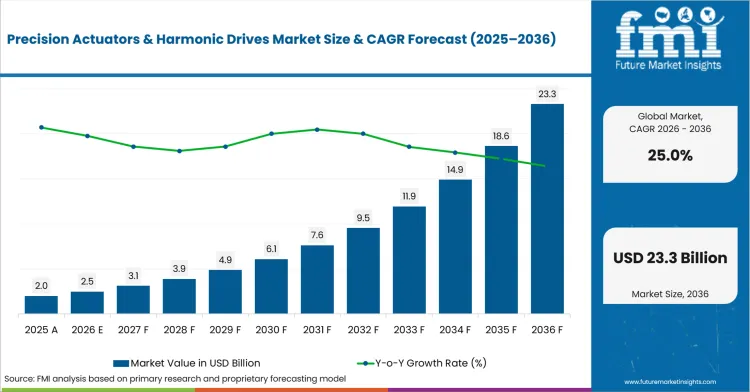
| Metric | Value |
|---|---|
| 2025 Market Size | USD 2.0 billion |
| 2026 Market Size | USD 2.0 billion |
| 2036 Market Size | USD 23.3 billion |
| Forecast CAGR (2026-2036) | 25.0% |
| Product Focus | Strain-wave (harmonic) gears |
| Strain-wave (harmonic) gears Share (2026) | 48.0% |
| Application Focus | Industrial robot joints |
| Industrial robot joints Share (2026) | 44.0% |
| Component Focus | Gears and reducers |
| Gears and reducers Share (2026) | 62.0% |
Summary of the Precision Actuators & Harmonic Drives Market
| Market Signal | Commercial Impact |
|---|---|
| Demand and Growth Drivers | Robot platforms are becoming smaller and more capable, so motion hardware carries more responsibility for joint accuracy and reliable operation. That pressure turns reducer selection into a production decision instead of a simple component purchase.
|
| Product and Segment View | Strain-wave gears suit compact robot joints that need low backlash and low weight during repeated motion. Cycloidal reducers suit heavier robot axes that face repeated shock loads during daily industrial operation.
|
| Geography and Growth Outlook | Country growth depends on robot investment and access to precision motion expertise, and import reliance raises service risk across long replacement routes.
|
| Competitive Landscape | The field includes strain-wave specialists and broader motion-control groups, and technical fit carries more weight than company size. The winning offer must fit the joint and remain serviceable throughout the robot platform's full operating life.
|
| Analyst Perspective | Reducer supply is rarely the main problem for a well-funded robot program with several qualified component options. The harder task is proving that the selected unit fits the joint and survives the full duty cycle.
|
How is the precision actuators & harmonic drives market segmented?
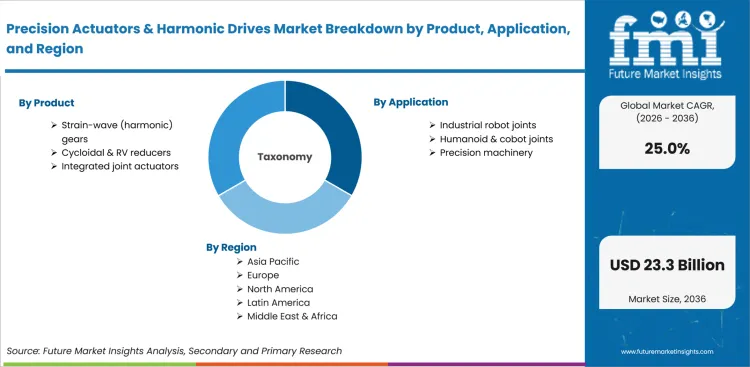
The precision actuators & harmonic drives industry is segmented by product, application, component, end user, business model, and region.
The report groups the market by product, application, component, end user, business model, and region. Product coverage compares strain-wave gears with cycloidal and RV reducers and treats integrated joint actuators as a separate group. Application coverage separates industrial robot joints from humanoid and cobot joints and tracks precision machinery as another use case. Component analysis covers gears and reducers alongside motors and encoders with service revenue completing the commercial view. End-user analysis covers robot OEMs and humanoid developers with machine builders forming the third group. Business models include OEM supply and distribution with custom programs serving joints that need special geometry or performance. Regional coverage spans seven major areas, while precision gearbox machinery depends on reducer design that protects equipment accuracy and operating life.
How does strain-wave gearing shape demand within the product category?
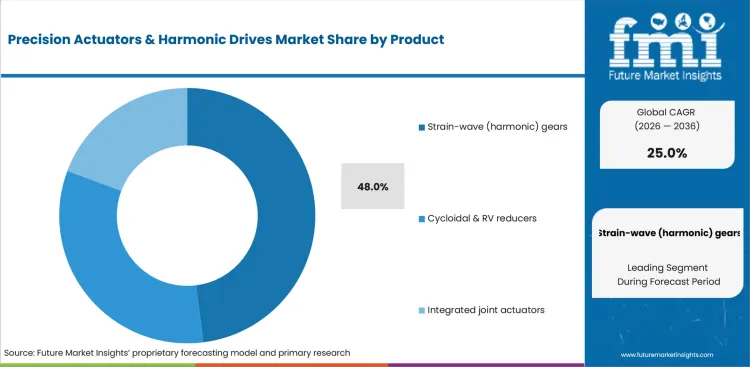
Strain-wave gearing suits compact joints that need low backlash and low weight during repeated movement. The flexible spline creates a high reduction ratio inside a small housing for robot arms and precise machine axes. Nidec Drive Technology Corporation offers FLEXWAVE units as component sets and enclosed gearboxes for different joint layouts. The range helps robot makers choose between custom layouts and standard units during platform development. The business case rests on matching the transmission to the real joint load and motion profile.
- Strain-wave gears are forecast to hold 48.0% share of the product category in 2026 due to their compact size and controlled backlash. Harmonic Drive Systems Inc. combines this gear design with servo motors in rotary actuators, which cuts interface work and simplifies motor sizing. The September 2025 SHA Series manual confirms several actuator sizes designed for compact rotary axes.
- Humanoid and cobot developers favor strain-wave gears for light joints that need smooth movement. Engineers comparing zero backlash gearheads focus on positioning accuracy across compact designs for modern robot joints. Catalog torque alone does not explain performance during repeated acceleration or heat buildup, so stiffness and service life must match the actual motion cycle.
What supports demand for industrial robot joints within the application category?
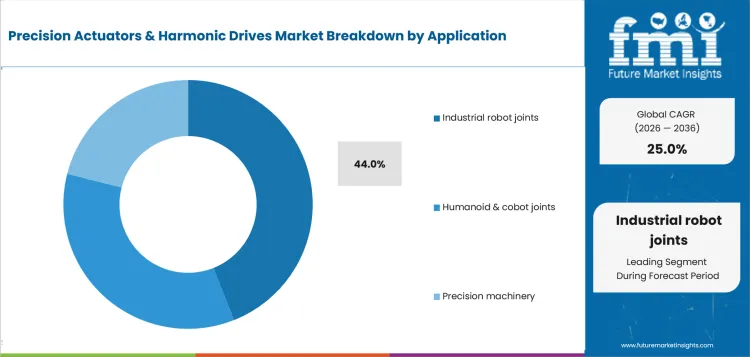
Industrial robot arms use several precision transmissions, so one weak axis slows the complete production cell and reduces repeatability. In June 2025, Nidec Drive Technology Corporation presented FLEXWAVE reducers and compact drive products at automatica in Munich. The exhibit showed how smaller robot systems depend on matched gearing and motor control. A weak transmission choice often forces slower motion and brings joint maintenance forward during daily production.
- In 2026, industrial robot joints are expected to hold 44.0% share as each industrial robot arm needs several controlled axes which creates repeat demand across multiple joints. Players such as Sumitomo Drive Technologies supplies cycloidal gearboxes for axes that need stiffness under changing loads. Axis-sizing support therefore adds more commercial value than a simple catalog sale during long serial production programs.
- Automation engineers need precise joint hardware as factories shorten changeovers and demand repeatable motion across product variants. Shared workspaces for collaborative robots increase the need for smooth motion and reliable stopping. Testing torque margin and braking response during joint trials reduces late changes during volume production.
How do robot OEMs evaluate gears and reducers within the component category?
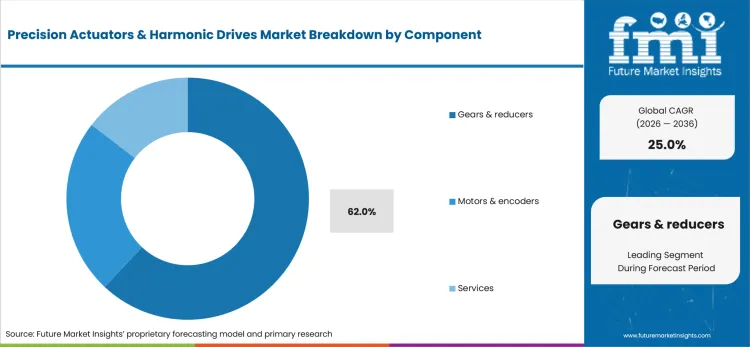
The reducer sets practical limits for torque and positioning accuracy across the complete axis. It must fit the motor and bearing system without adding excess heat or weight. Nabtesco Corporation offers RV precision reducers for joints that need high rigidity and shock resistance. Its range shows that transmission choice shapes the full axis design instead of one isolated component. That choice also shapes bearing loads and cooling needs across the complete joint housing during operation.
- By component, gears and reducers are projected to hold 62.0% share in 2026. Transmission design directly affects torque and stiffness across every joint in the finished robotic system.
- Demand for gears and reducers is anticipated to rise as robot makers shorten design cycles and expand joint variants. Mechanical choices must align with robot motion control software settings to keep each axis stable during repeat production.
Why do robot OEMs shape demand within the end-user category?
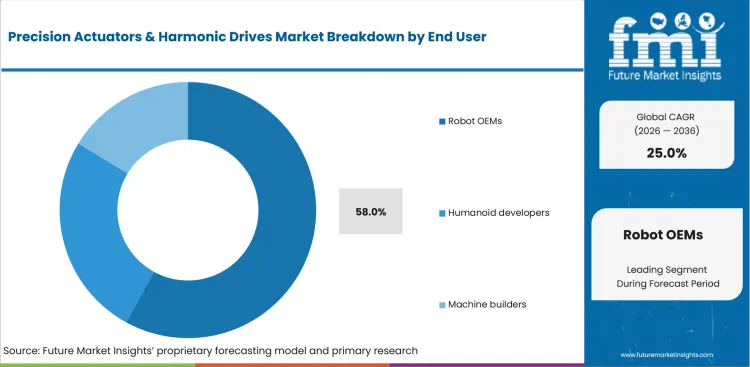
Robot OEMs choose reducers early to ensure each joint meets payload and speed targets within the planned arm shape. Robot makers carry warranty risk across years of operation, so component life and service access influence design approval. Harmonic Drive Systems Inc. supports this work with component sets and geared actuators at several integration levels.
- Robot OEMs are estimated to hold 58.0% share of the end-user category in 2026, reflecting their control over joint specifications and platform tests. Nabtesco Corporation offers precision reducers across several torque classes for industrial robot axes, which helps OEM engineers avoid costly changes during complete arm design. Clear load data helps OEMs lock the joint design without late derating during platform testing.
- Integrated actuator packages attract robot OEMs that want less wiring and shorter commissioning during platform development. A matched motor and reducer removes one design interface but restricts later component changes. The format suits platforms that value lower integration effort over complete freedom to select every part.
How does OEM supply influence purchasing within the business model category?
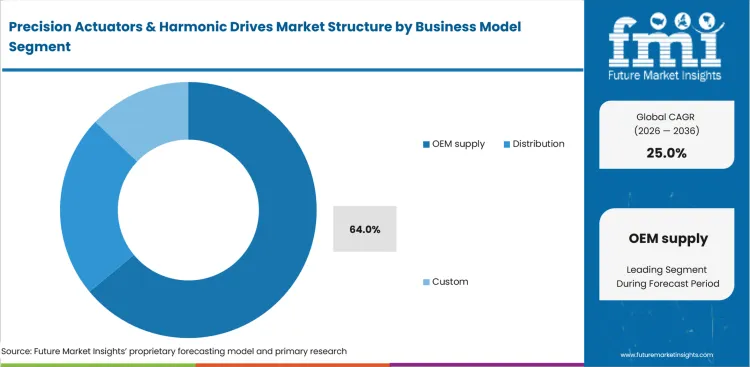
OEM supply links the reducer maker directly to a robot platform and its production schedule. Early access to joint data improves motor matching and life calculations during platform development. Platform approval makes later reducer changes costly once tooling and control settings are fixed for production. Sumitomo Drive Technologies reflects this model through precision gear units and drive products for long-running industrial equipment programs. Long production runs make delivery continuity as valuable as the first technical fit across serial programs.
- OEM supply is expected to hold 64.0% share of the business model category in 2026 due to direct involvement in platform design and repeat production. Sumitomo Drive Technologies provides precision gear units with related drive controls, which gives robot engineers a clear route for specification updates and replacement planning.
- Robot makers favor OEM supply for long platform lives and tighter control over specifications. Direct contracts resolve joint-fit questions during development and define service responsibility throughout the platform life. The model suits stable production programs and offers less value for low-volume machines that change often or depend on several local sources.
What are the drivers, restraints, and opportunities in the precision actuators & harmonic drives market?
Demand is projected to rise as compact robot joints need more torque and tighter motion control. Qualification work is expected to slow approvals if component tests do not represent the finished joint. Integrated actuators are expected to widen revenue by combining gearing with motors and feedback hardware.
- Driver: Compact joints need greater torque density and steadier positioning under load, which is projected to increase precision reducer purchases across robot platforms.
- Restraint: Application approval is expected to take longer if duty-cycle evidence and safety records fail to represent the finished robot or machine.
- Opportunity: Integrated joint packages are expected to create new revenue by combining reducers with motors and feedback devices inside one tested design.
Robot designers must balance smaller joint housings against usable output torque during repeated movement. A compact reducer protects reach and payload if it holds position across the full motion cycle. In January 2026, WITTENSTEIN SE announced a planned acquisition of STXI Motion to add motor electronics and software. The deal reflects demand for joint packages that connect mechanical design with control performance. These capabilities let robot developers size the mechanical and control system as one package during new platform design.
Catalog ratings often look sufficient even though the finished joint faces a different duty cycle. Repeated acceleration and heat reduce stiffness or service life during daily operation even if peak torque appears acceptable. In January 2025, the European Agency for Safety and Health at Work summarized Regulation 2023/1230/EU for machinery manufacturers. The rule applies from January 2027 and raises the value of machine-level test records. Weak component evidence raises qualification costs and forces engineers to repeat work during machine approval.
Long qualification cycles create demand for actuator packages with matched motors and control data. In July 2026, Nabtesco Corporation invested in Alva Industries to study compact motor technology and links with precision reducers. Growing interest in the humanoid robot field is expanding motion-system requirements beyond traditional industrial arms. The commercial value comes from shorter design work and clearer evidence for final machine approval. Packages backed by joint-level test data and local engineering support stand out during final selection.
Which country CAGRs are profiled in the precision actuators & harmonic drives market?
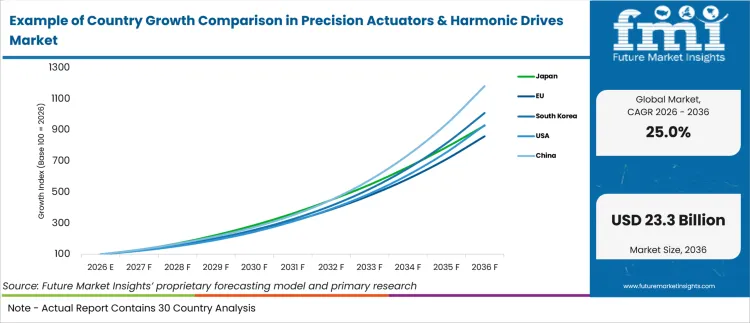
| Country | CAGR |
|---|---|
| Japan | 25.0% |
| European Union | 24.0% |
| South Korea | 26.0% |
| United States | 25.0% |
Source: FMI's proprietary forecasting model and primary research
How do country-level CAGRs compare in the precision actuators & harmonic drives market?
Country growth depends on local robot production and access to precision motion expertise during platform design. South Korea gains from dense robot fleets across electronics and vehicle plants that need fast technical response. Japan combines robot manufacturing with a deep domestic reducer base that supports new platform design and replacement work. United States demand follows plant retooling but faces longer service routes for imported motion parts. European Union programs devote more time to safety records and machine approval during new equipment launches. These differences influence the location of engineering support and replacement stock during the forecast period.
- Japan has a long-standing base of robot and precision reducer manufacturers serving industrial equipment. Demand in Japan is forecast to rise at 25.0% CAGR from 2026 to 2036. Local engineering expertise lowers design risk for new axes and replacement programs across industrial equipment. The International Federation of Robotics reported in September 2025 that Japan installed 44,500 industrial robots during 2024. The installation volume supports steady demand for joint components and replacement service across factories with high robot use. Harmonic Drive Systems Inc. and Nabtesco Corporation offer different options for compact and higher-load axes. High-volume plants using automotive robotics depend on multi-axis assembly systems with durable precision transmissions.
- The European Union places machine safety and technical records near the center of robot approval. Precision actuator industry in the European Union is estimated to expand at 24.0% CAGR through 2036. The International Federation of Robotics reported in June 2025 that Europe’s automotive industry installed 23,000 robots during 2024. The installation activity supports demand for newly qualified joints and replacement parts across vehicle plants that need regional technical service.
- South Korean electronics and vehicle plants operate dense robot fleets that need quick engineering support. Industry in South Korea is projected to record 26.0% CAGR during the forecast period. In January 2025, the International Federation of Robotics reported that South Korea’s 2024 robot plan allocated USD 128 million for industry development. The funding supports domestic work on robots and core motion parts across several large manufacturing programs. High equipment use raises the value of life data and local service during qualification.
- United States automakers are retooling plants for changing vehicle programs and flexible production lines. Precision actuator demand in the United States is anticipated to advance at 25.0% CAGR between 2026 and 2036. The International Federation of Robotics reported in May 2025 that United States automakers installed 13,700 robots during 2024. This installation activity increases demand for joint hardware and regional repair support across major vehicle plants. Automakers and system integrators compare local stock with engineering help across new vehicle programs. Operating-expense models such as robotics as a service add another route for users that want flexible automation access.
Who are the notable companies in the precision actuators & harmonic drives market?
Harmonic Drive Systems Inc., Nabtesco Corporation, WITTENSTEIN SE, Sumitomo Drive Technologies, and Nidec Drive Technology Corporation are the notable companies shaping this market.
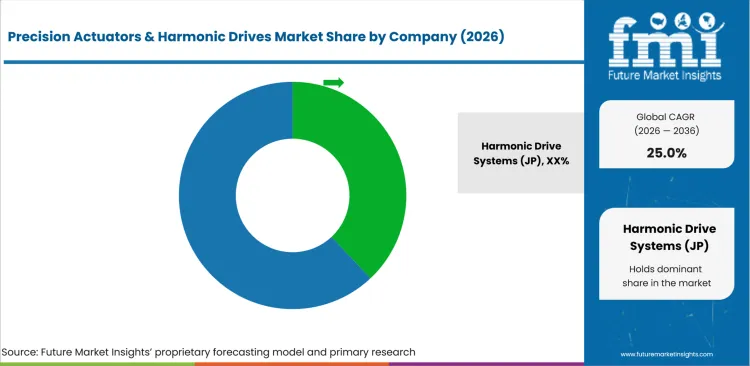
The market includes strain-wave specialists and groups with broader cycloidal or integrated motion portfolios. The selection process starts with backlash control and torque density, and price becomes decisive once performance requirements are met. Robot platforms remain in service for years, so joint-sizing support and replacement access influence final selection. Integrated motors and sensing reduce design work but limit later component changes for robot makers during production. Related gearbox and gear motors choices also shape transmission performance across industrial equipment. Commercial value comes from proving fit in the target axis and supporting the installed robot for its full service life.
- Harmonic Drive Systems Inc. and Nidec Drive Technology Corporation focus on compact joints that need high reduction and low backlash. Their strain-wave ranges offer several housing and output options for compact joint layouts across robot platforms. The final choice depends on motor fit and life evidence across the intended motion cycle. Application support turns a catalog part into a dependable component for long production programs.
- Nabtesco Corporation and Sumitomo Drive Technologies serve axes that need high stiffness and resistance to shock. Their cycloidal ranges suit robot bases and demanding joints with changing loads or repeated shock. Recent compact products extend this experience into cobots and mobile robots that need smaller housings. The smaller units open lower-torque applications while preserving the shock-load capability used in heavy axes.
- WITTENSTEIN SE combines precision gearing with motors and sensing for integrated robotic systems used in demanding robot platforms. The integrated approach reduces coordination work across mechanical and control disciplines during joint design and early platform testing. The tradeoff is tighter dependence on the complete package, so robot makers need full-system test evidence to protect flexibility during serial production.
Competitive Benchmarking: Precision Actuators & Harmonic Drives Market
| Company | Precision reducer portfolio | Integrated actuator capability | Torque and sensing support | Robot-joint application fit | Geographic reach |
|---|---|---|---|---|---|
| Harmonic Drive Systems Inc. | High | High | High | High | Global |
| Nabtesco Corporation | High | Low | Medium | High | Global |
| WITTENSTEIN SE | High | High | High | High | Europe, North America, and Asia-Pacific |
| Sumitomo Drive Technologies | High | Medium | Low | Medium | Global |
| Nidec Drive Technology Corporation | High | Low | Low | Medium | Asia-Pacific, Europe, and North America |
Scoring basis: High indicates substantial direct capability in the stated dimension and Medium indicates relevant but partial capability. Low indicates limited direct evidence for that dimension across the reviewed product and service range.
Source: Future Market Insights competitive analysis, 2026. Ratings reflect relative portfolio relevance and workflow fit. Service capability and geographic reach shape the remaining comparison.
Key Developments in the Precision Actuators & Harmonic Drives Market
- In June 2025, Harmonic Drive SE, introduced a strain-wave gear with an integrated torque sensor for robotics and sensitive assembly work. The sensor offers 0.1% full-scale measuring accuracy and the complete gear and sensor system reaches 1% accuracy. Direct torque feedback gives control engineers a clearer signal during sensitive force-controlled assembly and contact tasks. The compact design removes separate hardware and saves space inside modern robot joints and actuators.
- In December 2025, Nabtesco Corporation, launched the RVmini® and Monocrank™ compact precision reducers for low-torque robot applications. Nabtesco stated that its established RV range had passed 14 million units in cumulative production. The new products bring that design experience into cobots and humanoid joints that need lower weight and smaller housings. The launch extends Nabtesco into lower-torque joints while retaining the cycloidal engineering used in its established RV products.
- In June 2025, WITTENSTEIN SE, presented miniaturized Galaxie gearboxes and actuators with frameless motors and six-axis force sensors at automatica. The combined offer targets industrial and medical robots that need low backlash within limited space. The package reflects demand for complete joint systems that reduce coordination work during early platform design.
- In April 2026, Sumitomo Drive Technologies, previewed the Fine Cyclo B series and the smartris drive package for SPS Italia 2026. Fine Cyclo B covers acceleration torque from 417 to 4,000 Nm across compact machines and heavier robotic axes. Smartris extends the offer into mobile robots and automated transport systems and gives developers one route from reducer selection to motor control.
Key Players in the Precision Actuators & Harmonic Drives Market
Strain-wave and zero-backlash specialists
- Harmonic Drive Systems Inc.
- Nidec Drive Technology Corporation
Cycloidal and high-load reducer manufacturers
- Nabtesco Corporation
- Sumitomo Drive Technologies
Integrated motion-control specialists
- WITTENSTEIN SE
Precision Actuators & Harmonic Drives Market - Report Scope
| Coverage field | Report scope |
|---|---|
| Market breakdown | Product, Application, Component, End User, Business Model, and Region |
| Market Definition | The market covers precision reducers and integrated actuators used to control torque and position in robot joints or precision machine axes. |
| Regions Covered | North America, Latin America, Europe, East Asia, South Asia, Oceania, and the Middle East and Africa |
| Countries Covered | Japan, European Union, South Korea, United States, and 30+ countries |
| Key Companies Profiled | Harmonic Drive Systems Inc., Nabtesco Corporation, WITTENSTEIN SE, Sumitomo Drive Technologies, and Nidec Drive Technology Corporation |
| Forecast Period | 2026 to 2036 |
| Approach | Hybrid sizing combines manufacturer-level estimates with country checks based on robot demand across major regions. |
Source: Future Market Insights - analysis driven by proprietary forecasting models and primary research
Precision Actuators & Harmonic Drives Market - Research Methodology
| Method | Approach |
|---|---|
| Primary Research | FMI interviews robot manufacturers and machine builders that specify precision reducers for new equipment and replacement programs. Motion engineers explain how torque class and joint geometry affect component choice across different duty cycles. Component distributors describe lead times and replacement demand from installed robot fleets and service channels. These interviews separate common market drivers from local service needs and show how original equipment programs differ from replacement work. |
| Desk Research | Desk research reviews official robotics statistics and machinery rules that affect robot design and market access. Official company pages confirm product ranges and dated developments across strain-wave and cycloidal systems. Integrated actuator systems are checked against published robot-joint applications and current evidence of commercial availability. Customs data enters the analysis when a product code clearly covers precision gears or related motion components. |
| Market Sizing and Forecasting | Market sizing starts with manufacturer participation and estimated demand for robot joints or precision machine axes. Revenue estimates are checked against product mix and application shares within the forecast model. Country forecasts use robot installations and local manufacturing activity as indicators for precision motion demand. |
| Data Validation | Data validation compares company participation with distributor evidence and interviews from robot manufacturers across the profiled regions. Segment shares are checked against published product ranges and known joint applications across the market. Country CAGRs are tested against robot installations and local manufacturing conditions across each profiled market. |
Precision Actuators & Harmonic Drives Market by Segments
Precision Actuators & Harmonic Drives Market segmented by Product:
- Strain-wave (harmonic) gears
- Cycloidal and RV reducers
- Integrated joint actuators
Precision Actuators & Harmonic Drives Market segmented by Application:
- Industrial robot joints
- Humanoid and cobot joints
- Precision machinery
Precision Actuators & Harmonic Drives Market segmented by Component:
- Gears and reducers
- Motors and encoders
- Services
Precision Actuators & Harmonic Drives Market segmented by End User:
- Robot OEMs
- Humanoid developers
- Machine builders
Precision Actuators & Harmonic Drives Market segmented by Business Model:
- OEM supply
- Distribution
- Custom programs
Precision Actuators & Harmonic Drives Market by Region:
- North America
- United States
- Canada
- Latin America
- Brazil
- Mexico
- Argentina
- Europe
- Germany
- United Kingdom
- France
- Italy
- Spain
- East Asia
- China
- Japan
- South Korea
- South Asia
- India
- Thailand
- Indonesia
- Oceania
- Australia
- New Zealand
- Middle East and Africa
- GCC countries
- South Africa
- Turkey
Research Sources and Bibliography
- International Federation of Robotics. (2026, January 8). Top 5 Global Robotics Trends 2026. International Federation of Robotics.
- International Federation of Robotics. (2025, January). World Robotics R&D Programs - 4th edition. International Federation of Robotics.
- International Federation of Robotics. (2025, May 8). Robot Installed in US Auto Industry Up by Double Digits. International Federation of Robotics.
- International Federation of Robotics. (2025, June 17). Europe’s Auto Industry Installed 23,000 New Robots. International Federation of Robotics.
- International Federation of Robotics. (2025, September 25). World Robotics 2025 report - INDUSTRIAL ROBOTS. International Federation of Robotics.
- European Agency for Safety and Health at Work. (2025, January 16). Regulation 2023/1230/EU - machinery. European Agency for Safety and Health at Work.
- WITTENSTEIN SE. (2026, January 22). WITTENSTEIN further boosts its expertise in holistic drive solutions - Planned acquisition of STXI Motion Ltd. WITTENSTEIN SE.
- Nabtesco Corporation. (2026, July 8). Investment in Alva Industries, a Norwegian Advanced Motor Technology Company. Nabtesco Corporation.
- Harmonic Drive SE. (2025, June 24). Harmonic Drive® Gear with torque sensor. Harmonic Drive SE.
- Nabtesco Corporation. (2025, December 2). Launch of New Products in the “RVmini® Series” and “Monocrank™ Series” of Compact Precision Reduction Gears. Nabtesco Corporation.
- WITTENSTEIN SE. (2025, June 20). Drive technology and sensors for the next revolution in robotics. WITTENSTEIN SE.
- Sumitomo Drive Technologies. (2026, April 21). Fine Cyclo B Series, smartris & NEO Essential Series. Sumitomo Drive Technologies.
- Harmonic Drive Systems Inc. (2025, September). SHA Series AC Servo Actuator Manual. Harmonic Drive Systems Inc.
- Nidec Drive Technology Corporation. (2025, June 17). Nidec Drive Technology to Exhibit Products at Automatica 2025 in Munich. Nidec Corporation.
This bibliography is provided for reader reference and uses primary government, standards-body, official trade body, and company sources.
This Report Answers
- What is the projected value of the precision actuators and harmonic drives market in 2026 and 2036?
- What CAGR does FMI forecast for the precision actuators and harmonic drives market from 2026 to 2036?
- Which product and application segments shape demand for precision motion hardware across robotic systems?
- Which operating pressures support adoption across robot manufacturing and precision machinery programs?
- How do market growth rates differ between Japan and the European Union over the forecast period?
- How do South Korea and the United States compare across robotics investment and service needs?
- Which companies compete through reducer breadth and integrated actuation across robot-joint applications?
- How does FMI validate market sizing and segment shares across country forecasts?
- What should engineering teams address during a sourcing decision or long-term platform commitment?
- How do safety records and machine documentation affect company selection in regulated robot programs?
Frequently Asked Questions
What is driving growth in the Precision Actuators & Harmonic Drives Market?
Robot makers need compact motion parts that hold position under changing loads and repeated cycles. Positioning drift reduces output and creates safety risk across automated tasks that depend on repeatable motion.
Who are the key players in the Precision Actuators & Harmonic Drives Market?
Harmonic Drive Systems Inc. and Nidec Drive Technology Corporation compete in compact strain-wave systems for smaller joints. Nabtesco Corporation, Sumitomo Drive Technologies, and WITTENSTEIN SE add cycloidal reducers or integrated robot-joint packages.
What is a notable restraint in the Precision Actuators & Harmonic Drives Market?
Catalog ratings often fail to represent the finished joint under repeated movement and heat. Missing duty-cycle evidence delays machine approval and forces expensive design changes late in the platform program.
Why should executives track the Precision Actuators & Harmonic Drives Market?
Precision motion hardware sets payload and repeatability limits across industrial and service robot platforms. Reducer choices affect development time and service cost, so executives need a clear view of each company’s application support.
What business problem does the Precision Actuators & Harmonic Drives Market address?
The market addresses accurate rotary motion in systems that cannot accept backlash or position loss under load. These products help robot joints repeat controlled movement under changing forces across long operating cycles.
What should procurement leaders evaluate before selecting suppliers?
Robot makers should compare torque margin and motor fit during early platform design and supplier evaluation. Life calculations and application samples should confirm thermal behavior ahead of any volume-supply commitment.
What limits return on investment for purchasers?
Return on investment falls if developers overspecify components or underestimate the effort needed to integrate each robot joint. Excess weight and long qualification cycles reduce automation savings before the platform reaches stable production.
How do suppliers build long-term account confidence?
Reducer manufacturers build trust by sharing application data that reflects the customer’s actual duty cycle. Reliable delivery and clear service routes protect production throughout the complete operating life of each robot platform.
Preview the report firsthand - request a free sample
Get SampleGet the brochure for pricing and purchase details.
Get PDFTable of Content
- Key Takeaways
- Market Size and CAGR
- Top Growth Driver
- Fastest Growing Segment
- Leading Region
- Key Companies
- Emerging Opportunities
- Executive Summary
- Global Market Outlook
- Demand-side Trends
- Supply-side Trends
- Technology Roadmap Analysis
- Analysis and Recommendations
- Analyst Perspective (What is happening? Why now? What should investors know?)
- Key Questions Answered
- How large is the market?
- What is the CAGR?
- What are key trends?
- Which region dominates?
- Who are the leaders?
- Market Overview
- Market Coverage / Taxonomy
- Market Definition / Scope / Limitations
- Research Methodology
- Chapter Orientation
- Analytical Lens and Working Hypotheses
- Market Structure, Signals, and Trend Drivers
- Benchmarking and Cross-market Comparability
- Market Sizing, Forecasting, and Opportunity Mapping
- Research Design and Evidence Framework
- Desk Research Programme (Secondary Evidence)
- Expert Input and Fieldwork (Primary Evidence)
- Tooling, Models, and Reference Databases
- Data Engineering and Model Build
- Quality Assurance and Audit Trail
- Market Background
- Market Dynamics (Drivers, Restraints, Opportunity, Trends)
- Scenario Forecast (Optimistic, Likely, Conservative)
- Impact Analysis
- AI Impact
- Sustainability Impact
- Regulatory Impact
- Technology Impact
- Consumer / Buyer Analysis
- Purchase Drivers
- Adoption Barriers
- Buyer Journey
- Opportunity Map Analysis
- Product Life Cycle Analysis
- Supply Chain Analysis
- Investment Feasibility Matrix
- Value Chain Analysis
- PESTLE and Porter's Analysis
- Regulatory Landscape
- Regional Parent Market Outlook
- Production and Consumption Statistics
- Import and Export Statistics
- Global Market Analysis and Forecast, 2021 to 2036
- Historical Market Size Value (USD Billion) Analysis, 2021 to 2025
- Current and Future Market Size Value (USD Billion) Projections, 2026 to 2036
- Y-o-Y Growth Trend Analysis
- Absolute $ Opportunity Analysis
- Global Market Pricing Analysis, 2021 to 2036
- Global Market Analysis and Forecast, By Product, 2021 to 2036
- Introduction / Key Findings
- Historical Market Size Value (USD Billion) Analysis By Product, 2021 to 2025
- Current and Future Market Size Value (USD Billion) Analysis and Forecast By Product, 2026 to 2036
- Strain-wave (harmonic) gears
- Cycloidal & RV reducers
- Integrated joint actuators
- Strain-wave (harmonic) gears
- Y-o-Y Growth Trend Analysis By Product, 2021 to 2025
- Absolute $ Opportunity Analysis By Product, 2026 to 2036
- Global Market Analysis and Forecast, By Application, 2021 to 2036
- Introduction / Key Findings
- Historical Market Size Value (USD Billion) Analysis By Application, 2021 to 2025
- Current and Future Market Size Value (USD Billion) Analysis and Forecast By Application, 2026 to 2036
- Industrial robot joints
- Humanoid & cobot joints
- Precision machinery
- Industrial robot joints
- Y-o-Y Growth Trend Analysis By Application, 2021 to 2025
- Absolute $ Opportunity Analysis By Application, 2026 to 2036
- Global Market Analysis and Forecast, By Component, 2021 to 2036
- Introduction / Key Findings
- Historical Market Size Value (USD Billion) Analysis By Component, 2021 to 2025
- Current and Future Market Size Value (USD Billion) Analysis and Forecast By Component, 2026 to 2036
- Gears & reducers
- Motors & encoders
- Services
- Gears & reducers
- Y-o-Y Growth Trend Analysis By Component, 2021 to 2025
- Absolute $ Opportunity Analysis By Component, 2026 to 2036
- Global Market Analysis and Forecast, By End User, 2021 to 2036
- Introduction / Key Findings
- Historical Market Size Value (USD Billion) Analysis By End User, 2021 to 2025
- Current and Future Market Size Value (USD Billion) Analysis and Forecast By End User, 2026 to 2036
- Robot OEMs
- Humanoid developers
- Machine builders
- Robot OEMs
- Y-o-Y Growth Trend Analysis By End User, 2021 to 2025
- Absolute $ Opportunity Analysis By End User, 2026 to 2036
- Global Market Analysis and Forecast, By Business Model, 2021 to 2036
- Introduction / Key Findings
- Historical Market Size Value (USD Billion) Analysis By Business Model, 2021 to 2025
- Current and Future Market Size Value (USD Billion) Analysis and Forecast By Business Model, 2026 to 2036
- OEM supply
- Distribution
- Custom
- OEM supply
- Y-o-Y Growth Trend Analysis By Business Model, 2021 to 2025
- Absolute $ Opportunity Analysis By Business Model, 2026 to 2036
- Global Market Analysis and Forecast, By Region, 2021 to 2036
- Introduction
- Historical Market Size Value (USD Billion) Analysis By Region, 2021 to 2025
- Current Market Size Value (USD Billion) Analysis and Forecast By Region, 2026 to 2036
- North America
- Latin America
- Western Europe
- Eastern Europe
- East Asia
- South Asia and Pacific
- Middle East & Africa
- Market Attractiveness Analysis By Region
- North America Market Analysis and Forecast, By Country, 2021 to 2036
- Historical Market Size Value (USD Billion) Trend Analysis By Market Taxonomy, 2021 to 2025
- Market Size Value (USD Billion) Forecast By Market Taxonomy, 2026 to 2036
- By Country
- USA
- Canada
- By Product
- By Application
- By Component
- By End User
- By Business Model
- By Country
- Market Attractiveness Analysis
- By Country
- By Product
- By Application
- By Component
- By End User
- By Business Model
- Key Takeaways
- Latin America Market Analysis and Forecast, By Country
- Historical Market Size Value (USD Billion) Trend Analysis By Market Taxonomy, 2021 to 2025
- Market Size Value (USD Billion) Forecast By Market Taxonomy, 2026 to 2036
- By Country
- Brazil
- Mexico
- Chile
- Rest of Latin America
- By Product
- By Application
- By Component
- By End User
- By Business Model
- By Country
- Market Attractiveness Analysis
- By Country
- By Product
- By Application
- By Component
- By End User
- By Business Model
- Key Takeaways
- Western Europe Market Analysis and Forecast, By Country
- Historical Market Size Value (USD Billion) Trend Analysis By Market Taxonomy, 2021 to 2025
- Market Size Value (USD Billion) Forecast By Market Taxonomy, 2026 to 2036
- By Country
- Germany
- UK
- Italy
- Spain
- France
- Nordic
- BENELUX
- Rest of Western Europe
- By Product
- By Application
- By Component
- By End User
- By Business Model
- By Country
- Market Attractiveness Analysis
- By Country
- By Product
- By Application
- By Component
- By End User
- By Business Model
- Key Takeaways
- Eastern Europe Market Analysis and Forecast, By Country
- Historical Market Size Value (USD Billion) Trend Analysis By Market Taxonomy, 2021 to 2025
- Market Size Value (USD Billion) Forecast By Market Taxonomy, 2026 to 2036
- By Country
- Russia
- Poland
- Hungary
- Balkan & Baltic
- Rest of Eastern Europe
- By Product
- By Application
- By Component
- By End User
- By Business Model
- By Country
- Market Attractiveness Analysis
- By Country
- By Product
- By Application
- By Component
- By End User
- By Business Model
- Key Takeaways
- East Asia Market Analysis and Forecast, By Country
- Historical Market Size Value (USD Billion) Trend Analysis By Market Taxonomy, 2021 to 2025
- Market Size Value (USD Billion) Forecast By Market Taxonomy, 2026 to 2036
- By Country
- China
- Japan
- South Korea
- By Product
- By Application
- By Component
- By End User
- By Business Model
- By Country
- Market Attractiveness Analysis
- By Country
- By Product
- By Application
- By Component
- By End User
- By Business Model
- Key Takeaways
- South Asia and Pacific Market Analysis and Forecast, By Country
- Historical Market Size Value (USD Billion) Trend Analysis By Market Taxonomy, 2021 to 2025
- Market Size Value (USD Billion) Forecast By Market Taxonomy, 2026 to 2036
- By Country
- India
- ASEAN
- Australia & New Zealand
- Rest of South Asia and Pacific
- By Product
- By Application
- By Component
- By End User
- By Business Model
- By Country
- Market Attractiveness Analysis
- By Country
- By Product
- By Application
- By Component
- By End User
- By Business Model
- Key Takeaways
- Middle East & Africa Market Analysis and Forecast, By Country
- Historical Market Size Value (USD Billion) Trend Analysis By Market Taxonomy, 2021 to 2025
- Market Size Value (USD Billion) Forecast By Market Taxonomy, 2026 to 2036
- By Country
- Kingdom of Saudi Arabia
- Other GCC Countries
- Türkiye
- South Africa
- Other African Union
- Rest of Middle East & Africa
- By Product
- By Application
- By Component
- By End User
- By Business Model
- By Country
- Market Attractiveness Analysis
- By Country
- By Product
- By Application
- By Component
- By End User
- By Business Model
- Key Takeaways
- Key Countries Market Analysis
- USA
- Pricing Analysis
- Market Share Analysis, 2025
- By Product
- By Application
- By Component
- By End User
- By Business Model
- Canada
- Pricing Analysis
- Market Share Analysis, 2025
- By Product
- By Application
- By Component
- By End User
- By Business Model
- Mexico
- Pricing Analysis
- Market Share Analysis, 2025
- By Product
- By Application
- By Component
- By End User
- By Business Model
- Brazil
- Pricing Analysis
- Market Share Analysis, 2025
- By Product
- By Application
- By Component
- By End User
- By Business Model
- Chile
- Pricing Analysis
- Market Share Analysis, 2025
- By Product
- By Application
- By Component
- By End User
- By Business Model
- Germany
- Pricing Analysis
- Market Share Analysis, 2025
- By Product
- By Application
- By Component
- By End User
- By Business Model
- UK
- Pricing Analysis
- Market Share Analysis, 2025
- By Product
- By Application
- By Component
- By End User
- By Business Model
- Italy
- Pricing Analysis
- Market Share Analysis, 2025
- By Product
- By Application
- By Component
- By End User
- By Business Model
- Spain
- Pricing Analysis
- Market Share Analysis, 2025
- By Product
- By Application
- By Component
- By End User
- By Business Model
- France
- Pricing Analysis
- Market Share Analysis, 2025
- By Product
- By Application
- By Component
- By End User
- By Business Model
- India
- Pricing Analysis
- Market Share Analysis, 2025
- By Product
- By Application
- By Component
- By End User
- By Business Model
- ASEAN
- Pricing Analysis
- Market Share Analysis, 2025
- By Product
- By Application
- By Component
- By End User
- By Business Model
- Australia & New Zealand
- Pricing Analysis
- Market Share Analysis, 2025
- By Product
- By Application
- By Component
- By End User
- By Business Model
- China
- Pricing Analysis
- Market Share Analysis, 2025
- By Product
- By Application
- By Component
- By End User
- By Business Model
- Japan
- Pricing Analysis
- Market Share Analysis, 2025
- By Product
- By Application
- By Component
- By End User
- By Business Model
- South Korea
- Pricing Analysis
- Market Share Analysis, 2025
- By Product
- By Application
- By Component
- By End User
- By Business Model
- Russia
- Pricing Analysis
- Market Share Analysis, 2025
- By Product
- By Application
- By Component
- By End User
- By Business Model
- Poland
- Pricing Analysis
- Market Share Analysis, 2025
- By Product
- By Application
- By Component
- By End User
- By Business Model
- Hungary
- Pricing Analysis
- Market Share Analysis, 2025
- By Product
- By Application
- By Component
- By End User
- By Business Model
- Kingdom of Saudi Arabia
- Pricing Analysis
- Market Share Analysis, 2025
- By Product
- By Application
- By Component
- By End User
- By Business Model
- Türkiye
- Pricing Analysis
- Market Share Analysis, 2025
- By Product
- By Application
- By Component
- By End User
- By Business Model
- South Africa
- Pricing Analysis
- Market Share Analysis, 2025
- By Product
- By Application
- By Component
- By End User
- By Business Model
- USA
- Market Structure Analysis
- Competition Dashboard
- Competition Benchmarking
- Market Share Analysis of Top Players
- By Regional
- By Product
- By Application
- By Component
- By End User
- By Business Model
- Emerging Startups
- Innovation Benchmarking
- Competition Analysis
- Competition Deep Dive
- Harmonic Drive Systems (JP)
- Overview
- Product Portfolio
- Profitability by Market Segments
- Sales Footprint
- Strategy Overview
- Marketing Strategy
- Product Strategy
- Channel Strategy
- Nabtesco (JP)
- Wittenstein (DE)
- Sumitomo (JP)
- Harmonic Drive Systems (JP)
- Case Studies
- Success Stories
- Recent Developments
- Competition Deep Dive
- Assumptions & Acronyms Used


